



Abstract
A long sociological tradition has examined how state coercion undergirds the “free market” for labor. In the contemporary prison, however, there are signs this relationship has been turned on its head. Whereas in the past, state coercion helped prisons generate profit for private markets, today market ideas are increasingly used within prisons to facilitate state control. I draw on an analysis of seven waves of the Survey of Inmates in State Correctional Facilities, as well as 61 interviews with state prison administrators, prison industry advocates, and formerly incarcerated people. Although the market for the products of prison labor has declined, and incarcerated people, on average, are working less than ever before, inequality in the distribution of work and rewards for this work has sharpened. This changing structure of prison labor is associated with a changing understanding of it. Prison administrators, and to some extent incarcerated people themselves, use market ideas to explain the new organization of prison labor and justify people’s places within it. This organization and these ideas solve managerial problems within the prison and are suggestive of parallels between prison and social welfare policy in the contemporary era.
A long sociological tradition has examined how state coercion undergirds the “free market” for labor. Foundational work in economic and political sociology (Polanyi [1944] 2001) and the sociology of punishment (Rusche and Kirchheimer [1939] 2003) illustrates how “[t]he road to the free market was opened and kept open by an enormous increase in continuous, centrally organized and controlled interventionism” (Polanyi [1944] 2001:146), from the enclosures to the workhouse. Scholars have shown how state coercion continues to structure the low-wage labor market in myriad ways, denying the “right to live” (Polanyi [1944] 2001:82) outside of the labor market and so compelling people to participate on disadvantaged terms within it (Collins and Mayer 2010; Hatton 2021; Piven and Cloward 1971; Purser 2012; Reich and Prins 2020; Seim and Harding 2020; Smith and Simon 2020; Somers and Block 2005; Soss, Fording, and Schram 2011; Zatz and Stoll 2020).
Yet within the contemporary prison there are signs this political economy has been turned on its head. Whereas in the past, state coercion helped prisons generate profit for private markets, in the present, market ideas are used within prisons to facilitate state control. As others have argued, in an age of mass incarceration, the prison may not prod people into labor market participation so much as manage those excluded from it, “neutraliz[ing] and warehous[ing] . . . those rendered wholly superfluous by the recomposition of the demand for labor” (Wacquant 2009:7; see also Feeley and Simon 1992; Garland 2001; Gilmore 2007; Western and Beckett 1999).
But this does not mean market ideas have disappeared. The market for the products of prison labor has declined dramatically, and incarcerated people, on average, are working less than ever before, yet inequality in the distribution of work and rewards for this work has sharpened over time. At the same time, prison administrators, and to some extent incarcerated people themselves, use market ideas of price, choice, and competition to explain this new organization of prison work and justify people’s positions within it.
Historically, prison administrators and reformers rooted the rehabilitative potential of prison labor in the practice of hard labor, which justified incarcerated people’s lack of choice with respect to work and the coercion necessary to bring it about. These moral valuations neatly aligned with the profit motives of businesses that contracted for or leased this labor, as well as with state governments’ efforts to reduce the costs of incarceration (Adamson 1983; Blackmon 2008; Hindus 1980; Lewis 1965; Lichtenstein 1996; McKelvey 1935; McLennan 2008; Perkinson 2010; Rothman [1971] 2006; Sellin 1976).
Today, prison officials have begun to espouse a new morality of prison work, which no longer locates its value in the physical process of work, but rather in incarcerated people’s participation in a labor market, in which they are imagined to have a degree of choice over how they spend their time. Here it is not the act of working that is thought to transform the incarcerated person; rather, it is by choosing to work and applying themselves in their jobs that incarcerated people can express who they are and distinguish themselves from those around them (Gibson-Light 2020; Goodman 2012a).
In today’s prison, where there is not as much work for people to do, and increasing inequality in the way this work (and the rewards for it) are distributed, market principles help make the absence of work appear as the absence of work ethic. Market principles can make jobs feel like privileges rather than punishments and introduce a sense of choice and competition into the coercive experience of prison life. Prison administrators understand these principles as being important not primarily to the pursuit of profit but rather to the maintenance of order (Feeley and Simon 1992) through the consent they elicit from those incarcerated (Burawoy 1979).
Building on previous scholarship at the intersection of economic sociology and the sociology of punishment, this article illustrates how the contemporary state fosters market understandings in pursuit of goals that have as much to do with control as with production (see Brown 2015; Soss et al. 2011). That we see market ideas so consciously being used to structure prison work around coercive ends is a testament to the market’s moral power in contemporary society, and a reminder of the enduring power of Polanyi’s insight that markets of all forms are not naturally occurring but social creations “reflecting a complex alchemy of politics, culture, and ideology” (Krippner 2001:782).
This study is based on seven waves of the Survey of Inmates in State Correctional Facilities, fielded between 1974 and 2016, supplemented by 61 interviews with state prison administrators (15), employees at one national prison industry organization (2), and formerly incarcerated people (44). I describe historical changes to the organization of prison labor since 1974. I demonstrate a decline in the percentage of incarcerated people working, and the average number of hours worked by those working. Whereas the average incarcerated person worked approximately 29 hours per week in 1974, they worked approximately 14 hours per week in 2004, a decline of over 50 percent. The relative absence of work has become an important feature of prison life, with the experience of incarceration increasingly becoming an experience of “doing nothing” (Alford 2000:131). At the same time, the line between “good jobs” and “bad jobs” has sharpened: a few prison jobs offer regular hours and high (relative) pay, but most require very little work time and are rewarded very little.
I show that this new organization of prison labor is associated with a new market framework through which administrators understand how prison work is organized and the purposes it ought to serve. Using historical sources, I document the emergence of these ideas in the 1970s. I then provide preliminary quantitative evidence that the adoption of market ideas within a particular state prison labor system is associated with declining work hours and a sharpening of inequality within that system, suggesting that market ideas may not only justify new inequalities within the prison but also help generate them.
I draw on interviews with state prison administrators, prison industry advocates, and formerly incarcerated people to explore the role these market ideas and practices play in prison life, as understood by the participants themselves. Prison administrators connect market principles to a moral vision in which incarcerated people might learn how to become responsible workers through the exercise of choice with respect to their labor, while acknowledging that the labor market inside the prison helps solve internal problems of prison order. Formerly incarcerated people’s accounts, in turn, support the idea that at least some incarcerated people have a degree of choice with respect to the work they perform, but they also highlight how the “choices” afforded to incarcerated people are sharply constrained by the coercive systems within which they are embedded.
I conclude by observing how the simultaneous decline of work and rise of market ideas in the prison has a parallel outside of it, as market-based initiatives like welfare reform have emerged alongside structural forms of joblessness (Simon 1993; Wacquant 2009; Wilson 1987), helping to recast structural conditions as questions of individual pathology and deservingness.
Work And Punishment In Prison
A History of Hard Labor
One might say that economic sociology was born in the workhouse. As Polanyi ([1944] 2001:106) argued, the replacement of outdoor welfare relief with the workhouse was an important institutional precondition for the emergence of a labor market, making survival outside the labor market contingent on subjecting oneself to forced labor within “a place of horror.” Early sociologists of punishment identified a similar principle, of “less eligibility,” operating in criminal justice policy (Rusche and Kirchheimer [1939] 2003). In each case, the logic went, the consequences of trying to survive outside the labor market (whether through welfare or through crime) needed to be harsher and more degrading than the worst experience within it (see Bonnet 2019; Somers and Block 2005). The U.S. penitentiary’s most direct institutional predecessor was the workhouse (Colvin 1997).
From one perspective, institutions like the penitentiary and workhouse contributed to an emergent market economy purely in a negative sense, by making life outside the labor market worse than the worst life within it. But coercive institutions like the penitentiary were also economically and morally productive in their own right. By the late nineteenth century in the United States, the use of coerced labor for profit was central to correctional regimes and businesses across the country (Page and Soss 2021). This labor was differentiated from “ordinary work” (Zelizer 2012), embedded in differentially racialized moral visions of the purposes served by coerced prison labor.
In the North, prison work was viewed as beneficial for the incarcerated person. This idea had its roots in the early penitentiaries and prison reform societies of the northeast, among reformers who had great faith in the rehabilitative potential of the process of labor: the habits inculcated through manual work and the self-restraint required to work alongside others. A closely related assumption was that the root of criminality was “idleness.” Reformers believed the penitentiary, like the workhouse before it, might integrate workers into an emergent industrial economy (Colvin 1997; Rothman [1971] 2006).
Beginning at New York’s Auburn prison in 1819, incarcerated people were forced to work together during the day, and returned to isolated cells at night. By the 1830s, this “Auburn system” had outpaced a rival Pennsylvania system of solitary confinement to become the predominant model of prison organization throughout the industrial Northeast (McLennan 2008). This model captured the moral imaginations of prison reformers like Louis Dwight, the founder and secretary of Boston’s Prison Discipline Society, who saw forced labor as promoting values of discipline and self-control that were critical to the country’s transition to market society (Lewis 1965; Rothman [1971] 2006). When Alexis de Tocqueville and Gustave de Beaumont visited the United States in 1831 to survey penitentiary systems, they noted that a regime of forced labor would “overcome [the incarcerated person’s] disposition to idleness. . . . Perhaps, leaving the prison he is not an honest man, but he has contracted honest habits” (Beaumont and Tocqueville [1833] 1964:90). The Auburn model of congregate labor was also cheaper than the Pennsylvania model. It allowed for smaller, less expensive cells, and, consistent with the emerging factory system, promised to be more profitable than work in isolation (Lewis 1965; Rothman [1971] 2006). Such fiscal considerations ought not to be considered entirely separable from reformers’ moral ideals regarding the virtues of industry. If reformers believed the purpose of punishment was to teach idle criminals to become self-sufficient men, then having them produce the means of their own confinement was surely a good start (Lewis 1965).
By the late-nineteenth century, these moral arguments had helped usher in a system of prison labor in which large businesses contracted for coerced prison labor and made substantial profits as a result. In 1887, according to a contemporaneous report, over 70 percent of all incarcerated people nationwide were “being put to hard, productive labor in the service of profit-making enterprises of one sort or another,” with 80 percent of these laborers in the prison factories and work camps of the Northeast, Midwest, and West (McLennan 2008:88–89; see also Commissioner of Labor 1887). The same report found that a full 94 percent of incarcerated people were doing work of some kind, as most of those not assigned to “productive” labor were involved in “prison duties.” Private contractors’ brutal drive for profits did come into tension with those committed to the reformatory potential of work but, by the end of the nineteenth century, “the contractor, and with him, the imperatives of large-scale capitalist industry, had emerged from the shadows to be crowned ‘sovereign’ of the penal domain” (McLennan 2008:136).
If, by the end of the nineteenth century, Northern arguments for the rehabilitative potential of hard labor seemed little more than a patina masking the use of incarcerated labor for profit, in the postbellum South this patina was missing altogether. The 13th Amendment to the Constitution, ratified in 1865, had prohibited slavery and involuntary servitude “except as a punishment for crime whereof the party shall have been duly convicted.” As the United States abolished slavery, it reaffirmed the distinction between voluntary “ordinary” work and involuntary convict labor. Southern correctional officials and employers used this legal distinction to reproduce a system of unfree labor, and a color line, threatened by Emancipation.
Soon after the Civil War, Black incarceration grew across the region (Adamson 1983; Sellin 1976). By the end of 1865, every southern state but Arkansas and Tennessee had outlawed vagrancy, defining it “so vaguely . . . that virtually any freed slave not under the protection of a white man could be arrested for the crime” (Blackmon 2008:53). Where prison work in the North had been understood as part of a broader disciplinary regime, prison work under the convict-lease system in the South was more blatantly coercive—a system designed to extract the labor power of Black people for profit; to reaffirm a white supremacy jeopardized by Emancipation (Adamson 1983; Blackmon 2008; Hindus 1980; Lichtenstein 1996; McKelvey 1935; Perkinson 2010; Sellin 1976); and to ensure the criminal justice system would be self-supporting.
While in some ways a functional substitute for slavery (Adamson 1983), convict labor was also distinct in important ways. First, because leasers had little economic interest in the long-term productivity of leased workers, leasers often treated them particularly harshly, unconcerned whether they lived or died (Blackmon 2008). Second, those workers were not as concentrated on plantations. They also played an important role in an industrializing “New South”—a source of cheap industrial labor that reproduced historical relationships of racial domination (Garvey 1998; Lichtenstein 1996).
Beyond its economic value, white Southern elites understood convict leasing as a necessary response to the problem posed by emancipated Black people. As a South Carolinian official put it in 1888, “after the emancipation of the colored people, whose idea of freedom from bondage was freedom from work and license to pillage, we had to establish means for their control” (Sellin 1976:158). Northern models of reformation through industrial training were considered unrealistic for the Black population. Perkinson (2010:101) cites Thomas J. Goree, the Texas Prison Commissioner in the 1880s and 1890s, who explained differences between northern and southern prison labor regimes by an appeal to the racial differences of incarcerated people. In the North, “the majority of men are white,” he explained, eager for education and industrial training. In Texas and throughout the South, on the other hand, “a large majority of our population have been raised on farms . . . having neither the capacity or inclination to learn a [skilled] trade.” Such prisoners, the bulk of them “colored,” could be “made to work,” he suggested, “but they cannot be made to think intelligibly” (Perkinson 2010:101).
Despite these important regional differences between the North and South, by the late nineteenth century there were commonalities in the role of prison labor across state prison systems, as correctional administrators nationwide found vibrant external markets for prison labor and its products. In each case, these profit-making enterprises were upheld, in part, by a moral vision of forced prison labor. In the North, this vision had to do with the transformative potential of work: work could change a (white) person, and so people had to be compelled to work in order to change. In the South, this vision was intimately bound up with white supremacy and the desire to establish control over newly free Black people.
The Decline of the Market for the Products of Prison Labor
Today, the material basis on which these ideological projects were originally constructed has almost disappeared. The vibrant market for the products of prison labor has long since declined, the result of a slow yet steady estrangement of prison labor from private and public markets. Some of this estrangement was a result of technological advancements in industries outside the prison, which meant prison production could not compete, as “goods could seldom be produced in a prison with any reasonable prospect of gain, or even without serious risk of loss” (Rusche and Kirchheimer [1939] 2003:110).
This process was accelerated in the last decades of the nineteenth century by labor leaders and small business owners who were threatened by competition from prison labor and the big businesses that deployed it. Leveraging its growing power and influence, the labor movement joined with small manufacturers, prison reformers, and other Progressives to reconfigure convict labor, restricting its use by private employers and compelling local authorities to reconceive both the organization and the meaning of prison work (McLennan 2008).
By the first decade of the twentieth century, even states as enmeshed in convict leasing as Alabama had begun to scale back the leasing of Black incarcerated people to private enterprise—a result of both rising moral outrage about the practice, and changes in the economics of leasing that reduced its advantages relative to the deployment of free labor (Blackmon 2008). Supporting state efforts to restrict the private uses of prison labor, Congress—under pressure from the garment, textile, furniture, boot and shoe, and cordage industries—passed the Hawes-Cooper Act in 1929, which divested prison-made goods of their interstate character and so made it possible for states to ban their importation (Rothman 1980). Other legislation in the 1930s and early 1940s further restricted the transportation of prison-made products (Jones 1941).
These processes of technological change and political contention more or less eliminated the private use of prison labor. As Figure 1A shows, whereas “productive” prison labor (i.e., labor used for the production of things that could be sold on the market or to other state agencies) was, in 1885, managed by a mix of private businesses and state government, by 1940 it was managed entirely by state administrators. The proportion of incarcerated people involved in this kind of production fell from 70 percent in 1887 to 48 percent by 1940, and the proportion engaged in reproductive labor for the prison (“prison duties” in historical reports) increased from 23 to 40 percent (see Figure 1B). Most incarcerated people were still working in 1940 (87 percent compared to 94 percent in 1887), but they were no longer working for private companies, and increasingly were working for the upkeep of the prison itself.
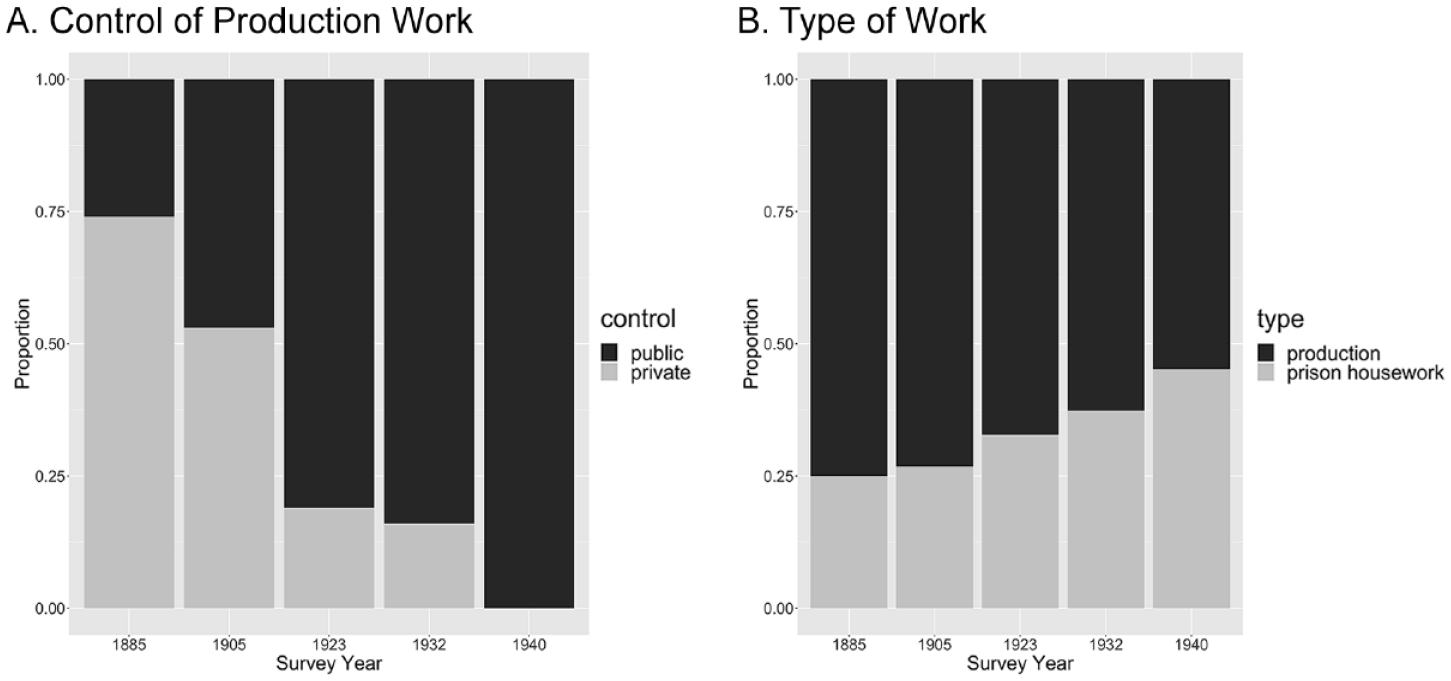
The Decline of the Private Market for Prison Labor, 1885 to 1940
Scholars have suggested that the decline of the private market for prison labor was an important precondition for the rise of Progressive Era ideas about the rehabilitation of incarcerated people, because it created the ideological vacuum in which criminologists, psychiatrists, and prison reformers could experiment with new ideas and practices (McLennan 2008; Rusche and Kirchheimer [1939] 2003). Such an account echoes Zelizer’s (1985) history of the changing valuation of children during the same historical period. The prohibition of child labor in the late nineteenth and early twentieth centuries coincided with the emergence of new ideas about children’s emotional worth. Children became emotionally “priceless,” Zelizer argues, at exactly the moment they became economically useless. Likewise, the rise of penal welfarism in the first half of the twentieth century (Garland 2001)—beliefs and practices that regarded incarcerated people more as patients to be treated than as labor to be deployed—coincided with the decline of incarcerated people’s productive potential. Work was still an integral part of the experience of incarceration but, increasingly, its purpose was distinguished from its economic outputs. Instead, reformers sought to incorporate work into a broader rehabilitative regime, “reconfiguring the activity of labor as a process of training and instruction, rather than of production and profit-making” (McLennan 2008:325).
The historical story of prison labor told by McLennan and others tends to end here, around 1940, with prison labor’s gradual retreat from the private market. From one perspective, little has changed regarding the organization of prison labor since then. As they were in the 1940s, the majority of incarcerated people working today are managed by state authorities and are doing work on behalf of the state. Today, most are involved in what Zatz (2008:870) calls “prison housework” (such as laundry, maintenance, cooking, and cleaning); a minority remain involved in “state-use” production (of license plates or office furniture, for example), controlled by prison administrators and sold to state agencies. As I will discuss, an effort by the federal government, starting in 1979, to revive the idea of partnerships between private businesses and state departments of correction had resoundingly little success.
Two trends are worth noting in the period since 1940. First, the relative economic value of prison labor likely continued to decline even after prison labor withdrew from the private market. By the 1970s, further technological improvements, available outside of prison labor programs but difficult to incorporate within, had rendered prison labor even less productive, relative to labor outside, than it had been in the 1930s and 1940s (Hughett 2021). Meanwhile, waves of prison unrest in the 1950s and 1970s spurred state administrators to further reduce their reliance on the work of incarcerated people for the operations of prisons and prioritize institutional security over cost efficiency (Hughett 2021; Thompson 2011). State prison expenses per capita (in real dollars) rose by a factor of six between 1940 and 1975, according to state financial reports, suggesting the cost-saving purposes that prison labor once served within the institution may have diminished as well. 1
Second, beginning in the 1970s, economic changes outside the prison dramatically increased unemployment among the poor and working-class Black men who were most likely to be incarcerated, severing the link between prison work and the imagined futures to which incarcerated people might return (Feeley and Simon 1992; Simon 1993; Wacquant 2009; Wilson 1987). 2 As Feeley and Simon (1992:464n29) write, “The model of industrial discipline was rarely fully achieved in prisons [in the past], but at least it had a clear referent in the real world”; in contrast, contemporary prison programming increasingly represented “a signifier without a signified.” In the place of an ideology of industrial discipline, a “new penology” was emerging, in which primacy was given to the “efficient control of internal system processes in place of traditional objectives of rehabilitation and crime control” (Feeley and Simon 1992:450). Prison administrators’ sense of the ends to which they ought to strive had shifted toward the organization’s own internal operations.
As the prison population skyrocketed between the 1970s and early 2000s, scholars argued that the prison served as a new type of “labor market institution”: not a workhouse, as it had been in the nineteenth century, but rather a warehouse, artificially deflating unemployment rates outside prison by containing and controlling those who were rendered economically superfluous by a changing labor market (Gilmore 2007; Wacquant 2009; Western and Beckett 1999). The prison no longer facilitated economic production within the institution and without. Instead, it had become the epitome of an emergent “culture of control” (Garland 2001).
With the continued decline of the relative productivity of prison labor, and changes outside the prison that severed the tie between prison work and the jobs to which incarcerated people might return, what has happened to the organization of prison labor itself? Somewhat surprisingly, existing research has yet to answer rather basic questions about the prevalence and structure of contemporary prison work as it relates to the history outlined above.
Market Discipline
What is the political economy of prison labor in the age of mass incarceration, and how does this shape the experience of incarceration? After decades in which the experience of incarceration was relatively neglected by scholars of punishment (Wacquant 2002), recent years have seen renewed interest in the meaning and lived experience of prison labor (Gibson-Light 2020, 2022; Goodman 2012a, 2012b; Hatton 2018, 2021; Zatz 2008; Zelizer 2012). This literature makes clear that work remains central to the experience of incarceration, and prison work (like the experience of incarceration as a whole) remains, for many people, an experience of extreme domination (Gibson-Light 2020; Hatton 2018).
But scholars have also observed striking variation in incarcerated people’s orientations toward prison work. Some document how, among incarcerated people, prison work is seen as key to achieving dignity in an otherwise mortifying total institution (Gibson-Light 2020); others have documented how some incarcerated workers see prison labor as akin to “modern-day slavery” (Hatton 2018:181).
As I argue here, this heterogeneity itself seems to be an integral part of the emergent political economy of the prison. As the external market for prison labor has diminished, differences in incarcerated people’s relationship to work have grown sharper. Prison administrators, and to some extent incarcerated people themselves, explain the new organization of work—and this new inequality—by reference to market ideas of price, choice, and competition. Through this lens, the structural absence of work (or underemployment) in prison is seen as the result of a lack of work ethic; a prison job increasingly is seen as a privilege rather than a punishment; and those who occupy the highest positions in the hierarchy of prison labor are seen, and see themselves, as more deserving than those below (Gibson-Light 2020). Administrators suggest these features of the organization of prison labor help preserve institutional order. The political economy of prison labor might be said to have become an economic politics, or a set of economic ideas that serve the prison’s coercive ends. If coercive labor control historically helped the prison generate profit, the invocation and implementation of market principles within prisons today helps elicit consent to state coercion (Burawoy 1979).
To what extent does the new organization of prison labor actually resemble a labor market, a “meeting place for the purpose of barter or buying and selling” (Polanyi [1944] 2001:59)? In the context of the prison, coercion is never far from view, and it is certainly not my claim that incarcerated people’s choices are by any means “free.” Indeed, labor markets of all kinds are not free, and coercion exists across the (non-incarcerated) low-wage labor market in ways that give employers significant power with respect to the choices workers can make (Manning 2003). Nonetheless, incarcerated people today do seem to have (or understand themselves to have) at least moderately more choice than they had in the past concerning the deployment of their own labor power. We see this in the wide variety of ways that administrators discuss using wages to incentivize work within the prison; and in the ways incarcerated people discuss wages influencing their work decisions. My qualitative evidence suggests these wage practices are often nested within other institutional structures that also simulate the low-wage labor market, such as formal job application processes. By introducing limited freedoms into an environment of extreme domination, the contemporary prison helps create the illusion that incarcerated people are responsible for their own fates inside.
Existing accounts of prison labor hint at the importance of this emergent organization of work. For instance, Gibson-Light (2020), studying a facility in the Sun Belt region, observes how incarcerated workers create meaning in their jobs by differentiating their positions from those below them in an occupational status hierarchy. He implicitly recognizes that this process is facilitated by market principles: “Positions in market hierarchies offer ready-made lines along which to erect symbolic boundaries” (Gibson-Light 2020:200; see also Gibson-Light 2022). But he takes for granted these “market hierarchies” within the prison, rather than theorize their emergence or trace their structure.
Gibson-Light focuses on three categories of prison workers in his study, yet in some ways it is those who do not work who play the most interesting (and puzzling) role in his account. He writes that work is mandatory for most people incarcerated, yet approximately a third of people at the facility he studies do not work at all. In the minds of his interviewees, many of these non-workers had chosen not to do so, and thus were deserving of ire. These non-workers “don’t want to do nothin’”; they were the ones “sitting around” the yard, who “don’t even want a job”; they were the “motherfuckers” who “don’t want to work,” the “fucking bums” (Gibson-Light 2020:207, 209). Perhaps Gibson-Light’s interviewees are incorrect about the degree of choice the non-workers have over their own lack of work. Or perhaps Gibson-Light overstates the extent to which formal work requirements are enforced in practice. Either way, among incarcerated people in prison, the structure of the organization of labor seems to facilitate a view of the non-worker as pathological and makes incarcerated people feel as though they are responsible for the work position they hold (or do not) (see Goodman 2012a).
This article seeks to extend and deepen the work of contemporary scholars of prison labor. First, by tracing the structural conditions that have produced variation in the experience of contemporary prison work, I help make sense of the heterogeneity we see in qualitative portraits of prison labor today. Second, by combining this macro analysis of prison labor trends with qualitative analysis of interviews with correctional administrators and formerly incarcerated people, I connect the new structure of prison labor with an emerging morality of prison labor, in which incarcerated people are seen as responsible for their own success or failure within the prison labor market.
More broadly, the emergence of “market discipline” in prison may find a parallel in the decline of cash assistance and rise of workfare that has reshaped poor women’s orientation toward work in the contemporary era (Collins and Mayer 2010; Hays 2003; Soss et al. 2011). If traditional cash assistance provided money without work requirements, historical prison labor systems instituted work requirements without money. In the contemporary era, both of these arrangements have been altered in favor of market principles and practices that make money contingent on work and work responsive to money.
Wacquant (2010:203) and other scholars have suggested that the welfare and criminal justice systems have, since the 1970s, “obeyed inverse principles,” as welfare became focused on “people changing” (i.e., producing market subjects), whereas the prison disavowed any pretensions toward transformation, geared instead “toward brute neutralization, rote retribution, and simple warehousing.” The case of prison labor, however, suggests these principles may not be so inconsistent after all: making “market subjects” may be entirely consistent with managerial ends. This raises the question of the extent to which similar “market” interventions in the contemporary welfare state may be oriented as much around questions of control as around production (Piven and Cloward 1971).
Data And Methods
Quantitative Data
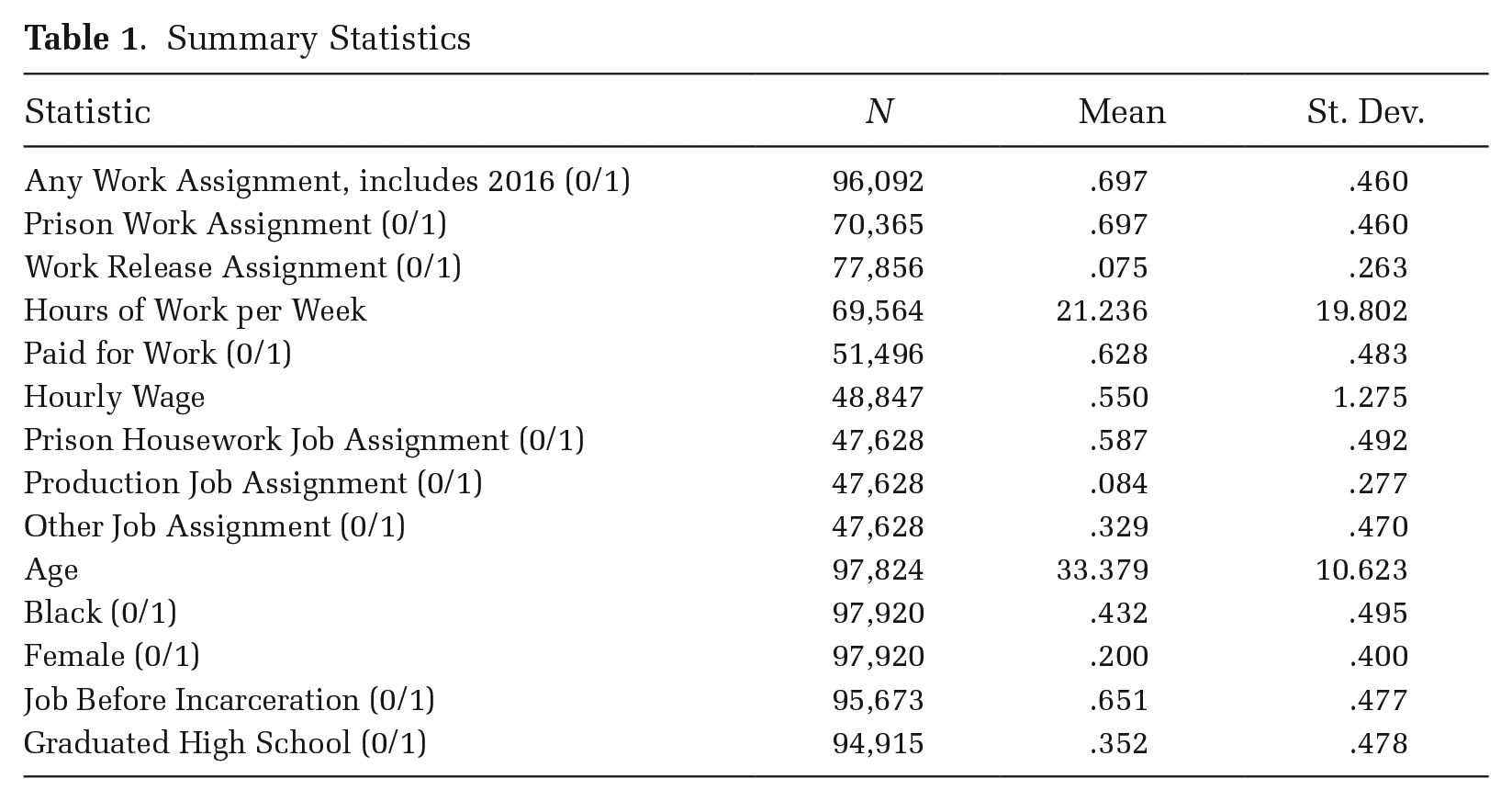
This study uses data from seven waves of the Survey of Inmates in State Correctional Facilities (Survey of Inmates) (U.S. Department of Justice, Bureau of Justice Statistics, 1974, 1979, 1986, 1991, 1997, 2004, and 2016). 3 The Survey of Inmates uses lengthy survey interviews with a stratified random sample of adults incarcerated in state prisons, weighted to be representative of people in state prisons nationally. I use these weights in all the descriptive statistics and analyses presented here. Incarcerated people participating in the survey were assured their participation was voluntary and confidential and that no individuals would be identified from the survey data. Table 1 presents summary statistics.
Summary Statistics
Quantitative Measures
Prison work and working hours
To understand whether and how much incarcerated people are working, I rely primarily on respondents’ answers to two questions that were asked consistently between the 1974 and 2004 waves of the Survey of Inmates. The first question, asked of all respondents, was whether or not the respondent had a work assignment within the institution. 4 The second question, asked only of those who reported having a work assignment, was how many hours per week they worked. This second question was phrased slightly differently in different waves of the survey, but there is no reason to expect these differences would drive the changes observed.
I am primarily interested in the changing prevalence and organization of work that takes place inside the state prison, but I also display some results that measure whether an incarcerated person has a work assignment within or without the facility. This broader measure includes as working respondents who reported participating in “work-release programs,” which allow those classified as low risk to leave the prison facility (for the day or week) to work directly for a private employer.
I include these results for two reasons. First, if incarcerated people’s participation in work release programs was increasing as their participation in prison work was decreasing, then a decline in prison work might more accurately be understood as a substitution of work release for prison work. A measure of “any work” within or without prison allows me to address this potential alternative explanation. Second, the 2016 Survey of Inmates only asked the broader question of whether a respondent worked within or outside the facility, and so any comparison between 2016 and earlier years must rely on this broader measure. The 2016 survey did not ask about the number of hours a respondent worked. The 2016 survey provides the most up-to-date insight into the experience of incarceration, but it is the least detailed of any survey wave in terms of the experience of prison work.
Occupations
The 1974 to 2004 waves of the Survey of Inmates ask all respondents who reported having work assignments within prison to specify the occupational category in which they worked. Work classifications are more or less consistent over time: production, janitorial duties, grounds, kitchen, laundry, hospital, farming, other services (e.g., library, administrative services, barber), maintenance, and other. For ease of interpretation, I reduce these 10 categories to three: production, which maps closely onto the work typically organized through state prison industries programs; prison housework (janitorial duties, grounds, kitchen, laundry, and maintenance), encompassing all institutional work assignments having to do with day-to-day reproduction of the prison; and other (hospital work, farming, other services, and other), which occupy a middle ground between prison housework and production in terms of both job status and pay (e.g., hospital orderly).
Pay
The 1974 to 2004 waves of the Survey of Inmates ask all respondents who report having work assignments within the prison whether they are paid for their work (yes/no); how much they are paid for their work (in dollars); and the frequency with which they are paid (per hour, per day, per week, or per month). I convert all reported pay into 2022 dollars. The Survey of Inmates includes some obvious reporting errors, with some incarcerated people reporting wages that are clearly inaccurate (e.g., $4,396 an hour). To ensure my results are not driven by outliers, I trim the top 1 percent of hourly wages from the analyses, leaving the maximum hourly wage at $12.49, still more than nine standard deviations above the mean. Results are broadly similar regardless of the cut-off I use.
State
Most of my quantitative analyses examine national-level changes in the prevalence and organization of prison labor. However, one set of analyses uses state-level variation in the organization of prison work. To protect respondents’ confidentiality, the Survey of Inmates makes it difficult to link respondents to localities. For most years it is impossible to determine the state in which a respondent was incarcerated. However, the publicly available 1991 and 2004 surveys do make it possible to link respondents to states with a fairly high degree of confidence, and I took advantage of that potential.
Controls
Many of my analyses rely on simple descriptive statistics, but I supplement these with multivariate regression models. In these models I control for a range of demographic characteristics, including respondents’ age, gender, and race (Black/non-Black); whether respondents were employed at the time they were incarcerated (yes/no); whether they had graduated from high school (yes/no); and whether they were currently involved in educational (yes/no) or vocational (yes/no) programming.
Quantitative Analyses
Prevalence of work
The analyses display three different (weighted) measures of the national prevalence of work from 1974 to 2016: the proportion of people who report having a work assignment at the facility; the average number of hours worked among those working; and the average number of hours worked among all people in prison (i.e., including those who do not report working as having worked zero hours).
Distribution of work hours and income
I also explore the changing structure of the allocation of work in state prisons, as well as the wages paid for this work, from 1974 to 2004. I use a standard measure of inequality, the Gini coefficient (Atkinson 1970), to measure inequality in the distribution of hours, wages, and weekly income among incarcerated people. The Gini coefficient ranges from 0, which indicates perfect equality in the distribution of a variable, to 1, which indicates perfect inequality. After analyzing these distributions among the state prison population as a whole, I also analyze them among two subgroups: those who reported working, and those who report working and getting compensated for their work. I supplement these aggregate measures of inequality with measures of hours and pay by job status. Previous research suggests production work tends to be afforded the highest job status and highest pay within prisons (e.g., Crittenden, Koons-Witt, and Kaminski 2018; Gibson-Light 2020, 2022), whereas reproductive labor in the prison (characterized here as “prison housework”) tends to be regarded as the lowest status labor. Growing inequality in the distribution of work ought to be reflected in growing inequality in the relative hours and rewards of these job categories.
State-level change
The aforementioned analyses describe changes to the organization of state prison work at the national level between 1974 and 2016. I argue that these changes in the structure of prison labor are associated with changing understandings of this labor, as prison administrators and incarcerated people alike espouse market principles to explain the way work is organized. However, the observed relationship between this shift in understanding and the national-level changes in organization I document might be confounded by any number of other temporal factors. It would strengthen my argument if I could show, even in a preliminary way, that state-level adoption of market ideas preceded and appeared to influence the changes in prison labor organization, adjusting for unobserved state-level characteristics and unobserved time trends.
The state-level diffusion of the Prison Industry Enhancement Certification Program (PIECP), with its explicit market orientation (described in more detail below), provides this opportunity. If changes to the prevalence and organization of prison labor (i.e., less work, on average, and more inequality in its distribution) are in fact associated with a market orientation to prison labor, then we might expect a state’s implementation of the PIECP to be associated with such changes in a state’s organization of prison labor. I use multilevel models to explore the relationship between a state’s implementation of the PIECP program and the structure of prison labor (hours and pay) across job categories, using data from 1991 and 2004 (the years in which I am able to link individuals to states).
Qualitative Data
In addition to the quantitative data described above, I draw on 61 in-depth, semi-structured interviews with state prison administrators, employees from one national prison organization, and formerly incarcerated people.
Prison administrators
I began recruitment of prison administrators by emailing administrators within state Departments of Corrections in all 50 states in early 2021. Administrators from 16 states responded that they would be open to the project, and administrators from 10 states ultimately participated: Alaska, Kansas, Kentucky, Michigan, Missouri, North Dakota, Oregon, Rhode Island, Utah, and Wisconsin. Across these states, I interviewed 15 administrators: two directors of their respective state Departments of Corrections, six assistant directors of Departments of Corrections (of operations or programming), two wardens, four administrators of their state’s correctional industries programs, and one communications director. In addition, I interviewed two administrators involved in a national organization concerned with prison work programs. Interviews lasted just under an hour, on average; the shortest interview was 27 minutes, and the longest interview was an hour and a half. To preserve these respondents’ anonymity, I refer to them interchangeably as “administrators,” regardless of their specific job titles. I asked respondents questions about the organization of prison work within their state; any changes they had noticed in the organization of prison work over time; and their understandings of the current and historical purposes of work within the prison.
A word of caution is in order in terms of the interpretation of findings derived from these interviews. On one hand, I was able to interview administrators from a wide variety of states. I interviewed administrators from states representing every region of the country (West, Midwest, Northeast, and South); states that vary in political party control (four Republican, two Democratic, and four split); and states that have higher rates of incarceration than the national average (Kentucky, Michigan, and Rhode Island), lower rates than the national average (Alaska, Kansas, Missouri, North Dakota, and Utah), and rates near the national average (Oregon and Wisconsin). That said, the states and administrators that were willing to participate in this study were a minority of the broader population of states and administrators to which I reached out, and so are a selective and likely non-representative sample of the population as a whole. Those willing to speak with me were likely prouder of and more confident in their states’ prison work programs than those who refused. It is notable, for instance, that I was unable to interview any administrators in the Deep South (i.e., Georgia, Alabama, South Carolina, Mississippi, and Louisiana) where, as noted earlier, prison work was historically used as a substitute for enslaved people’s labor.
I use the qualitative interviews not so much to show that this new market logic works in identical ways everywhere, or to illuminate the full extent of variation in the organization and understanding of these markets across the country, but rather to get under the hood of the quantitative data. I show how administrators see the contemporary organization of prison labor through the framework of a labor market, and how these administrators link such a framework to the purposes they think prisons ought to serve.
Formerly incarcerated people
In addition to interviewing prison administrators, two research assistants and I also interviewed 44 formerly incarcerated people across three states between March 2021 and October 2022. These interviews were concentrated among people who had been incarcerated in New York state prisons (25) and Virginia state prisons (16); we also interviewed three people who had been incarcerated in Oregon state prisons. Most of these interviewees (31) were recruited through snowball sampling as a result of my research assistants’ personal networks. I recruited an additional 10 interviewees through snowball sampling via my own personal networks, and I recruited three interviewees through their connections to prison administrators. Of these formerly incarcerated respondents, 15 (34 percent) were non-Hispanic Black, 17 (39 percent) were non-Hispanic white, and 12 (27 percent) were Hispanic. The vast majority (86 percent) were men, and they ranged in age from mid-20s to late-60s.
Interviews with formerly incarcerated people lasted approximately 90 minutes, on average. The shortest interview was 31 minutes, and the longest lasted more than six hours, spread out across six separate interview sessions. The interviews were wide-ranging, asking questions about respondents’ work experiences before, during, and after incarceration. For this article, I focus on responses concerning work inside the prison. We asked questions about the process by which respondents obtained jobs in prison, the conditions of work within these jobs, the wages they were paid and hours they worked, as well as other job amenities and hardships. We also asked whether respondents participated in other forms of work inside prison (whether sanctioned or not) and how these activities related to their formal employment.
As is the case with my interviews among prison administrators, interviews among formerly incarcerated people are likely not representative of the experience of people incarcerated in state prisons nationwide. The experience of incarceration varies dramatically across different states (see Barker 2009), and even across different facilities within the same state. Moreover, because we relied heavily on social networks for recruitment of our sample, it seems likely these respondents were more similar to the research team on a range of unobserved characteristics than the population of formerly incarcerated people as a whole. Again, however, the purpose of these interviews was not to document the statistically average experience of prison work, but rather to understand how the patterns observed in the quantitative data, and in interviews with prison administrators, might relate to the everyday experience of prison work as experienced by incarcerated people themselves.
Findings
The Changing Organization of State Prison Labor
The first set of results reports on two distinct but related changes to the organization of state prison labor in the years since 1970: a steady decline in the number of hours worked by the average incarcerated person, and sharpening inequality in the distribution of work hours and work income among incarcerated people. These changes took place in the context of the more than fivefold expansion in state incarceration rates. As the prison’s prominence within U.S. society grew, the significance of prison labor to the experience of incarceration shifted.
Declining work for the average incarcerated person
I first report on a previously undocumented trend among incarcerated people in state prisons in the years after 1970: the steady decline of work in prison for the average incarcerated person. This trend is due to a decline in the proportion of incarcerated people who reported having any work assignment in state prisons, as well as a decline in the number of work hours per week among those with a work assignment. As the black bars of Figure 2A show, in 1974, 78 percent of incarcerated people reported having a job assignment of some sort within the prison. By 2004, this number had dropped to 63 percent. Figure 2B shows that the average number of hours worked per week among those working also declined, from 37.3 hours per week in 1974 to 22.8 hours per week in 2004.
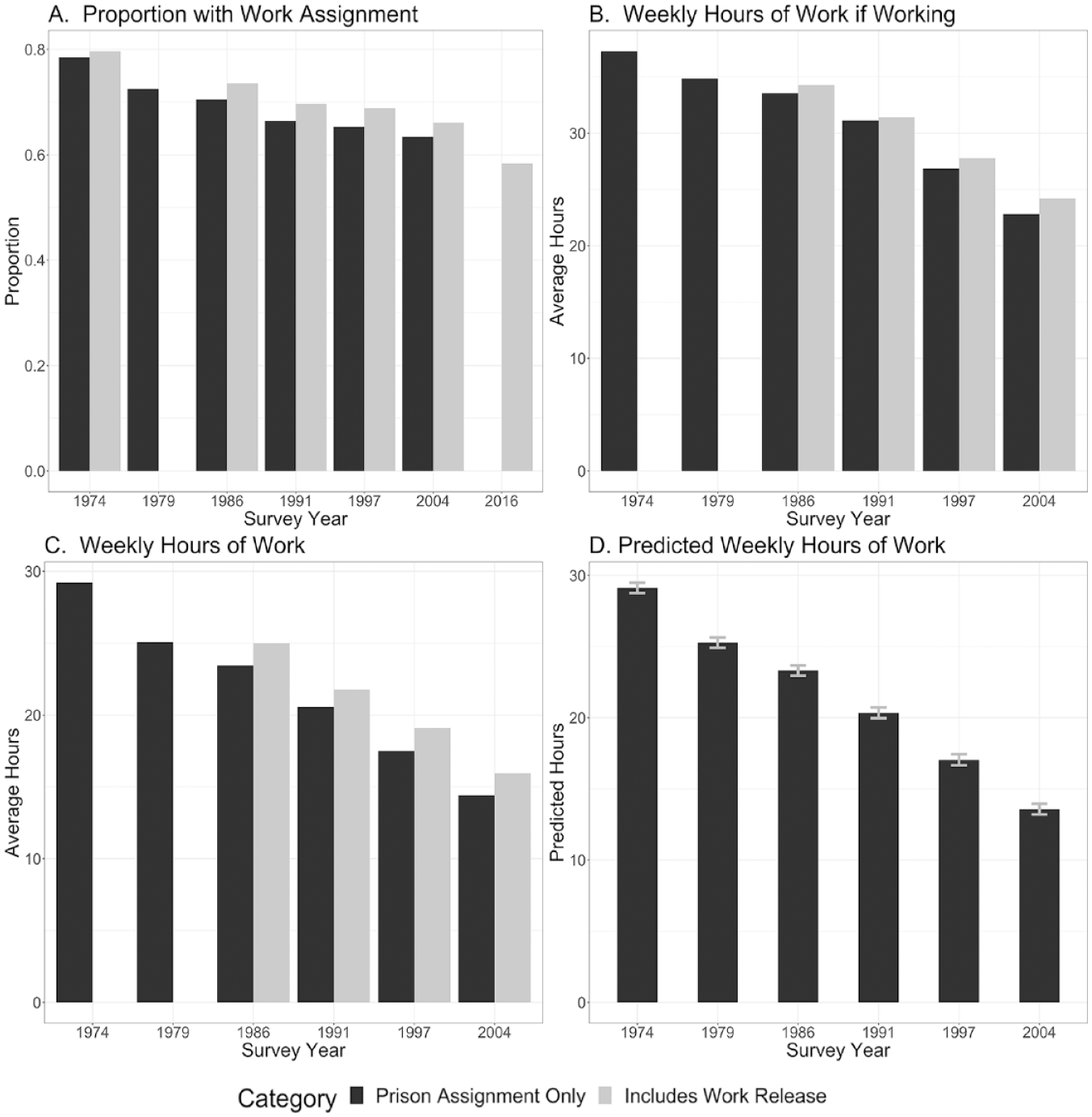
Declining Average Work in State Prisons, 1974 to 2016
Combining these data (i.e., including those who report not working as having worked 0 hours per week) in Figure 2C, we see that, over the entire period, there was a decline of more than 50 percent in the average number of hours worked by an incarcerated person in an average week: from 29.2 hours per week in 1974 to 14.4 hours per week in 2004. Another way of considering the data is that, in 1974, 65 percent of incarcerated people were working “full-time,” at least 35 hours a week. By 2004, this number had declined to 30 percent.
The gray bars in panels A, B, and C of Figure 2 are a broader measure of work among those incarcerated; they include as “working” anyone who reported having a work assignment either within the prison or in a work-release program. Panel A shows that the decline of prison work—for which I have precise measures between 1974 and 2004—seems to have continued through 2016. Whereas 80 percent of incarcerated people reported having some kind of work assignment in 1974, and 66 percent reported having some kind of work assignment in 2004, only 58 percent reported having a work assignment in 2016. There is no evidence that a rise in work-release programs explains the decline of within-prison work assignments, as the decline in any work assignment mirrors the decline in work assignments within prison.
Might these trends be driven by changes in the composition of people in state prisons, or changes in other forms of prison programming? For example, if white people in prison were more likely to work than Black people, and the share of Black people in prison increased, this could explain the decline of work in state prisons rather than a change in the role of work itself. Likewise, if people involved in educational programs were less likely to have a job in prison, and the share of people involved in educational programs increased, this might also explain the decline of work in state prisons. Appendix Table A1 examines the trends explored above in a regression framework, allowing me to control for the demographics of people in prison and their involvement in other programs. These models suggest that the decline of work in prison cannot be explained by the changing composition of incarcerated people themselves, or their changing participation in other kinds of programs. Figure 2D (based on Model 3 of Appendix Table A1) displays the predicted hours of work for an incarcerated person in each survey year, after adjusting for race, age, sex, education, and whether or not a person was employed before they were incarcerated. The similarity of these predicted values with Figure 2C suggests the compositional differences in the prison population explain little of the decline in prison work over time.
How should we make sense of the declining amount of work conducted by the average incarcerated person in the period after 1970? It would be inaccurate to say that prison labor declined in aggregate during this period. Given the sharp increase in the incarceration rate during the period under study, the aggregate number of people working in prison (and hours of prison labor) certainly increased, even as the amount of work conducted by the average incarcerated person decreased by half. 5 Yet for those incarcerated, the meaning of work, and of joblessness, within the prison seems to have shifted, in ways I expand upon below.
Increasing inequality in distribution of hours and income
The decline in average hours of work in state prisons was accompanied by increasing heterogeneity in incarcerated people’s relationship to work. We can see this in a general way by breaking down incarcerated people’s relationship to work into three categories: people working for pay, people working without pay, and people not working. Figure 3 displays this composition over time. In 1974, the majority (52 percent) of incarcerated people in state prisons were working for pay, a smaller proportion (25 percent) were working without pay, and an even smaller proportion (23 percent) had no work assignment. By 2004, a much smaller proportion of incarcerated people (34 percent) in state prisons were working for pay, the proportion of incarcerated people working without pay had stayed relatively flat (26 percent), and the proportion of incarcerated people without work had increased sharply (to 40 percent).
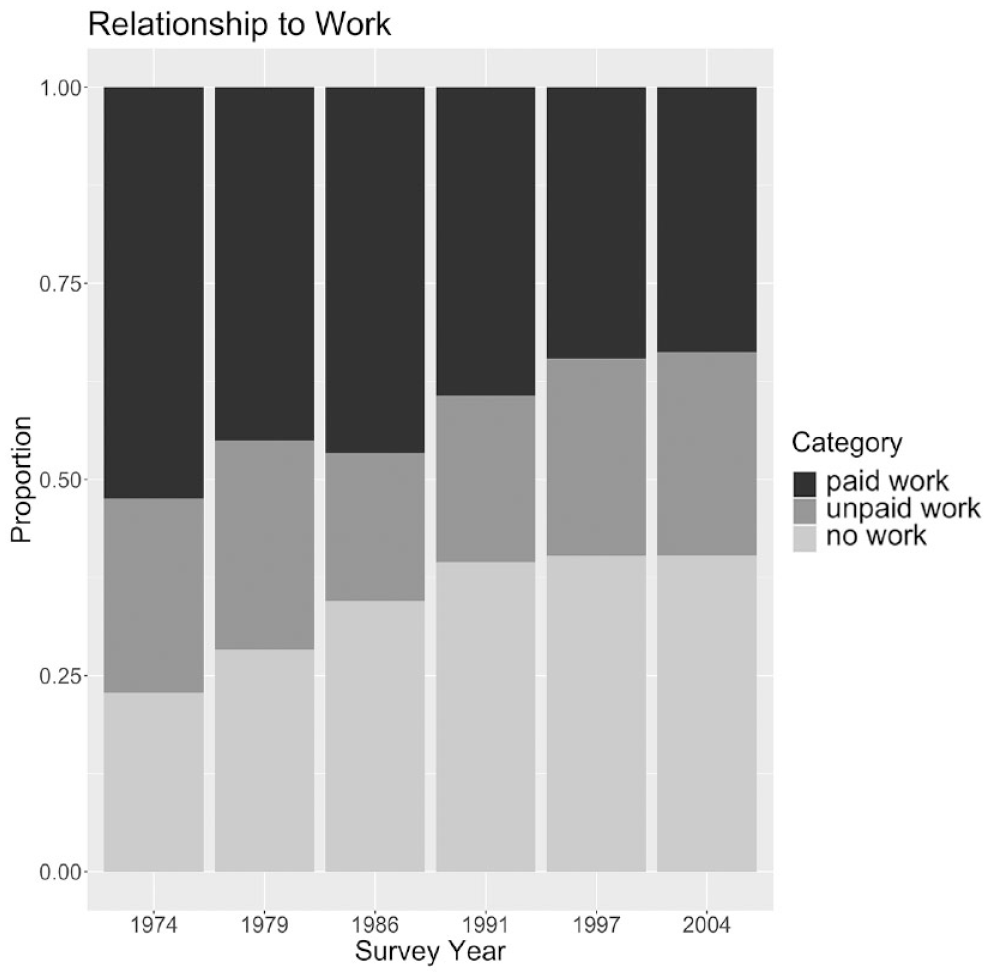
Increasing Variation in Incarcerated People’s Relationship to Work, 1974 to 2004
The distribution of work hours, and compensation for work, also grew significantly more unequal over this period. Figure 4 displays changes in the Gini coefficient for hours worked and weekly income among all people incarcerated in state prisons (panel A), as well as among two subsets of incarcerated people: all of those working (panel B) and all of those working for pay (panel C). The trend across each of these measures, for each of these samples, is similar and unambiguous: the distribution of both work hours and income grew increasingly unequal over the period. This was true for incarcerated people as a whole, as well as among the subsamples of those working and those working for pay. In analyses not shown but available upon request, I find that, among those working, the association between hours and wages also became stronger over the period, along both the extensive margin (i.e., respondents who were paid reported working more than those who were unpaid) and the intensive margin (i.e., respondents who were paid more reported working more than those who were paid less). In other words, respondents working the most hours were increasingly also compensated the most per hour. The experience of incarceration had long been an unequal one; from 1974 to 2004, these inequalities grew even sharper.
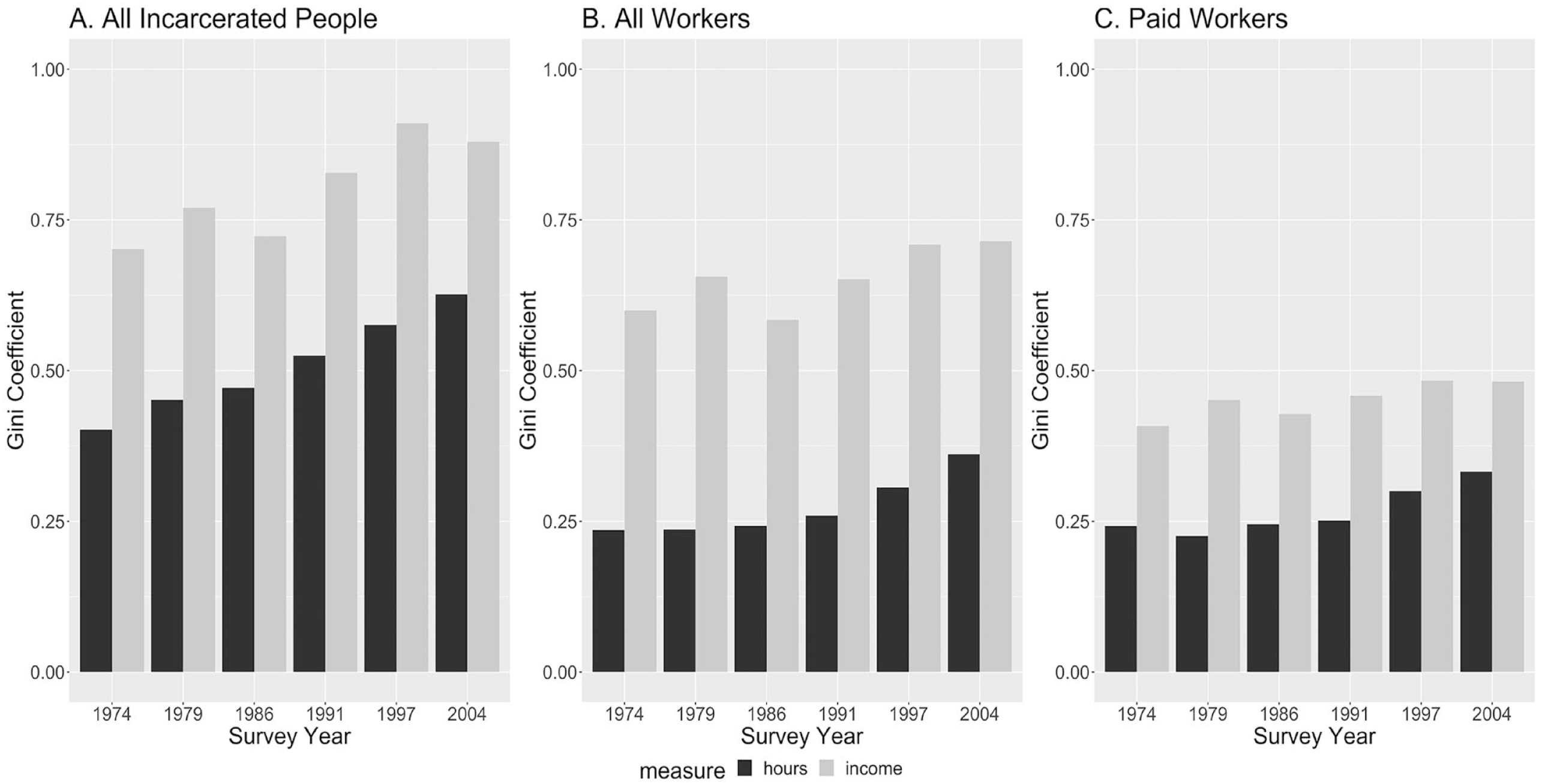
Increasing Inequality in Work Hours and Work Income, 1974 to 2004
Another way of appreciating the growing inequality in incarcerated people’s relationship to prison work is to examine changes to the hours of work and compensation for different job categories in prison. As outlined above, production work has typically been considered the highest status work within the prison, and “prison housework” has been considered the lowest. Across the period 1974 to 2004, more prison workers were assigned to prison housework jobs than to any other category (in 2004, 67 percent of incarcerated workers reported working in prison housework jobs, up from 49 percent in 1974). Over this same period, production jobs were always relatively scarce (by 2004, only 5 percent of incarcerated workers reported working in production jobs, down from 13 percent in 1974).
But between 1974 and 2004, the experience of work in these opposite ends of the prison workforce diverged. In 1974, those engaged in “prison housework” worked, on average, nearly the same number of hours as those engaged in production work (36 hours compared to 35, respectively). On average, those who engaged in “prison housework” earned $12.59 per week, while those who engaged in production earned $24.43, approximately twice as much. By 2004, however, those who engaged in “prison housework” worked, on average, 22 hours per week, while those engaged in production worked 29 hours per week, or 32 percent more hours. Those who engaged in “prison housework” earned, on average, $5.88 per week, while those who engaged in production earned $27.39, more than four and a half times as much.
Market Ideas in State Prison Labor Programs
As documented above, the average incarcerated person worked approximately half as many hours in 2004 as they had in 1974, and, as a whole, incarcerated people’s relationship to work grew more unequal. These changes to the structure of prison labor, I argue, were accompanied by—and to some extent, may have been caused by—changes in the way administrators conceived of the principles by which prison labor ought to be organized and the purposes it ought to serve. Market logics—references to price, choice, and competition—became more salient in how correctional administrators explained and justified the structure of work in prison.
The idea of the market
The idea for a labor market within the prison took root in the 1970s in prison industry programs, in which incarcerated people had traditionally produced items like license plates and furniture for state governments. In 1975, the Justice Department’s Law Enforcement Assistance Administration (LEAA), alarmed by the “inefficiency” of these programs, hired a consulting firm, ECON, Inc., to review them and recommend reforms. 6 Administrators worried that these programs were not living up to their economic potential, were increasing the costs of criminal justice to taxpayers, and, importantly, that their inefficiencies had contributed to waves of prison unrest over the previous two decades: “Institutional security and tranquility are reduced as inmate frustrations rise after hours wasted upon meaningless work assignments” (Grissom 1981:2).
In 1978, the consultants published their findings and recommendations. Their concerns almost entirely focused on a series of technical problems they believed had undermined the efficiency of prison industries: “antiquated equipment,” “featherbedding,” a “short work day,” “low skill jobs,” “unqualified supervisory staff,” and “weak records keeping systems.” They concluded, “It is difficult to imagine an environment more dissimilar to industries which function in the private sphere. . . . Realizing only a small fraction of their economic potential, such programs are a disservice to the taxpayers who must pay for correctional programs” (ECON Inc. 1978:1).
The report invoked the free labor market as the model to which these prison work programs ought to aspire. In place of existing prison industries programs, the consultants outlined what they described as a new, “Free Venture” model of correctional industries (ECON Inc. 1978). As a contemporaneous evaluation of the Free Venture model summarized it, “The fundamental goal of Free Venture prison industries is the establishment of prison industries which are as similar as possible to their private sector counterparts, within the constraints of security requirements and legislative restrictions.” Among the principles defining this model were “[i]nmate wages based upon productivity” (Grissom 1981:2).
Along with promoting market principles in the organization of state prison industries programs, the federal government also sought to reintroduce prison labor for the use of private businesses. In 1979, the federal government began reopening state prison doors to private industry, at least a crack, with the establishment of the Prison Industries Enhancement Certification program (PIECP), part of the Justice Systems Improvement Act. The program authorized the LEAA to license a limited number of partnerships between private businesses and state departments of corrections, for which legal limits on the distribution and sale of prison-made goods would be lifted. Among the requirements for participating departments of correction were that incarcerated people had to be paid prevailing community wages, and incarcerated people must “participate on a voluntary basis” (Federal Registrar 1999, emphasis added).
By 1980, two concurrent processes within state prison industries had begun: one concerning the market principles around which prison industries ought to be organized, and the other concerning the private businesses who were once again invited inside the gates. Summarizing the sentiment of the period, Chief Justice of the Supreme Court Warren Burger (1982:111) suggested that because the country was about to “embark on a multi-billion-dollar prison construction program,” rather than building “more ‘warehouses’ . . . we [should] change our thinking and build factories with fences around them.”
Both of these processes intensified during the 1990s. First, the Crime Control Act of 1990 increased the number of jurisdictions eligible to participate in the PIECP program, from 20 to 50, and loosened restrictions on certification, which together made “significant program expansion possible” (Auerbach 2012:12). Second, in 1995, the Bureau of Justice Assistance (BJA) selected the Correctional Industries Association (CIA)—a professional association of administrators who ran correctional industries programs—as the new “technical assistance contractor” for PIECP, a move intended to strengthen the PIECP program by “bringing the program inside the correction industries community” (Auerbach 2012:15).
The relationship between market ideas and prison labor structure
The ambition of the new generation of market reformers to reestablish links between state prison labor and private business failed quite dramatically. The PIECP legislation’s requirement that private companies pay people in prison prevailing community wages meant the one significant comparative advantage the prison offered—a group of cheap workers—was rendered moot. Private firms have thus largely stayed away. At its height, in 2005, the PIECP program involved only 6,555 incarcerated people in state prisons anywhere in the country, approximately one half of 1 percent (0.0052) of those incarcerated in state prisons that year.
A state’s decision to pursue a PIECP certificate is likely associated with a state’s embrace of the market orientation to prison labor promoted by the federal government over these years. However, because the actual involvement of private businesses in PIECP states remains exceedingly small, it is unlikely to have had any substantial impact on the organization of prison work systemwide. This allows me to explore, in a preliminary way, if and how the market ideas associated with the pursuit of the PIECP certificate, even in the absence of any meaningful implementation, are associated with changes in the organization of prison labor.
As explained in the Methods section, I analyze the two years of data (1991 and 2004) for which I am able to link respondents to states with a relatively high degree of confidence. I then compare respondents from the 16 states that implemented the PIECP program between 1991 and 2004 with respondents from states that either did not have the PIECP program in either year (14 states) or had implemented the PIECP program prior to 1991 (20 states), adjusting for state and year effects. This allows me to estimate the association of a change in PIECP status (net of state and year) on the outcomes in which I am interested: the number of hours incarcerated people work and how much they are paid for this work across different job categories.
Figure 5 displays results from multilevel models investigating the association between a change in a state’s involvement in PIECP and changes to the prison labor structure, disaggregated by occupational categories corresponding with different levels of job status: prison housework (low status), other (middle status), and production (high status). Panel A illustrates the association between a state’s acquisition of PIECP status and changes in hours worked across job categories. It suggests a state’s acquisition of PIECP status is associated with a significant decline in the average number of hours worked by those assigned to prison housework jobs (a drop of about 1.7 hours). During the years covered by this analysis, the majority of prison workers (62 percent) had prison housework assignments. This likely helps explain why (in an analysis not displayed) I find that a change in PIECP status is associated with a statistically significant decline in the average number of hours an incarcerated person works regardless of job category.
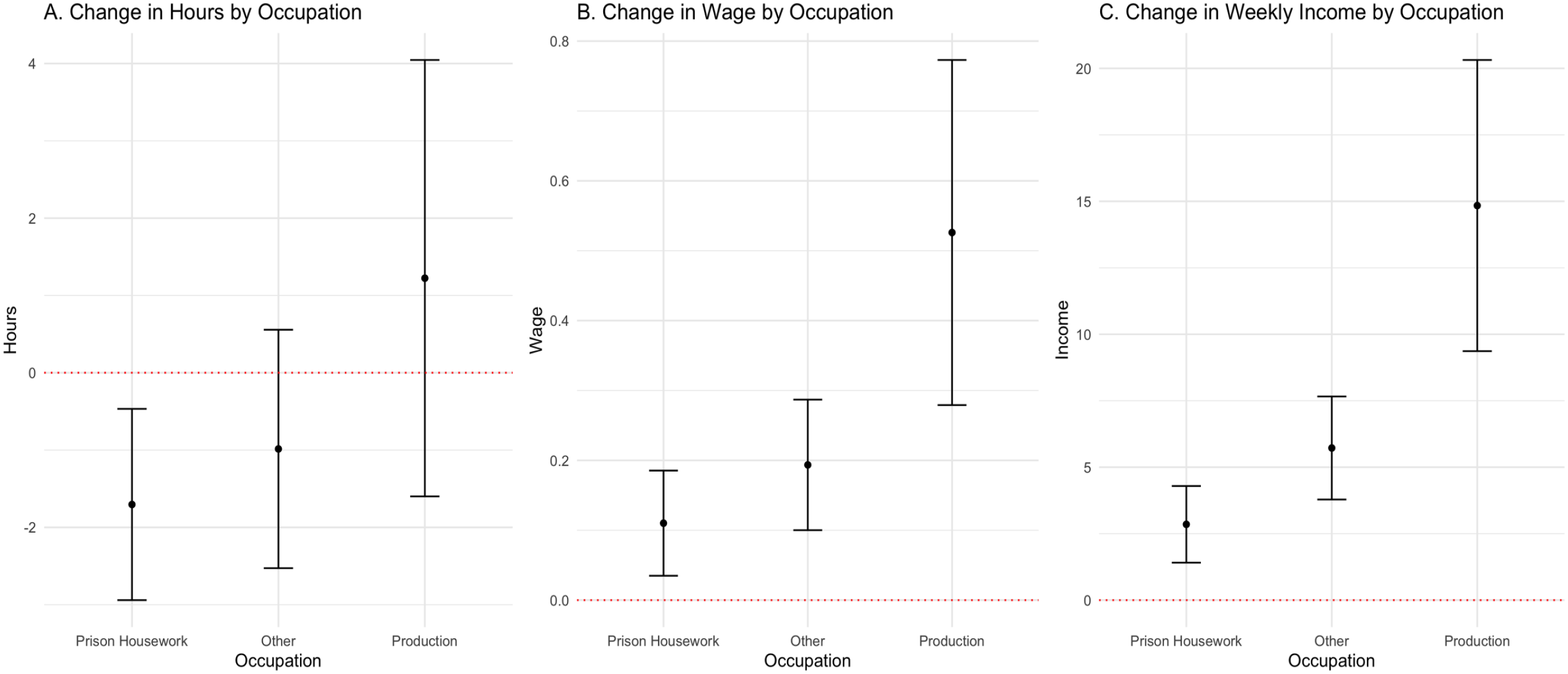
Association between PIECP and Prison Labor Structure, 1991 to 2004
Panels B and C in Figure 5 illustrate the association between a state’s acquisition of PIECP status and changes in the wages and weekly income earned by incarcerated people working in different job categories. Here, we see that a state’s acquisition of PIECP status is associated with higher wages and weekly earnings across job categories, but the gains are unequally distributed. A state’s acquisition of PIECP status is associated with a significantly higher increase in wages among those working in production than among those working in prison housework jobs; likewise, a state’s acquisition of PIECP status is associated with a significantly higher increase in weekly earnings among those working in production than among those working in prison housework. Overall, a state’s acquisition of PIECP status is associated with a decline in average work hours and a sharpening of inequality in the hours worked and pay across different job categories—similar to the trends we see at the national level.
We should treat these results as preliminary. First, they rely on only two years of data. Second, it is unclear by what process, exactly, states select into participation in the PIECP program, meaning the relationship between PIECP enrollment and the structure of prison employment might be confounded by changes within a state that explain both the decision to enroll in the program and the observed changes to the organization of prison labor. But the results do provide at least tentative support for the idea that the introduction of a market orientation to prison labor—operationalized by a state’s participation in the PIECP program—is, at the state level, associated with a decline in average working hours and increasing inequality in the hours, wages, and weekly incomes in the work that remains. This, in turn, implies that similar national-level changes in the organization of prison labor, observed earlier, may be associated with, and even driven by, the emergence of a market orientation to prison labor.
Market Understandings in Prison Life
How is the market invoked among prison administrators and incarcerated people themselves? What does it mean for people to consider the contemporary organization of prison labor through the framework of the market? And what work do such understandings do, in terms of what they highlight and what they occlude? I now turn to these questions.
Correctional administrators
Correctional administrators with jurisdiction over prison labor emphasized how market principles of price, choice, and competition played a role in their management of prison labor. Through the invocation of such principles, administrators suggested the structural absence of work within the prison was related to incarcerated people’s “choices” with relationship to work (i.e., their lack of work ethic) and that it was necessary to provide economic incentives to motivate incarcerated people to work, particularly within jobs that demanded longer hours or more difficult working conditions. Administrators also discussed the role of competition across departments within the prison as driving wages up for the most sought-after incarcerated workers. Administrators described incarcerated people as having more choice with respect to work than they had in the past, suggesting a break from a history of hard labor. But their accounts also minimize the reality that any choice in prison occurs within a context of extreme coercion, demonstrating how contemporary market talk may obscure the arrangement of power within the prison.
Central to many administrators’ accounts was the “choice” that incarcerated people had about whether or not to work. When I asked an administrator in North Dakota whether incarcerated people were required to work, he responded, “You get some people that are just, you know, they just want to be left alone. . . . We can’t force anybody to work.” The decision not to work, he continued, would not have any consequences for incarcerated people other than the fact that “they don’t have another source of income.” An administrator in Missouri noted that incarcerated people had many job opportunities, but “[o]ne of the tricky parts about prison, and I think it’s this way in most states, the people in prison don’t have to do a single thing if they don’t want to.” An administrator in Utah said that while some sorts of programming were mandatory, meaning there would be disciplinary consequences for refusing, this was not true of work programs: “There’s no real consequence outside of you wouldn’t have as much money on your books.” A Rhode Island administrator said, “We can’t mandate work, so . . . we encourage it.”
These accounts almost certainly overstate incarcerated people’s choices concerning work, and about their freedom of choice more generally. The idea that incarcerated people “don’t have to do a single thing if they don’t want to,” for instance, belies the coercion inherent in the experience of incarceration. And while the North Dakota administrator suggested the state could not “force anybody to work,” the state’s Facility Handbook for prisons notes that if an incarcerated person “refuse[s] to take a job assignment from the Job Placement Committee, [they] may receive a disciplinary report” (North Dakota DOCR 2021:74). In Kentucky, an administrator argued that “we cannot force an inmate to work,” while acknowledging, unprompted, there would be “some repercussions” for not working, such as being moved to a special housing unit with others who refused and being “track[ed] . . . more closely.” Likewise, in Michigan, an administrator said that while “prisoners here are not compelled to work,” if they refused to work they would be put on “double low status,” with limits on their leisure time. The “freedom” to choose whether or not to work was often in a context in which refusal could lead to greater punishment. The principle of “less eligibility,” historically used to make prison less attractive than finding work outside it, was now used to motivate work within it.
That said, many administrators acknowledged there simply were not enough “real” jobs to occupy everyone. In Wisconsin, an administrator observed that many incarcerated people who wanted to work were “involuntarily unassigned” because “there’s just not enough jobs in the institution to be able to employ” everyone. Other administrators acknowledged that many of the jobs they offered in their facilities demanded very little actual work. A Kentucky administrator referenced how someone working as a porter in the unit could “hurry up and get their job done and go back to bed in a couple of hours,” and a Rhode Island administrator admitted that a job that looked like an eight-hour assignment on paper might actually take an hour and a half. Work requirements were often in name only, these administrators implied, and people could get away with doing very little work if they so chose.
In this environment, administrators suggested they needed to incentivize people to work in the few jobs that required real time and effort. Several discussed how they increased the wages for jobs that demanded high skill levels or that were particularly onerous. In Utah, an administrator explained they were in the process of building a new prison facility, and incarcerated people were responsible for making and installing many of the products that would be used in the new building. She needed a “work crew of incarcerated individuals to be at the site installing” the furniture, but she was having difficulty finding qualified applicants, so “we’ve had to just make it a little more exciting” with a higher wage. In Alaska (where the prison and jail population are combined), the prison has “detox cells” for new arrivals who come to prison drunk or addicted to drugs, and the prison hires other incarcerated people to “watch for signs of detox distress.” An administrator explained, “No one wants to sit in a room with somebody who’s going to be puking, and who’s pissed off because they’re drunk, and they just got arrested, right? So . . . instead of 40 cents an hour, we’re gonna pay you a dollar an hour. All of a sudden, we got people who are perfectly happy sitting in a corner for a few hours doing absolutely nothing.”
Some administrators discussed setting wages in relationship to how much the prison depended on an incarcerated person’s labor. For instance, a Missouri administrator said that kitchen jobs began at $7.50 a month, but prison cooks, at the top of the kitchen hierarchy, could make anywhere between $25 and $40 a month “because they’ve actually got a skill and we’ve got to rely on them to make a good palatable product.” In Kentucky, an administrator explained how, just within the past few years, they had changed their pay policy to incentivize productivity rather than seniority: “In the past, anybody was eligible for a pay raise based on time . . . which we felt like was not a good incentive, because a guy could literally be one of the worst employees you have and he would be at top pay within X number of years.” The new policy made a huge difference, “because our skilled labor guys, who really want to do a good job, are striving for those positions just like you or I or anybody else would.”
Administrators also discussed how competition for the best prison workers drove wages up at the top of the prison labor market. As seen in the quantitative data, in most states, prison industries programs (production work) paid significantly more than other forms of work, a source of consternation for those responsible for supervising that other work. As one prison industries director put it, “I think anybody would want to employ the best people possible.” Because he was able to pay more than others, he was able to attract the best candidates, and he would sometimes get “a little razzing” about it from the wardens, who were unable to compete: “They wish they could pay what I could pay.” Conversely, in Kentucky, an interviewee involved in prison industries recounted how wages for other forms of work had started to increase, meaning “we were actually in competition with those jobs, there might be like a janitor position cleaning the dorm, almost making as much as a guy in industry.” This was alarming to him, and so prison industries had recently increased wages on the industries side: “That’s made a big difference for us being able to recruit the best of the best to come work for us.”
Formerly incarcerated people
Prison administrators’ accounts were echoed, to some extent, in the accounts from formerly incarcerated people, many of whom also described a system of prison labor in which they had some degree of choice over their work conditions, and in which wage incentives were an important consideration in their work decisions. But the accounts of formerly incarcerated people also highlight how these choices, and these incentives, exist within a context of extreme domination.
Many interviewees reported they were required to have a work assignment while in prison. Yet what this meant in practice varied widely. For instance, Oregon’s Ballot Measure 17, passed by referendum in 1994, requires incarcerated people to work 40 hours per week. In practice, however, this could not be enforced because there simply was not enough work to go around. As one formerly incarcerated person put it, “In Oregon the law says that it’s mandatory work, but there just aren’t enough jobs. Not even close.” He estimated there was enough work for 30 to 50 percent of incarcerated people. If a person did not want to work, he said, it was not hard for them to avoid it.
New York, like Oregon, has a formal requirement that, unless they are in school, an incarcerated person is supposed to have a job assignment. Several formerly incarcerated people in New York pointed out that if you tried to refuse work there would be severe consequences. One said that if you “didn’t want to work, you was going to the box.” Another said that if you refused work, you could “get disciplinary action.” That said, many of the entry-level job assignments in New York required very few hours of work. One formerly incarcerated person described a “chapel porter” job that required about 30 minutes of work a day: “I just cleaned, I swept and mopped the chapel, took out the garbage, and then went about my business.” Another formerly incarcerated person from New York described a “sanitation job” that was “one of the sweetest things, because you only work 10 minutes a day. You ride around in the truck . . . and you’re done.” A third described how he “kinda worked as a porter,” responsible for cleaning the yard, but within three weeks he “got cool with a cop” (i.e., a correctional officer) who told him, “You don’t really have to come in.” This person’s formal job assignment belied the fact that he did not actually have to do any work. A fourth said that most of the porter jobs within the dorms would take no more than an hour, and “once you finish doing what you’re doing in the dorm, you’re not really doing nothing else.”
Several interviewees from Virginia reported they did not work at all for long stretches of their sentences. One person, who spent five years incarcerated in a Virginia state prison, explained that his disciplinary record was never clean enough for him to get a job. At the time, he “never did shit but work out in the weight pile and get high.” Another formerly incarcerated person from Virginia explained that he “did not have a state job the whole time I was in” the state prison, and instead took part in “a million side hustles.”
If it was possible not to work while in prison, or work very little, why did many people work longer hours? Interviewees reported a wide range of amenities that came with work assignments, many of which are outside the scope of my analysis: the free food that might come with a job in the kitchen; being able to groom oneself regularly if one worked in the barber shop; the freedom of movement that came with a position in the yard; the protection that could accompany working closely with a correctional officer; the chance to move illicit products, and information, in the library; and just having something to do with one’s time.
The relative absence of work within the prison could make a job feel like a privilege rather than a punishment, at least for some. The Virginia interviewee whose record was not clean enough for a job said explicitly, “It was kind of a privilege to work.” Another Virginia interviewee discussed how he had volunteered to be transferred to a different prison that was just opening because he was “guaranteed a job” there, suggesting a job was considered an amenity rather than a drawback. A formerly incarcerated person from Oregon said that while the relative absence of work meant most people were not forced to work if they did not want to, “most people want to do something. It’s how you get a little bit of spending money.”
Interviewees broadly affirmed that the wage was one of the most important factors in their decisions about work in prison. Among journalistic discussions of prison work, prison workers’ low pay tends to be treated as definitive evidence of coercion. Incarcerated people themselves, however, tend to be much more attentive to differentiation within these low wages. As Gibson-Light (2020:203) observes, “Although the difference between $0.20 and $1.00 per hour might seem minimal to an outsider, prisoners and staffers alike attested that this gap could generate divergent carceral experiences as men relied on wages for necessary goods and services.” This idea was affirmed in my interviews. One formerly incarcerated person from New York described how “the difference from 10 cents to 25 cents an hour is a big difference.” The lower wage meant an incarcerated person could likely only buy “two ramens and a soap” for a week’s worth of work, which led to a lower status than those who could afford more supplies: “You can tell who’s poor just by smell, or maybe seeing the ashy-ness of their skin.”
A formerly incarcerated person from Oregon explained that although “you can live off the state while incarcerated without any finances, it’s just less enjoyable, because you won’t be able to have all the things that you want or have all the connections that you want.” When he got a well-paying job in the prison, he was able to afford things that “improv[ed] quality of life”—phone calls to people on the outside; shoes that were of better quality than the state-issued shoes, which “were not very comfortable, they didn’t last very long, they smelled funny”; and food, like protein bars and tuna fish, that were “more healthy than what they would serve.” Another person from Oregon said the $80 per month he was paid as a law librarian went a long way compared to the $30 he was paid as an orderly: “You can supplement your diet, get protein shake stuff for working out. That difference made life, I would say, significantly better. Just gives you more options and a little bit more freedom.” A formerly incarcerated person in Virginia discussed how the $0.45 an hour he made on a maintenance crew was good money—he “ended up saving . . . a lot of money.”
Many of the incarcerated people interviewed described a degree of choice between a job that paid very little but required no effort, and a “real” job that was compensated well but required actual commitment. A formerly incarcerated person from Oregon described the tradeoff in stark terms: If you go to work for the call center, you’re going to be sitting on a phone for eight hours a day. . . . You’re going to punch in, you’re going to punch out. If you work on the yard, you’re going to go out there for maybe an hour or two in the morning and a couple hours in the afternoon and you’re gone. So that’s part of the tradeoff, is that you’re going to work more hours, but again, you’re gonna get compensated for those in a different way.
Another formerly incarcerated person from Oregon made a similar distinction. If you worked doing laundry for the institution, a lower-paying, lower-status job, “chances are they’re going to let you off early most days, and you get multiple bathroom breaks.” Call center positions paid much more, but “you’re expected to make this many calls and get this many leads, and you’re being directly monitored through the entire process.”
A formerly incarcerated person from Virginia decided to give up a laidback job in prison intake for a more difficult job in the prison’s flash freeze vegetable plant because of the higher pay: “My job was standing there cutting vegetables. . . . So I had this big ass knife that was cabled to the counter. And we cut vegetables for—they had three 8-hour shifts going on down there.” He had to punch in and out of a time-clock but was paid $1.10 an hour, far more than any other job he had been offered. Another formerly incarcerated person in Virginia left a job on the prison farm, where he had grown emotionally attached to taking care of the heifers, for a job working demolition. The demolition job was much harder and required much more work, “at least 40 hours a week,” but paid $0.95 an hour, “the most any inmate in the Virginia Penitentiary could hope to make.” Working this job was “the first time I was able to live on my penitentiary salary”; it paid “enough to sustain my little coffee habit,” and he even “saved a little bit of money.” Formerly incarcerated people explained in detail the tradeoffs they made between the difficulty of the jobs they worked and the pay they received.
Formerly incarcerated people also discussed a tradeoff between pay and the hazards to which they were subjected. In New York, an interviewee explained how he transferred from a mattress shop job to a job involving asbestos abatement “because the asbestos paid more money.” The mattress shop paid $15 every two weeks, whereas the asbestos abatement paid $60 over the same interval. As he explained, the asbestos job offered so much more money because “a lot of people didn’t like working in asbestos” due to the health risks associated with it: “Mesothelioma, lung disease, and all that.” Another person from New York explained how he was assigned to the “blood spill team” at Coxsackie Correctional Facility, a particularly violent facility at the time of his incarceration. He said he was compensated $18 and given cigarettes every time he was asked to clean up blood, which was quite frequently, as “every time the gates [cells] crack, somebody getting cut or stabbed there.”
Formerly incarcerated people in all three states—Virginia, Oregon, and New York—described internal labor markets within the prison that support the broad story of historical change outlined above, in which pay inequality and some degree of choice increasingly structured the organization of prison work. Yet there were also interesting differences between the accounts of formerly incarcerated people in these different states. Oregon and Virginia were relatively early adopters of the PIECP program, having adopted it in 1989 and 1995, respectively. New York, on the other hand, is one of the few remaining states not to have adopted the PIECP program. There is thus reason to suspect that the role of market incentives and competition might be less prevalent in New York compared to Oregon and Virginia.
Although my interviews were not a representative sample of formerly incarcerated people across these three states, the patterns among them are suggestive. Interviewees from New York were more likely to emphasize the coercive nature of prison work than were interviewees from Oregon or Virginia. For example, three interviewees from New York volunteered that prison labor was analogous to slavery. Such explicit analogies to enslavement, which echo Hatton’s (2018) interviews of formerly incarcerated people in New York, were absent from interviews in Virginia and Oregon. To some extent, the market organization of prison labor, more prominent in Oregon and Virginia, may have made prison labor feel less coercive, helping generate consent to the condition of extreme state control.
Of course, even in places like Oregon—the state with what appeared to be the most developed internal labor market of the three—incarcerated people’s choices with respect to work were severely constrained. One respondent described how he worked his way up to a highly desired job as an assisted living orderly, in which he was placed in a cell with an elderly incarcerated person, for whom he was responsible. He thought it would be an easy gig, with relatively high pay and relatively few responsibilities, until he was assigned to a person with dementia who “wouldn’t stop masturbating when I was in the cell.” Once you were assigned to a person, “You don’t really have a choice.” He was not permitted to quit the job until, ultimately, he filed a Prison Rape Elimination Act (PREA) complaint against his assignee: “That was probably the . . . worst weeks of my life in prison.”
Market Discipline: Morals and Management
How have the organizational shifts described above changed the way prison officials understand the moral significance of work in prison? In a report on the goals of prison industry supported by the American Correctional Association, Guynes and Grieser (1986:19) observed that a “subtle change” had begun to take hold among prison reformers. Whereas correctional theorists had long believed “inmates could be reformed by the act of laboring,” an emergent model emphasized the need for prison industry to map onto a “real world parallel.” Notably, coercing incarcerated people to work was no longer viewed as reformative. Instead, the real-world model required prison industries to operate using “inmate incentives and penalties.” In a separate report, Grissom (1981:7) observed that, in light of the prison riots of the mid-twentieth century, prison industries managers were being encouraged to “change their approach in dealing with inmate workers from an autocratic style to one stressing motivation.”
In the accounts of prison administrators today, we no longer hear about the act of labor as transforming people’s psyches. Nor do we hear much about the ways prison labor is distinct from “ordinary work.” Rather, administrators describe the importance of establishing labor markets inside the prison that are as similar as possible to those on the outside. Administrators in Oregon and North Dakota emphasized the internal labor market as making possible the broader correctional goals of “normalization” and “humanization.” Likewise, an administrator from Kentucky said, “We treat it as much like we can as an industry on the street. . . . We do application processes, you get pay raises based on skill level and things like that. So, you know, we really try to make it mimic what life on the outside will be so that there’s not a shock value to these people [once they get out].”
Alongside this commitment to creating structures and processes that resemble the outside market as much as possible, administrators seem to have shifted their own sense of responsibility for those in custody, viewing incarcerated people as responsible for their own choices and outcomes with respect to a prison labor market. This perspective is consistent with the idea that incarcerated people have choices about their own work-life in prison, but it neglects the ways work opportunities in prison have declined, focusing instead on moral distinctions among incarcerated people themselves. For instance, a Rhode Island administrator explained that some people “come in and they want to work,” whereas others “want to go play basketball, they want to just hang out in the yard. . . . They have no incentive to work, regardless of what we try and do.” An administrator in Alaska said that for some people, “nothing is going to incentivize” work: “It’s just, ‘I’d rather sleep my sentence away.’ . . . That’s an internal switch that we haven’t been able to flip yet.” In Missouri, an administrator said that despite all the jobs and opportunities they offered incarcerated people, “there’s still a lot of offenders sitting around doing nothing,” because people in prison “don’t have to work. . . . They can do nothing for their entire time.” Rather than shaping incarcerated people through mandatory work, many administrators saw themselves as offering opportunities to incarcerated people that these people could accept or reject. As an administrator from Wisconsin put it, “It’s really hard to get people to see past Friday, and get them to see down the road.” Those who did not work were recast as lazy and unmotivated.
These internal distinctions generated through the labor market aligned with administrators’ concerns with prison management. For instance, in Wisconsin, to qualify to apply for industry jobs, which paid more than anything on the institutional side, an incarcerated person had to have no rule violations for the previous 12 months. According to an administrator, this “incentivizes people to be more rule compliant, makes the institution safer.” In Utah, an administrator described how PIECP jobs, which paid far more than any other job in the prison, were “coveted,” and they only “consider the people who are really invested in the work and doing good work for those positions when they come up.” This was “an incentive for the others,” she said, a carrot that would motivate everyone else to behave. This sentiment was echoed in the account of one incarcerated person from Oregon, who thought there had been less extortion among incarcerated people in Oregon prisons since the introduction of new job ladders: “Once you start establishing some routes [to] where you’ve got a job that you like, or one that at least pays you enough that you feel comfortable continuing to do it, you don’t want to lose it.”
Today, administrators seem to see the prison labor market as a way of categorizing and differentiating those in their custody—a way of distinguishing between those who are motivated and those who are not, those who pose risks and those who do not. Through such distinctions, and the privileges (and pains) associated with them, the prison might motivate incarcerated people to compete with one another for more pay and more privileges. We see these distinctions come alive for incarcerated people themselves in Gibson-Light’s (2020) account of the symbolic boundaries that incarcerated people draw between themselves and those below them in the job status hierarchy. This was true in my interviews as well, as incarcerated people discussed the ways their prison pay allowed them to live in more comfort than their peers; or the ways their “real jobs” were distinct from the make-work they left behind.
Conclusions
The case of prison labor, historically and in the contemporary era, reminds us of the ways coercion has always been integral to labor markets, albeit differently in different historical eras. In the late nineteenth and early twentieth centuries, forced labor for profit was central to the political economy of the prison. Coercion was consistent with moral visions of prison labor: rehabilitative in the North and punitive in the South. Today, when prison administrators’ orientation to prison labor centers more on internal order than on profit, their moral vision of prison labor seems to have shifted as well. Administrators downplay the transformative potential of work itself, and instead describe the importance of making the job market inside the prison as similar to the one outside as possible, so that incarcerated people can learn to respond to market incentives—and can behave as disciplined market subjects inside.
We tend to imagine labor markets as being associated with the ends of economic production, yet the case of contemporary prison labor challenges this association. The period in which prison labor was most clearly profitable, when there was a vibrant market outside the prison for the goods produced by incarcerated people, was also the period in which incarcerated people had no choice about whether and how to deploy their labor. In the contemporary period, incarcerated people have more (albeit limited) discretion over the allocation of their own labor power, but the products of this labor are more estranged from any external market than ever before. In the contemporary era, prevalent market ideas—of price, choice, and competition—flourish even within our society’s most coercive institutions, oriented toward control as much as production.
We should not, of course, understate the extent to which profits are still extracted from incarcerated people during and after their incarceration. Local, state, and federal criminal justice organizations expropriate resources from the poor through fines, fees, seizures, and the like (Harris 2016; Page and Soss 2021). And private companies often charge incarcerated people inflated prices for things like phone services and commissary charges. As Page and Soss (2021:291) write, “the center of gravity in criminal legal predation has shifted from labor to finance.”
Researchers have also suggested that a criminal record may make it easier for employers to exploit incarcerated people upon their release, as the formerly incarcerated feel compelled to stay in jobs they would otherwise quit (Purser 2012; Reich and Prins 2020). In many cases, the criminal legal system directly pressures people into disadvantageous positions within the labor market through work requirements associated with child support enforcement, criminal legal debt, and probation and parole (Zatz 2020). This is another important way in which the criminal justice system may facilitate broader forms of economic coercion. Indeed, to the extent that people in prison learn, through their participation in prison labor programs, to feel a sense of personal responsibility in relationship to the coercive environment to which they are subjected, this may facilitate a similar orientation to work upon their release. Within prison and without, the experience of “freedom” with respect to one’s work is embedded within a system of control.
One important limitation of this study is that I was unable to interview any administrators or incarcerated people from states in the Deep South. The quantitative dynamics I described here (i.e., the decline of work and increasing responsivity of work hours to pay) are common across regions, but the Deep South is unique in the extent to which incarcerated people continue to be compelled to work without pay. It is difficult to know exactly how administrators in those states that do not pay the vast majority of prison workers organize or understand this work, although it seems almost certain that market ideas do not feature nearly so prominently. Future work ought to explore if and how market logics have emerged in states in which the legacy of slavery is most enduring.
Moreover, even in states in which market logics seem most evident, they clearly do not operate alone: alternative logics of hierarchy and reciprocity are deeply engrained in the prison’s institutional life, undergirding patron-client systems organized around security, protection, favors, and status. Future research might explore in more detail the ways the market logics outlined here interact with the range of other logics that percolate within the prison.
Future work might also explore the implications of the shifting logics of prison labor for racial and gender inequalities within prison. Existing literature suggests racial group membership and gender continue to play important roles in the allocation of prison work assignments (Crittenden et al. 2018; Gibson-Light 2022). In my own preliminary analyses (Reich and Cowan 2023), I find significant variation in pay by race at the national level, yet this is explained almost entirely by state-level variation in prison pay and prison racial composition: the states that pay less (or not at all) tend to be states that incarcerate a higher proportion of non-white people, but differences in pay by race disappear once one controls for state. Here, again, the legacy of differently racialized regional histories of prison labor come to the fore.
Finally, my account of the emergence of market discipline in prison labor programs invites the question of the extent to which we see similar dynamics in other institutional arenas of U.S. life. How often are market principles invoked and practiced to forward ends that have little directly to do with profit? To the extent the dynamics explored here are similar to those seen in the contemporary social welfare system, for example, one implication may be that the imposition of work requirements in welfare programs may have had less to do with encouraging labor market participation than with the symbolic reconfiguration of the absence of work, as market logics ascribe people’s lack of work to their own choices. Within the prison and without, market principles may be introduced among the poor less as a means for the expropriation of their labor power than as a means for their control.
Footnotes
Appendix
Could the decline of average work in prison be explained by the changing composition of people incarcerated, or their changing participation in other kinds of programs? Table A1 displays the relationship between the prevalence of prison work and survey year in a multivariate regression framework. Model 1 regresses whether or not one has a work assignment within the prison on the year in which one was surveyed. Model 2 regresses the number of hours one works per week (within prison) on the year in which one was surveyed, restricting attention to respondents who report having a work assignment. Model 3 regresses the number of hours one works per week on the year in which one was surveyed among all respondents. Models 4 and 5 are the same as Model 3, except they include indicators for participation in certain programs that are only asked in particular survey years—whether or not one is participating in a counseling or vocational program at the time of the survey (asked only in 1974 and 1991) and whether or not one has ever participated in an educational or vocational program (asked only in 1991, 1997, and 2004). In all the models except for Model 5, 1974 serves as the reference year. In Model 5, 1991 serves as the reference year. Overall, the table shows that controlling for age, race, gender, prior employment, education, and other program participation makes little difference in explaining the decline in average prison work.
Acknowledgements
This article benefited tremendously from the advice, comments, and support of Guillermina Altomonte, Clare Dalton, Paul DiMaggio, Samuel Donahue, Erin Hatton, Amanda Hughett, Michael Jaron, Christopher Muller, Suresh Naidu, Seth Prins, Joshua Page, Teresa Sharpe, and Jennifer Silva. Thanks also to Andrew Massengill and Angel Solis Jr. for their research assistance. I am also very grateful for feedback from NYU’s Culture Workshop, and appreciative of the support of the Russell Sage Foundation.
