



Abstract
Police culture creates an “us versus them” dynamic, which, at its worst, treats threats to the “thin blue line” as worthy of group response. Prior research documents such a group threat process as a possible mechanism for police misconduct, but few studies have analyzed the precise network relationships that serve as the conduit for a misconduct response. Using data on misconduct, officer injuries, and officer networks within the Chicago Police Department (CPD) between 2004 and 2015, this study examines the extent to which injuries officers receive from civilians might elicit a misconduct response from officers’ peers, and especially their direct network associates. Findings demonstrate that network ties to injured officers predict higher levels of subsequent misconduct, especially for officers with stronger ties to the injured officer. Furthermore, the effects of peer injury on subsequent misconduct are contingent on the race of the suspect involved: officers whose peers are injured are linked to more use of excessive force, as well as other types of misconduct, when the suspects involved are Black. These findings support our central hypothesis of a networked group threat response that links peer injuries to police misconduct.
Recent high-profile killings of Black civilians by the police have ignited a national reckoning around police violence and sparked one of the largest social movements in U.S. history, Black Lives Matter (Buchanan, Bui, and Patel 2020). Conversations around defunding or abolishing the police, reimagining public safety, and reducing the footprint of the criminal justice system have stirred public debate and launched policy debates from city halls to Congress. At the same time, a noticeable countermovement has framed calls for police reform, accountability, oversight, and abolition as a “War on Cops,” which threatens not just the institution of policing but public safety writ large (MacDonald 2016). Some have even flaunted a “Blue Lives Matter” framing to rally pro-police sentiment (Cooper 2020; Shanahan and Wall 2021; Solomon and Martin 2019).
The rise of the Blue Lives Matter frame raises the larger issue of police culture as perpetuating a “Thin Blue Line” and, ultimately, an “us versus them” mentality, which gets reinforced through police training and culture (Manning and Van Maanen 1978; Savitz 1970; Westley 1970) and the inherently group-based nature of policing (Chappell and Piquero 2004; Kappeler, Sluder, and Alpert 1998; Roithmayr 2016; Skolnick and Fyfe 1993). The idea that police officers must endure an ever-present threat to their lives—and now their profession—generates what Sierra-Arévalo (2021) calls “the danger imperative,” a shared cultural lens and preoccupation with danger and safety that can, in fact, lead to more dangerous behaviors. What happens when blue lives are threatened not on the political stage but while on patrol? Could the underlying group threat ethos perpetuated by police culture and the danger imperative lead to aggression when police feel threatened? How do officers react when one of their fellow officers is injured or, worse, killed by a suspect? And, how does the race of the suspect or that of the officer influence their response?
We hypothesize that the in-group nature of policing can lead officers to respond aggressively to threats or injuries to their fellow officers, especially when those officers have stronger network ties with each other. Previous research has documented that violent actions or perceived attacks against police officers can elicit biased (Legewie 2016) and sometimes retaliatory behavior (Fassin 2013; Vargas 2014). However, these existing studies have not formally considered how strong working relationships between officers might serve as the conduit through which group threat is transmitted and as the mechanism by which a response will occur.
We contribute to this research in three ways. First, we assess whether a networked group threat response occurs after attacks to officers by looking at injured officers’ strong (recent partners) and weak (collaborators or members of the same cohort at the police academy) ties. Second, we examine whether the race of the suspect amplifies a threat response in the form of heightened misconduct generally and the use of force specifically. Third, we use the timing of fatal injuries (instances in which officers were killed by civilians) as well as assignment into cohorts to conduct a difference-in-differences analysis estimating the effect of having a network tie to a slain officer on misconduct.
To analyze the connection between peer injuries and misconduct, we use a unique dataset from one of the largest police agencies in the United States—the Chicago Police Department. Using data on arrests, injuries, and misconduct that occurred between 2004 and 2015, we find that injuries to officers’ peers predict increased excessive force and other types of misconduct after the injury occurs. The effects of peer injury on subsequent misconduct are contingent on the race of suspects involved: officers whose peers are injured are linked to more excessive force—as well as other types of misconduct in the aftermath of such injuries—especially when the suspects involved are Black. While the implications of injured network associates clearly depend on suspect race, they are less consistently linked with officer race: the observed pattern of a group-threat response to peer injuries appears to hold for both White and Hispanic officers, but may differ for Black officers. Furthermore, and consistent with the idea that networks serve as a conduit for group threat, we find that the effect of a peer injury is most pronounced among officers who were working closely with the injured officer. In framing a group threat response as a networked phenomenon, we demonstrate that injuries to officers can intensify police misconduct, and we identify several conditions that yield especially high risk of increased aggression toward civilians.
Understanding Police Misconduct
Most explanations for police misconduct center on individual-level attributes such as an officer’s temperament, attitudes toward force or authoritarianism, and demographic characteristics such as gender, age, tenure, and race (Kappeler et al. 1998; Muir 1977; Worden 2004). There is some evidence that a small number of officers generate a large number of complaints, but no single trait predicts misconduct (Smith and Holmes 2006; Worden 1996). One general point of agreement is that female officers are overall less likely to be involved in contentious situations (Bloch and Anderson 1974; Sherman 1975; Sichel et al. 1978) and are more skilled than their male counterparts at both de-escalating volatile situations and avoiding aggressive behavior toward civilians (Porter and Prenzler 2017; Rabe-Hemp 2008). Studies disagree on whether younger and less experienced officers are more disposed toward the use of force and violence (Blumberg 1989; Ridgeway 2016), or whether such officers simply experience more contentious situations that can generate misconduct (Fyfe 1978; Hayden 1981; Worden 1989). Similarly, there is debate on whether Black officers are more likely (Ridgeway 2016), no more likely (Riksheim and Chermak 1993; Smith and Klein 1984; Worden 1996), or less likely to use force (Ba et al. 2021). Complicating matters is the fact that Black officers are often assigned to areas with higher rates of violent crime (Ba et al. 2021), suggesting that what is often interpreted as a race effect might be one of ecology or work assignment (Fyfe 1981; Geller and Karales 2006; Kane 2006; Worden 1996).
A central critique of the individual-level approach to studying police misconduct is the lack of attention to the cultural, organizational, and contextual features of police departments. Two deeply intertwined dimensions of police culture—in-group solidarity and a persistent focus on danger—shape police misconduct and violence. 1 Statistically, policing is not the most dangerous job; it is, however, one of the few jobs in which the possibility of harm comes not only from workplace accidents but also from intentional actions from those with whom officers interact. “Unlike the miner claimed by a tunnel collapse or the construction worker slain in a fall from a roof, officers contend with the extraordinary threat posed by violent assailants” (Sierra-Arévalo 2021:72). To address this possibility, police are socialized to understand the public as a source of potential threat, in turn encouraging an “us versus them” orientation to policing that requires officers to collectively defend themselves from outside attack (Skolnick 2002; Waddington 1999). This pervasive preoccupation with violence and officer safety—what Sierra-Arévalo (2021) terms the “danger imperative”—operates as a cultural frame that constrains how officers respond to real or perceived threats in their environment.
Formal organizational features of police agencies also shape patterns of misconduct. Police agencies are closed systems in which a strong sense of solidarity and in-group protection of a “blue brotherhood” unifies officers (Chappell and Piquero 2004; Kappeler et al. 1998; Roithmayr 2016; Sierra-Arévalo 2019). Within such closed systems, it is unsurprising that departmental oversight (e.g., the existence of an internal review committee and its response to problematic officers) is often associated with lower levels of police misconduct (Lersch and Mieczkowski 2000; White and Kane 2013). In addition, the overall diversity and composition of departments may be associated with levels of misconduct. Despite a few studies finding no association between levels of officer diversity and the risk of shootings (Smith 2003), most studies find that the increased representation of Black officers tends to decrease police abuse, misconduct, and racial profiling in departments (Holmes and Smith 2014; Legewie and Fagan 2016; Nicholson-Crotty, Nicholson-Crotty, and Fernandez 2017).
Contextual explanations maintain that on-the-ground interactions and working conditions are proximal correlates of use of force and misconduct. Research consistently finds that police are more likely to dismiss procedurally just protocols and use force against civilians who are perceived by officers as hostile, “disrespectful” (Pickett and Nix 2019), or “noncompliant” (Alpert and Dunham 2004; Klinger 1994; Terrill 2001; Worden 1996). Yet work conditions and spatial contexts can shape how officers perceive interactions and influence officers’ perceptions of danger or threats to their authority (Nix, Pickett, and Wolfe 2020; Worden 2004). 2 Perceptions (or experiences) of danger and threats can be correlated with neighborhood crime, especially violence. Thus, assignments to areas with higher levels of crime may lead to increased occupational activities that escalate violent situations. To this point, officers working in higher crime communities tend to use both lethal and non-lethal force against civilians at higher levels than do officers in lower crime communities (Fyfe 1980; Lim, Fridell, and Lee 2014; Terrill and Reisig 2003). For example, one St. Louis study (Klinger et al. 2016) found that although neighborhoods’ racial composition and economic disadvantage do not directly predict police shootings, their violent crime rates do.
The Networked Nature of Police Misconduct
We build on the idea that social networks—the formal and informal social and work ties among officers—offer one potential link between cultural, organizational, and ecological perspectives pertaining to police misconduct and violence (Ouellet et al. 2020). Police activity is nested and interconnected. Officers are embedded within districts or units and, even if they work alone (e.g., “one person squad cars”), police almost always collaborate with their fellow officers within a given district or unit on certain activities, such as making arrests or serving warrants. This generates subsets of officers who are more likely to work with each other given assignments, shifts, or preferences. Beyond formal groupings within police agencies, officers socialize and learn from their peers, instructors, and superiors—a process that begins within the police academy and continues throughout their careers.
Research on policing has continually documented the importance of these sorts of small groups and social networks on officer behavior, including misconduct. Ethnographies from the 1960s onward show that much of police learning happens informally through officers’ partners and co-workers and formally in spaces like the police academy and training (Moskos 2008; Savitz 1970; Van Maanen 1973). For example, seating arrangements and learning groups in police academies can have strong and lasting implications for officers’ friendships and partnerships (Conti and Doreian 2010). Field training officers (FTOs), who are responsible for “on-the-job training” of new recruits, exert substantial influence on behavior, with one study suggesting roughly one-quarter of the variation in new police officers’ allegations of misconduct is attributable to FTOs (Getty, Worrall, and Morris 2016).
Scholars have recently begun to apply quantitative network models to understand police behavior, including police misconduct and use of force (Ouellet et al. 2020; Wood, Roithmayr, and Papachristos 2019). Such an approach stresses the importance of formal and informal structures on behaviors and provides a meso-level explanation somewhere between the individual and organizational/cultural levels. Police misconduct—just like deviance more generally—is associated with social networks; the experiences, behaviors, opinions, and attitudes of officers’ network associates can shape officers’ own propensity for misconduct (Ouellet et al. 2019; Quispe-Torreblanca and Stewart 2019; Roithmayr 2016). 3 For example, a recent study using data from London’s Metropolitan Police Service found that a 10 percent increase in prior peer misconduct increases an officer’s subsequent misconduct by as much as 8 percent (Quispe-Torreblanca and Stewart 2019). In a study of the Chicago Police Department, Wood and colleagues (2019) found that both levels of misconduct and misconduct relationships between officers are associated with dyadic-level factors such as the age, race, gender, and experience of an officer’s partnerships, with strong tendencies toward homophily in misconduct relationships. Beyond dyadic relationships, Ouellet and colleagues (2019) found evidence of peer influence among use of force patterns: officers are more likely to adopt use of force patterns that are similar to their peers’ use of force over time. Finally, an officer’s propensity to misuse force is not only shaped by their peers (ego networks), but also by the officer’s position in their global network. Zhao and Papachristos (2020), for instance, found that officers holding a brokerage position are more likely to use force and shoot at civilians.
In this study, we maintain that a networked account of policing connects cultural, organizational, and ecological perspectives on police misconduct, specifically in the case of how officers perceive and respond to danger (Ouellet et al. 2020). Officers are socialized into police culture via networks, often beginning during their time in the academy, with hours of training on “officer safety” and extending into the squad room and locker room culture with “war stories” and calls to “be safe out there” (Manning and Van Maanen 1978; Roithmayr 2016; Savitz 1970; Sierra-Arévalo 2019; Westley 1970). It is precisely through such networks that officers learn about which neighborhoods and situations are possibly dangerous and form expectations about supporting the Thin Blue Line. Becoming an officer and joining a particular department brings with it a high-level association with police culture and the culture of a particular department, but it is repeated on-the-job (and possibly off-the-job) relationships that reinforce expectations, norms, and attitudes about the situations officers face while doing their daily work.
Injuries and Group Threat
One possible mechanism through which network group processes and the cultural dominance of the danger imperative might contribute to police abuse, misconduct, and violence is through the group threat principle. Network research has shown that social ties can affect problematic police behavior, but the mechanisms through which this might happen are unclear. In this study, we seek to understand one possible network mechanism for police use of force and misconduct: threats to network members. Researchers have long observed the effects of group threat on negative attitudes toward and discriminatory treatment of out-groups. Social psychologists have written on how both realistic (Sherif and Sherif 1953) and symbolic (McLaren 2020) threat—the two classic components of group threat—can result in a negative response toward outgroups (Stephan and Stephan 2000), especially when exacerbated by intergroup anxiety (for a meta-analytic review, see Riek, Mania, and Gaertner 2006). Sociologists have used a group threat response to explain patterns of contentious race relations (Blalock 1967; Blumer 1958), as well as violence in many scenarios, from retaliation among street gangs (Decker and van Winkle 1996; Papachristos 2009; Short and Srodtbeck 1965) to forms of political violence (McLaren 2020) and police behavior (Legewie 2016).
This notion of danger and the threat of danger that defines police culture can be amplified in small group settings such as working groups, units, or squads, and it can drive cohesion and solidarity among police; such a notion often demands unwavering support to one’s peers and co-workers (Bittner 1970; Sierra-Arévalo 2021; Skolnick and Fyfe 1993). Threats to the Thin Blue Line are thus precisely the sorts of mechanisms that prompt problematic police behaviors, such as a “code of silence” in which officers protect their fellow officers at the expense of department protocols and public safety (Skolnick 2002), and perhaps even the propagation of cultural responses such as “Blue Lives Matter.” This sort of in-group emphasis on danger can result in aggressive policing tactics and has been associated with a range of police misconduct, from rudely talking to motorists, overly aggressive arrests, and even excessive or illegal use of force (Fagan, Conyers, and Ayres 2022; Jacobs and O’Brien 1998; Ouellet et al. 2019; Skolnick and Fyfe 1993).
Race and the control of marginalized communities play a central role in the history of policing in the United States (Alexander 2010; Stuart, Armenta, and Osborne 2015; Vitale 2017). The legacy of this racialized history manifests in the over-policing and hyper-surveillance of minority communities (Rios 2011), higher rates of traffic and pedestrian stops of Black and Hispanic individuals (Antonovics and Knight 2009; Coviello and Persico 2015; Fagan et al. 2022; Legewie 2016), higher rates of police violence during interactions with officers (Kramer and Remster 2018; Terrill and Mastrofski 2002), and the use of harsher and more disrespectful language during police-civilian interactions (Voigt et al. 2017). The salience of race in U.S. policing is especially acute when considering the experience of police force and lethal police violence among Black men, who are 1.5 times more likely to be killed by a police officer than Hispanic men and over 2.7 times more likely than White men (Edwards, Esposito, and Lee 2018). Disproportionate exposure to aggressive policing and police violence also intensifies many other social inequalities and health disparities: it lowers educational outcomes among Black youth who are disproportionately exposed to an aggressive police presence (Legewie and Fagan 2019) and who are particularly vulnerable to police contact at school (Hagan, Shedd, and Payne 2005), generates trauma and other mental health problems (Bor et al. 2018; Sewell et al. 2021), and undermines public safety by eroding trust between communities and police officers (Bell 2020; Bor, Cohen, and Galea 2017; Kirk and Papachristos 2011).
Perceived threats to the Thin Blue Line are most often visualized by the police as coming from Black and Hispanic communities and individuals (Simon 2021). Would-be “assailants” are often not raceless or genderless mannequins used in police training videos, but rather young Black and Hispanic men perceived of as coming from or living in “high crime” neighborhoods (Anderson 2012; Capers 2009). There is some debate on how the broader ecology of violence (Klinger et al. 2016) and officers’ psychological states (Correll et al. 2014) contribute to or explain racial disparities in police violence. Regardless, the deep-seated association between race, place, and criminality (Klinger et al. 2016) implies that those most likely to be perceived as potentially violent or criminal will also be those most likely to encounter police primed to respond to a threat (Eberhardt et al. 2004; Goff et al. 2014; Sierra-Arévalo 2021). Thus, racial biases (implicit and explicit) and racialized policing practices are likely to feed back into and bolster the larger group threat and the “us versus them” frame of police culture.
Existing research primarily uses aggregate demographic data on the racial composition of neighborhoods to proxy perceptions of threat and analyzes its implications for policing. Studies have shown that the presence or growth of minority groups in a neighborhood or area can provoke a sense of economic or political threat, which can, in turn, influence the enforcement of social control (Baumer, Messner, and Rosenfeld 2003; Jacobs and Carmichael 2002; Stults and Baumer 2007; Turk 1966). This perceived threat directly translates into various aspects of policing (Liska and Yu 1992), including the increased size of the police force (Stults and Baumer 2007), elevated arrest rates (Eitle, D’Alessio, and Stolzenberg 2002), and higher levels of use of force (Jacobs and O’Brien 1998).
This racialized group threat perspective comes into sharpest focus not as police respond to larger demographic patterns, but when officers are injured by civilians. Attacks on officers can be framed as a concrete example of the danger of the job, which is consistent with group threat hypotheses, and which can trigger a violent or overly aggressive response by officers. 4 Threats to a member of the group—someone’s direct or indirect social relation—might be all the more palpable and might make such a group threat response more likely to spread through social networks. Ethnographic studies in Chicago (Vargas 2014) and Paris (Fassin 2013) have documented instances in which police retaliated against residents who harmed or “disrespected” fellow officers. Whereas this research suggests any threat to the Thin Blue Line might elicit a group threat response, we hypothesize that the idea of group threat becomes more potent when the threat or injury is experienced by one’s immediate peers, partners, and workmates. That is, the perceived threat will be greater the closer one is to a fellow officer experiencing harm from a civilian, and particularly from a Black civilian. 5 The “War on Cops” becomes not just an abstract idea, but an actual experience.
Furthermore, experiencing such a direct or indirect exposure to injury might elicit multiple types of deviant outcomes. Consistent with prior research, the immediate injury to a partner or peer could activate an aggressive response, such as excessive use of force, be it from retaliation, fear, or desire for social control. In addition, the injury of a fellow officer might activate less harsh forms of police abuse. Thus, while officers might not engage in physically abusive behavior in response to a peer’s injury, they might increase other aggressive types of behaviors, such as the use of abusive language, as well as more frequent stops and harassment of civilians in a particular neighborhood or of a similar demographic profile (Fagan et al. 2022).
To the best of our knowledge, studies have not yet considered or directly measured the possibility of a networked group threat response to harm or injuries to officers, but two studies that have measured direct threats to officers and their peers have produced mixed findings. Using two prominent fatal shootings of police officers by Black civilians in New York City as a natural experiment, Legewie (2016) found that police were overall more likely to use force against Black civilians in the days after the shootings. The timing of these effects and their contingency on race provide compelling evidence in support of group threat theory. However, Legewie (2016) does not address whether specific officers, such as those who have stronger ties to the threatened or injured officers, respond more strongly to events in which officers were harmed.
A second study directly analyzes the potential for network effects due to the effect of injuries to officers by civilian suspects, but it looks only at weak ties—officers who entered the academy together but no longer work together (Holz, Rivera, and Ba 2023). This study shows that injuries among such officer cohorts predict small increases in subsequent use of force but no significant change in the improper use of force (i.e., excessive force). We follow Holz and colleagues (2023) by looking at cohort-mates, but we expand our analyses of a networked group threat response to include other types of ties as well (discussed in the next section). Using their definition of ties, Holz and colleagues (2023) improve the estimation of possible network effects, but they ignore the importance of tie strength and other measurable avenues of network ties, such as partnership networks of officers who have worked together recently. 6
Current Study
The current study contributes to and advances this area of research by using a formal networked approach to more precisely measure possible pathways through which group threat might translate into action by police, specifically whether officers’ social networks can be used to trace the increased risk of misconduct following injuries to network members. To this end, we examine five hypotheses, starting with our core assertion of the effect of a network associate’s injury on subsequent misconduct:
Hypothesis 1: Officers with injured network associates have a higher propensity for misconduct after the injury of their network associates.
Although a large array of possible psychological mechanisms might explain an increased sense of group threat (e.g., explicit retaliation, fear, heightened implicit biases, increased perception of risk, or subconscious desire for control), it is unclear how different psychological mechanisms lead to different misconduct responses. For example, specific retaliation could explain both excessive use of force as well as an increase in the number of aggressive stops. Or, a response that involves excessive force is possible without explicitly retaliatory or even group-centered motives. The current data do not allow us to parse out mechanisms or their differing effect on types of behaviors, but our analysis does differentiate between excessive force (the most extreme form of misconduct) and all other types of misconduct to sharpen our understanding of the outcomes on which we observe any networked group threat response. We propose the following:
Hypothesis 2: Officers with injured network associates have a higher propensity for both excessive force and other types of misconduct after the injury of their network associates.
We also examine how the content and form of the ties between officers factor into the group threat response. Consistent with social learning theories of deviance (Haynie 2001; Sutherland 1947), we expect greater transmission of information and a greater sense of solidarity among stronger ties—relationships that are more frequent, more intense, and of greater duration. For example, the injury of an officer’s long-time partner might be experienced as a greater threat than the injury of an officer with whom they share only a loose tie, such as shared participation in the police academy. As such, we expect the following:
Hypothesis 3: The increase in misconduct following injuries to network associates will be larger for stronger ties among an officer’s network.
In the present case, we anticipate a greater effect of injuries to strong ties (e.g., partners who regularly work closely together), and a smaller effect of injuries to weaker ties (i.e., collaborators who work together on occasion) and broad ties (i.e., officers who only share cohort membership at the police academy).
Given the pervasive racial biases in policing and the racialized perception of group threat, we pay particular attention to the source of injury to officers, in this case whether the suspect involved in the injury is Black or non-Black. We propose the following:
Hypothesis 4: Ties to injured officers are more predictive of misconduct (both excessive force and other misconduct) when officers are injured by Black suspects than when officers are injured by non-Black suspects.
Our analyses also disaggregate by race of officer to assess possible interactions between officer and suspect race and ethnicity. In supplementary analyses, we further assess whether racial mismatch between injured officer and implicated civilian predicts misconduct.
Finally, we analyze fatal injuries to officers, which represent the ultimate safety-related concern and thus are likely to produce a misconduct response within officers’ networks, even among relatively broad ties. Fatal injuries are rare but may trigger a greater sense of threat, and knowledge of such events may be more likely to spread through networks. We thus propose the following:
Hypothesis 5: Ties to fatally injured officers predict higher levels of excessive force and other misconduct.
Given the rarity of fatal injuries, we are only able to assess Hypothesis 5 among members of the same academy cohort.
Data And Methods
The data used in this study are created from publicly available data made accessible by the Invisible Institute, 7 including data on arrests made by Chicago Police Department (CPD) officers, complaints made against officers, tactical response reports, and personnel records, which are used to link records, provide demographics, and determine time of hire. We analyze over a decade of officer-year observations on all officers who had completed their training and were active at some point in the CPD between 2004 and 2015. Officers are defined as “active” in years where they made at least one arrest; we use this measure because arrests capture a basic metric of being “on the street”—officers who are not making arrests are likely in roles with less capacity to engage civilians or with fewer overall interactions with civilians (e.g., officers on administrative duties, data analysts, detectives). 8 Over 80 percent of the analytic sample are district officers, which means they are assigned to specific geographic patrol areas (called districts in Chicago) as opposed to unspecified or citywide units; the modal excluded officer is a detective who often works on cases that cross district boundaries. 9
Table 1 provides additional background information on the analytic sample (n = 70,093 officer-years). Most officers are male (81 percent) and just over half of officers are White (52 percent). Approximately 44 percent of officers are Black (23 percent) or Hispanic (21 percent). On average, officers entered the academy at age 28.6 (SD = 4.9 years) and had tenure of approximately 11.1 years (SD = 6.3). All officers made at least one arrest per year. The average officer in the analytic sample made 33.7 arrests in any given year (SD = 40.9) and is exposed to 790 (SD = 355) arrests and 1.88 (SD = 1.34) homicides in the beats where they make arrests.
Descriptive Statistics
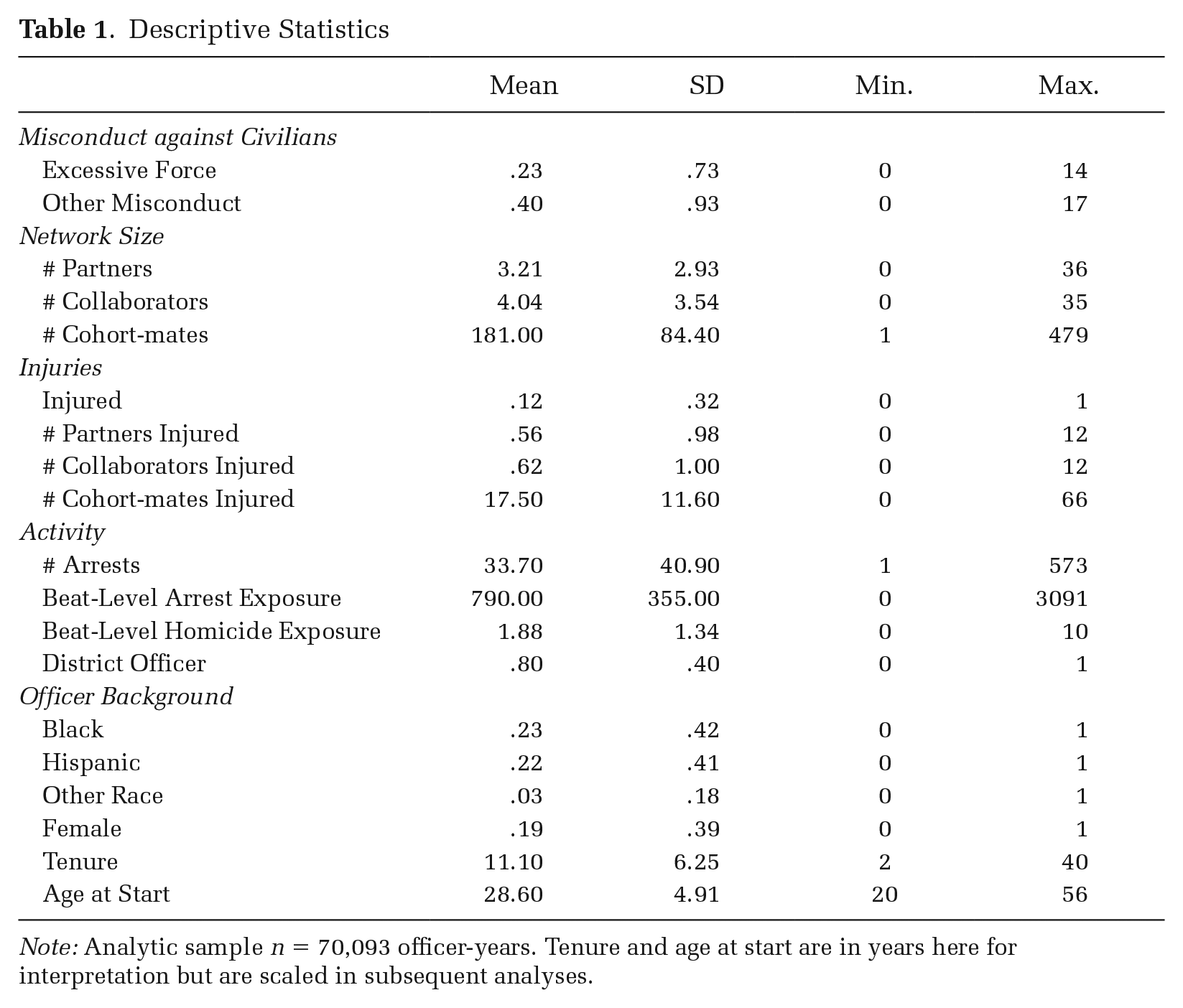
Note: Analytic sample n = 70,093 officer-years. Tenure and age at start are in years here for interpretation but are scaled in subsequent analyses.
Officer Networks
We study three types of network associates (or “peers”): (1) regular partners, who work frequently together, (2) collaborators who have worked together on occasion, and (3) members of the same cohort who trained concurrently at the police academy. Specifically, we define regular partners as officers who worked together in a capacity that led to their making at least two arrests within the past year, and collaborators as those who made just one arrest together within the past year. 10 To identify partners and collaborators, we construct yearly co-arresting networks (officers who are listed as making an arrest together) using data on all arrests made by officers in our analytic sample (N = 2.4 million arrests). 11
To restate, we define partners as officers who have a longer record of repeated interaction through arrests. Such partners do not necessarily work together exclusively and are not necessarily assigned to the same two-officer car or patrol team (although most CPD officers do work in two-person cars). We define collaborators as officers who are likely to know each other professionally but do not have a record of repeated interaction. Compared to partners, collaborators are more likely to be a product of officers who happen to be nearby and intersecting at the scene of an incident, or who are substituting duties for another officer while assisting on an arrest. Partners who repeatedly arrive on the scene together are more likely to have a close working relationship and thus be stronger ties. 12 Finally, we define members of the same cohort as officers who entered the police force within two months of each other. After entering the police force, officers attend the police academy, where they complete roughly 900 hours of training over a six-month period. Officers who enter the police force within two months apart are likely to have trained concurrently, and are thus reasonably likely to either know or know of each other (Doreian and Conti 2017). As Table 1 shows, officers, on average, had 3.2 regular partners and 4.0 collaborators in a given year and belong to a cohort with 181 other officers. 13
Injuries
Data on police injuries are available from Tactical Response Reports (TRR) filed between 2004 and 2015. Among other things, TRRs record when an officer is injured during an encounter with a civilian. TRRs do not identify all injuries that officers sustain while on the job, such as injuries due to accidents at the station house, but they do identify the type of injury of interest here—injuries that occur during an interaction involving a civilian. 14 Figure 1 displays the distribution of injuries sustained by officers and their peers.
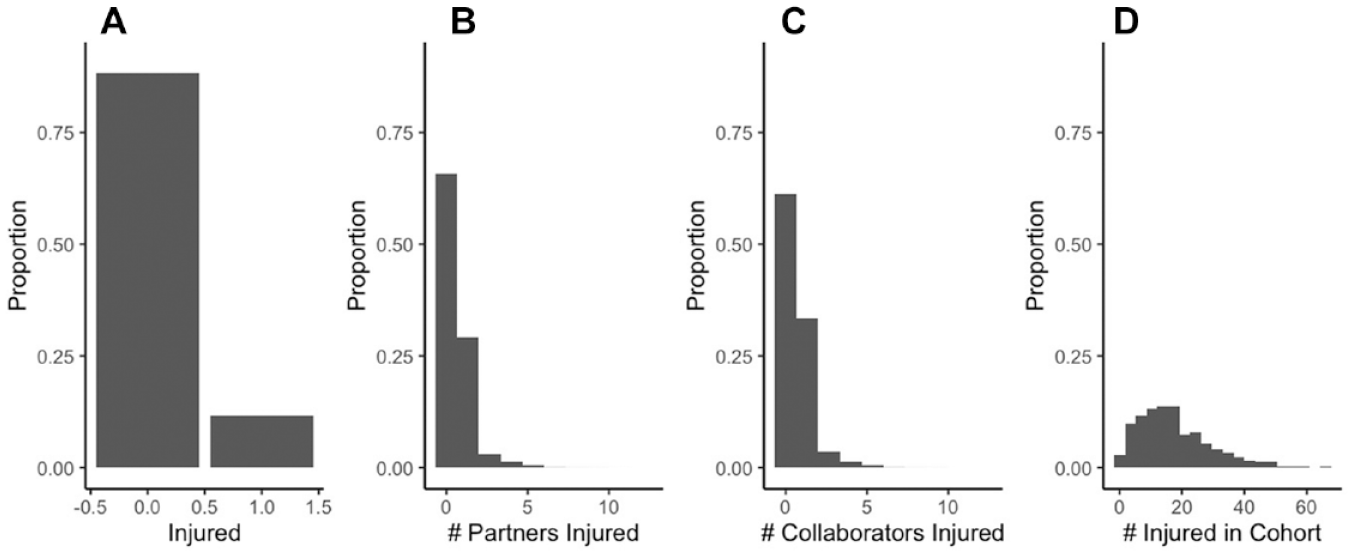
Distributions of Injuries
Approximately 12 percent of officers in our sample are injured annually (Figure 1A). In any given year, approximately 34 percent of officers have experienced one or more injured partners in the prior year (Figure 1B), and 38 percent of officers have recently experienced one or more injured collaborators (Figure 1C). Figure 1D describes the distribution of recent injuries in each officer’s cohort, where the average officer’s cohort has 17 injured members.
Fatal Injuries
We also analyze the effects of fatal injuries to cohort-mates on misconduct. 15 Fatal injuries occurred when an officer was slain or died due to injuries sustained while on duty. They exclude officer deaths sustained while off-duty (e.g., due to accidents or suicide). Using the Officer Down Memorial, we identified four fatal injuries during the observation period, two of which occurred in 2008 and two of which occurred in 2010. Although these events were relatively rare, their severity potentially triggers stronger network effects among peers because, as described above, death is the starkest example of the dangers of the job. There were 345 officers in our analytic sample for whom a member of their cohort was slain during our study: 210 officers belonged to the same cohort of the two officers who were slain in 2008, and 135 officers belonged to the same cohort of the two officers who were slain in 2010.
Excessive Force and Other Misconduct
To investigate whether excessive force and misconduct increases among officers who are tied to injured or slain network associates, we analyze all civilian complaints about officers in the analytic sample that occurred between 2004 and 2015. These included approximately 10,800 complaints of excessive force, as well as approximately 15,000 complaints of other kinds of abusive, inappropriate, or illegal behavior, including illegal search, false arrest, improper lockup procedures, traffic violations, verbal abuse, and other types of criminal misconduct (e.g., racial profiling, First Amendment violations, and domestic misconduct).
We differentiate between two types of misconduct: excessive force and other misconduct. For each type of misconduct, we constructed the outcome by considering (1) officers’ total number of allegations of each relevant type and (2) the weight of evidence on whether those allegations occurred. The data used here have the benefit of varying legal levels of severity, specifically, whether the complaints were investigated, sustained, unexonerated (i.e., neither enough evidence to prove or disprove the complaint), or exonerated. Our results reflect differences in investigatory outcomes, but we also retain all complaints in our main analyses for several reasons. 16 First, most complaints were uninvestigated or inconclusive (only 15 percent of allegations were investigated and could not be exonerated), and receiving multiple such complaints is likely a signal for misconduct, especially if it occurs frequently (most officers who received complaints received multiple complaints). Second, prior research suggests complaints in themselves capture problematic police behavior and misconduct (Terrill and Ingram 2016). Using the same data as the present study, Rozema and Schanzenbach (2019) found a strong correlation between civilian complaints and future civil litigation and city payouts.
Specifically, for each type of misconduct (excessive force and other misconduct), we assigned misconduct to be 0 for officers with no misconduct of the relevant type in a given year. Otherwise, we summed over all allegations of the relevant type for any given officer and year using the following scores: 1 = uninvestigated or exonerated accusation of misconduct, 2 = investigated and unexonerated accusations, 3 = sustained accusations. Our results are not sensitive to model specification 17 and are robust to alternative strategies for measuring misconduct, including the construction of a binary outcome, the removal of uninvestigated and exonerated complaints, and use of officer reports rather than civilian reports to proxy excessive force. 18
Suspect Race
To investigate our central group threat hypotheses, we code the race of the officer and the civilian involved in each injury incident using the TRR reports. 19 The main analyses differentiate between injuries to officers by Black suspects and by non-Black suspects. Sensitivity analyses differentiate between same- and different-race officer-suspect pairings (i.e., separate covariates for the number of peers injured by same- and different-race suspects).
Control Covariates
All analyses include control covariates to improve estimates of the effect of injuries to officers and their networks on complaints. Following prior research, we include controls for past misconduct (average number of complaints in prior years as a proxy for officer’s underlying behavioral tendencies for misconduct), recent injury, injury history (the average number of injuries in prior years), network characteristics (network size and average levels of misconduct among peers), officers’ own arrest activities and exposure to arrests and homicides in beats, and officer background, including their tenure, age at hire, gender (male/female), and race (White, Black, Hispanic, and other).
Because prior research demonstrates the ecological patterning of misconduct, especially in conjunction with perceived racial effects (Ba et al. 2021; Fyfe 1981; Geller and Karales 2006; Kane 2006; Worden 1996), we include fixed effects for unit assignments (a unit most often refers to a geographically bounded police district, but it can also refer to a specialized investigatory unit) as a proxy for both type and place of an officer’s policing activity. Officers work within their assigned unit at any given time; those working in higher-crime neighborhoods, who make more arrests, or who are involved in more complaint-warranting behavior may be linked to more injuries and more misconduct. Fixed effects for unit and time help account for some of the association between injury/deaths and the propensity for misconduct that reflect these differences. Because we lack data on formal beat assignment, we control for officers’ weighted exposure to homicides and arrests in the beats where they make arrests. 20 Ecological conditions are also partially accounted for by using controls for officers’ own arrest activity, how collaboratively officers work, and average levels of misconduct among their peers. 21
Analytic Strategy
We assess whether peer injuries predict subsequent misconduct overall (Hypothesis 1), as well as separately for excessive force and other types of misconduct (Hypothesis 2). For each analysis, we use ordinary least square regression to model misconduct (in which officers who received sustained allegations of misconduct or repeated allegations received a higher score).
22
Specifically, we model
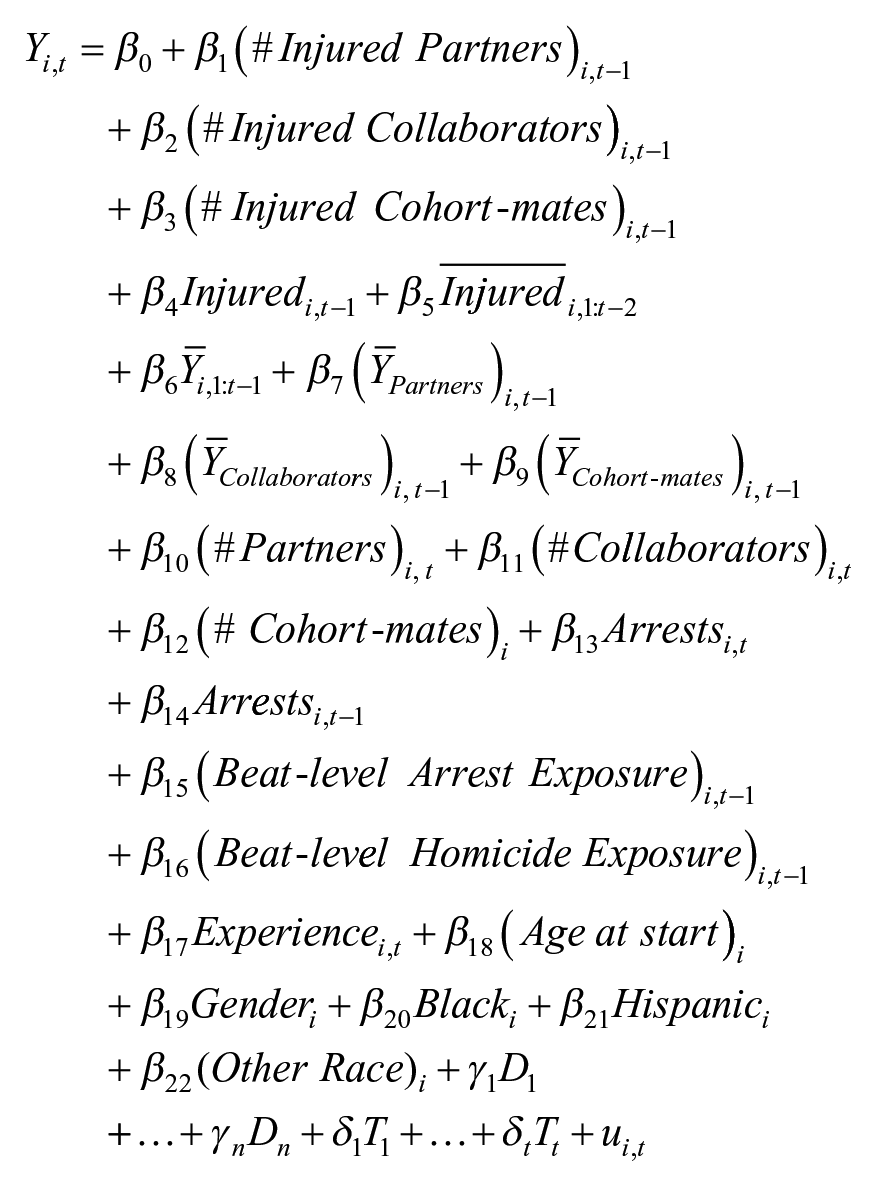
where
We conduct two additional analyses to test our hypotheses on race (Hypothesis 4) and to investigate the link between fatal injuries and misconduct (Hypothesis 5). First, we disaggregate the number of an officer’s network associates who were injured by Black civilians and the number who were injured by non-Black civilians for each type of tie. We then disaggregate these analyses further by conducting separate regressions by officer race. Second, we analyze the consequences of fatal injuries for both types of misconduct. Here, key covariates are the “group” indicator for whether officers experience a slain peer (cohort-mate) at some point, the time indicator for whether that death already occurred, and their interaction effect, which identifies officers who have already experienced the death of a peer. This strategy can be considered a difference-in-differences analysis, where the interaction term between group and time indicators describes how the difference in levels of misconduct over time differs between the two groups. Specifically,
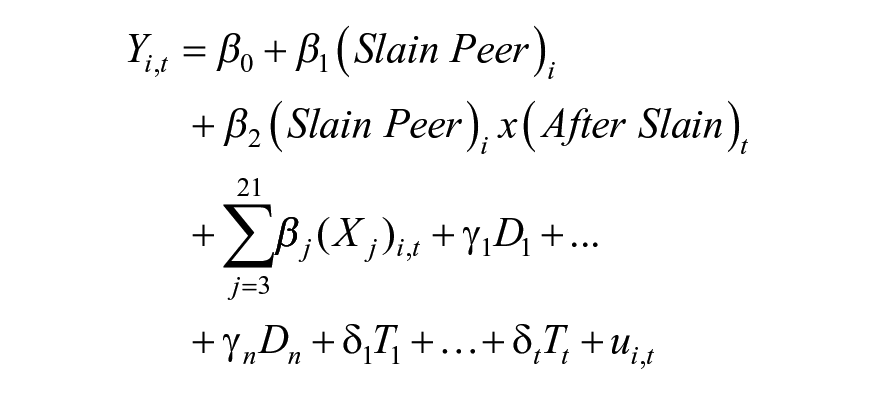
where
Results
Predictors of Excessive Force and Other Misconduct
Table 2 shows the results of OLS regressions of misconduct with unit/district fixed effects 23 beginning with total misconduct (Model 1), and then separating out excessive force (Model 2) from other misconduct (e.g., unwarranted searches and stops, destruction of property, verbal abuse, coercion) (Model 3).
Misconduct by Peer Injuries, Activity, and Background
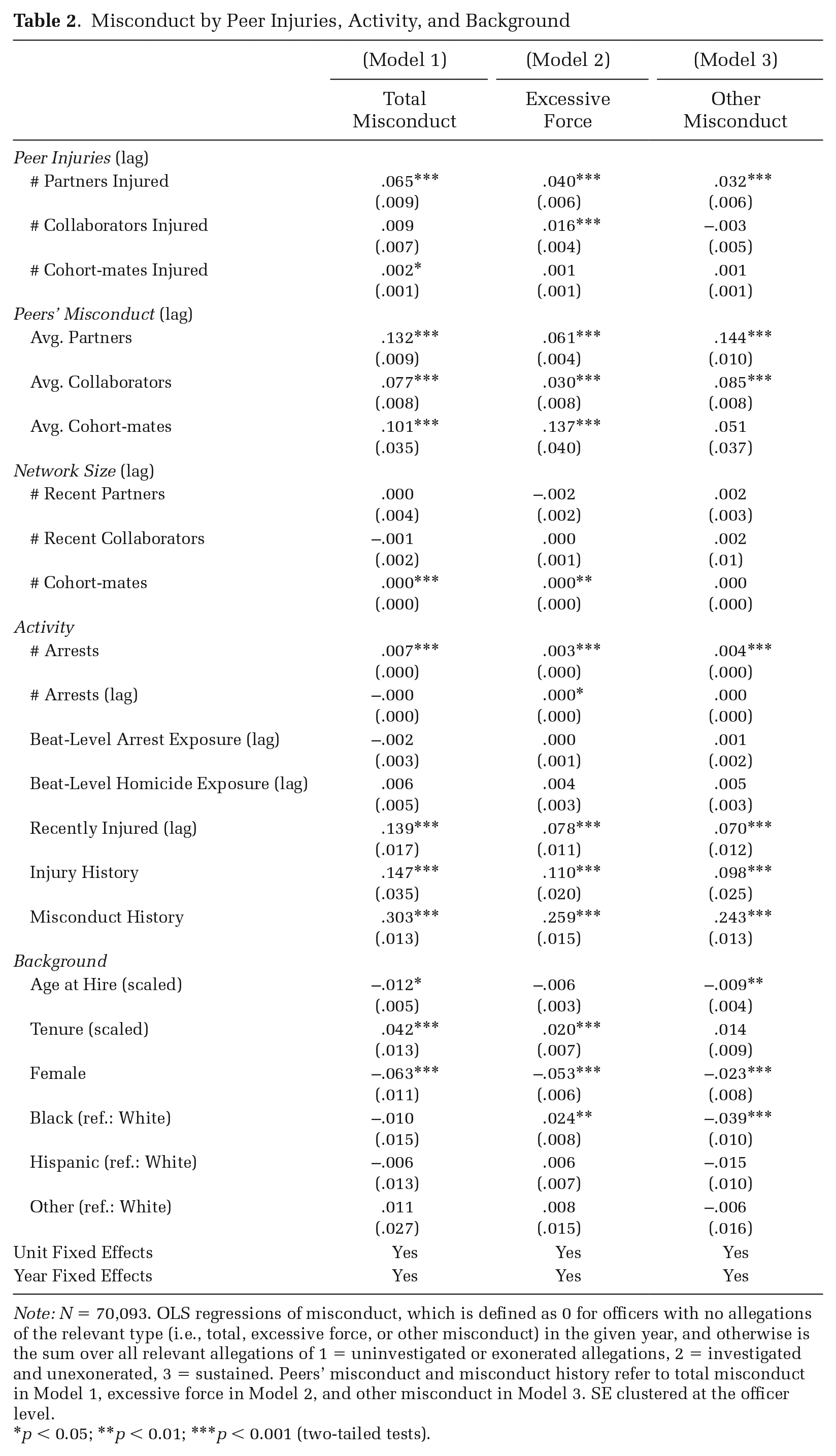
Note: N = 70,093. OLS regressions of misconduct, which is defined as 0 for officers with no allegations of the relevant type (i.e., total, excessive force, or other misconduct) in the given year, and otherwise is the sum over all relevant allegations of 1 = uninvestigated or exonerated allegations, 2 = investigated and unexonerated, 3 = sustained. Peers’ misconduct and misconduct history refer to total misconduct in Model 1, excessive force in Model 2, and other misconduct in Model 3. SE clustered at the officer level.
p < 0.05; **p < 0.01; ***p < 0.001 (two-tailed tests).
Across models, measures of activity are strong predictors of subsequent misconduct. These predictors likely reflect differences in officers’ underlying activities and propensity for misconduct and injuries. For example, officers already engaging in misconduct and whom have previously been injured by civilians are more likely to subsequently be involved in misconduct. In addition to own injury history, we control for own recent injury to ensure the estimated effects of injuries to partners or collaborators are not due to officers getting injured together. 24
Several demographic characteristics of officers predict excessive force and other misconduct. Female officers and officers who were hired at an older age are associated with less misconduct. In contrast, longer tenure (i.e., being a member of older cohorts) predicts more excessive force, net of the other controls. Black officers are associated with more excessive force but less other misconduct relative to their White counterparts. However, these racial differences only emerge after we control for officers’ history of misconduct and network characteristics. In other words, associations between officer race and misconduct are net of racial differences in individual officers’ underlying propensities for misconduct (e.g., related to personal history and psychology) and net of differences in networks and activity.
Finally, officers’ misconduct patterns resemble that of their network associates: partners and collaborators of officers who are more involved in misconduct are themselves involved in more misconduct. Officers also tend to resemble their cohort-mates in excessive force, net of the controls. Network size is less consistently associated with misconduct: larger numbers of cohort-mates are connected to excessive force, but all else equal, numbers of partners and collaborators do not predict misconduct.
Injuries to Peers and Tie Strength
Our main findings involve the implications of injuries to peers on misconduct: when officers have more partners who are injured during an interaction with a civilian, they are more likely to be involved in subsequent misconduct (Hypothesis 1). Partners of officers who sustained higher levels of misconduct are also likely to sustain higher levels of excessive force and other misconduct that does not involve force (Hypothesis 2). Collaborators’ injuries correlate with subsequent levels of force as well, although to a lesser extent than for partners’ injuries. Finally, there is little effect of cohort-mates’ injuries on levels of misconduct.
Critically, the effect of having injured network associates is stronger for stronger ties (Hypothesis 3). Injuries to partners and collaborators are both linked to allegations of excessive force, but the magnitude of the association is larger for partners than for collaborators (Table 2, Model 2). Furthermore, only injuries to partners, and not injuries to collaborators or cohort-mates, are linked to other kinds of misconduct (Table 2, Model 3). The effects of tie strength account for similarities between peers’ activities on the job (due to controls for own and peers’ misconduct, arrest activities, number of peers, and police district); that is, results are not driven by the fact that partners are more likely to match on misconduct levels and injuries than are collaborators or cohort-mates.
Overall, these results support the idea of a group threat response to injured peers on misconduct via either a greater number of allegations or in more evidence that misconduct occurred. Because this outcome could be sensitive to civilians’ willingness to report misconduct, we also assess whether injured peers have implications for the risk of receiving any allegation of misconduct over the course of a year. Sensitivity analyses show that injuries to peers predict not only more excessive force in terms of repeated or higher-evidence allegations (as in the main results), but also more involvement in allegations of excessive force in the first place (see Appendix Table A1, Model 2). In fact, each injured partner predicts an increase of 0.075 in the log-odds of whether officers allegedly use excessive force (Appendix Table A1). This translates to approximately 50 more officers who use excessive force in the average year if all officers were to have one injured peer (rather than no injured peers). Although this is not a large effect in terms of the number of officers, it is a large effect on the number of victimized civilians given officers’ capacity for repeated excessive force. However, the sensitivity analyses show the results are less robust for other kinds of misconduct outside of excessive force (Appendix Table A1, Model 3). 25
Suspect and Officer Race
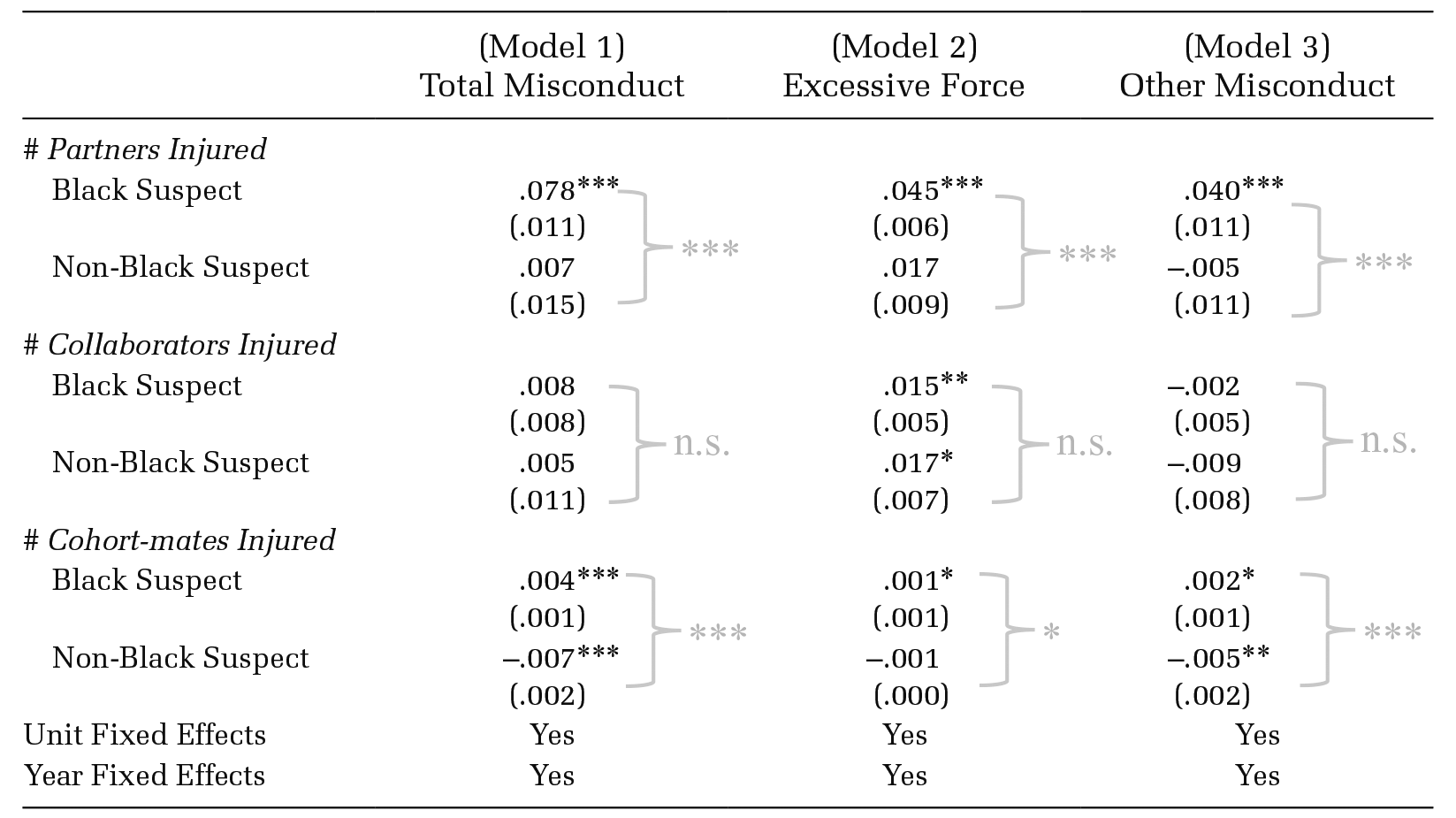
Next, we examine the role of race, starting with the race of the suspects who injured officers’ peers. Table 3 repeats the above analyses but disaggregates numbers of injuries to officers’ network associates based on whether the injured officer sustained the injury while interacting with a Black or a non-Black civilian. 26 Models use the same set of control variables as prior analyses. Results show the effects of peer injuries on increased misconduct are most striking for injuries attributed to Black suspects (Hypothesis 4). Injuries to partners attributed to Black suspects are positively associated with subsequent misconduct, whereas injuries to partners attributed to non-Black suspects are not associated with misconduct. The difference in effect of injuries to partners that implicate Black and non-Black suspects is statistically significant: we reject the null hypothesis of no difference in favor of the alternative hypothesis of a stronger effect for Black suspects than for non-Black suspects at the 0.1 percent significance level (Table 3, Model 1).
Misconduct by Peer Injuries and Suspect Race
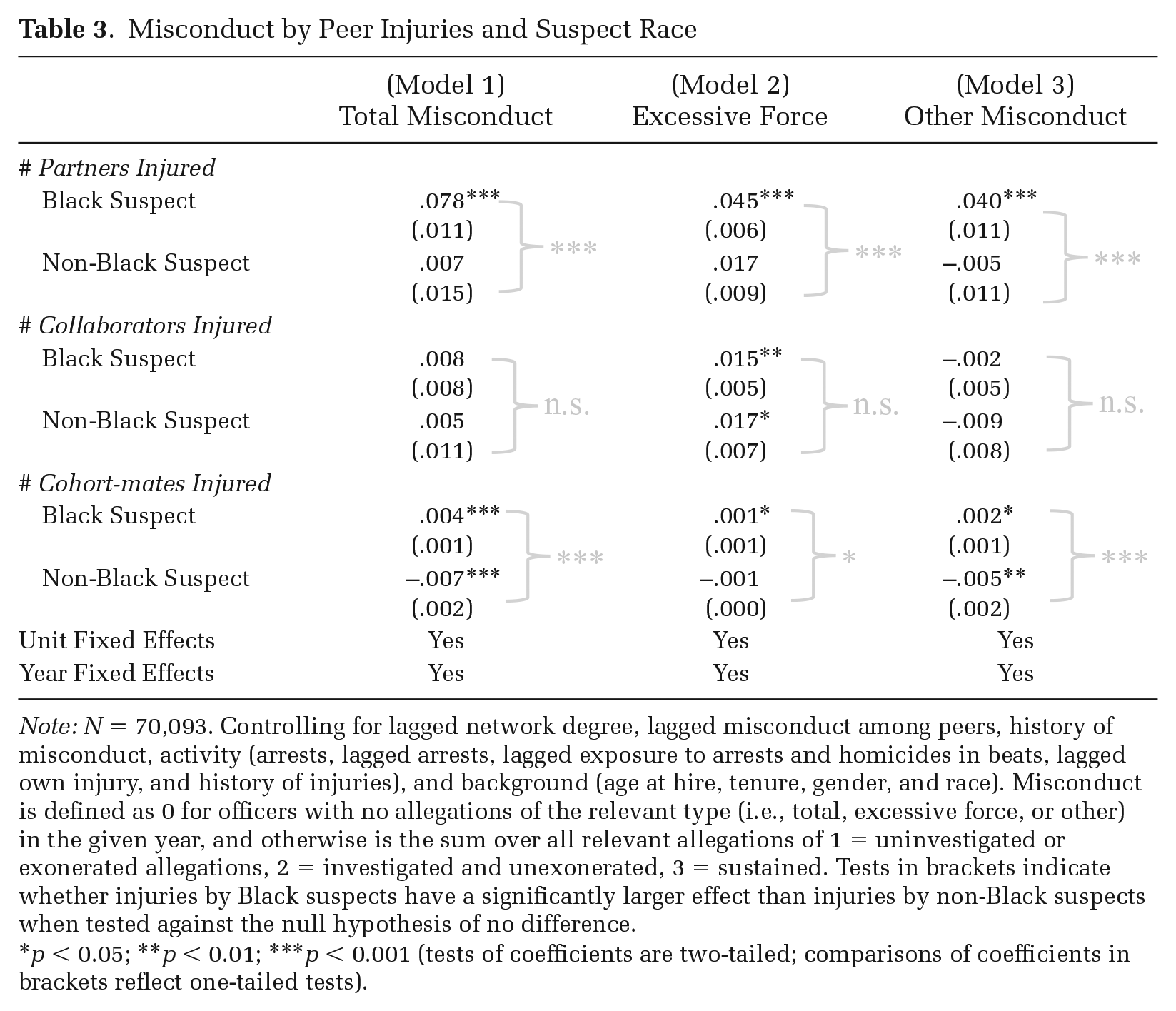
Note: N = 70,093. Controlling for lagged network degree, lagged misconduct among peers, history of misconduct, activity (arrests, lagged arrests, lagged exposure to arrests and homicides in beats, lagged own injury, and history of injuries), and background (age at hire, tenure, gender, and race). Misconduct is defined as 0 for officers with no allegations of the relevant type (i.e., total, excessive force, or other) in the given year, and otherwise is the sum over all relevant allegations of 1 = uninvestigated or exonerated allegations, 2 = investigated and unexonerated, 3 = sustained. Tests in brackets indicate whether injuries by Black suspects have a significantly larger effect than injuries by non-Black suspects when tested against the null hypothesis of no difference.
p < 0.05; **p < 0.01; ***p < 0.001 (tests of coefficients are two-tailed; comparisons of coefficients in brackets reflect one-tailed tests).
The contingency of the effects of injuries to partners on suspect race remains after breaking down the analysis by misconduct type. Injuries to partners attributed to Black suspects, but not to non-Black suspects, are linked to higher levels of excessive force (Table 3, Model 2) and other types of misconduct (Table 3, Model 3). The difference in the implications of injured peers by suspect race may also be more present for injured cohort-mates, but it is not present for collaborators and is strongest for injured partners. These patterns again support that there is a more consistent, and likely more intense, group threat response in the aftermath of threats to stronger ties such as partners.
Figure 2 depicts the relationship between injuries to partners and suspect race, building on the results from Table 3 and underscoring two key patterns. First, the largest and most robust implications of partners’ injuries for misconduct are injuries that implicate Black suspects. Second, threats to officers’ partners attributed to Black suspects are positively associated with excessive force (middle panel) and other types of misconduct (right panel).
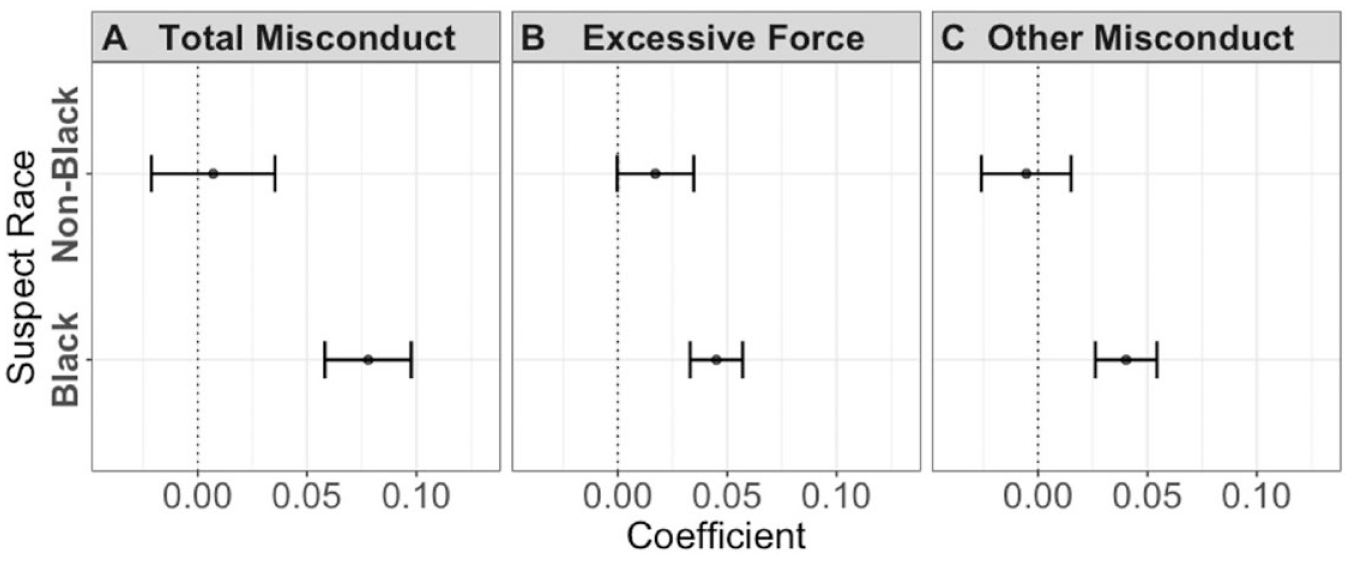
Effect of an Injured Partner on Officers’ Misconduct by Suspect Race
Table 4 disaggregates the analysis by officer race (White, Hispanic, and Black). 27 Threats to partners from Black suspects (but not non-Black suspects) predict more excessive force among officers of any race (Columns 1, 2, and 3). The difference in the effects of injuries on excessive force that is attributed to Black versus non-Black suspects is statistically significant for White and Hispanic officers (at the 5 percent and 1 percent significance level, respectively). Threats to partners that are attributed to Black suspects (but not non-Black suspects) also predict more other misconduct for White and Hispanic officers, and the contingency of the effect on suspect race holds across officer race (Columns 4, 5, and 6).
Misconduct by Peer Injuries Stratified by Officer Race
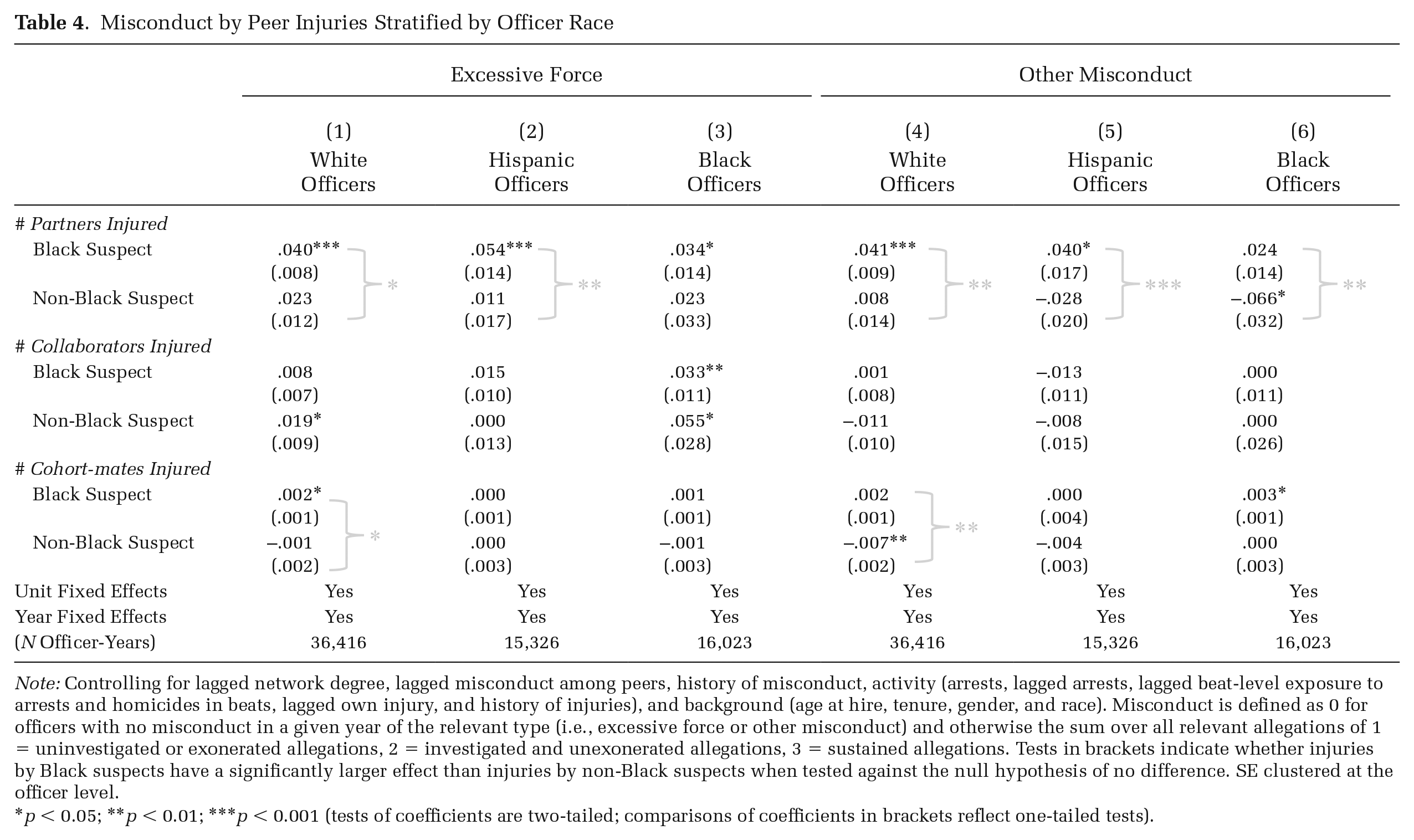
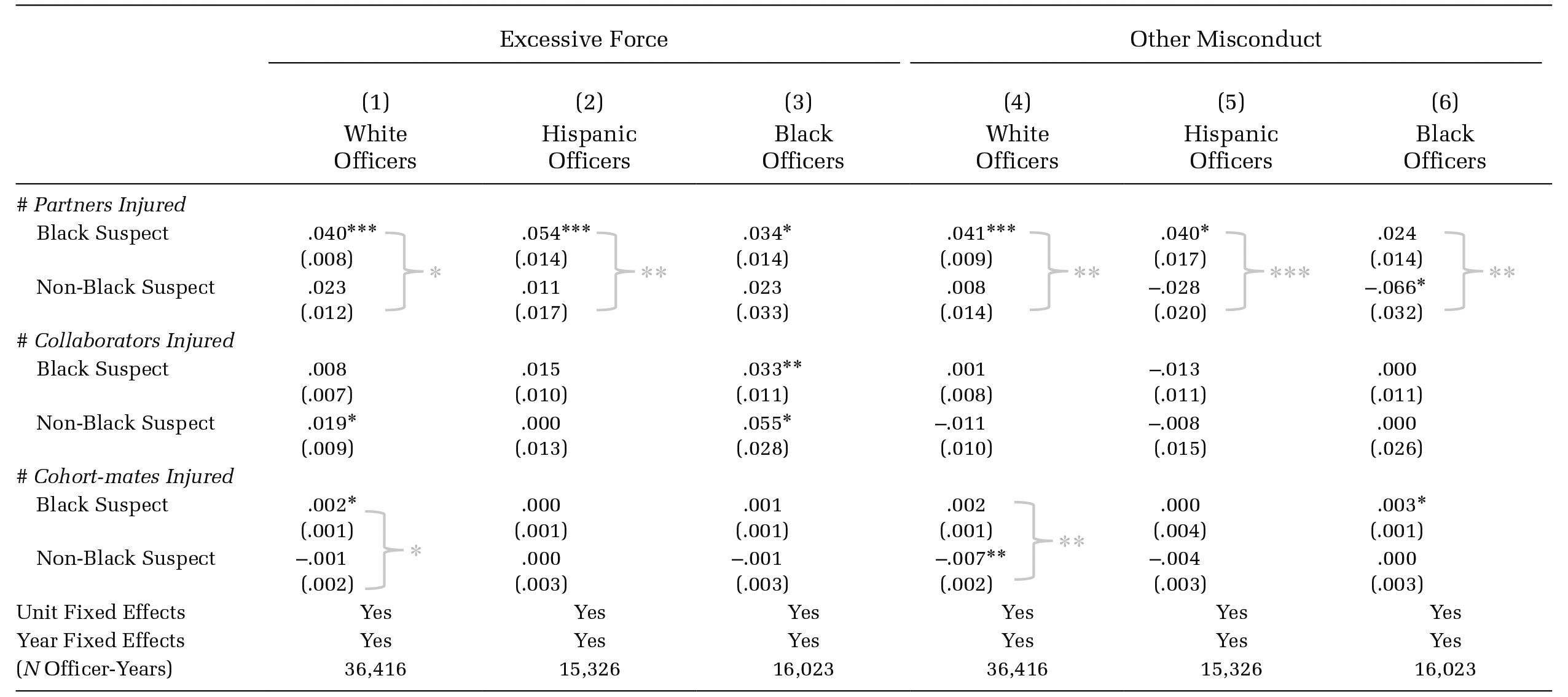
Note: Controlling for lagged network degree, lagged misconduct among peers, history of misconduct, activity (arrests, lagged arrests, lagged beat-level exposure to arrests and homicides in beats, lagged own injury, and history of injuries), and background (age at hire, tenure, gender, and race). Misconduct is defined as 0 for officers with no misconduct in a given year of the relevant type (i.e., excessive force or other misconduct) and otherwise the sum over all relevant allegations of 1 = uninvestigated or exonerated allegations, 2 = investigated and unexonerated allegations, 3 = sustained allegations. Tests in brackets indicate whether injuries by Black suspects have a significantly larger effect than injuries by non-Black suspects when tested against the null hypothesis of no difference. SE clustered at the officer level.
p < 0.05; **p < 0.01; ***p < 0.001 (tests of coefficients are two-tailed; comparisons of coefficients in brackets reflect one-tailed tests).
Overall, a group threat response following peer injuries depends more consistently on suspect race than on officer race. It is clear that injuries by Black suspects are more positively associated with misconduct than injuries by non-Black suspects. Yet there is also a possibility that Black officers differ from other officers, in that injuries to partners of Black officers by non-Black suspects actually predict less “other” misconduct, all else equal (Column 6). The negative effects of injuries to peers of Black officers by non-Black suspects on misconduct warrant further investigation and are somewhat sensitive to model specification. 28 Further research is needed to determine whether this pattern is due to small cell sizes or heterogeneity in how Black officers perceive racialized threat and how they connect with other officers.
Figure 3 provides a summary of the effect of having an injured partner on predicted misconduct, varying officer race as well as the race of the civilian who was involved in injuries. Overall, both excessive force (Figure 3A) and other types of misconduct (Figure 3B) are linked to prior injuries to peers, and the extent to which this is true depends strongly on suspect race. Officers of any race whose partners are injured by Black suspects (but not non-Black suspects) are linked to both excessive force and other problem behaviors outside of excessive force, net of the other covariates. Again, these findings do not provide definitive evidence on implications of officer race: patterns of increased excessive force and misconduct are consistent for White and Hispanic officers with injured partners, but the evidence is less clear for Black officers across all models. However, the effect of suspect race remains consistent: there is a group threat response by officers of all races after injuries to their peers by Black suspects.
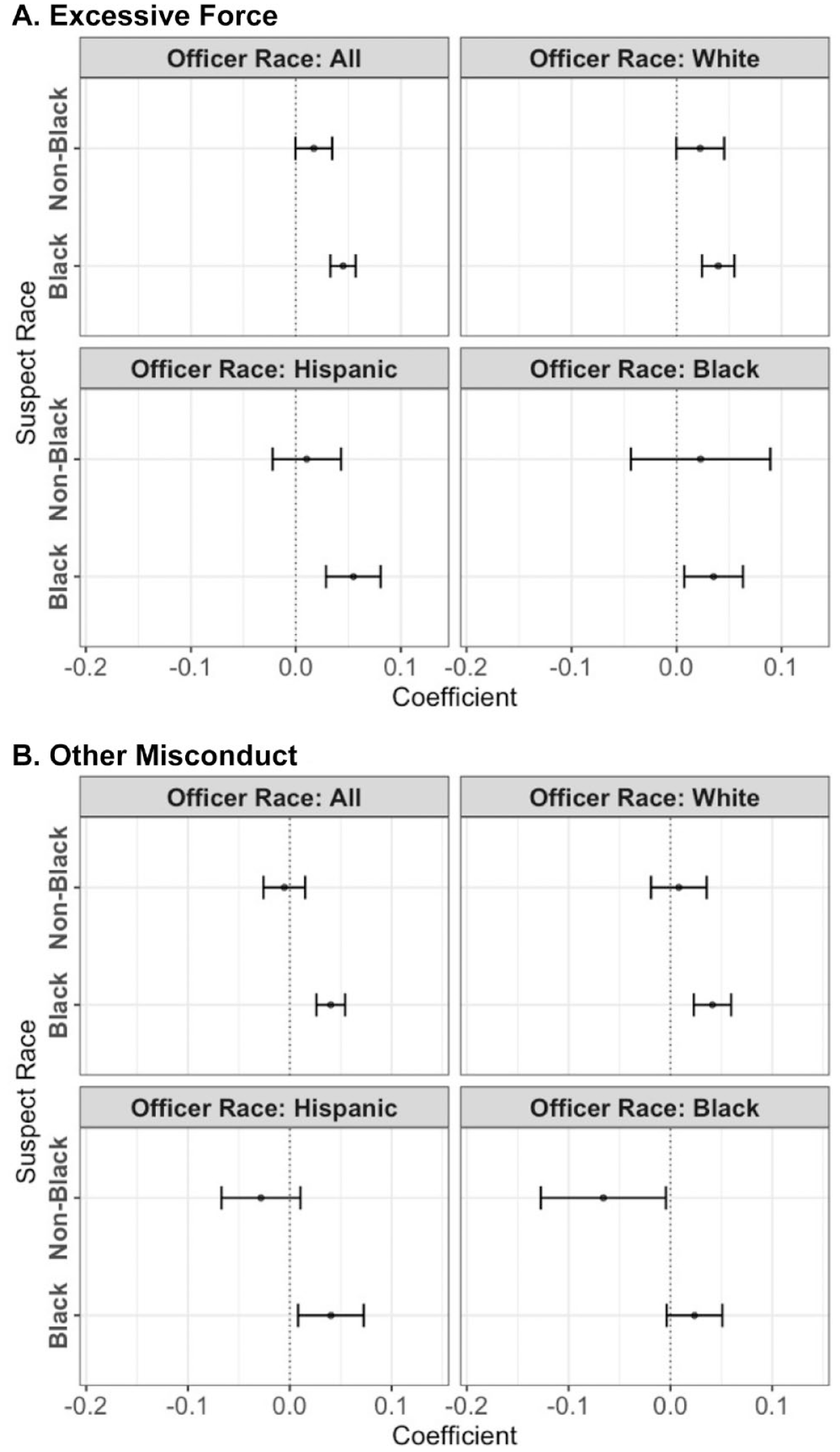
Effect of an Injured Partner on Officers’ Misconduct by Type of Misconduct, Suspect Race, and Officer Race
Fatal Injuries and Slain Officers
The final set of analyses examines fatal injuries, which may improve our ability to potentially observe a networked group threat response for weaker types of peer relationships (cohort-mates). 29 The results in Figure 4 show predicted misconduct using a regression that compares the intensity of excessive force between “Group A,” composed of all officers with no slain peer (solid line), and “Group B,” composed of all officers who were cohort-mates of the officers who were slain in 2010 (dotted line). We conduct this comparison between the two trends by including an indicator for group membership, an indicator for time, and their interaction, which describes the difference in misconduct between the two groups over time.
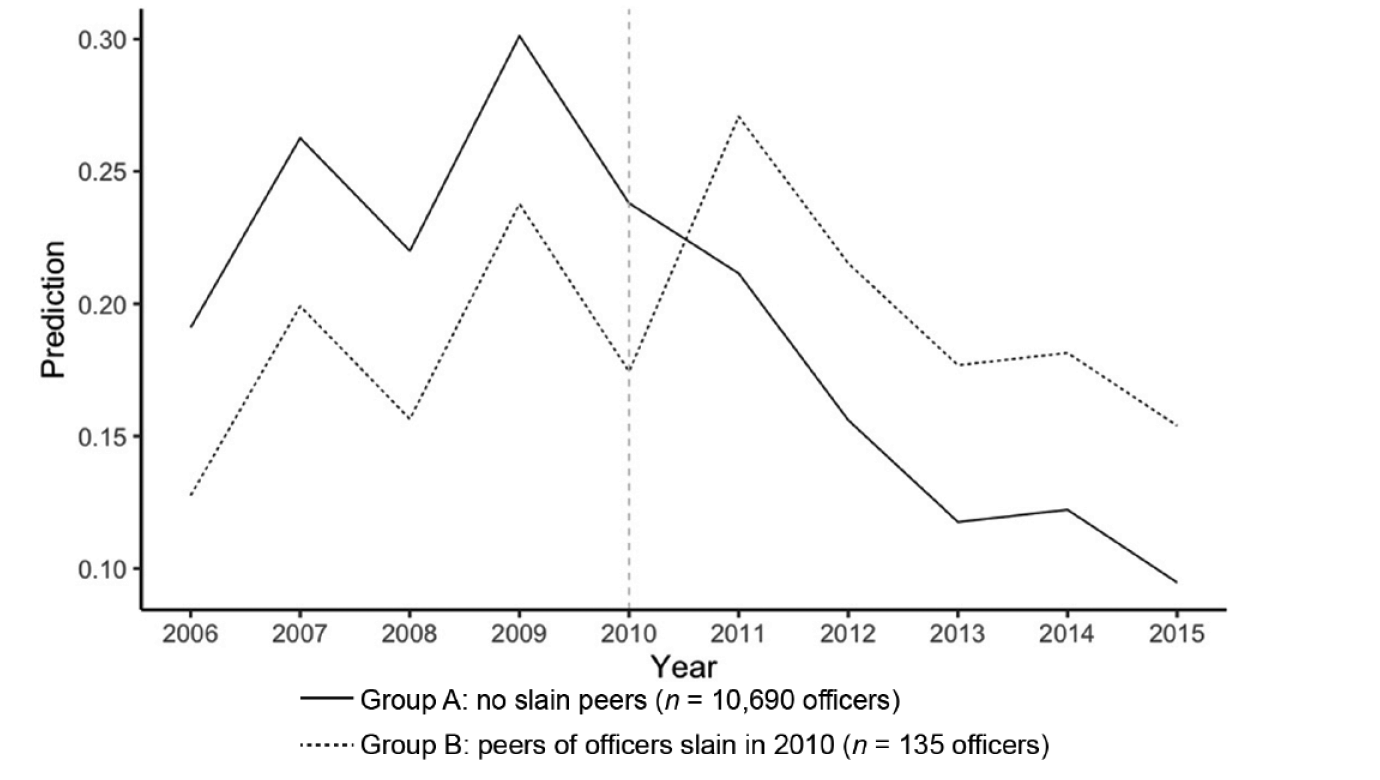
Difference-in-Difference in Excessive Force among Officers with and without Ties to Peers Slain in 2010
The results show an uptick in excessive force after an officer’s death among cohort-mates of the slain officer (Group B). Peers of officers who were slain in 2010 (Group B) comprised a group that was initially less prone to excessive force than their counterparts with no slain peers (Group A). However, the amount of excessive force within the group with the slain peer caught up to the other officers shortly after 2010, and then surpassed them, as shown in Figure 4. This difference in trends is significant at the 0.1 percent significance level, as shown in the regression on which Figure 4 is based (see Appendix Table A2). Similar analyses show that officers whose peers were slain in 2008 also had higher levels of excessive force than officers with no slain peers, although the difference was not statistically significant, which could reflect a less recent cohort, larger cohort, or other details of injuries that require further investigation (see Appendix Figure A1). Overall, the analyses on the aftermath of slain cohort-mates provide partial support for Hypothesis 5: ties to fatally injured officers are linked to increased excessive force.
Sensitivity, Limitations, And Scope
Our main analysis considers whether injuries to peers predict which officers have heightened misconduct after controlling for time-constant officer characteristics such as gender or race and ethnicity, as well as individual officers’ misconduct histories. As a robustness check, we re-ran our main models adding officer fixed effects instead of controlling for time-constant officer characteristics (Appendix Table A3). The key findings remain unchanged—injuries to peers predict more misconduct, especially misconduct that involves excessive force—even in these sensitivity analyses that only leverage within-officer variation in misconduct. In the sensitivity analyses, coefficients on some of the controls for peers’ excessive force are no longer significant, which suggests officers’ excessive force resembles that of their peers at any given time, in part due to their underlying use of excessive force. Our finding of the intensification of excessive force after injuries to peers is also robust to various strategies for accounting for officers’ underlying use of excessive force. Furthermore, we conducted a placebo test that considers the possibility of a reverse relationship between injuries to peers and misconduct (Appendix Table A4). Using current excessive force and other misconduct to predict future partner injuries, we found no effect of current misconduct on future partners’ injuries, lending further support to our results.
We also assess the robustness of the results on suspect race. First, the results on suspect race persist in models that include officer fixed effects (Appendix Table A5). These sensitivity analyses increase our confidence that unobserved differences between officers do not drive our observation of a stronger networked group-threat response after injuries attributed to Black suspects (compared to after injuries attributed to non-Black suspects). Second, we find that the misconduct response that depends on suspect race is robust to analyses that also control for racial congruence between the focal officer and their partners (Table A5, Models 1 to 4). These sensitivity analyses suggest misconduct does not depend as much on the racial match between officers and their partners. Third, while injuries by Black suspects have a stronger effect on misconduct than injuries by non-Black suspects (Table A5, Models 1 and 3), injuries that involve racial mismatch do not have a stronger effect than injuries by suspects of the same race as officers (Table A5, Models 2 and 4). Finally, our main finding on suspect race—the link between peer injuries that are attributed to Black suspects and heightened misconduct—is unlikely to be driven by more severe injuries to officers’ peers due to Black suspects. When defining injuries using only reports of battery or deadly use of force against officers, there continues to be a significant effect of injuries by Black suspects, and this remains significantly larger than the effect of injuries by non-Black suspects (Appendix Table A6).
A limitation of our analyses is that we cannot fully observe work relationships between officers (doing so requires data from patrol assignments, which we do not have). We conducted two sets of analyses that suggest results are robust to our strategy of proxying work relationships with co-arrests. First, results are unchanged in the unrestricted sample (Appendix Table A7, Column A), the sample restricted to officers that make at least one arrest in a given year (the main results), and the samples that impose stronger restrictions to at least 5 or 25 arrests (Appendix Table A7, Columns C and D). Second, we show that results are robust to alternative cut-offs for which officers count as partners (Appendix Table A8). Our approach of using co-arrests likely underestimates work relationships by excluding relationships that do not yield an arrest, but results do not depend on the specific choice of the number of co-arrests required for officers to count as partners.
Discussion
Policing in the United States is characterized by a culture that generates a blue brotherhood, that is, a cohesive in-group and strong sense of solidarity that prioritizes safety of oneself and one’s fellow officers. Threats to this blue brotherhood, whether real or perceived, might elicit a group response in the form of more aggressive policing, increased arrests, and more frequent use of force and misconduct (Fassin 2013; Legewie 2016; Vargas 2014). Prior research has found some evidence of such a group threat response (Holz et al. 2023; Legewie and Fagan 2016), but our study examines how direct network ties and the strength of those ties might act as the conduit for subsequent misconduct, including the use of excessive force. We find evidence that threats to the “thin blue network”—an officer’s immediate network of peers, partners, and cohort mates—can indeed prompt subsequent police misconduct. Our results underscore the importance of networks—and especially injuries to peers—in predicting when and how much misconduct occurs.
We find that having injured network associates predicts increased misconduct after the injury, especially for misconduct that involves excessive force. Injuries to officers’ peers are associated with subsequent increases in misconduct through a larger number of allegations or more allegations that cannot be exonerated (sensitivity analyses show that injured peers are also associated with higher risk of receiving any allegation of excessive force). Our main results support the idea that “other” misconduct (i.e., misconduct not involving excessive force) also increases in the aftermath of injuries to officers’ peers, but sensitivity analyses show that implications of injured peers are less robust for this type of misconduct. These results support Hypothesis 1—that injuries to officers’ network associates predict subsequent misconduct among officers—but also qualify that there is a more consistent connection between injured peers and increased misconduct that specifically involves excessive force (in partial support of Hypothesis 2).
Increased misconduct in the aftermath of injuries to network associates also depends on the type of network associates involved. In strong support of Hypothesis 3, injuries to peers have the largest effect on misconduct when these peers are strong ties; in our case, regular partners who worked together on multiple occasions. Effect sizes are smaller and less consistent for weaker ties (“collaborators” and “cohort-mates”). In addition, while officers who work closely together may have similar underlying misconduct propensities, this is unlikely to fully account for our findings, because we control for officers’ and their peers’ misconduct history and include unit fixed effects that help account for officers’ locations and activities. This finding suggests injuries to strong ties may trigger a more significant group threat response than injuries to officers’ weaker ties. Such an interpretation extends the existing literature on the timing of a group threat response following high-profile events (Legewie and Fagan 2016) by analyzing whether the response occurs within networks. Prior analyses by Holz and colleagues (2023) consider only weak ties (cohort-mates) and thus do not account for how such a response could move through exact networks of strong ties between officers who have regularly or recently worked together.
In support of the core group threat argument (Hypothesis 4), heightened excessive force (as well as other misconduct) following injuries to network associates is significantly larger when injuries are attributed to Black suspects. The contingency of this networked misconduct response on suspect race holds across all models, including those considering officer race: all officers whose peers are injured by Black suspects are more likely to be involved in more misconduct; the same is not true when officers’ peers are injured by non-Black suspects. Yet we also found some differences across officer race that we cannot fully explain. Namely, injuries to network affiliates of Black officers by non-Black suspects—injuries that may be less consistent with officers’ biased frame of what threats to policing look like—may predict less misconduct that does not involve force; this pattern was somewhat sensitive to model specification. Thus, while our results clearly illustrate how a sense of threat may spread through officers’ networks, particularly following threats that originate from Black civilians, they are less clear on whether Black officers interpret this threat differently from officers of other races.
The analysis of fatal injuries supports the interpretation of a networked group threat response in several ways. First, although injuries to cohort-mates in general had only weak implications for misconduct, fatal injuries were at times linked to more misconduct, suggesting the death of an officer can carry great weight across even the broadest of network ties. Second, investigating the effects of fatal injuries to cohort-mates also allowed for a difference-in-differences analysis that strengthens the interpretation of a group threat response by offering some degree of protection against the complications of network choice. Overall, and in support of Hypothesis 5, we observe a link between fatally injured officers and more excessive force and other misconduct. However, further research is needed to understand how cohort size, recency, or contextual details of the death moderate the experience of having a slain cohort-mate.
Despite our controls for misconduct history and fixed effects that help account for officers’ locations, activities, and underlying propensities for misconduct, there likely remain unobserved differences between officers with many injured partners and collaborators and officers without them. This issue is reduced when defining network associates as cohort-mates, because cohorts are formed by relatively random assignment. Even when defining network associates in this more conservative way, we see that severe injuries to peers are associated with more police misconduct. Such sensitivity analyses suggest that our observation of a networked group threat response does not just reflect how officers choose their networks but, instead, at least partially captures how officers actually respond in the aftermath of injuries to their network associates.
There are several limitations to our study. First, even though we leverage assignment to districts and misconduct history to account for underlying misconduct propensity and heterogeneous injury risk due to heterogenous crime exposure, more injury-prone officers and more misconduct-prone officers may still be more likely to form partnerships. Thus, while we document a networked misconduct response, further research, especially considering additional officer-level attributes, is needed to unpack these mechanisms. Second, future research is also needed to fully understand the racial and ethnic differences we identify, especially racial homophily and heterogeneity between officers and civilians in events that lead to injuries. Our findings on race align with recent findings on biased policing against Black civilians (Coviello and Persico 2015; Fagan et al. 2022; Legewie 2016; Voigt et al. 2017), and are consistent with the idea that policing has a racially biased frame of perceiving Black civilians as “threats” (Simon 2021).
Finally, there are likely a host of different psychological motivations (e.g., stereotyping, risk assessments, frustration, job dissatisfaction, overt retaliation) linked to group threat that can increase the use of force as well as other types of misconduct, and many such motivations are likely intertwined with individual officer attributes, group contexts, and cultural dimensions of policing (Correll et al. 2014). Our study demonstrated one possible way to measure the processes through which group threat gets activated and translated into behavior, but we are unable to parse out all possible mechanisms driving misconduct or differentiate how various social psychological processes might take place within network contexts of officers. Additional data and future research should further unpack the connections between psychological motivations for misconduct and specific types of misconduct.
These findings offer potential insights for policies aimed at reducing police misconduct and abuse. At the individual officer level, history of misconduct—and the misconduct of one’s peers—are a strong and consistent marker of misconduct and use of force. These tendencies are likely to intensify after the injury of a peer, which suggests there are “bad apples” and “problem officers” whose behavior is already known and documented and yet are still given opportunities to abuse civilians. Enforcing greater oversight for high-misconduct officers is essential, not because it will “fix” the institution of policing, but because it might reduce some of the harm and trauma perpetuated by these individual officers. Managing problem officers, however, necessitates policy and institutional changes, including eliminating or reducing barriers, such as qualified immunity, that hinder police accountability. It also requires developing policies and practices, such as de-escalation training or revised use of force policies, that more fully constrain and discipline officers in the event of misconduct (Ray and Neily 2021).
Yet, our results also demonstrate that focusing solely on individual officers is myopic. The finding that network ties facilitate misconduct responses underscores that police misconduct (like deviance more generally) is a group phenomenon. Focusing solely on individual officers ignores this fact and, in so doing, pays no mind to the immediate group dynamics associated with some of the misconduct and use of force. Policies and efforts to curb police misconduct and abuse must expand their focus toward networks and groups of officers. Our analyses demonstrate that existing data sources could be used to implement networks-based interventions. For example, management and oversight tools could be used to detect networks in the aftermath of an injury to anticipate the need for support while also curtailing subsequent misconduct before it increases: officers linked to injured peers could be provided necessary psychological support and placed in assignments or given work duties after the injury that are less likely to lead to contentious interactions with civilians.
Turning our attention from individual officers and toward networks and groups represents an important shift in our explanations of police misconduct, but it also suggests that larger organizational and cultural factors play a crucial role in sustaining police misconduct and abuse. The underlying culture in the institution of policing that prioritizes in-group safety at the cost of the safety of civilians is much larger than a single unit, group, or department (Sierra-Arévalo 2021). No single policy, strategy, or training—even those extending beyond “problem officers”—is sufficient to lead to such structural changes. Simply monitoring or disciplining networks of officers will likely not lead to cultural or structural change if the dominant explanation for police misconduct remains focused on individuals. Moreover, attempts at changing police policy and culture can exacerbate a sentiment among police officers that the “War on Cops” has grown, even despite lack of evidence (Sierra-Arévalo and Nix 2020), feeding directly back into the “warrior” mindset that dominates policing (Stoughton 2015). It is this very culture that tells officers in a police network to respond to the harm of “one of their own” as opposed to intervening when “one of their own” engages in inappropriate behavior or calming down a fellow officer when tensions are high. Policy discussions can and should continue to focus on organizational level changes that can hopefully curb some dangerous behaviors, but a broader cultural pivot away from a “warrior” mentality is crucial.
Our findings imply that threats to the Thin Blue Network manifest not simply on the Facebook pages of police officers or the lawn signs of police family members, but in the very real and potentially deadly interactions between civilians and police. Identifying risk factors for when and where police misconduct might increase is crucial for mitigating harm and reducing trauma, but it should not distract scholars and policymakers from also addressing the deeper issues that sustain problematic police behavior. While the network insights from this study underscore the importance of shifting our theories and policies pertaining to police misconduct away from individual-level explanations, we do not purport to have solutions to all the deeper structural or cultural dimensions embedded in U.S. policing. Rather, we hold only that ignoring the group nature of policing, and the culture that supports it, leads to potentially deadly outcomes for civilians.
Footnotes
Appendix
Effects of Peer Injuries on Excessive Force and Other Misconduct Varying the Threshold between Partners and Collaborators
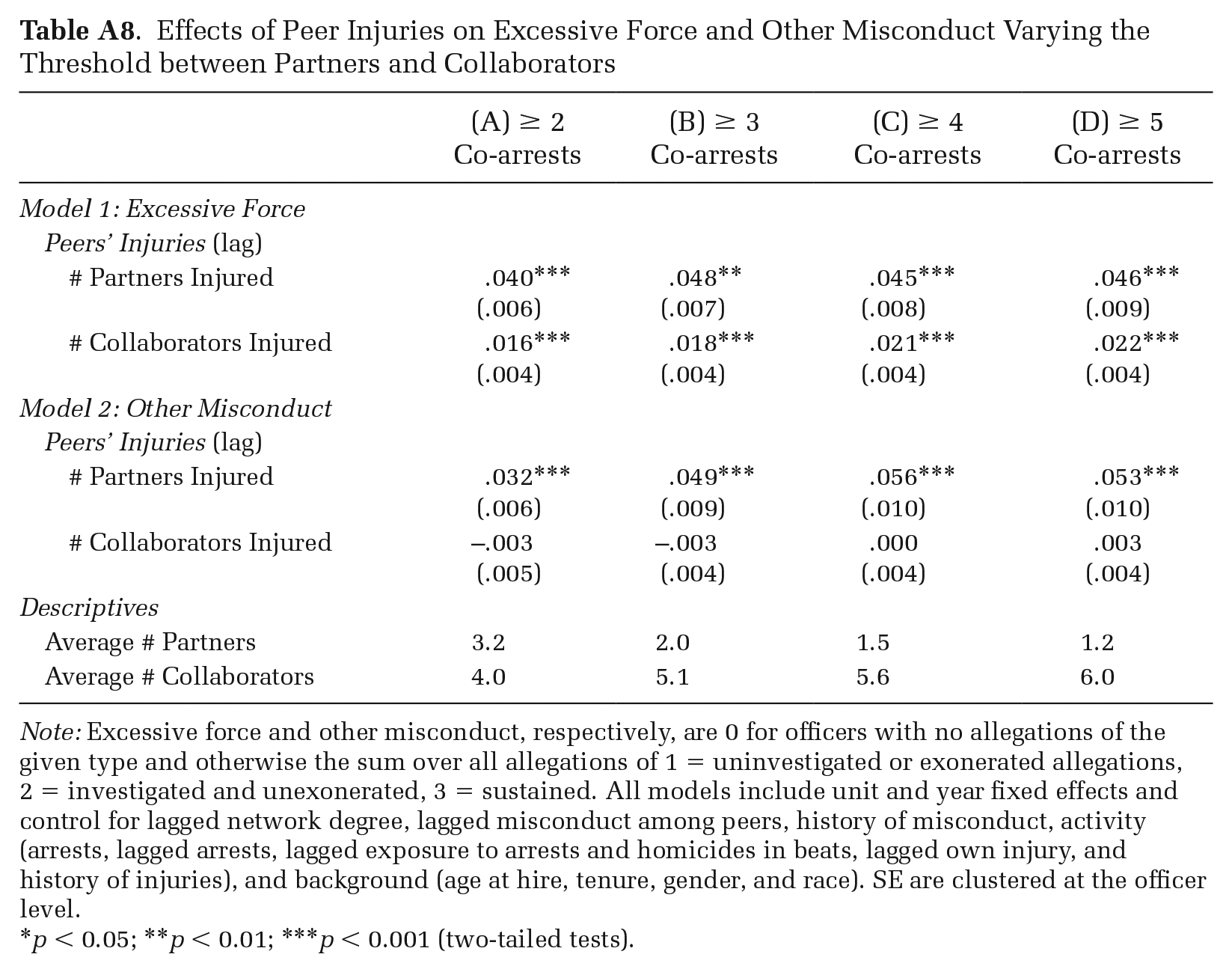
| (A) ≥ 2 |
(B) ≥ 3 |
(C) ≥ 4 |
(D) ≥ 5 |
|
|---|---|---|---|---|
| Model 1: Excessive Force | ||||
| Peers’ Injuries (lag) | ||||
| # Partners Injured | .040***
(.006) |
.048**
(.007) |
.045***
(.008) |
.046***
(.009) |
| # Collaborators Injured | .016***
(.004) |
.018***
(.004) |
.021***
(.004) |
.022***
(.004) |
| Model 2: Other Misconduct | ||||
| Peers’ Injuries (lag) | ||||
| # Partners Injured | .032***
(.006) |
.049***
(.009) |
.056***
(.010) |
.053***
(.010) |
| # Collaborators Injured | −.003 (.005) |
−.003 (.004) |
.000 (.004) |
.003 (.004) |
| Descriptives | ||||
| Average # Partners | 3.2 | 2.0 | 1.5 | 1.2 |
| Average # Collaborators | 4.0 | 5.1 | 5.6 | 6.0 |
Note: Excessive force and other misconduct, respectively, are 0 for officers with no allegations of the given type and otherwise the sum over all allegations of 1 = uninvestigated or exonerated allegations, 2 = investigated and unexonerated, 3 = sustained. All models include unit and year fixed effects and control for lagged network degree, lagged misconduct among peers, history of misconduct, activity (arrests, lagged arrests, lagged exposure to arrests and homicides in beats, lagged own injury, and history of injuries), and background (age at hire, tenure, gender, and race). SE are clustered at the officer level.
p < 0.05; **p < 0.01; ***p < 0.001 (two-tailed tests).
Acknowledgements
The authors thank Jeffrey Fagan, James Murphy, George Wood, Alexandra Ciomek, Sebastian Steffen, and Kristina Brant for helpful comments on earlier drafts. We also gratefully acknowledge research assistance by Olivia Pinney.
Funding
This research has been supported (in part) by Grant #1908-18023 from the Russell Sage Foundation and Grant #2049513 from the National Science Foundation.
