



Abstract
Does activity on hard-right social media lead to hard-right civil unrest? If so, why? We created a spatial panel dataset comprising hard-right social media use and incidents of unrest across the United States from January 2020 through January 2021. Using spatial regression analyses with core-based statistical area (CBSA) and month fixed effects, we find that greater CBSA-level hard-right social media activity in a given month is associated with an increase in subsequent unrest. The results of robustness checks, placebo tests, alternative analytical approaches, and sensitivity analyses support this finding. To examine why hard-right social media activity predicts unrest, we draw on an original dataset of users’ shared content and status in the online community. Analyses of these data suggest that hard-right social media shift users’ perceptions of norms, increasing the likelihood they will participate in contentious events they once considered taboo. Our study sheds new light on social media’s offline effects, as well as the consequences of increasingly common hard-right platforms.
The relationship between social media use and subsequent offline social behavior is ambiguous (Caren, Andrews, and Lu 2020; Haidt and Bail 2022; Zhuravskaya, Petrova, and Enikolopov 2020). Some studies have found that social media influence social attitudes (e.g., Bond et al. 2012; Dignam and Rohlinger 2019). For example, social media users express more polarized views after being exposed to tweets from politicians with opposing ideologies (Bail et al. 2018) and regard members of different ethnic communities more negatively after deactivating their Facebook accounts (Asimovic et al. 2021). Complementary studies report a link between social media activity and offline behavior in places as varied as Egypt (Tufekci and Wilson 2012), Russia (Bursztyn et al. 2019), and Chile (Scherman and Rivera 2021). However, other research argues that using social media has little effect on users’ opinions and behavior (e.g., Foos et al. 2020; Schumann et al. 2021; Theocharis and Lowe 2016), and that individuals’ existing attitudes drive their use of social media (Heiss and Matthes 2019; Nordbrandt 2021). Moreover, much of the scholarship attributing offline mobilization to social media has limited scope, focusing on places with authoritarian regimes (e.g., Enikolopov, Makarin, and Petrova 2020; Steinert-Threlkeld 2017; Weidmann and Rød 2019) or large but rare protests, such as the 2015 Charlie Hebdo protests (Larson et al. 2019) and the 2021 U.S. Capitol riot (Van Dijcke and Wright 2021).
We shed new light on the relationship between social media and offline social behavior by examining if and why hard-right social media (HRSM) activity affects subsequent civil unrest throughout the United States. We focus on HRSM platforms like Gab, Parler, and Truth Social for four reasons. First, while there is widespread concern about online hard-right radicalization and attacks on democracy (Marwick, Clancy, and Furl 2022), it remains unclear whether users’ time spent on HRSM translates into offline social and political activity (as with social media, in general). On one hand, anecdotal accounts of individuals participating in recent hard-right unrest depict an HRSM ecosystem of menacing rhetoric directed at perceived enemies, which compels users to engage in protests, property destruction, and mass and interpersonal violence (Roose 2019; Sheets 2021). On the other hand, millions of people are exposed to hard-right online content each day, but hard-right unrest is relatively uncommon (Marwick et al. 2022).
Second, the HRSM ecosystem’s current evolution creates, in one sense, a strong test of the link between social media and offline social action. While rhetoric on HRSM can spread to conservative legacy media outlets, such as Fox News and The Washington Times (Benkler, Ferris, and Roberts 2018), hard-right online communities in the United States skew toward uncompromising ideological positions and are increasingly insulated from most social, digital, and legacy media. In other words, unlike left-leaning and mainstream social media, HRSM are isolated and unused by the majority of media consumers (Freelon, Marwick, and Kreiss 2020; Rogers 2020); their content has a relatively limited diffusion, or reach. For example, during 2020, the year of our study, around 13 million people had Parler accounts (Aliapoulios et al. 2021). 1 In 2022, about 6 percent of U.S. adults (roughly 15.5 million people) regularly got their news from HRSM (Stocking et al. 2022). This userbase is sufficient to support consequential offline events but is smaller than the hundreds of millions monthly active users of, say, Facebook, Instagram, and YouTube in the United States (Iqbal 2021; see also Hosseinmardi et al. 2021). Therefore, in terms of the number of people consuming a particular social media of interest and available to participate in subsequent offline unrest, examining HRSM sets a comparatively high bar for detecting an effect.
Yet, despite the limited reach of HRSM, their growing isolation helps us understand the mechanisms by which social media can affect offline social behavior. This is our third reason for focusing on HRSM. Studying the case of HRSM helps us identify how smaller reach can strengthen the quality of users’ exposure to hard-right content. That is, we can see how decoupling from the broader media ecosystem—which is not (yet) happening among left-leaning social media (Benkler et al. 2018; Freelon et al. 2020) 2 —confers some advantages for instigating offline social action. One advantage underscored by our analyses is the declining importance of independent gatekeepers and influential third-party participants in public discourse, or “claims-makers” (Koopmans and Olzak 2004), paired with the emergence of a new breed of discursively powerful figures—social media users with elite status on HRSM platforms. Our study’s insights into HRSM elites help explain why HRSM can lead to unrest despite its deepening isolation. They also highlight how social media communities are not flat spaces of interactions and information sharing among peers (Zhuravskaya et al. 2020), but have a consequential social structure.
Our fourth reason is that HRSM presage a deeply fragmented online media landscape. Today, many left- and right-leaning social media users likely interact minimally online, but they at least share platforms. These shared platforms salvage the possibility of serendipitous exposure to other attitudes, which can help decrease animosity to those with opposing political views (Levy 2021; but see Bail et al. 2018). In contrast, HRSM point to a future of multiple platforms catering to different worldviews, and users, after selecting the most accommodating platforms, quarantining into clusters of similar platforms (see Kor-Sins 2021; Rogers 2020). Such isolation would all but eliminate the possibility of encounters with users holding contrary perspectives, and potentially even nonpartisan users and organizations. A few current HRSM platforms have had tenuous beginnings, but it is likely that the large amount of financial capital backing these projects (Goldstein 2022a, 2022b; Hakim 2022) makes it only a matter of time until developers create HRSM platforms that effectively corral vast numbers of conservatives. Furthermore, as we will elaborate, HRSM—that is, commercialized digital spaces that deliver an ideological product—could be signs of an emerging ideology economy.
We begin our study by defining HRSM and extending the theory of discursive opportunity structures (Koopmans and Olzak 2004) to our contemporary moment. This theoretical discussion details how the decreasing reach of HRSM can improve users’ quality of experience. We then examine the relationship between HRSM and subsequent civil unrest, as well as why this relationship may exist, using three kinds of data. First, we use hard-right civil unrest event data covering the United States from January 2020 through January 2021. In all analyses, we use two sources of event records, the Armed Conflict Location and Event Data (ACLED) project and the Crowd Counting Consortium (CCC). Replicating the analyses with two event databases accomplishes several strategies for mitigating errors of measurement and representation common in event data (Demarest and Langer 2022). Second, we have 2020 HRSM activity data from Parler. This database, unlike many other collections of social media data, has a transparent data-generating process without subsampling observations, provides reliable location information, and comprises observations that are uniformly HRSM activity, offering consistency in their effect. Third, we draw on an original database of video content Parler users shared during 2020 and information about these users’ accounts, such as their assigned status. With this database, we construct and analyze proxies of (1) event coordination, (2) the transformation of individuals’ views, often referred to as “radicalization” in the context of HRSM, and (3) users’ shifting perceptions of social norms.
With a spatial panel dataset based on months and core-based statistical area (CBSA) and county units, our main analysis indicates that a 10 percent increase in HRSM activity predicts a .04 percent increase in the number of hard-right civil unrest events during the following month (per 100,000 people). The results of numerous robustness checks, placebo tests, quasi-experimental analyses, and sensitivity analyses support this finding. Under what we argue are reasonable assumptions, the effect can be interpreted as causal. Our second analysis, focusing on why HRSM are associated with subsequent unrest, suggests HRSM affect users’ perceptions of social norms. Users come to view participation in hard-right unrest as more acceptable than they once thought, thereby making offline unrest more likely after HRSM activity. As a whole, our findings shed new light on increasingly insulated and little understood HRSM, as well as advance our understanding of why social media can have offline social consequences.
What are hard-right social media?
HRSM, in our view, are similar to alternative social media platforms, or “alt-tech.” Like alt-tech, HRSM are fundamentally relational: they are defined, in part, by standing in opposition to mainstream platforms. They claim to support viewpoints not welcome on mainstream platforms, nor acceptable to the corporations behind these platforms (Gehl 2015). Often, this entails professing to restrain from moderation (Rogers 2020; Stocking et al. 2022) and the championing of “free speech” and “individual liberty” (Dehghan and Nagappa 2022; Jasser et al. 2021; Kor-Sins 2021). For example, the founder of Parler called it a “neutral town square” (Nicas and Alba 2021).
Yet, despite its founder’s characterization, Parler is all but exclusively used by political conservatives (Aliapoulios et al. 2021; Nicas and Alba 2021). This points to a second defining element of HRSM, and one that distinguishes them in the broader alt-tech world: the content. Whereas alt-tech includes digital spaces with left-leaning and utopian discourses (Gehl 2015), HRSM content is predominantly hard-right. By “hard-right,” we refer not to an extreme of the political spectrum (e.g., “far-right,” “right-wing”); most content on HRSM is not extreme relative to the modern conservative movement. 3 Instead, we mean that the majority of content is, first, socially and politically conservative and, second, more recalcitrant than other conservative perspectives. It is mainly the content of the contemporary conservatives who resist compromise with the political center or left (Fawcett 2020). Additional features of the content arise from the relational element. Namely, hard-right content often glorifies being “banned” or “deplatformed” from mainstream social media—creating a social capital characteristic of HRSM (Dehghan and Nagappa 2022)—and flaunts its grievances of purported exclusion (Jasser et al. 2021).
HRSM differ from alt-tech in another important way. Alt-tech platforms, at least in their original conceptualization, seek to “flatten the producer/consumer hierarchy . . . [and refuse] to participate in the dominant political economy of the corporate internet” (Gehl 2015:2, 5). Their internal goals and operations are not orientated toward financial profit (Gehl 2017). In contrast, most HRSM seek profit and to enrich their founders and investors by, for example, selling advertisements, memberships, and financial products, as well as promoting affiliated conservative media elites and organizations (Dehghan and Nagappa 2022; Goldstein 2022a, 2022b; Jasser et al. 2021). Thus, HRSM compose a digital ideology economy. Users’ sharing of content (for free) helps produce digital spaces offering distinct and desirable ideological experiences to other conservatives (Jasser et al. 2021; Stocking et al. 2022), which the platforms’ owners commercialize.
Hard-right social media as a cause of unrest
Should we expect HRSM use to cause countrywide trends of offline unrest? A large literature documents online hard-right content and activity around the world, yet stops short of causally connecting this digital realm to offline outcomes (e.g., Schulze 2020; Wahlström, Törnberg, and Ekbrand 2021). A smaller number of studies provide evidence consistent with the argument that HRSM use causes hard-right attitudes and offline violence. For instance, anti-refugee sentiment on Facebook strengthens users’ xenophobic attitudes (Heiss and Matthes 2019) and predicts attacks on refugees in Germany (Müller and Schwarz 2021). Hate speech on Twitter correlates with racially and religiously motivated crimes in London (Williams et al. 2020). In the United States, Donald Trump’s anti-Muslim tweets were associated with subsequent county-level numbers of hate crimes (Müller and Schwarz 2020).
At first glance, Koopmans and Olzak’s (2004) discursive opportunity structures (DOS) theory suggests that the growing insulation of U.S. HRSM would undermine, rather than foster, users’ participation in offline unrest across the United States. According to DOS, discursive opportunities enable individuals’ consumption of ideas, messages, and information, and they are structured along three dimensions: first, visibility, or how gatekeepers (e.g., the editors and journalists of legacy media) determine messages’ public prominence; second, resonance, or the extent to which claims-makers grant relevance to messages; and third, the legitimacy gained by claims-makers’ public support. These features determine both the experience and reach, or diffusion, of media consumption, thereby influencing individuals’ participation in contentious action. Koopmans and Olzak argue that for non-mainstream groups, such as hard-right partisans, high levels of visibility, resonance, and legitimacy help diffuse their messaging and increase mobilization (see also Wahlström and Törnberg 2021).
The isolation of HRSM from the broader media ecosystem appears poised to impede discursive opportunities and yield little offline unrest. That is, HRSM are coalescing into an “indigenous channel of communication,” or a media source accessed by only a limited number of people (Koopmans and Olzak 2004:202). This concentration should make hard-right ideas less publicized by gatekeepers and unlikely to provoke reactions or support from claims-makers and influential participants in the public discourse. As a result, HRSM’s messages would have limited diffusion and be less likely to spur widespread offline mobilization.
Despite these potential discursive pitfalls, we argue that HRSM’s insulation can in fact facilitate unrest. Recall that discursive opportunities shape not only diffusion but also the experience of individuals consuming information. Applications of DOS theory have largely focused on the former—the reach of messages—whereas considering the latter draws our attention to the quality of individuals’ exposure to messaging. For example, if someone fleetingly observes a vague message originating from a marginalized group, this is the result of a discursive opportunity with high reach but low quality. In contrast, a discursive opportunity with high quality would create regular exposure to unequivocal and (seemingly) credible information.
By distinguishing between reach and quality, we posit that HRSM’s isolation shapes discursive opportunities in ways that limit reach but improve quality. One significant way they do so is by replacing independent gatekeepers and claims-makers with platform elites. The insulation of HRSM reduces the importance of potentially unreliable and unsympathetic gatekeepers and claims-makers, thereby making elite HRSM users more visible and prominent in the community. Furthermore, hard-right platforms often formally promote these elites. For example, some display a special symbol alongside elites’ accounts, making visible their status, such as Gab’s “PRO account” designation (Jasser et al. 2021) and Parler’s “gold badge” icon, which was given to users like U.S. Representative Marjorie Taylor Greene; former government official, scholar, and pundit Hugh Hewitt; and Enrique Tarrio, the leader of the Proud Boys, a far-right group. Platforms can also prompt new users to follow elites at the sign-up stage (as Parler does) and algorithmically amplify their content on users’ feeds. 4
In summary, HRSM’s isolation eliminates hard-right messaging’s reliance on mercurial mass media gatekeepers and influential public discourse participants. This strengthens new discursive leaders who are a reliable source of visibility, resonance, and legitimacy for hard-right messaging. The resulting discursive opportunities limit messages’ reach across society but bolster the quality of their reception by users. In other words, HRSM create an environment in which their users, although comparatively few in number, consume highly visible, widely resonant, and unambiguously legitimated information whenever they log on. Therefore, we have the baseline expectation that HRSM activity cultivates unrest, and we begin with a basic hypothesis:
Hypothesis 1: Greater HRSM activity will be associated with an increase in subsequent hard-right civil unrest.
Coordination, norm perception, and the generation of unrest
Why might HRSM activity—users’ exposure to especially visible, resonant, and legitimated hard-right messaging—lead to greater hard-right civil unrest? Many scholars, policymakers, and journalists have focused on how social media, and especially HRSM, can radicalize users (e.g., Alfano, Carter, and Cheong 2018; Ribeiro et al. 2019; Roose 2019; Sheets 2021). These accounts suggest that users’ high-quality experiences of messaging create meaningful connections between users and extremists whom the users otherwise would not have encountered (Pauwels and Schils 2016; Wahlström et al. 2021). These connections then transform users’ attitudes and preferences by making certain issues salient while explaining the issues through biased and radicalized frames (Broockman and Kalla 2022). Finally, this transformation motivates users to act in ways they previously would not have, such as engaging in protest and violence (Müller and Schwarz 2020; Wahlström and Törnberg 2021).
While the radicalization—or, conceived more generally, the transformation—argument has become popular, some related research observes that users might not be transforming into radicals through online activity. Instead, users appear to consume online content that matches their offline media diet (Hosseinmardi et al. 2021; see also Munger and Phillips 2020), and they join digital communities that align with their existing views (Gaudette et al. 2021; Wojcieszak 2010). In the case of isolated HRSM, users must already be attracted enough to the HRSM community to join the lesser-known platforms. For example, many users of Gab sought it out because it provided a refuge for their stigmatized hard-right views (Jasser et al. 2021). Numerous Parler users had profile bios expressing similar sentiments, such as, “Libertarian happy to have found a place where free speech and defending individual freedom can thrive” and “So this is where the cool kids hangout, patriots I like people that are tired of being censored and taken our 1st amendment away from us.” Thus, we are skeptical that using HRSM transforms individuals’ fundamental worldview or generates newfound motivation to participate in contentious action.
Other research on online activity and unrest, mainly political protest, points to the coordinating power of social media (Hsiao 2021; Larson et al. 2019; Little 2016; Müller and Schwarz 2021; Steinert-Threlkeld 2017; Tufekci 2014; Wahlström and Törnberg 2021). This scholarship emphasizes how social media can help users efficiently plan and share the logistics of protest, as well as learn whether others are participating in a protest. These “strategic” and “peer pressure” kinds of coordination lower the cost of collective action, increasing the likelihood of unrest (Enikolopov et al. 2020). However, they should be most consequential in autocratic settings, where regimes control the media and civil society is weak (Enikolopov et al. 2020; Steinert-Threlkeld 2017; Weidmann and Rød 2019). In liberal democracies, activists have access to other options for easy and effective coordination, such as preexisting social networks and legacy media, which remain popular in the United States (Allen et al. 2020).
Nevertheless, hard-right individuals in liberal democracies likely distrust many forms of legacy media and see isolated HRSM—with their high-quality experiences of messaging, especially the resonance of information on the platforms—as a credible way to coordinate with like-minded others. For example, Parler content from the days before the U.S. Capitol riot suggests the platform offered a space for disparate hard-right groups to establish a shared outlook and agenda countering the imminent congressional counting of electoral college votes (Munn 2021). We therefore hypothesize that HRSM facilitate strategic or peer pressure coordination, resulting in more hard-right unrest.
Hypothesis 2: The more HRSM users discuss the coordination of events, the more frequent subsequent hard-right civil unrest will be.
We have argued that high-quality experience of information via HRSM comprises, in part, exceedingly visible hard-right messaging and the unambiguous and consistent legitimization of this messaging. Extending this idea, we also posit that HRSM can promote unrest because they shift users’ perceptions of social norms. Sociologists have extensively theorized and studied social norms (Hechter and Opp 2001; Horne and Mollborn 2020), detailing their complexity and multidimensionality (Jasso and Opp 1997; Robbins, Dechter, and Kornrich 2022). We focus on individuals’ perceptions of prescriptive behavioral norms, or their understanding of which behaviors are permitted and endorsed by a group they belong to. Individuals often update these perceptions of acceptable behaviors based on simple cues from others in the group (Andreoni, Nikiforakis, and Sigenthaler 2021; Bicchieri 2005; Bursztyn, Egorov, and Fiorin 2020), especially high-status and widely admired group members (Blair et al. 2021; Horne and Mollborn 2020). Importantly, these cues do not affect people uniformly. They influence individuals who identify strongly with the group, and cues from the group’s elites primarily affect those who lionize the elites (Clayton et al. 2021; Ruisch and Ferguson 2022).
Recent research shows that social media expose users to cues, including cues from in-group elites, that shift their perceptions of acceptable behavior. For example, Siegel and Badaan (2020) experimentally reduced the use and tolerance of sectarian language among Arab Twitter users and residents of Lebanon by displaying tweets that promoted a common religious identity and were endorsed by religious elites. Anspach (2021) found that when Americans already harboring racial resentment were exposed to Trump’s racist tweets, these Americans described Black people using more negative language. This latter example underscores a critical aspect of people’s shifting perceptions of norms: their beliefs and values are not transforming. Instead, individuals come to perceive their existing, private views as more acceptable than before, and behaviors once considered taboo as now condoned by others (Bursztyn et al. 2020). As one Parler user implied in their profile bio, their reaction to the contemporary moment has long-cultivated roots: they were already “born for a storm.” 5
Insights from the scholarship on norms, both generally and among social media users, apply to the specific context of HRSM. First, HRSM users have chosen to join platforms like Parler and consume hard-right online content. They also often opt to closely follow elite HRSM users, in part because these elites are promoted by the platforms, as earlier discussed, and are respected figures within the broader conservative movement. This suggests HRSM users already harbor hard-right views and are receptive to cues about norms from other members of the online community. Second, HRSM users are insulated from independent gatekeepers and claims-makers while exposed to visible and legitimated messaging from HRSM elites explaining and interpreting the world.
If HRSM users experience their existing beliefs and values reflected in the speech of community elites, we expect they will understand the behaviors that stem from these beliefs and values as more acceptable. In other words, if users see elites echoing what they already thought about the world, they will likely interpret this echoed speech as a significant cue endorsing their worldviews. They will then shift their impression of prescriptive norms in a way that aligns their perceptions of norms with their existing views, as well as the behaviors motivated by these views. During 2020, when many U.S. conservatives believed civil unrest was necessary to counter threats to individual liberty, social status, and political control, the more HRSM users who shifted their perceptions of norms in a way that increased their confidence in the acceptability of their hard-right views and resulting behaviors, the more unrest there would have been. This reasoning leads us to our third hypothesis:
Hypothesis 3: The more HRSM users’ existing views are reflected in the speech of HRSM elites, the more frequent subsequent hard-right civil unrest will be.
Data
We test our hypotheses by drawing on three kinds of data: instances of hard-right civil unrest in the United States, recorded in two distinct databases; observations of HRSM activity across the United States throughout 2020; and an original collection of tens of thousands of videos HRSM users shared during 2020, along with information about these users’ accounts.
Hard-Right Civil Unrest
We measure hard-right civil unrest across the United States from January 2020 through January 2021 using records from the ACLED project, a geo-referenced database of civil and political unrest (Raleigh et al. 2010). In this database, a contentious event is any congregation of three or more people demonstrating against entities such as government institutions, policies, and protected classes of people. These events were protests, peaceful and violent, as well as activities such as riots and other mêlées, so we refer to them as “unrest.” 6 Additionally, because participants’ ire could have focused on groups of people and fellow citizens, not solely government symbols, rules, and institutions, we describe the unrest as “civil,” although much of it did have political overtones. We use ACLED’s descriptions of the parties involved in each instance of unrest to identify which events involved the American hard-right. Based on this classification, ACLED registered 1,765 hard-right events from January 2020 through January 2021. We designate the remaining events (N = 22,367) as “non-hard-right” unrest, and we use these in a placebo analysis. Section A of the online supplement provides examples of unrest events and details of the classification.
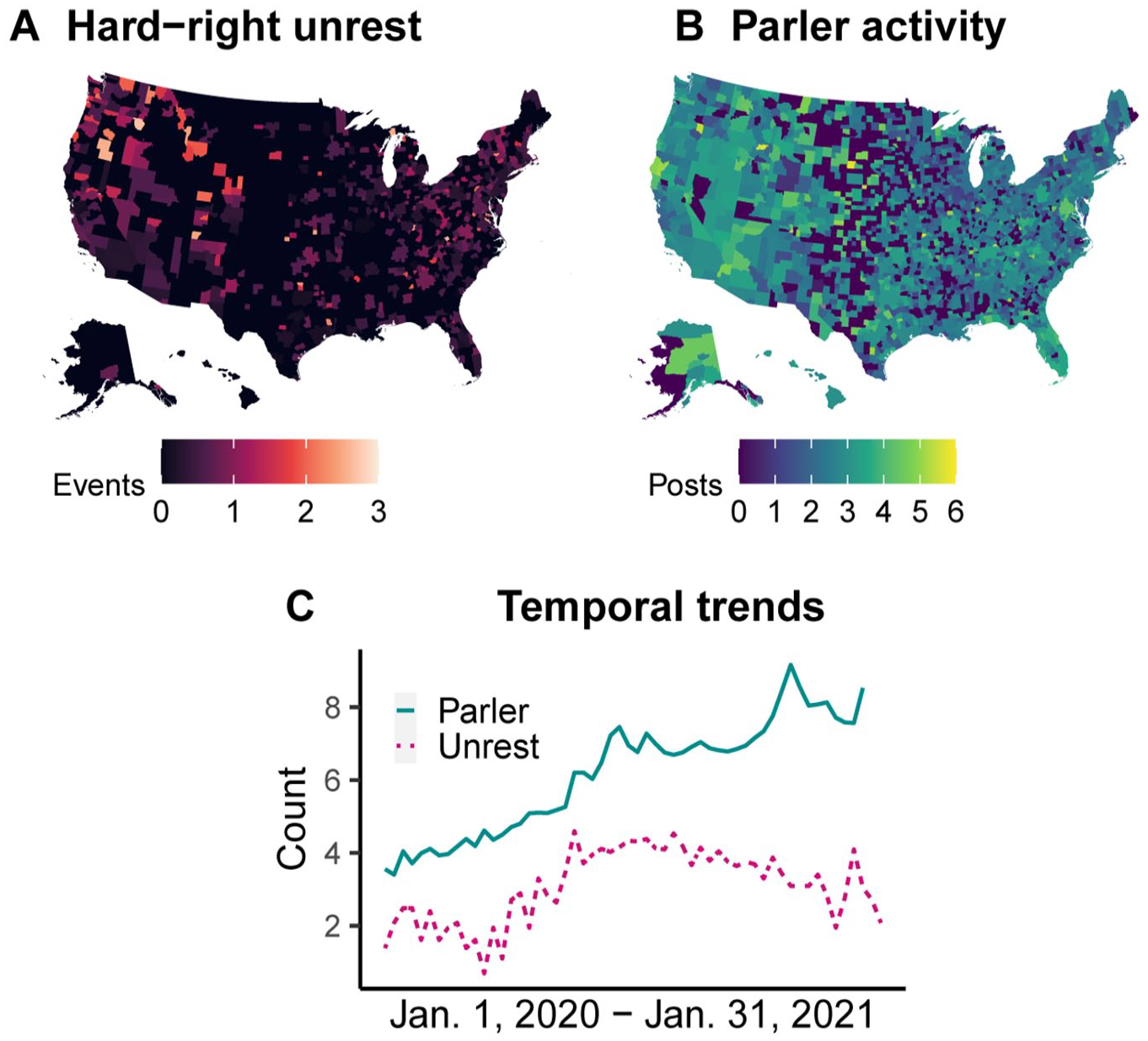
Figure 1A shows that hard-right unrest was relatively rare in the United States. Most CBSAs (N = 2,281; some counties are included, as explained below), especially those in the country’s center, experienced no incidents. However, a fifth of all CBSAs had at least one incident, and 98 (4 percent) had five or more. Unrest events were not concentrated in CBSAs containing state capitals. Many confrontations occurred in places like north-central Washington, the Upper Peninsula of Michigan, and southwestern Virginia. Figure 1C presents the temporal pattern of hard-right unrest. Its frequency increased during the first half of 2020, then declined slowly before spiking in late 2020.
Trends in Hard-Right Unrest and Social Media Use
The ACLED project collects information from various sources, including local, regional, and national news media outlets, reports from NGOs, and mainstream social media platforms. 7 These data are then reviewed and coded weekly by an internal team of researchers. Difficult coding decisions are reviewed by members of the ACLED researcher community, consisting of academics and researchers professionally connected with ACLED. 8 Other geo-referenced event databases have different data collection and coding procedures, such as crowdsourcing the nomination of events to record. The CCC database relies in part on crowdsourcing: 9 events are nominated for inclusion in the database, then the project’s co-directors, research assistants, and numerous volunteers review the event’s information and update the database (Fisher et al. 2019).
For the purposes of this study, we are agnostic about whether ACLED or CCC more accurately captures the number of hard-right civil unrest events in the United States. Each uses a data-collection procedure with unique strengths and weaknesses, as well as slightly different definitions of an event and its ideological orientation. Therefore, we use both ACLED and CCC separately to construct two versions of our outcome variable, counts of hard-right unrest events, and conduct two parallel sets of analyses. (For details of the CCC database, see Section A in the online supplement.) Conducting the empirical investigation with two distinct event databases accomplishes several of the strategies for mitigating errors of measurement and representation common in event data, such as using independent research teams to code events and using a wide range of source material (Demarest and Langer 2022).
Hard-Right Social Media Activity
Our observations of HRSM activity are from a database of Parler users uploading, or sharing, self-recorded videos in the United States during 2020 and early January 2021. Many of these videos were filmed and shared by users while at home (McAlexander, Rubin, and Williams 2021). Each sharing instance (N = 57,222) is associated with metadata, including date, longitude, and latitude. Section A in the online supplement elaborates on the Parler database.
Figure 1B shows that Parler use was more common and evenly distributed across the country than was unrest. Among CBSAs, 70 percent had at least one instance of activity; 770 CBSAs (34 percent) had at least five instances. Like hard-right unrest, though, HRSM activity (when population normalized) was not concentrated exclusively in major cities. For example, we observe relatively high activity rates in northern California, southeastern Idaho, and western Indiana. Figure 1C presents the trend of Parler use. Activity rose during the first half of 2020, then plateaued before growing again.
Using the Parler database to construct an HRSM activity variable confers a few advantages over common social media databases. First, potential sampling biases are clear. Most other social media databases are compiled from platforms’ application programming interfaces (APIs). Unfortunately, data from APIs are often sampled from the universe of observations using undisclosed methodologies and vary unpredictably across sampling draws (Kim, Nordgren, and Emery 2020; McCormick et al. 2017). For example, Pfeffer, Mayer, and Morstatter (2018) used automated accounts to make specific tweets up to 84 times more likely to appear in their samples than they should have given Twitter’s API documentation. In contrast, the Parler database comprises uploads of videos created using ExifTool, a technology commonly used when making videos on mobile phones. Therefore, unlike most other social media data, we know what the sampling bias is: the sample is biased if video upload patterns at the CBSA-month level differed systematically from other usage patterns. Fortunately, we have no reason to believe Parler users posted CBSA-month aggregated numbers of videos in systematically different ways than, say, reading comments. 10
A second advantage is the reliability of location information. This kind of information is often absent from social media data. When it exists, it usually only captures the very few user accounts that voluntarily share their location (Beauchamp 2017; Mitts 2019; Steinert-Threlkeld 2017). Moreover, users who share location information are systematically different from other individuals in the same area (Malik et al. 2015). In contrast, the Parler database provides location information that is recorded from users’ devices (via ExifTool), not from any opt-in settings or self-reports. 11
A third advantage is that the Parler data approximate consistency in their measurement of HRSM activity. When researchers studying the effects of a social media platform use data from large, heterogenous platforms, such as Twitter or YouTube, they must discern what kind of activity counts as what, such as designating some usage or content as “conspiracy” or “hard-right.” Despite many sophisticated techniques for measuring digital material, it remains difficult to correctly interpret language like allusions, inside jokes, and sarcasm, especially when observed independently of threads or exchanges between users. Furthermore, even if activity or content are correctly classified, researchers must often assume their interpretations are not significantly altered by (unmeasured) other activity or content on the platform (e.g., Scoville et al. 2022). The Parler database, in contrast, offers a collection of observations that approximates uniformity and consistency in HRSM activity. 12 Users would interpret even seemingly apolitical activity or content as part of hard-right discursive activity given that it is on Parler.
Spatial Panel Dataset
Using the data on hard-right civil unrest and HRSM activity, we created a spatial panel dataset. We mapped observations’ locations across the United States, then used a zonal statistic to tally the total number of observations within metropolitan and micropolitan statistical areas, jointly known as U.S. Census Bureau CBSAs, for each month from January 2020 through January 2021. Each CBSA consists of a substantial population nucleus and adjacent communities that are integrated socially and economically with the nucleus, such as suburbs bound to a city through residents’ commutes. If an area of the United States is not part of a CBSA, we label it by its county; these areas are rural places with minimal ties to a population center of at least 10,000 people. Including these remote areas gives us coverage of the entire United States. Although our spatial panel dataset contains some county units, we refer to all the units as CBSAs for simplicity. 13
There are two key considerations for selecting CBSAs as our unit of analysis: how the influence of social media use unfolds in practice, and how individuals are likely to decide where to participate in contentious events. First, people can be influenced by social media use directly or indirectly. Direct influence can be due to active use, as when individuals share videos, or passive use, such as viewing others’ videos or reading their comments. Indirect influence, or “two-step communication flow” (Druckman, Levendusky, and McLain 2018; Katz and Lazarsfeld 1955), occurs when someone learns about online community members’ speech, status, and interactions from a platform user whom they know, such as a friend or co-worker. Using CBSA units allows us to account for all these paths of influence. The units’ values only record observations of active direct use, but we assume these values accurately reflect the frequency of passive direct use in that area. In addition, the units encompass places where active HRSM users likely caused indirect exposure, such as workplaces and social gathering spots. 14
Second, CBSAs cover territory that has everyday meaning for most U.S. residents. Participants in contentious events likely see the area designated as their CBSA as the setting where it is meaningful to express their ideas and join up with like-minded individuals, even if it means driving some distance from their home. After all, CBSAs are designed to cover the area where most residents work, commute, and socialize. CBSA territories also likely hold symbolic meaning reinforced through localized news coverage, advertisements for businesses, and discussions about politics and policies, such as decisions made by school boards. 15
Table 1 summarizes the main variables in the spatial panel dataset (when using ACLED data, N = 29,653 CBSA-months). The variables are rates per 100,000 CBSA residents, which we computed using population data from the 2019 American Community Survey (ACS). 16 Our dataset also includes a variable measuring internet access, a possible time-varying confounder. To construct the variable, we collected the maximum broadband download speed (MBDS) available to each census tract within each CBSA, recorded biannually by the Federal Communications Commission, and calculated the median MBDS per CBSA-month. To conduct supplemental analyses using weighted and matched CBSA observations, we gathered sociodemographic information on CBSAs from the 2019 ACS. Specifically, for each CBSA, we recorded the population; the proportion of residents identifying as non-Hispanic White; the proportion of residents with a bachelor’s degree; the median household income; the unemployment rate; the median age of White male residents; and the proportion of residents with an internet service subscription. We additionally calculated the share of votes cast for Trump in the 2016 U.S. presidential election using data from the MIT Election Data and Science Lab (2018). Finally, we created a binary variable indicating whether or not a CBSA contains a state capital.
Summary of the Spatial Panel Dataset Using Armed Conflict Location and Event Data (ACLED)
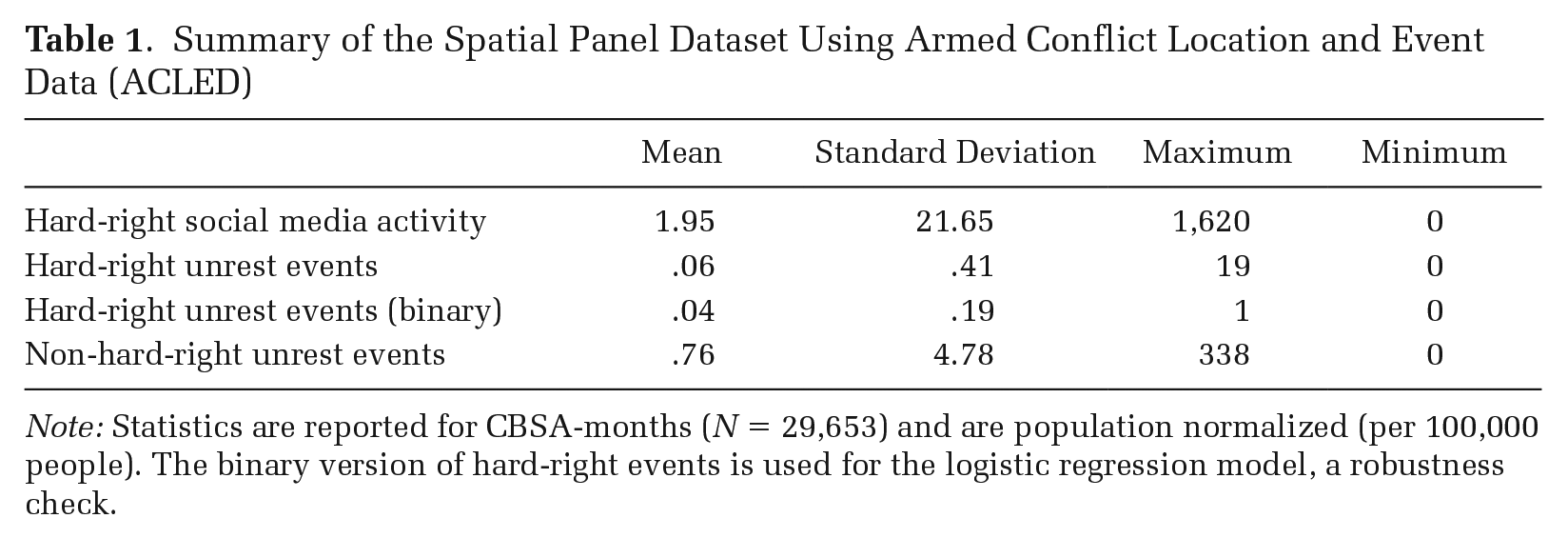
Note: Statistics are reported for CBSA-months (N = 29,653) and are population normalized (per 100,000 people). The binary version of hard-right events is used for the logistic regression model, a robustness check.
Hard-Right Social Media Discourse
To test our second and third hypotheses, we constructed three variables. The variables are based on linking the Parler activity database with a dataset of video transcripts, which also contains user account metadata obtained from a third database. In other words, we use the content associated with the activity observed in our spatial panel dataset. We created the transcript corpus by gathering the video files from the public release of Parler data and transcribing their audio (see Section B of the online supplement). We additionally watched and interpreted 200 randomly selected videos. This exploratory analysis provided a foundation for the subsequent measurement of the transcript corpus using multiple machine learning techniques. The resulting variables are proxies, yet we are confident of their utility because of the extensive model development and validation exercises we conducted. Learned proxies, although imperfect, can demonstrate the existence and direction of theorized effects (Knox, Lucas, and Cho 2022).
Coordination language
To test Hypothesis 2, we constructed a variable capturing the amount of users’ language about coordinating events in each CBSA-month. To do so, we used a semi-supervised machine learning model to learn a “coordination” topic and then estimated its prevalence in each video transcript. 17 This approach has some advantages over more common alternative measurement techniques, such as calculating the frequencies of words associated with concepts of interest (“keywords”) and unsupervised topic models.
Compared to the keyword tabulation, the semi-supervised model can learn unanticipated patterns of words that tend to appear alongside keywords. For example, if we expect HRSM users rely on the word “rally” to coordinate events, but they in fact often use other words that usually appear with “rally” but which we did not anticipate (e.g., “going,” “time”), the model will identify topics based on both the keyword and learned associated words (Eshima, Imai, and Sasaki 2021). Compared to unsupervised approaches, the semi-supervised model uses keywords associated with concepts of interest, such as event coordination, to learn relevant topics. It also learns additional “unknown” topics, or those not anchored by any keywords, similar to unsupervised topic models. Together, these capabilities allow us to detect and measure both anticipated and unanticipated ways HRSM users discussed events’ coordination.
To model the “coordination” topic, we use keywords like “gather,” “protest,” “solider,” “storm,” and “war.” Evidence suggests HRSM users used these and other rather obvious terms. For example, Trump publicized his January 6, 2021 rally (which preceded the U.S. Capitol riot) using the word “protest,” and participants in the riot used “war” and “solider” on social media in the run-up to the event (Feuer 2021). We additionally modeled four other keyword-assisted topics that we expected were part of the corpus and six “unknown” topics. Adding other expected (keyword-assisted) topics tends to improve the fit of the model (Eshima et al. 2021). Section B in the online supplement presents the details of this analysis, including how we selected the total number of topics and validated the model’s measurement.
After measuring the prevalence of the “coordination” topic in each transcript, we labeled videos as being mostly about event coordination (or not) using two different thresholds: whether the topic’s prevalence was in the 70 percent quantile or in the 85 percent quantile of all the prevalence estimates. 18 Then, for each CBSA-month (and for each threshold), we calculated the proportion of activity that entailed sharing an event-coordination video. Higher values indicate that more videos in a CBSA-month had a relatively high proportion of coordination language (see Table 2).
Summary of the Variables Measuring Hard-Right Social Media Discourse
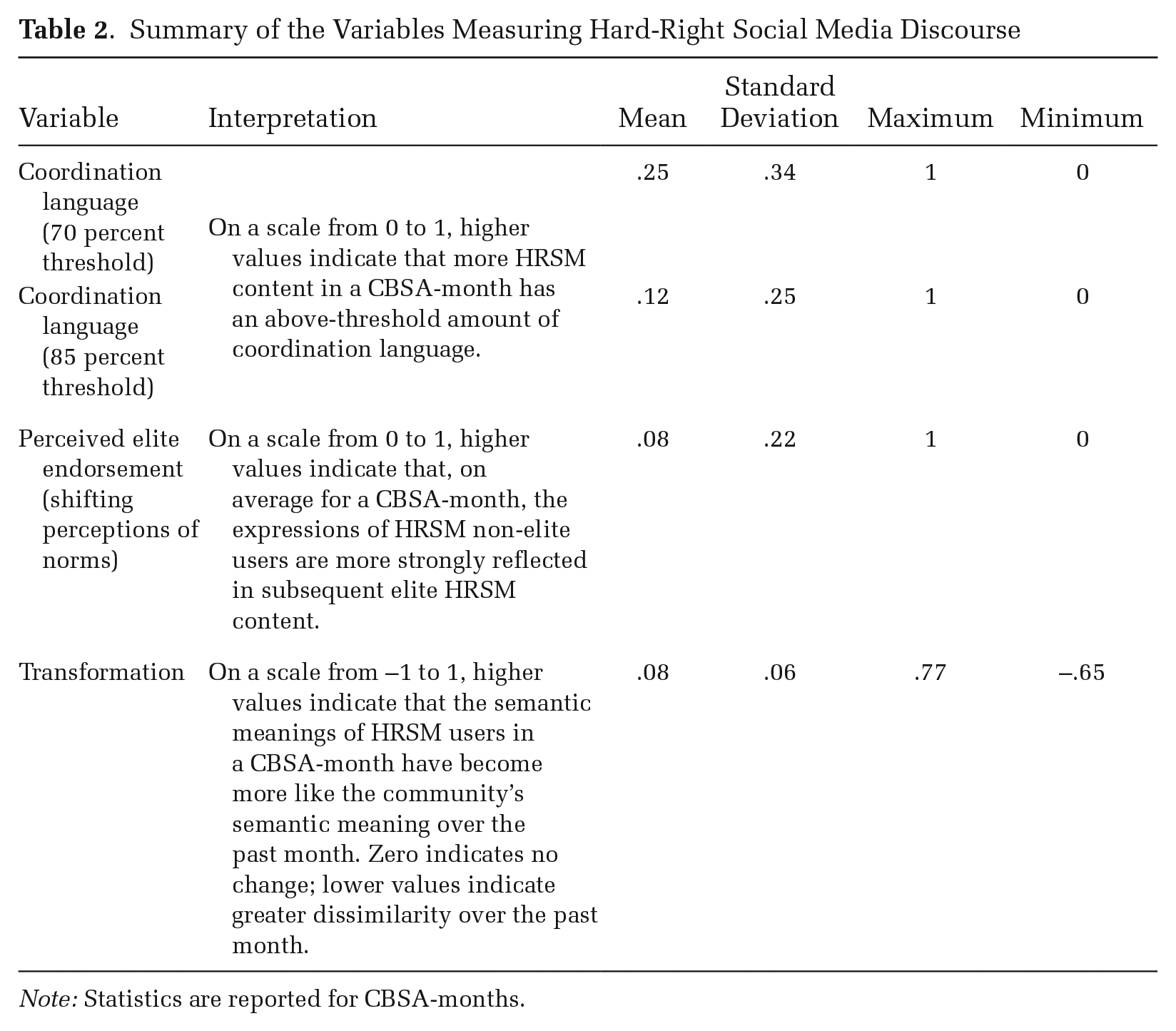
Note: Statistics are reported for CBSA-months.
Shifting perceptions of norms
We posit that HRSM users will likely shift their perceptions of prescriptive behavioral norms in a way that favors their existing hard-right views—and corresponding behavior—if they see their worldviews reflected in the speech of HRSM elites. Thus, we constructed a variable that measures the extent to which users experience their outlooks appearing in elites’ expressions at a later point in time. Specifically, for each CBSA-month, we calculated how strongly Parler (non-elite) users’ video content aligns with the subsequent month’s elite speech on Parler, or

where the strength of users’ experience of elite reflection, S, for CBSA i during month t is the negative average cross-entropy (C) of each (non-elite) video, v, located in that CBSA-month and the following month’s speech of Parler elites across the United States, or e at t + 1. This latter speech is contained in elites’ videos from month t + 1, videos the platform makes accessible to users across CBSAs. The negative sign and a subsequent unit scale transformation make values closer to 1 indicate that outlooks expressed in user videos in a CBSA-month are, on average, more strongly reflected in the messaging of HRSM elite speech during the following month (see Table 2).
We use cross-entropy to calculate how strongly users’ outlooks on the world are mirrored in subsequent elite speech. Our reasoning is that the strength of reflected outlooks is a function of, first, the overlap in kinds of content and, second, the relative importance non-elite and elite users place on that content (Chatman et al. 2014). That is, an HRSM user will perceive their outlook to be more strongly endorsed by HRSM elites if those elites are discussing the same topics to the same degree as the user. Cross-entropy helpfully measures distributional differences by simultaneously accounting for both the overlap in content and the emphasis placed on the content (Marchetti and Puranam 2022). We emphasize that by computing the cross-entropy of user videos and temporally later elite videos, we are not measuring any change in users’ outlook. This aligns with the argument that users shift their perceptions of norms, not their values or beliefs. Table 2 summarizes the variable, and Section B in the online supplement offers further details of its construction, including how we identified Parler elites, measured content, and calculated C. The supplement also provides examples of elites and their speech.
Transformation
The recent scholarship on social media-driven transformations of individuals—which, in our research context, is often conceptualized as radicalization—suggests that transformation is unlikely to occur. As a result, we do not expect it to link HRSM to unrest, and we do not offer a hypothesis about transformation, generally, or radicalization, specifically. Nevertheless, there is broad apprehension about radicalization in the HRSM context, so we constructed a variable capturing this process and use it as a control in our models. We detail the theoretical foundations and empirical techniques involved in the variable’s construction in Section B of the online supplement. Table 2 summarizes its distribution and interpretation. Values closer to 1 indicate that users’ semantic meanings in a given CBSA-month have become more similar to the meanings in the rest of the Parler community since the previous month, suggesting more convergent transformation among users. Values of zero indicate no change (no transformation) and values closer to –1 suggest greater semantic dissimilarity (divergent transformation).
Methods
The empirical investigation consists of two parts. First, to test Hypothesis 1, we analyzed the relationship between HRSM and unrest using spatial regression methods with spatially and temporally lagged variables and CBSA and month fixed effects (FEs). This approach, known as two-way fixed effects (TWFE), is familiar to many, straightforward to interpret, and uses all available data. It also has potential weaknesses due to invalid comparisons, functional-form assumptions, and unaccounted-for confounding. To address these issues, we also conducted two quasi-experimental analyses. These methods help avoid some of the main analysis’s pitfalls, but they have their own limitations, such as data loss due to matching treated and control observations. In this first part, we additionally conducted sensitivity analyses to assess the threat unaccounted confounders pose to our main findings. The second part examines how HRSM might be linked to unrest by testing Hypotheses 2 and 3. We analyzed the three proxies of HRSM discourse using the methods from Part 1.
Part 1: Spatial Regression
The spatial regression analysis begins with a baseline model that uses ordinary least squares (OLS) to regress CBSA-level unrest event rates (logged and population normalized) on rates of HRSM activity (logged and population normalized) during the previous month in the same CBSA. 19 A second model adjusts for time-invariant confounders by adding CBSA and month FEs. 20 A third model, which we refer to as our main model, accounts for potential time-varying confounders by including month and spatial lags (both logged and population normalized) and the internet speed control. Specifically, it uses an OLS regression to estimate the logged and population normalized number of right-wing contentious events Y in CBSA i and month C as a function of

where β1 describes the influence of prior Parler activity (Xit–1). With the parameter Yit–1, the model adjusts for the possibility that contentious events are prompted by preceding events. Y itw adjusts for the average number of hard-right events that occurred within first-order neighboring weights matrix w. 21 The parameter Zit–1 represents time-varying internet access. CBSA within-unit panel effects α account for unobserved time-invariant differences between CBSAs, including common administrative area attributes, such as median household income, as well as characteristics relevant to our study, such as residents’ consumption of legacy media and usage rates of other social media platforms (e.g., Facebook).22, 23 Parameter γ adjusts for unobserved effects across months, such as seasonal weather and waves of the COVID-19 pandemic. Stochastic error is represented as ε. Robust standard errors are clustered at the CBSA level with the Satterthwaite degrees of freedom correction. 24
To evaluate the robustness of the main model’s results, we estimated a series of alternative models: a logistic regression; a zero-inflated Poisson model; and a replication of our main model using a second-order neighboring weights matrix (further explained in Section D of the online supplement). Then, to assess the theoretical model guiding our interpretation, we conducted two additional checks. First, we examined whether the posited causal order is correct. The temporally lagged parameter guards against misinterpreting the causal direction, but we further evaluated the relationship’s direction by regressing Parler activity on prior hard-right unrest rates, with month and spatial lags of Parler activity, as well as CBSA and month FEs. Second, we tested the underlying assumption that HRSM activity affects hard-right unrest specifically, rather than various kinds of unrest. For example, it could be that greater engagement with HRSM strengthens users’ interest in a broad range of social and political debates, resulting in a general tendency to protest, including but not exclusive to participating in hard-right unrest. To examine this possibility, we conducted a placebo outcome test (Eggers, Tuñón, and Dafoe 2021). We regressed Parler activity on non-hard-right incidents of unrest, while using these observations of non-hard-right contentious events for the temporally and spatially lagged controls in a model specification otherwise identical to the main model.
Despite the robustness, reverse causality, and placebo checks, threats to our main findings remain. The estimates could be biased due to comparisons between units with the same treatment status, and attenuating this bias relies on strong modeling assumptions (Imai and Kim 2021). In addition, confounders not accounted for by the models’ temporal ordering of variables or by the CBSA and month FEs could undermine the results. To address these risks, we first conducted supplemental analyses based on entropy balancing and a difference-in-differences (DiD) design with panel matching and covariate refinement. These are explained in Sections G and H of the online supplement. Then, we used our main results and some results from the supplemental analyses to estimate the level of unaccounted confounding that would be required to make Parler activity’s coefficient statistically indistinguishable from zero (when α = .05) or equal to zero. To assist interpretation, we compared this level of necessary confounding to the strength of known benchmarks, or important observed covariates (Cinelli and Hazlett 2020). 25
Part 2: Linking Hard-Right Social Media to Unrest
The second part of our empirical investigation tests Hypotheses 2 and 3. It replicates the OLS spatial regression models from Part 1, but with the proxies of HRSM discourse replacing the HRSM activity variable. We fit a bivariate model and a TWFE model; the latter includes the time-varying covariates used in the main analysis, the CBSA and month FEs, and the transformation variable. An additional model includes both the coordination and shifting perceptions of norms proxies together.
After obtaining these models’ results, we assessed the strength of the findings. As reported below, the results did not provide strong evidence of coordination language being associated with subsequent unrest (Hypothesis 2), so we sought to gain confidence in this unexpected finding by exploring another source of Parler content, a corpus of five million Parler comments. (For details of this corpus, see Sections A and K in the online supplement.) After removing common English stopwords, we calculated the frequency of all words in the corpus and words related to the coordination of contentious events. These frequencies offer a complementary and readily understandable picture of Parler users’ coordination language. Finally, because the results did provide evidence consistent with users shifting their perceptions of norms (Hypothesis 3), we used the relevant proxy variable in a second round of supplemental and sensitivity analyses. 26
Results
This section presents the results when using ACLED data to measure unrest. We refer briefly to the results based on CCC data; we report them in detail in the online supplement. The key conclusions of the main analyses, robustness checks, quasi-experimental methods, and sensitivity analyses are consistent across data sources.
We begin by examining basic patterns in how HRSM activity relates to subsequent unrest. First, we identified CBSA-months with (population normalized) levels of Parler activity and subsequent unrest events in the 95th percentile, then located the Parler transcripts and ACLED event descriptions from these CBSA-months. With these records, we evaluated the plausibility of the former influencing the latter. We find evidence that online activity might be spilling over into offline action. For example, in the Lansing, Michigan, area during November 2020, several of the videos contained messages like the following: 27
I saw barbarians . . . burning American cities to the ground, like I saw mobs of these murderous maniacs. They’re beating men women and children. . . . Have you seen what they’ve done and the kind of fear that they try to strike into the heart of every patriotic man and woman? They’re sucker punching senior citizens. I’ve seen gangs of globalist goons making these belligerent and by the way super unscientific demands that you wear a mask. Are you? I don’t know if you know this one, but I saw an evil empress in Michigan [Note: Most likely a reference to Michigan governor Gretchen Whitmer, a Democrat]. . . . She has these scientific jihadis with her. They are insisting with the force of law that you sport the approved burqa to cover your face. You’re not allowed in the store. You’re not allowed in the school unless you cover that face with their burqa. Slimy scoundrels, fanatics, they’re tinkering and tampering with the levers and dials of our democratic process.
In another video, a Republican politician says, by the power of the Holy Spirit I will be your next Republican governor. We are at war in Michigan. The enemy is tyranny . . . we are here to ask this house to audit every vote and make sure only legal votes count. We also ask this house if necessary to use their powers under the Amendment to send electors for President Donald J. Trump. . . . We didn’t start this fight but we’re going to win. The enemy will do anything to defeat us. They keep fighting us. Try to take away our guns, killing innocent babies through abortion, and now they’re rigging [the] election, stealing our vote, and we must not let tyranny win. We have had enough. So, today I send this message to every man, every woman that’s a Michigan native or resident. . . . Michigan needs you. . . . Rise up. Join us in this fight and together let us take back control. . . . We will defend our American way of life, our elections, our freedoms whatever the cost might be.
Then, in the same CBSA during the following month, we observe events like, “Trump supporters and members of the Proud Boys gather[ing] outside the House office building . . . to protest the election results and show support for Donald Trump” (December 2; ACLED #USA18987) and “members of the militia group the III% [and] American Patriot of Michigan Militia gathered outside of a ‘When the Gretch Stole Christmas’ event” [Note: A reference to Gretchen Whitmer] (December 23; ACLED #USA19868).
Discourse on HRSM platforms overwhelmingly mirrors offline hard-right ideas and rhetoric, but, as mentioned earlier, HRSM content includes a lot of mundane and even a few counter-ideological messages (Dehghan and Nagappa 2022). For example, a video posted in the Richland, Washington, area during November 2020 implored others to “not have Thanksgiving gatherings unless [they’re] positive that everyone there has quarantined successfully for days.” The video creator went on to say, “thank you to the millions of Washingtonians who have each other’s backs every day.”
Content contradicting prevailing hard-right rhetoric does not mean it is implausible that HRSM use generally leads to unrest. The content could be ignored by other HRSM users, anger them (and thereby incite offline action), or have more complex, less obvious effects, such as those captured by our three measures of expressions and meaning. Regardless, seemingly out-of-step content is rare and always competing for attention with typical hard-right rhetoric, such as the videos also shared in the Richland area during the same month that called for “every legal vote [to] be counted . . . no illegal votes [to] be counted [and] any evidence of fraud or irregularity [to] be brought forward to the court,” a trope undermining the legitimacy of the 2020 election, as well as videos that referred to Joseph Biden’s election victory as “a dangerous moment in our history” and promised to help “release the Kraken,” a reference to a plan to stop Biden’s presidency. The month after these videos were posted, the area saw demonstrations advocating for the reopening of local businesses despite COVID-19 regulations and an armed rally by the Three Percenters and Retake Washington militias (ACLED #USA19596).
In a second initial examination, we calculated the correlation between HRSM activity and unrest over time. The two weekly time series, shown in Figure 1C, are positively correlated; the Spearman’s rank correlation is .52 (p < .001). We examined the temporal relationship further with correlations of Parler and unrest events up to 10-week lags in either direction from a given week (see Section A of the online supplement). These results indicate positive and significant correlations forward and backward within a window of roughly 10 and 8 weeks, respectively. Some overlap backward in time is possible because people participating in hard-right events may have used Parler afterward. The trends are similarly correlated when using CCC data (see Section A of the online supplement).
Part 1: Hard-Right Social Media Activity Is Associated with Subsequent Hard-Right Unrest
Table 3 presents the spatial regression model results. The first model indicates that the basic relationship in Hypothesis 1 exists (p < .001), and that subsequent changes to the model’s specification only improve model fit. The second model, which adds CBSA and month FEs, also suggests a positive association between HRSM activity and subsequent hard-right events (p < .01). Similarly, our main model (Model 3, Table 3), which additionally accounts for temporal and spillover effects with spatial and month lags, indicates that HRSM activity is positively associated with later unrest (p < .01). The results also indicate that CBSAs’ prior events have a negative association with unrest (p < .05), and events in neighboring CBSAs have a positive association with unrest (p < .001). We obtain consistent results when using CCC data (see Section C of the online supplement).
Models Estimating the Relationship between Hard-Right Social Media Activity and Subsequent Unrest
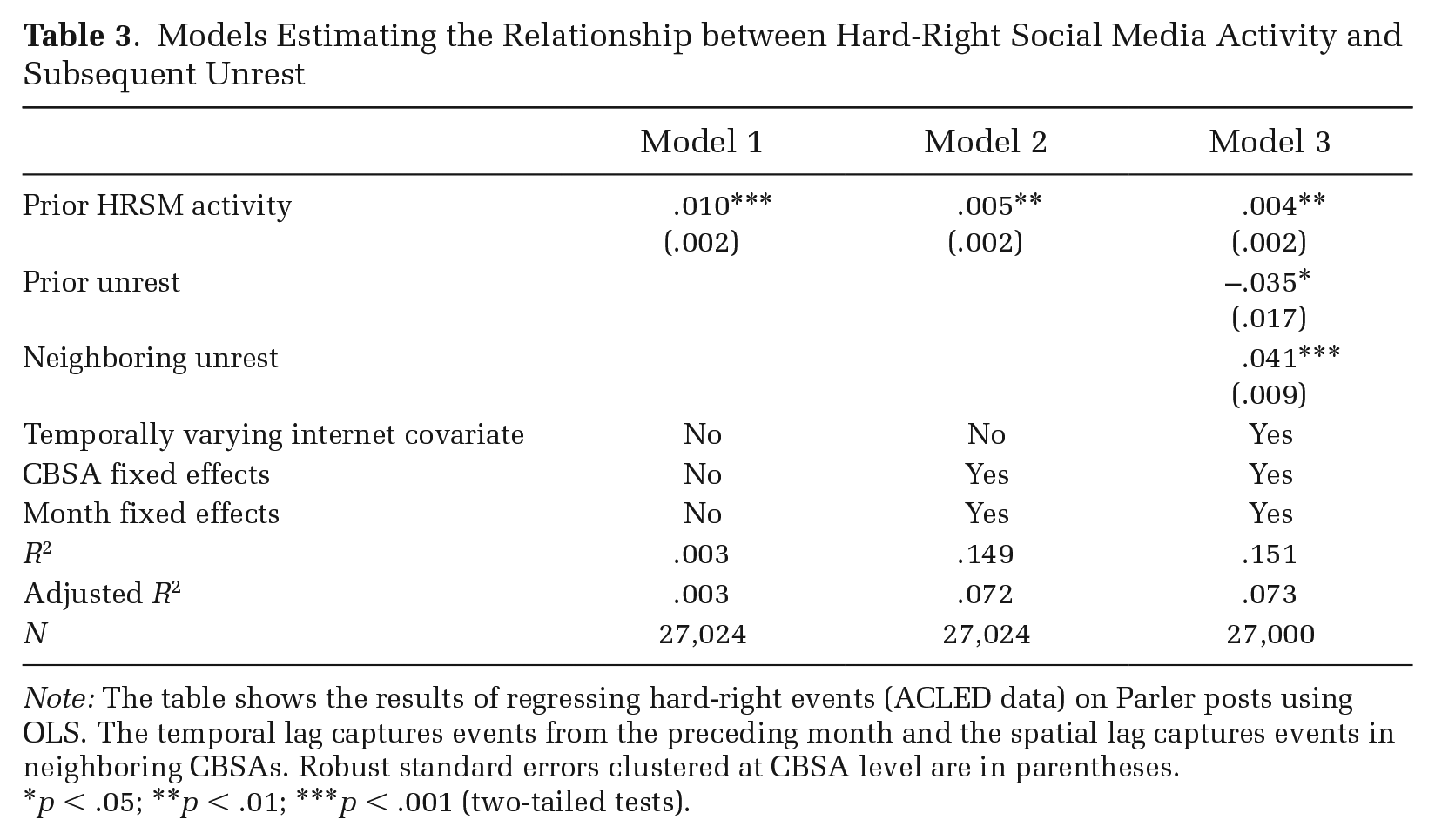
Note: The table shows the results of regressing hard-right events (ACLED data) on Parler posts using OLS. The temporal lag captures events from the preceding month and the spatial lag captures events in neighboring CBSAs. Robust standard errors clustered at CBSA level are in parentheses.
p < .05; **p < .01; ***p < .001 (two-tailed tests).
The magnitude of the relationship between HRSM activity and subsequent hard-right unrest is not large. A 10 percent rise in activity on Parler yields a .04 percent increase in events per 100,000 people. Despite the modest effect size, two characteristics of social media and civil unrest caution against dismissing its importance. First, there are few barriers to using social media, and the membership of social media platforms can grow quickly. Consequently, HRSM activity could increase rapidly, especially considering Parler’s spring 2021 revival and the launch of social media platforms by Trump and other conservative figures and investors (Goldstein 2022a, 2022b). Second, a single incident of hard-right unrest can be consequential. For example, during 2020, several protests by the Proud Boys resulted in numerous hospitalizations and some fatalities (Haas, Olmos, and Parks 2020; Herman, Lang, and Williams 2020).
Our robustness checks consistently support the main finding that HRSM activity is associated with subsequent hard-right unrest (see Section D of the online supplement). When using either ACLED or CCC data, the logistic regression and zero-inflated Poisson model both indicate that prior Parler activity is a positive predictor of unrest and statistically significant at conventional levels. We obtain similar results when using an alternative second-order spatial weights matrix in our main model.
In our analysis of the theoretical model guiding our interpretation, reversing the direction of the relationship—regressing Parler activity on prior hard-right unrest, with month and spatial lags of Parler activity and CBSA and month FEs—indicates that hard-right unrest is not associated with subsequent Parler activity. The placebo test shows that HRSM use is not associated with subsequent non-hard-right unrest. The models using CCC data provide consistent placebo test results (see Sections E and F in the online supplement). In addition, the results of our supplemental analyses using, first, balanced data and, second, panel-matched data with a DiD estimator align with those from the main model (see Sections G and H of the online supplement).
Finally, we examine the sensitivity of the main and supplementary results to unobserved and unaccounted-for confounding. To facilitate interpretation, we frame the results in terms of three observed benchmarks that have strong theoretical or empirical justifications for predicting unrest: prior hard-right unrest, hard-right unrest in neighboring CBSAs, and CBSAs’ preexisting level of conservative ideology among residents. The results indicate that unobserved confounders as strong as prior unrest events or as strong as neighboring unrest events are not sufficient to explain away our results. Furthermore, an extreme confounder explaining all the residual variation of unrest would have to be as strongly associated with Parler activity as prior unrest or more associated than neighboring unrest to threaten our results. The sensitivity analysis of the balanced models provides similar results, and we additionally learn that unaccounted confounders as strong as CBSAs’ preexisting level of conservative ideology are also not sufficient to overturn our results. The sensitivity analyses of the CCC-based results lead to consistent conclusions. Section I in the online supplement presents the complete results and detailed explanation.
To summarize, the results from Part 1 support Hypothesis 1 and offer evidence consistent with the argument that more HRSM activity promotes greater offline civil unrest. If we assume the main and supplemental models account for all relevant confounders—which include time-varying temporal and spatial lags, as well as measures of preexisting hard-right ideology—the results suggest HRSM use in an area causes hard-right unrest. If we are unwilling to make that assumption, we can still interpret the effects as causal if we assume that omitted confounders are not as strong as (1) the effects of previous hard-right unrest in an area or (2) unrest in a neighboring area (see Cinelli, Forney, and Pearl 2022).
Part 2: Evidence That Users’ Shifting Perceptions of Norms Link Online Activity to Unrest
Table 4 presents the results of our tests of Hypotheses 2 and 3. The baseline model estimating the association between coordination language and subsequent unrest suggests a positive relationship (p < .001), yet the model adjusting for previous unrest, unrest in neighboring CBSAs, internet access, the transformation of users, and CBSA and month FEs indicates there is no relationship between prior coordination language and unrest (Model 5, Table 4). We obtain similar results when using CCC data (see Section J in the online supplement). Thus, although the results provide an intriguing signal that HRSM users’ discussion of events is associated with subsequent unrest, they do not offer strong support for Hypothesis 2.
Models Estimating the Relationship between Hard-Right Civil Unrest and Prior Coordination Language and Perceived Elite Endorsement
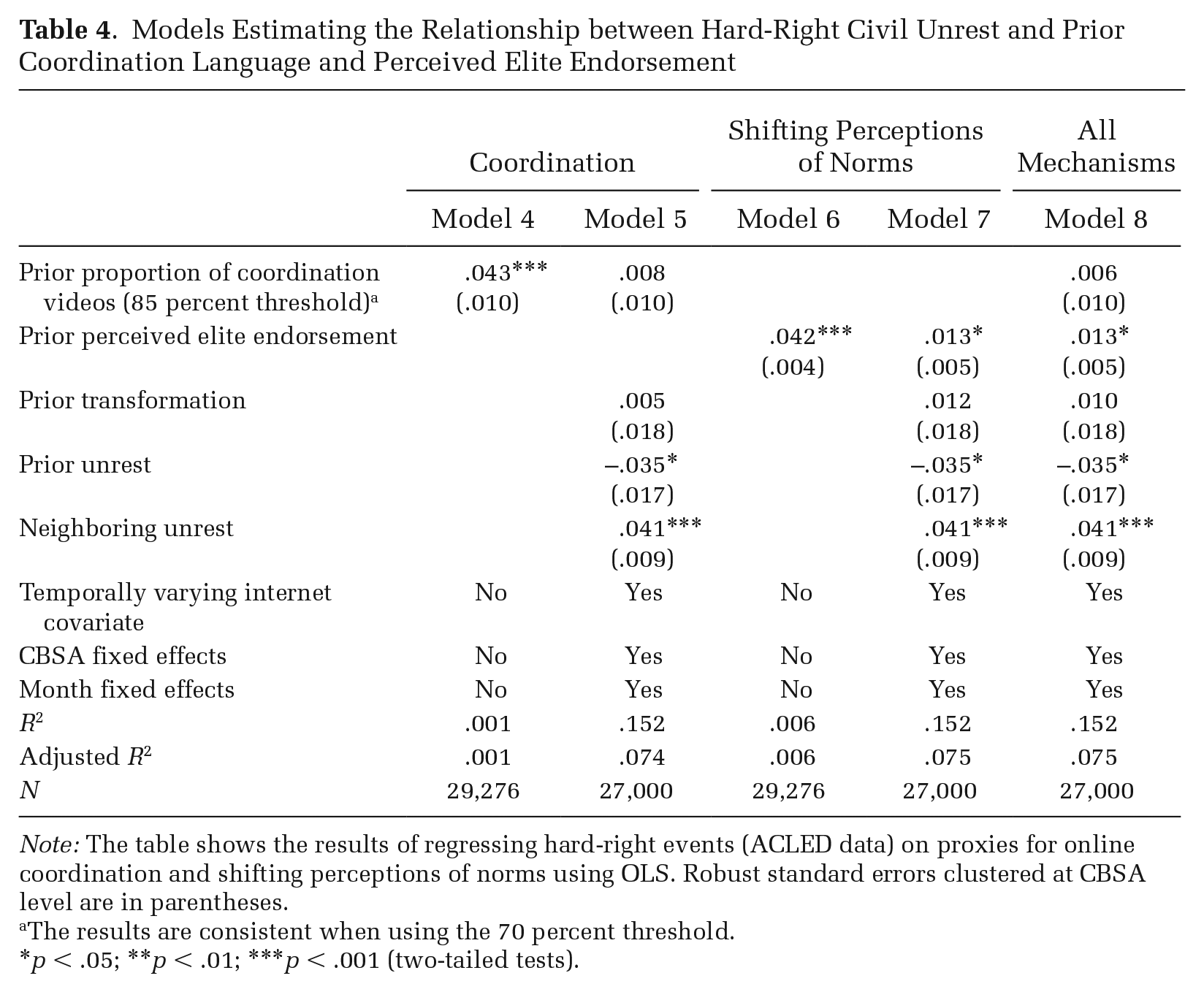
Note: The table shows the results of regressing hard-right events (ACLED data) on proxies for online coordination and shifting perceptions of norms using OLS. Robust standard errors clustered at CBSA level are in parentheses.
The results are consistent when using the 70 percent threshold.
p < .05; **p < .01; ***p < .001 (two-tailed tests).
To better understand this unexpected outcome, we examined the language on Parler using a distinct corpus of users’ comments (see Section K in the online supplement). We found that coordination language in users’ comments is extremely rare. Only two of the 50 most frequent words—“joined” and “meeting”—appear related to the coordination of events, and neither made up more than .5 percent of all the words. Moreover, the term “joined” was often used to talk about people joining the platform. We also found that the frequency of selected words plausibly related to coordinating events, such as “rally,” “protest,” and “gathering,” do not exceed .12 percent of all words. We interpret the rarity of coordination-related words in users’ comments as further evidence that coordination was unlikely to link Parler and hard-right unrest across the United States during 2020.
Table 4 additionally shows that the reflection of users’ content in the following month’s elite content is positively related with subsequent unrest in users’ CBSA. Model 6, a baseline model, and Model 7, which accounts for transformation in users, as well as the neighboring unrest and temporally invariant and varying covariates, both describe an association between perceived elite endorsement and unrest during the following month (p < .001 and p < .05, respectively). Model 8 shows that the relationship is robust to adjusting for coordination language (p < .05). Using CCC data generates similar results (see Section J in the online supplement). These findings offer strong evidence in support of Hypothesis 3. They are also consistent with the argument that when HRSM users see their existing views reflected in the speech of HRSM elites, their perceptions of norms will shift, leading to more hard-right offline unrest.
Finally, we took steps to address model dependency and possible confounding in our tests of Hypothesis 3, as well as assess the threat posed by unaccounted-for confounding. First, we re-estimated Models 6 and 8 using entropy-balanced covariates and obtained results consistent with those reported in Table 4. They also align with the results of models using CCC data (see Section J in the online supplement). Section L in the online supplement reports balancing diagnostics and the complete results. Then, to evaluate the impact of unaccounted confounders, we analyzed the sensitivity of the results of our fully specified models (i.e., Model 8, Table 4, using ACLED data and, with CCC data, Model J5, Table J1), as well as results of models using the balanced data. These analyses indicate that unaccounted confounders as strong as (1) prior unrest or (2) neighboring unrest are not sufficient to threaten our results, whether we are using ACLED or CCC data. The analyses of the balanced-covariates results (using both ACLED and CCC) lead to similar conclusions: unaccounted confounders as strong as the two benchmarks or as strong as CBSAs’ preexisting level of conservative ideology would not be enough to overturn our results. Section L in the online supplement presents details of these analyses. Considering the high bar set by the benchmark variables, the sensitivity analyses, along with the supplemental results, offer compelling additional evidence supporting Hypothesis 3. Furthermore, as in Part 1, the effect of perceived elite endorsement can be interpreted as causal if we assume the main and supplemental models account for all relevant confounders, or if we assume that omitted confounders are not as strong as the benchmarks.
Discussion and conclusions
Does HRSM use lead to hard-right civil unrest? Using a transparent and reliable data source for HRSM activity and two distinct databases of unrest, we find that HRSM activity increased subsequent unrest in the United States during 2020. The results are robust to different variable operationalizations and modeling approaches; reverse causality and placebo checks support our interpretation of the evidence. Additional quasi-experimental and sensitivity analyses suggest that, under reasonable assumptions, HRSM use in an area causes higher levels of offline civil unrest in that area.
It was unclear at the outset whether HRSM activity would be associated with subsequent unrest across the United States. After all, the scholarship on social media’s offline social and political consequences offers inconclusive findings (Haidt and Bail 2022; Zhuravskaya et al. 2020). Furthermore, there are sound reasons to expect that HRSM’s growing insulation from the broader media ecosystem would constrain their effect on countrywide patterns of unrest (Koopmans and Olzak 2004). Our main findings therefore illuminate social media’s offline social consequences, in general, while contributing to our understanding of HRSM specifically. This latter contribution is critical: hard-right-specific social media platforms are becoming more popular among the political right (Jasser et al. 2021; Schulze 2020) and attracting billions of dollars of investment (Goldstein 2022a, 2022b; Hakim 2022). A robust, well-financed, and broadly influential U.S. HRSM ecosystem is emerging, and our findings offer a glimpse into its future.
To understand the link between HRSM and unrest, we extended the theory of discursive opportunity structures (Koopmans and Olzak 2004) into the social media age. We specifically distinguished between the diffusion, or reach, of activists’ and partisans’ messaging and the quality of experiencing message exposure and consumption. HRSM’s growing insulation, we posited, hinders diffusion but improves the quality of discursive opportunities. A more limited diffusion decreases reliance on independent mass media gatekeepers and influential public discourse participants to facilitate the impact of messaging, replacing them with elite HRSM users. These elites, often supported and promoted by HRSM platforms, provide other users with highly visible, widely resonating, and unambiguously legitimated hard-right ideas, information, and rhetoric every day.
We additionally theorized why high-quality experiences of hard-right messaging, occurring via HRSM, might cause civil unrest. Our theory and empirical evidence suggested that HRSM users shift their perceptions of prescriptive behavioral norms. We argued this happens when users see their beliefs and values reflected in HRSM elites’ speech, which they interpret as an elite endorsement of their viewpoints. As a result, they will update their understanding of norms in a way that favors their existing hard-right views and, in turn, become more confident of the acceptability of behaviors stemming from these views. This process increases the likelihood of subsequent unrest.
We see our theoretical arguments and empirical analyses as early steps toward greater insight into the link between social media activity, users’ shifting understandings of the offline world, and their subsequent offline behavior—particularly in the context of an increasingly insular HRSM ecosystem. There are, of course, straightforward ways to extend our analyses and findings. For example, future research could focus on improving and expanding our data: with information on the size of unrest events, analyses could examine the effect of HRSM activity on the magnitude of mobilization; with techniques to infer missing location information, activity on other HRSM platforms could be merged with the Parler data. Future studies could also measure and analyze the Parler video content more extensively by incorporating information from videos’ images and sounds into our database of videos’ transcribed speech. We made the transcript database available with this article to facilitate such research. 28 Other studies could probe the tentative evidence that coordination language could lead to offline unrest (i.e., Model 4, Table 4). This type of discourse may be more influential in other contexts, such as in autocracies, but still play a role at particular moments in countries like the United States. Indeed, comparing settings is a way for future research to examine the generalizability of our findings. This work could, for example, compare U.S. HRSM with hard-right pockets of mainstream social media platforms or other countries’ HRSM ecosystems.
Another avenue for future research is to examine politically leftist social media content and activity, which may cause corresponding contentious events. We do not examine this possibility ourselves because our data limit us to studying HRSM. Nevertheless, although leftist social media are not currently undergoing a “strategic exit” like the online right (Freelon et al. 2020), de facto isolation may emerge on mainstream platforms as conservative social media users migrate to HRSM platforms (see Kor-Sins 2021; Rogers 2020). Under such conditions, de facto majority leftist (but otherwise mainstream) platforms could enable tests and advancements of our arguments. After all, the theories and mechanisms we develop in this study apply to any social media platform with high-quality discursive opportunities. Our findings suggest these can occur on any platform or social media ecosystem that is becoming increasing isolated, as long as the isolation decreases the importance of independent claims-makers while increasing the influence of platform elites, and users see their online expressions reflected in the speech of these elites.
Our preliminary extension of DOS theory into the digital era could be further developed and refined. One important way to do so is to specify and exploit where there is and is not overlap between, on the one hand, our arguments about the quality of discursive opportunities and users’ shifting perceptions of norms and, on the other, the phenomena commonly known as “mis/disinformation” and “echo chambers.” Some key similarities and differences could be leveraged to advance theory.
Studies of “mis/disinformation” center on inadvertently false or inaccurate media content (misinformation) or content purposefully designed and promoted to mislead (disinformation) (Benkler et al. 2018; Freelon et al. 2020). In contrast, we analyzed, first, HRSM users’ experience of information exposure and consumption—including the role of HRSM elites in these experiences—and, second, how differences in these experiences affect users. We did not focus exclusively on content. Put more specifically, the cues that can shift users’ perceptions of norms could be mis/disinformation, but being misleading is not necessary. In fact, when reading the Parler transcripts and comments, it was clear that the content sometimes contains valid, and banal, reactions to recent events.
In the context of social media, the metaphor of echo chambers refers to the situation in which users find themselves in environments where information and interactions reinforce their preexisting beliefs (Sunstein 2009; Terren and Borge 2021). Online situations like echo chambers can expose social media users to cues aligned with their existing beliefs, perhaps making the cues more likely to shift their perceptions of norms. However, cues from echo chambers do not necessarily have strong effects. They could simply affirm, not shift, users’ existing understanding of norms. Moreover, common conceptualizations of echo chambers are typically silent about internal social structure, such as differential status among members and the role of elite users (Terren and Borge 2021). In contrast, our argument emphasizes that users’ elite status plays an important role in how social media activity affects non-elite users’ offline behavior.
Nonetheless, the notions of mis/disinformation and echo chambers point to useful ways to further study how social media activity can shift users’ perceptions of norms. For example, we know that social media content can mislead (Benkler et al. 2018; Freelon et al. 2020) and distort individuals’ understanding of themselves in broader society, in part by hindering experiences of shared environments (Bail 2021; Terren and Borge 2021). With these insights, future research could build toward a concept of “mis-norms,” or the situation in which social media users assume the norms in their primary online community, such as Parler, are appropriate when interacting with other (offline) groups they belong to, such as sports clubs or their children’s school community. Social media could have profound effects on offline behavior in local communities by distorting individuals’ sense of which norms are applicable in particular social contexts—engendering the situation of “mis-norms”—instead of simply reinforcing their existing ideas or exposing them to misleading information, both of which have long been part of the conservative movement in the United States (Hofstadter 1965).
Supplemental Material
sj-pdf-1-asr-10.1177_00031224231156190 – Supplemental material for “Born for a Storm”: Hard-Right Social Media and Civil Unrest
Supplemental material, sj-pdf-1-asr-10.1177_00031224231156190 for “Born for a Storm”: Hard-Right Social Media and Civil Unrest by Daniel Karell, Andrew Linke, Edward Holland and Edward Hendrickson in American Sociological Review
Footnotes
Acknowledgements
We thank Luis Leon Medina and Matthew Shawcroft for research assistance and Carl Dahlman, Jeffrey Jensen, Andrew Lindner, Abdul Noury, Rourke O’Brien, Steven Pfaff, and Blaine Robbins for their comments. We additionally thank Charles Seguin, Daniel DellaPosta, Gary John Adler, David Baker, Marjan Davoodi, Diane Felmlee, Kerby Goff, Chris Julien, Eric Plutzer, and the other members of the Culture and Politics workshop at Penn State’s Department of Sociology and Criminology. We are indebted to three anonymous reviews and the editors for their excellent suggestions. D. K. and A. L. contributed equally. The authors acknowledge that they received no funding in support for this research and declare no competing interest. Support for open-access publishing was provided by the Open Access Publishing Fund administered through the University of Arkansas Libraries.

Notes
References
Supplementary Material
Please find the following supplemental material available below.
For Open Access articles published under a Creative Commons License, all supplemental material carries the same license as the article it is associated with.
For non-Open Access articles published, all supplemental material carries a non-exclusive license, and permission requests for re-use of supplemental material or any part of supplemental material shall be sent directly to the copyright owner as specified in the copyright notice associated with the article.
