



Abstract
We investigate how sociology students garner recognition from niche field audiences through specialization. Our dataset comprises over 80,000 sociology-related dissertations completed at U.S. universities, as well as data on graduates’ pursuant publications. We analyze different facets of how students specialize—topic choice, focus, novelty, and consistency. To measure specialization types within a consistent methodological frame, we utilize structural topic modeling. These measures capture specialization strategies used at an early career stage. We connect them to a crucial long-term outcome in academia: becoming an advisor. Event-history models reveal that specific topic choices and novel combinations exhibit a positive influence, whereas focused theses make no substantial difference. In particular, theses related to the cultural turn, methods, or race are tied to academic careers that lead to mentorship. Thematic consistency of students’ publication track also has a strong positive effect on the chances of becoming an advisor. Yet, there are diminishing returns to consistency for highly productive scholars, adding important nuance to the well-known imperative of publish or perish in academic careers.
Sociology operates on the verge of its own undoing, seemingly without respite. Throughout the twentieth century, many scholars sounded the alarm around the fragile state of the discipline: sociology is disintegrating (Znaniecki 1945:514), amid a clash of theories (Giddens 1976:715), compartmentalized into “congeries of outsiders to each other” (Collins 1986:1340–41), with subspecialties drifting apart from each other (Hand and Judkins 1999:18). As early as 1920, we find calls to map the field (Committee on Standardization of Research 1920, cited in Rhoades 1981:16). It seems the discipline can only be pursued, if at all, against its own tendency for self-subversion (Holmwood 2010:650).
Yet, after a century of sociology’s alleged disintegration, students continue to pursue the discipline. In fact, the number of awarded PhDs in sociology has increased steadily since the 1990s, and in recent years, it is close to the prior peak of the late 1970s (see Figure 1), which is known as a period of critical overcrowding (Collins 1986:1338; Crane and Small 1992:199). The field’s demographics changed too. Since the late-1980s, women have been awarded the majority of sociology doctorates, and the share of ethnic minority graduates climbed from approximately 10 percent in the 1970s to around one third in 2016. In contrast, the number of faculty positions has slightly declined since 2000 (ASA 2021a). These antagonistic trends might increase the pressure to publish early in one’s career, which, in turn, raises the bar that young scholars must clear to secure a permanent position in sociology (Warren 2019).
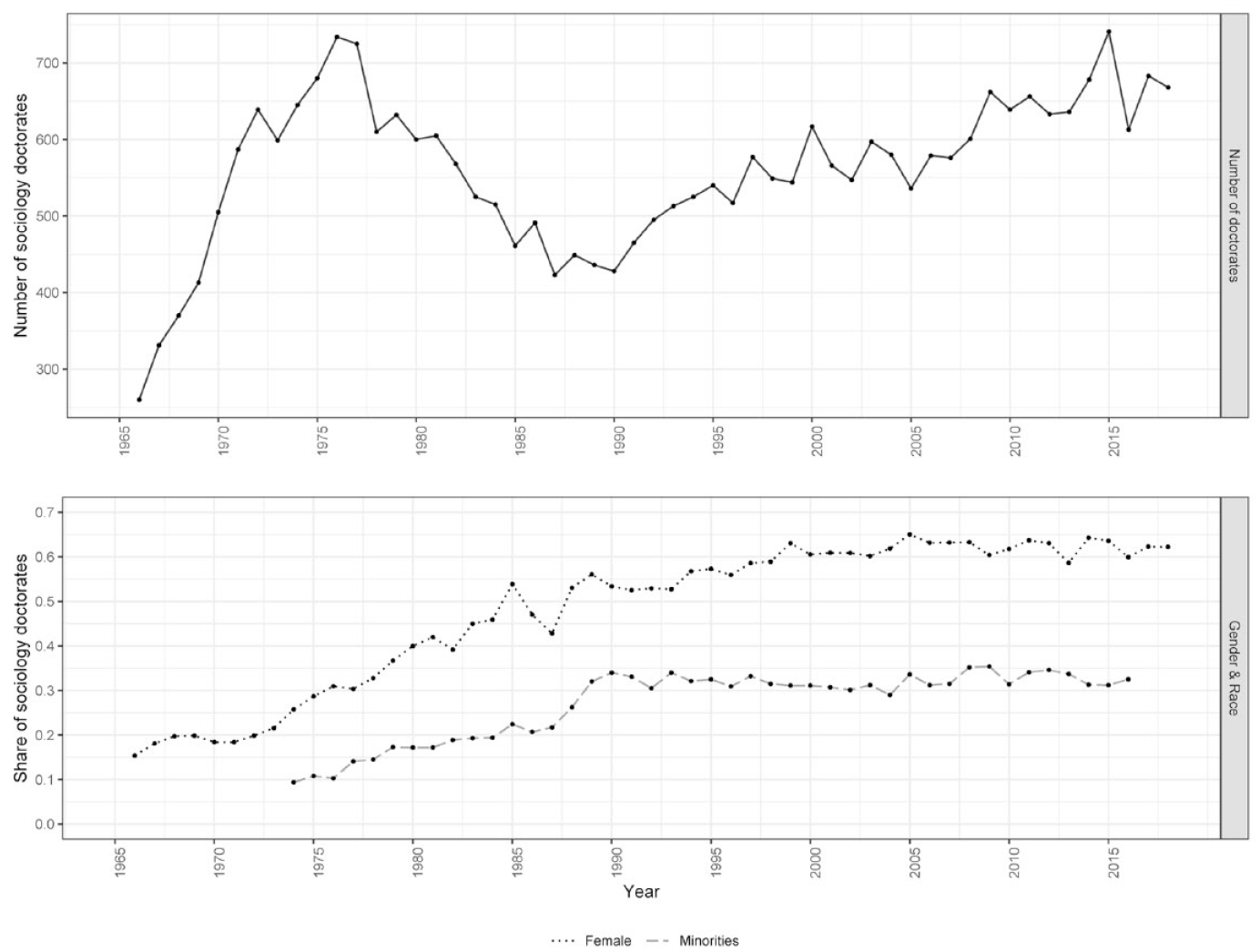
Demographic Developments in U.S. Sociology
Specialization has long been recognized (Collins 1986; Weeber 2006), maligned (Coser 1990; Gitlin 1990), and studied (Leahey, Keith, and Crockett 2010; Leahey and Moody 2014) as a publication strategy of extant sociology faculty, but little attention is given to how graduate students adopt this strategy. This is surprising, given that young scholars are charged with reproducing and transforming the field (Bourdieu 1988:94; Kuhn 1962:151). Our objective here is therefore to answer, how do sociology students specialize and to what professional returns? To observe students’ specialization, we utilize an understudied genre of writing: the dissertation, which, we argue, enacts a student’s appeal for recognition in one of the field’s research areas.
The academic specialization process entails adopting a particular research focus, and sustaining this focus consistently over time to become a recognized expert. This focus can vary in degree and targeted content. It also occurs within a larger context of available themes in the field, with respect to which it can be described as novel or traditional specialization. We synthesize these facets of specialization into three antinomies: tradition versus innovation (Foster, Rzhetsky, and Evans 2015; Kuhn 1959; Leahey and Moody 2014), focus versus breadth (Leahey 2007; Leahey et al. 2010; Teodoridis, Bikard, and Vakili 2019), and consistency versus change (Koppman and Leahey 2019; Trapido 2015). With regard to student dissertations, the first two facets concern students’ topical choices: Does their thesis deal with a narrow set of topics? Is it within an identifiable research tradition, or does it span across them? The last facet concerns the extended publication track of students after graduation: Do they continue to publish in the same thematic area as their dissertation or do they change their focus? In addition to these three facets, we also consider specialization in the sense of students’ choice of specific topics, which we call targeted specialization.
To study research specialization, we focus on the language used in student theses and ensuing published works. We fit a structural topic model (STM) (Roberts, Stewart, and Airoldi 2016; Roberts et al. 2014) to the abstracts of student dissertations. We recover topics, or “word systems” (Astley 1985:499), reflective of the research areas directly expressed in young scholars’ writings, and then use these topics to develop measures for each facet of specialization. By linking this information to students’ ensuing careers, we are able to ascertain the relation that different forms of specialization have on an important long-term career outcome in academia: time to becoming a primary advisor. Such attainment is a conservative proxy for success—only around 3 percent of PhDs in our broad sample become advisors of sociology-related theses—but it reflects if and when a student occupies an influential position in field reproduction. Furthermore, by focusing on cohorts of graduate students, our approach allows us to illuminate specialization strategies used at the start of a career, whereas prior studies concentrating on salaries (Leahey 2007) or citations of extant faculty (Sinatra et al. 2016) may suffer from survival bias.
We connect facets of specialization to the time it takes until first mentorship via event-history models. We find students in 1980 to 2015 became advisors of sociology-related PhDs via distinct specialization strategies. Students were most likely to achieve influential field positions when they targeted certain topics reflective of the cultural turn or statistical models rather than adopting a thematic focus in general. They were also likely to secure such positions when they adopted novel topic-combinations rather than traditional forms. Finally, students were more likely to become advisors when they established a consistent research identity early in their careers. Such consistency need not be large, however. Only a small number of publications consistent with the dissertation provides considerably better chances to achieve a position as an advisor. This finding adds important nuance to the well-known imperative of publish or perish.
Specialization as Career Strategy in Sociology
During the plenary sessions of the 1988 annual meeting of the American Sociological Association, Gitlin (1990:216) argued that sociology had lost public value because students with ever more specialized interests invested in obscure scholastic writing rather than engage in debates of public import. Coser (1990:208–9) added that in this kind of highly specialized writing, the “methodological tail wags the substantial dog,” and concepts lack critical bite. Moore’s (1990) rejoinder in this debate argued, on the contrary, that African American, Latinx, and women sociologists, in particular, play a significant, albeit specialized, role in advancing the discipline’s critical tradition, often in their teaching and in organizing for regional professional associations.
The 1988 ASA polemic occurred during a period in which young sociologists adopted high degrees of specialization to avoid downward mobility into contingent academic work (Weeber 2006:59). More formally, in the 1980s and 1990s, young sociologists pursued specialization as an effective adaptation to an overcrowded academic market, in which they could only compete for the attention of their peers within narrow disciplinary niches (Collins 1986).
The narrative of fragmentation alluded to in the introductory paragraph, and echoed by Gitlin and Coser, is grounded in the true state of affairs of a growing field with many loosely connected themes and an impoverished corps—a discipline that is increasingly subject to the pressures of specialization and market-oriented higher education (Holmwood 2010). What this narrative obscures is that fragmentation is an emergent property of the way novice scholars vie for a place in the field; namely, through specialization. It is no surprise then, that previous efforts to investigate sociology—as a field (Leahey and Moody 2014) and career (Koppman and Leahey 2019; Leahey 2007; Leahey et al. 2010)—focus on the issue of specialization.
Our own contribution to a better understanding of specialization as a career strategy in sociology is threefold: we investigate an understudied site for specialization—the dissertation; a critical career outcome—becoming an advisor; and a suite of specialization strategies—topic choice, focus, novelty, and consistency.
The Dissertation Genre
The dissertation is one of the most decisive documents in a scholar’s life. 1 It can be thought of as a claim to a career and to a research program worth pursuing (Bourdieu 1988:94). A thesis can also be thought of as a rite of passage (Collins 2002:43), whereby a young scholar shows deference to a field’s canon (Paré, Starke-Meyerring, and McAlpine 2011:220). Of course, young scholars have also been described as central agents of field transformation (Kuhn 1962:151), a role that may also be expressed in the dissertation genre.
Dissertations constitute a site for the specialization strategies of young sociologists; this is the field constituency variously charged with reproducing or transforming the field. Also, this constituency’s efforts to capture the attention of a niche audience fuel the disciplinary lament of fragmentation. In addition, unlike any other genre of academic writing, the dissertation does not suffer from publication bias, a pressing issue in the sociology of science (Fortunato et al. 2018).
Becoming an Advisor
Becoming an advisor encodes a crucial aspect of the success of a specialization strategy. It is through relations of mentorship that scholars recruit allies into intellectual movements and legitimate novel academic identities (Frickel and Gross 2005). Which graduates do or do not become advisors, and the time it takes to become one, reflects which forms of specialization are in most immediate demand. Scholars who achieve this stage become gatekeepers of the specialized disciplinary niche. Also, intergenerational networks of mentor-mentee relationships can reinforce the status of different methodologies in sociology subfields (Bandelj 2019). These are also central to the transmission of highly codified research practices (Leahey 2006).
Despite the critical importance of advisorship as a career achievement, particularly in relation to specialization strategies, this is not an outcome that receives much attention in the literature. Many scholars emphasize rewards granted to esteemed faculty as important points in academic careers—for instance, prestigious prizes (Zuckermann 1977), higher salaries (Leahey 2007), or high-impact papers (Sinatra et al. 2016). Just a handful of studies focus on the acquisition of long-term positions, like (tenured) professorships (Balsmeier and Pellens 2014; Leahey et al. 2010; Lutter and Schröder 2016). This work finds that besides the quantity and quality of the basic unit of scholarly achievement (i.e., publications), other non-meritocratic factors, especially gender (van den Besselaar and Sandström 2016) and affiliations at elite institutes (Burris 2004), influence the chances of becoming faculty. Instead of using appointments to professorships or getting tenure as a proxy for academic success, we focus on all graduates of sociology-related theses and identify which go on to become advisors of sociology-related theses themselves and the time to such a position. We argue this is a more conservative and substantive approximation of achieving an influential and successful scientific career.
There is a considerable gap between the site in which we will study specialization—the dissertation—and the career stage in which we will measure the success of this strategy—becoming an advisor. To connect the two, we conceptualize and measure different facets of specialization, some of them narrowly connected to the document of the dissertation; others extending outward from the dissertation to a scholar’s entire documented research output.
Facets of Specialization
Students write about specific methodologies, theories, and subject matters that appeal to distinct audiences in the field. Through the selection of topics, students can display varying degrees of thematic latitude (focus versus breadth); furthermore, they can consolidate prior links and traditions, or combine topics that have rarely been combined (tradition versus novelty). In their future work, students can persist in the same vein of their dissertation or venture out to other themes (consistency versus change). These different facets of specialization have rarely been studied together, or with an approach that allows the specialized subject matter to emerge directly from students’ writing.
Specializing on Target Topics
A dissertation draws from multiple topics; that is, multiple methods, theories, and subject matters expressed in careful word choices that elicit recognition from peers. This community of peers may be organized in specialized sections of a professional organization (Leahey 2007; Leahey and Moody 2014); or it may be more loosely structured as a collective that shares a set of methods and ontologies (Knorr Cetina 2009) and “similar views on contested scientific topics” (Teplitskiy et al. 2018:1828). In either case, the topic structure expressed in dissertation writing displays students’ aptitude to elicit their community’s signature thought style (Antons, Joshi, and Salge 2019:3044–5; Fleck 1979). This crucial act of position-taking through topic choice will have differential professional returns, as students will vary in their success dealing with a topic, and the communities students appeal to through their topic choices may have more or less to offer them in terms of career prospects.
The effect of targeted specialization in specific topics on career outcomes is not well understood (Gieryn 1978). Among the few studies that exist, Hoppe and colleagues (2019) find that in medicine, selecting certain topics contributes to lower success rates of African American scientists at the NIH. Munoz-Najar Galvez, Heiberger, and McFarland (2020) find that in education, targeting topics associated with the interpretive approach improves PhD students’ chances of an academic career. And Moody (2004) finds that for sociology, specialty areas shape collaboration networks, and quantitative work is more likely to be coauthored. Based on the extant literature, we formulate a baseline hypothesis that specializing more than others in specific topics will likely shape career prospects:
Hypothesis 0: Targeting certain topics will affect PhD students’ chances of becoming an advisor.
Focus versus Breadth
In contrast to the effect of targeted specialization, much effort has been put into disentangling whether specialists or generalists have more successful careers. This distinction captures the trade-off between spending limited resources to gain an in-depth understanding of a specific domain versus gathering more superficial knowledge across several domains. Previous research describes affordances and penalties for both strategies. For instance, specialized scholars who master the literature of a subfield can leverage this mastery to write more papers (Leahey 2007) or produce breakthrough inventions (Conti, Gambardella, and Mariani 2014). In the sociology of concepts and categories, Hannan and colleagues (2019:4) argue that, in a variety of contexts, “a clear position in one category tends to increase an offer’s appeal”; they call the obverse of this affordance the “category-spanning discount.”
In contrast, Teodoridis and colleagues (2019) find that affordances for both specialist and generalist strategies apply in creative work, depending on the pace of change in a given field, with generalists being the more desirable collaborators in slower fields. A related stream of work argues that creative workers should seek boundary-spanning combinations that achieve greater recognition (Burt 2004; Fleming 2001; Fleming, Mingo, and Chen 2007; Schilling and Green 2011). Acknowledging the competing evidence, as well as the lack of pertinent case studies dealing with the dissertation genre or academic field novices, we hypothesize two competing claims: 2
Hypothesis 1a: A topically focused thesis leads to higher chances of becoming an advisor.
Hypothesis 1b: A topically broad thesis leads to higher chances of becoming an advisor.
Novelty versus Tradition
Several studies find that novel combinations of prior knowledge increase the recognition of academic papers. This line of work describes unusual combinations of chemical substances (Foster et al. 2015), bibliographic references (Uzzi et al. 2013), disciplines (Leahey, Beckman, and Stanko 2017), subfields (Leahey and Moody 2014), concepts (Hofstra et al. 2020), and topics (Antons et al. 2019) as garnering outsized recognition. However, there is also evidence that papers benefit from closeness to established knowledge. Foster and colleagues (2015) make clear that the “bread and butter” business of academia (i.e., job talks and grants) rewards the production of traditional work, and Shi, Leskovec, and McFarland (2010) show that work squarely situated within and consistent with a research community has the likeliest chance of recognition. Fleming (2001), Uzzi and colleagues (2013), Trapido (2015), and Leahey and colleagues (2017) all point out that novel recombination of ideas and categories represents a high-risk high-reward endeavor that often fails, but sometimes yields great success.
It is unclear how novelty reflects on young scholars and their prospects to become advisors. Younger scholars are more likely to pursue novel research (Bourdieu 1988; Kuhn 1962), but they often face precarious job prospects. Thus, we posit competing claims between innovative and traditional combinations (Kuhn 1959):
Hypothesis 2a: Novel topic combinations in a thesis increase the odds of becoming an advisor.
Hypothesis 2b: Traditional topic combinations in a thesis increase the odds of becoming an advisor.
Consistency versus Change
Our hypotheses thus far connect crucial features of specialization in students’ dissertation writing to a long-term outcome of their academic careers: becoming an advisor. We reviewed a broad literature showing the relevance of specialization to career outcomes. But the link between an initial state of specialization and a long-term outcome relies on the assumption that entry conditions into an academic field can credibly affect how a student’s career unfolds. This link has been theorized in classical works in the sociology of science, where scholars’ initial standing in a field is said to express and reproduce stable aspects of their institutional and social status (Bourdieu 1988). Of course, this assumption needs to be tested empirically. To do that, we introduce another facet of specialization, which we refer to as consistency versus change. This facet describes the link between the topic structure of a student’s dissertation and topic choices in ensuing work, leading up to the career stage when the person may be considered to become an advisor.
Patterns of consistency (versus change) affect the unfolding of professional careers. For a new scholar, persisting in the same research area is a safe bet because changing specializations requires starting over, and chances of failure are high (Gieryn 1978:105–7). Yet, there are times when a significant pivot might pay off. For instance, movie actors increase their chances of being hired by playing similar roles early in their careers, and then by playing against type later on (Zuckerman et al. 2003). By contrast, Indian bureaucrats are rewarded for being a generalist early and adopting a more specialized and consistent identity later (Ferguson and Hasan 2013).
Closer to our case, Koppman and Leahey (2019) find that in sociology, long-standing commitments to a relevant identity, such as interdisciplinarity, increase a scholar’s likelihood of using unconventional methods. The authors also find that affiliations to high-ranking universities add to the effect of a consistent identity; a result that is consistent with cumulative advantage (Correll et al. 2017). Similarly, for academic engineers, Trapido (2015) shows that audiences are more likely to deem authors’ novel contributions valuable when they are consistent with previously developed identities as innovators. Synthesizing previous findings on the effects of consistency leads to a third pair of competing hypotheses:
Hypothesis 3a: A consistent research identity (persisting with topics expressed in one’s thesis) improves the odds of becoming an advisor.
Hypothesis 3b: A changing research identity (departing from topics expressed in one’s thesis) improves the odds of becoming an advisor.
Analytic Strategy
To study how student theses reflect strategies of specialization, we draw on approximately all doctoral theses from 1980 to 2015 that conduct research related to sociology. We apply structural topic models (STM) (Roberts et al. 2016; Roberts et al. 2014) to those texts to identify the themes used in students’ writings. In so doing, we adopt a methodological frame that uses the actual language in students’ theses. The identified themes cut across fixed schemes of prelabeled categories often used in prior work. We argue that students’ specialization strategies are reflected in how they use these topics, and we develop metrics indicative of these strategies’ usage. Finally, we use event-history models to test hypotheses as to which specialization strategies enable graduates to quickly reach sociology advising positions. 3
Sample
Our analyses draw on a comprehensive database of doctoral theses written in the United States provided by ProQuest. We selected all dissertations in which the stem “sociol” was present in the title, abstract, keywords, or department (N = 82,363). 4 In doing so, we cast a wide net for theses related to sociological “thought styles” (Fleck 1979), representing the disciplinary structure as fragmented and influenced by neighboring fields. This relatively broad definition allows us to trace graduates from multiple disciplinary backgrounds who also contribute to the sociological field (Lamont and Molnár 2002). Knowing the department of graduation also allows us to distinguish between students at sociology’s “institutional heartland,” that is, students graduating from sociology departments, and authors whom we label as sociology-related. The data comprise each dissertation’s abstract, title, name of the graduate student, advisor’s name, institutional affiliation, and National Research Council (NRC) discipline. In total, the records contain theses from 12 disciplines, 5 cover 275 different U.S. institutions, and stretch from 1980 to 2015.
Identifying Thought Styles via Structural Topic Models
To discover thematic structures in dissertations, we use topic modeling (Blei 2012; Evans and Aceves 2016). Scholars have used topic models successfully to describe, for instance, the methodological divide of sociology (Schwemmer and Wieczorek 2020), themes of management research (Antons et al. 2019), math education (Inglis and Foster 2018), computer science (Anderson, McFarland, and Jurafsky 2012), and education research (Munoz-Najar Galvez et al. 2020). A conventional topic model takes as input a collection of texts formatted as a document-term matrix—a table in which every document is represented as a vector of word counts over the vocabulary of the document collection. The model learns the mixture of topics that make up each document and the words that belong to each topic via successive updates to two sets of prior multinomial distributions, (1) one of documents over topics and (2) one of topics over words.
We fit a structural topic model (STM) to the abstracts of sociology dissertations. STMs were developed by Roberts and colleagues (2014) to enable the use of document covariates (e.g., publication year) to improve the consistent estimation of topics. One of the ways an STM can include document covariates is in the estimation of a document-specific distribution over topics based on a document’s covariates. In other words, in an STM, topic proportions can be modeled as a function of covariates. 6 Our model uses a spline on year of publication to allow the average topic proportions to vary over time. We will describe the resulting trends in the first section of our results.
Like other unsupervised learning procedures (Molina and Garip 2019), however, researchers have to decide the number of topics (k) the model should identify. Note that this is problematic because the relevant topics are not known a priori. We selected a solution with 60 topics after using a careful three-step approach to select k (see Part A of the online supplement).
Two output matrices are essential for us. The first contains a list of topics, each consisting of words ordered by their probability of being associated with the respective topic. Table 1 presents these topics using FREX values (Roberts et al. 2016), where a word is weighted by the harmonic mean of its rank in terms of frequency (FR) and exclusivity (EX) for a topic. For instance, among the most descriptive words for topic40 (T40) are “qualitative,” “theme_emerge,” “ground_theory,” “phenomenological,” and “live_experience.” It seems intuitive to assume theses with high loads of T40 are engaged in qualitative methods. Thus, labeling topics resembles qualitative coding approaches, because topics allow multiple interpretations depending on the perspective we use to look at them (Inglis and Foster 2018).
Topics in Sociological Dissertations, 1980 to 2015
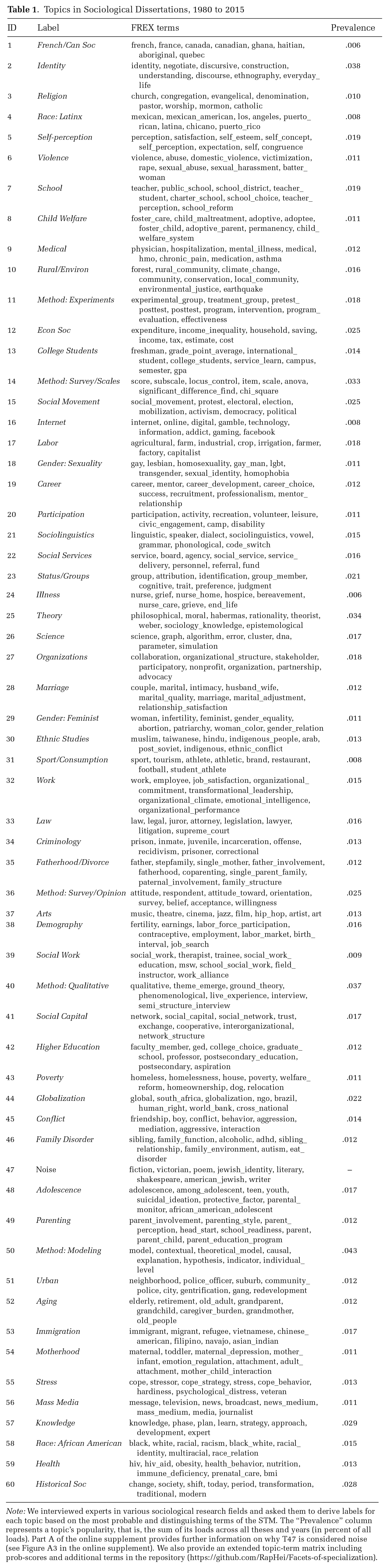
Note: We interviewed experts in various sociological research fields and asked them to derive labels for each topic based on the most probable and distinguishing terms of the STM. The “Prevalence” column represents a topic’s popularity, that is, the sum of its loads across all theses and years (in percent of all loads). Part A of the online supplement provides further information on why T47 is considered noise (see Figure A3 in the online supplement). We also provide an extended topic-term matrix including prob-scores and additional terms in the repository (https://github.com/RapHei/Facets-of-specialization).
The second important output for our undertaking is the document-topic matrix, often denoted θ. This matrix contains each document summarized as a vector of the proportions of its words associated with each topic (Roberts et al. 2014:1069). These topic proportions represent the strength of association between each topic and a given dissertation. We use the θ matrix to construct metrics for students’ topic choices, focus, novelty, and consistency.
Following Antons and colleagues (2019:3044–5), we argue that classification of scholarly work resulting from a topic model resembles Fleck’s (1979) “thought styles” because it provides “a snapshot of the word choices representing the thought collective’s encoding of its signature thought style.” Topics then “bear a more or less distinctive coloring conforming to a given thought style” (Fleck 1979:109), and we treat a dissertation described in terms of topics as a proxy for students’ position in the sociological discourse—sociology’s “word system” (Astley 1985:499)—at a crucial early career stage. These topics will later become a means to measure facets of specialization (targeted specialization, focus, novelty, consistency) that we relate to students’ career outcomes.
Dependent Variable
Our dependent variable is the time to becoming a primary advisor of a sociology-related PhD student. We view “sociology-related” theses as those that are defended in a sociology department or that contain the stem “sociol,” as described in the Sample subsection. 7 The broad sample of dissertations related to sociology represents the permeability of disciplinary boundaries (Lamont and Molnár 2002). Our dependent variable, which follows the same inclusion criteria as our sample, reflects a student’s success at becoming a gatekeeper for future students aspiring to enter the sociological field. 8 We interpret the time it took a student to first become an advisor as a conservative approximation of reaching an influential position in the sociological field.
To construct this variable, we matched all unique PhD student names to the names of primary advisors in our sample. This matching procedure captures students’ transition from student to advisor within the U.S. graduate education system. Note that former students in our sample who move on to advise students on dissertations with no reference to sociology would not appear as advisors in our data.
Independent Variables
In this section, we describe the way we measure each facet of specialization: targeted specialization, degree of focus, degree of novelty, and consistency with ensuing published work. All our measures are built on top of the document-topic matrix θ, which represents documents as mixtures of topics.
A topic of targeted specialization is distinctive of a student’s dissertation relative to the extent to which peers use the same topic. We want to capture that distinction among peers, because most topics (e.g., theory or methods) are used to a similar extent in many dissertations—that is, most topics in a dissertation cannot be discerned as targets of specialization. Therefore, we develop a metric that ascertains the extent to which students target a topic above and beyond most of their peers. Formally, the metric for targeted specialization measures if the topic load of a topic i in a document d (θdi,t) is larger than the 75th to 90th percentiles (in steps of 5) of that topic in the previous year across all theses
The degree of focus in a thesis (Hypothesis 1) is measured by calculating the Herfindahl index for the discrete probability distribution over topics θd that summarizes each document d as a mixture of topics. Here we are following Ferguson and Hasan (2013), who used the Herfindahl index to measure the focus of prior experience in specific types of work and the effect on Indian administrative officers’ careers. The Herfindahl index is calculated by summing the squared topic proportions over all topics k in a dissertation, that is,
Our measure of novelty (Hypothesis 2) captures the extent to which a dissertation introduces rare or unique combinations of topics with respect to prior dissertations. For that purpose, we adapt the relational measurement of “novel integration” used by Leahey and Moody (2014:236). We begin by converting the document-topic matrix, θ, into an occurrence matrix, where each dissertation receives a value of 1 on the two topics with highest proportions, and a value of 0 elsewhere. This matrix records the combination of the two most descriptive topics in each dissertation. Then, we subset this matrix to consider only the dissertations published three years prior to the document for which we want to measure novelty. Call this dissertation A, and imagine it combines the topics higher education and violence. We compute a ratio r of the number of times we observe the combination of higher education and violence to the expected occurrence of this combination. The novelty of dissertation A is calculated as 1 – r, with higher values indicating greater novelty of its distinctive combination. We provide empirical examples in Part C of the online supplement.
Students’ thematic consistency captures their continued focus on the topics first discussed in their dissertations. We gathered each student’s publications as part of a larger project in which we matched articles published by students in the ProQuest sample with papers recorded in the Web of Science database. 9 In reconstructing students’ publication records, we only consider articles in journals classified under the social sciences and humanities. In total, we match 140,746 articles to 18,548 students over a period of 35 years.
In a second step, we use our structural topic model to represent the abstracts of the journal publications as mixtures of the 60 topics that best describe U.S. dissertations related to sociology. We compare students’ dissertation to their ensuing publications using cosine similarity as a measure of thematic distance—a conventional procedure in natural language processing (Manning, Raghavan, and Schütze 2008). These comparisons allow us to keep a running average of how consistent students remain with respect to the topics of their dissertation over time. In so doing, consistency provides a longitudinal measure to answer Hypothesis 3 on how coherent students’ publication records appear in light of their dissertation, or, put differently, how consistent a research identity is when measured from the start of an academic career.
To close this section, we discuss the control variables of our models. We use three controls for academic standing: productivity, institutional prestige, and insider status. Productivity is the number of papers a student published, which we introduce to our models in log scale. For institutional prestige, we use an indicator variable that takes a value of 1 when the student’s institution appears in the top 10 of the U.S. News and World Report rankings for graduate departments. This indicator is discipline and year specific when available. However, we had no recourse to comparable rankings before 1992, so we use that year as reference for all previous years. 10 We also control for students’ status as field insiders and outsiders. We define insiders as young scholars graduating from sociology departments; conversely, field outsiders are PhD students writing a thesis related to sociology but receiving their doctoral degree from other departments.
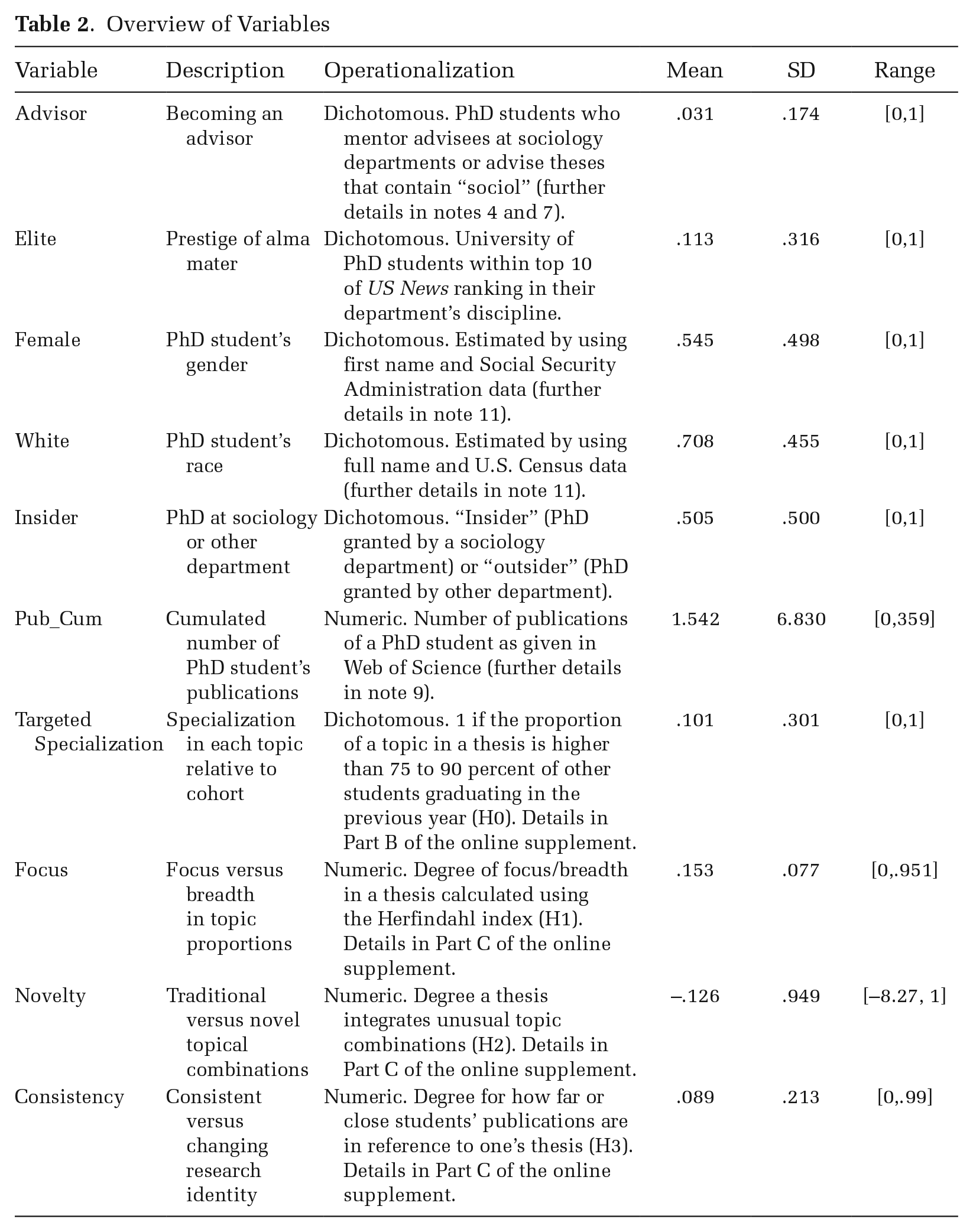
We also control for students’ gender and race, which are both covariates known to influence scientific careers (Cech et al. 2011; Huang et al. 2020; van den Besselaar and Sandström 2016). Gender has also been shown to influence the choice of research topics (Key and Sumner 2019), in general, and methods, in particular (Grant, Ward, and Rong 1987). Gender and race are derived from students’ names by matching first names to Social Security Administration data to predict gender, and matching surnames to U.S. Census data to predict race (Hofstra et al. 2017; Hofstra and de Schipper 2018). 11 All our variables are described in Table 2.
Overview of Variables
Event-History Analysis
Our data provide information not only on who becomes an advisor of sociology PhDs, but how quickly they reach that position. On average, it takes 10 years between PhD and first serving as an advisor (see Part D of the online supplement). We take advantage of the time dependencies in our data by drawing on event-history analysis (EHA). This modeling strategy gives us two estimates of interest: the likelihood of becoming an advisor, and time to first advisorship.
EHA assumes a collection of units moves among a finite number of states that may occur at any point in time and are influenced by some observable factors (Coleman 1981:6). Eligible data should therefore include events, time elapsed until events happen, and time-constant or time-varying covariates. In our case, this setup models the time from PhD graduation to first becoming a PhD advisor, and how this process is influenced by facets of specialization reflected in one’s thesis (topic choice, focus, novelty) and publication record (consistency), controlling for social attributes and performance (gender, race, prestige of alma mater, publications). 12
The language of “hazard rate” of an event points to origins in health studies (Amorim and Cai 2015), but EHA has many applications in social sciences and offers a variety of models (Blossfeld, Rohwer, and Schneider 2019; Box-Steffensmeier and Jones 2004; Singer and Willett 2003). We chose a parametric model with Weibull distribution to measure the time until first advisorship (see model choices in Part D of the online supplement).
Results
Popular and Trending Topics in Sociological Dissertations
Between 1980 and 2015, the topics of sociological dissertations reflect a great diversity of subject matter subfields (e.g., T6 violence, T12 economic sociology, T34 criminology, T38 demography) and methods (e.g., T11 experiments, T14 survey/scales, T36 survey/opinion, T50 modeling, and T40 qualitative methods). Some topics reflect dimensions of social phenomena that span methods, theories, and empirics (T4 race: LatinX, T58 race: African American, T29 gender, T41 social capital). Finally, a group of topics comprise the vocabularies of neighboring disciplines (T5 self-perception, T21 sociolinguistics, T59 health). 13
Some combinations of topics recur across many dissertations, which we can represent as a topic correlation network. Figure 2 shows the network of topic relations between 1980 and 2015, which reveals popular topic combinations. This network shows that methodology is a structuring principle of how students combine topics. For example, qualitative methods (T40) tends to be combined with educational topics (T7 school, T13 students, T19 careers, T42 higher education, or T57 knowledge) as well as with T2 identity and T58 race: African American. As another example, we find that two closely connected topics about surveys—T36 opinions and T14 scales—link to themes related to family and social psychology.
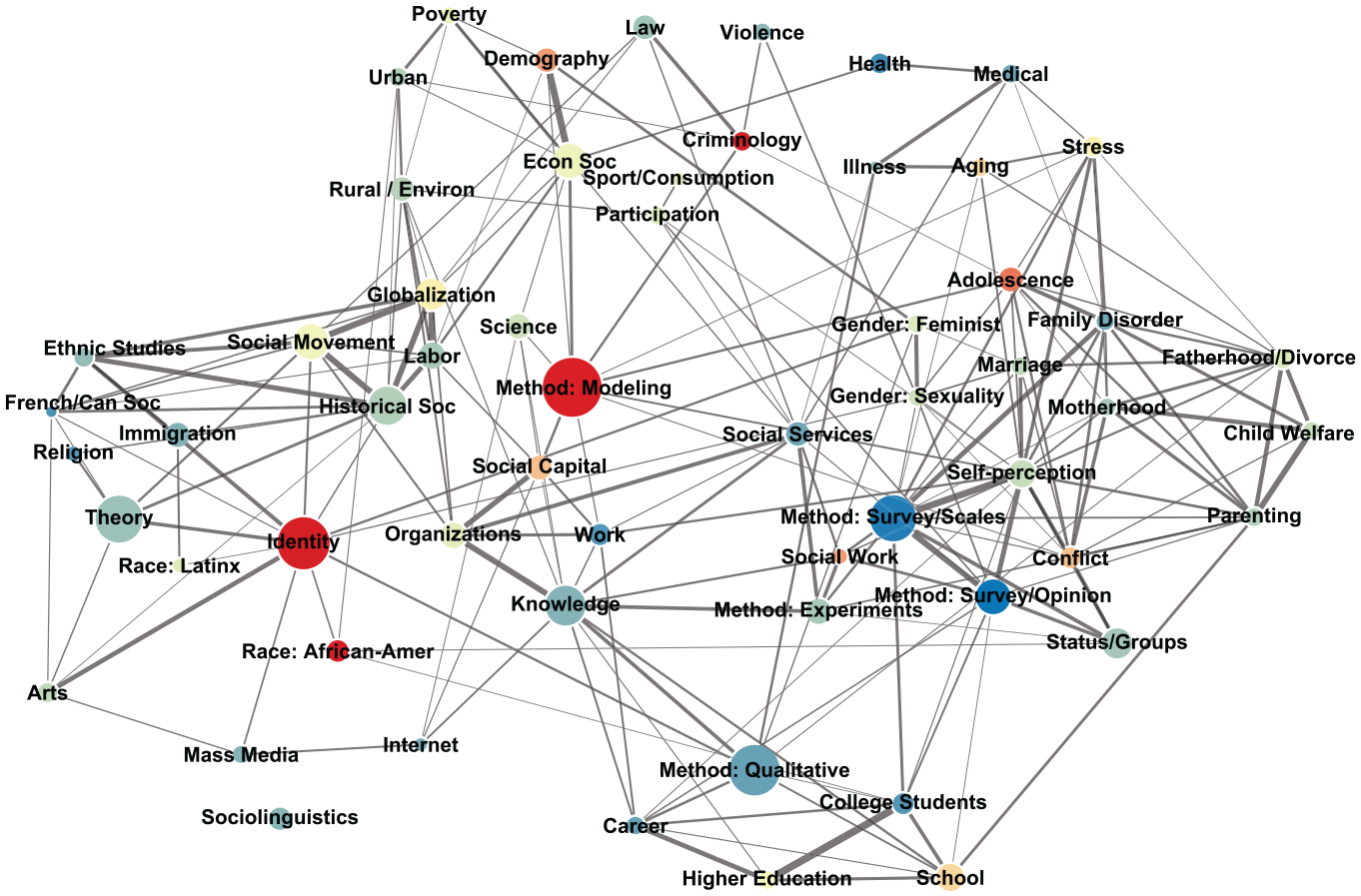
Network of Topic Co-usage in Sociological Dissertations, 1980 to 2015
The most prevalent topic—T50 modeling, with most distinctive terms “model,” “contextual,” “theoretical_model,” “causal,” “explanation”—occupies a bridging position in the topic network and is located between several thematic specialties (e.g., T12 economic sociology, T41 social capital, and T48 adolescence). To a lesser extent, T25 theory and T2 identity also exhibit bridging positions, yet both are more frequently linked to topics related to the cultural turn on the left-hand side of Figure 2 (e.g., topics on the study of ethnicity/race and the arts).
Figure 3 depicts the 10 most trending and declining topics in sociological theses during the period under study. 14 The topic gaining most in students’ popularity is T2 identity, which includes the following as its most distinctive terms: “identity,” “negotiate,” “discursive,” “construction,” and “understanding.” T2 identity represents the intellectual movement often dubbed the “cultural turn” in social sciences (Alexander 1988; Jacobs and Spillman 2005). 15 The cultural turn is concerned with processes “through which people define and express themselves” (Best 2007). Fittingly, T2 comprises concepts of discourse and meaning-making.
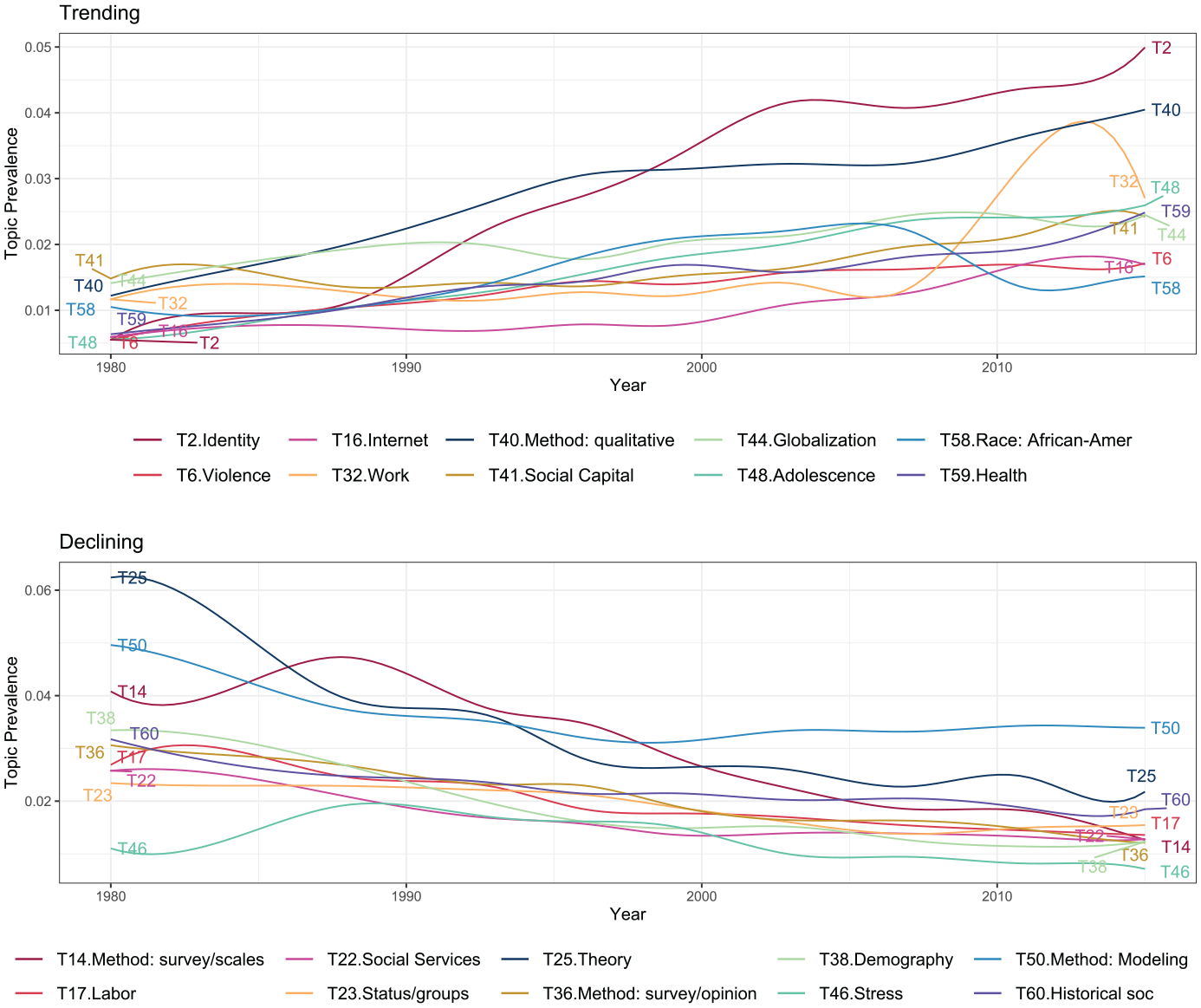
Most Pronounced Trends of Topics in Sociology, 1980 to 2015
Almost parallel to T2 is the ascent of T40 qualitative methods. Among its most descriptive words are “phenomenological,” “interviews,” and “understanding.” T40 is closely connected to T2 identity and T58 race: African American. Thus, the rise of these topics suggests a shift in the research efforts of PhD students toward qualitative methods and issues of identity and race.
Another popular topic is adolescence (T48). We hypothesize that this topic’s trend is likely connected to the launch of Add Health in the mid-1990s. The National Longitudinal Study of Adolescent to Adult Health is a representative longitudinal study tracing the transition of then-students to young adults and including social networks as well as various other contextual data, which suited the needs of the scientific community and resulted in a large amount of dissertations and publications (Add Health 2018). T32 work—described by concepts like “work,” “employee,” “job_satisfaction,” “organizational_commitment,” and “transformational_leadership”—also saw a stark rise but was limited to a relatively small period, from 2007 to 2012. This trend may be related to the financial crisis and insecure employment opportunities for large parts of U.S. society.
T25 theory and topics related to survey methods are on a generally declining path in the past few decades. In the early 1980s, T25 was by far the most common topic, yet it has declined ever since. In 1980, almost 7 percent of words in a thesis were assigned, on average, to T25 theory, but this number was cut in half in the mid-1990s, only to decline further to just above a 2 percent average in 2014. Its most exclusive words include “philosophical,” “moral,” “Habermas,” “rationality,” “theorist,” and “Weber.” However, the topic’s most likely terms are “social” and “concept,” which confound theory and general sociological framing terms. This suggests the decline in theory captured by our model may be conservatively estimated. One potential explanation for this decline may be that PhD students face higher demands to foreground empirical results at the expense of theoretical interpretation, as some contemporary critiques suggest (Besbris and Khan 2017; Swedberg 2017).
Students also wrote less about survey methods (T14 and T36). This may be surprising, given the long history and abundant utilization of surveys in social sciences—arguably one of the largest methodological contributions of social sciences in the past century (Platt 1998). However, (household) surveys have faced reduced cooperation of respondents and higher nonresponse, which has led to declining accuracy and an increased need for imputation and inflation of measurement error (Meyer, Mok, and Sullivan 2015). It stands to reason these developments would affect graduate research, as they have affected social research more generally. However, other quantitative topics, like T50 modeling, declined much slower than T14 survey/scales and T36 survey/opinion in the 2000s, and have regained some popularity in recent years.
The other topics dwindling in students’ favor are mostly located at the periphery of the sociological field and connected to other disciplines like psychology (e.g., T46 stress or T23 status/groups). In general, these extra-jurisdictional themes occupied less salient positions from the beginning of our observation period; hence, their decline took place at a lower magnitude than the other trends we discuss.
In summary, between 1980 and 2015, students expressed a growing interest in topics related to the cultural turn (T2 identity, T40 qualitative methods) and race (T58 race: African American). After the heated theoretical debates of the 1970s and early 1980s (Alexander 1987), it seems theory, in contrast, has become an auxiliary tool for empirical graduate research and less of a thought style in its own right. At the same time, students’ writing in survey-related methods mirror the challenges these subfields have faced in the past decade.
The Relation between Topic Choice and Becoming an Advisor in Sociology
In this and the following subsection, we test our hypotheses regarding facets of specialization and their effects on the time it takes students to become advisors in sociology. We begin by discussing targeted specialization, then we turn our attention to focus, novelty, and consistency. To test our hypotheses, we present an event-history model that measures the time between thesis and first advisorship (see Table 3). 16 In our sample, 2,345 PhD students advised at least one student with a thesis related to sociology or at a sociology department. Thus, only around 3 percent of all PhDs in our sample end up as a primary advisor for doctoral students later in their career. This underlines that our outcome represents a conservative proxy of academic success, that is, advising assumes having a faculty position as well as responsibility over graduate training.
Event-History Models for Time to First Advisorship in Sociology
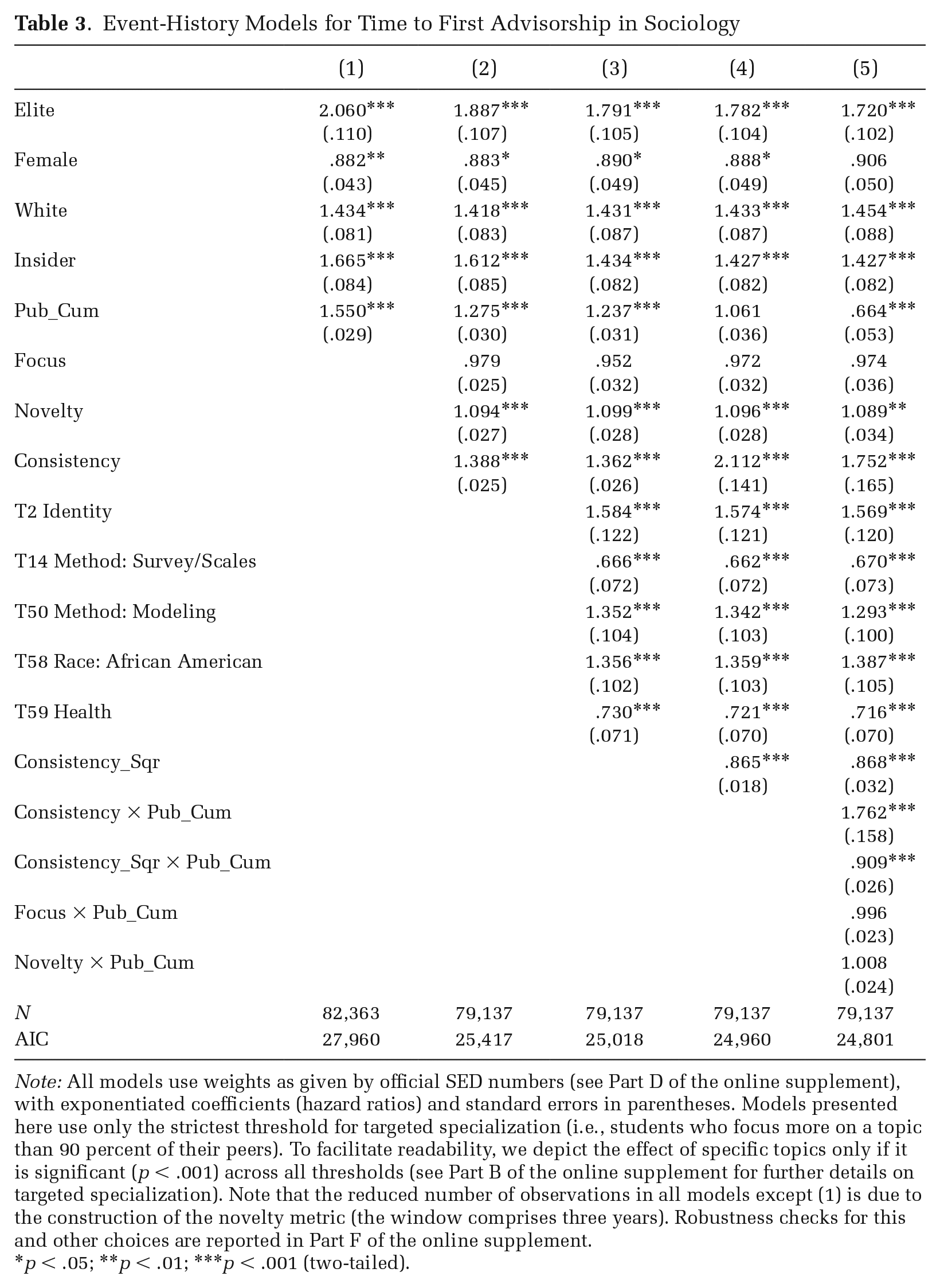
Note: All models use weights as given by official SED numbers (see Part D of the online supplement), with exponentiated coefficients (hazard ratios) and standard errors in parentheses. Models presented here use only the strictest threshold for targeted specialization (i.e., students who focus more on a topic than 90 percent of their peers). To facilitate readability, we depict the effect of specific topics only if it is significant (p < .001) across all thresholds (see Part B of the online supplement for further details on targeted specialization). Note that the reduced number of observations in all models except (1) is due to the construction of the novelty metric (the window comprises three years). Robustness checks for this and other choices are reported in Part F of the online supplement.
p < .05; **p < .01; ***p < .001 (two-tailed).
We can confirm our baseline hypothesis (Hypothesis 0) and affirm that the topic structure of a thesis—the particular combination of subjects, methods, and theories—affects career chances. Figure 4 depicts five targeted specializations that are strongly associated with becoming an advisor. Each of these topics is highly significant (p < .001) across all thresholds of the targeted specialization variable. 17
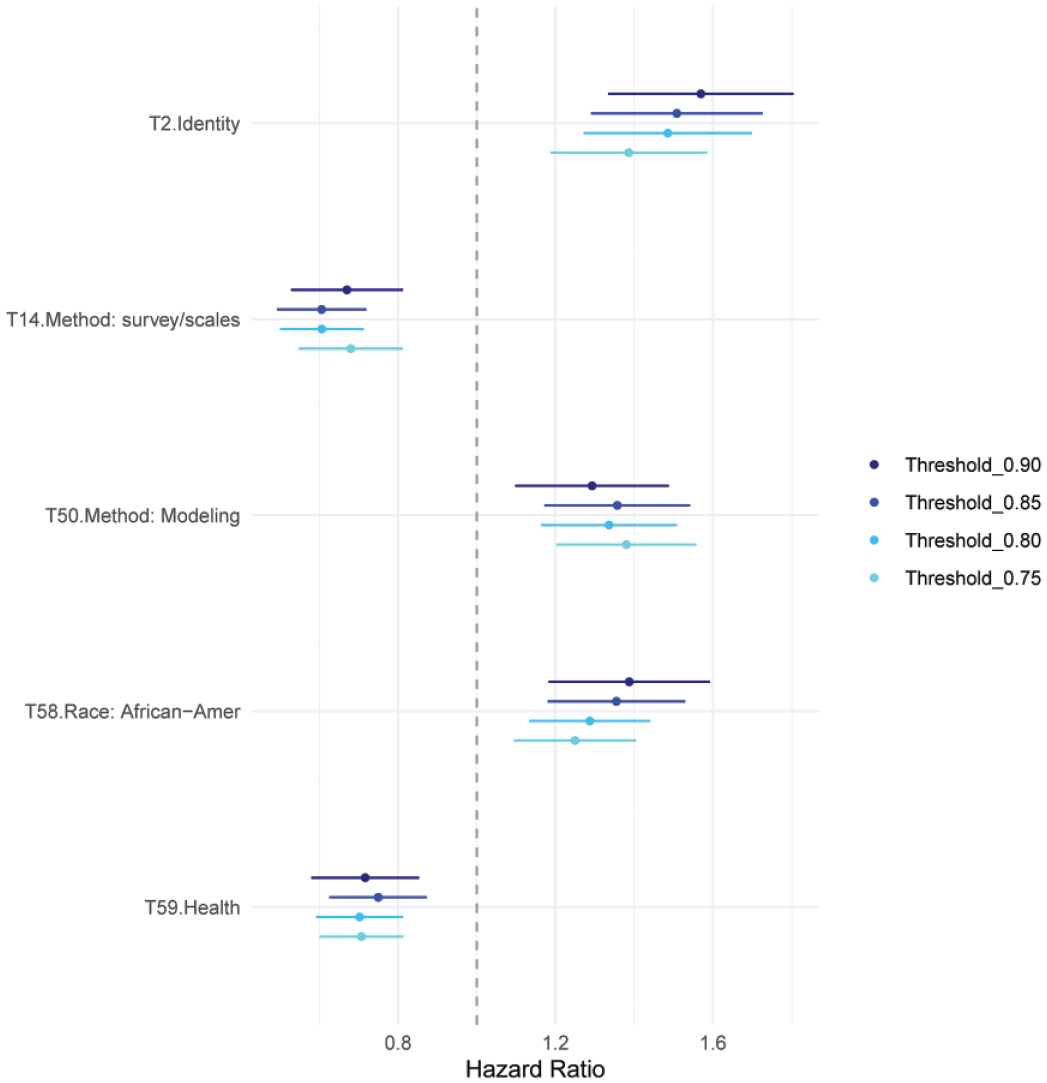
Hazard Ratios for Becoming an Advisor in Sociology
Methods matter
Specializing in a specific topic reveals mixed effects. Three topics affect a student’s chances of becoming an advisor positively, and two decrease the likelihood of advisorship. T14 survey scales had the strongest negative effect. T14 was also among the most declining topics, which we linked to severe contemporary challenges with developing surveys (Meyer et al. 2015). However, the negative relationship to advisorship may also stem from the wide range of applications of this technical skill. Future research should explore the extent to which specialization in this topic, and others with similar technical content, may provide differential job opportunities in academia and industry.
In contrast with surveys, T50 modeling has a strong positive effect. This topic represents general statistical approaches applied in dissertations and is semantically close to a diverse set of subject matters (see Figure 2). The effects of T14 survey scales and T50 modeling should be read together as suggesting a possible shift in dominant quantitative research practices and may even represent a turn toward “data science.”
Cultural turn, identity, and race
T2 identity is among the most popular and trending topics for sociology PhD students. This topic reflects the cultural turn, one of the major currents in social sciences in the past decades (Alexander 1988; Jacobs and Spillman 2005). Our results reveal that the probability of becoming an advisor rises considerably when a PhD student writes about identity, culture, or discourse. The effect is stronger the more a student focuses on T2.
T58 race: African American also significantly increased a student’s chance of becoming an advisor. The effect of T58 also grows with greater focus on it. Note that the specific topic about race our model captures tends to be combined with T2 identity (Figure 2). However, the social construction of race as a sociological object of study in U.S. scholarship predates the cultural turn (cf. Du Bois [1897] 2020). Sociological debates about race in the United States span far more varied intellectual histories than those captured in the cultural turn. These histories are to this day in a state of flux, revision, and recovery (Magubane 2016; Morris 2015).
Neighboring fields
Finally, we find that T59 health is negatively associated with the likelihood of becoming an advisor of sociology-related dissertations. Across all thresholds of the targeted specialization covariate, focusing on T59, which has as distinctive terms “HIV,” “obesity,” “health_behavior,” and “immune_deficiency,” reduces chances to advise PhD students by almost 30 percent. Despite its growing popularity in sociology-related dissertations (see Figure 3), T59 is not at the core of the sociological field (see Figure 2). At the same time, social theories seldom inform public health studies (Pound and Campbell 2015). T59 may represent a changing academic environment with more fluid research demands, to which sociology—with its permeable boundaries—is particularly sensitive. Yet, for the observed time period, students specializing in T59 health have lower chances of becoming advisors of sociology-related PhDs. 18
To assess the magnitude of the reported effects, Figure 5 compares targeted specialization to the influence of race and gender. Race and gender are two of the most formative dimensions in U.S. society, stratifying social hierarchy in general (McCall 2002), and academe in particular (van den Besselaar and Sandström 2016). Our models confirm that female, minority PhD graduates have a significantly lower likelihood of becoming an advisor, net of an individual’s merit in terms of publications (see Table 3). Thus, racial, and to a lesser degree, gender inequalities leave their footprint in sociology departments, despite the field’s growing diversity (see Figure 1). Comparing these to T50 modeling, Figure 5 shows T50’s effect has a similar magnitude. 19 Of course, this does not mean these inequalities can be compensated for through topic choice in a dissertation alone. Instead, this result points to the importance of studying the interplay of topic choice, status, and inequality in academia (even more for a scholar’s entire record, see Bandelj 2019; Key and Sumner 2019; Koppman and Leahey 2019).
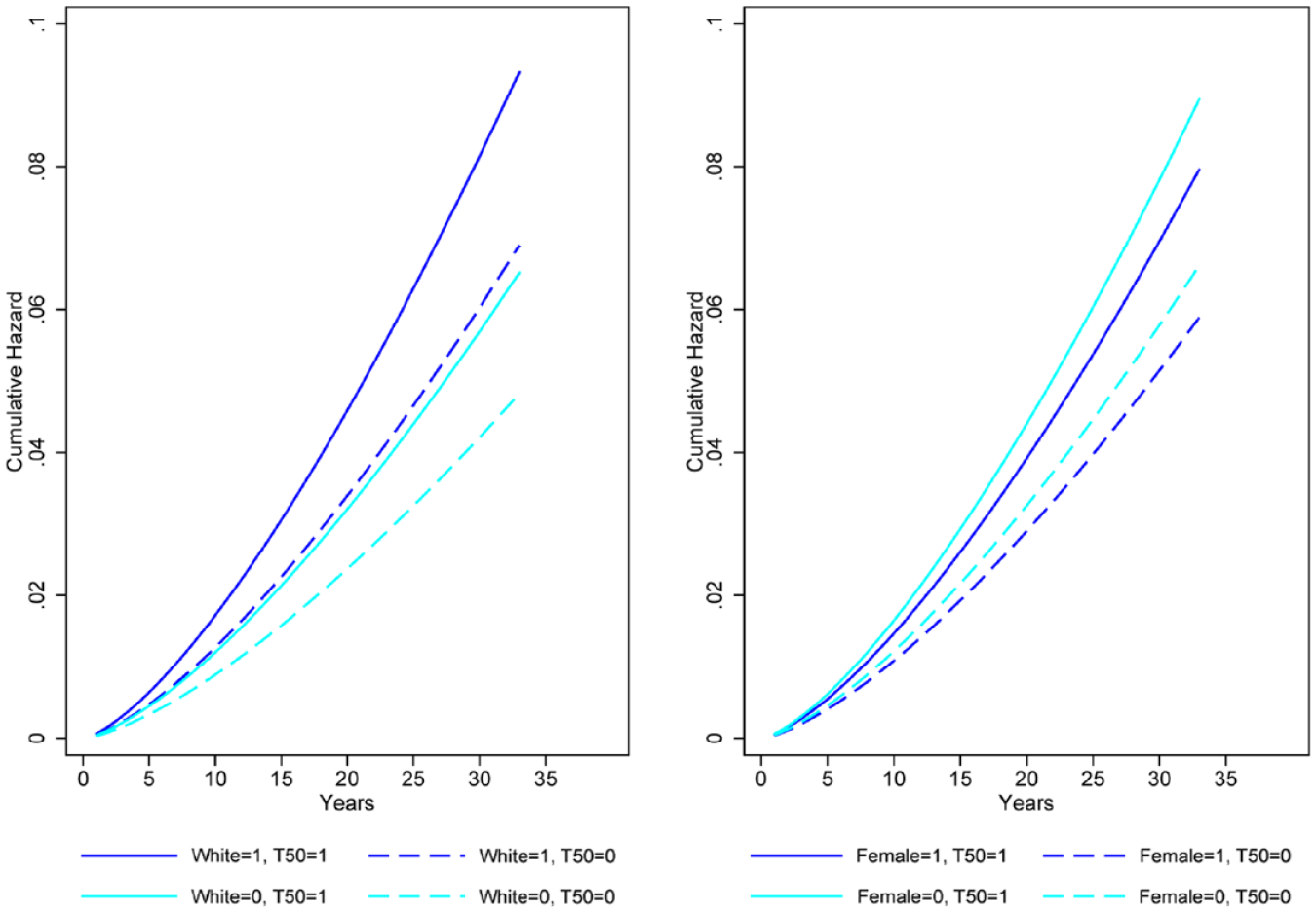
Cumulative Hazards for Time to First Advisorship, by Gender, Race, and Targeted Specialization in T50 Methods: Modeling
Summing up our results on targeted specialization, we find that topics related to identity, race, and quantitative modeling positively contribute to students’ chances of becoming an advisor in sociology. In contrast, students specializing in survey methods and health in their theses are less likely to advise sociology-related PhDs. This sheds new light on which sociological topics garner influential field positions.
The Influence of Focus, Novelty, and Consistency on Becoming an Advisor in Sociology
In addition to the influence of targeted specialization, we explore three facets of specialization discussed prominently in prior literature on academics’, and more generally, creative workers’, success: focus, novelty, and consistency. By breaking specialization into these analytic dimensions, we are able to identify which facet of specialization is most related to becoming an advisor, and net of the specific topic choices made by PhD students.
Regarding Hypothesis 1, we find no significant effect (p < .05) of focus in our models (Table 3). The effect of focus vanishes after considering the influence of targeted specialization and other facets of specialization that are missing controls in previous studies (e.g., Conti et al. 2014; Leahey 2007; Schilling and Green 2011; Teodoridis et al. 2019). 20
Hypothesis 2 asks whether novel or traditional combinations of topics in a thesis promote PhD graduates’ career chances. Across all models, students integrating novel combinations of topics in their thesis have close to a 10 percent higher chance of advising sociology PhDs themselves. Again, this is net of other forms of specialization. The sociological field thus seems to reward unusual blends of thought styles expressed in early stages of a scholar’s career. Of course, the specific chains of mechanisms that connect early-stage innovation and later-stage career success will require further study. However, our results are in keeping with Leahey and Moody’s (2014) findings that sociology rewards innovations, such as subfield integration.
Our final hypothesis (Hypothesis 3) concerns consistency, and switches the text source from the dissertation to a student’s publication track. We find scholars who publish articles consistent with their dissertation have a better chance of becoming advisors. The size of this effect is comparable to the largest effects of specific topic choices. However, the effect is particularly strong for moderate values of consistency and marginally decreases for higher values (i.e., has a negative squared effect). This supports prior work showing that a consistent identity is essential to promote novel work (Trapido 2015) or unusual methods (Koppman and Leahey 2019). Our finding adds further nuance, however, by suggesting there are diminishing returns to identity consistency.
The consistency metric rests on students’ number of publications during their careers. Therefore, we investigate the relationship between publication output over students’ careers and their identity consistency. 21 Figure 6 demonstrates that high productivity can decrease the likelihood of mentorship at low levels of consistency; in other words, a dramatically changing research identity is not rewarded. In contrast, only a small number of publications with a consistent thematic angle (in reference to the thesis) provides better chances to achieve a position as an advisor. The relation between identity consistency and productivity, therefore, can describe significant differences in career outcomes.
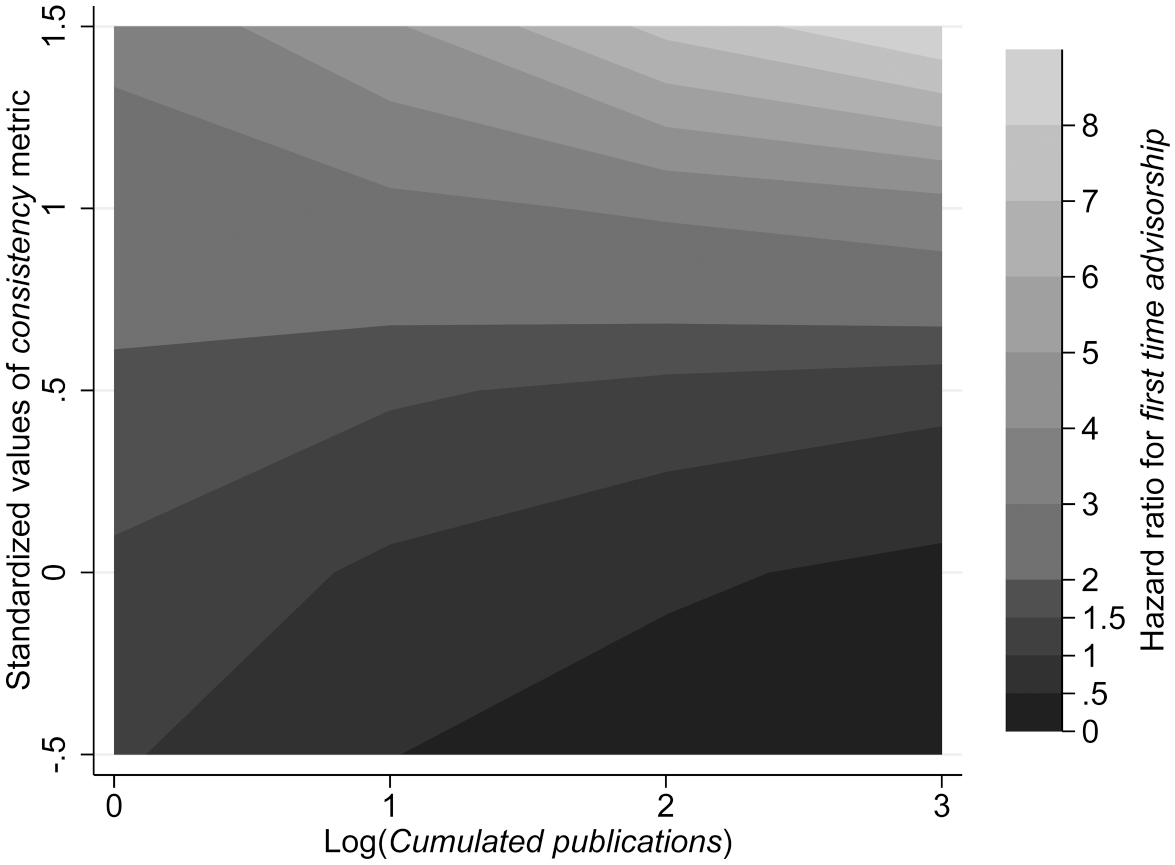
Marginal Effects of Interaction between Consistency and Number of Publications
Discussion
Even the most experienced scientists perceive their discipline from a necessarily limited individual perspective. The sociology of science (Merton 1973), and, more recently, science of science (Fortunato et al. 2018; Wang and Barabási 2021), provide a more comprehensive bird’s eye view on academe’s inner-workings. A key concern in these areas of study is the fierce selection process inherent to all scientific fields, that is, who achieves an academic career and by what strategy? In this article, we disentangle distinct facets of specialization as potential career strategies (targeted topics, focus, novelty, and consistency), provide a consistent methodological frame to measure them (structural topic modeling), and use an understudied population (PhD students) to capture how specialization strategies used at an early career stage relate to long-term success in academia.
Our results show across a number of robustness checks that it is not topical focus of a thesis that provides career advantages, but targeted specialization and novel combinations. In particular, theses closely related to the cultural turn (T2 identity), statistical approaches (T50 modeling), and race (T58 race: African American) correspond with rare ascents to mentorship. Dissertations targeting survey methods (T14) are, in contrast, less likely to bring the graduate an advisorship. In addition, we find that departures from tradition and embracing novel combinations of topics help graduates become advisors. Last, and most important, we find that students whose ensuing publications echo and elaborate their dissertations exhibit a consistent research identity and have a considerably higher chance of becoming an advisor. Whereas there are diminishing returns to consistency for highly productive scholars, a relatively small number of consistent publications significantly improves the likelihood of achieving an advisor position, adding important nuance to the publish or perish imperative.
The social sciences are not a favored source of case studies in the sociology of science (Leahey 2008). Yet, we chose to study sociology because of the long-standing polemic in this field regarding specialization. On the one hand, specialization has been recognized as a necessary strategy in a massified field with narrowing job opportunities (Collins 1986). On the other hand, specialization is said to be responsible for the discipline’s fragmentation (Coser 1990; Gitlin 1990). In our field, specialization is a multifaceted, contentious, high-stakes career strategy. Our approach was to analytically and empirically distinguish these facets of specialization. With the exception of targeted specialization, the facets are abstract enough to provide a common analytic framework that can be applied to multiple academic fields.
There are many compelling prospects for such a comparative study of academic specialization. The first one is that facets of specialization may vary in relevance across fields that participate in similar intellectual movements. For instance, academic shifts like the cultural turn (Jacobs and Spillman 2005) encompass the social sciences as a whole, with fits and starts specific to each discipline. Yet, we do not know if underneath this shared thematic surface lie different relations between focus, innovation, consistency, and academic success. Does the combination of novel and consistent specialization yield similar advantages for career prospects in other disciplines? And what about specific topic choices? We have yet to uncover how common themes come to express distinct ways of vying for recognition across academic fields.
A second prospect of a comparative sociology of specialization is the study of migration. Our interest in the reproduction of the sociology field led us to narrowly focus on who becomes an advisor in a sociology department or of a sociology-related dissertation. However, one could imagine other outcomes of interest, such as becoming an advisor in a neighboring or distal field, or becoming an advisor in a focused or eclectic set of topics. On this point, there is not only an opportunity to better understand academics’ individual projects, but also the way the academic system distributes rewards and risks in the form of migration patterns.
A third opportunity of this prospective research program would be the comparative study of field relations to government and industry. In a prior study of education research, we found that graduate students grew more interested in interpretive research approaches just as pressure mounted from the government to norm the field according to the standard of randomized control trials (Munoz-Najar Galvez et al. 2020). These results were suggestive of the emergence of a particular configuration of field autonomy, expressed in how education graduate students chose to specialize. Fields with different relations to industry and government may achieve autonomy in varied ways, which, in turn, should lead students to seek different forms of specialization.
In focusing on a long-term career outcome of specialization (i.e., advisorship), we omitted the lived conditions of scholars that may lead them to choose and sustain this strategy. Future research will do well to embed specialization in a broader system of career checkpoints—spanning from undergraduate to tenure (Meyers et al. 2018)—working arrangements (Cech and Blair-Loy 2014), and family formations (Wolfinger, Mason, and Goulden 2009). In addition, linking PhD students’ initial thematic tracks with alternative outcomes could prove fruitful. People who have gained a sure footing in academia as an advisor might also occupy other important positions, for example, in councils, committees, or media discourse. Thus, connecting the dots of scientists’ professional life course before and after the PhD seems a worthwhile step over and above our findings.
A key limitation of our study is that we only have access to primary advisors to construct our outcome variable. 22 In addition, we have no information on student drop-out rates, so we cannot control for selection biases happening before graduation. Nevertheless, we believe the focus on graduating students and their timing to becoming a (primary) advisor is a conservative proxy for academic success, given the resources necessary to achieve doctoral mentorship. We also note that our results are limited to the time period and set of students we study. The stability of our results over 30 years suggests much of this pattern may still hold, such as the extant divisions in the field and specific topics and strategies that secure advising roles. However, we also acknowledge that the period from 2015 to 2021 has been especially tumultuous socially and has likely resulted in further change. It may be that the extant political context has resulted in a sea change for hiring and what matters.
Supplemental Material
sj-pdf-1-asr-10.1177_00031224211056267 – Supplemental material for Facets of Specialization and Its Relation to Career Success: An Analysis of U.S. Sociology, 1980 to 2015
Supplemental material, sj-pdf-1-asr-10.1177_00031224211056267 for Facets of Specialization and Its Relation to Career Success: An Analysis of U.S. Sociology, 1980 to 2015 by Raphael H. Heiberger, Sebastian Munoz-Najar Galvez and Daniel A. McFarland in American Sociological Review
Footnotes
Acknowledgements
Special thanks to David Jurgens, Bas Hofstra, and Vamshi Krishna for help with data collection and architecture. Our gratitude as well to Joshua Gagne, Charles Gomez, Patrick Kaminski, E. Nadia Kline, Benjamin Keep, Elina Mäkinen, Richard Münch, Peter McMahan, and Michael Windzio. These data were collected by the Mimir Project, conducted at Stanford University.
Funding
The data collection on this project was partly funded by the Office of the President at Stanford University and other aspects were partly funded by the National Science Foundation [Awards 1827477, SMA1829240, and 1633036]. We are also grateful for funding received from the Fulbright Program, the Fritz Thyssen Foundation, and the German Federal Ministry of Education and Research [Award 01PU17021C].

Notes
References
Supplementary Material
Please find the following supplemental material available below.
For Open Access articles published under a Creative Commons License, all supplemental material carries the same license as the article it is associated with.
For non-Open Access articles published, all supplemental material carries a non-exclusive license, and permission requests for re-use of supplemental material or any part of supplemental material shall be sent directly to the copyright owner as specified in the copyright notice associated with the article.
