



Abstract
The relative education hypothesis states that in contexts where university degrees are scarce, workers with bachelor’s degrees are sought after and enter cognitively skilled occupations; but as education expands across birth cohorts, some workers with bachelor’s degrees are unable to maintain their position in the labor market. In an earlier ASR article (Horowitz 2018), I found support for this argument; however, Furey (2021) shows model instability in estimates of the education–skill relationship. We should treat the results from these two studies as a range of possible estimates, and carefully consider interpretation of the findings in the context of the selected reference categories. Future revisions of the relative education hypothesis should consider that absolute and relative education effects might not shift concurrently, and also that labor market experiences may vary considerably by field of study and occupation.
In a previous ASR article, I examined the cognitive skill utilization of workers with bachelor’s degrees, and how this utilization changes as education expands over birth cohorts (Horowitz 2018). The primary argument of the relative education hypothesis is that in contexts where university degrees are scarce, workers with bachelor’s degrees are sought after and enter cognitively skilled occupations; but as education expands across birth cohorts, some workers with bachelor’s degrees are unable to maintain their position in the labor market (Collins 1979; Hirsch 1976). The original study tested this by examining CPS data from 1971 to 2010 and found that workers with bachelor’s degrees used less cognitive skill in labor markets with more degree-holders. In addition to the absolute declines in educational attainment, this gain appears even larger given the increases in skill usage for workers without college degrees.
The original study used a four-category education classification, grouping results into no college, some college, four-year degree, and more than a four-year degree. In a re-analysis of CPS data, Furey (2021) suggests the results from the original study depend partly on the measurement system. Using an alternative four-category coding system provides results similar to the original study, but the absolute declines in cognitive skill usage are weaker. Results using an alternative five-category coding scheme suggest no absolute decline in cognitive skill usage, weaker relative educational effects, and that relative education effects only exist in comparison to workers without any high school degree.
Between the original study and the comment, we have three different coding schemes, with results on a continuum: strong, substantively meaningful effects in the original study; a set of results that are close to the original study, but with some weaker effect sizes; and a third set of results that suggest no absolute changes, as well as slightly different and weaker changes to relative education advantage. This is a concerning degree of model instability given the relatively small coding decisions that cause them.
It is important to note there are some areas of agreement across the models, and that we learn several important lessons by taking both studies into account. First, there is no evidence for increasing skill utilization for workers with bachelor’s degrees as education expands across birth cohorts. Just as Horowitz (2018) did not show skill upgrading for workers whose highest education is a bachelor’s degree, Furey’s (2021) results similarly do not support skill-biased technological change. There is less support for the relative education hypothesis in some specifications, but also no evidence in either study that rising demand for bachelor’s degrees is outstripping the supply.
Second, the gap between individuals with a four-year degree and those with the lowest measurement of education shrinks across all three models. This is because—after taking into account the age, period, and cohort trends and how they change across different geographic and demographic categories—workers at the bottom of the education gradient engage in more skilled work than they did previously. Jobs with very low cognitive demands are replaced with higher-skilled occupations after temporal shifts are taken into account, but workers whose highest education is a bachelor’s degree enter fewer (Horowitz 2018) or similarly (Furey 2021) skilled occupations. These two findings are consequential: they mean predictions based on skill-biased technological change regarding shortages of skilled workers are unlikely to be true, at least up until 2010. Furthermore, depending on the comparison group, relative advantages for bachelor’s degree-holders have declined.
Together, the three models also provide a range of estimates for absolute skill usage among workers with bachelor’s degrees. They do not provide conclusive evidence on whether workers with bachelor’s degrees are entering less-skilled occupations in more-educated birth cohorts (Horowitz 2018), or if the supply of bachelor’s degrees is roughly equal to the demand (Furey 2021). This is because Furey’s (2021) models include theoretically plausible and alternative coding systems that, in turn, lead to an important shift in the substantive interpretation of the effect size. It is very difficult to resolve the discrepancy across models in this case because alternative coding schemes that restore the original results do not rebut the problem of model instability and instead reinforce it. In the present case, if a researcher demonstrates that recoding the variables produces estimates comparable to Horowitz (2018), it simply proves the point that model instability is high. Likewise, this level of model instability casts doubt on Furey’s (2021) results, as the alternative models present a symmetrical critique in the opposite direction. Additional findings in the present framework may provide incremental evidence to tip the scale toward or against the relative education hypothesis, but they mostly reinforce the argument that the results are too unstable to serve as the final word on this research question.
There are also legitimate questions about what the appropriate comparison group should be. Furey (2021) favors a comparison between workers with a bachelor’s degree and those with a high school diploma, whereas the original study used a comparison between workers with a bachelor’s degree and those with the least amount of education. Both positions have merit, and there is no way to definitively adjudicate between them. The advantage of Furey’s (2021) comparison is that from a narrative perspective, young adults with high school diplomas are faced with the decision to attend a four-year college. The advantage of using the lowest educational category is that respondents with the least amount of education have fewer credentials to be affected by educational expansion, and thus serve as a theoretically appealing comparison group. To some extent, the differences also reflect a preference for using more similarly educated workers as a comparison group versus the overall changes to skill usage in the labor market.
The relative education hypothesis provides insight into the nature of educational credentials, but Furey’s (2021) comment demonstrates that we need to adjust its theoretical formulation and resulting empirical models. The theory remains promising, because even beyond Horowitz (2018), new research provides support for its claims (Allen and Belfi 2020; Araki 2020; Wiedner 2020). Furthermore, there are several areas of agreement across the models presented here, and the range of estimates represent a foundation for future research. However, at least two areas require future attention. First, it is important to note that absolute and relative declines in educational attainment may not occur at the same time, which could make calculating effect sizes challenging and provide inconsistent estimates. Second, workers whose highest credential is a bachelor’s degree likely do not share a single labor market, and we should pursue analyses that can separate respondents by field of study or occupational grouping.
Description, Job Queues, And Comparisons
Furey’s (2021) comment prompted me to revisit some of the hypotheses and limitations mentioned in the original study. It also prompted me to re-examine some of the descriptive trends, which I undertake using Furey’s preferred specifications.
First, despite its name, the relative education hypothesis consists of two separate empirical predictions: (1) as educational attainment rises, absolute levels of skill usage will decline for workers whose highest credential is a bachelor’s degree, and (2) levels of skill usage will decline compared to overall skill usage in the workforce. Each of these trends provide evidence for the main theoretical hypothesis: the value of a bachelor’s degree declines as education expands. But absolute and relative declines do not necessarily occur at the same time, and depending on the rate of increased skill usage across the workforce, it is possible for a group to lose absolute skill usage in some time periods but relative skill advantage in others. If cognitive skill usage remains steady across the overall labor market, absolute skill usage should decline. But if skill rises—as it did in the latter part of the timeframe of this study (Liu and Grusky 2013)—it could easily offset any declines in skill usage. Instead, we would see the weakness of a bachelor’s degree compared to overall increases in skill utilization.
To provide a tangible example, I calculate the skill level of workers whose highest education is a bachelor’s degree, using Furey’s (2021) preferred specifications in the Annual Social and Economic Supplement 1 (Flood et al. 2020) (see Figure 1). The absolute changes in skill usage are not evenly distributed from 1971 to 2010, and the trends identified by Horowitz (2018) and Furey (2021) are visible at different times. Workers whose highest education is a bachelor’s degree use considerably less skill over the time series, with a particularly steep decline for all three skill measurements from 1971 until 1979. The total drop from 1971 to 2010 in all three dependent variables is roughly .3 points, which is a moderate decline on par with the findings in Horowitz (2018). But the declines from 1980 to 2010 are much smaller and slower than the ones before it and are consistent with Furey’s (2021) contention that any declines in absolute skill usage are not substantively meaningful. Overall, changes to absolute and relative skill advantages are uneven and may not occur in tandem, and we should alter our expectations and the models that test them to account for this.
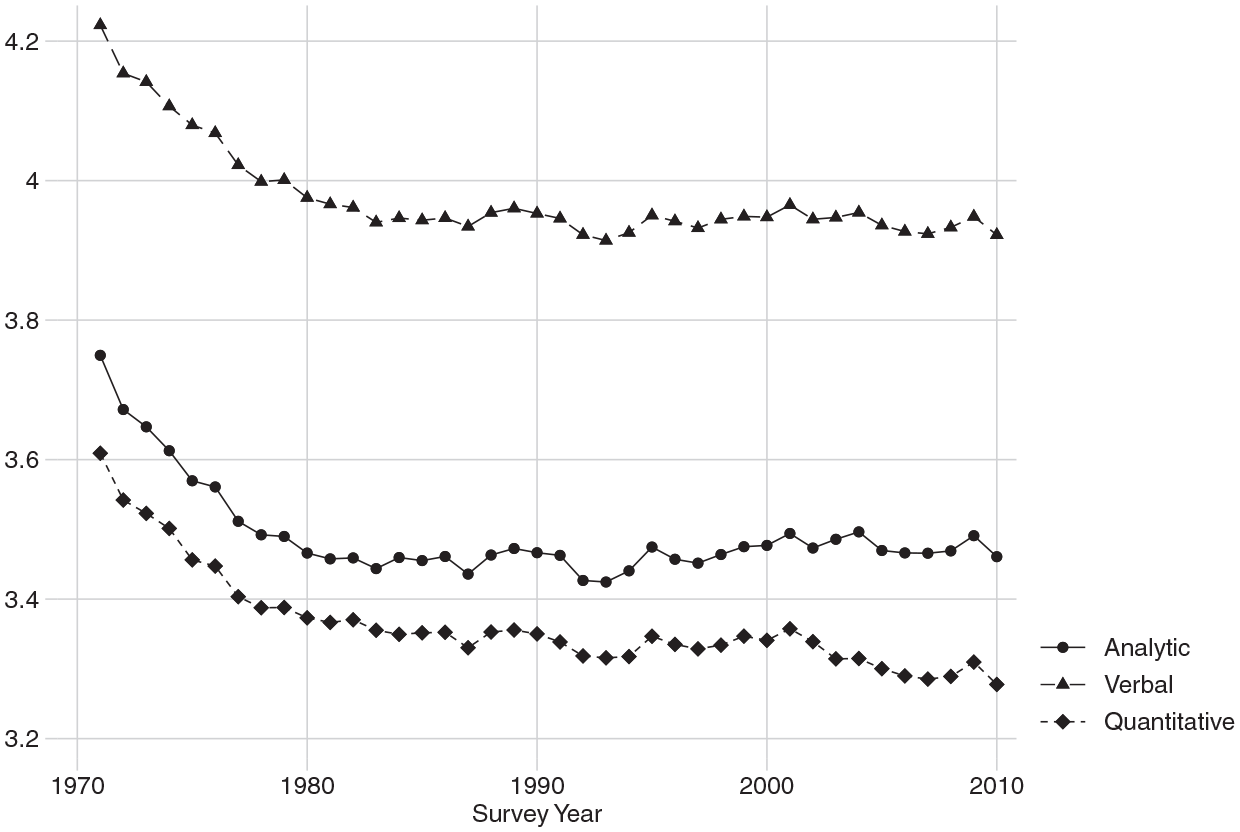
Absolute Trends in Skill Usage for Workers, Highest Credential Is Bachelor’s Degree
Second, this is a good opportunity to reiterate one of the most important limitations of the original study: workers with bachelor’s degrees do not all have the same labor market experience, and the original study was only able to address this in a few ways (e.g., regional educational competition). The original study suggests there are more losers than winners in later birth cohorts, and that the relative education hypothesis is the best explanation for overall trends in educational attainment. But labor market signals of workers with bachelor’s degrees are heterogeneous by field of study, and so the aggregate trends likely mask much more complicated changes. Workers with bachelor’s degrees in computer engineering send very different signals in the labor market than do those with political science degrees, and both send different signals than classics majors (Reimer, Noelke, and Kucel 2008). Relatively few datasets include information on university major and adult outcomes across both cohorts and long periods of time, but this is an important avenue for future research.
Similarly, educational competition and occupational replacement may be felt very differently across the labor market. As education expands, labor market queues for some occupations become much longer, whereas others may see a much smaller uptick in applications; some occupations, such as computer programming, may grow dramatically, and others may not grow at all (Kalleberg 2011; Mouw and Kalleberg 2010). If workers are in different queues, and there is relatively little crossover from one queue to the other, then by definition not everyone is in the same labor market (for a related argument, see Reskin and Roos 2009). Some occupations are subject to more competition or skill biasing than others, and the current model may not be enough to summarize these countervailing forces. Disaggregating occupational groups may help explain the model instability highlighted by Furey (2021). But even if it does not, it will help us interpret and contextualize the results we currently have.
Note About Policy
Furey (2021) suggests the relative education hypothesis could motivate less investment in higher education, but I do not believe it should. One of the key social contracts of the liberal market economy is that education provides a route for individuals who are not well-off to improve their economic and social standing (Jackson and Grusky 2018; Mijs 2016). Although the liberal promise of education is not entirely fulfilled, it remains true that university degrees are an important route for intergenerational mobility (Torche 2011). While shrinking advantages in the labor market erode the promise of education, limiting access to university education is an even worse violation. If universities represent the path to a better life, then eliminating funding for universities to protect the rents of those who do earn degrees is a perversion of the social contract. In any case, we are not there yet: even in Horowitz (2018), workers with bachelor’s degrees retain a substantive labor market advantage over those without them.
Furthermore, a declining benefit of private returns is not a good reason to reduce public investment in higher education if the public return is high. If more individuals receive quality educational experiences and go farther in school, the human capital gained should lead toward more innovation and scientific breakthroughs that improve well-being (Baumol 2005). University education increases support for civil liberties and tolerance (Campbell and Horowitz 2016). The relative education hypothesis predicts more competition for workers with bachelor’s degrees, but the COVID-19 pandemic exposed and exacerbated deficits in public health, primary education, and community resources (An and Tang 2020; Bailey and Moon 2020; Engzell, Frey, and Verhagen 2021; Shokoohi, Osooli, and Stranges 2020). Given the opportunity, there is no shortage of problems that university graduates can work on.
At the same time, adding more bachelor’s degrees is at best an inefficient method for increasing the proportion of winners in the labor market. Addressing inequality requires either increasing the proportion of good jobs in the labor market (Kalleberg 2011) or developing pay-setting institutions that reduce inequality between positions (Rosenfeld 2021). More bachelor’s degrees can help solve some society-wide problems, but fixing inequality is likely not among them.
Footnotes
Acknowledgements
I thank Barbara Entwisle for comments on a previous draft of this manuscript.
