



Abstract
Scholars have studied the educational value of televised presidential debates for decades. The past three election cycles, with the addition of Donald Trump’s unconventional rhetorical style, these concerns have only magnified. We utilize the 2024 June debate between Joe Biden and Donald Trump as well as the 2024 September debate between Kamala Harris and Donald Trump to determine whether viewers update their perceptions of where the candidates’ stand on traditional policy issues (such as the economy, abortion, and foreign policy) as well as emergent issues (such as concerns about aging leaders and the state of democratic institutions in the United States). We also compare issue-learning to image-learning, operationalized as updated views regarding a candidate’s character traits. We find that voters significantly update their perceptions of candidates on both their issue stances and perceptions of their character. Furthermore, we find that issue learning was greater than image learning in 2024.
Introduction
Presidential debates are the most widely viewed campaign events (Arkin, 2024) and provide a rare opportunity for voters to encounter candidates in a shared, unfiltered space. These debates have long been considered pivotal moments in electoral politics. Beyond their entertainment value or influence on campaign momentum, debates offer a rare, structured opportunity for voters to hear directly from the candidates on a shared stage (Anneberg Public Policy Center, 2014; Keum & Cho, 2021). For decades, scholars have examined the educational potential of debates, with a particular emphasis on “issue learning,” that is, the extent to which viewers gain knowledge about where candidates stand on important policy topics (Benoit et al., 2003; Chaffee, 1978; Holbrook, 1999). Historically, this learning has been taken as evidence of a healthy democratic process, where citizens engage rationally with competing political arguments and update their evaluations accordingly.
In recent years, the landscape of political communication has changed. In the new political communication and campaign environment, many have questioned whether debates still fulfill their educational role, or whether they now function primarily as image-making events (Grabe & Bucy, 2009; Jamieson & Birdsell, 1988; Park et al., 2025; Rowland, 2013), reinforcing preexisting attitudes and emotional attachments rather than facilitating issue-based reasoning. This concern is especially relevant in elections where the candidates are already well known to the public, as was the case in the 2024 general election.
The June 2024 debate between President Joe Biden and former President Donald Trump marked a historic moment, not only because it was the first Presidential election debate held so early in the cycle, but also because it ultimately contributed to a major shift in the race, with Biden withdrawing from the contest weeks later (Colton, 2025). The September debate featured Vice President Kamala Harris and President Donald Trump, provided an opportunity to observe how voters respond to a familiar yet first-time presidential candidate. These back-to-back debates created an apt context for evaluating whether and how political learning still occurs, and under what conditions.
This article revisits the concept of issue learning in debates with three primary goals. First, we assess whether viewers continue to demonstrate issue learning, even in an environment characterized by candidate familiarity, polarization, and distrust. Second, we evaluate whether learning extends beyond traditional policy domains (e.g., the economy, foreign policy) to include emerging voter concerns such as age-related fitness and institutional trust. While not conventionally classified as “issues,” these non-traditional concerns have become central to electoral discourse and merit inclusion in how scholars conceptualize political learning. Third, we explore the relative importance of image-based versus issue-based learning, particularly in the context of candidate evaluations and voter decision-making. If debates are increasingly judged on tone, presence, and character, we must ask: what are voters actually learning; the candidates’ issues or their image?
To address these questions, we conducted a two-wave pre/post survey experiment during both the June and September 2024 presidential debates. We measured participants’ perceptions of each candidate across a range of issues and image dimensions. In doing so, this study not only tests classic assumptions about debate effects but also extends the literature by considering how political learning might be evolving in response to changes in the electoral and media landscape.
Ultimately, we find that debates still serve as important venues for political learning, but that what counts as an “issue” may need to be reconsidered and expanded. In 2024, viewers updated their perceptions not only about traditional policy areas but also about a candidate’s current issues that they face that may be centered around their character, fitness, and commitment to democratic norms (i.e., non-traditional and emergent issues in the 2024 election campaign cycle). These findings suggest that scholars should continue to study issue learning, but with an expanded conceptual scope that reflects the complex realities of contemporary campaign discourse.
Issue Learning in Campaign Debates
Early debate research focused on reducing uncertainty, shaping candidate evaluations, and influencing vote choice (Chaffee, 1978; Holbrook, 1999). Among these outcomes, one of the most enduring theoretical constructs is issue learning: the cognitive gains resulting from attention to political argumentation and factual claims presented during debates (see Benoit et al., 2003). Debate scholars consistently find that voters acquire or refine their knowledge about candidates’ positions on major policy questions through exposure to debate content. In the foundational literature, voters update their knowledge on traditional policy domains such as taxation, health care, immigration, and foreign affairs (Benoit et al., 2003; Benoit & Hansen, 2004; Holbrook, 1999; McKinney & Carlin, 2004). The normative appeal of debates rests in part on their capacity to inform citizens about these substantive issues, encouraging deliberative engagement and issue-based voting. As McKinney and Warner (2013) note, debates are “arguably the only moments in the campaign where candidates must speak directly to each other and the public in a relatively unmediated way,” enhancing their potential to foster a more informed citizenry (McKinney & Warner, 2013, p. 239).
However, the empirical focus on issue learning has declined in recent cycles. Though early studies consistently found modest but meaningful effects on voter knowledge (e.g., Benoit et al., 2003; Holbrook, 1999, 2002), more recent research has turned toward other outcomes. For example, Warner et al. (2020) identify debates as an opportunity for candidates to provide information to viewers in order to reinforce partisan attitudes. Other studies have focused on how candidates use language or emotions (or both) to engage potential voters, even in contexts outside the United States, (Boussalis et al., 2021; Wicke & Bolgnesi, 2025). Additionally, the spread of misinformation in debates has been current and topical in research (e.g., Diep, 2025; Dimitrova & Nelson, 2018). The informative and persuasive effects of debates are then amplified by the media (Haber et al., 2021). This shift in what is given attention as an outcome from the televised debates may be due in part to changing debate formats, increasing polarization, and a media environment that attends to conflict and spectacle over policy detail (Jamieson & Birdsell, 1988; Kim et al., 2021; Rowland, 2021b) and even fact-checking. As a result, one could argue again that the civic function of debates as venues for issue-based deliberation may be in decline.
At the same time, the conceptual boundaries of “issue learning” itself have rarely been interrogated. Much of the literature implicitly assumes a narrow definition tied to policy specifics. These definitions overlook broader themes that are central to contemporary campaigns, such as generational leadership capacity, particularly if we should be taking a closer look at a candidate’s age, and the state of America’s democracy (if leaders are being anti-democratic). Consider, for example, that in the aftermath of the June 2024 debate, media coverage focused less on whether Joe Biden appeared “presidential” in a traditional sense, that is, behaving in a manner befitting or not befitting a president; rather, there were broader questions about whether he had the capacity to continue serving as president. Much of the discussion, instead, centered on concerns about his age, stamina, and ability to handle the ongoing demands of the office, rather than on his “presidentiality” or even his policy positions (e.g., Collinson, 2024; Korecki et al., 2024; Epstein, 2024; Morris & Rogers, 2024). This shift in media framing moved attention away from how Biden performed in the debate and toward longer-term judgments about age and endurance. As a result, viewers may have updated their overall impressions of Biden following the debate, even though his policy positions were, perhaps, already known and largely unchanged.
Alongside these concerns, issues related to potential abuse of presidential power also became salient (American Oversight, 2024; Froomkin, 2023; Swenson & Sanders, 2024). Voters and media scrutinized whether candidates might misuse executive authority if elected, reflecting broader anxieties about whether leaders are behaving in a manner befitting a democracy and/or are operating beyond established institutional checks. Likewise, widespread public and scholarly attention focused on the possibility that a candidate might refuse to respect established term limits or fail to leave office peacefully after a single or second term.
Notably, Trump publicly entertained ideas about seeking a third presidential term despite the constitutional two-term limit (Ward, 2024), suggesting various legal or political avenues to remain in power beyond traditional limits. These emergent concerns raise important questions for academic scholarship: Should “issue learning” be expanded to include current/emergent concerns about the potential leaders as well? In the context of the 2024 elections, are these concerns about the state of American democracy, leadership suitability, and institutional integrity? This essay takes another look at what past research has said about debates and issue learning, considers how debates and public discussion have changed over time, and explores the growing focus on candidate image.
Foundations of Issue Learning and Need for Expansion
Throughout the 1980s, 1990s, and early 2000s, scholars consistently found that debates, especially the general election presidential debates, contributed to modest but statistically significant increases in voters’ knowledge about candidates’ issue positions (Benoit et al., 2003; Chaffee, 1978; Holbrook, 1996). These gains were typically measured through pre- and post-debate surveys assessing respondents’ ability to correctly attribute policy positions or priorities to each candidate. Importantly, issue learning was treated not simply as recall, but as a signal of democratic engagement and cognitive elaboration during campaign season (Holbrook, 1999; Jennings et al., 2022).
One of the central insights from this body of research was that debates were particularly useful for voters who were politically interested but not yet firmly decided (Benoit et al., 2003; McKinney & Carlin, 2004). For these persuadable or inattentive voters, debates served as a high-information moment, with clearer contrasts and fewer distractions than typical campaign advertisements or soundbite-heavy news coverage. In their meta-analysis, Benoit et al. (2003) observed that debates often led to improved factual understanding even among low-information voters, provided that the debate content included substantive issue discussion.
Scholars also noted that the depth of issue learning depended on various conditions such as the salience of the issues discussed, the cognitive load imposed by the debate format, and the pre-existing attitudes of the viewer (Hwang et al., 2007; Pfau, 1988). For example, viewers were more likely to retain information on issues they cared about or had previously encountered in the media. Similarly, debates that featured clear and extended policy contrasts, such as those on taxation in 1980, social security in 2000, or foreign policy in 2004, were more likely to generate measurable learning effects (Holbrook, 1999; McKinney & Warner, 2013).
Early research treated issue learning as a key sign of healthy democratic engagement. The idea was that voters could watch a debate, hear different policy ideas, and come away with a clearer sense of where each candidate stood. This lined up with an ideal view of democracy, one where citizens are informed, rational, and able to compare competing arguments. Scholars like Rowland (2013, 2021a) and Reijven (2022) have written about this kind of public reasoning, where debates ideally help voters make decisions based on thoughtful discussion, not just emotion or personality. Overall, debates have historically helped voters understand where the candidates stand on important issues. Based on this, we propose the following hypothesis:
Even when issue learning was garnering significant scholarly attention, some skepticism emerged. Scholars noted that candidate messaging increasingly prioritized surface-level appeals and image management over policy specificity (Grabe & Bucy, 2009; Jamieson & Birdsell, 1988; Rowland, 2013). Benoit (2007) observed that debates often devolved into rehearsed talking points, with candidates evading substantive engagement when faced with direct policy challenges. Arguably, this decline in meaningful discussion matched larger changes in how political communication was working: more focus on strategy, party identity, and entertainment rather than serious conversations.
Moreover, the measurement of issue learning itself began to draw scrutiny. Critics argued that many studies overestimated knowledge gains by using simplistic recall measures or failing to account for guessing (Holbrook, 2002; Jerit et al., 2006). Others questioned whether learning about a candidate’s stated position necessarily equated to meaningful democratic engagement, particularly when candidates were inconsistent, vague, or evasive in their responses. The gap between issue exposure and issue comprehension, especially in polarized or low-trust environments, posed a significant challenge to traditional models of political learning.
The subsequent drop-off in issue learning research raises an important question for this article: have debates stopped helping people learn about candidates’ positions, or have our ideas about what counts as “issue learning” simply not kept up with how debates have changed? Should we now include other things like a candidate’s age or any other emergent issue, when we think about what voters learn? As campaign discourses have shifted, so have the kinds of topics that grab voters’ attention. In the recent 2024 Presidential election, concerns about a candidate’s age and physical or mental readiness for the job, as well as whether one or both candidates will abuse power while in office, became major points of focus in both media coverage and public opinion. These may not seem like traditional policy issues, but they clearly matter to how people judge candidates and decide how to vote. To explore whether debates help people learn about these concerns, we offer the following hypothesis:
Issue Learning to Image Learning
One response to the changing nature of campaign discourse is to expand the definition of issue learning to include non-traditional concerns. Another possibility is that debates no longer function primarily as vehicles for issue learning at all. Instead, they may be better understood as arenas for image construction and emotional resonance. In this view, the most lasting impressions left by debates are not about policy positions, but about how candidates present themselves, and how viewers feel about them.
Though early debate scholarship emphasized the role of issue learning in shaping voter decisions, more recent research suggests that debates may now function primarily as sources of image learning. That is, debates influence the formation or reinforcement of candidate impressions based on traits, performance, or emotional appeal rather than substantive policy content. Image learning includes evaluations of likability, trustworthiness, competence, and relatability, qualities that may shape vote choice even in the absence of issue knowledge (Grabe & Bucy, 2009; Malloy et al., 2023; Nai et al., 2023; Warner & Banwart, 2016; Warner et al., 2011). Scholars have found that debates often strengthen pre-existing affective responses to candidates, especially when policy positions are vague or overshadowed by candidate demeanor and rhetorical style (Fridkin et al., 2007; Stewart, 2015).
This shift aligns with broader patterns of affective polarization, where partisans increasingly dislike and distrust the opposing party not necessarily because of ideological disagreements, but because of identity-driven, emotional hostility (Abramowitz & Webster, 2016; Iyengar et al., 2012; Mason, 2015). As Iyengar and Westwood (2015) argue, partisan identity has taken on social and psychological significance that can outweigh policy-based reasoning. In this context, debates may serve more to affirm affective loyalties than to inform undecided voters about issues (see also, Kim et al., 2021; Park et al., 2025). When voters process debate content through an identity-protective lens, they may focus more on how a candidate “feels” than on what they say.
Additionally, modern debates, which are perhaps more shaped now by media spectacle, viral soundbites, memes, and real-time commentary (see Grabe & Bucy, 2009), tend to amplify moments of performance over substance. Candidates may benefit more from a well-delivered attack or an emotional anecdote than from detailed policy explanations. As a result, even when policy content is present, its effects on voter cognition may be limited by the dominance of emotional and image-based cues.
This all suggests that debates might shape public opinion less by helping people understand policies, and more by shaping how people feel about the candidates. Rather than focusing on what candidates say about policies, viewers may be more attuned to how candidates present themselves. If debates are now more about image than substance, we need to ask: are viewers learning more about who the candidates seem to be than what they believe? This question becomes especially important when comparing the relative strength of image-based versus issue-based learning effects. To explore that, we propose the following hypothesis and research question:
Method
To assess issue and image learning following televised presidential debates, we employed a quasi-experimental design. The methods and procedures used in the study are described below.
Participants and Procedure
This study draws on two datasets collected during the 2024 U.S. presidential election cycle. The first dataset was collected during Summer 2024 and focused on the debate between Biden and Trump. The second dataset was collected in Fall 2024 during the debate between Harris and Trump. Both studies followed a similar procedure: participants completed a pre-debate survey, watched the live-streamed debate via Zoom, and completed a post-debate survey. Participants were recruited from various universities across the United States and received course-related credit as an incentive. All procedures were reviewed and approved by the Institutional Review Board at the host institution.
June 2024 Sample: Biden–Trump Debate
In Summer 2024, 56 participants were recruited from 5 universities across the United States, primarily in the Midwest. All participants were at least 18 years old and provided informed consent before participating. After completing an online pre-test survey assessing demographics, initial candidate impressions, and perceptions of key political issues, participants joined a Zoom meeting where a member of the research team streamed the Biden–Trump presidential debate live. Alternatively, participants were allowed to view the debate on their own device, but were instructed to return to the Zoom meeting afterward. There was no interaction between participants, as the Zoom chat function was disabled for the duration of the study except for technical support. Following the debate, participants completed a post-test survey evaluating the candidates’ performance and their perceptions of the debate overall.
In June, the sample included 25 participants who identified as men (44.6%), 29 as women (51.8%), and 2 as non-binary (3.6%), with a mean age of 22.96 (SD = 8.13) years. Participants identified racially as Asian/Asian American (n = 1, 1.8%), African American/Black (n = 2, 3.6%), Hispanic (n = 2, 3.6%), White (n = 46, 82.1%), and as another race/ethnicity not listed (n = 5, 9%). Politically, the sample included strong Democrats (n = 2, 3.6%), moderate Democrats (n = 7, 12.5%), leaning Democrats (n = 8, 14.3%), independents with no major party preference (n = 15, 26.8%), leaning Republicans (n = 13, 23.2%), moderate Republicans (n = 8, 14.3%), and strong Republicans (n = 3, 5.4%).
September 2024 Sample: Harris–Trump Debate
The second dataset was collected in Fall 2024 and centered on the September 10th presidential debate between Harris and Trump. Participants were recruited from universities across 12 states following the same procedures used in June. After removing participants who did not complete both the pre- and post-debate surveys, a final sample of 367 participants was retained. The September sample included 132 participants who identified as men (36.0%), 227 as women (61.9%), 3 as non-binary (0.8%), and 3 that did not want to disclose gender identification (0.8%). The mean age was 20.87 (SD = 6.17) years. The racial composition of the sample was Asian/Asian American (n = 24, 6.5%), African American/Black (n = 34, 9.2%), Hispanic (n = 32, 8.7%), and White (n = 260, 70.7%). Politically, the sample included strong Democrats (n = 29, 7.9%), moderate Democrats (n = 66, 18.0%), leaning Democrats (n = 61, 16.6%), independents with no major party preference (n = 73, 19.9%), leaning Republicans (n = 57, 15.5%), moderate Republicans (n = 58, 15.8%), and strong Republicans (n = 23, 6.3%).
Measured Variables
Issue Learning
Issue-related perceptions were measured using eight items that asked participants to evaluate each candidate on both traditional policy domains and nontraditional, but increasingly salient, issue concerns that were commonly discussed in the election cycle and anticipated to be featured in the debates. Participants responded on a 7-point Likert scale ranging from 1 (Strongly Disagree) to 7 (Strongly Agree) for 8 issues items: Biden/Trump/Harris (1) can be trusted on abortion policy; (2) can effectively handle the conflict between Israel and Palestine; (3) can effectively handle the war in Ukraine; (4) can manage immigration policy; (5) can manage the economy; (6) is too old to do the job of being president; (7) might refuse to leave office if they lose the election; and (8) will abuse the powers of the presidency for personal gain.
The first five items reflect topics pertaining to traditional domestic and foreign policy concerns. The latter three include concerns that are not traditional “issues” but still matter to voters, particularly as the campaigns progressed for the 2024 election, like a candidate’s age, respect for democratic rules, or potential for abusing power. These concerns may be especially important for voters who are not focused on policy details but care about a candidate’s fitness for office. Including both types of items allows us to capture a broader picture of what voters might learn from watching a debate.
As operationalized here, issue learning can be bi-directional. In other words, a debate viewer may learn that a candidate is more or less aligned with their own position on abortion or the war in Ukraine. Thus, how they score the candidates can go up or down as a result of their issue-learning. Because some people will revise their scores upward (trust more) and some downward (trust less) on an issue, the aggregate change can cancel out. Thus, rather than comparing whether a candidate’s score on an issue increased or decreased overall—an indication of debate persuasion—we assess the absolute value in change on a candidate’s issue score. In other words, if one person revises their score one point up on abortion policy, and another person revises their score one point down, the net persuasion is zero, but the issue learning score is one point (since both viewers were able to better calibrate the candidate’s position on abortion relative to their own preferences). Hence, we take the absolute value of the change on issues between pre and post-debate to determine issue learning. All scores are presented in Table 1.
Issue and Image Learning From Debate Viewing.
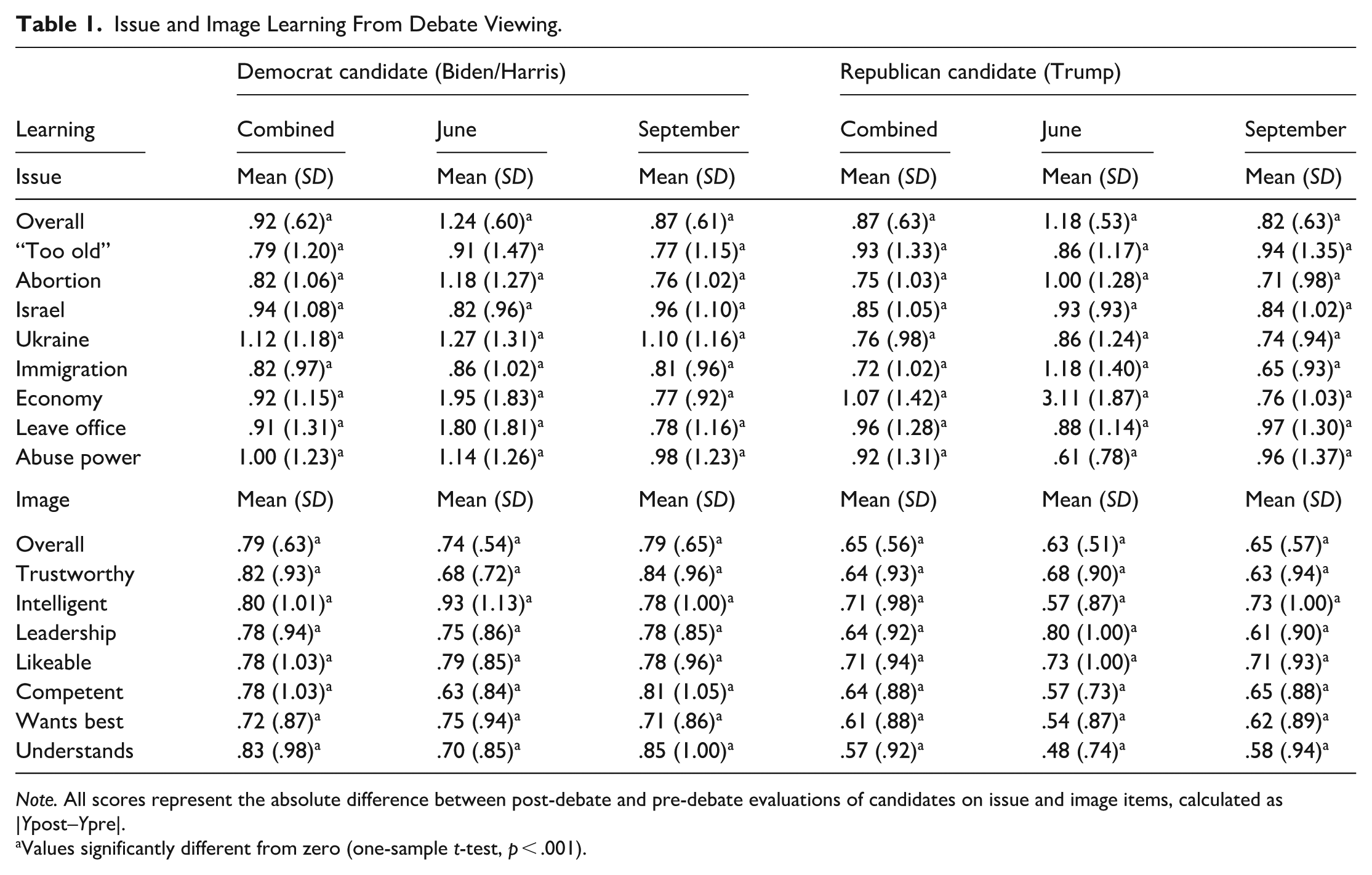
Note. All scores represent the absolute difference between post-debate and pre-debate evaluations of candidates on issue and image items, calculated as |Ypost–Ypre|.
Values significantly different from zero (one-sample t-test, p < .001).
Image Learning
Perceptions of candidate image were measured using six items adapted from Warner and Banwart (2016). Participants rated their agreement with each statement on a 7-point Likert scale ranging from 1 (Strongly Disagree) to 7 (Strongly Agree). For each debate participant, respondents indicated the extent to which they perceived the candidate to be: (1) trustworthy, (2) smart, (3) a good leader, (4) likable, (5) competent, (6) genuinely wanting what is best for America (benevolence), and (7) understanding the problems faced by people like themselves (homophily). As with issue learning, image learning can also be bi-direction (i.e., people can learn that they like a candidate more or less on a given trait). Thus, we also utilize the absolute value of the difference between pre and post-debate image score to measure image learning. All image change scores are reported in Table 1.
Results
The first hypothesis predicted that viewers would learn about traditional issues, whereas the second hypothesis predicted viewers would learn about non-traditional issues. There was consistent evidence of issue learning for all three candidates on each issue measured. As reported in Table 1, the typical participant revised their evaluation of Biden overall by approximately one and a quarter point, with the largest revisions occurring on the economy (ΔM = .92), perceptions that he would not leave office (ΔM = .91), that he would abuse power (ΔM = 1.0), and abortion (ΔM = .82).
Viewers of the June debate learned approximately the same about Trump overall, with the greatest issue learning occurring on the economy (ΔM = 3.11), followed by immigration (ΔM = 1.18). Issue learning appeared to go down for the September debate (though this may be due to the difference in sample size), with the average issue perception changing by not quite 1 point. The largest areas of learning for Harris occurred on her handling of Ukraine (ΔM = 1.12), perceptions she might abuse power (ΔM = .98), and her ability to handle the conflict between Israel and Palestine (ΔM = .96). The areas of greatest change for Trump in the September debate were fears of him refusing to leave office (ΔM = .97), abusing power (ΔM = .96), and perceptions he was too old (ΔM = .94).
Image Learning
Image learning was the focus of the third hypothesis. Like issue learning, image learning was observed for all three candidates (see Table 1). In general, image learning scores were higher for Biden (ΔM = .74) and Harris (ΔM = .79) than Trump (ΔM = .65). Biden’s greatest area of change was intelligence (ΔM = .93), whereas Harris saw the most change in homophily (ΔM = .85), trustworthiness (ΔM = .84) and competence (ΔM = .81). In June, perceptions of Trump’s leadership changed the most (ΔM = .8), whereas in September, it was perceptions of his intelligence (ΔM = .73) and likability (ΔM = .71) that moved more than any other trait.
The research question (RQ1) asked whether viewers learned more about issues or image. The results indicate that viewer’s did more issue learning (Biden: ΔM = 1.24, SD = 1.08; Trump: ΔM = 1.18, SD = 1.03) than image learning (Biden: ΔM = .74, SD = .54, t[55] = 4.97, p < .001; Trump: ΔM = .63, SD = .51, t[55] = 1.13, p = .13) for both candidates. Thus, analysis of RQ1 suggests that viewers learn more about the issues than the image of the candidates in the debate. This finding also held for the September debate. People learned more about Harris on issues (ΔM = .87, SD = .61) than image (ΔM = .79, SD = .65, t[366] = 1.91, p < .05). Similarly, viewers learned more about Trump on issues (ΔM = .82, SD = .64) than image traits (ΔM = .65, SD = .57, t[366] = 4.88, p < .001). Thus, people experienced greater issue than image learning when viewing a presidential debate.
Post hoc demographic analyses revealed a consistent effect of partisanship on candidate image learning. Across both debates and for candidates from both parties, Republicans reported greater image learning than Democrats. When the debates were analyzed jointly, Republican viewers learned more about the Democrat (Republican: M = .98; SD = .77; Democrat: M = .63; SD = .46; t[258.75] = 4.95; p < .001) and the Republican (Republican: M = .75; SD = .63; Democrat: M = .51; SD = .46; t[327] = 3.92; p < .001) candidate’s image than Democrat viewers. However, no partisan difference emerged in issue learning from the debate viewing experience, nor did gender influence either issue or image learning in either debate. Considering Vice President Harris’s historic presidential candidacy as a woman of color, we further examined the role of shared gender and racial identities. Though a shared gender identity (i.e., woman) did not influence learning, a shared racial identity (i.e., identifying as either Asian/Asian American or African American/Black) increased issue learning about Harris relative to white viewers (Shared Identity: M = 1.01; SD = .75; White: M = .82; SD = .55; t[52.50] = 1.70; p < .05).
Discussion
The results of this study reaffirm a central, enduring argument in political communication: people do learn from debates. Both issue learning and image learning occurred in the 2024 general election debates, offering evidence that these campaign events continue to play a meaningful role in shaping public opinion. Viewers showed measurable changes in how they evaluated the candidates on both traditional policies and more emergent concerns. Perhaps surprisingly, we also found that people learned consistently more about how they felt about the candidates on the issues than they did about image traits. These findings carry implications not only for how we understand the effects of presidential debates, but also for how we conceptualize political learning in an evolving media and electoral environment.
To begin with, this study demonstrates that even with highly familiar candidates like Biden and Trump, viewers can still update their evaluations on important political dimensions. In both debates, on all measured issues, traditional and nontraditional alike, people significantly revised their perceptions of the candidates by—on average—almost a full point. This strongly suggests that debates can drive learning even for candidates with well-established public profiles. This suggests that when debates provide new or clarifying information, even about long-standing figures, learning can still occur.
Importantly, issue learning was not confined to traditional domains like the economy or foreign policy. In both debates, participants updated their views on nontraditional issues, namely, a candidate’s age, willingness to leave office at the end of their term, and potential to abuse executive power. These results highlight the need to distinguish between traditional issues, such as economic policy or foreign affairs, and nontraditional issues, which reflect evolving voter concerns that may not appear in party platforms but are nonetheless central to public evaluation. These concerns, while not typically treated as “issues,” were highly salient in the 2024 campaign and were clearly processed by viewers as relevant criteria for judgment. The fact that participants shifted their perceptions in response to these items underscores the importance of revisiting how issue learning is conceptualized and measured.
These results also have implications for the ongoing debate over whether issue learning or image learning dominates modern debates. The answer, based on this study, is clear. In both debates, viewers tended to learn more about issues than about candidate image. This may be due to our unique operationalization of learning—a change in any direction on issues. For example, because candidates can clarify their positions in a debate, people who share their issue stances are likely to revise upward, whereas people who disagree with their issue stances will revise downward. These changes will net-out zero on an overall measure of issue agreement, but by assessing change rather than persuasion, we were able to identify consistent learning effects.
We also found some exploratory evidence of differential learning, in which Republicans seemed to learn more about candidate images than Democrats, and people with a shared racial identity seemed to learn more about Harris. The identity-based learning may be due to greater interest and attention given the shared group characteristic. The partisan difference may be particular to the 2024 cycle or may be a more persistent difference between the parties. Because this analysis was post hoc, any speculation requires follow-up investigation in future elections.
To summarize, our contribution to debate scholarship lies in its demonstration that presidential debates continue to promote meaningful political learning not only about candidate image, but also about issues (which proved more important over two debate cycles), even in an era of extreme candidate familiarity and media saturation. The 2024 debates show that issue learning can be both broad and deep, encompassing conventional policy areas and emergent concerns about leadership behavior and institutional stability. Crucially, the study also challenges traditional conceptions of what constitutes an “issue” by showing that voters also learn and update their perceptions on nontraditional concerns such as a candidate’s age, their willingness to leave office, and potential for abusing power. These findings suggest that issue learning remains a vital component of debate effects research, but one that should be reconceptualized to reflect the current or evolving priorities and anxieties of the electorate. As this study shows, broadening what counts as a political “issue” to include voters’ current perceptions of candidates’ democratic norms and leadership capacity/ability may help capture the full impact of modern debates.
Future research should continue to investigate the conditions under which issue and image learning occur, especially across diverse electoral contexts and with increasingly segmented audiences. Additionally, examining the role of partisanship, media framing, and social media amplification may provide further insight into why some messages stick while others fade. In the meantime, these findings serve as a reminder that debates still matter, not just for how voters feel about the candidates, but for what they learn about them.
Limitations
Though the present study offers valuable insight into political learning during a historic general election debate, several limitations should be acknowledged. First, the June debate sample size was relatively small (N = 56), which limits statistical power and increases the possibility that a few outlier responses can generate unreliable estimates. It is important that we clarify the gap in sample sizes between our two samples. The difference can be explained by when the two debates were held. The June debate happened during the summer, when very few students are on campus or taking classes. Because we recruit mainly through student pools and course outreach, it was much harder to find participants at that time, which led to a smaller sample. The September debate, however, took place during the regular fall semester, when students are fully back and easier to reach. This made it possible to recruit a much larger group. These normal differences in summer versus fall student availability explain the gap between the two samples.
However, the presence of statistically significant findings despite reduced power in the June Sample suggests that the observed effects are notable and may warrant replication with larger, more diverse samples. Second, the data were collected from a university sample. College students tend to differ demographically and politically from the general voting population, though they do not generate differences in estimates of debate effects (Benoit et al., 2003).
Finally, though our measure of issue learning is appropriate to capture our primary interest—whether viewers update their subjective assessment of where the candidate stands on issues relative to their own preferences—it does not capture whether voters are acquiring factual information. The debates are also noteworthy for their ability to platform misinformation (Rowland, 2021a), and the 2024 debates were not exempt from this. Research on viewers’ ability to discern objective fact from exaggeration, speculation, and outright deception should proceed independent of our findings about subjective learning.
Conclusion
Our study examined the June 2024 debate between Trump and Harris as well as the September 2024 debate between Trump and Harris to determine whether voters gain useful information about the candidate’s issue stances and perceptions of their character. In both debates, viewers significantly revised their perceptions of the candidates on every issue we measured, both traditional issues such as abortion and the economy, and non-traditional issues like age-related decline and the risk of anti-democratic behavior. Viewers also significantly revised their perceptions of the candidates’ character on all seven image traits we measured. Furthermore, issue learning was demonstrably greater than image learning. Thus, debates clearly provide useful information to viewers as they seek to generate the judgments necessary to make an informed voting decision.
Supplemental Material
sj-docx-1-abs-10.1177_00027642261431484 – Supplemental material for Issue and Image Learning in Debates: Evidence from the Two Televised Presidential Debates in 2024
Supplemental material, sj-docx-1-abs-10.1177_00027642261431484 for Issue and Image Learning in Debates: Evidence from the Two Televised Presidential Debates in 2024 by Steven D. Gardiner, Freddie J. Jennings, Ben R. Warner and Mitchell S. McKinney in American Behavioral Scientist
Supplemental Material
sj-docx-2-abs-10.1177_00027642261431484 – Supplemental material for Issue and Image Learning in Debates: Evidence from the Two Televised Presidential Debates in 2024
Supplemental material, sj-docx-2-abs-10.1177_00027642261431484 for Issue and Image Learning in Debates: Evidence from the Two Televised Presidential Debates in 2024 by Steven D. Gardiner, Freddie J. Jennings, Ben R. Warner and Mitchell S. McKinney in American Behavioral Scientist
Supplemental Material
sj-docx-3-abs-10.1177_00027642261431484 – Supplemental material for Issue and Image Learning in Debates: Evidence from the Two Televised Presidential Debates in 2024
Supplemental material, sj-docx-3-abs-10.1177_00027642261431484 for Issue and Image Learning in Debates: Evidence from the Two Televised Presidential Debates in 2024 by Steven D. Gardiner, Freddie J. Jennings, Ben R. Warner and Mitchell S. McKinney in American Behavioral Scientist
Supplemental Material
sj-docx-4-abs-10.1177_00027642261431484 – Supplemental material for Issue and Image Learning in Debates: Evidence from the Two Televised Presidential Debates in 2024
Supplemental material, sj-docx-4-abs-10.1177_00027642261431484 for Issue and Image Learning in Debates: Evidence from the Two Televised Presidential Debates in 2024 by Steven D. Gardiner, Freddie J. Jennings, Ben R. Warner and Mitchell S. McKinney in American Behavioral Scientist
Footnotes

Funding
The authors received no financial support for the research, authorship, and/or publication of this article.
Declaration of Conflicting Interests
The authors declared no potential conflicts of interest with respect to the research, authorship, and/or publication of this article.
Supplemental Material
Supplemental material for this article is available online.