




Abstract
The U.S. State Department estimates that 9 million nationals live abroad, with the American presence in the Iberian Peninsula growing sharply since 2015. In Spain, the U.S. population in 2024 stood at 138% of its 2020 level, while in Portugal it had reached 439% of its 2020 level. These communities, increasingly significant in size and organization, have become active sites of partisan mobilization during U.S. electoral cycles. This article examines the political transnationalism of Americans residing in Spain and Portugal, focusing on how processes of political resocialization—through exposure and transference—shape their engagement with U.S. politics during the 2024 election campaign. Drawing on a virtual survey disseminated through partisan committees and diaspora networks, we assess political knowledge, efficacy, interest, participation, and tolerance. Explanatory factors include limited sociodemographic characteristics alongside migration trajectories and variables related to both previously mentioned theories. We employ canonical correlation analysis alongside heliograph visualizations to capture patterns of behavior and enhance interpretability. By situating these dynamics in a context of electoral polarization, the study advances understanding of how non-resident citizens influence and are influenced by transnational political processes and broader debates on democratic quality.
Keywords
Introduction
The State Department has reported that, according to updated data at the beginning of 2020, 9 million nationals were living abroad. 1 In this context, the U.S. population based in the Iberian Peninsula (Spain and Portugal) has increased substantially since 2015. In Spain, the number of Americans registered in 2024 stood at 138% of its 2020 level. In Portugal, the figure had reached 439% of its 2020 level over the same period. 2 In this environment of strong population growth, both countries, due to the relative importance of the diasporas settled there, have committees with strong social roots that have recently represented the interests of the two most relevant political parties in American politics. The activity developed by these committees naturally peaks during the electoral processes that take place every 2 years.
These American citizens residing outside the national territory (i.e., outside the political system of which they hold nationality/citizenship) are immersed in processes of political resocialization that end up shaping their relationship with both the political system of their country of origin and the political institutions of the host society (Biderbost et al., 2018; Croucher, 2009; Von Koppenfels, 2025). In this research, based on the survey of civic competencies at the level of individuals, we aim to decipher what are the patterns of political transnationalism of Americans based in both countries of the Iberian Peninsula.
In other words, in light of two specific theories of political resocialization (exposure and transference), empirical evidence was generated to explain the ways in which these individuals relate to U.S. politics in the context of the 2024 election campaign (White et al., 2008). Electoral periods, especially those with deeply polarized features such as this one, are propitious for formulating research designs on patterns of political transnationalism because they activate citizen attitudes and behaviors, latent or silenced between elections, whose knowledge is relevant to gauge the role played by nonresident citizens in the current environments of loss of democratic quality and civic disaffection (Cintolesi, 2022; Fiorina & Abrams, 2008).
To execute the above, a virtual survey was collected and channeled through formal groups (such as the aforementioned party committees) and informal networks of the diaspora living in Spain and Portugal to ensure the presence of politically empowered individuals and others with lower levels of monitoring of the political reality. As dependent variables, information was collected, focusing on that electoral process, on political knowledge, political efficacy, political interest (attention), political participation, and political tolerance. 3 As explanatory variables, following the aforementioned theories of political resocialization, we have inquired about sociodemographic factors, party identification, ideological self-placement, characteristics of the immigration process at the individual level, and elements linked to the temporality of the respondent’s presence in the societies in which he/she has lived (destination, origin, and, eventually, others in which he/she has also lived). It is important to remember that this article, unlike others on the American diaspora abroad, does not aim to find out how its members vote or what their links are with the international branches of the Democratic or Republican political parties. This research only attempts to decipher patterns of political transnationalism, using civic competencies as indicators, among Americans Abroad in a peculiar electoral context. Although data have been collected on all the variables mentioned here, this paper focuses on how the two theories of political resocialization can explain civic competencies as indicators of political transnationalism among Americans residing in the Iberian Peninsula.
The data collected were approached using canonical correlation analysis (CCA), a multivariate statistical technique that allows, for research designs such as the current one, to observe the simultaneity of behavior of independent and dependent variables grouped in two sets (Betti et al., 2022). To proceed with data visualization, an innovative strategy was used: heliographs were constructed. Heliographs are a specific type of graphing created to facilitate a quick understanding of the results derived from a CCA for novice readers (Degani et al., 2006).
The article is structured as follows. First, a conceptual definition of political transnationalism and recent examples of its academic exploration are introduced. In the same section, the main patterns of the American population living abroad and a quick review of their study are described. Second, the theories of political resocialization and the conceptual definition of civic competencies are commented on. Third, the data and methods of the research are detailed. Fourth, results are presented and discussed, illuminated by the literature review. Finally, the conclusions remark limitations and potentialities of the research and possible academic and policy avenues derived from the findings.
Political Transnationalism and Americans Abroad
Transnationalism is understood as the set of practices that a diaspora exercises in relation to some dimension of its society of origin (Portes et al., 1999; Vertovec, 1999; Waldinger & Fitzgerald, 2004). Within this framework, there are economic actions (sending remittances to family members in the society of origin, creating companies, or making investments in the economy of the country that has been left behind). In the specific case of political transnationalism, reference is made to the way in which emigrants relate to the political system of origin through informal and formal activities (Bauböck, 2003, 2007; Kalicki, 2009; Martiniello and Laffleur, 2008; Biderbost & Boscán, 2011; Biderbost, 2010a, 2010b; Escobar, 2007; Cano and Delano, 2007; Lafleur, 2013; Parra, 2006; Waldinger, 2014; Jang, 2023).
The recognition of overseas voting (for non-resident citizens) in democratic societies was two things at once. On the one hand, it was the crystallization (i.e., the result) of decades of effort by expatriates who were politically linked to the countries they had left. On the other hand, it was the starting point for the systematization of a set of political transnationalism practices that sought to influence, now with greater force, the balance of power in their societies of origin. It was at this point that the Social Sciences, with an interest in migratory processes, began to study in detail the causes and consequences of this set of political actions carried out by citizens outside their national territory.
Initially, the academic approach to political transnationalism was framed within the logic of migration from the global south to the global north (Dumont, 2008; Guarnizo et al., 2003; Hartmann, 2015; Itzigsohn, 2000; Jaulin, 2016; Østergaard-Nielsen, 2001; Toivanen, 2016). The extension of voting rights abroad among Latin American countries sparked interest in this type of study (Boccagni, 2011; Bolzman, 2011; Calderón, 2003; Escobar et al., 2014; Itzigsohn & Villacrés, 2008; Lafleur, 2011; Lieber, 2010; Morales & Pilati, 2014). Researchers wanted to know how Latin American emigrants voted and how this influenced national politics. Over time, research also began to decipher the practices of citizens from developed democracies residing outside their countries’ borders. Data was then collected, analyzed, and discussed on the behavior patterns of German, French, Swiss, Italian, British, and Canadian citizens (among other nationalities) in relation to the political institutions of their countries of origin (Rhee, 2012; Hotaka, 2003; Kalicki, 2008; Tintori, 2011; Honohan, 2011; Lizi et al., 2015). In this specific context, it is possible to insert the tradition of studies on the political profile of Americans residing outside the national territory (Croucher, 2012; Spiro, 2016; Von Koppenfels, 2014, 2020).
The specific figure for the number of American citizens living outside the national territory is a matter of debate. 4 While the criteria used by the State Department estimated that around 9 million people were living abroad in 2020, 5 the criteria applied by the Association of Americans Residents Overseas (AARO) is much more restrictive and calculated a figure of 5.5 million people in this situation for 2024. 6 The difference between the two institutions lies in whether or not they include in their estimates individuals who, temporarily, would not (in principle) plan to extend their absence from their country of origin. The following table compares the estimates for the top ten countries according to the U.S. population established there on a permanent basis. Spain emerges as one of these main destinations (Table 1).
Numbers of Americans Abroad.
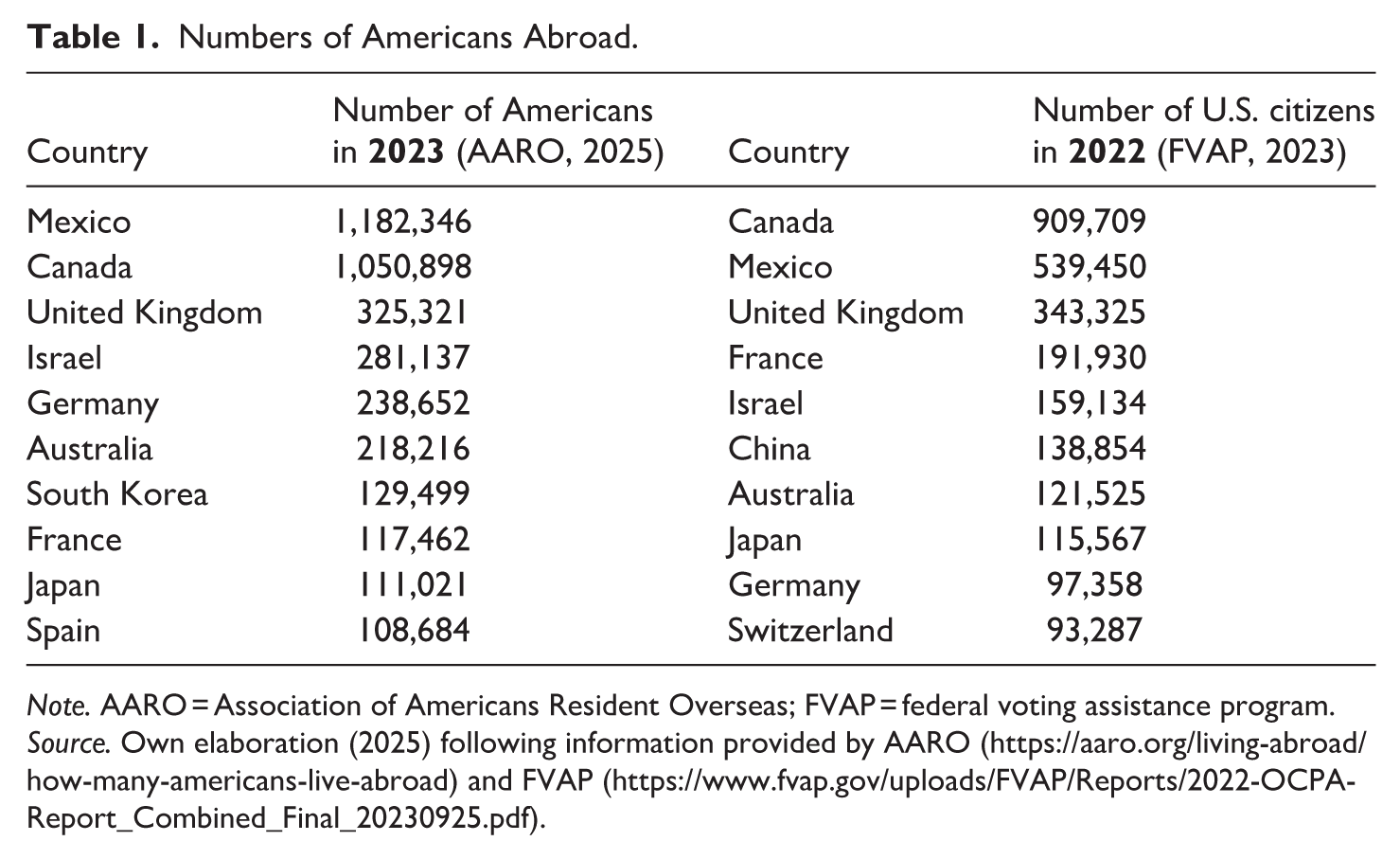
Note. AARO = Association of Americans Resident Overseas; FVAP = federal voting assistance program.
Source. Own elaboration (2025) following information provided by AARO (https://aaro.org/living-abroad/how-many-americans-live-abroad) and FVAP (https://www.fvap.gov/uploads/FVAP/Reports/2022-OCPA-Report_Combined_Final_20230925.pdf).
The reasons that have historically led Americans to settle abroad have been varied. 7 Various works have attempted to systematize these reasons 8 (Amit et al., 2007; Dashefsky, DeAmicis, et al., 1992; Dashefsky & Woodrow-Lafield, 2020; Von Koppenfels, 2020). First, there is a group linked to missionary-type religious work. Second, there is a group of individuals related to the development of economic activities 9 who have emigrated for this purpose (as employees or employers). Third, there is a significant group of people who, once naturalized, return to their countries of origin at different stages of their lives or emigrate to third countries (as a way of ending their immigrant experience in the United States). A fourth group is that linked to retirees who, in search of quality of life and greater purchasing power, decide to settle in other countries.
A fifth group of Americans residing outside the United States is those who emigrate for political reasons. These reasons are not necessarily linked to persecution but rather refer to the impossibility of living in close proximity to polarized political scenarios that they dislike. This has been observed on different occasions, particularly in the late 1960s and early 1970s (coinciding with the Vietnam War and the cycles of collective action that took place in American society) and in the present day.
A sixth group of Americans living abroad is made up of binational families who live in border regions (with Mexico or Canada) or in other countries. 10 A seventh group is linked to the cultural diaspora that settles in third countries for work or artistic reasons. To this group can be added the subgroup made up of undergraduate and graduate students participating in academic exchanges (although not exclusively) throughout the world. A final group is made up of expatriates, military personnel, and civilians (plus their families) who perform tasks for the U.S. government abroad. To this group, we could “add” the subgroup made up of officials from international organizations based in other countries.
In recent times, the most complex and comprehensive work that has provided systematic empirical evidence for a better understanding of the reality of American emigrants is Americans Abroad (Dashefsky & Woodrow-Lafield, 2020). Both in this contribution and in others since the social sciences have expressed their interest in this group, one of the main questions to be verified is that related to the actual quantification of its members (Boyd, 1981; Bratsberg & Terrell, 1996; Dashefsky et al., 1992; McCann & Rapoport, 2023; Mindes, 2019; Rubin, 1966).
The comparison of certain sociodemographic parameters between U.S. emigrants and the population of the 50 states of the Union has also been a recurring element in these approaches (Rubin, 1966). The exploration of their reasons for leaving has been another constant, together with the investigation of their processes of adjustment and integration into their destination societies (Amit & Riss, 2007; Belyavina & Bhandari, 2012; Belyavina, Li, & Bhandari, 2013; Croucher, 2009; Methvin, 2009). At the same time, in light of the possibility of voting abroad, there has been interest in the legal aspects and strategies for maintaining contact with the political system of the country of origin (Dark, 2003a, 2003b; Davidson, 1968; Kalu & Scarrow, 2020; McCann & Rapoport, 2023; Murray, 2012; Von Koppenfels, 2014, 2015, 2025). Attempts have also been made to understand the patterns and causes of return to the United States or re-emigration to other destinations (Dashefsky et al., 1992; Dashefsky & Woodrow-Lafield, 2020).
The years following the COVID-19 pandemic have seen extraordinary growth in the population of US origin (by birth or naturalization) abroad in general, and in Spain and Portugal in particular. Estimating the exact number of these movements is complex because of to various factors. As seen above, US records differ greatly from one another.
The records of the destination countries also present obstacles to making accurate calculations. On the one hand, in some cases, these individuals also hold European citizenship (either because they are descendants of former immigrants from countries that make up the Schengen Area or because they themselves became naturalized immigrants during their years of residence in the United States). 11 On the other hand, in the specific case of Spain, Americans who also have a Latin American nationality are granted a significant reduction in the number of years they must reside in the destination country to acquire citizenship of the host country. 12 The following table shows the growth, according to official sources in Spain and Portugal, of the population residing exclusively as Americans in these countries (Table 2).
Americans Residing in Portugal and Spain.

Source. Own elaboration (2025) following information provided by the National Institute of Statistics (Spain) and National Institute of Statistics (Portugal), and Agência para a Integração, Migrações e Asilo (Portugal).
From a political point of view, the American diaspora in Spain and Portugal is organized into different branches of Democrats Abroad and Republicans Overseas. In the case of the former, there are seven chapters in Spain. Portugal has a single committee with more centralized activities. In both countries, membership is open to American citizens, although the activities organized may include the entire community. The range of actions or tasks they carry out throughout the year is not strictly political or, 14 as they also seek to facilitate, through cultural and social events, both the integration of their compatriots into the host society and dialogue between members of the host communities and the “newcomers” from across the Atlantic.
After the Republicans Abroad organization was dissolved in 2013, Republicans Overseas took in most of its overseas affiliates the following year, including those on the Iberian Peninsula. In both Spain and Portugal, activities in each country are centered on central committees. Compared to their Democratic counterparts, their actions have an eminently political profile, linked above all to encouraging voter registration and voting. 15
Both affiliates of U.S. political parties in the Iberian Peninsula countries were highly active in the weeks leading up to the November 2024 elections. This was justified by what, in their institutional assessment, was at stake in those elections. 16 However, from the point of view of social media presence, the Democrats had greater visibility across the platforms used (Facebook, Instagram, Bluesky, and Signal).
It should be noted that these committees carry out their work in a political context (Spanish and Portuguese), which, although it has become increasingly polarized with the electoral consolidation of political parties at the ideological extremes, has a tradition of greater political consensus due to the parliamentary design of their political regimes. What happens politically in the United States is mostly interpreted from a European (rather than strictly national) perspective, with the exception of what may happen with the Iberian diaspora residing in America (notably, e.g., in the case of Portugal with its emigrants from the Azores archipelago). These contextual factors frame the work of American political parties in southern Europe.
Theories of Political Resocialization
In studies on the political integration of immigrants into host societies, working hypotheses have become increasingly sophisticated in attempting to explain which independent variables lead to better incorporation into the receiving political system. In this regard (and distancing themselves from previous ideas that believed that political attitudes acquired in the early years of life were unchangeable), two sets of theories on the political resocialization of immigrants have been developed and tested.
The first of these is the exposure theory (Arvizu & Garcia, 1996; Biderbost et al., 2018; Ramakrishnan & Espenshade, 2001; White et al., 2008). This theory suggests that the longer a person has been in contact with the political institutions of the host society, the greater the likelihood that they will be politically integrated into that context. Following this reasoning, it is the variables linked to the host environment (peer group, work or study environment, access to citizenship in the new country, etc.) that favor the process of political participation by immigrants in their destination country.
The second is the transfer theory (Biderbost et al., 2018; Black et al., 1987; Finifter & Finifter, 1989; White et al., 2008). This theory suggests that the baggage, from a socioeconomic perspective, a person brings from their country of origin is what ultimately shapes their patterns of political integration into the host society. The educational background that immigrants bring with them to their destination or their social class of origin determines their political performance. Following this reasoning, it is the variables linked to the environment of origin (education, social class, income level, etc.) that favor the process of political protagonism of immigrants in their destination.
Patterns of political transnationalism (of emigrants in relation to their societies of origin) are the flip side of patterns of political integration (of immigrants in relation to their destination societies). Both are measured using indicators that tend to coincide with the civic competencies possessed by individuals (or the population groups to which they belong). These abilities refer to skills that enable people to interact correctly (positively) with the political systems they regularly have to deal with and tend to have a virtuous circular relationship (the ones produce the others; Biderbost et al., 2018; Boscan & Biderbost, 2019). Among other competencies, political knowledge, 17 political attention, 18 political efficacy, 19 political participation, 20 and political tolerance 21 are often measured. These skills are fostered (produced) by various variables (sociodemographic, linked to the passage of time, related to the specific characteristics of migratory processes, etc.).
If the indicators for both processes (political transnationalism and political integration) coincide, there is no reason why theories of political resocialization cannot be applied to explain how migrants establish ties with the political institutions of their countries of origin from the territories where they are settled. The theory of exposure, adapted to this situation, would intuitively suggest that those who have been exposed to the U.S. political system in situ for the longest time will have greater development in their civic competencies linked to that political landscape. Within this framework of intuitions, given the diversity of the American population living permanently or temporarily in the Iberian Peninsula (long-term expatriates, students, a small group of former immigrants, a growing group of recent immigrants, etc.), it would be assumed that political involvement during presidential election campaigns (ignoring other explanatory factors) would be high (given the predominance of recent arrivals). Proficiency in the English language would be part of this “package” of variables linked to the society of origin.
The theory of transfer, adapted to this situation, would intuitively suggest that the socioeconomic characteristics of integration into the host society, measured primarily on the basis of income level, educational credentials, and the nature of employment or activity in the destination country, are what explain the level of development of civic competencies in relation to the original political system. 22 Entrepreneurs, people with little education, and people with relatively low incomes (i.e., in comparative terms) in the Iberian Peninsula would be less attached to the idea of following the ups and downs of U.S. politics. On the contrary, retirees, highly educated people, and people with relatively high incomes in Spain and Portugal would have greater leeway to actively monitor the political reality of their country of origin. Proficiency in local languages and the number of years of residence in the Iberian Peninsula would be part of this “package” of variables linked to the destination society.
Data and Methods
The data were collected through an online survey created in Qualtrics. The survey was distributed through various mechanisms between October 1 and November 5, 2024 (the last day coinciding with the presidential election day). To encourage participation, a raffle was held among all those who left anonymized contact information and responded to the entire survey, with a prize of a $250 Amazon gift card. The survey design was preevaluated by American citizens residing both inside and outside the United States to detect any problems with clarity in the wording.
The survey was disseminated both through key individuals (apolitical leaders with some influence over their compatriots) within the American community in Portugal and Spain and through pre-established social media groups made up of American citizens in both countries. Platforms such as Facebook, LinkedIn, and Internations were used for this purpose. The survey was also invited to be distributed through the local branches of Democrats Abroad and Republicans Overseas. The final sample consisted of 349 people. The survey included a final “open” section in which respondents could record their thoughts, actions, ideas, and suggestions. 23
The data were analyzed using the latest version of IBM SPSS Statistics (31.0; 2023). A canonical linear correlation was performed between two sets of variables. This test allows us to observe how two groups of variables are related: on the one hand, the explanatory factors associated with the theories of political resocialization described in the previous section, and, on the other hand, the civic competencies that describe the patterns of political transnationalism of American citizens in the Iberian Peninsula during the 2024 presidential election campaign.
The use of CCA is appropriate for the purposes of this research because it allows us to detect the type of relationship that exists between two different groups of variables (one independent and the other dependent). As a dependency technique, it helps to maximize correlations between linear combinations of variables. Although relatively unknown until a couple of years ago, it is claimed that, for these cases, it is the most powerful tool (Hair et al., 2007). The general form of canonical correlation is expressed as follows:

This technique has numerous advantages (Hair et al., 2007). First, it allows the simultaneous prediction of the behavior of multiple dependent variables based on the existence of multiple independent variables. This helps to better respond to the complexity of social reality, which is methodologically reflected in the multidimensionality of the concepts with which we work (different civic competencies and indicators of political resocialization theories in our case). Second, unlike other stochastic methods, it imposes fewer restrictions on the types of data that can be worked with. In this sense, it allows for the inclusion of both metric and non-metric factors within the groups of independent and dependent variables.
Third, the use of canonical correlation reduces the probability of committing Type I errors, that is, those linked to finding significant relationships when they do not exist. Fourth, it allows us to detect, within each group or set of variables, which factor(s) contribute most to the relationships that are found. In this way, other models (such as a multiple regression) can be constructed a posteriori that include only those variables with statistical significance.
In the specific case of this research, CCA could be used because the requirements for its implementation were met (Hair et al., 2007). On the one hand, there are at least ten observations per variable. This avoids what is called “overfitting” of the data. On the other hand, the assumptions required for the data to be applied were respected: linearity, homoscedasticity, and multicollinearity.
Its use in fields related to political science has been limited but diverse. In studies of political culture or related topics, it has been used to examine the relationship between psychological characteristics (authoritarian personality and pro-social attitudes) and the manifestation of different types of political and social prejudices (Whitley, 1999). It has also been used to investigate how the recording of different civic competencies in childhood and adolescence is associated with political behavior among young adults (Krampen, 2002). It has been used to identify which individual and environmental factors newspaper editors use to consider the inclusion of information (political and otherwise) (Chang & Lee, 1992). Finally, CCA has been applied to see how formal and informal patterns of social capital are associated in different countries in order to find different regimes of participation and cohesion (Pichler & Wallace, 2007). In principle, there are no studies on the political transnationalism of emigrants that have used this multivariate technique to identify the factors that promote it.
The results of the CCA are visualized using an innovative technique called “heliograph.” This method of graphing the results of this multivariate test, designed by Degani et al. (2006), aims to offer the reader a mechanism for observing a large amount of information that substantially surpasses the traditional tables presented in statistical reports. Its greatest advantage lies in the fact that it facilitates the comprehension of the descriptive and explanatory patterns behind the variables used.
The construction of the heliograph, as recalled by Degani et al. (2006) and Biderbost and Boscán (2019, 2021), is based on properties defined by Alexander (2002) for the design of graphs or diagrams intended to create a sense of totality. These properties are the level of scale (to represent the strength of the statistical significance of different relationships between independent and dependent variables), alternative patterns and echoes (to suggest the existence of different descriptive and explanatory patterns), the void (the inner center of the drawing where the levels of scale converge), and color contrast (to appreciate the positive or negative meaning of the relationships between variables). Other properties are superimposition (to mark the probable existence of variables that assume different patterns) and gradation (to reflect the intensity of the relationships between variables). The heliograph shown in the following section was created with Claude Opus 4.1 (Anthropic, 2025; artificial intelligence software for data analysis and visualization).
Results and Discussion
CCA requires working with two sets of variables: one consisting of the supposedly dependent variables and the other consisting of the supposedly independent variables. 24 The first consists of the five civic competencies described throughout this document. The second set includes variables that refer to classic sociodemographic variables in this type of study (age) and the two theories of political resocialization used.
From the perspective of exposure theory (to American society), English language proficiency and number of years residing in the United States have been used (Arvizu & Garcia, 1996; Ramakrishnan & Espenshade, 2001; White et al., 2008). From the perspective of transfer theory (from the host society to the society of origin), educational level, proficiency in local languages (Spanish and/or Portuguese), and number of years of residence in the destination country have been incorporated (Black et al., 1987; Finifter & Finifter, 1989; White et al., 2008). Another aggregate variable that cannot be confined to either theory is linked to the migratory experience in the family tree (i.e., who in the family left the United States and has maintained, as permitted by family history and legislation, the transmission of U.S. nationality/citizenship).
In the case of CCA, it is important to review the following results (Hair et al., 2007). First, the level of significance of the canonical function must be considered. In this case, although four canonical functions (linear combinations between sets of variables) obtain this significance, only one also has a relevant size of canonical correlation and practical significance measured through the redundancy index (how much of the variance of the set of dependent variables is explained by the set of independent factors). Specifically, for this single relevant canonical function, its level of significance is .000, its canonical correlation magnitude (Rc) is 53.7%, and its redundancy index is 7.8%. These are acceptable values when using this instrument (Clark, 2006; Glatfelter, 2009).
In the set of dependent variables, civic competencies, although they have a high adequacy coefficient (26.9%), show differentiated signs (political knowledge and political participation move in the opposite direction to the rest of the skills). This is contrary to the literature and previous findings (Biderbost et al., 2018; Biderbost & Boscán, 2019). 25 For a sample of around 350 individuals (as is the case here), canonical loadings greater than 0.30 are considered relevant for a significance level of .05. All civic skills, with the exception of political attention, exceed this threshold (80% of the set). This indicates that the composition of the set is both theoretically and empirically adequate. As the literature has already stated, political attention is usually the civic competence in which the least differences are perceived between individuals due to its less demanding nature (Biderbost et al., 2018; Torney-Purta et al., 2007).
In the set of independent variables, following the same reasoning, age, proficiency in English, proficiency in the local language (only for Portuguese), years of residence in the United States, and years of residence in the receiving country are significant because they have a canonical load greater than .30. Seventy-one percent of the variables included in the set were significant, which confirms the correctness of their composition. Educational level and family migration history were not relevant. This first pattern reveals, in a superficial review, that both theories of political resocialization explain patterns of political transnationalism among Americans living in Spain and Portugal (White et al., 2008).
First, older expatriates (−.605 canonical load) are those who claim to be more politically aware and involved. 26 However, age seems to be associated with less political tolerance (being willing to establish stable relationships with people who hold diametrically opposed ideological views) and political efficacy (believing that one's personal opinion or that of the group to which one belongs matters or is taken into account). Age is a variable that cannot be associated with any of the theories discussed. It seems that among older people there is a pattern of “active frustration” (disillusionment with the political system without neglecting it at the cognitive and behavioral levels).
As support for the exposure theory (which refers to the number of years lived in the United States), English language proficiency (−.448) and the number of years lived there (−.310) are associated with both greater political knowledge and greater political participation. However, the opposite is true for political tolerance and political efficacy. Once again, this pattern of “active frustration” with political transnationalism emerges. In other words, there seems to be a behavioral pattern among those who feel abandoned by the system but nevertheless continue to engage with it (cognitively and behaviorally). Greater familiarity with the U.S. political system has generated, among the members of this sample, a disillusionment that, paradoxically, is accompanied by greater involvement.
In support of transfer theory, the years lived in the destination country (.526), and proficiency in the local language (only Portuguese, with .640) are associated with greater political tolerance and political efficacy. 27 However, they correlate negatively with political knowledge and political participation. A second behavioral pattern of political transnationalism then emerges, which could be showing signs of “inactive acceptance” of the U.S. system. In other words, these are people who do not follow politics and did not plan to vote but, finding themselves more rooted in their destination, seem to have developed less polarizing and more idealized attitudes toward the U.S. political system in the context of the election campaign. Eventually, in the long term, among those who assume this pattern of behavior, there could be a “pool” of more involved citizens as a result of their “non-negative” proximity to political reality (because civic competencies tend to have a virtuous circular relationship) 28 (Biderbost, 2014).
Other analyses, a posteriori, based on supervised and unsupervised techniques, may help to better identify the existing subsets among American emigrants in Spain and Portugal (also analyzing profiles based on political affiliations and their levels of intensity, which, for reasons of space, could not be explored here). The collection of complementary qualitative data will also contribute to this end. However, it is striking that civic competencies are delineated, in their meaning, for this sample in this specific election campaign. Clearly, the political polarization currently prevailing in the U.S. political system may be playing a significant role in the production of scenarios of this nature. Those who claim to participate more say they tolerate less, and this could be leading, as has already been proven in similar studies addressing social media echo chambers, to the formation of defensive “political subsystems” that exclude those who think differently (Kubin et al., 2021; Tucker et al., 2018).
The following table summarizes the findings derived from applying this technique to the sample of Americans living in the Iberian Peninsula. The variables with canonical loads in bold are those that are relevant from an empirical point of view (Table 3).
Canonical Correlation Analysis: Main Results.

Notes. In some cases, the signs were reversed to facilitate understanding of the data. The signs indicate the direct or inverse nature of the relationship between the different independent and dependent variables. The variables marked in red are those that are statistically significant (with a factor loading above .30).
Source. Own elaboration (2025).
The table above represents what was usually used to convey the results of a CCA. In recent years, a data visualization technique called heliograph has been developed that intuitively displays the same information. Using circles (representing canonical functions), bars (representing canonical loadings), and their internal/external arrangement (representing the sign of the relationships), it is possible to observe how the variables are linked between the different sets of variables.
In the following graph, it can be seen that the variables in light blue are those linked to theories of political resocialization (exposure and transfer), while those in red are reminiscent of civic competencies. Highlighted, it is possible to find the variables with the greatest descriptive and explanatory potential in the sample. Compared to the previous table, it is possible to see more clearly the existence of behavioral patterns of “active frustration” (with values of participation and political knowledge coinciding in sign with indicators of exposure theory) and “inactive acceptance” (with values of political efficacy and tolerance coinciding in sign with indicators of transfer theory; Graph 1).

Heliograph with results.
The context of the 2024 presidential election campaign was unique for several reasons. Not only because of the untimely (but paradoxically expected) change of one of the presidential candidates, but also because of the return of political violence that threatened the life of another candidate. These events added spice to a political scene that, from a historical perspective, had been becoming increasingly polarized and, as Klarhoefer (2024) recalled, “less fact-based and more disrespectful.” The same author recalls that citizen participation in public debate on changes in public policy has been declining in recent years. In scenarios of this nature, combined with an increasing number of citizens leaving to reside temporarily or permanently abroad, it is relevant to ascertain to what extent they reproduce (or not) overseas the dynamics present in their country of origin. The empirical evidence gathered here has shed some initial light on this issue (Appendix A).
Limitations and Conclusions
This article has not sought to describe, with sociodemographic and party identity details, U.S. citizens living in Spain and Portugal. It has merely attempted to shed light on the patterns of political transnationalism of this specific group in the context of one of the most polarized election campaigns in recent U.S. history. At the same time, it should be borne in mind that this is a non-probabilistic sample which, although relatively large, may suffer from the shortcomings inherent in this data collection strategy.
In our findings, following the suggestions of political resocialization theories, both exposure to the American system and sustained presence in southern Europe seem to influence the ways in which civic competencies are assumed as indicators of political transnationalism. Those who have been most exposed to the United States, most claim to know details and to have participated politically in the period under study (November 2024 elections). Conversely, those who have the most contact with the host society, due to the length of their stay or their language skills, describe themselves as more politically efficient and tolerant.
Without allowing the analysis technique applied to detect clusters or groups, it would appear that there are behavioral patterns of “active frustration” among the former and “inactive acceptance” among the latter. As already mentioned, civic competencies have a virtuous or vicious circularity among themselves. It is impossible to know, at this point, which civic competencies will “pull” others within similar samples in the future. The evolution of the political systems of origin and host countries will likely play a strategic role in this.
At the time of writing, the US, Spanish, and Portuguese media continue to report on the increasing arrival of these new immigrants from North America to the Iberian Peninsula. If this phenomenon continues over time, studies of this type will tend to become more widespread. This requires the creation of larger samples that, within the framework of longitudinal research designs, will allow changes to be observed over time. At the same time, the collection of qualitative data will be essential to complement the quantitative findings derived from surveys such as the one used as the basis for this study. Mixed strategies are the only ones that will allow the detection of subgroups, according to patterns of political transnationalism, that may already be present within this collective.
In conclusion, unless electoral legislation changes (which seems unlikely in the short term), U.S. political parties will have to conduct election campaigns that are more closely aligned with the huge number of expatriates. To this end, it will be essential to construct profiles of those who are politically empowered/disaffected, cross-referenced by ethnicity, religion, and party loyalties. The management of emigration, as a U.S. public policy, will also have to pay greater attention to this reality in its different dimensions (overseas voting, tax payments, access to social security, remittances, etc.).
The usefulness of the findings referred to here, as can be seen, falls within the classic “politics-policy” binomial. In relation to the first component (politics), the huge number of Americans settling in southern Europe will require the design of both online and offline specific electoral strategies to reach them. The political culture of the country of origin is undergoing so many changes that launching campaigns to attract the “emigrant vote” will require careful efforts to understand “who’s who” in the new political divisions within the expatriate electorate. This will affect both federal and lower-level electoral dynamics where the right to vote from abroad is recognized.
With regard to the second component (policy), the empirical evidence described here suggests that the nation and states of origin of these expatriates should consider their civic profile in order to design and implement “proposals” that successfully reach this population group. How can good emigration management policies be designed in the current context of political polarization and civic disaffection? As with the first component of the aforementioned binomial, it is essential to have detailed and evolving knowledge of this group to favor approaches that maintain and promote their U.S. citizen identity even during prolonged stays abroad (which may become permanent). “Iberian Americans” are already a reality, and there are no signs that this situation will revert to previous scenarios, at least in the coming years. There are many avenues of research and policy to explore ahead.
Footnotes
Appendix A
The survey is available at the following link: https://qualtricsxmtmxlmw6vn.qualtrics.com/jfe/form/SV_eSdzWuw5XU6N7Ke

Funding
The authors received no financial support for the research, authorship, and/or publication of this article.
Declaration of Conflicting Interests
The authors declared no potential conflicts of interest with respect to the research, authorship, and/or publication of this article.