



Abstract
Protest–counter-protest (P-CP) interactions are still underresearched in social movement studies. Usually, they are subsumed under movement–counter-movement (M-CM) interaction. We argue that this covers only one part of the empirical phenomenon because not all counter-protests are tied to a counter-movement. We suggest differentiating between closely coupled and uncoupled counter-protest and introduce a conceptual framework for this. While the literature on counter-movements or M-CM interactions is still helpful for understanding uncoupled P-CP interactions, factors like (perceived) actor characteristics of the initial protesters, local civil society structures, the role of the general public, control over (urban) space, and short-term situational dynamics require more attention if we aim to better understand the uncoupled counter-protest setting. Throughout the article, we illustrate our conceptual argument with several empirical observations about specific counter-protests.
Introduction
Protests are public actions by nongovernmental actors to express criticism or dissent, and that are linked to social or political claims (Rucht et al., 1992, p. 4). Protests can take various forms in the real life, including, for example, demonstrations, strikes, petitions, or violent attacks (Kriesi et al., 2020) or in the digital sphere, including online petitioning, “flash activism” in social media or hacktivism (Earl, 2006). Counter-protests are those protests that directly react to another protest, usually taking place at the same place and time or at least in close geographical and temporal vicinity. They are relatively rare among all protests, but the specific dynamics of protest–counter-protest interactions and the observation of growing polarization offline and online have made them an object of scientific attention (Ellinas & Lamprianou, 2024; Hager et al., 2022; Inata, 2021; Inclán, 2012; Reynolds-Stenson & Earl, 2018; Shahin, 2023; Wood, 2021).
Usually, we study counter-protests as part of a counter-movement’s tactic—as part of a movement’s and a counter-movement’s “loosely coupled tango of mobilization and demobilization” (Zald & Useem, 1987, p. 247). Social movements use protest to make their claims, and della Porta and Diani’s (1999) even include the use of protest as a necessary element in their widely cited definition of social movements as “(a) informal networks, based (b) on shared beliefs and solidarity, which mobilize about (c) conflictual issues, through (d) the frequent use of various forms of protest” (p. 16). There is thus a very close link between protest and social movements. Still, while all social movements use some protest strategies, not all protest events are always linked to a social movement. Sometimes, protests can be the result of spontaneous gatherings or are mobilized by only loosely coupled coalitions of societal groups that do not (yet) form any lasting networks and where participants do not share beliefs or identity beyond the concrete grievance triggering the protest. We argue that this is especially relevant for some counter-protests where participants share little beyond the shared rejection of an opponent whose presence triggered the counter-protest.
Thus, we call for a distinction between different kinds of counter-protests and emphasize the distinction between social movements and protests because they address phenomena at two different levels: the level of networks (i.e., social movements) and the level of events (i.e., protest events). While social movements may often employ protests as a central means to make their claims heard, they are not limited to this activity and are engaged in a range of activities beyond protests such as internal community building.
Based on the differentiation between social movements and protest, we further call for a distinction between different kinds of counter-protest events, arguing that counter-protests can be coupled with a counter-movement to various degrees. Some counter-protests are not linked to counter-movements at all. For example, during the COVID pandemic, many countries witnessed protests against health measures and restrictions on public life. At these events, protesters often combined demands against concrete measures and restrictions with conspiracy narratives (della Porta, 2023; Ozduzen et al., 2023; Volk & Weisskircher, 2023). Sometimes, these COVID protests were faced with counter-protests, trying to block the path of the COVID protesters or to disturb their demonstrations and speeches. This conflictual interaction was not one between a social movement and a counter-movement. We did not see one movement opposing the state measures and one supporting them. People involved in these counter-protests did not form a (loose) network based on shared collective identities. There was no coherent “anti anti-COVID measures movement”. More likely, they were ad-hoc coalitions of organizations active in various policy fields, united by their opposition to the conspiracy-theorist, regressive and sometimes radical right-wing rhetoric of the protesters against COVID restrictions. The confrontation on the streets did thus not stem from a movement–counter-movement (M-CM) dynamic where two social movements compete about an issue, like in the case of the competition and confrontation between the most famous examples of M-CM interaction—the anti-abortion/pro-life and pro-abortion/pro-choice groups in the United States (Rohlinger, 2002).
This article’s point of departure is that the existing literature on counter-movements in general and on M-CM interactions is insufficient for explaining the mobilization, development and outcomes (see Zhghenti, 2025, this issue) of counter-protests that are only loosely coupled or not coupled with counter-movements. Instead, for these phenomena, additional explanatory factors need to come into play that take into account the short-term and situational interaction dynamics between protesters and counter-protesters. We hence argue that the long-term perspective of the important and valuable counter-movement literature (see reviews in Dillard, 2013; Meyer & Staggenborg, 1996; Zald & Useem, 1987) needs to be complemented by a more event-focused perspective, especially in the case of protests and counter-protests that are only loosely coupled or not coupled with counter-movements, at all. We can only understand the dynamics unfolding in such protest-counter-protest interactions by combining the long-term M-CM perspective with the one that accounts for the short-term and more situational interactions between protesters and counter-protesters. Such a perspective—we will argue—opens up new avenues for social movement research more generally. For example, it draws attention to the question of under which conditions P-CP confrontations continue and possibly transform into an M-CM interaction.
In what follows, we will first identify the defining characteristics of counter-protests (Section “Exploring Counter-Movements and Counter-Protests”). Reviewing existing research, we show that, while counter-movements received considerable scholarly attention, counter-protests—as specific events—were researched much less. We emphasize that not all counter-protests are linked to a counter-movement and that we need to examine and differentiate to which extent counter-protest and counter-movements are connected. The next section (“Diverse Links Between Counter-Movement and Counter-Protest”) then discusses and systematizes the diverse connections between counter-protests and counter-movements. In particular, we propose to distinguish between closely coupled, loosely coupled and uncoupled counter-protest. Such a distinction allows us to improve our understanding of conditions, dynamics (e.g., radicalization), and outcomes (e.g., public opinion, see Zhghenti, 2025, this issue) of different counter-protests. Finally, in Section “Explaining Uncoupled Counter-Protests,” we will detail the additional factors that help explaining uncoupled counter-protests, emphasizing in particular the role of short-term situational factors in which control of public spaces and public discourse plays a central role.
Exploring Counter-Movements and Counter-Protests
Social movements interact with diverse actors, including adversaries, (potential) allies, and third parties or bystanders (Rucht, 2004). Some research focuses narrowly on interactions of social movements with the state. In this vein, contentious politics was defined as interactions in which “at least one government is a claimant, an object of claims, or a party to the claims” (McAdam et al., 2001, p. 5). Other publications have criticized this strong focus on the state and have pointed to the various other sources of power that social movements contest (and are being influenced by), such as institutions of economic or cultural power (Armstrong & Bernstein, 2008). This more diverse set of opponents includes also counter-movements, that is, social movements that oppose an original movement by making opposing claims on the same topic (Meyer & Staggenborg, 1996). The analysis of M-CM interactions also tied in with the growth of more relational and interactionist approaches to social movements (Duyvendak & Jasper, 2015; Fillieule & Broqua, 2020; Goldstone, 2004).
Following Meyer and Staggenborg’s (1996) seminal work on counter-movements, by now, there is a considerable body of research on counter-movements (for review see Dillard, 2013). Several publications explore the factors that influence the emergence of counter-movements. Meyer and Staggenborg (1996) in particular suggested three factors that focus on characteristics of the original movement: (a) when the initial movement is successful in the sense of large and visible mobilizations; (b) when attention to the initial movement’s claims grows in political elites and the public and starts to threaten established interests increasingly; and (c) when the initial movement finds (more) political allies (Andrews, 2002; Meyer & Staggenborg, 1996; Staggenborg & Meyer, 2022). Relatedly, research shows how movements and counter-movements influence each other’s opportunity structures (Alimi & Hirsch-Hoefler, 2012; Andrews, 2002), how they shape each other’s forms of action and strategies (Banaszak & Ondercin, 2016; Drago & Sun, 2025, this issue; Inclán, 2012; Lo, 1982), and frames (Ayoub & Chetaille, 2020; Dorf & Tarrow, 2014; Esacove, 2004; Fetner, 2001; Rohlinger, 2002). Beyond the characteristics and successes of the initial movement, some studies point to role of additional factors and interaction contexts less directly shaped by the opposing movement (Fillieule & Broqua, 2020), including opportunity structures (elite support, discursive opportunities, repression; Alimi & Hirsch-Hoefler, 2012) and resources (preexisting mobilization infrastructures, social media know how; Staggenborg & Meyer, 2022).
Counter-protests have been only scantly considered in this literature as well as in research on social movements more generally. Accordingly, Reynolds-Stenson and Earl (2018) find that “social movement scholarship has little to say about when and why counterdemonstrators are likely to mobilize” (p. 263). They argue that the macro-perspective of M-CM has shifted attention away from the micro-level interactions between protesters and counter-protesters (Reynolds-Stenson & Earl, 2018, p. 264). Furthermore, examinations of M-CM interactions tend to focus on the long-term and stable interactions between collective actors and overlook short-term, situational dynamics. A closer look at the event-level of P-CP interactions can offer a more micro, situational perspective. Protest and counter-protests engage in sequences of strategic interactions (Wood, 2021) that are different from the “sustained interaction” that movements and counter-movements enter with one another (Meyer & Staggenborg, 1996, p. 1629).
The presence of counter-protests can have a range of consequences. First and foremost, it changes the choreography of a protest-event. Usually—without a counter-protest—this choreography involves the following actors: (a) the protesters, that is, the organizers of the protest event and those who have responded to their mobilization; (b) bystanders, who observe the protest from the sidelines, (c) journalists or other persons who report about the protest, (d) usually in case of demonstrations and other forms of street protests the police, and (e) more or less directly—also the addressees or target of the protest, that is, authorities or other actors who are framed as being responsible for the grievance expressed in the protest. Each of these actors can influence the situational dynamics considerably: Policing strategies influence the trajectory of a protest event and its subsequent perception. Bystanders may ignore the protest or interact with the protesters in a supportive or opposing way. They may also change their role by joining the protest. Addressees may also ignore the protest or directly interact with the protesters, engage in dialog, or reject their demands. Together, their actions and strategies shape the appearance and perception of the respective protest event.
When counter-protests emerge, an additional actor enters the stage and changes the protest choreography. More precisely, counter-activists can mobilize already before the initial protest—as soon as they learn about the mobilization of the initial protest. The appearance of counter-protesters potentially influences the opportunities and strategies of all other actors. Protesters now face competition for public space and media attention and may have to adapt their protest strategies. Especially in more confrontative settings, the role of the police changes from enabling, channeling, or repressing one protest to separating two protests. Addressees or targets of the initial protest may not always appreciate the unexpected support of the counter-protest. For the media, the appearance of counter-protesters shifts attention from the protesters’ demands to the conflict between protesters and counter-protesters.
While counter-protests have been mentioned in various contributions to social movements studies (Meyer & Staggenborg, 1996; Zald & Useem, 1987), only a few authors have explored the event-level of P-CP interactions more systematically (Hager et al., 2022; Inata, 2021; Inclán, 2012; Meier et al., 2025a, this issue; Reynolds-Stenson & Earl, 2018; Vüllers & Hellmeier, 2022). These studies focusing on event-level interactions show that counter-protests are more likely in the case of (large) original protests (Inclán, 2012; Reynolds-Stenson & Earl, 2018; Vüllers & Hellmeier, 2022). Vüllers and Hellmeier (2022) showed in their examination of right-wing protests and left-wing counter-protests in Germany that supporter and opponent events tend to mirror one another in size. Similarly, Reynolds-Stenson and Earl (2018) argued that counter-protests respond most strongly to the original protests’ strength. In their study of U.S. protests between 1960 and 1995, they showed that in addition to the original protest’s size, counter-protests are also more likely if previous protests by that movement were numerous, had police intervention, had high media coverage, and were sponsored by an SMO. Inclán (2012) furthermore showed in her study of Zapatista and anti-Zapatista protests in Mexico that concessions made to one movement lead to more protests on both sides. Covering P-CP events in Eastern Europe, Navrátil and Kluknavská (2023) demonstrated that mobilization and countermobilization of migration-related protests in Slovakia and the Czech Republic reflect the political and discursive opportunities—less opportunities in the more closed Slovakia—and that the frequency of countermobilization followed the mobilization of initial anti-immigrant protests.
This literature on counter-protests is a welcome addition to existing work on countermobilization due to its stronger focus on micro and short-term interaction dynamics. However, the relation of the events of counter-protests to the overarching network of counter-movements often remains unclear. Often, counter-protests—implicitly or explicitly—are considered a part of a larger counter-movement. Reynolds-Stenson and Earl (2018), for example, introduced counter-protests “as an important part of a counter-movement’s arsenal” and examine them as such (p. 265). Similarly, Hager et al. (2022) and Vüllers and Hellmeier (2022) specifically investigated the P-CP interaction in the context of left- and right-wing movements. Here, the emerging field of studies into counter-protests takes over a central notion from the literature on counter-movements without question: counter-protests are understood as a particular tactic within M-CM interactions (Meyer & Staggenborg, 1996). Counter-protests are interpreted as a result of a diversification of the social movement sector in which the emergence of one movement sometimes leads to the emergence of oppositional movements that share the objects of concern of the original movement but make competing claims (Meyer & Staggenborg, 1996, p. 1632).
Some studies on counter-movements have addressed the question when counter-movements stage counter-protests instead of choosing other forms of action such as lobbying and information campaigns. And they consider the repertoires of movements and counter-movements to be closely linked: while their ideological and political positions are diametrically opposed, their tactics are essentially mirrored. Meyer and Staggenborg (1996) accordingly show how the repertoires of the abortion and anti-abortion movement critically affected each other: after the success of the abortion movements in legal action (Roe vs. Wade in 1973), the anti-abortion movement started to increasingly lobby Congress (to impede and limit the implementation of Roe vs. Wade) “forcing the [abortion] movement to follow” (Meyer & Staggenborg, 1996, p. 1649). When anti-abortion efforts in congressional lobbying stalled, they increasingly moved first to public relations and then to direct action at abortion clinics, forcing again the abortion movement to address these arenas as well. Other authors argue that movements and counter-movements strategically adapt their framing to limit the opponents’ public support and alliance-building and to boost their efforts (Ayoub & Chetaille, 2020; Yazdiha, 2022).
However, not every counter-protest in the sense of a specific form of collective action is necessarily linked to a counter-movement—they may occur without being part of a broader counter-movement. There might not even exist any counter-movement (yet)—as the example discussed in the introduction of the counter-protests against the COVID-protests shows. Hence, instead of assuming that P-CP dynamics are always connected to an M-CM conflict, we need to examine and differentiate to which extent they are connected. This is what we will do in the next section.
Diverse Links Between Counter-Movement and Counter-Protest
While counter-movements and counter-protests have in common that they encompass non-institutional political mobilization organized to oppose an original mobilization, they also follow different dynamics. By making this distinction, we do not contest that counter-protests and counter-movements can be and often are related. Instead, we call for a more event-focused approach and emphasize that sometimes counter-protests occur independently of a counter-movement and develop only sometimes into a counter-movement. We hence propose that the kind of coupling between counter-movements and counter-protests varies, and its variance is essential for the research of social movements. We draw on the often-used metaphor of loosely or closely coupled interaction (sometimes called “tango”) between different actors. In other publications such coupling has been explored with respect to diverse interactions, for example, between movements and political parties (Hutter, 2012), movements and counter-movements (Meyer & Staggenborg, 1996) or between protesters and counter-protesters (Ellinas & Lamprianou, 2024). We will use that metaphor to examine the relationship between counter-protest and counter-movement.
On the one hand, some counter-protests are closely coupled with a counter-movement concerning the issues they address and the actors involved. In this case, counter-protests are organized by actors belonging to a preexisting counter-movement and address the central issues of that counter-movement. A prominent and well-studied example of this is mobilization around abortion. As shown for several countries, pro- and anti-abortion protests rely on often long-existing movements focused on either opposing or supporting the right to abortion. Meyer and Staggenborg (1996), for example, showed for the United States how, following considerable victories of the abortion movement in the 1970s—most notably the Supreme Court’s 1973 decision to legalize abortion—the anti-abortion movement picked up steam. Both movement and counter-movement built and maintained continuous networks over an extended period of time—with considerable financial and human resources—and interacted in various settings and forms of repertoires. The repertoires of the M-CM shifted over time: from legal action until the early 1970s to lobbying Congress after 1973 and to more protests in the 1980s.
On the other hand, some counter-protests are loosely or not at all coupled to a counter-movement. These counter-protests do not draw on preexisting networks of a counter-movement but are organized by loose and ad-hoc coalitions of individuals and organizations, coming together only for a single occasion. A prominent recent example is the early counter-protests against the protests against COVID-related restrictions in many countries by conspiracy theorists and anti-vaccination activists. These counter-protests were not connected to a “pro-COVID measures” counter-movement—as this did not exist. Undoubtedly, some of the organizers and participants of the pro- and anti-COVID-restriction protests were related to existing social movements, such as radical right or anti-fascist movements. However, the confrontation over health regulations was inherently new for both sides. These cases—pro/anti-abortion and COVID-restriction-related protests—can be seen as ideal types of closely coupled and uncoupled counter-protests and counter-movements, forming two ends of a continuum (see Figure 1).
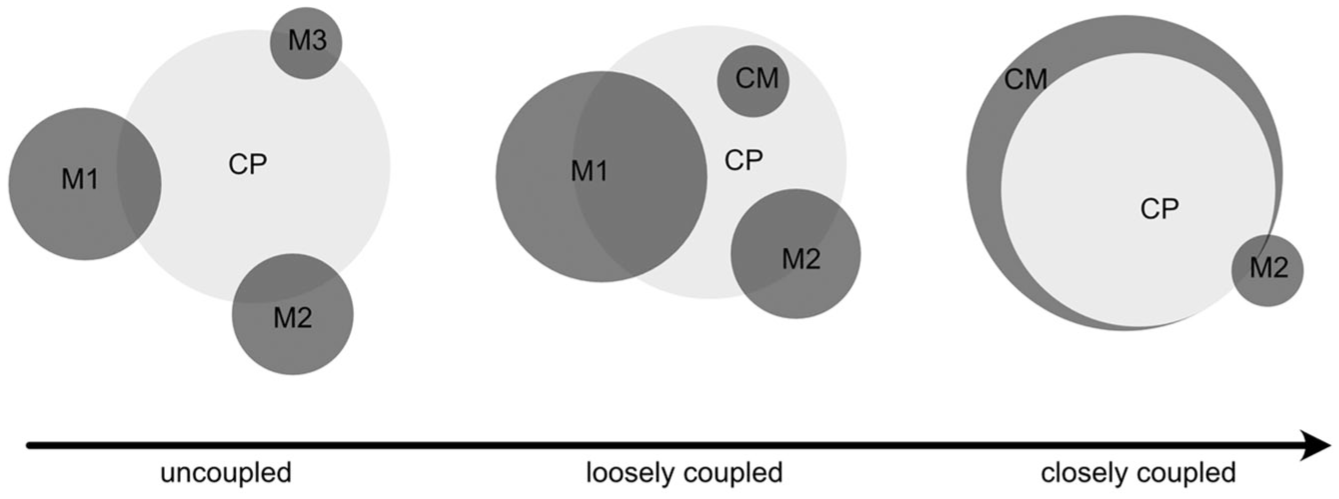
Uncoupled and closely coupled CP.
In the uncoupled setting, various movements and individuals as well as non-movement organizations participate in a counter-protest (M1–M3 in Figure 1). In the closely coupled setting, the counter-protest is part of a counter-movement (while additional actors may also participate). The loosely coupled setting is somewhere in between, with larger parts of the counter-protest coming from movements that also address the issue of the counter-protest, and maybe even containing a small counter-movement that does not dominate the event.
Similarly to offline protests, mobilization via social media can also be more or less coupled with a counter-movement. Here, it is likely that there are even more cases of loosely coupled counter-protests and counter-movements than in the physical world. For example, van Haperen et al. (2023) described opponents of Black Lives Matter (BLM) in social media as two groups—less coordinated conservatives in rural areas and well-coordinated extreme right activists. The less coordinated actors/actions are probably less coupled to the movement. The far-right movement activists’ comments or posts on social media regarding climate change (Dinan et al., 2022) also resemble loosely coupled counter-protests.
Between these two poles, we find various other cases with more or less coupling, and such examples can be any protest offline or online. First, these are cases where a counter-movement exists, but counter-protests draw on it only to some degree—in terms of overlapping issues or organizers’ networks. Some recent broad anti-far-right protests are examples of such cases (Rocchetti & Pilati, 2025, this issue). Protests are partly organized by a preexisting counter-movement, that is, an anti-far-right or anti-fascist movement and the counter-protests address its central issue. Still, the counter-protest is actually organized by a broad coalition of diverse actors ranging from trade unions and environmental groups to religious organizations (some of which are active in other movements, for example, the climate justice movement). This was the case for the anti-Legida protests in Leipzig (L. Meier et al., 2024; L. D. Meier et al., 2025b), where coalitions of movements and movement organizations collaborated for specific counter-events but were not part of one overarching social movement.
Second, various counter-protests occur without a counter-movement in place, but could eventually lead to the formation of a counter-movement in the future. In some of these cases, counter-protests draw on other preexisting ties between civil society organizations, including other movements (but not counter-movements). For example, pro-Palestine protests during Israel’s war against the Hamas in Gaza are in some cases countered by pro-Israel protests. The latter usually do not form part of a preexisting counter-movement and do not claim to represent a pro-Israel movement either. They do draw on preexisting civil society ties, for example, between some Jewish organizations. Many local ad hoc counter-protests, for example over the construction of a wind farm, a factory or the opening of a mine, have the same character. These are protests organized by people from different local civil society groups or even political parties that do not necessarily overlap with some existing social movement.
A third constellation exists when counter-protests without a counter-movement are more or less visibly organized by governmental actors. Protests organized by authorities or ruling parties countering anti-government protests do not really fit into the M-CM concept. Of course, also the literature has pointed to the role of political elites and sometimes governmental actors in movements and especially counter-movements, for example, in the case of the pro-nuclear power movement (Useem & Zald, 1982) or in anti-environmentalism (Staggenborg & Meyer, 2022). However, the extent of the authorities’ involvement differs. It is known that non-democratic authorities (e.g., in Russia, Venezuela, Egypt, and Hong Kong) use some existing networks to mobilize counter-protests against anti-government mobilizations (Cheng, 2020; Ekiert et al., 2020). This fact does not, however, increase the coupling between protest and movement. Such cases are not only a recent phenomenon. Already, Pichardo (1995) described how the local elite in California was involved in the mobilization of counter-protests against farmers in the 1930s. In the context of civil war, van Baalen (2024) presented the typology of various counter-protests based on their goals (pro- or anti-government, peace, intervention, or reform), and many of these were mobilized by other actors than social movements (e.g., military, foreign government). Considering the amount of literature on government-mobilized counter-protests (see review in Yuen, 2023), these types of actions could be seen as the most “studied” uncoupled counter-protests. On the other hand, there are also examples of similar government-mobilized protests that are well coupled with the movement. In Hong Kong, authorities mobilized a range of so-called citizens-based small local groups against the pro-democracy protests since the late 1990s, which eventually became the institutionalized movement behind the counter-protests in the 2010s (Yuen, 2023).
Furthermore, Internet-based activism—from alternative websites and claim-making on social media to culture jamming or email bombing to hacktivism (Earl, 2006; Uba et al., 2025; Van Laer & Van Aelst, 2010)—also provides examples of counter-protests loosely coupled to counter-movements. 1 Oktavianus et al. (2023), for example, showed that in the case of the Indonesian anti-LGTB campaign (#UninstallGojek), the protests and counter-protests in the form of tweets in favor and against the campaign were mainly mobilized by regular citizens rather than some organized movement. In the case of tweeting about BLM in the United States, van Haperen et al. (2023) found that supporters of the BLM were rather from loosely connected local grassroots groups, while opponents included well-networked radical right supporters that mobilized as a swarm.
Internet-based activism usually takes a verbal or visual form (i.e., social media or blog posts in contrast to street protests). In this case, it is even easier to find occasions when actors and issues of counter-protests only loosely link to some movement. Examples are direct and indirect interactions or reactions to initial mobilization in the form of a reply, repost (retweet), or mention of the adversary. Or the diverse conservative X (former Twitter) actors who criticize, mock, or delegitimize both #BLM activists and their conversations, as well as the posts about climate strikes or calls for action to help asylum seekers. More general, we think that in the social media sphere, counter-movements may probably better be labelled as “counter-publics” (Jackson & Foucault Welles, 2016) like the far-right actors that form a counter-public to Fridays For Future activists in social media (Zhang, 2024). But this is a debate that goes beyond the scope of this article. The same applies to the role of a platform’s moderators, whose controlling interventions in online mobilization and counter-mobilization resembles police interventions during street confrontations.
Of course, our distinction between uncoupled, loosely, and closely coupled counter-protests does not preclude the possibility that a social movement may develop out of uncoupled counter-protests. But for better understanding the differences between different kinds of counter-protests their history is more important than their potential future.
To sum up, distinguishing between different kinds of counter-protests—depending on their coupling to a counter-movement—is necessary to better understand the constellation of individual protests and enables the development of more general analyses of systematic differences between counter-protests. It allows us to better understand conditions, dynamics (e.g., radicalization), and outcomes of different counter-protests, which we will detail in the next section.
Explaining Uncoupled Counter-Protests
While the literature on M-CM interactions provides some clues for understanding closely coupled P-CP dynamics—and to some degree also for loosely coupled counter-protests—constellations of uncoupled protests and counter-protests require paying attention to additional factors in order to understand when and why uncoupled counter-protests emerge and how the interactions between the initiator protest and the counter-protest develop. The more counter-protests are uncoupled from counter-movements, the less they can be explained by previous M-CM interactions and characteristics. This means that other factors come into play in the case of loosely or uncoupled counter-protests as we will detail in this section. Without a counter-movement, many of its long-term characteristics like its organizational forms, resources, established frames, and collective identities or long histories of conflictual interactions that all affect closely coupled counter-protests are missing from the picture. Instead, other factors play a more central role, such as short-term situational dynamics. Furthermore, also the characteristics and actions of an original movement (if it exists) will affect uncoupled counter-protests much less than closely coupled counter-protests. Certainly, uncoupled counter-protests do not emerge in a vacuum. However, it is not primarily the constellation of M-CM relations (including their respective resources, frames, and political opportunities structures) that shapes their emergence and development but their very own specific constellation. We believe that many of the findings from the literature on counter-movements help us to understand counter-protests also in the absence of a counter-movement. Indeed, the (expected) size of the initial protest, public, and elite support for the initial protest’s claims (Andrews, 2002; Meyer & Staggenborg, 1996; Staggenborg & Meyer, 2022), and initial protest tactics will also play a role in shaping and (de-)motivating uncoupled counter-protests. However, the effect of these factors should be reevaluated, as characteristics of uncoupled counter-protests are more likely to depend less on the characteristics of the initial protest. This is because their addressees are not the same, and motivations and claims may be on different levels for protesters and counter-protesters. In the absences of a counter-movement, local settings may be more pivotal than in M-CM interactions.
In the following, we detail five factors centrally affecting loosely and uncoupled counter-protests: (perceived) actor characteristics, civil society structures, the role of the general public, control over (urban) space, and short-term situational dynamics. This is not an exhaustive list, rather we focus on those elements that are particularly relevant for loosely and uncoupled counter-protests when compared to closely coupled counter-protests. The proposed five factors can be located within the three elements of the classic agenda of social movement research used to explain the mobilization, diffusion and outcomes of protests: grievances, resources, and political and discursive opportunity structures (della Porta & Diani, 2015, p. 6).
Grievances: Initial Protest Actor’s Characteristics as the Central Grievance
Counter-protests that are closely coupled to movements and counter-movements revolve around a shared issue. They will offer opposing solutions, but the shared issue is the common starting point of the grievances motivating their protest. For uncoupled counter-protests this is not necessarily the case. Instead, the initial protest is often the grievance motivating the counter-protest. As we have discussed in the COVID protest example above, one crucial reason for counter-protests against COVID protests was the reading of the COVID-protesters as far-right. The counter-protesters did not respond mainly to the COVID-protesters demands. Actually, some of the demands like those against restrictions of the freedom of movement and the right to protest or those against executive decision-making might have garnered support from the left-wing counter-protesters in other constellations. The motivation for the counter-protests was mainly the interpretation of the COVID-protesters as far-right and the determination to not let far-right actors make their claims undisturbed (see L. Meier et al., 2025a, this issue). Thus, uncoupled counter-protests may react more to the (perceived) actor characteristics of the initiator protest than to the protesters’ demands—shifting the focus from issue competition to actor confrontation. In uncoupled protests, we thus have to focus more strongly on (perceived) actor characteristics than in closely coupled constellations.
This has important repercussions for the counter-protesters’ framing strategies: Uncoupled counter-protests can focus their diagnostic, prognostic, and motivational framing on the initiator protest to which they react. While usually the problem, the solution and the motivation of the protest cannot be the same, in uncoupled counter-protests this reduction is possible: The problem is the original protest, the solution is to stop this protest, and the motivation is also to stop or silence the initial protest.
Resources: The Role of Broader Civil Society Infrastructures
The success of all counter-protests, whether they are uncoupled or closely coupled or somewhere in between, will depend on the counter-protesters’ ability to mobilize resources, to mobilize activists to organize the counter-protest and to invest time (and money) into the mobilization, and to convince supporters to join the counter-protest. Nevertheless, in uncoupled counter-protests, organizers cannot draw on the resources of an established counter-movement. Therefore, other—often local—civil society structures play a more central role in uncoupled counter-protests than in M-CM interactions, because they can substitute to some degree organizational resources that counter-movements provide in M-CM interactions. In the example of broad anti-far-right coalitions detailed above, counter-protests do not only reflect the strength or weakness of existing anti-fascist movements, but the ability and willingness of many groups and organizations whose political focus is not the far-right, to mobilize together against a specific far-right protest. Such a counter-mobilization may be broad and strong even if the local anti-far-right groups are small and command over few resources. Civil society networks may thus have a stronger influence on the counter-protest dynamics than the explicit counter movement.
Opportunities: Role of General Public, Control Over Space and Situational Dynamics
In addition to providing resources, local civil society also contributes to the availability of more or less receptive and supportive discursive opportunity structures for counter-protests. The size of a counter-protest may often depend strongly on the outspoken support of local civil society actors, including social movements active in issue areas not directly related to the counter-protest. This goes along with a stronger role of the general public in constellations of uncoupled counter-protests.
Movements and counter-movements often target the same addressee in their opposing claims: local, regional, or national administrations or other political actors who are supposed to enact the claims and counterclaims of the two sides. Movements and counter-movements also—of course—address each other, and the latter is also true for counter-protesters. They address the participants of the initiator protests and try to delegitimize their claims. However, the third-party addressee of this delegitimization discourse is not necessarily the same authorities that the initiator movement addresses. It may well be that a more diffuse local or general public is the core addressee of a counter-protest. Counter-protests are always strong public statements in opposition to an initiator protest. Especially in uncoupled constellations the coalition of counter-protesters may be united by a mutual rejection of the initial protesters’ claims, or even by the rejection of the perceived actor characteristics of the initial protesters, but they do not necessarily share a common counterclaim. One goal of all counter-protests is to send a strong signal of opposition and to make sure that this opposition to the initiator movement is at least as, or more visible than the original protest. However, in uncoupled settings, the general public and (local) media become more important actors, and authorities are not necessarily addressed by counter-protesters, even if the initiator protest addresses them.
In offline settings, a central goal of uncoupled counter-protests is often control over (urban) space. Whereas movement and counter-movement compete, by definition, about an issue by making opposing claims, the focus of an uncoupled counter-protest is much more strongly the initial demonstration itself. This initial demonstration is the reason for the counter-protests, without it, the counter-protest would not exist. An important part of the interaction is therefore often directed at trying to disturb the original demonstration. Blockades, demonstration routes designed to stop the initiator demonstration, or attempts to drown out the original protesters’ speeches are frequent tactics of counter-demonstrations. Often counter-protesters try to get as close as possible to the initiator protest. In this situation making (counter-) claims may still be important for counter-protesters, but controlling the (urban) space, trying to limit the initiator protest’s ability to send their message, becomes a priority of the counter-protesters.
This leads to another aspect of the political opportunity structure: protest policing. When protesters and counter-protesters compete to control urban space, protest policing tactics play an important role. Whether or not counter-protesters are able to hold their counter-protests in direct vicinity of the initiator protests, whether they are able to block the initial protest’s route depends on policing strategies that may reflect sympathy for one of the two sides of the protest.
Overall, discursive and political opportunities for uncoupled counter-protests will likely be more volatile than in movement counter-movement interactions. Instead of the longer-term constellation of repeated interactions between a movement and a counter-movement, for uncoupled counter-protest, it is necessary to focus more strongly on short-term situational event dynamics. While counter-protests—except for the individual manifestation of discontent—will always require some mobilization work, the turnout and the success of uncoupled counter-protests will depend a lot on short-term situational factors like external events, coalition-dynamics, (un)favorable discursive opportunities and others. Of course, even without a counter-movement, existing movement organizations or movements may still play an important role in organizing a counter-protest. In these cases, available resources, histories of previous cooperation, or shared frames will again be relevant for understanding the emergence of counter-protests, even in an uncoupled setting. Nevertheless, the dynamics of uncoupled protests and counter-protests may be much less predictable than movement counter-movement interactions.
Conclusion
While counter-protests have received some scholarly attention, P-CP interactions have still not been systematically researched. And in studies that have looked at counter-protests, they have usually been addressed as a form of action present in an M-CM interaction. In this article, we have argued that this M-CM interaction covers only one part of the empirical phenomenon. Not all counter-protests are tied to a counter-movement. Social movements are mobilized networks with shared identities that persist for some time. They are social structures with some temporal continuity. Protests are events. They can be important building blocks in social movement networks, but they also can be isolated one-time events. Therefore, P-CP interactions should be studied in their own right and not subsumed under the more long-term M-CM interactions.
We have suggested to think of empirical counter-protests events as being conceptually located on a one-dimensional scale between the two poles of closely coupled and uncoupled counter-protests. Closely coupled counter-protests are staged by a counter-movement opposing the claims of the movement responsible for the initial protest. In uncoupled counter-protests such a counter-movement does not exist. Findings from the more general literature on counter-movements or M-CM interactions do help to understand uncoupled P-CP interactions to some degree. The size and visibility of the initial mobilizations, and whether or not the initial protest receives elite support are also important for uncoupled counter-protests. Whether this is also true for similarity in repertoires and arenas is debatable. However, some factors clearly have to be re-evaluated in the uncoupled counter-protest setting.
We have suggested that at least five factors play a particular role in loosely or uncoupled P-CP interactions: In uncoupled counter-protests (perceived) actor characteristics of the initial protesters are more important, sometimes the main reason for the counter-protest, and have repercussions for the counter-protesters’ framing strategies. Local civil society structures can provide resources for counter-protests and thus substitute the missing counter-movement to some degree. The political and discursive opportunities are more strongly affected by the general public, the perception of the conflict as a conflict about control over the (urban) space, and short-term situational dynamics.
Since the goal of our contribution was to re-think the role of counter-protests on a conceptual level, we have only provided some illustrative empirical examples that support our argumentation. Further research would need to empirically test the claims about the differences between closely coupled and uncoupled counter-protests. Whether all of our assumptions are true for a larger set of cases is an open question, but we hope these suggestions will be addressed in future empirical studies and ideally in systematic comparisons of M-CM and uncoupled P-CP interactions.
Footnotes

Funding
The authors disclosed receipt of the following financial support for the research, authorship, and/or publication of this article: Funding for this research was provided by the Federal Ministry of Education and Research (BMBF), grant numbers 01UG2450CY and 01UG2450JY.
Declaration of Conflicting Interests
The authors declared no potential conflicts of interest with respect to the research, authorship, and/or publication of this article.