



Abstract
This article examines how interactions between far-right protestors, counter-protestors and other actors, including the police, lead towards and away from violence that exceeds normal levels relative to the groups under analysis. Based on four cases (Dover, United Kingdom 2015–2016; Sunderland, United Kingdom 2016–2018; Charlottesville, United States 2016–2017; Chemnitz, Germany 2018), and integrating interactionist approaches with relational and processual analysis, the article describes a series of violence-enabling and violence-inhibiting mechanisms and discusses how this framework can enhance understanding of the violence dynamics of waves of far-right protests. The article (a) reiterates the importance of mechanisms at the situational level, but shows how these can profitably be understood as part of relational processes that develop across and beyond waves of contention; (b) highlights the value of integrating analysis of violence-enabling and violence-inhibiting mechanisms; (c) identifies blind-spots in movement-centric relational models and proposes a solution; and (d) introduces the idea that different protest ecologies – “movement-marginalised” and “movement-emboldened” – can produce different violence pathways.
Introduction
Far-right protests are regularly met by counter-protests, ranging from non-violent mass counter-protests to militant direct action. Scholarship on the far-right (Virchow, 2007; Zeller, 2020) and anti-fascism and anti-racism (Copsey & Merrill, 2020; Vysotsky, 2013) describes such encounters in detail. How these interactions affect the trajectories of such protests is less well understood, however (Haunss et al., 2025, this issue). This article makes strides towards addressing this knowledge gap by examining how interactions between far-right protestors, counter-protestors, and other relevant actors lead towards and away from physical violence during protests. To do so, it analyses violence escalation and inhibition within and across waves of heightened far-right activity in four locales: Dover, United Kingdom (2014–2016), Sunderland, United Kingdom (2016–2018), Charlottesville, United States (2017), and Chemnitz, Germany (2018).
The literature offers competing hypotheses regarding the effects of counter-mobilisation on far-right protests. Some studies argue that aggressive confrontation can fuel “cumulative extremism” (Eatwell, 2006) or “reciprocal radicalisation” (Bailey & Edwards, 2017), leading to further violent escalation. Others find that direct action by counterdemonstrators can curtail far-right activity, because they “out violence” their opponents (Beckman, 1992), force them to make tactical decisions that can surface strategic tensions (Drago & Sun, 2025, this issue) or, through “conjunctures” with broad-based civil counter-mobilisation, closing political opportunities or stimulating coercive state repression (Zeller, 2020, 2021). Following the “processual turn” in the study of contentious politics (Malthaner, 2017), this article does not test these hypotheses but rather examines how and under what conditions both might be true. Specifically, by identifying a series of violence-enabling and violence-inhibiting mechanisms operating at greater and lesser proximity to face-to-face encounters between protestors and counter-protestors, it generates new insight about how and under which conditions interactions between far-right protestors and counter-protestors produce more or less violent outcomes.
Theoretically, the article builds upon the recent use of interactionist approaches to explain the emergence of violence during protests and other forms of contention (Bramsen, 2018; Nassauer, 2018, 2019, 2021; Tiratelli, 2018). Grounded in Collins’ (2008) micro-sociological work on violence, such research focuses on the emotional dynamics of situational encounters and how specific patterns of interaction enable actors to overcome the tension and fear that otherwise inhibits the onset or persistence of violence. It has highlighted that situational encounters can acquire their own violence-favouring logics, distinct from the wider struggles of which they are a part (Nassauer, 2018, 2022), and proved effective at predicting the occurrence of violence (Nassauer, 2019).
This article also addresses questions that interactionist approaches address less well, however, about: (a) how such violence-favouring situations arise, (b) what can inhibit their emergence, and (c) why some violence-favouring situations do not give rise to violence. To do this, the article brings situational analysis into dialogue with three intersecting strands of political violence research: on the relational dynamics of conflict escalation and de-escalation (Alimi, 2024; Alimi et al., 2015), on processual approaches to conflict (Malthaner, 2017), and on the restraints on violence within radical milieus (Busher & Bjørgo, 2020). This approach follows calls to explore how we can augment interactionist approaches by integrating “upstream” structural and contextual factors (Nassauer, 2022; Tiratelli, 2018; Unverdorben, 2023; Whitehead et al., 2018) and reflects a long tradition of research on political violence and civil unrest that emphasises the value of integrating macro-, meso-, and micro-level analyses (Della Porta, 1995; Waddington et al., 1989). It also reflects a practical intent: our aim is to enhance the ability of state and civil society actors not just to manage far-right violence as it unfolds, but to anticipate and inhibit its emergence.
Our focus on far-right protest reflects the recognition that assertive far-right protests across the Global North and beyond represent a social issue that warrants attention. Such protest is also of particular theoretical interest. It remains relatively under-studied in comparison with other forms of protest (Gattinara & Pirro, 2019); is imbued with a deep logic of violence against perceived out-groups (Karapin, 2002), making variance in violence use particularly interesting; and is often characterised by the co-presence of counter-protestors.
Approach and Methods
As indicated above, we sought to integrate interactionist approaches with three strands of scholarship on political violence. Relational approaches to political violence examine how violence emerges through actions and interactions across a series of relational arenas (Alimi et al., 2015). Despite providing a relatively simple framework, such approaches have proven effective at capturing the emergent nature of violence, articulating causal complexity, including how developments in one arena can affect other arenas, and have helped locate key mechanisms of violence escalation and inhibition (Alimi, 2024). Alimi et al’s (2015) widely used framework focuses on five relational arenas:
Within-movement: activists within the same movement.
Movement-counter-movement: movement actors and their various opponents.
Movement-political environment: movement actors and political and cultural elites.
Movement-security forces: movement actors and security forces, including police and intelligence agencies.
Movement-public: movement actors and segments of the public.
This comprised the first component of our framework for data collection and analysis.
The second component reflected our intention to develop a processual analysis of these arenas. Rather than seeking to identify the much-invoked root causes of the phenomena of interest, processual approaches focus on tracing “process trajectories” (Malthaner, 2017, p. 2). These are understood to be “influenced by . . . environmental conditions and individual predispositions” but “driven and shaped by dynamics that they themselves generate, thereby transforming initial conditions and generating new goals and motives” (Malthaner, 2017). Instead of positing macro-level “risk factors” as determinants of outcomes, such approaches examine how they become inscribed in the “social and moral logics” (Whitehead et al., 2018, p. 337) through which people interpret and navigate situational encounters. To analytically embed such a processual understanding, we traced developments within each relational arena across three levels of proximity to potential violence:
Situational dynamics: during protest events.
Event preparation: actions and interactions that happen in preparation for a specific event.
Conflict dynamics: actions and interactions not specific to the event but through which those involved in the event identify and pursue their goals.
We also analysed protest events as part of protest waves, thereby enabling us to trace how relational dynamics evolve and feed back into themselves (Collins, 2012) across series of events.
Thirdly, research on restraint in radical milieus has highlighted that theories of violence are often poor at explaining its non-occurrence (Busher et al., 2019; Unverdorben, 2023), indicating theoretical limitations. To engage with this strand of research, we sought to describe both violence-enabling and violence-inhibiting mechanisms.
Case Selection and Overviews
We adopted a multi-case strategy, using within and across-case comparison to increase analytical leverage. Each case comprised a series of protests constituting a particularly intense period of far-right mobilisation, focused around, but not necessarily limited to, a specific locale.
We selected cases with sufficient similarity to withstand comparison, but sufficient variance to support effective theory building (Tarrow, 2010). Each case involved actors with a history of significant violence relative to their respective milieu, and each saw physical violence escalate beyond the usual action repertoires of the groups involved, attracting substantial national and/or international media attention. There was variance, however, in the patterns of violence: in two cases (Dover and Charlottesville), violence escalated across a series of events; in the other two, violence erupted following a trigger event. There were other important variances too which, based on the literature, we hypothesised would be theoretically interesting: the level of prominence of more ideologically radical actors; the proximity of these coalitions to political or cultural elites; and the extent to which activists sought coalitions beyond their movement. Two UK cases were included because the primary non-academic research users for this work were anticipated to be UK-based.
Dover, United Kingdom (October 2014 to April 2016) experienced five protests coordinated by groups and individuals at the most radical fringes of the United Kingdom’s anti-minority protest scene. Occurring during heightened movement fragmentation and intensifying confrontations with anti-fascist opponents nationally, these protests culminated in some of the most significant street violence between right- and left-wing actors in the United Kingdom since the 1990s. In January 2016, violent confrontations resulted in multiple injuries and more than 80 years of custodial sentences.
Sunderland, United Kingdom (September 2016 to December 2018), experienced two sustained protest campaigns organised around alleged sexual crimes committed by men with asylum backgrounds. There were 18 demonstrations over this period, bringing together local, national, and international anti-minority activists. Several activists had a history of football and protest-related violence, but the demonstrations also involved local residents with no such affiliations. While an initial protest resulted in racially targeted violence, only one of the subsequent events generated serious violence, and there was little tactical escalation across these campaigns. There was a campaign of intimidation and harassment directed at a local MP, however.
Charlottesville, United States (February to October 2017), saw five demonstrations by activists associated with the so-called alt-right during this period, including the “Unite the Right” rally on 11–12 August. Ostensibly, a response to the removal of statues and other historical markers associated with the Confederacy, these demonstrations were part of a wave of contention that gained momentum early in the first Trump presidency. The demonstration on 12 August was particularly violent, culminating in murder as one activist drove their car into counter-protestors, killing one and injuring around 35 others.
Chemnitz, Germany (August to December 2018) saw three large far-right protests and multiple smaller events following the fatal stabbing of a German-Cuban man. On 26 August, the day of the stabbing, a local hooligan group initiated a call-to-action that circulated through extreme and radical right networks. A gathering of approximately 1,000 people descended into chaos as some attendees broke through police lines to intimidate and harass people perceived to be from minority ethnic communities – albeit accounts of physical confrontation are disputed. The following day a protest attended by 6–8,000 people resulted in targeted violence against left-wing opponents, the police, migrants, and journalists. A third protest, organised by Alternative für Deutschland (AfD) on 1 September, was attended by 8,000 people but did not produce similar violence. A succession of smaller protests, rallies, and assemblies petered out by the end of December. While protest violence declined, violence occurred outside the protest arena, including a rehearsal for terrorist violence.
Data Collection and Analysis
We developed detailed case histories using documentary evidence (public reports, news reports, online publications), video and photographic evidence (including archived livestreams), 61 key informant interviews (including far-right activists, counter-protestors, local authority workers, police officers, and researchers); and social media analysis. We used Crimson Hexagon, a social media monitoring tool, to trace the online mobilisation timeline on Twitter and other publicly accessible platforms. We used Method52, an AI-based natural language processing tool, to extract, clean, and analyse public messages on Telegram, an encrypted messaging application. Digital ethnography was conducted across social media platforms, fringe forums, and messaging apps. Together, this enabled us to trace the evolving dynamics prior to, during and immediately after protest, offline and online, drawing upon observation and insider perspectives. Ethical clearance was obtained from the Principal Investigator’s host institution and the funding body.
Through detailed case timelines, we described what was happening within each relational arena throughout the periods under analysis. We used within and across-case comparison to develop consistent descriptors, repeatedly returning to the cases to ensure the descriptors continued to capture effectively and consistently the observed phenomena. We mapped these against the case histories, creating storyboards to interrogate the consistency with which the mechanisms produced similar outcomes. We understood mechanisms as “the pathways or processes by which an effect is produced,” following Gerring’s (2008, p. 161) “minimal definition.” For inclusion, we required that mechanisms (a) were present within more than one case and (b) either produced similar outcomes each time they manifested or there was a clear explanation as to why they did not (i.e. through interacting or counter-mechanisms). No assessment was made of the relative weight of each mechanism as we were interested in the relationships between mechanisms rather than their discrete explanatory importance. Detailed case histories, storyboards and elaborated mechanism descriptions can be found in a public report by the authors (Busher et al., 2022).
Mechanisms and Case Descriptions
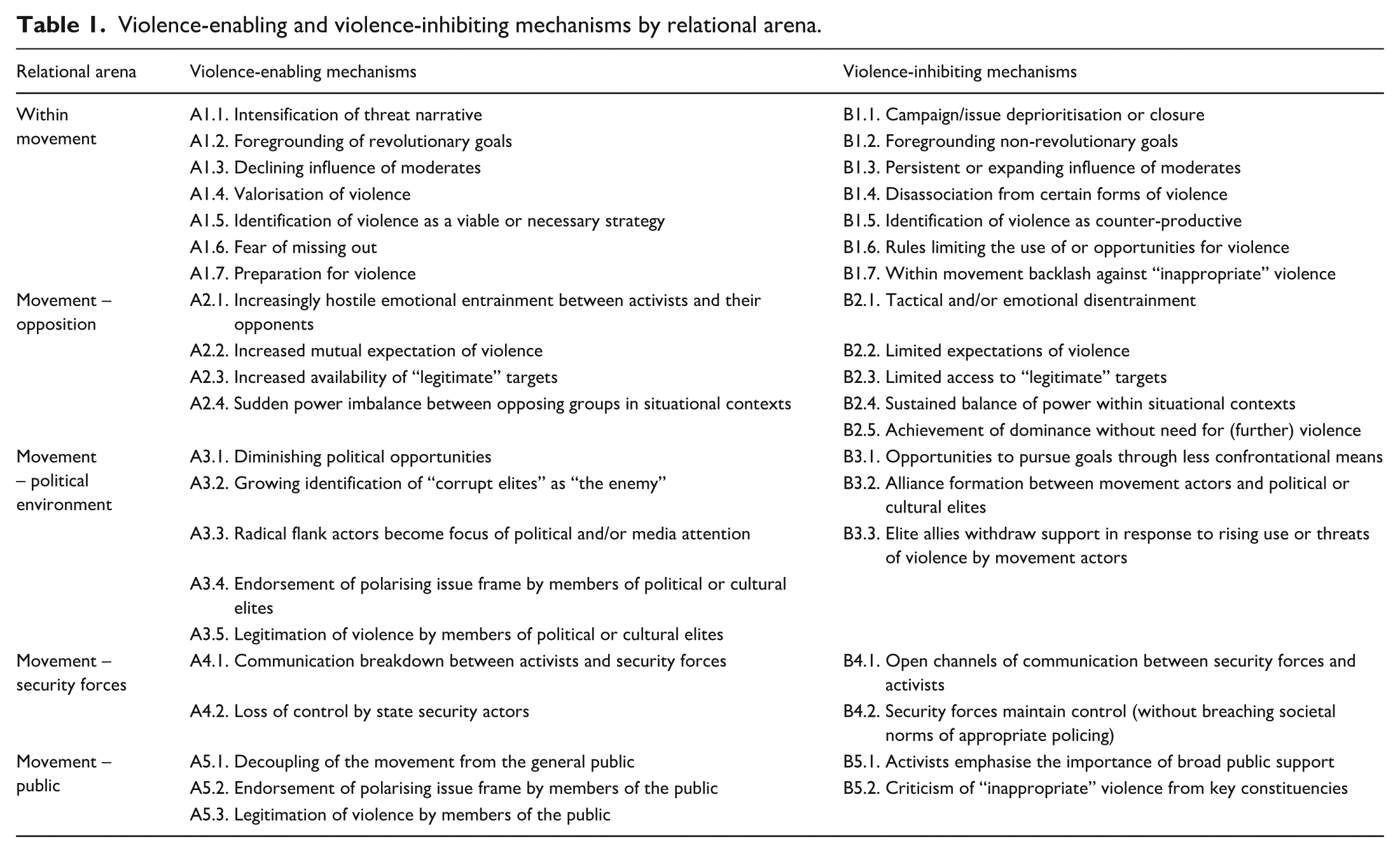
Case analysis generated 21 violence-enabling and 19 violence-inhibiting mechanisms, distributed across the 5 relational arenas. These are summarised in Table 1 and illustrated through brief case descriptions below (for detailed, fully referenced case histories, see Busher et al., 2022).
Violence-enabling and violence-inhibiting mechanisms by relational arena.
Dover
In Dover, mechanisms operating at the situational level clearly contributed to the most significant violence. At the September 2015 and January 2016 events, violence flared when police temporarily lost control (A4.2). On both occasions, far-right activists circumvented police lines, bringing them into contact with opponents and increasing the availability of “legitimate” targets (A2.3). At the January event, the sudden appearance of a large group of far-right activists in a side-street next to their opponents resulted in situational breakdown. Chaotic inter-personal violence ensued involving multiple sudden power imbalances between right- and left-wing protestors (A2.4). Relative moderates lost control of a significant portion of the march (A1.3) – a product of the groupuscular nature of these protests; the hostile emotional entrainment between political opponents as they clashed (A2.1); and high levels of intoxication among far-right activists (which likely also inhibited situational tension and fear).
Mechanisms operating beyond the situational level also contributed to violence escalation. A humiliation–revenge dynamic gained intensity across the Dover protests and other unusually violent events in Liverpool, Manchester, and Newcastle (A2.1). The September 2015 and the January 2016 protests were promoted within far-right networks as opportunities to settle scores, with imagery valorising heightened violence (A1.4). For the January 2016 event especially, far-right and anti-fascist activists expected (A2.2) and prepared for (A1.7) violence. Many anti-fascists brought defensive equipment (e.g. helmets), and some far-right activists brought weapons (e.g. poles and baseball bats).
The declining influence of moderates (A1.3) was evident prior to the event. From 2013, the preeminent far-right street movement, the English Defence League, had declined. As it collapsed, splinter groups emerged, combining with groups like the National Front and National Action, which espoused more extreme ideologies and tactics. Events in Dover, Liverpool, Manchester, and Newcastle were framed as white nationalist events, with growing anticipation of (A1.1) and calls for (A1.2) racial conflict.
Concomitant to this was a decoupling from the public (A5.1). Activists evinced decreasing interest in public engagement beyond their immediate supporters. Preparation and planning for the Dover events was dominated by discussions about fronting-up to anti-fascist opponents, and intra-movement jockeying for position. A fear-of-missing-out dynamic (A1.6) helped mobilise activists from across the far-right for the January 2016 event. Shortly before the event, the influence of relative moderates declined further (A1.3) when the National Front’s leadership withdrew its endorsement amidst concerns about the likelihood of significant violence and its implications for their own organisation.
Further violence was inhibited by the fact that event organisers retained control over a core portion of the march (B1.3), limiting involvement in the most chaotic violence. When police authorities did lose control, they recovered it fairly quickly (B4.2). The instances of overwhelming advantage in protestor-versus-counter-protestor confrontations were also short-lived (B2.4). With one exception, once activists achieved emotional dominance over their opponents, their focus usually moved onto another target (B2.5). There is striking footage of one far-right activist putting an anti-fascist into the recovery position before continuing with the melee.
Sunderland
In Sunderland, several violence-enabling factors were present. The local anti-minority protest scene included individuals associated with the most radical fringes of the far-right (A1.3). Allegations of the sexual assault of a young local woman posted on social media created intense moral indignation among activists (A1.1), and this appeared to gain traction with a wider public (A5.2). The violence that occurred here was less severe than in our other cases, however.
Limited violence did occur at an initial “flash demonstration” and at one protest during the second campaign. On both occasions, violence happened when demonstrators escaped police control (A4.2) and enjoyed an overwhelming situational advantage over their opponents (A2.4), enabling an uninhibited rampage of the sort that Collins (2008) typifies as a “moral holiday.” Another serious violent incident occurred outside the main protest campaigns. In this instance, 2 weeks of online goading between Tommy Robinson, a prominent activist, and Celtic football fans fostered increasingly hostile emotional entrainment (A2.1). Some Sunderland and Celtic fans clearly prepared for violence and managed to engage Robinson and his entourage outside of police control (A4.2). There was a sudden, brutal outbreak of violence, albeit one the police quickly constrained once they arrived (B4.2). However, the escalation of violence across the campaigns seen in Dover did not happen in Sunderland.
The simplest explanation for the relative absence of violence was the lack of counter-protestors at most of these events (B2.1). With the protests framed as being about obtaining justice for a sexual assault survivor (B1.2), anti-racist and anti-fascist groups did not want to risk problematic optics. The lack of counter-protests meant there were few targets of violence apart from the police, who were not perceived as legitimate targets within the campaign framing (B2.3), and with whom communication was maintained throughout (B4.1).
After the initial flash demonstration, the police also ensured they were sufficiently resourced to inhibit and respond to further violence-favouring situations (B4.2). Police control limited the availability of legitimate targets (B2.3), which inhibited violence, in turn diminishing expectations of violence for subsequent events (B2.2) and weakening the entrainment between right- and left-wing activists (B2.1). Campaign organisers engaged with the police, who negotiated conditions on the marches and built trust with key activists (B4.1). The choreography of most of the events was also unfavourable to violence. The logic of the protests required conveying victimhood and vulnerability, rather than asserting dominance over their opponents (B2.2). The objective of the campaign was to address injustice through the criminal justice system (B1.2) rather than pursuing revolutionary change. Local and national actors adopted mass mobilisation strategies that entailed appealing to and not alienating public support (B5.1). Rebel Media, a Canadian media outfit, became involved, lending further support to the pursuit of moderate strategies (B1.3). Despite attempts to cultivate activist and public indignation, especially through social media, activists emphasised the peaceful nature of their protests (B1.4) recognising that calls to violence would jeopardise their claims to respectability and legitimacy (B1.5).
Beyond the protest arena, law enforcement and the local authorities sought to address campaigners’ concerns through community meetings, policing operations focused on crime by foreign nationals, and engaging the national government about the impacts of asylum dispersal in the city (B3.1). This made it harder for activists to mobilise support (B1.1) or justify violence (B1.5).
Charlottesville
In Charlottesville, the most significant violence flared at a torchlight parade on the University of Virginia’s campus on 11 August 2017 and at the “Unite the Right” protest the following day. As in the other cases, situational dynamics played an important role. For example, while the initial stages of the 12 August protest saw significant aggression but relatively limited direct interpersonal violence, this shifted after the Charlottesville Police Department (CPD) declared the rally an unlawful assembly, whereupon episodic but extreme violence broke out throughout the city centre. At this point, communication between CPD and the rally organisers and attendees broke down (A4.1), as it did between CPD and other law enforcement agencies. CPD effectively withdrew from policing the demonstration (A4.2).
As they were pushed out of the park by police and the rally dissolved, “moderates”, including the event organiser and “alt-right” figureheads, lost control of their own protest (A1.3). Furthermore, as angry far-right demonstrators dispersed, they encountered large numbers of counter-protestors. With scant police intervention (A4.2), numerous “legitimate” targets became available (A2.3). Multiple violence-favouring “local situations of overwhelming advantage” (Collins, 2008, p. 125) ensued (A2.4), with individual counter-protestors isolated, trapped, and subject to severe violence. In the most extreme case, James Fields Jr used the lack of policing at a critical road junction to ram his car into a group of counter-protestors, killing a young woman, Heather Heyer.
As in the other cases, however, mechanisms operating prior to the event created conditions conducive to violence-favouring situational dynamics. Communication between CPD and other law enforcement agencies was poor in the run-up to the event, and trust had broken down between CPD and anti-racist protestors following protests earlier that year.
The heterodox composition of the rally – meant to “unite” various far-right factions – made it particularly volatile. As the event gained prominence, a fear-of-missing-out dynamic (A1.6) drew in numerous actors who had not originally been invited. Over 600 alt-right activists representing roughly 50 groups from 39 of the nation’s 51 states attended the rally. Many came from the radical flank of the movement (A1.3) and, unlike the organisers, had little interest in how the rally’s optics might affect public support (A5.1), foregrounding their own revolutionary goals instead (A1.2).
Violence was valorised before, during, and after the event (A1.4) and was widely perceived as a viable and necessary strategy for achieving their higher-order aims (A1.5). Many in attendance had prepared for violence, including lengthy discussions about how to navigate legal obstacles (A1.7). Social media discussions prior to the rally involved the endorsement, legitimation, and incitement to violence by a broader (anonymous) public (A5.3).
In the movement–counter-movement arena, hostile emotional entrainment between “alt-right” factions and their “antifa” opponents (A2.1) intensified over months, raising mutual expectation of violence (A2.2). What surprised anti-fascists was the lack of control exerted by CPD (A4.2), which was contrary to their prior experience and likely affected the situational dynamics.
At the conflict-level, groups and individuals, including some organisers, were emboldened by the Trump presidency, perceiving that they enjoyed greater support from political elites than at any time in recent history (A3.1). This hardened their narratives around “corrupt (Democrat) elites” (A3.2) and persuaded many attendees that they had broader political support (A3.4). For many, this was born out in Trump’s post-rally comments about there being “very fine people on both sides.”
Where the organisers retained some control, they potentially inhibited further violence (B1.3); requesting that those carrying weapons leave the area after the rally was declared an unlawful assembly, mindful of increased legal jeopardy. Prior to the event, organisers provided guidance regarding the limits of acceptable violence (B1.6). Notably, the militia groups largely maintained their discipline (B1.4, B1.6). The sheer scale and preparedness of the counter-protest limited the number of sudden power imbalances (B2.4).
Chemnitz
In Chemnitz, the importance of situational dynamics is again evident. The speed and scale at which protestors were able to mobilise, boosted by a fear-of-missing-out dynamic (A1.6), gave them a series of situational advantages that favoured violence escalation. Activists found themselves in multiple local situations of overwhelming advantage enabling them to outmanoeuvre police (A4.2) and heavily outnumber counter-protestors (A2.4), particularly during the first 2 days of disorder. Violence occurred when small groups of counter-protestors were surrounded by protestors or when counter-protestors dispersed after demonstrations.
As protests continued, the number of participants declined and anti-migrant activists ceased to enjoy numerical advantages over the counter-protestors, inhibiting further violence (B2.3). At later demonstrations, the police acted proactively, disbanding the AfD’s march on 1 September when counter-protestors blocked the route and containing counter-protestors earlier in the day. While isolated violence occurred, it was not on the scale of previous demonstrations, as police regained control of the situation (B4.2). Importantly, relative movement moderates were able to exert greater influence on this occasion, maintaining greater protest discipline (B1.3).
Again, however, the conditions for these situational dynamics are shaped in the days and weeks prior to the protests. The potential for violence was heightened by the fact that a significant proportion of those mobilised were embedded within Mixed Martial Arts (MMA) clubs and sports-Nazi subcultures that valorised violence, viewing it as integral to identity, status, and masculinity (A1.4). These combined a commitment to revolutionary goals (A1.2) and expertise in fighting (A1.7), meaning many of the protestors came prepared and equipped for violence, making situational advantages more likely.
The Chemnitz protests were characterised by a broad coalition, with radical right electoral parties and ordinary citizens standing alongside overt neo-Nazis and football hooligans. This apparent breadth of support, combined with uncritical comments from national political figures about the initial mobilisation, emboldened protestors, adding political and public weight to their claims about the dangers of immigration around which the mobilisations cohered (A3.4, A5.2) and legitimating, if not explicitly supporting, their violence (A3.5, A5.3).
As protests continued, however, movement moderates distanced themselves from violence and those who most actively engaged in violence (B1.4). They also exerted greater discipline (B1.6) to protect their reputation and uphold public support (B1.5; B5.1). During later events, stewards worked closely with the police to manage confrontations with counter-protestors (B4.1). On the 1 September march, the AfD were at pains to brand their event “a funeral march” with explicit instructions to distinguish themselves from hooligan/neo-Nazi elements for example, by wearing black or carrying a white rose – a symbol of resistance to the Nazi regime – rather than banners (B1.4, B1.6).
Discussion
Across the cases, the most serious interpersonal violence followed the sort of situational breakdowns described by Collins (2008) and Nassauer (2019): a loss of control by police authorities (A4.2), often alongside loss of control by movement moderates (A1.3), giving rise to sudden violence-favouring power imbalances between protestors and counter-protestors (A2.4). This supports the argument that mechanisms operating at the situational level might be necessary for violence escalation, even in cases such as these where some degree of violent intent is present in all events.
Developments prior to the protests also influenced their outcomes, however, creating relational conditions that favoured situational breakdowns. In Chemnitz, Charlottesville, and Dover, violence-enabling situations were more likely and violence became more significant because some far-right activists valorised (A1.4), anticipated (A2.2), and prepared for it (A1.7). Hostile entrainment between protestors and their opponents intensified across online and offline encounters prior to the events (A2.1), loss of control by police authorities (A4.2) was in most cases pre-configured by communication breakdowns between the police and protestors (4.1) or other stakeholders (see below), and in each case, the intensification of threat narrative (A1.1) around specific events was used to expand participation in protest activity.
The pre-event phase was also important in generating violence inhibition. In Charlottesville, rules regarding firearms issued in advance of the protest may have limited serious physical violence even as situational conditions favoured further escalation (B1.5). In Sunderland, the choreography of the protests and the priority given to building public support (B5.1), disassociating from violence (B1.4), challenging rather than overthrowing the system (B1.2), and cooperating with the public authorities (B4.1) made violence-favouring situations less likely.
Indeed, most of the mechanisms operated across two or more levels of proximity to violence. For example, across the cases there were instances where moderates lost sway (A1.3) at the situational level as the protest choreography broke down. In most cases, however, they had begun to lose influence prior to the events for example, due to a fear-of-missing-out dynamic at the preparation level pulling in multiple factions jockeying for position or, at the conflict level, movement fragmentation or the emergence of new groups.
The role of developments at the event preparation and conflict levels does not diminish the importance of mechanisms operating at the situational level. It does, however, situate such mechanisms as part of relational processes that operate across greater and lesser levels of proximity to physical violence (see Collins, 2012). Recognising this is especially pertinent at a time when digital media are vastly expanding opportunities for interaction across time and space and generating new forms of co-presence.
In addition, tracing mechanisms across different levels of proximity to violence illuminates the importance of decision-making by prominent actors within protest waves and how this can shape subsequent actions and interactions – insight likely to be of significant practical use. The decision of the activists in Sunderland to frame their protests as a campaign for justice for sexual assault survivors (B1.2), and the subsequent decision of anti-racist groups not to counter-protest (B2.1), despite the presence of known far-right activists, undoubtedly curtailed violence escalation. Conversely, the decision of the CPD to declare the rally in Charlottesville unlawful without having a clear communication and enforcement plan in place (A4.1) played a significant role in the violence that followed.
The Distinct Relational Dynamics of Far-Right Contentious Action
Several aspects of the findings warrant further discussion. Due to space limitations, we introduce the three most pressing points only with a view to stimulating further research.
The mechanisms we detected are broadly commensurate with the literatures on the relational dynamics of violence escalation and on protest violence, hinting at wider applicability. The noteworthy exception is the almost complete absence of out-bidding dynamics between far-right actors and the security forces. These dynamics are identified in the literature as a particularly important escalation mechanism (Alimi et al., 2015; Della Porta, 1995). The closest mechanism we identified in our cases was “communication breakdown between activists and security forces” (A4.1), but this lacks the confrontational intensity that comprises most descriptions of “outbidding.”
Part of the explanation for this absence likely lies in the relational idiosyncrasies of far-right protest. While revolutionary right-wing and anti-government movements do target state security services, for most right-wing movements, such institutions are central to their vision of how society should be. Some activists might even understand their protests as supporting such institutions and vice versa, as was the case in Charlottesville and Chemnitz. In addition, while far-right campaigns are deeply imbued with narratives about corrupt elites, the primary focus of their violence is, usually, not the elites themselves, but their political, racial, and religious opponents, making it less likely to trigger the kind of significant upscaling of police response that would generate outbidding dynamics.
Identifying these peculiarities in the dynamics of escalation within far-right protest waves highlights again the value of understanding mechanisms that operate at the situational level as part of relational processes that evolve across a wider set of actions and interactions. It also demonstrates the potential value of using this approach to compare violence escalation and inhibition dynamics across different protest milieus and over time.
The Blind-Spots of Movement-Centric Relational Approaches
As the cases illustrate, a particular strength of the relational approach is that it illuminates how developments in one arena influence those in others. What our case analysis also shows, however, is that movement-centric relational frameworks, in which all the relational arenas revolve around the movement, can leave analytical blind-spots. In Dover, for example, the violence is partly explained by the declining influence of moderates within the counter-movement, and the breakdown of communication between counter-movement actors and state security forces. In Chemnitz, officials who equated right-wing extremism and anti-racism limited dialogue and engagement with anti-racist networks prior to August 2018, undermining the development of more effective civil society structures. In Charlottesville, a breakdown of dialogue among political elites made protest management increasingly difficult for security forces and political elites. In Sunderland, emergent consensus among the local Bangladeshi community, anti-racists and state actors on the potential for counter-demonstrations to exacerbate community tensions resulted in these actors refraining from organising confrontational counter-protests.
Such relational blind-spots could be addressed by moving from movement-centric relational frameworks towards more holistic relational models that integrate analysis of other important relational arenas for example, the within-counter-movement arena; the counter-movement – state security arena; the within political environment arena, etc.
How Different Protest Ecologies Affect the Escalation and Inhibition of Violence
One of the more puzzling aspects of our initial list of mechanisms was that some appeared to contradict one another, particularly in the movement – political environment arena and the movement – public arena. In the former, A3.1 (diminishing political opportunities) sits awkwardly alongside A3.4 (elite endorsement of polarising issue frame) and A3.5 (elite legitimation of violence). In the latter, A5.1 (decoupling of the movement from the general public) exists in tension with A5.2 (endorsement of polarising issue frame by members of the public).
Our solution has been to conceive of these as reflecting different protest ecologies characterised by somewhat different pathways towards or away from violence. In what we call the “movement marginalised” protest ecology, violence-favouring situations become more likely as activists decouple from the public, become hyper-marginalised within the political arena, and relative moderates lose sway as they peel away from the movement. This was best characterised by the Dover case where, by the time the far-right activists descended on the town in January 2016, few had any interest in forging public or political support. Instead, the dominant logic was about exacting revenge on their left-wing opponents and jockeying for position within the radical fringes of the anti-minority protest scene.
In what we call the “movement emboldened” protest ecology, violence-favouring situations become more likely as radical flank actors perceive support among political and cultural elites, become more confident that the portion of the public that matters to them will stand by them if conflict escalates, and relative moderates within the movement fall into line with radical flank actors. This was best characterised by the Chemnitz and Charlottesville cases.
These protest ecologies are ideal types. Nonetheless, the identification of these ecologies highlights again the value of thinking of violence-favouring situations as parts of evolving relational systems. Practically, inhibiting violence emerging from these different protest ecologies is likely to require different responses. Further research is required to locate the most effective responses to violence emerging from these different ecologies. This could include research across a greater number of cases to enable a quantitative analysis of the presence and distribution of the mechanisms across cases characterised by the different ecologies.
Conclusion
There is an urgent requirement for a better and more analytically precise understanding of the dynamics of violence during waves of far-right protest. Such protest both comprises an increasingly prominent and widespread social issue and offers opportunities to test and expand understanding of the dynamics of violence during protests more broadly.
Responding to this requirement, this article has described the violence-enabling and violence-inhibiting mechanisms observed during four waves of intense far-right protests. It has done this using an analytical framework that integrates interactionist approaches to protest violence with three strands of the literature on political violence: on the relational dynamics of violence escalation and de-escalation; on processual approaches to conflict; and on restraint within radical milieus.
The case analysis reiterates arguments made elsewhere about the importance of mechanisms operating at the situational level. It also emphasises, however, the value of understanding these as part of relational processes that operate through a series of feedback loops at greater and lesser proximity to physical encounters between protestors and other actors. The approach we have proposed, combining analysis of different relational arenas with analysis of processes at the situational, event preparation and conflict levels provides an effective way to capture this. The dual focus on violence-enabling and violence-inhibiting mechanisms also helps to avoid the development of an overly deterministic account of how mechanisms at the conflict or event preparation levels affect outcomes, as well as providing valuable practical insight.
The mechanisms identified are broadly commensurate with what we expected based on the extant literatures. They highlight, however, relational idiosyncrasies of far-right protest when compared with other movements – especially the relative absence of outbidding dynamics between activists and police authorities. This further emphasises the value of relational approaches, and of comparison across different protest movements.
Our findings indicate two key ways in which analysis can be enhanced going forward. First, by addressing relational blind-spots. Second, by recognising and focusing greater analytical attention on how different protest ecologies – such as the “marginalised” and “emboldened” ecologies described in this article – can affect the pathways towards or away from violence escalation.
We suggest three priority areas for future research. First, interrogating how different protest ecologies affect the scale and duration of violence escalation. Second, using the approach described in this article to compare violence dynamics between far-right and other forms of protest. Third, examining the applicability of this approach to forms of contention associated with far-right actors other than marches, such as campaigns against migrant infrastructure, vigilantism, attempts to challenge electoral outcomes, or riots of the type seen in England and Northern Ireland in the summer of 2024.
Footnotes
Acknowledgements
We would like to acknowledge the insightful feedback of the editors of this special issue and two anonymous reviewers. We would also like to acknowledge the team at the Institute for Strategic Dialogue who provided the research infrastructure for the analysis of the digital data.

Funding
The authors disclosed receipt of the following financial support for the research, authorship, and/or publication of this article: This work was funded by the Centre for Research and Evidence on Security Threats (ESRC Award: ES/N009614/1).
Declaration of Conflicting Interests
The authors declared no potential conflicts of interest with respect to the research, authorship, and/or publication of this article.