




Abstract
Populism is theoretically associated with an antagonistic interpretation of politics. Populists tend to morally delegitimize their adversaries, exhibit “bad manners” toward them, and sometimes even try to exclude them from “the people.” They are also more inclined to prioritize radical policy and institutional changes. Therefore, populism appears to be directly at odds with consensus politics. This research aims to empirically test this relationship. Using two original surveys focused on the Spanish context, we investigate the relationship between populist attitudes and the propensity to consensual political solutions, examining both citizens and their political representatives. Our results confirm that populist attitudes contribute to low support for consensual approaches toward politics among both members of parliament (MPs) and citizens, but this relationship depends on the individual’s specific dimensions of populism. Anti-systemic and moral Manichaean attitudes are associated with less consensual preferences both for MPs and citizens, whereas people-centrist and identitarian populist attitudes exhibit this negative effect only among citizens. These results provide new insights into the ramifications of populist attitudes and underscore the importance of empirically examining the concept of populism across its various dimensions.
Introduction
Liberal democracy requires striking the right balance between adversarial and consensus-building political dynamics in parliamentary activity. On the one hand, dissent among parties naturally stems from political competition; however, pervasive expressions of difference can reduce negotiations (Valentino et al., 2008) and may lead to legislative deadlock. On the other hand, consensual approaches to politics can facilitate broad agreements essential for policy making, but there is a risk of marginalization of non-mainstream parties if the largest parties consistently align on policies (Fishman, 2019). Moreover, systematic convergence between the largest parties can reduce policy options, leading to a perceived lack of differentiation among them. This perception might cause citizens to perceive that all parties are the same (Coller, 2024), potentially causing citizens to disengage from politics, as they may conclude that their vote is unlikely to contribute to meaningful policy change.
Political systems can display more “majoritarian/competitive” or “consociational/consensual” styles depending on the institutional design and the sociopolitical context (McRae, 1997; Lijphart, 1999). Political party strategies and voters’ preferences are key to understanding this complex trade-off. Party-level aversion to compromise may paralyze parliaments’ law-making activity and even force new elections. These deadlocks may, in turn, provoke public discontent and distrust in institutions. Confrontational strategies may also fuel affective polarization among the public (Torcal, 2023). Highly polarized citizens display partisan biases (Iyengar et al., 2019) and show lower support for certain basic democratic principles (Kingzette et al., 2021). When voters and politicians develop strong animosity against opposing political parties (and their supporters) the incentives to constructively engage with them diminish.
Populism appears to constitute an important element in these polarizing dynamics. Populist discourses often portray political competitors as enemies that need to be vanquished, framing them as “others” who threaten the interests of “the people.” Citizens and representatives who embrace populist views may exhibit more tribal tendencies, rewarding in-group loyalty and conflict with out-party, while decreasing the willingness to cooperate or even punishing compromise (McCoy et al., 2018, Torcal, 2023). Despite the growth in support and the relatively successful institutionalization of populist parties in the last 2 decades (Kriesi & Schulte-Cloos, 2020), there is a scarcity of studies on the connection between populism and the levels of agreement in legislative chambers. Some authors have addressed coalition bargaining delays (Bäck et al., 2024), the spectacularization of law-making processes (Coller, 2024; Pacini, 2020), and informal practices by members of parliament (MPs) of populist parties (Kantola & Miller, 2021), but so far, to the best of our knowledge, nobody has studied the relationship between populist attitudes and the degree of support for political consensus.
Populist parties can be highly heterogeneous (Berlin, 1968), and their political tactics significantly impact their interactions with other actors. Their decision to cooperate with other political forces when enacting laws can be influenced by the nature of the policies, their perceived popularity and whether they are in government (Bartha et al., 2020). Therefore, rather than focusing on measuring the frequency populist and non-populist parties, which could be largely shaped by party dynamics and contextual factors, our study examines the potential associations between populist attitudes and the endorsement of compromise in politics.
This article focuses on the case of Spain, where levels of consensus in law-making have fluctuated significantly in the last decade (Coller, 2024). During this period, various populist parties—left-wing, right-wing, and secessionist—have decisively influenced governance at the national, regional, and local levels (Vampa, 2020). Using two original surveys, we capture four dimensions of populism, the propensity to endorse a consensual approach to politics, and other individual-level political attitudes and sociodemographic characteristics among national and regional MPs (n = 547) and citizens (n = 1,553).
The article is structured as follows. Section “Populism and Inclination Toward Consensual Policy-Making” presents the theoretical arguments that connect consensus politics and populism. Section “Data, Operationalization, and Methods” discusses the data and methodology used in the study. This is followed by section “Results” detailing the results of our analyses. We conclude in section “Discussion and Conclusion” with a discussion on how populist attitudes influence preferences for consensual versus conflictual approaches to politics.
Populism and Inclination Toward Consensual Policy-Making
Populism is a highly debated and contested term that has been conceptualized and operationalized in a variety of ways. Populism has been considered as a political strategy or mode of persuasion employed by politicians to reach power (Kazin, 1998; Weyland, 2001); as a distinct political logic of articulation of discursive elements (De Cleen et al., 2018; Laclau, 2005); as a performative political style that seeks a sociocultural identification between the people and the leader (Ostiguy & Moffitt, 2020); or as a “thin-centered” ideology that establishes a moral distinction between the “virtuous people” and a dangerous “other” who undermines their interests and sovereignty (Albertazzi & McDonnell, 2008; Mudde, 2004). The term is not one that politicians or their voters normally ascribe to voluntarily, due to its negative connotations in the public sphere (Freeden, 2017). Lack of self-identification as “populist” and the multifaceted nature of this concept has led many authors to consider populism a latent construct (Akkerman et al., 2014; Meijers & Zaslove, 2021), which can only be captured indirectly via the analysis of a variety of attitudinal or discursive traits. Thus, there is no simple and univocal indicator of populism, and its analysis implies assessing various of its components. Despite the ontological disagreements and the diverse analytical strategies used by the different traditions and approaches to the study of populism, most experts acknowledge a series of dimensions that we seek to capture and operationalize in this article.
First, populism includes an anti-systemic or anti-establishment component. It can be viewed as an empowering counter-hegemonic discourse or ideal that seeks to mobilize the aspirations of ordinary people to challenge the status quo (Canovan, 1981; Grattan, 2016; Panizza, 2005). Populism often emerges as a reaction against an elite or establishment perceived to be exploiting or harming the people. Populist discourses and ideas often blame mainstream politicians, but sometimes this critique is directed or extended to economic elites, intellectuals, immigrants, or ethnic minorities (Bonikowski, 2017). From this perspective, the people are encouraged to unite as a collective underdog, subjected to various forms of subordination and exploitation (Laclau, 2005; Olivas Osuna, 2022).
Second, people-centrism is a crucial feature of populism. The “ordinary people” are idealized and placed at the center of populist discourses (Canovan, 1981; Elchardus & Spruyt, 2016). Populists argue that the “will of the majority” or “will of the people” should not be constrained or filtered by politicians—whom they consider untrustworthy—and that institutional checks and balances obstruct popular sovereignty. This radical understanding of majoritarian rule challenges the principle of separation of powers and fosters a preference for direct democracy mechanisms, such as referendums, public consultations, and popular initiatives (Olivas Osuna, 2021). Populism, therefore, can lead to simplistic policy solutions (Müller, 2016), as well as to the bypassing of minority rights and to a “tyranny of the majority” (Stavrakakis, 2004).
Third, populism is associated with a moral Manichaean worldview that distinguishes the “pure” or “virtuous people” from a “corrupt other” (Mudde, 2004). Populists moralize the political debate and demonize political rivals and their supporters (Davis et al., 2024; McCoy et al., 2018). They mobilize resentment and turn this confrontational relationship into the basis for the development of a new political identity meant to challenge the hegemony of extant political modes of identification (Panizza, 2005). Populist discourses fuel negative emotions (Wodak, 2015; Müller, 2016; Salojärvi et al., 2023) and an exclusionary logic in political and social relationships (Brubaker, 2020; De Cleen & Stavrakakis, 2017) that splits the public sphere into opposing blocs, distinguishing “the people” from the “enemies of the people,” or more simply, good versus the evil. It is worth adding that populists often become the targets of demonizing and delegitimizing discourses from mainstream parties and populist parties of a different ideology (Schwörer & Fernández-García, 2021; Stavrakakis et al., 2018).
Finally, populism is also linked to the belief that the people’s identity and way of life is under threat. These ideas are based on an emotional and ahistorical conception of the past, the populist “heartland” (Mudde, 2004) and the development of a sense of nostalgic deprivation and pride (Gartzou-Katsouyanni et al., 2021; Gest et al., 2018). Populist movements re-construct history to shape collective memories, develop national mythologies, and evoke humiliation and self-victimization narratives (Homolar & Löfflmann, 2021). These processes help them to homogenize a heterogenous group and mobilize them through shared grievances (Laclau, 2005).
In sum, populist politicians and citizens are inclined to view reality as a confrontation between opposing blocs, with their own bloc perceived as morally superior and victimized by the other. They often believe that the ill-intentioned leaders of the opposing bloc should be excluded from significant decision-making processes. Consequently, populism is often linked to increased ideological and affective polarization (McCoy et al., 2018) and to the intensification of conflict over control of key institutions (Roberts, 2022).
In line with these arguments, populist individuals are expected to display a lower disposition to embrace political consensus. We aim to evaluate this and offer insights on whether populist attitudes affect the propensity of consensual approaches toward politics both for citizens and their representatives. Moreover, since populism is a complex and multi-dimensional concept, we seek to explore which specific dimensions of populist attitudes may impact citizens’ and MPs’ attitudes toward compromise, independently of the party they belong to or vote for. Specifically, we test the extent to which attitudes associated with four different dimensions of populism—anti-systemic, people-centric, moral Manichaean, and identitarian—have a negative effect on the willingness to espouse political compromise of both citizens and their representatives.
Data, Operationalization, and Methods
To enable the comparison of the results for MPs and citizens, we employ two surveys, one for parliamentarians, and the other for citizens. The first is known as the “third questionnaire to political representatives in Spain” (Coller et al., 2023), 1 which was an online survey to 547 MPs carried out from May 2022 to February 2023 using Qualtrics and adapted from The Comparative Candidates Survey (CCS) project (see the first article of this special issue for details). The second is a survey to 1,553 Spanish voting-age citizens carried out in early 2023 by YouGov, which includes both a measure of our dependent variable and several dimensions of populist attitudes, and is therefore ideal for our research purposes (Olivas Osuna et al., 2024). This survey was carried out online and the fieldwork took place from February 22 to 24, 2023. Gender, regional, and educational level quotas were employed. The original sample included 1,846 interviews but, after removing those screened out—on account of the total response time, the quota being full, or the interview being left uncompleted—the final sample is 1,553. The margin of error is 0.5%.
For a meaningful comparison, we need to focus on measures of the dependent, independent, and control variables available both in the CCS to MPs and in the YouGov citizens’ survey. Our dependent variable is the propensity to make concessions to reach agreements with political adversaries, or as Hibbing and Theiss-Morse put it in their book Stealth Democracy (Hibbing & Theiss-Morse, 2002): “What people call ‘compromise’ in politics is really just selling out on one’s principles.” 2 These authors found that many believe that incorporating diverse views, discussing their relative merits and compromising was perceived as unnecessary and even counterproductive (Hibbing, 2002). This same item was later used by Hawkins et al. (2012) and by Akkerman et al. (2014). In both surveys, it is recorded as a five-fold Likert rating of agreement (1 = strongly disagree, 2 = disagree, 3 = neither agree nor disagree, 4 = agree, 5 = strongly agree). 3 Given that only two parliamentarians selected the first response option, in our analyses, we employ a three-fold categorization, which we reverse so that it grows with more consensual views (1 = strongly agree or agree = “anti-consensual,” 2 = neither agree nor disagree = “neutral,” 3 = disagree or strongly disagree = “pro-consensual”).
Our key independent variables are populist attitudes. Our models include several measures of populist attitudes rather than a summative scale or any other index (such as a weighted scale obtained with exploratory factor analysis), which would not allow us to study the potential differential effects of its distinct dimensions. 4 Suitably, both surveys include questions of the four dimensions of populist attitudes discussed in the literature review section and all four questions have the same wording and response options in both surveys: the anti-systemic or anti-establishment dimension (the system is rotten, we need a brand new one), the people-centrist dimension (MPs must follow the will of the people), the moral Manichaean dimension (it is possible to tell whether a person is good or bad knowing whom she votes for), and the identitarian dimension (our identity and way of life should be preserved at all costs). 5 Again, these four populist attitudes’ are measured on the five-fold Likert ratings (Supplemental Table A1 in Supplemental Appendix shows their detailed frequency distribution alongside that of the dependent variable).
Following standard practice, we also control for a battery of sociodemographic variables available in both surveys. The first is sex (0 = male, 1 = female), whereas the second relates to age (due to data availability, we employ a nine-fold specification of age group; see details on our coding choices and the frequency distribution of the variables in Supplemental Tables A1 and A2). The third relates to education level. We employ a binary measure for “university graduate” (0 = no, 1 = yes). A more fine-grained three-fold categorization with the traditional distinction among primary, secondary, and tertiary or university education levels was not advisable because the parliamentarians’ survey only includes four MPs with primary or lower education. This is consistent with the findings of previous studies on Spanish MPs’ high educational level (Coller et al., 2014; Coller & Santana, 2009). The fourth sociodemographic control is marital status. We employ a binary specification, married or cohabiting (0 = no, 1 = yes). The fifth and last sociodemographic control relates to religious denomination, ascription, or belonging; we employ a binary specification, catholic (0 = no, 1 = yes), whereby the “failure category” includes belonging to any other denomination or to none. This is the only specification that makes sense because there are only eight MPs who are “non-Catholics,” and it would be hard to argue that the in-group demarcation would group Catholics and, say, Muslims together. Note that we could not control for religiosity because there is no comparable measure in the two surveys. 6 The only major sociodemographic control absent in our models is probably income because of the disparity between MPs’ income and that of average citizens. Beyond the sociodemographic controls, we control for two political orientation variables available in both surveys: left–right ideological self-placement, available on an 11-point scale (0 = left, 10 = right), and satisfaction with democracy, coded on the same scale.
Supplemental Table A3 in Supplemental Appendix shows the variables’ descriptive statistics and variance inflation factors (VIFs). The low VIFs imply that all the variables can be simultaneously included in the models without generating collinearity problems. 7 In all our analyses, we incorporate the probability weights available in the surveys to redress for the deviations from representativeness of the raw samples.
There is almost universal agreement that ordinal regression (OR) models are preferable to linear regression ones when the dependent variable is a three-fold Likert rating. We employ the logit link (i.e., OR logit models [ORLM]). We have employed two author-contributed Stata commands, “omodel” (Wolfe & Gould, 1997) and “brant” (Long & Freese, 2014), to test whether the proportional odds (PO) assumption (sometimes referred to as the parallel lines or parallel regression assumption) holds. The results indicate that all the variables of the parliamentarians’ sample and several variables of the citizens’ sample meet the PO assumption (see Supplemental Table A4). Therefore, with the aid of another author-contributed package, “gologit2” (Williams, 2016), we test a partial proportional odds model (PPOM), which retains the assumption for those variables and is, therefore, more efficient and parsimonious than a model which freed all variables from the PO constraint. Notice that, in practice, the PPOM for parliamentarians boils down to a standard ORLM that assumes PO because all its variables satisfy the assumption.
In line with much social science research, we treat our five-fold Likert independent variables as numerical or quantitative, that is, we presume their effects to be linear. Doing so improves parsimony (Williams, 2021), 8 but implies making the assumption that the categories of the independent variables are equally spaced (Long & Freese, 2014). Fortunately, variables are generally very insensitive to variations in the spacing between values (Pasta, 2009). Nonetheless, we have run Wald tests to double-check that the linearity assumption regarding the effects of our four populist attitudes’ measures is appropriate. The results, shown in the upper panel of Supplemental Table A2 in Supplemental Appendix, confirm that all meet the assumption.
Three of the control variables have a fair number of ordered categories: age group has nine and both left–right ideological self-placement and satisfaction with democracy have 11. Customarily, explanatory variables with so many categories are treated as numerical and, when there are reasons to expect nonlinear relationships, a square term is added. In our case, we surmise this could be convenient for ideology. Nonetheless, we have run the Wald tests of the linearity assumptions for these three variables as well. The results, shown in the lower panel of Supplemental Table A5, attest again to the suitability of the assumption, except for ideological self-placement for the MPs’ sample. Considering these results, we add the square of left–right ideological self-placement (we employ factor notation to do so in order to guarantee that the model is correctly specified). The remaining four controls are binary.
Results
Overall, we observe a greater proclivity to support compromise solutions among MPs than citizens (Supplemental Table A1). Interpretation of ordinal logistic regression results is cumbersome so we resort to a graphical approach. Figure 1 shows the average marginal effects of all the independent and control variables on the proclivity to compromise in politics. Having anti-systemic and moral Manichaean populist attitudes reduce this proclivity for both parliamentarians and citizens. People-centrist and identitarian populist attitudes also have a negative effect, but only among citizens. Only two of the controls have statistically significant average marginal effects, and only for citizens (women and younger citizens are more consensual 9 ).
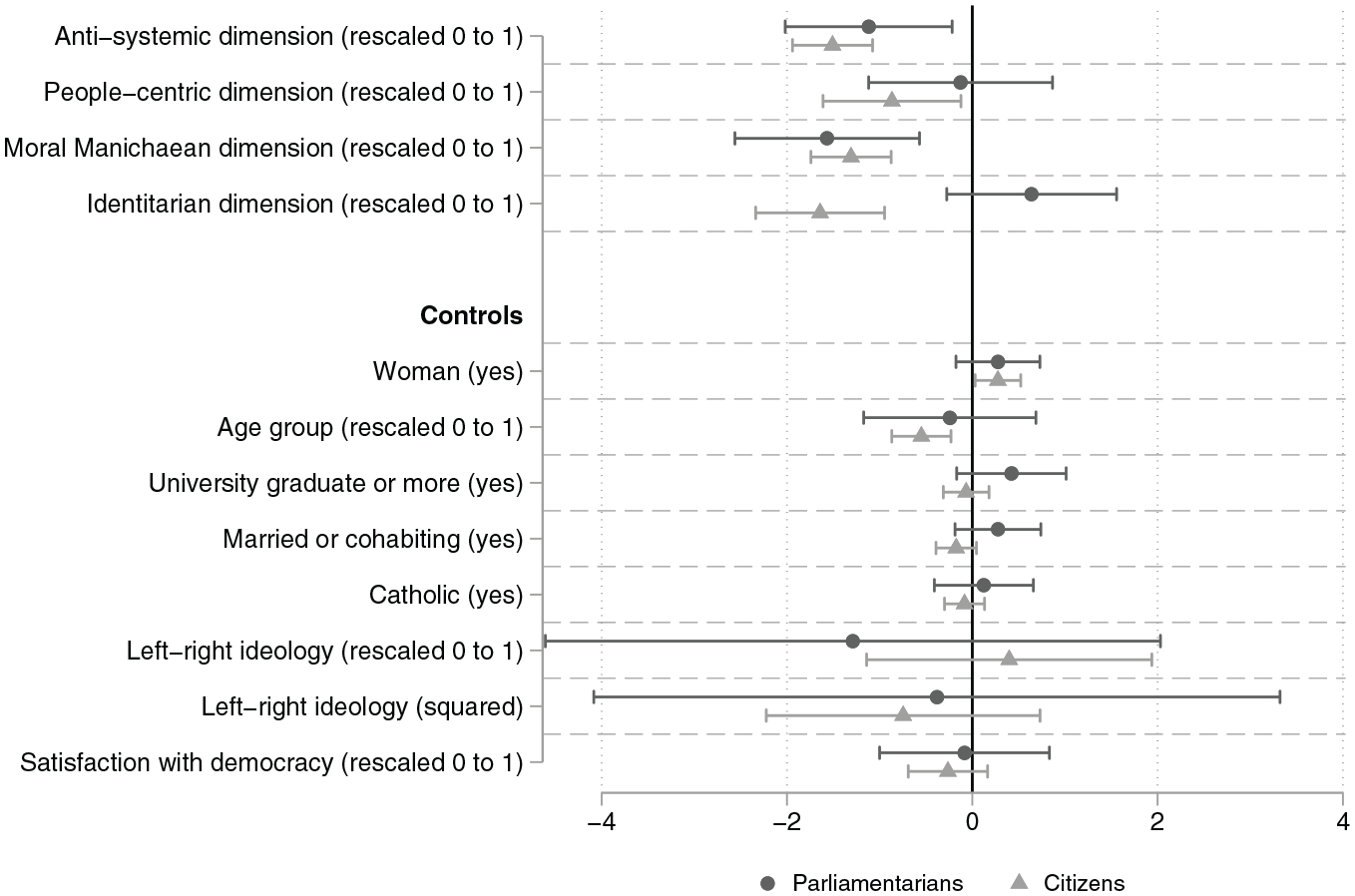
Average marginal effects on propensity to compromise in politics.
Average marginal effects have a powerful summarizing capacity at the cost of concealing potential nonlinear effects and differences in the effects on different outcome categories. Eventual nonlinear effects only affect left–right ideology, the only variable entered as a second-order polynomial both on theoretical grounds and considering the linearity tests displayed in Supplemental Table A5. Differential effects depending on outcome categories only affect citizens, since all the variables satisfy the PO assumption for parliamentarians, as shown in Supplemental Table A4.
To fill this gap, Figure 2 shows the odds ratios for the different outcome categories: from a low disposition to consensus to either medium or high dispositions (low to medium + high); and from either low or medium dispositions to high (low + medium to high). For the sake of parsimony, Figure 2 is restricted to citizens (those who may display distinct effects for different outcome categories) and to the four dimensions of populist attitudes (see Supplemental Table A6 in Supplemental Appendix for the detailed numerical results for both samples and all the variables).
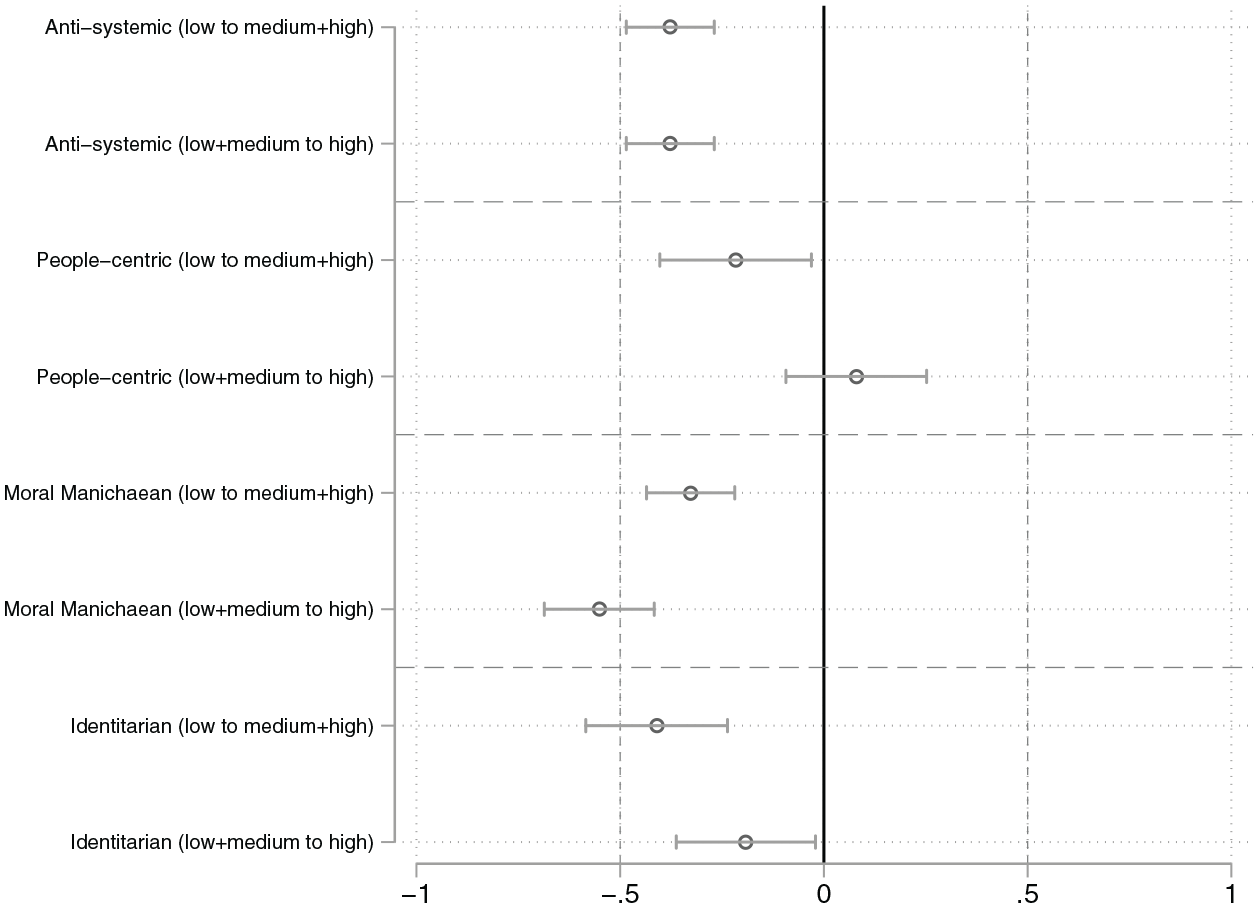
Effect of citizens’ populist attitudes on the odds ratios of their stance to compromise in politics.
Figure 2 provides further data on citizens. First, given that the anti-systemic dimension satisfies the PO assumption, no new insights are gained for this variable. However, although Figure 1 reveals that the people-centric dimension of populist attitudes reduces proclivity toward a consensual approach among citizens, Figure 2 shows that this is entirely because it makes it more likely to be anti-consensual (the confidence interval of the second outcome crosses the no-effects vertical line). Second, although both the moral and the identitarian dimensions of populist attitudes reduce the prospects of endorsing consensus in politics, the former does so especially because it makes it less likely for citizens to hold pro-consensual views (the negative effect is stronger), whereas the latter makes it more likely to hold those that are anti-consensual.
Supplemental Table A6 provides the corresponding information for the controls, clarifying that, among citizens, women are less likely to be anti-consensual (the effect from low consensual disposition to medium + high is positive and statistically significant) and that those who are college educated are more likely to be pro-consensual (the effect from low + medium to high is positive and statistically significant).
Arguably, these findings are easier to interpret in terms of probabilities of specific categories than in terms of odds of cumulative groups. The most intuitive way to make sense of the results of logistic regressions is to translate them into the metrics of probabilities. To that end, Figure 3 shows the predictive margins (that is to say, the predicted probabilities, holding all other variables constant) of the dispositions to consensus in politics depending on the changes in the four dimensions of populist attitudes analyzed in this research. Figure 3 has four rows, each of which show plots for a different dimension of populist attitudes. Each row has two plots: the left being for parliamentarians and the right, for citizens. Hence, Figure 3 has eight plots in total. In each plot, the predicted margins of a low disposition to consensus in politics (i.e., a non-consensual inclination) are shown with light gray circles, those of a medium (i.e., neutral) disposition to consensus are shown with medium gray triangles, and those of a high propensity to consensus (i.e., a pro-consensual inclination) are shown by dark gray squares.
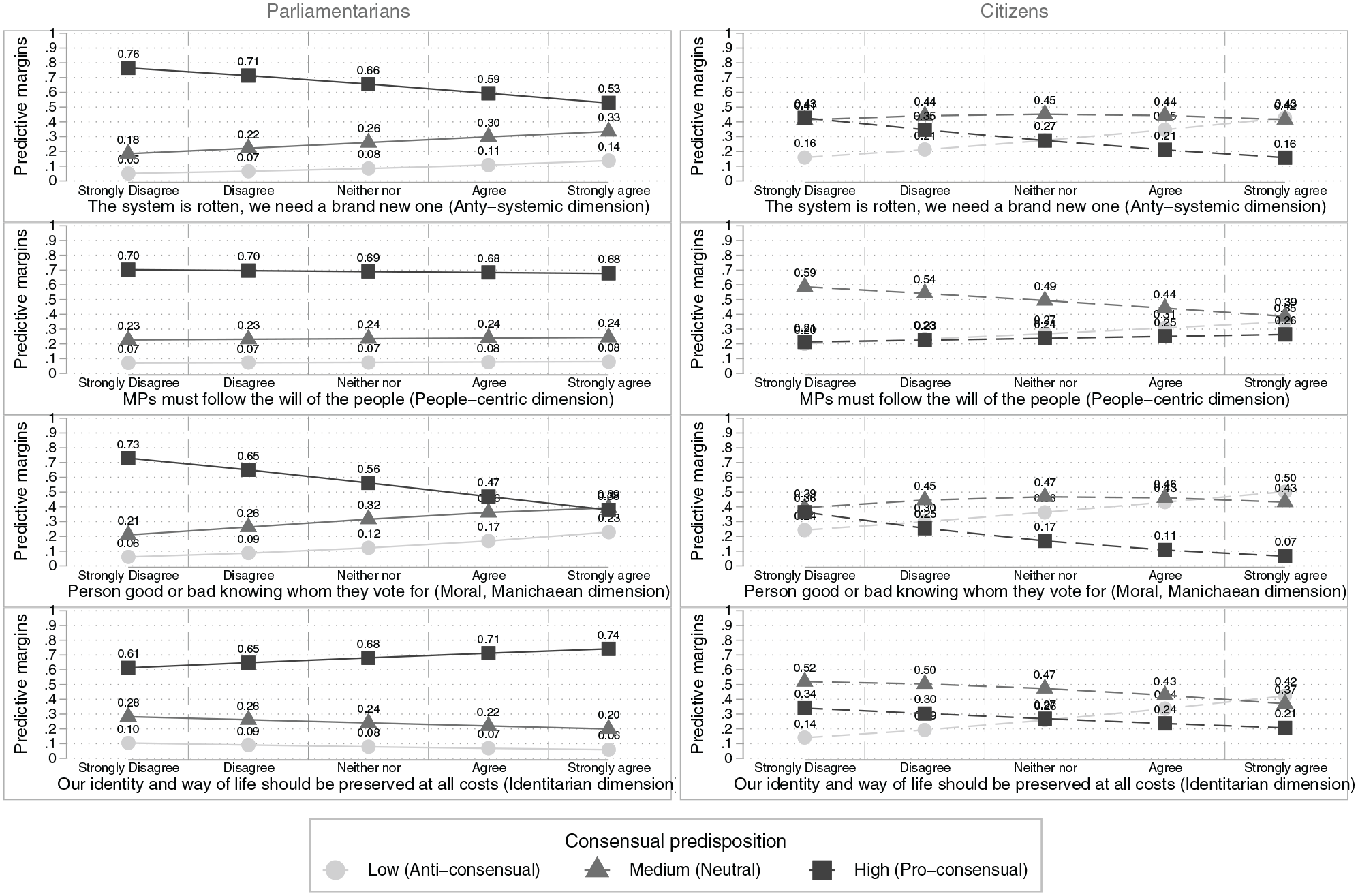
Effects of populist attitudes on consensual predisposition in politics.
The first or upper row of plots shows the results for the anti-systemic dimension of populist attitudes, which we had already learnt to have a negative and statistically significant effect on the proclivity toward consensus in politics for both parliamentarians and citizens. In the case of the parliamentarians, as anti-systemic populist attitudes become more intense, the predicted probability of a high (=pro-consensual) disposition to consensus falls (23 points, from 0.76 to 0.53), whereas both the probabilities of a middle (=neutral) and a low (=anti-consensual) approach rise (15 and 9 points, respectively). In citizens’ case, the predicted probability of a high (=pro-consensual) disposition also falls (27 points, from 0.43 to 0.16), but this translates now only into a rise of the low (=anti-consensual) one.
The second row of plots shows the results for people-centrism. In the case of the parliamentarians, this dimension was not statistically significant, and the left plot shows almost flat probabilities for the three outcomes. In the case of citizens, as people-centrism becomes more intense, the predicted probability of a middle (=neutral) predisposition to compromise falls, matched by similar increases in low (=anti-consensual) and high (=pro-consensual) predispositions.
The third row of plots shows the results for the moral dimension of populist attitudes. The pattern of relationships is like that seen in the first row of plots, both for parliamentarians and citizens. In the case of the former, as anti-systemic populist attitudes become more intense, the predicted probability of a high (=pro-consensual) disposition falls sharply and the two other categories increase in similar magnitudes. In the case of citizens, the predicted probability of a high (=pro-consensual) disposition also falls substantially, while that of a low (=anti-consensual) disposition rises.
The fourth or bottom row of plots shows the results for the identitarian dimension of populist attitudes. In the case of parliamentarians, for which this dimension was not statistically significant, as identitarian populist attitudes become more intense, we see a mild increase in the high disposition to consensus (=pro-consensual), mostly at the expense of a middle (=neutral) disposition. In the case of citizens, the plot reveals a substantial increase of the low (=anti-consensual) disposition at the expense of the two other categories.
Thus, Figure 3 helps us understand with greater detail the relationships between populist attitudes and the proclivity toward consensus in politics. We already knew from our former analyses that two dimensions of populist attitudes (the anti-systemic and moral) reduced this proclivity among both parliamentarians and citizens. Figure 3 reveals that this is so because these two dimensions reduce the predicted probability of a high (=pro-consensual) disposition to consensus. It also shows that, among parliamentarians, this reduction is matched by an increase in both middle (=neutral) and low (=anti-consensual) dispositions, but among citizens, it is matched only by an increase in low (=anti-consensual) dispositions. We also knew that the other two dimensions (people-centrism and identitarian) reduced the proclivity toward consensus in politics only among citizens. Figure 3 clarifies that this is mainly because of the increase in the low (=anti-consensual) disposition.
Discussion and Conclusion
This article has contributed to a better understanding of the relationship between populism and consensual preferences by providing empirical evidence that bridges the gap between these two extensive and established literatures. Using original data from surveys directed to Spanish MPs and citizens, we explored this exiguously studied but relevant issue of the potential connection at attitudinal level between populism and consensus-building.
As expected, populist attitudes appear to have a negative effect on propensity to endorse compromise solutions in politics. However, these effects are conditional on specific dimensions of populism. This negative relationship is significant for the four populist dimensions analyzed in the case of citizens—anti-systemic, majoritarian, moral Manichaean, and identitarian dimensions—and in two—anti-systemic and moral Manichaeism—in the case of policymakers.
The question arises as to why “the dog fails to bark” in the case of the people-centric and identitarian dimensions for MPs. 10 We argue in explanation that the idea that MPs should follow the people’s will is bound to be more appealing to citizens than to MPs. Thus, it makes sense that people-centric attitudes have a negative effect on proclivity toward consensual politics among citizens but fail to have a similar effect among MPs. The absence of effects of the identity dimension among MPs is more difficult to account for. This may have to do with the daily experience of MPs in parliaments to the extent that MPs are accustomed to engaging in recurrent negotiations as a means of gaining the support of parliamentarians of other political parties to foster their political projects. This experience may have taught them that preserving certain identities and ways of life “at all costs” is probably not practical and may have led them to downplay the effect of this dimension on the propensity toward consensus.
One of the limitations of this study is that some of the questions commonly used in populist attitudes scales could not be included in the elite survey, as they would make little sense when asked to politicians. Questions referring to whether political elites undermine the interests of “the people” would likely trigger a very different reaction among MPs that might even affect their perception of the rest of the questionnaire, which is why this anti-elite dimension is excluded in our comparison. Additionally, a more straightforward comparison might be feasible by holding constant the variation attributable to the survey administration and fieldwork, which would allow for additional comparisons between the two groups. Moreover, due to our survey’s characteristics, we have addressed the effect of ideological radicalism by including the square of ideology; an interesting avenue of future research might be to investigate this issue in more detail with additional measures of ideological radicalism. Our results should also be contrasted with future studies using other cases and comparative studies.
Further lines of research might focus on at least three issues. First is the need to capture all the different dimensions of populism using questions that can be asked to both MPs and citizens to better account for the distinct magnitude observed between these two groups. Second, to investigate the causes of the greater overall reluctance for consensual solutions among voters, which might be the result of a differential degree of polarization, and any latent contagion effect between elites and citizens that may reinforce this connection. Third, to analyze the potential consequences of increasing levels of conflictual preferences in other domains, such as parliamentary cooperation and the legislative process, among others.
Supplemental Material
sj-docx-1-abs-10.1177_00027642241285017 – Supplemental material for Disagreeing to Agree: Populism and Consensus Among Members of Parliaments and Their Voters
Supplemental material, sj-docx-1-abs-10.1177_00027642241285017 for Disagreeing to Agree: Populism and Consensus Among Members of Parliaments and Their Voters by Carles Pamies, José Javier Olivas Osuna and Andrés Santana in American Behavioral Scientist
Footnotes
Declaration of Conflicting Interests
The authors declared no potential conflicts of interest with respect to the research, authorship, and/or publication of this article.
Funding
The author(s) disclosed receipt of the following financial support for the research, authorship, and/or publication of this article: Financial support of the Spanish Ministry of Science and Innovation (PID2019-108667GB-I00 and PID2020-113182RA-I00 projects), the Junta de Andalucía (P18-RT-5234 project), and the Comunidad de Madrid (2022-5A/SOC-24238 project).

Supplemental Material
Supplemental material for this article is available online.
Notes
Author Biographies
References
Supplementary Material
Please find the following supplemental material available below.
For Open Access articles published under a Creative Commons License, all supplemental material carries the same license as the article it is associated with.
For non-Open Access articles published, all supplemental material carries a non-exclusive license, and permission requests for re-use of supplemental material or any part of supplemental material shall be sent directly to the copyright owner as specified in the copyright notice associated with the article.
