



Abstract
Ethnic minority populations, such as the Chinese and other racial minority communities, have traditionally been the targets of physical and social harassment. The onset of the Coronavirus (COVID-19) pandemic has reignited the racism, violence, and xenophobia faced by individuals of Chinese descent across North America. As a result, there is now a spotlight on the Chinese immigrant experience and the capacity for these individuals to authentically communicate and present their identities, specifically through the use of self-labels. In a mixed-methods investigation, we assessed the preferred self-labels among a sample of the Chinese population in Canada and sought to uncover the meanings imbued in the labels they use to describe themselves across different contexts. In addition, the relationships between label preferences and measures of ethnic identity and language were examined. Although bicultural labels (e.g., Chinese Canadian, Canadian Chinese, Hong Kong Canadian, etc.) were the most preferred, there was a variety of labels used, suggesting a more complex meaning in the choice of self-labels. Implications for identity and self-categorization are discussed.
Keywords
Introduction
One of the ways individuals define, communicate, and come to understand their identities across different contexts is through self-labeling (Phinney, 1992). For example, a Chinese immigrant might refer to themselves as Asian-American when introducing themselves in a university classroom, but as a Hongkonger when conversing with their friends in the Asian Students’ Association. Self-labeling allows individuals to explicitly claim a social category and assert their social group membership, and can therefore represent a conscious choice about how to present oneself among different groups and across different contexts (Phinney, 1992; Speight et al., 1996). Understanding the malleability of self-labels among members of ethnic minority groups is particularly important because these individuals continuously navigate contexts and situations in which their ethnicity exposes them to bias, prejudice, and discrimination. In this article, we focus on the Chinese community, a prevalent and robust population in Canada and the United States, to investigate the use of ethnic self-labels and their impact on social and ethnic identification. Specifically, we center our attention on a subgroup of the Chinese community living in Canada, Cantonese speakers, and investigate their unique self-labeling preferences, language attitudes, and identity, derived from their shared spoken language and socialization experience, and explain the implication of these findings for policy and practice.
First, we present quantitative data to illustrate the variety of self-labeling practices among Chinese community members in Canada. Then, we follow with qualitative data that demonstrate the richness of the phenomenon and explore the motives and rationale behind chosen self-labels. The “Asian American” term (or the similar AAPI, which stands for Asian American Pacific Islander) is a well-established ethnic label in the United States due to its official recognition and widespread use (though some complications remain; Budiman & Ruiz, 2021; Kambhampaty, 2020). In contrast, there is no clear equivalent use or support for “Asian Canadian” in Canada (Khan, 2021; Takeuchi, 2014); additionally, the use of “Asian” itself may not precisely capture or express the identity that minorities may want to convey, given the different national ideologies endorsed by Canada (i.e., multiculturalism) versus the United States (i.e., assimilation). There are multiple motivations to deepen our understanding of the act of self-labeling among ethnic minorities: (i) to recognize the willingness (or lack thereof) for minorities to self-declare their ethnicity via their self-labels; (ii) to acknowledge the within-group variability of self-labels and their adequacy in representation; and (iii) to strengthen the awareness and use of self-labels among institutions and organizations, which serve minority immigrant communities.
Social Identity and Self-Labeling
Social identity is an important part of “an individual’s self-concept which derives from their knowledge of their membership in a social group (or groups) together with the value and emotional significance attached to that membership” (Tajfel, 1981, p. 255). One component of social identity is ethnic identity, the degree to which an individual identifies with an ethnocultural group (Phinney, 1992). Importantly, “the study of ethnic identity involves an emphasis on how group members themselves understand and interpret their own ethnicity” (Phinney, 1996, p. 143). As such, categorizing oneself as a member of a particular group, such as through the use of self-labels, is a basic element of group identity (Ashmore et al., 2004). Group identification involves both this self-categorization (e.g., as demonstrated via an ethnic self-label like “Chinese Canadian”) and the value individuals place on that group membership (e.g., “being Chinese Canadian is an important part of who I am”). Using a particular ethnic self-label involves a declaration of one’s ethnic group membership, which underscores particular understanding of and willingness to identify one’s ethnicity (Kiang, 2008).
Language is closely related to identity, and this relationship is especially strong for minority ethnic group members (Gudykunst & Ting-Toomey, 1990; Miller & Hoogstra, 1992). One way that ethnic minorities express their group’s distinctiveness is through the use of their heritage language, which facilitates and increases group identification and solidarity (Giles et al., 1977; Giles & Johnson, 1981). Language strongly contributes to an individual’s ethnic identity and acculturation experience (Kuo & Roysircar, 2004). Furthermore, ethnic group identification is especially important for visible and ethnic minority populations (e.g., Chinese, Korean, and other Asian communities) which have long been targets of harassment, discrimination, and violence. Indeed, visible minorities report approximately four times as many discriminatory experiences as non-visible minority populations 1 (Reitz & Banerjee, 2007), and often turn to their ethnic groups for support, meaning, and a sense of belonging as a means of coping with this discrimination (Branscombe et al., 1999; Kaiser & Pratt-Hyatt, 2009; Phinney, 1989; Tajfel, 1978). For example, strong ethnic group identification has been shown to mitigate the negative effects of discrimination among various groups including Asian, Latino/Latina, and Arab American adolescents, multiracial people, and African Americans (Armenta & Hunt, 2009; Branscombe et al., 1999; Giamo et al., 2012; Stein et al., 2014; Tabbah et al., 2016).
Self-identification with one’s ethnocultural group is developed through language, shared values, attitudes, and participation in cultural activities. Through the process of self-labeling, individuals can explicitly identify the groups they affiliate with and communicate their identities to themselves and others. Since ethnic identity is dynamic and fluid across time and space, individuals have the freedom to use different labels on different occasions and in different contexts (Davenport, 2020; Liebler et al., 2016, 2017; Portes & Rumbaut, 2001). For example, someone belonging to the Chinese community has the option to use “Chinese,” “Chinese American,” or “Asian” depending on the situation. We believe it is important to differentiate ethnic identity versus ethnic self-labels (cf. Rumbaut, 2005) because people might want to conceal versus reveal their ethnic identity differently across different contexts, using labels to present alternate versions which may not be their authentic selves (Goffman, 1959). For example, a young woman who self-identifies as Chinese may want to express her Chinese ethnic identity and label herself as “Chinese” when she is buying groceries at an Asian supermarket. On the other hand, she may describe herself as “Canadian” when she meets someone new at a party. As a further example, many Chinese individuals report themselves as “Canadian” when travelling outside of Canada, only using the “Chinese” label when pressed for another answer (Yim & Clément, 2019). Therefore, self-labeling is influenced by and responsive to the context, to some degree, but likely also limited to the labels that are deemed as “acceptable” or “correct” according to perceivers.
In his work on identity formation among immigrant young adults, Rumbaut (1994, 2005) differentiates between four categories of ethnic self-identity labels: (i) national-origin, (ii) hyphenated, (iii) American, and (iv) pan-ethnic. First, national-origin labels refer to the individual’s heritage culture as defined by nationality (e.g., Chinese, Mexican, Polish). Second, hyphenated refers to labels that incorporate a dual term that includes a “mainstream” 2 identity (e.g., American) and an ethnic identity such as the national origin or a pan-ethnic identity (e.g., African-American, Chinese-Canadian, Asian-Canadian). Although named as such, these labels may or may not be hyphenated, and can include various combinations of two identities (e.g., Yim & Clément, 2019). Third, there is American, which refers to an “unhyphenated” mainstream identity or the location where the immigrant is now living (e.g., American, Canadian, Italian, etc.). Finally, pan-ethnic refers to broad labels which represents an individual’s racial or ethnic identification; for example, “Latino” represents an individual of Latin American descent but there is no specification on the exact country of origin. As individuals may adopt different labels according to the situation, national-origin and pan-ethnic identities may often overlap (Kasinitz et al., 2008).
The act of self-labeling offers a glimpse into the importance that ethnic minorities and immigrants place on their cultural heritage and the degree to which they perceive themselves to be part of a given ethnocultural group (Anglin & Whaley, 2006; Ghee, 1990; Malott, 2009; Parham & Helms, 1981). Furthermore, self-labeling provides a window into ethnic minorities’ desire to belong to the dominant group or mainstream culture and may even reveal negative ingroup attitudes that may develop due to self-stigmatization and internalization of outgroup prejudice (Phinney, 1989).
Ethnic Self-Labels: A Universal Phenomenon for Minorities
Ethnic minorities in North America unfortunately share the experience of being considered an “other” compared to the dominant white population. In addition to potential bias and discrimination, ethnic minority individuals are often subjected to racial assignment, where they are “classified” and labeled by the majority group (Cokley, 2007; Cornell & Hartmann, 1998). This form of “othering,” versus the recognition and acceptance of ethnic groups by the majority, influences individual members’ ingroup identification and self-categorization, as evident in the Middle Eastern and North African (MENA), Black/African American, and Asian populations (Awad et al., 2021; Kiang et al., 2011).
Racism against the MENA population living in the United States has garnered much attention in the past decade, mainly after the terrorist attacks of September 11, 2001. In the United States, individuals of MENA descent are officially categorized as “white” (Appiah, 2020; Laws, 2020); however, this designation is not consistent with how the community perceives itself or is treated by compared with the dominant white population. There is a disconnect between ethnic categorization and label preference for the MENA population, as the U.S. Census does not include an Arab or MENA category. MENA and non-MENA individuals both differentiate the ethnocultural group as different from the white population; MENA individuals do not self-identify as “white” when they are free to select appropriate labels (e.g., Arab American, Palestinian, Egyptian), and only do so when such labels are not available (Maghbouleh et al., 2022). When appropriate self-labels are not available, ethnic group members may submit to racial assignment by the dominant group in order to be officially “counted” and recognized, even if the group opposes the labeling (Song, 2001). In comparison, Canada’s measurement and categorization of minority and ethnic populations include both pan-ethnic categories (e.g., South Asian, Latin American, Southeast Asian) and national origins (e.g., Chinese, Filipino, Japanese; Statistics Canada, 2016), which implicitly places value for one group over another, indirectly reinforcing the notion to minority group members that they are “minimized.” In stark contrast to the MENA ethnic group in the United States though, the Asian population in Canada are recognized with several ethnic groups listed and highlighted separately in questionnaires and reports (i.e., Chinese, Filipino, Korean, Japanese).
Considering the variety of self-labels that can be used by an ethnic group, there are certain qualitative differences among them with different implications for the individual’s own identification and how they are viewed by their ethnocultural group. For example, the 46.9 million individuals of African descent living in the United States (the second largest racial group after the white population) are commonly labeled as Black or African American by the U.S. Census (Jones et al., 2021). This labeling has been confirmed to be accurate, to a certain extent, as Black is the traditionally preferred label by these individuals with a possible shift toward more use of African American since it more accurately represents the group’s cultural heritage (Boatswain & Lalonde, 2000; Speight et al., 1996). However, differences in self-labeling distinguish subgroups among this population according to socialization experiences and racial identity development (Anglin & Whaley, 2006). For example, individuals preferring the “African American” label are more likely to endorse negative stereotypes about people of African descent, compared to those who prefer other labels (e.g., West Indian, African), suggesting that self-label differences are linked to the individual’s broader socialization experiences (Anglin & Whaley, 2006). Moreover, individuals of African descent often only have the option of a “Black” identity, which often overshadows other ethnic identities of immigrants from elsewhere (e.g., Caribbean; Davis, 1991; Kibria, 2000). Importantly, although this population in the United States prefers pan-ethnic labels such as Black or African American, this may not be the same for other groups, such as the Asian American group, or for other settings, such as Canada (Zhou, 2021).
In comparison to the United States, the Black community in Canada is much smaller, their origin of immigration more diverse, and have had different histories and experiences. For this population, Black is the most preferred label, compared to a wide variability in preferences for other labels such as African Canadian, Jamaican, African, and Black Canadian. Notably, African Canadian, a term seen as equivalent to African American, does not have the same traction in Canada as it does in the United States. Researchers suggest that the variations in labeling (i.e., 35 different preferred labels), which were more than studies which took place in the United States, can be attributed to the Canadian context, where the majority of Black participants were first- and second-generation immigrants who are ostensibly encouraged to preserve their heritage cultures, as a result of national ideologies and policies in favor of multiculturalism (Boatswain & Lalonde, 2000). Moreover, those who preferred using “Black” scored higher in African self-consciousness, which indicates greater awareness of an African heritage and greater recognition of culture-specific issues, compared to those identifying with the mainstream culture and preferring the use of “Canadian” (Boatswain & Lalonde, 2000).
The themes found in the self-labeling research on the African American population, both in the United States and in Canada, can be compared and extended to the Asian population. The self-labels preferred by an individual are not only connected to their group identification, but also their socialization experiences (Anglin & Whaley, 2006). It is reasonable, then, that subgroups that share similar experiences need to be examined in greater detail. Furthermore, the multicultural ideologies adopted in Canada may also allow for first- and second-generation Asian immigrants to value their cultural heritage, and label themselves using national-origin labels, rather than adopt a broad Asian Canadian label, the Canadian equivalent of Asian American.
Asian Americans
After the African American population, the next largest racial population group in the United States is the Asian population, at 24 million (Jones et al., 2021). The term “Asian American” has its roots on college campuses in the 1960s (Espiritu, 1992; Kitano & Daniels, 2000; Lien, 2001; Wei, 1993). In light of other social movements at the time, it was seen as a vehicle through which different East Asian individuals and groups (mainly Chinese and Japanese) could unite via a pan-ethnic Asian identity, “driven by the shared racial interests of persons of Asian origin in the U.S. as well as a larger struggle against racism” (Kibria, 1999, p. 33). Since then, the definition of the term “Asian American” has diversified to include other ethnic groups such as Filipino, Indian, Korean, and Vietnamese, to name a few (Barnes & Bennett, 2002). Although the “Asian American” term has been used for more than 50 years, there is no sign of a pan-Asian ethnicity in the United States, and ingroup membership in a pan-Asian community has thus been limited. For example, first-generation immigrants prefer national-origin identities (e.g., Chinese, Korean, Filipino), whereas second-generation youth overwhelmingly prefer to use an “American” label, on its own or along with a national-origin or pan-ethnic component (Kibria, 2000). Overall, if given a choice, Asian Americans do not identify as “Asian American”; they often choose to identify using a national-origin label (e.g., Korean) or using a hyphenated label (e.g., Korean American), a preference observed among Filipinos (Besnard, 2003), Indians (Farver et al., 2002), Chinese, and Koreans (Hong & Min, 1999).
Furthermore, South Asians, and Southeast Asians have generally identified less with the Asian American label (Espiritu, 1992; Kodama & Abreo, 2009; Shankar & Srikanth, 1998). Some groups have been documented to prefer specific ethnic group labels, such as Filipinos (Besnard, 2003) and Indians (Farver et al., 2002) and to resist using the Asian American label because it does not reflect the demographic shifts of its population since the term’s inception (Budiman & Ruiz, 2021). For example, the colonial history of the Philippines and Filipinos’ racialization experiences have distinguished them from other East Asian regions (Ocampo, 2016). Moreover, it is often the case that the Asian American term is linked exclusively to Chinese and Japanese Americans; they are exemplars of “Asian Americans” due to their long immigrant history and their leadership in pan-Asian organizations (Espiritu & Ong, 1994). There seems to be an informal understanding among pan-Asian groups about who would like to (or should) use the Asian American label; at its core are East Asians (i.e., Chinese, Japanese, Korean) and expanding outward, includes Southeast Asians (e.g., Vietnamese, Filipino) and South Asians (e.g., Indian, Pakistani; Park, 2008). For instance, both South and Southeast Asians struggle with using “Asian American” to refer to themselves, and outgroup perceivers also hesitate to apply the label to South Asians (Park, 2008; Ramakrishnan et al., 2020). Although the term “Asian American” clearly lacks precision, it may nevertheless be appealing due to its flexibility. Because individuals can attach multiple meanings to the label, it can therefore be representative of a variety of identities (Park, 2008).
There has been a long history of anti-Asian xenophobia and discriminatory policies both in Canada (e.g., Chinese Exclusion Act, Chinese head tax) and the United States (e.g., 1882 Chinese Exclusion Act, which formalized the exclusion of the entire Chinese ethnic group). More recently, the onset of the Coronavirus (COVID-19) pandemic has re-amplified the racism and anti-Asian sentiments directed toward Chinese and other Asian immigrant groups across North America (Esses & Hamilton, 2021; Lo et al., 2022; Lou et al., 2021). For instance, many members of these groups continue to fear for their safety and have been forced to change their daily routines to avoid possible threats (Noe-Bustamante et al., 2022). Additionally, Chinese and other Asian groups (and often other visible ethnic minority groups) are still not perceived as “real” Americans, despite the long-standing history and presence of these communities in North America.
In contrast to the African American group, Asian individuals in the United States have more latitude in their “ethnic label options” and ethnic identity expression, given their distinct national backgrounds, social mobility, and moderate position in the racial hierarchy present in the United States (Kibria, 2000; Mishra, 2018; Song, 2001). This is not to say that Asian individuals can easily identify with any identity; they cannot declare themselves as “Americans” because they are expected to have an “ethnic bind”—expectations that they have a general knowledge of Asian concepts and that they maintain cultural traditions and practices (e.g., holiday celebrations, heritage language proficiency; Song, 2001). However, despite greater integration with the white population (e.g., intermarriage; Lien et al., 2003; Mishra, 2018), individuals from various ethnic groups, including Asians, are typically seen as “perpetual foreigners” and are often challenged when using an “American” label (Armenta et al., 2013; Goto, 2002; Tuan, 1998). In recognition of the diversity of the Asian population and the labeling options available for them, we now focus on the Chinese community, a specific segment of the population that is one of the biggest immigrant groups in North America.
Chinese Identities: Asian American, Chinese American, or Something Else?
Chinese immigrants have been present in North America since the 19th century. They were the “first non-white foreigners who arrived en masse of their own free will, unlike shackled African Americans, who were brought as slaves, or Native Americans, who were decimated in their own land” (National Asian American Telecommunications Association, 2001). The Asian American identity which arose in the 1960s included Chinese individuals who were born in the United States, descendants of early Chinese immigrants, and other Asian individuals who were brought up in the American context without robust socialization differences (Espiritu, 1992). However, waves of immigration in the mid-20th century have changed the demographics of the Asian, and specifically, Chinese, population. In the United States, the majority of Asian Americans are born elsewhere (U.S. Census Bureau, 2022a), and in Canada, almost half of the immigrant population (48.1%) was born in Asia (Statistics Canada, 2016). Many immigrant children who were born abroad but raised in North America can be referred to as 1.5-generation or one-and-a-half generation. The term generally refers to children who are foreign-born and immigrated at an early age, typically prior to adolescence (Lu, 2016; Pew Research Center, 2004; Rumbaut, 1994; Zhou, 1997). One-and-a-half generation is a distinct class of immigrants who “[migrated] as part of a family unit, but who have experienced at least some of their formative socialization in the country of origin” (Bartley & Spoonley, 2008, p. 68). Importantly, we distinguish between first-generation, 1.5-generation, and second-generation immigrants in the present article, with first generation being individuals who were born elsewhere and immigrated to a new country, 1.5-generation limited to those who were born elsewhere but immigrated as children, and second-generation being individuals who are born in the immigrated country (i.e., the first generation to not be born in the country of origin). Both 1.5-generation and second-generation immigrants have internalized two cultures through long-term and intense exposure, so it is very likely for them to develop integrated identities and become bicultural (Hong et al., 2000; LaFromboise et al., 1993; Phinney & Devich-Navarro, 1997). Chinese individuals living in North America are constantly balancing two identities. Despite their long-standing history and presence in the United States and reporting that they feel “American,” they often report that their claims of American identity are rejected (Cheryan & Monin, 2005). For Chinese young adults with ancestry from China, Hong Kong, or Taiwan, there is no clear preferred self-label, with a mélange of national-origin, hyphenated, and pan-ethnic labels being used (Kiang, 2008). It is noteworthy though that only one participant in a study of 242 Chinese young adults selected “American” as their preferred ethnic label, especially as approximately 64% of the sample were second-generation immigrants who were born in the United States, supporting the fact that individuals may be limited in their choice of labels by others’ perception of them (i.e., as “foreigners”; Kiang, 2008).
Extending this line of research, Yip (2009) investigated the role of multiple identities among Chinese young adults in the United States, as both American and Chinese identities can be salient simultaneously, despite being viewed as independent. Chinese young adults who had a strong American identity were more likely to report experiencing both their Chinese and American identities as salient across different situations (e.g., with family, classmates, etc.), suggesting that they are constantly balancing their identities. It is possible that although the Chinese participants report feeling as American as their white peers, there is also a belief that the label “American” is reserved for white individuals, inherently excluding those who are visible ethnic minorities (Devos & Banaji, 2005; Kiang, 2008; Tuan, 1998). Thus, it is possible that hyphenated labels are chosen, instead of the national-origin “American,” because Chinese individuals living in North America cannot fully “claim” their American identity (Cheryan & Monin, 2005; Lalonde et al., 1992). 3
All things considered, Chinese individuals living in North America have the flexibility to use a variety of self-labels to indicate their cultural identification, though there seems to be a preference for national-origin labels and hyphenated labels (e.g., pan-ethnic American: Asian American; national-origin American: Chinese-American, Taiwanese-American). However, the racialization of visible ethnic minorities presupposes an Asian culture upon individuals, deterring their use of an American-only identity and limiting their self-labeling options (Cheryan & Monin, 2005). Moreover, previous research has investigated the self-labeling practices among different ethnic groups who share a pan-ethnic label, such as African Americans (Anglin & Whaley, 2006; Boatswain & Lalonde, 2000) and Asian Americans (Kiang & Johnson, 2013; Kiang & Witkow, 2018), and found self-labels to be associated with social identity and stereotypes related to those identities. However, there is meaningful within-group variability within specific ethnic groups, especially in their willingness and desire to self-declare their ethnic identity. Furthermore, this topic has been underexplored in the Canadian context as most of the research has been based in the United States. Visible minority populations are made up of a number of groups that are themselves diverse, in terms of birthplace, language, and socialization experiences (Anglin & Whaley, 2006; Statistics Canada, 2017). For example, Chinese communities across North America are comprised of individuals who immigrated from a variety of settings (e.g., Mainland China, Hong Kong, Taiwan), each with their respective sociopolitical histories that create an array of sociocultural differences, including the extent to which they shared a common spoken language, such as Cantonese, Mandarin, and other regional dialects. The exploration of how language practices and heritage language proficiency can inform self-labeling and self-identification is long overdue.
Self-labeling has implications for minorities’ racialized identities and intergroup experiences (e.g., discrimination, marginalization); thus, a clear and accurate understanding of their motivations allow for improved implementation of programs and services to distinct communities with different needs and can inform policy decisions in government and educational institutions. For example, anti-Asian racism is currently not addressed in Canada’s Anti-Racism Strategy (2019–2022), though a definition of this phenomenon is included (Canadian Heritage, 2019). A closer examination of the self-labeling used by the Canadian Asian population, starting with the Chinese community, will advise educators and policy makers about the nuances of how minorities wish to declare themselves and, in turn, wish to be addressed. The simple recognition and use of one’s preferred ethnic label by institutions and organizations can emphasize inclusion and engender feelings of belonging and both identity and physical safety (see also the case of gender pronouns as identity-safe cues; Atter, 2021; Chen, 2021; Fryday, 2022; Johnson et al., 2021; Murphy & Taylor, 2012). Finally, the demographic changes in North America requires a re-evaluation of the definitions and inclusivity of the terms used to describe minority populations. The demographic of the Asian American population has changed since the term was first coined; East Asians were the majority of the Asian American immigrants in the past, but this is no longer the case as immigrants from countries such as the Philippines and India have increased (Budiman & Ruiz, 2021). Indeed, our focus on the Asian American experience is driven by the contemporary diversity of the Asian diaspora. For example, it is noteworthy that members of some groups often do not classify themselves and/or are not classified as Asian, despite being included in pan-Asian community definitions (Kodama & Abreo, 2009; Shankar & Srikanth, 1998). “Asian” is defined as referring to individuals descended from people of the East Asia, Southeast Asia, and the Indian subcontinent according to the U.S. Standards for Race and Ethnicity (Office of Management and Budget, 1997) and although the “Asian American” term has remained in use since its inception, shifts in the composition of who qualifies as Asian American highlights the malleability of labeling and ethnicity as a social category. The demographic make-up of Asian immigrants to North America has shifted greatly; from the majority of the Asian population previously originating from East Asia to, in recent decades, the Filipino and Indian groups growing in numbers (Budiman & Ruiz, 2021; Kodama & Abreo, 2009; Statistics Canada, 2016). These natural immigration changes in the composition of the Asian American population underscore another reason for the importance of self-labeling practices and the accurate representation of the label for the individual. Finally, the study of self-labeling contributes to a more nuanced understanding of the stereotypes, biases, and challenges encountered by minorities, which threaten their sense of belonging (e.g., perpetual foreigner), as well as the fine tailoring of programs and initiatives to improve the adjustment and integration for these immigrant groups. Therefore, ethnic self-labeling and individual/collective identification among members of these minority groups remain incredibly important for behavioral scientists and policy makers to understand.
As such, we conducted the present mixed-methods investigation to explore the act of self-labeling and its relevance to ethnic identification and identity negotiation. First, we asked participants to complete a series of questionnaires, finding associations between self-label choice, identification, and attitudes toward language switching. Next, we dug deeper into these results and collected qualitative data to flesh out our quantitative findings. Overall, these studies demonstrate the within-group variability of self-labeling among members of the Chinese ethnic group in Canada and suggest that the recognition and use of ethnic minorities’ preferred self-labels help promote inclusion and identity-safe spaces in society. The relationships between language, ideology, and group identity are complex, and language could be associated with the use of specific ethnic labels (Anglin & Whaley, 2006). Therefore, one of the objectives of the present study is to focus on the self-labeling preferences among Cantonese-speaking Chinese individuals living in Canada and the extent to which a shared spoken language, specifically Cantonese, is associated with self-labeling practices. First, we hypothesize that Cantonese-speaking Chinese individuals living in Canada will prefer a hyphenated self-label, which indicate their affiliation with both their Chinese ethnicity and the mainstream Canadian culture. There will likely only be minimal preference for pan-ethnic terms, such as Asian or Asian Canadian, as these terms do not communicate ethnicity and Canadians are largely encouraged to preserve and promote their ethnicity. Moreover, we hypothesize that individuals who prefer to use hyphenated self-labels will be more likely to identify with both cultures in values, attitudes, and behaviors. Conversely, they may have less opportunities to use and maintain their heritage language and report lower proficiency in Cantonese. We weave together both quantitative and qualitative results to explore the nuances of the various self-labels preferred by Chinese individuals living in Canada. Using this mixed-methods approach allows us to better understand the situations and contexts that drive preferences for a given self-label.
Method
The Research Setting
The present study was conducted in the Canadian context, specifically focusing on the Chinese community living in the cities of Toronto and Ottawa. The data from the present study is part of a larger research dataset from Yim (2020) and Yim and Clément (2019) which examined Cantonese–English bilinguals’ language attitudes and cultural identification. Canada’s national ideologies promote multiculturalism and over three percent of the nation’s entire population indicated a Chinese language as their mother tongue (i.e., Cantonese, Mandarin, and other Chinese dialects, as defined by Statistics Canada). The Chinese community is the second-largest ethnic group in Canada (recently surpassed by the South Asian community), and Cantonese is one of the top heritage languages spoken in many Chinese communities across the country. On a national level, Cantonese is the second most prevalent immigrant mother tongue with over 594,000 speakers and is one of the top immigrant mother tongues across Canadian cities (Toronto, Vancouver, Calgary, Edmonton, and Ottawa; Statistics Canada, 2016). Although individuals within the Chinese community come from different regions, Cantonese is the main spoken language. Many first- and second-generation Cantonese speakers living in Canada originate from Hong Kong and the nearby southeastern region of China.
Within this context, it is important, to elaborate on Hong Kong as a site of linguistic and cultural contact. Its colonial history introduced Western influences into society, constructing a bilingual and bicultural environment where English is prevalent throughout society from spoken discourse to written text. English is socially valued in Hong Kong and approximately 43% of residents are communicatively competent in English (2001 Hong Kong Census as cited in Chen, 2005). This results in the phenomenon of language switching being common social practice in Hong Kong, easily observed in different modes. However, although its residents are bilingual, individuals originating from Hong Kong are ethnically Chinese. In 1997, there was a change in political status in Hong Kong (from British to Chinese) and Hong Kong became a Special Administration Region of China, with many citizens emigrating to English-speaking countries in the years before. At the time, the population was wary of the political transformation and, in fact, Hong Kong was the largest contributor to the immigrant population in Toronto from the period of 1991 to 1995; that is, at that time, 9.1% of new immigrants to Toronto were born in Hong Kong (Statistics Canada, 2006). It can be inferred that the immigration rate from Hong Kong peaked during those years as a consequence of its political turnover, as it is in contrast to the steady immigration rate of 4.3% to 4.5% during the years before and after (Statistics Canada, 2016).
Quantitative Data
Participants
One hundred and fifty-eight participants (61 male, 97 female) completed the online study. The age of participants ranged from 17 to 49 years old, with the mean age being 21.88 years old (SD = 6.00). Most participants were born in Canada versus being born elsewhere (n = 106 and 52, respectively). Among those born elsewhere, the majority were born in Hong Kong (n = 32) and China (n = 17), and their mean length of residence in Canada was M = 10.63 years (SD = 9.23). The participants in the sample were from immigrant families as the majority of both their mothers (n = 154, 97.5%) and fathers (n = 154, 97.5%) were also not born in Canada. Therefore, the sample can be considered to consist of 1.5-generation and second-generation immigrants. Most participants considered themselves part of or belonging to the Chinese community (n = 120, 76%). On a 7-point Likert scale, participants exhibited relatively high identification to both Canadian culture, M = 5.84 (SD = 0.84), and Chinese culture, M = 5.69 (SD = 0.96), as assessed using the Vancouver Index of Acculturation scale (VIA; described below), suggesting that participants engaged in mainstream Canadian behaviors as well as maintained ethnic cultural practices. On average, participants saw their dual identities as partially overlapping (M = 4.20, SD = 1.48).
Participants were bilinguals who were highly orally proficient in both Cantonese (M = 78.96, SD = 19.60) and English (M = 92.46, SD = 11.78), with stronger literacy skills in English (M = 93.30, SD = 10.59) but weak in Chinese reading and writing (M = 49.91, SD = 36.26). On a 5-point Likert scale, they considered themselves to be practical bilinguals who were fluent in their second language but may not use it everyday (M = 4.03, SD = 0.86). Cantonese was the primary language used at home with family members, whereas English was dominant in their other life domains. When asked which language they would choose to communicate in, the majority selected English (n = 120).
Participants were recruited in one of two ways. First, the study was posted on the Integrated System for Research Participation at the University of Ottawa. Undergraduate students taking an introductory course were awarded one credit in exchange for participation. Second, snowball sampling was used, and recruitment emails were sent to participants to share with their social networks. The inclusion criteria for the study were that participants must be able to speak and understand both Cantonese and English. We were motivated to recruit young adult and university samples because identity is mostly complete by this stage, and individuals are able to take ownership of their agency and independence in a university setting. Moreover, it is through their university and college experiences that many Asian Americans establish their identities, often while confronting stereotypes and racism (Kodama et al., 2001).
Measures
Sociodemographic variables were assessed using a demographic and language questionnaire, which included questions on socioeconomic status and language learning history. Participants were also presented with a question to self-identify themselves; they were given a list of responses to select from or allowed to input an ethnic self-label to describe themselves.
Identification
Self-labeling. Participants were asked to select their preferred ethnic label when given a set of randomized options (see Figure 1), which includes labels that have previously been endorsed by the same community (Yim & Clément, 2019). They were also given the opportunity to use their own label if it was not included in the list. To introduce the question, participants read an introduction defining ethnicity and its different forms (adapted from Phinney, 1992).
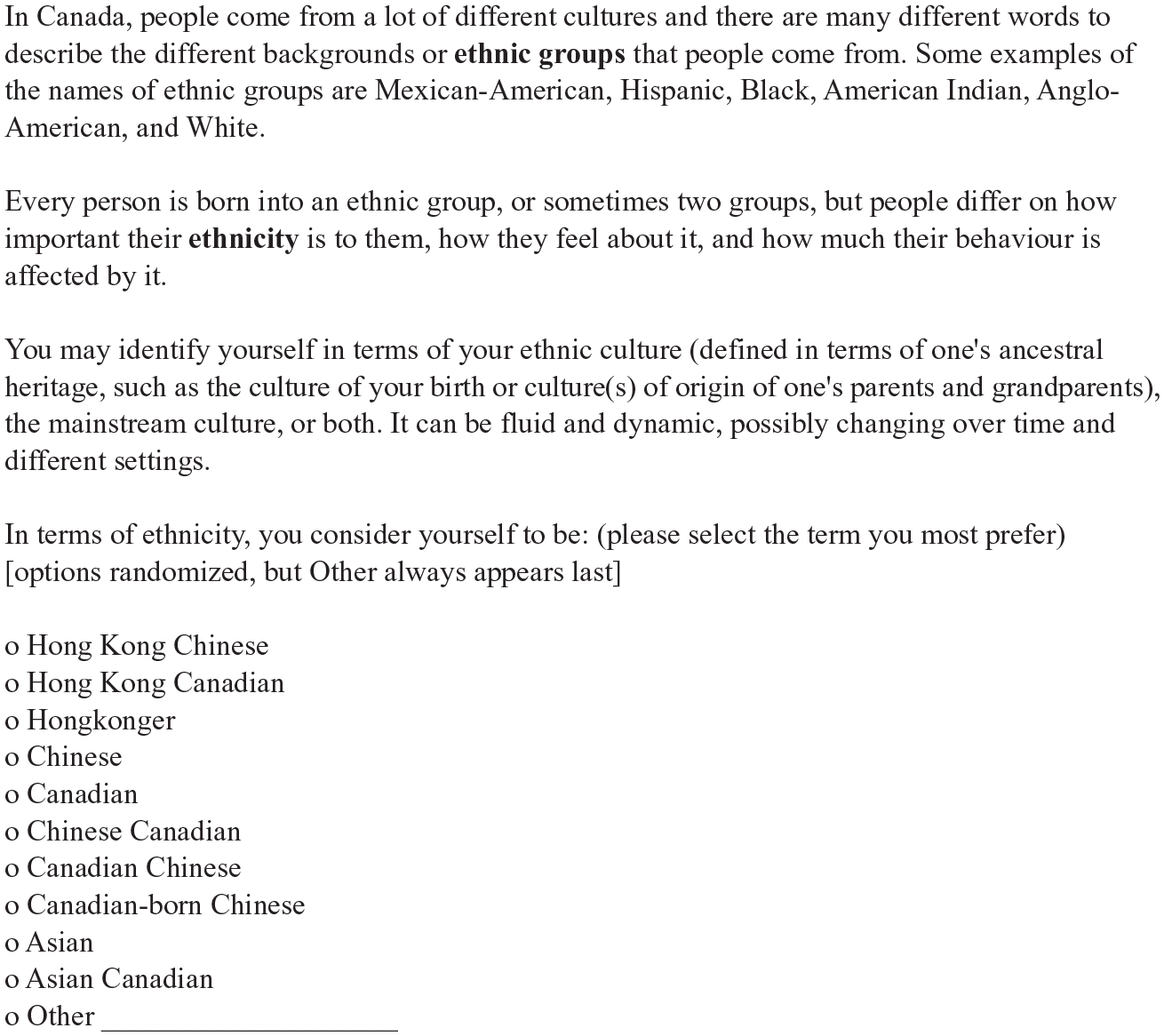
Question asking for preferred self-label.
VIA. A subset of the VIA (Ryder et al., 2000) was chosen to assess participants’ lifestyle, behaviors, and participation in cultural activities for each culture (Chinese culture versus Canadian culture). Five VIA questions (3: willingness to marry, 4: social activities with people, 5: comfortable working with people, 8: belief in values, and 10: interest in having friends) were selected and adapted for each culture, which produced 10 questions with responses made on a 7-point Likert-type scale, allowing for a bidimensional measure of acculturation by generating separate subscores for the heritage culture and mainstream culture. For example, “I would be willing to marry a person from my ethnic culture” and “I would be willing to marry a Canadian person.” The questions were presented randomly and responses were made on a 7-point Likert scale. Reliability was measured using Cronbach’s alpha and was strong for both Canadian items, α = .83, and Chinese items, α = .85.
Bicultural identity. Participants were presented with one question which uses circle diagrams developed by Comanaru (2009) to visually represent the degree of integration of bicultural’ dual identities by using a series of overlapping circles.
Language proficiency. Participants self-reported their language proficiency in speaking, understanding, reading, and writing for Cantonese and English using a scale from 0 (no proficiency) to 100 (native-like proficiency). Participants also self-rated their bilingualism level on a Likert scale, ranging from 1 (non-fluent bilingual) to 5 (fluent bilingual) for each language.
Code-switching attitudes. Code-switching is a term used to describe the spontaneous switching from one language to another, often exhibited by bilinguals (Appel & Muysken, 1987; Grosjean, 1982). Despite its common occurrence, the act of code-switching often garners an overall negative impression by its listeners as well as its users (for a review, see Heller, 1988). Five questions developed by Dewaele and Li (2014) were included to assess broader code-switching attitudes. The nature of the questions was theoretical and global in nature, often referring to individual values and beliefs. The responses were recorded on a 5-point Likert scale, and the reliability for this set of questions was moderate at α = .58.
Procedure
The Qualtrics online survey platform was used for the present study. Participants first provided informed consent before completing the questionnaires described above. To finish, participants were thanked for their participation and provided with a debriefing form.
Qualitative Data
Participants
Thirteen participants (2 male, 11 female) completed a short online survey. The age of participants ranged from 21 to 37 years old (M = 25.3, SD = 4.6). All participants considered themselves belonging to the Chinese community in Canada. More specifically, 8 participants indicated themselves as part of the Toronto Chinese community and 1 individual identifying their belonging to the Hong Kong community. Participants viewed their Chinese and Canadian identities as partially overlapping according to the bicultural identity measure described in Study 1 (M = 4.00, SD = 1.91).
Measures
Demographic questions were included to assess language and residence history. As in Study 1, participants were also presented with a self-identification question and circle diagrams (Comanaru, 2009) to identify the degree of integration for their dual identities. Several open-ended prompts were used to ask participants to explain the reasoning behind their self-label choices, changes in their preferences across different times and/or spaces, and about their language use (e.g., “explain the reasons why you chose the label,” “does your identification with the label change at different times or in different situations”).
Procedure
Using Qualtrics as the online survey platform, participants provided informed consent before completing demographic questions and the open-ended prompts regarding their choice of self-labels.
Results
Self-Label Preferences
The majority of participants selected an ethnic label from the options provided (n = 148; see Table 1). Many participants preferred hyphenated labels, which are those that indicated two cultures, such as Chinese Canadian (n = 29), Canadian Chinese (n = 9), Asian Canadian (n = 8), and Hong Kong Canadian (n = 2). The most preferred individual label was Canadian-born Chinese (n = 44, 27.8%). When different representations of the “Chinese Canadian” label are summed together (i.e., Canadian-born Chinese, Chinese Canadian, Canadian Chinese), the “Chinese Canadian” label can be considered the most preferred in the sample (n = 82, 52%), suggesting that most participants identify with both the Canadian and Chinese cultures in some way as they were included in versions of a “Chinese Canadian” label. Notably, many individuals also felt compelled to share the specific location of their origin, such as Hong Kong Chinese (n = 26), Hong Kong Canadian (n = 2), and Hongkonger (n = 1), demonstrating that a Chinese ethnic group label lacked precision and the information is warranted for clarity.
Preferred Self-Labels, Presented in Alphabetical Order.
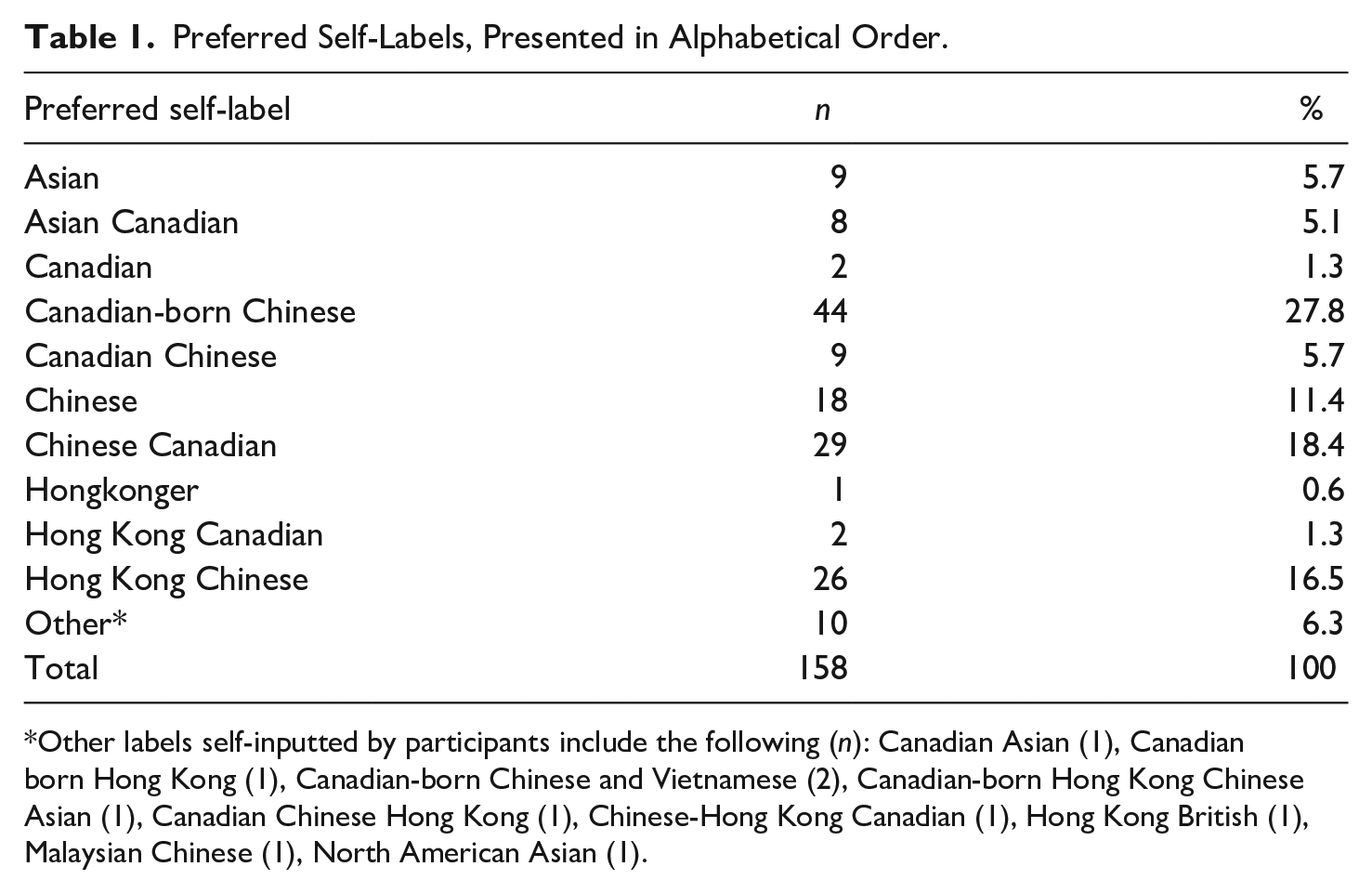
Other labels self-inputted by participants include the following (n): Canadian Asian (1), Canadian born Hong Kong (1), Canadian-born Chinese and Vietnamese (2), Canadian-born Hong Kong Chinese Asian (1), Canadian Chinese Hong Kong (1), Chinese-Hong Kong Canadian (1), Hong Kong British (1), Malaysian Chinese (1), North American Asian (1).
We classified the self-labels according to the classification proposed by Rumbaut (1994, 2005): (i) national-origin (Chinese; n = 18), (ii) hyphenated (versions of Chinese Canadian; n = 51), (iii) Canadian (n = 2), and pan-ethnic (n = 10). However, the specific origin labels (e.g., Hong Kong Chinese, Canadian-born Hong Kong, Hongkonger; n = 30) and Canadian-born Chinese 4 term (and its variations; n = 47) did not easily correspond to the four types. Therefore, rather than attempting to force them into the typology, we elected to simplify the groupings and organize the terms by monocultural versus bicultural.
All self-labels which included two separate cultures were classified as bicultural labels; for example, Canadian Chinese, Asian Canadian, and Hong Kong Canadian (n = 100). On the other hand, self-labels which included either only one culture or included two associated cultures (i.e., specific origin labels) were classified as monocultural labels; for example, Asian, Chinese, and Hong Kong Chinese (n = 58). The monocultural group was then renamed as ethnic cultural labels, as all self-labels referenced participants’ ethnic culture except for two participants who identified as Canadian, which we opted to omit from analyses due to its small number.
Group Comparisons Between Bicultural Versus Monocultural Labels
There was a significant difference in Canadian acculturation, as measured by the VIA, t(95.07) = −3.57, p < .001, indicating that participants who used bicultural labels (M = 6.03, SD = .74) scored higher in Canadian acculturation than those who used an ethnic cultural label (M = 5.51, SD = .93). There were no significant differences in Chinese identification between the groups, t(153) = −3.80, ns. Similarly, this pattern was also reflected in the participants’ language proficiency.
There were no significant differences in participants’ reported level of bilingualism, t(153) = .43, ns. However, supporting our hypotheses, there were differences in their reported proficiency in Cantonese and English. Participants who selected bicultural labels were significantly more proficient in English (M = 95.85, SD = 6.63) than those who selected an ethnic cultural label (M = 83.44, SD = 16.01), t(66.05) = −5.53, p < .001. Conversely, those using bicultural labels were also significantly weaker in Cantonese language proficiency (M = 55.61, SD = 22.67) than those who chose an ethnic cultural label (M = 77.19, SD = 21.66), t(153) = 5.23, p < .001. Finally, in terms of attitudes, participants who used bicultural labels held more favorable code-switching attitudes (M = 3.53, SD = 0.62) than those with ethnic cultural labels (M = 3.31, SD = 0.66), t(154) = −2.08, p < .05.
Qualitative Exploration of Self-Label Preference
Several themes emerged from participants’ responses to open-ended prompts that asked them to elaborate on their preferred self-labels and their process for selecting these labels.
Accuracy and Order
Our qualitative data complemented the findings we observed with our larger quantitative sample. Participants’ preference for hyphenated labels (i.e., labels that name two cultures) was evident, such as Chinese Canadian (n = 2), Hong Kong Canadian (n = 2), Canadian-born Chinese (n = 1), Taiwanese Canadian (n = 1), and Asian Canadian (n = 1). Taking the different versions of the “Chinese Canadian” label together, this self-label was the most preferred in the sample (n = 6; 46.2%). When mapping the self-labels to Rumbaut’s (1994) classification, there were only national-origin (Chinese; n = 2), hyphenated (versions of Chinese Canadian; n = 7), and pan-ethnic labels used (i.e., Asian; n = 2); no participants identified as Canadian. Importantly, self-labels which indicated specific origins, such as Hongkonger and Taiwanese, did not correspond to the typology, yet this regional specificity seemed to an important detail to note for our participants. As a whole, there were a variety of bicultural labels (n = 7) and monocultural labels (n = 6).
Participants commonly provided justifications reflecting their upbringing (n = 11, 84.6%). As one participant directly stated, “I am Chinese born in Canada,” while another declared, “Born in China raised in Canada.” Participants also reflected on the importance of the order of the cultures in their preferred self-label: I see myself as Chinese first and Canadian second (as opposed to the other way around). Although I have no memories of my time living in China as a baby, I try to maintain a strong connection to my heritage.
Moreover, one participant elaborated on the importance of specificity in the self-label, in contrast to using a pan-ethnic label: “It feels more accurate to say Chinese Canadian because I feel like both are an important part of my identity. Just one of the others doesn’t fully encompass my identity and Asian Canadian feels too broad.”
Situational Shifts
Many participants indicated that their preferred self-label changes according to different situations in order to better connect with others (n = 8, 61.5%). For example, one participant explained this dynamic as such: I switch between the terms “Chinese Canadian,” “Chinese,” “Canadian,” “Asian,” and “East Asian.” It depends on how I’m trying to identify and connect with people. If I’m trying to share something specific to Chinese culture, I may highlight my “Chinese” or even “East Asian” label more. If I’m with friends who are also Asian, we may use the “Asian” or “Chinese” label when sharing our experiences. If I’m in a more professional setting, I may use “Chinese Canadian” to give others a clearer idea of my identity. If I’m speaking with others in different countries, I may use “Canadian” or even “North American” to share thoughts (since I think this label takes precedence over the “Chinese” label).
The malleability of self-labels is also evident at times where there is need for simplicity: “I will usually introduce myself as Canadian because legally speaking, I am a Canadian citizen. It is less complicated than saying I am Chinese Canadian.”
In contrast, one participant reported that their self-label does not change unless they are required to do so: It doesn’t change. I use the label “Hong Konger” across different situations, regardless of the people I am with. If on demographics surveys, they don’t provide the label, I would choose the label that is most similar to my ethnicity, which is most likely “Chinese.”
The above example reinforces that individuals are sometimes forced to select a non-preferred self-label if a preferred label is not available (similar to Maghbouleh et al.’s [2022] study of MENA individuals in the United States).
Label Preference Depends on the Language Being Spoken
Similarly, in relation to the association between self-labels and language, many participants indicated a simple “no” or stated that they were not aware of a change due to language (e.g., “I’m not aware that it changes”). A few participants expanded on their language proficiency and self-label choice: Yes, I think I identify more with “Hong Kong Canadian” now that my English seems to be stronger than my Cantonese (since I use it very frequently with everyone around me and in my daily life, whereas I only speak Cantonese with my family/other HK people occasionally).
Furthermore, it is possible that individuals do not think about emphasizing or feel the need to emphasize their “other” identity when they are making one identity salient via their linguistic choices; for example, the (shared) Chinese identity is activated and emphasized when speaking Cantonese, so less attention is paid to their Canadian identity. As one participant described, “my previous answers were dependent on me speaking English. If I was speaking Chinese. . . I usually just say ‘Chinese’ or ‘East Asian’ as it is simplest for me. I don’t even know how I would express ‘Chinese Canadian’ in a comfortable way. But more than that, I do feel more in touch with my ‘Chinese/Asian’ side when speaking Chinese so that helps.”
The present qualitative findings complement our quantitative results; namely, they elaborate on the awareness of individuals’ use of different variations of “Chinese Canadian” and the significance linked to a particular variant. Moreover, the qualitative explanations highlight the complexities of declaring a preferred self-label and bring attention to the subtle cues and contextual constraints that influence these choices.
Discussion
In this article, we used a multi-methods approach to explore the preferred self-labels chosen by first- and second-generation Chinese immigrants in Canada. The quantitative data detailed the variations in self-labeling within a distinct ethnic minority group, the Chinese community in Canada. Additionally, the qualitative data collected deepened our understanding of self-labeling preferences and the many reasons behind individuals’ conscious choices. Taken together, the results of these two studies suggest that self-labeling is a dynamic act of ethnic self-declaration navigated by Canadian Chinese community members that has implications for their feelings of inclusion and integration in greater society.
A clear preference for bicultural self-labels among the participants in our sample was observed, in line with our hypothesis. Participants selected labels such as Canadian Chinese, Chinese Canadian, and Canadian-born Chinese, emphasizing a desire to acknowledge a sense of belonging to two cultures. Moreover, our current investigation of Cantonese–English bilinguals within the Chinese community suggests that there is likely important variability in self-labeling preferences within other ethnic groups. In this sample, many individuals opted to include the specific Chinese origin of their families (e.g., Hong Kong), revealing that this information is intentionally and meaningfully included in their self-presentation. Furthermore, participants’ language proficiency (i.e., in English and Cantonese) was an important variable associated with preferred self-labels, such that it reaffirms the strong contribution of language in the processes of acculturation and ethnic identification among minorities (Gudykunst & Ting-Toomey, 1990; Kuo & Roysircar, 2004; Miller & Hoogstra, 1992).
In contrast to the term “Asian American” being used commonly in popular media and elsewhere in the United States (Budiman & Ruiz, 2021), the equivalent “Asian Canadian” term has received very little support and is not widely used (Khan, 2021; Takeuchi, 2014), which is reflected in our study. The minimal usage of this term suggests that pan-ethnic categorization is not a popular option, echoing previous findings among the Black community in Canada (Boatswain & Lalonde, 2000). It would be interesting to investigate further whether this generalizes across other ethnic groups in Canada and to determine how national differences in group categorization and labeling practices have an influence on individual- and group-level label choice. For example, the U.S. Census distinctly focuses on the Hispanic/Latino ethnic classification, where all individuals can be classified as “Hispanic or Latino” or “Not Hispanic or Latino” with the former being “a person of Cuban, Mexican, Puerto Rican, South or Central American, or other Spanish culture or origin regardless of race” (U.S. Census Bureau, 2022b). In contrast, there is no such differentiation in Canada; Latin, Central, and South American are simply regarded as one of many categories of ethnic origins (Statistics Canada, 2021a). It is also possible that individuals who immigrated from these regions to Canada may be more likely to emphasize their national origin (e.g., Peruvian, Guyanese, Ecuadorian). As a result of Canada’s national ideologies toward multiculturalism and diversity (i.e., pluralism ideology; Bourhis, 2001; Bourhis et al., 2012), minority groups are encouraged to maintain their heritage language and ethnic culture, and in turn, they are ostensibly more comfortable and willing to self-declare their country of origin. However, the small number of participants who identified as Canadian in our quantitative sample could be an indication of ethnic resistance, a constraint for individuals to solely identify with the mainstream Canadian culture (especially for individuals residing in countries with an assimilation ideology). It is possible that the hesitancy toward including an ethnic label stems from exposure to and internalization of the perpetual foreigner stereotype, such that Asian individuals feel obligated to claim an ethnic label (Goto, 2002); yet as mentioned previously, it is difficult to compare across the Canadian and American contexts as Canadian ideologies and policies encourage integrated identities, as opposed to assimilated identities, among immigrants.
We used a broad classification method to categorize the self-labels: bicultural versus monocultural. Applying previous typologies (Rumbaut, 1994) was limiting for the present data. For example, there were instances of using the Chinese Canadian label as well its inverse, Canadian Chinese, which cannot be presumed to be equivalent; the order of the terms is likely to be significant to the identity which individuals want to portray, as suggested by some participants in their qualitative responses. The qualitative subtleties between such similar labels must be examined in greater detail to document the underlying meaning and value of these variations. Furthermore, other potentially important self-labeling patterns were evident in the present sample. As Cantonese speakers of the Chinese community, many participants’ self-labels included information about their specific region of origin (e.g., Hongkonger, Hong Kong Canadian, Hong Kong Chinese). This is noteworthy because it suggests that they see this information as an important part of their self-categorization and index this differentiation (i.e., apart from Chinese) in the way they present themselves. The qualitative data reinforces the meaningfulness of specificity and order in preferred self-labels. For instance, one participant highlighted the importance of emphasizing Chinese first despite not having any recollection of their time spent in China.
The dynamic and nuanced nature of self-labeling is even evident when focusing on the most preferred label in our study of Cantonese–English bilinguals, “Canadian-born Chinese,” commonly shortened to “CBCs.” On a surface level, it directly refers to an individual of Chinese descent who is born in Canada, but ingroup members understand it as a term referring to individuals who grew up in and assimilated to the mainstream Canadian culture, likely identifying themselves as and exhibiting social behaviors that are more “Canadian” than “Chinese” (Kobayashi & Preston, 2014; Law, 2012). Equivalent terms exist for Chinese individuals who have immigrated elsewhere, such as American-born Chinese (ABCs), Australian-born Chinese (ABCs), and British-born Chinese (BBCs). These terms refer to a distinct subgroup of individuals within the Chinese community: the 1.5-generation and second-generation immigrants who are bicultural and actively navigating the duality of their ethnic Chinese culture and the dominant mainstream culture (Yim & Clément, 2019). Importantly though, Canadian-born Chinese/CBC is a neutral term which refers to a socially constructed identity, in comparison to the “juksing” term which has a similar definition but a negative connotation (though individuals are trying to reclaim it and use it more positively; Yim & Clément, 2019). However, we cannot presume that all individuals were considering these meanings when responding to the self-label question in our study. Furthermore, common derogatory terms used in the discussion of ethnic identity, such as “whitewashed” and “FOB” (fresh off the boat), hinted at immigrants’ continuous negotiation of their identities and need to differentiate themselves from other waves of immigration that could be perceived as “too white” (earlier immigrant cohorts) or “too ethnic” (new immigrant cohorts). Although such complexities can be more or less evident in a self-label, we propose that these fine distinctions are inherent in the second-generation immigrant experience among many members of the Chinese community and other ethnic minority groups (e.g., Feliciano & Rumbaut, 2019) and recommend a broader look to see whether any common patterns can be identified.
Finally, we turn to the significant differences evident in language attitudes between individuals who preferred bicultural self-labels, compared to those who preferred ethnic cultural labels. Indicating one’s preferred self-label is reflective of one’s attitudes toward language use, that is, their views of language switching and whether it is appropriate for bilinguals to switch between their languages in conversations. Despite no differences in their bilingualism level, the bicultural self-label group exhibited more favorable attitudes toward code-switching, that is, more acceptance of mixing both languages together, as they are also likely those who exhibit similar behaviors (i.e., switch between their languages often).
A primary objective of the present article was to examine the self-labeling preferences among individuals who share a common spoken language. We have demonstrated that Cantonese speakers of the Chinese community in Canada are unique in their self-label choices, preferring to self-declare and highlight their specific location of origin using a common ingroup self-label (e.g., Hong Kong Chinese, Hong Kong Canadian). Moreover, self-label preferences were associated with identification, language proficiency, and language attitudes. This association between ethnic identification and self-labeling demonstrates that individuals belonging to the Chinese community in Canada feel secure in the presentation of their ethnic identity; that is, they are comfortable in marking themselves as a Chinese group member and claiming their ethnic identity, and do not feel vulnerable in doing so. As such, this research provides a more complete and novel understanding of self-labeling among members of this particular ethnic minority group and demonstrates their relative comfort with declaring their identities through self-labels. Understanding how self-labels are chosen by members of ethnic minority groups and which labels are preferred, as well as any subgroup differences, is imperative for organizations and institutions that strive to serve these communities and create inclusive and identity-safe spaces where they feel like they belong. From our investigation, we suggest further research on ethnic minority groups who share a spoken language, for example, Catalan-speaking individuals in Spain or French-speaking minorities in Western Canada. In times of increased discrimination and exclusion (as is the current reality), ethnic identification among minorities can be strengthened in the form of reactive ethnicity (Rumbaut, 2008) and, furthermore, can be protective against the psychological effects of discrimination (Branscombe et al., 1999; Huynh et al., 2014; Stein et al., 2014).
Our close examination of the Chinese community and their preferred self-labels has several implications for policy and practice. We encourage government and not-for-profit organizations, especially those serving Chinese communities and working to combat anti-Asian racism, to incorporate the diverse self-labels individuals adopt in order to convey understanding and recognize the within-group variability within the Chinese ethnic group. We urge educators and community leaders to set an example by inquiring about and using one’s preferred ethnic self-label to communicate inclusivity and acceptance, similar to addressing individuals using their preferred gender pronouns. Such simple actions may be able to convey to ethnic minorities, including newcomers and immigrants from earlier cohorts, that they are valued and supported by greater society. In the current sociocultural North American context, where Anti-Asian sentiments are heightened, understanding and using preferred self-labels can be a first step in reinforcing Chinese community members’ sense of belonging and full integration into society.
Footnotes
Declaration of Conflicting Interests
The authors declared no potential conflicts of interest with respect to the research, authorship, and/or publication of this article.
Funding
The authors received no financial support for the research, authorship, and/or publication of this article.