




Abstract
Against a backdrop of growing interest in localized cultural policy, this article explores the example of Oldham, an “overshadowed” town (Pike et al., 2016) situated on the edge of the Northern English city of Manchester (United Kingdom). While urban planning discourse has acknowledged the impact of large cities on neighboring satellite areas, finding that regeneration projects can result in a weak sense of place for [such] secondary towns (Turok, 2009), few have considered the extent to which arts organizations in secondary towns are able to sustain their work and create their own narratives. Drawing from the thought of Pierre Bourdieu and from theories of institutional logics, I adopt a relational approach to exploring the ways in which organizations within the local cultural ecology understand their operating environment. Although cultural policy endeavors to use local arts infrastructure to build local capacity, this case study reveals a situation in which those organizations in satellite towns remain unable to gain the status enjoyed by their metropolitan counterparts. Further, it examples a field that remains highly institutionalized, hierarchical, and increasingly professionalized. Institutional arrangements result in organizations in the satellite-town depending upon its city neighbor for crucial legitimating capitals. Just as stories of class reproduce patterns of inequality, this situation is similarly true for organizations. Organizations are found to be complicit in the production and reproduction of inequalities within the institutional field, with dominant organizations appearing more able to access legitimizing capital than others. Ultimately, I argue that organizations in satellite towns are heavily reliant on symbolic resources supplied by the institutional fields of greater scope in which they are nested. Organizations are required to harness the support of elite individuals and dominant “world-maker” organizations, which lie beyond their immediate local context to secure legitimacy for themselves and their activities. This situation I term “satellite dependency.”
Keywords
Introduction
Siting Satellites
Throughout the last decade, much consideration has been paid to the role of the arts and cultural sector in contributing to “place-making”; in particular, the function of cultural and intercultural city planning for advantage (Landry, 2000; Lees & Melhuish, 2015), regeneration, and place-based funding (Durrer et al., 2019; Jancovich, 2017; Markusen, 2014; Miles & Ebrey, 2017; O’Brien, 2014). Within the United Kingdom, the combined economic effects of austerity, the United Kingdom’s new relationship with Europe (Brexit), the economic impacts of COVID-19, as well as the HM Government’s (2022) “leveling up” agenda have resulted in an increased policy focus on the role of the arts and cultural sector and its potential to contribute to restoring towns and cities (Gilmore et al., 2019). Subsequently, scholarly attention has also turned to the nature and role of culture and creativity in restoring rural communities (Duxbury, 2021). However, little scholarly consideration has been paid to those postindustrial and peri-urban, satellite towns, located on the outskirts of these cities—specifically how the proximity of a nearby creative city impacts upon the satellite’s cultural organizations. While the spatial dimensions of individual power have been clearly demonstrated in the work of Cunningham and Savage (2015), the territorial nature of organizational power has been paid little scholarly attention.
This satellite-town-based study shifts attention away from creative metropolitan cities. Evoking Gilmore’s (2013) “crap towns,” it examines the ways in which organizations negotiate the complexities of their localized institutional systems to fulfill their organizational goals and explore how prevailing institutional ideologies across their relationships shape organizational operations and the institutional field. This research explores how cultural organizations in Oldham—a satellite town on the outskirts of the city of Manchester, United Kingdom—relate to each other, to policy, and to organizations within the city. It examines how interorganizational power dynamics contribute to the production and reproduction of inequalities within localized arts and cultural sectors, arguing that organizations located on the outskirts of creative cities (Florida, 2002; Landry, 2000) are subject to domination by their metropolitan counterparts. In understanding the dynamics of relationships within local fields, it highlights the need for more nuanced understanding of the local geographies and local institutions in the reproduction of organizational and spatial inequalities. Furthermore, it provides a critical challenge to those institutional systems that are the sources for legitimacy, such as national arts funders' investment strategies and educational frameworks, to break the recursive cycle that maintains field hierarchies and satellite dependencies.
Literature Review
Urban planning discourse has long acknowledged the impact of large cities on neighboring towns, finding that regeneration projects can result in a “weak sense of place for the secondary towns” (Turok, 2009). The expounded benefits of culture-led regeneration and their “trickle down” effects have been called into question (cf. Cohen, 2007; Colomb, 2011). Scholars such as Wilson (2017) note that creative cities (Florida, 2002; Landry, 2000) run the risk of perpetuating social inequality or draining surrounding secondary towns of talent (Leslie & Catungal, 2012). More recently, O’Connor (2022) has asserted that the “shiny buildings” resulting from creative city planning paradigms serve to distract from the lack of affordable housing and workspace for those creating the art itself that follows as a result of higher land prices. While Kelsey and Kenny (2021) argue that interventions at social and community levels rather than capital infrastructure provision may provide more favorable conditions for successful economic regeneration. Meanwhile, academic debates continue to wrangle with relationships between arts funding, cultural policy, and the instrumental use of the arts (e.g., Belfiore, 2012; Hadley & Gray, 2017; O’Brien 2014). For some (Hadley & Gray, 2017), instrumental policy making, coupled with scarce financial resources, has led to a lack of autonomy for arts and cultural organizations within the sector. However, organizational survival is not merely dependent upon material resources and technical information; they must demonstrate social acceptability and credibility to survive (Scott, 2014). Policy instruments have a temporal element and become highly institutionalized over time, lending themselves to reifying the uneven shape of the sector and shaping the actions of organizations within it (Capano & Howlett, 2020). With (public) funding comes a need to adhere to regulative institutional practices (Scott, 2014), which further shapes the contours of the sector, since organizations require legitimacy, which can be secured via conforming to the rules and requirements of the field (Powell and DiMaggio, 1991). Legitimacy plays a central role in the structures of power and influence, which, in turn, affects who may exercise power (Berger et al., 1998). Larsen (2014) argues that instrumental claims for the societal and economic value of the arts have become a tool not just for policy makers to justify the spending of public money on the sector, but also for organizations themselves to legitimize their work within their own institutional contexts. Organizations use legitimizing practices advantageously to justify their continued existence and to maintain their status within an inequitable institutional hierarchy (Larsen, 2014). In a similar vein, Coburn (2016) acknowledges that while instrumental structural forces within institutions “shape strategic action,” they are not limited to constraints, but also provide “a feedstock of ideas, approaches, and practices” (p. 468). Crucially, she notes that the effects of structural constraints within a given institution are not evenly distributed throughout it but are dependent upon the location of actors within that social structure. The work of both Larsen (2014) and Coburn (2016) foreground the importance of hierarchies and power relations within institutional contexts. The role of legitimating resources in securing organizational success has significant implications for organizations operating on the periphery of cities.
The view that prevailing social conditions may be adopted to advance the aims of actors is central to this research. To this end, the work of Pierre Bourdieu (1984, 1989, 1991, 1993, Bourdieu and Wacquant 1992) may prove especially fertile. His understanding of how symbolic systems form a mechanism by which domination is both precipitated and consented to, in combination with the contention that structural constraints are distributed unevenly within institutional hierarchies, is a key tenet of this research. Organizational scholars including Emirbayer and Johnson (2008) and Sieweke (2014) call for Bourdieu’s theories to be used more widely in the investigation of organizational action. Emirbayer and Johnson (2008) cite the need for greater understanding of “organizational position takings” (p. 14) and identify a paucity of organizational research, which moves beyond false dualisms, such as might be exemplified by the instrumental versus intrinsic value debate within the arts and cultural sector. They call for relational approaches, such as Bourdieu’s, to discern the ways in which organizations are both enabled as well as constrained by structural forces (Emirbayer, 1997; Emirbayer and Johnson, 2008). As such, we need to complexify how we understand the mechanisms of power and resistance in operation at organizational level within the arts and cultural sector.
This research explores the ways in which arts organizations use noneconomic capitals, both material and symbolic, to gain and maintain power. In so doing, it highlights the role of geographies, policy, and inequity within institutional contexts. By revealing prevailing institutional logics (Thornton et al., 2012), this study posits that town-based arts and cultural organizations are subject to institutional practices, which benefit their metropolitan counterparts. By considering both professional and voluntary-amateur organizations within the scope of this study, this inquiry offers an opportunity to observe how the dynamics of institutional inclusion and exclusion are impacted by policy demands as well as institutional attitudes.
Methodology and Data Collection
This case study adopts a field approach. A field, in this context, is not merely bound by a geographical boundary, but constitutes a network of connections and relations (Boterro, 2009; Crossley, 2011, 2012). In keeping with the work of Bottero (2009), Crossley (2011, 2012), and Mohr (2013), this research uses networks as a methodological tool for both conceptualizing the field and visualizing field relationships. The examination of networks is a useful tool for gaining relational perspectives (Decuypere, 2020). Organizational theorists (Inkpen & Tsang, 2005) claim the analysis of networks can help researchers to understand “how the social context in which firms are embedded influences their behaviour and performance” (p. 146) and provide crucial access to new knowledge. Durrer et al. (2019) have previously asserted that arts and cultural organizations “jostle entrepreneurially for the attention of national bodies to secure their inclusion in the network and gain access, influence and control” (p. 327) demonstrating the role of networks as critical ways to understand field dependencies and interactions.
Threefold interviews (Triptych interviews) were designed to reveal institutionalized understandings of the field through the creation, first, of participant-generated network maps; second, a “go-along” (Kusenbach, 2003) designed to reveal symbolic meanings attributed to material artifacts in the field, one which enabled participants to engage with material elements of their organization to understand the role of material artifacts in the construction of organizational agency; and third, semistructured interviews, which generated narrative data to inform understandings of institutional relations and logics operating within the field.
These sets of data were brought together to produce a relational understanding of the field (Reay & Jones, 2016). The participant-produced network visualizations were combined with narrative data to assemble sociograms (Contandriopoulos et al., 2018; Emmel & Clark, 2009; Tubaro et al., 2016). Rather than simply visualizing one data set, sociograms bring together different data sources, drawing from both visual and interview data, and are discussed against the backdrop of contextual data. The participant-produced network maps provided a set of visual data illustrating the connections between the organizations within the field. By analyzing these ties, both qualitatively and quantitatively, some of the mechanisms through which power and authority within the field are constructed could be examined.
The participant-produced network maps were simultaneously a sampling tool as well as a qualitative method to gather data about the structure of a participating organization’s “field” as they understood it. Each organization represents a “unit of study” within the case study. For each unit, the data collection is replicated. Each of the units of study is interconnected via the field. By adopting the concept of field for this project, then, those participating in the inquiry constituted a bounded social setting, revealing the institutional connectedness of the participants.
A total of 33 participants took part in interviews during which 24 participant-generated visual network maps were produced. The discrepancy in numbers between participants and maps is a result of some organizations being represented by two individuals attending one interview but collectively producing one map. Nine organizations are represented by more than one interview participant. This situation strengthens the data by limiting purely personal views and ensuring views were representative of organizational work. Interviews yielded 32 hours, 55 minutes, and 44 seconds of recorded audio, all of which were transcribed and coded. Of the 26 interviews, 2 were second interviews which took place to accommodate a “go-along” interview.
The results of the network mapping exercise were collated and, through a process of quantifying the ties identified on the participant-produced maps, those connections were visualized. The visualization provided a readable depiction of the field and an overview of the nature of the relationships within it. Having taken the data from each of the individual participant-produced network maps, it was cleaned and then transformed into an affiliation (or affinity) matrix (Borgatti et al., 2013). Using the results of the content analysis from the interview data, the additional ties identified by research participants within the course of interviews were added. Using these combined data, the resulting affiliation matrix set out the 21 organizations participating in the study as column headings, and 136 rows, each representing an organization identified within the participant produced sociograms and the corresponding verbal accounts from interviews. All ties are directional, therefore, showing the reciprocity (or lack) of connections. The resulting sociograms were produced using Gephi visualization software (Bastian et al., 2009).
Ostrower (2002) asserts that the further “up-system” an organization is, the more powerful its board representatives are and closer its ties to prestige national organizations are, while Upchurch (2016) highlights how arts governance continues to offer opportunities for elite condescension. Given the claim that the arts are governed by a narrow band of elite individuals (Savage et al., 2013) and Cunningham and Savage’s (2015) assertion that individual power is centered around metropolitan geographies, this research attended patterns of arts governance. Desk-based web research was conducted to understand how governance structures contribute to power relations within the field. Using public documents such as Charities Commission and Companies House data in the public domain, I identified 157 individuals in positions of trusteeships within the field. Using information within the public domain including social media, I was able to ascertain the roles and occupations of individuals in governance roles. These data were then visualized using Gephi software (Bastian et al., 2009).
The Case of Oldham
Identified by the Office for National Statistics (HM Government, 2019) as one of the most deprived areas in the United Kingdom, the borough of Oldham is 1 of 10 making up the Greater Manchester Combined Authority (GMCA). The city of Manchester lies less than 10 miles away. At the time of the research, the city’s estimated cultural sector turnover was £52 million (Manchester City Council, 2016, p. 37). Manchester’s “Cultural Ambition” strategy for the Greater Manchester region seeks to make the city the “UK’s most culturally democratic city” (GMCA, 2019). The city’s stated aim was “‘to lure’ 11.2 million people who live within fifty miles” (Roodhouse, 2010, p. 84). With city center organizations enjoying the geographical advantage of being at the heart of both the city region and large capital investment, Oldham is certainly an “overshadowed” satellite town (Roodhouse, 2010) (Figure 1).
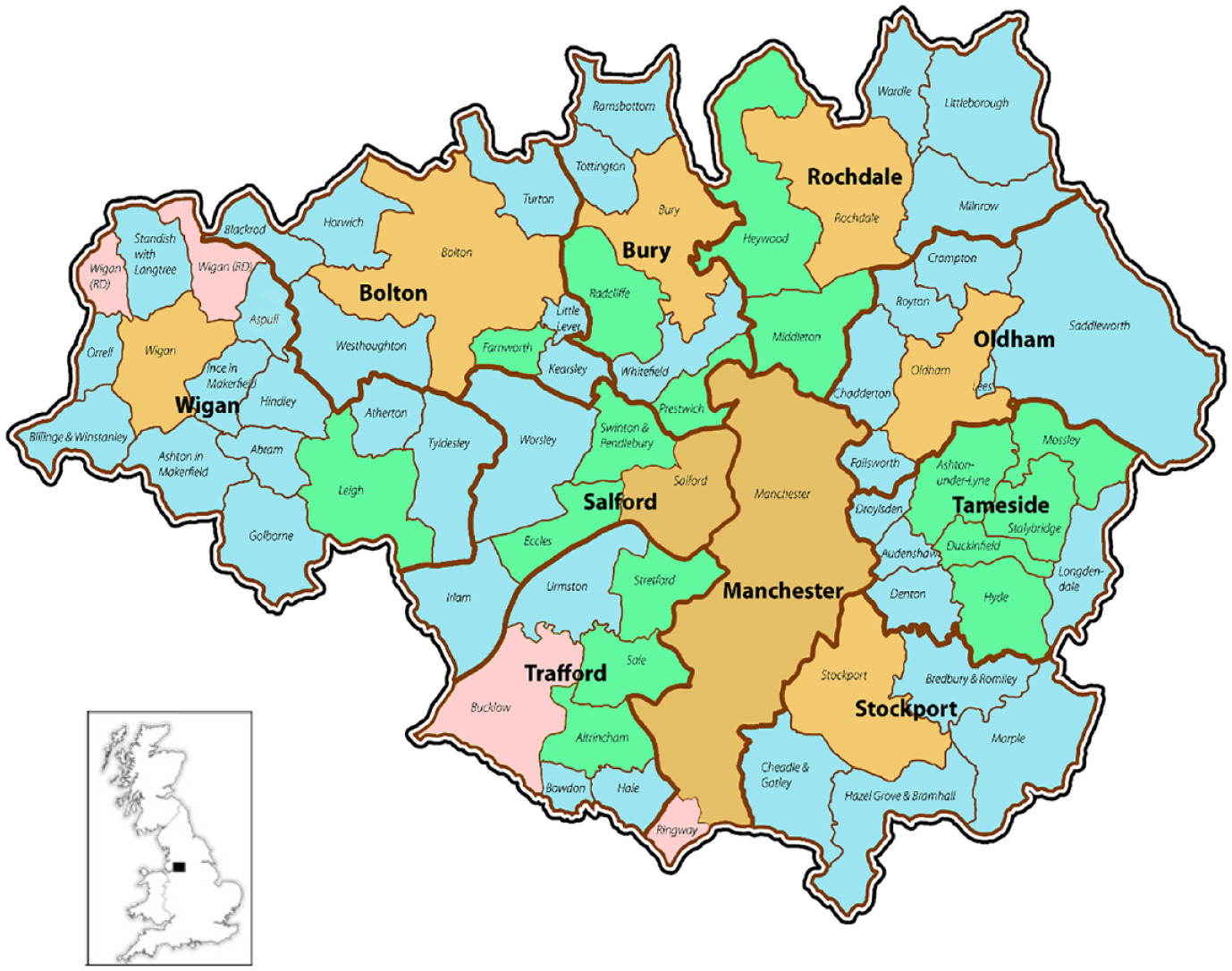
Location of Oldham within GMCA.
The borough of Oldham features contrasting demographics across its electoral wards. Urban areas house a culturally diverse population and some of the country’s poorest households, while rural parts are home to a predominantly White population and some of the United Kingdom’s wealthiest households (Oldham Council, 2019). In 2001, rioting broke out associated with Oldham’s diverse communities “leading separate and parallel lives” (Cantle, 2006), and soon became one of the defining features of Oldham’s cultural policy. The Cantle Report (2006) that followed identified the absence of engagement between ethnic groups and called upon the town to prioritize community cohesion. The report especially emphasized the need for engaging women and young people in projects within the town that might foster greater cultural understanding. The Cantle Report cited the work of schools, voluntary groups, and arts organizations as important partners for driving positive change in the town, and it is against this backdrop that organizations in Oldham continue to operate.
Beyond the town center, particularly in the rural Saddleworth wards of Oldham, is a rich range of cultural organizations comprising amateur artists and run by voluntary committees. These organizations include amateur orchestras, theater groups, music festivals, and shows. Saddleworth North is Oldham’s wealthiest ward with a demographic of over 97% White British residents commanding average incomes of over twice that of those of predominantly Bangladeshi origin (approximately 60%) living in Coldhurst (Oldham’s poorest ward). These committee-run organizations rely upon either business models (ticket sales) for the work they do, or on donations and sponsorship, or a mixture of both. These activities are run free of local policy demands and funding obligations, but nevertheless are embedded within their social and spatial contexts.
The development of Oldham’s cultural offering has seen the construction of Gallery Oldham, the library, and life-long learning center. The site of this development now forms part of the Council’s proposed “Cultural Quarter.” The most recent council investment is the current 13-million-pound (Museum Insider, 2020) project to create the Oldham Museum and Archive. The borough of Oldham enjoys a well-developed and supported “formal” cultural sector (cf. Gilmore, 2013) in addition to large numbers of amateur organizations. By including organizations within the amateur sector as well as those in regular receipt of public funds, this research is concerned with the role of legitimation and power beyond those impacted directly by policies and funding criteria in operation within the regularly funded sector.
Results and Discussion
The sociogram (Figure 2) presents a visual overview of organizations constituting the Oldham arts field. It illustrates all the ties identified by each of the organizations taking part in the study. Even before bringing in the concrete evidence of contextual data (from interviews), the high numbers of connections and degrees of reciprocity are apparent. The eigenvector values of the network make clear that organizations beyond geographical borders of the town are key field members. Connections between Oldham-based organizations with prestigious Manchester-based organizations are prevalent. In particular, organizations regularly funded by public money, namely organizations funded through local authority and Arts Council England (ACE), enjoy the greatest degree of network exposure.
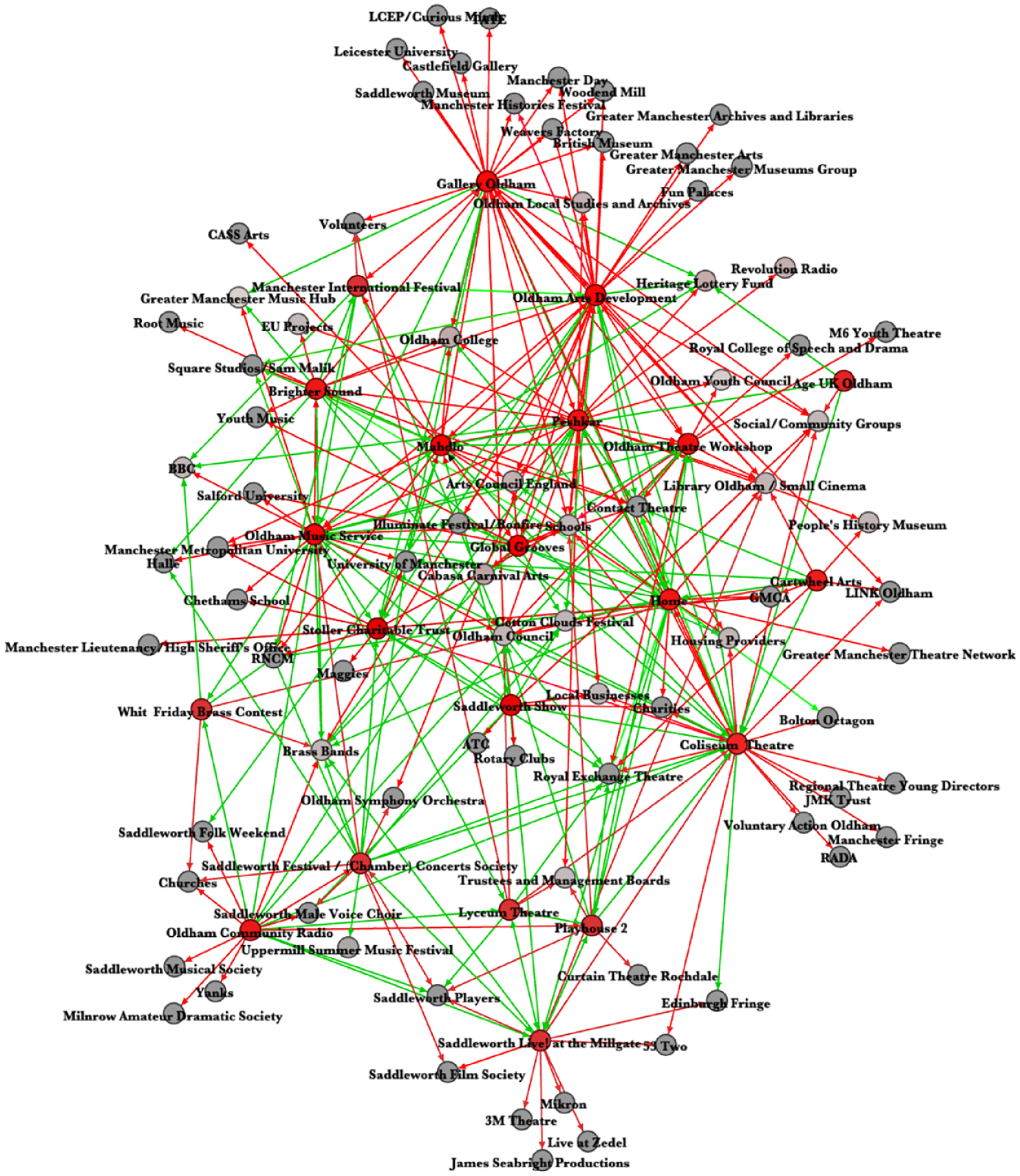
Network sociogram with directional network ties.
Subsequent analysis of the interview data reveals that network connections bestow valuable symbolic capital upon an organization. One organization stated that its network connections with prestige Manchester-based organizations provide “status—we become credible, then, as an arts center.” However, Manchester city center-based organizations did not universally reciprocate relationships with their satellite neighbor. Perhaps most notably, the city-center-based organization that had been identified as a “star-partner” for one Oldham organization responded that they had “never even heard of [the Oldham based organisation]”.
ACE maintains institutional authority not only via the implementation of instrumental funding requirements. Organizations are willing to accept and comply to the regulation of the ACE and welcome its halo effect. Interview transcripts revealed Oldham organizations in receipt of regular ACE funding in the borough have an “amplified voice” as a direct result of their ACE funding status. One organization in the field confirmed the legitimizing effect ACE National Portfolio Status brings them, claiming: “The profile has just gone through the roof [ . . . ] it’s pricked people’s ears up—and people are now like—‘Oh, right. They’re serious, are they?’” Organizations expressed the view that organizational adherence to ACE guidelines ensured that they “do it right.” The underlying assumption locally is that ACE “knows best” how cultural organizations should operate. The importance of being able to respond to current policy expectation is expressed explicitly by one participant who articulated the benefits of connections with ACE, stating: “I think we get a lead from the Arts Council about what are their priorities” [through the connection].
The sociogram reveals universities to be key conduits for organizational legitimation, providing institutional authority as well as information. Operational networks and the governance networks each illustrate that the Royal Northern College of Music, Manchester Metropolitan University, Salford University, and the University of Manchester are key field members, the latter three each being mentioned by at least five organizations. Through governance ties or other connections, the Royal College of Speech and Drama, the University of Leicester, the University of Edinburgh, and the University of Leeds are also connected to operations within the field. Notably, tertiary education links exist only within the context of publicly funded organizations, suggesting institutional affinity between the two.
A striking finding of this research is the role of elites for organizations within the field. The analysis of the management boards for each of the organizations reveals the involvement of many influential individuals at board level. Figure 3 shows that there is a marked correlation between elite board members and elite organizations. This uneven situation evidences a field governed by a narrow band of high-capacity individuals with significant overlap between roles and organizational connections. Indeed, over a quarter (27.7%) of the individuals identified hold trustee or significant positions of influence with more than one organization. Board memberships within the field included 16 titled individuals as well 18 individuals who have the title of Chief Executive or Director. Board members connect Oldham organizations to a variety of up-system or elite individuals and prestige organizations. Although Oldham Borough Council-led services have no trusteeships, connections between local authority and other organizations exist through professional networks, holding positions as observers on boards of governance, or council officials serving on trustee boards. Twelve field trustees work in local government positions, including positions of significant authority within the GMCA. The desire for publicly funded organizations to attract either councilors or council employees to their boards is self-evident with ties to council officials offering organizations the opportunity to stay in touch with local political change and afford them some voice or representation within the political environment. Those organizations with greatest recognition boasted representatives not only from local borough council but also representatives from significant positions of authority within the GMCA. This finding is another illustration of how Manchester operates within the sphere of influence over arts activities in Oldham.
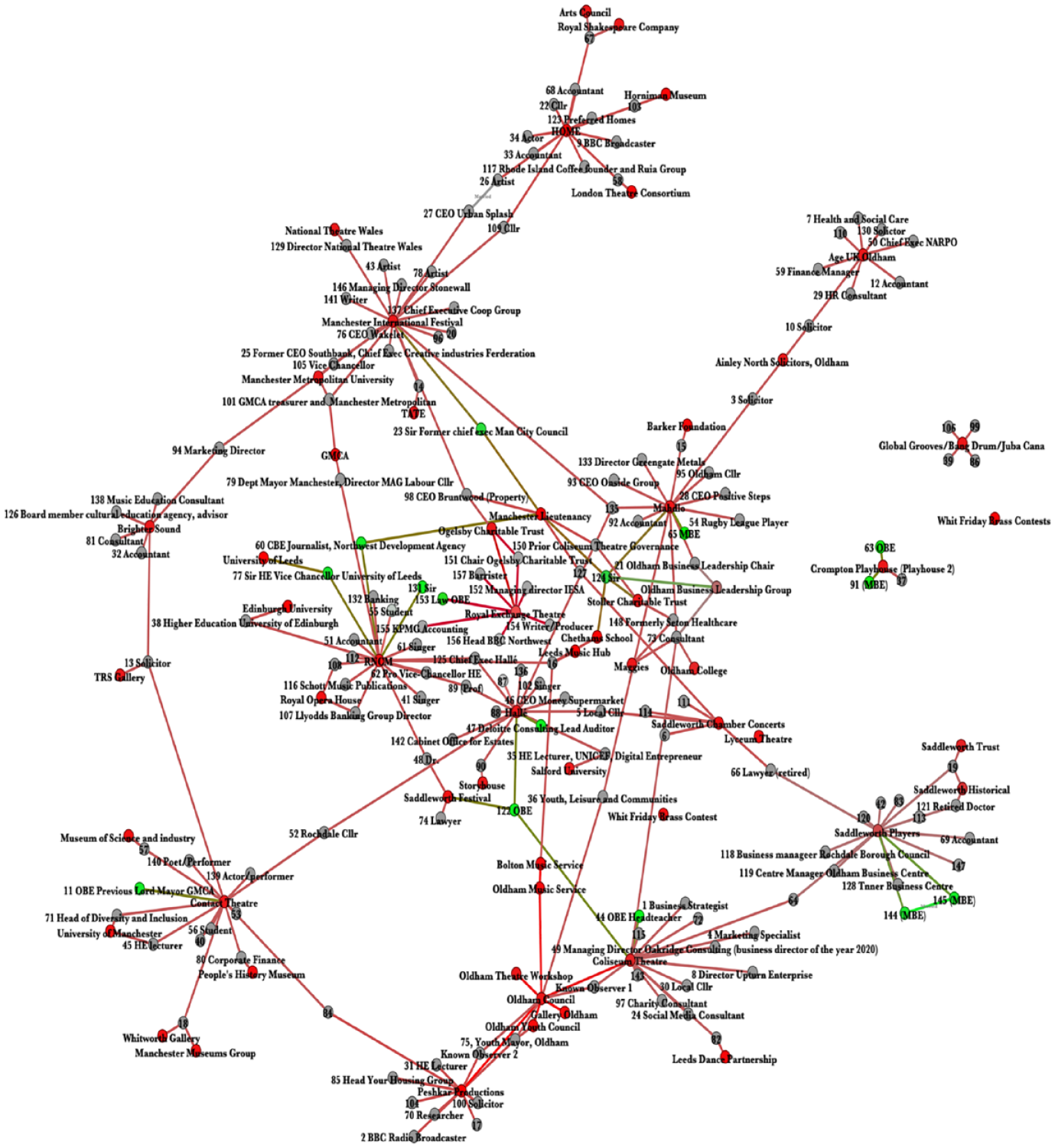
Governance networks.
The proliferation of elite individuals serving on one or more of the participating organizations’ boards is notable—and their value to the organizations that they govern is highly valued. This is perhaps most explicitly asserted in the following comment: “some of our patrons are patrons in other places as well as in Manchester. So, they’re not patrons for no reason you know—they’re connected people.”
One trustee in the field holds a governance position in two city-center prestige organizations and also sits on the ACE North board, while another is a local councilor who is active in the GMCA, as well as a trustee of two prestige organizations. This pattern demonstrates the highly connected nature of the field, demonstrating strong links between funders, local council, and organizations.
The influence of elite individuals upon the operation of organizations presents a paradox operating within the field. On the one hand, organizations recognize and welcome funding from elite donors while claiming opposition to elitism. One participant stated: “The thing [ . . . ] all my team hate—[ . . . ] is elitism.” This rejection of elitism belies the organization’s reliance upon its elite connections. The same organization boasts one of the most elite, well-connected governing boards in the research. This dissonance permeates the field. One organization claimed to reject elitism, “people get quite snooty [ . . . there is] this rather old-fashioned view of patronage and worthiness and what have you,” while later revealing direct compliance with “snootiness” by remarking, “I wouldn’t say she goes to many high-quality classical music events—I haven’t seen her at the Bridgewater Concert Hall.”
The influence of philanthropic giving is evidenced by seven organizations displaying connections with Sir Norman Stoller or (the recently deceased) Michael Ogelsby. While the Stoller Charitable Trust’s interests are largely focused on Oldham-based activity, the Ogelsby Charitable Trust (in addition to the Ogelsby family’s business, The Bruntwood Group) contributes to a variety of organizations and currently supports the work of three of Manchester’s most significant cultural organizations. In addition to their patronage of arts organizations across the region, both men have held positions on the Manchester Lieutenancy. Members of the Manchester Lieutenancy are identified as being connected either currently or within the time span of this project, through organizational governance structures with seven of the most central organizations in the field. Voluntary organizations in the study also draw down on capital from connections to the Lieutenancy. One voluntary organization stated: “[Named member of the Lieutenancy] is on our Committee (and) was very good at twisting arms of our sponsors ( . . . ) I mean, Norman Stoller and others would provide the finance.” Voluntary-amateur organizations are not afforded legitimacy through relationships with funding bodies, which serve to affirm an organization’s (trust)worthiness. The voluntary-amateur organizations, therefore, rely upon the contributions of high-capacity individuals who are able to foster personal connections with other high-capacity individuals through friendships and organizations such as Rotary International.
Oldham’s arts organizations purport to action societal calls for cultural democracy, yet arts governance continues to provide opportunities for elite condescension. The situation in Oldham suggests wealthy elites exert considerable influence over the field, although elite interest more broadly is centered around city center activity. Organizations are willing to harness the opportunities that elite involvement provides, creating a symbiotic relationship between the two. As we can see, organizations in Oldham pursue ties with the up-system ones. Individual organizations enjoying dominant positions in the field draw upon the capitals those connections bestow in doing so; they are able to build their organizational capacity.
Spatially, Oldham organizations’ relationship to the city is complex, simultaneously offering opportunities and challenges. There is an overall sense among organizations that both Oldham and Oldham-based organizations function as places to “start-out,” with one field participant no longer based in the town stating: “I’ve done work as an artist in Oldham because I lived there—and they taught me—but . . . .” The “but” appears to consign Oldham very much to historical context rather than a part of their significant present. Manchester city center organizations and the city’s cultural offer tempts creative professionals away from the surrounding area. Organizations within Oldham are aware of their secondary status within a hierarchy that prioritizes its metropolitan counterparts. There is an overwhelming sense that Oldham-based organizations are means to other ends, not ends in themselves. “I used to be an arts manager in Oldham,” stated one participant: “It was my first job in the arts, actually.” Oldham is where one proceeds from, not works toward: a stepping stone to elsewhere. Oldham operates as a springboard for artists to move up—and out into more prestige positions within the field. Yet, Oldham’s role in providing the raw material for success stories, whether individual actors, musicians, or artists, serves to enable Oldham-based organizations in their work. These narratives of success contribute to concretizing organizational legitimacy to secure positions within the field. Yet many point to a situation in which, ultimately, talent is drained from Oldham. What is, perhaps, at stake here is that Oldham is unable to retain its success stories.
For these reasons, qualifications are highly prized as enabling individuals and organizations to establish their credentials as experts. Yet, the evidence from Oldham also highlights some of the deeply problematic tensions within the field. One participant drew attention to their qualification, bestowed by Royal Academy of Dramatic Arts (RADA). RADA is governed by a predominately White, male council whose members enjoy a variety of knighthoods and honorary titles (rada.ac.uk). This prestige qualification undoubtedly legitimizes both the individual and the work of the organization. Yet the qualification, bestowed by an organization governed by elite individuals, sits uneasily with the emphasis placed on Oldham organizations’ commitment to diversity, access, and inclusion. Policy rhetoric is seemingly at odds with field conditions. On the one hand, policy demands require organizations to respond to instrumentalized demands for inclusion and democratization as strategies to meet the needs of an inclusive cultural democracy, while, on the other hand, the institution is simultaneously legitimized through a system of educational qualifications awarded by institutional elites. Oldham’s field dynamic highlights a deeply problematic situation: the professionalization of the arts and cultural sector requires this overlap with another highly institutionalized sector. There is a clear tension between the field’s espoused desire for inclusion and participation, and yet prestige and accreditation are bestowed via institutional arrangements that display little evidence of the same.
The articulation of Oldham as a place of poverty and inequality is crucial to the organizational success of regularly funded organizations: “The area is horrendous. You know, we’re in the bottom of everything! And we’re not beyond saying that as well—not when we go for a grant.”
The organizational benefits of working among the poorest operate as a key source of capital allowing organizations to speak directly to policy and legitimize their work. Being the United Kingdom’s poorest borough defines some of the organizational work that takes place and plays a crucial part in how said organizations understand what they do: one organization referred directly to the benefits of being based in Oldham, stating clearly, “we play a game with Oldham,” and further clarifying: “There’s a lot of careerism that goes on, you know—and the industry is poverty.” Such remarks evidence the commodification of demographics for organizational success. In recognition of the capital that Oldham’s economic status affords, one participant remarked scathingly: “There are a load of gatekeepers who protect their jobs, essentially, who don’t actually want change to occur.”
Claims that the arts and culture are key drivers for economic growth are in direct conflict with an organizational reliance upon poverty for their existence. The policy rhetoric of diversity and inclusion exposes the complex relationships between cultural policy and the reality of the cultural practices in which individuals participate. Organizations across the borough admit to engaging a broadly homogenous audience base, which lacks ethnic diversity. Demonstrating the value of being able to speak to policy demands, voluntary organizations endeavor to engage with the rhetoric of inclusion and evidence an honesty about the challenges it poses, which is not reflected by organizations in receipt of public funding. Remarking upon the work of one of Oldham’s regularly funded organizations, one participant remarked: “It reaches the audience more than most people do. Erm—so, which is a strength—a big challenge for them is getting diversity.” This admission contradicts the claims made by the organization in question which claimed: “They support our scheme because we have so many BME (Black and Minority Ethnic) young people.” Oldham organizations are well positioned geographically to access a broad demographic through their work in theory. But many organizations recognize that they fail to do so.
The overshadowing of “horrendous” by Manchester’s allure has been sustained by patterns of cultural consumption. The Metro Link tramline between Oldham and Manchester was established in 2014, and many organizations refer to it as a pivotal event in shaping the cultural landscape of Oldham:
The council had the idea that if they built the trams, you could bring people in from all the points from outside [and] they would all flock into Oldham but in fact what they all did, was they all flocked into Manchester [ . . . ] and [ . . . ] well, basically,—audiences collapsed.
Improved transport has meant that Oldham organizations compete with organizations based in Manchester: “[It’s] easy for [audiences] to go and watch theater in Manchester, or to go to Manchester, and be young creatives in Manchester.”
One Saddleworth-based organization, however, counters the trend and reveals that there may be potential for the borough to draw from the city center. The small rural-based voluntary organization described their low expectations of audiences coming out to their (then) venue “in the middle of nowhere”: “Getting an audience to come from Manchester—just never going to happen—that’s what we thought.” Nevertheless, for each of the performances they put on, they sold out. While this rural organization proved capable of drawing audiences from Manchester, few draw audiences from the town center of Oldham to the borough’s wealthy rural ward in Saddleworth:
You ask anybody in this [Saddleworth] area what their connection is with Oldham—there isn’t one! [ . . . ] It’s like the Berlin Wall—no one goes—No one wants to go! [They say:] “We’re not going to Oldham!”—And they don’t come to us either!
In Oldham, others confirmed a lack of reciprocity: “How do you get those people from Saddleworth to come to Oldham for their culture and not to Manchester?” These statements reveal hyperlocalized differences in the cultural consumption habits within the borough itself. One of the central grounds for the division between town-based and Saddleworth-based organizations is not so much geographical but related to their different sources for and practices of legitimacy. While the Saddleworth organizations draw heavily upon traditional cultural forms legitimized through elite governance ties, the town center organizations rely upon addressing instrumental policy goals including community cohesion, inclusion, and participation, through which they gain local council support and legitimacy via public funding. With such funding comes a need to adhere to the corresponding regulative institutional practices through which they are legitimized. In Saddleworth, organizational legitimacy tends to be based on supported systems of shared (middle-class) cultural values. Nevertheless, as this research demonstrates, while organizations appear to be secured through different bases of legitimacy, there is compelling evidence that these converge through ties to powerful organizations, influential individuals, and connections in the city and beyond. Overall, the evidence suggests that as a satellite town of Manchester, Oldham’s operations are dependent upon the activities of organizations within the city center where power converges.
One city-center-based organization’s view of Oldham’s relationship to Manchester summed up the ongoing unequal situation: “There is a relationship, in that Oldham is part of the GMCA—and they send us money.” This statement leaves little doubt that Oldham’s city neighbor commands a position of power in the field and recognizes it. This suggests the value placed upon the cultural organizations in Oldham by city center-based organizations remains one of master and servant.
Conclusion
This enquiry demonstrates how towns such as Oldham are subject to what I have termed “satellite-dependency,” a situation in which established metropolitan, prestige organizations, and metropolitan elites provide crucial sources of symbolic resources to organizations on the periphery. For Oldham-based organizations, agency amounts largely to complicity in the institutional system. Oldham-based organizations’ reliance upon organizations with national influence based outside of their locale, within Manchester city center and beyond, for sources of legitimacy demonstrates the recursive nature of institutional structures. Institutional arrangements enable dominant organizations to maintain their positions of power, justify their own operations, and increase their influence in the field. The spatial nature of individual and organization power and influence is centered in the city, creating a core of influence to which organizations on the periphery are drawn.
My research finds that the institutional field is dominated by established organizations. Hierarchies are upheld through prevailing institutional narratives, beliefs, and values. They are translated and transmitted variously through interorganizational relationships, professions, and material artifacts, which cumulatively secure legitimacy. Furthermore, cultural organizations based on the edge of a “creative city” often misrecognize the “opportunities” offered by their institutional contexts, resulting in their continued dependency upon them. The acceptance that large, metropolitan, and national organizations, including ACE, exemplify “the right way” of doing things confirms the legitimacy of certain organizational practices. This is not only for those in receipt of public monies, who one would expect to conform to the institutional logics of policy instruments, but also upon those voluntary-amateur organizations outside of the subsidized sector who accept and adopt the same rules at play. Although amateur-voluntary organizations are not subject to the same mechanisms of accountability, they readily use similar vocabularies to justify both their activities and participation within the field. Furthermore, these organizations also rely on elite networks to access high-status connections and potential philanthropic giving, thus weakening their ties to shared social goals of cultural democracy.
The relevance of these findings goes beyond the scope of “creative cities,” successful arts policy, and thriving cultural scenes. The dynamics, legitimizing practice, and power relations of the arts and cultural field within satellite towns may seem insignificant when compared with the specialized inequalities found within large urban conurbations, especially those like Greater Manchester that have such thriving creative and cultural economies at their core (Manchester Urban Institute, 2019). However, there is an increasing recognition that towns and peri-urban areas, such as Oldham suffering entrenched inequality and relative deprivation, need investment not just in transport and digital infrastructure to ensure connectivity with their city centers, but also in soft or “social infrastructure” within their locales (Kelsey & Kenny, 2021). This includes spaces for community engagement, for assembly and cohesion, to support local creative expression and cultural production contributing to place identities, to animate the public realm and build the social foundations of everyday life (Gilmore, 2014; O’Connor, 2022). Local arts organizations and their ability to thrive within their localities and avoid institutional practices that serve often to suppress their potential to provide such infrastructure are, therefore, crucial within the places “beyond the creative city,” as part of broader ecosystems of place. This challenge for cultural policy makers and funders will be to find ways to support local organizations that break the cycle of legitimation and dependency. However, the geographies of power, influence, and legitimating structures, as illustrated here, make meeting this challenge a complex one, opening avenues for further research.
Footnotes
Acknowledgements
Grateful thanks to Dr. Abigail Gilmore for her invaluable assistance. Additional thanks to the reviewers whose comments were both helpful and supportive. Also, thanks to Leila Jancovich and Ben Walmsley for their supervision throughout the research project.
Declaration of Conflicting Interests
The author declared no potential conflicts of interest with respect to the research, authorship, and/or publication of this article.
Funding
The author received no financial support for the research, authorship, and/or publication of this article.
