



Abstract
The current post-truth era is characterized by the rapid spread of conspiracy theories which has been exacerbated by public’s lack of agreement on objective facts and presentation of unverified information without supportive evidence. Existing research has examined a myriad of factors which explain the causes of conspiratorial thinking. To extend current research, this study examines the effects of institutional trust and demographic factors (i.e., age, gender, political ideology, household income and education in science, technology, engineering, and mathematics [STEM]) in explaining conspiracy orientation (i.e., the dispositional tendency to subscribe to different conspiracy theories) and conspiracy attribution (i.e., the situational tendency to subscribe to conspiracy theories about specific problematic situations). A survey dataset (N = 720) was collected in South Korea. The findings showed that institutional trust had greater effects than STEM education in explaining conspiracy orientation and attribution. On the other hand, different demographic factors had different effects on conspiracy orientation and attribution.
Keywords
In the current post-truth era, conspiracy theories have become more prominent and widespread, partially due to rise in the use of social media (Roulet, 2020). To date, it is estimated that half of the population believes in at least one conspiracy theory and that there are no underlying traits that explain the profile of a conspiracy theorist (Hogenboom, 2018). Research on conspiracy theories remains fragmented because there is a lack of comparative and transdisciplinary approach to comprehend the complexity of the phenomenon (Butter & Knight, 2016). On one hand, some studies suggested that conspiracy theorists share one thing in common: monological belief systems (i.e., “conspiracist worldview”) (e.g., Franks et al., 2017; Wood & Douglas, 2013). On the other hand, this view is challenged because conspiracy theories are not mutually supportive (Sutton et al., 2014), purporting the view of a “conspiratorial mindset” which explains individuals’ belief in reciprocally reinforcing conspiracy theories (Dagnall et al., 2015). Sunstein and Vermeule (2009) noted the serious risks of some conspiracy theories and the importance of understanding the “causes” and “cures” of conspiracy cascades. At the same time, while trust (e.g., Miller et al., 2016) and demographic differences (e.g., Piltch-Loeb et al., 2019) partially explained conspiratorial thinking, the effects of the intersection of the two should be further explored (e.g., Saunders, 2017).
Acknowledging the importance of knowing the causes and cures of conspiracy theories, this study brings together perspectives from psychology and communication and explores two particular research questions: (a) how does conspiratorial publics’ (dispositional) conspiracy orientation (i.e., general tendency to believe in different conspiracy theories) relate to their (situational) conspiracy attribution (i.e., tendency to subscribe to conspiracy theories related to specific problematic situations)? And (b) do institutional trust and demographic differences (i.e., age, gender, political ideology, household income and education in science, technology, engineering, and mathematics [STEM]) reduce conspiracy orientation and conspiracy attribution? By examining the common and different underlying factors which explain publics’ dispositional and situational tendency to subscribe to conspiracy theories, the findings will provide empirical support for the phenomenon of cognitive momentum which explains individuals’ effortless cognitive transition from conspiracy orientation to conspiracy attribution (J.-N. Kim & Grunig, 2021).
Literature Review
Definitions of Conspiracy Theories
Conspiracy theories have been extensively researched since the 1970s (e.g., Marcus, 1977; McCauley & Jacques, 1979; Phillipson, 2007) from the perspectives of different disciplines including psychology (e.g., Wood & Douglas, 2015) and philosophy (e.g., Coady, 2003). The different disciplines differ in their emphasis but share similar definitions of conspiracy theory. Coady (2003) in applied philosophy, characterizes conspiracy theories as (a) attributing historical events to being caused by agents acting secretly and (b) being in the conflict with official explanations of the historical events. In the discipline of psychology, Douglas and Sutton (2008) defined conspiracy theories as “attempts to explain the ultimate cause of an event (usually one that is political or social) as a secret plot by a covert alliance of powerful individuals or organizations, rather than an overt activity or natural occurrence” (p. 211). Thus, psychological research has explored the psychological factors that explain individuals’ subscription of allegations regarding secret plots by powerful organizations and people to achieve self-interested goals by deceiving publics (Douglas et al., 2017, 2019; Wood & Douglas, 2015) such as individuals’ tendency to attribute agency and intentionality (Douglas et al., 2016). The communication discipline mostly takes on the psychology perspective and associates conspiracy theories with the rejection of official and mainstream accounts of social and political events as plots to fool or distract publics and the adoption of alternative interpretations (M. Kim & Cao, 2016). From a journalistic perspective, Konkes and Lester (2017) define conspiracy theory as “a speculative explanation for an event that involves elite individuals secretly colluding for their interests, rather than the public interest” (p. 827). Kim and Cao (2016) further differentiate conspiracy theories from misinformation and rumors, noting that not all conspiracy theories are false (unlike misinformation) and that they are not used to seek control or closure in uncertain situations (unlike rumors). Misinformation is defined as information which is presented as accurate but is later found to be false (Hameleers & van der Meer, 2019). Rumors refer to unverified information which may spread through various channels and make a detrimental impact on social stability (DiFonzo, 2008). As van Prooijen and Douglas (2017) argued, central to the definition of conspiracy theory is that “a group, or coalition, of powerful and evil-minded individuals” is involved in causing malevolent events in order to achieve a hidden goal (p. 324).
From Conspiracy Orientation to Conspiracy Attribution
Understanding the development processes of conspiratorial thinking is one approach for explaining the causes and identifying possible remedies. Existing research has identified two types of conspiratorial thinking. First, some research has identified conspiracist “worldview” or “ideation” as part of the monological belief systems that become an evidential framework for them to accept and adopt new conspiracist ideas (Swami & Furnham, 2012). It is a type of general dispositional tendency to attribute events to hidden conspiracies (i.e., conspiracism or conspiracist ideation) (Wood & Douglas, 2015). Wood and Douglas (2015) further discussed that individuals who possessed conspiracist worldviews also tend to use themselves as a model to project how others think and behave. When they do not have information about others, they assume that others are more or less like them. They tend to be outside the political mainstream and are either extreme left-wing or extreme right-wing and share a feeling of alienation and disconnection from the mainstream values and ideologies of society at large.
According to Wood and Douglas (2015), individuals who have such a high dispositional tendency tend to subscribe to different conspiracy beliefs in general. Conspiracy theories form an individual’s monological belief system and create a self-sustaining worldview consisting of mutually supportive beliefs (Wood et al., 2012). They are related to a mechanistic worldview that covers the belief that everything interconnects and is related to a powerful group’s attempt for hegemony (Orosz et al., 2016). Swami and Coles (2010) found that conspiracy theories are related to one another and that they have the same psychological and sociological origins. A conspiracist explanation is the binary opposite of a conventionalist explanation whereby an individual attributes the cause of events to overt processes rather than hidden conspiracies. Individuals who adopted a conspiracist worldview tended to share some common demographic and psychological factors (Galliford & Furnham, 2017).
The more conspiracy theories one agrees with, the more he or she is likely to accept other conspiracy theories because his or her monological belief systems provide easily accessible explanations for new phenomena that are difficult to comprehend (Swami & Furnham, 2012). The monological belief system also acts as a basis of evidence for new conspiracy theories. Belief in one conspiracy theory is often associated with belief in other conspiracy theories (Swami & Coles, 2010). All conspiracy theories are connected to each other and are part of a conspiracy meta-theory (Goertzel, 1994). Wood et al. (2012) found that even mutually incompatible conspiracy theories are positively related because they can be explained by the broader belief in the monological belief system that the authorities are engaged in cover-up. Thus, it is not about the coherence of conspiracy theories but individuals’ higher-order belief system that can become the closed-off worldview known as the monological belief system. The dispositional tendency to believe in conspiracy theories is also known as conspiracy orientation (J.-N. Kim & Lee, 2023).
On the other hand, while it is generally believed that belief in one conspiracy theory explains belief in another conspiracy theory because of the common factors that contribute to it (Darwin et al., 2011), in the Malaysian context, Swami (2012) found that there are specific cultural and social psychological forces associated with the Jewish conspiracy theory which cannot be explained by conspiracism. Thus, it is weakly associated with the dispositional aspect of conspiratorial belief, pointing the need to examine the situational aspect of it. Franks et al. (2017) also challenged the assumption of the “monological” aspect of belief in conspiracy theories and found that it is not entirely monological. Although the dispositional tendency to believe in conspiracy theories is plausible, there are also situational factors that provide more meaningful explanations for the endorsement of belief in conspiracy theories (Vitriol & Marsh, 2018). For example, J.-N. Kim and Grunig (2021) argued that conspiratorial thinking could be triggered by situational causes. When individuals encounter a new problematic situation, they are likely to activate conspiratorial thinking to guide their cognitive and communicative actions in a preset direction. Their interest in the situation could be explained by situational causes such as the extent to which they recognize the situation as problematic, consider it to be affecting them, and feel capable of solving the problem (J.-N. Kim & Grunig, 2011). When they experience barriers such as not having the capability to deal with the situation, they could be engaged in situational conspiratorial thinking to compensate for the inability (J.-N. Kim & Grunig, 2021). This corresponds to van Prooijen and Douglas’s (2017) argument that when individuals have to cope with the uncertainty of crisis situations, conspiracy theories may help them make sense of the world by specifying the causes of the crises which, in turn, help them predict the future. This is especially prevalent when they are not in control of the situation. They may or may not already have a conspiracist worldview or a monological belief system to believe in all conspiracy theories. The situational tendency to engage in conspiratorial thinking is known as conspiracy attribution (J.-N. Kim & Lee, 2023).
Conspiracy orientation as a dispositional tendency and conspiracy attribution as a situational tendency could be related to each other. According to J.-N. Kim and Grunig (2021), cognitive momentum is defined as a process which takes place when individuals link the already-held information in their cognitions with the new data related to the new situation. Some individuals make cognitive transitions from “one set of prepossessed thoughts” (dispositional conspiratorial thinking) to “other related and compatible cognitive conclusions” (situational conspiratorial thinking) (J.-N. Kim & Grunig, 2021, p. 233). This process also causes cognitive retrogression, defined as individuals’ making a reversed cognitive effort to retrospectively seek evidence to support their preferred conclusions and to actively share such evidence to reinforce their pre-existing ideas (J.-N. Kim & Grunig, 2021). This further reinforces individuals’ belief in the conspiracy theories or the set of mutually supportive conspiracy theories to which they already subscribe.
Based on J.-N. Kim and Grunig’s (2021) conceptualizations, this study seeks to analyze the extent to which dispositional tendency is related to situational tendency in conspiracy thinking. This study defines conspiratorial thinking as the belief that the problematic consequences of certain events are secret plots by powerful individuals or organizations to advance their own interests. It conceptualizes two variables and examines their association: conspiratorial orientation (dispositional) and conspiratorial attribution (situational). Conspiratorial orientation is defined as a cognitive tendency of attributing problematic consequences of social events to malicious intentions or mischievous behaviors of powerful groups and individuals (J.-N. Kim & Lee, 2023). It is a dispositional trait measured as the extent to which one is receptive and subscribes to different theories related to social and public affairs. Dispositional factors describe the overall make-up of an individual that shapes his or her core values and remains stable over time (Johnston et al., 2016). Some examples of formative measures of conspiracy orientation include whether one believes in popular and enduring conspiracy theories such as theories about unidentified flying objects (UFOs) and September 11. On the other hand, conspiratorial attribution is defined as a situational tendency to subscribe to conspiracy theories about specific problems and issues and is measured using formative measures of whether one believes in the conspiracy theories in relation to recent situational events (J.-N. Kim & Lee, 2023). The following hypothesis is proposed:
H1: The higher the (dispositional) conspiracy orientation, the higher the (situational) conspiracy attribution.
Institutional Trust
Existing research has consistently identified the significance of trust in explaining belief in conspiracy theories. Endorsement of conspiracy theories is also known as “motivated reasoning” which refers to the use of a “motivated” heuristic route of reasoning to serve an individual’s ideological and psychological needs (Miller et al., 2016). Miller et al. (2016) found that while knowledge exacerbates motivated reasoning, trust mitigates it. In other words, even if the conspiracy theory is consistent with one’s worldviews, as long as they trust the institutions related to the event, their trust will signal to them that the evidence for the conspiracy theory is not sufficient to substantiate the belief that the event is a secret plot. Trust in institutions involved in the events reflects whether individuals trust these institutions as sources of information (Jovančević & Milićević, 2020). But because these institutions also possess high power in the events (“powerful sources”), as power is a negative cue in conspiracy mentality, these powerful institutions also trigger distrust as sources of information (Imhoff et al., 2018, p. 1374). Imhoff et al. (2018) found “consistent and reliable support for the notion that conspiracy mentality was associated with decreased credibility attributed to the powerful source and increased credibility attributed to the powerless sources” such as lay publics (o. 1375). Despite the self-reinforcing nature of conspiracy endorsement, trust still moderates conspiracy belief in some situations (Saunders, 2017). According to J.-N. Kim and Gil de Zúñiga (2021), distrust gives rise to pseudo-information which causes institutional malfunction. To examine the effects of institutional trust in individuals’ endorsement of classical and situational conspiracy theories, the following hypotheses are proposed:
H2a: Individuals with higher institutional trust report lower conspiracy orientation.
H2b: Individuals with higher institutional trust report lower conspiracy attribution.
STEM Education
Expert sources are often considered to be useful in assessing whether conspiracy theories can be warranted. In spite of this, individuals who subscribe to conspiracy theories could be suspicious of experts’ views on the theories (Dentith, 2018). After all, experts on the subject matters could also be people in positions of authority in the events, supporting the official explanations of the events. So, the question remains: how can conspiracy theories be disputed when expert sources are also discredited? It is even more problematic when effective reasoning is not necessarily a cure to prevent intelligent people from subscribing to conspiracy theories (Jastrzębski & Chuderski, 2017) because many people are not motivated to reason in the situations (“lazy thinking”) (Pennycook & Rand, 2019). Meanwhile, education levels are negatively associated with conspiracy belief (Douglas & Sutton, 2018; Goertzel, 1994) because the more highly educated are less likely to have the general tendency to attribute intentionality and agency to an event where it does not or is unlikely to exist (Douglas et al., 2016). Moreover, individuals who have lower education levels tend to be more likely to believe in a range of conspiracy theories (Douglas et al., 2016). According to van Prooijen (2017), education is significantly associated with conspiracy endorsement because of a complex interplay of psychological factors including analytical reasoning. In this light, belief in conspiracy is closely associated with the rejection of science as individuals are more likely to consume conspiracy news rather than science news (Bessi et al., 2015). Meanwhile, there is evidence that STEM education has a positive effect on reasoning and problem solving (Li et al., 2019) and that science-mindedness has a negative relationship with conspiracy endorsement (Hart & Graether, 2018). Considering that those with a scientific worldview are significantly less likely to subscribe to conspiracy theories, this study posits to test if STEM education as a demographic factor reduces conspiracy beliefs. The following hypotheses are proposed:
H3a: Individuals with STEM education report lower conspiracy orientation.
H3b: Individuals with STEM education report lower conspiracy attribution.
H4: An interaction of institutional trust and STEM education reduces conspiracy attribution.
Other Individual Determinants
Galliford and Furnham (2017) identified a positive correlation between belief in political and medical conspiracies and argued that people who adopted a conspiracist worldview tended to accept or reject all types of conspiracy theories due to some common factors including low self-esteem, low conscientiousness, and young age. Hart and Graether (2018) found that age, gender, and ideology are significant factors while income also makes a difference because of its correlations with education levels, powerlessness, and self-esteem (van Prooijen, 2017). van Prooijen (2017) also unveiled how a host of interrelated factors including gender, age, and income led to a reduction of belief in conspiracy theories. At the same time, political ideology which affects bi-partisan affiliation is also a critical factor in determining the close-mindedness or open-mindedness of individuals in accepting beliefs which are inconsistent with their own. Hence, this study proposes the following research question:
RQ1a: Do other individual factors (i.e., gender, age, political ideology, and household income) affect conspiracy orientation?
RQ1b: Do other individual factors (i.e., gender, age, political ideology, and household income) affect conspiracy attribution?
Methods
Data Collection
Survey data was collected in 2010 from the online panels of Embrain, a South Korean polling agency. The final sample (N = 720) had a proportionate gender balance: 375 males (52.0%) and 345 females (47.9%). The average age was 33.7, and political ideology was slightly liberal (mean = 3.16, 1 = very conservative and 5 = very liberal). 47.6% of the respondents reported the completion of undergraduate and postgraduate studies as their highest educational attainment. More than 50% (59.7%) reported a monthly household income level of less than USD $4,000.
Development of Measures
The three main latent variables (i.e., conspiracy orientation, conspiracy attribution, and institutional trust) were operationalized into measures based on existing research studies. First, based on existing studies (e.g., Dagnall et al., 2015), conspiracy orientation is measured as a composite index consisting of four items related to enduring classical conspiracy theories including whether one believes that (a) the existence of aliens and UFOs is hidden by governments, (b) NASA did not send a man to the moon, (c) the U.S. government condoned Al-Qaeda’s September 11 terrorist attacks, and (d) the British royal family plotted Princess Diana’s car accident because it did not want her to marry a Muslim man. Second, conspiracy attribution is measured as a composite index consisting of items related to two recent events (at the time of data collection) including whether one believes that (a) there is some hidden truth behind the current (Korean) government regarding U.S. beef imports and mad cow disease and (b) there is a dubious plot in the recent announcement by the (Korean) government’s investigation team regarding the Cheonan incident. The import of U.S. beef has been a controversy in South Korea. A ban was imposed in 2003 after reports of mad cow diseases in the United States but was lifted in 2008 as a gesture for the South Korean President to rebuild ties with the United States, triggering a large anti-government protest in South Korea (J.-N. Kim et al., 2012). The Cheonan incident took place in 2010 when a torpedo attack from North Korea killed 46 South Korean sailors; there were some people who casted doubts over official reports of the cause of the sinking of the ship (J. Kim, 2011). Conspiracy orientation was measured using U.S. and U.K. conspiracy theories because they are well-established for a long time, reflecting a valid measure for a dispositional mindset (J.-N. Kim & Lee, 2023). On the other hand, conspiracy attribution was measured using Korean conspiracy theories which happened in recent periods prior to the time of data collection, reflecting a valid measure for a situational mindset (J.-N. Kim & Lee, 2023).
Conspiracy orientation and conspiracy attribution were measured on a scale from 1 (strongly disagree) to 5 (strongly agree). Lastly, institutional trust was measured as a composite index (e.g., Miller et al., 2016; Saunders, 2017) consisting of trust for the key institutions related to the two events: (a) the Korean government, (b) Ministry for Food, Agriculture, Forestry and Fisheries, (c) Ministry for Health, Welfare and Family Affairs, (d) Ministry of Environment, (e) Ministry of Knowledge Economy, (f) Korea Food and Drug Administration, (g) Rural Development Administration, (h) Food-related companies and pharmaceutical companies, (i) Biotechnology-related scientists, (j) Civil group, (k) Media and journalists, and (l) University professors and researchers from non-profit research institutes. The items were measured on a scale from 1 (no trust at all) to 5 (trust very much). Respondents were also asked to report their gender (male vs. female), whether they had STEM education (lay publics vs. STEM), their age, their political ideology on a five-point scale from conservative to progressive and their household income in 10 bracket choices (ranging from under $2,000 to over $10,000).
Data Analysis
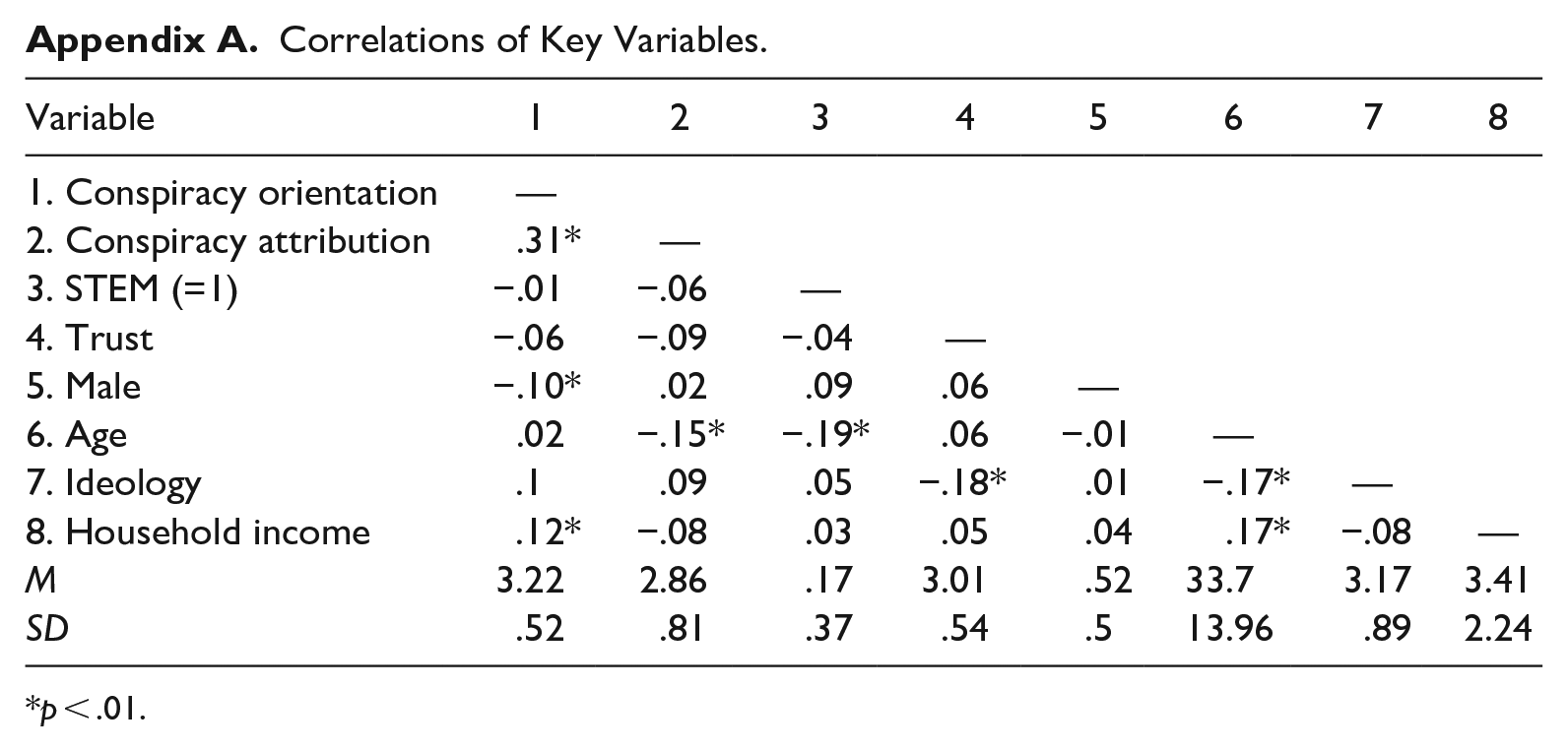
To test the hypotheses (H1–H4) and the research question (RQ1), correlation analyses for H1 and H2, t-tests for H3, analysis of variance (ANOVA) for H4 were conducted, and multiple regression model was run for RQ1. To address H3, the dataset was divided into two: the lay publics group (N = 600) and the STEM-educated group (N = 120). A key variables’ correlation matrix is presented in Appendix A.
Findings
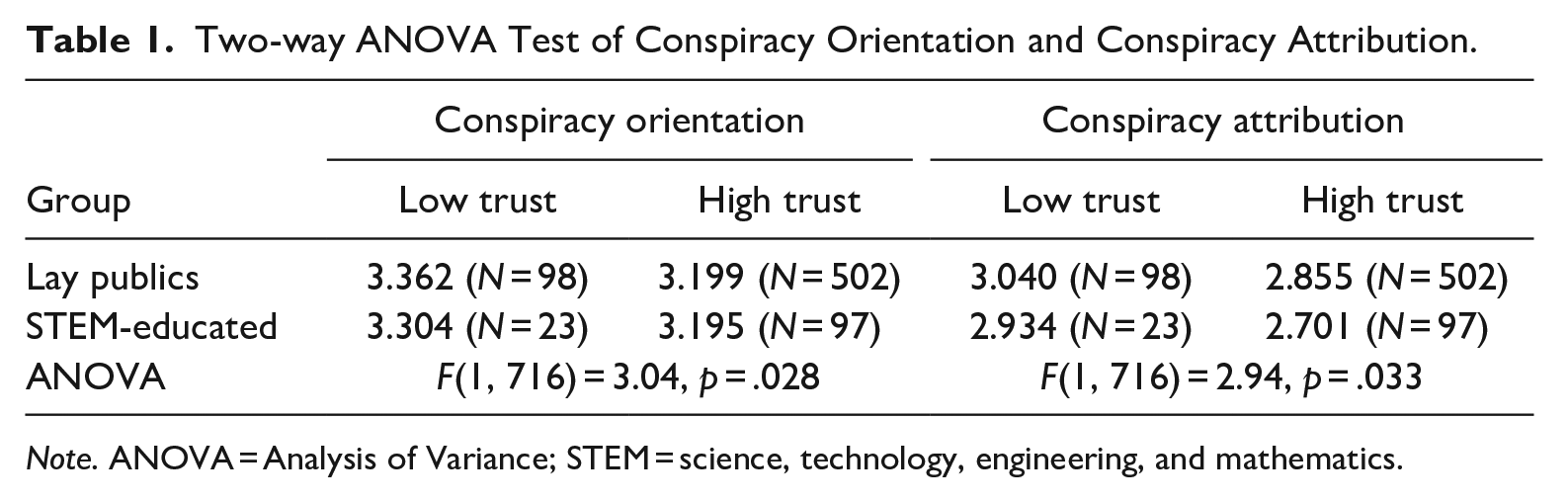
The results showed a significant positive relationship between conspiracy orientation and conspiracy attribution (γ = .317, p < .01) so H1 is supported. And trust was an important factor in diminishing individuals’ conspiracy orientation (H2a) and conspiracy attribution (H2b). The t-test comparison between low trust and high trust groups showed that two groups had a significant difference in conspiracy orientation (t = 2.984, p < .01) and conspiracy attribution (t = 2.361, p < .05). The mean values for the low trust group (conspiracy orientation = 3.35, conspiracy attribution = 3.02) were higher than the mean values for the high trust groups (conspiracy orientation = 3.20, conspiracy attribution = 2.83). However, the STEM-educated group did not show any notable difference from the lay publics group in conspiracy orientation (H3a) and conspiracy attribution (H3b). The mean value of conspiracy orientation for the STEM-educated group was 3.22, while the lay publics group had a mean value of 3.23, resulting in no significant difference (t = 0.178). The mean value of conspiracy attribution of the lay publics group (mean = 2.89) was slightly higher than the STEM-educated group (mean = 2.75), indicating a significant but weak difference (t = 1.72, p < .10). When considering trust with STEM education (H4), the high-trust group with STEM education (N = 97) had the lowest conspiracy orientation (mean = 3.195), and conspiracy attribution (mean = 2.701) while the low-trust group with no STEM education (N = 98) showed the highest conspiracy orientation (mean = 3.362) and conspiracy attribution (mean = 3.040). The 2 × 2 ANOVA test (on trust and STEM education) showed that the overall four groups’ mean differences are significant (conspiracy orientation: F(1, 716) = 3.04, p < .05, conspiracy attribution: F(1, 716) = 2.94, p < .05). In post hoc comparison test (Tukey), only the lay publics and low trust group was significantly different from the lay publics and high trust group in terms of conspiracy orientation. In the case of conspiracy attribution, only the lay publics and low trust group and the STEM-educated and high trust group had a significant difference.
Table 1 shows that there was no interaction effect between the effects of STEM education and trust levels (F [1, 716] = 0.05, p = .820) and simple main effects analysis showed that people with lower trust levels reported significantly higher conspiracy orientation and attribution (conspiracy orientation: F(1, 716) = 4.24, p < .05, conspiracy attribution: F(1, 716) = 4.07, p < .05) while STEM education did not show any main effects.
Two-way ANOVA Test of Conspiracy Orientation and Conspiracy Attribution.
Note. ANOVA = Analysis of Variance; STEM = science, technology, engineering, and mathematics.
For the final test of RQ1, multiple regression was first conducted on conspiracy orientation. The result shows that female (β = −.103, p < .05), liberal (β = .082, p < .05), and higher income earning (β = .139, p < .01) respondents had higher conspiracy orientation. After all the individual factors were controlled, the influence of trust and STEM education disappeared. For the model with conspiracy attribution, the results showed that respondents who were male (β = .064, p < .10, marginally significant), younger (β = −.155, p < .01), and had lower household income (β = −.079, p < .05) had higher conspiracy attribution. STEM education did not have any significant effects in the regression model. Furthermore, although lower trust had a marginally significant effect (β = −.063, p < .10) on higher conspiracy attribution, no interaction effects between STEM education and trust were found (Table 2). This shows that institutional trust was more powerful in influencing the model. Figure 1 shows that the STEM-educated group did not show as much of a change in conspiracy attribution even if they reported higher trust. On the other hand, the steeper slope for the lay publics group shows a greater change when higher trust was reported. The findings suggest that conspiracy orientation has a more dispositional nature (which could be explained by demographic differences) than situational conspiracy attribution (which could be explained by both trust and demographic differences).
Multiple Regression of Conspiracy Orientation and Conspiracy Attribution.
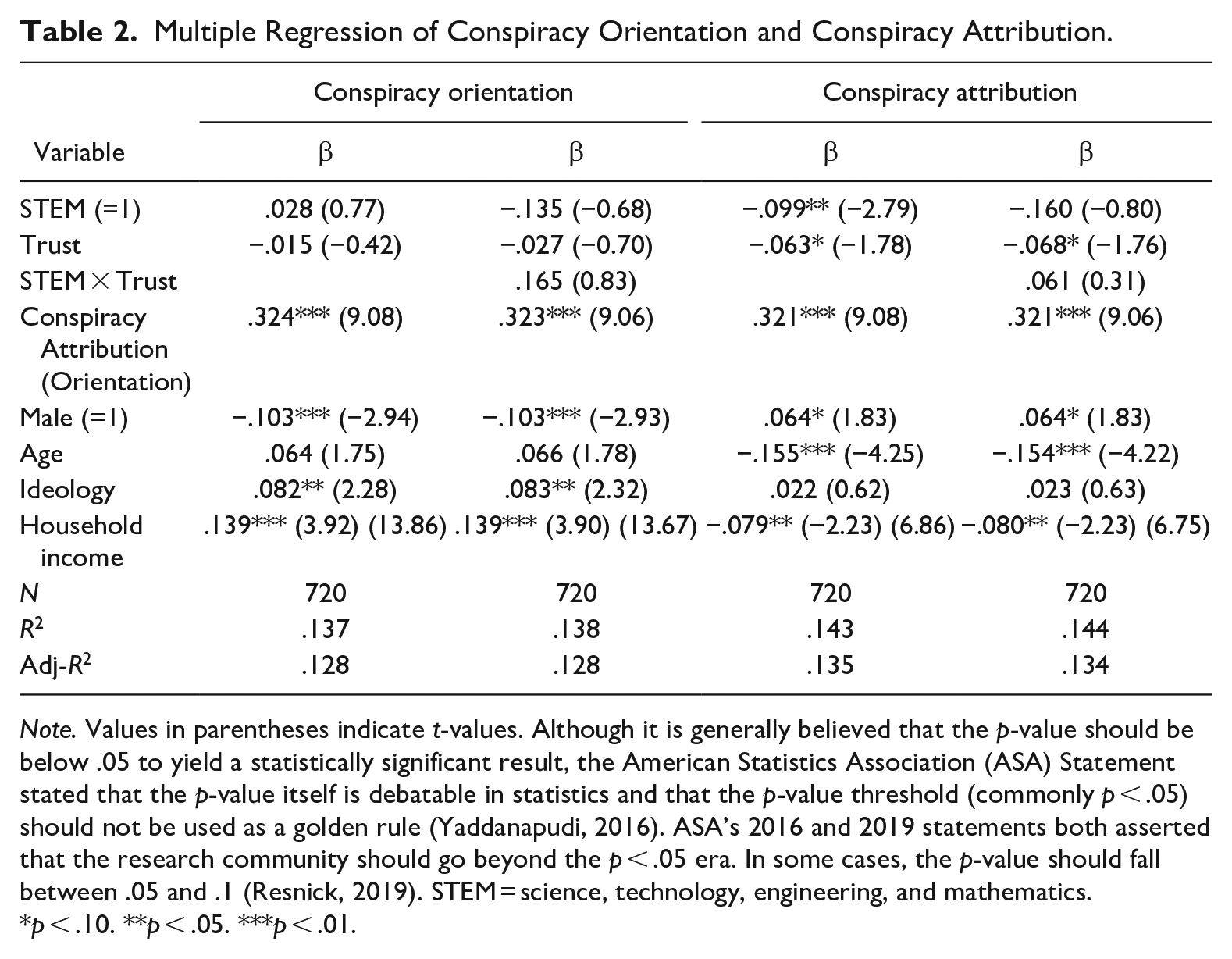
Note. Values in parentheses indicate t-values. Although it is generally believed that the p-value should be below .05 to yield a statistically significant result, the American Statistics Association (ASA) Statement stated that the p-value itself is debatable in statistics and that the p-value threshold (commonly p < .05) should not be used as a golden rule (Yaddanapudi, 2016). ASA’s 2016 and 2019 statements both asserted that the research community should go beyond the p < .05 era. In some cases, the p-value should fall between .05 and .1 (Resnick, 2019). STEM = science, technology, engineering, and mathematics.
p < .10. **p < .05. ***p < .01.
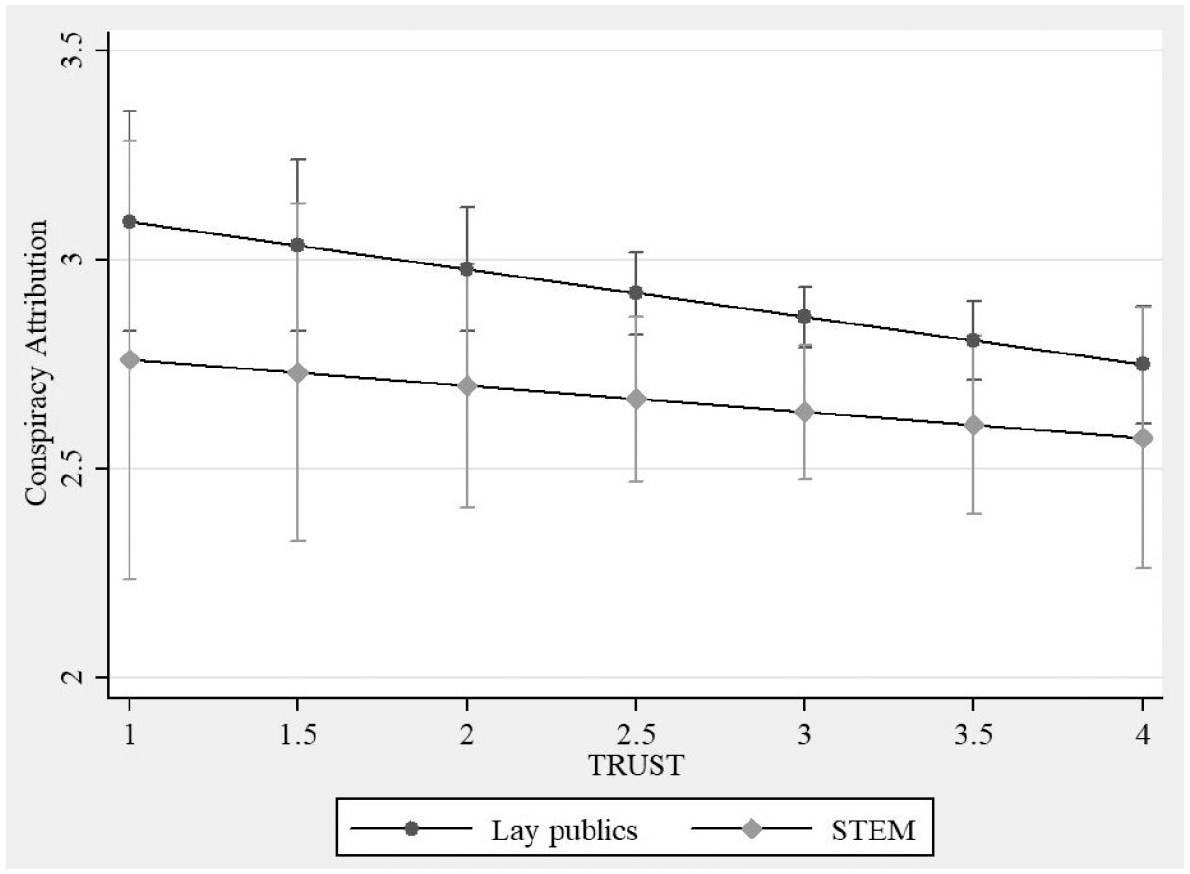
Plot showing the differences between the science, technology, engineering, and mathematics-educated group and the lay publics group in the slope of change in trust and conspiracy attribution.
Discussion
Belief in conspiracy theories is also known as “motivated reasoning” because individuals are “motivated” to seek or create rational justifications for their desired conclusions (Miller et al., 2016). Problem solvers make reversed cognitive efforts to seek evidence that supports their preferred conclusions and share evidence that reinforces their pre-existing ideas (J.-N. Kim & Grunig, 2021). This causes closed-mindedness as individuals actively search and optimize evidence to reinforce their worldviews including the conspiracy theories to which they subscribe. Some common contextual causes, such as lack of trust, cause individuals to engage in cognitive regression from drawing conclusions to finding evidence to optimize them. J.-N. Kim and Gil de Zúñiga (2021) argued that it is necessary to understand the causes and process of this phenomenon because it causes an information crisis in which individuals as “information actors” seek and share pseudo-information (p. 165).
The findings of this study provided empirical support for J.-N. Kim and Grunig (2021) and J.-N. Kim and Gil de Zúñiga (2021) conceptualizations in several ways. First, the findings validated the proposition that conspiracy orientation which explains individuals’ dispositional tendency to adopt a conspiratorial worldview for cognitive closure is significantly related to conspiracy attribution which explains individuals’ situational tendency to subscribe to conspiracy theories related to specific social affairs and issues. This supports J.-N. Kim and Grunig’s (2021) proposition that there could be a “looping causal chain” which causes individuals to continuously subscribe to specific conspiratorial beliefs as they would engage in information behaviors to optimize conspiratorial thinking (p. 235). Second, this study identified some common factors which explain the motivation to engage in such a causal chain. Specifically, the findings showed that demographic differences (i.e., female, liberal and higher household income) explained conspiracy orientation while institutional trust and demographic differences (i.e., male, younger age, and lower household income) explained conspiracy attribution. The findings pointed to the dispositional nature of conspiracy orientation such that it could be better explained by demographic differences alone. On the contrary, institutional trust still played a significant role in affecting conspiracy attribution which is characterized by belief in conspiracy theories in situational issues. This confirms the view that trust in institutions which are often also the powerful decision makers behind the issues and the sources of information about those issues could work to counter conspiracy theories. Retrospectively, when one trusts the institutions, he or she also trusts them as sources of information and decision-makers behind the issues. Lastly, the demographic differences tested also showed consistent and contradictory findings compared to existing studies. For example, consistent with existing studies, age has a negative association with belief in conspiracy theories (e.g., Galliford & Furnham, 2017; Hart & Graether, 2018). However, this study found that females reported higher conspiracy orientation but males would report higher conspiracy attribution (e.g., Hart & Graether, 2018). Income was also found to have a negative association with conspiracy attribution (e.g., van Prooijen, 2017) but a positive relationship with conspiracy orientation. Political ideology showed no significant difference in conspiracy attribution but in conspiracy orientation (e.g., Hart & Graether, 2018). But it should be noted that the differences in the findings could be caused by the differences between the South Korean population (reflected in this study) and the U.S. population (reflected in most existing studies) in terms of the latter’s greater tendency to report bi-partisan affiliations (e.g., Miller et al., 2016).
To respond to J.-N. Kim and Gil de Zúñiga (2021) query, the findings from this study indicate that it is hard to derive a definite set of factors that can explain the conspiratorial thinking of information actors who contribute to pseudo-information. Some cross-situational demographic factors could be used to explain conspiracy orientation. However, for conspiracy attribution, it could depend on institutional trust as well as situational factors. Individuals who are affected by a problematic situation are likely to attribute the situation to conspiracies as a simple explanation to a complex situation in order to psychologically cope with the uncertainty and fear arising from the situation (van Prooijen & Douglas, 2017). These situational factors could also affect or could be affected by institutional trust. As van Prooijen and Douglas (2017) argued, problematic events, which trigger feelings of uncertainty and fear in individuals, could instigate processes of sense-making, resulting in conspiracy attribution. This conspiracy attribution could be further explained by individuals’ low institutional trust in the powerful organizations and individuals who are involved in the problematic situations.
Conclusion
The causes and cures for the rise and spread of conspiracy theories require examination into the common and distinctive underlying factors which explain conspiratorial thinking. This study shows that the profiles of conspiratorial publics could be explained by their effortless transition from (dispositional) conspiracy orientation to (situational) conspiracy attribution and by their differences in trust, education, gender, age, ideology, and household income. This reaffirms the view that there is no one set of formulas that can explain the underlying traits of conspiratorial publics (Hogenboom, 2018). There is no one set of common factors that could explain conspiratorial thinking in all situations and that there could be distinctive factors in certain situations. For example, demographic differences could explain (dispositional) conspiracy orientation while institutional trust is a significant predictor of (situational) conspiracy attribution. And the demographic differences which explained the two types of conspiratorial thinking are different. Depending on the situations or issues, the conspiracy theories used to explain them could be constructed and spread by different groups of individuals who are motivated to retrospectively find evidence to support their preferred conclusions.
Limitations and Future Directions
This study has several limitations. First, because the sample was collected in South Korea, it is possible that the findings were only applicable to South Korea. Further studies should be conducted to explore the effects of trust and demographic differences on conspiratorial thinking in other countries. Second, the sample size for the STEM-educated group (N = 120) was relatively smaller than the lay publics group, and a bigger sample size representative of the STEM-educated population may yield different results. Third, quota sampling was not used in this study so the sample may not be representative of the census data. Also, although it is possible that political factors such as the political party in power could affect some variables such as political ideology, individuals’ support, or lack of support for the political party in power at the time of data collection was not examined. Fourth, while the main purpose of this study was not to test the distinction between conspiracy orientation and conspiracy attribution, future studies should explore this. Lastly, although the survey items used to create the composite index for institutional trust were developed based on the two issues tested for conspiracy attribution, the institutions included in the items were not involved in the issues tested for conspiracy orientation. And such a composite index for institutional trust could only be applied to specific institutions related to the conspiracy theories surrounding the issues tested but not all issues. Thus, further studies could measure institutional trust at two levels: general trust for all institutions and specific trust for institutions involved in the situations tested.
Footnotes
Appendix
Correlations of Key Variables.
| Variable | 1 | 2 | 3 | 4 | 5 | 6 | 7 | 8 |
|---|---|---|---|---|---|---|---|---|
| 1. Conspiracy orientation | — | |||||||
| 2. Conspiracy attribution | .31* | — | ||||||
| 3. STEM (=1) | −.01 | −.06 | — | |||||
| 4. Trust | −.06 | −.09 | −.04 | — | ||||
| 5. Male | −.10* | .02 | .09 | .06 | — | |||
| 6. Age | .02 | −.15* | −.19* | .06 | −.01 | — | ||
| 7. Ideology | .1 | .09 | .05 | −.18* | .01 | −.17* | — | |
| 8. Household income | .12* | −.08 | .03 | .05 | .04 | .17* | −.08 | — |
| M | 3.22 | 2.86 | .17 | 3.01 | .52 | 33.7 | 3.17 | 3.41 |
| SD | .52 | .81 | .37 | .54 | .5 | 13.96 | .89 | 2.24 |
p < .01.
Declaration of Conflicting Interests
The author(s) declared no potential conflicts of interest with respect to the research, authorship, and/or publication of this article.
Funding
The author(s) received no financial support for the research, authorship, and/or publication of this article.