




Abstract
We use a unique, nationally representative, survey of UK social media users (n = 2,005) to identify the main factors associated with a specific and particularly troubling form of sharing behavior: the amplification of exaggerated and false news. Our conceptual framework and research design advance research in two ways. First, we pinpoint and measure behavior that is intended to spread, rather than correct or merely draw attention to, misleading information. Second, we test this behavior’s links to a wider array of explanatory factors than previously considered in research on mis-/disinformation. Our main findings are that a substantial minority—a tenth—of UK social media users regularly engages in the amplification of exaggerated or false news on UK social media. This behavior is associated with four distinctive, individual-level factors: (1) increased use of Instagram, but not other public social media platforms, for political news; (2) what we term identity-performative sharing motivations; (3) negative affective orientation toward social media as a space for political news; and (4) right-wing ideology. We discuss the implications of these findings and the need for further research on how platform affordances and norms, emotions, and ideology matter for the diffusion of dis-/misinformation.
The spread of misleading and false information online presents liberal democracies with at least two distinctive challenges (Jack, 2019). There are epistemic problems, as norms guiding public communication, such as verifiability and authenticity, start to erode. And there are civic problems, because citizens’ engagement in dis-/misinformation is, in itself, a performative contradiction of the ideals of authentic deliberation, equality of voice, and expression free from manipulation. Widespread and routine sharing of false information by substantial numbers of social media users is both a symptom and an accelerator of an emerging online culture of distrust and cynicism (Chadwick, 2019; Jones-Jang et al., 2020; Kim & Gil de Zúñiga, 2020; Vaccari & Chadwick, 2020). It brings into view dysfunctional norms of public communication, such as when individuals see legitimate political action as a matter of deceiving others, or of undermining the epistemic integrity of good evidence and of reason-giving itself. It involves the sowing of division and the erosion of trust in spaces where citizens can reasonably engage with each other, agree on basic definitions of truth and falsehood, have meaningful discussions, and solve important social and political problems. Hence, it is important to understand the individual-level factors that affect the spread of dis-/misinformation.
People, Platforms, Motivations, and Attitudes
The field of online dis-/misinformation studies is blossoming (Weeks & Gil de Zúñiga, 2019). Research to date has foregrounded changes in news ecosystems (e.g., Benkler et al., 2018), automation in the spread of disinformation (e.g., Howard, 2020), the attitudinal and cognitive mechanisms that enable rumors to spread and hamper attempts at correction (e.g., Berinsky, 2017), and the ways in which different social media affordances help debunk false claims (e.g., Bode & Vraga, 2015). There is still much to explain about why people engage in behavior that circulates false or misleading information on social media.
In this study, we focus on the amplification of false or misleading information, which we define as the sharing of exaggerated or false news without seeking to correct inaccuracies in the news. The spread of false messages on social media ultimately must rely on the behaviors of large numbers of individuals, who, in their everyday interactions, decide to amplify, correct, or ignore content (Bode & Vraga, 2018; Chadwick & Vaccari, 2019; Donovan & boyd, 2019). It is crucial to identify and explain different news sharing behaviors and, in particular, to differentiate between the correction and the amplification of false or misleading information.
To address this challenge, our first research question (RQ1) asks how common is the amplification of false or misleading news—a previously unmeasured behavior: Among UK social media users, how prevalent is the amplification of exaggerated or false news?
We develop theory about four factors that may potentially explain amplification: use of specific digital platforms, motivations in sharing news online, affective orientations to news on social media, and ideology.
Different Platforms, Different Blends of Affordances, and Different Norms
To date, much research about online mis-/disinformation has focused on the role of Facebook or Twitter in isolation (e.g., Allcott & Gentzkow, 2017; Guess et al., 2020). While these platforms are important, they are by no means the only ones that matter for public news consumption and sharing. Of the four platforms we study here, in 2020 Facebook had 2.5 billion users worldwide, but YouTube had 2 billion and Instagram 1 billion—far more than Twitter which had 340 million users (We Are Social, 2020). About 46% of Internet users across the world use Facebook for news, but 27% use YouTube, 13% use Instagram, and 11% use Twitter (Reuters Institute for the Study of Journalism, 2020). The diversity of platforms raises an important question that has sometimes formed the backdrop to public debate about dis-/misinformation but remains inadequately researched: is it the case that some platforms play more important roles than others in enabling the spread of misleading and false information?
Thinking about the role of specific platform use in the spread of dis-/misinformation recognizes that many people now use multiple platforms and tend to compartmentalize their usage based on how their motivations and goals converge with platform affordances. Here, we define affordances as the possibilities for action that a technology enables. Affordances are co-determined by users, features of the technology, and the outcomes of usage (Evans et al., 2016). An expansive conceptualization of social media affordances incorporates not only the actions that social media enable, but also how users imagine and understand the functioning of platforms and the social structures and relationships that are constituted as a result (Bucher & Helmond, 2017).
The literature offers various classifications of social media affordances (Bucher & Helmond, 2017) and the concept’s implications for mis-/disinformation have only recently begun to be explored (Bimber & Gil de Zúñiga, 2020). All four platforms we study here allow users to connect with others, to publish textual and audiovisual content, and to access, comment on, express approval of, and share content posted by others. However, they also differ in other important ways. A useful approach to elucidating these differences is the “Modality-Agency-Interactivity-Navigability” (MAIN) model (Sundar, 2008), which has recently been partly updated to explore how cues and cognitive heuristics may lead users to believe or share falsehoods (Molina & Sundar, 2019). We build on this framework to identify theoretically relevant differences in the affordances of Facebook, Instagram, Twitter, and YouTube. We expand the MAIN model, however, by discussing an additional affordance: ephemerality (Bayer et al., 2016), which is also relevant to the spread of problematic information but has not been much considered in this context.
Modality entails whether content is presented as visual, aural, textual, or a combination of these. Visual content can invoke the “realism heuristic” that leads people to treat images as more “representative” and therefore more “truthful” than text (Sundar, 2008; Vaccari & Chadwick, 2020). Instagram and YouTube deliberately prioritize audiovisual content. To the extent that audiovisual content that is false, manipulated, and taken out of context may be more persuasive and shareable than text-only content, it may spread more easily on Instagram and YouTube than on Facebook and Twitter. Instagram, in particular, occupies an ambiguous position as a site for the construction of “authentic” visual representations, because so much of the most viral material on the platform is highly stage managed and promotional (Zulli, 2018).
Agency refers to the identity of the source of information and the clarity with which users can identify it. All social media pose challenges in this regard because they juxtapose a panoply of different sources that have varying degrees of professionalism, authenticity, and social responsibility (Thorson & Wells, 2016), and this makes it complicated to identify what can be trusted. The four platforms we study in this article did not differ substantially in this regard when we collected our data.
Interactivity comprises opportunities for active engagement with, and production of, content. Interactivity can give users the impression of self-empowerment and the feeling of reciprocity in the co-production of meaning. These can enhance the credibility of misleading information and lead people to share it just to be seen to be contributing to the discussion (Duffy et al., 2020). All four platforms we consider here enable users to comment on others’ posts in various ways and showcase these comments to other users, so the generally rich affordance of interactivity across the platforms should have similar implications for the amplification of mis-/disinformation.
Navigability entails the ability to move around digital spaces and to discover information. When users are presented with personalized messages, either as a result of a keyword search or through algorithmically curated features that highlight content matching their preferences, they are more likely to believe this information to be relevant and valuable (Molina & Sundar, 2019). The platforms we study all aim to enhance navigability by providing internal search engines, algorithmically curated news feeds, and hashtags, but Instagram and YouTube arguably feature the most powerful navigability affordances. On Instagram, the “Explore” tab shows images and videos from both users one follows and users one does not follow, based on a combination of the user’s location, the content she has engaged with, and her algorithmically inferred preferences. On YouTube, additional videos are auto-suggested on the right-hand side and a new recommended video starts playing automatically at the end of the one being watched. These designs make it more complex to judge the quality of information, while giving users the impression that content has been tailored to their needs. When false information is accessed under these conditions, users might find it more credible, or at least they may be less preoccupied with its quality.
Finally, ephemerality is an increasingly relevant affordance of social media. It enables users to share messages that disappear after a short period of time (usually one day, or upon reception). Although ephemerality provides some privacy protections for users (Lane et al., 2018), it also poses substantial challenges to the authenticity of public discourse (Bernstein et al., 2011). When users post ephemeral messages, they may feel less bounded by norms of honesty and fairness, because they may be less likely to be held accountable in the future. Journalists and fact-checkers also have much less time to identify and debunk ephemeral messages. In 2016, Instagram launched “Stories,” whereby users post photos or videos that are only available for 24 hours. About a year later, Facebook implemented a similar function, also named “Stories”; in 2020 Twitter followed, with what it called “Fleets.” At the time of our data collection (July 2018), only Facebook and Instagram offered ephemerality affordances and Instagram’s version of “Stories” had a head start of almost a year on Facebook’s, which likely made it more salient for its users.
In sum, at the time of our data collection, Instagram and YouTube stood out relative to the other platforms, due to the greater emphasis they placed on audiovisual content and for their strong content discovery functions. In addition, Instagram and, to a lesser degree, Facebook also enabled users to communicate ephemeral messages.
Over time, regular activation of affordances can shape behavioral norms. Online, many subnetworks, and communities have distinctive norms, which people readily recognize and talk about (Duffy et al., 2020; Lane et al., 2018). An experimental study by Effron and Raj (2020) demonstrated that the more people are exposed to false headlines, the more they consider it ethical to share them, even when they are clearly labeled as false. Norms are relational. They do not deterministically cause behavior but they constrain and enable it. Expectations about what is considered “appropriate” and “acceptable” can also evolve over time: norms are not fixed forever but must be carefully examined.
When considering how affordances and norms relate to sharing dis-/misinformation, it is important to focus on behavior proximate to the sharing of political content. Thus, here we assess the role of platform use for political news. Using a platform frequently to get political news is more likely to implicate an individual in the affordances and norms conducive to the sharing of dis-/misinformation. In the absence of prior research on this topic explicitly comparing how usage of different platforms relates to sharing dis-/misinformation, we ask a second research question (RQ2): is using particular social media platforms for political news associated with an increase in the likelihood that a user will amplify exaggerated or false news?
Motivations
Social media use relies to a large extent on individual choices. As discussed in the previous section, different platforms combine a variety of affordances, but it is users who choose whether to use a platform, and how to use it. Therefore, news sharing on platforms will, to some extent, be shaped by individual motivations.
Approaches to motivations in existing mis-/disinformation research vary. Some studies measure the impact of general attitudes or beliefs, rather than motivations specifically oriented to sharing online. Researchers have begun to learn about some motivations, such as disrupting debate or spreading hostility, that have grown online but have ambivalent relationships with liberal democratic ideals of citizenship (e.g., Petersen et al., 2020). Studies have also started to move beyond general accounts of why people share information and toward explanations of how specific motivations may lead people to share different types of information with specific goals in mind, including misleading others, trolling, or undermining the foundations of debate. For example, Chadwick et al. (2018) found that an “entertaining/trolling” motivation “to disrupt the rationality and veracity” of political discussion explained some of the sharing of disinformation on social media.
In sum, research on users’ motivations for sharing problematic information on social media has uncovered various potentially relevant factors, but a systematic and generalizable account of the motivations that matter is lacking. Hence, Metzger and colleagues (2021, p. 7) invited “future research [. . .] to establish baseline data on the wide range of motivations invoked by those sharing misinformation.” We answer this call by assessing how specific motivations for news sharing explain the amplification of false or misleading information. Thus, our third research question (RQ3) is: what motivations for sharing news on social media are associated with the amplification of exaggerated or false news?
Affective Orientation to News on Social Media
Affect plays an important role in news sharing on social media. Messages that elicit strong emotions are more likely to be shared (Kümpel et al., 2015). However, most prior research focuses on specific emotions triggered by particular types of messages, rather than on general affective orientations that different users have toward news and the environments through which they acquire it. Some empirical evidence is now emerging about the role of overtly hostile, “anti-system,” attitudes in the spread of dis-/misinformation (Petersen et al., 2020). However, affect can also be directed toward a media source or a communication environment. Little research of this kind exists in relation to mis-/disinformation and social media sharing. Most studies have highlighted the importance of negative emotional statuses in the cognitive and behavioral response to specific political messages. For example, Weeks (2015) found that citizens who experience anger tend to process misinformation in ways that reinforce their partisan identities. Shin and Thorson (2017) found that, on Twitter, factchecks favorable to one political party were more likely to receive hostile comments from supporters of the rival party.
Yet these studies highlight the role of transient, message-specific, emotional responses. We suggest that these short-term affective statuses can, over time, and in conjunction with personality traits and political attitudes, solidify into relatively stable and enduring affective orientations that systematically shape how individuals conduct themselves in specific communication environments. We propose that one such durable affective orientation may be particularly relevant to the amplification of mis-/disinformation: negative emotions toward political content on social media. A consolidated negative affective orientation toward politics on social media may mean that a person has fewer qualms about circulating misleading or false information. It may have a destructive aspect that stems from hostility or cynicism—a desire to further “poison the well.”
Thus, we test the following hypothesis (H1): negative affective orientation toward political news on social media will be positively associated with the amplification of exaggerated or false news on social media.
Ideology
Finally, we consider whether the amplification of mis-/disinformation on social media aligns with specific ideologies. The strategic dissemination of false information has become a central weapon for right-wing political actors across liberal democracies (Bennett & Livingston, 2018), though it has also been observed that firm empirical evidence for an ideological divide is sparse (Freelon et al., 2020). If such a divide exists, it would have profound implications for democracy. If mis-/disinformation distorts electoral outcomes by disproportionately favoring one political side, it might affect key policy outcomes on issues such as income inequality, climate change, public health, immigration, and civil rights, among others. It may also be used by those who lose democratically held elections to incite supporters to reject the results, as was the case immediately after the 2020 US Presidential election.
There is some evidence from the United States and European contexts that conservative beliefs play a role in the sharing of problematic information. Grinberg et al. (2019) and Guess et al. (2019) found that, during the 2016 US presidential campaign, conservatives were substantially more likely to share from a list of known “fake news” sites than citizens on the left and in the center. There is also some evidence that belief in fabricated news is linked with voting for right-wing populist parties (Zimmermann & Kohring, 2020). Yet none of these studies explain the amplification of mis-/disinformation, as we do here.
With these considerations about challenges to democracy in mind, but also in the context of little existing empirical research, we ask a final research question (RQ4): is right-wing ideology positively or negatively associated with the amplification of exaggerated or false news on social media?
Research Design, Data, and Method: A Focus on Amplification
We designed a survey questionnaire and asked a UK national polling company, Opinium Research, to administer it. Random sampling of panel recruits was based on quotas for age, gender, and region of residence. Information on the characteristics of the sample and comparisons with the British population are available in Supplemental Appendix A1. 1 The participation rate was 32.8%; the median time for completion about 9 minutes. The survey ran July 5–16, 2018. Respondents who said they never use at least one of the four most popular digital media platforms in the UK (Facebook, Twitter, Instagram, and WhatsApp) were immediately screened out of the survey, leaving an overall sample size of 2,005 social media users. Next, we identified people from among this sample who had shared news about politics on social media by asking: “Some people like to share news about politics on social media. Over the last month, approximately how often did you share news on social media?” Responses could range from 1 = “never” to 6 = “more than once a day.” Only those 589 respondents who reported sharing political news on social media at least once in the past month were presented with our key questions about amplifying misleading or false news. 2
Outcome Variable: Amplification of Exaggerated or False News
As discussed, we define amplification as the sharing of exaggerated or false news without seeking to correct inaccuracies in the news. Substantial empirical challenges confront large-scale empirical research on why people share mis-/disinformation on social media. One approach has involved identifying false information and using digital trace data to see how it spreads (e.g., Guess et al., 2019; Vosoughi, et al., 2018). Another approach has involved asking people if they were aware of a specific false statement and shared it (e.g., Valenzuela et al., 2019). The challenge here is that the variety of possible information and sharing behaviors is complex (Molina et al., 2019). How can we know when a person shares false information, not because they want to amplify it, but because they want to criticize it and draw attention to it, in the hope of reducing its impact? This can be addressed empirically. Survey research, despite its limitations, can make a valuable contribution.
We integrated these ideas into our survey questionnaire. We began by building upon a question used in previous studies (Barthel et al., 2016; Chadwick & Vaccari, 2019; Chadwick et al., 2018; Rossini et al., 2020): “Sometimes people might share news on social media that turns out not to be fully accurate or is exaggerated. In the past month, do you recall sharing a news story that. . .” Respondents could choose from: “seemed accurate at the time, but you later found was made up” (scored 1); “was exaggerated, and you were not aware of this” (scored 2); “was exaggerated, and you were aware of this” (scored 3); “you thought was made up when you shared it” (scored 4); or “none of the above” (scored zero). Following Chadwick et al. (2018), we rank-ordered these responses to create a scale ranging from less problematic to more problematic sharing, based on variations in an individual’s stated intentions, how conscientious they were in finding out if the news they shared was accurate, and whether they shared news that was exaggerated or completely fabricated. The scale ranges from not having shared any exaggerated or false news (0), through to having shared false news in full awareness of its falsity (4). 3
To establish whether the sharing was amplification and not an act of drawing attention to problematic information to correct inaccuracies, we followed up by asking those who said they shared exaggerated or false news: “When you shared such news, did you provide information to correct inaccuracies in it, or did you simply share the news as it was?” Respondents could then choose between “I provided information to correct inaccuracies in the news” and “I shared the news as it was, without correcting it.” 4 When a respondent said they shared to correct inaccuracies, we recoded their response about sharing mis-/disinformation to zero. After all, these were not cases of amplification. In contrast, when an individual said they shared news simply as it was, we retained the scores from their answers to the previous question. This means that our analysis is based on a precise classification of amplification.
Explanatory Variable I: Using Social Media Platforms for Political News
Our first set of explanatory variables is the frequency with which people use specific social media platforms for getting news about politics. Since we were interested in public news sharing, our survey asked about this for the four most popular public social media platforms in the UK: “How often do you turn to each of the following for getting political news?: Facebook, Twitter, Instagram, YouTube.” Responses ranged on a 5-point scale for each platform where 1 = “never,” 2 = “at least once a month,” 3 = “at least once a week,” 4 = “every day,” and 5 = “more than once a day.” We entered each of these four variables separately in our models.
Explanatory Variable II: Motivations for Sharing News on Social Media
We asked participants who said they shared political news in the past month how relevant the following motivations were for them when they shared news: to inform others, to influence others, to provoke discussions, to find out other people’s opinions, to express feelings, to upset others, to please others, to feel like they belong to a group, to entertain others, and to demonstrate knowledge. For each item, responses ranged from 1 (“not important at all”) to 4 (“very important.”)
A principal component analysis (PCA) revealed that these motivations clustered into two clear factors (see Supplemental Appendix A2a). One factor is what we term civic-deliberative motivations. People who scored high on this factor want to provide political information for others, foster the exchange of ideas, and learn about the opinions of others. The other factor is what we term identity-performative motivations. People high on this factor want to affirm their identity by displaying their group allegiances and demonstrating knowledge, but they also seek attention from others, including by provoking them. These motivations relate to some core themes in research about online mis-/disinformation. Those who share news to increase their sense of group belonging are less likely to see social media as an opportunity to learn from others and bridge political divisions. They are more likely to see their sharing as a way to advance their in-group’s identity rather than openly engage with out-groups (Kahan, 2013). Those who share news to entertain others may use humor to generate attention, but also be less careful about the truthfulness of what they share (Chadwick et al., 2018). Lastly, the conscious motivation to upset others, while important for cutting through a cluttered media environment, might also reveal a tendency toward weaker adherence to norms of evidence and reason-giving.
Explanatory Variable III: Affective Orientation Toward Political News on Social Media
Respondents’ affective orientation toward political news on social media was assessed using the English Positive and Negative Affect Scale (PANAS) (Watson et al., 1988). The full PANAS contains 20 adjectives capturing positive and negative emotions. To avoid overburdening respondents, we selected three adjectives from each group, chosen in equal number from those Watson and colleagues identified as the most statistically valid. Our survey asked: “In general, when you think about reading political news on social media, how do you feel?” The positive states were as follows: “enthusiastic,” “inspired,” and “excited”; the negative states were “ashamed,” “upset,” and “hostile.” Response modes were as follows: “Very slightly or not at all” (coded as 1), “A little” (2), “Moderately” (3), “Quite a bit” (4), “Very much” (5), and “I don’t know.” We performed a PCA and, as expected, the results revealed two clear factors for positive and negative affect among our respondents (see Supplemental Appendix A2b).
Explanatory Variable IV: Political Ideology
Respondents placed themselves on a 7-point scale (1 = “left,” 7 = “right”). The distribution of ideological preferences was evenly balanced, both in our overall sample and in the subset of news sharers. Table A3 in the Supplemental Appendix shows that both resemble a classic bell-curve distribution.
Control Variables
We included a number of control variables that theoretically relate to the amplification of misleading information: gender, age, educational attainment, political interest, internal political efficacy, recalled exposure to inaccurate political news on social media in the past month, trust in politicians, and trust in journalists. To assess a potential confounder for negative affective orientation to news on social media, we also controlled for trust in political news on social media (Facebook, Twitter, and Instagram, which we combined into an index; α = .85).
Results
As Table 1 shows, a third (33.8%) of UK social media users who shared news in the past month amplified exaggerated or false news (RQ1). This amounts to a tenth (9.9%) of all UK social media users—a substantial minority, especially if one considers social desirability bias in a survey and how strictly we defined amplification. Respondents most often amplified content that they said they were not aware was exaggerated when they amplified it. This was the case for 14.8% of all those who shared political news. It at least implies that the person later found out, even if the act of amplification at the time was not aimed at correcting the exaggeration. However, the more problematic behavior was also evident: 7.6% of sharers said they knowingly amplified made-up news.
Frequency of Political News Sharing and Frequency of Sharing That Amplifies False or Exaggerated News.
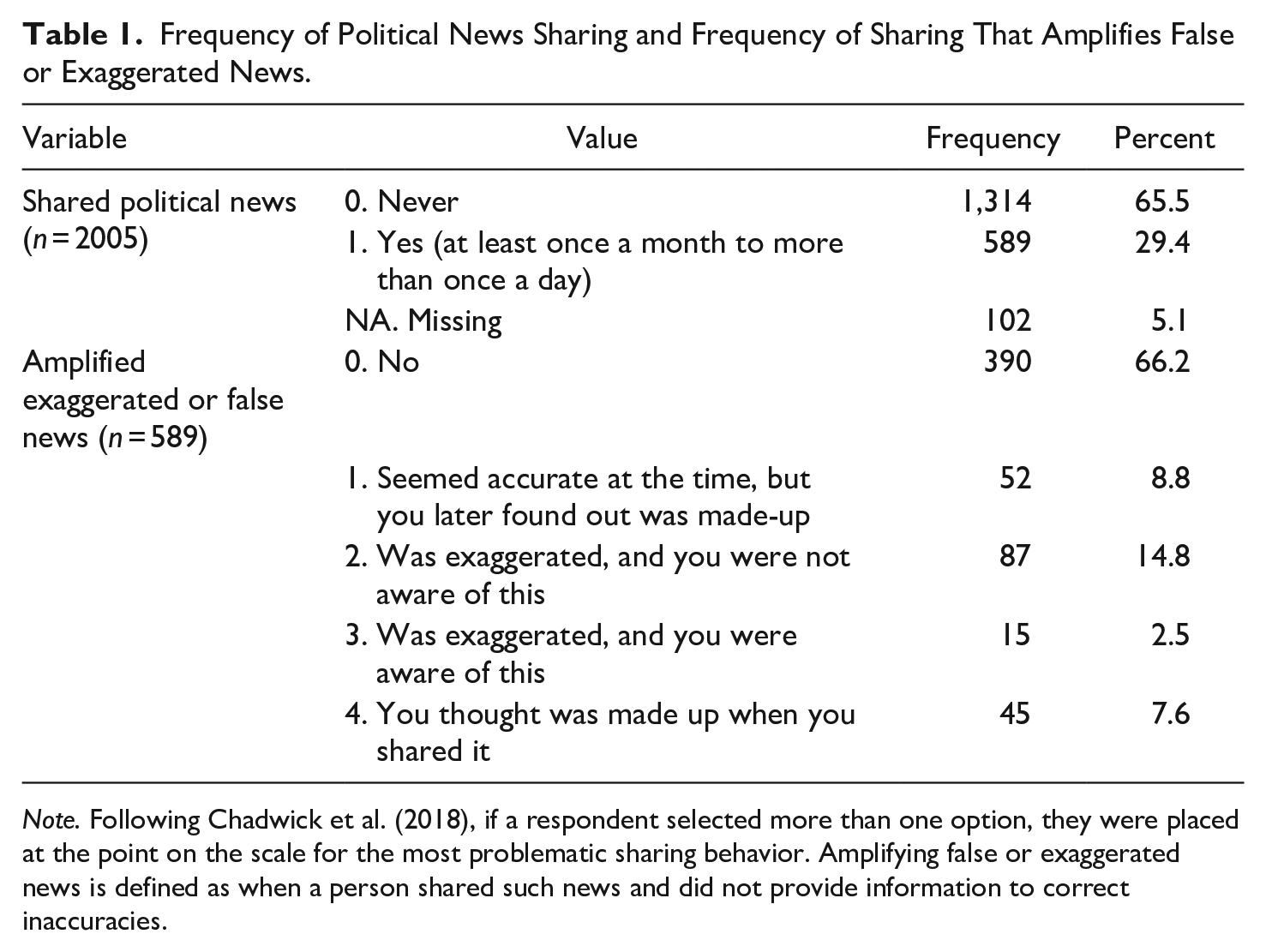
Note. Following Chadwick et al. (2018), if a respondent selected more than one option, they were placed at the point on the scale for the most problematic sharing behavior. Amplifying false or exaggerated news is defined as when a person shared such news and did not provide information to correct inaccuracies.
To understand what explains amplification, we ran an ordered logistic regression with amplification as the outcome variable predicted by the explanatory and control variables. To avoid loss of statistical power and biases due to listwise deletion, we imputed any missing values for all independent and control variables. Table 2 displays the results of this analysis, pooled over the five imputed datasets.
Ordered Logistic Regression Predicting the Amplification of Exaggerated or False News.
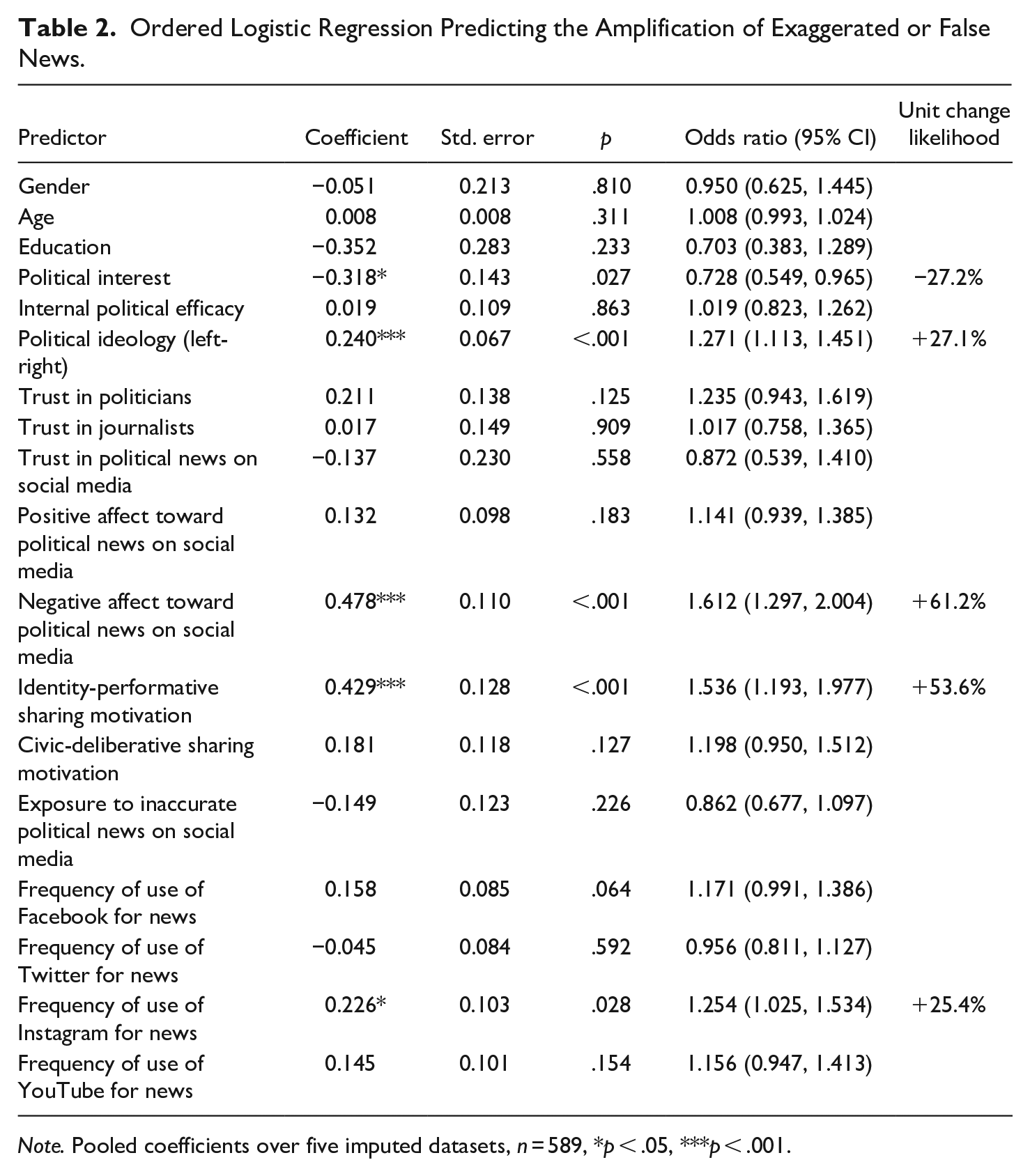
Note. Pooled coefficients over five imputed datasets, n = 589, *p < .05, ***p < .001.
The likelihood of more problematic amplification behavior increases significantly the more frequently respondents use Instagram for news. As indicated by the odds ratio, a one-unit change in the use of Instagram for news leads to a 25.4% greater probability that a person will score higher on our amplification scale. In contrast, the relationship is not significant for Facebook, Twitter, or YouTube. Thus, more frequent use of Instagram for political news increases the likelihood that a social media user will amplify exaggerated or false news on UK social media (RQ2). 5
Table 2 also shows that those with identity-performative motivations for sharing news, such as the desire to upset others, please others, or feel a sense of group belonging, are more likely to amplify exaggerated or false news (RQ3). The strength of the relationship is substantial: the likelihood of scoring higher on the amplification scale increases by 53.6% for each one-unit increase in the scale for identity-performative motivations. The relationship involving political-deliberative motivations is not statistically significant.
Right-wing ideology is also associated with the amplification of exaggerated or false news (RQ4). The likelihood of scoring higher on the amplification scale increases by 27.1% for each scale-point shift from left to right.
Finally, the data support our hypothesis that, in the UK, negative affective orientation toward political news on social media predicts the amplification of exaggerated or false news (H1). For each one-unit increase in negative affect, the probability of scoring higher on the amplification scale increases by 61.2%. The relationship with positive orientation toward news on social media is not statistically significant.
Discussion: New Findings and New Questions in the Study of Mis-/Disinformation
Our analysis shows that using Instagram for political news makes it more likely that a UK social media user will amplify problematic information. This is a behavior that involves one-third of UK news sharers. Other factors we found explain amplification are identity-performative motivations, negative emotions toward news on social media, and right-wing ideology.
Although our research design cannot fully disentangle the role played by discrete social media affordances, our results highlight the importance of studying the spread of mis-/disinformation across platforms and as a multi-platform phenomenon, which is only possible when research designs embrace multiple digital environments. Among the four platforms we studied, Instagram’s strong emphasis on visual modality, its distinctive navigability affordances, and its early introduction of ephemerality suggest that these may play a role in enabling the amplification of false or misleading content. In light of this finding, Instagram’s omission from the explanatory research on mis-/disinformation to date is somewhat puzzling (though see Vraga et al., 2020). Instagram’s role needs to be taken more seriously and it goes beyond the evidence that the Russian Internet Research Agency ran disinformation campaigns on the platform during the 2016 US general election (DiResta et al., 2018). Careful management of stylized visual aesthetics could play a particularly important role (Kohn, 2017). A US study found that political campaigns’ Instagram posts contain even less policy content than traditional campaign TV ads (Hiaeshutter-Rice, 2020). In light of our results, further research should examine how norms of sharing are cultivated and activated on Instagram, and how these norms relate to the affordances of visual modality, navigability, and ephemerality. For example, future research could integrate content analysis with surveys and examine whether Instagram disproportionately attracts individuals who hold norms conducive to the amplification of mis-/disinformation, whether the platform’s affordances inculcate those norms among its users, or whether both factors are in play. It could be that norms of the promotional culture typical of Instagram reduce the informational quality of the kinds of political information supplied on the platform by media and political actors. Our remarks here require further empirical inquiry.
Our analysis has also revealed that identity-performative motivations and negative affective orientations toward political news on social media are important explanatory factors in the amplification of exaggerated or false news. These findings confirm part of our theoretical discussion that identity protective cognition (Kahan, 2013), provoking emotional reactions in others (Chadwick et al., 2018), and hostility toward social media as a space for politics lead people to amplify mis-/disinformation on social media. We contribute distinctive new knowledge in this study by showing that negative affective orientation toward a specific media environment can make a difference, particularly to the most destructive forms of sharing.
Finally, we have provided new evidence, and from outside the United States, that people on the ideological right are more likely than those in the center and on the left to share exaggerated or false news. It is important to bear in mind that, in this study, we devised a survey instrument that mostly measured amplification as a strategic, purposive behavior. Our questions gave respondents the opportunity to report that they had at least bothered to determine at some later stage that the news they amplified was problematic. But we could still identify with precision that those who amplified mis-/disinformation did not seek to correct what they shared. This suggests a need to think beyond the idea that conservatives may be more likely to be deceived by mis-/disinformation or may be cognitively more vulnerable to misperceptions, due to dogmatism, “cognitive rigidity,” or the need for “cognitive closure,” for example (Jost et al., 2018). These psychological mechanisms may be more convincing for explaining belief in, rather than purposive amplification of, false information. Equally, our findings provide some clues as to why some conventional measures of media literacy do not unlock the reasons why people share problematic information (Jones-Jang, 2019). For many, believing in disinformation may be a necessary precursor to sharing it, but belief may not be as important for political actors who prioritize the strategic value of deception as a means of disrupting the public sphere to gain power. Research should pay more attention to whether, over the last decade, the organizational infrastructures and communication strategies of conservative politics in the UK and other countries have changed as much as they have in the United States (Freelon et al., 2020). Such changes may be reshaping norms governing not only the elite supply of news and information, but also non-elite information sharing behavior online. It could be the case that understandings of the democratic “rules of the game” and in-group norms of fairness in electoral competition have started to diverge across ideological groups. Conservatives may be more likely to amplify mis-/disinformation because they feel the stakes are higher and their party needs to win by any means possible. Further research is needed to identify the extent of these perceptions among mass publics, and if they are specific to the UK context. Future research should also investigate more fully the role of attempts at deception by political and media elites.
Our study has some important limitations. It is based on cross-sectional data and thus we cannot make any claims about the direct, causal nature of the associations we document, nor are we able to trace if the associations we uncovered persisted over time. To be valid, our self-reported measures of amplification presuppose that respondents accurately recalled news they had previously shared and that they had learned whether such news was true or false before answering our questions. But if anything this means that our data are likely to underestimate, not overestimate, the prevalence of false information amplification on UK social media. Another limitation is that platforms have specific affordances and norms that shape news sharing behaviors, but our research design only indirectly tested their impact through our measure of platform use. We hope future research can marry data at the population level with richly detailed accounts of platform affordances and norms to more fully explain why people amplify false or misleading information on social media.
Supplemental Material
sj-pdf-1-abs-10.1177_00027642221118264 – Supplemental material for The Amplification of Exaggerated and False News on Social Media: The Roles of Platform Use, Motivations, Affect, and Ideology
Supplemental material, sj-pdf-1-abs-10.1177_00027642221118264 for The Amplification of Exaggerated and False News on Social Media: The Roles of Platform Use, Motivations, Affect, and Ideology by Andrew Chadwick, Cristian Vaccari and Johannes Kaiser in American Behavioral Scientist
Footnotes
Declaration of Conflicting Interests
The author(s) declared no potential conflicts of interest with respect to the research, authorship, and/or publication of this article.
Funding
The author(s) received no financial support for the research, authorship, and/or publication of this article.
Supplemental Material
Supplemental material for this article is available online.
Notes
Author Biographies
References
Supplementary Material
Please find the following supplemental material available below.
For Open Access articles published under a Creative Commons License, all supplemental material carries the same license as the article it is associated with.
For non-Open Access articles published, all supplemental material carries a non-exclusive license, and permission requests for re-use of supplemental material or any part of supplemental material shall be sent directly to the copyright owner as specified in the copyright notice associated with the article.
