



Abstract
This essay draws from game design to improve the prospects of democratic deliberation during government consultation with the public. The argument begins by reviewing the problem of low-quality deliberation in contemporary discourse, then explains how games can motivate participants to engage in demanding behaviors, such as deliberation. Key design features include: the origin, governance, and oversight of the game; the networked small groups at the center of the game; the objectives of these groups; the purpose of artificial intelligence and automated metrics for measuring deliberation; the roles played by public officials and nongovernmental organizations during the game; and the long-term payoff of playing the game for both its convenors and its participants. The essay concludes by considering this project’s wider theoretical significance for deliberative democracy, the first steps for governments and nonprofit organizations adopting this design, and the hazards of using advanced digital technology.
Keywords
Introduction
As other articles in this special issue attest, deliberation often involves an element of play—a free, unstructured movement among ideas that can lead to epiphanies (Mansbridge et al., 2006). Playful moments occur often in small groups, which regularly engage in creative symbolic activity even when assigned serious tasks (Bormann, 1996). In this essay, however, I argue that groups could more effectively leverage a kind of playfulness to more fully meet the high standards of public deliberation.
The broad conceptions of “play” that I utilize fits within the broader scope of this special issue (Craig, 2023), but it best corresponds to the idea of “serious games.” Rodriguez (2006) explicated this kind of play it relation to the “homo ludens” formulation of Huizinga (1955). Rodriguez argues that serious play—whether in the classroom or public life—has classical features of a game, such as mutually understood objectives, meanings, equipment, rules, and an element of fantasy, yet it is not “isolated from serious concerns.” In particular, “ethical questions about civility and fairness are often intimately connected with the act of playing.” More generally, Rodriguez continues, “Social action is partly motivated by a desire for intense experiences of risk, uncertainty, surpassing oneself, overcoming a challenge, etc. These regions of social life cut across the distinction between the playful and the serious.” To bridge the playful and the serious, defining “play” and “games,” requires “keeping our descriptive categories sufficiently supple.”
For two reasons, I narrow my focus to envision deliberative play within online groups. First, digital media are the future of civic engagement—or perhaps social interaction itself, as is already evidenced by the remarkable share of people’s time commanded by Facebook, WhatsApp, and other social media platforms (Bernholz et al., 2021; Taplin, 2017; Vaidhyanathan, 2018), not to mention the video conferencing explosion during the COVID-19 pandemic (McClain et al., 2021). Creating a more deliberative democratic system requires building methods of public engagement that function well online. Contrary to what some have argued (e.g., Gastil, 2000), improving online deliberation is a necessity, not a luxury
Second, specialized online events can achieve high levels of deliberative quality (e.g., Knobloch et al., 2013) but a comprehensive system of online engagement might feature the worst behavioral tendencies found elsewhere online. A serious proposal for online deliberation must address trolling, social loafing, polarization, and other dysfunctions. In this essay, I suggest that these and many other obstacles can be overcome through an online interface that applies some of the lessons learned in game design.
My argument for a gamified system of online deliberation proceeds in three steps. I begin by clarifying the problem of low-quality deliberation, first in general terms then specifically in online contexts. Next, I explain the general approach of “gamification.” Broadly, this means adaption through the application of game design principles (Burke, 2014), and this has been used as a means for addressing serious public issues (Giessen, 2015; Hassan, 2017). Drawing on the favorable—but mixed—lessons of past efforts at civic gamification (Burak & Parker, 2017; e.g., Hamari et al., 2014; Meloni et al., 2018), I devote the bulk of this essay to a detailed design proposal for online deliberation. I close by suggesting the wider theoretical significance of this design project, the first practical steps for implementing it, and the potential hazards of incorporating advanced digital technology into deliberation.
The Problem of Deliberative Quality and Online Engagement
The deliberative theory of democracy arose as a critique of conventional political discourse (Gutmann & Thompson, 2004). Earlier models of democracy emphasized the deliberative function of a representative body, which elevated politics above the whims and irrationality of the mob (Held, 2006). Participatory democracy had welcomed the wider public onto the center stage of the decision-making process (Pateman, 1970), but it did not ask whether public sentiments stemmed from “enlightened understanding” of policy questions (Dahl, 1989). Deliberative democratic theory critiqued previous models for their inattention to the quality of talk, whether in a legislative chamber, media system, public meeting, or everyday conversation (Chambers, 2003).
Given contemporary deliberative theory’s origins as a means of critique (Habermas et al., 1991), it is unsurprising to see deliberation research questioning the quality of public discourse. Even public forums designed to produce high-quality deliberation can fall short, either by generating less-than-ideal analyses of issues (Himmelroos, 2017), or by failing to sustain mutual respect and social equality (Doganay, 2004; Ugarriza & Nussio, 2016). Also, some theorists argue that deliberation involves a tension between analytic and social goals (Curato et al., 2013); achieving one aim may undermine the other (Brinker, 2019). Even at the structural level, deliberative designs fall far short of the ideal (Parkinson & Mansbridge, 2012; Usui, 2007). When assessing discourse quality in conventional political settings, investigators have to lower the bar for what counts as deliberation, lest every instance yields a failing grade (Zhang & Chang, 2014).
For the past two decades, scholars have debated whether the move from face-to-face to online spaces would improve the prospects for deliberation (e.g., Baek et al., 2012; Min, 2007; Stromer-Galley, 2002). As democratic reformers and e-government advocates move deliberative venues online, the results remain mixed (Kropczynski et al., 2015; Monnoyer–Smith & Wojcik, 2012; Noveck, 2015). For example, adversarial politics can dominate online spaces (Gencer Kasap, 2016), and it does not take much incivility to undermine the deliberative potential of an online engagement (Hwang et al., 2018). Even an online space that promotes productive public engagement, such as through participatory budgeting, can degrade over time and erode public confidence in democratic processes (Barros & Sampaio, 2016).
More fundamentally, online environments provide rough soil for deliberation to take root. Digital technology has brought an explosion of information sources and a commercial social media system that can undermine democracy itself (Howard, 2015; Sunstein, 2017). Though governments have used the Internet to enhance their transparency, by publishing information or conducting accessible meetings, even well-intentioned e-government does not always advance deliberation (Piotrowski, 2017; Porumbescu, 2017). In sum, the ideal of deliberative democracy remains stronger than the common practice of it, particularly in online public spaces.
Civic Gamification
To improve the effectiveness of deliberative reforms online, it helps to clarify how such designs fit into existing institutions and cultural practices (Beauvais & Warren, 2019; Ercan et al., 2018; Knobloch et al., 2015; Lyons, 2017). Whether such a system connects the public with government officials or simply brings together diverse voices, a digital deliberative system needs a design that makes it both usable and useful (Davies & Chandler, 2012; Manosevitch, 2014).
Toward that end, I invoke the spirit of this special issue (Craig, 2023) to propose that online deliberation can be more engaging and effective if it becomes more playful—more like a game and less like a chore (Lerner, 2014). Even the idea of a playful game can be confusing, since a raft of games advertise themselves as “serious.” As noted at the outset of this essay, even serious social activities can incorporate playful or game-like qualities to great effect (Rodriguez, 2006). Indeed, research on such games has found they can cultivate empathy, foster community, sharpen reasoning skills, and help players solve collective problems in the real world (Ampatzidou et al., 2018; Boyle et al., 2016; Burak & Parker, 2017; Giessen, 2015; Madigan, 2015; McGonigal, 2011; Muhamad & Kim, 2020).
This notion of bringing play back to democracy builds most directly on Lerner’s (2014) landmark work, Making Democracy Fun. Inspired by that book’s fusion of democratic theory and game studies, I have proposed a macro-level system of public consultation (Gastil & Richards, 2017) supported by a Corporation for Public Software (Gastil & Davies, 2020). Theoretically, such a system could yield long-term boosts in the public’s political efficacy and the government’s public legitimacy (Gastil, 2021), and I developed an example of such a system for participatory budgeting (Gastil & Broghammer, 2021). This essay adds to this project by concretizing precisely how game design features could be deployed in a policymaking context.
Previous scholars, reformers, and innovators have drawn on game design principles to improve many existing systems, within and beyond the political sphere—a process sometimes called “gamification” (Chou, 2015). Studies testing discrete game elements, such as leaderboards, have found that popular features of games can also motivate lay citizens to work together with public officials on solving policy problems (Christelle et al., 2018; Gordon and Mihailidis, 2016; Hassan & Hamari, 2019; Lerner, 2014; Mayer, 2009; Thiel et al., 2016; Tolmie et al., 2014). Nevertheless, this approach to democratic reform has large theoretical gaps (Hassan, 2017; Morschheuser et al., 2017), such as explaining why certain game components trigger particular outcomes (Boyle et al., 2016; Giessen, 2015; Thiel et al., 2016). Previous work has suggested the motivational mechanisms triggered by game features (Gastil & Broghammer, 2021). The next step requires leveraging this motivational theory to design a truly gamified policymaking system. Simply put, I aim to show how a playful deliberative process can motivate players and policymakers alike to generate and enact effective public policies.
Assumptions and an Overview
I present this concept of a deliberation game in three steps. I begin by laying out the empirical and design assumptions underlying this proposal. Afterward, I offer a broad overview of the deliberation game, which previews each of the subsections that follow. Some might object to calling what follows a classical “game” (Huizinga, 1955), but I find it more illuminating to use that term to show how one can incorporate game features into a deliberative design. Following Rodriguez (2006), I demur on whether that makes the resulting public engagement a game, or merely a playful social process with game-like features.
Assumptions
To begin, a few caveats are in order. For the remainder of this paper, I choose a narrow focus rather than a wider lens. For instance, there are an infinite number of ways that one could gamify a public engagement process, and I endeavor to show a single coherent design. Likewise, there are numerous policymaking contexts, but I consider only a setting in which public officials have authority to enact policy and seek robust public input before doing so. Finally, one can gamify face-to-face engagement (e.g., Gordon and Mihailidis, 2016; Lerner, 2014), but I choose to consider game features applied to online spaces. In the conclusion, I will widen my focus to suggest the broader implications for deliberative democratic theory of a game designed within these narrow parameters.
Also, there are features of a digital space that I take for granted, given their ubiquity (McClain et al., 2021). There are several platform options for convening a meeting, from the grid of faces in Zoom to the chat threads popular in Reddit and Discord. There are also abundant open-source or proprietary tools for managing meetings, such as Loomio and Slack. A new generation of more advanced interfaces have also appeared, which can mix chat, video, and graphics to support decision-making groups. One of the most impressive is the Common Ground for Action software now promoted by the nonprofit Every Voice Engaged, originally developed through a partnership of the Kettering Foundation and Conteneo (Christelle et al., 2018). Likewise, recent years have seen rapid—if inconsistent—advances that bridge civic engagement with automated facilitation (Fishkin et al., 2018; Wyss & Beste, 2017) and artificial intelligence (Havrda, 2020). Thus, the following design concepts assume the existing levels of technology being available, as well as the prospect for advanced features becoming more refined in the near future. After incorporating such technology into my design, in the conclusion I consider the potential hazards that such tools can pose.
My final assumption heading into the main section of this paper concerns viability. Across all of the aforementioned technologies, both governments and nongovernmental organizations have been willing to adopt new technology for public engagement (Noveck, 2015, 2018). Whatever the limitations of modern democratic governance, it is reasonable to assume that at the local, state, and federal level, there will remain civic innovators seeking to advance technology in the service of democracy. Thus, designing an online game for public engagement can advance both theory and practice. In the conclusion, I will build on this assumption by suggesting practical first steps for implementation.
Overview of the Game
Figure 1 provides an overview of the deliberative game I propose, and I will summarize these components from left to right, which is the same order that I discuss them in the pages that follow. First, the left-hand side of the Figure 1 shows who initiates the game. Each instance of the deliberation game comes from a collaboration between nongovernmental actors and public officials (Kelshaw & Gastil, 2008), along with an oversight board for the game platform. Second, the heart of the game is a network of residents who are the “players” in this game. They are placed into small groups that connect through various processes to produce a summary recommendation to public officials. Third, between each session, the player groups receive artificial intelligence analysis of their discourse and automated deliberation metrics, which can inform their subsequent meetings. Fourth, rather than remaining at a distance, public officials and nongovernmental actors offer input to these groups between sessions. Finally, the conclusion of the game involves a three-step process, whereby officials formally receive the players’ recommendations, offer a timely and substantive response, then permit players to evaluate that response. If successful, the intended result is a boost in legitimacy for governmental and nongovernmental actors alike, as well as an increase in the political self-confidence of the residents who participated as players in the small groups.
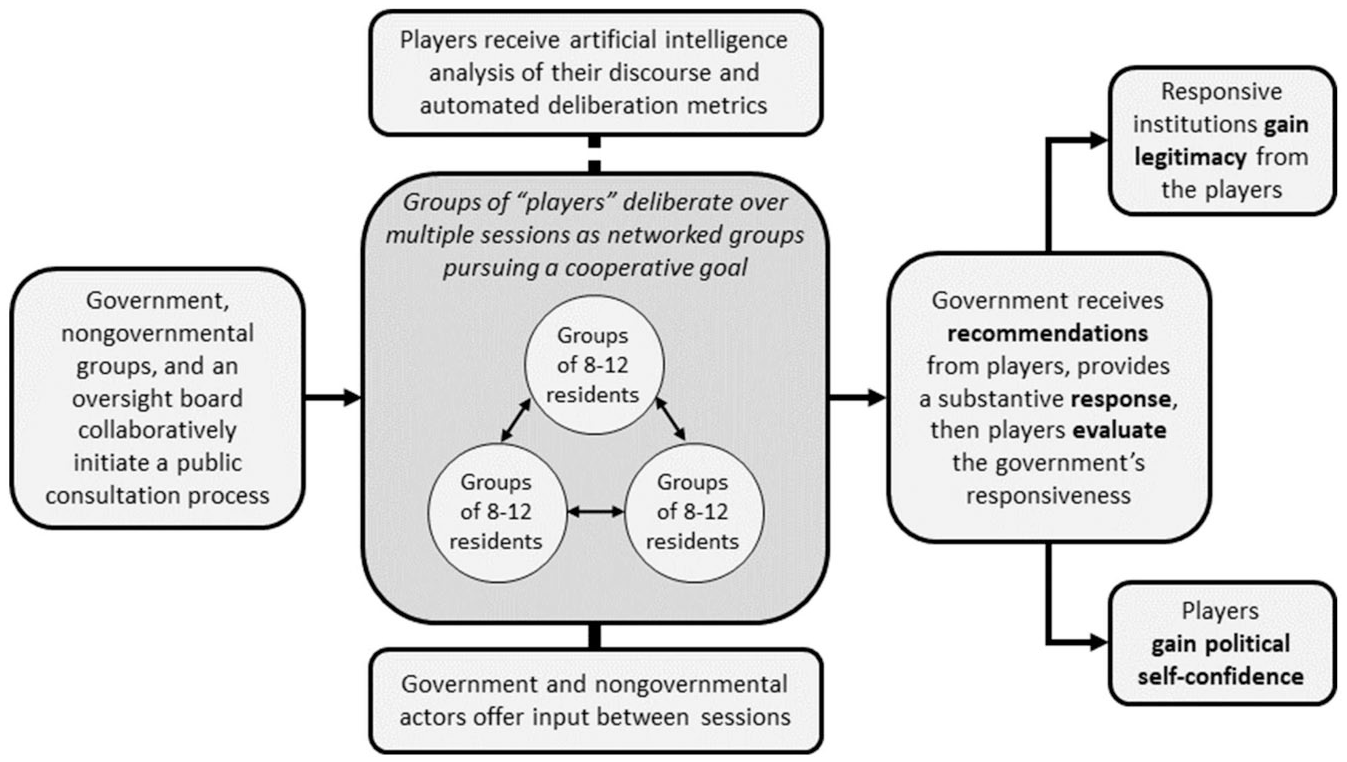
Design for an online game for deliberative public consultation in policymaking.
Core Components of an Online Deliberation Game
Having laid out the assumptions and given a broad overview of the proposal, I now describe in more detail the key components of the design. In turn, those subsections address these topics: the origin, governance, and oversight of the game; the networked player groups at the center of the game; the objectives of these groups; the purpose of artificial intelligence and automated metrics for measuring deliberation; the roles played by public officials and nongovernmental organizations during the game; and the long-term payoff of playing the game for both its convenors and its players.
Initiation and Governance
Ideally, a deliberative policymaking game would emerge from a collaboration among public officials and influential nongovernmental civic organizations. One model for such a collaboration comes from the Oregon Citizens’ Initiative Review, which uses an independent commission to oversee its work (Gastil & Knobloch, 2020). A majority of that commission consists of former citizen panelists, who were drawn at random from the state’s list of registered voters. In a similar way, this game should be governed by its user base, through a mix of stratified random selection and peer evaluation to identify experienced, cooperative users capable of evaluating the game’s performance.
The other useful analogy is the public funding of media, common in many countries but less so within the U.S. (Pickard, 2014). For online engagement, there could exist a parallel Corporation for Public Software (Gastil & Davies, 2020). A cross-national study of such entities has found that public media have the best chance of balancing independence and accountability when they have four features (Benson et al., 2017), all of which fit the deliberative system I propose. These include multiyear funding cycles; a legal charter that limits government influence while mandating a public-service mission; an oversight board that has staggered membership with dispersed appointment authorization; and regular evaluation by diverse public users.
Networked Player Groups for Crowdsourced Policymaking
The use of digital technology encourages the use of larger numbers of player-participants, as when governments use “crowdsourcing” to gather input from vast numbers of citizens (Aitamurto & Landemore, 2015; Noveck, 2018). Deliberative reformers have preferred larger samples when forming “minipublics” (Landemore, 2013; Owen & Smith, 2018). Governments or civic organizations create these randomly selected bodies of citizens to perform a task during an electoral or policymaking cycle, such as evaluating a proposed law (Grönlund et al., 2014).
When working across multiple designs for face-to-face deliberation, however, organizers routinely divide larger bodies of citizens into small groups for discussion. Because of the tremendous value of well-structured small-group discussion, this movement from “plenary sessions” into “break out groups” occurs whether the full body of citizens has thousands, hundreds, or even merely two dozen participants (Gastil & Levine, 2005).
With this in mind, I propose that once a deliberative game gets underway, its players should be divided into diverse small groups. The assignment process should distribute demographic and ideological differences across the groups, given the importance of such diversity for deliberation (Abdel-Monem et al., 2010; Miura & Hida, 2004; Papacharissi, 2004). A more refined algorithm could also ensure that some of the small groups have higher concentrations of underrepresented populations. Such minorities might find a stronger voice in these “deliberative enclaves” (Karpowitz et al., 2009).
I envision these small groups as networked, in that they should have the ability to communicate with each other between discussions. In face-to-face settings, this is done when large assemblies come together to work as a single body, akin to a legislature (Carson et al., 2013; Farrell & Suiter, 2019; Warren & Pearse, 2008). In the online deliberation game, a network model works better than holding massive plenary sessions because of the difficulty of convening synchronous meetings. Whatever their virtues, synchronous meetings for bodies numbering in the hundreds (or more) end up excluding people who cannot coordinate their schedules with the others. Finally, as I describe in the following section, the information to be exchanged among these groups should travel well through a networked process.
Policymaking as a Cooperative Game
With the players placed in groups, each group then sets about pursing the goal of the deliberation. In multi-player game designs, there exists a simple distinction between cooperative and competitive goals (Salen & Zimmerman, 2004). Democratic theory largely conceives of policymaking as a competitive enterprise, though deliberative theorists have stressed that a healthy democracy has both adversarial and cooperative modes (Mansbridge, 1980). The game I envision uses networked groups that aim to recommend a collaborative solution that is both politically viable and optimal in terms of desired policy outcomes.
In successful cooperative games, however, there is typically a common enemy. In the board game Flash Point, for example, players must work together to rescue people and pets from a burning building. Fire itself is the adversary. So, too, in a deliberative game there should be a minimum threshold condition that must be crossed for players to provide recommendations to policymakers. Straightforward metrics include a minimum percentage of player groups supporting the winning proposal, as well as a minimum level of enthusiasm for seeing it implemented. To raise the stakes, any unsuccessful consultation could force the issue to be tabled for a period of time, analogous to the tabling that stalls legislation in a parliament (Robert, 1990).
A less punitive approach provides incentives for exceeding bare minimum thresholds by the highest margin possible. Successful efforts to build consensus and enthusiasm could result in, say, funding enhancements in a participatory budgeting process or accelerated inception for projects stuck in an implementation queue. Such incentives make meaningful the theoretical imperative to pursue consensus in deliberation, even when unanimity is impossible owing to the disagreement inherent in a pluralist society (Cohen, 1989).
Metrics, Artificial Intelligence, and Intergroup Communication
Another common game design feature gives players constant feedback so that they can assess their performance (Salen & Zimmerman, 2004). Straw polling on proposals under consideration is one such way that minipublics track progress toward end goals (e.g., Warren & Pearse, 2008), and the networked groups herein should be able to see collective sentiments toward the most viable proposals under discussion. Given the challenge of meeting a high standard for deliberation, however, more can be done to improve discussion quality.
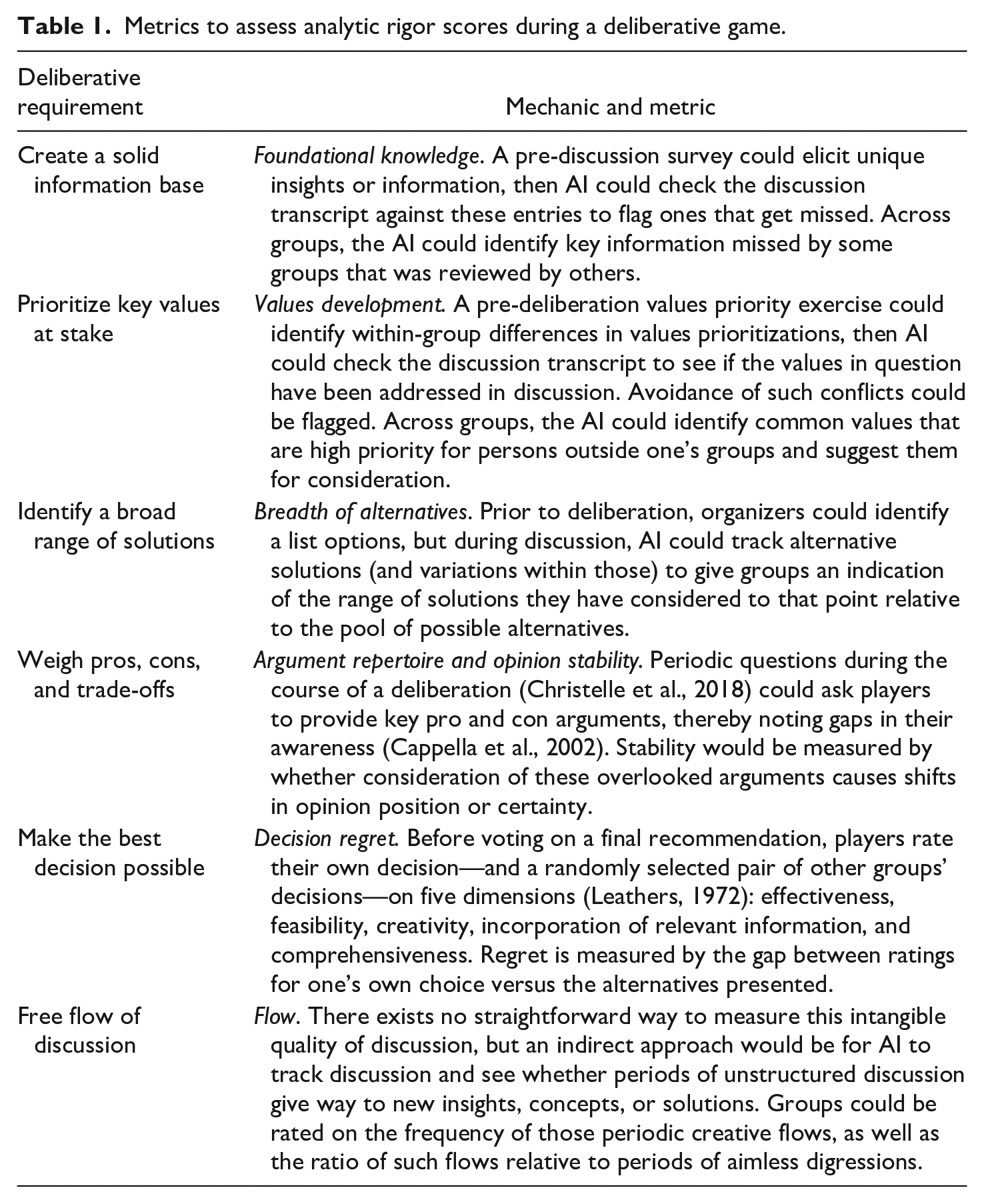
Table 1 suggests micro-level game mechanics and corresponding metrics that could encourage each of the features of deliberative discussion (Black et al., 2011; Gastil & Black, 2007), including the more intangible and playful concept of “free flow” that facilitators often emphasize (Mansbridge et al., 2006). The left-hand column lists a criterion by which one can assess a facet of deliberation, and the right-hand column suggests how groups of players could track their progress using metrics. The over-arching game mechanic here is a simple one: maximizing one’s score as a deliberating body. Comparing one’s group with other groups could yield a leaderboard, improvement ratings, round-by-round performance peaks, and other indicators that feed into a player’s achievement motivation (Gastil & Broghammer, 2021).
Metrics to assess analytic rigor scores during a deliberative game.
As a complement to the aforementioned metrics, Table 2 suggests a way to assess democratic social relations during a deliberative game (Gastil & Black, 2007). Whereas the first set of metrics focused on the content of the discussion and the decision, this second set of metrics assesses internal relations within the group. As such, the over-arching game mechanic would not be an achievement rating but instead a harmony rating for the group, designed to appeal to players’ social motivation for belonging and connection (Gastil & Broghammer, 2021).
Metrics to assess democratic social relations during a deliberative game.
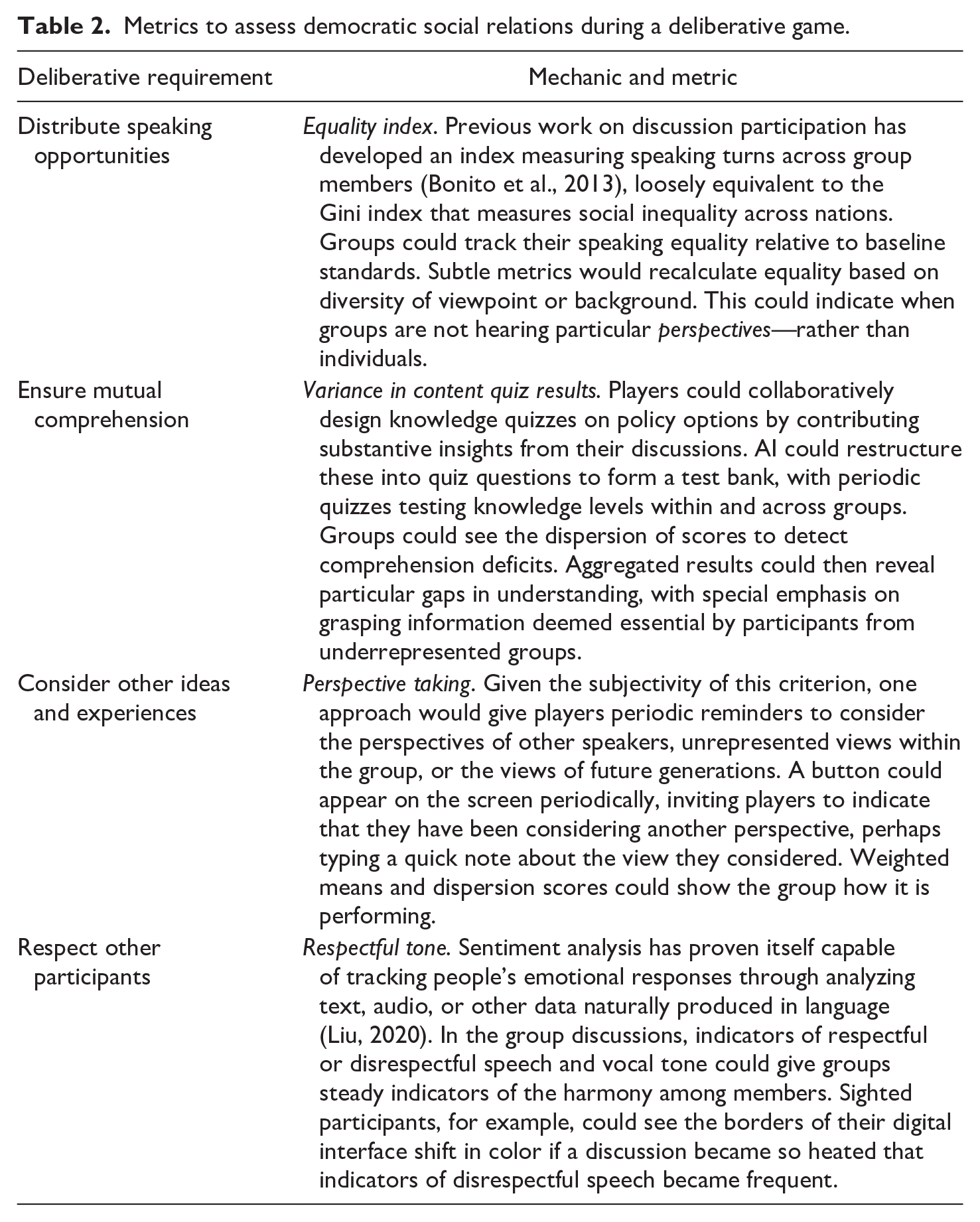
Recalling that groups meet in periodic sessions, these performance metrics could provide helpful indicators to player groups—between those sessions—to help them recognize when their intra-group relationships are breaking down or performing at peak levels. The examples provided in Table 2 are meant to show the range of tools that could be used, such as an equality index (for speaking opportunities), quiz results (mutual comprehension), perspective-taking button presses (consideration), and AI scanning of words and vocal tone (respect).
Governmental and Nongovernmental Input
The other mid-process input comes from the same public officials and civic organizations that initiated the process. It has become common for officials to play an active role in minipublics that foreground citizens (e.g., Farrell & Suiter, 2019). Likewise, nongovernmental actors often interact repeatedly with citizen panelists—even when the citizens hold all the decision-making power (Gastil & Knobloch, 2020). For example, a public official might weigh in on a policy discussion to share relevant research about citizen-generated proposals or past experiences pertinent to the policy alternatives. In some cases, it may be appropriate to invite comment from policy analysts in nearby jurisdictions who have addressed similar problems.
To get the most out of these contributions, players should have the opportunity to assess these inputs along two dimensions. Ideally, official and nongovernmental input would be both useful and respectful. By scoring these inputs and publicizing the results, the incentives become clear for making pertinent and appropriate contributions to the deliberation. Given the importance of reputation for officials and activists alike, this should discourage tangential, misleading, or dismissive behavior toward the players.
Long-Term Outcomes beyond Self-Congratulation
Successful completion of a deliberative public consultation game should prove to be its own reward, in that each effective engagement should yield some measure of policy improvement and satisfaction for all parties. That said, there could be ways of assessing long-term success that get past congratulatory self-evaluations and take into account other potential benefits of deliberation. As for policy impacts (Barrett et al., 2012), one could create an equation that factors in (a) whether a recommended policy was adopted, (b) what level of support it enjoyed from players, and (c) a net impact rating that independent experts assign to the policy.
Public opinion surveys could also check two important feedback loops from a deliberative process to see if it is “self-reinforcing” (Burkhalter et al., 2002). In particular, does holding these deliberative engagements boost players’ political self-confidence, their appetite for deliberation, and their belief that common ground can be found? If a deliberation game works as intended, it should also accord increased legitimacy on the government and nongovernmental actors who organized it (Gastil, 2021). Encouraging results from other deliberative minipublics suggest the potential for such “spillover effects” (Knobloch et al., 2019; Van der Does & Jacquet, 2021), but such outcomes cannot be taken for granted.
To add one last gamified element, strong outcomes on these long-term impact metrics could result in rewards. For public officials, there could be a discount on the cost of running future iterations of the game—a recognition that government responsiveness validates the game itself. For the players, perhaps high ratings might earn them rewards, such as reputational badges within the game system; opportunities to play administrative roles within the system; opportunities to put topics on the agenda for future deliberation; or expanded policy/budget authority within their jurisdiction. Such a mix of motivations—from the potential to address basic needs to the bonding and achievement from a job well done—could prove a potent means of sustaining public participation over time.
Conclusion
Stepping back from the particulars of this proposed online policymaking game, the ideas presented herein have a wider theoretical significance. First, this essay provides another illustration of the utility of designing deliberative events in a way that appeals to people’s motivations to meet basic needs, forge social connections, and gain status (Gastil & Broghammer, 2021). Second, this essay shows that the features of successful games—often linked to those same motivations—can be deployed in deliberative design to achieve the desired ends of deliberation. Third, I hope that the efficacy of linking games and deliberation inspires deliberative theorists to consider other juxtapositions, which could draw in ideas from other seemingly unlikely subfields to the ongoing project of deliberative democratic design.
As for the practicality of this article’s particular proposal, it will most likely come into being in a piecemeal fashion. Though it stands on the findings of prior research, the overall game system remains untested in the field, and even an innovative government might want more assurance of its viability before adopting it wholesale. Thus, a first step would be forming partnerships among researchers, civic organizations, and governments willing to experiment with incorporating particular features of this game into existing practices, such as online public meetings.
If such efforts prove successful, a working prototype of this game could be implemented in a smaller geographic jurisdiction before scaling up to a state or nation. Cities such as Austin, San José, and Pittsburgh seem ideal locations with the United States because they already have a surplus of talent in software development, major research universities, a history of institutionalized public engagement, and a public accustomed to interfacing with their community through online tools.
Starting locally also has the advantage of working on basic design challenges before facing those that come from a more massive scale. Once successfully built, the system may appeal to federal clients, such as the Environmental Protection Agency, if its active user base includes citizens who reside in particular locale, state, or nation. For that reason, early development may need a boost from targeted recruitments, akin to those used by market research firms, which continuously recruits new survey respondents to maintain a large and representative survey respondent pool. Thus, the system’s initial development may need the muscle not only of visionary software developers but also of major foundations or a visionary corporate partner, if government funding of such a system is not forthcoming.
Regardless of its sponsors, I recognize that this project embraces digital technologies that have often done more harm than good. The 2016–2020 Presidential elections in the US showcased a confluence of powerful social media, political bots, and propaganda posing as news, and digital technology brought this reality into being (O’Neil, 2017). For example, this proposal has a robust role for artificial intelligence, but such tools are rarely developed through an inclusive and deliberative public process (Buhmann & Fieseler, 2022).
The lack of transparency in source code more generally poses a challenge to any government or civic organization that relies on digital technology. Placing a greater emphasis on open-source coding mitigates these hazards, but that only makes civic tech open to those who can understand it. Making an online process open to the general public requires translating the code into comprehensible language and having a credible oversight process in place. Again a Corporation for Public Software (Gastil & Davies, 2020) may be the right approach to ensuring a transparent process for developing civic tech in the public interest.
Footnotes
Declaration of Conflicting Interests
The author(s) declared no potential conflicts of interest with respect to the research, authorship, and/or publication of this article.
Funding
The author(s) received no financial support for the research, authorship, and/or publication of this article.
