



Abstract
This study examines the role of a wide range of personality characteristics—such as the Big Five personality traits, self-esteem, goal pursuit/adjustment, social behavior, and educational aspirations—for the intergenerational transmission of educational attainment in Germany, and compares their relative importance with that of cognitive skills. We use information on more than 8,000 students from the German National Educational Panel Study. We find that personality characteristics do not mediate the association between parents’ and children’s attainment of the university entrance qualification (the Abitur) by age 19/20. Only educational aspirations are a strong mediator for intergenerational educational transmission. A few personality characteristics moderate intergenerational educational transmission, and they do so in favor of children with high-educated parents either as Matthew effects or compensatory advantages. In contrast to personality characteristics, cognitive skills act as strong mediators, while moderation is rather weak when accounting for personality characteristics—but again, they work in favor of privileged children. Our German study reveals similarities but also differences compared with the mostly U.S.- and U.K.-based research and inspires to rethink the importance of personality characteristics and cognitive skills for intergenerational education attainment.
Keywords
Introduction
Social inequalities in society are legitimated by educational attainment. Yet various studies show that educational attainment is strongly dependent on parental background (e.g., Breen et al., 2009; Heisig et al., 2020). Scholars are keen to discover the mechanisms of intergenerational educational transmission and, in this respect, also the role of so-called noncognitive characteristics (Farkas, 2003). For the latter, for example, studies show that children’s personality traits, self-regulatory processes, or aspirations influence their willingness to exert effort (e.g., Apascaritei et al., this issue; Bandura, 1986; Efklides et al., 2006; Palacios-Abad, this issue; Trautwein et al., 2009), and effort in turn shapes their educational success (de Fraja et al., 2010).
Research on the association between children’s educational attainment and different personality dimensions has been growing over the past two decades. Studies on the role of personality characteristics for social inequalities in educational attainment are, however, still rare compared with studies on the role of cognitive skills. Moreover, findings of these studies are inconclusive: Some studies report notable effects of personality characteristics on the intergenerational transmission of educational attainment (Damian et al., 2015; Hsin & Xie, 2017; Shanahan et al., 2014), while others find very small or no effects (Betthäuser et al., 2020; Burger et al., 2020; Carneiro et al., 2007; Mood et al., 2012).
Potential reasons for the mixed findings are that studies use different personality characteristics and not all studies include cognitive skills as potential confounders. Most studies only analyze whether compositional differences in personality characteristics by social background contribute to social inequality in educational attainment (mediation), but ignore social disparities in the returns of children’s personality characteristics for their educational attainment (moderation). Finally, most studies look at the United States and United Kingdom. Yet the importance of personality characteristics for intergenerational educational transmission might vary across countries. For example, the comprehensive school systems (with course-by-course tracking) in the United States and United Kingdom and Germany’s early between-school tracking in secondary education differ in their degree to which educational decisions are “choice-driven” (Jackson et al., 2012).
Against this background, we examine whether children’s personality characteristics mediate and/or moderate the intergenerational transmission of educational attainment in Germany. Educational attainment is measured as obtaining the Abitur (the German university entrance qualification) by the age of 19/20. We use data on more than 8,000 students from the German National Educational Panel Study (NEPS).
Our study extends previous research by examining the mediating and moderating role of a large variety of personality characteristics. Our major goal is to provide a broader picture of the role of personality characteristics for intergenerational educational transmission and not to test hypotheses for each of the included personality characteristics. To evaluate their relative importance, we take the influence of cognitive skills as a reference point.
Personality Characteristics as Mediators and Moderators
Figure 1 presents our stylized theoretical model on how personality characteristics and cognitive skills influence the intergenerational transmission of educational attainment. We use this model to organize our literature review and theoretical considerations. According to our research question, we focus on personality characteristics and present general theoretical considerations of why and how they should impact on intergenerational educational transmission.
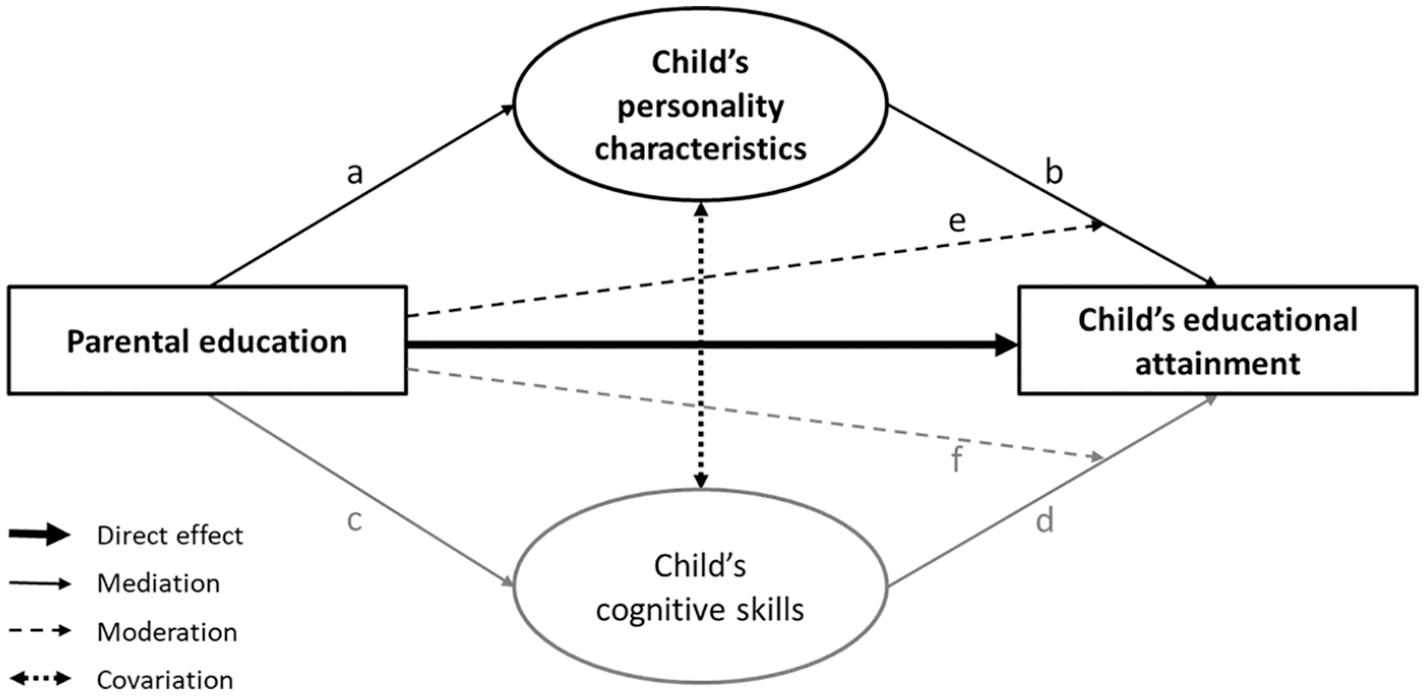
Stylized model of intergenerational transmission of educational attainment with focus on personality characteristics.
Mediation
For personality characteristics to mediate the impact of parental education on children’s educational attainment, children with less-educated parents should more frequently exhibit less favorable personality characteristics (path a in Figure 1), which in turn decrease their educational attainment (path b). This mediation is also called “structural amplification” (Ross & Mirowsky, 2011).
Concerning compositional differences in personality characteristics by social background (path a), prior studies suggest that existing compositional differences are not due to a direct (hereditary) transmission of personality characteristics from parents to children (Anger, 2012; Burger et al., 2020) but rather due to differences in environmental conditions like family resources or parenting practices (Anger & Schnitzlein, 2017; Farkas, 2003; Mood et al., 2012; Shanahan et al., 2014). For example, children with less-educated parents are more likely to experience economic difficulties; this is associated with interpersonal conflicts and emotional challenges, which in turn might reduce children’s agreeableness and emotional stability (de Coulon et al., 2011). Empirical evidence for path a is inconclusive: Some studies report a positive relationship between parental background and children’s personality characteristics (Betthäuser et al., 2020; Carneiro et al., 2007; Hsin & Xie, 2017; Liu, 2019; Peter & Storck, 2015), while others observe no or only very weak associations (Duncan et al., 2005; Shanahan et al., 2014; Silles, 2011).
Personality characteristics could also influence children’s educational attainment (path b), for example, by affecting teachers’ grading/evaluations, even for equally competent students (e.g., Borghans et al., 2016; Randall & Engelhard, 2010), or children’s (and parents’) educational decisions. For the latter, for example, global self-esteem can affect students’ decisions to continue in education by affecting their psychological well-being (Rosenberg et al., 1995). Similarly, according to the Wisconsin model of educational attainment, children’s educational aspirations influence educational attainment above and beyond their cognitive skills (Sewell et al., 1969). Empirical evidence for path b is likewise mixed: Some studies find personality characteristics are predictive of children’s educational attainment (Borghans et al., 2008; Damian et al., 2015; Duckworth & Seligman, 2005; Heckman et al., 2006; Hsin & Xie, 2017), while others report very small or no effects (Betthäuser et al., 2020; Burger et al., 2020; Carneiro et al., 2007; Mood et al., 2012). Moreover, research concerning the Big Five personality traits—extraversion, agreeableness, conscientiousness, emotional stability, and openness to experience—supposes that the values in the middle of the scale are “optimal,” while the extreme negative and positive values are rather disadvantageous for education (see Borghans et al., 2008). Finally, consistent and large effects are only reported for children’s educational aspirations (Burger et al., 2020; Sewell et al., 1969)—plausibly because they are associated with educational plans (Schoon & Parsons, 2002) and thus might “affect education through the individual’s ability to foresee future gains and to defer rewards” (Lundberg, 2013, p. 428).
In contrast, and as a reference point for personality characteristics, cognitive skills are shown to play a strong mediating role (paths c and d): Higher parental educational attainment strongly enhances children’s competence development and this, in turn, positively influences children’s educational attainment (e.g., Bourne et al., 2018; Damian et al., 2015; Erikson, 2016; Hsin & Xie, 2017; Shanahan et al., 2014).
In sum, these theoretical considerations suggest that children’s personality characteristics mediate the intergenerational educational transmission (structural amplification). However, the mixed empirical findings for personality characteristics suggest a weaker influence than that of cognitive skills, except possibly for children’s educational aspirations.
Covariation
Personality characteristics could also influence educational attainment indirectly by enhancing cognitive skills (Cunha & Heckman, 2008; Damian et al., 2015; Heckman et al., 2006). Students with higher educational aspirations might exert more effort, which would increase their learning productivity and competence development (Schoon & Parsons, 2002). Conversely, competences might affect personality characteristics, as lower competence levels might result in more problematic behavior, lower self-esteem, higher goal disengagement, or lower aspirations (Rosenberg et al., 1995).
Findings on covariation are inconsistent. Rosenberg et al. (1995) find that cognitive skills affect global self-esteem more than the inverse. In contrast, Cunha and Heckman (2008) state that personality traits and behavioral problems influence cognitive skills. Covariation between personality characteristics and cognitive skills is likewise plausible (Borghans et al., 2008). To reduce potential confounding of the personality characteristics’ mediation, we account for this covariation in our analyses.
Moderation
The impact of personality characteristics on educational attainment might vary by parental education (moderation, path e). One potential mechanism is the “Matthew effect” (Merton, 1968), which predicts that favorable personality characteristics are more beneficial for children from privileged families, “because their environment facilitates and enhances the positive effects of specific traits” (Damian et al., 2015, p. 475). Thus, Matthew effects lead to larger social disparities among the children with favorable personality characteristics.
Another mechanism in favor of children from privileged families is the compensatory advantage hypothesis (Bernardi & Cebolla-Boado, 2014). It suggests that privileged parents have the socioeconomic and cultural resources to compensate for their children’s unfavorable characteristics—for example, privileged parents might manage to reduce teachers’ penalties when children show behavioral problems (Lareau, 1987). In contrast to Matthew effects, the compensatory advantage mechanism states larger social disparities among the children with unfavorable personality characteristics.
Finally, in contrast to both aforementioned mechanisms, the resource substitution hypothesis states that moderation works in favor of children from less-privileged families (Ross & Mirowsky, 2011): Favorable personality characteristics could be more salient for less-privileged children because they have fewer parental (cultural and social) resources to rely on (Farkas, 2003; Liu, 2019; Lundberg, 2013; Shanahan et al., 2014). Thus, for them, personality characteristics that enhance independent decision making and goal setting such as educational aspirations might be more important for educational attainment. However, as discussed above, less-privileged children might be less likely to have favorable personality characteristics. These opposite directions of mediation and moderation could generate “resource substitution with structural amplification” (Ross & Mirowsky, 2011; Shanahan et al., 2014).
Empirical studies on personality characteristics as moderators (path e) are scarce, and mostly for the United States. Liu (2019) states evidence for “resource substitution” concerning socioemotional skills. Likewise, Shanahan et al. (2014) state empirical support for “resource substitution with structural amplification” for three Big Five personality traits (agreeableness, emotional stability, and openness to experience), however, they did not control for cognitive skills (and did not allow for nonlinearity, see next section). When controlling for children’ cognitive skills, Damian et al. (2015) and Carneiro et al. (2007) did not observe differences in the impact of personality traits or social maladjustment by social background.
The aforementioned theoretical accounts can also be applied to cognitive skills as moderators (path f). The findings are mixed: Bernardi and colleagues find empirical support for the compensatory advantage hypothesis for France and Italy (Bernardi & Cebolla-Boado, 2014; Bernardi & Triventi, 2020), while Damian et al. (2015) report evidence for a Matthew effect for the United States.
Direct Effects
Parental education might also directly affect children’s educational attainment, for example, because of the status maintenance motive (Breen & Goldthorpe, 1997) or differences in knowledge about the education system (Erikson & Jonsson, 1996). Such direct effects might be especially important in the tracked education system of Germany, as parents are more influential when secondary school track decisions take place very early (e.g., van de Werfhorst, 2019). Moreover, parental education is related to parental income, which might enable or inhibit children from staying longer in education (Chevalier et al., 2005).
The Present Study
We examine the role of personality characteristics on intergenerational educational transmission for Germany. Educational attainment is defined as completion of the highest upper secondary education certificate, the Abitur, which is the necessary requirement for university enrollment. Our study includes different dimensions of children’s personality. In a narrow sense, we include
The Big Five personality traits (as in Shanahan et al., 2014).
With a broader personality concept including motivation, goal setting, or social behavior, we also consider:
Flexible goal adjustment and tenacious goal pursuit, serving as two self-regulatory strategies of coping when faced with obstacles (Brandtstädter & Renner, 1990).
Prosocial behavior and problematic peer relationship behavior, related to the behavioral problems index used by Cunha and Heckman (2008) and the interpersonal skills used by Liu (2019).
Global self-esteem (as in Burger et al., 2020).
Educational aspirations (as in Burger et al., 2020).
Germany is an interesting case to revisit the mostly U.S.- and U.K.-based research. The German education system is known for its highly stratified secondary education system, characterized by early tracking into a lower, intermediate, and academic secondary track after primary school (Bol & van de Werfhorst, 2013). Only the academic track leads directly to a university entrance qualification (Abitur). 1
In comparison with comprehensive school systems, this early track placement is more strongly based on prior school performance and less on individual choice (Jackson et al., 2012). Grades in primary schools impose formal restrictions for parents’ decisions regarding their children’s secondary school track. Grades also define the key criterion on which teachers base their recommendations. Personality characteristics might also be relevant for track placement, for example, by influencing teachers’ recommendations. Research shows that working-class children in Germany are less likely to be recommended for the academic track by primary school teachers than equally achieving higher class children (Caro et al., 2009).
This initial track placement is, however, not deterministic for obtaining an Abitur in Germany: Students can move up and down tracks during general upper secondary education (Schindler, 2017). More important, in the past two decades, vocational schools have gained in importance as an alternative pathway to the Abitur after leaving general education (termed “vocational track,” hereafter). School leavers with an intermediate school-leaving certificate (after Grade 10) can choose between doing an apprenticeship or attending the vocational Abitur track. Also students from the academic track can opt for the vocational track after Grade 10 (see also Table 1 in Data section). In 2015 and 2016 (the observation years for educational attainment in our study), a little over 50% of all school leavers held the Abitur—with about two thirds obtained via the academic track and one third via the vocational track (National Education Report, 2018, Tab. D9-3web).
Expectations
Drawing on the theoretical considerations and the insights of Germany’s rather performance-based tracking in secondary education, our baseline expectation is to find moderate to weak mediating and moderating effects of personality characteristics for the intergenerational educational transmission in Germany. We expect the largest mediation for educational aspirations (structural amplification). Concerning moderation, all three mechanisms—Matthew effects, compensatory advantages, and resource substitution—would be possible in Germany.
Distinguishing between the two Abitur pathways, we expect to find support for Matthew effects or compensatory advantages for the academic track, because parents are more important for early track placement, which in turn influences Abitur graduation. In contrast, for the vocational track, personality characteristics might be more important for students with less-educated parents (resource substitution). These children are older when making this decision and less dependent on their parents’ opinions. Similarly, students do not rely on teacher recommendations to enter the vocational track. Thus, less-privileged children’s aspirations, goals or self-esteem might become more important. However, the alternative of doing an apprenticeship is highly attractive for school leavers from less-privileged families, diverting them from the Abitur (Hillmert & Jacob, 2010). In contrast, privileged students placed in nonacademic tracks in secondary school are more likely to utilize the vocational Abitur track than lessprivileged students (Virdia & Schindler, 2019). Thus, the two competing expectations for the vocational track are: Privileged children with favorable personality characteristics benefit from this “second chance” to obtain an Abitur (Matthew effects) versus parental support compensates for their less favorable personality characteristics (compensatory advantages).
We try to disentangle the different moderation mechanisms empirically in the following way. Without any moderation, the lines for privileged and less-privileged children would be parallel. The three moderation hypotheses predict that these lines diverge from parallelism—yet depending on family background, at different ends of the distribution: For privileged children, the Matthew effect predicts divergence for favorable personality characteristics and, in contrast, the compensatory advantage hypothesis for unfavorable personality characteristics. For less-privileged children, the resource substitution predicts divergence for favorable personality characteristics. Hence, when estimating the interaction effect of children’s characteristics with parental background in a linear fashion, both the compensatory advantage and the resource substitution hypotheses predict the same pattern: larger social disparities among those with unfavorable characteristics and smaller social disparities among those with favorable characteristics. In our moderating analyses, we therefore allow nonlinearity in the influence of personality characteristics on attainment. This approach also alleviates the assumption “the more, the better” for favorable values of personality traits.
Data and Methods
Data Source and Study Sample
We use data from the ongoing German NEPS (Blossfeld & Roßbach, 2019) on 15,239 students who attended Grade 9 (approximately 14/15 years old) in fall 2010. 2 Since 2010, they have been interviewed once or twice each year. Their parents were also interviewed as long as their children attended general schools.
Information on the independent and control variables of our study were mainly measured in Grade 9 (Waves 1 and 2). The dependent variable—respondents’ educational attainment—was measured in fall 2015 (Wave 9) when students were approximately 19/20 years old. Our study sample only includes students without missing information on their education attainment in fall 2015 (n = 8,343).
Table A2 (online supplement) shows that the distributions of the full sample and our study sample are almost identical concerning personality characteristics. Cognitive skills and educational aspirations in Grade 9 are somewhat higher in the study sample, because it includes more respondents who attended the academic track in Grade 9. Thus, our study sample is positively biased; however, we also have to note that the full sample includes a substantial oversampling of students from the nonacademic track.
Dependent Variable
Our dependent variable is defined as obtaining an Abitur by age 19/20—independent of whether it was obtained via the academic or the vocational track (1 = Abitur, 0 = no Abitur). By applying this definition, we study the overall intergenerational transmission of educational attainment—including both the effects of the independent variables on initial track placement (see Gil-Hernández, this issue) and the effects on subsequent educational decisions.
In a second step, we differentiate between the two pathways to an Abitur. The analyses for the Abitur via the academic track include the entire sample with “1” only assigned to respondents who graduated from the academic track (thus the reference group also includes those who obtain an Abitur via the vocational track). For the Abitur from the vocational track, the analyses only include students who left general education without an Abitur (usually after Grade 10; n = 4,692). The value of “1” is assigned to vocational track graduates. Table 1 shows attainment of Abitur via the different pathways by the school track in which students were sampled in Grade 9. Compared with official statistics, our sample includes a higher proportion of Abitur graduates from the academic track (74%) and a lower proportion from the vocational track (26%).
Attainment of Abitur in Fall 2015, by School Track Placement in Grade 9.
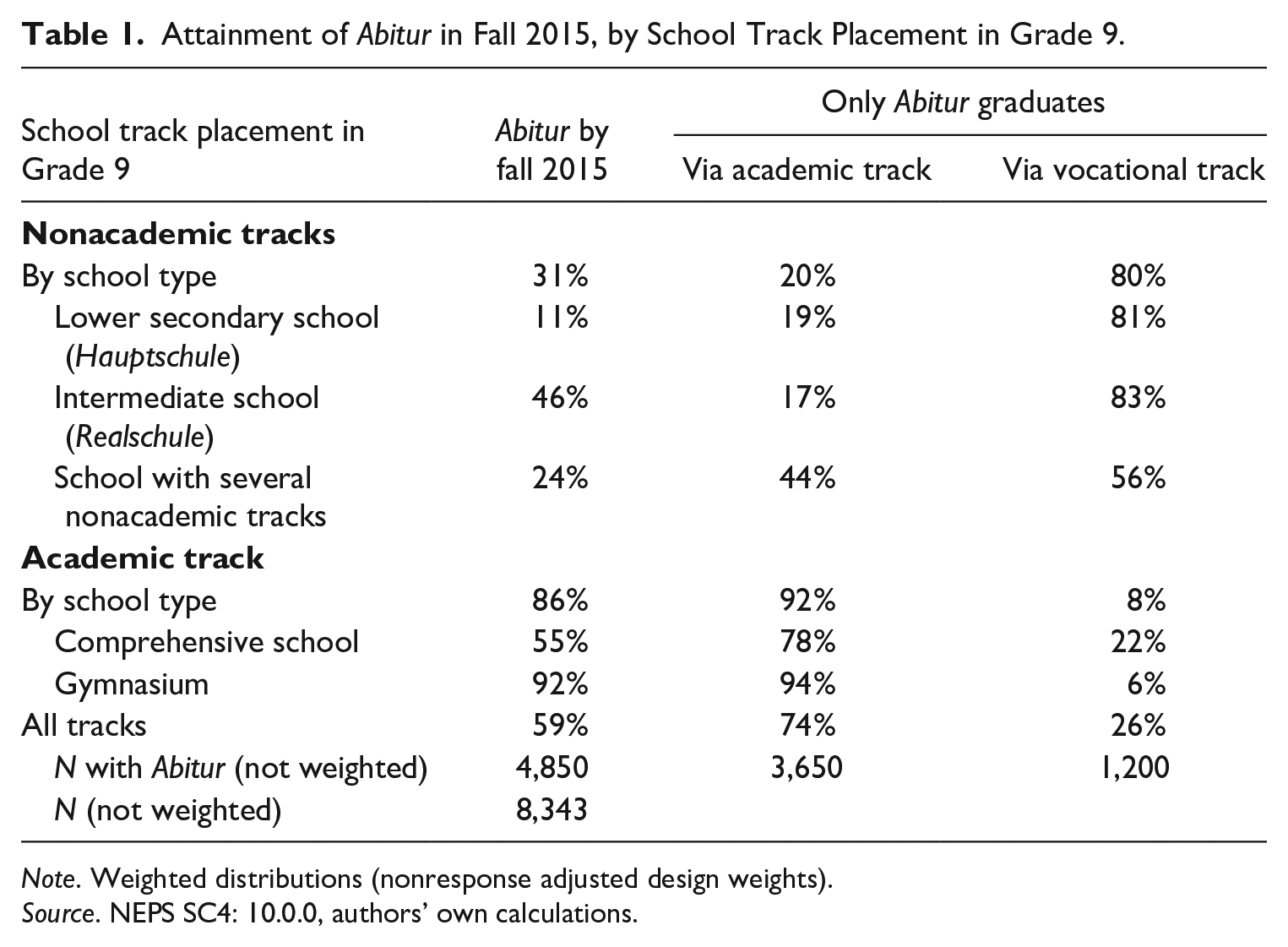
Note. Weighted distributions (nonresponse adjusted design weights).
Source. NEPS SC4: 10.0.0, authors’ own calculations.
Independent and Control Variables
Parental educational attainment is defined as a dummy variable indicating whether at least one parent holds the Abitur. 3
We use several measures to operationalize personality characteristics, which were assessed either in Grade 9 or in Grade 10. All variables are coded so that higher values indicate personality characteristics that seem to favor Abitur graduation. The Big Five personality traits—extraversion, agreeableness, conscientiousness, emotional stability, and openness to experience—are measured using the short instrument BFI-10 (Rammstedt & John, 2007). For global self-esteem, we use a German version of the Rosenberg Self-Esteem Scale (von Collani & Herzberg, 2003). Flexible goal adjustment and tenacious goal pursuit are measured by short scales based on Brandtstädter and Renner (1990). We use two subscales from the Strength and Difficulties Questionnaire (Goodman, 1997) to measure prosocial behavior and problematic peer relationship behavior. For educational aspirations in Grade 9, we consider students’ desire (regardless of their current educational achievement) to achieve the Abitur. For details on the items and time of measurement, see Table A1 in the online supplement.
For children’s cognitive skills, we use the weighted maximum likelihood estimator (WLE) of the mathematics test in Grade 9—this is a point estimate expressing the most likely competence score given a person’s item responses (Duchhardt & Gerdes, 2013). We also conduct robustness checks measuring cognitive skills as a latent variable based on the WLE for mathematics and reading, and test scores for deductive reasoning (Table A7, online supplement). We control for students’ gender and migration background (i.e., whether students themselves or their parents were born outside of Germany).
For our multivariate analyses, all continuous variables are z-standardized across the full sample. Descriptive statistics for all independent and control variables are reported in Table A2 in the online supplement.
Analytical Strategy
To test mediation, we use structural equation modeling (SEM; Kline, 2011). SEM allows us to estimate direct and indirect effects and the percentages of explained variance of intergenerational educational transmission that is mediated via personality characteristics or via cognitive skills. The models are specified in line with our theoretical model, with personality characteristics and cognitive skills mediating the effect of parents’ education (see Figure 1). We include the different personality characteristics one at a time to avoid overcontrolling. We do not estimate a latent variable based on all personality characteristics considered, because the concepts are meant to cover distinct dimensions. The control variables are included in all models—and they are allowed to have a direct effect on educational attainment and indirect effects through personality characteristics and cognitive skills (not shown in Figure 1). We allow the error terms of personality characteristics and math competences to covary (see Figure 1). Parental education and respondents’ migration background were likewise allowed to covary. To assess the goodness of fit, we provide the coefficient of determination, similar to R2.
To disentangle the different moderation mechanisms, we estimate linear probability models (LPMs) including interactions between the quintiles of the personality (and cognitive skills) variables and parental education. LPMs allow a straightforward estimation and interpretation of nonlinear interaction effects. 4
NEPS uses a stratified and clustered sampling design, in which students are drawn within federal states, school types, schools, and classrooms. We adjust the standard errors to account for the classroom clustering and school type stratification by using the NEPS design weights in our descriptive analyses (Steinhauer & Zinn, 2016). To deal with missing values, our SEMs use full information maximum likelihood (FIML) estimation; we excluded cases with missing values on our dependent variable. FIML usually leads to similar results as multiple imputations but is more efficient (Allison, 2012). In the LPMs, we use listwise deletion.
Results
Intergenerational educational transmission is very evident in our sample: 78% of children from higher educated families attain the Abitur, but only 43% of those from less-educated families do so. Zero-order correlations between parental education and personality characteristics are rather weak (below ±0.08), except for educational aspirations (0.35). The correlations between personality characteristics and educational attainment range from a strong correlation with educational aspirations (0.61), to still notable correlations with problematic peer relationship behavior and global self-esteem (both 0.11, respectively), to weak (less than 0.10) or no correlations with all other personality characteristics (Table A3, online supplement). In contrast, the correlations of children’s cognitive skills with both their parents’ educational attainment and their own educational attainment are high (0.29 and 0.41, respectively).
Mediation
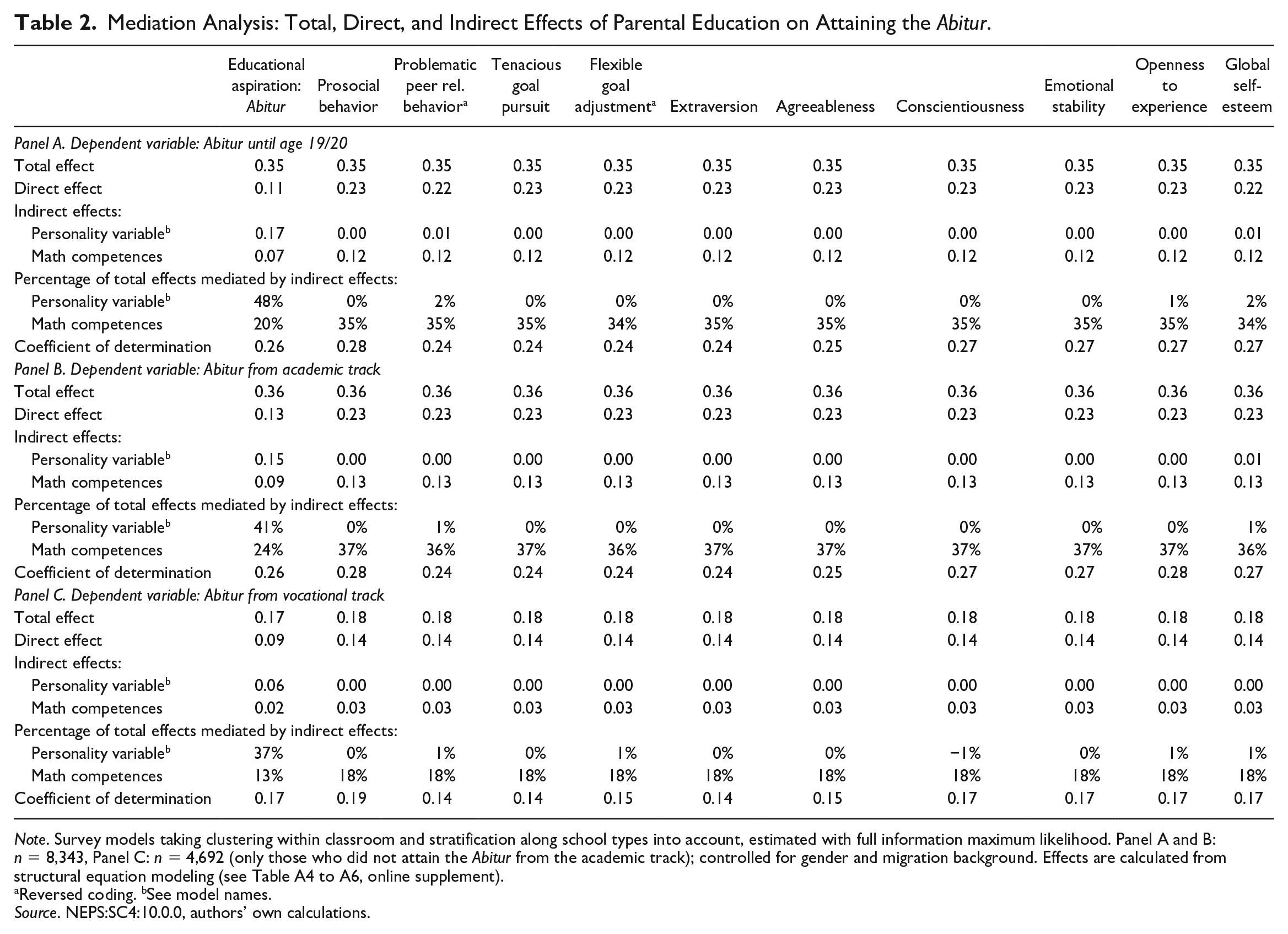
We first analyze mediation via personality characteristics. Table 2 reports the results from SEMs decomposing the association between parental education and children’s educational attainment into a direct and a mediating (indirect) effect via personality characteristics (paths a and b, Figure 1), including a second mediation path via math competences (paths c and d). The most important rows are “percentage of total effects mediated by indirect effects.” The explained percentage of the association between parents’ education and children’s Abitur completion until age 19/20 by personality characteristics is zero, or close to zero (Panel A). Only educational aspirations strongly mediate about 48% of the intergenerational attainment transmission (“structural amplification”). This is even stronger than the mediation via math competences (35% in most models, and only 20% when aspirations are included). Thus, higher parental education is associated with higher educational aspirations and cognitive skills among children, and both of these characteristics improve the chance to obtain the Abitur. Concerning the weak mediating role of the other personality characteristics, a closer examination of the effect sizes of the variables reveals that parents’ education influences personality characteristics to some extent (path a), but personality characteristics are almost not associated with attaining the Abitur (path b; Table A4, online supplement).
Mediation Analysis: Total, Direct, and Indirect Effects of Parental Education on Attaining the Abitur.
Note. Survey models taking clustering within classroom and stratification along school types into account, estimated with full information maximum likelihood. Panel A and B: n = 8,343, Panel C: n = 4,692 (only those who did not attain the Abitur from the academic track); controlled for gender and migration background. Effects are calculated from structural equation modeling (see Table A4 to A6, online supplement).
Reversed coding. bSee model names.
Source. NEPS:SC4:10.0.0, authors’ own calculations.
When looking at the two Abitur pathways separately (Panels B and C, Table 2), the results are similar—with one exception: Math competences are less important as a mediator for Abitur graduation from the vocational track (13% to 18%, depending on the model) than from the academic track (24% to 37%). The lower direct effects of parental education for the vocational track are also notable. Thus, intergenerational educational transmission is weaker for the vocational track—mostly because parental education and cognitive skills are less important (for effect sizes, see Tables A5 and A6, online supplements).
As a robustness check, we estimated a model including all measures for cognitive skills (as a latent variable) and all measures for personality characteristics at the same time (see Table A7, online supplement). The results confirm that cognitive skills and aspirations are central in the intergenerational educational transmission (explaining 33% and 43%, respectively), whereas all the other personality characteristics together play at best a marginal role (explaining only 2% of the intergenerational transmission).
Moderation
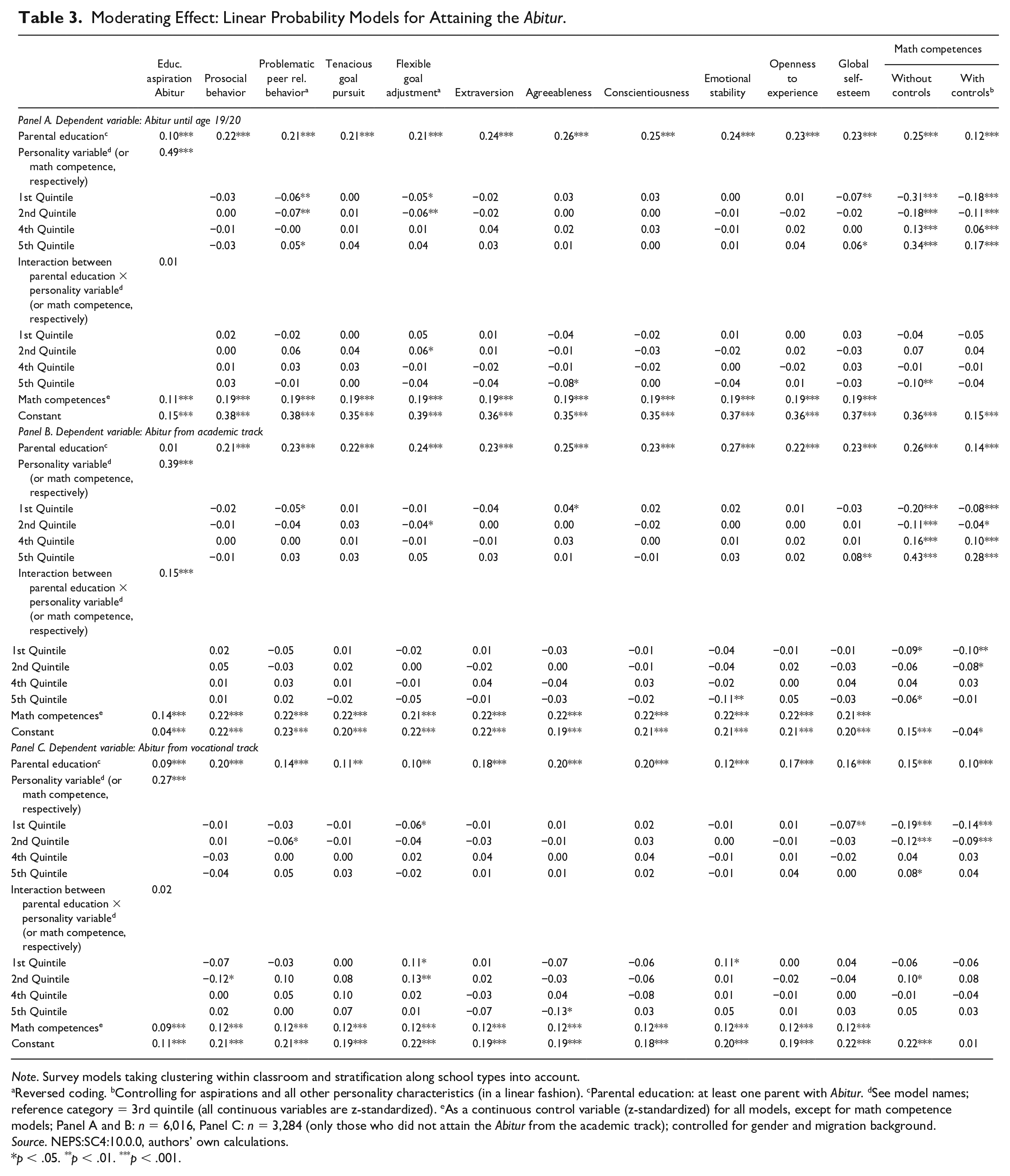
The weak mediating effects of personality characteristics might obscure social disparities in the returns to children’ personality characteristics on their educational attainment. To test moderation (path e, Figure 1), Table 3 presents the results of our LPMs including the interaction effects of parental education with children’s personality characteristics (and with cognitive skills, path f).
Moderating Effect: Linear Probability Models for Attaining the Abitur.
Note. Survey models taking clustering within classroom and stratification along school types into account.
Reversed coding. bControlling for aspirations and all other personality characteristics (in a linear fashion). cParental education: at least one parent with Abitur. dSee model names; reference category = 3rd quintile (all continuous variables are z-standardized). eAs a continuous control variable (z-standardized) for all models, except for math competence models; Panel A and B: n = 6,016, Panel C: n = 3,284 (only those who did not attain the Abitur from the academic track); controlled for gender and migration background.
Source. NEPS:SC4:10.0.0, authors’ own calculations.
p < .05. **p < .01. ***p < .001.
For Abitur completion by age 19/20 (Panel A, Table 3), most interaction effects between parents’ education and children’s personality characteristics are very small and statistically insignificant. There are two exceptions: agreeableness and flexible goal adjustment. Figure 2 presents predicted probabilities for them. As middle values are seen as optimal, the smaller social attainment gap at the top quintile (caused by a lower advantage of privileged children) might suggest a Matthew effect for those with more “optimal” values of agreeableness. For flexible goal adjustment, two interpretations are possible: In line with compensatory advantages, children with higher educated parents are not penalized when they do not stick to their goal. Alternatively, in line with resource substitution, children with less-educated parents who stick to their goals are more likely to obtain an Abitur. As we show below, the interaction is only significant and in line with compensatory advantage for the vocational track. This might be taken as a hint for compensatory advantages also for the overall Abitur graduation.
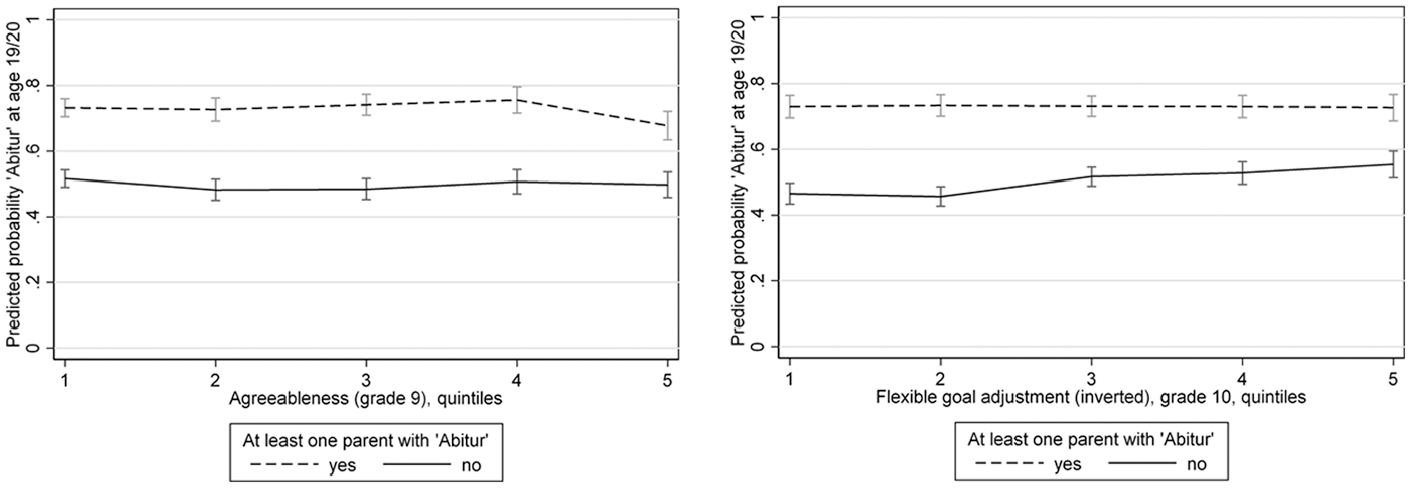
Predicted probabilities for selected moderating effects for Abitur until age 19/20.
For math competences as a point of reference, we find a significant interaction effect for the fifth quintile without controlling for personality characteristics. This effect is consistent with resource substitution. However, when controlling for personality characteristics (like controlling for math competences in the estimations for personality characteristics), the interaction term becomes smaller and insignificant (Panel A, Table 3).
We next differentiate between the two pathways. For the academic track (Panel B, Table 3; and Figure A1, online supplement), we find empirical support for a Matthew effect for educational aspirations: Social disparities in attainment are almost zero for children who did not aspire to achieve the Abitur but about 16 percentage points for those who did. Moreover, the estimates for emotional stability suggest larger social disparities in attainment for the middle quintiles, with a lower gap especially for the top quintile. When middle values are seen as the most favorable values (see above), this result indicates a Matthew effect or a compensatory advantage; in any case, it points to an effect in favor of privileged children. Finally, for math competences, we find evidence of a Matthew effect because of the larger social disparities in attainment in the three top quintiles of the competence distribution (controlling for personality characteristics).
For the vocational track (Panel C, Table 3; and Figure A2, online supplement), we find several significant interaction effects. Unfavorable values of flexible goal adjustment exert a negative effect, but only for children with less-educated parents; whereas flexible goal adjustment among privileged children does not influence their Abitur attainment, plausibly because their parents “push” them toward the Abitur. This indicates compensatory advantages for privileged children. For prosocial behavior, we find a Matthew effect, that is, larger social disparities in attainment for the top three quintiles. For agreeableness, social disparity in attainment is smaller in the top quintile (and somewhat smaller in the lowest quintile), suggesting a Matthew effect for favorable middle values. For emotional stability, the social attainment gap is largest for the bottom quintile with privileged children having the highest graduation probability in this quintile—this pattern does not correspond to any of the three moderation mechanisms. In contrast to the academic track, for the vocational track the interaction terms for math competences (controlling for personality characteristics) are smaller and insignificant. 5
In sum, we find few moderating effects for personality characteristics and mostly small effects, except for educational aspirations. The moderating effects found all favor children of higher educated parents—either as Matthew effects or compensatory advantages. In one exception, we find an inconclusive pattern (see Figure 2, for flexible goal adjustment). Interestingly, social disparities in children’s aspirations are only a strong moderator for the academic track, which is plausible because teachers’ and parents’ interference in children’s educational decisions is stronger for the first track placement.
Conclusions
In this study, we examine the role of several personality characteristics as mediators and moderators of the intergenerational transmission of educational attainment in Germany (defined as the Abitur). As highlighted, the German system has introduced more “choice-driven” pathways towards the Abitur—namely via vocational schools. We found remarkable differences between the pathways.
Concerning mediation, we only find strong support for “structural amplification” for educational aspirations—and this to a similar extent as cognitive skills. Differentiating between the pathways to the Abitur, we find that the strength of intergenerational educational transmission is weaker for the vocational track than the academic track, because cognitive skills and the direct effects of parental education are less important for attaining the Abitur via the vocational track.
The moderating role of personality characteristics is, however, notable: Educational aspirations and, to a lesser extent, emotional stability are moderators for the Abitur via the academic track, and prosocial behavior, flexible goal adjustment, and emotional stability are moderators for the Abitur via the vocational track. In contrast to the academic track, for the vocational track, children from less-educated and higher educated families are, ceteris paribus, equally likely to attain the Abitur provided they aspire to do so. All moderation effects found benefit children with higher educated parents—either as Matthew effects or compensatory advantages—and thus support the intergenerational transmission of educational attainment (see also Gil-Hernández, this issue).
Accounting for personality characteristics reduces the interaction effect between parents’ education and cognitive skills—thus, the role of cognitive skills might be overestimated in previous research, which does not control for personality characteristics. A significant moderation effect for cognitive skills is only observable for the academic track (as a Matthew effect).
Compared with previous research, our German study reveals both similarities and differences. Among the personality characteristics studied, educational aspirations are the most important resource for educational attainment in Germany. This is in line with the U.S. study by Burger et al. (2020). Unlike the U.S. study by Damian et al. (2015), we find rather small effects of the Big Five personality traits for educational attainment, but similar to them, we find a Matthew effect for cognitive skills for the academic track. Concerning the Big Five, this country difference would be in line with the expectations for a tracked versus comprehensive school system. Interestingly, cognitive skills play a similar role in both countries, which indicates that both between-school tracking and within-school tracking lead to performance-based sorting processes.
As major contributions, our study shows that personality characteristics play a stronger moderating role than a mediating one—but most existing studies only examine mediation. In many of our model specifications, covariation between personality characteristics and cognitive skills was stronger than the impact of personality characteristics. As most prior studies did not include covariation, they might have overestimated the role of personality characteristics. Furthermore, cognitive skills play a smaller role when accounting for differences in personality characteristics, which is often missing in analyses of cognitive skills.
When accepting that the personality characteristics included in this study—especially aspirations, flexible goal pursuit, and prosocial behavior—positively correlate with children’s effort in school (see Radl & Miller, this issue), our findings suggest that effort is not an equalizer but rather a contributor to intergenerational educational transmission. Translating our results from personality characteristics to effort would suggest that reproduction works via social disparities in both exerting effort and returns to effort.
Finally, one major caveat of our study is that competences are more precisely measured than self-reported personality characteristics (see discussion in Hsin & Xie, 2017). The Cronbach’s alphas (reported in Table A2, online supplement) reveal acceptable reliability for most constructs; however, they are low for four of the five Big Five personality traits. We therefore cannot rule out an underestimation of the influence of personality traits in our analyses.
Supplemental Material
sj-pdf-1-abs-10.1177_0002764221996779 – Supplemental material for Intergenerational Transmission of Educational Attainment: How Important Are Children’s Personality Characteristics?
Supplemental material, sj-pdf-1-abs-10.1177_0002764221996779 for Intergenerational Transmission of Educational Attainment: How Important Are Children’s Personality Characteristics? by Anne Christine Holtmann, Laura Menze and Heike Solga in American Behavioral Scientist
Footnotes
Acknowledgements
We thank Carla Grindel and Marie-Christine Franz for their support as student assistants and Roisin Cronin for language editing.
Declaration of Conflicting Interests
The author(s) declared no potential conflicts of interest with respect to the research, authorship, and/or publication of this article.
Funding
The author(s) disclosed receipt of the following financial support for the research, authorship, and/or publication of this article: Research reported in this publication was supported by project funding provided from the German Research Foundation (DFG, Grant No. SO 430/8-2) and the LIfBI Bamberg (Grant No. ZuV_03_08_0517).

Supplemental Material
Supplemental material for this article is available online.
Notes
Author Biographies
References
Supplementary Material
Please find the following supplemental material available below.
For Open Access articles published under a Creative Commons License, all supplemental material carries the same license as the article it is associated with.
For non-Open Access articles published, all supplemental material carries a non-exclusive license, and permission requests for re-use of supplemental material or any part of supplemental material shall be sent directly to the copyright owner as specified in the copyright notice associated with the article.
