



Abstract
People all over the world were under severe stress and were concerned about their health after a devastating pandemic struck the world in the form of a novel coronavirus disease (COVID-19) in late December 2019. Many nations imposed strict lockdowns and quarantines, causing citizens to maintain social isolation, throwing many companies to a halt. Thousands of people took to Twitter during these challenging circumstances to express their feelings about being caught in the middle of a storm. Twitter witnessed an outpouring of emotions ranging from fear, anger, and sadness associated with the spread of a novel virus that has no known cure, to voices of support and trust for nations’ official response to the pandemic. In studying the emotional response (anger, fear, and sadness) on Twitter about the COVID-19 crisis, we thus see a tale of two crises unfold—choosing health or economy. We capture collective emotions on social media and investigate the patterns and impact of these negative emotions during various stages of the disease outbreak. It also provides crucial insights to health officials and government agencies on communicating crisis information to the public via social media.
Introduction
The COVID-19 coronavirus has wreaked havoc on the lives of millions of families around the world from its start at the beginning of 2020. Coronavirus had infected about 15 million people in 188 countries by the end of June 2020, resulting in over 500 thousand deaths. Doctors and other healthcare providers throughout the world had struggled to keep up with the increasing number of patients reporting viral symptoms.
Aside from the health risks, the abrupt halt in corporate operations across the board has had a significant economic impact. Amidst the news about filing for unemployment benefits, it has been estimated that around 25% of Americans fear for their jobs. Over three-fourths of the world is under lockdown to stay safe, with many technology-based organizations provide work-from-home options to their employees and many other organizations are laying off their employees, leaving millions of workers jobless.
The crisis regarding health and economy, has led to negative emotions (Torcal, 2014). Negative emotions could lead to panic type behavior such as panic buying that has resulted in supply chain disruptions. Thus, because citizens across the world are experiencing negative emotions of fear and sadness, understanding the nature of emotions is important for developing strategies to manage these reactions. In the context of the COVID-19 pandemic, there is widespread agreement that the health and economic challenges are not mutually exclusive, but rather are interconnected (Forbes 1 ). To better understand the current state of emotions in the general public with respect to the economic circumstances and the health related concerns, in this paper, we have performed an exploratory analysis of the social media data related to COVID-19.
Social media content conveys details about the emotional state of its users, thereby giving rise to emotional patterns. Emotional patterns result in the spread of emotions from one person to another, resulting in shared emotions. Text messages exchanged on social media play the role of linguistic signals in the transfer of interpersonal emotions. In this article, we propose that examining the conversations in one such social media, Twitter, will help in understanding the crisis at hand.
Along these lines, we address the following two research questions: RQ1: what are the patterns of negative emotions over time during the pandemic? RQ2: How do the negative emotions differ in relation to the two crises of Health versus Economy?
The emotions during COVID-19 are quite entangled because health crisis management teams are involved in flattening the curve and bringing infections under control, and public morale is poor owing to financial losses caused by the epidemic. Even while the public engages in various debates on social media, the majority of them revolve around health and economic problems. However, it is difficult to objectively classify the debates into these two categories. Hence, in this paper, we follow a topic modeling approach to social media messages (Evans & Aceves, 2016; Rao et al., 2020), first to segregate the messages into Health versus Economy discussions and then to examine emotional differences in message communication during the pandemic. The outcomes of this study can have important theoretical and practical implications. Understanding the role of emotions during various intervals of an outbreak could provide an opportunity to formulate effective coping models based on public thinking. It is important for policymakers to engage citizens in cognitive-behavioral thinking for decision making during the time of uncertainties. Understanding the emotional transition during various phases on an outbreak is a start.
The rest of the paper is organized as follows. The Literature Review section focuses on the role of emotions in the context of social media data and the role of social media through the lens of emotional patterns that the messages generate. In the Methodology section, we provide details on the data used to address our research questions and explain the different methods and statistical tests that we carry out. In the Results section, we analyze the results of the methodology used and elaborate on the results in the discussion section. Finally, we conclude our paper by presenting the implications of our research. We also present a number of future directions for research.
Literature Review
In this section, we examine studies on extracting emotions from natural language, such as user text, as well as review studies on emotions during a crisis. Because emotions influence social media users’ behavioral responses when it comes to sharing emotional content, we link emotions to the theoretical foundations of emotional patterns observed during crises.
Emotions in Social Media Communication
Emotions have always been an integral part of how people respond to situations and are often representative of their physical actions. People respond verbally to the emotions. This verbal expression is publicly visible on social media sites like Facebook and Twitter, where users respond to a wide variety of posts (Tian et al., 2017).
Furthermore, people express their emotions, such as fear on social media platforms (Ebadi et al., 2019; Guille et al., 2013). In times of a pandemic, keeping track of these emotions in online communication can be helpful in preventing mass panic, fear, and hysteria (Lee, Agrawal, & Rao, 2015).
Several studies examine social media as an ideal vehicle for swiftly spreading emotions across geographical boundaries and riling up like-minded users (Oh et al., 2015). Twitter users post, respond to and share other’s posts online. These posts have an emotional connotation attached to these messages. Studying emotions attached to the user’s tweets can thus be an effective tool in curbing or mitigating public’s negative sentiment towards a proven technique of handling a crisis. While analyzing the sentiment of people from their posts, creating an effective map of their negative emotions is required as the negative emotions such as fear and sadness could create unrest and unnecessary anxiety among citizens, while the positive emotions create reassurance (Fredrickson et al., 2003; Vemprala et al., 2020). This map can help us gain insights into how to dispel these negative emotions during times of crisis.
Negative emotions such as fear and sadness dominate people’s lives during disasters. Along with the emotions fear and sadness, studies have found that anger is also closely associated with physical health of individuals (Gallo & Matthews, 2003; Kuppens et al., 2008). For instance, acts of terrorism evoke negative emotions of anger and sadness which further support of extreme measures like war to address the cause of such negative emotions (Cheung-Blunden & Blunden, 2008). Positive emotions, such as joy, trust, and hope, reduce the focus on negative emotions, help citizens take the right action during the crisis and help cope with the unpleasant situation (Fredrickson et al., 2003). People react strongly to negative emotions, and in times of crises, these emotions can spread like wildfire on online platforms through differing emotional patterns. Therefore, it becomes necessary to evaluate negative emotions among the online community to better map and chart the progression of emotional patterns on Twitter.
Emotional Patterns
Emotional patterns can be observed in online social networks, as well as in society, where users can influence other users’ emotional states by reacting and sharing tweets that imitate their emotional states and behavioral attitudes (Schoenewolf, 1990). The emotional outpourings of users begin a toxic chain of negative emotions that travels much faster through social media than positive emotions. Recent studies focus on such patterns from an aggregate emotion perspective as collective emotion on social media (Oh et al., 2015). There has been substantial research on negative emotions during short durations such as Boston marathon bombing and the infectious influence of negative emotions on everyday moods in work groups (Lee, Rehman, et al., 2015; Schoenewolf, 1990).
Individuals may not be completely aware of the situation before the crisis, but after being constantly subjected to this kind of emotional content, they may create pre-conceived ideas about the events surrounding the crisis. Further, research has indicated that in-person interactions and non-verbal signals are not strictly required for such emotional patterns to emerge among social media users (Kramer et al., 2014). Observing the emotional state of other people online may be enough to make others experience similar emotions. This is especially daunting when an outbreak rages, such as the current COVID-19 pandemic. Feelings of sorrow may lead many people to depression, and some of them will need immediate medical support, which then strains healthcare systems that are already under a lot of stress from the influx of patients as seen in the case of Ebola (McMahon et al., 2016). Aside from the aforementioned findings, the rise of negative emotional patterns poses a much greater threat to the management of an outbreak. Students mobilize on the streets as protesters not necessarily to engage with the political agenda of the leaders promoting the protests, but to mimic the behavior of others, according to a study on the Venezuela crisis (Dammert & Malone, 2006). Prior exploratory analysis (Rao et al., 2020; Vemprala et al., 2020) on coronavirus pandemic suggests that: • Fear is constant across the board because fear will be present even if we talk about any—health or economy-related discussions. In the context of health, people are afraid of catching the infection and fear for their lives. While economy-related discussions run around, people fear themselves being laid off, not going to work or earning money. Thus, the level of fear is the same. • Sadness is another prevalent emotion in both health and the economy because people anticipate vaccines, but the vaccine takes longer to produce, and once coronavirus is over, they can go to work, earn money, and dine out, but there is no clear projection as to when the pandemic ends.
Methodology
The approach used in this paper included data collecting, preprocessing, separating health- and economy-related tweets, extracting emotions, measuring the mean difference among emotions to capture emotional patterns, and evaluating the results. We outline the specific steps in Figure 1 and discuss them in more detail in the following sections. Research Context Diagram.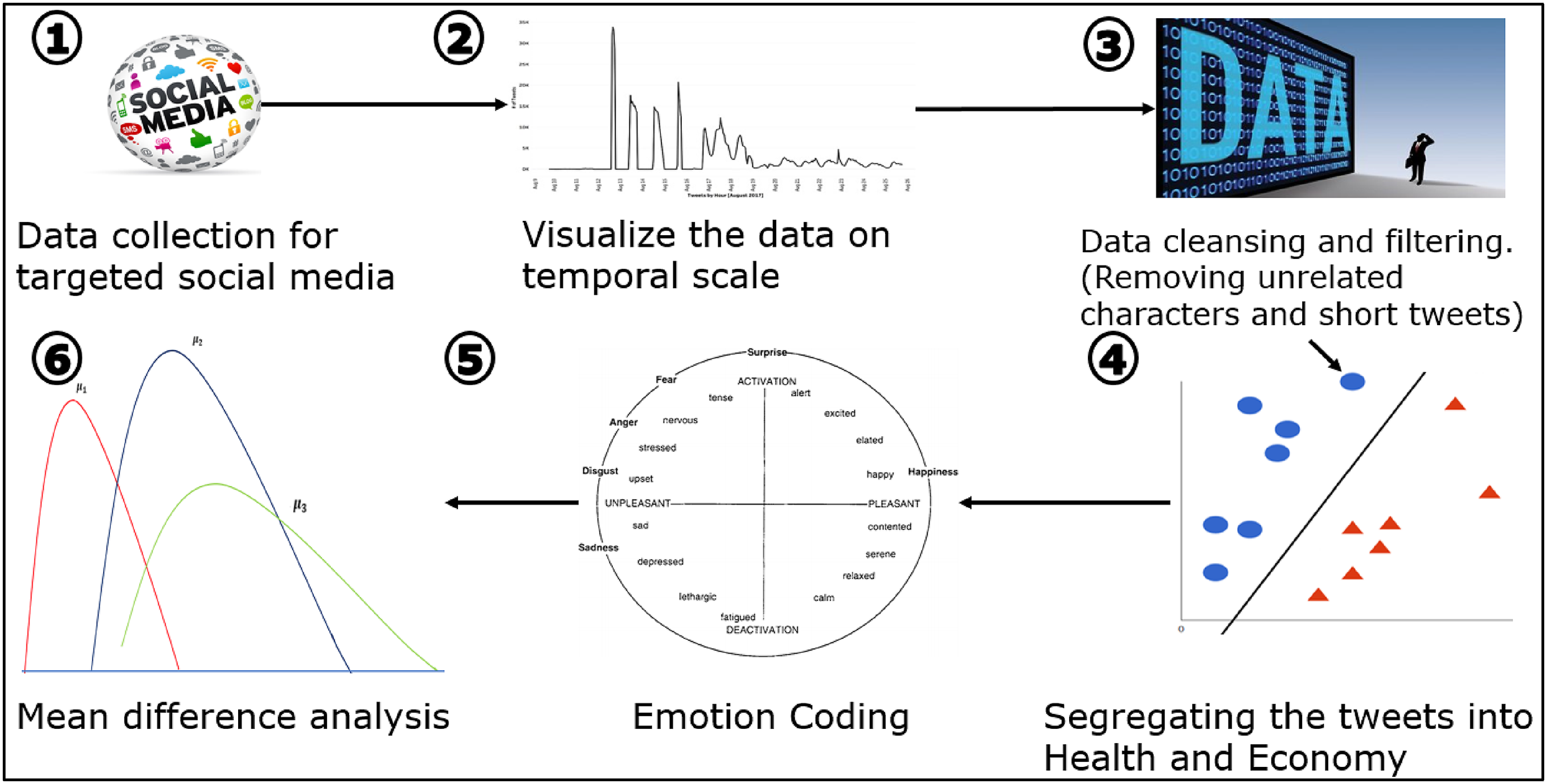
Data Collection
The novel coronavirus (COVID-19) has been the primary discussion topic on social media since the beginning of the year 2020. This study presents an analysis of tweets produced from January 20, the day China officially confirmed the existence of the infection outside Hubei province. We used Twitter streaming Application Programming Interface (API) to collect the tweets based on the keyword coronavirus and added COVID-19 to our list when the WHO officially named the disease. This streaming API looks for these keywords anywhere in the tweet and extracts the tweet text and the tweet characteristics, including retweets count, the screen name of the tweet user, the time when the tweet is posted, and hashtags. By the end of June, we collected around 194 million tweets for 163 days.
Data Cleaning and Initial Processing
We preprocessed raw tweets into consumable word tokens by removing emojis, emoticons, URLs, images, videos, web generated content, and undecipherable characters. We also excluded non-English tweets, which represented less than 5% of the overall tweets in our sample.
Segregating Tweets into Health versus Economy
To objectively classify the tweets for Health and Economy, we need the keywords specific to COVID-19 for health and economy. Hence, we trained an Latent Dirichlet allocation (LDA) topic model using the most relevant web pages providing health and economy updates on COVID-19 (Blei, 2012). Topic model provides keywords that are closely related to each of the topics. The LDA has been widely applied on thousands or millions of text messages that cannot be human annotated to perform a supervised machine learning classification (Vemprala et al., 2021). While training the LDA model, we treated each sentence as a single document and assumed that the number of topics to be fixed based on concrete inference of data. We need to specify the number of topics prior to running the LDA. To make the number of topics an objective selection, we trained the LDA model assuming that there was only one topic first and measured the coherence score of the LDA model. In the next iteration, we measured the coherence score of the LDA model assuming there were two topics and continued this process until we reached five topics. The coherence score was low for LDA model with one topic, was highest for a model with two topics, and then began to decline steadily. We selected the LDA model with two topics based on the best coherence score of 0.65. As we have trained the LDA model based on the COVID-19 web pages, we are able to get the keywords for health and economy discussions separately. We systematically analyzed the words under each topic, separated the health and economy keywords to represent unique keywords in each of the categories, and classified health- and economy-related tweets if any of the respective keywords are present in the tweets.
Emotion Coding
Identifying the emotion that the tweet conveys is an important phase in our study of how emotions shift over the time of the pandemic. Nonetheless, it is not straightforward to separate emotions from the rest of the tweets. The total number of tweets of social media user’s hash-marking emotions that specifically reference emotions inside the tweet itself is small (Mohammad, 2012). In a research conducted on the dataset of ISEAR (International Survey on Emotion Antecedents and Reactions), the emotions extracted using Lexicons yielded more reliable results than the emotions extracted based on machine learning techniques (Gievska et al., 2014). The ISEAR dataset contains a large number of personal reports on circumstances linked to seven emotions, that is, joy, fear, anger, sadness, disgust, shame, and guilt, solicited from more than 3000 students from all over the world. 2 In their study, the authors used three machine learning algorithms Support Vector Machine (SVM), Naive Bayes, and Decision Tree, to extract the emotions from tweet text. They also used keywords based on the National Research Council Canada (NRC) lexicon, also known as the EmoLex compiled by the National Research Council of Canada, to extract emotions. They compared the lexicon-based approach with the machine learning-based emotions extraction approach using the keywords precision and recall. In general, a machine learning algorithm will require humans to manually correct the system generated category for a categorization task in order to validate the algorithm’s efficiency. In the case of the NRC lexicon, the authors obtained a large-scale emotion annotation and validated the accuracy of each English word selected from a dictionary and the associated emotion that the word conveys using Amazon’s Mechanical Turk service. The findings from their study confirm that there is a huge performance jump from machine learning-based emotion categorization to lexicon-based categorization. They also suggested a hybrid approach that takes into account both lexicon and machine learning methods to improve the results. However, the hybrid approach requires labeled datasets. Considering the cost involved in manually labeling the exponentially increasing COVID-19 tweets, we limited ourselves to a lexicon-based approach to emotion-extraction. Specifically, we used the NRC lexicon, which contains around 14,182 words and each word was associated with eight emotions (i.e., anger, fear, trust, anticipation, surprise, sadness, joy, and disgust) and with two sentiments (i.e., positive and negative), and their associated scores are manually annotated on Amazon’s Mechanical Turk as a binary value (0 or 1). All the tweets are tokenized to produce a bag-of-words. Each of the words is matched against emotion words. The total number of emotion words is normalized by the length of the tweet to represent the underlying emotion. Using this normalization technique, we consider the multiple emotions that the tweet text can capture, rather than strictly classifying each tweet into one single emotion. We considered three negative emotions which are extensively considered in many behavioral studies following Ekman’s basic emotions as Anger, Fear, Disgust, and Sadness (Ekman, 1992). Out of the four negative emotions, we have not considered disgust in our study as the emotion disgust is not related to tragic events like the Boston Marathon Bombing and current coronavirus pandemic.
Comparing Emotions across Health and Economy
In order to answer our two research questions, we conducted a two-factor ANOVA between emotions across Health versus Economy tweets. The first factor is the group level differences between all the three negative emotions that help us answer the second research question about what type of emotions dominate in the Twitter discussions during a pandemic. The second factor in our model is the date component, which helps us uncover the effect of emotional patterns.
With a wide range of emotions pouring in on social media sites during a pandemic, it would be difficult to interpret the change in emotions. However, when we consider the time factor, as the pandemic progresses, we see a wide range of economic and health impacts. We considered the daily transition of emotions starting from January 20, 2020, until June 30, 2020. Considering the date as a second factor in our analysis provides more nuanced power to our ANOVA model. The two-factor level of analysis enables us to answer the first research question about emotional patterns during the pandemic. As there are two types of concerns (Health and Economy topics), seen across the Twitter discussions, the two-factor (emotions and time) ANOVA tested on both health- and economy-related discussions enables us to answer the research questions about the differences in emotions related to Health versus Economy.
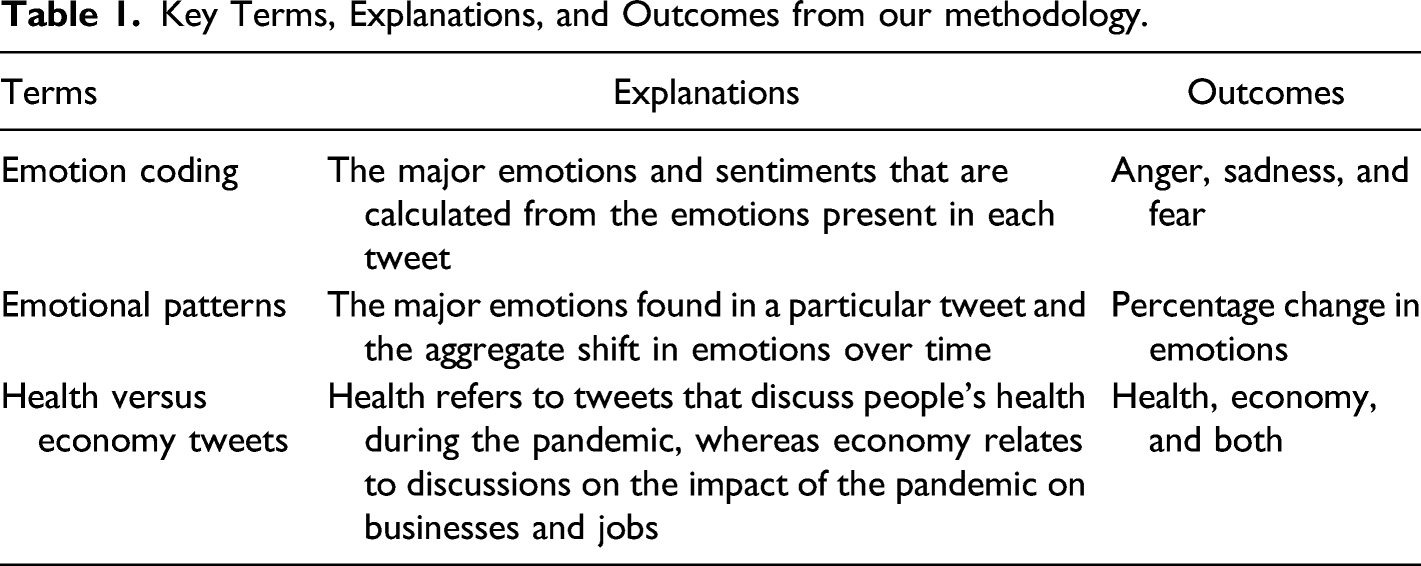
Key Terms, Explanations, and Outcomes from our methodology.
Results
We compared the consolidated means of the three expressed emotions during the pandemic for each of the categories Health and Economy. Figure 2 shows the distribution of tweets by health and economy categories. In general, there are more discussions about health than about the economy. When the Tweet discussions are separated into the various emotion categories, as shown in Figure 3, it is clear that all negative emotions are prevalent in both health and economic discussions. There have also been instances of emotional spikes occurring at short intervals. Diffusion of Virus Tweets within Health versus Economy Categories. Distribution of Emotions within Health and Economy Categories.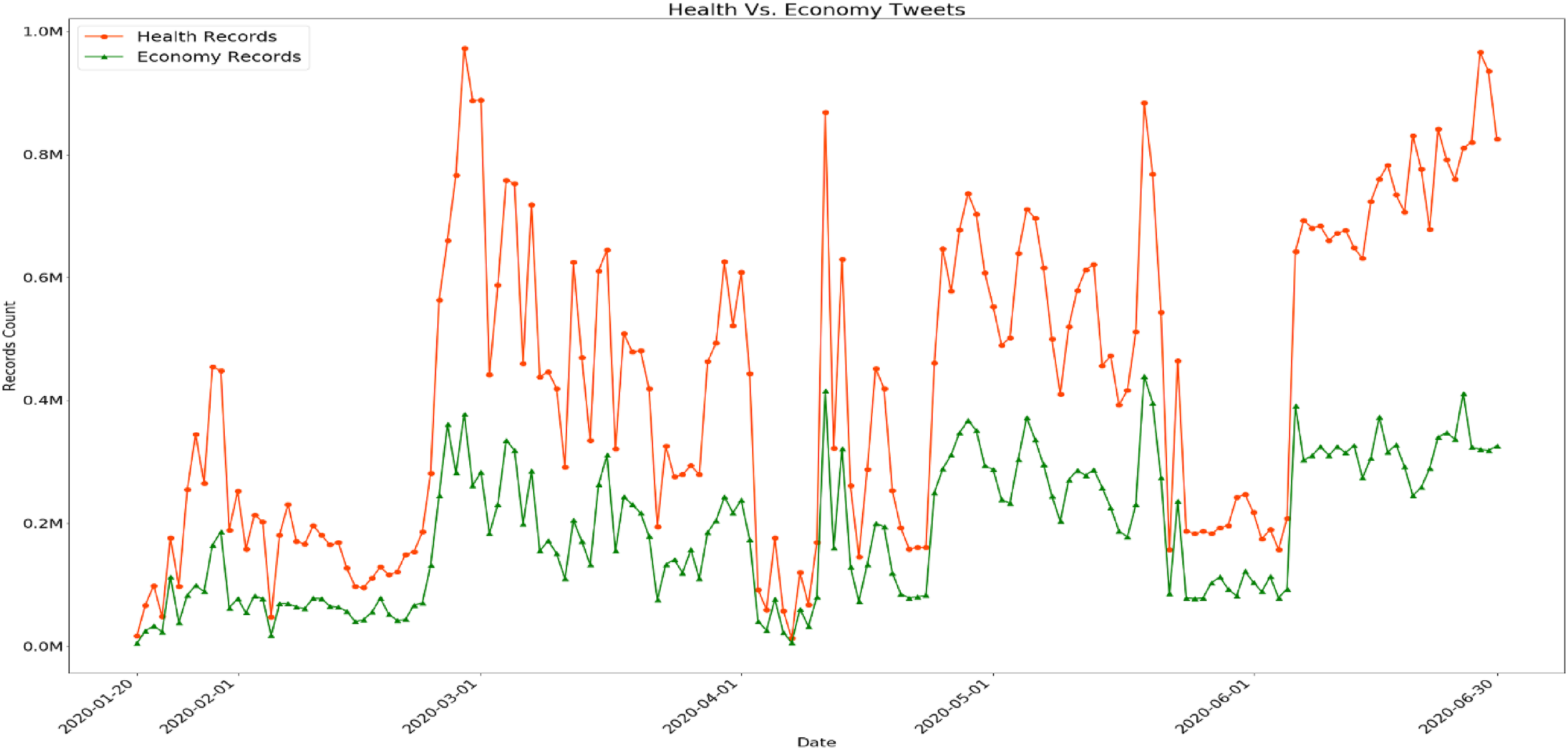
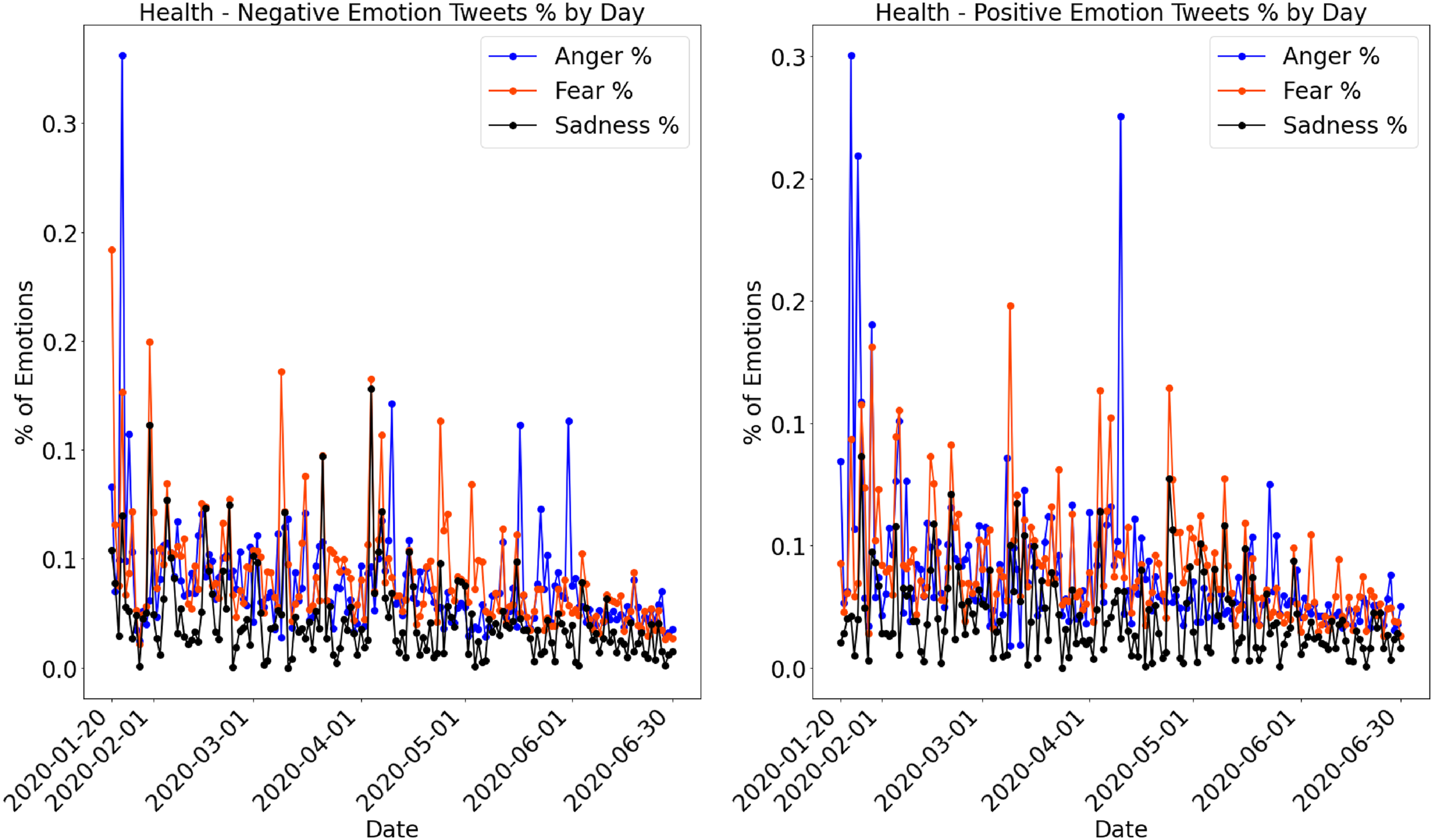
Figure 3 shows the line graph of change in emotions during the virus outbreak around Health- and Economy-related topics.
Percentage of Tweets by Emotions in Health and Economy categories.
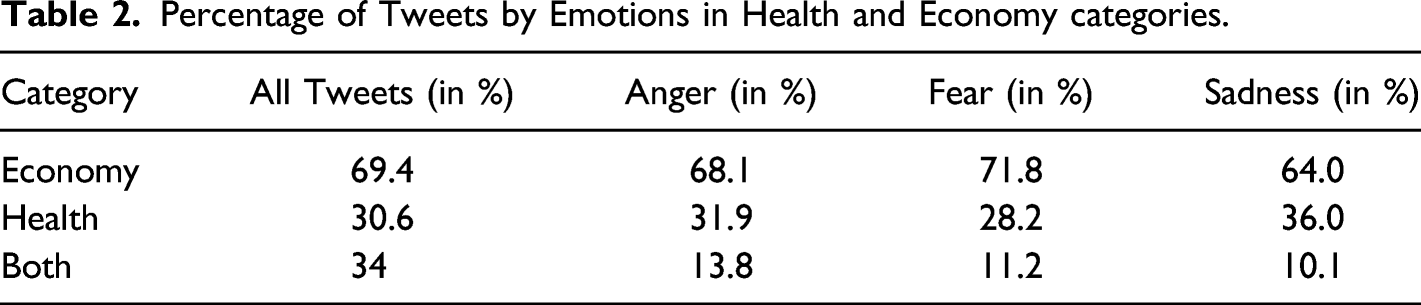
Our ANOVA results show that there is a significant difference in negative emotions under health category discussions (F = 68.385, p < 0.001). However, there is no significant difference in negative emotions under economy category (F = 2.967 with an F-critical of 3.026 at 0.05 significance). To understand what emotions dominate in each of these categories, we have performed a post hoc analysis using the Tukey test to conduct multiple comparisons of emotion groups. Before performing the Tukey test, we checked for normality assumptions using the Levene’s test. As we have normalized the emotions in our data considering the total number of tweets for the day, our data satisfy the equal variance condition. Figure 4 present the marginal means graphs for all the three emotions within health and economy categories, respectively. Pattern of Negative Emotions.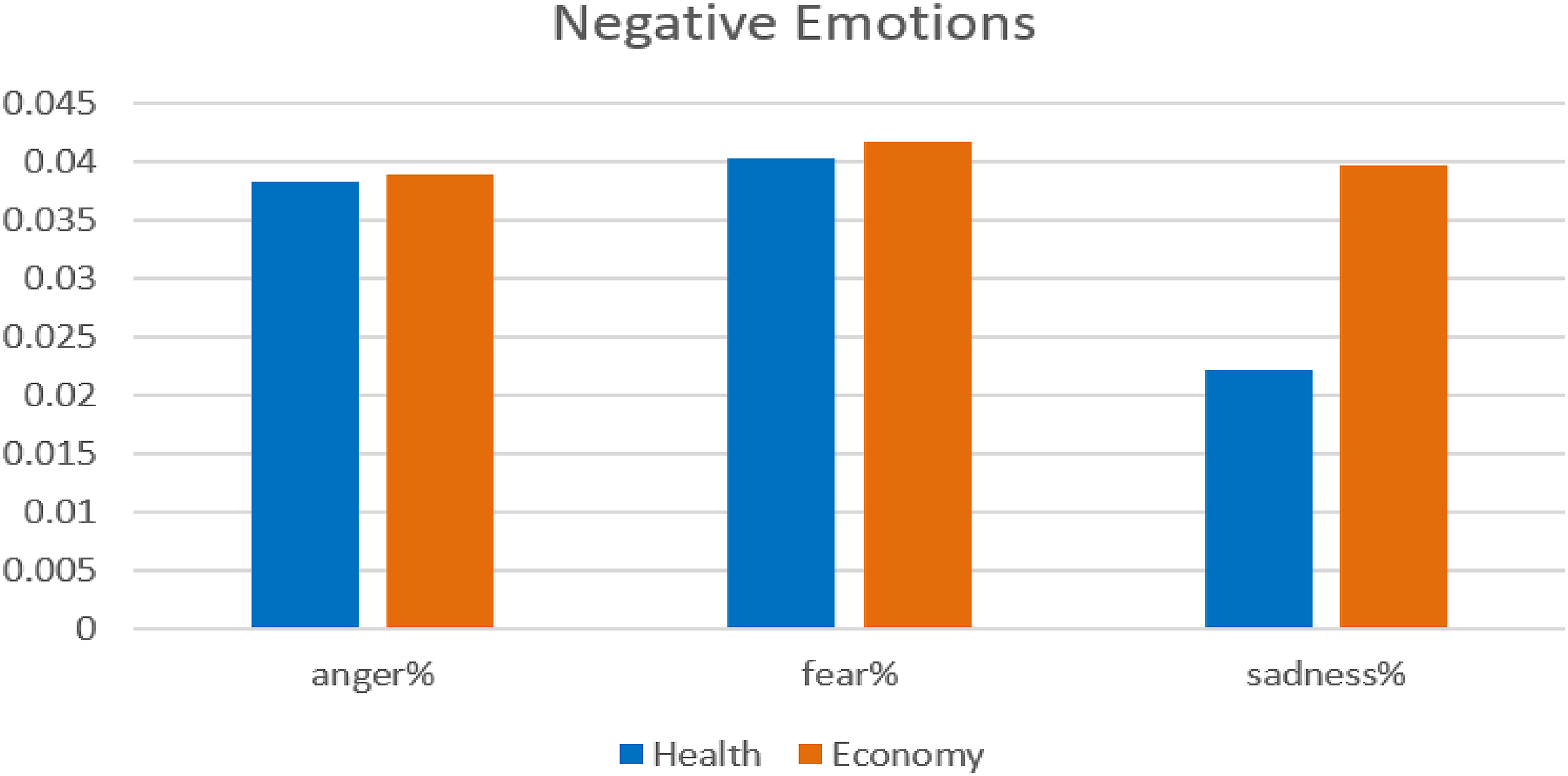
In the context of the health, looking at the graph of Health-Negative Emotion Tweets % by day (in Figure 3), we can see that emotion with the most peaks during any given day is fear. People are genuinely afraid of getting the novel coronavirus and are actively trying to avoid catching the virus which in turn makes them fear it even more. When these users come on Twitter to vent their fear they inadvertently start a chain of negative emotions which spreads across the social media platform. This essentially validated the presence of emotional patterns in the online community which surely translated to the real world and affects the emotions of everyone in society. This is succinctly seen in our graph too.
In the context of the economy, looking at the graph in Figure 3 of Economy-Negative Emotion tweets by day, we see two main blimps. In the initial part of our dataset, we see users largely fearful. The main concerns highlighted in the tweets relate to fear of job losses, reduced wages, less hours and an overall lower economy. Around the middle of the dataset we see a spike in anger. This can be attributed to peoples’ frustrations caused due to repeated lockdowns and extended periods of social distancing being increased even after the desired time limit expired. People were angry as they were not able to go to their jobs to or outside to beaches and dine in restaurants.
The graph shows that the emotions are floating around on the Twitter platform which concisely show how and what emotional patterns are present in society and online social platforms.
In figure 4, we see that sadness is significantly different from anger and fear, for health related discussions. People are far angrier and more fearful of the virus than they are sad. They are angry and afraid of catching it and try to avoid catching it at all costs. Sadness is low on the left side of the chart. In addition, in figure 4, we see that anger is comparable to fear and sadness. This makes sense in the context of the discussions surrounding the economy, where people have been immediately affected by the virus where their work establishments have shuttered, and they have limited opportunities because of the slump in the economy. In this case, we can argue that working people will be angrier at the virus, at their past employers or at the government.
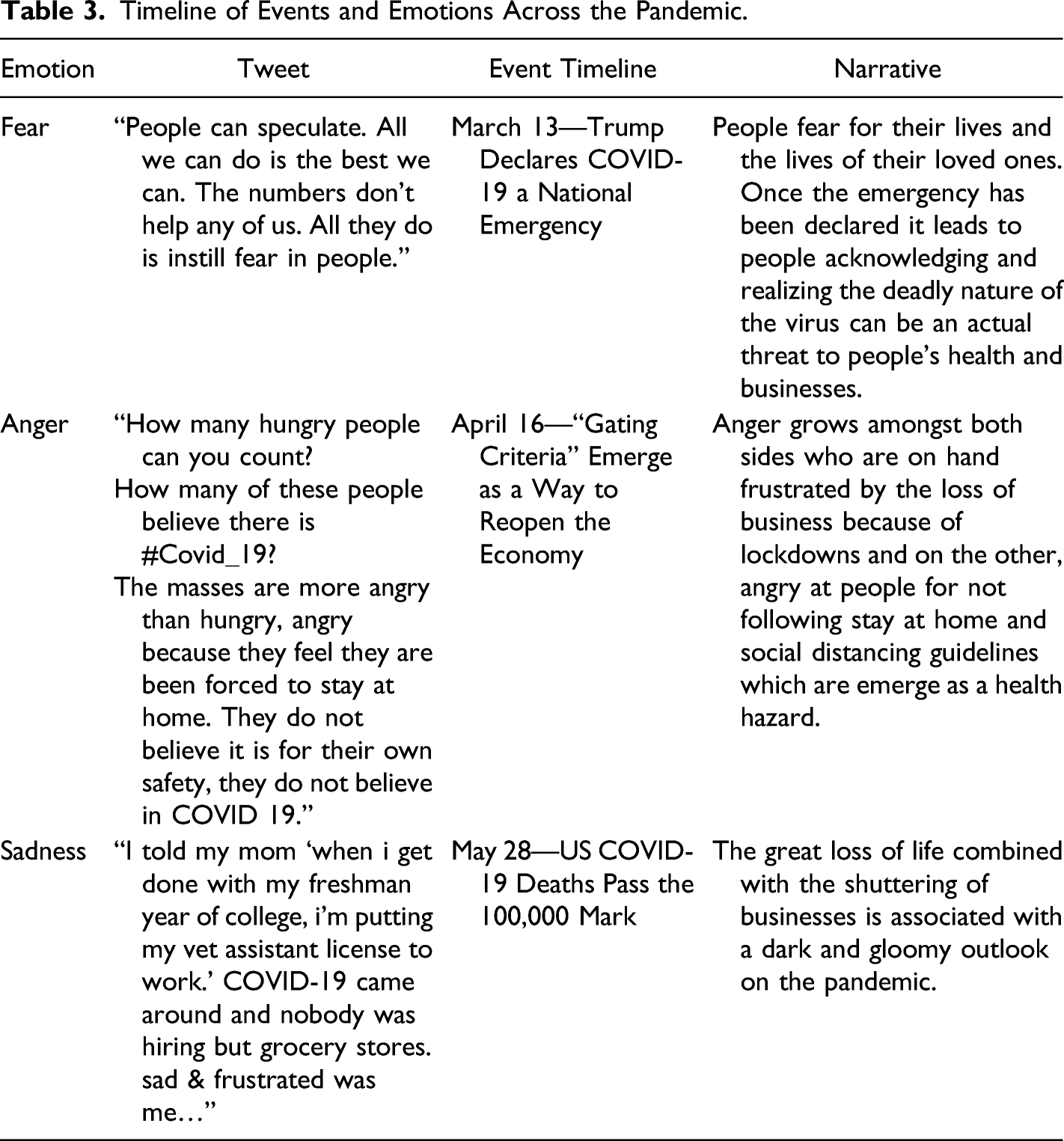
Timeline of Events and Emotions Across the Pandemic.
Discussion
The conversation in most of the world for balancing health versus economy (The Washington Post, March 27, 2020) has motivated our research direction in this study. Studies have looked at negative emotions in conversations about physical health and safety. Research in the past has examined negative emotions in the context of work groups, bombings, and diseases. However, during a pandemic, both health and economic emotions play key roles in people’s lives, especially in times of infectious diseases such as COVID-19 (Columbia Business School, 2020, May 11).
Through a statistical analysis of emotional patterns, we present an analysis of the public sentiment on online social media communities like Twitter about the health versus economy debate. This debate has primarily been about saving human lives versus saving the jobs that those humans perform to earn their livelihoods. Through our analysis we find that online health discussions outnumber the economy discussions. This is true offline as well because for any kind of long term economic recovery to take place, it is imperative that first, the virus is dealt with swiftly and surely (The Hill, 2020, May 13).
Also, there is a need to understand how the negative emotions vary across periods and individuals on Twitter as it provides significant theoretical and practical implications. In terms of academic research, analyzing differing emotions during a pandemic contributes to the literature on emotional coping and response during crises.
It is thus important that public sentiment on Twitter be analyzed to come up with theoretical framings to understand how emotions differ online and how they can be used as a medium for disseminating purposeful and directed communication during times of crises. As it has been evidenced by research that well directed online communication can be an effective tool to spread influence among the society at large (Stieglitz & Dang-Xuan, 2012).
Implications
Implications for Research
We build on previous work related to emotional sentiments in Tweets that explain how users communicate online during crisis situations (Lee, Agrawal, & Rao, 2015). Our study analyzed emotional patterns on social media platforms to uncover the continued presence of fear of uncertain situations like the coronavirus epidemic. Through a longitudinal analysis of the data we uncover emotional patterns showcasing the continuity of emotions across the pandemic. For example, the emotional concerns of users are consistent across the three periods. They shift from anger early on in the pandemic to fear and then to sadness.
Further research is needed to understand the effects of emotional patterns. It is imperative that we understand how emotions vary across time so that we can plan and communicate better during times of crises. Research in this direction gives us an insight on how to address problems of misinformation, panic and mass hysteria. It is also important that we understand how mitigating negative emotions helps us to foster harmony and goodwill for response efforts in the community that are needed for successfully tackling this pandemic.
Implications for Practice
The practical contributions from this paper amount to the identification of distinct emotions that are attached to users’ post on social media. Twitter is the preferred media of choice for instant news, views, and information. It is also a medium where users share their emotions instantly which can be very helpful in collecting data real time data for behavioral studies. Moreover, by considering a split approach to the study of emotions in the context of cross-discussions, such as health and the economy, during a pandemic, we present a framework for modeling discussions that can help to devise purposeful solutions to conflicts and disagreements.
The discussions around health and economy are used to analyze how emotions differ with regard to two parallel viewpoints. We study how user sentiments vary across days and the exponential effect that these emotions have on a large community of social media users. Considering the group level differences between two emotionally charged factions studied in this paper can have implications for policymakers on how to deal with conflict during crises. For example, officials can tweak their communication strategies when addressing diverse groups in society to reduce conflict. They can reinforce the strategies that are associated with mitigating negative emotion sharing on Twitter and remove elements that result in negative emotions. Understanding which emotions are prevalent during a crisis in the social media domain can help governments, federal agencies, and medical institutions put out effective public safety advisories to curb misinformation, subdue paranoia, dispel panic and anxiety, and amplify calming and reassuring messages that effectively target and eliminate negative emotions in society.
Conclusions
In this study, we focus on emotional patterns and how users react to the coronavirus pandemic on Twitter. Users express a plethora of emotions online and much of them are either positive or negative as evidenced by our dataset with 192 million records. A majority of the users post their own thoughts and feelings regarding the pandemic and share other similar feelings from the Twitterati. We see a heavy presence of fear online where people are fearful for both their lives and livelihoods. They are apprehensive of testing and scared of contracting the virus. Another emotion is anger, which is seen particularly with regard to the economy where people are disgruntled at losing their jobs or because of the restrictions placed on their economic pursuits with places of businesses being shut down for a long period of time.
In conclusion, we reiterate the need to keep track of emotions online as Twitter is now a source of instant information for a lot of people. This sharing can inadvertently lead to emotional patterns online where a single user or a group of users can affect a much larger group of people, all the while spreading their emotions. These insights from our study on emotion sharing can be purposed to both dispel the negative emotions online and foster the spread of positive and engaging views during times of crisis. There is evidence of emotional overtones in a majority of the content and views that are shared on Twitter and our study effectively summarizes how these emotions vary over day and months.
Though this study has made contributions to theory and practice related to emotional patterns, it suffers from a few limitations. One such limitation is related to the dataset being a worldwide repository of Tweets related to coronavirus without demarcation for national boundaries. We have not used geotagging in this paper to study how emotions vary across geographic boundaries and how dispersed are the emotions geographically. Another limitation is related to the ongoing nature of the pandemic. Since the coronavirus is an event that is still very much in effect, the addition of new data generated from this even can fluctuate the results related to the spread of emotional patterns.
In terms of future work, we can look at the rate of emotion diffusion on Twitter and try to answer how different emotions spread across the online social media community. What kind of emotional changes occur in the users when significant events happen such as a second wave of virus outbreaks or similar scenarios. Also, due to the time series nature of our data, we can even use predictive analytics to forecast what kind of emotional changes may be associated with events in both the health and economy sector.
In this study, we looked at the collective emotions of the pandemic. Segregating the tweets of the various stakeholders on the basis of their interests, such as the emotions in the tweets of federal, local, and public health institutions, provides further insight into the reasons for the shift in patterns of emotions.
Footnotes
Declaration of Conflicting Interests
The author(s) declared no potential conflicts of interest with respect to the research, authorship, and/or publication of this article.
Funding
The author(s) received no financial support for the research, authorship, and/or publication of this article.
