




Abstract
In this article, I explore the relationship between transparency and publicity, and consider how the links between the two ideas might be reconceptualized to make better sense of their empirical reality. Both transparency and publicity have acquired a normative power as management ideas that govern all kinds of organizations—political, commercial, nonprofit, and public sector. Transparency is normatively associated with ensuring accountability of those who govern (whether politically or economically) to those they are governing, while publicity is a strategic act motivated primarily by self-interest: to engage in publicity is to make visible something that one desires to be seen in a particular way in order to reap the benefits of that perception. The result of these normative associations is that transparency and publicity are often understood as conceptually opposed and incommensurate concepts. In this article, I challenge this dichotomy and suggest that, given the empirical reality of their application by organizations, it is more productive to understand the concepts as a transparency–publicity hybrid, rather than separate ideas. By investigating the empirical connections between transparency and what might be termed promotional publicity, new and more productive thinking about the effects of their interaction on organizations can develop.
Introduction
In this article, I explore the relationship between transparency and publicity, and consider how the links between the two ideas might be reconceptualized to make better sense of their empirical reality. Both transparency and publicity have acquired a normative power as management ideas that govern all kinds of organizations—political, commercial, nonprofit, and public sector (Sahlin & Wedlin, 2008). In political theory, the words have been used interchangeably, where publicity is equated with transparency when governments publicize information to citizens as part of the democratic process, or when publicity is a mechanism for communicating information in the public sphere (Fenster, 2006; Habermas, 2006). However, more recently a differentiation has emerged in theory and practice, where transparency is associated with virtuous behavior enacted in the interests of accountability to a wider audience, while publicity is associated with self-interested forms of promotion.
While the roots of this distinction are unclear and, as I suggest in this article, inaccurate, it reflects critiques of neoliberalism that challenge the wisdom and benefit of market logic in areas where collective goods, services, and concerns prevail (Brown, 2015; Cronin, 2018). My aim here is not to dismiss such critiques, but rather to engage with one of their main concerns: the encroachment of vested interests on public discourse (Habermas, 2006). I do so by investigating the empirical connections between transparency and what might be termed promotional publicity 1 so that new and more productive thinking about the effects of their interaction on organizations can develop. The focus on organizations is important not only because both transparency and publicity primarily invoke organizational action but also because all organizations are social actors: when they respond to transparency and publicity demands, they make contributions to public discourse that have a significant impact on our collective and individual lives. Understanding how and why they communicate, and what effect their communication has, is therefore essential if their effects on public life under neoliberalism are to be fully understood.
Transparency and publicity materialize as a range of templates and scripts for organizational action in relation to managing visibility vis-à-vis stakeholders and society. Both are global phenomena, adopted and promoted as principles for practice by symbolically powerful actors such as global trade bodies, global nonprofit organizations (NGOs), regional and national governments, and transnational corporations, which helps them circulate and promotes their uptake (Czarniawska & Joerges, 1996; Höllerer et al., 2017; Sahlin & Wedlin, 2008). Transparency is normalized through global rankings, standards (e.g., GRI, Transparency International, Sunlight Foundation), codes of practice, and the existence of many international organizations, and has become a universal norm characterizing ethical, stakeholder-focused organizations (Fenster, 2006; Garsten & Montoya, 2008a; Rawlins, 2008). Its importance is exemplified by contemporary “transparency movements”—the accumulation of formal and informal institutions that demand openness and provide open access, data-driven resources for challenging corporate and governmental secrecy and corruption (Nolin, 2018). Transparency is now embedded in locations as diverse as national Freedom of Information Acts; World Trade Organization toolkits; commitments by international and supranational organizations such as the United Nations (United Nations System, 2016); legislation for corporate nonfinancial reporting in specific areas of collective interest (such as environment); research funding for investigating and legislating on issue-specific forms of transparency (see, e.g., Alliance for Corporate Transparency); charters for the international NGO sector (see, e.g., http://www.ingoaccountabilitycharter.org/); and transparency registers of lobbying. These movements, tools, and regulatory norms facilitate the widespread embedding of transparency as a valid stakeholder demand in relation to large organizations and institutions, and consolidate its status as a social value that defines and governs “best practice” for organizations both large and small (Christensen & Cornelissen, 2015).
The evolution of transparency’s considerable moral authority is grounded in its deployment as a practice that can counter corruption, and therefore protect citizens from the abuse of power by elites. Thus, transparency is implicitly associated with ensuring accountability of those who govern (whether politically or economically) to those they are governing (Birchall, 2011a). Transparency in nonpolitical contexts may be prompted by shareholder or stakeholder concerns and feedback, community campaigns, social movements, or trends (e.g., to improve diversity, increase sustainability, or reduce pay inequality). From this perspective, transparency acts are motivated by collective interests, a public service to which self-interest is subordinated. This is not to say that self-interest is absent from transparency acts, merely that the primary impetus for action comes from concerns outside, rather than within the organization.
Publicity, on the other hand, is motivated primarily by self-interest: to engage in publicity is to make visible something that one desires to be seen in a particular way in order to reap the benefits of that perception (Brighenti, 2007). Publicity is a strategic act associated with the promotion of political ideas and parties, products, services, causes, and ideologies. It is manifest as a media logic that governs organizational action, as reputation management strategies, as legitimacy claims, and in many other promotional forms (Fredriksson & Edwards, 2019; Merkelsen, 2011; Pallas et al., 2016; Waeraas, 2018). Through publicity the collective is persuaded to buy into the organization’s objective, whether it is in their own best interests or not. What is made visible serves a particular purpose for the organization, while collective benefits are secondary.
The global industry of promotional experts that ensures organizational interests are realized through nuanced and sometimes implicit modes of persuasion consolidates the power associated with publicity and its institutionalized practice (see, e.g., Draper, 2020). It stands in contrast with transparency, because it is in the business of framing or limiting the information that audiences can access, in the interests of the organization (A. Davis, 2013; Mynster & Edwards, 2014). Accountability is not the central concern: the organization, rather than stakeholders, communities or the public, decides what should be known and who should know it.
The result of these normative associations is that scholarship has treated transparency and publicity as conceptually opposed and incommensurate concepts. In the public domain, the dichotomy emerges when efforts to publicize transparency initiatives are critiqued on the basis of self-interest undermining their implicit claim to virtue (Nolin, 2018). Yet from a historical and analytical perspective, the opposition is surprising. As I argue in this article, it is more productive to understand transparency and publicity as tightly connected. The two have always been deeply entwined (Brown, 2015; Cronin, 2018; Quijano, 2007): for example, histories of the promotional industries show that both commercial and nonprofit organizations have long made political interventions in ways that serve their specific interests, by engaging with stakeholders’ collective concerns—whether they be about the legitimacy of big business, trading relations, sustainability issues, or inequalities (M. Davis, 1977; Ewen, 1976, 1996; Lock et al., 2016; Marchand, 1998). It therefore seems unwise to assume that transparency can ever be untainted by publicity, or that publicity can never facilitate the collective benefits of transparency.
In fact, recent scholarship has pointed out the inherently political nature of transparency as both material practice and disciplinary discourse. From this perspective, transparency is always managed, strategic, and driven by particular objectives (Christensen 2002; Christensen & Langer, 2009; Fenster, 2006). In turn, political scientists have long recognized that publicity is essential to democratic systems, given that information—including the information revealed through transparency efforts—needs to circulate in order to be useful to citizens (Dryzek, 2009; Dryzek & Niemeyer, 2010; Mansbridge et al., 2010). If transparency can be understood as a political and promotional act, and publicity can serve collective purposes as well as self-interest, then the juxtaposition of transparency against publicity is misplaced, and the normative associations that have led to this apparent dichotomy are open to interrogation.
In this article, I develop an understanding of the mutual constitution, inseparability, and irreducibility of the two ideas through the hybrid concept of transparency–publicity matrices. I begin by summarizing existing literature on transparency and publicity, exploring the connections between the two concepts. I then introduce transparency–publicity as a heuristic for understanding those connections, and propose a four-way typology to explain how modes of transparency–publicity are characterized by different logics, objectives, assumptions about audiences and organizations, and practices. I conclude by considering how the tensions inherent to transparency–publicity generate different forms of justification and critique that have to be managed by organizations, and outlining directions for future research.
Transparency
Transparency is enacted through both discourse (by claiming openness) and practice (by making information visible; Fredriksson & Edwards, 2019). From one perspective, transparency may be thought of as a lack of concealment, and thereby a lack of intervention (Birchall, 2011a). However, in organizational contexts, transparency acts may be more accurately understood as the managed removal of concealment through making factual information accessible. Organizations thereby “reveal” themselves to audiences in response to challenges (but see also Draper 2020, for a discussion of how this works for individuals). This understanding of transparency speaks to the democratic ideal with which it is associated, where citizens demand accountability, grant (or not) legitimacy to different actors, and participate more effectively in political and civic life, based on the information they have (Habermas, 1984).
However, in practice enacting transparency in response to audience demands is more complicated. As Hannah Arendt (1968/1993) argues, facts are not strategic and offer no agentic power until meaning has been attributed to them. Transparency acts, then, are empty political exercises unless some kind of meaning is attached to the facts that are revealed. To generate legitimacy for the organization, they have to be framed in a way that demonstrates accountability and responsiveness. This involves translation: facts revealed through transparency efforts are always curated and managed through processes of availability, approval, and accessibility, through which their meaning is constructed (Stohl et al., 2016; Broad, 2020). Transparency therefore constitutes more than simply disclosure. Information is revealed with some kind of intent to be seen and understood from a particular perspective (Rawlins, 2008); it is selected and targeted and as such, it does not eliminate power imbalances, but rather produces “new forms of power effects” (Flyverbom et al., 2015, p. 404; see also Draper, 2020).
Transparency carries ideological weight because of its grounding in the democratic principle of accountability. In contemporary politics, this accountability is often focused on citizens’ right to scrutinize and challenge the activities of political elites so that they cannot be captured by vested interests that work against the populace (Fenster, 2006; Hood, 2007; see Schudson, 2020, for a discussion of how transparency can be undesirable in some contexts). In neoliberal contexts, however, definitions of ‘political elites’ are muddied because a wide variety of organizations are engaged in political life. As Brown (2015) points out, when politics is normatively defined by economic and market rationality, the way is open for market actors to simultaneously exercise political influence and affect the way that political discourse unfolds (see, e.g., Daum, 2019). This positions them, and those who promote them, among elites with political power, but it also makes them subject to transparency demands because when any organization claims political agency and membership of a collective through their discourses or practices, they must sacrifice some level of singularity and secrecy surrounding their activities to justify that claim (Birchall, 2011a).
Alongside the emergence of neoliberal politics, the rise in corporate social responsibility (CSR) practices since the 1980s has normalized stakeholder expectations that organizations acknowledge their role in mitigating collective concerns, and act politically by virtue of popular demand (Lock et al., 2016). Demands for accountability are applied to organizational practices—for example, by demonstrating responsible supply chains, avoiding aggressive fundraising campaigns, ensuring sustainable work practices, or investing only in ethical companies. CSR initiatives are publicized in order to communicate the fact that organizations are responding to stakeholders and taking responsibility for their actions as institutions that can have a profound impact on collective concerns such as environmental protection, discrimination, or alleviating poverty. However, they also raise the spectre of the instrumentalization of politics: organizations become vulnerable to accusations of promoting collective issues for their own gain, or of strategically managing communication to direct attention away from other issues, which ultimately weakens the foundation for collective action (Aronczyk, 2013a; Banet-Weiser & Mukherjee, 2012; Roper et al., 2016).
As transparency discourses and practices travel across political, commercial, and nonprofit environments, the idea of transparency is decontextualized and abstracted from politics, then recontextualized and adapted to new environments (Czarniawska & Joerges, 1996). However, transparency always retains a claim to legitimacy in the public sphere because it is associated with evidence that an organization is acting for collective, and not private reasons. This lends transparency a virtuous character and social value (Hansen et al., 2015), so that those who are transparent can claim moral standing. From a promotional perspective, this makes transparency desirable, something to be co-opted and instrumentalized as “transparency capital” (Birchall, 2011a, p. 8) to benefit from social and political opportunities and build trust with stakeholders (Kim & Lee, 2018). Hence, claims to transparency, as well as the information revealed by transparency acts, need to be circulated through publicity not only to ensure audiences can access the information they require but also to demonstrate the virtuous character of the organization (Broad, 2020; Lee, 2020; Kantola, 2016). From this perspective, the presentation of transparency is never neutral; on the contrary, as Garsten and Montoya (2008b) argue, it is part of a normative neoliberal order that promotes the performance of ethical, responsible governance.
Publicity, then, is indispensable to realizing the organizational and collective benefits that transparency can deliver. However, this also means that as soon as facts about transparency efforts are deployed they become suspect, carrying the taint of self-interest and the suggestion of manipulation. They inevitably invite critique, because they invoke opinion rather than objective fact and act as a form of “visibility management” (Flyverbom, 2016, p. 99; Yeung, 2005). From this perspective, the production, meaning, and significance of transparency depend on mediated interactions, many of which are generated through publicity, and an important organizational risk associated with transparency is its dependence on sense-making in context (Hansen & Weiskopf, 2019). Interpretations of organizational claims remain fundamental to transparency’s ontology so that the outcome of transparency efforts can never be certain (Fenster, 2006; Flyverbom, 2016).
Once invoked and made public, transparency has disciplinary effects. To publicly claim transparency is to claim a status that must already exist; it therefore acts as a form of Foucauldian governance, constituting organizational culture and practice through observation (openness inevitably engages scrutiny) as well as regulation (transparency requires specific structures of interaction between organizations and their stakeholders) (Flyverbom et al. 2015; see also Lee 2020 for an example of this in the university context). Struggles over transparency relate to this double-edged productivity of publicity, offering on the one hand, the potential to gain legitimacy and on the other, the risk of inviting new forms of scrutiny and governance. One way of managing this is to make certain information transparent in order to redirect public attention away from sensitive areas. For example, publicizing hospital waiting times and treatment success rates may help to reduce scrutiny of spending and investment decisions; or publicizing positive student experience metrics may reduce the pressure for universities to demonstrate intellectual rigor in their degrees. Here, an increase in transparency coexists with an increase in invisibility and opacity—a reduction of publicity about the organization in areas that have the potential to threaten its legitimacy (Christensen & Cheney, 2015; Fredriksson & Edwards, 2019; Hood, 2007). These publicity-driven dynamics are integral to the forms of power that result from the pursuit of transparency in specific contexts and the need to balance internal and external interests (Flyverbom et al., 2015).
Publicity
While transparency is associated with accountability, publicity is connected to the self-interested circulation of information in political, economic, and social spheres of life. Publicity is predicated on a strategic deployment of visibility that differentiates itself from transparency by the underlying self-interest, rather than collective interest, that prompts action. In competitive contexts where attention is a scarce resource (Webster, 2016), publicity helps organizations promote products, services, causes, and ideas to target audiences, increasing their popularity and reputation (Draper, 2020). Moreover, because publicity techniques are designed to excel in attracting attention, they are also indispensable to political life as mechanisms through which the public can be made aware of information relevant to collective concerns. They carry information from one arena to another, facilitate media engagement and coverage, and thereby contribute to the content and quality of public deliberation (Goodin & Dryzek, 2006: Habermas, 2006).
Publicity is characterized by a wide range of promotional strategies, from rational argument, to rhetoric, emotion, and digital engagement, and used extensively by actors who seek to both sustain and challenge hegemonic power (Edwards, 2016). While Habermas (2006) cautions against its use by economic elites to legitimize their presence in the political sphere, other scholars have argued that organizational publicity can contribute to a healthy public sphere and civil society through relationship building, developing collective social capital, and fostering dialogue and engagement within and between cultures (Bardhan, 2011; Hiebert, 2005; Lugo-Ocando & Hernandez-Toro, 2016; Sommerfeldt, 2013; Taylor, 2010).
Some political communication scholars have argued that publicity has a significant amount to offer democracy, delivering more tailored, interesting, and engaging political content to citizens and facilitating their contribution to policy making (Henneberg, 2004; Scammell, 2014). Indeed, Penney (2017) points out that citizens themselves are enthusiastic adopters of marketing tactics—organizing rallies, wearing slogans on t-shirts and caps, using social media tools—in their own efforts to circulate political messages online and off-line. Some actors in “counterpublic spheres” use publicity to generate debate, rather than shut it down, and here, publicity can work in favor of marginalized groups and their causes through its ability to “call constituencies into being [ . . . ] such that citizens identify and engage with different representatives on different topics in different contexts,” or shed light on actions that would otherwise remain hidden (Parkinson, 2012, p. 163; see also Daum, 2019). In such circumstances, publicity works in the interests of transparency and the collective.
Nonetheless, while publicity may have the capacity to oil the wheels of democratic debate and participation, its persuasive intent and the fact that it is underpinned by organizational self-interest—even when enacted by NGOs or public sector organizations (see, e.g., Fredriksson & Edwards, 2019; Mynster & Edwards, 2014)—means that it is inherently biased. This makes organizations vulnerable to accusations of obfuscation and propaganda, a form of spin, or “presentational” response to (actual or potential) critique (Hood, 2007). This risk is exacerbated by the fact that contemporary audiences are well-versed in promotional culture and readily skeptical of organizations’ stated intentions; making a convincing argument about contributions to civic life in terms of genuine engagement with a wide range of stakeholders, or addressing collective, rather than private, interests, is particularly difficult (Edwards, 2016).
Responding to such challenges would require replacing publicity with transparency and prioritizing collective interests in acts of organizational revelation. This is easier said than done: unfettered transparency may result in operational and reputational risks that conflict with an organization’s obligation and capacity to fulfil its mission (Birchall, 2011b). In competitive contexts, for example, a degree of concealment is necessary to retain market advantage, while in politics national security is often invoked as a reason for secrecy (Birchall, 2011a; Fenster, 2006; Garsten & Montoya, 2008a). Reputation management includes ensuring that organizations are not known for certain activities, are not the same as their competitors—and secrecy is often invoked to achieve this (Cronin, 2020; Dimitrov, 2018). Internally, secrecy may serve a range of social and operational purposes that facilitate organizational processes and relationships (Costas & Grey, 2014). Moreover, because markets are by definition unequal environments, strategically managing visibility, being seen in a particular way, is necessary for success. Therefore, if transparency is called on to counter criticisms of publicity—particularly in commercial environments—it can only be enacted as visibility management, which allows organizations to ensure their transparency efforts align with both operational imperatives and legitimacy claims (Flyverbom et al., 2016; see also Broad & Lee, this issue). Inevitably, then, organizations that use transparency to deny self-interested publicity simultaneously run the risk of revealing their pursuit of legitimacy, rather than the public interest, because it is impossible for transparency to ever be completely altruistic.
This discussion reveals many parallels between transparency and publicity: the importance of strategy to both practices; the interplay of self-interest and public interest; and the centrality of interactions to their ontology. It also shows in more detail the connections between the two ideas. Transparency reveals information, but that information must circulate in order for it to have any kind of political power; publicity puts transparency to work, making it a productive force in social, economic and political relations. On the other hand, publicity is nonsensical without some kind of transparency; one has to create publicity about something, whether that something is the organization’s preference or that of its stakeholders.
Getting Beyond the Dichotomy: Transparency–Publicity Matrices
Does this bring us perilously close to arguing that transparency and publicity are, to all intents and purposes, the same thing? I suggest not, but it is clear that the imbrication of the two ideas prompts new questions about how we should understand the connection between them. Most important, their interaction generates inevitable tensions and, following Birchall (2011a, p. 12), it is productive to “inhabit” these tensions rather than try to resolve them. One way of doing this is to engage with a hybrid idea of transparency–publicity, rather than to continue with dichotomous concepts.
Hybridity subverts any claim to singular superiority (Bhabha, 1994), and instead directs attention to the different ways in which the combined presence of transparency and publicity might manifest in discourse and practice. It reveals the ideological nature of any claim to superiority of one over the other, because such claims can only survive at the expense of excluding alternative realities. Thus, a dogmatic focus on virtuous, altruistic transparency in the interests of citizens excludes publicity efforts that serve the public interest despite their self-interested component; an emphasis on the primacy of strategic information management ignores the reality that meaning is always cocreated and total control over what is revealed is impossible. Hybridity also highlights the power dynamics at the heart of transparency–publicity interactions—between organizations and audiences; civic, for-profit and nonprofit organizations; governments and citizens. Each of these actors has different reasons for engaging with transparency–publicity and in practice, will jostle for attention to their interests. It is through these struggles that tensions emerge.
To understand how and why tensions exist, and how they might affect the practical manifestation of transparency–publicity, we can bring their underlying justificatory logics into play. Boltanski and Thévenot (1991/2006) propose a number of different “worlds,” or orders of worth, each of which encompasses a specific logic used to justify the value attached to different actors and actions. Of the six they identify, three are of particular interest here. First, the civic world values actors that prioritize the common good over individual interests. This does not equate to renouncing one’s status as an individual, but simply to recognizing that one has a dual identity as a member of a collective, as well as an autonomous individual. Autonomy is exercised in the decision to sacrifice self-interest in favor of actions that serve the common good—a civic justification for action therefore involves a degree of reflexivity and “a quality of conscience” (p. 114). Correspondingly, those who judge the integrity of actors claiming civic legitimacy have to assess these essentially internalized processes based on external signs. Claims to civic legitimacy are always vulnerable to being rejected, if the signs are perceived to be unconvincing. Transparency, as an act motivated primarily by the demands of external stakeholders, is one sign that organizations can use to demonstrate their civic legitimacy, but one in which the underlying intent will always be open to contestation.
The second world relevant to the argument being made here is the world of fame, which values actors that attract esteem from others. The more widely esteemed and influential, the more valuable the actor. Esteem is always constructed in relation to others, and is therefore defined in part by the competitive context for reputation. It is not related to self-esteem; rather, it is constructed by external specialists in creating and promoting identities and reputations (such as the public relations or advertising industries—see also Aronczyk, 2013b, on the transnational promotional class). However, the disconnect from the self means that any legitimacy claim based on fame, while it increases value, carries no guarantee of being grounded in reality and is therefore always vulnerable to being revealed as a fiction. Publicity aligns with the world of fame because it is designed to frame and communicate aspects of organizations that will enhance their positive reputation among stakeholders and in relation to competitors. The risk of undesirable organizational realities being revealed, however, is ever-present.
Finally, the market world is driven by competition and values actors that can “win,” on the basis that they have what others want. As neoliberalism has spread, market logics are no longer limited to delivering well-priced products, but might be understood in terms of securing numbers of donors, voters, or volunteers, as well as customers. Market worlds are characterized by exchange relationships based on individual desires, rather than a collective commitment to a common good (e.g., NGO appeals for donations and volunteers often call out the personal sense of well-being that can come from charitable acts; see Chouliaraki, 2013). Value is associated with different actors based on the popularity of what they offer (rather than their own popularity, which is valued in the world of fame). However, the dynamics of competition mean that claims to leadership are never secure, and counterclaims continually emerge from competitors. Publicity aligns with the market world when it is used to promote objects—products, services, political parties, charity causes—that can satisfy stakeholders’ desires. Claims to success or legitimacy made in these terms must constantly be reinforced because markets continually evolve.
The worlds that Boltanski and Thévenot (1991/2006) identify are heuristics that need to be empirically tested in any context, but they are useful here because they suggest a clear differentiation between the ways in which we might judge organizations’ transparency–publicity acts, depending on the evidence we see and the ways in which we assess that evidence. That judgment will vary and will often lead to critique because each of the worlds not only has flaws in their logic that open them up to challenges, but also because their coexistence generates conflicting and perhaps even incommensurate bases for assessments of value. This inherent conflict underpins the tensions inherent to the hybrid and leaves organizations no option but to engage with challenges from stakeholders once they engage in transparency–publicity acts.
To understand these dynamics, we need to engage with hybridity in practice. Hansen and Weiskopf (2019) argue that the complexity of transparency can be understood as a set of transparency matrices: different, coexisting modes of transparency that take the idea in different directions. Transparency matrices are context-dependent and heterogeneous because they depend on mediated observations; that is, different ways in which the material context enables a particular form of visibility. As such, they constitute a form of mediated visibility, characterized by strategic choices about how transparency should be created, what form it should take, and what purpose it might serve (Thompson, 2005). The analytical focus is on the relationships between elements and the logic that draws them together as a group (Hansen & Weiskopf, 2019). Adopting this heuristic for transparency–publicity, the analytical starting point is that the hybrid incorporates civic, fame, and market logics, and that the tension between them is not static, but depends on the degree to which one idea dominates the other as a motivating force for action in a particular context.
Drawing on the schema outlined by Hansen and Weiskopf (2019), Table 1 shows how different transparency–publicity matrices might be constituted. The civic logic is divided into two aspects that correspond to the two main modes of collective arrangements: a representative logic, where civic engagement is focused on information gathering and understanding, but where decision making is retained by elite institutions; and a participatory logic, corresponding to a mode of civic engagement focused on power sharing and collaboration. Market logic is focused on revealing information with the primary purpose of increasing market share (where market is defined in broad terms and not only in for-profit contexts); while the logic of fame is focused on enhancing reputation. The matrices are not mutually exclusive, but overlap and may be invoked simultaneously in the same context.
Modes of Transparency–Publicity.
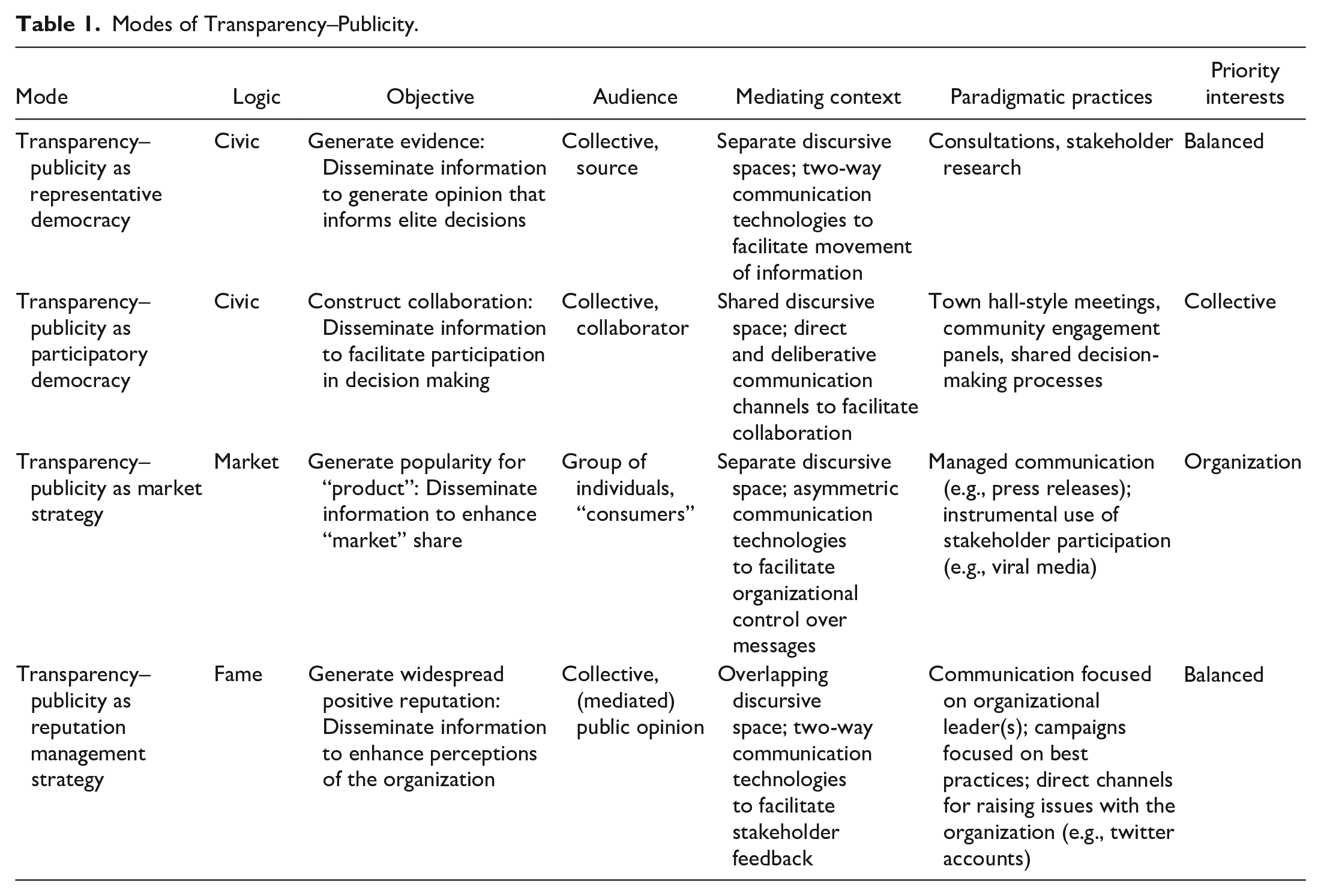
Underlying logics generate different objectives for different modes of transparency–publicity. For the representative democratic mode, the aim is to gather evidence for organizational decision making. Information is delivered to audiences so that they might form opinions as a collective, which can then be fed back to the organization. The organization decides what information to communicate and how it should be communicated, while the audience acts as a source of information to be taken into account. Paradigmatic communication practices are characterized by two-way mechanisms, since communication in both directions is necessary to realize the objective, but the different roles of organization and audience mean a distance between them is retained. Overall, this activity corresponds to the civic world, because policy making is designed for the common good, but collective and self-interest are balanced because the organization retains the power to determine whether to incorporate the audience’s opinions in their decisions.
In the participatory democratic mode, the objective is collaboration rather than gathering evidence, and audiences are viewed as partners in decision making. Transparency–publicity is enacted to share power as well as information, so that organizations lose their elite status and communication between audiences and organization is conducted within the same discursive space, as equals. Communication practices are characterized by more direct connections between organization and audience, including deliberative forms of communication, so that genuine collaboration can be achieved. The civic world is more fully realized in this logic, because the common good takes priority, as evidenced by the organization placing itself in the role of a civic actor, where its own interests are on a par with, rather than superior to, its collaborators.
In the market mode, the aim of transparency–publicity is simply to increase market share. Audiences are addressed as individual decision makers, each of which is motivated by self-interest and targeted with information to persuade them to support the organization in some way. The organization is a market actor first and foremost, competing for popularity of its “product” (and this is true not only of commercial organizations but also of those who operate in markets constructed for public goods such as health care or education, as well as charity or political organizations). Producer/consumer roles, broadly defined, describe the relationship between organizations and audiences, who communicate from these different discursive positions. Asymmetric communications are the norm, and transparency–publicity may be driven by a specific need at a point in time (e.g., to launch a new product) rather than as an ongoing principle of interaction. Organizational self-interest takes precedence here.
Finally, in the reputation management mode, transparency–publicity is designed to improve the status of the organization. Here, the audience is targeted in order to generate a favorable public opinion; individual decisions are less important than aggregate sentiment. Reputation management is a competitive process, prompting organizations to behave as market actors, but they may also invoke the common good—for example, by articulating a commitment to sustainable management practices—as a way of responding to legitimacy challenges from the civic sphere. There is a closer communicative relationship between organizations and audiences than in the representative mode or the market mode, because retaining reputation requires a close knowledge of how public opinion is changing to respond effectively. However, public opinion is often interpreted through the lens of (social) media coverage of topical issues that attract more attention (e.g., in recent years #MeToo, climate change, or immigration). While organizations retain power over how they respond to such trends, the influence of (mediated) public opinion may generate significant changes in practice; collective and self-interest are more balanced in this mode.
Because the modes coexist, the hybrid idea of transparency–publicity moves between these different manifestations in a process of ongoing translation, abstracted, and decontextualized depending on the demands of the organization, the interactions with the audience/public, and the sociocultural, political, and economic context (Czarniawska & Joerges, 1996). Factors prompting translation from one mode to another could be sociocultural and political (e.g., different stakeholder expectations; regulatory norms; competitor behavior; professional and sectoral norms; organizational culture; media landscape; political pressure) as well as process- and technology-related (e.g., the types of information that are available and can be made accessible; availability of technologies to facilitate access, feedback, and control; communication strategies and tactics; availability of spokespeople) (Flyverbom, 2016; Fredriksson & Edwards, 2019; Fredriksson et al., 2016; Pallas et al., 2016; Sahlin & Wedlin, 2008). As the hybrid idea moves, its materialization in practice changes; because organizations must manage the expectations of multiple audiences simultaneously, conflicting practices may coexist, making the organization vulnerable to critique if behaviors become visible to the “wrong” audience.
Transparency–publicity matrices provide a way of engaging theoretically with the complex relationship between these ideas in practice. In the final section, I explore in more depth how the heuristic also enables a stronger analysis of the relationship between tension, critique, and justification when organizations engage in transparency–publicity acts.
Transparency–Publicity: Tension, Critique, and Justification
Justifications draw on the principles associated with a particular order of worth (the underpinning logic, in the schema above), and are made in the context of a societal need to reach agreement on matters of collective concern (Boltanski & Thévenot, 1991/2006). Justifications are always subject to critique, because audiences are made up of “ordinary people [who] never stop suspecting, wondering, and submitting the world to tests” (p. 37). Any mode of transparency–publicity is therefore subject to challenge, but it is the balanced modes that are most vulnerable because, by definition, they are an attempt to combine competing priorities. In modes where interests align clearly with either the collective or the organization, justification may be easier because there is one dominant rationale for action, and the relationship between organization and audience is clearer. However, where interests are balanced, the organization claims adherence to one logic (civic, fame), but engages in behavior and communication that suggests another.
For example, in the representative democracy mode organizations suggest to audiences that their input will be valued and taken into account. The organization may make information available so that they can assess their audience’s opinion, act on their behalf, and adapt to their concerns—a form of “public relations capitalism” (Cronin, 2018). Such claims will be challenged on the basis of whether the organization’s communication and subsequent actions live up to these promises. However, scepticism is inevitable because the power that transparency–publicity offers audiences is always mediated by the organization, which remains the final arbiter of what is communicated and acted on. An organization’s response to the “right to know” may result in “we will define what you have the right to know”; democratic intent is undermined by the desire to preserve a monopoly on decision making.
In the reputation management mode, on the other hand, organizations may claim that action taken in response to stakeholder feedback is evidence of their status as virtuous societal actors. CSR initiatives, for example, may be publicized as evidence of integrity and a sense of responsibility that extends beyond the market. However, because these claims are based on civic logic, but are being used for competitive purposes in a marketized environment, doubt is likely to emerge about the organization’s sincerity and critique will focus on the validity of the claims to collective rather than self-interest.
Finally, while the other modes may be less vulnerable to critiques of deceptive behavior aimed at misrecognition of organizational interests, they are still subject to challenges based on the validity of their chosen logic. For example, organizations that prioritize market logic may face challenges from activists and shareholders demanding more collectively-oriented behavior. Such critiques may, of course, push organizations toward a balanced mode of transparency–publicity. Such a move resolves one critique, but introduces another, where the focus will shift to the sincerity of their actions. In the end, balancing interests will only be accepted if a higher principle for stakeholders’ agreement can be found that encompasses both sets of interests (Boltanski & Thévenot, 1991/2006). How this is done will differ from case to case.
Critiques of transparency–publicity fundamentally engage with the distribution of power between collectively motivated and self-interested organizations and audiences. They are an important challenge to the abuse of power and superficial displays of civic integrity. It is not always the case that organizations are being duplicitous, but the constant presence of critique means that they perpetually face potential scrutiny. If their commitment to collective interests is genuine, engaging with critique could be a productive process of learning on both sides. If not, then critique helps to reveal this reality and stop the unfettered pursuit of self-interest. That said, and as noted above, organizations with genuine commitment may respond to criticism by hiding information that may make them vulnerable, or that may be too strong a contradiction to the claims being made (e.g., executive salary levels in the context of commitments to fair pay for all staff). Thus, critique can also end up supporting dominant actors by prompting secrecy to secure the virtuous reputation promised through transparency (Birchall, 2011b; Fenster, 2006; Stohl et al., 2016).
As this discussion suggests, addressing the relationship between transparency and publicity through the notion of hybridity and the sociology of justification helps explain how and why the virtuous claim associated with transparency is always a risk for organizations, as well as why publicity is always necessary. Furthermore, understanding transparency–publicity as a series of coexisting matrices driven by different logics, but responding to different contextual imperatives, allows organizational motives for engaging with their chosen actions to be integrated into analyses. Some strategies, and some of their justifications, may be more successful than others, particularly if they allow a compromise to be reached and their actions to be understood based on a higher common principle that manages to combine market, fame, and civic logic in a new formulation.
The heuristic model proposed here recognizes that “pure” transparency and “pure” publicity are ideological ideas rather than empirical realities. Nonetheless, the two ideas are not merged as one, because preserving their ontological differences—their identity as ideas driven by collective or self-interest—is fundamental to understanding how the hybrid operates in practice. They are the basis for assertions of both power and resistance when the different modes of transparency–publicity are enacted. They also help explain why critique is frequently based on the degree to which transparency–publicity acts actually deliver on an organization’s stated motivation. 2 In the end, the empirical reality of transparency–publicity is a tension-filled space characterized by a dialectic between claim and critique that is unlikely ever to be fully resolved.
Because the focus of the model is on complexity in practice, new research avenues open up linked to the variety of transparency–publicity matrices and the ways in which they are able to coexist. For example, as the dialectic of justification and critique emerges, what kinds of compromises are reached, and how do different actors negotiate the process? How are transparency–publicity matrices manifest in different sectors, which modes are more sustainable, and why and how do justifications of transparency–publicity change over time as societal expectations of organizations evolve? Other questions might explore whether and why some transparency–publicity acts are more tolerated than others—for example, do claims in relation to high-profile issues such as the environment generate higher perceptions of credibility and virtue than less popular concerns (e.g., care for the aged), or is the opposite the case? Finally, understanding the changing connections between individual components of each matrix will help explain how justification and critique evolves over time.
The starting point for the argument developed here is that organizations are important social actors, and we should therefore think more deeply about what we might expect of them when they call out different interests in their appeals for our attention and support. Their presence across politics and commerce, nonprofit and public sectors, extends the spaces where domination and resistance interact as part of public life; it means they are subject to the challenges faced by all actors who influence how we live in and organize those spheres. Critiquing the rationales and interests underlying their transparency–publicity efforts forces organizations to provide evidence that justifies not only their specific actions but also their status as political actors per se. From this perspective, the transparency–publicity hybrid can highlight the politically productive potential of engagement between organizations and their stakeholders, as well as the ways in which that potential may be undermined.
Footnotes
Acknowledgements
The author would like to thank Tim Wood and Melissa Aronczyk for their helpful comments on earlier drafts of this article, as well as Magnus Fredriksson and César Jiménez-Martinez, who have both contributed to the development of this article through the conversations and reflections we have shared about transparency and visibility.
Declaration of Conflicting Interests
The author declared no potential conflicts of interest with respect to the research, authorship, and/or publication of this article.
Funding
The author received no financial support for the research, authorship, and/or publication of this article.