



Abstract
Youth is a recurrent topic of public debates, particularly because youth features in almost all issue fields discussed in mass media, ranging from educational and cultural to criminal matters. However, previous research has highlighted that youth is not necessarily actively involved in raising its own voice within the public sphere, which gives cause for concerns about the representation of youth in public discourses and thus in democratic opinion formation. This article wishes to critically assess the proposition that young people are objects of public discourses rather than active participants. For this purpose, it will analyze public statements reported in newspapers of nine countries (Germany, France, Greece, Italy, Poland, Spain, Sweden, Switzerland, and the United Kingdom). The analysis makes conceptual use of claims-making analysis and tries to identify contextual factors that determine the extent to which youth actors actively participate in public discourses. In particular, we wish to assess whether discursive inclusion or exclusion of youth is patterned along countries and/or policy fields. Our findings show that policy fields are the most important contextual factors. Moreover, considering claims and actors, public debates about youth are rather similar between the nine countries. This indicates that public debates about youth are patterned by a similar, cross-national differentiation along policy domains.
Introduction
Public debates recurrently address young people when political issues are at stake. This is particularly true in those issue fields strongly linked to childhood and adolescence, such as education. Beyond that, however, youth features in almost all other political issue fields as well, given that young people are an implicit and/or explicit target group of many public policies and/or themselves a proper political actor involved in these political debates and contentions (Falchikov, 1986; Levinsen & Wien, 2011). Here, we can name, for instance, public debates about the transition from school to work, education, and cultural competencies (Thurlow, 2007), youth unemployment and poverty among young people (Ruddick, 2003), young migrants and members of minorities (Bredström, 2003; Lepianka, 2015), gender-related issues, criminal behavior among young men and women (Bartie, 2010; Dorfman & Schiraldi, 2001, Males, 1999; Males, 2002), values, and attitudes of young people (The Varkey Foundation, 2017), living habits or consumption patterns (Blackman, 2004; Gaines, 1994; Giroux, 1996; Steinberg, 2011), and political and/or otherwise public activity (this special issue; see also Cammaerts, Bruter, Banaji, Harrison, & Anstead, 2016; Sloam, 2017).
The pervasiveness of “youth” as a public issue leaves one crucial question unanswered. Do youth actors actively participate in these public debates, that is, are their voices heard within the mass media? This question is highly relevant, when considering the double function of public discourse in modern societies. On the one hand, public discourses shape society’s view of public issues and social problems (cf. Fairclough, 1994; Gamson, 1988; Hall et al., 1980; Wodak & Chilton, 2005), and on the other hand, they are important arenas of political opinion formation and policy deliberation. Social groups not represented sufficiently within the public sphere risk thus to be unheard. This insight applies to public debates about migrants and racial minorities, where discursive exclusion entails elements of racial discrimination (Pickering, 2001; Van Dijk, 2000; Wodak, 2008). But it seems to apply to youth as well (cf. Kulynych, 2001; Levinsen & Wien, 2011). In fact, even though “youth” is an important and pervasive issue within the public sphere, we might be dealing with public debates about youth without young people.
Our article wishes to substantiate and unravel the assumed absence of youth from public debates related to them. The main objective of this article is to ascertain the role of youth in public debates about youth as a “public issue” (cf. Males, 1999; Mazzarella & Pecora, 2007). In particular, we wish to assess whether our assumption about the absence of youth applies to all issue fields and/or countries or is limited to specific contexts. Our article is thus geared to answer two questions. On the one hand, we need to empirically assess the degree to which youth actors’ voices are heard in public debates conducted within the mass media. For this purpose, we will take a closer look at mass media content data for the period between 2010 and 2016 and nine countries (Germany, France, Greece, Italy, Poland, Spain, Sweden, Switzerland, and the United Kingdom). On the other hand, we wish to better understand whether participation and/or exclusion is determined by the discursive context. Is the access of youth actors to mass-mediated discourses patterned along different policy fields or rather along different national arenas? This comparative focus promises to deliver new insights into ongoing research, given that the role of youth within the public discourse might be dependent on two discursive contexts, namely, national arenas of public contestation and/or policy domain–specific issue fields.
Conceptual and Theoretical Issues
This article agrees with the prevailing assumption of previous research on public discourses that public issues are not objectively given and unalterable, but arbitrary, relative, and contentious. They are arbitrary and relative, because they are the product of highly contingent processes of issue formation into which a specific set of actors is involved; and they are contentious because public debates about pressing issues mobilize different actors with competing interests and missions, and thus competing visions and definitions of the issue at stake (e.g., Gamson, Croteau, Hoynes, & Sasson, 1992; Kiess, 2019; Tilly, 1986). In particular, it is argued that public debates are basically an arena of power struggles between competing actors, advocating for different issues, interests, and world fields (Fairclough, 1994, 2007; Fairclough, Cortese, & Ardizzone, 2007; see also Gamson et al., 1992). Due to the inherent importance of power, public discourses are necessarily exclusionary, because powerful actors are able to influence and/or monopolize public debates much more proactively than actors with limited or little power (Wodak, 2008). In this regard, it has been argued that power in public discourses is strongly shaped by what has been called the “discursive opportunity structures” of a nation-state and/or policy field, because the chances to raise one’s voice within the public sphere is determined by the structure of the political institutions (i.e., the access points it provides to arenas of policy deliberation and decision making), policy domains (i.e., the policy agendas and policy communities dominating them), and the mass media systems (Koopmans & Olzak, 2004; McCammon, 2013).
This conceptual and theoretical approach applies also to youth, because public discourses define youth as public issue awaiting policy interventions (e.g., Blackman, 2004; Ruddick, 2003; Solomos, 1991). In this regard, research has assembled ample evidence on negative attribution of youth to social risks and drawbacks, given that youth is associated with deviant behavior, nonconformism, or antisocial activities (e.g., Bartie, 2010; Dorfman & Schiraldi, 2001; Jackson & Scott, 1999; Kelly, 2003; Solomos, 1991). Public discourses thus tend to construct subjects about whom can be spoken (Hall, 1996; cf. Androutsopoulos & Georgakopoulou, 2003). And in this regard, it seems to be crucial who participates in these public discourses, and who has thus the ability to influence the manner in which public discourses deal with and define youth-related issues.
Against this backdrop, it is important to better understand the way in which public discourses about youth are structured in terms of claimants and discussants. In particular, it is important to empirically determine which actors participate in public debates about youth-related issues. Mass media are an important arena for these debates, because they provide the interface for actors to raise their voices publicly to identify public issues that await action. Actors might claim that something has to be done, for instance, in order to improve the position and outlook of young people within the educational system, the labor market, the living situation of poor families, the integration of (young) migrants, and/or the cultural habits of young people. By doing so, they contribute to the formation of youth as a public issue (see, for general political divides, Lakoff & Wehling, 2016). But if we consider that public debates about youth are arbitrary, relative, and contentious, as agreed above, it is of crucial importance to determine which type of actors are able to raise their voice, and which are less able to do so, given that these biases have an impact on the way how youth-related issues are defined and handled. From previous research, we know that public debates nurture concerns, anxieties, and opposition, possibly also because they are one-sided and do not necessarily consider the interests and views of the target group at stake (e.g., see Males, 1999).
Drawing on these insights, we assume that public debates about youth-related issues will be less prone to involve youth actors; that is, individuals or organizations among teenagers, students, adolescent, and young adults. Following the argument of public discourses as power-driven deliberations, we should even expect that youth actors are excluded from public discourses in all countries and issue fields to a significant extent. This lower degree of participation in public debates is plausible, when taking the lower levels of political participation among young people in electoral and unconventional practices into account (Cammaerts et al., 2016; Levine, 2009; Sloam, 2017). Additionally, the marginal role of youth within public debates might also be a consequence of limited power youth have as a collective actor (despite increasingly successful organizing campaigns in the past decades, see, e.g., Kim & Sherman, 2006). Youth are less organized as interest group and stakeholder, 1 and they are institutionally less involved in policy-related consultations and deliberations, when compared with other interests, such as labor organizations, academic institutions, or science organizations. In comparison, corporate and state actors have more resources at hand to dominate policy debates. Especially state actors are often able to dominate public debates due to their privileged access to information, which is why media cover such actors first and foremost (Bennett & Manheim, 1993). Moreover, as youth actors show lower interest in conventional politics, they might be less interested in participating in public discourse but rather engage in organizing direct action, or spare-time activity not reported in the news or not visible as political claims. Finally, mass media might contribute to the discourse exclusion also because journalists are bound to strict rules regarding covering minors (e.g., parental consent for interviews), and because news about youth-driven claims and interventions will have a lower news value, given that media audiences are older. News value theory (Galtung & Ruge, 1965) has accounted for some of these factors, arguing that media selects news (and claims) based on their newsworthiness. For these reasons, we expect youth actors to feature less often in public debates as claimants.
However, this general proposition might overstretch the power-related argument, because it is to be expected that differences will emerge in the extent to which young people are excluded from mass-mediated public debates. Particularly, the comparative design of our study helps explore the limits of this general assumption, by distinguishing between countries and/or issue fields with a stronger presence and/or absence of youth-related actors. The comparison will help to validate whether youth is generally absent in all youth-related public debates. And it will help to identify those contexts that limit youth participation. In this regard, we propose to look closely at two discursive contexts that seem to play a role in patterning participation in public discourses: countries and policy domains. For both contexts, we propose to formulate additional hypotheses.
On the one hand, it is necessary to look at country-specific patterns of youth participation in public debates, and thus to compare degrees of discursive exclusion of youth. Studies on contentious politics have highlighted that countries diverge in the structure of their public spheres and thus grant differential access to social actors to public discourses. In fact, it has been stressed that discursive opportunity structures diverge between nation-states, depending on how political institutions and mass media systems are patterned and operate (Koopmans & Olzak, 2004; McCammon, 2013; also Tilly, 1986). Moreover, there is evidence that cultural context like traditional beliefs (McCammon, Newman, Muse, & Terrell, 2007) also matter for successful claims making. Together, cultural, institutional, and media (newspaper)-specific factors may limit or facilitate discursive inclusion of youth. Countries do thus provide distinct political contexts for the development of public debates. The institutional structure of the polity, the constellation of powers between state and nonstate actors, constitutional legacies, and policy priorities are all important factors determining country-specific discourse constellations, and thus also the role and place of youth as a claims-making actor. In line with this research strand, we expect that the discursive participation of youth will vary strongly between countries.
On the other hand, nation-states have established specialized policy domains devoted to specific issues and areas of public interventions. Within each of these policy domains, specialized policy communities, advocacy coalitions, or discourse communities have been established (Jordan & Richardson, 1983; Lahusen, Kousis, Kiess, & Paschou, 2016; Singer, 1990; Sabatier & Jenkins-Smith, 1993; Swales, 1990), which tend to shape, guide, and monopolize public deliberations about their issues. Public debates should thus be patterned along different policy domains, each of them tied back to a set of policy actors with a clear mandate and/or strong vested interests in the issues at stake. A comparison of issue fields should allow to identify issue field–specific levels of discursive exclusion. In these cases, we would assume that the closure of the policy domain is mainly due to the constellation of actors, the established discourse communities, and, in particular, the dominant key actors. To put it in a nutshell, youth would be excluded primarily because other actors (e.g., politicians or ministers specialized in education) have occupied and monopolized the issue-specific arena.
Finally, both contexts might be relevant at the same time, when considering potential interaction effects. Discourse analysis and studies of contentious politics tend to converge in the observation that public debates are not monopolized by policy and discourse communities equally across all issue fields and countries. In fact, both patterns could interact in the sense that public discourses are subjected to a layered exclusion of youth: The exclusion should be patterned from the most exclusionary issue field in the most exclusionary country, to the least exclusionary issue field in the most exclusionary country.
In addition, we might expect that youth is marginalized as soon as specific actors are able to control specific issues. This does not necessarily imply a monopolization of public interventions, because various actors and mass media are involved in shaping public debates, thus guaranteeing a minimum level of pluralism. More consequential is the ability of public actors to secure opinion leadership in quantitative and qualitative terms. In this regard, we can assume the following:
Data and Method
Our investigation builds on an extensive comparative data set derived from a newspaper claims analysis conducted within the EURYKA project covering nine European countries, namely, France, Germany, Greece, Italy, Poland, Spain, Sweden, Switzerland, and the United Kingdom. Within each country, five newspapers were selected to extract claims on youth-related public discourses. The selection of newspapers represents a relatively similar spectrum for each country (i.e., conservative, liberal, left, and tabloid). 2
Our approach followed the method of claims-making analysis (Koopmans & Statham, 1999): First, we retrieved newspaper articles published between January 1, 2010, and December 31, 2016, containing the words “youth,” “young,” “teenage,” and/or “student” in the respective languages. The unit of analysis is the claim raised in the public sphere by youth actors and claims raised about them by others. The purpose is to use the print media as a (preselected) archive of public interventions, and thus as an arena of public discourses. Second, we coded all claims—including political decisions, verbal statements, protest actions, and nonprotest, civic engagement/empowerment actions—from a random set of articles until reaching our quota. Every claim had to have “youth” (or a specific young group/individual like “young unemployed” or “secondary school students”) as its object, that is, the person(s) for or against whom the claim was voiced had to be young people <30 years old. However, if the claimant was a youth actor, then the claim was allowed to have a non-youth-related object. With this exception we aimed to be as inclusive in regards to youth public participation as possible. 3 After a coder workshop, several online training sessions, and intercoder reliability checks, 4 the collected claims were coded using a standardized codebook and an online coding tool. The quotas were 100 claims for each newspaper and 500 claims for each country resulting in a data set of 4,524 claims total. 5
To capture the claimant and covering, inter alia, in how far youth itself is reported as a speaking actor, we use as our dependent variable a standardized list of actors (“summary actor”) derived from previous claims-making analysis projects, including, for example, state actors (e.g., government, federal employment agency) and youth actors (e.g., individual young person, political youth group/organization, religious youth group/organization). Our main independent variables are “summary issue” (12 main categories) and country. Again, the standardized list of issues is based on previous projects, was refined during our pretests, and includes as main categories, for example, employment, education, sports, law and order, and so on. Both independent variables help us cover the context in which the appearance of youth in public debate is situated. To check for further effects, we also include newspaper (list of five newspapers across the political spectrum and including one tabloid, separately for each country), “summary addressee” (the actor the claim is directed toward, same list as for “summary actor”), and, finally, position of the claim toward the rights of youth as interpreted by the coders (negative, neutral, or positive). Our analyses will employ descriptive statistics and binary regression analysis to assess the specific impact of these contextual factors on youth being represented as claims-making actor. Moreover, correspondence analysis is used to ascertain whether issue fields are associated to (and thus controlled by) specific actors and dissociated from youth actors.
Findings
In the following, we present the main findings of our empirical analysis stepwise to validate or refute the hypotheses introduced before. In a first step, we wish to give a picture of our dependent variable in its descriptive distribution in order to get a sense of the magnitude and prevalence of youth participation or exclusion from public discourses. In a second step, we wish to ascertain the explanatory power of two contextual factors, namely, country and issue field. Finally, we need to get an understanding of the discursive constellations that seem to pattern discursive exclusion of youth actors.
Mapping the Absence or Presence of Youth Actors in Public Debates
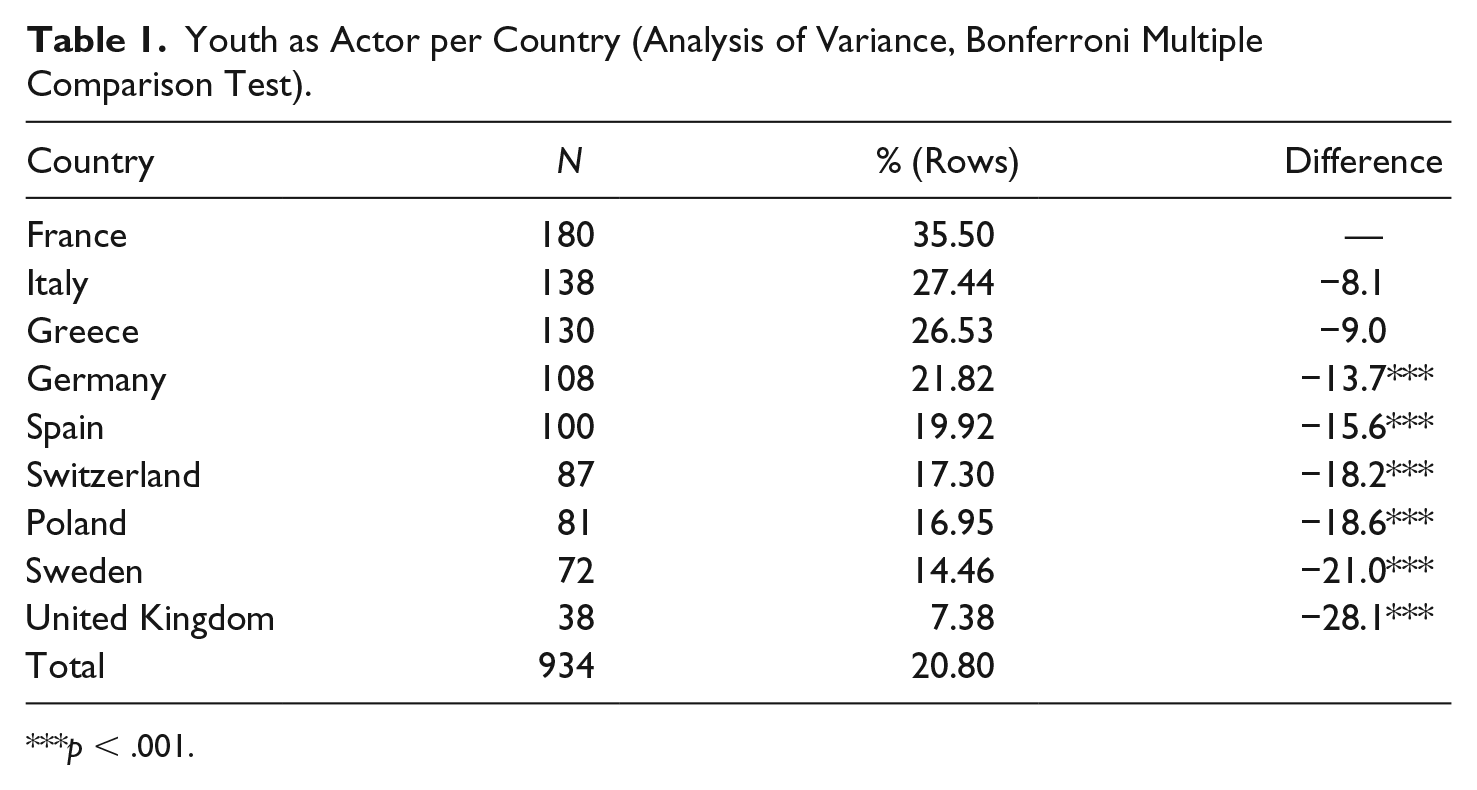
As summarized in Table 1, we see that youth actors are only a minority actor in the public debates of all countries, which corroborates our general assumption only partly because we suspected more general exclusion of youth claimants from the debate about youth. The relative absence is not necessarily a surprising finding, because youth actors belong mainly to the group of nonstate actors. And previous analyses have shown that mass-mediated debates greatly privilege state actors—in particular, the members of the executive—when comparing them with all other claims-making actors (e.g., Bennett & Manheim, 1993; Giugni, 2010; Lahusen et al., 2016). More telling are the differences between countries (assumed in Hypothesis 1) and the fact that France is among the countries with the highest share of claims made by youth actors, followed by Italy and Greece. The other countries assemble a significantly lower share of claims by youth actors.
Youth as Actor per Country (Analysis of Variance, Bonferroni Multiple Comparison Test).
p < .001.
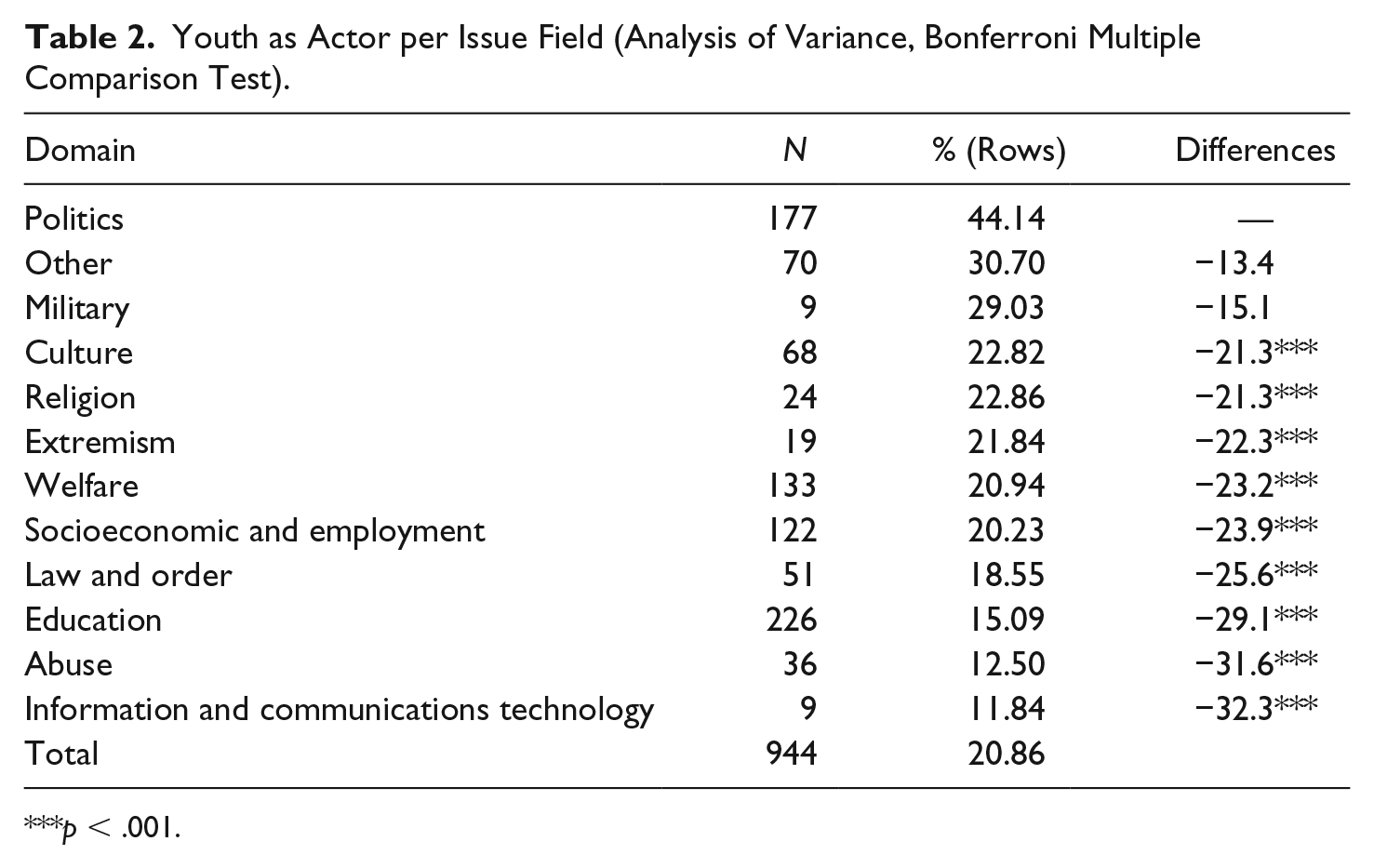
A similar variability in the discursive exclusion applies to youth-related issue fields (as assumed in Hypothesis 2). Youth actors are most strongly represented in debates on political issues (e.g., voting, other conventional and unconventional forms of political participation, volunteering). In other issue fields, the participation rate is much lower. This is particularly true for those policy domains that are frequently addressed in terms of absolute numbers and seem to be of key importance in discourses about youth: education, social welfare, and socioeconomic situation and employment (Table 2).
Youth as Actor per Issue Field (Analysis of Variance, Bonferroni Multiple Comparison Test).
p < .001.
We thus can confirm that youth is not generally absent from public debates about youth-related issues, when comparing policy domains and countries. However, we have more open national public spheres and field-specific debates, and more exclusionary ones.
Determining the Importance of Discursive Arenas: Countries Versus Issue Fields
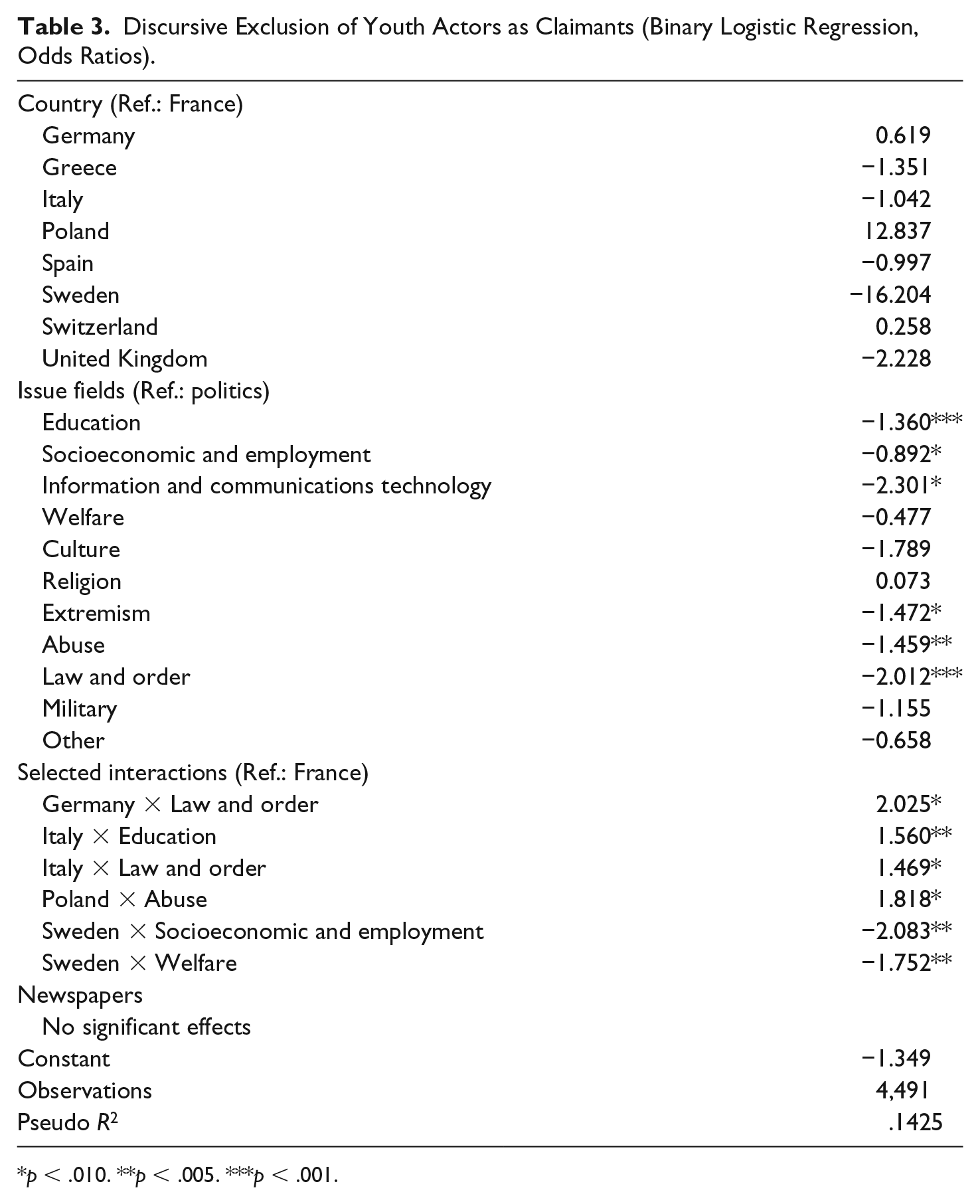
These findings encourage us to push the analysis further down the road, by ascertaining which kind of discursive contexts are more consequential for the exclusion of youth actors from public debates. For this purpose, we have conducted a binary logistic regression that tries to ascertain the effect of the two main variables (countries and issue fields), while controlling for the effect of newspapers. Table 3 presents the main findings in terms of odds ratios. They can be interpreted as the relative probability that the participation of youth actors in public debates will decrease, when comparing countries and/or issue fields with the most inclusive category. The effects of all countries and issue fields are listed. As to interaction effects, the table only includes those effects that are statistically significant. And the effects of newspapers (our control variable) are not displayed at all, given that none of the 45 papers that we included in our data set remained significant in the full model.
Discursive Exclusion of Youth Actors as Claimants (Binary Logistic Regression, Odds Ratios).
p < .010. **p < .005. ***p < .001.
These findings validate the importance of issue fields (Hypothesis 2), while refuting the assumption that national discourse arenas are a determining factor in explaining rates of participation or absence (Hypothesis 1) when newspapers are introduced as controls. While we have found significant effects of three newspapers in a simplified model not accounting for interaction effects between country and issue fields (not presented here), 6 these did not hold in the full model discussed here. Additionally, there is little evidence that national issue debates (interactions in our model) are particularly consequential for the absence of youth from the public sphere (Hypothesis 3). These findings suggest that there are common and policy field–related patterns in youth-related news coverage in European countries that downplay national differences.
Understanding the Patterns Structuring Issue Field–Specific Discourses
Issue fields are thus the most important factor explaining the presence or absence of youth actors in youth-related public debates. According to our theoretical discussion, the differing exclusivity of issue fields could be attributed to the fact that we are dealing with specialized discursive arenas dominated by specific actors, who have clear mandates and/or privileged access to a respective arena, and who are privileged by newspapers in their news coverage. To validate this hypothesis, we conducted a multiple correspondence analysis (MCA) with a series of variables that might guide claims making in the public sphere: the issue fields and countries, the actors making the claim, and the actors addressed by them, and finally a variable that measures the youth-benevolent content of the claim. The MCA with principal components ascertained a model that accounts for 53% of the variance between claims. As shown in Figure 1, these two axes construct a discursive space that places debates centering on social and socioeconomic issues (the top quadrants), and issues pertaining to legal matters, security, and criminal behavior (the lower quadrants); on the x axis, the main distinction is between debates devoted to educational matters, and all other debates.
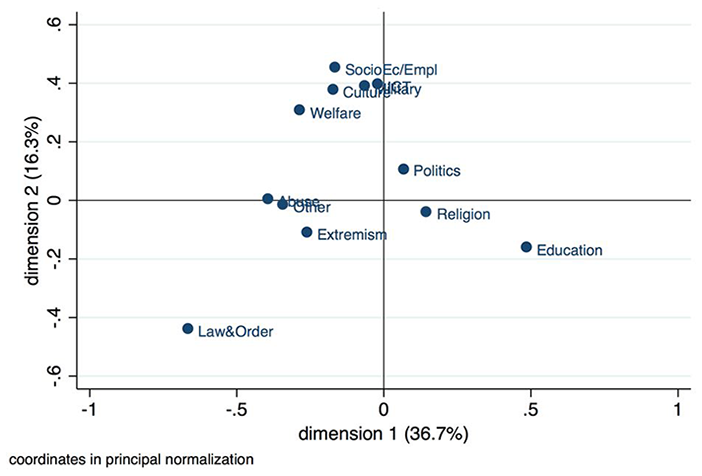
The public discourse about youth, the place of issue fields (multiple correspondence analysis).
Figure 2 discloses where the various categories of actors are placed in the discursive space. As expected, we see that the discursive space is patterned by different issue fields and related actors. Labor-related issues are mainly dealt with labor-related organizations and professional groups; public discussions about extremism, abuse, and law and order are controlled by the judiciary and the police; and even in the case of debates centering on educational matters, we see that debates are mainly conducted by organizations from the area of higher education, vocational training, and schools. Youth actors are placed by MCA in the middle of the discourse space, showing that these actors are as close as they are distant from all these issue-specific debates.
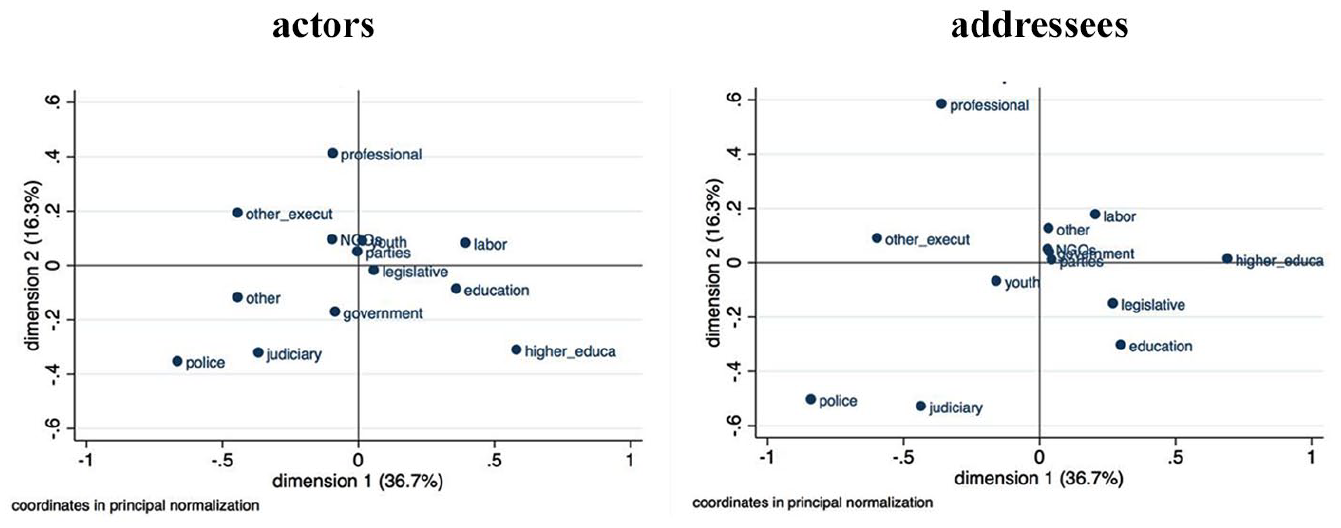
The public discourse about youth, the place of actors and addressees (multiple correspondence analysis).
These findings thus help explain the relative absence of youth actors from specific issues, as evidenced in Table 2: Youth actors are not fully excluded from any of the public debates in a full-fledged manner, but at the same time, they play a rather marginal role in most of them. As Figures 1 and 2 show, this can be attributed to the fact that other actors are successful in securing opinion leadership within issue-specific debates, thus succeeding in being associated as an actor to an issue.
Discussion and Conclusions
This article was geared to provide more systematic evidence on the discursive participation and/or absence of youth from public debates, by having a look at the number of claims they were able to place within youth-related news coverage. Data were available for nine countries and 45 newspapers and could be differentiated into more than 11 issue fields. Our findings show that neither exclusion nor inclusion is the correct way of framing the problem, given that we have to speak about a gradual absence of youth from public debates about youth-related issues. The “relative” absence enables to ascertain the discursive contexts that seem to increase marginalization. In this regard, our analyses go beyond previous national accounts (Levinsen & Wien, 2011) and enable us to draw a number of lessons.
First, countries do make a difference with regard to the participation of youth in public debates, when other factors are not taken into consideration. Youth as claimants are included more often in France but least included in Sweden and the United Kingdom. These significant variations might be explained by the discursive opportunity structures (Koopmans & Olzak, 2004; McCammon, 2013) and the general policy orientation of these countries. With regard to France, research has recurrently highlighted that this country is marked by a more contentious approach to politics (Tilly, 1986). Particularly interesting is the stronger exclusion of youth in Sweden, and as our analysis per issue field showed, the exclusion is particularly strong in welfare-related issue fields, such as education, employment, and socioeconomic matters, as well as social policies and welfare. We might assume that a culture of welfare paternalism plays a role, meaning that policy actors and stakeholders claim to be in charge of finding solutions to youth-related problems on their behalf.
Second, the most striking finding of our empirical analysis lays in the fact that countries are not a relevant factor to take into account, once we include other contextual variables into the statistical model, namely, newspapers and issue fields. Indeed, if we control for the newspapers the claims-making data were extracted from, we see that differences between countries disappear as a statistically significant factor, because differences between newspapers (per country) neutralize the potential effect of countries. In particular, we see that the stronger presence of French youth actors is mainly due to two newspapers (L’Humanité and Le Parisien). In principle, this peculiarity could be an indication of a selection bias within our data: we might have opted for youth-friendly newspapers in France, while ignoring them in other countries. This selection bias is unlikely, given that we selected a similar spectrum of print media per country. Hence, the particular contribution of the two French newspapers in granting voice to youth actors can be interpreted as a confirmation of the contentious and thus more open discursive opportunity structure of France (in terms of cultural, institutional, and newspaper-specific factors), as it has two newspapers that are more open to include social actors that are not normally heard in other countries.
Third, while countries do not prove to be a consistent factor explaining different levels of discursive exclusion or inclusion, issue fields were confirmed to be the most relevant force. Youth actors participated in the public sphere most fervently with regard to debates related to political issues, such as voting, (un)conventional forms of political participation, or volunteering. They were less involved in most other discussions. On the one hand, we can name majoritarian debates about education, employment, and welfare (with the largest share of claims in total), and on the other, we can identify minoritarian debates about extremism, abuse, and matters of law and order (with the smallest share of claims). Further analyses showed that the exclusion of youth in these issue fields is most likely a consequence of the structure of the related policy domains. In many of these issue fields, we are speaking about specialized arenas of policy deliberation, with specialized actors or actor alliances having a specific mandate or interest in shaping and guiding public deliberations. Our findings corroborated this assumption and earlier findings on policy communities (Jordan & Richardson, 1983; Lahusen et al., 2016; Sabatier & Jenkins-Smith, 1993; Singer, 1990; Swales, 1990), because we were able to identify a specific set of specialized actors behind each issue: We could speak about educational actors guiding education-related debates, labor organization, and professional groups shaping labor-related debates, the judiciary, and the police imprinting on discussions about criminal behavior. Since public discourses shape society’s view of public issues (cf. Fairclough, 1994; Gamson, 1988; Hall et al., 1997; Wodak & Chilton, 2005) and are important arenas of political opinion formation and policy deliberation, the gradual absence of youth, which is particularly strong in some youth-related policy fields, should be a matter of public concern.
Our findings raise a number of topics and questions that await further analysis. In the first instance, our data do not seem to indicate that there is one integrated public debate about youth, but rather a number of specialized and segmented debates. What our data are unable to show, however, is whether youth actors are actively excluded from issue-specific debates by established policy actors within the field, and/or whether they choose not to raise their voice against them. Active exclusion might thus be paired with passive self-exclusion by youth themselves. Moreover, the findings that issue fields are associated to a higher and/or lower level of discursive exclusion across countries requires further explanation. We might assume that specialized stakeholders, policy actors, and experts participating in each of the national policy fields, are at the same time directly or indirectly involved in transnational deliberations and forms of organizations, which leads to a gradual streamlining of national policy domains around the shared expertise and the transnational discourses of these policy actors, stakeholders, and experts. Under these circumstances, prospects of youth actors to make themselves heard would be anything but rosy.
Footnotes
Declaration of Conflicting Interests
The authors declared no potential conflicts of interest with respect to the research, authorship, and/or publication of this article.
Funding
The authors disclosed receipt of the following financial support for the research, authorship, and/or publication of this article:Results presented in this article have been obtained within the project EURYKA - Reinventing Democracy in Europe: Youth Doing Politics in Times of Increasing Inequalities. This project has received funding from the European Union’s Horizon 2020 research and innovation programme under grant agreement No 727025.
