




Abstract
Europeans proclaim a readiness to engage for solidarity in support of others, even across their most immediate environment. However, our knowledge is rather limited on how widespread transnational European solidarity might be. Additionally, we do not know what kinds of beliefs and ideas are patterning cognitively the popular conceptions of transnational European solidarity. This article aims to present fresh insights on all these aspects. The analysis is based on a survey conducted in the context of the TransSOL project. This survey provides data about citizens reporting to have supported people abroad through various practices. In conceptual and theoretical terms, the article wishes to analyze and discuss transnational European solidarity from the perspective of political citizenship. Findings show that solidarity activities in support of other Europeans are more likely among citizens with “civic” skills and commitments, stronger identifications with the European Union, and preferences for more inclusive social rights.
Introduction
There is evidence that European solidarity is in crisis nowadays (Balibar, 2010; Grimmel & Giang, 2017). Solidarity understood as a value and key factor in the process of resource sharing among member countries of the European Union (EU; di Napoli & Russo, 2018) has been weakened by the Eurocrisis, the Brexit referendum, or the refusal of Eastern European countries to accept the relocation of refugees. However, European solidarity is not restricted to interstate cooperation, but involves also more individual-level, low-key, informal expressions, such as interpersonal solidarity action by EU citizens (Ciornei & Recchi, 2017; Lahusen & Grasso, 2018; Nowicka, Krzyżowski, & Ohm, 2017).
The goal of this article is to shift attention from institutionalized aspects of solidarity between European countries and to explore the conditions and sources of interpersonal European solidarity. By this term, we understand people’s practices of engagement in support of the rights of citizens in other European countries. We apply the perspective of political citizenship to shed light on the meaning and foundations of European interpersonal solidarity and thus ask: Is this solidarity related to those dimensions of citizenship that are considered to be crucial elements in citizenship studies (e.g., Turner, 2009), namely, citizens’ civic engagement, identities, and rights? Is European solidarity associated to European civic skills, feelings of attachment, and preferences for inclusive social rights?
This article argues that the study of interpersonal solidarity among European citizens (e.g., Baute, Abts, & Meuleman, 2019; Ciornei & Recchi, 2017) can benefit from ongoing research on political citizenship. In particular, it can build on two broader stances. The first one is a top-down perspective that stresses the importance of a European citizenship (as understood by, e.g., Nowicka et al., 2017; Ross & Borgmann-Prebil, 2010; Sangiovanni, 2013) that builds on a formal status of EU citizens, a common European identity, and shared rights—in particular with regard to civic and economic freedoms, but also encompassing the “European Social Pillar” (Nowicka et al., 2017; Ross & Borgmann-Prebil, 2010; Sangiovanni, 2013). The main assumption of this top-down approach is that European citizenship is an important bedrock for interpersonal solidarity, because it promotes and encourages related activities within the European population. The second one—a bottom-up approach developed by Isin and Nielsen (2013) and Isin (2017)—focuses on transgressive “acts of citizenship.” Following Foucault, Isin (2017) emphasizes that cross-border solidarity is a manifestation of international citizenship and its attempts to countervail injustices.
In our study, we attempt to integrate both approaches by investigating the role of three aspects of citizenship on transnational solidarity action. For this purpose, we make use of previous research to develop three hypotheses that center on the civic, identitarian, and social aspects addressed before. To test these hypotheses, we will draw on data from the TransSOL survey and focus on seven countries (Denmark, Germany, France, Greece, Italy, Poland, and the United Kingdom). The empirical analysis will show that the three elements of active citizenship are relevant factors to explain European solidarity action. However, findings paint a nuanced picture that will be discussed at the end of this article.
Theoretical Debates and Research Hypotheses
Our study can draw inspiration from a wide range of analyses in the social sciences. Scholars interested in public policies (e.g., Soysal, 2012), for instance, have argued that the neoliberal social project burdens individuals with obligation to ensure solidarity. Below the level of public policies, it has been shown that public discourses (Trenz, 2016) and transnational solidarity organizations (Baglioni, 2001; Eterovic & Smith, 2001) play a role in limiting and/or promoting European interpersonal solidarity. And finally, cross-national networks, that is, individual ties and cross-border mobility and interactions (Ciornei & Recchi, 2017; Nowicka et al., 2017) and shared identification with Europe (Ross & Borgmann-Prebil, 2010) seem to be important determinants of solidarity action as well.
While these insights focus on different facets of European solidarity, they tend to converge on the observation that transnational solidarity at the citizens’ level seems to be linked to a set of attitudes and preferences associated with the notion of European citizenship. In accordance with the bottom-up performative perspective focused on “acts of citizenship” (Isin, 2017; Isin & Nielsen, 2013), we propose to disaggregate these citizenship-related attitudes into three dimensions (i.e., the civic, the identitarian, and the social), and to make use of different strands of research to develop testable hypotheses for each of them.
First, research on civic activities provides important insights into our topic. The classical scholarship focuses on civic culture, as emphasized by de Tocqueville and Durkheim. This strand assumes that civic virtues and political socialization foster political participation. In particular, it stresses the importance of civic skills obtained within “schools of democracy”: Civil society organizations have a crucial impact on political engagement of individuals (de Tocqueville, 1982). This concept has been further developed by Putnam, Leonardi, and Nanetti (1994), who showed how people’s interest in public issues, membership in political organizations, and dense horizontal interpersonal networks are the sources of civic cooperation. This understanding of political engagement is coherent with the findings of literature that demonstrates the role of skills and resources in political participation. A cornerstone in this regard is the evidence that time, money, and civic skills positively contribute to civic participation (Brady, Verba, & Schlozman, 1995; Marien, Hooghe, & Quintelier, 2010; Teorell, Sum, & Tobiasen, 2007). Our first hypothesis builds on these insights. We argue that political interest, knowledge, and participation (i.e., electoral participation and membership in civic organizations) are crucial determinants of transnational solidarity, because they provide people with the necessary civic skills to engage in supporting other Europeans’ rights.
Second, many citizenship scholars (Lister, 2005; Suszycki & Karolewski, 2013; Turner, 2009) claim that identity—the recognition of oneself as a citizen and the affective relation to a polity—is the foundation of political citizenship. Accordingly, strong European identity leads to political engagement to stand up for the rights of other Europeans. This argument is also consistent with the top-down approach to the study of European solidarity mentioned above (Ross & Borgmann-Prebil, 2010; Sangiovanni, 2013). Scholars defending such a position have to live with the fact that European identity is not very strong and highly contested (Checkel & Katzenstein, 2009; Risse, 2010). However, even a weak identity seems to be relevant, because multiple political identities and related affective and emotional dispositions (Ceka & Sojka, 2016) seem to explain individual attitudes toward the EU and practices of transnational solidarity action. More specifically, empirical research by Mau (2005) and Ciornei and Recchi (2017) confirms that the identification with Europe is related to the support for European solidarity.
The attachment to Europe, however, might not be the only relevant identity. In fact, a number of studies are convinced that solidarity can also be an expression of global citizenship (Armstrong, 2006; Dean, 2014). It could be the cosmopolitan orientation of a person, which may contribute to transnational solidarity acts, also within the EU (Stevenson, 2006). In this sense, there is convergence among citizenship and Europeanization researchers (Ceka & Sojka, 2016; Isin & Nyers, 2014; Yuval-Davis, 2011). As such, European and global identifications may both contribute to transnational solidarity action.
In line with these hypotheses, we assume that closed, exclusive, and particularistic identities (i.e., with a strong attachment to the country and low identification with Europe and humanity) will most probably discourage people from getting involved in support of the rights of other Europeans. Open and more inclusive identities should be those most clearly promoting European interpersonal solidarity, as evidenced by Ciornei and Recchi (2017) and Bechtel, Hainmueller, and Margalit (2014), who prove that multicultural orientations foster transnational solidarity.
Third, the analysis of transnational solidarity as potential “acts of citizenship” (Isin, 2017) has to consider that social rights are an important aspect of citizenship. This means that the support of universal social citizenship and unconditional social rights might be tightly linked to the individuals’ readiness to engage in solidarity actions across borders. This topic remains underresearched, and the existing literature provides ambiguous findings. Scholars suggests, on the one hand, that “institutionalized forms of solidarity” (i.e., legally binding social rights, welfare entitlements, and benefits) are highly beneficial in promoting social and political solidarity, because the support of public policies and institutions of redistribution will also encourage citizens to support others in need (Stjernø, 2012). According to Banting and Kymlicka (2017), policy regimes shape the normative expectations of social membership, which in turn shape the prospects of inclusive solidarity. A universal welfare state can thus enhance preferences for inclusive solidarity. On the other hand, various studies have shown that more generous welfare states are not positively associated with higher shares of attitudes supporting redistribution (Dallinger, 2010; van Oorschot, 2006).
This inconclusive debate is strongly tied to the national welfare state and its citizens. Hence, we still know very little about whether these findings apply to the European level, where a strong welfare state is missing. The few available studies (Baute, Abts, & Meuleman, 2019; Baute, Meuleman, Abts, & Swyngedouw, 2018; Gerhards, Lengfeld, Ignácz, Kley, & Priem, 2018) point to a positive relation: egalitarian values, preferences for redistribution, and the support of generous social policies increase the probability of subscribing to European social citizenship and thus to the idea that social rights should be granted to EU citizens (Baute, Meuleman, Abts, & Swyngedouw, 2018). Unfortunately, these studies do not address the relation between these attitudes and individual solidarity action. However, in line with their assumptions, we would also expect that the support of universal social rights will have a positive impact on European solidarity action.
Data and Method
This article is based on a data set generated by an EU-funded research project (TransSOL) conducted among citizens of eight European countries (Denmark, France, Germany, Greece, Italy, Poland, Switzerland, and the United Kingdom). The survey reached out to approximately 2,000 respondents in each of the countries. Samples were matched to national statistics with quotas for education, age, gender, and region. For our analysis, we made effective use of data from 12,700 respondents, excluding Switzerland as non-EU member state. The questionnaire aimed to address the major dimensions of solidarity and to gather information on the relevant independent variables.
Our dependent variable is “reported solidarity practices” (see also Table A1 of the Supplemental Appendix, available online). For this purpose, we make use of answers to the following question: “Have you ever done one of the following in order to support the rights of . . .?” Our questionnaire listed various target groups (citizens of your country, Europeans and non-Europeans; the unemployed, migrants/refugees, and people with disabilities). Out of these target groups, the following analysis will center on fellow Europeans. Respondents could provide various answers, making use of several categories. For the following analyses, we made use of those categories most clearly tied to solidarity actions: (1) attended a march, protest, or demonstration; (2) donated money; (3) devoted time; or (4) bought or refused to buy products in support of the goals. For our analysis, we decided to merge the answers into a binary variable that separates the active from the inactive people. This was due in part to the low numbers of some of these categories, as indicated in Table A1 of the Supplemental Appendix (available online): Participating in protests are the least diffused; donating money and buying or boycotting products are the most diffused practices. Moreover, people engaged in one form of activity are more likely engaged in another form of activity (i.e., Cramer’s V varies between 0.15 and 0.22).
With regard to our hypotheses, we introduced a number of independent variables into our explanatory models, which are listed in detail in the Supplemental Appendix (Table A3, available online). First, we operationalized “civicness” in terms of civic and political skills: the degree of respondents’ political interest, their ability to recognize EU politicians on photographs (political knowledge), the participation at the last national and EU elections, and associational involvement (a composite index variable measuring passive memberships in up to 15 organizations). Second, we used various items to test the role of exclusive or inclusive identities: We adopted variables measuring the attachment to the own country, to the EU, and to humanity; and we included two questions retrieving diversity orientations (e.g., the acceptance of nonnationals as citizens and of multiculturalism). Third, we operationalized the support of universal social rights with regard to the inclusivity and generosity of public policies. Preferences for universal and inclusive social rights were measured by a question asking the respondents whether migrants should receive (un)conditional access to social rights, with answers ranging from immediately to never. At the same time, preferences for European redistribution policies were measured by a question asking for different reasons to provide or refuse EU countries financial help, with answers ranging from “moral duty” to “refuse help to country handling money badly.”
The analysis builds on descriptive statistics and regression models. For the latter, we have checked for multicollinearity, which proved to be irrelevant. Additionally, we included a number of controls to guarantee that differences between active and inactive citizens are not exhaustively explained by the sociodemographic characteristics (e.g., age, gender, migration background) and the social structural background (e.g., educational attainment, financial hardships, contacts with social workers as a measure of obtaining welfare support when in trouble, and subjective social class affiliation) of the respondents. Finally, we included “country” as a further control variable, given that we are primarily interested in factors affecting cross-nationally on “transnational solidarity practices.”
Findings
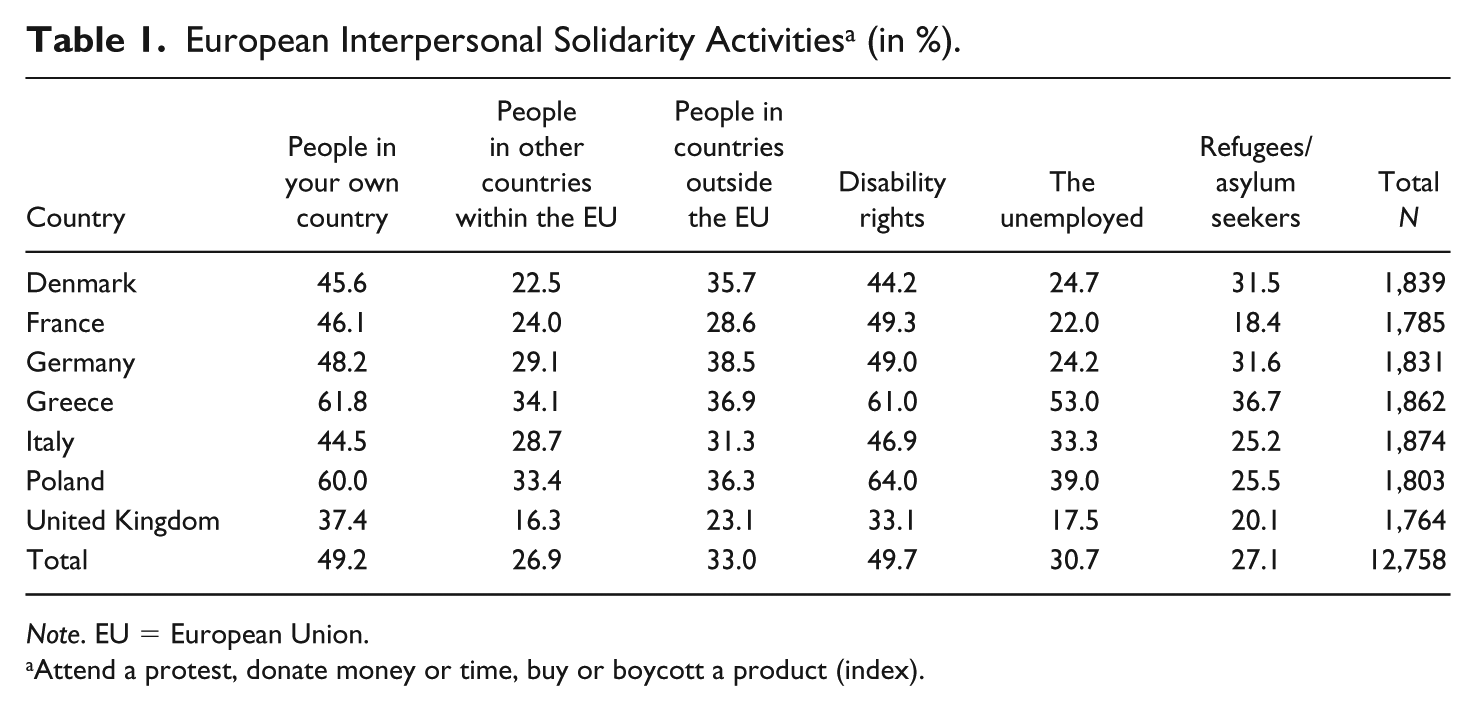
Solidarity practices in support of others are widely diffused within the citizenry of the eight countries under analysis. However, levels of activity are different when considering various potential targets. As Table 1 lists, the level of reported solidarity is highest for fellow citizens, and for people with disabilities. It is lowest for European people, and somewhat higher for people living outside Europe. Probably, the latter benefit from philanthropic attitudes (helping people in need, e.g., Africa), while respondents might believe that fellow Europeans are less in need than people from other continents.
European Interpersonal Solidarity Activities a (in %).
Note. EU = European Union.
Attend a protest, donate money or time, buy or boycott a product (index).
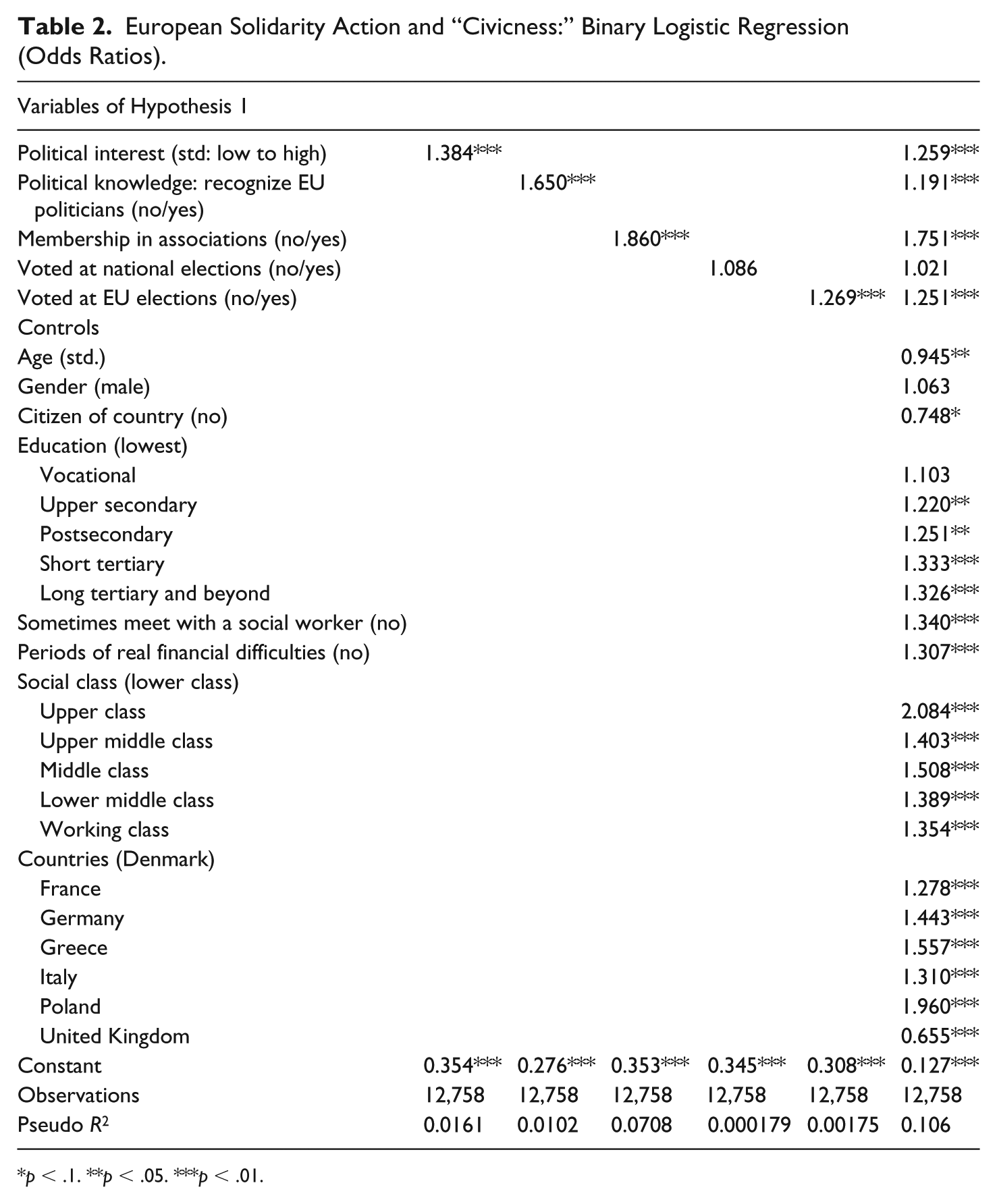
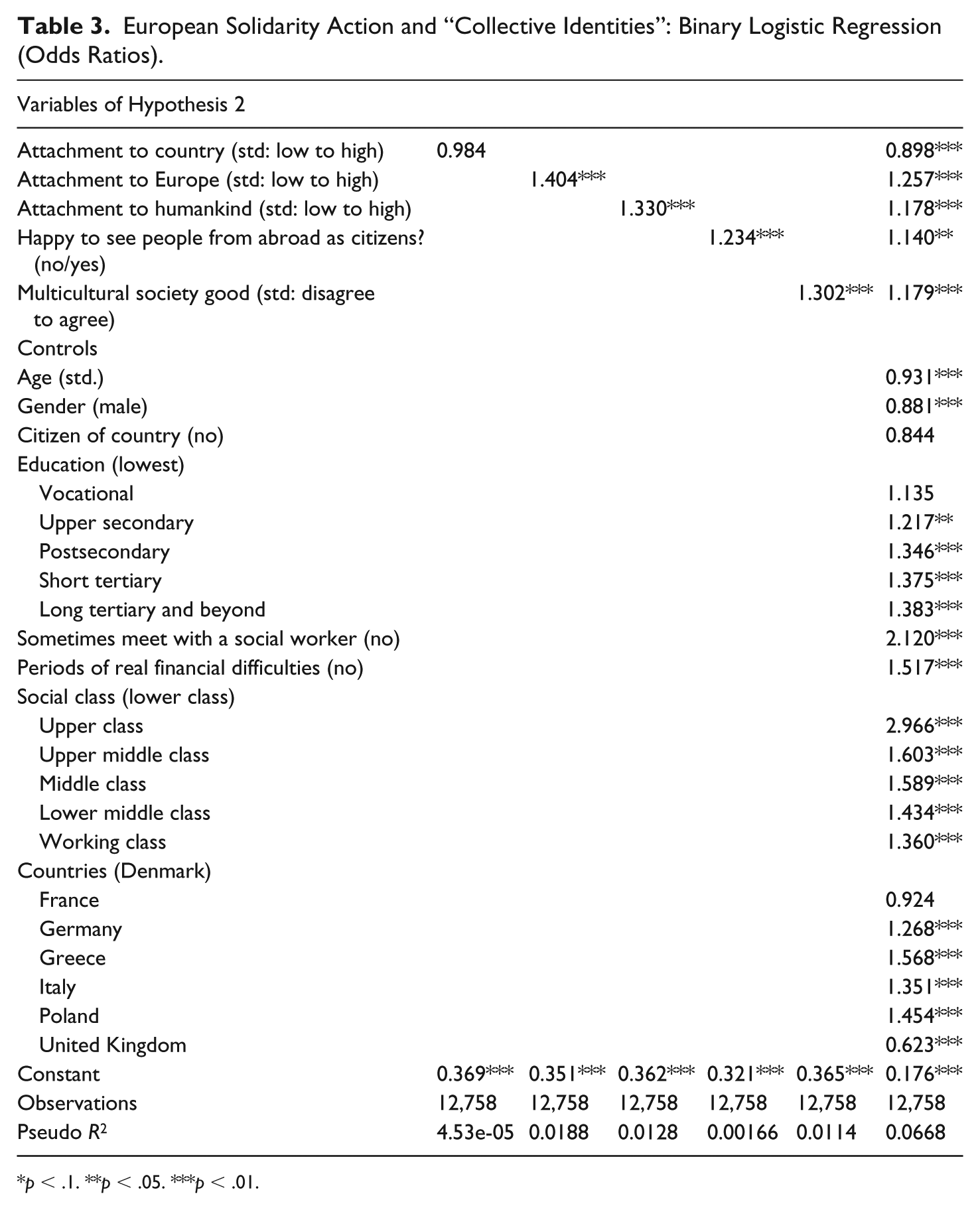
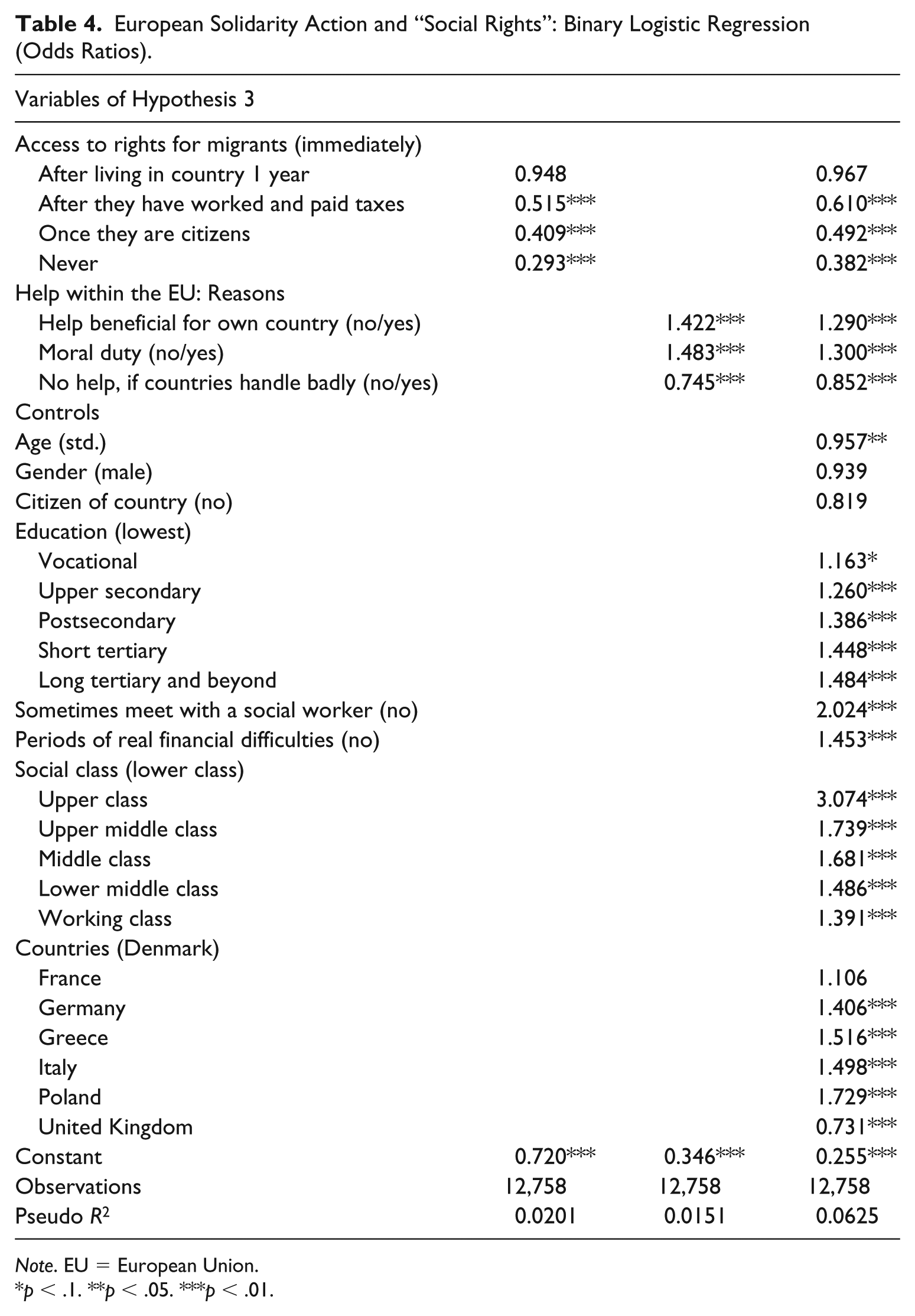
Findings show that solidarity with fellow Europeans is less developed within the citizenry of our eight countries, when compared with other target groups. But what can we say about the profile of those engaged in European interpersonal solidarity? And which of the citizenship-related hypotheses prove to be the strongest in explaining practical commitment to transnational solidarity? For this purpose, we move to the findings of our regression analysis. Tables 2 to 4 show that our three hypotheses can be validated to a certain extent, but with important qualifications. In the first instance, we see that the “civicness” (our first hypothesis) has a higher explanatory power when compared with the two other dimensions. The civic element seems thus to be of greater importance than the identity-related and welfare attitudes element, because this model is able to predict a higher share of the respondents activity or inactivity (see the pseudo R2).
European Solidarity Action and “Civicness:” Binary Logistic Regression (Odds Ratios).
p < .1. **p < .05. ***p < .01.
European Solidarity Action and “Collective Identities”: Binary Logistic Regression (Odds Ratios).
p < .1. **p < .05. ***p < .01.
European Solidarity Action and “Social Rights”: Binary Logistic Regression (Odds Ratios).
Note. EU = European Union.
p < .1. **p < .05. ***p < .01.
Table 2 displays that political interest is strongly associated with transnational solidarity action, and the same applies to political knowledge (i.e., recognizing pictures of high EU officials). European solidarity is correlated with participation in European elections, but it is unrelated to electoral participation at the national level. This shows that transnational solidarity action is not motivated by political behavior per se, and thus is more closely related to civic engagement in general. In fact, passive membership in voluntary associations promotes solidarity action, probably because the exposure to opportunities, incentives, contacts, or information tied to the respondents’ membership in associations increases the probability that respondents are active in support of other Europeans, too.
With regard to the second model (“collective identities”), we see that a multilayered identity (i.e., an attachment to the EU and to humanity) is an important component of transnational solidarity (see Table 3), even though European attachments have a stronger effect than universalist identities. Inversely, strong national identities negatively affect the propensity to engage in European solidarity action. The support for a multicultural society has a positive effect, and the same is true for an open posture toward foreigners. Overall, we see that multilayered collective identities and a preference for diversity and multiculturalism have an enabling impact on transnational solidarity.
The findings of the third model (“social rights”), as exhibited in Table 4, underline that redistributional preferences and the support of an inclusive social citizenship do have an impact on the readiness to stand for the rights of fellow Europeans. Citizens who believe in a more inclusive provision of rights and services are also more engaged in supporting the rights of other Europeans. And respondents who perceive fiscal solidarity between EU governments as a mutual benefit or moral duty are more likely to be engaged in civic solidarity. Accepting conditionality seems to reduce the likelihood to support the rights of other Europeans. At the same time, the commitment to European solidarity is more diffused among those professing a semi-open conception of social citizenship (i.e., immigrants should become citizens and/or work and pay taxes), when compared to those agreeing to a fully exclusive notion of citizenship. European solidarity practices thus vary with the degree of inclusivity of social citizenship conceptions.
Tables 2 to 4 show that the introduction of control variables does not alter the picture considerably (see also Table A2 in the Supplemental Appendix, available online). They attenuate the effect of political knowledge and of multilayered identities, but the importance of civic orientations, European identities, and preferences of universal social rights is reaffirmed. The controls generate partially unexpected results. Social inequalities do have an impact on transnational solidarity practices, because respondents with higher cultural capital in terms of educational attainment are more often involved in European solidarity practices than people with low educational credentials. Most clearly, social class affiliation matters. All social classes are more active than the “lowest” social class members, but the probability of being committed increases the higher we climb up the social ladder. Financial hardships of the household are associated with transnational solidarity as well, which highlights that exposure to deprivations and degradations seem to encourage citizens to get active on behalf of others. Higher cultural capital seems to be more important than economic wealth, as was corroborated by other studies (Fernandez, 2018; Kiess, Lahusen, & Zschache, 2018; Kurowska & Theiss, 2018). Additionally, our findings show that the need of respondents to rely on welfare services and social workers—even among the more privileged classes—promotes readiness to act in support of other Europeans. This is in line with existing studies, which show an empowering effect of welfare state support on political participation (Lynch & Myrskyla, 2009; Mettler, 2005).
Conclusions and Discussion
European solidarity has received considerable attention in recent research. Studies were interested in the role of institutionalized forms of solidarity (i.e., in terms of redistributive and fiscal policies) and public attitudes in support of them (Baute, Meuleman, & Abts, 2018; Ross & Borgmann-Prebil, 2010). Less attention has been paid to interpersonal solidarity action by citizens. Our analyses were devoted to this topic, and findings highlight that European civic solidarity is a phenomenon of its own. In comparison with other studies (e.g., Gerhards et al., 2018), our findings show that the number of citizens engaging in transnational solidarity activities is lower than the share of citizens approving factual and potential redistributive policies within the EU. This deviation is little surprising, given that solidarity activities require more commitment than verbal approval. Additionally, we have seen that citizens are more often engaged in solidarity actions within their country and in support of people outside of Europe, with only one out of four respondents committed to support other Europeans.
Our analyses evidence that European interpersonal solidarity is closely related to “active citizenship.” Our findings allow us to draw three main conclusions. First, European solidarity action by citizens seems to share many similarities with civic engagement and political participation at large, with some important qualifications. Our findings show that political interest, political knowledge, and membership in associations are important factors furthering European solidarity, as much as they do instigate other forms of civic participation (Brady et al., 1995; Teorell et al., 2007). Civic skills are thus an important precondition of an active citizenship (de Tocqueville, 1982). However, European solidarity seems to be a more restraint form of civic engagement, which means that active citizens “do not become more solidaristic merely by virtue of participation” (Segall, 2005, p. 368). What seems to further—and limit—European interpersonal solidarity is its close relation to the notion of European active citizenship. Political knowledge about the EU and participation at EU elections is closely linked to reported solidarity with fellow Europeans, while political participation at the national level (e.g., at national elections) is largely irrelevant.
Second, transnational solidarity within Europe is closely related to European citizenship in terms of shared feelings of belongingness and collective identities. In fact, the respondents’ attachment to Europe turned to have a positive impact on European solidarity (see also Levy, 2017). However, we found that this effect does not collide with a positive influence of a strong attachment to global humanity, which speaks for a multilayered citizenship (Yuval-Davis, 2011) strengthening solidarity among Europeans. This is an indication that preferences for an open polity and society enhance the individual’s propensity to stand for the rights of other Europeans. However, it shows that European civic solidarity will remain restraint as long as European and multilayered identities are not widely shared by the citizens of European member states.
Third, European solidarity action is also linked to the idea of social citizenship and the ideals of universal social rights. Civic solidarity in support of fellow Europeans is more likely among people who profess a more generous provision of welfare services, rally for a less conditional access to social benefits to outsiders, and support fiscal solidarity among European countries. Contrary to expectations derived from previous studies (e.g., Banting & Kymlicka, 2017), European civic solidarity is not a mere reflection of institutionalized solidarity, because we could not find more active citizens in generous welfare states (e.g., Denmark), and less in more residual countries (e.g., Greece). Solidaristic citizens share similar ideals across all countries, and they share similar experiences in terms of exposure to social needs and welfare services. Moreover, our study indicates that European civic solidarity is instigated by ideals of universal social rights. Solidarity between Europeans seems to be encouraged and motivated by the belief that social rights should not be dependent on national citizenship. Findings thus suggest that civic solidarity within the EU is closely related to the notion of European social citizenship as an open community of mutual rights and obligations. Giving more prominence to European citizenship and the rights and entitlements associated with it might thus contribute also to furthering European solidarity at the level of interpersonal civic engagement.
Supplemental Material
Supplemental_Appendix – Supplemental material for European Transnational Solidarity: Citizenship in Action?
Supplemental material, Supplemental_Appendix for European Transnational Solidarity: Citizenship in Action? by Christian Lahusen and Maria Theiss in American Behavioral Scientist
Footnotes
Acknowledgements
The data used in this article were collected as part of the European Horizon 2020 Project European paths to transnational solidarity at times of crisis: Conditions, forms, role-models and policy responses (TransSOL) led by Christian Lahusen at the University of Siegen.
Declaration of Conflicting Interests
The authors declared no potential conflicts of interest with respect to the research, authorship, and/or publication of this article.
Funding
The authors disclosed receipt of the following financial support for the research, authorship, and/or publication of this article: This project was funded by the European Commission under the EC Horizon 2020 research and innovation programme (Grant Agreement No. 649435).
Supplemental Material
Supplemental material for this article is available online.
Author Biographies
References
Supplementary Material
Please find the following supplemental material available below.
For Open Access articles published under a Creative Commons License, all supplemental material carries the same license as the article it is associated with.
For non-Open Access articles published, all supplemental material carries a non-exclusive license, and permission requests for re-use of supplemental material or any part of supplemental material shall be sent directly to the copyright owner as specified in the copyright notice associated with the article.
