




Abstract
This research examines artist networks created by shared museum exhibition. While previous research on artistic careers assesses self-cultivated networks, historical recognition may be further influenced by connections created by important others, such as museum curators and art historians. I argue when museum exhibitions show artists together, curators are creating symbolic associations between artists that signal the artist’s import and contextualization within his or her peer group. These exhibition-created associations, in turn, influence historians who must choose a small selection of artists to exemplify a historical cohort. The research tests this idea through a cohort of 125 artists’ exhibition networks in the Museum of Modern Art, New York, from 1929 to 1968 (996 exhibitions). Individual network variables, such as number and quality of connections, are examined for impact on an artist’s recognition in current art history textbooks (2012-2014). Results indicate certain connections created by exhibition have a positive effect on historical recognition, even when controlling for individual accomplishments of the artist (such as solo exhibitions). Artists connected with prestigious artists through “strong symbolic ties” (i.e., repeated exhibition) tend to garner the most historical recognition, suggesting robust associations with historical peers may signify an artist’s exemplary status within his or her cohort, and consequent “good fit” into the historical narrative.
Keywords
History is inherently relational. Historians do not simply contextualize, but also connect historical events and figures together to create a chronological narrative. Consequently, when examining historical recognition, the connections made between historical personages are important and revealing. For example, the significance of connections for history’s narrative is dynamically evident in the art world. In art history, associations between artists both group them together, such as an artistic movement, style, or school, and relate them with former and future groups (Becker, 1984; Gilmore, 1988; Giuffre, 2001). Examples of this type of connective history abound. Consider the legendary “Cubism and Abstract Art Graph” by Museum of Modern Art’s (MoMA) founding director Alfred Barr or Sarah Fanelli’s “Artist Timeline” formerly installed on the walls of London’s Tate Modern. Both examples visually link artists to structure and sequence modern art’s historical movement. Likewise, the table of contents of major art history textbooks develop chronologically, organizing history through progressive artistic associations. Linking artists affirms the impression of art’s advancement, demonstrating “how a steady line of development has led inevitably from those beginnings to the present situation of undoubted achievement” (Becker, 1984, p. 346).
As historians construct narratives that advocate progress, they also serve as “reputational entrepreneurs” who work to control the memory of historical figures (Fine, 1996). Much research examines how historical memory is strategized by an actor (Kapsis, 1989; Lang & Lang, 1988), but also by those with a stake in the actor’s reputation (DeNora, 1995; Fine, 1996; Mulkay & Chaplin, 1982). These “others” who attempt to shape the memory of historical figures do so in part by both providing reputational narratives that resonate with current social and cultural values (Ducharme & Fine, 1995; Schwartz, 2000) and positioning them within institutions whose purpose is to record, preserve, and communicate such narratives to the larger public (Corse & Griffin, 1997; Foote, 1990; Lang & Lang, 1988).
Following such research, this study examines the importance of curator-created connections by testing if exhibition networks between artists increase the likelihood of retrospective consecration. While much network research analyzes the relations created by actors, this research examines networks created with actors. I argue curators historically contextualize and promote artists by creating associations between artists through in-common exhibition. In turn, curator-created connections directly influence the extent to which an artist is recognized in the art historical canon.
Literature Review
Previous work establishes the importance of actor-created connections for professional development and reputation. Research shows artists seek connections for socialization both in terms of professional instruction (i.e., how to create) and how to navigate their profession’s complexities and complications (Craig & Dubois, 2010; Lachmann, 1988). Moreover, prestigious connections can be valuable in terms of status (de Nooy, 2002; Giuffre, 2009; Lang & Lang, 1988) and economic benefit (Pinheiro & Dowd, 2009). Yet advantageous network connections need not be personally created through direct social interaction by the network’s actors. For instance, Useem’s (1978) study of board membership in corporations shows how network ties can be created through in-common organizational participation, where simply joining a group can shape conceptions of how actors are connected. Similarly, Davis (1941) elucidate how ties are created through mutual attendance of social events. Another means of imagining social ties is by assessing how individuals are connected to one another through third parties, without the need of any social interaction between the actors. For example, Giuffre’s (1999) analysis of photographers being connected through gallery representation shows how such ties influence artist’s reputation.
Consequently, while analysts use the term “actor” for the members of a network, it does not necessarily follow actors have network agency (see Giuffre, 2013). Particularly after an actor’s death, reputational entrepreneurs (e.g., historians) often create associations not existent during the actor’s lifetime. For example, connecting an actor to other historical personages broadens the scope of an actor’s historic impact. Indeed, much research indicates reputation is developed by the network of influence ascribed to an actor by others (Anheier, Gerhards, & Romo, 1995; Giuffre, 2009; Jones, 2010). Lang and Lang (1988, p. 95) discuss a “satellite effect,” where already prestigious artists “serve as symbolic markers for art historians, curators, and cataloguers, with the glow from the luminaries falling on the lesser figures within their orbit.” The “orbit” of a major artist need not be from personal associations created by the artist him or herself, but rather intellectual or stylistic connections created by a curator or art historian. To illustrate this point, Lang and Lang (1988) use the example of a museum exhibition dedicated to the etchings of Whistler, which also served to resurrect the work of other, largely forgotten etchers. Working in the same locality, medium, during the same time frame, or being associated with an associate all served as reasons for curators to connect lesser known artists to the prestigious Whistler.
Once prestigious connections are created, further valorization is possible. van Venrooij and Schmutz (2010) and Schmutz and Faupel (2010) both note critics employ evaluative associations between major and minor artists as a legitimating strategy for the status of the lesser known artist. In their research on connections between writers, Anheier and Gerhards (1991) find simple claims of influence offer status rewards, as they provide a means of association, particularly between established and emerging writers. Other work on continuity and reinvention of reputational image confirms the importance of creating associations between historical figures. Corse and Griffin (1997) cite Alice Walker’s self-created connection to the writer Zora Neal Hurston as central to reviving Hurston’s historical reputation. Likewise, Schwartz (2000) shows the change in George Washington’s reputation was partially reliant on Washington’s comparison with other influential U.S. presidents, principally Abraham Lincoln.
Such research indicates network connections can (a) be based on intellectual associations rather than actor-directed affiliation and, even when created by those external to the given network, (b) be meaningful connections, particularly for remembrance and historical recognition. Such may be the case because these associations are often solidified in textbooks and taught as the historical narrative. Over time, such connections become part of the general social understanding of historical individuals. As a result, associations created by those professionals tasked with archiving, chronicling, and teaching may be of particular import for understanding variation in artists’ long-term remembrance and retrospective consecration.
The Museum Curator as Reputational Entrepreneur
One of the most important forms of reputational communication in the art world is the museum exhibition. Becker (1984, p. 117) describes selection by a museum as the “highest kind of institutional approval available in the contemporary visual arts world; no more can happen that will make [the exhibited] work more important or allow it to add more than it already has to the artist’s reputation.” Yet exhibitions communicate more about an artist’s reputation than simple selection and display suggests. Because exhibiting artworks side-by-side is an inherent invitation for comparison and association, further valorization is possible when an artist exhibits with others of greater reputation. Such associations are strengthened when an exhibition connection is repeated. Over time and exhibits, new connections may position artists into additional artistic associations and circles, affording entry into higher (or lower) artistic status groups and promoting (or demoting) him or her to new levels of significance.
Museum exhibitions are usually overseen by a curator. Curators are specialized art experts and, among other tasks such as research and conservation, are responsible for selecting the artwork for display in exhibition. Part of this responsibility requires the curator to instruct the museum’s audience on why exhibited objects were selected and how they fit together collectively. Such instruction can be explicit through catalogue introductions and essays, labels for the pieces exhibited, advertising text, and other supporting content; however, implicitly, simply exhibiting works together denotes comparability. That is, in exhibiting works side-by-side, the curator is creating a deliberate grouping and inviting association. Overall, while there are several reasons why objects are exhibited together, the core idea behind exhibition is that, together, objects demonstrate associations that make them more artistically or educationally meaningful (see Dean, 2002). Taking this a step farther, this research argues through exhibition curators create associations not just between the artworks, but also between artists. This association is clearly exemplified in “group exhibitions,” where the connection between artists is the specific focus of the exhibition. For example, exhibitions such as “Cézanne, Gauguin, Seurat, Van Gogh,” “Ad Reinhardt and Mark Rothko,” or “Stieglitz, Weston, Adams, and Callahan” unmistakably connect these artists. In arguing that exhibition creates connections between artists, I am interested in two research goals: (a) whether curatorial connections matter for an artist’s historical recognition and (b) if exhibition connections do matter, what type of exhibition networks offer the greatest impact.
Research Population
Artists of the 1913 Armory Show
To gauge the importance of curator-created connections, I track a population of artists over approximately 1,000 exhibitions. My research population is the 307 artists who participated in the 1913 Amory Show, a key historical exhibition in the United States widely considered to have introduced the European modern art movement to American audiences. I use the artists from the Armory Show as a cohort of professional peers and a distinctive grouping in its own right. Armory Show artists were brought together for U.S. exhibition because they represented the scope of important artists working under the rubric of “modern art” in 1913 (see Brown, 1988). These artists serve as an ideal population for this research because they are a large, cohesive cohort introduced at a time when modern art’s historical narrative was largely undeveloped in the United States. Consequently, this first-mover cohort of artists needed to be introduced, explained, and valorized within the U.S. art world through, among other forms of recognition, museum exhibition.
Exhibition at MoMA, 1929-1968
Significantly, the Armory Show is meaningfully linked to the emerging institutional base for modern art in the United States, first represented in the MoMA—the first U.S. museum dedicated to the modernist movement. MoMA opened in 1929 and acknowledged its roots in the Armory Show: “ . . . the epoch-making Armory Show was the real beginning of the Museum” (Alfred Barr [MoMA’s founding director], 1949, quoted in Bee and Elligott, 2004, p. 16). Accordingly, Armory artists were particularly well-known and well-exhibited at the Museum (Braden, 2009). MoMA’s founders, Lillie P. Bliss and Abby Rockefeller, both developed their modern art collections at the Armory Show (Brown, 1988). Bliss’ art collection, which would become the nucleus of MoMA’s permanent collection, was strongly influenced by her art advisor and the Armory Show’s President, Arthur Davies—who also recommended Alfred Barr for the MoMA’s founding director.
Since the MoMA is “consistently identified as the institution most responsible for developing modernist art” (Kleiner & Mamiya, 2005, p. 796) in the United States, MoMA’s curatorial decisions about artists have proven particularly influential for U.S. art history (Braden, 2009). Consequently, the connection between Armory Show artists and the Museum creates an ideal condition for examining how curators advocate for and shape historical recognition of artists through exhibition connections. Given that MoMA’s early exhibitions were particularly important for the institution’s survival and legitimacy (as well as the legitimacy of the burgeoning field of modern art in the United States), the foundational first decades of exhibition were likely carefully crafted with the understanding their content would form U.S. perceptions of modern art in general and artist’s reputation in specific.
As the Armory Show artists were first-movers in the United State’s introduction to modern art, MoMA curators relied on these artists to contextualize early exhibitions and educate audiences about the modern art movement (Bee & Elligott, 2004). MoMA curators highlighted certain Armory artists, grouping and regrouping particular artists together in different ways. Such groupings can be understood as reputational entrepreneurism, in that how these artists were connected in exhibition may have long-term consequences for which artists were consecrated within U.S. modern art history. For this study, four connection measures for exhibition networks (centrality, strength, quality, and betweenness) are identified and detailed below.
Network Structure and Cultural Consecration
My research focus is not the network of connections between artists, but the curator’s connection of artists with others. Consequently, analysis is of the network position and amount of connections an artist garners through exhibition, rather than the overall network shape or flow. Network analysts note both the quantity and quality of an actor’s connections impose constraints and offer opportunities, where beneficial structural positions have few limitations and many possibilities (Hanneman & Riddle, 2005). While there are no precise network definitions for either “constraint” or “opportunity,” much network literature convincingly argues certain connection characteristics serve as reliable indicators. The following four network indicators have been discerned for this study: number of exhibition connections (centrality), percentage of network’s repeat exhibition connections (strength), exhibition connections with prestigious others (quality), and a measure of connectivity (betweenness).
Centrality: Number of Exhibition Connections
While there are different ways to measure how central an actor is within a network, in general, actors are central if they connect to many other actors within the network. Centrality is often used as a measure of an actor’s power within a network in that, if the exercise of power is relational, the more people to whom an actor is connected, the more direct influence he or she can exert (Bonacich, 1972; Hanneman & Riddle, 2005). Likewise, actors with many ties generally have more opportunities because they have several alternatives: if some connections are ineffective, the actor has other connections on which to rely (Hanneman & Riddle, 2005). A large network, then, offers greater autonomy. Autonomy, in turn, can highlight and define individuals within a network, where an actor may be known for their unique network position and distinctive versatility.
Extending these ideas to artistic fields, artists with many exhibition connections may have increased exhibition opportunities. Indeed, previous research on artist-created networks indicates having a large network increases job opportunities (Pinheiro & Dowd, 2009), financial success (Faulkner & Anderson, 1987), and career stability (Giuffre, 1999)—suggesting centrality is important in the art world. In contrast, artists who maintain close connections to only a small circle of professional associates tend to be narrowly categorized and receive less critical attention (Giuffre, 1999, 2001). Artists largely located outside formal or informal networks, such as membership in professional associations or artistic clubs, do not cultivate connections and also tend to receive fewer art world rewards (Anheier & Gerhards, 1991; Craig & Dubois, 2010; Lang & Lang, 1988).
Regarding this study, numerous exhibition connections may indicate an artist’s relevance to a variety of artistic producers and movements. A large exhibition network may signal artistic range and thus provide several alternative interpretations for an artist’s work. Being considered relevant for exhibition in an array of groupings, themes, and premises can lead to increased exhibition opportunity and greater subsequent valorization. Given the importance of large networks found in previous research, this study expects:
While the quantity of exhibition connections an artist accrues may signal diversity and relevance, the composition of exhibition connections (i.e., with whom the artist is exhibiting) may matter as well. The following two measures attempt to capture quality attributes that indicate valuable network connections for historical recognition.
Strength of Ties: Percentage of Repeat Exhibition Connections
Strong network ties are created when an actor repeatedly associates with certain others. While strong connections may provide benefit with regard to support and allegiance, strong associations can also prove limiting (Granovetter, 1973). People who are similar tend to group together and form strong associations, but weak associations (e.g., acquaintances) can be more advantageous for the flow of new information and benefits not available in one’s own network. The benefit of weak ties is often evident in the art world. Uzzi and Spiro’s (2005) research on close work groups in Broadway musicals found a parabolic effect, 1 where innovation is stifled when strong ties become too insulated. Giuffre (2001) finds a similar network phenomenon, where artists narrowly defined by artistic circles are also narrowly defined in artistic style. These artists receive less critical recognition than those with large, unrestricted networks and, perhaps consequently, unrestricted style categorization (also see Pinheiro & Dowd, 2009).
Yet when considering the symbolic ties between artists created through exhibition, repeated connections may be important for long-term recognition. Regarding historical understandings, artists who repeatedly exhibit together, particularly if they are from the same cohort, offer a ready example of artistic groupings, such as “movements” or “schools,” that appeal to art historical logic (Becker, 1984; Gilmore, 1988). Indeed, research on field experts indicates easy categorization is beneficial for recognition and acceptance, particularly by critics (Craig & Dubois, 2010; Franssen & Kuipers, 2013). At the very least, repeated exhibition between artists indicates the creation of a productive association—one proven popular and meaningful for audiences. Consequently, my second hypothesis states as follows:
Quality of Ties: Exhibition Connections With Prestigious Others
In relational networks, actors connected to powerful or prestigious others are structurally closer to resources and therefore have a positional advantage over those connected to weak or insignificant others. For networks created through evaluative judgments, such as in museum exhibition, connection indicates a professional assessment of association between actors. In exhibition, curators are implying an association between artists’ works. Consequently, artists exhibited with high status, others may, in turn, acquire prestige through association, where simple physical proximity in exhibition space may be enough to proffer advantage. Exhibiting with well-regarded others can produce a “halo” (Nisbett & Wilson, 1977) or “satellite effect” (Lang & Lang, 1988), where perceived favorable attributes of one artist positively influence the assessment of associates, such as fellow exhibitioners. To measure the perceived status of others within an artist’s exhibition network, I examine the number of artists within the network who had a previous solo exhibition at MoMA. As solo museum exhibitions are considered one of the highest honors of the art world (Becker, 1984), artists whose exhibition network is composed largely of others who attained this honor should be advantageously positioned, leading to my third hypothesis:
Betweenness: Connecting Unconnected Artists
The centrality of an artist can also be understood by the different artists he or she connects in a network. That is, while artists A and C may never exhibit together, artist B exhibits with both and, therefore, serves as a bridge between them. Connecting unconnected others may make an artist stand out as unique in their diversification and wide-ranging applicability to others. Simmel (1971/2011) envisioned this phenomenon through an expanding social circle. Narrow social circles are defined by specific characteristic traits and the individual members of such circles are not highly distinct from one another. However, as one’s circle widens to include many other circles, an actor develops a unique position as someone who bridges many groups, subsequently fashioning an individual identity within a network.
Examining the connections of artists through in-common gallery representation, Giuffre (2001) finds the most successful artists tend to have large networks that allow them to bridge several unrelated groups. Working as a bridge, in turn, enables these artists to associate with a wide variety of artists and galleries. This diversity not only translates to more attention but also to broad artistic categorization, where critics perceive these artists as working in a variety of styles (Giuffre, 2001; Pinheiro & Dowd, 2009). That is, the capability to span unconnected artists may signal an artist’s multivocality, allowing him or her to relate to different groups. In her study of literary interpretations, Griswold (1987) finds that different readings and multiple meanings of a cultural product may indicate the artist’s “cultural power” to evoke relevancy in different contexts. Because connections between diverse groups may lead to additional recognition opportunities for an artist, my fourth hypothesis states as follows:
Data and Methodology
My population is the 307 artists who participated in the Amory Show of 1913. I tracked each artist’s exhibition history at MoMA from 1929 to 1968—996 exhibitions examined in total. As some Armory artists were never included in MoMA exhibition, my research population reduced to 125 artists. For each of these artists, I generated a network of connections created when these artists exhibited with one another.
Dependent Variable: Number of Pages in Art History Texts
I assess retrospective cultural consecration (i.e., the cultural recognition an artist receives currently) through representation in 21st-century art history textbooks. The variable is a count of the combined number of pages an artist acquired in three recent texts: Gardner’s Art through the Ages (2012), Janson’s History of Art (2013), and Stokstad’s Art History (2014). These texts were selected as the three most prestigious and widely used introductory textbooks for college-level art history courses in the United States (see Peers, 2006). Heeding number of pages dedicated to an artist allows me to gauge the extent of recognition within these references.
Independent Variables: Curator Connections Through Shared Exhibition
Exhibition connections are a count of exhibition “ties” or associations between Armory artists (i.e., the number of artists exhibited with a given artist at MoMA [1929-1968]). My second centrality measure captures the strength of these connections, measured via the percentage of an artist’s exhibition network composed of repeat connections (exhibiting with cohort artists more than once). This measure is normalized (a percentage opposed to a count) allowing comparison of network repetition for all artists in the database. To test the importance of the “satellite” or “halo” effect on an artist’s later consecration, I also document the extent to which an artist exhibits with particularly successful, well-recognized artists. I do this by examining the percentage of an artist’s network composed of artists who previously had a solo exhibition at MoMA. Finally, to ascertain artists who connect or bridge between others, I include a measure of betweenness centrality, which indicates an artist’s strategic location between otherwise unconnected artists.
Control Variable: Individual Recognition
While the focus of this study is on how exhibition networks influence subsequent coverage in art history, historical recognition may be more a product of individual accomplishment than network connections. Consequently, I control for individual achievement by including a variable that captures distinguishment of an individual artist: a count of the number of solo exhibitions an artist received at MoMA (1929-1968).
Results
Exhibition and Network Patterns
Before turning to the regression analysis, it is first valuable to provide a sense of the exhibition patterns occurring at MoMA. The data set includes 996 exhibitions and, out of the population of 307 Armory artists, 125 Armory artists exhibit in MoMA at least once between 1929 and 1968. Picasso and Matisse are most prominent, with 97 and 70 MoMA exhibitions respectively. The next most exhibited is Leger (43 exhibitions) and the “father of modern art,” Cezanne (39 exhibitions).
Counterintuitively, a large number of exhibitions does not parlay into the most exhibition connections with other artists. As shown in Table 1, 2 Armory artists with the most MoMA exhibitions do not overlap with those with the most connections to cohort artists (with the exceptions of Picasso, Matisse, and Sheller). For example, Marin and Bellows exhibited with the most Armory artists (110 and 108 connections, respectively) but are midtier artists with regard to the number of MoMA exhibitions garnered (30 and 17 MoMA exhibitions). A simple explanation for this could be those with many exhibitions are associated with artists other than Armory artists and, therefore, their connections are not taken into account by this research. Yet when examining Armory artists with the most exhibitions where no other Armory artist is featured (subtracting solo exhibitions), these artists generally do not overlap with those with the most MoMA exhibitions (except, again, for Matisse, Picasso, and Sheeler). Rather, as Table 1 demonstrates, artists with the most noncohort exhibitions tend to be those with extensive cohort connections—indicating artists well-connected to those of their own cohort are also well-connected to artists from other periods (for an analysis of exhibition connections between different historical periods, see Braden & Teekens, 2018).
Top 10 Armory Artists in Terms of MoMA Exhibitions and Exhibition Connections, 1929-1968.
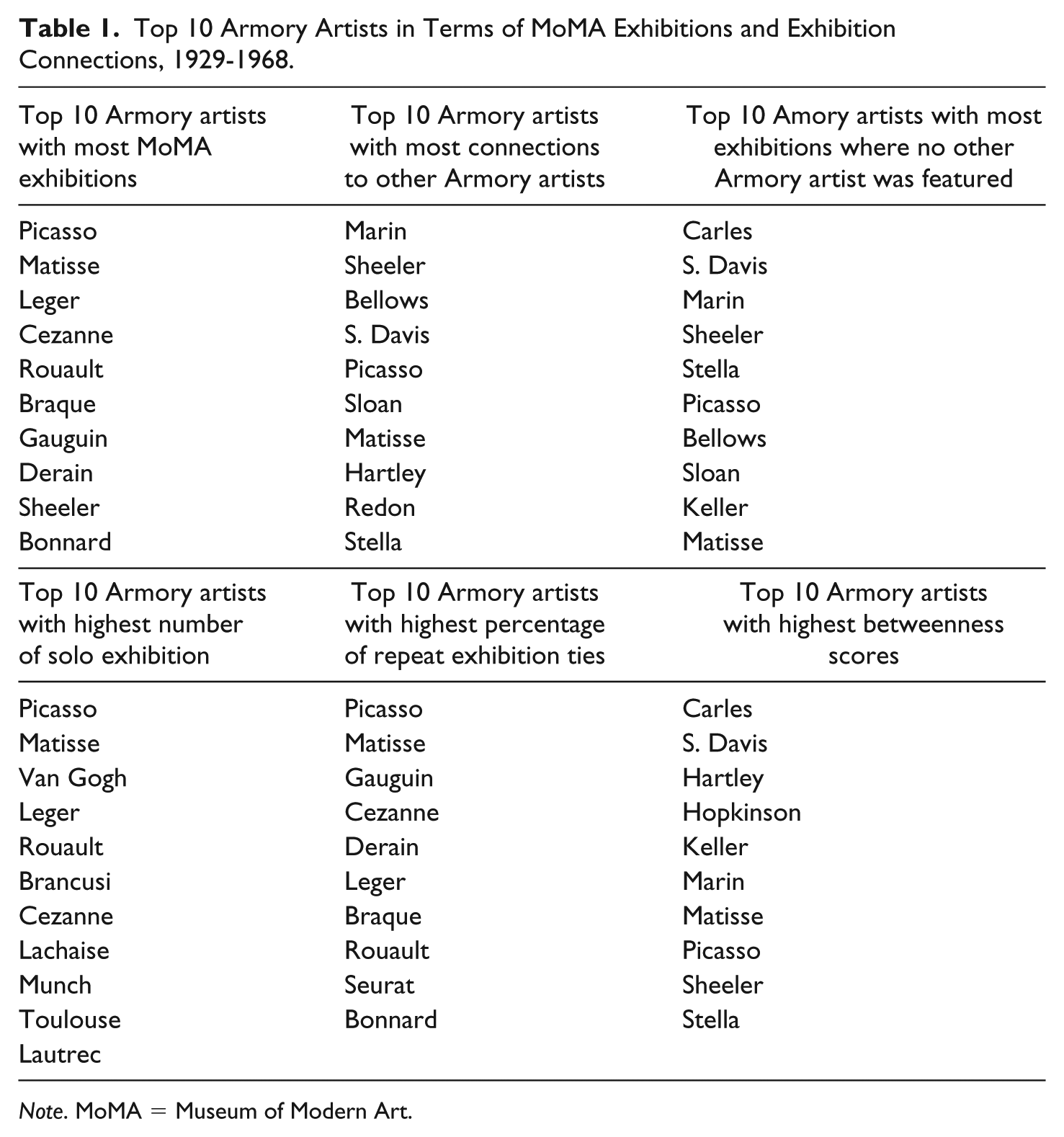
Note. MoMA = Museum of Modern Art.
What attribute, then, overlaps with a large amount of MoMA exhibitions? At least within the parameters of this research, the answer is a high percentage of repeat exhibition connections. That is, Armory artists featured in the most MoMA exhibitions often reexhibit with the same Armory artists. For example, Picasso enjoys more MoMA exhibitions than any other Armory artist and also has the highest percentage of repeat exhibition ties: 90% of Armory artists who exhibited once with Picasso, subsequently exhibited with him again. A similar pattern occurs for Matisse, who has both the second most MoMA exhibitions and second highest percentage of repeat ties: 89% of the Armory artists exhibited with Matisse were exhibited with him more than once. In all, 9 of the top 10 Armory artists with the most MoMA exhibitions also have the highest percentage of repeat exhibition connections.
Much literature on artistic reputation and recognition notes the importance of the “halo” or “satellite” effect—the idea artists are more likely to receive recognition and rewards if they are associated with prestigious others. For exhibition ties, I examine the halo effect by determining what percentage of an artist’s exhibition connections are with others who had a prior solo exhibition at MoMA. The top 10 artists with the highest percentage of their exhibition network composed of solo exhibited Armory artists (53% to 66%) do not generally overlap with the top artists regarding number of exhibitions or repeat ties. Rather, artists with the highest number of MoMA exhibitions (and repeat ties) have exhibition networks composed of only 30% to 38% of artists with solo MoMA exhibition.
Finally, artists with the highest betweenness score, or those who serve as bridges between otherwise unconnected artists, generally are not given the most exhibitions, garner the greatest number of exhibition ties, nor are connected to prestigious others. However, eight of the top 10 “bridging” artists also have the highest number of exhibitions without other Armory artists. This overlap is conceptually logical given the argument of this research: artists not strongly exhibited with their cohort are not strongly associated with their cohort (i.e., they do not “fit” in exhibition with cohort peers). Consequently, these artists may be placed in diverse exhibition groupings, leading to connections outside their cohort—but also to a wide range of intercohort exhibition connections as curators attempt to make meaningful connections between these artists and their cohort contemporaries. This diversity gives these artists a high-betweenness score, but rather than an indicator of status, exhibiting with otherwise unconnected artists may indicate a curatorial struggle in “fitting” these artists within a historical grouping.
Regression Analysis
Having explored general patterns in network connections, a regression analysis shows the impact of such connections. Given my dependent variable is a count of text pages and overdispersed, I use negative binomial regression. Table 2 presents descriptive statistics and Table 3 presents a correlation matrix for the variables used in the models.
Descriptive Statistics for Network and Individual Variables of Armory Show Artists at MoMA, 1929-1968 (996 Exhibitions).
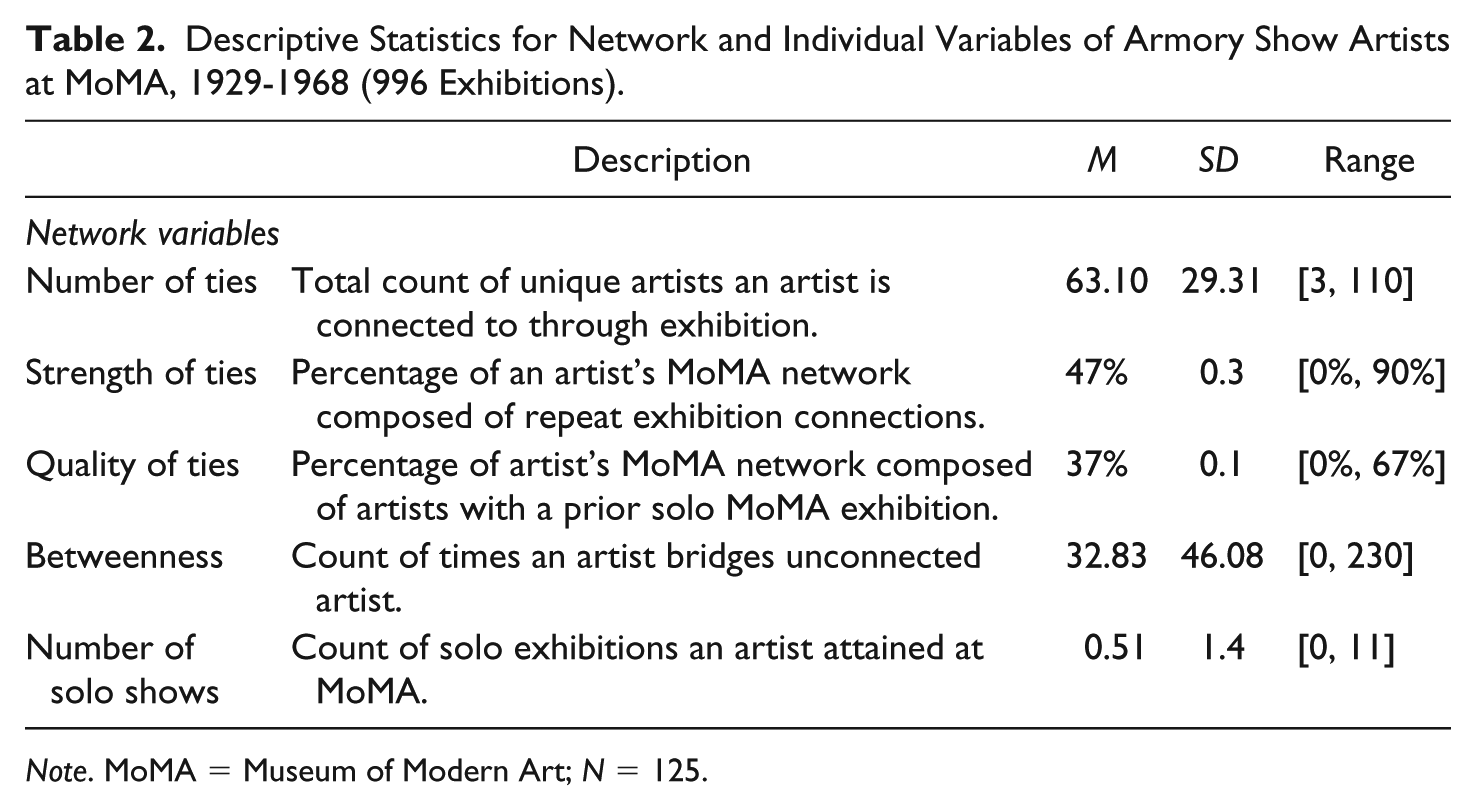
Note. MoMA = Museum of Modern Art; N = 125.
Correlation Matrix (N = 125).
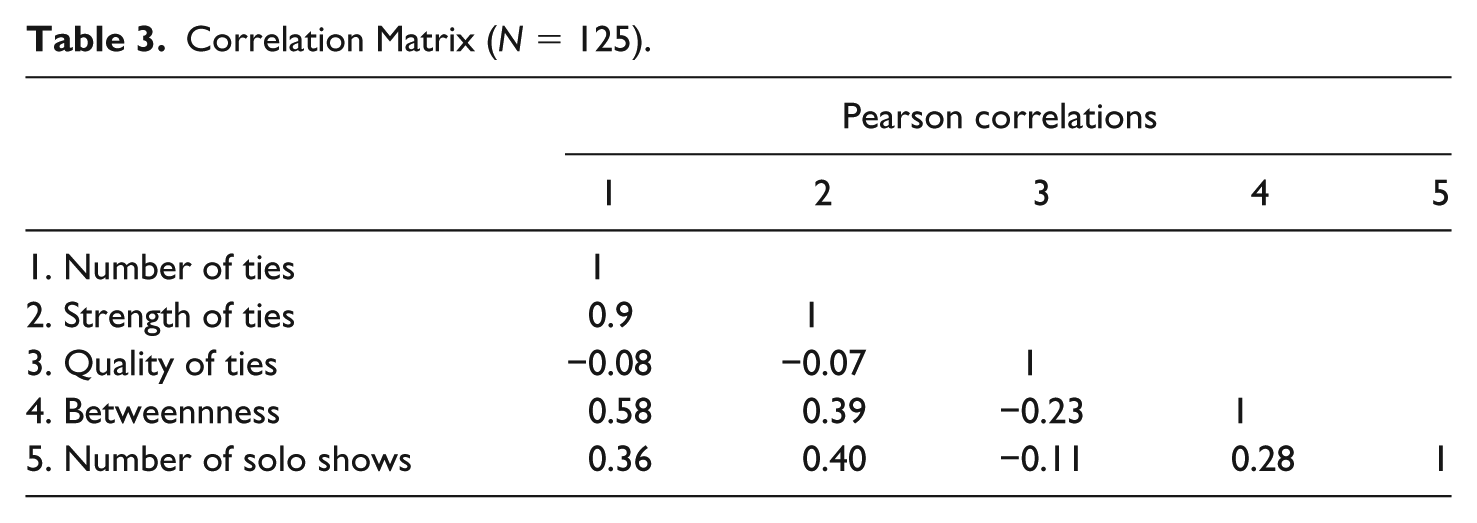
An issue complicating the analysis is that two measures—number and repetition of ties—are highly correlated (0.9; see Table 3). Though both variables measure an artist’s centrality within the exhibition network, they do so in different, meaningful ways. Again, number of ties measures how many total Armory artists a given artist is connected to through exhibition. Repetition of ties is the percentage of an artist’s exhibition network composed of repeat exhibition with other Armory artists. Put another way, one variable measures an artist’s network breadth (number of connections), while the other measures the depth of an artist’s exhibition network (repetition). Their high correlation signifies, for these artists, breadth and depth go hand-in-hand; however, to retain the distinct information given by these two measures, I modeled both separately. The results for both models are robust with effects maintaining direction and significance across specifications.
In Table 4, the first three models separately examine the effect of individual solo exhibitions (Model 1) and network variables (Models 2 and 3). Models 2 and 3 separate the highly correlated variables “number” (Model 2) versus “strength” (Model 3) of ties. All variables, except betweenness, are significant and positive across all models, providing support for Hypotheses 1, 2, and 3. Hypothesis 4, which measures betweenness, is rejected.
Negative Binomial Regression Analyses for Effects of MoMA Exhibition Network and Individual Variables of Armory Show Artists on Modern U.S. Art History Textbook Coverage (2012-2014).
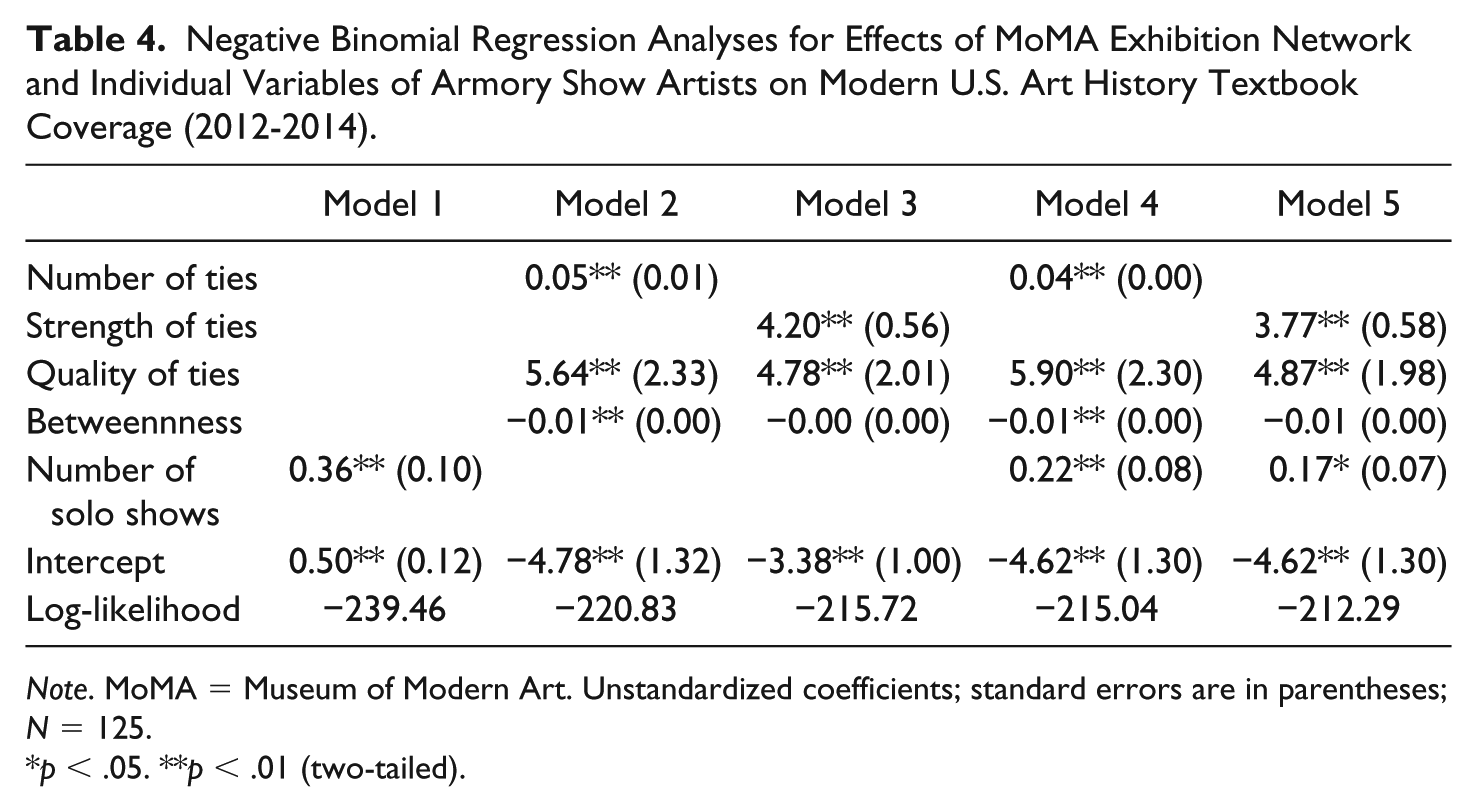
Note. MoMA = Museum of Modern Art. Unstandardized coefficients; standard errors are in parentheses; N = 125.
p < .05. **p < .01 (two-tailed).
Model 4 examines all variables except “strength of ties” (examined in Model 5). All variables are significant in this model. Though a small effect, “betweenness” is both significant and negative, indicating artists who often bridge unconnected artists are slightly less likely to receive retrospective consecration in textbooks (rejecting Hypothesis 4). “Number of ties” also has a small effect, but in a positive direction. The strongest effect comes from “quality of ties,” which measures the percentage of a given artist’s network that is composed of artists with a solo exhibition. This strong positive effect is particularly impressive considering the control variable: number of solo shows an artist achieves him or herself, which offers a comparably modest positive effect. In other words, this research indicates that being exhibited with prestigious others may have a greater effect on 21st-century recognition than receiving a solo exhibition for oneself.
Model 5 adds the variable “strength of ties,” which measures the percentage of an artist’s network composed of repeat exhibition connections. This final model offers the greatest explanatory power (see Table 4); though, “betweenness” loses significance in this model. Measures for “strength” (repeat exhibition connections) and “quality of ties” (connections to prestigious others) provide the greatest effect—particularly when compared with the minimal effect offered by acquiring solo exhibition for oneself. As discussed below, overall, the regression analysis clearly indicates the importance of exhibition connections, specifically strong connections to prestigious others.
Discussion
The finding that both prestigious connections (“quality” of connections) and strength of connections (repeat exhibition) matter for later recognition in textbooks has important implications. Connections to prestigious artists are valuable, but connections must also be reiterated in exhibition. That is, while high-status connections matter, how effective one’s connections are matters as well. At a basic level, repeat connections signify a successful association between artists and help reinforce an artistic grouping. Repetition also signifies organizational approval. A connection between artists acquires authority when repeated, as reiterating a connection indicates the association was not created casually, but rather is endorsed by the museum whose curators purposefully reconnected the artists (see Alexander, 1996). Over time and exhibition, such connections become taken-for-granted understandings, at least on the museum level. As these understandings disseminate to the wider public through touring exhibition, mass media, and growing audiences, organizational understandings become widespread cultural understandings (Johnson, Dowd, & Ridgeway, 2006).
Once an association between artists is widely recognized by the art world, textbooks are likely to include these artists within the historical canon (see Gilmore, 1988, regarding “schools” of music). Art history texts explicitly connect artists both one-to-another and to the development of art through time. Artists with established associations, then, fit into the flow or “story” of art history’s narrative. Connections between personages enable historians to demonstrate stages within the continuous movement of art history, allowing a credible development story to be crafted. Those not associated with cohort peers are difficult to fit into a connective history and, therefore, less likely to be recognized within the limited space historians have for their narrative. In all, recurrent connections between artists resonate, not only within exhibition, but also over time.
To illustrate this idea, I offer a comparison case study of MoMA exhibition connections for the Armory artists Gaston Lachaise and Georges Seurat. Both are major historical figures. Both received MoMA recognition through solo exhibition (though, whereas Seurat had only one, Lachaise enjoyed two solo exhibitions between 1929 and 1968). Both artists also have similar exhibition trajectories at MoMA. For example, both had approximately equal exposure through exhibition (Lachaise was featured in 23 and Seurat in 28 MoMA exhibitions [1929-1968]) and, through these exhibitions, both connected 83 times with other Armory artists. Despite such similarities (and the important distinction of two solo exhibitions for Lachaise), only Seurat is recognized in modern textbooks.
While seemingly equally recognized by early MoMA exhibitions, the difference between Lachaise and Seurat’s recognition within 21st-century texts may be rooted in the number of repeat associations the two artists received in early exhibitions. Figure 1 illustrates the exhibition connections of Lachaise and Seurat. The thickness of the lines in Figure 1 denote the “strength” of the connection, that is, how many times Seurat or Lachaise exhibited with a given artist. Figure 1 clearly illustrates a large overlap in artists exhibited with both Lachaise and Seurat, yet Seurat obviously has stronger ties (more repeat exhibitions) with these artists—in fact, approximately 10% more than Lachaise. Though Seurat and Lachaise are both influential artists, when choosing which to include in the historical narrative, Seurat’s stronger connections may have made him easier to fit in the limited space historians have within a text. That is, persons not strongly associated with cohort others are difficult to integrate and, consequently, to contextualize within a connective history.
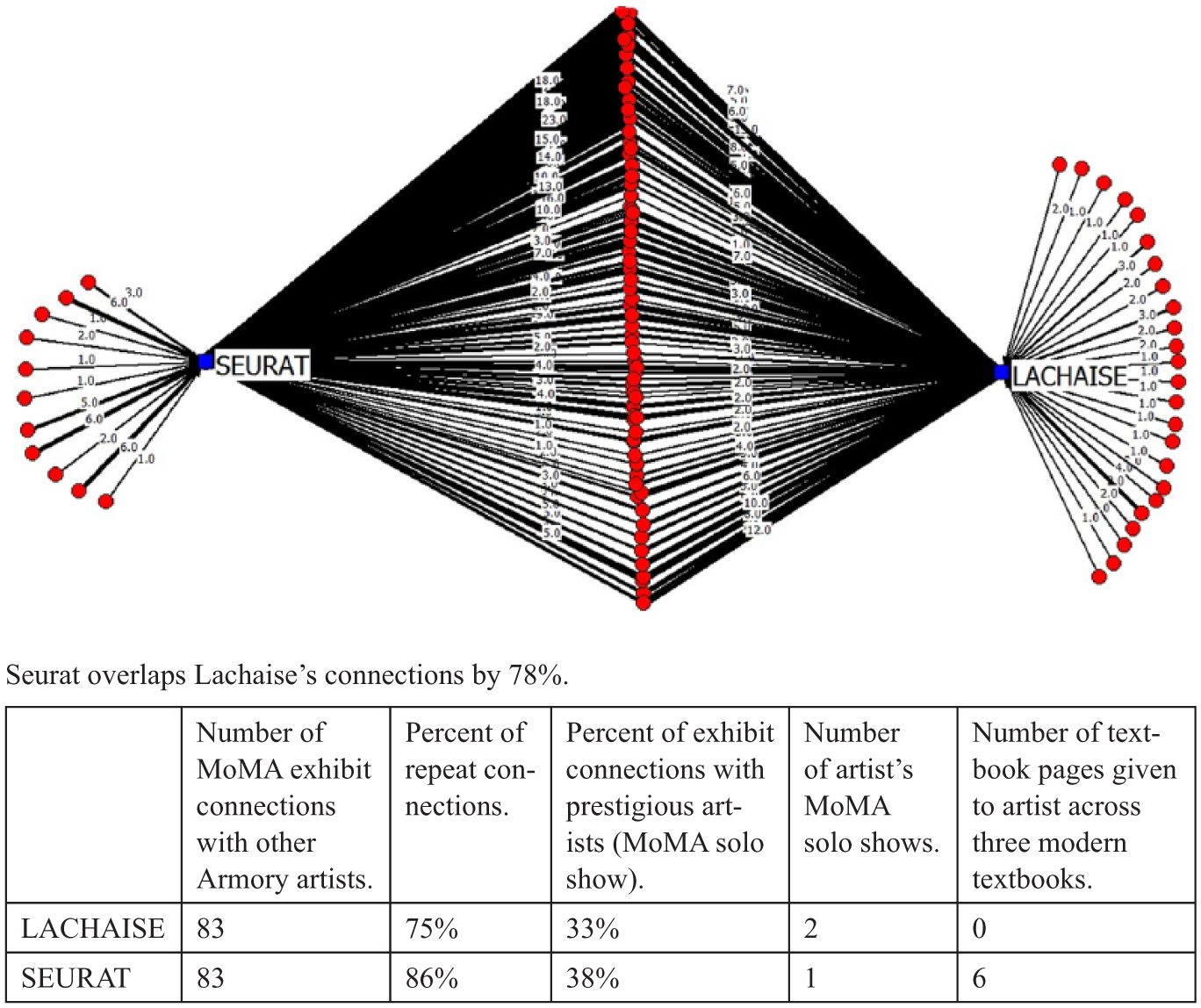
MoMA exhibition connections for Gaston Lachaise and Georges Seurat from 1929-1968.
Conclusion
While curators choose which artists to extol via exhibition, they are also choosing networks of artists to exhibit together. This research finds these exhibition-created networks are important to an artist’s subsequent attention in art history. Exhibiting with prestigious others and the robust connections formed with repeated exhibition has the greatest positive effect on later textbook coverage, at least for the Armory Show artists. This research argues when curators exhibit artists together, they are claiming a meaningful association between these artists and repeating this connection over exhibitions serves to solidify the relationship. In turn, art historians likely favor such effective associations because they serve as connective tissue within the historical narrative.
Much potential research is suggested by these findings. While I examine a historical cohort, I do not consider exhibition connections created with past (or future) artists or the exhibition population generally (however, see Braden & Teekens, 2018). Exhibitions featuring only a few artists suggest a closer relationship and, given the importance of repeat connections found here, understanding degree of connection and relative status of coexhibited artists may prove consequential. For example, Kirschbaum (2015) finds as jazz gained artistic status, bandleaders became associated through the musicians (sidemen) they employed and who shared their style identity. Associations between major and minor artists through aesthetic identity may provide an additional level of connection. Furthermore, this research could expand the measure of consecration to consider economic valuation. Velthuis (2013) examines how the price of an artwork serves as a symbolic signal, not only for the value of work but also for placement in artistic hierarchies. Economic valuation may thus serve as a measure of contemporary valorization and, given that aesthetic and market value tend to converge over time (Abbing, 2008), symbolic signaling between pricing and exhibition may offer informative interactions.
In closing, my results suggest certain considerations regarding the importance of networks for not only understanding artistic fields specifically but also understanding historical recognition in general. This research demonstrates those not only well-connected, but also strongly connected, are likely to attract long-term recognition—even when individual valorization, such as solo exhibition, is held constant. Such findings suggest the import of connection narratives when considering retrospective consecration. History (be it of art or general social history) is fundamentally presented as a progression narrative. To be considered part of history (and, therefore, to receive long-term recognition and prestige), historical personages must connect to each other to establish a historical position and contextual importance. However, such positioning is often not created by the actor’s own endeavors. For example, consider that successful artistic careers are centuries long. By necessity, then, important art world arbiters, such as curators and historians, must create an artist’s historical position and relation to other artistic creators. This research indicates when arbiters are forming a canon, historical connections and consequent contextualization may be as important as individual contribution.
Footnotes
Acknowledgements
The author is indebted to Timothy J. Dowd, Joshua Elzy, Katherine Giuffre, Ju-Sung Lee, Matthijs Punt, Robert O’Reilly, Vaughn Schmutz, Thomas Teekens, and two anonymous reviewers for their helpful comments.
Declaration of Conflicting Interests
The author declared no potential conflicts of interest with respect to the research, authorship, and/or publication of this article.
Funding
The author(s) disclosed receipt of the following financial support for the research, authorship, and/or publication of this article: Work on this article was partially supported by the Netherlands Organisation for Scientific Research (NWO) through the Innovational Research Incentives Scheme Veni.