




Abstract
This article presents two studies examining the effects of disclosing online native advertising (i.e., sponsored content in blogs) on people’s brand attitude and purchase intentions. To investigate the mechanisms underlying these effects, we integrated resistance theories with the persuasion knowledge model. We theorize that disclosures activate people’s persuasion knowledge, which in turn evokes resistance strategies that people use to cope with the persuasion attempt made in the blog. We tested our predications with two experiments (N = 118 and N = 134). We found that participants indeed activated persuasion knowledge in response to disclosures, after which they used both cognitive (counterarguing) and affective (negative affect) resistance strategies to decrease persuasion. The obtained insights do not only advance our theoretical understanding of how disclosures of sponsored blogs affect persuasion but also provide valuable insights for legislators, advertisers, and bloggers.
Native advertising, which is advertising in the form and function of nonadvertising content, has mushroomed in the past years (Faber, Lee, & Nan, 2004; Rosin, 2015; Wojdynski, 2016). In native advertising, there is no distinction between commercial content and real or authentic opinions, feelings, and experiences of the journalist or sender (Chia, 2012; Pollit, 2015). Critics argue that native advertising is unethical and misleading, because it is unclear for the audience that this is a form of advertising that is masked as editorial content. Identification of advertising is a key element of consumer rights (Cain, 2011). Therefore, legislators responded to this criticism and created regulations that should help consumers recognize these contemporary forms of advertising.
The literature shows that disclosures of native advertising can activate persuasion knowledge, that is, disclosures activate people’s understanding of the persuasive nature of sponsored content (e.g., Boerman, van Reijmersdal, & Neijens, 2012; Nelson, Wood, & Paek, 2009; Tessitore & Geuens, 2013; van Reijmersdal, Lammers, Rozendaal, & Buijzen, 2015; Wei, Fischer, & Main, 2008), and consequently mitigate persuasion (e.g., Boerman et al., 2012; van Reijmersdal et al., 2015).
However, insights into the mechanisms that underlie disclosure effects on persuasion are scarce. By combining insights from the persuasion knowledge model (Friestad & Wright, 1994) and resistance theories (Hass & Grady, 1975; Knowles & Linn, 204; Zuwerink & Cameron, 2003), we theorize that the use of resistance strategies explains effects of disclosures on persuasion in native advertising. Such strategies are diverse (Zuwerink & Cameron, 2003), and insights into the precise strategies that people use to turn activated persuasion knowledge into resistance against persuasion are lacking. However, these insights are crucial for our theoretical understanding of how disclosing native advertising can help consumers understand and cope with this embedded form of online advertising. Therefore, our first aim is to assess whether disclosures activate persuasion knowledge (i.e., people’s recognition of a message as being advertising), whether and how this activates specific resistance strategies, and how this consequently mitigates persuasion. We do so by focusing on common resistance strategies that have been proven to negatively affect persuasion in other contexts than blogs, being cognitive strategies (i.e., counterarguing) and affective (i.e., activation of negative affect) strategies.
In this study, we focus on a specific form of native advertising: sponsored blogs. In the online social media context, particularly blogs became a popular venue for native advertising. Sponsoring blogs is prevalent, because many blogs and bloggers are highly popular as indicated by their readership. For example, blogs in the United States may reach 100,000 (www.beautygloss.nl) or even 989,352 (www.thechive.com) unique visitors a day. Bloggers are assumed to have a strong influence on their reading audience (Kapitan & Silvera, 2015). However, so far only a handful of studies on blog disclosures have been conducted. These studies show that disclosures of sponsored content in blogs influence readers’ responses to the blog, the blogger, and the advertised brand (Campbell, Mohr, & Verlegh, 2013; Liljander, Gummerus, & Söderlund, 2015). But insights into the mechanisms explaining these effects of blog disclosures are lacking.
We conducted two experiments that focus on two different types of blogs (cooking vs. sports) and two different types of products. By conducting two experiments, we could test whether the effects of disclosures generalize to different instances of sponsored blogs and, if so, provide a stronger basis for drawing conclusions.
The obtained novel insights do not only advance our theoretical understanding of how disclosures of sponsored blogs affect persuasion but also provide valuable insights for legislators, advertisers, and bloggers. For legislators, insights from this study can aid decisions regarding native advertising disclosure regulations. For advertisers and bloggers, insights from this study may be valuable for deciding whether or not to use sponsored blogs and for understanding the consequences of the recently introduced guidelines on disclosing native advertising.
Theoretical Background
The disclosure of sponsored content is a relatively new phenomenon and has not been studied much in the context of blogs. Studies consistently find a negative effect of disclosures showing lower perceived credibility of the blog and the blogger, more negative attitudes toward the blog (Colliander & Erlandsson, 2015), and decreased readers’ intentions to engage in electronic word-of-mouth (Liljander et al., 2015).
Importantly, disclosing the sponsored nature of a blog also affects perceptions of the advertised brand. Some studies showed negative effects of disclosing sponsoring in blogs on consumers’ attitudes toward the brand, top-of-mind brand awareness (Campbell et al., 2013), and purchase intentions (Liljander et al., 2015). However, others studies showed positive effects of disclosures on brand attitude and purchase intentions (Colliander & Erlandsson, 2015). These conflicting findings may be caused by the differences between the sources of the disclosures (i.e., an outsider, for example, a tabloid article vs. the blogger himself; see also Carr & Hayes, 2014).
Persuasion Knowledge
Disclosures of the commercial purpose of a blog post are particularly intended to inform audiences about the relationship between a blogger and an advertiser (Federal Trade Commission, 2015). This means that its main goal is to help consumers recognize the advertising in the blog which is considered a first and crucial step of activating their persuasion knowledge (i.e., their personal knowledge and beliefs about advertising motives and tactics; Friestad & Wright, 1994). However, whether people indeed activate their persuasion knowledge in response to sponsored blog disclosures has not been examined until now.
Several studies in different media contexts, such as television programs, movies, radio, and websites, have shown that disclosures can indeed activate consumers’ persuasion knowledge (e.g., Nelson et al., 2009; Tessitore & Geuens, 2013; Wei et al., 2008; Wojdynski & Evans, 2016). To examine whether disclosures also achieve their goal of activating persuasion knowledge in the context of sponsored blogs and replicate prior findings from other contexts, we propose the following hypothesis:
Resistance Toward Sponsored Blog Content
When people’s persuasion knowledge is activated, they are expected to cope differently with the persuasion attempt than when this knowledge is not activated. According to the persuasion knowledge model, people can use their knowledge about a persuasion attempt to either be persuaded or to resist the persuasion (Friestad & Wright, 1994). However, reactance theory posits that, in general, people want to maintain their freedom of choice and do not want to be manipulated (Brehm & Brehm, 1981). Therefore, it is assumed that people tend to resist persuasion attempts when they recognize them as such (Petty & Cacioppo, 1977; Wei et al., 2008; Wood & Quinn, 2003). When blog readers realize that a message has as persuasive goal, this may be experienced as a threat to their freedom of choice, which may evoke resistance strategies to cope with the unwanted persuasion attempt.
Since resistance can be both cognitive and affective (Knowles & Linn, 2004), we propose that the activation of persuasion knowledge can evoke both cognitive and affective resistance responses, and that these strategies may explain the influence of blog disclosures on the advertising’s persuasive outcomes.
Cognitive Resistance
According to the cognitive response approach (Petty, Ostrom, & Brock, 1981), people mainly respond to persuasive messages with cognitions. Depending on various (message) factors and preexisting thoughts these cognitions can be either positive or negative. These cognitions subsequently have an impact on attitudes and other related responses such as intentions and behavior. When people are motivated to resist a persuasive message, they are likely to respond with negative cognitions (i.e., counterarguing). Zuwerink and Cameron (2003) indeed found that counterarguing is an effective and often used cognitive resistance strategy in response to persuasive messages.
There are several reasons for people to resist persuasive messages. One often-studied variable is perceived persuasive intent of a message. Research indeed demonstrated that warning people about an upcoming persuasive message can increase counterarguing (Petty & Cacioppo, 1977; Wood & Quinn, 2003), meaning that people are more likely to refute the arguments made in the persuasive message. Moreover, a study on sponsored content in a television program demonstrated that a disclosure increased the number of thoughts about advertising and decreased the number of positive thoughts about the brand (Boerman, van Reijmersdal, & Neijens, 2013).
In line with these findings, disclosures in the context of sponsored content in blogs may not only activate people’s persuasion knowledge, but this may also result in more counterarguing. The realization that the blog has a commercial purpose may make the readers refute the claims made about the brand or product. Based on this, we propose the following path of cognitive resistance:
Prior studies in various contexts (i.e., TV, radio, movies, and blogs) have demonstrated that disclosing sponsored content negatively affects consumers’ attitudes toward the brand (Boerman et al., 2012; Campbell et al., 2013; Wei et al., 2008), and their intention to purchase the advertised brand or product (Liljander et al., 2015; Tessitore & Geuens, 2013). In addition, Milne, Rohm, and Bahl (2009) found that employees disclosing their relationship with a company (vs. not disclosing this information) when participating in online communities reduced the reader’s purchase likelihood of a product. This negative effect of disclosures on brand responses is assumed to be a result of resistance (Milne et al., 2009). However, no study has yet examined whether resistance mechanisms underlie this process, and if so, which types of resistance strategies are of importance.
People’s cognitive responses to a persuasive message have consistently shown to be an important mediator for persuasion. Specifically, counterarguing a persuasive message decreases persuasion in terms of attitudes (Petty et al., 1981; Zuwerink & Cameron, 2003). The cognitive resistance that is hypothesized to be instigated by the disclosure and the activation of persuasion knowledge may thus have a negative effect on consumers’ brand attitudes.
Moreover, the theory of planned behavior and the theory of reasoned action (Fishbein & Azjen, 1975) postulate that people’s attitudes predict their intention to perform a specific behavior. Similarly, the hierarchy of effects model postulates a relationship between attitudes and behavioral intentions (Lavidge & Steiner, 2000). In line with this reasoning, it has often been demonstrated that consumers’ attitude toward the brand can predict their intention to purchase the product (Homer, 1990; MacKenzie, Lutz, & Belch, 1986; Spears & Singh, 2004). Therefore, we expect that cognitive resistance leads to less favorable brand attitudes, which ultimately results in lower purchase intentions:
Affective Resistance
Although cognitions have been proposed as an important mediator for persuasion effects, people also tend to have affective responses toward persuasive messages. These affective responses are defined as mood and feelings (Edell & Burke, 1987). When people are motivated to resist persuasion, they are likely to experience negative affective reactions such as anger and irritations and use these to resist the message. Indeed, one of the most prevalent affective resistance strategies is negative affect, which involves responding to the persuasive attempt by getting angry, irritated, or upset (Zuwerink & Cameron, 2003).
Research has shown that when a disclosure activates persuasion knowledge, this can instigate critical feelings, such as skepticism and disliking (Boerman et al., 2012). As a disclosure instigates skepticism and disliking, it may also trigger more emotional responses such as anger and irritation. Furthermore, activating persuasion knowledge in response to a disclosure results in a change of meaning (Friestad & Wright, 1994). This change of meaning from a fun pass-time to a persuasive attempt may make the consumer feel deceived, and hence may instigate negative emotional responses. We therefore expect that the activation of persuasion knowledge also leads to affective resistance toward the sponsored blog.
The evoked negative affect could also be the mechanism explaining the detrimental effect of a disclosure on brand attitudes and purchase intentions. Because the consumer is angry or irritated about the sponsoring, the sponsoring party (i.e., the brand) is likely to be negatively evaluated. The negative affect may thus be attributed to the brand (Zuwerink & Cameron, 2003) and therefore explain negative effects of disclosures on brand attitudes and purchase intentions. In line with this reasoning, research has indeed shown that critical feelings toward sponsored content result in less favorable brand attitudes (Boerman et al., 2012). Therefore, we propose a second path of resistance through which negative persuasion outcomes in response to a disclosure may be explained:
The complete hypothesized model is presented in Figure 1. To test this model, we conducted two experiments in which participants were exposed to sponsored blogs that included either no disclosure or a disclosure that explicitly stated that the brand paid for exposure in the blog to persuade the reader. We assessed participants’ persuasion knowledge, cognitive and affective resistance strategies, brand attitude and purchase intentions in both studies.
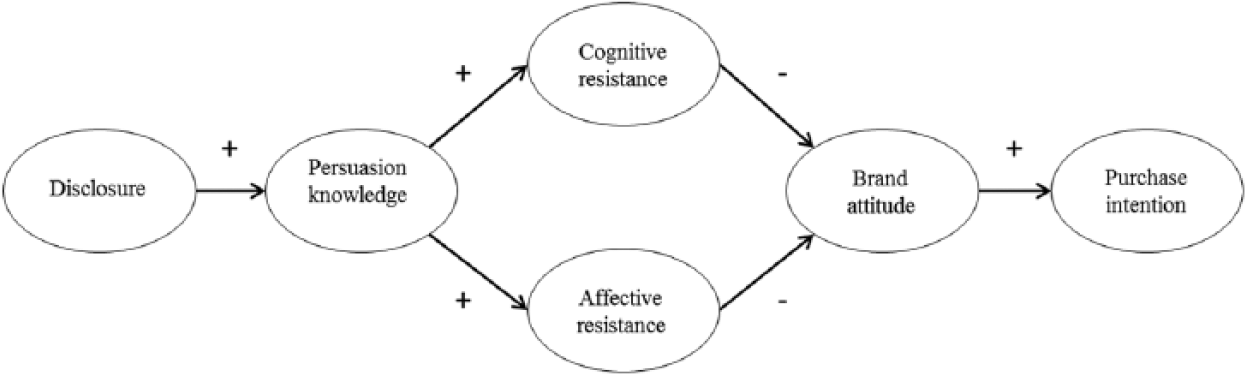
Hypothesized model.
Study 1
Method
Sample and Procedure
We adopted a one-factor (disclosure or no disclosure) between-subjects design. 1 A total of 118 students (Mage = 21.19, SD = 2.20, 78% female) participated in the study in exchange for credits or money ($8.50). Participants were randomly assigned to one of the two conditions (n = 59 per condition). They came to the university’s lab and were seated in isolated cubicles. After giving informed consent, they were shown a sponsored food blog either with or without the disclosure. Next, they filled out a questionnaire with questions about the sponsoring brand (including attitudes and purchase intention), persuasion knowledge, resistance strategies, and demographics, respectively.
Stimulus Materials
Participants were exposed to a fictitious blog post from a fictitious food blog aimed at students. The blog post described how to prepare an easy casserole using a branded casserole mix. The blogger explained how she made the dish and said that the result was tasteful. The brand name was mentioned once, when the ingredients were listed. For the disclosure condition, a disclosure stating “[BRAND] paid for this blog to persuade you” was inserted in the middle of the blog (cf. Wojdynski & Evans, 2016) in bold using a font that was one size bigger than the blog text. The disclosure is based on suggestions by the Federal Trade Commission and on earlier research on disclosure effects (Boerman et al., 2012; Campbell & Kirmani, 2000).
Measures
Persuasion Knowledge and Resistance Strategies
To measure persuasion knowledge, we asked participants to what extent they thought: “the blog post is advertising (pk1),” “the blog post is commercial (pk2),” and “the blog post contains advertising (pk3)” (based on Boerman et al., 2012; van Reijmersdal, Neijens, & Smit, 2010) on a scale ranging from 1 (strongly disagree) to 7 (strongly agree; Cronbach’s α = .92, M = 4.81, SD = 1.58). The abbreviations (pk1, etc.) refer to the items in Figure 2.
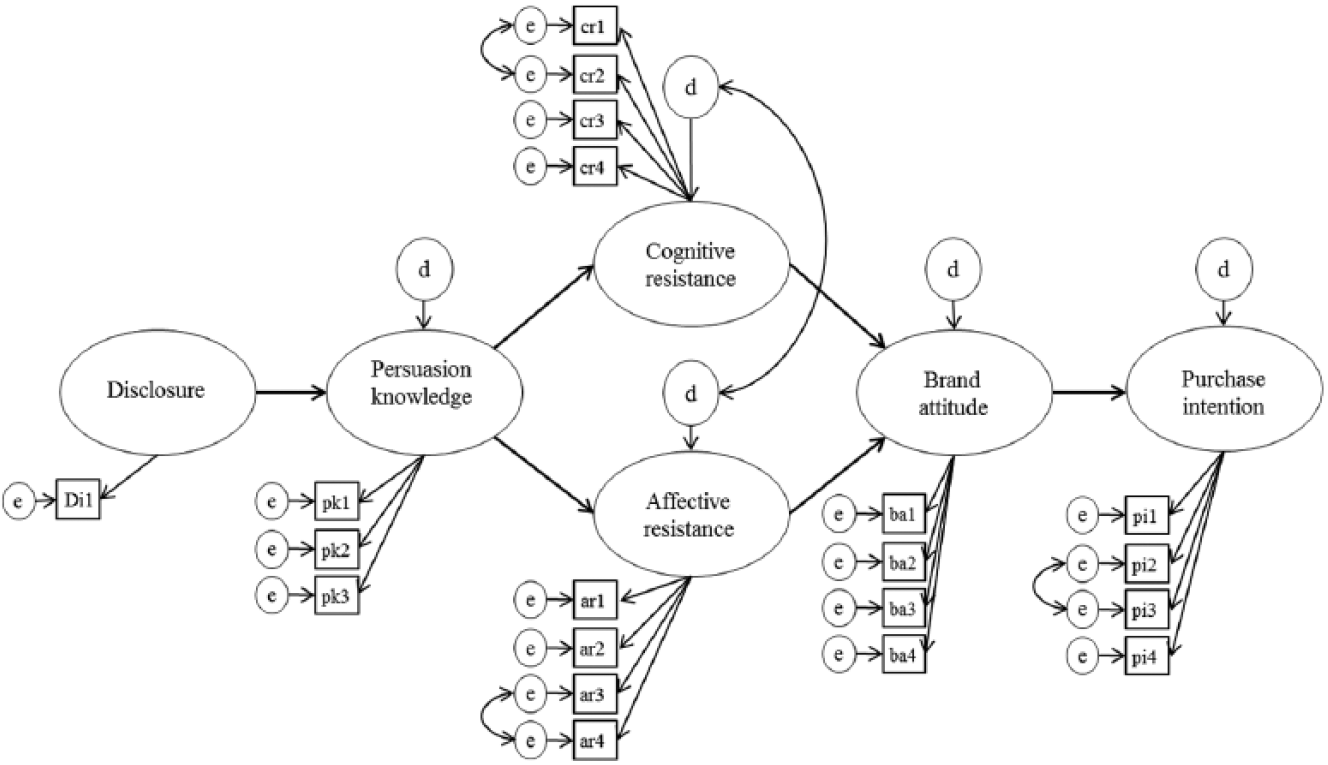
Adapted model.
To measure the cognitive resistance strategy “counterarguing,” participants were asked to what extent they agreed with the following four statements: “While reading, I contested (cr1)/refuted (cr2)/doubted (cr3)/countered (cr4) the information in the blog post” (Fransen, Ter Hoeven, & Verlegh, 2013; Zuwerink & Cameron, 2003) on a scale ranging from 1 (strongly disagree) to 7 (strongly agree; Cronbach’s α = .90, M = 3.42, SD = 1.47).
The affective resistance strategy of “negative affect” was measured with the following four statements: “While reading the blog I felt angry (ar1)/enraged (ar2)/irritated (ar3)/annoyed (ar4)” (Zuwerink & Cameron, 2003) on the same 7-point scale (Cronbach’s α = .85, M = 2.31, SD = 1.15).
Brand Attitude and Purchase Intention
Brand attitude was measure by using 7-point semantic differentials with the statement “I think [BRAND] is negative-positive (ba1)/uninteresting-interesting (ba2)/unattractive-attractive (ba3)/bad-good (ba4)” (Cronbach’s α = .86, M = 4.68, SD = 0.89; Boerman et al., 2012; Matthes, Schemer, & Wirth, 2007; van Reijmersdal et al., 2015).
Purchase intention was measured with the following four statements “I would like to try [BRAND] (pi1),” “I intent to buy [BRAND] (pi2),” “I want to buy [BRAND] (pi3),” and “I will look for [BRAND] in a store (pi4)” (Spears & Singh, 2004) on a scale ranging from 1 (strongly disagree) to 7 (strongly agree; Cronbach’s α = .84, M = 4.54, SD = 1.18).
For all constructs items scores were averaged to create single measures.
Results and Conclusion
Analysis of variance showed that participants in the two conditions did not differ with respect to age, F(1, 116) = 0.09, p = .77, or sex, χ2(1) = 0.20, p = .66, indicating successful randomization.
In order to test the hypotheses, the model from Figure 1 was estimated using structural equation modeling in AMOS 23. All variables were included as latent constructs. The latent variable disclosure was estimated from the manifest indicator “condition” (0 = control; 1 = disclosure) and was entered as an exogenous variable (i.e., not caused by any other variables in the model); the latent variables persuasion knowledge, cognitive resistance, affective resistance, brand attitude, and purchase intention were estimated from their manifest items and were entered as endogenous variables (i.e., caused by other variables in the model).
With structural equation modeling, the fit of a model is generally assessed based on the comparative fit index (CFI) and the root mean square error of approximation (RMSEA). CFI values between .90 and .95 are considered acceptable, CFI values above .95 good. In addition, RMSEA values between .05 and .08 are considered acceptable, RMSEA values below .05 good (Byrne, 2013). Ideally, each RMSEA value should be accompanied by a p of close fit statistic of .05 or higher, as such a statistic is indicative of good fit and, hence, minor specification error (Kline, 2005).
The hypothesized model resulted in an acceptable CFI value but an unacceptable RMSEA value: χ2 (df = 165; n = 118) = 316.972, p = .000, CFI = .900, RMSEA = .089, with p-close = .000. Therefore, model modification indices were explored and model fit was improved by controlling for shared measurement error by allowing disturbance terms and error terms of items with similar content to correlate (see Figure 2; Byrne, 2013; Kline, 2005). This model resulted in good fit: χ2 (df = 161; n = 118) = 216.489, p = .002, CFI = .963, RMSEA = .054, with p-close = .344.
The results of the adapted model (Figure 2) indicated that, compared with the condition without a disclosure, respondents in the disclosure condition activated their persuasion knowledge more, as predicted in Hypothesis 1 (β = .632, p < .001). The more respondents’ activated their persuasion knowledge, the higher their cognitive resistance (β = .449, p < .001), as predicted in Hypothesis 2. However, respondents’ cognitive resistance did not affect brand attitudes (β = .135, p = .245), thus not supporting Hypothesis 3.
As predicted in Hypothesis 4, the more respondents activated their persuasion knowledge, the higher their affective resistance (β = .403, p < .001). In addition, as predicted in Hypothesis 5, higher levels of affective resistance were associated with more negative brand attitudes (β = −.384, p = .003), which were positively related to purchase intention (β = .746, p < .001), showing that the more positive the attitude, the higher the intention to purchase.
In sum, this study showed, as expected, that persuasion knowledge and affective resistance explain the negative effect of disclosing sponsored blogs on persuasion. However, this study found no evidence for cognitive resistance underlying these negative disclosure effects. To replicate these findings and to test whether the hypothesized effects generalize to other instances of sponsored blogs, we performed a second experiment.
Study 2
In the second experiment, we used an existing blog with a fictitious sponsored blog post on a different topic (running), which included a different product (head phones) and a different writing style, including more product characteristics and product claims. In addition, a broader sample including nonstudents was used. This offers the opportunity to replicate the findings of the first study using a product that is more involving. In addition, in the first study the blog barely included arguments, which may explain why we found no indirect effect of disclosure on purchase intention through counterarguing. Using a blog with stronger arguments may provide more insights into these indirect effects.
Method
Sample and Procedure
In this study, we also adopted a single-factor (disclosure vs. no disclosure) between-subjects design. 2 A total of 134 respondents (Mage = 27.75, SD = 10.23, 67% female, 82% higher educated) participated in an online experiment. The participants were recruited through e-mail and Facebook. By clicking on a link they could participate immediately. After participants gave informed consent, they were randomly assigned to a sponsored blog about running in which a disclosure was either present (N = 69) or not (N = 65). Next, we measured brand attitude, purchase intention, persuasion knowledge, resistance strategies, and demographics, respectively.
Stimulus Materials
The participants were exposed to a fictitious sponsored blog post of the existing blog Runnersworld. The blog described a story about the fun of running while listening to music. The blogger describes her search for the best equipment to listen to music while running and promotes the earplugs of a brand by explicitly mentioning several advantages of this brand (e.g., “the special design prevents the earplugs from falling out of your ears,” “they are available in different colors,” and “the earplugs are rain and sweat proof”). We chose earplugs because this product might be interesting for both men and women. Sponsorship disclosure was manipulated by adding the following disclosure: “[BRAND] has paid for this blog and it aims to influence you.” As in Study 1, the sponsorship disclosure was inserted in the middle of the blog before the brand placement using a bold font.
Measures
Persuasion Knowledge and Resistance Strategies
We used the same items as in Study 1 to assess persuasion knowledge (α = .93, M = 4.02, SD = 0.94), cognitive resistance (α = .91, M = 2.67, SD = 0.99), and affective resistance (α = .95, M = 2.01, SD = 1.07), now measured on 5-point scales (1 = strongly disagree and 5 = strongly agree).
Brand Attitude and Purchase Intention
For brand attitude, we used the same items as in Study 1 (α = .94, M = 3.61, SD = 0.85) on a 5-point scale. For purchase intention we used the following four statements: “I will buy [BRAND] (pi1),” “I have the intention to buy a product of [BRAND] (pi2),” “I am interested in buying a product of [BRAND] (pi3),” and “It is likely that I will buy a product of [BRAND] in the future (pi4)” (Spears & Singh, 2004). Participants could respond to the statements on a scale ranging from 1 (completely disagree) to 5 (completely agree; α = .88, M = 3.16, SD = 0.85). Again for each construct the item scores were averaged to create single measures.
Results and Conclusion
Analysis of variance showed that participants in the two conditions did not differ with respect to their age, F(1, 132) = .64, p = .425, sex, χ2(1) = 2.56, p = .141, or education, χ2(4) = 3.32, p = .507, indicating that the randomization was successful.
For Study 2, we estimated identical models to Study 1 (see Figures 1 and 2). Again the model without any disturbance or error correlations resulted in an unacceptable fit: χ2 (df = 165; n = 134) = 542.883, p = .000, CFI = .857, RMSEA = .131, with p-close = .000. Yet, with the correlations included the fit was acceptable: χ2 (df = 161; n = 134) = 279.811, p < .001, CFI = .955, RMSEA = .074, with p-close = .004. For the large part, the findings from Study 1 were replicated. This time, however, all the paths shown in Figure 1 were found to be significant—including the path from cognitive resistance to brand attitudes.
The results of the adapted model showed that, again, respondents in the disclosure condition activated their persuasion knowledge to a greater extent than respondents in the condition without a disclosure (β = .353, p < .001), supporting Hypothesis 1. The more respondents’ activated their persuasion knowledge, the higher their cognitive resistance (β = .486, p < .001), as predicted in Hypothesis 2. Furthermore supporting Hypothesis 3, the higher respondents’ cognitive resistance, the more negative their brand attitudes (β = −.248, p = .009), which were positively related to their purchase intentions (β = .839, p < .001). As predicted in Hypothesis 4, activated persuasion knowledge was also positively related to affective resistance (β = .244, p = .005). With respect to Hypothesis 5, the model shows that the higher the affective resistance, the more negative the brand attitudes (β = −.381, p < .001), which were positively related to their purchase intention (β = .839, p < .001).
In sum, Study 2 provides evidence for the use of cognitive and affective resistance mechanisms underlying the effect of disclosing sponsored content in blogs on persuasion outcomes. Contrary to Study 1, Study 2 found that counterarguing in response to the disclosure also mitigated persuasion.
Discussion
The general aim of this study was to increase our understanding of whether and how disclosure effects on persuasion outcomes are explained by people’s use of resistance strategies. In reaching this aim, we gained more insight in which resistance strategies are responsible for mitigating persuasion due to blog disclosures. We integrated the persuasion knowledge model (Friestad & Wright, 1994) with resistance theories (Knowles & Linn, 2004; Zuwerink & Cameron, 2003; Zuwerink & Devine, 2000) and theorized that disclosures can activate people’s persuasion knowledge, resulting in the use of cognitive and affective resistance strategies, which in turn mitigate persuasion. These theoretical assumptions were tested in two experimental studies in which we used two different blogs, with different types of arguments, for different types of products.
Our studies are the first to show that the use of resistance strategies explains the effects of disclosing sponsored content in blogs on persuasion. Importantly, when readers are exposed to a sponsored blog with a disclosure, their persuasion knowledge is activated, which triggers cognitive resistance and/or affective resistance against the sponsored content. That is, people start counterarguing the message and they experience negative affect. Due to the use of these strategies, persuasion is decreased: attitudes toward the sponsoring brand become more negative and purchase intention is lower. We found evidence for these effects in two different types of sponsored blogs (i.e., in a cooking blog and a sports blog), for two different types of products (food mix and head phones), and for a blog post on a fictitious blog (Study 1) and on an existing blog (Study 2).
Interestingly, in the second study, we found significant relations between both cognitive and affective resistance and persuasion, but in the first study there was only a significant relation between affective resistance and persuasion (i.e., brand attitude and purchase intention). This means that although the disclosure activated persuasion knowledge and in turn was associated with increased counterarguing, this was not followed by more negative brand attitudes and purchase intent in the first study.
Possible explanations for this finding may be found in the differences between the two sponsored blogs. First of all, in the first experiment a low involvement product was used, whereas the second study included a relatively high involvement product. Maybe, for the low involvement product, the outcome of counterarguing was not significantly negative because people did not care that much about the product.
Second, the first blog included very few pro product arguments. The arguments that were given were related to the taste of the dish as a whole and to the ease of preparing the dish. The increased counterarguing due to the disclosure in this study may therefore not have been focused on the brand but on the preparation and taste of the dish. Perhaps this explains why counterarguing did not affect brand attitudes. In the second study, explicit pro arguments for the branded product were provided. Consequently, in the second study, people may have actually countered these specific arguments, which directly affected their attitude toward the brand in a negative manner.
Our studies contribute to the literature in several important ways. First, whereas previous work mainly focused on the effects of disclosures on persuasion knowledge and persuasion itself, the present research is the first to provide insights into the mechanisms that explain why disclosures and activated persuasion knowledge lead to less persuasion by sponsored content. Second, by examining two different types of resistance strategies as the explanatory mechanisms of disclosure effects, we have uncovered the mechanisms people use to resist persuasion by sponsored blog content due to a disclosure.
Our findings are in line with previous studies that assessed the effects of sponsored content in other media: These studies also showed that disclosures of sponsored content can activate persuasion knowledge (e.g., Nelson et al., 2009; Tessitore & Geuens, 2013; Wei et al., 2008) and decrease persuasion (Boerman et al., 2012; Campbell et al., 2013; Liljander et al., 2015; Tessitore & Geuens, 2013; Wei et al., 2008). Our studies add to the findings from these previous studies by pinpointing the cognitive and affective resistance mechanisms that explain these effects.
Limitations and Future Research
Future research is needed to provide further insights into the role of cognitive resistance in disclosure effects. These studies may compare blogs with the same content but for products with different levels of consumer involvement. Moreover, these studies could compare blogs for the same products but with varying numbers of pro product arguments.
Although self-reported measures of counterarguing are common in the literature on resistance (Asbeek Brusse, Fransen, & Smit, 2015; Zuwerink & Cameron, 2003), future studies may employ other measures, such as thought-listing or think-aloud methods (Cacioppo, Von Hippel, & Ernst, 1997; Rozendaal, Buijzen, & Valkenburg, 2010). The use of such measures can increase our insights into the use of counterarguing as a means to resist persuasion after exposure to a disclosure. Moreover, these methods may illuminate the content of the counterarguments, that is, whether they pertain to the brand, the blogger, the advertisement, or to persuasion in general.
We focused on the two common cognitive and affective resistance strategies, being counterarguing and negative affect (Zuwerink & Cameron, 2003). However, future research may include more strategies, for example, source derogation, weighting of attributes, or attitude bolstering (Ahluwalia, 2000; Zuwerink & Cameron, 2003) and determine whether and how these strategies explain disclosure effects.
Theoretical and Practical Implications
Theoretically, this study contributes to our current knowledge in several important ways. First, the integration of the persuasion knowledge model with resistance theories yields interesting new insights for explaining effects of disclosures. Although the persuasion knowledge model (Friestad & Wright, 1994) stated already that the activation of persuasion knowledge enables consumers to cope with persuasion attempts, this is the first study providing empirical support for the idea that consumers indeed adopt resistance strategies when persuasion knowledge is activated by a disclosure for sponsored content. Thereby, this study provides insight in how consumers actually cope with a persuasion attempt during a persuasion episode, in case people’s knowledge about advertising.
For policy makers and legislators, the current study has significant implications. This study demonstrates once again that disclosures help people recognize advertising in sponsored content. Moreover, the current study also demonstrates that disclosures increase the critical processing of blogs. Although recognition of advertising, and not critically processing of persuasive messages, is central to consumer protection law, legislators could consider the current findings as a positive outcome and as empirical support for the idea behind social media rules.
For advertisers, the findings of the current study may seem negative. Adding bloggers to the communication mix seems a promising tool to reach (potential) consumers for many reasons. The advantages of using blogs for advertising are plenty, such as reaching a relevant audience and increased impact because of the hidden nature of this advertising format. Yet, social media guidelines seem to stand in the way of positive outcomes of blogvertising. After all, this study clearly demonstrates that disclosures negatively influence brand responses. However, transparency might be appreciated and recognized by readers of sponsored blogs in the long run and in the end might soften their resistance. Though this study demonstrates short-term negative effects of disclosures for brands, long-term effects are not examined and could be positive.
Footnotes
Declaration of Conflicting Interests
The author(s) declared no potential conflicts of interest with respect to the research, authorship, and/or publication of this article.
Funding
The author(s) received no financial support for the research, authorship, and/or publication of this article.