



Abstract
Use of public assistance by noncitizens is controversial. Before 2018, institutionalization and receipt of cash benefits were considered as evidence of whether immigrants were likely to become a “public charge” and, therefore, ineligible for citizenship. But a new rule—proposed in 2018 and finalized in 2020—also made participation in SNAP/Food Stamps and Medicaid relevant as evidence. We examine whether participation in SNAP/Food Stamps and Medicaid among U.S.-born children—whose own eligibility for program participation should be unaffected by the new rule—has changed, based on the citizenship status of their parents. We find evidence that, after the 2018 proposal, U.S.-born children with noncitizen parents are less likely than the children of U.S.-born parents to participate in these programs. We discuss the literature on “chilling effects” and on the impact of safety net programs on children’s long-term outcomes.
Immigrants are a growing fraction of the U.S. population. 1 Commensurate with this increase, Figure 1 shows that U.S. citizens, particularly U.S.-born children, are very likely to live with at least one noncitizen. The share of U.S.-born children with at least one foreign-born parent has increased and now accounts for about 23 percent of U.S.-born children (Batalova 2024). The foreign-born are more likely to have lower education levels that those born in the U.S. 2 and make up a disproportionate share of those with lower-income levels. In this article, we want to understand how participation of U.S.-born children in two important safety net programs—Supplemental Nutrition Assistance Program (SNAP)/Food Stamps (nutritional assistance) and Medicaid (health insurance for lower-income people)—has changed over time based on the citizenship status of their parents.

Percentage of U.S. Citizens with at Least One Noncitizen in Household by Year
Why might participation have changed over time based on parental citizenship status? There are two ways in which immigration status and use of public programs interact: first, whether eligibility for such programs varies by immigration status; and second, whether and how use of, or likely use of, public programs affects a person’s potential immigration status. Historically, both have been areas of public discourse and policy changes. Eligibility for most public assistance programs depends on immigration status and underwent fundamental changes with the Welfare Reform Act of 1996. The likelihood of being a “public charge”—one who relies primarily on public assistance—has long been grounds for the exclusion of immigrants to the U.S. As early as 1882, the U.S. government began using this as a reason for denial of entry, and, in addition, immigrants’ ability to adjust their immigration status to permanent residence or to citizenship was—and still is—affected by whether they are deemed likely to become a public charge. In 2018, a new rule was proposed that included participation in SNAP/Food Stamps and Medicaid as a component of the public charge determination.
In this article, we examine how participation in various programs changes over time for U.S. citizens based on their relationship to noncitizens. In particular, we examine how the participation of U.S.-born children in SNAP/Food Stamps and Medicaid changes over time between those who have U.S.-born and noncitizen parents. Although the immigration status of parents did not change children’s eligibility for these programs, parents’ beliefs about how participation in the programs might affect their own path to citizenship may have.
We find that as the interpretation of the public charge rule was expanded to include more programs, participation in SNAP/Food Stamps and Medicaid fell more for U.S.-born children with noncitizen parents than for those with U.S.-born parents. These findings are consistent with a “chilling effect” from the new interpretation of what constitutes being a public charge.
In a separate analysis, we examine whether participation in Medicare (health insurance for those aged 65 and older) among elderly U.S. 3 citizens changes over time depending on whether they live with noncitizens. While older U.S. citizens who live with noncitizens are less likely to be on Medicare at the point of eligibility—turning 65—than those who live with only citizens, we do not find statistically significant changes in the relative take-up between those who live with noncitizens and citizens when the public charge criteria changed. Note that the new interpretation of what it means to be a public charge did not expand to include Medicare. These findings suggest that the drop in participation in SNAP/Food Stamps and Medicaid among children is tied to their parents’ concerns over the new interpretation of public charge, rather than a general concern among noncitizens about interacting with the government.
In what follows, we offer a brief overview of changes over time in immigrants’ eligibility for public programs and interpretations of the public charge rule. We discuss the literature around chilling effects and participation in public programs among immigrants. We also discuss the burgeoning literature on the effects of investments in children through public programs, and why reduced use of the safety net among eligible U.S.-born children is a cause for concern. We then describe the American Community Survey (ACS) data and describe the estimation strategies and results.
The Public Charge Rule, Chilling Effects, and the Effects of Public Programs
Immigration, immigrants’ eligibility for public programs, and the Public Charge Rule
Immigrants’ use of safety net programs in the U.S. has long been controversial; concern over it is part of the earliest immigration restrictions, and eligibility for programs among immigrants has been the subject of much change over time. In this section, we provide an overview of how eligibility for public programs is related to immigration status and outline some of the major changes over time. We also discuss how participation in public assistance programs has potentially affected immigrants’ status over time with changes in the interpretation of the public charge rule.
Immigration
Before turning to how immigration status interacts with the safety net, we outline the immigration process in the U.S. in general. 4 Immigrants to the U.S. can be divided, although not neatly, 5 into three groups: permanent legal immigrants, temporary visa holders, and unauthorized immigrants. Congress has authority over the number and type of immigrants coming into the country, and the executive branch interprets and implements the rules. Legal permanent residents are often referred to as “green card holders.” Most permanent legal residents are immediate family members of U.S. citizens. “Immediate” family are spouses, unmarried children under the age of 21, or parents of adult U.S. citizens. This number is not capped. Another group are nonimmediate family members of U.S. citizens (including unmarried adult children) and close relatives of permanent residents. Almost two-thirds of legal permanent admissions are immediate and nonimmediate family of U.S. citizens and permanent residents. Another 13 percent of admissions are given to individuals with employment in certain job categories. Fourteen percent are refugees and asylees. Finally, there are “diversity visas” (4 percent) 6 and “others” (3 percent) (Watson 2022). In many cases, those granted a green card had an “adjustment of status” from one of the other two categories of visa holders. Lawful permanent residents (green card holders) can apply for citizenship after five years of continuous residence. Temporary visas are also called “nonimmigrant” visas because people are not expected to reside in the U.S. permanently; these include some work-related visas (H1-B for high-skill workers, for example), student visas, and tourist visas (see Watson 2022).
The limits on numbers of immigrants and the rules governing the system were put in place in 1990 in the Immigration and Nationality Act. This act also limits green cards going to (nonimmediate) family members of U.S. citizens from any one country of origin in a given year to 7 percent. Since there is much more demand from some countries than others, wait times can vary a great deal. As Watson (2022) notes, in May 2022, the average wait time for processing green card applications for unmarried adult children of U.S. citizens (considered nonimmediate family members) was more than eight years. For people from Mexico, the wait time was 22 years.
Overview of citizenship status and eligibility
While a thorough overview of eligibility criteria for safety net programs is beyond the scope of this work, it is worthwhile to understand that the Personal Responsibility and Work Opportunity Reconciliation Act (PRWORA) of 1996 (also known as the “Welfare Reform Act”) created important differences in eligibility based on immigrant status (Zimmerman and Tumlin 1999). Up until that point, eligibility for immigrant noncitizens legally residing in the U.S. followed the same criteria as for citizens. For example, if one met the income, asset, and categorical tests for Aid to Families with Dependent Children, one could receive it regardless of citizenship status. It is important to keep in mind that undocumented immigrants were not eligible for most public assistance, even before the 1996 reforms.
PRWORA initially excluded noncitizens from receipt of most programs, but eligibility for programs such as Food Stamps (now SNAP) and Supplemental Security Income (SSI) was subsequently restored for noncitizens who had been legally residing in the U.S. prior to the enactment of the law (August 1996). PRWORA and subsequent changes created two new important dimensions of eligibility for immigrants. The first is whether one is a “Qualified” or “Unqualified” immigrant. Qualified immigrants are those legally residing in the U.S. who meet an extensive list of criteria. 7 Unqualified immigrants are those who do not meet those criteria. Within the Qualified category, eligibility varies by program. For example, refugees and asylees are eligible for SNAP as long as they meet the same financial and nonfinancial requirements as U.S. citizens, whereas lawful permanent residents who meet those requirements are eligible only after a five-year waiting period. 8 Noncitizens who are at least 65 years old are eligible for Medicare Part A as long as they are lawfully present in the U.S. and they (or their spouses) have worked for at least 40 quarters in jobs where they paid Medicare payroll taxes. 9
PRWORA and related reforms also created differences in eligibility based on year of arrival to the U.S. Qualified immigrants who arrived prior to the enactment of Welfare Reform (August 22, 1996) are eligible for more support than those arriving after. For example, Qualified immigrants who arrived prior to August 22, 1996, are eligible for Full-Scope (nonemergency) Medicaid, whereas those arriving after that date are eligible only if they meet a set of additional criteria. 10
Public charge rule
Layered on to the complicated relationship between citizenship status and program eligibility is the potential impact of participation in programs on one’s immigration status. The U.S. has long been concerned about the immigration of those who may be a “burden” to the public. Section 2 of the Immigration Act of 1882 says that those authorized to supervise “the business of immigration” will be “designated to examine into the condition of passengers arriving at ports . . . and if on such examination there shall be found among such passengers any convict, lunatic, idiot, or any person unable to take care of himself or herself without becoming a public charge, . . . such person shall not be permitted to land.” 11 While times have changed and we are no longer sending officials onto ships at ports of entry to decide if someone appears to be a “lunatic” before letting them ashore, the public charge rule has continued to exist since 1882. Those deemed likely to be a public charge can be denied admission to the U.S., adjustment of status to green card holder, and citizenship. The executive branch of the federal government can change the interpretation of how to determine if someone is—or is at risk of becoming—a public charge.
From 1999 until 2020, before a new “final rule” was put into place, “only primary reliance on cash benefits or long-term medical institutionalization were considered” (Bernstein et al. 2020) as grounds for denying admissions or residency in the U.S. The “new rule” was proposed in 2018 and took effect as a “final rule” in February 2020. It changed the “totality of circumstances” considered in a public charge determination to include not only cash benefits and long-term institutionalized care, but use of SNAP/Food Stamps, nonemergency Medicaid, 12 and Section 8 housing or public housing (Bernstein et al. 2020; Whitener 2019). The “totality of circumstances” could also include “income and assets, age, health, family size, education and skills, like English proficiency” (Bernstein et al. 2020). This new rule was to be considered for applications for green cards from within the U.S. and abroad, as well as to applications for temporary visas from abroad or changes/extensions to temporary visas from those already resident in the U.S. (Bernstein et al. 2020). In effect, this new rule meant, for example, that someone who had been lawfully residing in the U.S. and was applying for a green card could be denied this change in status because they were receiving SNAP benefits or Medicaid. 13
This new interpretation of the public charge rule was proposed by the U.S. Department of Homeland Security (DHS) (2018) on October 10, 2018, but had been discussed earlier. There were legal challenges to the proposal, with lawsuits filed by 21 states and the District of Columbia (Jordan 2019), such that the final rule did not take effect until February 2020. Nonetheless, research finds that a larger share of noncitizens reported in surveys that they were avoiding applying for noncash benefits “because of green card concerns” in 2019 than in 2018 (Bernstein et al. 2020).
With new leadership in January 2021, the “final rule” was changed, with the current one (DHS 2022) dating to December 23, 2022. 14 This reverted the interpretation of the “public charge rule” to that which existed from 1999 to 2020. However, concerns over confusion among the immigrant population remain. The first thing one sees on the Food and Nutrition Service webpage “SNAP Eligibility for Non-Citizens” (USDA Food and Nutrition Service 2022) is a banner labeled “Important,” which states, “Applying for or receiving SNAP benefits does not make you a ‘public charge.’ You can apply for or receive SNAP without immigration consequences.”
Chilling effects
There is a rich literature on immigration that is concerned with both the potential for public benefits to attract immigrants (cf. Borjas 1999) and the potential for immigrants to be afraid of applying for benefits for which they are eligible. The concern in the latter strand of literature is that chilling effects may keep immigrants from applying for programs that would benefit them or their children and for which they are eligible.
Chilling effects may arise not only because of direct concern about the public charge rule, but because of immigration enforcement actions. 15 Watson (2014) investigates the effect of federal immigration enforcement action on the decision to participate in Medicaid. She creates a measure of enforcement action by dividing the number of “deportable aliens” by the number of noncitizens in a geographic area. 16 This study covers participation in Medicaid in 1993–2002, 17 years that saw large increases in enforcement action. 18 For example, Watson estimates that the average increase in enforcement activity from 1994 to 2000 resulted in an 8.7 percentage point decrease in the likelihood of participating in Medicaid for children of noncitizen mothers in low-socioeconomic status households, an effect that is both statistically and economically significant. There are no effects for the children of mothers who are citizens.
Later enforcement actions also appear to have chilling effects on safety net participation. Alsan and Yang (2024) study the effect of the Secure Communities (SC) program on SNAP and SSI. SC was meant to ensure removal of undocumented immigrants charged with criminal acts and noncitizens convicted of criminal acts that would make them subject to deportation. 19 In order to achieve these goals, SC emphasized collaboration between state and local law enforcement, the Federal Bureau of Investigation (FBI), and the DHS; fingerprints of those arrested would be sent automatically to FBI and sent to DHS to see if the individual was potentially in violation of immigration laws (for example, because they had overstayed a visa or because, if they were convicted, the charge against them would constitute a violation of their visa requirements, whether or not they were “undocumented” at the time of the arrest). SC was in effect from 2008 to 2014 and then reinstituted in 2017. The program had a staggered rollout across the country on a county-by-county basis. This implementation allows researchers to compare outcomes in areas that adopted the SC program early (treated areas) to comparable areas that had not yet adopted the program (control areas). This quasi-experimental technique allows one to estimate the causal effect of the program on the outcomes studied. While the purported goal of the SC program was to improve public safety by targeting resources to remove dangerous people, research suggests there was no improvement in crime rates (Gonçalves, Jácome, and Weisburst 2024; Miles and Cox 2014). Because the county-by-county rollout allows for convincing causal evidence, there are many studies of the effects of SC on a variety of outcomes, nearly all of which find worrisome unintended consequences that indicate the program made things worse for the native born. 20 Alsan and Yang (2024) find that Hispanic households—even those headed by citizens—reduced their participation in SNAP and SSI. They conclude that heightened fear of deportation, particularly in communities with more noncitizens, resulted in decreased safety net use among Hispanic U.S. citizens.
Effects of public programs
Some readers may be asking why they should care about chilling effects. If the goals of many of these policy changes are to reduce the incentives for participation in public programs, to reduce the burden on the taxpaying public, and specifically to reduce noncitizens’ use of said programs, then chilling effects help achieve these goals. One reason to be concerned is that children born in the U.S. to noncitizens, regardless of their immigration status, are U.S. citizens, and so have a right to access these programs. However, beyond the idea of ensuring equitable access to programs for all U.S. citizens is the issue of the effect of these programs on later-in-life outcomes.
In her seminal book, It Takes a Nation: A New Agenda for Fighting Poverty, published on the heels of the 1996 Welfare Reform, Rebecca Blank (1997) provides a comprehensive overview of the evidence on the effectiveness of antipoverty programs and offers evidence that many were more effective at reducing poverty than usually given credit for by policymakers and the public. In the intervening decades, much more work has been done on the impacts of safety net programs. Advances in data and analytical methodologies have allowed researchers to better understand not only the effects on current poverty status of those receiving benefits but also the impact of early-in-life-access to safety net programs on later-in-life outcomes. The picture that emerges is one where access to nutrition assistance and medical care coverage help form the building blocks of human capital, thus leading to healthier and wealthier adult lives among those who receive benefits as children. 21 Quasi-experimental designs that rely on the geographic rollout of policies that allow for a comparison of outcomes between treated and control locations provide mounting evidence of causal beneficial effects of early-in-life access to benefits. In particular, Hoynes, Schanzenbach, and Almond (2016) show that early-life exposure, including in utero, to SNAP/Food Stamp benefits leads to improvements in health and less reliance on the social safety net for women. Medicaid exposure has been found to reduce mortality and disability and increase employment later in life (Goodman-Bacon 2021), and beneficial effects of early-in-life exposure to Medicaid have been found to last into the subsequent generation after initial exposure (East, Miller, et al. 2023). In other words, a grandmothers’ access to Medicaid while pregnant affects her grandchildren’s outcomes. There is also direct evidence that the loss of access to benefits for documented immigrants with the passing of the 1996 Welfare Reform Act had adverse consequences for their children’s health and that as eligibility for some was reinstated in subsequent years, their children’s health outcomes improved (East 2020).
One should care about whether chilling effects have reduced access to SNAP/Food Stamps and Medicaid because the parents making the decisions about whether or not to participate in these programs are giving birth to and raising U.S. citizens. If these children’s early-life environment is characterized by poor nutrition and lack of health care, then they (and their children)—all of whom are U.S. citizens—may have poorer health, worse labor market outcomes, and ultimately more dependency on social safety net programs.
Data and Methodology
We use data from the ACS from 2001 to 2022 22 to examine receipt of Medicaid and SNAP/Food Stamp among U.S.-born children between the ages of 0 and 17. Medicaid receipt is reported for individuals beginning in 2008. SNAP/Food Stamp receipt is available for the whole period. It is reported at the household level, so we examine whether a child is reported to be living in a household where anyone is receiving SNAP/Food Stamps. 23
We are interested in whether there is a change in reported receipt of these programs by the citizenship status of the parents of the U.S.-born children. During this period, the children’s eligibility for these programs should not have been affected by their parents’ citizenship status. However, noncitizen parents may have been more reluctant to access programs because of rhetoric around, and the adoption of, the final rule for public charge determinations. Parents may have worried that their children’s participation in these programs would compromise the parents’ own path to citizenship—even though that is not what the final rule said. Or, in the case of SNAP/Food Stamps, if noncitizen members of the household were reluctant to access the program, the benefit levels, which are based on household size (counting those eligible), may have been too low to be worth the cost of applying for children only.
We are particularly interested in the timing of the change in participation in programs by U.S.-born children whose parents are all noncitizens, a mix of U.S.-born citizens and noncitizens, or all U.S.-born citizens. Since single-parent families typically have fewer resources than two-parent families and are thus more likely to be eligible for supports (Kearney 2023), we consider them separately.
Figure 2 shows the percentage of U.S.-born children falling into our five categories over the sample period. Over 60 percent of U.S.-born children live with two U.S.-born parents; the next largest category is children with a single U.S.-born parent. But the percentage of U.S.-born children with any noncitizen parent has increased since the early 2000s. Two noncitizen parents is the most prevalent category among those living with any noncitizen parents, with about equal shares of those with two parents of mixed citizenship status and those with a single noncitizen parent. Note that we exclude those with naturalized citizen parents from the analysis since use of safety net programs may affect naturalization because of the public charge rule.

Percentage of U.S.-Born Children by Parental Status and Year
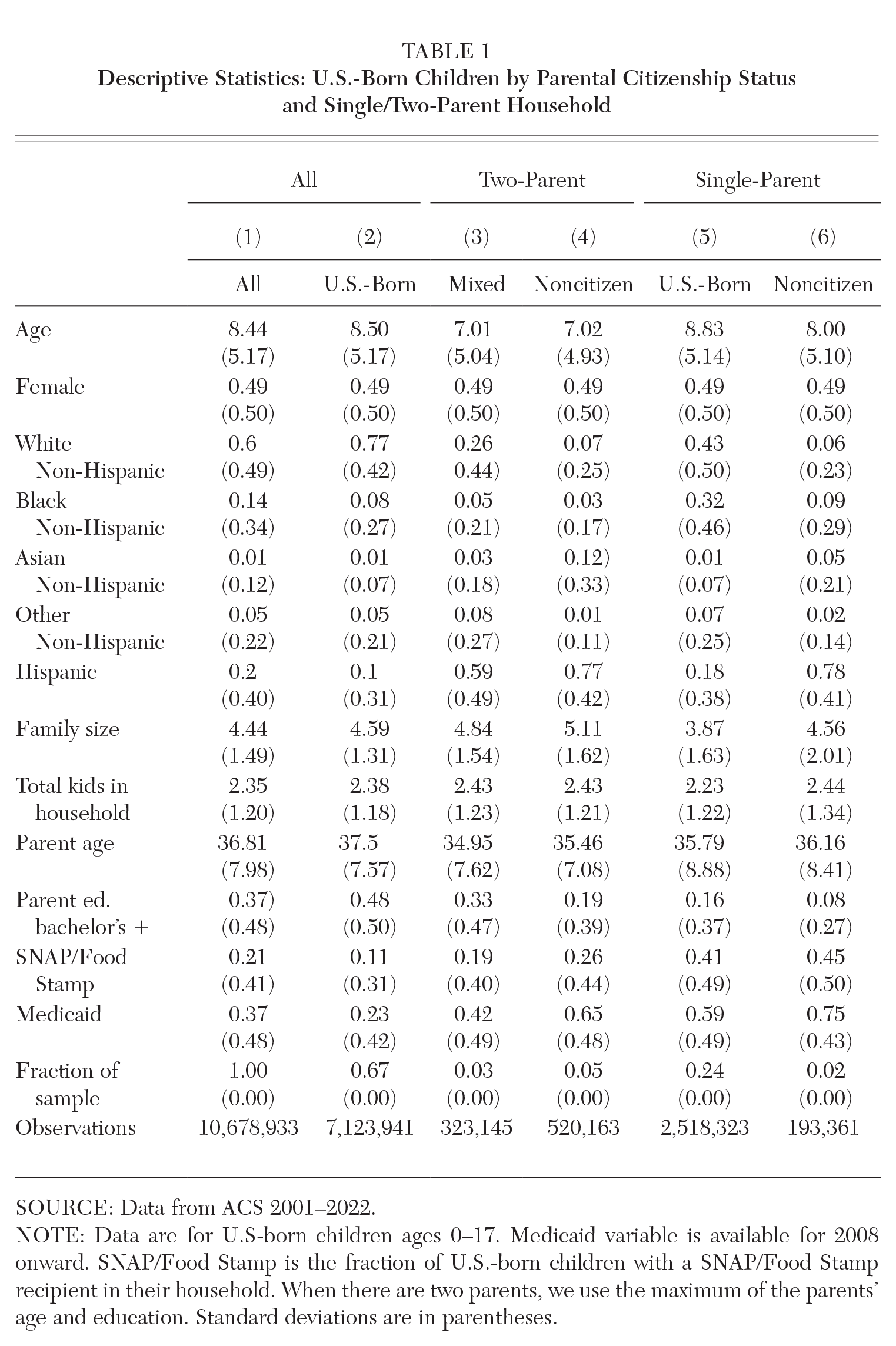
Table 1 shows summary statistics for the sample overall and for our five different family types. We show the average age, fraction female, fraction in race/ethnicity categories, family size, and total number of children in the household for U.S.-born children ages 0–17. We also show parental age and fraction with at least a bachelor’s degree. When there are two parents, we use the maximum education of those parents and the age of the parent with the maximum level of education. Table 1 also shows the fraction of the children in a household where someone receives SNAP/Food Stamps, and the fraction of the children receiving Medicaid. 24
Descriptive Statistics: U.S.-Born Children by Parental Citizenship Status and Single/Two-Parent Household
SOURCE: Data from ACS 2001–2022.
NOTE: Data are for U.S-born children ages 0–17. Medicaid variable is available for 2008 onward. SNAP/Food Stamp is the fraction of U.S.-born children with a SNAP/Food Stamp recipient in their household. When there are two parents, we use the maximum of the parents’ age and education. Standard deviations are in parentheses.
Over three-quarters of children with any noncitizen parents are Hispanic, compared to 10 percent with two U.S.-born parents and 18 percent with a single U.S.-born parent. The percentage Asian is also much higher among children with noncitizen parents than in the U.S. overall. Family size is larger, and there are more children in the household among children with noncitizen parents. Noncitizen parents also have lower levels of education: 19 percent of children with two noncitizen parents have a parent with a bachelor’s degree or above; among those with two U.S.-born parents, it is 48 percent. Among children with single parents, 8 percent of those with a noncitizen parent have a parent with a college degree or above; while for those with a U.S.-born parent, it is 16 percent.
Not surprisingly, children with the most highly educated parents are the least likely to be on Medicaid or to be in a SNAP household. SNAP and Medicaid receipt are higher among single-parent families in general, but highest among those whose single parent is a noncitizen. Among children in two-parent families, receipt of these programs is higher among those with noncitizen parents than among those with U.S.-born parents. Because program eligibility depends on income and assets (among other things), and income and assets are correlated with education, age, race/ethnicity, and household composition, when we turn to regression analysis, we examine how adding these characteristics affects the relative probability of SNAP and Medicaid receipt by the citizenship status of parents. This allows us to see how program receipt differs when we make comparisons between children with differing parental citizenship status but with the same observable personal, parental, and household characteristics.
Before turning to the regression analyses, Figures 3 and 4 show the percentage of U.S.-born children who live in a household where someone receives SNAP/Food Stamps from 2001 to 2022, and the percentage of U.S.-born children who receive Medicaid from 2008 to 2022, by parental citizenship status. 25 Figure 3 shows a dramatic increase in SNAP receipt for all groups around the onset of the Great Recession, peaking between 2012 to 2014, and then beginning to fall. There is also a sharp increase from 2019 to 2020 with the onset of the pandemic recession. Children with a single noncitizen parent are most likely to be in a SNAP household throughout the period, followed closely by those with a single U.S.-born parent. Among two-parent families, those with all noncitizen parents are more likely to be in a SNAP household than those with mixed-citizen parents, who are, in turn, more likely to receive SNAP benefits than those with all U.S.-born parents. The gap between those with noncitizen parents and those with all U.S.-born parents begins to shrink in 2016 and is smallest in 2019 after the announcement of the new public charge rule.

Percentage of U.S.-Born Children Who Live with at Least One SNAP/Food Stamp Recipient by Parental Status and Year

Percentage of U.S.-Born Children Who Are Covered by Medicaid by Parental Status and Year
For Medicaid, Figure 4 shows increasing receipt for children in all family types through about 2014, consistent with Medicaid expansions after the Affordable Care Act. U.S.-born children with a single noncitizen parent and those with two noncitizen parents are most likely to receive Medicaid. It is lowest for those with two U.S.-born parents and second lowest for those with a U.S.-born and noncitizen parent. Among those with two U.S.-born parents or those with a single U.S.-born parent, there is not much change over time, after that initial increase (Medicaid receipt is less likely to move with economic booms and busts than SNAP receipt). The time pattern is different for those with noncitizen parents, falling after 2018.
In what follows, we first use regression analysis to examine how the level of receipt of SNAP and Medicaid compare by parental citizenship status, controlling for characteristics that are expected to be correlated with income and assets and, thus, eligibility for these programs. We cannot, of course, directly observe eligibility because the level of detail about income and assets used to determine actual eligibility is not available in the ACS. After examining how participation differs between observably similar children based on parental citizenship status, we then turn to examining how the differences between groups change with each year to see whether the patterns are consistent with a response to changes in, or rhetoric around, the public charge rule.
Results
SNAP
Differences in levels of receipt by parental citizenship status
In Table 2, we investigate how much of the overall difference in SNAP receipt by parental citizenship status, displayed in Figure 3, can be explained by differences in characteristics of these children, parents, and families that are correlated with income and assets. The top panel (A) includes two-parent families and compares those with two noncitizen parents to those with two U.S.-born parents. The second panel (B) includes two-parent families and compares those with one noncitizen and one U.S.-born parent to those with two U.S.-born parents. The last panel (C) includes single-parent families and compares those with a noncitizen parent to those with a citizen parent.
Estimated Effects of Parental Citizenship Status on Probability of U.S.-Born Children’s Household Receiving SNAP/Food Stamps

SOURCE: Data from ACS 2001–2022.
NOTE: Dependent variable (dep. var.) is binary variable indicating whether an individual is covered by Medicaid. Sample consists of U.S.-born children under age 18. Child demographics include indicators for race/ethnicity, age, and sex. Household (HH) demographics include indicators for family and number of children in HH. Parent demographics include indicators for age, family size, sex, and education of the parent. When there are two parents, we use the maximum value of age and education. Sex is the sex of the parent with the highest education. If parents are opposite sex and are of the same educational attainment, then sex is female. Robust standard errors.
The columns add successive controls to the analysis. 26 The first column shows the unadjusted difference. The second includes indicator variables for the child’s race/ethnicity, age, and gender, as well as linear controls for family size and number of children. The third column adds indicator variables for the parent’s age, education, and gender. 27 The last column adds state and year fixed effects.
As we add more controls, we are changing the comparisons. For example, in panel A, column 1 indicates that children with two noncitizen parents are 14.8 percentage points more likely to be in a SNAP-receiving household than those with two U.S.-born parents. In column 2, we see that when we make the comparison between children who have the same age, race/ethnicity, and gender and live in households of the same size with the same number of children, that difference is cut in half to 7.4 percentage points. As we add controls for parental characteristics and controls for state of residence and the time period, the gap shrinks to 2.5 percentage points.
The patterns are quite similar across the columns within each of the panels: Those with noncitizen parents are more likely to be in a SNAP household when compared to those with native-born parents. When we add controls for child, household, and especially for parent demographics, these differences shrink. For those with mixed parents, the raw gap is 8.5 percentage points, and it shrinks to 0.4 percentage points after adding all the controls. For single-parent households, the raw gap for children with a noncitizen parent is 3.4 percentage points, and this shrinks to negative 6.1 percentage points after adding all the controls.
The last column adds state and year fixed effects. Noncitizens and citizens tend to live in different states, and there are persistent differences in safety net participation across states. Similarly, there are differences in safety net use over time, and the fraction of children with noncitizen parents changes over time. If differences in state of residence or year between children with noncitizen and U.S.-born parents were driving differences in SNAP participation, we would expect the fourth column estimates to be different from the third; however, including state and year fixed effects yields the same qualitative results. In what follows, we use the full set of controls in the last column to examine the time pattern in receipt of SNAP. Controlling for characteristics ensures that differences in SNAP participation by parental citizenship status over time are not driven by changes in parental education or state of residence—for example, between children with noncitizen and native-born parents.
Differences in time patterns of SNAP receipt by parental citizenship status
We estimate linear probability models controlling for child, household, parental characteristics, and state and year fixed effects, as in Table 2 column 4. The year 2008 is the omitted category. We add interaction terms between each year and parental citizenship status and plot these coefficients and 95 percent confidence intervals in Figures 5a–5c.
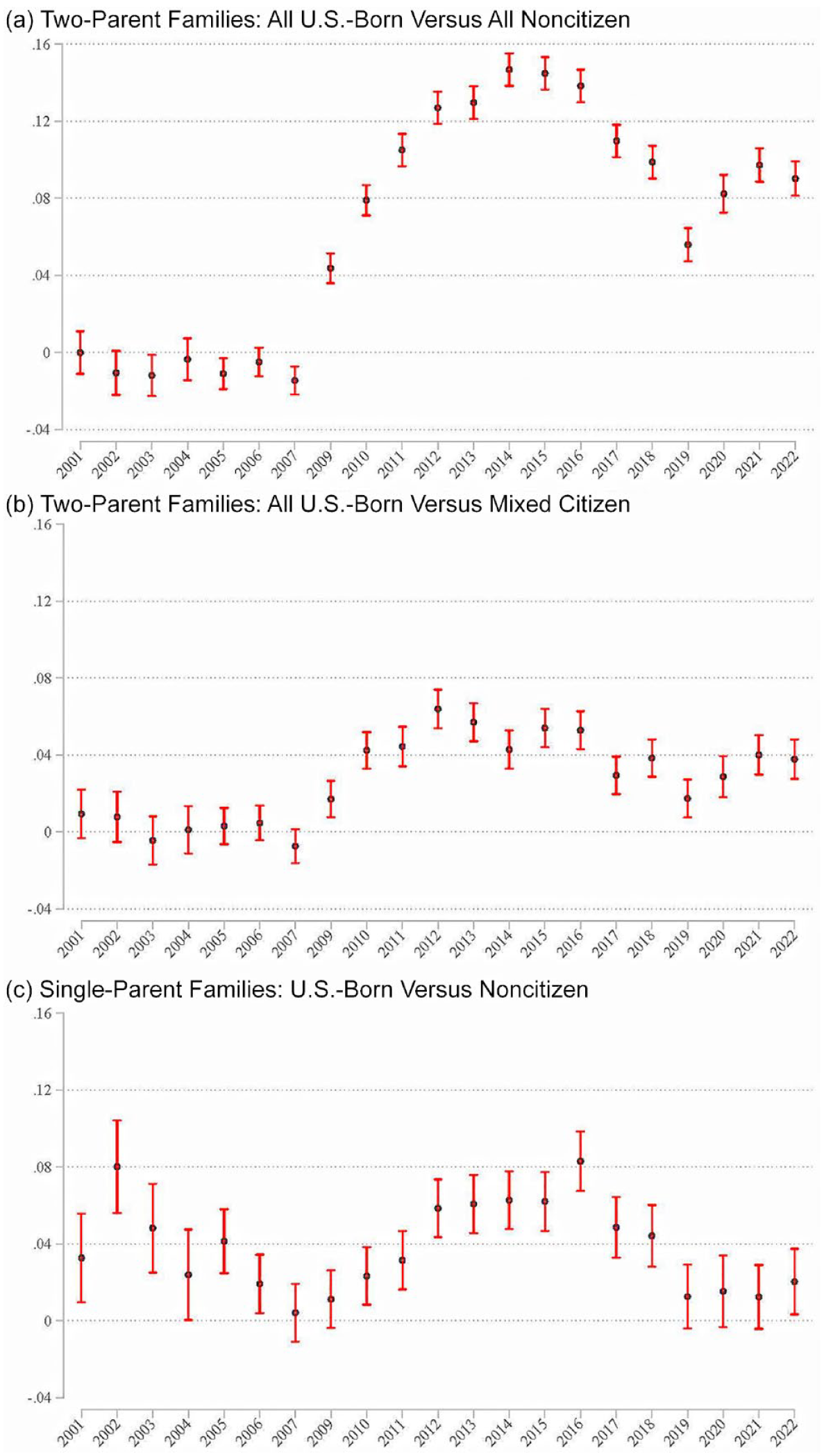
Difference in SNAP/Food Stamp Receipt for U.S.-Born Children by Parental Status by Year
Figure 5a shows that for two-parent families, the comparison in receipt of SNAP benefits between those children with two noncitizen parents and those with two U.S.-born parents was fairly stable from 2001 to 2008. There is an increase in the difference from 2009 to 2014; then the difference begins to decline until 2019. With the onset of the pandemic recession, the difference climbs again. Table A1 in the online appendix shows the differences in these year-to-year changes and provides the statistical test for whether the changes are statistically meaningfully different from each other. 28 In particular, the 2.8 percentage point relative drop from 2016 to 2017, when rhetoric around changes to the public charge rule began, is statistically significant. Similarly, the 4.3 percentage point drop from 2018 to 2019 when the new rule was proposed is statistically significant.
Figure 5b (and columns 3 and 4 of Table A1 in the online appendix) show similar patterns for U.S.-born children with one U.S.-born and one noncitizen parent compared to those with two U.S.-born parents. There is a statistically significant relative drop from 2016 to 2017 of 2.3 percentage points, and a drop of 2.1 percentage points from 2018 to 2019.
Figure 5c (and columns 5 and 6 of Table A1 in the online appendix) shows the results for single-parent families. For those with a noncitizen parent compared to a U.S.-born parent, SNAP receipt drops by a statistically significant 3.3 percentage points from 2016 to 2017 and 3.4 percentage points from 2018 to 2019.
These patterns are consistent with concerns among noncitizen parents about the implementation of the public charge rule. In the next section, we consider similar evidence regarding Medicaid receipt.
Medicaid
Differences in levels of Medicaid receipt by parental citizenship status
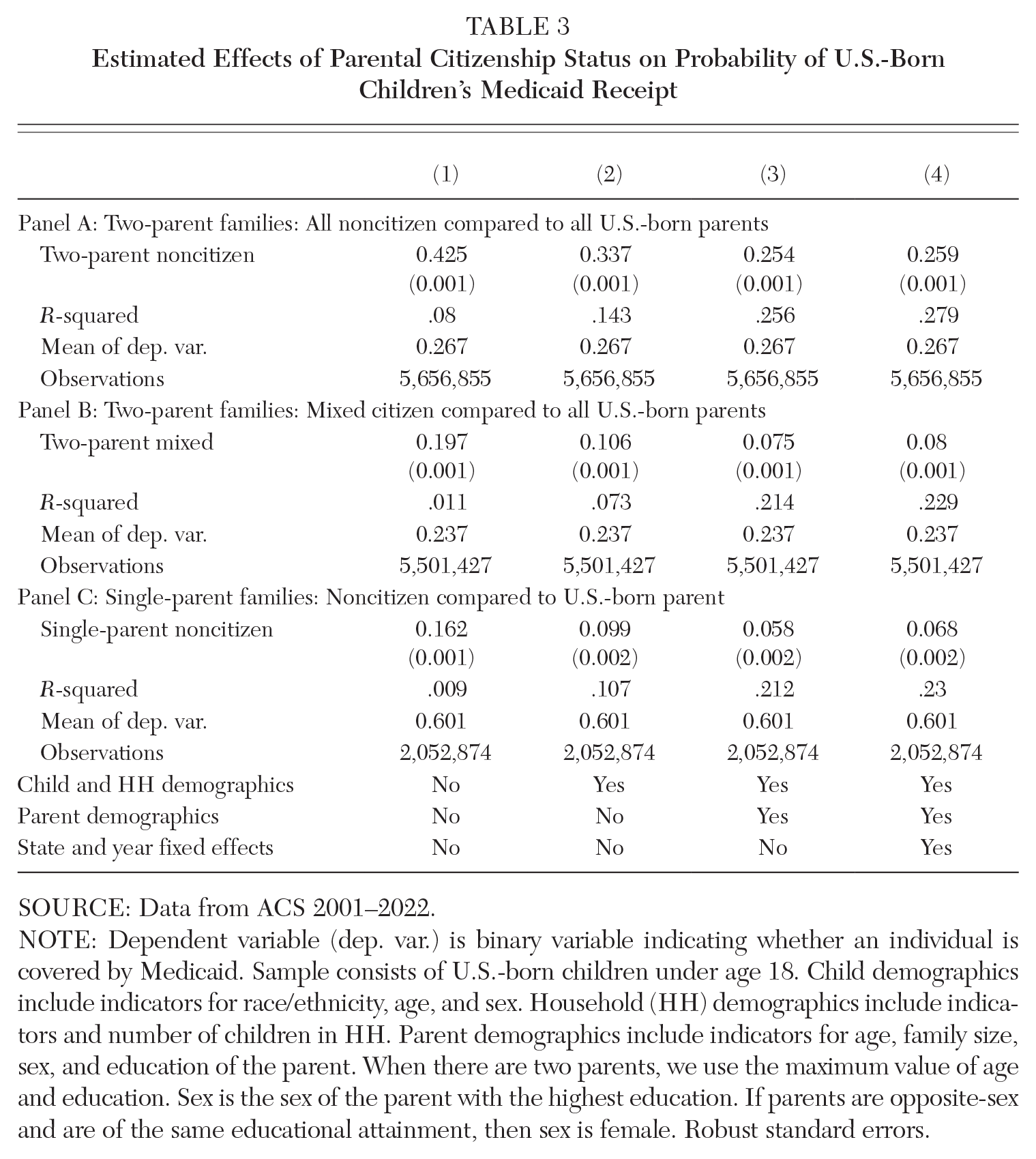
Recall Figure 4 shows that children with noncitizens are more likely to participate in Medicaid than children of the U.S. born. Table 3 is set up very similarly to Table 2 for SNAP. 29 We first show the raw gap in Medicaid receipt and then add successive controls to see how that gap changes. Medicaid information is only available in the ACS from 2008 onward, so the years included are 2008 to 2022.
Estimated Effects of Parental Citizenship Status on Probability of U.S.-Born Children’s Medicaid Receipt
SOURCE: Data from ACS 2001–2022.
NOTE: Dependent variable (dep. var.) is binary variable indicating whether an individual is covered by Medicaid. Sample consists of U.S.-born children under age 18. Child demographics include indicators for race/ethnicity, age, and sex. Household (HH) demographics include indicators and number of children in HH. Parent demographics include indicators for age, family size, sex, and education of the parent. When there are two parents, we use the maximum value of age and education. Sex is the sex of the parent with the highest education. If parents are opposite-sex and are of the same educational attainment, then sex is female. Robust standard errors.
Panel A shows that among two-parent families, children with noncitizen parents are 42.5 percentage points more likely to receive Medicaid than are those with two U.S.-born parents in the raw data. This gap drops to 25.4 percentage points when child, household, parental controls are added and is qualitatively similar at 25.8 percentage points when state and year fixed effects are included. Panel B shows a similar pattern for two-parent families comparing those with mixed-citizen-status parents: The raw gap is 19.7 percentage points and shrinks to 8.0 percentage points when all the controls are included. Finally, among single parent families, children with a noncitizen parent are 16.2 percentage points more likely to be on Medicaid than are those with a U.S.-born parent on average, but only 6.8 percentage points more likely when compared to those with similar characteristics.
Differences in time patterns of Medicaid receipt by parental citizenship status
Figures 6a–6c show the coefficient and 95 percent confidence interval for the interaction between the citizenship status of the parent and year variables for the different groups. Again, 2008 is the omitted year. Table A2 in the online appendix shows the relative difference between two consecutive years and whether the difference is statistically meaningful.
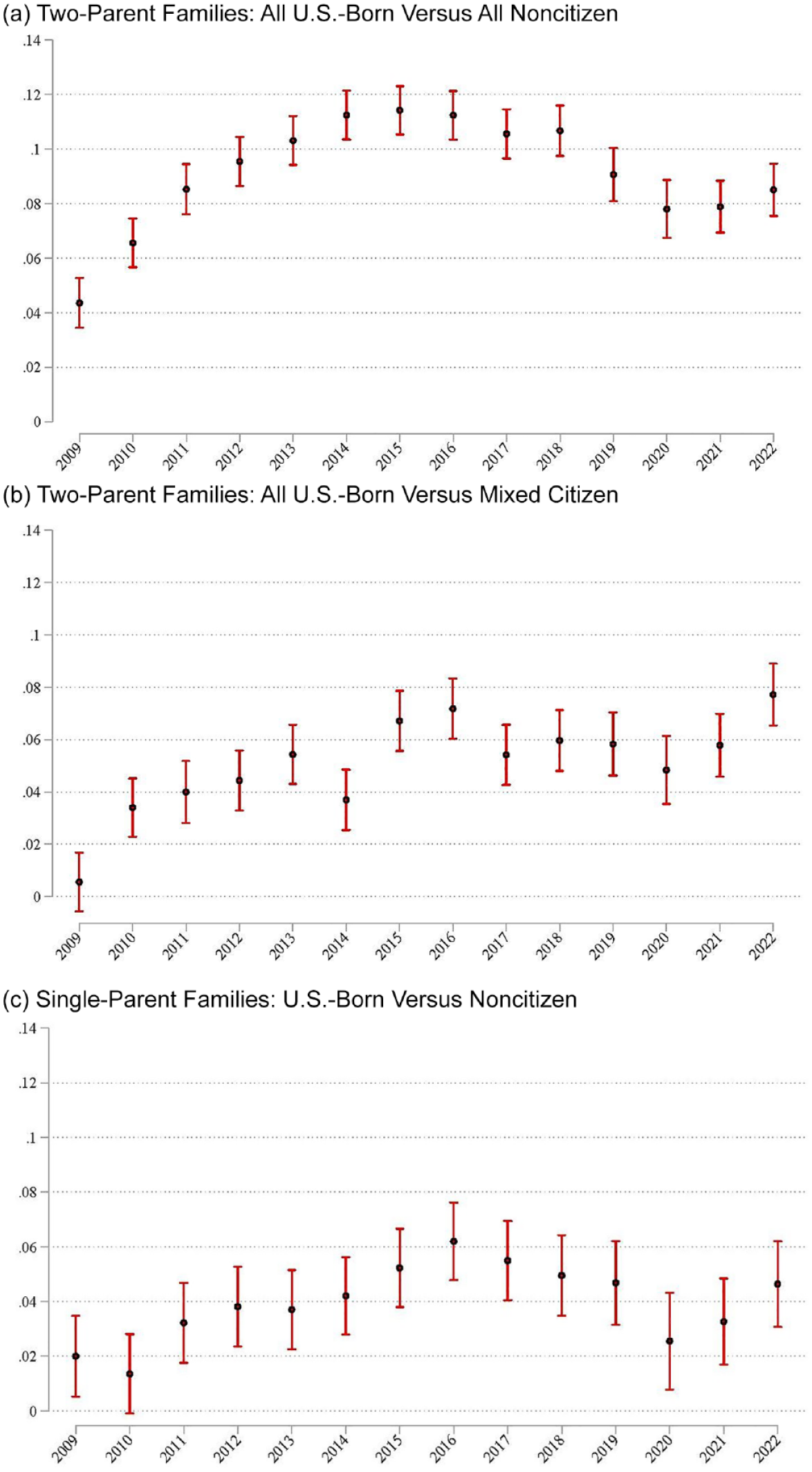
Difference in Medicaid Receipt for U.S.-Born Children by Parental Status by Year
Figure 6a shows the year pattern in the difference between those with two noncitizen parents compared to those with two U.S.-born parents. Relative receipt increases through 2015 and then begins to decline. We estimate statistically significant drops of 1.6 percentage points and 1.3 percentage points from 2018 to 2019 and from 2019 to 2020. These years correspond to the announcement and adoption of the “final rule” public charge interpretation that included Medicaid receipt as part of the criteria.
Two-parent mixed citizenship and single-parent noncitizen families show patterns that are fairly consistent with these findings. For mixed-citizen parents, in the years when public charge was under discussion, there is only a statistically significant drop from 2016 to 2017. For single-parent families, the only statistically significant drop is from 2019 to 2020. Sample sizes are smaller for these family configurations, so we may lack the power to detect small changes.
Medicare
As a final query, we investigate the differences in the time pattern of the receipt of Medicare among elderly U.S. citizens based on the citizenship status of others in their household. Medicare—a social insurance program that requires one to have paid into the Medicare system for 40 quarters (10 years) and be 65 years or older—is not one of the programs specifically listed in the public charge guidelines as contributing to the “totality of circumstances” that might lead to a public charge finding. Noncitizens are eligible as long as they are “qualified” immigrants and their work history is sufficient. If one were confident that people understood the nuances around the public charge rule, one might use Medicare receipt to see whether the patterns observed in the earlier programs were due to general changes in attitudes toward government programs, or a specific reaction to the new interpretation of the public charge rule. Of course, if people connected to noncitizens are fearful of any interaction with the government, one might see a chilling effect in Medicare as well. Thus, we offer the Medicare results as an interesting comparison, because a reduction in Medicare use would add more weight to the idea that what we saw in the other programs might not be due to the new interpretation of the public charge rule but to other, general changes that affect program participation.
Recall that Figure 1 includes a line for the percentage of 60- to 70-year-old U.S. citizens who live with any noncitizens. It is lower than for the overall population but has risen over the period. By 2022, close to 5 percent of older U.S. citizens lived with at least one noncitizen. Figure 7 shows that between 51 percent and 55 percent of U.S. citizens aged 60 to 70 received Medicare between 2008 (when the information begins being collected in the ACS) and 2022, with the share generally increasing over the time period.

Percentage of U.S. Citizens Ages 60–70 on Medicare by Year
Because Medicare eligibility changes sharply at age 65, we can use a “regression discontinuity” design to examine receipt of Medicare as people become eligible. In particular, we control for an individual’s age and examine what happens on either side of age 65, when they become eligible for Medicare (Card, Dobkin, and Maestas 2009).
This “regression discontinuity” approach relies on the idea that health and other conditions that might affect whether one takes up a program like Medicare are unlikely to change starkly right at age 65, but eligibility does. We examine whether the jump in Medicare receipt at age 65 is different for U.S. citizens depending on whether they have any noncitizens in their household.
Figure 8 plots the estimated effects of aging on Medicare receipt for citizens who live only with other U.S. citizens and those who live with noncitizens. Age – 65 is plotted across the horizontal axis so that the figure is centered on zero. 30 The light dots show how Medicare receipt changes with age for U.S. citizens who live only with other citizens; the dark dots show how it changes for those who live with noncitizens. 31 There is a large discontinuous jump in Medicare receipt for both groups at age 65, but the jump is smaller for those who live with noncitizens. Table 4, column 1, shows the estimated coefficients of interest that correspond to Figure 8. 31 There is a 71 percentage point increase in Medicare receipt at age 65 for those who live only with citizens. That jump is 6.8 percentage points lower for those who live with noncitizens, and the difference is statistically meaningful. When we break the sample into native-born citizens and foreign-born (naturalized) citizens, the patterns are similar, although foreign-born citizens have a smaller jump at age 65. Although the estimated effect of living with noncitizens is larger for the native-born at −5.5 percentage points compared to −3.5 percentage points for foreign-born citizens, these differences are not statistically meaningful.

Regression Discontinuity Estimates: Estimated Effect of Turning 65 on Medicare Receipt by Any Noncitizen in Household Status
Regression Discontinuity Estimates: Effect of Turning 65 on Medicare Receipt (Robust Standard Errors)

SOURCE: Data from ACS 2008–2022.
NOTE: Dependent variable (dep. var.) is an indicator for person covered by Medicare. Sample consists of U.S. citizens between the ages of 60–70. In addition, we include all combinations of interactions between any noncitizen, the running variable, and the discontinuity. The results for said interactions can be found in Table A3 in the online appendix.
p < .10, **p < .05, ***p < .01.
Similar to the earlier results, we let the coefficient of interest—the differential jump at age 65 for those who live with noncitizens—differ for each year, with 2008 again the omitted year. Figure 9 presents the estimated coefficient on the interaction term and its 95 percent confidence interval. Table A4 in the online appendix shows the difference between each pair of years and the statistical test for whether the differences are statistically meaningful. None of the effects by year are different from each other at conventional levels of statistical significance.
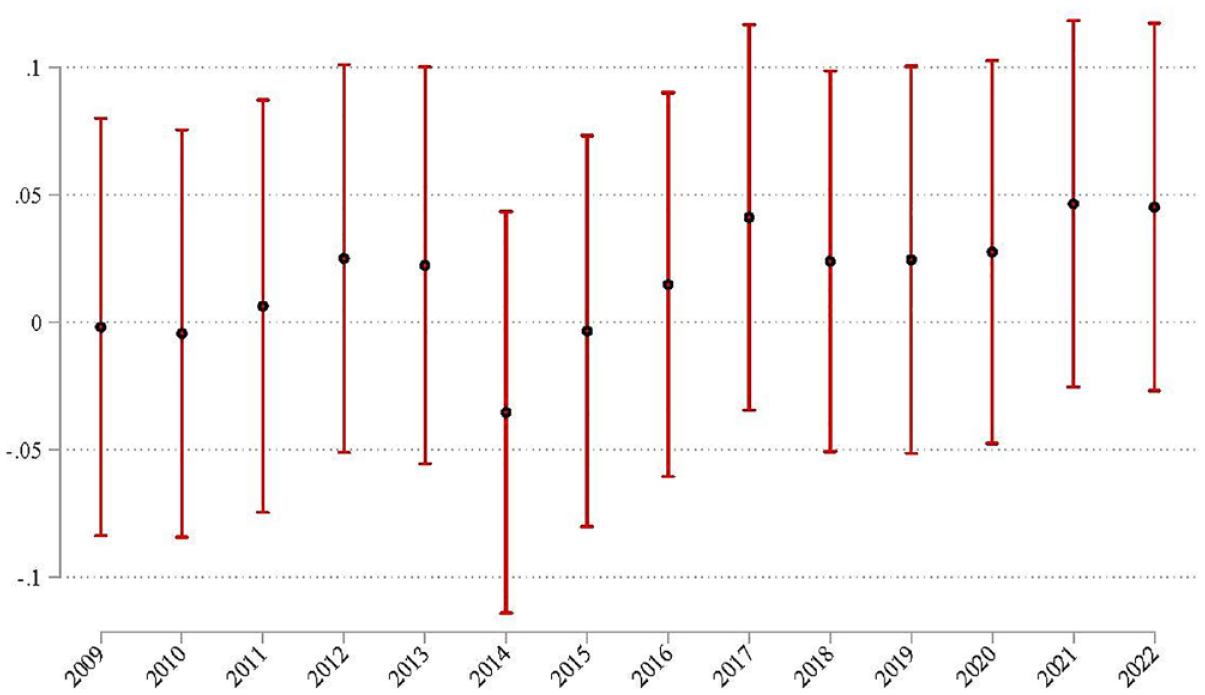
Difference in Effect of Turning 65 on Medicare Receipt for U.S. Citizens Ages 60–70 in Households with Noncitizens by Year
The time patterns do not suggest that changes to the interpretation of the public charge rule differentially affected the jump in Medicare receipt at age 65 for those who live with noncitizens compared to citizens. Recall that Medicare was not one of the programs to be considered in weighing the totality of evidence regarding whether someone is, or is likely to become, a public charge. This result is consistent with the idea that the time patterns in receipt of SNAP and Medicaid for children are driven by concerns over the public charge rule and not general concerns about interacting with government programs.
Stepping back from the time patterns and changes in the public charge rule, comparing results in column 2 versus column 3 in Table 4 indicates that the jump in Medicare receipt at age 65 is smaller for foreign-born citizens than it is for native-born citizens. Although the ACS does not include the detailed information that would be necessary to know if this is because the foreign-born are less likely to be eligible, because of work history, for example, or because they are less likely to take up even when eligible, future work to shed light on this is important as research indicates that Medicare access has important implications for health outcomes (Card, Dobkin, and Maestas 2009; Coile, Levine, and McKnight 2014).
Discussion
Immigrants are a growing share of the U.S. population, and an increasing share of U.S.-born children have noncitizen parents. These children, who are themselves citizens, tend to live in households with fewer resources, and their access to public assistance programs may be particularly important in ensuring access to adequate nutrition and medical care. At the same time, immigrant participation in welfare programs often comes in for special scrutiny by the public and policymakers. Restricting immigration of those likely to become a “public charge” was among the country’s earliest immigration restrictions.
The 1996 Welfare Reform Act restricted immigration eligibility (although some restrictions were later revoked), and immigration enforcement has changed over time, with some periods showing a vastly higher likelihood of detention and removal of the undocumented. Since interacting with the government through program participation may be viewed as riskier in times when there is more restrictive immigration enforcement, program participation in the immigrant community may be sensitive to enforcement action.
A large literature finds that safety net program participation for immigrants is affected both by changing eligibility for programs and by the enforcement regime. Even the participation among U.S.-born children—who are citizens and thus are eligible for safety net programs if they meet income and asset criteria—are sensitive to these changes. This suggests there is a chilling effect, with some who are eligible for these programs not taking them up.
Here we present evidence that changes in the interpretation of the “public charge” rule proposed in 2018 and implemented later had a chilling effect on participation in SNAP and Medicaid among U.S.-born children with noncitizen parents. The rule proposed in 2018 expanded the list of things that could deem an immigrant likely to become a public charge—and thus render them ineligible to apply for a green card or to naturalize—to include participation in SNAP/Food Stamps and Medicaid. We find that participation drops for U.S.-born children who have noncitizen parents relative to those with U.S.-born parents when the new public charge interpretation is proposed and adopted. Interestingly, we do not find such evidence for elderly U.S. citizens in their take-up of Medicare based on whether they live with noncitizens, and Medicare is not one of the programs named in the 2018 proposed (and later implemented) change in the public charge rule.
Participation in public programs is often controversial since it is viewed as a burden on the taxpaying public, but the evidence argues against this narrow view of nutrition assistance and health programs. Rather, research suggests that investments in young children lead them to have healthier, wealthier lives; in the long run, many programs pay for themselves because, as adults, early-life recipients of assistance need fewer supports, earn more, and contribute more in taxes. In our research, we focused on U.S.-born children—citizens who are likely to live their whole lives in the U.S.—and found that their participation in these programs shows a pattern consistent with a chilling effect from the 2018 proposed public charge rule. Research on the effects of programs like SNAP and Medicaid suggests that these U.S. citizens may suffer both short and long-term consequences from these chilling effects.
Supplemental Material
sj-jpg-1-ann-10.1177_00027162241293910 – Supplemental material for The Public Charge Rule and Program Participation Among U.S. Citizens
Supplemental material, sj-jpg-1-ann-10.1177_00027162241293910 for The Public Charge Rule and Program Participation Among U.S. Citizens by Leslie McGranahan, Diane W. Schanzenbach, Kristin F. Butcher, Luojia Hu and Ryan Perry in The ANNALS of the American Academy of Political and Social Science
Supplemental Material
sj-xlsx-1-ann-10.1177_00027162241293910 – Supplemental material for The Public Charge Rule and Program Participation Among U.S. Citizens
Supplemental material, sj-xlsx-1-ann-10.1177_00027162241293910 for The Public Charge Rule and Program Participation Among U.S. Citizens by Leslie McGranahan, Diane W. Schanzenbach, Kristin F. Butcher, Luojia Hu and Ryan Perry in The ANNALS of the American Academy of Political and Social Science
Footnotes
NOTE: This work was written for the Authors’ Conference in Memory and Honor of Rebecca M. Blank held at the Federal Reserve Bank of Chicago, February 22, 2024. The authors thank the organizers, Leslie McGranahan and Diane Schanzenbach, as well as participants at the conference for helpful feedback. Kristin Butcher and Luojia Hu gratefully acknowledge the mentorship and guidance they received from Rebecca Blank and David Card that resulted in  in Card and Blank (2000). Disclaimer: The views expressed here do not necessarily represent the views of the Federal Reserve Bank of Chicago or the Federal Reserve System.
Supplemental Material
Supplemental material for this article is available online.
Notes
Kristin F. Butcher is vice president and director of microeconomic research at the Federal Reserve Bank of Chicago. She is an applied microeconomist researching issues in labor, health, and education. She is the inaugural holder of the Marshall I. Goldman Chair in Economics at Wellesley College.
Luojia Hu is a senior economist and economic advisor at the Federal Reserve Bank of Chicago. She conducts research in econometrics, labor economics, and consumer finance. She previously held positions as an assistant professor of economics at Northwestern University and a visiting research fellow at Princeton University.
Ryan Perry is a senior research assistant at the Federal Reserve Bank of Chicago on the microeconomics team. She has research interests in labor, immigration, and finance.
References
Supplementary Material
Please find the following supplemental material available below.
For Open Access articles published under a Creative Commons License, all supplemental material carries the same license as the article it is associated with.
For non-Open Access articles published, all supplemental material carries a non-exclusive license, and permission requests for re-use of supplemental material or any part of supplemental material shall be sent directly to the copyright owner as specified in the copyright notice associated with the article.

