



Abstract
Border corruption can help facilitate the smuggling of people and irregular migration, but it receives limited attention in academic research. In this article, I explore how smugglers use corruption and bribery to circumvent border restrictions. I focus on the role of bribery in the survival economy of border communities, including migrants, smugglers, and border authorities, and on its role in facilitating cross-border movement. This study draws on extensive ethnographic research conducted on land routes between West Asia and Europe, interviewing smugglers specifically on the Syrian–Turkish border and the Evros border between Turkey, Greece, and Bulgaria. My findings indicate that on both borders, smugglers and border guards accommodate each other’s interests in creative collaborative processes. As such, corruption and bribery are not merely illegal practices but rather strategic adaptations in response to harsher border enforcement policies, stemming from specific needs of local border realities.
I heard about the hostel’s reputation even before arriving at the border. Some participants I had interviewed on the way recommended that I speak to the owner. He greeted me at the gate and agreed to be interviewed on one condition: “Next time you come here, you stay at my hostel.” 1
Amez owns a small hostel in a Turkish town a few kilometers from the Evros river border with Greece and Bulgaria. 2 His hostel is known among people on the move—refugees, asylum seekers, and migrants—as a place to rest before attempting to cross the border to Europe on foot or by truck. But it wasn’t the role played by the hostel in illegalized cross-border movement that interested me. There was more to its owner’s reputation.
Amez called himself a Kurdish Turk and, before owning the hostel, used to work for the Turkish border police as a customs enforcement officer. He had initially been stationed at the border for 16 months during his compulsory military service. “Because the [Turkish] state always sends Kurds [to do military service] in the worse places,” 3 he added. By the time his service period was over, Amez had married and decided to stay, finding work as a customs officer at Turkish–Bulgarian border checkpoints.
During the course of the interview, I tried to verify the rumors I had heard about him: that he was sent away from the border force because he was accused of taking bribes from smugglers bringing in goods and migrants hidden in trucks; that his wife’s cousins were border officers in Bulgaria; and that during the rise in border crossings in 2015, Amez and his extended family had established one of the most functional collaborations with people smugglers operating on the Evros border. Amez confirmed all of the above, adding that “at some point [the Turkish Jandarma] found out and told me I couldn’t stay any more. That’s when I bought the hostel. But I know they just took over what we had set up and gave the task [of coordinating with smugglers] to someone else.” 4
At the time of the interview (March 2022), Amez’s hostel was not only a place hosting people on the move to Europe. It was also where border guards and smugglers met to agree on collaboration deals. “I have family members working as border officers on the Bulgarian side of the border,” Amez explained. “We work with smugglers constantly, and I am the bridge between them [officers and smugglers].” It’s the mutual interest of making some money that brings smugglers and border officers to the same table, Amez explained. The combination of Turkey’s rising inflation and Bulgaria’s low wages means that police officers in both countries are struggling too (Duvar English 2022), and so, the profit to be made from working with smugglers is more than a simple opportunity. “Some say smugglers and police are like water and oil,” Amez said. “That’s not true. Smugglers and police work well together when they have the same interest and someone to make good connections [between them].” 5
In this article, I present research that creates a more nuanced picture of people smuggling and border enforcement on the land routes between West Asia and Europe. I focus on corruption and bribery as strategies performed by migrants, smugglers, or border guards, all of whom are actively engaged in negotiating their own interests, opportunities, and risks at the border (Campana and Gelsthorpe 2021). Thus, I provide evidence of how actors on the border receive, react, and respond to the implementation of border securitization policies on the ground. I focus especially on the negotiation between smugglers and border guards, arguing that corruption and bribery can be understood as practices of accommodation and collaboration between supposedly antagonistic actors. With the heightening of border enforcement across Europe, bribery and corruption provide a way for smugglers, migrants, and police forces to renegotiate border crossings according to their localized means and needs (Izcara-Palacios 2019).
The relation between the bribery of border guards and people smuggling has not been widely studied, despite often being referred to as playing an important role in the facilitation of irregular migration (Ajis et al. 2021). The few studies directly focusing on corruption at the border have framed bribery as a socially embedded practice that strives to satisfy the needs of smugglers, migrants, border officers, and local border communities as they attempt to survive harsh socioeconomic living conditions at the border (Izcara-Palacios 2019). This literature provides an important and nuanced understanding of border enforcement and people smuggling; evidence from these studies shows that, in dire and marginalized socioeconomic contexts, migrants and smugglers are joined by local communities and border authorities in relying on irregular practices (Ayalew Mengiste 2018). Indeed, corruption and bribery are part of the survival economy of stable and transient border communities: not just illegalized or illegitimate practices, they form part of the way in which multiple actors relate to each other and manage to survive (Ayalew Mengiste 2018).
During the past two decades, the securitization of migration, theorized as the “security-migration nexus” (Faist 2005), has become the main hegemonic discourse at the government level (Geiger and Pécoud 2010). The logic is that the best way to deter irregular migration is to immobilize people on the move in camps and detention centers on transit routes and to increase deterrence through border enforcement and policing that raise the risk of detection, arrest, and deportation of those crossing borders irregularly (Dastyari, Nethery, and Hirsch 2022). Governments and border agencies in Europe especially have championed the idea that investing in border security and policing not only reduces irregular migration by affecting the decision-making process of undocumented migrants, but also impacts the ability of facilitators and people smugglers to provide those very irregular border-crossing services (European Commission 2021).
Critical scholarship looking at the securitization of borders and criminalization of migration is debunking the mythology that such policies have the all-encompassing prosocial effect of curbing irregular migration flows and people smuggling (Andersson 2014; Arbogast 2016; De Genova 2013; Gerard and Pickering 2014). This scholarship uses historical and structural explanations that emphasize the role of economic and political factors in shaping migration flows and crime, and an emerging consensus is that the criminalization of movement can generate much of what it is supposed to fight: vulnerability and exploitation of migrants (Andersson 2014; De Genova 2014; Lucht 2011) and further entrenchment of criminal services like people trafficking, smuggling, corruption, and bribery (Martinez and Slack 2013).
The criminogenic view argues that the criminalization of migration fuels demand for criminal services, but some notable counterexamples challenge that idea. For example, Australia’s anti-immigration policies, which increased border securitization, led to a reduction of irregular migration and smuggling (Missbach 2022). To date, the literature espousing a criminogenic approach has not addressed such instances or devoted much space to investigating how key actors—migrants, smugglers, and border guards—engage with the actual implementation of criminalization policies on a day-to-day basis (Izcara-Palacios 2019). Recent ethnographic studies on smuggling around the world have added nuance by looking at agency, relations/networks, and interdependencies among migrants, smugglers, and border guards (Álvarez Velasco 2022). These insights challenge the “binary predator-victim” perspective that dominates the official discourse on irregular migration and people smuggling (Zhang, Sanchez, and Achilli 2018). At the same time, these studies highlight the limitations of critical theories on people smuggling by framing cross-border crime formation as a phenomenon linked to local contexts and the sociopolitical dynamics of specific borderlands; rather than simply relying on macro understandings, they refer to the actual experience of those living in or engaging with borders (Frank-Vitale 2023).
In the following sections, I present ethnographic accounts related to corruption on migration routes entering and leaving Turkey and consider interconnected segments of a broader migration route as the focus of my study, rather than single hotspot locations (Baird 2017). The specific borderlands in focus are the westernmost part of the Syrian–Turkish border, running between Hatay and Sanliurfa (entering Turkey) and the Evros borderland between Turkey, Greece, and Bulgaria (entering Europe). In choosing to look at corruption on these particular routes, I aim to provide further insights into the impact of border enforcement on smuggling in one of the most crucial segments of the migrant crossroads between Asia and Europe.
Relevant Theory
In investigating the impact of border enforcement policies on people smuggling, I realized that border communities—by which I mean all those who live permanently or temporarily in border regions—are constantly renegotiating their relations to the border and the state (Sanchez 2022). Keshavarz and Khosravi (2022) define smuggling as a “situated activity that is enmeshed within the historical and geopolitical conditions of borderlands” (Keshavarz and Khosravi 2022, 2). During my fieldwork, I noted that migrants, smugglers, border police, and local communities often rely on smuggling and corruption as strategies to promote survival practices in response to economic marginalization and political violence from central governments (Dzawanda and Matsa 2023) as well as to gain protection against repressive border security policies (Augustova and Suber 2023).
Critical empirical studies have attempted to create a nuanced perspective on people smuggling by framing it as a constitutive part of the survival economies of borderlands. On borders as different as the U.S.–Mexico border (Frank-Vitale 2023), the east (Ayalew Mengiste 2018) and west (Maher 2018) Africa border routes, and the Balkans (Mandić 2017), the relation between smugglers and migrants, as well as with local communities and border guards, constitutes a form of codependence in the production of illegality (Andersson 2014), where shared knowledge, norms, and practices are made and exchanged in relation to border policies.
I draw on Kalir, Sur, and van Schendel’s (2012) notion of “ecologies of licitness and illegality” to explore how border enforcement measures imposed by states can produce illicit responses (such as corruption and bribery) that are nonetheless seen as legitimate and necessary by local border communities facing the perceived failure of national government policies toward peripheral border areas (Kalir, Sur, and van Schendel 2012). In undertaking my fieldwork, I was curious to assess what level of collaboration might exist between smugglers and border guards given their mutual needs, but I was not expecting that collaboration to be endemic to most borders I was researching. I became interested in how daily and small-scale corruption served as a subtle, omnipresent strategy of collaboration between smugglers and border guards negotiating their own interests and harsh border enforcement policies; in observing this phenomenon, I came to understand it as one mechanism of local political economies of survival navigating formal and informal, legal and illegal practices. As with Amez’s story, I was invited to see corruption from the perspective of those, be they smugglers, border guards, or people on the move, who justified it as a necessary activity for surviving the harsh living conditions on the border.
The broader literature on corruption relies on different definitions of the concept. Organizational and management scholars broadly define corruption as a synonym for bribery, embezzlement, conflict of interest, or any act of misconduct within an organization (Brief, Buttram, and Dukerich 2001). Economists have restricted this definition by conceptualizing corruption as the misuse of public power for private benefit (Torsello and Venard 2016). In both cases, these definitions implicitly suggest that corruption involves shifting balances of power relations. In their critique of the approaches, anthropologists argue against a single definition of the term. Considering the multiple ways in which actors conceive of corruption, they instead aim to understand the social reality of corruption as specific to a particular context; in this effort, they call on ethnographic research as a method for inductively analyzing institutions, norms, and conventions from the bottom up (Torsello 2011).
Within the empirically grounded literature on people smuggling, however, corruption and bribery are only marginally addressed (Brachet 2018; Triandafyllidou 2018), with the role of corruption as an enabling factor of smuggling remaining widely overlooked and undocumented (United Nations Office for Drugs and Crime [UNODC] 2021). A few studies, especially some focusing on the Mexico–U.S. border, have dedicated more attention to the corruption of border officers by smugglers (Andreas 2009; Gallagher and David 2014), while acknowledging the inherent difficulty for researchers studying this phenomenon when most actors involved, whether migrants, smugglers, or border guards, are not keen to blow the whistle (Galemba 2018). Other studies have looked specifically at corruption and bribery of border officials as a feature of people smuggling at airports in Malaysia (Ajis et al. 2021), the forgery of passports at European consulates and embassies in Angola (van Wijk 2008) and Pakistan (Khoser 2007), and the practice of bribing soldiers at military checkpoints in the Sahel (Brachet 2018) and on the Iranian–Turkish border (Augustova and Suber 2023).
Izcara-Palacios (2019) reports how corruption is most often reported in source and transit countries, which are usually seen as poorer, as having weaker institutions, and as being more vulnerable to mafias and organized crime groups (Izcara-Palacios 2019), rather than in richer, destination countries (Zhang 2009). In the latter, corruption of border officials is more likely to be described as an expected but unimportant glitch in the implementation of border enforcement policies (Boswell and Straubhaar 2004), the unavoidable and isolated action of a few individuals, and not as an endemic phenomenon with similarities to corruption in sending and transit countries (McKeown 2008).
In this article, I build on a bottom-up definition of corruption that stems from the participants’ understanding of collaboration between smugglers and border guards facilitated through the payment of bribes, that is, cuts derived from a percentage of the total fees charged by smugglers to migrants wishing to cross the border. Participants did not refer to corruption and bribery in a single specific way. For example, despite the fact that most of the participants spoke Arabic, none of them referred to collaboration between smugglers and authorities as / واسطة wasta, the term usually used in Arabic to broadly indicate nepotism, corruption (Lackner 2016), or the provision of informal connections in public administration (al-Thbah 2021, 3). Given the overlapping meanings provided by the literature, I use the terms “corruption” and “bribery” interchangeably to indicate a repertoire of relationships, deals, mediations, intercessions, meetings, and, ultimately, a passage of money between—especially—smugglers and border guards, made to guarantee the success of cross-border illegalized movement. In this way, I give a name to the otherwise hinted-at ways in which participants referred to this sort of collaboration.
Despite the fact that not all forms of corruption at the border happen through bribes (i.e., monetary payments) but also take other shapes and forms (e.g., giving/receiving favors or gifts), the data collected indicate that most forms of corruption are carried out through payments of monetary bribes. These are meant to accommodate the needs of border guards and facilitate illegalized movement in the face of stronger border policies. The data further reveal how these deals between smugglers and border guards provide for the protection of groups crossing borders. That is, bribery is not a strategy aimed only at guaranteeing the nonintervention of border enforcement. Rather, it actively engages border agents in protecting smuggling operations from the intervention of other border security forces, as well as from the risk of kidnapping and ransom from criminal gangs and militias.
In the sections to come, I show how paying bribes is a strategy that “guarantees” smuggling operations, privileging smugglers who collaborate with border officers (to ensure a higher proportion of successful journeys) against those who don’t (and instead face higher risk of detection, arrest, violence, and pushbacks). Harsher border enforcement polices push people on the move toward smugglers who, through bribery of border officials, can offer guaranteed trips with higher success rates and protection. In this light, the sections below show how border policies are adapted and transformed by local border realities and thus fail to succeed in their declared aim to curtail cross-border crime.
Research Methodology
The degree to which smuggling and corruption are visible on a specific borderland depends on a number of factors, such as the magnitude and diffusion of the phenomenon or the degree of acceptance, both socially and legally (Torsello and Venard 2016). In any case, conducting ethnographic fieldwork on smuggling and corruption is a challenging endeavor. The obvious reason is that smugglers are understandably reluctant to expose themselves by reporting their activities, an unnecessary risk that could lead to their being identified and arrested by authorities (Maher 2018). This adds to the risks (real and perceived) faced by researchers in accessing smugglers themselves (Achilli 2018; Baird 2017).
In this article, I consider only two fieldwork locations of an otherwise much larger sample of locations and interviews collected over a year of multisited ethnographic research. 6 The two locations are the southwestern border between Syria and Turkey and the Evros river border between Turkey, Greece, and Bulgaria. Through the analysis of 14 structured interviews with smugglers met on these two borders, I outline how corruption and bribery are perceived across two key locations of irregular border crossing on the land route that passes through the Turkish migration corridor connecting West Asia and Eastern Europe.
This research is based on ethnographic methodologies. Although ethnographic research is not new to scholars studying irregular migration (Fitzgerald 2006), crime (Fassin 2013), or smuggling (Sanchez and Antonopoulos 2023), it has rarely been used to study corruption (UNODC 2021). As such, a qualitative approach provides anecdotal evidence that, although not statistically relevant or easily generalizable, is nonetheless useful in offering rich and in-depth details of the phenomenon (Torsello and Venard 2016).
On the two borderlands included in this study, I interviewed 14 smugglers. To do so required an enormous amount of work into reaching out to potential participants, each of whom had to be contacted multiple times in person, by phone, or through social media in order to gauge interest. To gain trust, I often asked for mediation through either a previous participant or a mutual acquaintance. As such, the sampling of participants was not random, but guided by my personal networks of contacts built over 10 years of working as a journalist covering migration and smuggling in Syria, Lebanon, and the Balkans.
In media and government narratives, smugglers are depicted mostly as a cohesive group. Far from this, smugglers do not constitute a single, homogenous group but encompass many different roles; likewise, they are distinct in gender, class, and nationality (Campana 2018). The 14 participants played a wide range of roles (Antonopoulos and Winterdyk 2006). Eight participants worked as coordinators of smuggling groups, five as recruiters of clients, and four as managers of safe houses; two owned a covert business managing a travel agency. Five participants held more than one role at the same time, for example, coordinating a specific route while also working as the main recruiter for clients. Participants were all men between 22 and 70 years of age, from Syria, Turkey, Iraq, and Lebanon. A higher role in the network often coincided with a higher level of education and other professional experience, and participants who had worked in trade as managers or brokers were much more likely to have a coordinating role holding various elements of the organization together. Participants with lower education and from lower class backgrounds were working mostly as guardians of safe houses, drivers, or guides taking groups on the routes across mountains.
Of the 14 participants, five were interviewed on either side of the Syrian–Turkish border, with three being interviewed over the phone while they were in Syria. The other nine interviews were conducted on the Turkish border with Greece and Bulgaria, in the Turkish villages from which these smugglers operated.
Participants were equally split between those who were part of the local community, born and raised in the border areas, and those who were not. Most had worked as facilitators for many years either as their only profession or as a side hustle, a business conducted on the side of other regular work. Three participants had once been people on the move themselves, who then decided to stay in a specific area and work as facilitators.
When I first approached participants, most were skeptical at best about being interviewed. Nearly all expressed the worry of being identified by law enforcement or of revealing information that might undermine their very illicit and often secretive work (van Liempt and Bilger 2012). Khosravi’s (2020) applies Glissant’s (1990) “right to opacity” as the right to resist “being known” by those whose very existence would then be “illegalized,” criminalized, and controlled by state authorities (Khosravi 2020). Mindful of this, I have kept all participants anonymous and redacted from my notes, or subsequently anonymized, specific details of current routes and methods used in smuggling. Those who did agree to participate did so because they were both surprised at my interest and attracted to the opportunity to share their insights on their relations with the police and border authorities. A strong motivating factor shared by many was ego-related and based on the emotional toll of a life of secrecy. As mentioned by Abu Jalal, a Syrian smuggler based in Turkey who worked as a coordinator of a smuggling group from a travel agency’s office in the city of Edirne, I cannot speak about my work to anyone. It’s for security reasons. I don’t speak about it to my family, my wife, or my friends. [Keeping it a secret] was OK at first, and I thought I would get used to it. But it is very heavy in the long time. . . . I was both suspicious and surprised when I received your message.
7
Although I used no deception in gaining access to the participants, their answers were sometimes questionable: some seemed to conflate experiences and could not be verified by triangulating with other sources. Not included in my analysis are those statements that I could not verify or that seemed doubtful, given information from other participants or observations.
The Turkey–Syria Border
The border between Syria and Turkey has been at the center of much geopolitical attention in the past decade. Since the start of the Syrian revolution, which escalated into civil war and also a proxy-international conflict, Turkey’s approach to border management and security with Syria has shifted greatly (Tokmajyan and Khaddour 2022). Before the start of the Syrian uprisings in 2011, Turkey had championed a soft-border policy inaugurated in the mid-2000s through free-trade agreements, shared venture projects in the energy, construction and transport sectors, and visa waivers (Del Sarto 2010). The involvement of Turkish Jandarma in the smuggling of gasoline and other goods was an issue already before the war. Exposing the gap between the state’s ability to curtail it and its participation in reproducing the illicitness of trade, Baird (2017) drew on multiple local media sources published between 2006 and 2013 to show how closely the smuggling of goods was related to the corruption of border officials in Turkey.
With regard to people smuggling, despite a softer open-border approach in the initial days of the war in Syria, Turkey later adopted full-fledged securitization and border closures to reduce the number of Syrian refugees (Okyay 2017). In 2016, it started the construction of an 800-kilometer border wall, which was completed in 2018 (Şahin 2018). According to the official state narrative, the wall was a necessary measure to combat people smuggling of both refugees escaping war and of jihadists after the defeat of Daesh, or ISIL, in 2016 (Yilmaz 2018).
With the enforcement of securitized borders at the start of the war, the smuggling of people joined the smuggling of commodities—such as gasoline, antiquities, and weapons—as an illicit business (Suber et al. 2022). Local border communities on either side of the border were known to be involved in the smuggling of gasoline and other goods well before the war, especially by groups with long-standing relations to communities living across the border (Tokmajyan and Khaddour 2022). Syrian Turkmen, for example, are Syrian citizens of Turkish origin and one of the largest ethnic groups living in the areas close to the Syria–Turkey border. Sharing language and kin with communities on the Turkish side of the border, Syrian Turkmen are known for being the natural middlemen for trade between border towns and cities (Jirousek 2000). The same can be said of Arab communities living in the Turkish province of Hatay/Antakya, part of Syria until 1939. Before the earthquake that hit the region in February 2023, most of Hatay’s population was Arabic-speaking and had kinship ties to nearby Syrian communities in Idlib, Latakia, and Aleppo (Levkowitz 2022). The presence of such cross-border communities with experience in cross-border business and trade meant that during the early stages of the war, most cross-border movement was facilitated autonomously. But once Turkey closed the border in 2015, small-scale and self-organized smuggling became much harder, and finding smugglers with good connections to the Syrian militias and Turkish Jandarma officers became a necessary step to cross the border.
Abu Hassan was a Syrian Turkmen who was part of a network of smugglers that coordinated movement between Syria, Turkey, and Greece. In his first role as a smuggler, he drove groups across the Syrian border to Turkey by car. Before the war, he had lived and worked as a driver in the Syrian border town of Jarablus. His experience there and his connections to local militias in Syria and Jandarma officers in Turkey enabled him to start managing his own group and establish a route from Jarablus (Syria, Aleppo Governorate) to Karkamis (Turkey, Gaziantep district), following the Euphrates valley cutting across the border (Figure 1).
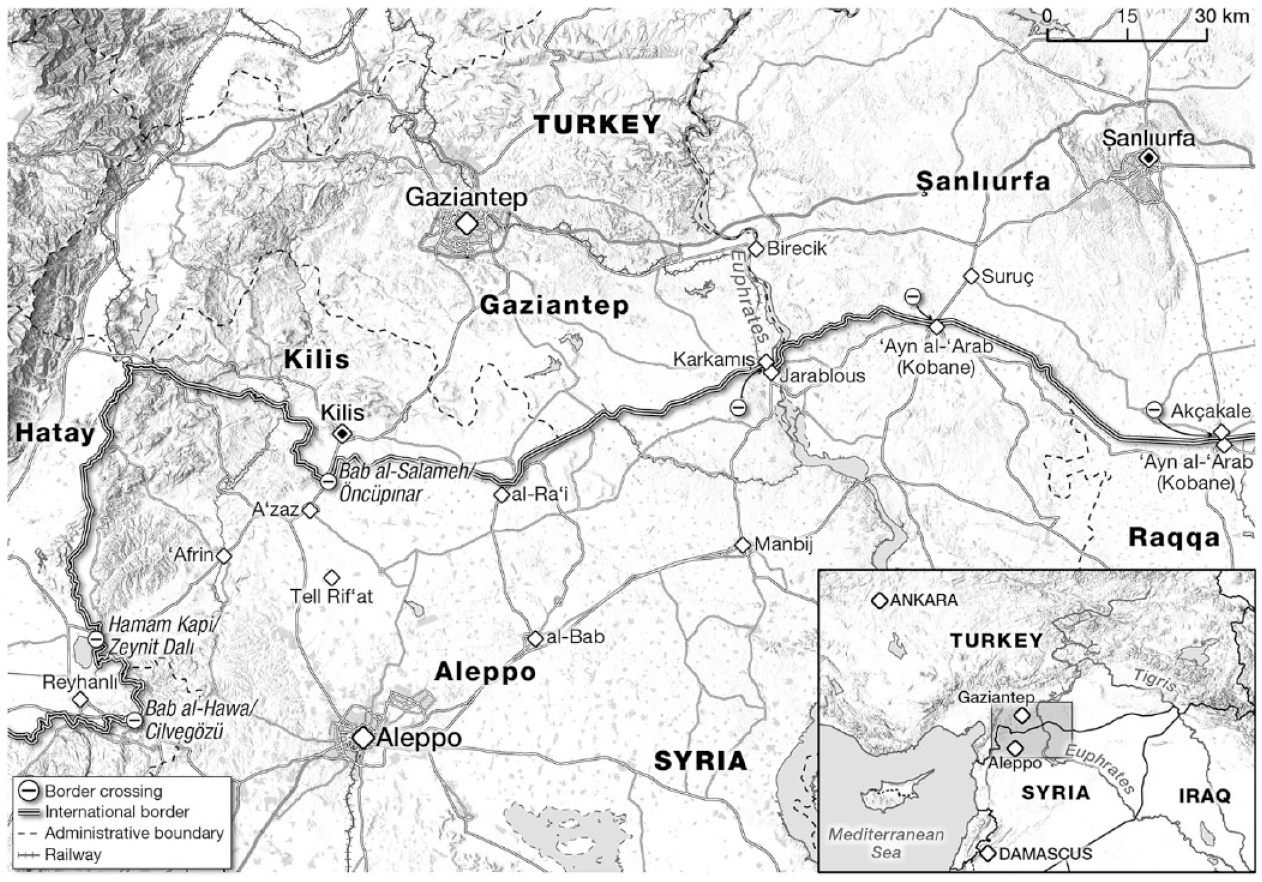
The Western Side of Syria’s Northern Border with Turkey
With regard to his experience of collaboration with Turkish border officers, he reported that since the big migration of 2015, especially when Turkey closed its borders in early 2016, we started to collaborate with officers from the Turkish Jandarma. We made a deal to use three border points: Bab Al Salameh in Azaz, Al Rai in Al Bab, and then also the military border crossing in Jarablus! . . . We would pay one officer a third of the total fee and he would redistribute it [to] other officers. It was a great deal for us, because the smuggling fees from Syria to Turkey went up from $100 to $2,000–$3,000 [U.S. dollars] per person when the border closed. . . . We used those military crossing borders for hundreds of journeys.
8
Soon after the implementation of the European Union (EU)–Turkey deal, between 2016 and 2019, Turkey launched a series of military operations in northern Syria (Tastekin 2022) and installed a stable military presence that is currently controlling a 30-kilometer-deep buffer zone along the border into Syrian territory (al-Hilu 2021). The smugglers I interviewed who were actively organizing people’s transit across this border said that bribing Turkish officers had become necessary to guarantee success. Abu Mohammed, a 46-year-old from Aleppo, shared how he had to adapt to the new border policies by starting a collaboration with another smuggler, a Syrian Turkmen from the border city Azaz, who could guarantee border crossings, thanks to his connections to Turkish officials.
The most successful smugglers [in Syria] are the ones with a collaboration with Turkish law enforcement. We used to collaborate with a Turkish military officer until two years ago. He was responsible [for] one of the checkpoints close to Reyhanli border between Idlib and Hatay. He was helping us in every trip by securing the road and order[ing] soldiers to check other locations and not the roads we were using.
9
Over the 12 trips he had coordinated in this way, Abu Mohammed estimated facilitating the transit of more than 600 people; together, these trips brought in the biggest earnings of his smuggling career because, as clients referred his services to friends and family, his reputation as a trusted facilitator grew. He did not say whether it was the fact that his associate was ethnically Turk or spoke Turkish that helped in establishing relations with local officers in Turkey. But he did explain that his smuggling partner’s understanding of the border derived from nearly 20 years working as a trader in textiles and shoes between Syria and Turkey. It was through that business that the two of them had met before the war. Neither had ever thought of working in the people-smuggling business, Abu Mohammed confessed, but ended up doing so due to economic necessity.
It was really hard to lose everything I had built when the war started. All of a sudden, I found myself with nothing and [had to] make money fast to support my family. I asked around and smuggling people soon became the best option. [Before 2016] we [him and the other smuggler] used to do two to three trips a day, it was really easy. Ninety percent of the trips were successful without needing to bribe the police.
10
When interviewing smugglers in Kilis, Gaziantep, and Hatay—three of the major arrival cities for cross-border movement organized from northwestern Syria—participants revealed that bribing Syrian militias, whether government forces or opposition militias, was not a sustained practice until 2013–2014, a few years into the conflict (Achilli and Tinti 2019). With the disruption of war and more than half of the Syrian population seeking refuge, bribery became a key source of revenue for both regime and opposition militia groups to help cover the costs of war (al-Ghazi 2022). Participants explained that the bribes paid to the Syrian militias controlling the Syrian side of the border, be these regime- or rebel-controlled, could either be bribes to allow for passage through internal or border checkpoints or guarantees of protection from criminal groups.
The Turkey–Greece Border
The continuation of the land route entering Turkey from Syria is the exit route crossing the Evros border with EU member states Greece and Bulgaria. In 2015, the rise in migration numbers moved EU members to increase border enforcement on external border points, such as land and sea borders with Turkey, which then hosted the largest number of refugees in the world (United Nations High Commissioner for Refugees [UNHCR] 2023). This effort culminated with the 2016 deal between Europe and Turkey (European Council 2016), designed to stop irregular crossings by returning those who entered the EU irregularly in exchange for 6 billion euros to aid border management and provide support for refugees in Turkey (Terry 2021). The deal broke down in March 2020, when Turkey—following losses in military operations in western Syria—opened its borders to raise pressure on the EU and NATO (Norman 2022) and announced that refugees would not be prevented from trying to reach Europe (Dicle Ergin 2020). In 2021, the deal was renewed, and since then, numbers of border crossings have reduced again, with journeys facilitated by smugglers becoming the only way migrants and asylum seekers have to try to cross the border (ANSA 2023).
Both the borders of Greece and Hungary have been key locations of investment by European border security through the deployment of agencies such as Frontex, Europe’s growing border and coast guard agency (Léonard and Kaunert 2022), and direct investment in training national border guards and providing better technology to detect and prevent crossings (Andersson 2016). Between both locations, around 200 kilometers of border fences were built and brought to completion between 2015 and 2017 (Figure 2; Dumbrava 2022). In light of these new border policies, smugglers are relying on the strategy of making connections with border officers.
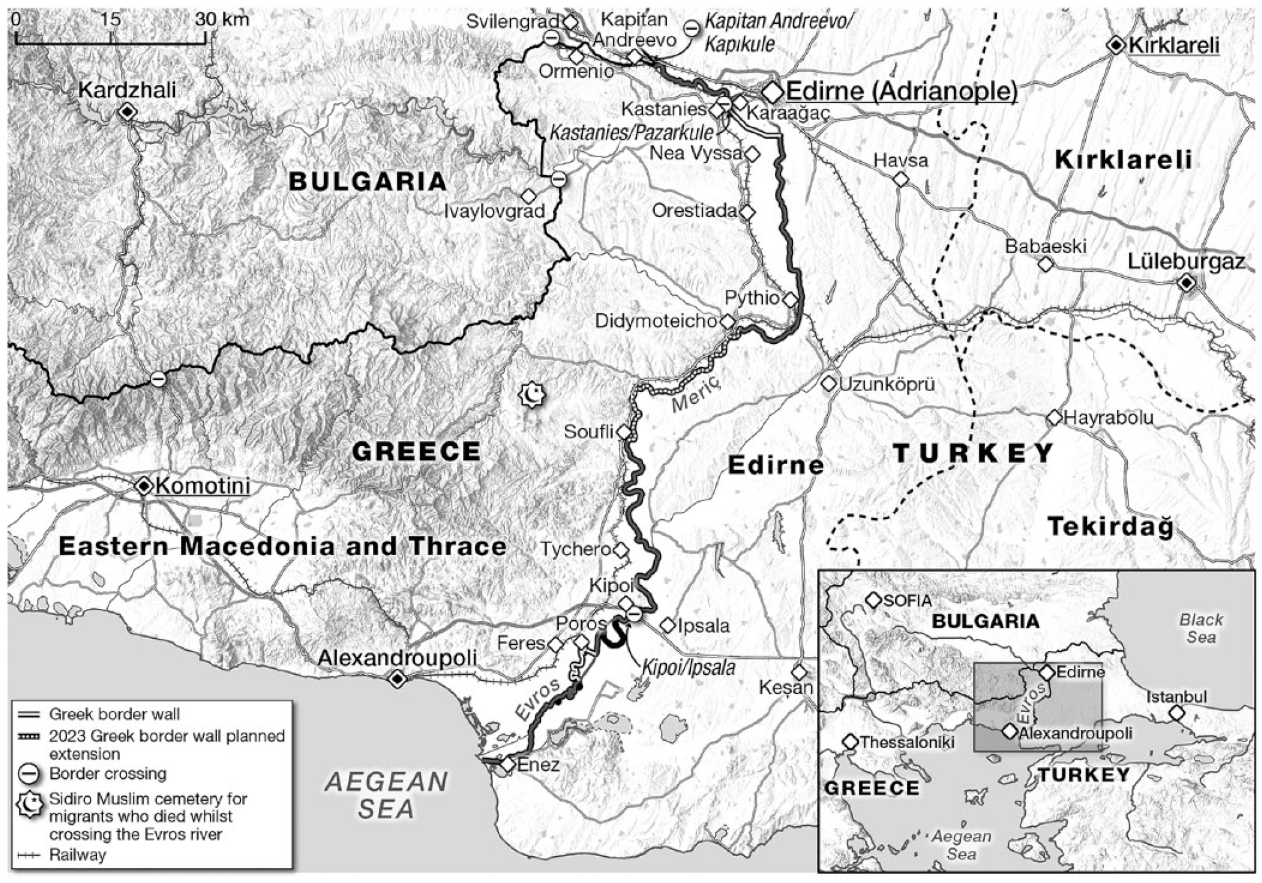
The Evros River Border Separating Turkey and Greece
Bribing border officers allows smugglers to offer what participants refer to as “guaranteed journeys,” that is, ones for which a deal has been struck with a border officer and for which the chance of both protection and success is much higher. Abu Rami, a Syrian smuggler I interviewed in Turkey in February 2022, had been working as a recruiter for four years, first in Istanbul and then in Edirne. His role was to find clients: people who were looking for smugglers to get them to Greece or Bulgaria safely. He explained how after the 2016 EU–Turkey deal, collaboration with border officers in Turkey, Greece, and Bulgaria became a prominent feature of successful smuggling operations.
Every smuggler dreams of a collaboration with a border officer, but it is hard to establish. It requires a good and trusted network, which takes time to build. It is important to reach an agreement with a high-ranked officer, not any soldier or border guard. An agreement with an officer secures the journey and makes them guaranteed, because they have the authority to order border patrols to other locations and not the ones where a crossing has been agreed. Big smugglers are the ones with good connections with European officers.
11
Another participant, Abu Adnan, a smuggler from Syria who was particularly wary of meeting me in Istanbul after having had troubles with a competitor smuggler just weeks before, agreed that bribing officers had increased the prices of smuggling. The cost of the officer’s bribes had to be added to the client’s fees, he explained; moreover, tariffs along the same route could vary according to whether or not accommodations had been made with police.
At the end of the interview, he told me about the fallout he and his associate were dealing with in relation to managing their collaboration with Greek border officers. Abu Adnan was based in Istanbul, so it was his associate in Greece who had the direct connections with officers in the Greek border town of Orestiada. My informant was very worried, as losing this associate and the connections to Greek law enforcement would greatly affect his ability to organize future smuggling operations. He explained how the two of them had started working together for mutual benefit: [After the 2016 EU–Turkey deal] I got frustrated with the increasing failure rate of trips. I noticed I could recruit many people that could afford to pay nearly 6,000 euros each. I got put on a “waiting list” to work with another smuggler in Greece who was more expensive but had good relationships with the Greeks [police]. We did a few trips to try this collaboration. The trips were so smooth, safe, and successful. We worked well, because I find many clients and he has the right connections to border police.
12
Not all smugglers manage to create collaborative relationships with border officers. As in Abu Adnan’s case, for smugglers without a direct line to border authorities, the option is to build working partnerships with other smugglers who already have active deals with border officers. Smugglers with active connections to border officers are in very high demand among other smugglers who look to reduce the chances of failing operations.
Corruption is not a one-way relationship in which only smugglers are keen to initiate deals. Participants provided testimonies that the opposite is also true. I interviewed Abu Qamishlo over WhatsApp. A 30-year-old Syrian smuggler from the border town of Qamishli, he had worked as a reverie—a guide—for migrant groups being smuggled from Syria to Turkey and then on to Greece and Bulgaria. He had been working on that route five years already and reported that bribery is multidirectional: guards were also looking to establish deals with smugglers.
The first time I was arrested, they [Greek border police] said I needed to pay them so we could make a deal for me to pass the border with my group. . . . I have never trusted them, but I still work with them.
13
Investigations run by local and international media in 2022 on both the Evros border and in the north of Serbia gave evidence of local border police working with smugglers to manage, control, and profit from irregular flows of migrants crossing the border (Dragojlo 2022; Lighthouse Reports 2022). When conducting fieldwork in both locations, I heard from participants that they or others they knew of were being sourced out by border guards keen to establish deals. In both locations, I interviewed local informers who worked as middlemen—often hotel owners or former border officers—whose role was to liaise between smuggling groups and local border enforcement.
It was in this context that I met Amez, the Kurdish hostel owner on the Turkish–Greek border whose story started this article. His new role after having been sent away from the border force was to be the middleman between smuggling groups on the Evros border and Turkish and Bulgarian border officers.
In this hostel, I have seen many things happen. Some time ago, I hosted Bulgarian police officers coming here to meet with the Afghan, Turkish, and Syrian smugglers who are active in this border. The meeting was set up by the Bulgarian border officers through my cousin, who works as [a] customs officer in Bulgaria. I provided the house where this meeting could happen, and I was involved in the deal to provide the locations where smugglers would deposit the money to pay off the officers.
14
Discussion
The data presented in this article suggest that that bribery and corruption are strategies by which both smugglers and border officers creatively navigate the limits imposed by border enforcement policies. This finding is compatible with previous empirical research that understood bribery and corruption as a negative outcome from a migration governance and border security perspective and as an unintended consequence of increased border enforcement (Antonopoulos and Winterdyk 2006; Brachet 2018; Izcara-Palacios 2019). The evidence provided from fieldwork on two distinct border locations on Turkey’s and Europe’s external borders suggests that bribery and corruption are both endemic practices of border dynamics, as well as strategies that are increasingly being embraced by smugglers and border guards as they react to and subvert policies of securitization and criminalization. As such, the corruption of border guards through bribery is not an ad hoc dynamic emerging haphazardly due to “a few bad apples” (Jancsics 2021) but rather, I argue, a consequence of migration control policies interacting inefficiently with local social dynamics to create a corruption-prone environment.
In both border areas surveyed during my fieldwork, the effect of harsher border policies has been to push smugglers and border officers to find accommodation measures through bribery and corruption. Within the specific context of each border, I found that smugglers and border officers were accommodating their supposedly contrasting roles, interests, and relations through a recognition of mutual benefit. In this sense, the extent of bribery and collaboration present on both borders demonstrates how smugglers and border guards have adapted border control policies to the socioeconomic needs of local realities.
The critical criminogenic literature argues convincingly that harsher border enforcement policies have had negative implications for people on the move, by curtailing their independent, irregular movement and criminalizing their undocumented presence on transit routes through forced encampment, detention, and deportation. Despite reducing the overall number of border crossings, border enforcement policies have turned smuggling into a much more needed service. In both the Turkey–Syria and the Turkey–EU border, the implementation of stricter security border policies in and after 2016 has emboldened smugglers in the use of corruption and bribery of border officials as an adaptive strategy to new circumstances.
That smugglers and border guards use bribery to adapt to new border policies does not necessarily mean that their collaboration is making smuggling safer for people on the move. In purposefully focusing on the experience of smugglers and border guards in regard to guaranteed smuggling deals, this article does not consider the experience of people on the move and their perspectives on bribing and smuggling. A fuller analysis could complement these findings by bringing in a migrant’s perspectives on bribery. That perspective could shed light on the experience—the risks and harms—of migrants who enter into guaranteed smuggling deals as well as that of those who do not have the economic means to access the higher prices of guaranteed trips.
Participants on the Syrian–Turkish border refer to the closing of the border in 2016, the completion of the border wall in 2018, and Turkey’s military intervention in northern Syria (2016–2019) as game changers for people smuggling. Having fewer options to cross the border autonomously, refugees escaping Syria had to turn to smugglers, who, in turn, had to charge higher fees in order to cover collaboration deals that would guarantee successful and safe operations. The continuation of the Syrian war and Turkey’s economic recession also contributed to the needs of border communities, as new waves of refugees were on the move and Syrian militias and Turkish border officers began tapping into the smuggling business to make revenue to sustain themselves. Border enforcement policies in Turkey did indeed affect smuggling and local border dynamics, but not in the way those policies were intended to. If, on one side of Turkey’s border, securitization did reduce the number of irregular crossings, it also created the opportunity for smugglers, militias, and border officers to profit from the needs of people on the move.
Participants on the Turkey-Greece border also point to 2016 as a turning point. The EU–Turkey deal introduced new border enforcement approaches, including the increased use of surveillance technology; the construction of border walls and fences; the increased collaboration between Frontex, Europol, and national police forces; and new policing methods and techniques of detection and apprehension. These changes pushed smugglers to change their organizational structures and practices (Campana and Gelsthorpe 2021). Bribery and corruption of Turkish Jandarma and border officers in Greece and Bulgaria by people smugglers active on the Evros river border provided a higher chance of success and lessened the increasing risk of arrests, beatings, and pushbacks (Border Violence Monitoring Network [BVMN] 2022). As mentioned by participants interviewed on this border, bribery has become an established form of collaboration between smugglers and border guards, a form of accommodating mutual interests. But bribing officers is not an easy task. Smugglers with a connection to border enforcement are in very high demand. Moreover, the data show that it is not only smugglers aiming to bribe border guards. Bribery is multidirectional, with border police forces seeking to collaborate with smugglers, either to profit from irregular crossings or to facilitate smooth passage and thus reduce the number of migrants stranded at one border.
In the context where border enforcement policies that aim to curtail cross-border movement fall short of understanding the needs of those involved, collaboration between smugglers and border enforcement—the Turkish Jandarma and Greek and Bulgarian border officials—is a key strategy for accommodating the interests of both groups.
Corruption and bribery are part and parcel of survival strategies adopted both by smugglers and border officers to adapt and reappropriate the workings of border securitization policies on specific borderlands. Corruption and bribery should thus be seen both as an adaptive reaction and as a survival strategy embedded in the political economy of borderlands facing economic marginalization and insecurity.
Conclusion
I have investigated how bribery and corruption are used as part of the survival economies of local communities, especially among people smugglers and border guards. By focusing on bribery and corruption as both strategies of reception and responses to securitization and criminalization policy, I have argued that the notion of accommodation and collaboration between smugglers and border guards is useful in understanding the relationship between implementation of border enforcement strategies and adaptation to the fast-changing practices of people smuggling.
In line with the critical criminogenic argument, this evidence suggests that current migration policies are generating more crime (more smuggling, more corruption) and more violence. This study aligns with other work on corruption (Andreas 1998; Singh 2022; Slack and Campbell 2016), where poorly enforced or unrealistic and practically unviable state regulations facilitate rent-seeking behaviors between those in positions of power, like smugglers and border guards, and those in more vulnerable positions, such as migrants and asylum seekers. In the case of people smuggling and bribery, these crimes have become intertwined in the very workings of migration security policies as smugglers and border officers adapt to local realities. By challenging and reappropriating strict and impractical border regulations through bribery and corruption, border actors reshape the implementation of migration policies of border control to their own advantage, including them in the wider range of survival strategies that make up the political economy of borderlands.
For the sake of reducing border crossings at all costs, states have instituted policies that neglect both the needs of people on the move and the needs of local border communities. These measures have turned borders into better fortified and surveyed barriers to movement, but they have also fueled the demand for alternative ways to cross borders and survive. In response to that need—and tending to their own interests—actors at the local level have created accommodations to enable cross-border movement. By exploiting the strategies of bribery and corruption, smugglers and border guards have seized the opportunity to create bridges between two supposedly antagonistic actors in the migration industry.
Footnotes
Notes
David L. Suber is a researcher and freelance journalist, working on the intersections between organized crime, people smuggling, and border policing at the University College London (UCL) Department of Security and Crime Science. He is the codirector of the journalism platform Brush&Bow, producing multimedia investigations and documentaries.