



Abstract
The adverse impacts of community firearm violence in the U.S. are unequally felt across geographic and various sociodemographic segments of our population. Researchers, government leaders, and the general public need to contend with the various ways in which unjust socioeconomic and political forces and systems of power and privilege lead to differences in risk exposure among population groups, as well as differences in the extent to which various segments of the population are protected from the adverse effects of firearm violence. We highlight dozens of studies to illustrate how firearm violence and community trauma in the U.S. can be more effectively addressed when a “social and structural determinants” perspective is used to understand and respond to this public health problem.
Keywords
Introduction
The burden of firearm violence in the U.S. is significant and among the highest in the world compared with other similarly large and wealthy countries, despite unparalleled spending on policing, imprisonment, and curative medical care (Stemen 2017; Wager, Ortaliza, and Cox 2022). All communities are affected (Centers for Disease Control and Prevention 2020; Kaufman et al. 2021; The Global Burden of Disease 2016 Injury Collaborators 2018). Yet the consequences of firearm violence in the U.S., especially community firearm violence, are unevenly borne, with minoritized and marginalized communities, and particularly Black adolescents and young adults, shouldering the greatest toll of death, injury, and resultant trauma. Community firearm violence is defined as interpersonal firearm violence, including firearm homicide, between non–intimately related parties (Bancalari, Sommer, and Rajan 2022). Firearm homicide is the third leading cause of death for all young people ages 15 to 24, but it is the second leading cause of death for Black girls and young women and the leading cause of death for Black boys and young men, who in 2020 made up <1 percent of the population but accounted for nearly one in five (18 percent) firearm homicides (Centers for Disease Control and Prevention 2020).
The disproportionate impacts of community firearm violence within racially and economically segregated neighborhoods do not arise passively (Galea and Vaughan 2021) or in a vacuum. Rather, they are rooted in historical and present-day structural racism and other oppressive systems of power and marginalization that create and concentrate inequitable community conditions of numerous risk factors associated with interpersonal violence (e.g., poverty, unemployment and underemployment, grief and loss, and disinvestment in basic requisites of life) and few protective factors associated with safety (e.g., high-quality and accessible education, housing, and economic and workforce opportunities) (Prevention Institute and Big Cities Health Coalition 2021). This enduring inequity has been exacerbated amid the COVID-19 pandemic, which has reinforced unequal systems of support and intensified the destabilizing conditions where interpersonal violence becomes more likely. The pandemic also coincided with massive increases in firearm sales and availability (Rivara, Vars, and Rowhani-Rahbar 2021), which have been linked in prior research to subsequent increases in firearm injury rates (Laqueur et al. 2019). Dozens of U.S. cities, large and small, experienced record surges in community firearm homicide in 2020, with the greatest increases occurring in low-income Black and Brown communities (Kegler et al. 2022; Rosenfeld and Lopez 2020). While the rate of increase has slowed (Simon et al. 2022), elevated levels of firearm homicide have persisted as disruptions to pre-pandemic patterns of individual and community life have continued.
As devastating as firearm homicide is, it captures only a fraction of the reach and harm of this enduring public health problem. A nationally representative survey administered in 2013 to 2014, when rates of firearm violence were relatively low, estimated that approximately 8 percent of children and teens and 13 percent of the subset of those ages 14 to 17 reported hearing gunshots or seeing someone shot over their lifetime (Finkelhor et al. 2015). One study among communities highly impacted by structural disinvestment and interpersonal violence found that 56 percent of youth ages 12 to 15 had heard gunshots in the past year (Zimmerman 2014). Another study estimated that in affected communities, young Black men have personally known, on average, three homicide victims, mostly peers, by the age of 24 (J. Smith 2015). As with direct exposure, these secondary experiences of violence have well-established associations with a wide range of social-emotional and health risk outcomes, particularly when firearms are involved, including posttraumatic stress symptoms, anxiety, depression, substance misuse, aggression, antisocial behavior, and school problems (Foster and Brooks-Gunn 2009; Fowler et al. 2009; Garbarino, Bradshaw, and Vorrasi 2002; Santilli et al. 2017), as well as subsequent self- and other-directed violence involvement (Aubel et al. 2021; Foster and Brooks-Gunn 2009; Fowler et al. 2009; Garbarino, Bradshaw, and Vorrasi 2002; Jennings, Piquero, and Reingle 2012; Kagawa et al. 2018; Santilli et al. 2017; Testa, Semenza, and Jackson 2021).
Community-Level Trauma and Consequences of Firearm Violence
Firearm violence does not happen only to people; it happens to places, and there is growing recognition that in communities with high levels of firearm violence, not just individuals but whole communities experience trauma (Pinderhughes, Davis, and Williams 2015; Sharkey 2018). The concept of community trauma, developed by Pinderhughes, Davis, and Williams (2015) at Prevention Institute, encompasses more than the aggregate of individuals who have experienced trauma from exposure to violence. It also, and significantly, comprises the cumulative and compounding community-level consequences of chronic, cyclical violence on environments and institutions fundamental to daily life, health, and safety. Symptoms of community trauma include such broad manifestations as greater law enforcement presence and greater involvement in the criminal legal system among residents; metal detectors and hardened security measures at schools; sidewalk memorials at places where people have died from violence; shuttered businesses and other disinvestments in the local economy; and damaged, fragmented, or disrupted social relations—particularly intergenerational relations—in response to persistent, unaddressed trauma (Pinderhughes, Davis, and Williams 2015; Sharkey 2018). Community firearm violence and the resultant harms may extend, therefore, across entire neighborhoods and over time.
Scholarship increasingly documents that community trauma from firearm violence contributes to adverse health and safety experiences at a population level, regardless of direct or witnessed victimization or involvement. For example, ethnographic research in violence-impacted neighborhoods suggests that youth frequently navigate strategically through public spaces by shifting their schedules, their networks, and their routines in response to community violence (Anderson 1998; Harding 2010; N. Jones 2009; Opara et al. 2020). Research using data on a population-based cohort of youth followed from birth through age 15 estimates that Black youth are nine times more likely than White youth to live or attend school in neighborhoods where there has been a recent firearm homicide (James et al. 2021). Moreover, this spatially proximate exposure to firearm violence is associated with a greater risk of depression, especially among Black male youth living in highly disadvantaged communities (Buggs et al. 2022). Quasi-experimental studies in New York City and Chicago have also found declines in cognitive functioning, lower levels of attention and impulse control, and worse standardized test performance among children in the aftermath of a homicide that occurred near their home relative to children in the same neighborhood who were assessed at a time when no violence had occurred (McCoy, Raver, and Sharkey 2015; Sharkey 2010; Sharkey et al. 2012, 2014). Likewise, in Philadelphia, researchers have documented increases in children’s use of emergency department mental health services in the two months following a shooting within two to three blocks of their home (Vasan et al. 2021). Additionally, a study of the relationship between firearm violence and functional disability among men in four major U.S. cities found that neighborhoods with high rates of both fatal and nonfatal shootings have a disproportionately greater prevalence of disability than those with low rates of firearm violence (Semenza and Stansfield 2021). Persistent exposure to violence may also increase the probability that an individual will carry a firearm, thereby further raising the probability of firearm injury and death (Fontaine et al. 2018; Hureau and Wilson 2021). Together, these studies help to underscore the ways in which endemic violence and manifestations of community trauma perpetuate structural cycles of continued disinvestment, fractured support, and poor health outcomes.
A Social and Structural Determinants Lens for Understanding Community Firearm Violence and Community Trauma
Unpacking and addressing inequities in community firearm violence and trauma at both the individual and community levels requires that we attend to the individual-level behavioral factors that are proximally associated with exposure to or engagement in violence (e.g., impulsivity, aggression, weapon carrying, and alcohol and other substance misuse). But, perhaps more critically, it also calls for deliberate investigation and action to counter the root causes—or the social and structural determinants—that contribute to the injustice and inequity that give rise to population-level patterns of increased risk of interpersonal violence in the first place (Galea and Vaughan 2021). Social determinants are defined by the World Health Organization (WHO 2022) as “the conditions in which people are born, grow, work, live, and age and the wider set of [socioeconomic and political] forces and systems [of power and privilege] shaping the conditions of daily life.” While less often made explicit, the latter portion of this definition encompasses what also may be called structural violence—or the violence of injustice and inequity that stems from societal relations and arrangements and that subjects people and communities to common forms of lived oppression (Rylko-Bauer and Farmer 2016).
This social and structural determinants lens offers a framework not only for understanding the ways in which the uneven burden of community firearm violence and community trauma is a fundamental feature of an unjust distribution of the institutions critical to violence prevention, but also for generating healing and safety, equitably and sustainably, for all people, families, and communities (Armstead, Wilkins, and Nation 2021; Galea and Vaughan 2021). Well before they were embedded in mainstream public health thinking, these concepts had been known and mobilized in minoritized and marginalized communities. However, the experiential knowledge and wisdom of the people and communities most affected by violence have long been de-emphasized or ignored (Buggs and Zeoli 2022). A more comprehensive and reflective understanding of the complexities of violence production and victimization—as well as community safety and health—means that the work of violence prevention and community safety must uplift and center the perspectives, priorities, and lived experience of those most impacted.
This article highlights selected literature examining the social and structural factors shown to systemically increase the risk of community firearm violence exposure and community trauma, as informed by the WHO Social Determinants of Health and Health Inequity Framework (hereafter, SDOH Framework) (Solar and Irwin 2010). The SDOH Framework (Figure 1) outlines the pathways linking structural and interpersonal firearm violence and conceptualizes macro-level structural mechanisms (e.g., governance, social policies, public policies, etc.) as being rooted in key social, economic, and political institutions and processes. These mechanisms then generate social gradients and caste divisions according to which inequities in firearm violence are organized, including along the dimensions of income, education, occupation, gender, race/ethnicity, and other factors. Together, this structural context and the resultant racialized and gendered socioeconomic position of individuals are termed the social determinants of inequities in firearm violence. Social determinants then operate through multiple intermediary processes (e.g., the availability of adequate housing, opportunities for healthy child development, sustainable livelihoods, nutritious food, etc.) at the neighborhood, family, and individual levels to produce an unjust and disproportionate burden of firearm-related harm and community trauma (Solar and Irwin 2010). These pathways between macro-level social structures, intermediary processes, and firearm-related outcomes are conceptualized as interconnected, cumulative, and cyclical.
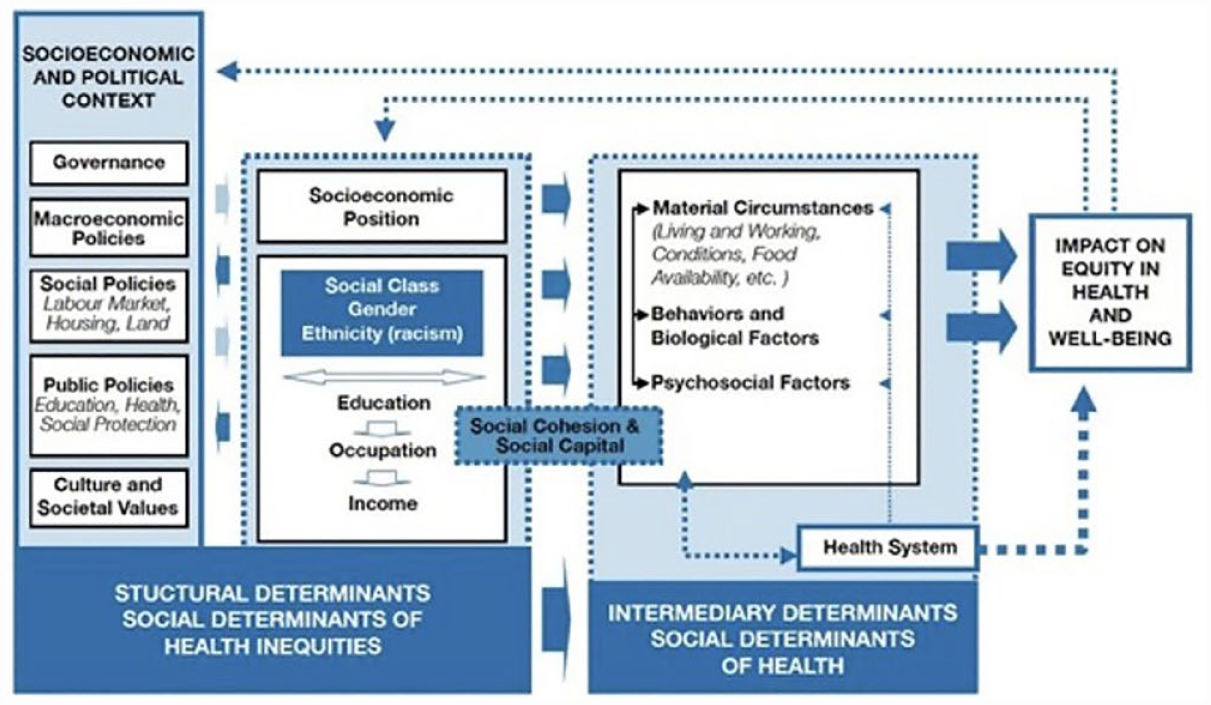
World Health Organization Social Determinants of Health and Health Equity Framework
In the U.S., the SDOH Framework is situated in a racial capitalism milieu. The concept of “racial capitalism” asserts that the accumulation of capital and racialized systems of exploitation and oppression are interdependent and mutually constitutive. From the extraction of slave labor to the racialized access to conditions necessary for optimal health and intergenerational well-being, economic opportunity has been structured historically and persistently, overtly and implicitly, against minoritized people of color (C. Jones 2000; Laster Pirtle 2020; Robinson, Sojoyner, and Willoughby-Herard 1983). Systemic racism is defined as “the totality of ways in which societies foster discrimination, via mutually reinforcing systems of discrimination (e.g., in housing, education, employment, earnings, benefits, credit, media, health care, and criminal [legal]) that in turn reinforce discriminatory beliefs, values, and distribution of resources” (Bailey et al. 2017, 1453; Yearby 2020). While it is incredibly challenging to quantify the totality of benefits or harms any person or community has endured as a result of racist, capitalist systems—or the differential ways through which these systems operate on health—there is a growing body of research that points to a strong connection between systemic racism, social and structural determinants of inequities, and firearm-related outcomes (Santilli et al. 2017). Described below are fundamental manifestations of the ways in which macro-level social structures and intermediary processes operate in everyday life to create environments with multiple risk factors associated with community firearm violence and community trauma while simultaneously providing few protective factors associated with community safety.
Relationships between Community Firearm Violence, Community Trauma, and Social Policies That Concentrate Risk or Protection
An examination of the laws and practices governing how and which places—and, by extension, which people—receive investments in residential and economic development reveals the cyclical and interconnected impact of social policies that create the thicket of conditions determining the likelihood of community firearm violence. For example, the discriminatory practice of redlining—just one example of a multitude of actions, both public and private, to have excluded specific populations from wealth building and economic mobility—has guided a systematic disinvestment in racially minoritized communities and a concurrent investment in predominantly White communities over generations. As a result, historically underinvested communities experience significantly higher rates of firearm injury compared to areas that were deemed worthy of investment more than 80 years ago (Benns et al. 2020; Poulson et al. 2021). Further, studies of contemporary racial residential segregation—a deliberate result of redlining, racialized restrictive covenants, urban renewal projects of the 1950s and 1960s, and other discriminatory practices—find that greater racial and economic segregation correlates with the geographic concentration of households experiencing deprivation. This contributes, in turn, to the concentration of firearm violence (Browning et al. 2010; Krivo et al. 2015) and disparities in firearm homicide between Black and White population groups (Wong et al. 2020).
Living in communities with concentrated absolute or relative social and economic disadvantage increases the probability of involvement in and exposure to community firearm violence (Beardslee et al. 2021; Schleimer, Buggs, et al. 2022). This relationship is both direct and indirect and reflects the syndemic 1 nature of violence and community trauma. Insecurities in basic needs such as food, housing, and financial resources at the individual, household, and community levels are independently and jointly associated with the increased risk of violence exposure and involvement (Schuck and Widom 2021). For example, food insecurity, defined as “the disruption of food intake or eating patterns due to a lack of money and resources” (Miller et al. 2021, 318), has been linked to increased violence, even when controlling for other predictors, such as income level and population density (Caughron 2016). Limited access to food, coupled with limited financial resources or limited transportation to access food, is predictive of increased firearm injury risk—a finding that highlights the potential for additive or multiplicative effects in the relationship between firearm violence and social and structural determinants (R. Smith et al. 2020). The impact of food insecurity on predictors of violence, such as externalizing behaviors like youth aggression and antisocial behavior, has been noted even when food insecurity occurred years prior (Slopen et al. 2010). Concentrated disadvantage and needs insecurities may contribute to interpersonal violence by negatively affecting cognitive functioning; increasing stress levels; intensifying unhealthy conflict; and contributing to mental health problems such as anxiety, depression, and substance use disorder (Hatcher et al. 2019). Furthermore, when experienced during childhood, basic needs insecurities and concentrated disadvantage may serve as risk factors for exposure to violence in the home—itself considered an adverse childhood event that increases the risk of future violence exposure and involvement (Miller et al. 2021). There is also substantial evidence that wage differentials and neighborhood-level income inequality are strongly associated with violent crime (Kennedy et al. 1998; Rowhani-Rahbar et al. 2019). Thus, counties with higher levels of income disparity—high median incomes and high levels of poverty—are more likely to experience higher rates of firearm violence than are those with relatively low median incomes, even where poverty rates are high (Johnson et al. 2021).
Community-level constraints on access to social institutions essential to individual and community well-being contribute further to the exclusion of historically minoritized groups from economic and social opportunities—and increase the risk of firearm violence, both directly and indirectly. Because public school districts in much of the U.S., for example, are substantially funded by local property taxes, high-poverty areas, which have lower home values, collect less in taxes and have less funding for schools; while low-poverty areas with higher home values are likely to secure more taxes and funding for youth academics and extracurricular development (Chemerinsky 2003). Underfunded schools are more likely to yield poorer educational outcomes, a risk factor for later-in-life exposure to violence (Bray et al. 2020; David-Ferdon et al. 2016). In reciprocal fashion, exposure to community firearm violence is also a predictor of educational performance (Bergen-Cico et al. 2018). There is also strong evidence that early childhood care, which the U.S., unlike most other similarly large and wealthy countries, does not guarantee, is associated with reduced violent crime (Heckman, Pinto, and Savelyev 2013; Reynolds et al. 2001).
Macroeconomic policies affecting the built environment have also been explicitly linked to social and structural determinants of violence. Neighborhood blight and physical disorder, including disproportionate numbers of dilapidated buildings and vacant lots, are predictive of firearm violence (Branas et al. 2018). Exposure to environmental pollution, though not yet widely studied, seems to impact firearm violence as well. Research has found that air pollution, disproportionately concentrated in low-income communities, has a positive association with violent crime and may cause additional stress for already vulnerable low-income families living in concentrated disadvantage (Bondy, Roth, and Sager 2020). Moreover, while researchers have long linked lead exposure—primarily from paint in homes or gasoline in vehicles—to increased risk of cognitive impairment, aggression, impulsivity, and violent behavior, elevated air-lead levels have also been found to be predictive of violent crime rates and specifically of firearm violence (Boutwell et al. 2017; Emer et al. 2020; Stretesky and Lynch 2001).
Beyond their impacts on the physical and built environment, concentrated poverty and deprivation—along with persistent violence exposure—can fracture social networks and disrupt social relations in ways that affect collective efficacy, that is, the capacity for a community to achieve a common set of goals and intervene on behalf of its youth and public spaces (Sampson, Raudenbush, and Earls 1997). Communities experiencing high rates of violence have been shown to have lower levels of collective efficacy and social cohesion—an outcome symptomatic of community trauma and an underdeveloped network of the social support so necessary for counteracting multiple, simultaneous stressors.
Relationships between Community Firearm Violence and Carceral- and Punishment-Related Policies
The complex, mutually reinforcing relationship between governments and industries that benefit from overpolicing and mass incarceration is yet another overlapping structural determinant of firearm violence inequities. The U.S. has the highest rate of incarceration in the world—its incarcerated population has grown 700 percent since 1970—despite the clear disconnect between incarceration rates and crime rates (Ghandnoosh 2019). Black, Latinx, and poor Americans make up a disproportionate number of those incarcerated; these inequities are driven by entrenched systemic issues, such as excessive surveillance and overpolicing of neighborhoods suffering from violence, discriminatory sentencing, and a criminal legal system that operates differentially based on wealth and race (Alexander and West 2012; Braga 2015–2016). The myriad devastating consequences of overpolicing and mass incarceration at the individual, household, community, and societal levels are well documented, as are the profits they generate (Bowleg 2020; Sered 2019). Even more relevant to the present argument is the restrictive and far-reaching impact that contact with the criminal legal system has on economic opportunity and impoverishment, particularly for Black families (DeFina and Hannon 2013; Western and Wildeman 2009); in the context of racial residential segregation and concentrated disadvantage, mass incarceration continues to have an outsized influence on the uneven distribution of firearm violence in the U.S.
Just as low-income communities of color suffer from the interplay between mass incarceration and firearm violence, they are burdened by both high rates of firearm violence and high levels of legal cynicism, in which people view the law as illegitimate, ill equipped, and unresponsive to public safety needs. Long-standing histories and experiences of surveillance, state-sanctioned violence, and mass incarceration in low-income and minoritized communities, coupled with perpetually low arrest rates for homicides and serious violence in those same communities, have contributed to high levels of skepticism about the criminal legal system as a reliable source of safety and justice (Desmond, Papachristos, and Kirk 2016). Further, one’s racialized and gendered socioeconomic position clearly affects how one experiences legislation regulating firearms (Desmond, Papachristos, and Kirk 2016). For instance, Stand Your Ground laws, which offer impunity to people who respond to threats of physical violence with deadly force, have been linked to increased firearm violence and led to an additional 600 homicides each year—and to the emboldening of racially driven armed vigilantism (Spitzer 2015). To find further evidence of racial biases in the criminal legal system, one need only consider that, in homicide cases with a White defendant, a ruling of “justified” is 281 percent more likely when the victim is Black than when White (Roman 2013). Stop-and-search practices to surveille for illegal firearm possession is another example of an enforcement effort that fails to reduce firearm violence and leads instead to the disproportionate policing of Black and Latinx people, especially male youth and adults, who are consistently stopped at higher rates than White people for similar behavior (Webster et al. 2020).
These histories shape the concept of legal estrangement, coined by the scholar Bell (2017) as “a theory of detachment and eventual alienation from the law’s enforcers . . . [that] reflects the intuition among many people in poor communities of color that the law operates to exclude them from society” (2017, 2054). Higher legal cynicism and lower levels of perceived police legitimacy have been significantly related to the increased probability of firearm acquisition in communities with high rates of firearm violence (Sierra-Arévalo 2016). Perceptions of community safety and exposure to firearm violence influence the likelihood that people will decide to carry firearms, thus increasing the risk that they will be used. The confluence of these factors and experiences, then, contributes to a deadly, cyclical phenomenon that further burdens communities plagued by firearm violence.
Solutions to Addressing Community Firearm Violence and Community Trauma
Given the vast complexities and interconnected inequities associated with and contributing to community firearm violence and community trauma across the U.S., large-scale and multilevel intervention will be needed to redress the situation. At the individual and interpersonal levels, community violence intervention (CVI) is a harm-reduction approach that aims to immediately decrease violence while attempting to alleviate the structural and social harms of the systems in which it thrives. Academic research and experiential knowledge from police and community members have found that an outsized proportion of the violence in any community is driven by a small number of individuals, even within neighborhoods with high rates of violence (Braga et al. 2008; Papachristos, Wildeman, and Roberto 2015), and that there is great overlap between those who have been victims or witnesses of violence and those who later commit it (Jennings, Piquero, and Reingle 2012). Thus, CVI strategies seek first to engage those who are at the highest risk of violence involvement—individuals who are often chronically alienated by, disconnected from, and distrustful of traditional structures of support, safety, and health (Boag-Munroe and Evangelou 2012)—and then to leverage the power of credible and authentic messengers to build genuine connections with those individuals and create pathways for identifying and addressing their needs. The intention is to alter negative life trajectories and facilitate healing and desistance from violence. While CVI programs have long operated in underserved communities and have shown promising success at reducing violence when adequately funded and supported, they have only recently begun to receive widespread attention and will require consistent political backing and sustained financial investment to realize their potential.
At the community and societal levels, firearm violence can be reduced when investments are made in communities and in individual well-being, particularly in ways that reduce economic and health inequity. Research on place-based environmental improvement initiatives has found that investments in vacant lot remediation, dilapidated building demolition, home façade renovation, and even lighting and tree planting can lead to decreases in firearm violence (Gobaud et al. 2022; Hohl et al. 2019; Kondo et al. 2017). Studies have shown that income support policies, theorized to help increase economic stability and security and reduce financial stressors, are significantly associated with reductions in firearm violence (Rowhani-Rahbar et al. 2022). State and local-level social spending on social and public health services has been associated with decreases in homicides (Kim 2019; Sipsma et al. 2017). The Earned Income Tax Credit, a federal antipoverty policy, has led to reductions in firearm violence (Lenhart 2021; University of Washington Department of Epidemiology 2021); and violent crime reduction was seen after passage of the federal Low-Income Housing Tax Credit Program, which incentivized affordable housing in low-income areas (Freedman and Owens 2011). Additional social policy efforts that would likely influence firearm-related outcomes include reducing income inequality (Johnson et al. 2021), supporting homeownership (Cui and Walsh 2015), improving workers’ protections (Blumstein, Rivara, and Rosenfeld 2000; Schleimer, Pear, et al. 2022), ensuring quality education, and strengthening the economic health of communities (Irvin-Erickson et al. 2017), among others.
To see meaningful improvements in community firearm violence and trauma, these kinds of place- and people-based investments must be maintained through dedicated funding strategies that support immediate intervention as well as upstream prevention. For example, the American Rescue Plan Act (ARPA), passed by the Biden administration to address a wide range of economic and social needs following the COVID-19 pandemic, provided an incredible infusion of cash to cities, counties, and states; some jurisdictions have used those funds to redress exclusionary policies and historical disinvestments in places and people by creating and implementing CVI initiatives, housing stability programs, and substance use disorder treatment options. Given that most jurisdictions still have ARPA funds available, there is still opportunity for other localities to follow suit. However, repairing sustained disinvestment in people and communities requires purposeful and sustained investment. Cities, states, and the federal government all have the ability to create line items in their respective budgets or develop permanent revenue streams through efforts, such as sales tax referendums, that can support community-based firearm violence intervention and prevention. Locales such as Oakland, California, New York City, and the state of Illinois have already instituted such revenue streams.
Beyond these examples, healing community trauma requires that communities have the agency to determine for themselves what they need to thrive. Intentionally designed policies and practices have not just created and maintained structural inequities that increase the risk of community firearm violence exposure but have also excluded communities most impacted by structural violence from creating the communities they want to live in. Thus, redressing these harms means equipping those very communities with the authority and capacity to choose their own paths to healing. Some cities, for instance, have begun implementing the democratic practice of participatory budgeting, in which residents have a direct say in deciding how to allocate government dollars in their respective locales. By empowering taxpayers to help determine how their monies are spent, these jurisdictions are moving towards centering the voices and experiences of those who have the most to gain, or lose, by addressing or perpetuating structural violence.
Conclusion
No community in the U.S. is immune from firearm violence; tens of thousands of Americans are killed by gunfire annually (Centers for Disease Control and Prevention 2020), and nonfatal firearm injuries outnumber fatalities by more than two to one (Kaufman et al. 2021). Countless more Americans live in neighborhoods plagued by the shared trauma, grief, and mental health consequences associated with secondary experiences of persistent firearm violence and community trauma (Aubel et al. 2021; James et al. 2021; Pinderhughes, Davis, and Williams 2015). Reducing violence and building community safety, equitably and sustainably, will come only from approaches that integrate varied and diverse expertise, tools, fields, and frameworks. Rather than being a discrete approach in and of itself, the preceding suggests that a social and structural determinants lens should be applied to every approach to firearm violence prevention and intervention. A strategy that takes a social and structural determinants approach will require multipronged efforts to dismantle the fundamental drivers of the multiple dimensions of inequity that create the cyclical process of systemic marginalization and racial capitalism at the root of firearm violence and community trauma. Most important, these efforts must prioritize supportive systems and services and center the voices and lived experience of individuals and communities.
Footnotes
Notes
Shani A. L. Buggs is a public health and policy researcher with the Violence Prevention Research Program and the California Firearm Violence Research Center at the University of California, Davis. Through her research on community-driven safety, she strives to inform policies that facilitate health equity and well-being for all families and communities.
Nicole D. Kravitz-Wirtz is a population health sociologist with the Violence Prevention Research Program and the California Firearm Violence Research Center at UC Davis. Her research aims to understand the social ecology of places to foster equitable, community-centered policies and practices for improving the health of people and communities impacted by violence.
Julia J. Lund is a research data analyst with the Violence Prevention Research Program and the California Firearm Violence Research Center at UC Davis. She utilizes interdisciplinary and mixed methods to understand the structural drivers of violence and support community-driven approaches to safety and wellness.