




Abstract
In high-income countries, both single parents and migrants face elevated risks of living in poverty, but research has paid little attention to the intersection of single parent and migrant status. I examine the ways in which immigration policies make migrants dependent either on the labor market or on their families as a spouse or partner and how these dependencies present risks to migrant women who are single parents. I draw on qualitative data on migrant women’s experiences in the first five years after migration to the UK, which include their transitions to single parenthood, to explore how their legal status affects the risks that they experience. Those risks concern exclusion from access to social protection and permanent legal residence, where access is contingent on the ability to maintain a relationship to the market as a worker or to the family through marriage or a stable partnership.
Introduction
Single-parent families and migrant families both face greater risk of poverty in high-income countries compared to families with two parents and families with parents who are born in and/or are citizens of their country of residence (Gornick and Jäntti 2010; Hughes and Kenway 2016; Smeeding et al. 2009). Yet there has been limited attention to the intersection of single parent and noncitizen/immigrant status. While family migration has been a central focus of migration studies, single parenthood is an understudied dimension. Migrant single parents may face challenges shared by all single parents in relation to paid work, care, and poverty risks. But in what ways do immigration policies shape their experiences?
Immigration policies regulate both the admission of noncitizens to a country as well as the terms and conditions of their stay; their access to permanent legal residence; eligibility to naturalize/apply for citizenship; and access to publicly funded social provision, such as income-related benefits. Those conditions may require a migrant noncitizen to maintain a relationship to the labor market, where employment or a particular level of income is a condition for rights of stay and permanent residence. Restrictions on access to publicly funded provision can also enforce the reliance of migrants on the market to meet their needs. As such, they can heighten the risks of poverty for migrants in and out of work. This raises particular issues for migrant women whose attachment to the labor market may be impacted by having children. And for those not in work, the requirement to be self-sufficient can enforce dependence on the family, raising issues for migrant women as single parents in particular.
This article examines the ways in which immigration controls structure dependence on the market or the family for migrants and the gendered effects concerning the risks for migrant women as single parents. First, I consider the evidence on migrants and single parenthood, drawing on existing data and research, with a focus on the UK and other high-income countries. Second, I address the conditions relating to work and family that regulate immigration and the implications for migrant women as single parents. Third, I examine lived experiences of those conditions and their effects. Drawing on qualitative data on the experiences of women who migrated to the UK as EU nationals, three cases are explored regarding transitions to single parenthood in the first five years post migration. I conclude by reflecting on the implications for immigration policies to mitigate rather than enforce the risks associated with market or family dependence for migrant women, and those who are single parents in particular.
Migration and single parenthood
Migrants—often identified in data and research as foreign born (born in a different country to where they are living) or foreign national (citizens of a different country/state to where they are living)—encompass diverse groups of people regarding their country of origin, citizenship and immigration status, length of time in a country of residence, as well as socioeconomic characteristics such as education. With respect to family form and household status, data for some countries, including the UK and United States, suggest that children with two foreign-born parents or one foreign-born parent and one parent born in the country of residence are less likely to be living in single-parent households compared to children whose parents were both born in that country (Landale, Thomas, and Van Hook 2011). However, the prevalence of single parenthood varies by countries of origin, with similar prevalence rates found in the United States for parents from, e.g., Central America compared to U.S.-born parents (Chaudry and Fortuny 2010). Using PISA (Program for International Student Assessment data (2009) on 15-year-old migrant pupils living in fifteen OECD countries, 1 from fifty-four different countries of origin, Dronkers and Kalmijn (2013) find that the likelihood of pupils living in a single-mother family is associated with the prevalence of single parenthood in the country of origin, but not the country of destination. This suggests that cross-national variation in attitudes towards family/single parenthood and gender relations may play a role. However, they also find that migrant mothers are more likely to be single mothers if their (former) partner was born in the destination country and if they speak the destination language at home with their children, indicating potential destination country effects.
Single parents face intersecting axes of inequality and disadvantage that require attention to gender, race and ethnicity, socioeconomic status, but also citizenship and immigration status. Those intersections shape the formation of single-parent families and experiences of work, care, and poverty risks thereafter.
In regard to the formation of migrant single-parent households, this can be shaped by restrictions on families reuniting across countries of origin and destination. Those restrictions may be geographic and socioeconomic in terms of the resources needed for all family members to move. Immigration policies can also restrict families from moving and living together. For example, the need for one family member to have secure and often permanent legal status for other family members to join them can inhibit undocumented migrants (those without legal residence) from being able to arrange legal transit for all family members. Spouses/partners may thus be prohibited from joining a migrant parent and children in countries of destination, which may impact on children living in one-parent households. Likewise, migrant single parents may be living with some of their children while continuing to support others who remain in countries of origin (Abrego and Menjívar 2011). Detention and deportation of a migrant parent can also result in forced formation of single-parent households in countries of destination. This is an issue of particular concern in the United States, where one in three children of foreign-born parents and half of all foreign-born children are estimated to have at least one undocumented migrant parent (Landale, Thomas, and Van Hook 2011, 14), but is also a concern in the UK (Griffiths and Morgan-Glendinning 2021).
In regard to poverty risks, migrant families (those with foreign-born and/or foreign national parents) have higher risks of poverty than nonmigrant families (Hughes and Kenway 2016). This is partly shaped by labor market disadvantage as well as more limited access to the provisions of welfare states (Sainsbury 2012). In the UK, migrant families are more likely to live in private rented accommodation rather than being owner occupiers or benefiting from social rent, and they are more likely to have one adult out of work (see research carried out by Burchardt et al. 2018). Nearly half (48 percent) of children living with migrant parent(s) born outside the European Economic Area (non-EEA) and 45 percent of those living with migrant parent(s) born within the European Economic Area (EEA) are living in poverty, compared with 27 percent of children in UK-born/long-term resident families. 2 Living in single-parent families increases the risk of poverty for all children, but particularly for those living in non-EEA families (Burchardt et al. 2018).
Increased poverty risks are reflected in the reduced income of single parent households, and in the inequalities of work and care that they experience. In regard to employment, focusing on Switzerland, Milewski, Struffolino, and Bernardi (2018) investigate the combined risk factors of being a migrant and a single parent for women’s labor market participation, based on Labour Force Survey data for 2008. They find that single mothers are more likely to be employed than mothers in couples. However, regardless of partnership status, migrant mothers were more likely than nonmigrant mothers to be out of work, while those in employment were more likely to be in full-time work, that is, to work longer hours. This presents a double disadvantage for migrant single mothers in that they are more disadvantaged in finding work and less able to find work or negotiate work with a part-time schedule in terms of reconciling work and care responsibilities (Milewski, Struffolino, and Bernardi 2018, 156).
With respect to care, labor market inequalities combine with issues affecting access to childcare provision and support. Childcare can create strong barriers to migrant women’s return to work after having children (Röder, Ward, and Frese 2018). Migrants may have more limited access to family or relatives to provide unpaid childcare support, and where publicly funded provision is limited, the affordability of private provision can inhibit access. Research on the return to work of mothers who had migrated to Ireland from the EU Accession countries, 3 all of whom were partnered, looking at their return to work after their first child, found that fewer returned to work at the end of maternity leave compared to Irish mothers (Röder, Ward, and Frese 2018). Among those who did, there was greater reliance on formal childcare provision given that they had limited access to nonparental relative care, which Irish mothers were more likely to use. And those who did return to work were more likely to do so for financial reasons compared to Irish mothers.
The evidence above thus points to the intersectional inequalities migrant women may experience as single parents: increased risks of poverty and being out of work, alongside childcare barriers to work. How, though, do citizenship and immigration policies shape those experiences?
Immigration policy: Work, family, and self-sufficiency
Policy agendas have sought to increase women’s labor market participation. However, there is still a gender gap in that participation, and particularly so when women have children (cf. Lewis 2009; Pettit and Hook 2005). At the same time, the assumption that women who are not in paid work or are not “primary workers” due to care can derive an income through the family obligates women to maintain a tie to (male) breadwinners, while economic dependency underpins power relations within a household (Orloff 1993). Yet immigration policies in many high-income countries, including the UK, often reinforce dependence on the market or marriage/legal partnership for migrants. Put simply, residence rights in a country are often contingent on one’s status as a worker or spouse/partner. 4 Likewise, immigration policies often restrict migrants’ access to social provision, again reinforcing dependence on the market or family. Work- and family-related conditions that underpin the regulation of migration must therefore be considered in terms of the potential risks that they present migrant women as single parents.
Worker status and conditions
The conditions of migrants’ legal residence in a country may be strongly shaped by economic criteria regarding employment and income. In the case of migrants granted entry as a worker, temporary residence, and eligibility to apply for permanent residence over time, may depend on their staying in work, in a particular occupation, or even staying with a particular employer. At the same time, access to publicly funded social provision, including social benefits and housing assistance, is often highly restricted for migrant workers in high-income countries (Ruhs 2013), reinforcing dependence on the market to meet their needs.
Access to citizenship within a country of residence through naturalization may also be economically exclusive, as reflected in the conditions attached to naturalization in a number of high-income countries in Europe, such as the requirement to be in employment (Stadlmair 2018). Even where citizenship is not restricted by those criteria, as in the UK, the fees for naturalization, which have significantly increased in a number of European countries (Stadlmair 2018), in effect make it exclusionary for low-income groups.
Work and income-related conditions attached to citizenship and immigration policies can thus disadvantage migrant women whose labor market attachment and income are impacted by care, and particularly single parents, who are less able to rely upon marriage/partnership for economic “self-sufficiency.”
Family status and conditions
With respect to family, immigration policies across high-income countries have for long been premised on a “male breadwinner model” of the (male) migrant worker and dependent (female) spouse and children (van Walsum 2008). While women increasingly migrate as workers, they also constitute a greater share of family migrants compared to men (OECD 2017). Family migrants (and their children) derive their rights to reside in a country through the citizen/resident spouse or partner. The criteria for admitting family migrants often require sufficient resources to maintain family members. In some countries (e.g., Germany, the Netherlands, Spain), it also requires private health insurance (Oliver 2013). These conditions thus place family migrants, and often women, in a relationship of economic dependency on the resident/citizen, particularly if access to the labor market is restricted (Eggebø 2010). In addition, they create relations of dependency for residence rights, dependencies and unequal rights within a relationship that can heighten the possibility of exploitation, including domestic violence (Oliver 2013). Domestic violence may be recognized as grounds for exemption from some of the residence conditions. For example, the migrant spouse/partner may be granted permanent residence if they can prove that their return to the country of origin is not safe or if they have care obligations towards a child born in a country who is a citizen or has residence rights (Eggebø 2010; Oliver 2013). But the requirement to document a relationship with a former partner can also place women who separate from their partners due to domestic violence at further risk where they have no contact for those reasons (Shutes and Walker 2018).
At the same time, women are not only the family dependents of men but may also be family sponsors, seeking to apply for their spouses/partners and/or children to join them in countries of destination. As such, they face gendered penalties in relation to the income requirements attached to family reunification, which exclude low-income groups but especially women from meeting those requirements, given gender gaps in pay and income (Charsley et al. 2020).
Whether they are categorized as a noncitizen “worker” or “spouse/partner,” restrictions on migrants’ social rights results in migrant women experiencing pregnancy and parenting in high-income countries without access to social services and benefits (Abrego and Menjívar 2011; Shutes and Walker 2018), with implications for their welfare and that of their children.
EU migration to the UK pre-Brexit
The following sections examine the implications of work- and family-related conditions for migrant women as single parents. The analysis draws on data on the experiences of women who migrated to the UK as EU nationals prior to the withdrawal of the UK from the European Union (referred to as “Brexit”). EU nationals have often been depicted as relatively privileged migrants insofar as they have rights to freedom of movement in the EU. EU migration is therefore interesting to consider in revealing how work and family conditions can present particular risks for migrant women as single parents postmigration, even among women whose legal status is relatively secure.
Pre-Brexit, EU nationals migrating to the UK had rights to enter and reside according to EU legislation on the free movement of citizens of EU and EEA member states (Directive 2004/38). Their family members (spouse/partner and children) also had residence rights. After five years of continual legal residence, as a worker, student, self-sufficient person, or family member, EU nationals have rights to permanent residence. Prior to becoming permanent residents, EU nationals in the UK, in principle, also had rights to access social benefits on the same basis as UK citizens. However, in practice, this depended on demonstrating that they had a right to reside in the UK as a “worker” (Dougan 2016). If a worker became unemployed involuntarily, they were entitled to claim benefits as a job-seeker for up to three months. However, leaving the labor market in order to care was not given explicit recognition in free movement legislation. EU nationals are entitled to maternity/parental leave on the same basis as citizens of that country. But beyond that period, they should be in work or self-sufficient, or the family member of an EU national, to retain residence rights under EU law. While a parent can derive residence rights if caring for children who are EU nationals of school age, and thus exercising their right to education in another member state, parents of younger children do not benefit from this form of derived residence.
Methods
To examine the effects of these work-based and family-based conditions for migrant women as single parents, I draw on qualitative data on migrant women’s experiences as EU nationals living in the UK. The research comprised twenty-seven in-depth interviews with EU migrant women and providers of advice and support services on social benefits claims (interviewees were service users or staff of these providers). The interviews were carried out in 2015 in London (prior to Brexit), although London had not always been interviewees’ area of residence within the UK. All women interviewed in this study were nationals of other EU member states, mostly from countries in Central and Eastern Europe. Most had migrated to the UK over the five-year period prior to the time of interview. The sampling strategy in terms of this time frame was intended to focus the study on women who would not yet have met the criteria of five years’ continuous legal residence as an EU national in the UK to have an entitlement, in principle, to permanent legal residence. All interviewees had been in work during the time in which they had been living in the UK, although they had moved in and out of work over this period, with some not in work at the time of interview due to care responsibilities for their children (see Shutes and Walker [2018] for further details on the data and methods).
Three cases are selected for the purposes of examining, first, the lived experiences of work and family change in the five years following migration to the UK and, second, the intersections between transitions to single parenthood and the conditions relating to work and family that affect migrants’ access to residence and social protection. This approach enables insights into how single parenthood is experienced and perceived in the context of women’s lives, as well as an understanding of intersectional disadvantage through those lived experiences (Yorks 2022). The criteria for selecting these three cases in terms of work, family, and transitions to single parenthood, are set out below.
Family
None of these women had children on arrival in the UK. Two had arrived single (cases 1 and 2), while the other was married (case 3).
Work
All three were “workers” soon after coming to the UK. Two had been working in relatively low-paid jobs (cases 1 and 2) and the other in a higher-paid area of work related to her qualifications (case 3).
Work-family transitions
These cases show similar transitions within the five years post migration, with all women having children and moving out of work (all had children under five at the time of interview). They also show different pathways to single parenthood, as shown in Figure 1. One woman was a single parent when having her child without a partner (case 1), one became a single parent after having her child and leaving her partner (case 2), and the other was a “prospective” single parent insofar as she wanted to be able to separate from her husband and live independently with her children (case 3).
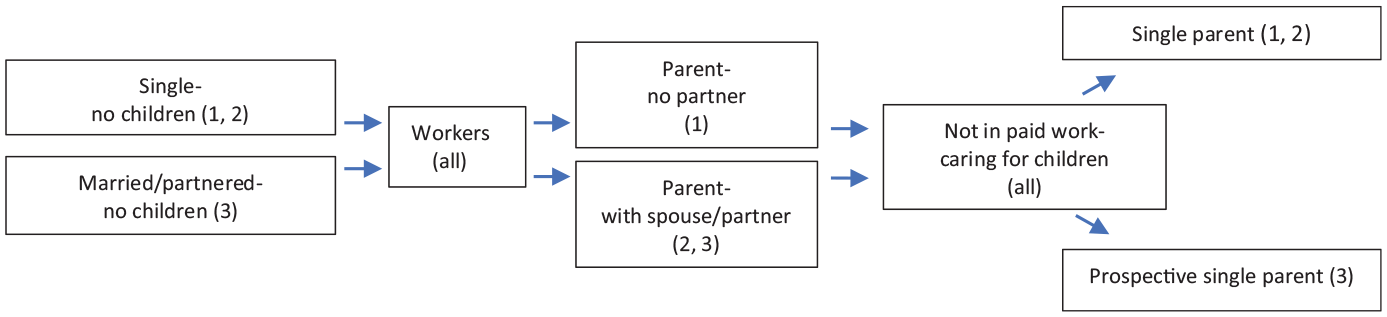
Work-Family Transitions after Migration to the UK Analyzed through These Cases
Between Work and Family: Lived Experiences of Migration and the Risks of Single Parenthood
Experiences of work and family change during the five years after moving to the UK presented particular risks for these women as single parents relating to their legal status and restricted access to social benefits and housing assistance. The names of these interviewees have been changed and some details omitted to protect anonymity.
Case 1: Anna
Anna had come to the UK to work. While she came alone, without other family, she had some friends and a sibling already in the UK. Although she had limited spoken English, finding work had not been difficult initially, and she had moved around various places in England doing temporary low-paid jobs, including factory work. Her experiences of mobility in work related to the temporary nature of the jobs as well as irregular and insufficient hours. As a worker, she had been able to access income-related benefits (Working Tax Credits) to top up her low wages, while relying on the informal support of her sibling during short periods out of work in between temporary jobs.
After coming to the UK, Anna had a brief relationship and became pregnant, having her baby as a single parent. She stopped work after having her baby and received Maternity Allowance (publicly funded maternity payments). At the end of the statutory period of maternity benefits (39 weeks), she tried to claim Income Support (means-tested social assistance, available to partnered or single parents with children under five 5 ), but her claim was refused as she was told she was only entitled to social benefits on the condition of “registering as a jobseeker.” As an EU national, the conditions for full access to social benefits in the UK required participation in the labor market (as a “worker” or registered as a jobseeker). As a result, Anna was required to make a claim for Jobseekers Allowance (means-tested unemployment benefit), “actively seeking work” being a condition of that benefit. However, her benefits payments ended after a short period due to the time limits on EU nationals’ entitlement to benefits as a jobseeker (three months).
Anna’s experience of low-paid work and becoming a single parent brought with it a need for social provision. But by moving out of work during this period to care for her child, she was unable to maintain her status as an EU citizen “worker.” This resulted in losing an entitlement to social benefits that were contingent on maintaining the status of worker. At the same time, she was unable to depend on being the spouse/partner of an EU national, either for residence rights or for an income. Anna was not in a relationship with the father of her child and was no longer in contact with him. Moreover, he was a non-EU national, so she derived no rights under EU law as the “family member of a mobile EU citizen.” The transition out of work and into care as a single parent thus inhibited her access to social benefits contingent on labor market participation and, potentially, her entitlement to permanent residence in the long term. Without being a worker, Anna had to be economically self-sufficient as a condition of legal residence, with implications for the welfare of both her and her child.
Anna had participated in English language classes, which offered childcare provision, but had received no other support in accessing childcare and found it very difficult to find work during this period. Moreover, she found the pressures to find work very stressful, and she wanted to be able to focus on caring for her young child. She continued to rely on informal sources of support after the benefits payments were stopped, sleeping in the living room of a friend with her child. She had taken up a cleaning job, relying on her friend to care for her child during the irregular hours in which she was working. But this work ended after three months. At the time of interview, her friend had started another job and was no longer available to provide care support. Anna hoped it would be easier for her to manage the everyday challenges of work and care once her child started school.
Case 2: Sara
Sara had come to the UK with plans to work and pursue future studies. She did various low-paid jobs, including catering work, working long hours in jobs that she found to be a “move down” in terms of her previous experience before coming to the UK; but with limited English initially, she was ambitious to stick with things. “After two months, I was getting better and I changed the job, then I had two jobs. I still wanted to study but because I had the two jobs, I was working like 16 hours a day, I was working seven days a week. . . . I was working because I wanted to go home in the beginning, but then I wanted to stay here.”
Over time, Sara started a relationship with a man who was a UK national, and subsequently she became pregnant. She tried to go back to work after having her baby, as her partner was not in work, but her partner was unreliable in looking after their child. Sara experienced domestic violence in the relationship, and eventually she moved away from her partner. Although she was a single parent of a child under five, she found she was unable to claim social assistance (means-tested Income Support for partnered or lone parents caring for children under five). She was told that the conditions for her entitlement to benefits as an EU national required her to be in work or actively seeking work. Like Anna, Sara instead had to claim Jobseekers Allowance (means-tested unemployment benefit). But she found the obligation to be seeking work to be extremely stressful to cope with at the time with a baby and shortly after leaving an abusive relationship.
Sara wanted to travel out of the UK to stay with her mother for a while, to access family support with her baby; but she was worried that if she did so, her benefits payments would be stopped, and she would potentially be unable to reclaim them on returning to the UK (as she no longer had the status of worker). While Sara had a right to transnational mobility within the EU, she felt very much immobile over this period. At the same time, she felt forced to be mobile in meeting the requirement to be seeking work as a condition for access to social benefits in the UK, moving back and forth between the job center and home each week and looking for jobs along with taking care of her baby. Although she had wanted to move back into work in time, she talked of the challenges of the circumstances in which she was expected to do this: with a young child, a lack of access to family support, and limited access to publicly funded provision; while access to jobs with hours compatible with her care responsibilities was also limited—“If I can’t do the shifts they want me to do, then they just give the work to someone who can.” At the time of interview, her child was enrolled in preschool provision, and Sara was working a few hours each week that were compatible with her care responsibilities.
Case 3: Matilda
Matilda had come to the UK with her husband, a UK national. She worked for a period of time in the UK, doing relatively higher-skilled work related to her qualifications. Matilda then had children and stopped work to care for them. She had, at the time of interview, been living in the UK for just over five years and had looked into securing her status as a permanent resident, granted to EU nationals after five years’ continuous residence in the UK. However, moving out of work to care for her children had affected her ability to meet the conditions of five years’ legal residence in the UK. Those conditions required her to demonstrate that she had been a worker, self-sufficient person, or family member of an EU citizen during that period. Matilda had been advised by the relevant UK authorities that she would have to demonstrate that she had been “self-sufficient” during the periods when she had not been working while caring for her children. As she had not had private health insurance during this period (having been advised this was a requirement of “self-sufficiency”), she indicated that she would have to “start over again” in order to get five years of “continuously working, applying for a job or supporting myself.” Her gendered experiences of moving out of work, in order to care, thus contributed to her exclusion from the status of worker. At the same time, she was unable to rely on the status of spouse/partner of a mobile EU citizen. Her husband, being a UK citizen, did not count as a mobile EU citizen under EU free movement law as he had not moved to another EU country.
Matilda had been wanting to separate from her husband but felt unable to do so as she would be unable to financially support herself as a “self-sufficient” individual, with children, although she was hoping to get back into the work that she had been doing previously. And because she could not claim permanent residence, she was unable to claim social benefits or housing assistance on this basis. Moreover, she was worried that without a right to reside in the UK and a means to financially support herself, if she left her husband she risked being “sent back” to her country of origin and losing her children: “Any time I feel like they could send me home, if something happens with my marriage then I could be sent home. It makes me feel trapped.” Irrespective of whether Matilda could legally be “sent back” (i.e., deported), the conditions that restricted her access to residence rights and social protection contributed to her fears and sense of dependency.
The experiences of work and family change that these three cases document underline the ways in which work- and family-related conditions of residence can disadvantage migrant women as single parents. First, care impacts on women’s experiences as “workers,” as evident across these cases. As such, reentry to the labor market following maternity leave or having children cannot be assumed without challenges, particularly if women are single parents or making that transition. Second, where women are single parents, as in the cases of Anna and Sara, they may not be able to rely on a spouse/partner for financial resources or for residence rights when out of work. And where women want to separate from a spouse/partner, as in the case of Matilda, requiring them to be self-sufficient as a condition of residence in effect inhibits them from making that transition.
Work and family migration to the UK post-Brexit
Following Brexit, UK policy towards EU nationals has changed. EU nationals living in the UK before the end of 2020 were required to apply for “settled status,” that is, permanent residence (or “presettled status” if they have not yet been resident for five years). Arguably, these changes have brought security of residence for women in circumstances similar to these cases, as the application process was simplified, doing away with the requirement to demonstrate five years’ continuous residence as a worker, self-sufficient person, or spouse/partner of an EU citizen. However, EU nationals migrating to the UK since January 2021 fall under the mainstream immigration system, the conditions of which are much more likely to enforce market dependence for workers and family members alike.
As discussed previously, noncitizen migrant workers admitted under that system have no entitlement to social benefits or housing assistance, in or out of work, until they become permanent residents (for which they may be eligible after five years). Moreover, they must have sufficient funds for healthcare charges as well as the fees for renewing visas or applying for permanent residence and citizenship—and more for a partner and children—which can amount to several thousand pounds (Walsh 2020). Likewise, permanent residents or UK citizens must have considerable funds to be able to have noncitizen partners and/or children join them and for them to obtain permanent residence (Walsh 2020). This raises issues regarding market-based inequalities and exclusions for noncitizens and citizens alike. But as the analysis in this article indicates, those types of inequalities compound the risks faced by migrant women, especially as single parents.
Conclusion
Migrant women as single parents face increased risks of poverty, and those risks may be exacerbated by the extent to which citizenship and immigration policies enforce market or family dependence. Making access to legal residence and to social benefits and other social provision dependent on being a worker, and a worker with an ongoing attachment to the labor market, may adversely affect migrant women whose attachment to the labor market is impacted by care. And, perversely, it may restrict migrant women as single parents from access to the provisions of welfare states at a stage in the life course when they and their children are particularly in need of those provisions.
Making legal residence dependent on marriage/legal partnership means that migrant women who are not in paid work when caring for children, without access to social provision, are dependent on a spouse/partner not only for an income, but for rights to remain in a country. This inhibits women as single parents from access to residence rights. It also inhibits women from being able to form an autonomous household as single parents for fear of losing their residence rights, but also for fear of losing their children. Even if residence rights may be granted to the primary caregiver of a child who has residence rights in a country, the uncertainty of derived rights and the legal status of children can prevail in contributing to fears and dependencies. This not only restricts migrant women from transitioning to single-parent households but potentially places them at greater risk of domestic violence.
Policy approaches to support migrant women as single parents thus require both social policies and immigration policies that mitigate the risks of work and family change. As the lived experiences of the cases of EU migrant women and the wider evidence explored in this article suggest, enforcing market or family dependency exacerbates the risks faced by women transitioning to single parenthood or wanting to separate from a partner and make that transition. Immigration policies that recognize work and family change, and that mitigate the impact of care on women’s lives and access to resources, might include exemptions from work, income, or self-sufficiency criteria for migrant parents with dependent children to facilitate and maintain access to legal residence. At the same time, given the greater risks of poverty for migrant families, and migrant single-parent families in particular, mitigating those risks requires opening up and supporting access to social provision, including income-related benefits, housing assistance, and childcare provision.
This article contributes to an understanding of the heterogeneity of single parents, including migrant single parents, shedding light on the intersections of migration status and single parenthood. It also contributes to understanding the impact of immigration policies on the risks that migrant women experience as single parents, including exclusion from access to residence rights and social protection. I also point to the need for wider research that attends to that heterogeneity in investigating policy impacts and outcomes for single parents. This requires integrating analyses of immigration policies in research on single parents, and vice versa, as central to developing understanding of the formation, experiences, and outcomes of single-parent families.
Footnotes
Notes
Isabel Shutes is Associate Professor in the Department of Social Policy at the London School of Economics and Political Science. Her research examines the intersections of migration and social policies; inequalities relating to citizenship and migration status; and the implications for paid/unpaid work, care, and social provision. Her recent publications have appeared in Global Social Policy, Journal of Ethnic and Migration Studies, and Journal of European Social Policy.