




Abstract
Obtaining employment is a major barrier to social reintegration for people on probation or parole. Research on the reentry process identifies several mechanisms that accentuate difficulties in locating work, including human capital development, structural changes in the labor market, and onerous probation and parole conditions. In this article, we review theories that explain low labor market participation rates among people reentering society, and we draw on multiple sources of data to identify the types of jobs that are available to people with low human capital. We find that nearly a quarter of people in America’s state and federal prisons had permanently removed themselves from the formal labor market before their most recent arrest; however, exclusionary hiring practices in the formal labor market often push those carrying the stigma of a criminal record into underground or informal labor markets, where wage rates are markedly higher than the federal minimum wage. Our findings demonstrate that severe and chronic employment struggles often predate and follow incarceration. We provide a detailed discussion of policy reform proposals that could help to remedy this harmful dynamic.
The structure of the U.S. labor market has dramatically changed over the last 50 years. Industry centralization, globalization, and technological advancement have contributed to monopsony, where employers pay workers less than the value of their work (Benmelech, Bergman, and Kim 2020; Manning 2020; Sokolova and Sørensen 2021), thereby reducing the bargaining power of workers and increasing wage inequality among them (Mueller, Ouimet, and Simintzi 2017). As low-wage job growth, driven primarily by service work, has surpassed middle-wage job growth (Dwyer and Wright 2019), low-skilled jobs with the potential for upward mobility and escaping poverty have largely disappeared (W. J. Wilson 1987, 1996). For example, by the late 1970s, globalization had already led to a mass offshoring and a significant decline in well-paid, unionized manufacturing jobs (Holzer, Offner, and Sorensen 2006; Lazonick, Moss, and Weitz 2020; Rosenfeld 2014, 2021; W. J. Wilson 1987).
Changes in labor market structure have been accompanied by structural shifts in criminal justice policies and practices. The expansion of the criminal justice system over recent decades has compounded racial inequality in employment, wages, and wealth accumulation (Western and Pettit 2005; Pettit 2012; Sykes and Maroto 2016). Today, roughly 4.3 million adults are on probation and parole (Minton, Beatty, and Zeng 2021) and 70 million adults in the United States have criminal records (Craigie, Grawert, and Kimble 2020). The stigma and costs of a criminal record are not limited to felony convictions (Kohler-Hausmann 2018). Rather, people with any kind of criminal record face barriers to employment (Holzer, Raphael, and Stoll 2006; Pager 2003).
Accounting for poor employment outcomes among people with a criminal record, researchers often point to characteristically low levels of educational attainment and sparse work histories. In 2010, 55.7 percent of all people in prisons and jails had dropped out of high school (Ewert, Sykes, and Pettit 2014). While wages of skilled workers have risen in recent decades, the real wages of people who dropped out of high school have declined (Autor, Katz, and Kearney 2005).
This article reviews research on barriers to work for people with a criminal record. We explain the ways in which the employment struggles of people with a criminal record are a product of structural challenges faced by many workers without postsecondary schooling, and we chart leading theories that help to explain their labor market participation. We highlight key empirical facts about how the justice system impacts job searches and present new estimates of employment measures and explanations for labor force withdrawal, drawing attention to the important role that the underground and gig economies play. We conclude with a discussion on policy implications.
Leading Theories
Four leading theories, all of which focus on structural constraints and employer decisions, help to explain the challenging labor market experiences of people with a criminal record, many of whom are on probation or parole.
Segmentation (dual labor market theory)
The bifurcation of “primary” and “secondary” workforces—which differs by employer and employee expectations, pay scales, autonomy, and other job attributes (Doeringer 1967; Doeringer and Piore 1971)—highlights how workers encounter different opportunities based on their human capital. While the primary labor market is characterized by good wages, better working conditions, and a chance for advancement, the secondary labor market comprises menial work, employment instability, low wages and no benefits, unsafe working conditions, and little chance of advancement (Reich, Gordon, and Edwards 1973).
Mismatch
Despite labor market segmentation and a slowing of educational attainment (Goldin and Katz 2007), aggregate labor skills have improved since the 1970s (Handel 2003). At the same time, job requirements and the demand for credentials have increased, reorienting the structure of the labor market to reward higher-skilled workers (Kalleberg 2011). This incongruity constitutes a labor market mismatch between employer-desired attributes and those possessed by marginal workers in many industries. Another form of mismatch occurs when workers invest in qualifications unrelated to their job requirements (Sørensen and Kalleberg 2014). As such, employers may penalize the wages of “overqualified” mismatches while also attempting to avoid overcompensating “underqualified” workers (Montt 2017).
Queueing
Prospective employers rank applicants by desirability, while applicants rank available jobs by desirability (Piore 2014). The intersection of these rankings forms a labor market queue that stifles the ability of workers with marginalized status(es) to ascend to a primary market (Reskin 2006). In other words, even the cessation of explicit discrimination is insufficient to quickly reach equitable outcomes because (dis)advantages accrue through work histories.
Stigma
Stigma is “an attribute that is deeply discrediting” (E. Goffman 1963, 12). Research shows that a criminal record operates as a negative labor market credential and signals to potential employers that justice-impacted applicants may be untrustworthy and unemployable (Pager 2003). Even when employers indicate a willingness to hire people with criminal records, they are statistically less likely to do so (Pager and Quillian 2005), as employers may believe that people with a criminal record lack the skills to perform well at work, prevent conflicts with colleagues, and be trustworthy with goods and money (Bushway, Stoll, and Weiman 2007). Employers may also fear legal or reputational liability (Lageson, Vuolo, and Uggen 2015; Bushway, Stoll, and Weiman 2007). The stigma of a criminal record further compounds existing racial discrimination in labor market outcomes (Pager 2003).
These theories and their supporting evidence suggest that justice-impacted individuals suffer from the “mark of a criminal record” (Pager 2003). Low human capital (Ewert, Sykes, and Pettit 2014; Holzer, Raphael, and Stoll 2006; Pager, Western, and Bonikowski 2009; Petersilia 2005; Western and Sirois 2019) and difficulties securing employment as a direct result of probation stipulations (e.g., curfews, mandatory check-ins, performing community service, etc.; Capece 2020) have many implications for justice-impacted individuals in the labor market. Below we list nine key empirical facts about employment and the formerly incarcerated population.
Key Empirical Facts
Our empirical analyses of multiple data sources, as well as a thorough review of the literature on this topic, leads to nine key facts about the employment and education/skills of people on probation or parole in the United States.
First, having a criminal record severely hampers employment opportunities (e.g., Finn and Fontaine 1985; Bushway 1998; Uggen et al. 2014). Employers may stereotype applicants with a criminal record or associate them with negative outcomes, including physical harm or increased liability (Cavico, Mujtaba, and Muffler 2014). These associations stem from both stigma of criminal justice contact (Sugie, Zatz, and Augustine 2019) and an assumption of low human capital (Bushway, Stoll, and Weiman 2007; Western and Sirois 2019). Employers claim to conduct background checks to assess applicant honesty, check for job-related offenses, and shield themselves and their companies from liability (Lageson, Vuolo, and Uggen 2015). However, such checks may result in the immediate removal of thousands of capable job candidates from the applicant pool.
Second, inquiring about applicants’ criminal history during hiring is a common employment practice. Approximately 97 percent of employers report conducting some form of criminal background check while screening job candidates (National Association of Professional Background Screeners [NAPBS] 2017). Of applicants asked by employers about their criminal history, 80 to 90 percent report being first asked on the application form (Vuolo, Lageson, and Uggen 2017; Denver, Pickett, and Bushway 2018). This suggests that many applicants with records never make it past the initial hiring stage.
Third, employment opportunities while incarcerated vary, ranging from staffing call centers to performing agricultural labor. While work experience and training programs support reintegration, opportunities to acquire skills in carceral settings are decreasing (Gottschalk 2010). Moreover, training and employment opportunities are often inequitably assigned. Jobs are commonly distributed based on existing skills and experience that privilege those who are already skilled. This distribution addresses the needs of the penal labor system, rather than skill deficits of the correctional population (Crittenden, Koons-Witt, and Kaminski 2018; Gibson-Light 2020). Furthermore, even when people gain work experience and formal credentials while incarcerated, they cannot always capitalize on these skills after release, as disclosing such earned credentials reveals applicants’ criminal histories (Lindsay 2021; Pager 2003). While prison credentials can signify skills and human capital that support employment searches, disclosing such credentials on a job application may invite discrimination during the employment search.
Fourth, formal employment rates are generally low in the year after release from prison. Estimates range from 40 to 64 percent (Pettit and Lyons 2009; Sabol 2007), although these do not capture the often temporary and unstable nature of jobs secured upon release (Harding et al. 2014; Western et al. 2015). Relatedly, studies show that even when people on probation or parole find employment, they struggle to remain employed (e.g., Harding et al. 2014). Many face challenges that include professional self-presentation, reliable access to transportation, and residential proximity to areas where jobs are concentrated (Harding et al. 2014).
Fifth, in recent decades, the availability of “quality jobs”—characterized by compensation (Howell and Kalleberg 2019), retirement benefits, health care, worker autonomy, and other benefits (Kalleberg 2011)—has sharply declined. People with a criminal record often struggle to find such jobs, resorting to the secondary labor market or the underground economy (Edin and Lein 1997; MacCoun and Reuter 1992; Levitt and Venkatesh 2000).
Sixth, given the aforementioned challenges, many justice-involved people submit numerous job applications and extensively mobilize their social networks to increase their odds of securing employment (Harding et al. 2014). They also apply to less desirable jobs, including those considered temporary or precarious (Sugie 2018). These jobs are found in the formal and informal labor markets (Pager and Pedulla 2015) and include construction, retail, maintenance, and warehouse work.
Seventh, recent research shows that people with a criminal record who find employment often work a fraction of the total workdays, suggesting that these individuals were not employed in full-time work (Sugie 2018). These temporary employment opportunities have been described as “foraging” (i.e., diverse and short-term jobs that help people to survive). Although most recently released people seek formal employment, many resort to foraging after a search period of roughly one month (Sugie 2018).
Eighth, many imprisoned people had labor market difficulties prior to their arrest. Table 1 displays data gathered by the U.S. Bureau of Justice Statistics in 2016 of employment statistics for imprisoned people 30 days before their recent arrest. Our analysis demonstrates that roughly three in five people who are incarcerated (61.2 percent) were employed in the formal labor market and worked an average of 1.26 jobs before their imprisonment. However, 38.3 percent of people who are incarcerated were unemployed prior to their current arrest. This finding suggests that low employment rates observed one year postrelease may not diverge widely from aggregate, preprison employment trends (Pettit and Lyons 2007; Sabol 2007).
Employment Statistics of People in State and Federal Prisons 30 Days before Their Recent Arrest, United States, 2016
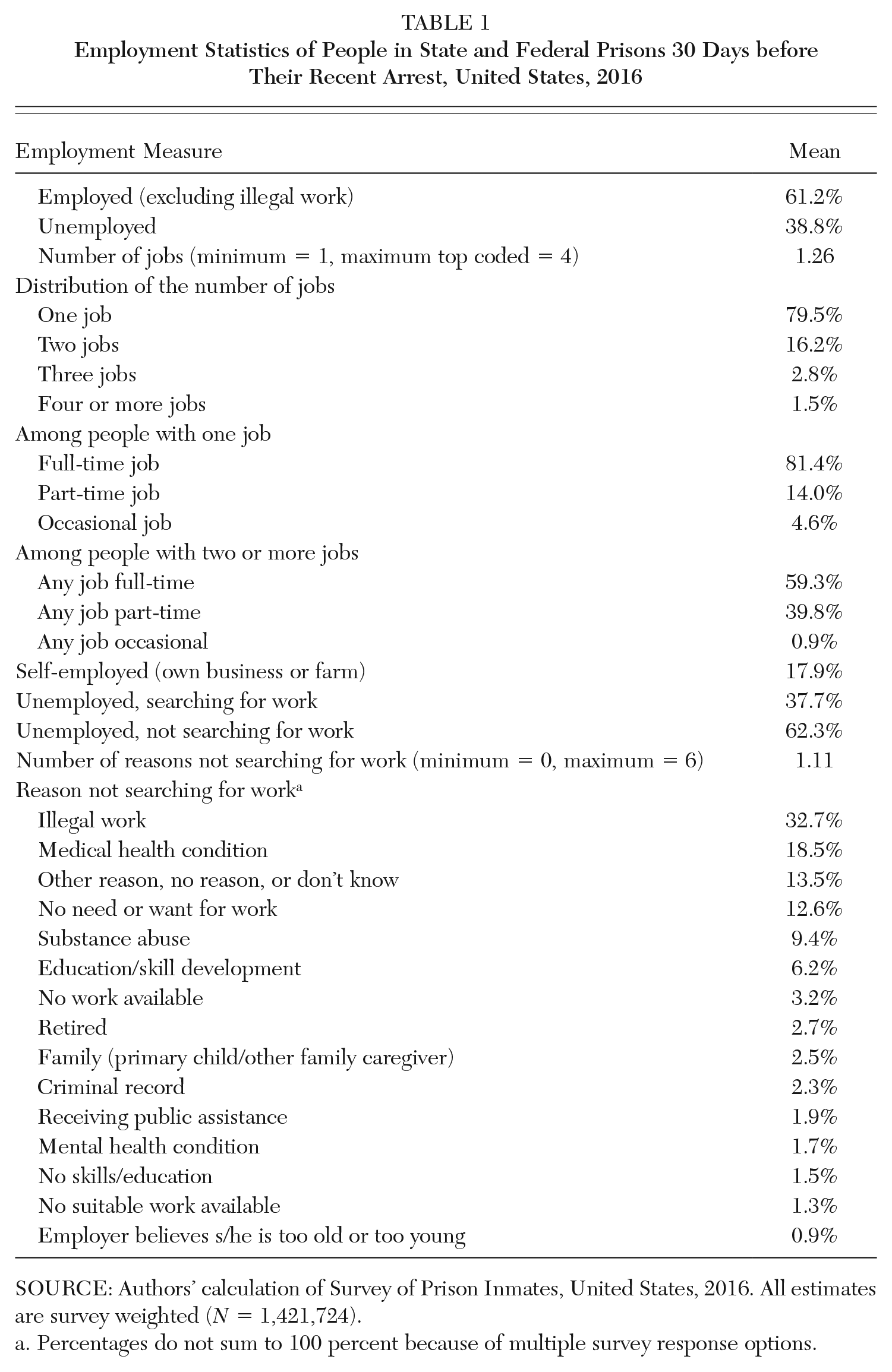
SOURCE: Authors’ calculation of Survey of Prison Inmates, United States, 2016. All estimates are survey weighted (N = 1,421,724).
Percentages do not sum to 100 percent because of multiple survey response options.
Last, many people who are incarcerated and who were unemployed prior to their arrest had removed themselves from the formal labor market. As Table 1 shows, while 37.7 percent of unemployed people were still searching for work, 62.3 percent had discontinued their search; this finding suggests that, overall, nearly a quarter (23.9 percent 1 ) of people—360,436 2 individuals—in America’s state and federal prisons had permanently removed themselves from the labor market even before their incarceration. Unemployed people who had ceased searching for work listed an average of 1.11 reasons for their labor force withdrawal. The most common reasons were employment in illegal work (32.7 percent), a medical condition (18.5 percent), no need or want for work (12.6 percent), substance addiction (9.4 percent), and—critically for the purposes of this article—education and skill development (6.2 percent).
Alternative Economic Opportunities for People with a Criminal Record
The underground economy
Exclusion from the formal labor market may lead to labor force withdrawal or immersion in the underground economy. As W. J. Wilson (1996, 74) observes, “Many people who are officially jobless are nonetheless involved in informal kinds of work activity, ranging from unpaid housework to work in the informal or illegal economies.” Indeed, recent research finds that more than one-quarter of U.S. adults engage in some form of informal work, with more than one in nine adults having two or more informal work arrangements (Abraham and Houseman 2019). As noted in Table 1, illegal work, which may be conflated with informal work, is an important reason for pre-arrest exit from the formal labor market.
Working in underground economies provides wages for people with a criminal record that “compensate for their disadvantages in the formal [labor] market” (Sykes and Geller 2016, 23). Underground economies run parallel to the formal labor market (Castells and Portes 1989), creating alternative employment and wage opportunities.
The underground labor market helps people living at the margins to maintain financial stability (Feige 1990; Haney 2018; A. Goffman 2015; Edin and Lein 1997). It supplements the secondary labor market, providing economic opportunities to people with a criminal record and others who lack legitimate employment options (Sykes and Geller 2016). These economies allow people with a criminal record to earn money that is not taxed, controlled, subject to garnishment, or regulated by the state. Haney (2018), for instance, finds that fathers with a criminal record who are employed in low-wage service positions are often engaged in informal and illegal economies to offset legal monetary sanctions and other financial obligations, like child support debt. This economy provides income to people who would otherwise experience financial instability or unemployment due to the disadvantages created by the formal labor market and their potential human capital deficits. Labor market queuing, coupled with stigma, may entrench the necessity of underground work, particularly for low-skilled men.
Research has explored the types of work available to men involved in the illegal or underground economy for decades (e.g., MacCoun and Reuter 1992; Saner, MacCoun, and Reuter 1995; Levitt and Venkatesh 2000). Table 2 shows the occupational distribution and average earnings of fathers laboring in the underground economy. More than two-fifths of fathers working underground are employed in construction and precision trades, earning an average hourly wage of $16, more than twice the current federal minimum of $7.25 per hour (US Department of Labor 2021). More than a third of fathers work in the service, maintenance/repair, and landscaping/agricultural sectors of the informal economy, earning average hourly wages within a range of $12.03 to $14.09. Therefore, many fathers with a criminal record have turned to the underground economy, earning wages that equal or surpass those available through low-wage work in the formal economy.
The Distribution of Occupations and Average Earnings among Fathers in the Underground Economy, Waves 2 and 3 of the Fragile Families and Child Wellbeing Study (FFCWS)
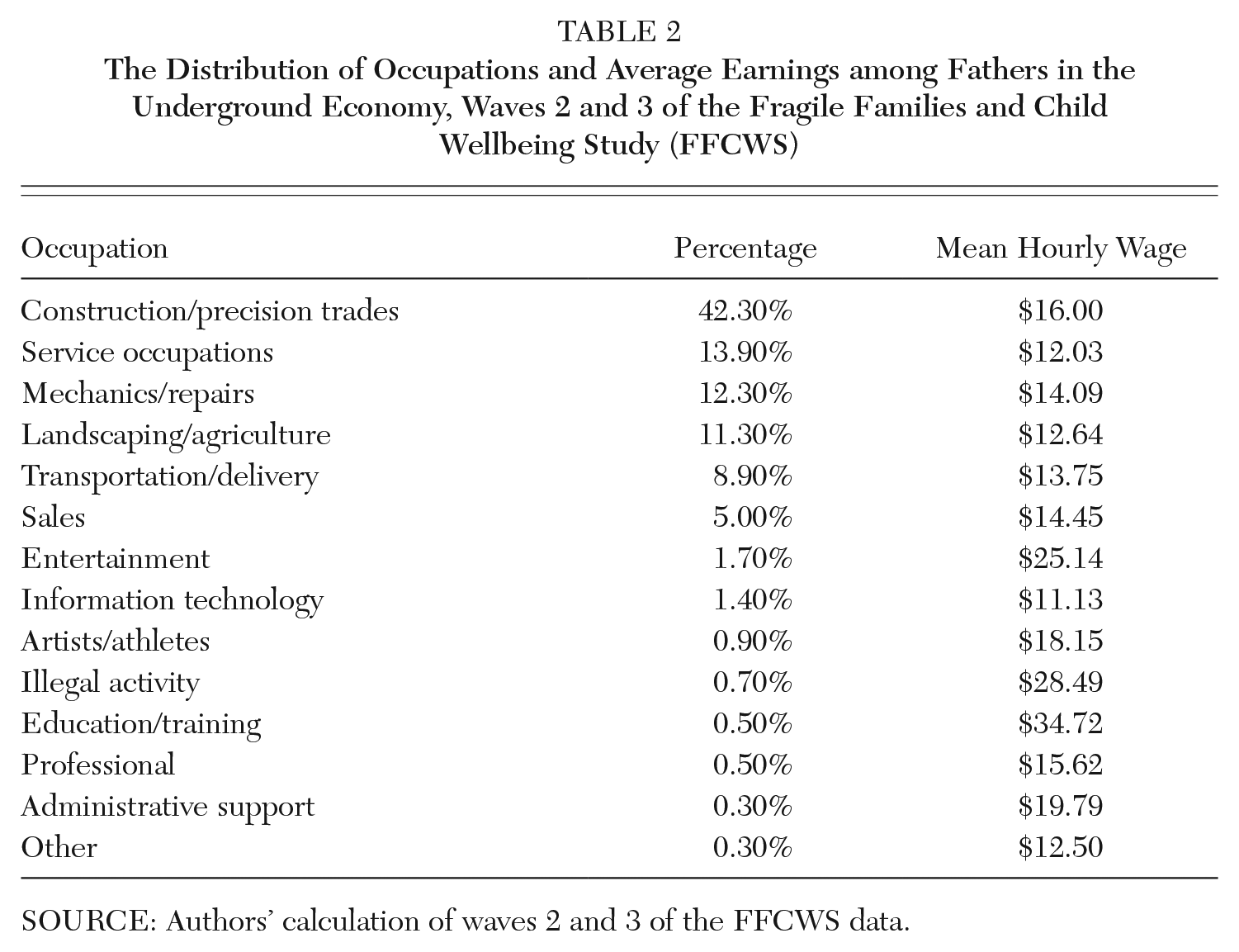
SOURCE: Authors’ calculation of waves 2 and 3 of the FFCWS data.
The gig economy
Technological advances have enabled the growth of the “gig” economy, creating alternative employment opportunities for job seekers (Huang et al. 2020). The gig economy includes digital, service based, on-demand platforms (e.g., Uber or Lyft), along with remote jobs that offer task-oriented, short-term employment (Greenwood, Burtch, and Carnahan 2017; Wood et al. 2019). The gig economy now employs approximately one in three U.S. workers (Rizer, Liebman, and Haggerty 2018), with a greater proportion of working-class people of color participating in this sector (Smith 2016; van Doorn 2017). This sector also offers employment opportunities to people with a criminal record who would otherwise experience discrimination and stigmatization in the formal labor market.
Like the underground economy, the gig economy offsets unemployment and underemployment by providing a means to earn or supplement income for people struggling to find or maintain stable work (Agrawal et al. 2015; Burtch, Carnahan, and Greenwood 2018). Through the gig economy, people with a criminal record can find independent employment or entrepreneurial ventures (Hwang and Phillips 2020; see also Table 1 for self-employment statistics).
However, notable drawbacks are associated with the gig economy, including global labor competition (Kanat, Hong, and Raghu 2018), economic vulnerability (Bergman and Jean 2016), job insecurity (Manyika et al. 2016), a lack of health care and other benefits (Schor 2016; Kalleberg and Dunn 2016), diminished wages over time (Jacobs 2017), inconsistent working hours (Lehdonvirta 2018), and the potential damage to future formal labor market opportunities. Still, the gig economy offers a key source of employment opportunity to people with a criminal record. This group is uniquely threatened, therefore, by the push to regulate the sector (Stewart and Stanford 2017; Rizer, Liebman, and Haggerty 2018) and introduce more formal labor market expectations (e.g., criminal background checks) that exclude people with a criminal record.
Research Implications and Policy Prescriptions
The literature that we have reviewed here gives rise to several research and policy implications related to labor market mismatch, queuing, and stigma. These policy implications include expanding direct investment in people with a criminal record, empirically investigating the impact of “ban the box” (BTB) policies, 3 and empirically assessing the spillover effects of such policies on people with a criminal record.
Policy prescription #1: Expand direct investments in education and skill development for people with criminal records, while providing workplace support and incentives for employers
To attenuate labor inactivity and underemployment of people with a criminal record upon release, social policies and programs must be devised that directly expand educational opportunities and opportunities for credentialing while incarcerated. We recommend that at the time of sentencing, an educational and skills development plan be devised for each person entering prison or placed on probation that spans the length of their sentence. For people who do not have a high school diploma, this plan would focus on building core skills that would enable the person to pass the General Education Development (GED) test, leading to a GED diploma. Once the GED has been obtained, or for people with an existing high school degree, additional coursework that prepares people for skilled trades or generalized knowledge should focus on assisting individuals in obtaining a two-year associate or a four-year bachelor’s degree, depending on the length of confinement or probation period. Each of these degree programs and their required coursework should be subsidized through special needs funding appropriations and philanthropic fundraising, working in concert with state-supported education programs. 4 Educational programs should also build out institutional and social support for people with a criminal record. 5 Additionally, upon reentry, should people with a criminal record and individuals on probation seek to obtain advanced degrees, federal and state grants and fellowships should be made available to them. 6
Where and when possible, people who are incarcerated should be matched with internal and external work opportunities that are commensurate with their educational and skills development prior to reentry. Apprenticeships should begin the year before parole or concurrent with probation periods. Employers should be incentivized to hire their apprentices with a criminal record through tax breaks and work subsidies that are tied to the employment of each paid person with a criminal record. 7 Corporate tax credits, health and retirement account rebates, and other financial incentives should be offered to employers who hire and invest in the full-time, long-term employment of justice-involved people. 8 One potential policy method to ensure long-term employment and work stability for people with a criminal record would be to increase annual tax credits and benefit rebates for employers over a 5-year period, enabling employers to plan and to stabilize their workforce, especially in volatile sectors of the economy and during economic downturns. An added benefit of this policy is that, over time, it would become increasingly costly for employers to lose their investments in such employees, necessitating requisite pay increases and advancement opportunities for people with a criminal record. Employers who leverage these tax credits and benefits rebates should be compelled to acknowledge and to comply with existing civil rights and antidiscrimination laws. 9
Additionally, employers should encourage and subsidize additional training and educational support for people with a criminal record even after employment is secured. This encouragement would bond the employer-employee relationship in a manner that underscores a long-term and mutual investment in each other. Successful completion of these additional skills and training should be accompanied by a predisclosed and contractually binding increase in wages and benefits, providing the employee with a known path to advancement and upward wage mobility consistent with human capital investments. This approach would also increase the personal income taxes paid by the employee while reducing the risk and fiscal cost of a potential reincarceration, and this incentive would also stabilize the employment history of the person with a criminal record.
Policy prescription #2: Empirically investigate the impact of BTB policies in both public and private employment
Grassroots organizers and some legislators have long promoted BTB policies to bar employers from inquiring about criminal records during the initial hiring process as a means of combating stigma. Reformers have also promoted “fair chance” laws to limit how employers use criminal records prior to making a job offer. Research suggests that BTB measures have improved public sector labor market outcomes for people with criminal histories (Shoag and Veuger 2021). The public sector is often the main target of BTB policies and is likelier to comply with these laws than the private sector. BTB policies raise the likelihood of public sector employment for people with convictions by an average of about 30 percent (Craigie 2020). Other research, however, finds a neutral impact of BTB laws on employment and earnings (Stoll and Bushway 2008). Some scholars attribute this finding to the continued abundance of applications for low-skill, low-wage jobs for which clean records are not a prerequisite (Rose 2021). Overall, research on BTB laws remains relatively limited, particularly regarding the private sector. More data are needed to understand the full impact of BTB laws and to generate policy recommendations that strengthen labor market outcomes for justice-involved people.
Policy prescription #3: Empirically research the spillover effects of BTB policies on people without a criminal record
The U.S. Equal Employment Opportunity Commission (EEOC) issued guidance that reminded employers using people’s criminal history to make employment decisions may violate federal antidiscrimination law under Title VII of the Civil Rights Act of 1964 (EEOC 2012). 10 Indeed, some studies have found that BTB policies result in employers statistically discriminating against Latino and Black men (e.g., Doleac and Hansen 2016; Holzer, Raphael, and Stoll 2006). A field experiment in New Jersey and New York found that the implementation of BTB policies increased the race gap for interview callbacks between White and Black from 7 percent (before BTB) to 45 percent (after BTB) (Agan and Starr 2018). Relatedly, some studies suggest that similar bans on other job screening practices cause statistical discrimination. For example, banning credit check screening generated, on net, poorer outcomes for the groups commonly thought to benefit from such legislation (Bartik and Nelson 2016).
Yet other researchers caution against the wholesale acceptance of such conclusions. Emsellem and Avery (2016) argue that such findings do not reflect problems inherent to BTB policies, rather that entrenched discrimination during the hiring process manifests as the criminalization of Black and Latino men. They call for policies that increase job opportunities for people with criminal histories while confronting racial discrimination in hiring. Procedures like blind hiring (Goldin and Rouse 2000), for example, may lessen the likelihood of statistical discrimination. Similarly, Craig and Fryer (2017) propose an “investment insurance” policy that would allow the government to hire any worker it believes to be qualified and for whom other employers do not offer a job, but only after the government has observed employers’ preference signals using employment data (i.e., following a statistical examination of the variation structure in hiring for particular applicants of an employer). Overall, policy-makers must acknowledge and address the concerning unintended consequences linked to BTB policies. They should also pass new laws and policies to prevent the statistical discrimination that may result from BTB initiatives.
Conclusion
Over the past decades, labor monopsony and deindustrialization have cleaved the structure of the labor market into a middle- to high-wage primary sector and a low-wage secondary sector. This structural bifurcation of the formal labor market has increased the importance of credentialization and skills; caused a growing labor market mismatch between worker attributes and employer demands; led to labor market queuing around low-wage, low-skill jobs, where stigma curtails the employment prospects of justice-impacted people; and encouraged many primary and secondary labor market workers to move into the underground and gig economies for essential or supplemental employment and income.
Labor’s fragility was only exacerbated by the Great Recession of the late 2000s, during which minority—and particularly Black—workers experienced the greatest unemployment and lowest wage growth (Federal Reserve Bank of Atlanta 2020a, 2020b). Meanwhile, the wage premium associated with a college and graduate education has continued to increase (Lindley and Machin 2016), furthering the skill- and wage- polarization of the labor market. Labor inequities caused by the COVID-19 pandemic have further harmed populations at the margins, like Black workers, workers without reliable childcare, or people lacking broadband, high speed Internet access (Center on Budget and Policy Priorities [CBPP] 2021; V. Wilson 2020).
For people with a criminal record, the declining availability of low-wage jobs is compounded by employer background checks, which can limit access to even low-level work in the formal economy. When people with a criminal record do find work, their jobs generally do not lift them out of poverty; instead, job requirements mandated by probation or parole only entrench economic inequality because they force people reentering society to rapidly engage in a labor market stacked against them, resulting in poor outcomes and the devaluation of their labor power.
Given the structural barriers to employment that people with a criminal record face, the underground and gig economies can be fruitful, parallel labor markets that supplement or replace formal employment. Policy-makers must consider that the potential regulation of the underground and gig economies could disparately impact people with a criminal record, who may depend on these sectors following their exclusion from the formal labor market. Moreover, policy-makers should also further consider the promises and pitfalls of BTB legislation to promote employment and economic mobility among people with a criminal record. Ultimately, new laws, increased educational support, and additional employer incentives are needed to boost employment and wage rates in the formal labor market for people on probation and parole.
Footnotes
Notes
Bryan L. Sykes is an inaugural Inclusive Excellence Term Chair Associate Professor and Chancellor’s Fellow in criminology, law and society (and, by courtesy, sociology and public health) at the University of California, Irvine. His research focuses on demography and criminology, with particular interests in fertility, mortality, population health, mass incarceration, inequality, and research methodology.
Meghan Ballard is a doctoral student in criminology, law, and society at the University of California, Irvine. Her research interests include linguistic (in)justice, racial and ethnic disparities in the criminal justice system, and the interplay between social inequities and access to justice.
Daniela Kaiser is a doctoral student in criminology, law, and society at the University of California, Irvine. Her research interests include the experience and consequences of criminal justice contact for individuals and their families, with a particular focus on how incarceration affects family life and child well-being.
Vicente Celestino Mata is a doctoral student in criminology, law, and society at the University of California, Irvine. His research interests include understanding the impacts of settler colonialism on immigration law and policy and the decision-making practices of immigration judges.
J. Amanda Sharry is a doctoral student in criminology, law, and society at the University of California, Irvine. Her research focuses on the genesis and effects of poverty and inequality, specifically how it relates to social marginality, formerly incarcerated populations, and the labor market.
Justin Sola is a doctoral candidate in criminology, law, and society at the University of California, Irvine. His research involves testing theories of why people seek security and exploring how inequality is maintained and magnified in the criminal legal system.