



Abstract
Future migration is central to contemporary politics, but we know little of how citizens and policy-makers perceive and predict migratory trends. I analyze migration forecasting in a representative sample of the population of France, using survey data and administrative records to document differences in the accuracy of forecasting among groups of individuals. The article takes an interdisciplinary approach to future-oriented thinking, conceiving it as a distributed cognitive process, and showing that educational attainment and migratory background shape one’s ability to predict short-term trends. My analysis stresses the importance of accounting for sociodemographic characteristics and social networks in forecasting: I show that social diversity can improve predictions and extend studies based on the Delphi methodology by discussing the relevant expertise to forecast in different realms.
In the geopolitics of mobility, 2020 has been a turning point. Unprecedented travel restrictions brought international migration to historically low levels—and who knows how and when mobility will resume. As in many domains currently, uncertainty prevails. However, migration politics inherently implies a degree of anticipation for better or worse. The threat that opening borders would lead to the “invasion” of rich countries (Lessault and Beauchemin 2009), or the statement that migrants would contribute positively to their countries of destination, imply assumptions about what would happen in the future. Anticipating the pattern of migratory flows is key to “ensure effective management of asylum, migration and integration systems” (Nejad and Schurer 2018). But how do people form their predictions about migration? Does the perception of the future of migration vary, depending on individuals’ cognitive abilities, socioeconomic status, and social networks; and which characteristics are associated with a better ability to forecast?
The existing literature on forecasting has largely focused on highly educated respondents, with an explicit interest in politics, as I discuss in the remainder of this article. In the real world, citizens have heterogeneous levels of cognitive skills, education, and political competence; but empirical research on prediction making in the general population is lacking. Moreover, current studies tend to focus on the psychological factors associated with prediction making, overlooking the socioeconomic factors influencing one’s perception of the future. This article shows that individual trajectories (in particular educational attainment and migratory background) shape individuals’ ability to predict short-term trends. Furthermore, prediction making has been mostly studied at the individual level, concealing the influence of group-level characteristics on future-oriented cognition. To the best of my knowledge, there is an absence of empirical research conducted on the general population putting into perspective the influence of individual and collective resources when it comes to prediction making. This article advances this line of research by showing that the best forecasters have several traits: they score high on fluid intelligence and cognitive flexibility, they tend to be highly educated, and they have more diverse social networks. Discussing why people who interact with migrants predict migratory trends accurately, this article adds to a growing literature that stresses the cognitive benefits of social diversity (Baggio et al. 2019; Bai, Ramos, and Fiske 2020).
To do so, this article draws on an empirical design mining the intersection between the cognitive and the social sciences. More precisely, it combines survey data—collected from a representative sample of 1,405 French citizens in July 2020—with administrative data accessed in November 2020. This empirical design sheds new light on the mainstream population’s and policy-makers’ perception of a burning social issue—the future of migration in the early 2020s. By connecting several strands of literature, this piece further confirms the relevance of combining disciplines to study sociopolitical cognition in a world on the move.
Literature Review: An Interdisciplinary Approach to Prediction Making
In light of the existing literature in several fields, the collective knowledge of future-oriented cognition remains limited because of a lack of interdisciplinary studies drawing on representative samples.
Social sciences’ perspective on forecasting
A recent edited volume (Beckert and Bronk 2019) offers a welcome analysis of the latest developments of the field of economic forecasting. It stresses that, while economic forecasting is largely used by stakeholders in practice, social science research on the topic remains limited. To fill the gap, this collective contribution explores the models available to forecast economic evolutions, how real-world actors make use (or not) of existing models, and the extent to which forecasts exert a direct influence on reality (self-fulling prophecies). The case studies analyzed throughout the volume are all drawn “from settings where ‘futures’ are explicit stakes in the field: economic forecasting, central banking, finance, and business innovation” (Beckert and Bronk 2019), which indicates that this publication leaves out “political settings” (Spillman 2020) and focuses solely on economic elites.
Likewise, the literature on political cognition largely focuses on political elites at the national and supranational levels (Tuckel 1983; Böhmelt et al. 2016; Kropp 2010). Therefore, this body of work is mostly based on small-n studies, raising questions about the generalizability of the findings (Vis 2019). Moreover, given that voters and politicians differ in several ways, we can rightly assume that conclusions based on data collected from (political or economic) elites do not necessarily hold true for the general population. Moreover, while political forecasting has a long legacy in the field of political psychology, this subfield remains mostly concerned with predicting electoral outcomes (see Lewis-Beck and Tien [2012] and Stegmaier et al. [2017] for overviews)—but there is more to political life than elections. Nonetheless, the latest advances in this field show that laypeople can forecast election results more accurately than the polling industry, presumably because they draw on information carried through their social networks (Murr, Stegmaier, and Lewis-Beck 2019). But the role and composition of these networks remain understudied.
Surprisingly, sociologists also remain silent on the role of social networks to access and process information relevant to forecasting. Early sociologists have studied social forecasting (e.g., Henshel 1982). This body of work, though, mostly studies the outcomes of social forecasting. Few empirical studies analyze how (the content and impact of) forecasts are shaped by forecasters’ social characteristics. One exception is worth mentioning: a recent empirical study conducted in the circus arts industry showed that “managers were not better than laypeople” at forecasting the success of new projects (Berg 2016). This research, however, is specifically focused on the creative industry and, crucially, did not collect any sociodemographic information from the research participants. Therefore, we do not know if characteristics such as education or social network played a role.
However, sociodemographic characteristics matter: sociologists have shown that individuals perceive their own future differently, depending on their socioeconomic background and networks. Dreams matter: “imagined futures both enable and motivate actions” (Whitford 2002, 338, cited in Frye 2012). The literature looking at educational aspirations and expectations (Kao and Tienda 1998; Engzell 2019; Vari-Lavoisier, in preparation) stresses that higher levels of socioeconomic resources are associated with higher aspirations and higher expectations regarding one’s future. This research also highlights that peer effects are decisive: scores of studies show that teenagers’ expectations about their own future are influenced by significant others (see Wu and Bai [2015] for a review). However, research on educational aspirations remains disconnected from the study of forecasting. As a result, the social science literature does not account for the influence of significant others on individual predictions. However, the psychological literature on forecasting shows the relevance of studying pooled predictions (at the group level), not least because these are consistently more accurate than individual forecasts.
Psychological approaches to forecasting
Psychologists greatly advanced the study of forecasting in the last decade. Their work shows that humans “see better than they foresee” but nonetheless act on their inaccurate predictions (Seligman et al. 2016). Extant psychological work stresses that intuitive predictions are usually worse than statistical predictions and, sometimes, worse than chance (Dawes, Faust, and Meehl 1989). People tend to be terrible forecasters notably because they largely “misuse” probabilistic rules when updating their beliefs and test their hypotheses in suboptimal ways (Kahneman, Slovic, and Tversky 1982; Mellers et al. 2019). Moreover, probability estimates proved to be highly susceptible to base rate neglect, hindsight bias, and overconfidence (see Gilovich, Griffin, and Kahneman [2002] for a literature review).
Expanding on this body of work, a team of researchers based at the University of Pennsylvania has been investigating, since 2011, why most people are terrible forecasters, while a few are “super forecasters” (Tetlock and Gardner 2016; Ungar et al. 2012). With the objective to study and support prediction making, this team set up large political-forecasting tournaments, sponsored by the Intelligence Advanced Research Projects Activity (IARPA). More precisely, they conducted experiments by randomly assigning forecasters to conditions that tested hypotheses about the drivers of accuracy (see Mellers et al. 2015). Based on this source of data, Tetlock and his team established that the accuracy of previsions correlates with individual cognitive abilities. Their work stresses, in particular, that the most accurate predictions were made by individuals who scored higher on fluid intelligence and cognitive flexibility, that is, the ability to update one’s beliefs and take into considerations various points of views (see Mellers et al. 2015, 2019). They also stress the importance of benefiting from “an enriched environment” (Ungar et al. 2012; Mellers et al. 2015), highlighting that working in groups (to combine predictions from multiple sources) proved to be systematically associated with more accurate forecasts than working alone.
These findings suggest that forecasting abilities depend on individual characteristics (fluid intelligence and cognitive flexibility) but also on group-level characteristics (or, at least, on the pooling of individual forecasts). However, the samples used for these studies were, deliberately, far from being representative of the general population. “Participation required a bachelor’s degree or higher and completion of a battery of psychological and political knowledge tests” (Mellers et al. 2015, 268). Participants tended to be men (83 percent), with U.S. citizenship (74 percent), and some postgraduate training (64 percent). This research is, therefore, based on data collected from groups that were highly homogeneous (educated in similar institutions, in the same country, sharing an interest in political forecasting, with enough free time to participate in such tournaments, and so on). Due to the lack of variability, this source of insights does not allow us to study how sociodemographic characteristics influence the ability to forecast. We know very little about the mechanisms that lead to observing better predictions at the group level; and the incidence of network composition remains underresearched, especially in the general population.
Pooling expertise: The Delphi method
Likewise, the abundant literature produced on the Delphi method focuses on elites, and more specifically on “experts” (see von der Gracht [2012] for a literature review). “Project Delphi” was launched in the 1950s and led to the development of a dedicated survey technique aggregating experts’ forecasting. The Delphi technique aims to foster an efficient group dynamic process by collecting and pooling anonymous, written, multistage forecasts, where feedback of group opinion is provided after each round. Even though a core objective of the Delphi method is to reach a consensus among experts, a general standard of how to measure consensus in Delphi studies does not exist yet (von der Gracht 2012, 1533). Crucially, the benefits of this methods, in terms of forecast accuracy, do not seem to be confirmed empirically: for example, a comparison of meta-analysis of estimates provided by ad hoc groups and by the Delphi method has shown that the former provided more accurate estimates than did the latter (Antman et al. 1992; Graham, Regehr, and Wright 2003).
This technique has been used in various domains, but empirical studies applying the Delphi methodology to elicit migration forecasts are scarce. Moreover, the only working paper we were able to locate on this specific topic looks at predictions in the far future (environment migration to the UK in 2060; cf. Findlay et al. 2012, 2–6); therefore, this research is not able to compare the forecasts to what actually happened (Findlay et al. 2012). Furthermore, the research relying on the Delphi methodology collected data from experts only, leaving out the general population (natives and/or migrants), which does not allow us to study if migration forecasts vary in the general population or to put into perspective experts’ predictions.
However, a recent paper focusing on nuclear energy stresses that nonexperts’ and experts’ predictions differ significantly (Hussler, Muller, and Rondé 2011). But their sample remains limited by the fact that all the participants were involved in the energy sector in some capacity. The above-mentioned studies did not collect data on participants’ networks either, obscuring the extent to which one’s social relations (e.g., having a spouse in the energy sector) might impact one’s own level of expertise on related issues.
Moreover, relying solely on experts’ forecasts raises a series of issues, as illustrated by desirability biases that can make experts’ forecasts diverge and impede the achievement of a true consensus (Ecken, Gnatzy, and von der Gracht 2011). And a closer look reveals that while this methodology selects experts, the criteria used to select those who participate in these panels tend to rely on conventional approaches, namely, sampling based on actor types and snowball sampling (Hirschhorn 2019), so that they represent “diverse affiliations” (Hirschhorn 2019; Santaguida et al. 2018; Skinner et al. 2015). Panels are made of experts, selected solely on criteria that supposedly reflect their expertise, without taking into consideration (or even collecting data on) their sociodemographic characteristics, their social networks, and/or their cognitive abilities—despite the abundant psychological literature stressing that cognitive abilities influence prediction-making skills (see below). In other words, the Delphi methodology leaves out cognitions, despite the fact that it seems to rely on the premise that distributed cognition can help one to approach complex issues, such as forecasting.
From peer effects to distributed cognition
Groups tend to perform better than individuals, in part because team interaction motivates individuals to do well in the presence of others (Hertel, Kerr, and Messé 2000). Studies in various domains have confirmed that groups can make process gains when they are cohesive and have strong productivity norms (Kerr and Tindale 2004). For instance, a large literature on peer effects in the classroom suggests that grouping students by performance can accelerate learning, especially among high achievers (see Epple and Romano [2011] for a review). However, we also know that teams can suffer from poor dynamics, such as social loafing (Bikhchandani, Welch, and Hirshleifer 1992; Hirshleifer and Teoh 2003).
Under which circumstances are group dynamics beneficial to solving complex problems? Two competing hypotheses can be drawn from the existing literature. On one hand, we know that peer effects are stronger within groups that are homogeneous with respect to key characteristics (e.g., academic achievement in the case of peer effects among students), and we know that intragroup cohesion and communication is hindered by (social or linguistic) heterogeneity. On the other hand, studies highlighting the benefits of cognitive diversity stress that ingroup homogeneity favors herding behaviors and blind spots (e.g., Syed 2019; Baggio et al. 2019). Early work (Henshel 1982) showed, for instance, that demographers’ failure to predict the postwar Baby Boom would have been caused by the fact that demographers disregarded relevant information because they “simply talked to each other too much.” Along the same lines, Syed (2019) stressed the adverse consequences of the homogeneity within the CIA. A recent synthesis published by Nature highlights that cognitive heterogeneity (a diversity of cognitive skills and cognitive styles) helps groups to solve collective action dilemmas and address environmental changes (Baggio et al. 2019). This strand of research makes a compelling case for the contribution of diversity to system performance (Page 2011). Extending this line of research, the current piece offers a study of whether network homogeneity facilitates teamwork or favors blind spots. By doing so, this article also contributes to the ever-evolving scholarship on distributed cognition.
Studying distributed cognition
Researchers interested in cognition study the mental processes allowing humans to acquire knowledge and understanding, that is, activities such as learning, remembering, sensing, perceiving, planning, and thinking (see Perry 2003). According to the classical view of cognition, cognitive processes are realized through internal symbol-manipulation in the brain (Bechtel, Abrahamsen, and Graham 1999; Hollnagel 2011, cited by Rybing 2018). However, this classical perspective has been widely criticized for excluding “the world from cognition and cognition from the world” (Rybing 2018, 30). The cognitive systems perspective, which emerged in reaction, stresses the need to develop a more comprehensive approach to human cognition, accounting for the fact that cognition does not happen only in the brain, but also through interaction between humans and their (social) environment.
Social cognition provides critical insights here (see Fiske and Taylor 1991, 2020). By studying how people think about themselves and others, this field highlights how individual cognition is shaped by sociocultural interactions. However, there is still a paucity of empirical studies that look at the extent to which cognition can be shared by several social agents. Looking at collective sociocognitive constructs, research on stereotypes (see Fiske 2018) is an exception in a landscape dominated by a pervasive “cognitive individualism” (Zerubavel and Smith 2010). Arguably, studying cognition at the group level raises methodological challenges, as illustrated by existing research on distributed cognition.
While early work used the term distributed cognition to study the combination of different executive functions within the same individual (McClelland and Rumelhart 1985), the term has been increasingly used to study conceptualize cognition at the system level rather than at the agent level (Blandford and Furniss 2006), that is, to study “cognition in the world as opposed to cognition in the head” (Rybing 2018, 30). To date, researchers have mostly employed distributed cognition to study work settings, such as airplane cockpits (Hutchins 1995), air-traffic control (Halverson 1994), control rooms (Garbis 2002), patient records (Bang and Timpka 2003), or collaboration in health care (Cohen et al. 2006) and research teams (Vari-Lavoisier et al. 2019). But future-oriented distributed cognition is largely understudied.
However, the psychological scholarship based on forecasting tournaments and on the Delphi methodology suggests the relevance of studying how social dynamics interact with cognitive abilities when it comes to forecasting. Extending these different strands of research, this article proposes to look at forecasting as a distributed cognitive process. To advance this research agenda, it studies how, in real-world settings, cognitive abilities, sociodemographic characteristics, and social networks jointly shape individuals’ ability to foresee what the future holds. It hypothesizes that in everyday life, people draw on their social environment to approach complex issues, such as forecasting. It tests this hypothesis in light of an original source of empirical data.
Data: An Interdisciplinary Empirical Design
To bring new objective evidence to the study of future-oriented cognition, this article draws on a cost-effective interdisciplinary empirical design. First, the PLAN project team collected data from a representative sample of French citizens between July 1 and 3, 2020, in a context marked by the spread of COVID-19. Circulated with the support of the survey company Respondi, the survey recorded respondents’ predictions of the evolution of the geopolitical situation at the time, with a focus on international mobility. It asked research participants to forecast migration trends in three months’ time (i.e., in September 2020). In addition, a series of items recorded participants’ predictions regarding broader sociopolitical trends (including election results and unemployment rates). Subsequently, I compared the forecasts collected at T0 (in July 2020) to objective administrative data reflecting the actual situation, in September 2020 (data from Eurostat and the French authorities, accessed in November 2020; see Table A3 in the online appendix).
The survey instrument comprised five modules that gathered participants’ sociodemographic characteristics (age, education, occupation, income), their migratory background (native, first-generation immigrants, or second-generation immigrants; see below), and social capital (e.g., proportion of friends born abroad). Further, the online survey recorded participants’ cognitive abilities by collecting data on fluid intelligence (Raven matrices) and numeracy (three-item scale), political knowledge (three-item scale), and cognitive styles (40-item scale, including 3 items measuring cognitive flexibility). See descriptive statistics for each variable in Table A1 in the online appendix.
The representative sample includes 1,282 French citizens (general population sample hereafter). The use of an exhaustive listing of all the French mayors (maires, as of July 2020) to distribute the questionnaire allowed us to collect an additional 123 surveys from local policy-makers (cf. online appendix Table A2). The final sample comprises 1,405 observations, of which 52 percent were female, 74 percent were employed (12 percent were retired, 7 percent were unemployed, 2 percent were students in some capacity, 5 percent were inactive/others). In the full sample, 80.4 percent of the respondents were natives (both parents born in France), 14.8 percent were second-generation immigrants (at least one parent born abroad), and 4.8 percent were first-generation immigrants (born abroad). The sample had a mean age of 45.2 years (SD = 12.9). See the online appendix for a detailed description of the sample, broken down by migratory status (Table A1) and subsamples (Table A2).
Empirical Strategy
This distinctive source of data allows me to (1) consider a sample that is representative at the national level; (2) compare policy-makers to the general population; and (3) compare natives, first-generation immigrants, and second-generation immigrants; while (4) adjusting for cognitive skills, sociodemographic characteristics, and network composition. The analyses presented here put into perspective the respective effects of (1) cognitive abilities, (2) socioeconomic characteristics, and (3) network composition on future-oriented cognition. The article focuses on predictions in two domains by comparing forecasts regarding short-term migration trends to forecasts regarding unemployment rates (baseline). In the subsequent analyses, the dependent variables are based on participants’ responses to questions about unemployment forecasts and migration forecasts, respectively.
Unemployment forecasts
Participants were asked, “Given the current situation, estimate the unemployment rate, in the general population, in France, in September 2020, as compared to January 2020.” Participants were invited to indicate their forecast using a sliding scale (ranging from –100, labeled strong diminution, to +100, labeled strong increase).
Migration forecasts
Participants were asked, “Given the current situation, estimate the number of asylum seekers, in France, in September 2020, as compared to January 2020.” Participants were invited to indicate their forecast using a sliding scale (ranging from –100, labeled strong diminution, to +100, labeled strong increase).
In November 2020, I combined this survey data with administrative data (cf. Table A4) to compute a score that reflected how accurately each respondent forecasted: the number of asylum seekers in France and unemployment rate in the general population in France on a 10-point scale (cf. Tables A1 and A2). This article draws on the final dataset to identify the factors associated with the most accurate predictions.
Bivariate Results
The descriptive statistics (see Table A1) confirm the relevance of considering unemployment forecasts as our baseline: we observe less variation (M = 5.38, SD = 2.47) for unemployment forecasts than for migration forecasts (M = 4.12, SD = 2.83).
Respondents have varied perceptions about migration trends, depending on their socioeconomic and migratory backgrounds. A focus on migration forecasts (survey data only) shows that a majority of respondents forecasted an increase in the number of asylum seekers (N = 700), a few predicted that the number of asylum seekers would remain stable (N = 176) over the period, while a minority forecasted a diminution in the number of asylum claims (N = 529). A breakdown by migratory background shows that, on average, first-generation immigrants predicted a drop in the number of asylum claims in France over the period (–4 percent on average), while second-generation immigrants and natives predicted a rise (+3 and 4 percent, respectively; see Figure A1 of the online appendix).
The empirical design allows us to assess who was right (cf. Table A3). The descriptive results indicate that more-educated respondents and first-generation immigrants did slightly better at predicting unemployment trends and much better at predicting migration trends than the rest of the sample (cf. Table A1). The multivariate results presented next aim to disentangle the respective incidence of cognitive skills, sociodemographic characteristics, and network composition on forecast accuracy.
To this end, I compare five models, gradually introducing new control variables and comparing the explanatory power of each model using the adjusted R-squared, as well as the Bayesian information criteria (BIC) and Akaike information criteria (AIC). To check the robustness of the findings, I ran these nested models on the full sample first (Table 1) and then restricted the sample to the general population (excluding policy-makers, cf. Table A4).
Multivariate Results (full sample)
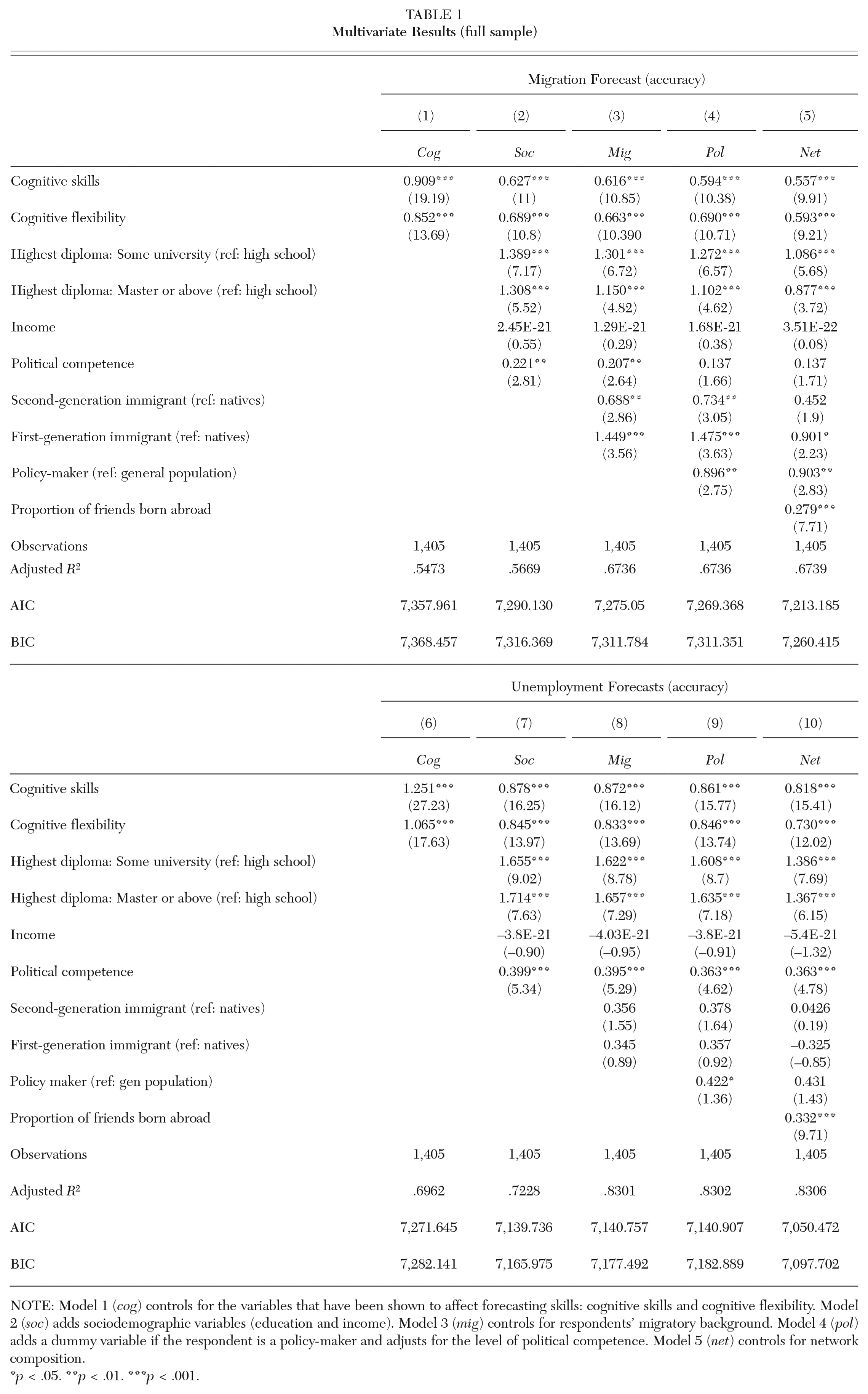
NOTE: Model 1 (cog) controls for the variables that have been shown to affect forecasting skills: cognitive skills and cognitive flexibility. Model 2 (soc) adds sociodemographic variables (education and income). Model 3 (mig) controls for respondents’ migratory background. Model 4 (pol) adds a dummy variable if the respondent is a policy-maker and adjusts for the level of political competence. Model 5 (net) controls for network composition.
p < .05. **p < .01. ***p < .001.
The comparison of these estimations, for the two outcomes of interest, shows that adjusting for participants’ sociodemographic characteristics and network composition increases the predictive power of the model (cf. model 5): the adjusted R-squared increases, while the BIC and AIC decrease (Vari-Lavoisier 2011). In other words, a modeling strategy based on an interdisciplinary approach to prediction making provides the best fit to the data.
Multivariate Results
The comparison of the five nested models shows the following:
- Cognitive skills (fluid intelligence and numeracy) are strongly correlated with forecast accuracy (cf. models 1 to 10, Tables 1 and 4A). These results are in line with previous psychological research (see below). This dataset confirms that these results apply to the general population, for both outcomes of interest (migration forecasts and unemployment forecasts). Likewise, cognitive flexibility is significantly and positively correlated with both outcomes in all the estimations. However, the coefficients decrease when adjusting for other factors, indicating that omitting sociodemographic variables might lead to overestimating the importance of fluid intelligence, numeracy, and cognitive flexibility.
- Education (cf. models 2 and 7, Table 1) is strongly and positively correlated with forecast accuracy. Adjusting for the highest diploma obtained decreases the significance of the correlation among cognitive skills, cognitive flexibility, and forecast accuracy. Changing the cutoffs for the different categories does not change the results, and adjusting for the current occupation indicates the same trends, with executives scoring higher than workers for both outcomes of interest (results available upon request). By contrast, income does not seem correlated with forecast accuracy (nonsignificant for both outcomes). The results are similar when adjusting for employment status, while suggesting that unemployed and inactive respondents did better than the reference category for unemployment forecasts, but not for migration forecasts (cf. models 7–10, Table 4A).
- Political competence (cf. models 2 and 7 Table 1) is positively correlated with forecast accuracy, for both outcomes, in the first estimations (p-value < .05), even if we restrict the sample to laypersons (see models 1 and 6 Table A4). However, we observe different patterns for the two outcomes of interest when we adjust for migratory background. For unemployment forecasts, political competence remains correlated with forecast accuracy in all the estimations (Tables 1 and 4A). For migration forecasts, political competence becomes nonsignificant after adding the dummy variable for policy-makers (cf. models 4–5, Table 1). To check the robustness of this result, I reran the estimations on the restricted sample (excluding policy-makers) and find a similar pattern (model 3 and 8, Table 4A), which shows that, even in the general population, political competence is not a strong predictor of forecast accuracy when it comes to migration. Having a migratory background and having friends born abroad appear to be more significant than political competence (cf. models 4–5, Table 1; and model 3, Table 4A).
- Local policy-makers scored higher for both outcomes of interest (cf. bivariate results, Table 2A); however, after adjusting for network composition, the effect becomes nonsignificant for unemployment forecasts (cf. models 9–10, Table 1). The effect remains significant (p-value < .01) for migration forecasts, which might reflect the fact that policy-makers are more likely to be familiar with a term such as “asylum seekers,” and might have a better sense of current figures, which helped them to give more accurate estimates of future trends.
- Having a migratory background improves migration forecasts (cf. models 3–5, Table 1 and Table A4), but not unemployment forecasts (cf. models 8–10, Tables 1 and 4A). The different estimations confirm that first-generation immigrants did better at predicting the number of asylum seekers than natives, even after controlling for a series of potential confounders. The comparison of the models 4 and 5 (cf. Table 1) suggests that migratory background and network composition are correlated (as one would expect). Therefore, second-generation immigrants do not score significantly higher after adjusting for network composition, but first-generation immigrants retain a comparative advantage in the different models estimated (cf. p-value < .05 in all the estimations); that is, even after controlling for network composition, first-generation immigrants predicted migratory trends more accurately than natives. The model 5 (cf. Table 1) suggests that policy-makers with a migratory background would be better equipped than anyone else to predict migratory trends.
- Network heterogeneity is positively and significantly correlated with both outcomes of interest: Respondents with a higher proportion of foreign-born friends predicted more accurately migratory trends and unemployment rates (p-value < .001, cf. models 5 and 10, Tables 1 and 4A).
Discussion
The multivariate analyses presented here stress the benefits of combining disciplines to advance the understanding of complex sociocognitive processes, such as forecasting.
First, the results indicate that previous work might have underestimated the role of formal education, while overestimating the role of specific cognitive skills (fluid intelligence and cognitive flexibility), due to the lack of variability within samples. However, the representative dataset that this article analyzed shows that, for individuals with comparable cognitive makeups and comparable levels of political competence, a higher diploma remains associated with better prediction-making skills. In light of these results, we can hypothesize that cognitive skills can help people to get a better education, and subsequently get a “better” job, but that it is through socialization and social networks that people access the general knowledge relevant to forecasting sociopolitical trends. Likewise, the importance of “political competence” might have been overestimated by previous studies, due to a lack of control variables. However, the multivariate results presented here show that, to forecast migration trends, abstract political knowledge is less relevant than the direct understanding of migration that one might gain through engaging with the lived experience of migrants themselves. Taken together, these results point toward the role of the social environment (friends and colleagues) as a strong predictor of individuals’ prediction-making skills.
Second, our results lead us to question the definition of expertise. The data show that personal experience provides people with valuable insights that help them to address complex matters. Even after adjusting for a series of potential confounders, migrants did significantly better than natives when asked to estimate future migratory flows—even better than policy-makers (cf. Table A2). By contrast, migrants did not perform better (or worse) than natives when it came to predict unemployment, while inactive respondents proved to be more accurate. People may gather more information on, and are more interested in, issues that are directly relevant to their own lives, which has practical implications, for instance if we consider the Delphi technique or forecasting tournaments. Expanding upon recent work (Hussler, Muller, and Rondé 2011), this article confirms the relevance of reconsidering the characteristics of the participants invited to participate in such procedures that pool forecasts. Here, it makes sense to consider the bivariate results, since the Delphi studies (and forecasting tournaments) deal with real people. If the objective is to improve the accuracy of pooled forecasts, it seems more relevant to set up panels made of diverse actors, who would score high on cognitive flexibility, be highly educated, and have diverse social networks. Furthermore, including individuals who have direct experience with a given matter can significantly improve the accuracy of forecasts made about the same or similar matters. Therefore, if the objective is to forecast migratory trends, it makes sense to incorporate the forecasts of migrants themselves. These results stand as an invitation to acknowledge how migrants can help host societies get a better understanding of themselves and be better prepared to address sociopolitical change.
Third, the multivariate results indicate that everyone, including natives, benefits from interacting with immigrants. Respondents with more heterogeneous networks (i.e., networks including a higher proportion of foreign-born friends) did much better at forecasting sociopolitical evolutions than individuals with more homogenous networks, keeping cognitive abilities and other key variables constant. People who have more immigrant friends seem more aware of the world in which they live. While some individual-level characteristics are significantly correlated with forecast accuracy, the findings presented here show that networks matter. This study expands here upon conclusions drawn from forecasting tournaments, which stressed that individuals make more accurate predictions when they benefit from an “enriched environment”: the current study fleshes out these insights by showing that, in everyday life, having friends with diverse backgrounds constitutes a richer social context, which is associated with better prediction-making skills. Interacting with people who migrated themselves helps natives to get a better sense of international mobility. These findings are in line with previous work showing that social diversity provides advantages to address complex problems, as shown by empirical research on resource management, for instance (Baggio et al. 2019; Page 2011). People with diverse backgrounds and different life experiences tend to think about the same questions in different ways (Syed 2019). This article substantiates these claims in light of a representative dataset, while adding to a growing body of evidence showing that social diversity is associated with a range of psychosocial benefits (Bai, Ramos, and Fiske 2020; Ramos et al. 2019).
However, this study is not without limitations. In our sample, first-generation immigrants exhibit higher levels of educational achievement than natives (only 23.9 percent did not go to university, compared to 39.4 percent for the full sample; cf. Table 1A). This could confirm that migrants tend to be positively selected with regard to cognitive abilities and educational achievement (Nejad and Schurer 2019). The composition of our sample might have been skewed by the method we used to circulate the survey (online), which often leads to underrepresentation of the most vulnerable groups (Buchanan and Hvizdak 2009), such as precarious immigrants. Nonetheless, our results indicate that highly educated migrants performed better than highly educated natives when it came to migration forecasts (but not unemployment forecasts). Of course, we cannot rule out the incidence of unobservable variables on the outcomes of interest. However, the diversity of measures included in the survey instrument provides reliable proxies for key factors, at the cognitive, socioeconomic, and network levels, which adds to previous datasets investigating forecasting.
Conclusion
Predictions regarding the future influence fundamental decisions, including economic choices (e.g., saving or investing), political behaviors (e.g., supporting a given candidate), technology adoption, and major life choices (what to study, where to move, whom to marry). Everybody forecasts, including citizens when they cast their ballots (anticipating that this candidate would do better than the others) and policy-makers when they design local or supranational policies. Forecasting is central in government planning (Pittenger 1980). And yet we still lack a comprehensive approach to the sociocognitive underpinnings of future-oriented cognition in the general population.
This article advances the current knowledge by using a distinctive source of data, which presents three main advantages: it compares predictions to the reality, it is based on a sample that is representative at the national level while including a subsample of experts (policy-makers), and it is highly interdisciplinary. The data analyses confirm the relevance of combining disciplines to put into perspective the respective incidence of cognitive skills, sociodemographic individual characteristics, and social networks. The multivariate results show that cognitive skills matter but also suggest that forecasting requires an understanding of the real world that one gains through education and, crucially, social interactions. These findings highlight the relevance of conceptualizing future-oriented cognition as a distributed cognitive process, involving not only individual brains but social beings who draw on information provided by their social networks to make sense of their environment. This article offers a sociological perspective on distributed cognition, confirming that highly homogenous networks create blind spots (Henschel 1982; Syed 2019), while cognitive diversity is associated with cognitive gains (Baggio et al. 2019; Page 2011; Syed 2019).
At the practical level, this study extends the knowledge based on the Delphi methodology in two ways. It stresses the relevance of drawing on the psychological literature to consider cognitive abilities (fluid intelligence and cognitive flexibility) when selecting experts. It also stands as an invitation to think critically about who is an expert, by showing that institutionalized expertise might be less relevant than firsthand experience when it comes to deciphering short-term trends. In sum, this article suggests that migrants carry unique skill sets and perspectives that host societies could better acknowledge.
At the methodological level, this article relies on multivariate results, backed up by various robustness checks. However, it fully acknowledges the strengths and the limitations of regression analyses and stresses that bivariate results remain highly relevant for drawing practical conclusions. In the real world, humans are not equal and do not operate “all other things held equal” (Desrosières 2008). Therefore, I contend that, to advance the understanding of human societies, the development of sophisticated econometric techniques might be less urgent than the implementation of well-designed interdisciplinary data collections—accounting for the interrelations among personality traits, cognitive skills, socioeconomic resources, and social network—while moving beyond convenience samples to survey representative samples of the world population, including second- and first-generation immigrants (cf. Vari-Lavoisier and Fiske, this volume).
At the epistemological level, this article illustrates how to combine disciplines and advance both psychological and sociological research at the same time. The empirical design built on an extensive review of the literature in different fields to identify measurements, relevant to sociologists, psychologists, and cognitive scientists, that could shed new light on forecasting. Inspired by research conducted on political cognition (Fiske 2019), this piece advances a research agenda at a crossroads, to better understand how innate psychological traits and acquired knowledge and social interactions jointly shape people’s perception of their sociopolitical environment.
Further research is needed, first to better understand if the patterns observed here (regarding unemployment and migration forecasts) apply to prediction in other realms. At the conceptual level, we still lack a comprehensive perspective on future-oriented cognition. Research on aspirations and expectations on one hand (cf. literature review) and research on forecasting, on the other, remain disconnected. Therefore, we do not know how the perception of one’s own future relates to the perception of broader sociopolitical evolutions. Future studies could record how participants foresee the near future, at the personal and sociopolitical levels, to better understand the extent to which forecasts regarding the evolution of the socioeconomic context (e.g., economic growth or interest rates) influence individual behaviors (e.g., saving or spending). This line of research would not only shed light on future-oriented cognition, per se, but would also move forward our understanding of the links between anticipation and action.
This area of inquiry matters at a scientific level, as well as at a societal level. Prediction is key to decision-making, including in policymaking; but forecasting models remain largely built on historical data. The year 2020 marked a turning point. As we are now navigating unknown territories, at the geopolitical, economic, social, and psychological levels, it might be time to update our forecasting models. The findings presented here suggest that pooling the predictions of people selected on their cognitive and social resources can be relevant to forecasting the evolution of a world on the move realistically. It also demonstrates that deepening the dialogue between psychology and sociology can contribute to better understanding and support of social agents’ efforts to act in a context of uncertainty. “However much we seek to limit the impact of uncertainty—or pretend it does not exist—it is an unavoidable feature of modernity” (Beckert and Bronk 2019, 14)—a statement that is, today, more relevant than ever before.
Supplemental Material
sj-docx-1-ann-10.1177_00027162211061259 – Supplemental material for Forecasting under Uncertainty: How Network Composition Shapes Future-Oriented Cognition
Supplemental material, sj-docx-1-ann-10.1177_00027162211061259 for Forecasting under Uncertainty: How Network Composition Shapes Future-Oriented Cognition by Ilka Vari-Lavoisier in The ANNALS of the American Academy of Political and Social Science
Footnotes
NOTE:
The PLAN project (Prediction-making at the Local level: Anticipating what’s Next) has received funding from the IC Migrations (grant ANR-17-CONV-0001). It is led by Virginie Guiraudon (Centre for European and Comparative studies, Sciences Po), in collaboration with Jacqueline Broadhead (COMPAS, University of Oxford). The author thanks Jacqueline Broadhead and Virginie Guiraudon for their supervision. Thanks are due to Sorana Toma and all the participants of the 2020 Cognition & Migration conference for their constructive feedback. The author acknowledges Susan T. Fiske’s mentorship and key support to develop this research.
Ilka Vari-Lavoisier is a researcher on the PLAN project, led by Virginie Guiraudon (CEE) at Sciences Po and in collaboration with Jacqueline Broadhead (COMPAS) at the University of Oxford. She is also a research affiliate in the Department of Anthropology, an associate member of the Department of Sociology, and teaches for the Department for Continuing Education at the University of Oxford.
References
Supplementary Material
Please find the following supplemental material available below.
For Open Access articles published under a Creative Commons License, all supplemental material carries the same license as the article it is associated with.
For non-Open Access articles published, all supplemental material carries a non-exclusive license, and permission requests for re-use of supplemental material or any part of supplemental material shall be sent directly to the copyright owner as specified in the copyright notice associated with the article.
