



Abstract
Immigration is increasing around the world. Academic work suggests that increasing immigration reduces social cohesion and subjective well-being, but these studies mainly focused on white majority populations. Using the 2002 to 2014 European Social Survey, we analyze data from 5,149 ethnic minority respondents living in twenty-four European countries. We examine the association between immigration and respondents’ well-being, mediated by two critical cognitive mechanisms: perceived discrimination and generalized trust. We find that in the short term, immigration is associated with greater perceived discrimination, which in turn is associated with lower trust and well-being. Over the longer term, though, immigration is associated with lower perceived discrimination from ethnic minorities, yielding greater generalized trust and perceived well-being.
The topic of immigration has been brought to the fore recently by political events, such as Brexit and the refugee crisis in 2015, but immigration to Europe has a long history. Immigration has long shaped the culture and countries on the European continent. Prior to the twentieth century, colonialism brought millions of Asian, African, and Amerindian workers to Europe. During the World Wars, immigrants from Africa and Asia served in the European armies. After World War II, the number of immigrants in European nations soared owing to decolonization and a shortage of workers (Emmer and Lucassen 2012). Over the last decades, immigration has increased markedly within Europe and from non-European countries as well (Eurostat 2020a). On one hand, the freedom of movement and residence within the European Union (EU) facilitates EU citizens to migrate within Europe. On the other hand, the number of people from non-EU nations applying for asylum has grown rapidly since 2010. In 2018, 21.8 million non-EU citizens were living in the EU-27 countries (Eurostat 2020b).
Rising immigration has increased opportunities for contact between social groups. Negative attitudes toward immigrants tend to emerge whenever native residents perceive newcomers as a threat. A European Commission survey revealed that EU citizens view immigration as the second most important issue facing the EU today, after terrorism (Eurobarometer 2018). Continued immigration and refugee resettlement have significantly increased ethnic diversity within the EU, motivating heated debates over the consequences of growing ethnic diversity. 1
Following Putnam’s (2007) contested view that ethnic diversity drives down trust, there has been extensive study in the past decade of trust, social cohesion, and social capital, and the research has mixed results (Dinesen, Schaeffer, and Sønderskov 2020; van der Meer and Tolsma 2014). Four types of trust have been studied in the literature, including trust in strangers, outgroup trust, ingroup trust, and trust in neighbors. Using different indicators of social cohesion and trust to test the effects of ethnic diversity in various countries, some studies find that ethnic diversity is harmful to social cohesion and trust, while others find nonsignificant or even positive relationships. More recently, a debate concerning impact of ethnic diversity on health and well-being has emerged. Using European data, Ramos et al. (2019) found that ethnic diversity causes a dip in well-being, but only in the short term. In the long term, these negative effects are offset by the beneficial effects of intergroup contact. A similar pattern has been confirmed in Li et al. (2021), who used data on the diversity of English neighborhoods.
Within this body of work, most studies have focused on the white majority in Europe and in the United States, overlooking ethnic minorities. We, therefore, focus on ethnic minorities here to understand how increasing diversity through immigration affects minority group members. We argue that ethnic minorities are affected by immigration in ways similar to those of their white counterparts; that is, the longer-term consequences for both groups should be more positive compared to the short-term effects that can be characterized by a period of adjustment. Consistent with this temporal perspective, we develop a model to disentangle the short- and long-term effects of immigration on the perceived well-being of minority group members. Although the initial challenges of immigration-driven diversity to majority group members are driven by perceptions of threat (Riek, Mania, and Gaertner 2006), the experience of ethnic minorities is quite different. In the short term, rising immigration triggers greater discrimination against minority group members by members of the majority, which undermines the former’s well-being. In the long term, however, as majority group members experience greater contact with immigrants, discrimination against minority group members declines, and the well-being of minority group members improves. Our results contribute to a better understanding of the consequences of increasing immigration for ethnic minorities.
Theoretical Background
Group threat theory claims that competition between majority and minority groups over limited resources and power can generate a perceived threat toward the majority group’s interests (Blalock 1967; Bobo 1988). An increase in the number and size of outgroups due to immigration may thus be interpreted as a threat by long-settled majority groups in immigration countries. Negative attitudes toward immigration thus emerge, and this might be reflected in discrimination against minority group members. Putnam’s (2007) constrict theory extends this rationale by claiming that increasing the number and size of outgroups also leads to lower trust in others. He posits that people may trust both ingroup and outgroup members less when exposed to a diverse environment due to a withdrawal from collective socialization. His work supports a negative association between diversity and generalized trust. Because people tend to assess the trustworthiness of others in general based on what they experience locally (Glanville and Paxton 2007), exposure to increasing diversity in local areas may imply less trust in others in society generally (Dinesen, Schaeffer, and Sønderskov 2020). Indeed, studies have found that simply “being around” diverse others without any interpersonal interaction can reduce trust (Dinesen and Sønderskov 2015) and that in these circumstances, people are inclined to display outgroup aversion (Olsson et al. 2005).
The perspective of ethnic minorities within contexts of rising diversity has been somewhat neglected. Although perceived threat may play the key role in undermining trust for majority groups, for ethnic minorities threat is likely less important and trust in others and contact experiences more important in shaping expectations. Studies have shown that positive contact with outgroup members improves intergroup attitudes (Pettigrew and Tropp 2008) and boosts trust (Schmid, Ramiah, and Hewstone 2014). However, for minority group members, the effects of increasing threat and declining trust in the majority are likely experienced indirectly. When majority group members feel threatened by immigration and rising ethnic diversity, they become less trusting of others, particularly minority others, leading to a reduction in the quality and quantity of intergroup contacts. From the viewpoint of ethnic minorities, this shift is perceived as rising discrimination, leading them in turn to reduce trust in others owing to their negative contact experiences.
Of course, not all contacts are negative, and increasing diversity through immigration also creates more opportunities for positive intergroup contact. Although rising diversity may initially challenge social cohesion and trust, over the longer term it offers more opportunities for intergroup contact (Pettigrew, Wagner, and Christ 2010; Schmid, Ramiah, and Hewstone 2014), enabling minority and majority group members to get to know one another and build trust (Rudolph and Popp 2010). Research demonstrates that ethnic diversity helps to break down stereotypes, and different groups in society become perceived as more similar as diversity increases (Bai, Ramos, and Fiske 2020). We, thus, argue that, with time, individuals and groups have more time to solidify interactions, and this contributes to a more positive social environment motivating greater generalized trust.
These contentions have been supported by recent work that extends the analysis of diversity’s effects on social cohesion and trust to incorporate subjective well-being (SWB). SWB is conceived as a broader concept than economic production or other income-based metrics measuring the overall welfare of individuals (Stiglitz, Sen, and Fitoussi 2009). Empirical work using large-scale microdata from the EU and in England found that although SWB may decrease in the short term owing to perceived threats and negative contacts associated with rising diversity, in the longer term, people gradually adapt to diversity, and SWB increasingly becomes disconnected from rising diversity (Ramos et al. 2019; Li et al. 2021). These findings echo those in psychological experiments (e.g., MacInnis and Page-Gould 2015) and meta-analyses (e.g., Pettigrew and Tropp 2008), showing that individuals are capable of living in increasingly diverse societies because rising rates of intergroup contact diminish intergroup prejudice. Evidence also suggests that ethnic minority groups have lower levels of SWB than majority populations after controlling for individual- and contextual-level characteristics (De Vroome and Hooghe 2014). However, no previous study has specifically investigated the connection between rising diversity through immigration on SWB among ethnic minority groups; nor have studies examined the role of perceived discrimination and generalized trust as intervening mechanisms linking diversity and well-being. Our study addresses this gap in the literature.
Hypothesis
In this study, we examine the effects of immigration on the well-being of ethnic minority individuals through the mediating effects of perceived discrimination and trust. As outlined in the following section, we break down the effect of immigration into short- and long-term effects, hypothesizing that short-term increases in immigration are associated with more perceived discrimination on the part of minority group members and that this perception is in turn associated with lower trust in others and reduced well-being. In the long term, however, as intergroup contact increases and familiarity between groups rises, perceived discrimination gradually dissipates, paving the way for increasing trust and well-being.
Data and Methods
We test our hypotheses using the European Social Survey (ESS)—a cross-national survey conducted every two years since 2002. We used random probability sampling to generate nationally representative samples from thirty-six European countries and Israel. In our analysis, individual-level variables include indicators pertaining to demographics, socioeconomic status, well-being, contact, and trust drawn from the ESS. Country-level variables measuring immigration, gross domestic product (GDP), and social inequality are taken from the Eurostat database. We match each individual- and year-specific observation with its corresponding country- and wave-specific characteristics. We further break down each country’s immigrant arrivals into a within-country mean (capturing the long-term effect of immigration) and within-country deviation from that mean (capturing the short-term effect of immigration). After controlling for a comprehensive set of individual- and country-level variables, we examine the association between short- and long-term immigration and respondents’ well-being, mediated by perceived discrimination and generalized trust. In our modeling approach, these measures are used together with country-level controls within a structural equation modeling and multi-level framework.
We use data from seven waves of the ESS (2002–2014) and selected all individuals who responded “yes” to the question, “Do you belong to an ethnic minority group?” This operation yields 5,149 ethnic minority group members living in twenty-four European countries. Of these respondents, 51 percent were female and 22 percent were employed. The sample had a mean age of 47 years (SD = 16.3; range, 16 to 92 years) and had completed a mean of 13 years (SD = 4.4) of full-time education. See Table 1 for a detailed description of our sample.
Sample Demographics by Country
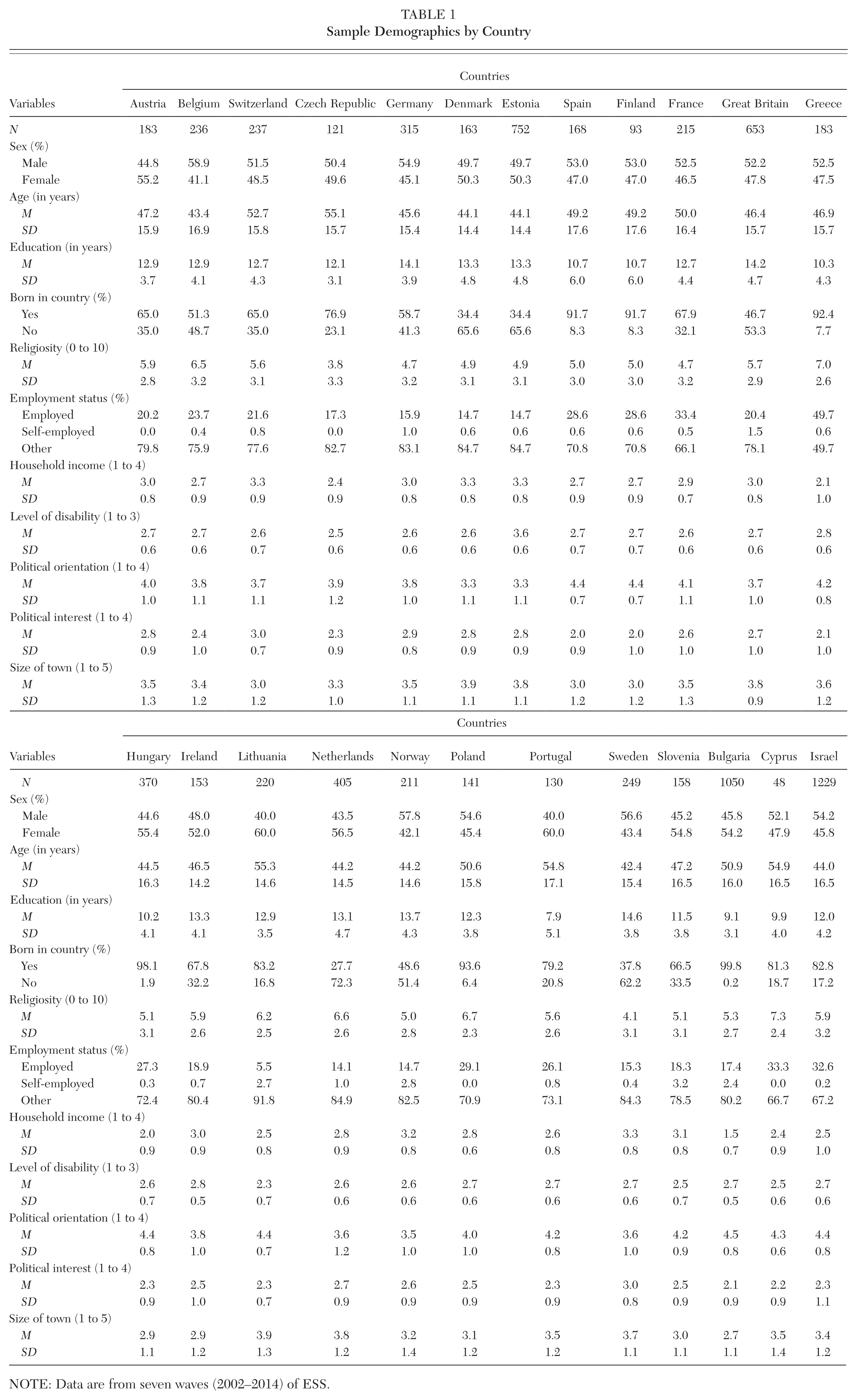
NOTE: Data are from seven waves (2002–2014) of ESS.
Measures
Perceived discrimination
We measure perceived discrimination by the sum of “yes” answers to three questions on whether the respondent has been discriminated against because of his or her “color or race,” “religion,” or “ethnic group.” This is a dichotomous 0 to 1 self-report measure, where a 1 score indicates previous experiences of discrimination. The higher the number of dimensions on which respondents report having been discriminated, the higher the score for this variable. 2 The score can range from 0 to 3.
Generalized trust
Generalized trust is measured with the question: “Do you think most people would try to take advantage of you if they got the chance, or would they try to be fair” (answers range from 0, most people would try to take advantage of me, to 10, most people would try to be fair). 3 Here we study generalized trust rather than ingroup/outgroup or neighborhood trust. Generalized trust is the most important form of social trust due to its positive effects on cooperation between strangers (Dinesen, Schaeffer, and Sønderskov 2020).
Well-being
Questions about happiness and life satisfaction are averaged to create a well-being variable. The measurement of well-being includes questions tapping into happiness (an emotional component) and satisfaction (a cognitive component), which constitute standard measures of well-being (Campbell 1981). Happiness is measured using answers to the question, “Taking all things together, how happy would you say you are?” with answers ranging from 1, extremely unhappy, to 10, extremely happy. Satisfaction is measured using responses to the question, “All things considered, how satisfied are you with your life as a whole nowadays?” with answers ranging from 0, extremely dissatisfied, to 10, extremely satisfied. Responses to the two questions are highly correlated (r = .72, p < .001).
Individual-level controls
We control for variables that have been shown to affect well-being within our study’s context. We measured employment status using three binary variables indicating “employee,” “self-employed,” and “other,” with “employee” serving as the reference category. Sex and birthplace were measured in the same way: 1 indicates female and native birth, respectively; and 0 otherwise. The model also includes: age (together with a quadratic term), level of religiosity (ranging from 0 = not at all religious to 10 = very religious), education (in years—highest = most years of education), size of town (1 = farm or house in countryside, 2 = country village, 3 = town or small city, 4 = suburbs of big city, 5 = big city), household income (ranging from 1 = finding it very difficult on present income to 4 = living comfortably on present income), and level of disability (1 = severe disability, 2 = minimal to mild disability, 3 = nondisability). We also control for interest in politics (ranging from 1 = not at all interested to 4 = very interested) and political orientation with a question pertaining to respondents’ agreement that the government should reduce differences in income levels (ranging from 1 = disagree to 4 = strongly agree).
Immigration flow
We use Eurostat data (Eurostat 2020b) on the number of incoming migrants, matched to country and year represented in the ESS. Given that we were interested in the effect of immigration as a whole, and not on the effect of immigration from a specific ethnic group or country of origin, we considered the number of all incoming immigrants in each country.
Country-level controls
To account for between-country variation, we included two variables that are known to influence well-being—country wealth and income inequality. We measured country wealth with the GDP (GDP per capita in current US$) using World Bank data. For inequality we computed a dissimilarity index (Massey and Denton 1998) using respondents’ educational distributions to indicate social inequality. 4 We use data that matches the exact country and year represented in the ESS.
Results
We test a three-level model (see equation 1) in which respondents (i) were nested within waves (t), which, in turn, were nested within countries (j). The number of immigrants, x, was considered as a characteristic of country- and year-specific waves indexed as tj.

With this model specification, we test hypotheses at the country level. We use the structural equation modeling framework to create variables for well-being (a latent measure), perceived discrimination, and generalized trust at the country level based on individual-level responses (for further details of this approach, see Ramos et al. 2019). The independent variable (i.e., immigration) is decomposed into two variables. The first comprises the average number of immigrants, xj, across all seven ESS waves for each country, yielding a coefficient that is time-invariant and captures the role of long-term immigration trends that differ between countries. This coefficient is an indication of longer-term immigration given a high value represents sustained high levels of immigration for the period of our data (2002–2014), and vice versa. We then subtract xj from xtj (a country’s number of immigrants in a specific wave), yielding a time-variant component xtjM that is group-mean centered and orthogonal to xj to capture recent changes in immigration, yielding a coefficient that indicates country changes in each wave relative to its overall level of immigration (for an identical methodological approach, see Fairbrother 2014). This coefficient indicates short-term changes in immigration because it represents fluctuations across waves for each country.
We follow the same procedure and decompose the country-level controls (i.e., GDP and social inequality) into two coefficients each. In our equation, xitj represents individual-level control variables,
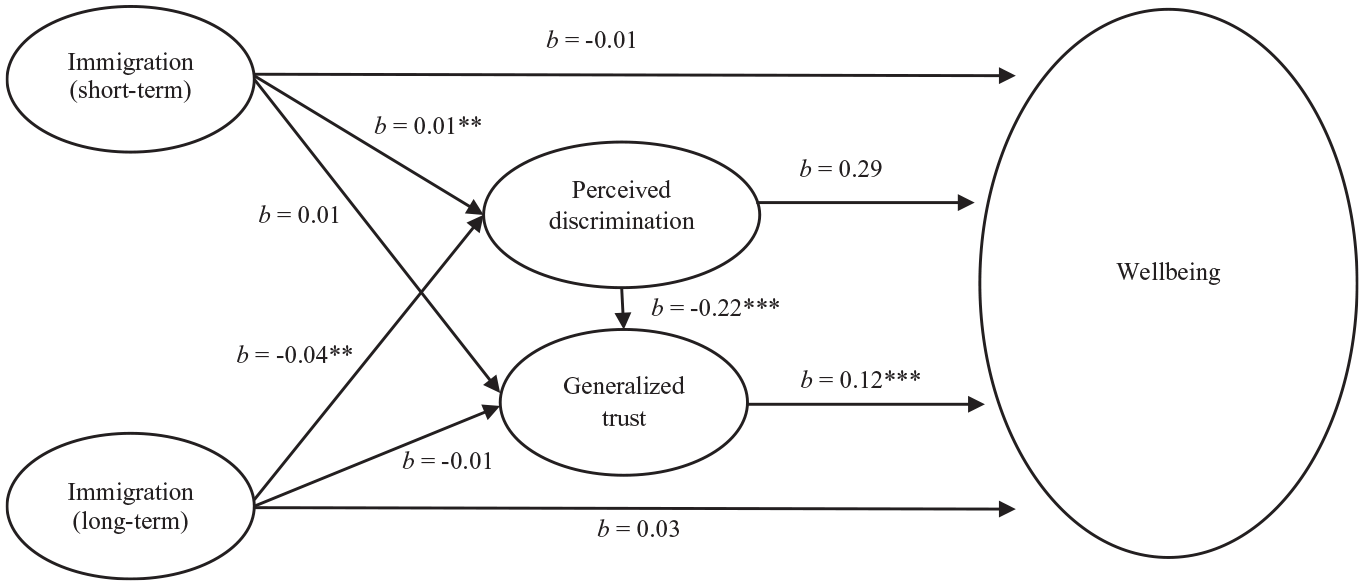
Indirect Effects Model of Immigration and Well-Being
Our model has a good fit to the data (X2 [2] = 0.29, p = .863, comparative fit index [CFI] = 0.99, root mean square error of approximation [RMSEA] = 0.001). Table 2 shows the direct effects at within- and between- country levels of the model for the ethnic minority sample. No direct effects of immigration (either short or long term) occurred on well-being, but short- and long-term immigration have significant and opposing indirect effects on well-being through perceived discrimination and trust. Specifically, short-term immigration is associated with increased perceived discrimination, which in turn is associated with lower trust and well-being (indirect effect = −0.001, SE = 0.001, p = .029). However, long-term immigration is associated with less perceived discrimination, which in turn is associated with more trust and better well-being (indirect effect = 0.001, SE = 0.001, p = .003; for details of indirect effects, see Table 3). We then test whether the indirect effect stemming from short-term immigration differs from the indirect effect stemming from long-term immigration, and find that the two effects are statistically different, b = 0.039, SE = 0.014, p = .005.
ESS Short- and Long-Term Effects of Immigration and Well-Being among Ethnic Minority Individuals
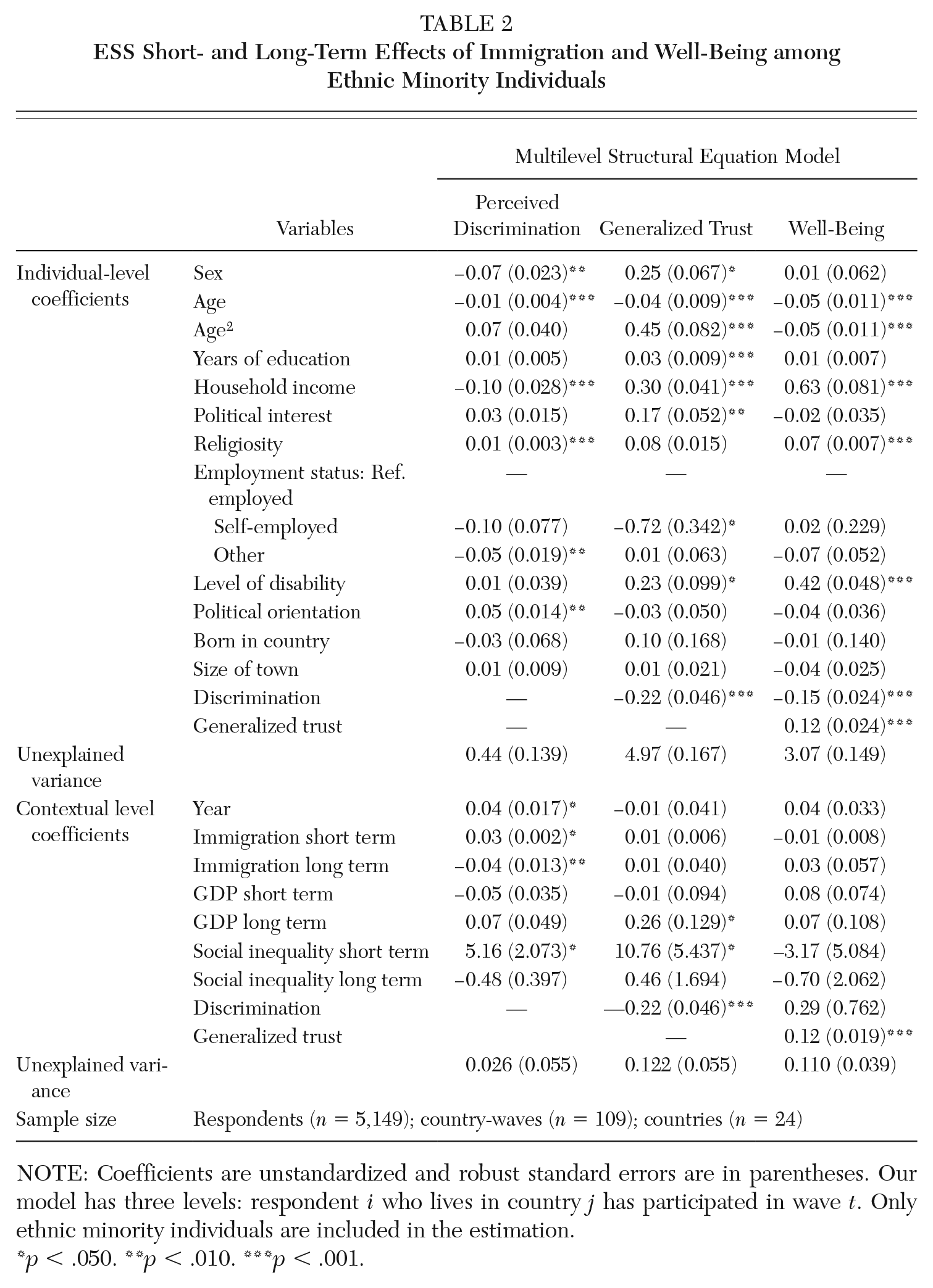
NOTE: Coefficients are unstandardized and robust standard errors are in parentheses. Our model has three levels: respondent i who lives in country j has participated in wave t. Only ethnic minority individuals are included in the estimation.
p < .050. **p < .010. ***p < .001.
Indirect Effects of Immigration (Short-Term and Long-Term) on Well-Being
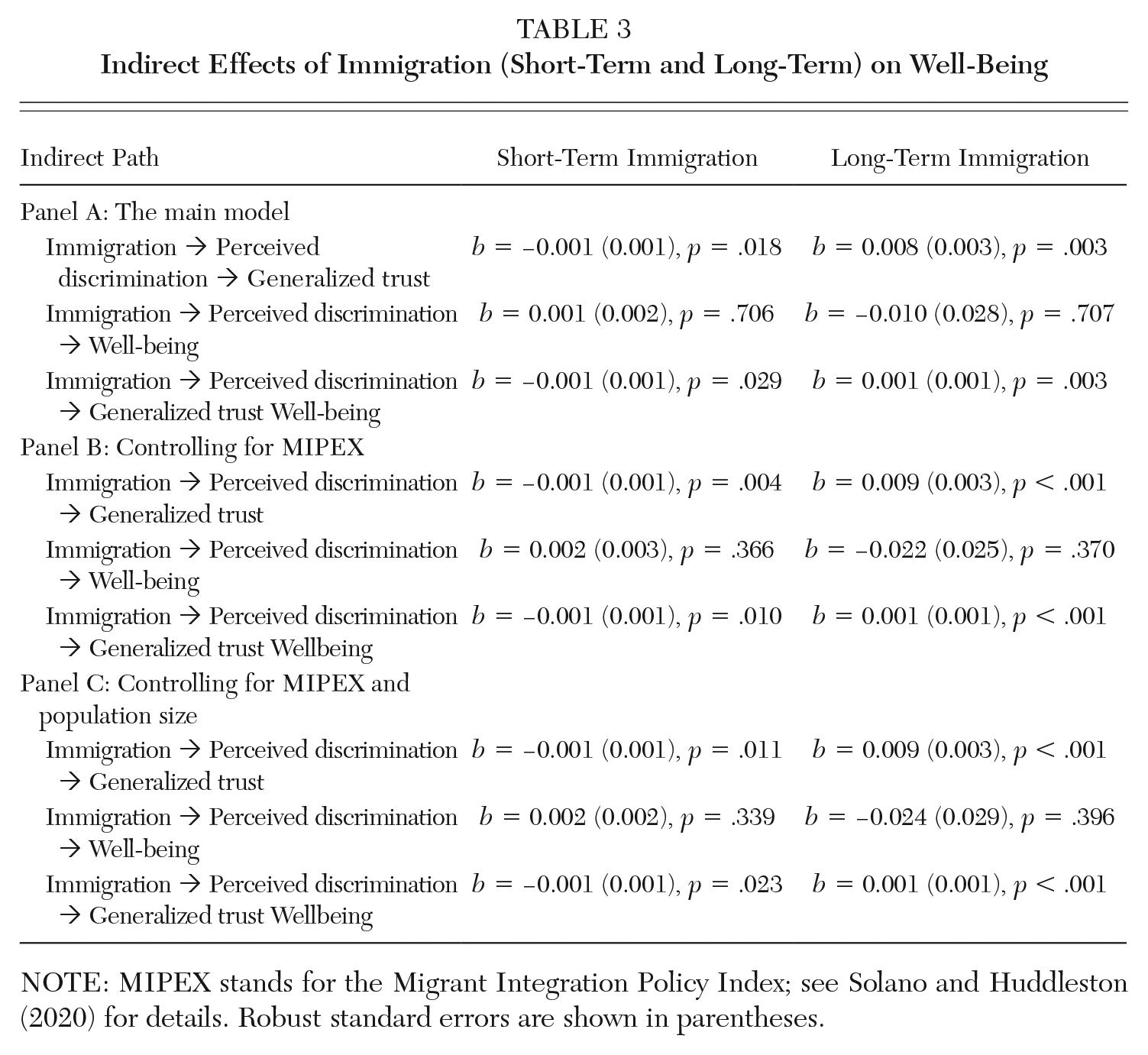
NOTE: MIPEX stands for the Migrant Integration Policy Index; see Solano and Huddleston (2020) for details. Robust standard errors are shown in parentheses.
We check the robustness of our results in two ways: first, we add population size to our main model to reduce concerns with using absolute number of immigrants; second, we include the Migrant Integration Policy Index (MIPEX), an index of immigrants integration into European countries (Solano and Huddleston 2020), to account for the possibility that immigrants perceive less discrimination and trust others more in countries with higher levels of immigration integration. Our main results still hold when we add these additional variables to the main model (see panels B and C of Table 3).
Discussion
Our study provides the first comprehensive test of the effects of immigration on the well-being of ethnic minority group members and identifies the cognitive mechanisms that mediate such effects. Using seven waves of the ESS, covering 5,149 ethnic minority individuals from twenty-four European countries, we analyzed a multilevel model that accounts for both between- and within-country-level direct and indirect effects of immigration on well-being via perceived discrimination and generalized trust. In our models, we found no direct effects of immigration on well-being but statistically significant indirect effects of immigration on well-being through perceived discrimination and trust. Our findings suggest distinct short- and long-term effects of immigration for ethnic minorities: in the short term, immigration increases perceived discrimination to reduce trust and well-being; in the long term, however, immigration reduces perceived discrimination owing to growing intergroup contact and familiarity, which in turn promotes improved trust and well-being. Structural changes in immigration over time change perceptions of experience, which in turn change feelings.
Our findings extend the literature investigating the impact of diversity on the white majority (Laurence and Bentley 2016; Ramos et al. 2019; Li et al. 2021) to encompass ethnic minorities, revealing that minority group members also adapt to diversity over time. Similar to Putnam (2007), our work did show some negative associations initially between immigration and generalized trust. However, this association exists only in the short term, and in the long term our results reveal a positive indirect effect among immigration, generalized trust, and well-being via reduced perceived discrimination (i.e., less negative contact). This finding is consistent with contact theory and findings noted in Schmid, Ramiah, and Hewstone (2014), and for well-being outcomes (Ramos et al. 2019). Overall, our research, therefore, does not support the negative claims of diversity and shows evidence of benefits of immigration. Our results suggest that more structured meaningful contact with outgroups that aims to reduce group-based discrimination will help to boost trust in general and ultimately improve individual well-being. Our analysis assessing the mediating effects of cognition can be extremely useful within the context of this study. The analysis allows us to understand why immigration has an impact on the well-being of ethnic minority groups. Being able to explain these relationships allows researchers and policy-makers to better address challenges that might arise from increasing immigration.
Our findings also suggest that the adaptation of ethnic minorities is contingent upon the majority groups adapting to these demographic changes. The majority group’s adaptation is manifested in lower levels of perceived discrimination, thereby reducing the burden on ethnic minorities. At the same time, lower perceived discrimination paves the way for more overall positive intergroup contact that gradually emerges with the growing presence of ethnic minorities. Hence, well-being and adaptation among both minority and majority groups are intertwined, which may be why we observe similar short-term and long-term effects between these groups, despite differentials in their social power. Our findings highlight the significance of a time-orientated focus. That is, the negative association between immigration and well-being is only found in the short term. In the long term, this negative association dissipates due to increased intergroup contact. Scholars, potential interventions, and social policy should aim to assess the longer-term processes and interactions between majority and minority groups. Short-term effects might be different, and this could be misleading, but they should not be ignored because potential conflict during this stage might be difficult to solve in the longer term. Although our study does not allow us to ascertain for how long these negative short-term effects could last, evidence does suggest that Europeans need around six to eight years to adapt to changes in religious diversity (Ramos et al. 2019). In our study, we focus instead on immigration and ethnic minorities; but given that some of the adaptation of ethnic minorities is contingent upon majority groups adapting to immigration, it is likely that we could be observing a similar time frame.
Despite our contribution, our study has limitations that deserve attention. First, our data are based on repeated cross-sections, ruling out the option of drawing any causal inferences from our results. Future research should employ both experimental and longitudinal survey data (with a large ethnic minority sample) to investigate the dynamics of human adaptation to diversity and to assess potential differences in such adaptations between ethnic majority and minority groups. Second, owing to the unavailability of data, we did not test the mediation effect of positive contact and were limited to perceived discrimination to measure negative contact. Having more detailed measures of positive and negative intergroup contact would permit us to test how different forms of contact may push or pull subjective well-being up or down. Last, smaller geographical areas, such as communities or neighborhoods, should be included in the scope of future studies to account for variations across local areas with respect to segregation, socioeconomic deprivation, and other factors that may affect well-being, and thus moderate how it is affected by immigration.
Footnotes
NOTE:
This research was supported by grants from the Nuffield Foundation (WEL/43108 - M.R.R., M.R.B., D.S.M., and M.H.) and Economic and Social Research Council (ES/R008507/1 – M.R.B., D.L., M.H.). The views expressed are those of the authors and not necessarily those of who have funded this research.
Notes
Danying Li was a research fellow at the School of Social Policy, University of Birmingham when she conducted this research. Her research investigates the effects that individuals’ socioeconomic status and different social context can have on health and well-being.
Miguel R. Ramos is an associate professor at the University of Birmingham. His research investigates the impact of social diversity on outcomes, including intergroup contact and well-being and health.
Matthew R. Bennett is a professorial research fellow at the University of Sheffield. His research interests include prosocial behavior, social care, and the impact of social diversity.
Douglas S. Massey is Henry G. Bryant Professor of Sociology and Public Affairs, with a joint appointment in the Princeton School of Public and International Affairs. His research interests include international migration, race and housing, discrimination, education, and urban poverty.
Miles Hewstone is emeritus professor, University of Oxford. He has published extensively in the field of intergroup relations.