




Abstract
Holiday clubs—publicly or privately operated organizations that provide child care services and healthy food to disadvantaged children in the United Kingdom (UK) when schools are not in session—are increasing in number. We know a good deal about the effectiveness of the clubs in terms of nutrition-related outcomes, but little is known about the anti-poverty resources these holiday clubs may provide. The possibility that club funding may be centralized through the national government requires a better understanding of holiday club resources. This study describes the range of resources that holiday clubs deliver and reports on how these resources are acquired and brokered by club staff and volunteers. We use data from seventeen clubs operating in disadvantaged communities in North East England during the summer of 2017, and find that clubs deliver an assortment of anti-poverty resources that are often tied to staff (personal and professional) networks.
Many UK families with school-age children face “holiday hunger” because they lack adequate levels of healthy and nutritious food during the school holidays (Defeyter, Graham, and Prince 2015; Garthwaite 2016; Graham et al. 2018; Graham et al. 2016). Low-paid work, high levels of unemployment, and inadequate social benefits have intensified holiday hunger and led local governments, charities, and religious organizations to establish holiday clubs to help families feed children during the summer school holiday (Mann et al. 2018). While summer programs for disadvantaged youth have existed in the UK for some time, holiday clubs are a relatively new type of organization. These clubs are similar to Summer Food Service Program sites funded by the United States Department of Agriculture that guide regulations concerning staff, operating times, nutritional requirements, and meal preparation. In the UK, holiday clubs are managed locally, rather than centrally as is the case in the United States, making summer food provision for children more uncoordinated and less uniformly prescriptive (Nord and Romig 2006).
Because holiday clubs are primarily associated with food provision, nearly all of the existing research in this area focuses on food-related outcomes and policy (Caplan 2016; Defeyter, Graham, and Prince 2015; Graham et al. 2016; Lambie-Mumford and Sims 2018; Long et al. 2018; Machin 2016; Purdam, Garratt, and Esmail 2016). Current studies of holiday clubs provide interesting insights into food insecurity, food poverty, and food justice, but not into general anti-poverty services that the clubs may provide.
The UK’s national government is currently considering the funding of holiday clubs (i.e., by the Department for Education), and a move toward central funding will likely drive important key performance indicators that the clubs must meet. Given that extant research has not investigated the possibility that clubs provide general anti-poverty services not related to food, changes in funding may end up causing significant disruptions. The aim of this study is to expand our understanding of holiday clubs by (1) describing the different resources that holiday clubs provide and (2) examining whether and how club staff and volunteers acquire and broker resources.
We draw upon Mario Small’s investigation of U.S. childcare centers to situate our study of holiday clubs (2009; see also Small 2006; Small, Jacobs, and Massengill 2008). We are aware of no existing studies that look at holiday clubs from this unique perspective, and we organize the remainder of our analyses into four sections. The first section draws on Small’s (2009) theoretical approach to frame the organization, network, and neighborhood effects literatures. That review covers basic concepts and ideas about the potential role of clubs as heterogeneous organizations (i.e., organizations that provide a number of different community resources) that improve the well-being of residents in disadvantaged communities. In the second section we describe the study’s data sources and analytical methods. Third, we present qualitative findings detailing how club staff and volunteers help to provide and broker a variety of resources for families with school age children. Finally, we conclude by suggesting that any national attempts to direct the composition of club resources must be carefully considered.
Theoretical Perspective
The ability of the poor to access resources is critical to their well-being (Amato and Zuo 1992; Bradshaw 2016; Bratt 2002; Nordenmark and Strandh 1999; Olson 1999; Sampson 2003; Stiehm 2000). However, poor individuals and residents in disadvantaged communities have fewer interactions with organizations that promote well-being than do more affluent individuals and residents in wealthier communities (Jencks and Mayer 1990; Wilson 2011, 2012). While the traditional literature on the relationship among neighborhoods, poverty, and community organizations is important to understanding well-being, it is not without limitations. Over the past decade, contemporary research on the potentially complex relationship between neighborhood effects and organizations has developed. This new line of work provides important additional theoretical specification about the impact of neighborhoods on organizations. For instance, Small and colleagues have shown that access to organizational resources depends on more than just the levels of neighborhood poverty, but also on other organizations within and outside of the neighborhood (Small 2006; Small and McDermott 2006; Small, Jacobs, and Massengill 2008; Small 2009).
Small (2006) has pointed out that local organizations in poor communities may, despite levels of poverty, improve community well-being because they can act as institutional resource brokers under the right set of circumstances (Small, Jacobs, and Massengill 2008). Small (2006, 277) defines institutional resource brokers as “those organizations that transfer resources to individuals.” We rely on Small’s (2006, 277–78) assumptions that institutional resource brokers (1) are networked with other neighborhood institutions; (2) reflect a variety of interests of staff, volunteers, and clients; (3) experience a variety of pressures, such as those from clients, the community, local government, political figures, and funders; and (4) are “a site of social interaction.”
Small’s arguments concerning resource brokers and neighborhood effects are situated within the organizational ecology literature (Carroll and Hannan 2004; DiMaggio and Powell 1983), which directs attention to an existing organizational population as a way of better understanding organizational forms (i.e., what organizations look like), as well as the poverty adaptation literature that demonstrates how the poor can, in particular circumstances, build and rely upon social ties and support networks to attenuate problems created by living in poverty (Belle 1983; González de la Rocha 1994; Mazelis 2017; Stack 1975; Valenzuela-García et al. 2014). Following Small’s (2009) research, we propose that holiday clubs, because of their links to other organizations, provide a variety of important and diverse resources, including material goods, services, and information within impoverished North East England communities. We also believe that these clubs employ staff and volunteers who aid in brokering resources within disadvantaged neighborhoods. Similar to Small’s (2006) argument that organizational resources in poor neighborhoods must respond to community needs, we too argue that holiday clubs should reflect the interests of parents, children, volunteers, and staff.
Data and Methods
Rates of childhood poverty are increasing across the UK; in 2019 approximately 34 percent of all children are believed to live in poverty (Social Metrics Commission 2019, 5). North East England has one of the highest poverty rates (37 percent), second only to London (Social Metrics Commission 2019, 44). While the central government has generally downplayed the extent of childhood poverty (see Bullman 2019), many nongovernmental organizations and local governments have been working toward poverty reduction. Holiday clubs have been a local approach to poverty reduction, and club efforts are often uncoordinated and sometimes even criticized as ineffective and too embedded in neoliberal solutions (Simpson, Lumsden, and Clark 2015; see also Craig and Dowler 1997). Nevertheless, it is within this general tension of scales and ideologies that holiday clubs have emerged (Mann et al. 2018).
The current study is based on data collected during an evaluation of holiday clubs in North East England. In particular, the Children North East Charity was awarded funding from the Big Lottery to provide financial support to four holiday club providers that operate seventeen clubs in disadvantaged communities across the North East during summer 2017. Club providers were required to use funding to bolster holiday club provision. Monies were spent on club resources, including food provision. This provision was monitored by an evaluation to ensure it met basic nutritional requirements set out by Children North East. Children North East also coordinated networking and norming events (i.e., meetings with all club operators and staff to ensure consistent delivery) and encouraged providers to share resources across clubs. While other holiday clubs operated in North East England, our research only examined those clubs whose providers were funded by the Children North East Charity.
Our research team’s evaluation included both qualitative and quantitative methods to understand the experiences of staff, volunteers, caregivers, and children. Thirty-five paid staff, 29 volunteers, 77 parents, and 220 children (in 17 focus groups) were interviewed for the evaluation. This research is based on the qualitative data from that evaluation and uses the interviews with stakeholders to better understand the resources that clubs provide and the role that staff and volunteers play in brokering resources.
Children who attended clubs generally came from the disadvantaged neighborhoods where clubs were located, and the recruitment strategy focused on all children from all economic backgrounds within those neighborhoods by emphasizing physical activities and trips to fun places alongside food preparation and provision. There was no mandatory requirement that clubs only allow free school meal children to attend. This strategy of inclusion was purposeful because providers and the funder believed it would attenuate the holiday club stigma (e.g., that clubs were only for the very poor). In addition, the funder named and advertised the project as a “Day Out, Not a Handout” because it was suggested by previous holiday club attendees. While this title was debated among the providers, the name makes clear that a holiday club stigma does exist. Despite recruitment efforts to reach out to all children through social media and school flyers, children from low-income households were often still identified as candidates for holiday clubs by school staff so that they could be directly recruited to the clubs by staff and volunteers. In this sense, low-income children had little choice about whether they would attend a holiday club, especially when it was their sole source of food during the summer. This “deserving” recruitment was often emphasized by staff because they saw clubs as places where they could provide food and aid to those most in need. Sometimes this approach caused problems and resentment. Local parents were reported to have complained when clubs enrolled children from non-club neighborhoods if their child was informed that the club was full.
Holiday club staff and volunteers were recruited by core staff who were employed permanently in community centers and/or nonprofits that operated year-round but were responsible for running holiday clubs. All clubs relied on local networks, including schools, places of worship, and community centers to recruit and employ additional staff and volunteers. Many holiday club staff and volunteers were employed at other organizations during the school year. For example, our sample of sixty-four staff and volunteers included more than a dozen teachers, nurses, and social workers. In addition, many staff and volunteers were parents of children attending clubs or retirees who were residents in the local community. Most recruitment occurred by word of mouth, and parents sometimes became club volunteers after attending clubs with their children. As we suggest in our findings, staff and volunteers sometimes brought their personal and professional networks to the club and could use them to help acquire and broker resources.
Given the relatively short duration that holiday clubs operate, our interviews took place when clubs opened in July 2017 and continued for six weeks until August 2017, when the clubs closed for the summer. Additional details about the seventeen clubs are presented in Table 1.
Description of Holiday Clubs (2017)
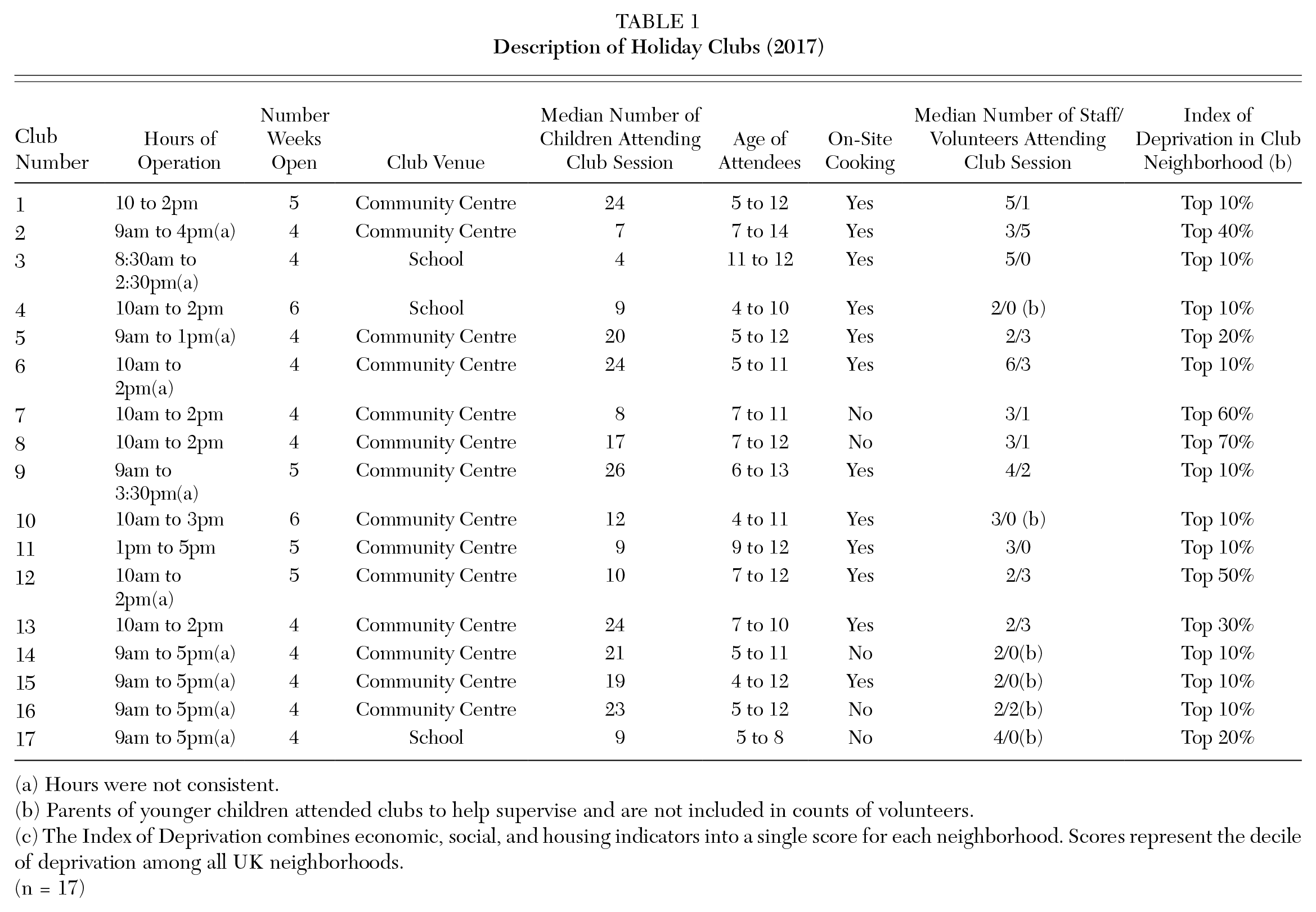
Hours were not consistent.
Parents of younger children attended clubs to help supervise and are not included in counts of volunteers.
The Index of Deprivation combines economic, social, and housing indicators into a single score for each neighborhood. Scores represent the decile of deprivation among all UK neighborhoods.
(n = 17)
Children North East required clubs to operate for at least four weeks during the summer and be open a minimum of four days per week for at least four hours per day. All of the clubs were free to attend and those who attended were between 4 and 14 years old. UK clubs appear to serve younger children (i.e., those 14 years old and younger) when compared to other countries. For example, the U.S. Summer Food Service Program caters to youth up to 18 years old. These differences might relate to cultural expectations about who should be eligible for food aid in a neoliberal system. In the UK, youth are viewed as self-reliant at a younger age and many begin working apprenticeships at 16; the same age at which most U.S. youth are still attending high school. Thus, the fact that UK children attending clubs tend to be younger than children in other countries might reflect cultural differences concerning the age at which individuals are viewed as responsible for providing for themselves.
Holiday clubs operated in schools, church halls, and community centers and were staffed by volunteers and seasonal employees, some of which had backgrounds as teachers, youth workers, social workers, sports coaches, and cooks. Most clubs had been open in the previous summer and operated by obtaining funding and spaces from charities and other organizations. Two clubs, opened by the same charity, were in their first year of operation. While clubs were distinctive, a quantitative evaluation found few differences in nutritional uptake among children, meaning that in the case of food provision club structures mattered little (see Defeyter et al. 2018).
We obtained ethics approval from their university to interview all participants, including children, parents, staff, and volunteers (Northumbria Reference Number 879). All interviews were voluntary and confidential. As Table 1 suggests, 10 of the 17 clubs are located in the top 10 percent of the most deprived communities in England in 2015 as ranked by income, employment, education, health, crime, housing, and living environment (Payne and Abel 2012).
A semistructured interview schedule comprising open-ended questions invited caregivers, children, employees, and volunteers to talk freely about their experiences in holiday clubs. Interviews were conducted by two of the authors and took place at the holiday clubs during normal hours of operation. All interviews were recorded, transcribed, and loaded into NVIVO so that the key resources that clubs provided could be readily identified. Themes representing similar resources that emerged from those data were then given initial codes to identify their content and were finally grouped according to the key type of resource that emerged (i.e., material goods, services, and information). This inductive approach was focused on identifying important resources as well as staff and volunteer networks (Auerbach and Silverstein 2003).
Findings
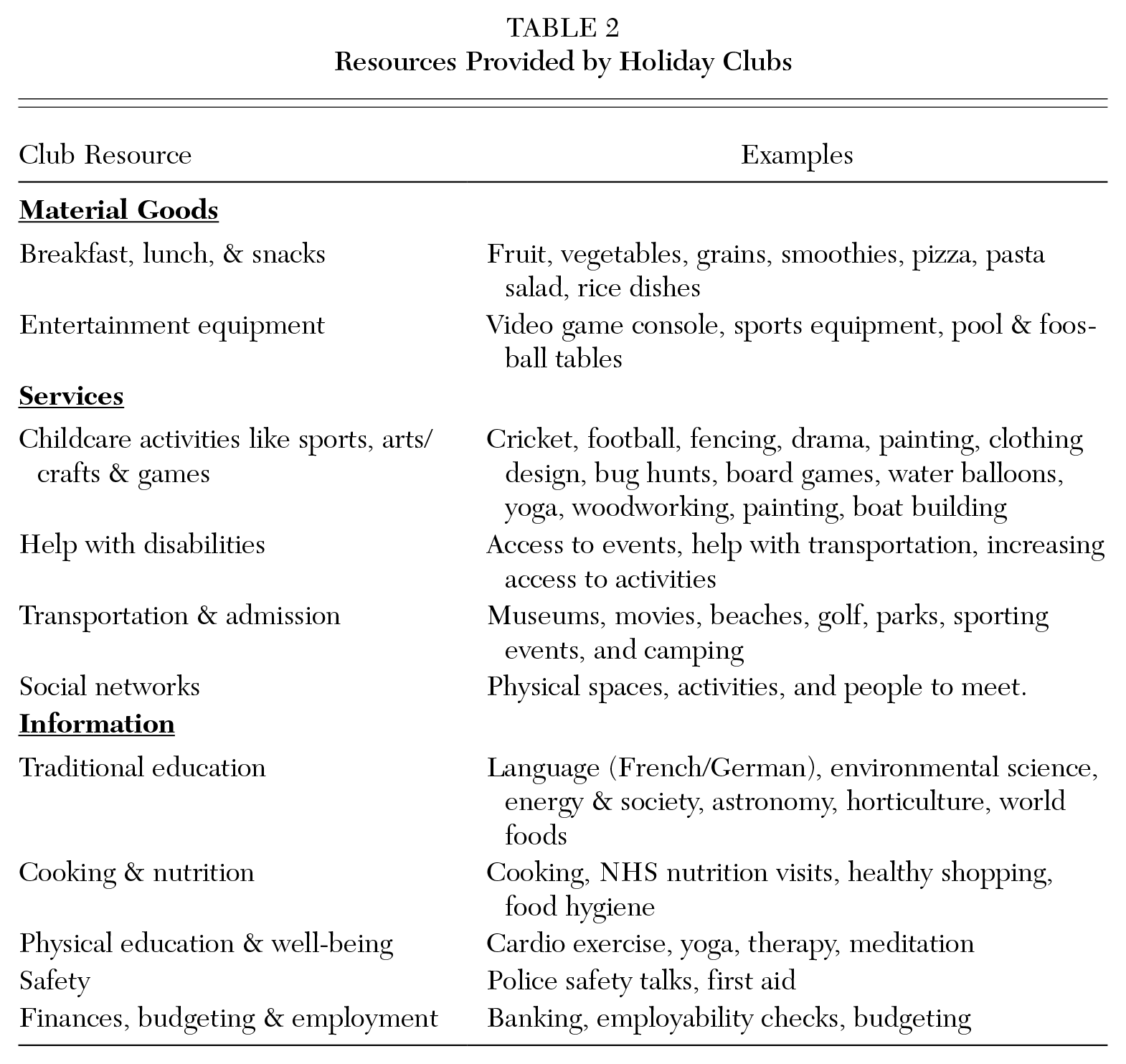
Consistent with the idea that holiday clubs provide for a variety of needs, children, caregivers, parents, volunteers, and staff reported their experiences with various material goods, services, and information. Table 2 provides a summary of these resources. We organize our analysis by looking at the most frequently mentioned resources in each category, noting the networks used to broker those resources when relevant.
Resources Provided by Holiday Clubs
Material goods
As one staff member put it, “To run a holiday club you need food.” Staff and volunteers’ explanations about sourcing and preparing food varied. In particular, staff and volunteers in some clubs were able to draw on personal and organizational networks to source and prepare food for their clubs. For instance, a staff member at one club was able to broker an arrangement between his/her club and a national charitable organization to provide the club with free and/or reduced cost food that would have otherwise gone to waste (“I get the food from FareShare that they do in conjunction with Tesco”). Staff and volunteers also relied on existing relationships with other people and organizations to help recruit additional staff and volunteers who could prepare the types of healthy meals that the club’s funder required. For instance, a volunteer at one club recruited a professional chef to help prepare meals, noting “Our food is brought in freshly each day. . .we have a chef who does it.” A staff member at another club told us that someone working in his/her club was able to convince a cook employed at a local college to volunteer at the holiday club: “The club cook is from a local college and is also a tutor. He has been fantastic in feeding children healthy meals which they have eaten the majority of them.”
In most cases, however, holiday club staff and volunteers did not have the networks to source free or discounted food or acquire free food preparation at their clubs. In such instances, staff and volunteers relied on club budgets to purchase food for children (e.g., “We bought it from Costco and stored it here in the fridge,” or “We just go to a local supermarket like Aldi or Tesco”). Some clubs even resorted to paying private providers to prepare and deliver lunches (“It was the provider who planned [and brought] the meals for us”). These clubs then brokered food provision for children and parents by connecting resources at local catering companies and supermarkets with their clubs. However, there was more financial pressure on these particular clubs as they required significant funding to acquire and prepare food. Staff and volunteers in these clubs often said that their club’s biggest challenge was to “see where we could source the money” to continue to pay for food provision. This point was driven home by one volunteer who indicated that “without funding there would be nothing on.”
Staff and volunteers in nearly every club emphasized that their food provision was subject to oversight based on national school food standards that were checked by the funder (Children North East) to ensure it met nutrition requirements. As one volunteer explained: Our meals go through the Food Standards Agency to ensure that it is up to standard and that the menus are how they should be. We have all been given [by Children North East] guidelines on portion sizes that our children should be given.
Club staff and volunteers reported that serving healthy food was important, as children might not get these foods at home. Staff and volunteers talked about providing healthy snack options like “fruit salad with melon, watermelon, strawberries, blueberries and grapes” that were too expensive for many parents and caregivers to purchase regularly. Children in several clubs reported taking extra food home so they could eat again later (e.g., “I took my bowl of fruit home, it was massive!”). Food was a hot topic of conversation with children: We get breakfast every morning except on Thursday because we go at 1 [pm] and we get dinner straight away. . . We get cereal, toast and bread and for drinks we get water, milk or juice. . .I love it!
Parents and caregivers also said club food provision was critical and helped them to manage the household budget: They get their meals. So, knowing that they have had their lunch is one less meal that we have to find. That’s why we come for the Tuesday evening meals, because it is cheap to feed the kids.
One single mother explained that meals provided by holiday clubs allowed her to have access to food and alleviated fears that her children would be taken away because they were malnourished: “I lost my job. In order to keep the children, I was skipping meals regularly so that they were fed. So, sometimes just eating what they left of their meals.” Finally, some holiday clubs were able to provide additional help to families simply because of their physical proximity to other local organizations. In such cases, volunteers and staff could provide parents with information about where they could get additional food for their households. For example, one volunteer noted that her club doubled as a food pantry: In this building we have the pantry for 52 weeks of the year. We have been able to tell club parents that if they put in £5 a week then they can choose £10 worth of food. So, whereas food parcels from food banks are just given to them, at this project they can actually choose what food they have. I think a lot of people find that very helpful.
In short, similar to Small’s (2009) study of childcare centers that finds staff and volunteer networks matter because they increase well-being, we find evidence that a few clubs leveraged staff and volunteer networks to feed children (Galaskiewicz, Bielefeld, and Dowell 2006). Thus, in at least a few instances, staff and volunteer networks helped to lower food costs and ease the financial pressure associated with providing food to children during the summer months.
While food was the major material good that clubs provided, some clubs also purchased, or were gifted, popular entertainment equipment for children to use free of charge at the club. For example, one staff member recalled, “My son is an ex-PE teacher and he had given me some equipment which I brought to the coach [at the club] and that was used for a variety of games.” Equipment often provided children with access to forms of entertainment that they would not have access to during the summertime or in their households. As one child noted, “I wouldn’t be playing pool because I don’t have a pool table and I wouldn’t be playing on the football table or having like a Wii [video game equipment] room all to myself.”
While all equipment remained at the holiday clubs, children often reported that they had daily access to these resources. Moreover, several children noted that entertainment equipment that they did not have access to at home gave them similar experiences to their middle-class peers.
Services
All holiday clubs provided childcare services in some form, and staff and volunteers in four of the seventeen clubs said that their clubs provided specialized care for children with disabilities. Parents and other caregivers felt that without holiday clubs, their children were more susceptible to crime, deviance, and antisocial behavior. That is, clubs gave kids “something to keep them busy.” For children, summer boredom was a frequent topic of conversation with the interviewers. Children reported that on days they were not at a club they were “sitting around bored” and “stuck in the house [with] nowhere to go . . . like being in jail.” Children said clubs reduced boredom, providing them physical activities like archery or surfing and entertainment like arts and crafts. In some cases, club leaders worked together to employ specialized staff who they could share across their organizations. These shared staff traveled from club to club to provide specialized activities such as football lessons (see also Guo and Acar 2005). The networks among clubs, then, allowed those clubs to employ staff jointly to leverage resources to provide additional services for children during the summer. For many staff and volunteers, clubs were similar to childcare facilities. These staff and volunteers often said that holiday clubs provided an important service to families who could not afford to send their children to standard childcare centers (e.g. “It is £2 for four hours [to attend holiday club] and some places charge up to £50 for an hour”). One challenge associated with childcare is bringing on properly trained staff and volunteers to provide childcare services. Clubs relied on staff with training they obtained through other organizations and settings: “I am a qualified nursery nurse and I am also a qualified youth worker and a qualified social worker, and I have done all the safeguarding children and everything you need to work with children. I have first aid [training].”
Staff and volunteers with less experience and training were often paired with experienced staff and volunteers to ensure that children’s needs could be met (see also Brass et al. 2004). This practice of matching experienced and inexperienced staff provided an informal training mechanism for staff and volunteers. For instance, one staff member noted, “So long as there are [experienced] members of staff then those other [inexperienced] volunteers and staff are fine to come and join in.”
Some staff and volunteers suggested that clubs were a more relaxed version of school rather than a childcare center. One staff member and school teacher explained: [I like] being in that positive role model, but in a relaxed format rather than being stuck in front of 30 kids and having that sort of behavior and discipline. We still have problems, but it is a more relaxed social format. We are dressed in more casual clothes. So, it’s just the normal things that a teacher would do.
Children and parents were concerned about safety during the summertime—a finding consistent with literature on childcare centers in disadvantaged neighborhoods (García and White 2006; Kling, Liebman, and Katz 2005). In particular, one child recalled a “scary” experience. She described, “This man was just sitting there being really inappropriate. So, we ran to my mam’s house and told my mam’s boyfriend. He took us to a different park, but the inappropriate man was there.” Most children suggested that they were closely monitored by caregivers when they were not at club and many were “not allowed to go out,” and some younger children told researchers they “must stay on the grass” in front of their home.
While parents and other caregivers often pointed out that childcare services were equally important to food because it allowed them to work and carry out other tasks, club staff indicated that they believed feeding children (i.e., providing the material resources to children and their families) was the most important function of clubs. These staff often sought out ways to identify children in need, often suggesting that clubs partner with schools to identify children who were the most economically disadvantaged: “It was my idea to actually get schools to pinpoint parents who would benefit from holiday club. I didn’t want parents who were only going to use it just for childcare.” Thus, while there was a clear sense by parents, staff, volunteers, and children that material goods such as food were important, staff and volunteers often ranked services such as childcare as less important than parents, while children viewed childcare as something that kept them from being bored at home.
Several parents also came to rely on club staff and volunteers for disability support. One parent pointed out that she was apprehensive about leaving her son at a club but discovered that the staff had the knowledge and resources to look after him. Another noted, “My middle son has autism and I need to separate the children over the holidays. I am the only adult who can supervise, and it is very difficult and expensive to take children out.” That parent reported that the holiday club volunteer recognized her son’s autism immediately and she then knew her son would be treated well. Several club volunteers reported having experience working with autistic children in their schools.
Providing disability and health services was sometimes possible because staff were affiliated with other organizations in the community. For instance, a few staff and volunteers reported that they were employed as social workers. Another volunteer said, “I am training to be a social worker and I was able to help with confidential information. I have dealt with it before.” Parent volunteers also pointed out that clubs often had adequate disability support. One mother noted, “My youngest one has disabilities; she is able to come on the trips with the club. She enjoys it and it gets her out because she never ever goes anywhere.” Clubs also provided disability services to parents and other caregivers. One grandmother of a club attendee explained: I have a wheelchair and I cannot wheel it myself, so obviously I need someone to push me. . . . There was always someone [at the club] to push me. [Staff member] at the club she said she would push me. You know that was lovely. Just being able to get out and about.
In sum, disability services were largely based on staff and volunteer skills developed in the school setting and were often described as important to parents, staff, volunteers, and caregivers.
Clubs also provided a space to promote friendship networks for children and parents (see also Van Eijk 2010). In this sense, holiday clubs broker friendships among children and parents that may have important implications for creating relationships that can help residents to adapt to poverty during times of crisis (Stack 1975). Friendship brokering often took on special meaning for newer community residents who found themselves without any attachments to community organizations when school was not in session or for those parents who were new to the community (Min 1992). For instance, children told the researchers that they had made new friends (e.g., “I have made friends with a girl and she plays with me every time I come, and she is just really nice”). For some children, the holiday club was the only source of interaction with peers during the summer since geographic isolation in disadvantaged neighborhoods is a common challenge for disadvantaged residents. In one case when a researcher asked a child whether she had seen her school friends she replied, “No, they all live far away from me.”
Holiday club staff and volunteers often said that their “clubs provide a chance for the parents to come and join in something free.” Likewise, parents and other caregivers told researchers that they made friends at the club (e.g., “I have met loads of different people,” or “You get to meet people and can do some of the activities that you would never do at home”). The structure of the holiday club promoted friendship networks among parents and caregivers. In particular, most clubs provided important places and times for parental social interactions. Clubs achieved this when staff and volunteers invited parents and caregivers to the club so that they could eat with their children and visit with other parents and caregivers. Parents at several clubs were also able to accompany children on field trips where they could interact with other parents. In addition, several holiday clubs required parents with younger children to attend the club with their child. Parents and caregivers often explained that the holiday club helped them to form meaningful relationships with their peers while their children were engaged in club activities with other children. As one parent described, “I have talked to a few of the mums, we don’t normally talk a lot through the school term. I have got to know a couple of the mums now from holiday club. So, it has been quite good.”
Communication with other parents whose children attended the club also helped to build a sense of community and belonging. As one parent explained, “I feel accepted in the community now. Do you know what I mean? I haven’t up until this last 12 months.” These friendship connections may also help parents to adapt to busy and complicated lives. As one mother reported, she spent all day with her new friend she met through a club and who “has given lifts to my kids.” In short, the clubs served an important service function in the community by strengthening friendship networks and increasing resilience and well-being on the part of parents and other caregivers.
Finally, clubs also provided children, and sometimes families, with transportation costs and entry fees to cultural institutions and recreational spaces. Cultural and recreational experiences improve well-being and bring children and families into contact with people outside of the community. These experiences are also characterized as an important human right (Babey, Brown, and Hastert 2005; Chatterjee and Noble 2016; Moore 1998). One child said that the club took her out of her neighborhood to play “crazy golf and [visit] the museum for free.” Children often told researchers that they could not afford to go to fun places during the summer without the club: I would not come here because my mam, she has to pay the bills, and it takes her a lot of money and she has to use the money that she has got. So, that is why I like to come here because we get to go on the trips and my mam doesn’t have enough money to take us all to the places.
Overall, most children mentioned the trips to fun places as often as they mentioned food. And many children reported that they wished they could take trips every day. Staff and volunteers also often emphasized that planning and funding trips to parks, museums, and entertainment establishments was important for the well-being of children: “Some of these children come from very disadvantaged backgrounds, so [day trips] are a new experience for them. . . . They get trips to the beach and all of these cool places that they have never been before. So, it is a good experience for them.”
Holiday clubs provided critical access to cultural events, recreational spaces, and entertainment for children and their families. This service was mentioned by all interviewees as a positive aspect of clubs. When staff or volunteers in a club had connections that could help to realize a trip, they said they used those connections. For instance, one volunteer recalled how a friend of the club leader helped to arrange and pay for a camping trip for the entire club: “One of the ladies that [the club leader] knows came in at Easter and they were going camping. That lady just found out about the club and provided the food [and organized the club] camping trip and it was quite a nice thing to be part of.” In most instances, however, the money provided by the funder typically allowed clubs to carry out this service function.
Information
Clubs provided information about food and nutrition, physical activity, and other more formal classroom-based educational topics to children and parents. Clubs also served as more traditional resource brokers by providing information about other community organizations and services in times of crises. While clubs provided education about food differently, they all had a food education component that staff reported was important for well-being (Colatruglio and Slater 2014; Rozin 2005; Utter et al. 2016). For instance, one club’s staff taught children how to grow their own vegetables: We were planting onions, so they learnt how to plant onions and how to cut herbs correctly. They harvested some beans and made a meal with the different beans. We have been trying to introduce them to food in a slightly different way. We made homemade ketchup and things, so it is really teaching them to cook from scratch and a little bit of life skill. Just teaching them to do stuff in the kitchen so they can understand a little bit more about how you can make basic food taste good.
Some clubs focused on world foods, food culture, food identification, and even food sales (e.g., in a child-run community café). Education about nutrition was mentioned by all volunteers and staff. The majority of clubs that were able to prepare food in buildings emphasized that they taught children skills by including them in the process (e.g., “It is always the children cooking as well”). Unfortunately, those clubs that did not have the staff or facilities to prepare their own food were at a disadvantage when it came to teaching children food preparation skills.
Several staff and volunteers said they taught children how to purchase food at local shops and grocery stores. These staff taught children how to shop in stores, save money, and make good nutritional choices. For instance, one club gave children a fixed amount of money and a list of grocery items to teach them how to shop for nutritious meals within a budget: We have taken the kids to a couple of trips to Tesco if we have needed veg[etables] and stuff. We gave them a shopping list and they would go and get it and we gave them the money to pay for it. They have some proper responsibilities, which has been really good.
Children also learned transferable skills from staff, such as how to prepare meals at home; many staff worked in school kitchens, restaurants, or local colleges during the school term. One volunteer said, “They never quite know what they are cooking until they get here. Like when we made the pizza, they liked making the dough, getting their hands in the dough, and they liked actually being in charge of cooking something in a pan.”
Children told the researchers that the club expanded their diets and motivated them to prepare meals at home (e.g., “We eat lots of different things, and we like it, and we like making our own food for healthy cooking”). Parents and children said that their new cooking abilities influence household dynamics (Fiese and Schwartz 2008). One staff member explained that “the kids get to try some different foods from around the world which they probably normally wouldn’t have tried and tested.” An eleven-year-old boy at the same club later explained that learning about world foods (i.e., increasing his cultural competencies [see Utter et al. 2016]) in a holiday club with his sibling has made him more motivated to cook at home: “Food Nation inspired us to like to cook a lot more. We never used to cook. We always used to get our dad to cook for us.” This change in motivation to prepare meals at home was also emphasized by parents who said that they relied less on takeaway meals since the children attended holiday clubs: “They want to do more cooking now. I thought they would never go in the kitchen. It was always left to me. But now they are coming home and saying, ‘I have cooked this, can we do it at home?’”
Finally, staff and volunteers were often approached by parents and caregivers for information about sourcing food when they were still struggling to feed their children. One volunteer explained, “We have had people that have come in such desperate situations that they just haven’t got the money. There is a food bank very close to here that we can [also] refer people to.” When these situations arose, club staff and volunteers reported knowing about local resources to help link parents and caregivers to other food service organizations in the local communities.
While parents emphasized physical activity as part of the “childcare service” because it provided children with something “to do” and kept them from being “bored” and/or “restless,” staff tended to emphasize physical education. Staff and volunteers believed that teaching about exercise and good exercise habits was especially important over the life course—and drew on their backgrounds in education to help provide this knowledge to children. They assumed these habits promote life-long fitness and well-being (Lubans et al. 2016, Penedo and Dahn 2005). As one staff member noted, “We have been doing quite a lot of physical activities, so trying to encourage the kids to become a bit fitter really.” In short, while parents saw physical activity as a service, staff believed it was an educational experience. Children simply considered exercise and learning about different activities to be “fun” (e.g., “We do a lot of sports with [other children] which I like, and I am really enjoying it.”)
Children often reported being engaged in formal educational activities while attending clubs. Staff tended to believe that children needed to remain “school ready.” Staff who were also teachers brought their knowledge of schools to clubs by providing lesson plans and other educational opportunities to children during the summer. Staff noted that they were often anticipating what children would be learning that particular year in school so that they could prepare them in the club. One staff member pointed out the benefit of a summer head start: “In other years we focused on literacy. This year we did French because we are going to start doing French in [school in] September. They feel that they will already know a lot before they start.”
In another case, a club with a volunteer teaching science reported, “Children will be learning about planets [in school], so I have had them doing quizzes this morning about Neptune and Saturn.” Staff and volunteers universally believed that educational opportunities at clubs were important to children’s well-being because they provided an “educational boost” to children residing in disadvantaged communities (Reardon and Portilla 2015; Schmitt et al. 2015).
Discussion and Conclusions
We set out to determine the range of resources that clubs provided. Consistent with Small’s (2006) observations of childcare centers in the United States, we find that holiday clubs provide diverse resources that reflect the needs of children, staff, volunteers, and caregivers. While all holiday clubs relied on other organizations in the community to provide resources to participants, the extent and shape of each club’s provision is clearly nuanced and dependent on club staff and volunteer networks. As a result, the delivery of resources at some clubs does appear to have relied more on staff and volunteer networks. Whether staff and volunteer ties produced more successful clubs and whether these ties become embedded in holiday clubs themselves should be the focus of future research.
We also set out to determine how staff and volunteers in clubs may acquire and broker resources by leveraging personal and professional networks. We discovered that many clubs were reliant on external networks and funding to acquire and broker resources. However, some clubs were highly dependent on volunteers and staff who worked within clubs to broker resources that improved the well-being of children, parents, and other caregivers. As we demonstrate, staff and volunteers helped several clubs to source and prepare food at little to no cost to the club, used their connections to arrange field trips, and provided equipment for children to use for activities while at a club.
Our results provide a starting point for a better understanding of holiday clubs in the UK. Such an understanding is critical as the UK government is currently considering how to support these clubs. We suggest that a universal and centralized funding scheme across the UK would benefit those clubs that have fewer networked staff and therefore appear to be more reliant on external funding sources. There are, however, reasons to be concerned about the way centralized funding is implemented. In particular, centralized funding schemes could disrupt important club functions that contribute to community well-being if clubs receiving funding are focused on singular and externally driven objectives.
UK policy-makers need only turn to the USDA Summer Program to better understand the likely consequences of a more singular focused and centralized funding scheme. In particular, evaluations of the USDA program suggest that it is often difficult to find program sponsors and reveal that attendance at the programs is low, even in the most deprived areas (Wauchoppe and Stracussi 2010). Providers often point out that reporting requirements for children and meals served are excessive and note that “a lack of activities at program sites are barriers to participation” (Wauchoppe and Stracussi 2010, 3). In the UK, many staff and volunteers working in the holiday clubs we studied also noted that their clubs were influenced by nonlocal networks and reporting requirements (see also Backman and Smith 2000, Guest 2000). These nonlocal networks present the potential for more formal coercive pressure via funding. For instance, the holiday clubs that we studied were all tasked with adhering to healthy eating guidelines as required by the provider who followed national food standards (Adamson et al. 2013). Thus, while clubs in North East England do more than feed children, they are simultaneously being pressured to pay more attention to and report on who they serve food to as well as the kinds and amounts of food served. This might be interpreted as a move toward a U.S. model that is distinctively focused on food provision.
In the end, our observations about club resources and staff networks provide us with optimism. First, we found that the resources that clubs provide matter to the parents, caregivers, and children who participated in our research. Second, while we believe that national directives aimed at clubs may be problematic, we also do not dismiss potential benefits of networks outside the community. That is, the central government and other national organizations have the capacity to mobilize significant levels of funding to support these holiday clubs and therefore can greatly expand well-being across the UK. More importantly, the national governmental and large nongovernmental organizations can help to direct needed funding and local mandates. Nevertheless, this must be done carefully and equitably by ensuring that all communities have access to these funds. Because our research suggests that clubs offer a diversity of resources that reflect community interests and because staff networks clearly matter for some clubs, we propose that any changes to club funding structures, especially at the national level, be carefully considered with significant input from a variety of clubs. By drawing attention to the various resources that clubs provide, along with the networks they leverage to acquire and broker resources, we hope that holiday clubs will continue to promote community well-being and health to their local communities.
Footnotes
Note:
An earlier version of this article was presented at the Autonomous University of Barcelona (Spain), February 7–8, 2019, in the “Who Cares? Workshop.” We would like to thank Professors Miranda Lubbers and Hugo Valenzuela García for inviting us to participate in that workshop and for their encouragement and support during the revision of our manuscript. We would also like to acknowledge the anonymous reviewers who provided insightful comments and suggestions. This research was funded by Children North East and the North East Child Poverty Trust.
Paul B. Stretesky is associate director of the Healthy Living Lab and professor of social sciences at Northumbria University Newcastle. He has authored six books and more than 100 articles and book chapters on inequality and social justice. He currently lectures on research methods and statistics.
Margaret Anne Defeyter is director of the Healthy Living Lab and professor of psychology at Northumbria University Newcastle. She has authored more than ninety articles and book chapters on school feeding and physical activity programs.
Michael A. Long is an associate professor of sociology at Oklahoma State University. He has published four books and more than seventy journal articles and book chapters in the areas of food insecurity and environmental degradation.
Zeibeda Sattar (Zeb) is a senior research assistant in the Healthy Living Lab. She has extensive experience in mixed methods research and currently lectures on undergraduate and postgraduate public health modules.
Eilish Crilley is a PhD student at The Northumbria University Newcastle and part of the Healthy Living Lab. She has previous experience evaluating holiday feeding programs.