




Abstract
Research on how the poor “make ends meet” typically shows that they are able to do so by relying on dense support networks of family and close friends. Recent research suggests, however, that these networks play a limited role. This article examines the role of informal networks in how sixty-one households in Barcelona, Spain, cope with poverty. We use a mixed-methods design that combines structured network delineation with semistructured interviews about the processes of support mobilization. Findings show a great variation in network size and resource capacity among households and in the kinds of ties that offer support. Social support was regarded as essential among members of poor households, but mobilized networks were often insufficient for covering even the most basic needs, and prolonged network mobilization could cause strain and long-term conflict. This analysis suggests that support networks may help people to cope with income volatility while simultaneously increasing the potential for social exclusion and isolation.
Past research in poor urban communities has shown that individuals and families struggling to get by rely on the informal support of relatives and close friends (Adler de Lomnitz 1977; Domínguez and Watkins 2003; Edin and Lein 1997; Stack 1974). Detailed ethnographic accounts revealed that money, goods, and services were frequently exchanged through geographically bounded, dense, and durable kin-based networks, which allowed families to survive economic deprivation (Adler de Lomnitz 1977; Stack 1974). While this literature emphasized the importance of social support for low-income families, González de la Rocha (2007) warned that it had inadvertently created a “myth of survival,” depicting the personal networks of the poor as “a cushion against the impact of economic change, and an asset that the poor can always turn to in case of need” (p. 47). Further, in the context of an economic recession, changing family structures, and an erosion of welfare states, she questioned whether the poor still benefited from support networks (cf. Roschelle 1997; see also the introduction to this volume by Lubbers, Valenzuela, and Small) and suggested a change in focus from the “resources of poverty” to the “poverty of resources” (González de la Rocha 2001). In line with her suggestion, various studies have shown the relative isolation and network poverty of low-income individuals (e.g., Menjívar 2000; Offer 2012).
A question that remains open, however, is why some studies show that social networks help individuals to cope with poverty while others observe a radically different reality (see introduction to the volume). To better understand how informal networks function under economic stress, we argue that scholars need to go beyond static descriptions of the association between poverty and received or available support to focus on the network mechanisms 1 underlying this association. Understanding how networks are shaped and how they are mobilized in times of need can help us to explain the varying levels of support obtained by people experiencing poverty.
This article focuses on the role that informal networks play in coping with poverty in a contemporary urban context. It examines the extent to which the personal networks of the poor are supportive and the processes through which support is mobilized. To do this, we first identify, from the extant literature, three mechanisms that govern the constitution and mobilization of networks and discuss how these mechanisms can generate different outcomes of support under economic stress. We also consider that individual agency, in the form of relational work (Zelizer 2005), may counteract these structural and normative mechanisms. This theoretical framework has guided our empirical research with sixty-one households in Barcelona, Spain, that were experiencing economic hardship. By combining semistructured interviewing and structured network delineation, we can simultaneously study mechanisms and outcomes.
Data were collected in Barcelona in 2017, in the aftermath of the economic crisis, when poverty, unemployment, and eviction had skyrocketed in Spain. As a Mediterranean welfare state that considers welfare provision primarily a family responsibility (e.g., Flaquer 2000), Spain has a much more limited social security system than Nordic and conservative European welfare states. Therefore, personal networks are believed to play a vital, protective role (cf. Lumino et al. 2017). The current case is thus particularly interesting for studying social support mobilization among the poor, as it combines high needs and low state provision. The next section presents our theoretical framework. Subsequently, we describe our data, methods, and results, and then conclude with a summary and a discussion of implications.
Social Networks and Support Mobilization in Situations of Poverty
Social support—the “emotional, informational, or practical assistance from significant others, such as family members, friends, or coworkers” (Thoits 2010, S46)—is embedded in an individual’s personal network, that is, the set of social relationships surrounding a person (e.g., relatives, friends, colleagues, neighbors; McCarty et al. 2019). From the personal network literature, we have deduced three mechanisms governing the constitution and functioning of personal networks that, when applied to persons experiencing poverty, put into question the level of social support they can obtain.
First, the composition of personal networks is profoundly shaped by social foci, that is, entities of different types (e.g., organizations, neighborhoods, individuals) around which joint activities of individuals are organized (Feld 1981). Particularly, participation in routine organizations (e.g., workplaces, schools, churches, sports clubs; Small 2009) creates meeting opportunities for starting and maintaining relationships. Common causes of poverty are associated with withdrawal from foci: losing one’s job tends to cut off workplace ties, divorce creates ruptures with in-laws and shared friends, and severe illness reduces social participation more amply (e.g., Wrzus et al. 2013). The lack of resources caused by poverty (e.g., a car, club memberships) may further inhibit participation in leisure activities (e.g., Van Eijk 2010). These processes of exclusion may explain the observation that people in poverty have smaller networks (e.g., Böhnke and Link 2017; Marques 2012; Campbell, Marsden, and Hurlbert 1986) than people with higher incomes. However, studies typically measure network size based on available or activated support; therefore, an alternative explanation for this finding is that a smaller set of network members are activated for support (E. Smith, Menon, and Thompson 2012).
Second, network composition is governed by homophily, that is, the tendency of individuals to associate with people who are similar to themselves in attributes such as sex, race, education, and social class (McPherson, Smith-Lovin, and Cook 2001). Homophily is partly induced by social foci, which often attract people with similar attributes, but individuals are also believed to prefer association with people like themselves (Byrne 1971) and to avoid dissimilar people (the latter is called heterophobia [Wimmer and Lewis 2010] or repulsion from dissimilar others [Skvoretz 2013]). Income homophily can be detected in networks if it is more salient than other forms of homophily or if income is strongly correlated with more salient attributes (e.g., race; Blau 1977). For people experiencing poverty, income homophily limits the material and financial support that their networks can provide (e.g., Harknett and Hartnett 2011).
Third, exchanges in informal networks are regulated by norms of obligation, reciprocity, autonomy, and equity (Portugal 2009; Jacobson 1987) that favor the emergence of long-term cooperation by promoting moral values of loyalty and fairness. The precise norms vary with the type of ties, creating tie-specific scripts of expectations, obligations, and types of transactions that are considered appropriate (e.g., Zelizer 2005). In particular, durable kinship ties are universally associated with an internalized sense of obligation to help one another (Curry, Mullins, and Whitehouse 2019) and with generalized (i.e., multilateral) and deferred reciprocity: Mediated between affections and trust, reciprocity between family members often takes place on a “lifetime scale” and transforms help into a sort of “long-term credit” which does not need to be repaid immediately, nor to be symmetrical: the counter-gift can come much later or even be destined for another person. (Portugal 2009, 61)
The more fleeting nonkin relationships, in contrast, are less obliged to help and are based on a narrower norm of balanced (i.e., bilateral), short-term reciprocity (Nelson 2000). In other words, it is less expected that people lend money or give material help to their friends, acquaintances, neighbors, or colleagues in need; but if they do, they expect the favor to be returned to them within a relatively short period of time. Yet among kin, balanced reciprocity also reigns alongside generalized reciprocity (Portugal 2009): about half of the economically distressed individuals who receive support from their families also provide it to them (Hogan, Eggebeen, and Clogg 1993). Even gifts obey this norm of give-and-take, as they usually incur an obligation of a reciprocal gift in reasonable time (Mauss 1923/1990; Sahlins 1972). Thus, despite its positive connotations for network cohesion, the norm of reciprocity becomes an expectation that people in poverty cannot always meet, limiting the mobilization of social support (Komter 1996; Offer 2012). Furthermore, support mobilization is potentially limited by the norm of autonomy, which implies that households are supposed to function as independent units. We focus on the norm of equity 2 only insofar that special conditions are considered that may form exemptions from these norms, for instance, for lack of money or time (Jacobson 1987; Portugal 2009).
In sum, based on these three mechanisms, we expect that the support networks of people in poverty are smaller and resource scarce and that network norms impede social support mobilization in times of poverty. As others have indicated, informal networks may be able to mitigate economic scarcity and function as “safety nets” at the micro level, but at the macro level, they may amplify social inequality, producing cumulative disadvantage: those who most need the support of their networks do not have it (DiMaggio and Garip 2012; Offer 2012).
A full understanding of how networks work requires not only an analysis of network structure and an understanding of meso-level norms, but also of people’s agency within that structure, or relational work (Zelizer 2005), that is, “the creative effort people make establishing, maintaining, negotiating, transforming and terminating interpersonal relations” (Zelizer 2012, 149). This relational work could counter the assumed negative consequences of the network mechanisms outlined above.
First, people may intentionally create relationships with others they believe can support them (Lin 2001). For example, Desmond (2012) observed that people in chronic poverty often no longer obtained support from their families, and therefore they established new social relationships accelerating the process of developing intimacy. Once formed, these bonds provided all kinds of resources, but they were usually not long-lived (hence his label disposable ties). Nevertheless, this strategy, characterized by the rapid creation, development, and discontinuation of the social ties, allowed households in deep poverty to get by on a day-to-day basis.
Second, individuals may employ tactics during support mobilization to improve the likelihood of obtaining help. Wherry, Seefeldt, and Alvarez (2018) found that potential lenders engage in obfuscatory relational work (cf. Rossman 2014), that is, the performance of face-saving strategies to deny a loan to close relationships, without breaking morality-laden norms of obligation or reciprocity. Strategies included stretching out the time to deliver the loan and offering a different type of help than what was asked in the hope that the help seeker would reconsider. We examine whether help seekers enact similar tactics that improve the likelihood of obtaining support.
Our Research
Data were collected within the framework of a research project about personal networks and poverty. 3
Sample
The project selected both (1) clients of the organizations that we focused on in our study: two charity organizations, a foundation for labor reinsertion, and an organization for evicted people that was started by others who had themselves been evicted; and (2) respondents not linked to these entities. For the first group, we drew an institutional sample from the organizations; while for the second, we used chains of references. Criteria for case selection included residence in the metropolitan area of Barcelona, 18 years or older, and being income poor. Proxy questions were used to probe qualification for this latter requirement, whereas more detailed questions about the household economy were asked during the structured interview. The diversity of the sample was maximized in terms of gender, age, household composition, nationality, locality, and employment status. Data were collected between January 16 and August 31, 2017.
The sample consists of sixty-one persons, forty women and twenty-one men, with an average age of 46.9 years (SD = 11.6; range 19–80). Most were born in Spain (N = 50). Forty-nine households were located under the Spanish poverty threshold after social transfer, 4 also counting income from undeclared jobs; twelve were located above that level at the time of the interview. The latter happened, for example, when a low-income single mother and her children had moved in with her parents, and the (extended) household was no longer in poverty, or when the financial situation fluctuated from month to month, or when people just came out of a situation of poverty. We included these cases for the narratives, but not in the descriptive statistics. About half of the sample was unemployed (N = 32), twenty were employed, five retired, and four had other employment statuses. Seventeen respondents lived in households formed by a couple with children, fourteen were single, eleven single parents with children, eight lived in three-generation households (usually after returning to the parental house), five in a couple without children, and six in other types of households.
Instruments and procedures
Face-to-face, semistructured and structured interviews were conducted by a team of trained researchers, in Spanish and/or Catalan. Interviews lasted between 1.5 and 4 hours. The semistructured (conversational) part explored life histories; household practices; and the access, roles, and dynamics of formal and informal support, following an interview guide developed and pilot tested in the project. This part was tape recorded with consent from the respondents and fully transcribed. The software used for qualitative data analysis was Atlas.ti. We employed both an a priori coding scheme based on the research questions and open coding to include emerging themes.
For the structured (survey-style) part of the interview, a questionnaire was designed and implemented in the software Egonet (see McCarty et al. 2019), regarding the respondents, their households (e.g., composition, work intensity, income, and housing), and their social networks. For networks, respondents were presented with seventeen freelist “name generators,” that is, questions to elicit a list of names of people outside the household (1) with whom respondents felt close and with whom they talked, went out, or had fun (socialization network; two questions); (2) who gave them and to whom they gave emotional, financial, material support; job information; and help with chores in the past year, as well as people who did not give them and to whom they did not give requested support (informal support network; fourteen questions, including available financial and emotional support if none was received); and (3) whom they knew via the entity and now felt close to (third sector network; one question). Respondents could nominate as many people as they saw fit, and the same person could be nominated on multiple questions. Once a list of names was elicited, we asked about the attributes of each nominee, for example, the type of relationship (seventeen categories), emotional closeness, and perceived relative financial situation (“Would you say that the financial situation of [nominee’s name] is much better, a little better, more or less the same, a little worse, or much worse than your own situation?”). Last, we asked respondents whether nominees had contact with one another, to visualize network structure. Figures 1 and 2 illustrate two such networks elicited with this method, using the software Visone (Brandes and Wagner 2004). The aggregated set of network data was first quantitatively analyzed, to generate descriptive statistics. For each case, the network visualization was also added to the transcription of the semistructured interview of the same respondent for the qualitative analysis (see above), following a triangulation approach (e.g., Creswell and Plano Clark 2007). On one hand, this mixed-methods approach allowed us to validate data about, for example, the support capacity of the networks or the presence of kin support. On the other hand, it allowed us to obtain a deeper understanding of networks by contrasting their structure (quantitative interview) with respondents’ narratives about their meaning and mechanisms (qualitative interview).
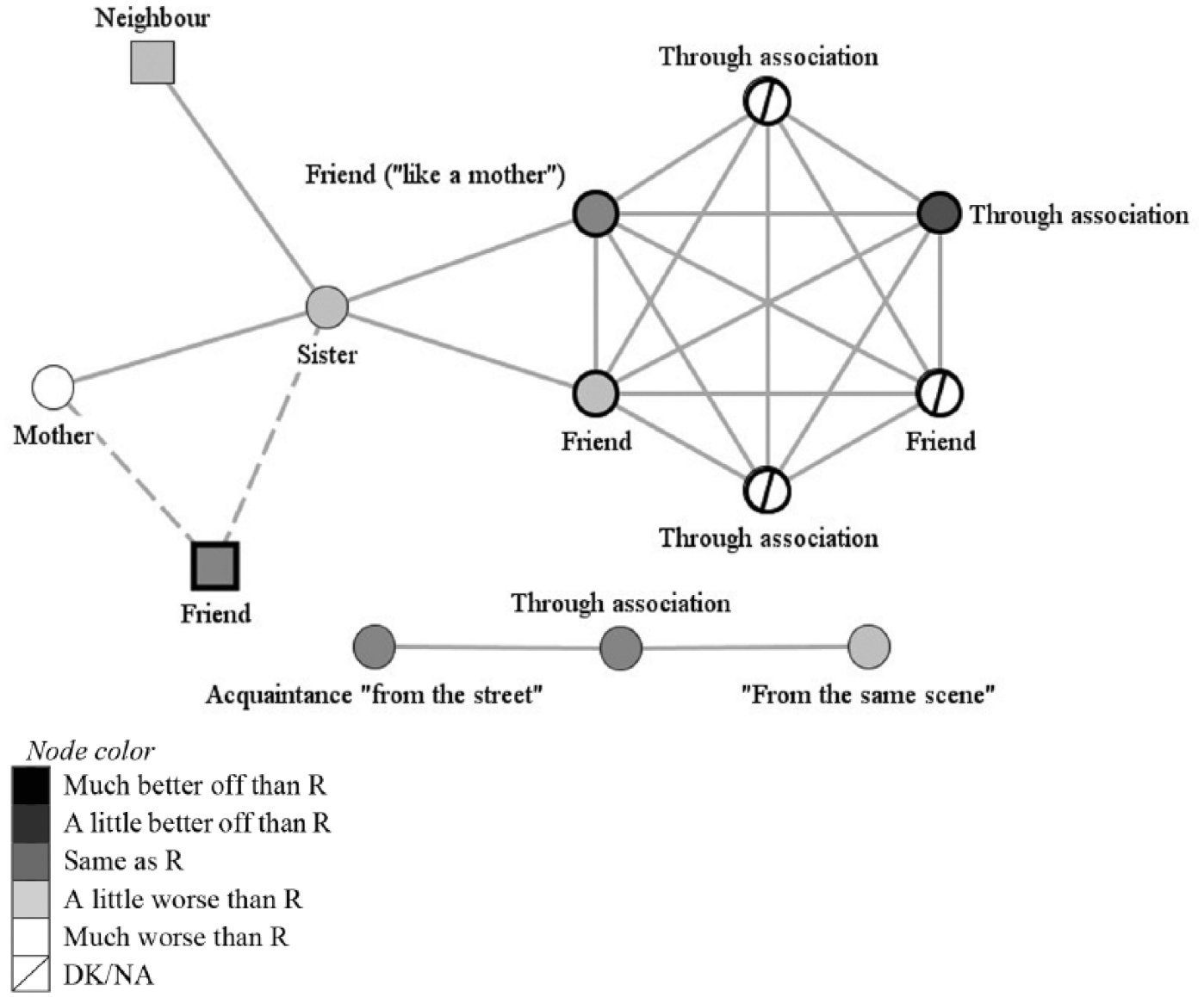
The Network of Yolanda
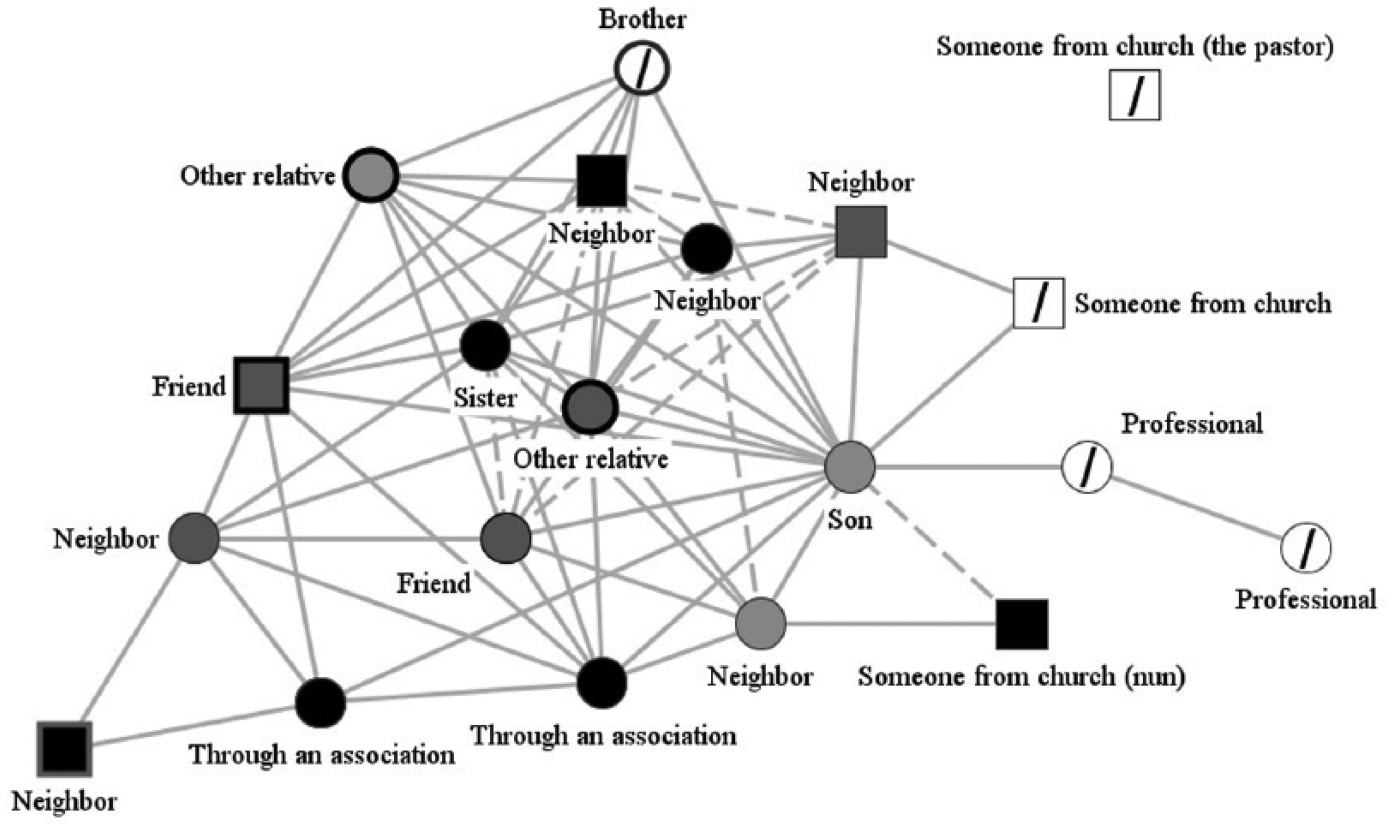
The Network of Asunción
Results
Economic circumstances and household practices
In the households of our sample set, poverty spells started for many reasons, chief among them unemployment, divorce, and chronic illness. Problems accumulated in a snowball fashion: poverty led to depression and anxiety and increased the chances of eviction and divorce. As one respondent, Lourdes, said, “When money doesn’t enter, love disappears through the window.”
All households had already depleted whatever financial assets they once had, and a delay in welfare checks or an emergency could therefore cause serious problems. They had already sold things they did not need, including in three cases highly sentimental items such as wedding rings (while married) and first communion bracelets. Many visited charity organizations and civil associations to obtain material help, housing assistance, legal advice regarding pending evictions, and help with labor reinsertion. Other practices that households employed to make ends meet were stretching limited resources (buying minimally and secondhand, relying commonly on cheap foods such as legumes and pasta), not wasting any food (not even the tomato peels left after making gazpacho, as one respondent, Marisol, explained), not having household appliances such as washing machines repaired when they were broken unless a friend or relative could repair it, salvaging materials thrown away by others or gathering scrap metal, not attending social events, and subletting a room.
Often, respondents were deprived of even the most basic needs (food, shelter, heat, healthcare): having electricity or gas cut off; skipping meals to prioritize children and partners to the extent that eating caused feelings of guilt; and failing to pay mortgages, ultimately causing eviction (one respondent was living temporarily in a car). Moreover, some indebted themselves, even to buy food. Several respondents also resorted to illegal practices such as squatting; connecting illegally to water, electricity, or the Internet; evading metro fares, or taking up undeclared jobs (often small), all of which still proved insufficient to make ends meet and increased anxiety due to the risk of being caught. As this list shows, “careful household management” was completely insufficient to address needs. Let us therefore turn to the role of social networks.
Social foci and network size
The respondents elicited on average fifteen network members (see Table 1). If we exclude formal ties, such as social workers, the average is slightly lower (M = 14.2, SD = 6.2). Average network size is roughly similar to that observed in large samples of general populations that also used multiple name generator designs (cf. Fischer 1982; Grossetti 2007). 5
Descriptive Statistics of Network Size
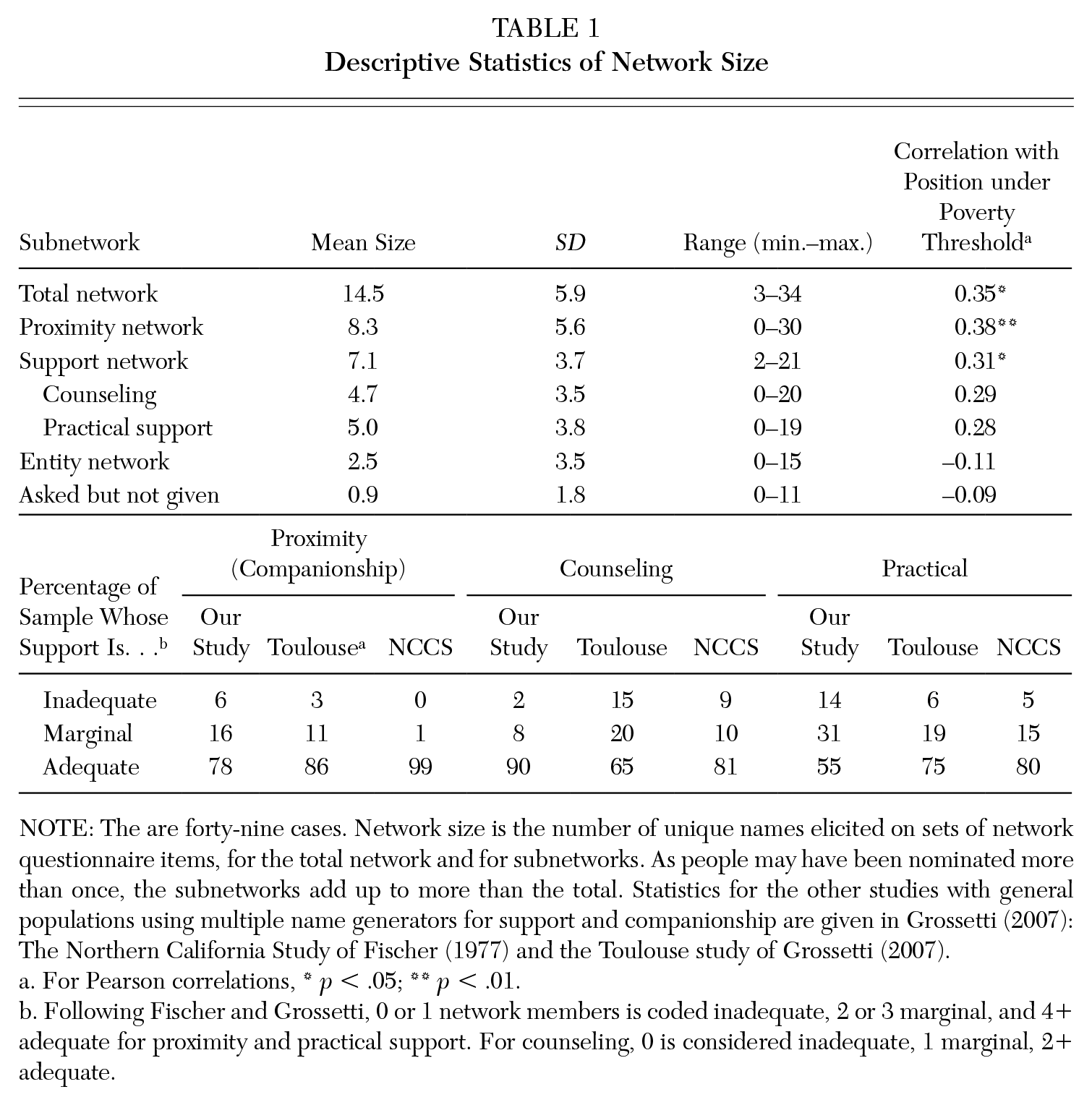
NOTE: The are forty-nine cases. Network size is the number of unique names elicited on sets of network questionnaire items, for the total network and for subnetworks. As people may have been nominated more than once, the subnetworks add up to more than the total. Statistics for the other studies with general populations using multiple name generators for support and companionship are given in Grossetti (2007): The Northern California Study of Fischer (1977) and the Toulouse study of Grossetti (2007).
For Pearson correlations, * p < .05; ** p < .01.
Following Fischer and Grossetti, 0 or 1 network members is coded inadequate, 2 or 3 marginal, and 4+ adequate for proximity and practical support. For counseling, 0 is considered inadequate, 1 marginal, 2+ adequate.
Respondents felt close to or socialized with on average eight persons; exchanged support with seven; and had met three people at the entities they attended, with whom they now felt close. The support network and the socialization network only partially overlapped, which implies that not every person in the personal network is mobilized for support and that measures of network size based only on supportive ties would generate smaller networks. To improve comparison with the aforementioned studies of general populations, with different question wording and research contexts, we coded three types of network support as inadequate, marginal, or adequate following Fischer’s (1982) coding scheme (see Table 1). Companionship and practical support (material, financial, and chores) in our sample were relatively more often marginal or inadequate than in general populations; whereas counseling (emotional support and job information) was more widespread among our respondents, perhaps due to the higher need for emotional support. Nevertheless, the majority of our respondents had adequate support according to these numerical criteria.
That being said, total network size varied considerably among respondents, with a minimum of three and a maximum of thirty-four network members. Moreover, poorer people in this restricted range tended to have smaller networks (see Table 1).
Many respondents recognized that they had lost contacts along the way. Problems that caused poverty spells cut them off from social foci: I have also noticed that friendships, when I had my divorce, have put me aside. (Esther) When you have a problem that you have a son with . . . with [drug use], people stay away. (Asunción; see Figure 2)
Moreover, economic resources, and sometimes depression, limited access to leisure activities. I don’t do anything. I really liked to go and see zarzuelas [a Spanish genre of musical theater], for which they also charged 6 euros for the entrance, but I didn’t go there anymore. Because to me those 6 [euros], plus 6, plus 6, well . . . I need them. Everything that I could stop doing, I have stopped doing. (Carmen)
Yet respondents also frequented new social environments, where they would meet new people. Children were for example transferred from a private to a public school, or from FC Barcelona to a less expensive, local soccer club. Respondents also met people at the entities they attended for help (see Table 1). Probably because it had been started by others who had experienced eviction and because of its reliance on the creation of horizontal ties, the association for evicted people was particularly successful in creating ties among its members compared to charity organizations (cf. Mazelis 2017). Members of this association had met on average 7.2 people at this organization whom they now felt relatively close to, compared to 2.9 for people who went to charity organizations. In sum, some people disconnected from social foci, while others continued to participate in organizations, or changed their participation in one organization for another.
Income homophily and support capacity
As the previous section illustrated, some people stopped participating in organizations that attracted people with a wider range of incomes and started to frequent other organizations that had a more restricted income heterogeneity. Additionally, a widening income gap between people led to loss of contact. Respondents frequently felt that family, friends, and acquaintances avoided them since their economic problems had started, or “fled” from them, as if they brought “bad luck,” even if they had never asked them for help. Many respondents alluded to this tendency: When you don’t have a job and you don’t have money, friends are a hello and goodbye and that’s it. (Felipe) When I had money, they [relatives] sucked up to me a lot, and now that I don’t have money . . . it’s as if I don’t exist. (Verónica)
In some cases, this may be heterophobia or repulsion of dissimilar people; for others, friends or acquaintances may have distanced themselves to avoid being asked for help in the future. Respondents too avoided more prosperous friends who showed a lack of understanding for their situations. Miquel, for example, resented his “spoiled” friends who were better off than him and dissociated himself from them.
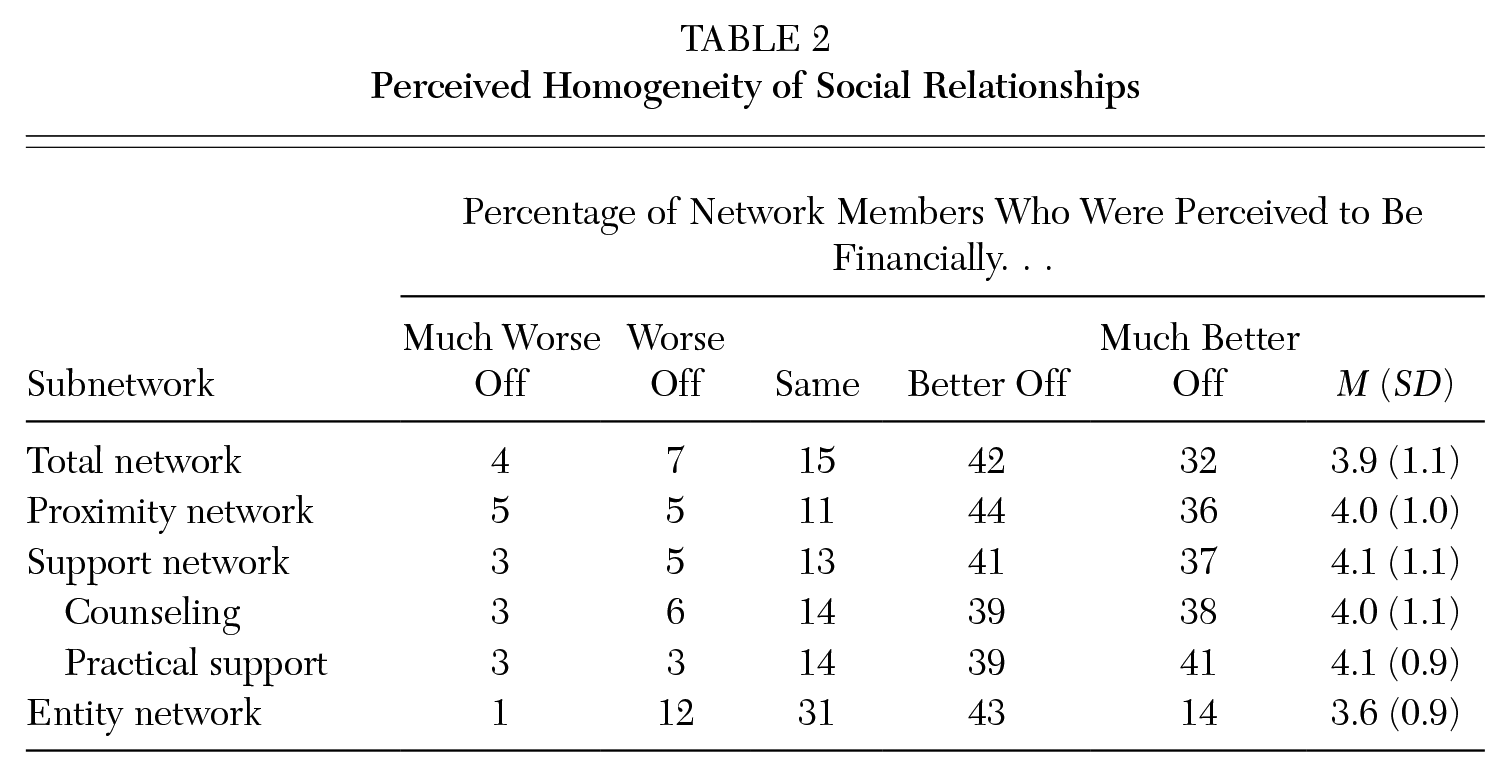
A loss of contact due to widening income gaps, withdrawal from organizations where more affluent individuals met, and other processes (e.g., intergenerational transmission of poverty) seem to restrict the economic heterogeneity of networks and, thus, their support capacity. Even so, respondents perceived that three-quarters of the elicited network members were a little or much better off than them (see Table 2), suggesting a certain support capacity, although “better off” does not necessarily mean “well off.”
Perceived Homogeneity of Social Relationships
Again, interindividual variation was considerable: three respondents had zero network members whom they believed to be better off, while thirteen reported fifteen or more. Indeed, many respondents referred to the low support capacity of their networks: My whole environment is more or less like me. I only have one friend, who . . . has quite a lot, we grew up together, and he has quite a lot of money. (Ramón) Even if I ask them [friends], they will not be able to help me. Economically? They will not be able to help me. . . . My future is fucked up, but there are relatives and friends who are much more screwed than I am. (Yolanda; see Figure 1)
However, others perceived a higher support capacity: They all have jobs, they’re well positioned, at least in my family. (Felipe) My social environment was not poor to say it in some way, it was medium-high, and I’d never have thought that this would happen. (Francesca)
Those with larger networks or a higher support capacity were aware of their benefits and maintained them with care: We’ve created a network of affected people, in which we’ve helped one another in any way. Eh . . . they’ve been evicted, they’ve gone into social housing and they have no furniture because the apartment is empty. With WhatsApp I have almost 800 high-level and low-level contacts. I need a bed of 1.35 [meters], it doesn’t matter, secondhand. . . (Francesca) They didn’t think that I would go so far with the lawsuit and the papers. . . . Because they don’t imagine what friendships I have, which I still have! Because I don’t lose friendships. If not, how would I go to the General Prosecutor of Catalonia . . . how would I go? And without a lawyer, I alone. (Diego, a former entrepreneur)
The number of network members believed to be at least better off correlated, r = .40 (p < .01), as did the number believed to be much better off, r = .50 (p < .01), with household income (in terms of percentage of the median national income; see note 3). Thus, respondents with lower incomes had a lower support capacity. Whether support capacity translates into support depends among other factors on norms.
Norms regulating exchanges
Kin obligation
We now explore whether norms regulating exchanges in social networks hindered support mobilization among our respondents. Family was expected to be the first resort, unless the economic situation of family members was equal to or worse than respondents’ own situation, or they had no contact: How embarrassing, when you have parents, [and you have] to borrow money from a friend. (Ruth)
For many, the help of kin, particularly parents, siblings, in-laws, and adult offspring was essential: these relatives provided them with shelter for short or long periods of time; structural, financial, and material help (e.g., giving them the car they don’t use anymore, paying their phone costs or their child’s school fees, offering a job in their enterprise); and food, and helped with bills and mobilized their contacts to obtain secondhand goods. Respondents described their help as “primordial” and “fundamental,” and said, “I would have died without their help.”
In many cases, however, family was unsupportive, even if they were economically able to help. Francesca, for example, was well off before she and her husband lost their jobs and, later, their house. She explained that her middle-/high-class family never helped them, for reasons she believed were pride or egoism.
If my brother had lent me a little money, which he knew I would return when I’d find work, it would have saved me from ruining myself completely.
He never lent you any money?
Never . . . never . . . ever.
Did you ask?
Yes.
Furthermore, long-term help, particularly taking kin in, started with the best intentions but often ended in exhaustion and conflict due to violations of the norms of reciprocity, equity, and autonomy. This was a general problem among participants.
And, well, when money does not enter the house, the problems begin, and a moment arrives when. . . . When you go to the fridge and grab a piece of bread it bothers them, when you take a shower it bothers them, and then it’s a very toxic circle and . . . I was a year with them, and they threw me out. They threw me out. (Paco) Worse times . . . when my brothers threw me out of the house, when my mother died. . . . Yes, I lived in the house with my mother, in Barcelona, my mother got ill, I was the villain . . . and . . . they threw me out of the house. (Júlia)
Thus, while kin had important support functions of loyalty and care, chronic poverty gradually depleted these resources (cf. Desmond 2012) and jeopardized relationships.
Financial support from nonkin was normatively less expected. Ramón, talking about his childhood friend who had a much better job than he did despite having studied less, contemplated: But of course, it’s your friend, it’s not your . . . it’s not your family. . . . You can’t stretch that relationship that much.
Other respondents made similar comments: Mixing for example friends and money is not recommended. (Ruth) It’s that friendships have no obligation. Neither do family members have an obligation, huh? (Celia)
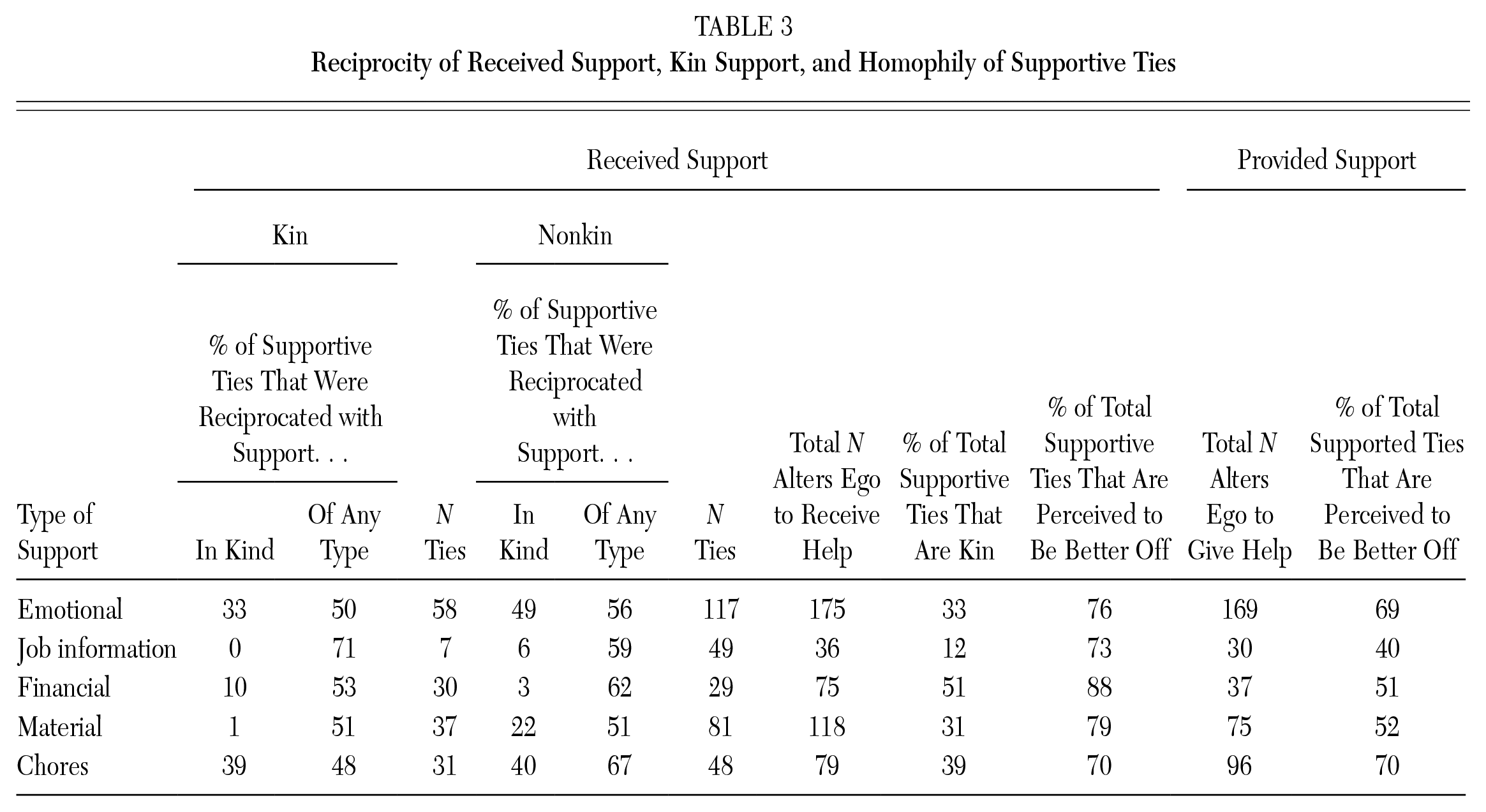
In many situations, however, nonkin were also called upon. Table 3 shows that most people who provided support, including financial and material help, were nonkin, although the volume or frequency of help varied. Most of them were friends, with whom respondents exchanged secondhand clothes or furniture, food, help with repairing things, or child care. Some friends also lent them large sums of money or invited them to live in their houses. Celia’s friend, for example, took her in for a low rent (€200 a month) and found her a job, whereas another friend paid for the repair of her car. Her family, in contrast, had never helped her.
Reciprocity of Received Support, Kin Support, and Homophily of Supportive Ties
To a lesser extent, neighbors, colleagues, church members, professionals, and other acquaintances played important roles in the day-to-day survival of the poor.
In these six years, I’ve found people who worked in the town hall. People who’ve been affected [by the crisis] but who solved their case, and I haven’t yet. And they’ve found work, and we went for a coffee and they said, “Here, 100 euros [Fran],” and they’ve helped me. . . . Clothes for me, shoes, my husband dressed in Levi’s, secondhand, but Levi’s. People who, look, who knew my daughter had to go on a school trip, which costed 180 euros, and they gave it to me. “[Fran], you’ll give it back when you can.” “[Fran], when you can, it means when you both work.” (Francesca)
While some of these acquaintances were better off, others were in similar situations.
The people who really helped me with some money at times when I needed it, well you’re not going to believe it, but they were companions of the shelter. (Ruth)
Small gestures of help were not only instrumental, but also meaningful as an act of kindness. Carmen, an elderly widow and retired seamstress, buys cheese at a small grocery store in her neighborhood. The vendor often pretended that his prices were lower than others, although she was well aware that he did not charge her the full price. Other times, he whispered, “Take it” when she reached for her wallet, adding that she could pay him when she received her paycheck. With a smile, he added, “But don’t push it, huh?” shaking off the awkwardness of the moment. Similar stories were told by others. Three months after Sara took up a new job in a hospital, her new colleagues had collected money to give her food. The school where Francesca’s children went waived their tuition fees without saying anything. Thus, so-called weak ties complemented help that was expected to come primarily from kin.
Autonomy
The norm of autonomy ensures respect for the independence of the household unit and provides a counterbalance to that of obligation. Kin would feel obliged toward young people who transition to adulthood and toward the elderly, but other adults in the family were expected to be autonomous, even in parent-child relationships. This norm of autonomy was used by parents to justify the denial of support to adult children: My mother is retired. . . . My mother, instead of going to live in [another town], between us we could have rented a bigger apartment, and between the two of us we could pay for it. . . . But she has decided that she has already raised her children and that she isn’t going to raise her grandchildren or anything. Since we left home, she half ignored it, you know? You’re married and you’re gone, it’s your problem. (Marisol) If I have no money, she [mother] is the first one to [say] . . . “then don’t go out” or “you should save more.” Well . . . I think . . . I think she could have given me something to eat and not let me go to the community kitchen. . . . Come on, I have my son and I won’t let him go to a community kitchen while I have money. (Cristian) I’ve asked my parents and they didn’t give me because, sure, you’re an adult, and well, and you must find out what life is about. (Ruth)
Sometimes, exemptions were made in the case of illness or the care of young children.
Conversely, if relatives helped on a sustained, nonreciprocal basis, they gained the right to interfere in the household’s autonomy (cf. Portugal 2009). For example, Marisol’s brother, a factory worker, helped her frequently, but he also questioned every decision she made.
My brother . . . is also always harping on me and he brings me down. . . . I understand, what he must think, maybe my situation won’t change. Truly with four children, little can change it. Then they start about the past. Why did you need to have that many children, why? They clearly don’t realize that they’re already there, that I can’t do anything, I can’t drown them. Then, when they light that little fire, yes, they go on and on about it.
Because kin are supposed to feel obliged, rejection by kin was particularly painful, to the extent that some people preferred not to ask for support. Tamara, a divorced mother of two, contemplated: But why was I so afraid that [mother] would tell me no [if asking for money]? Because I would have felt like an orphan. . . . So much so, I didn’t take the risk.
Respondents, then, prioritized the continuation of kinship ties over possible assistance and maintained their autonomy. This is comparable to Smith’s finding that unemployed African Americans were reluctant to mobilize their networks for support out of fear of rejection, a concept she named defensive individualism (S. Smith 2007; cf. Hansen 2004). In these cases, respondents tended to inform their relatives casually about their situation in the hope that they would offer help spontaneously. Sometimes they did, but often they did not.
Reciprocity
The norm of reciprocity was omnipresent in the narratives of the respondents. Calling on kin was by no means only associated with deferred, generalized reciprocity. Counterexpectations (monetary or not) were often in place. Felipe and his wife returned to live at his parents’ home for over a year, and his father claimed rent: Even my father has come to complain why I didn’t pay rent. [Simulating his response to his father:] “But don’t you know my situation, ditched as I am? But you’ve let me come here and now you’re going to claim me [rent], I’m working for you, I’m helping you, I’m cutting wood, so you have firewood for the whole winter . . . and this and that.” That’s why when that [conflict] happened with my brother and he told me to leave well I didn’t think twice. (Felipe)
Moreover, although reciprocity with kin was sometimes generalized (e.g., Inés cared for her ill sister, and their elderly parents helped Inés financially), reciprocity with kin was mostly balanced. This is clearly different from Stack’s (1974) and other early work, where reciprocity with kin was generalized and enforced on a community basis.
Another difference between our findings and Stack’s (1974) work is the help that our participants received from nonkin. With them, reciprocity was typically balanced and short term. Respondents reciprocated material help to nonkin in both monetary and nonmonetary ways: Well, in addition, I do what I can: if I have to take care of some child, I do, you know? Oftentimes I bring many children here. . . . Of course, this rewards people. (Patricia) One day a friend for example needs that I take care of her child and another day she dyes my hair, if I’m cut off the light or whatever [someone] pays the bill and later on I compensate in another way. (Rosa)
Even Carmen gave back to the vendor of the grocery store, when he asked her to repair some clothes for him. She did it for free, although she charged others for it to make some money. “Love is paid with love,” she said, “He does something for you, after that you can’t be rude.” By finding ways to reciprocate, supportive interactions could continue.
Financial help of nonkin was often in the form of a loan rather than a gift, regardless of how it was presented. It was tremendously helpful for managing income volatility (delayed pay checks, emergencies), but not a structural solution.
What happens? That these people who’ve been helping me, one gave me 500, 400, 600, to the people who gave this money I told them, “Look, I don’t guarantee you when I am going to return it, but I’m going to return it, I’ll pay you back! But I don’t know when.” And it’s no problem, but when I started working, the first payroll in February 2016 I started to give: 20, 20, 20, 20. My husband [said,] “For fuck’s sake!” Noooo, they’ve helped us, I can’t pay 100 to everyone, nor 50, but 20, 20, 20 . . . I have to start settling [debts]. (Francesca)
Table 3 confirms that most types of support were bilaterally reciprocated, in kind or (more frequently) with any type of support, while the tendency to reciprocate was approximately similar for kin and for nonkin.
Relational work
We expected that individuals would employ relational work to stimulate support mobilization. First, we explored whether respondents consciously created or “thickened” relationships to obtain support. Some romantic ties had an instrumental dimension. Livia, a single mother of four, most clearly verbalized this when talking about her childhood friend Sofía, who had reappeared in her life. Sofia was a successful businesswoman who had always had a crush on her. Although Livia did not identify as lesbian, she was “open to what might come,” as Sofia could support her. She thought, “If she helps me and I can give her at some point the satisfaction of being with her and trying it out . . . no? I tried it out.” Sofía gave Livia “unconditional help”: a job, a home, a car. The relationship was highly conflicted but went on for years.
Instrumentalization was also mentioned by Sara, whose neighbor was as short on cash as Sara and her partner were. Deciding it was cheaper to combine their resources, they regularly cooked and dined together. However, when her neighbor’s situation improved, she started to avoid Sara and her partner.
Then you realize that really, when people don’t have anything, they’re friendly, they’re nice, everything you want, but when they start to have [money] again, they become what they really were before. (Sara)
However, such mentions were rare and unlike Desmond’s concept of disposable ties, none were characterized “by a short duration but high levels of propinquity and by low levels of trust but high levels of resource exchange” (Desmond 2012, 1329): Livia’s relationship was long-lasting, and Sara and her neighbor only shared food on an equity basis. Only 11 of the 712 unique relationships (1.5 percent) had features of disposable ties: they were formed maximally two years ago, respondents felt close or very close to these people, they exchanged at least material or financial help, and ties were personal (e.g., not social workers). Yet even these eleven ties may be durable or exchange low volumes of help. Thus, most weak ties were not thickened for the purpose of support.
Second, respondents employed certain tactics during support mobilization to improve the likelihood of support. Obfuscatory relational work was primarily enacted by help providers, rather than by help seekers, at least in the narratives of the latter. Help providers obfuscated to avoid certain help requests (following nonreciprocation, or low-priority requests, such as lending money to pay the fees for an entrepreneurship course), by feigning not to have it, postponing help indefinitely, or by offering a different type of help than requested (cf. Wherry, Seefeldt, and Alvarez 2018). In contrast, help seekers mostly masked their economic conditions when trust was thin, to avoid stigmatization. Even small requests were carefully staged. For instance, Asunción did not have the money for detergent, and went in her nightdress to a neighbor: Well, I was going with . . . for not telling her that directly . . . a small [empty] jar of beans, of those made of glass, for cooked beans. A little jar, not too big, so she doesn’t say that I come with a huge vessel. [Laughs about her strategy. Simulates the conversation:] “Oh, see if you’ve got a little bleach now girl, I just finished it, and at this moment, look you caught me in this robe, and to go shopping, well no. . . .” Well, she gave me a stingy dash [of detergent].
Rather than obfuscatory relational work, help seekers mostly enacted elucidating relational work, to signal their deservingness of help and justify their help request, considering the severity of the problem, their own efforts to deal with it, and their past contributions to others. First, they explained their genuine needs to others who they thought might be able to help. This could be challenging, as they perceived people with higher incomes to show little understanding, or even disbelief: He [brother] doesn’t understand. He’s never been in the situation himself, God forbid. (Marisol) In general, the people who could help you economically are people who don’t understand your situation, or they don’t agree with what you’re doing or, sure, they hold the administration responsible and I can’t blame them. (Ruth)
Some used dramaturgical tactics to stress their needs, like Diego, who sent his son to a debtor.
It was because I sent my son, the youngest, and I said, let’s see if [debtor] feels sorry and he gives us a thousand euros from what he owes us. And ooooh, when my son came back . . . he says, “Papa, I won’t go there again.” I said, “What did he say?” “That he’ll give me money to go out, but that I shouldn’t pay you anything.” And that was the start of a fierce argument.
Respondents also stressed their own efforts to deal with the situation, to demonstrate that they did everything they could to avoid asking for help. Ramón, for example, had helped others, like his brothers-in-law, when they were poor. “But of course,” he said, “if they ask all the time, and you see that they don’t . . . they don’t do their best, they don’t work. . . . But sure, if you see that it’s a person who’s doing his best, seeking, working, and the man doesn’t make it, and he asks you [for help], well, I say give it to him, right? If you have it, of course. [But] [i]f you see it’s a person who doesn’t move things. . . .
He then turned to himself.
In my case that’s not the case, because I don’t stop. If I’m not doing one thing, I’m doing another. So, sure, if you ask people, they respond. They know you’ll return it.
Furthermore, respondents frequently alluded to the past support provided to others, appealing for generalized delayed reciprocity. For example, I don’t like to say it in someone’s face, but even so, you have conversations, [that] when I worked, I was the ATM of many people. (Rosa) I’m helping a lot, I’ve helped their children a lot and with many things, but it seems they don’t pay me in the same currency. (Celia) In fact, the people who’ve helped me the most were the people who know what I’ve done for others. (Francesca)
Last, respondents brought up their trustworthiness as debtors, which benefited their moral self-representation and secured future help.
It’s also true that I pay. It’s also true that I return it. Even if the next month, well look . . . eat lentils, every day. (Dolores) I’m a very good payer. . . . They’ll never say “Alas, this woman.” (Carmen)
For Carmen, the key to having a strong economic support network was knowing how to ask and returning favors and debts.
Conclusion
Previous academic literature has observed that people who struggle with poverty rely on dense support networks of family and close friends. Mediterranean welfare states, established in or before the 1970s, are also based on the premise of family solidarity. However, times have changed.
The economic crisis, changing family structures, higher geographic mobility, and increasing individualism call into question the emergence of the lifelong, kin-based, geographically bounded, densely knit support networks reported in the past. Our in-depth investigation in urban households in poverty in Spain aims to reveal contemporary processes of social support mobilization and the limitations of support networks. We expected that people experiencing poverty would have smaller and resource-scarce support networks, which are regulated by norms that impede structural support mobilization in times of poverty. We also expected that respondents would enact relational work to improve support mobilization.
The results confirm earlier reported findings that family and friends give essential help in poverty, particularly for emergencies or short periods of time, but we also show that stopping the characterization there renders a portrait of network support that is far from complete. First, even with social support, many households hardly got by, as observed by their deprivation of even the most basic needs and their reliance on charity organizations and illegal practices for survival.
Second, by examining support mechanisms, we found that support mobilization transformed the network itself. Specifically, the norm of kin obligation raised expectations that put family relationships under pressure. On one hand, if family failed to give support to a member in need, by, for example, appealing to the norm of autonomy, this failure was experienced as a painful rejection, a lack of love, and damaged family ties. On the other, sustained family support often led to exhaustion and conflict, due to violations of the norms of reciprocity and autonomy. Thus, in chronic poverty, family social capital is gradually depleted (cf. Desmond 2012). Perhaps even more alarming than insufficient support is the observation that in the snowball of problems that quickly accumulate in poverty spells, families’ rejection and long-lasting conflicts become additional sources of exclusion in an already highly fluid world formed by uncertain jobs, housing situations, economies, and marital ties. Particularly, considering the mental health problems that most respondents experienced (depression and anxiety), being cut off from or rejected by one’s closest ties puts people even further at risk of poverty and at a further distance from solving their problems.
In this sense, having a well-to-do family was a double-edged sword. Its support could quickly get people back on their feet, avoiding further entrapment in poverty. However, affluent families could also display a lack of understanding for the situation, or even disbelief, and often turned a deaf ear to help requests. In contrast, low-income families tended to be more understanding and, simultaneously, exempted from help requests.
In contrast to earlier research, friends and even mere acquaintances also gave important help, either complementing family support or in its absence. While smaller material exchanges (e.g., children’s clothes) among friends and acquaintances were frequent, larger sums of money and types of help were also exchanged. Maybe because ties were weaker, support of this kind was mostly bilateral and less subject to community sanctions. As nonkin are normatively not expected to help, such ties suffered less if they failed to provide support. However, even in the absence of support, nonkin relationships could deteriorate if the income gap increased. Furthermore, financial help needs to be paid back, even when no clear date is set for return, or return is not explicitly required. Thus, lending from friends and acquaintances helped to smooth household economies but was not a structural solution.
Notably, both the size and support capacity of networks were highly diverse in our sample. In contrast to an earlier classification into strong kin networks, disposable ties, and isolation (Desmond 2012, 1330), family support was not necessarily deeply embedded in networks, and acquaintances gave important help without the relationship eventually being disposed. Future research must investigate whether the greater complexity of support networks is replicated in other cultural settings and how it is related to income levels and other variables.
This study took place in Spain, which has the third highest unemployment rate in the OECD (OECD 2019a) and a Mediterranean welfare state system, which assumes that the family is the primary welfare provider. As our results show, this assumption is not only outdated and unsustainable, it damages individuals’ most important social relationships, putting them at even higher risk of exclusion. Better national policies must be developed to protect people against poverty traps and mental health decline. Institutions for poverty alleviation could pay more attention to family relationships and optimize their institutional role as brokers in the formation of social capital (cf. Small and Gose, this volume). As our research and that of Mazelis (2017) show, grassroots associations that employ horizontal models of organization stimulate the creation of ties and empower people. Perhaps vertically organized institutions could learn lessons from these organizations and adopt practices that empower relational autonomy.
Footnotes
Note:
We are especially grateful to the study’s respondents for their participation and openness. Furthermore, we thank Isabel Ferràndiz, Eduard Sala, Mercedes Vázquez, and Marta Lobato who assisted with the data collection; and Mario Small for his valuable feedback on an earlier draft. The article further benefited from anonymous peer review. The research leading to these results has received funding from RecerCaixa (Award no. 2015ACUP 00145). The contents of this article are the responsibility of the authors and do not necessarily reflect the views of the RecerCaixa program.
Notes
Miranda J. Lubbers is an associate professor in the Department of Social and Cultural Anthropology at the Universitat Autònoma de Barcelona (Autonomous University of Barcelona). Her research interests include social networks, social exclusion, poverty and livelihood strategies, and social cohesion.
Hugo Valenzuela García is an associate professor in the Department of Social and Cultural Anthropology at the Universitat Autònoma de Barcelona. His main field of interest is economic anthropology, and he has recently worked on poverty and livelihood strategies, as well as social networks and exclusion.
Paula Escribano Castaño is a PhD student in the Department of Social and Cultural Anthropology at the Universitat Autònoma de Barcelona. Her research interests include livelihood strategies in rural areas, neo-peasantry and self-sufficiency, and public policies and environmental values in Western societies.
José Luis Molina is a professor in the Department of Social and Cultural Anthropology at the Universitat Autònoma de Barcelona. Personal networks, migration, and livelihood strategies are among his research interests.
Antònia Casellas is an associate professor in the Geography Department at the Universitat Autònoma de Barcelona. Her research interests include urban governance, impacts and vulnerability of global change, and community economies.
Jorge Grau Rebollo is an associate professor in the Department of Social and Cultural Anthropology at the Universitat Autònoma de Barcelona. His research interests include family and kinship, childrearing, and social vulnerability.