




Abstract
This article reviews the evidence on young people in the UK making the transition from school to work in a changing socioeconomic climate. The review draws largely on evidence from national representative panels and follows the lives of different age cohorts. I show that there has been a trend toward increasingly uncertain and precarious employment opportunities for young people since the 1970s, as well as persisting inequalities in educational and occupational attainment. The joint role of social structure and human agency in shaping youth transitions is discussed. I argue that current UK policies have forgotten about half of the population of young people who do not go to university, by not providing viable pathways and leaving more and more young people excluded from good jobs and employment prospects. Recommendations are made for policies aimed at supporting the vulnerable and at provision of career options for those not engaged in higher education.
The transition from school to work (SWT) is crucial in the lives of young people. It is a make-or-break period that can impact a range of later outcomes, including employment opportunities, patterns of family formation, and health and well-being (Schoon and Bynner 2017). It generally spans the phase between completing full-time education or training, entry into paid employment, and establishing oneself in the labor market. It is closely linked with a number of other key transitions that mark the entry into independent adulthood, such as leaving the parental home and starting a family. Since the 1970s, the SWT has become more prolonged across most developed countries, as young people are increasingly required to complete higher levels of education to compete in the changing labor market (Furlong and Cartmel 2007; Shanahan 2000). Yet not all young people are participating in higher education, and compared to other European countries, the UK has a relatively high rate of early school leavers (leaving education after the completion of compulsory schooling). Despite efforts of successive UK governments to increase participation rates in postsecondary education, the rate of early school leavers in 2017 was still above 10 percent (Eurostat 2017), and the participation rate in higher education among 17- to 30-year-olds was 49.8 percent (DfE 2018). Thus, a large number of young people in the UK do not continue in education or go to university. While most policy efforts are targeted at increasing higher education participation, less attention is paid to the “forgotten half” (Rosenbaum et al. 2015), that is, those who do not attend or complete university. This review therefore focuses on this group’s experiences in the SWT, drawing on evidence from nationally representative data sources to map trends in the experiences of young people in the UK making the SWT since the 1970s.
Understanding the SWT
In this review, I treat the SWT as a status passage in the institutionalized life course (Buchmann and Kriesi 2011; Shanahan 2000), meaning that youth transitions are largely shaped by opportunities and constraints presented by the sociohistorical context encountered and, within this context, are dependent on individual decision-making and agency (Schoon and Heckhausen 2019). The SWT is guided by country-specific age-related informal as well as formal, that is legal, norms (such as minimum school leaving age or working hour restrictions). It can be understood as an institutionalized sequence of status-role transitions (i.e., transition from education to employment) and role configurations (i.e., working and studying at the same time) steered by social norms regarding age-appropriate behavior and the timing and sequencing of status/roles (Settersten and Gannon 2005). The state channels SWT patterns through related policies and welfare institutions that facilitate normative transitions, such as entry into paid employment after leaving full-time education, and buffer against nonnormative discontinuities in the life course, such as spells of unemployment (Heckhausen and Buchmann 2019). In addition to institutional arrangements and social inequality at the family level, historical and contemporary conditions, such as an economic boom or bust, the prevailing cultural climate and political setting, all play a role in shaping the contours of the life course. These conditions define the potential pathways for individuals to follow, specifying relevant requirements for achievement and defining key deadlines to do so. They also inform the “horizon of perceived possibilities,” that is, the perceptions about what career options are available and appropriate to strive for (Schoon and Heckhausen 2019). A comprehensive conceptualization of the SWT thus needs to account for both structural conditions and manifestations of individual agency.
Within a socioecological framework (Schoon and Heckhausen 2019), the interplay of structure and agency is the key focus. The SWT requires a number of important decisions, such as what kind of job or career to choose and whether to continue with further education or to leave school directly after completion of compulsory education. These choices reflect manifestations of agency, a central aspect in the study of SWTs (Elder, Shanahan, and Jennings 2015; Schoon and Lyons-Amos 2017). The manifestations of agency have to be understood within contextual constraints, and they vary depending on cultural context, gender, ethnicity, and social background. Moreover, agency is highly responsive to economic and social change. For example, evidence from three British age cohorts born in 1958, 1970, and 1989/1990 suggest that young people with less educated parents (in particular males) have generally lower levels of educational aspirations than those with highly educated parents; although for the cohort born in 1989/1990, educational aspirations have considerably increased, and the association between parental education and educational aspirations has reduced (Schoon 2010). Young people from less privileged family backgrounds are also less likely to attend university (Schoon and Lyons-Amos 2017), yet individuals are not passively exposed to external conditions, and young people from very similar backgrounds can end up in quite different positions in society when they reach adulthood. SWT has to be understood as a developmental process that extends over time, where structures shape and enable agency and individuals both reproduce and transform the structures that influence them (Schoon and Heckhausen 2019).
The UK Transition System
The distinct features of a country’s institutional arrangements that guide young people’s SWT have been described by the term transition system (Raffe 2014) or institutional filters (Blossfeld et al. 2005). Such arrangements comprise structures of the education and training system, related modes of labor market regulation, welfare provisions, family structures, and the nature of the links between educational systems and the labor market (Buchmann and Kriesi 2011; Schoon and Bynner 2019). These institutional factors influence and channel transition behaviors by offering a diverse set of opportunities and constraints (Heckhausen and Buchmann 2019).
Countries can be differentiated on the basis of the relatively enduring features of institutional and structural arrangements guiding SWTs, recognizing the multidimensional nature and underlying complexity of transition systems (Raffe 2014). For example, the UK (like the United States) has been identified as a liberal transition system, characterized by a comprehensive education system, as well as high flexibility and fragmentation in postcompulsory education (Blossfeld et al. 2005; Walther 2006). The labor market is mainly deregulated with a large segment of low-skilled and nonstandard jobs. Levels of benefits (when young adults are eligible for them) are low and limited in time. They are also conditional upon active job search.
Most liberal transition systems provide no structured path into skilled employment without college, emphasizing college education as a prerequisite for a viable career. Within the UK, vocational education and training (VET) models are not standardized, and there is only limited employer engagement in the VET provision (Wolf 2016). For young people not planning to go to university, the further education (FE) colleges provide the main post–compulsory education route for gaining vocational qualifications or making good on previous poor school performance. However, the neoliberal austerity approach to public funding following the 2008 Great Recession has led to cuts in FE provision and major increases in university tuition fees. At English and Northern Irish universities, students are currently charged up to £9,250 per year for tuition, and the average student in England will graduate with debts of more than £50,000. Current policy intentions aim to promote apprenticeships and technical training courses, yet young people and parents do not regard a vocational training pathway as a promising option, and early school leaving without any training has been a particularly concerning issue in the UK education system (Crawford et al. 2011). One explanation for early school leaving has been the relatively low compulsory school leaving age, which since 1972 was 16 years, increasing to 17 in 2013 and 18 in 2015. Yet still in 2018, only 50 percent of young people participate in higher education (DfE 2018).
Changing Youth Labor Markets and Increasing Precarity
What are the jobs that young people can enter upon leaving full-time education? Work, a key marker of independent adulthood and a major component of the institutionalized life course, has changed considerably since the 1970s. Following a “golden age” of the post-WWII economic boom and expansion of a highly institutionalized safety net, the 1970s have been characterized as the “crisis decades” (Hobsbawm 1995), preceding the current “age of insecurity and precarity” (Standing 2011). There has been an expansion of knowledge-intensive industries, especially in business services, generating an increase in the proportion of professional, managerial, and technical jobs requiring an academic qualification (Ashton 2017). At the intermediate level, the application of ICT-based technologies led to a de-skilling of skilled manual and administrative jobs. One consequence of this restructuring has been that the proportion of jobs in the middle level has been reduced; that is, there was a reduction in the jobs that traditionally required an apprenticeship or a relatively long period of training, while there was a rise in low-paid occupations (mainly in the service industries).
The loss and decline of many of the clerical and skilled manual jobs also brought with it the loss of viable employment opportunities for many young people entering employment immediately after leaving compulsory schooling, since these jobs were generally full time and guaranteed a regular income. This process, also referred to as the “hollowing out of the middle” (Autor, Siegfried, and Dorn 2009), led to a polarization of employment into “lousy versus lovely jobs” (Goos and Manning 2007). This trend toward increasing precarity, in particular for young people without academic qualifications, was evident even before the 2008 Great Recession (Blossfeld et al. 2005) but has accelerated ever since (Bell and Blanchflower 2011; Schoon and Bynner 2017).
Youth unemployment
Compared to the early 1970s, youth unemployment rates have risen in almost all developed countries (Blossfeld et al. 2005); and until 2014, youth unemployment rates in the UK were consistently slightly above the OECD average (Schoon and Bynner 2019). The term youth unemployment refers to 15- to 24-year-olds who are unemployed, which means that there can be variations in the operational definition between countries, as the lower age limit is usually determined by the minimum age for leaving school, where this exists. Differences in operational definitions have implications for comparability of findings across countries. Moreover, youth unemployment rates do not include students, who are classed as economically inactive, as are those who are looking after the family or home, those who are ill or disabled, or those who have retired.
Figure 1 shows the UK youth unemployment trends between 1975 to 2018 by age group. During this time period, the UK witnessed four major recessions: one during the mid-1970s, following the 1973 oil crisis; one at the beginning of the 1980s associated with deflationary government policies characterized by major spending cuts to reduce inflation; one at the beginning of the 1990s, characterized by stubbornly high interests rates (14.8 percent at its peak), culminating in “Black Wednesday” on September 16, 1992, when the UK government was forced to withdraw the pound sterling from the European Exchange Rate Mechanism after it was unable to keep the pound above its agreed lower limit; and the 2008 global financial crisis, also referred to as the “Great Recession.” Another major event was the 2016 EU referendum when the UK voted to leave Europe (Brexit), although the majority (about 70–75 percent) of 18- to 24-year-olds voted to remain.
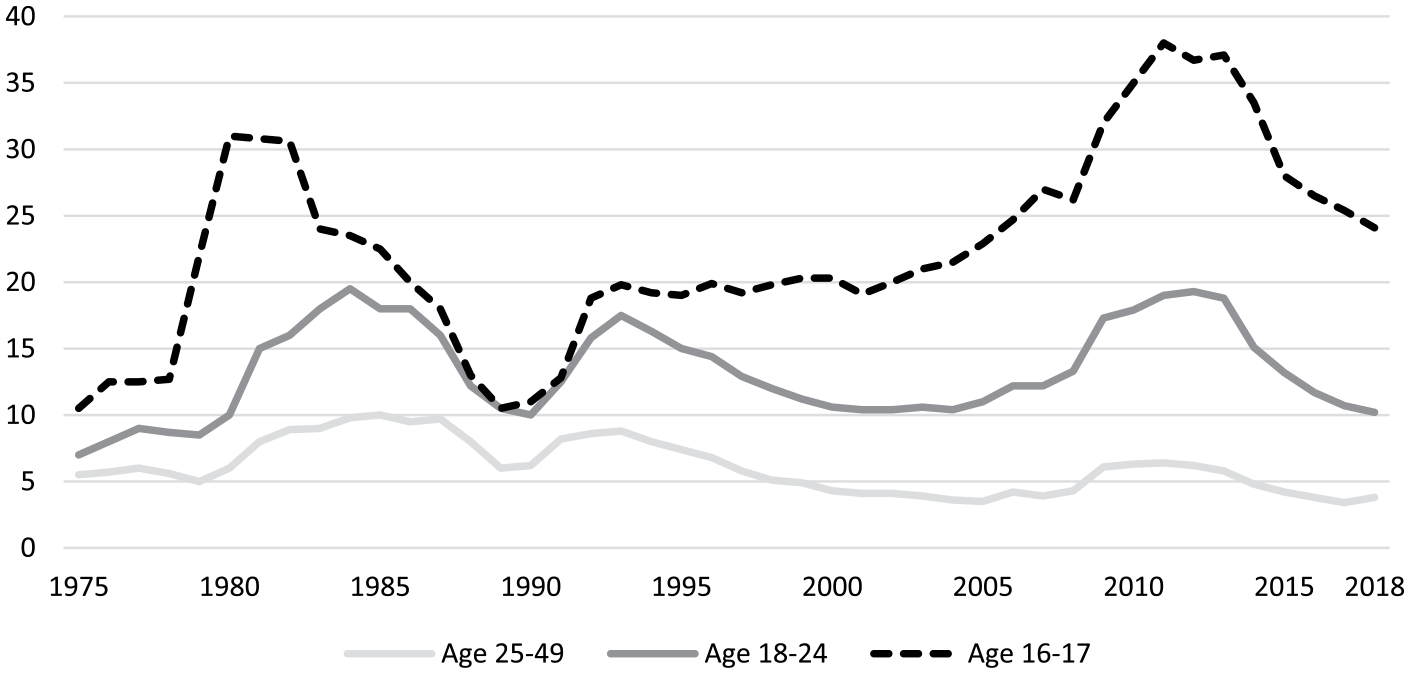
1975–2018 Trends in UK Youth Unemployment Rates
Evidence from the UK Labour Force Survey (Office for National Statistics [ONS] 2019), indicates that young people, in particular 16- to 17-year-olds, are much more sensitive to the state of the business cycle than workers in their prime age (25–49). The unemployment rate is higher for the young age groups, and the magnitude of the disadvantage widens during a recession. Employers are generally reluctant to lose more experienced workers, and the burden of adjustment typically falls on low-skilled and low-wage workers, as well as ethnic minorities who tend to fare worse during economic downturns, in particular in the aftermath of the most recent recession (Bell and Blanchflower 2011). For example, in the aftermath of the 2008 recession, unemployment rates among 16- to 17-year-olds peaked at about 37 percent in 2011, compared to 19 percent among 18- to 24-year-olds and 8 percent among the 25- to 49-year-olds in the same year.
The experience of youth unemployment, in turn, can bring with it long-term “scarring effects” in terms of health and well-being. For example, using data collected for a UK birth cohort born in 1958, Bell and Blanchflower (2011) linked experiences of youth unemployment (between ages 16 and 23) to indicators of general health, life satisfaction, and depression at age 50, demonstrating the long-term effects of a problematic start into the labor market, associated with “permanent scars rather than temporary blemishes” (p. 260). These negative effects can also extend to general employment and career prospects (Crawford et al. 2011; Gregg and Tominey 2005), as well as fertility intentions (Lyons-Amos and Schoon 2018).
Flexible employment and precarity
In the context of restricted employment opportunities for young people, another issue has to be considered: the shift toward precarious employment arrangements and low pay, even among college graduates (Standing 2011). In most developed countries, the number and proportion of full-time employees with contracts of intermediate duration have decreased continually since the mid-1980s, and there has been a shift toward more “flexible” working arrangements that followed deregulation designed to tackle perceived labor market rigidities (O’Reilly et al. 2015). In the UK, this flexibility is characterized by the growth of temporary, self- and part-time employment and of zero hour contracts with no guarantee of minimum working hours. Young people have been hit particularly hard by this trend, compared to older workers (Eurofound 2013; Iacovou 2017).
According to Eurostat, temporary employment includes work under a fixed-term contract, compared to permanent work where there is no end date. Across most European countries, the employment rate for young people with temporary work contracts increased in the aftermath of the 2008 recession, in particular in Spain (Eurofound 2013). Similar trends can be observed for the slightly older 25- to 29-year-old age group, although the number is only about half the proportion of 15- to 24-year-olds employed on a temporary contract. In the UK, temporary employment among 15- to 24-year-olds is less common than in other European countries. Nonetheless, it increased from 11 percent in 2004 to 15 percent in 2012, although a considerable number of young people (36 percent) say that they actually choose casual work (Eurofound 2013).
Underemployment is another aspect of the youth labor market (Schoon and Bynner 2017). An increasing number of young people in paid work would like to work more hours (time-based underemployment), or they are employed in jobs requiring lower educational qualifications than they have (skill-based underemployment). Like the experience of youth unemployment, employment conditions where there is a mismatch between the skills and education credentials of the individual and characteristics of jobs (i.e., overskilling or overeducation) can have prolonged effects on career progression, wage prospects, job satisfaction, and being able to enter secure and stable employment in the future (O’Reilly et al. 2015).
Not in education, employment, or training (NEET)
Another worrying statistic is the growing number of young people disconnected from education and employment. The term not in education employment or training (NEET) has been widely used in recent years to identify existing or potential transition problems including unemployment and labor market inactivity. The concept of NEET has its origin in the UK (Bynner and Parsons 2002), referring to problematic transitions. It has been widely adopted across countries and has become a core indicator for comparing the performance of states in integrating young people into society (OECD 2018).
There are, however, substantial problems with the definition of NEET (Furlong 2006). It is a rather broad category, masking considerable heterogeneity (see, for example, Dias and Vasconcelos, this volume). It refers to young people being inactive and not seeking employment. Among young women, the main reason for labor market inactivity is childcare responsibilities, while health and other factors are more prevalent among young men (OECD 2018). NEET also includes those who opt out temporarily through “gap years”; who are traveling before engaging fully with their studies or work career; as well as those who have fallen out of the benefit system completely, that is, those who are on the street or homeless, which makes it a complex indicator. Moreover, there are distinct cross-national differences in identifying NEET. For example, reflecting the relatively compressed SWT in the UK compared with other countries, the age limits for NEET were set originally at 16 to 18 (Bynner and Parsons 2002). This was before the compulsory requirement from 2015 that young people stay engaged in some form of education up to age 18. The current OECD definition (shared with the European Union) uses NEET to describe the economic activity status of 15- to 24-year-olds. Rather than being clear-cut, the term NEET reflects in many respects the different transition processes that young people are going through. Despite its limitations, the NEET indicator can be a useful tool in enhancing understanding of young people’s vulnerabilities in terms of labor market participation and social inclusion, in particular if the differentiation of different subgroups is clearly indicated.
Between 2000 and 2017 about one in six of all young people in the UK aged 20 to 24 experienced being NEET, which corresponds to the OECD average (Schoon and Bynner 2019). There had been a considerable increase in the aftermath of the Great Recession, rising from 15.4 percent in 2000 to 20.2 percent in 2012, but decreasing again to 15.0 percent in 2016. However, young people with low-level education qualifications are at a much higher risk of being NEET (Crawford et al. 2011; Schoon and Lyons-Amos 2016, 2017). For example, in 2013, more than 30 percent of 15- to 24-year-olds in the UK with only lower secondary-level education were NEET, compared to 9 percent of those with degree-level qualifications and 12 percent of those with upper secondary and postsecondary qualifications (Eurofound 2016).
Trends in Transition Patterns
So far, individual transitions have been discussed in terms of single transition states, such as education, employment, unemployment, or NEET, using evidence from aggregate trend data. Yet transitions do not proceed in a linear, unidimensional fashion. There is the possibility of reversibility, such as returning to education or finding a job after periods of unemployment. Moreover, the timing and sequencing of transition states matter for a better understanding of the transition process. For example, based on data from the 2013 European Labour Force Survey, about a third of young people classified as NEET were only temporarily inactive and soon after the survey reentered employment, education, or training; while others (about 6 percent) became discouraged and stopped looking for work or further training because they believed that there were no job opportunities for them (Eurofound 2016). Increasing availability of longitudinal data, following individuals over time opens up further opportunities for analyzing variations in the patterning of transitions (Buchmann and Kriesi 2011). Notably, the UK is home to a number of world-renowned cohort studies, such as the 1958 National Child Development Study, the 1970 British Birth Cohort, and the Millennium Cohort. Being able to contrast experiences of different age cohorts can provide valuable insights into the effects of social change by controlling for age, period, and cohort effects (Elder, Shanahan, and Jennings 2015).
Comparing evidence regarding early employment trajectories in four British age cohorts born in 1958, 1970, 1980, and 1990, Anders and Dorsett (2017) focused on experiences during the first 29 months following the end of compulsory schooling (i.e., age 16). That is, they compared SWTs that took place in 1974–1977 (1958 cohort), 1986–1989 (1970 cohort), 1996–1999 (1980 cohort) and 2006–2009 (1990 cohort). Using sequence analysis, they identified three distinct pathways in all four cohorts. The pathway of “accumulating human capital” is characterized by continuous education over the 29 months following compulsory school leaving age. The pathway labeled “entering the labour market” is characterized by continuous full-time employment after leaving compulsory education, or after one or two years of further education, and “potentially difficult transitions” comprise extended or frequent spells of unemployment or inactivity. The prevalence of these transition patterns is shown in Figure 2.
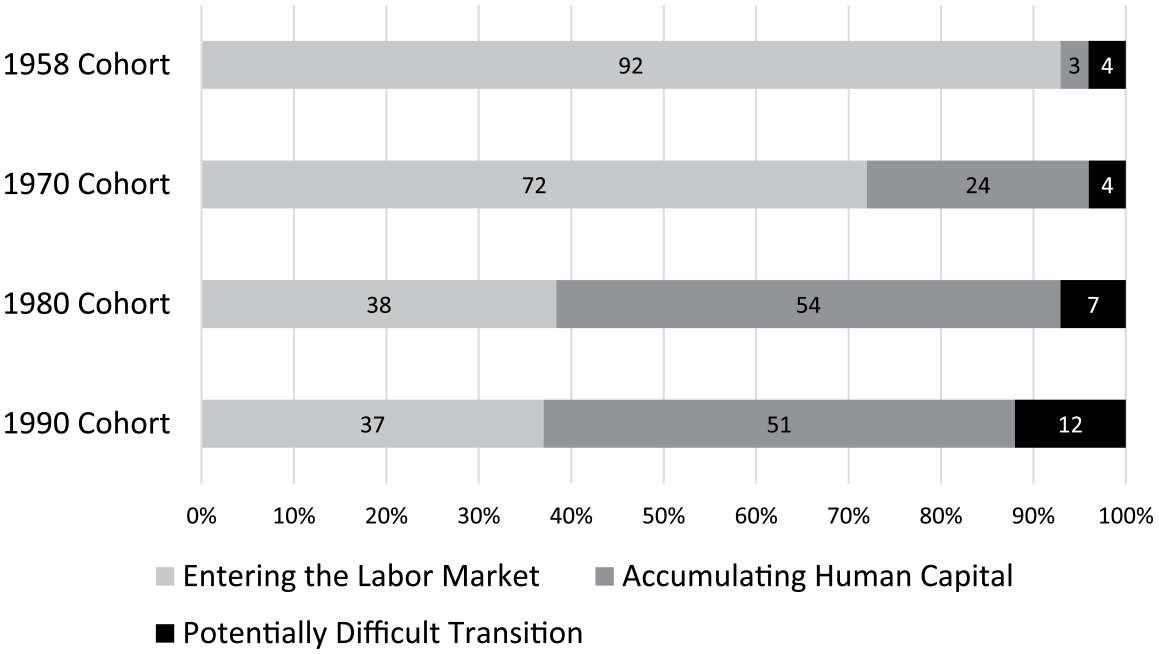
Employment Transitions in Four UK Age Cohorts
While the proportion entering continuous employment after compulsory schooling decreased across the cohorts, the number of young people entering further and higher education has increased. There has also been a rise in potentially precarious employment, in particular for the 1990 cohort. Similar findings were reported by Schoon and Lyons-Amos (2016), who used data from the British Household Panel Survey and the UK Household Longitudinal Study to compare transitions of individuals born in 1980–1984 and 1985–1990. Also using sequence analysis, they found five distinct transition patterns, differentiating those who participate in extended education, two pathways dominated by continuous employment, either directly after completing compulsory schooling at age 16 or after some further education; and two pathways characterized by exclusion from the labor market (prolonged experience of unemployment or inactivity). Like Anders and Dorsett (2017) they find a dramatic increase of precarious employment transitions, yet they provide a more differentiated account of the diversity in transition experiences, and they note that the findings might be due to a period effect of the Great Recession rather than cohort effects. They argue for a “diverse pathways view” (Schoon and Lyons-Amos 2016), moving beyond the conceptualization of youth transitions in terms of a dichotomy between “successful” transitions involving the accumulation of human capital and “problematic” transitions characterized by prolonged unemployment or labor market inactivity.
Both studies confirm that there is a large group of young people who succeed in entering continuous employment after the completion of secondary education, despite not going to university. The prevalence of this group was considerably reduced in the aftermath of education expansion yet remains significantly large. It is this group of young people who generally fall off the radar of policy-makers and who receive the least support, since there are no well-structured paths into skilled employment without college, and appropriate funding for further education and training has been neglected. While the pathways to college are well signposted and supported through state subsidies, the route into work for 16- to 20-year-olds is more like an unmarked minefield, where young people have to fend for themselves without institutional support. Even continuing in education until age 17 or 18, or taking a job that involves training, is not sufficient to guarantee better labor market outcomes (Crawford et al. 2011). To secure higher earnings, young people need training with opportunities for progression that leads them to an apprenticeship or an accredited qualification. However, access to viable education and training opportunities continues to be associated with one’s family’s social background.
Persisting Social Inequalities
A range of indicators of family socioeconomic status, including parental education, occupational status, and income, are all associated with young people’s education and employment aspirations and attainment, as are individual-level characteristics such as gender and ethnic minority status (Schoon and Lyons-Amos 2016, 2017). Parents in a higher social position have more access to financial resources that enable them to purchase study materials or tutoring, to finance extended education and associated tuition and living costs, to support their children doing unpaid internships or volunteering to acquire relevant skills and knowledge, or simply to provide them with a desk and a room to do their studies. They are more likely to live in areas with well-resourced schools, adequate employment opportunities, and good transport. They have the relevant cultural knowledge of how to deal with different institutions and to negotiate with gatekeepers, and they have the social networks to facilitate access to important information and contacts.
As already indicated, the wider sociohistorical context, institutional factors, and family socioeconomic circumstances all shape the “horizon of perceived possibilities” for young individuals; that is, the perceptions about what career options are available and appropriate to strive for (Schoon and Heckhausen 2019). Young people from relatively disadvantaged backgrounds report lower levels of self-confidence and career ambitions than their more privileged peers (Duckworth and Schoon 2012; Schoon 2010); they are less likely to participate in further and higher education and are more likely to experience precarious employment transitions (Schoon and Lyons-Amos 2016, 2017), even after taking into account early academic attainment. Generally, young people from marginalized subgroups of the population encounter diminished options and have limited resources in pursuing their aims.
Since the 1990s, successive UK governments have started the so-called aim higher initiatives to increase participation in higher education, particularly among students from nontraditional backgrounds and ethnic minority groups and disabled persons. Educational aspirations of young people have continuously increased, including among those from relatively disadvantaged backgrounds (Schoon 2010), in particular among young women and those with ethnic minority backgrounds (Schoon and Lyons-Amos 2017). While UK government policy is focused on getting disadvantaged students into tertiary education, it might be even more important to ensure that young people have equal chances to achieve their General Certificate of Secondary Education, which is usually taken at age 16.
There is evidence of the devastating and persistent impact of social inequality regarding transitions into upper secondary education (Bukodi and Goldthorpe 2013), highlighting the period of secondary schooling as a vital stage for a more comprehensive understanding of inequalities in educational progression and attainment (Pensiero and Schoon 2019). A persistent problem in the UK is the so-called tail of low achievers, who leave school without basic skills in literacy and numeracy (Marshall 2013), which is particularly pronounced among poor and socially disadvantaged students (Machin and Vignoles 2004). The introduction of attainment targets and the publication of school league tables in the 1990s has introduced incentives for schools to focus their support on high-ability pupils, to the neglect of more disadvantaged pupils who are at a greater risk of school exclusion, dropping out of school early, and subsequent unemployment (Leckie and Goldstein 2017; Wilson, Croxson, and Atkinson 2006).
Nonetheless, since the 1970s, individual behavior regarding education and career transitions has become less bound by traditional norms and values. That is, the sources of socialization and collective identity associated with class, gender, ethnicity, and workplace solidarity, and in consequence the exercise of agency through, for example, aspirations and job search, have become more diverse and individualized (Beck 1992; Giddens 1991). The increasing individualization conceptualizes the life course, including the SWT, as a deliberative project, a “reflexive” or self-steered process, governed by risks that have to be circumvented. That is to say, the SWT is understood as “something you must largely accomplish yourself” (Beck 1992), an expression of individual agency. The assertion that individuals are now free to choose their destination has however been questioned by some scholars, as there is evidence of persistent unequal access to educational and career opportunities (Bynner 2005; Furlong and Cartmel 2007; Schoon and Lyons-Amos 2016, 2017).
The Interplay of Structure and Agency in the SWT
The notion of agency has been identified as a central aspect in the study of SWTs (Dannefer and Huang 2017; Schoon and Heckhausen 2019). It refers to the choices and actions that individuals take within the opportunities and constraints of history and social circumstance (Elder, Shanahan, and Jennings 2015). However, as a nonstructural construct, agency has remained an underspecified, “slippery” theoretical concept within sociological research (Hitlin and Elder 2007). Often it is considered as the “unexplained variance” function in statistical models, without any requirement for it to be empirically measured or analyzed (Dannefer and Huang 2017). Yet agency is essential in directing individual effort and attention, in setting goals, in planning and carrying out the pursuit of these goals. There is ample evidence of the human capability for innovation and deliberate efforts to assert oneself against contextual factors. Agency cannot be reduced to the unconscious reproduction of existing social structures, or to the unfettered, decontextualized principles of choice and selection (Schoon and Heckhausen 2019). In sociology, terms such as structured or bounded agency (Evans 2002; Shanahan 2000) are used to reflect the social embeddedness of individual agency. Although individual agency and career planning are circumscribed by structural constrains, individuals are not passively responding to given structures, but are active coproducers of their own development. Agency has to be understood as a relational process, emerging through the interactions with the wider social context (Schoon and Heckhausen 2019), and it involves “the externalization of conscious intentionality into human action” (Dannefer and Huang 2017, 5).
The empirical assessment of agency requires attention to the multiple components underlying the capability to intentionally select goals, the dynamics of goal pursuit, and the societal channeling of opportunities and influence on the “horizon of perceived possibilities” (Schoon and Heckhausen 2019). The wider sociohistorical context, institutional regulations, and social structures all play a role in shaping the contours of the life course, setting up the “action field” of potential pathways for individuals to aspire to and to follow, specifying relevant requirements for achievement and defining key deadlines to do so (Heckhausen and Buchmann 2019). Individual resources such as ability, motivation, and aspirations steer individuals to invest time and effort in the pursuit of distinct goals, to persist in the face of adversity, to disengage from futile goals, or to reengage when the conditions are favorable (Schoon and Heckhausen 2019).
Evidence from the British cohort studies suggests that young people from relative disadvantaged family backgrounds, who express high levels of educational and/or occupational aspirations (i.e., aiming to go to college or university and entering a professional career) fare better in their SWT than their less ambitious peers from a similar background (Ashby and Schoon 2010; Schoon and Parsons 2002). Controlling for variations in cognitive ability, they are more likely to continue in further and higher education and are less likely to experience unemployment or prolonged exposure to NEET (Schoon 2014; Schoon and Lyons-Amos 2016, 2017; Schoon and Polek 2011). Yet while young people born in 1958 had more chances to realize their ambitions, for those born after 1970, educational qualifications became more important as a predictor of later career outcomes (Duckworth and Schoon 2012; Schoon and Parsons 2002), reflecting the increasing importance of credentials in the wake of education expansion. Moreover, agency is less effective in conditions where socioeconomic hardship is overpowering (Duckworth and Schoon 2012), and there is a potential “dark side” to high levels of agency beliefs. For example, unrealistic ambitions can hinder a smooth transition by promoting inadequate persistence or overconfidence (Schoon and Lyons-Amos 2017). This is particularly the case where agency beliefs are not matched to individual competences, or where educational and occupational expectations are not matched (Khattab 2015; Sabates, Harris, and Staff 2011). To fully understand the interactions of structure and agency, it is thus crucial to carefully analyze both the structural conditions and patterns of individual competences and their interactions over time.
Conclusion
The SWT in the UK is characterized by increasing precarity and uncertainty. Young people have to navigate a landscape of changing educational and employment opportunities, characterized by increasing skill demands and credentialism, and increasing differentiation between those on an academic track and those trying to make it via the traditional work-oriented transitions without going to university. Compulsory school leaving has been deferred to age 18, yet funding for further education, the main educational route for gaining vocational qualifications, has been drastically cut. Thus, while the pathways involving tertiary education are signposted and supported, there is very little support and guidance for those who enter the labor market directly after compulsory schooling or after some training. Moreover, there is a lack of viable alternative career pathways for those who initially intended to have an academic career. Although young people are under increasing pressure to complete higher-level academic qualifications to compete in a changing labor market, a large percentage of young people in the UK do not go to university. They are most likely to end up in temporary, precarious employment, entering a trajectory of disadvantage that will be difficult to escape. Individual agency can to some limited extent compensate against the consequences and experience of socioeconomic adversity, yet without viable career pathways, access to safety nets, and opportunities for a new start when things do not go as planned, they will not be able to make it in the long run.
Giving up on those who do not pursue higher education—the “forgotten half”—by not providing opportunities for earning a living through gainful employment can bring with it a series of consequences that is of high cost to the economy and society at large. The experience of increased uncertainty; temporary and precarious employment conditions; low pay; and a mismatch between education credentials, competences, and job characteristics can bring with it long-term scarring effects on future employment opportunities and personal health and well-being. It might also lead to social unrest and loss of trust in institutions. Policy actions are crucial to reduce the threat of a large number of young people facing prolonged unemployment or precarious employment conditions and the lifetime scars those leave. In particular, it is important to prevent school exclusion and early school drop-out and to reduce the long tail of underachievement. Moreover, well-designed welfare-to-work policies are needed to keep young people attached to the labor market. Also needed are viable and generally recognized apprenticeship programs, targeted at low-achieving groups but also at those who are not inclined to go to university despite a high level of ability, or who shy away from the high level of debt that going to university can incur. Leaving young people without the support they need to forge their pathways to financial independence will have implications for generations to come. Today’s young people are the parents of tomorrow’s children and also have to feed the pensions of older generations. Their welfare and integration into society should be a major concern to policy-makers and the government.
Footnotes
NOTE:
The preparation of this article was supported by a Research Professorship awarded to the author by the Berlin Social Science Center (WZB), Germany, and a grant from the British Economic and Social Research Council (ESRC), Grant Number ES/J019135/1 for the Centre for Learning and Life-Chances in the Knowledge Economies (LLAKES, Phase II).
Ingrid Schoon is a professor of human development and social policy at University College London, Institute of Education. She is a fellow of the British Academy of Social Sciences (FAcSS) and the Social Science Centre (WZB) in Berlin.