




Abstract
Are attitudes toward work and perceptions of the benefits of work transmitted from parents to youth similarly across a variety of cultural contexts? What determines the centrality of work to one’s life? How are intrinsic work values (intangible rewards such as autonomy, learning opportunities, and self-fulfillment) and extrinsic work values (such as status, income, and financial safety) shaped; and how do these work attitudes have consequences in the political, economic, and well-being domains? Are the determinants of work values robust across countries, and do the consequences of having certain work values differ by country? These research questions guide this issue of The ANNALS. This introductory article clarifies key concepts underlying the volume and provides an overview of the data sources and analytic approaches addressed in the individual contributions. Most importantly, we provide a broad theoretical framework with notions from various disciplines aimed at giving readers a fuller grasp of the multifaceted significance of work values.
Next to the importance that people attach to their family, work is one of the most valued qualities of life. In European countries, more than 80 percent of the population indicates that work is of major importance (World Value Survey wave 6; authors’ calculations based on Inglehart et al. 2014). This may not come as a surprise because most people, after leaving full-time education, face a lengthy period of being active in paid work, self-employment, or civil service. Daily activities are centered on work, and work provides financial security; most importantly, though, work relates to feelings of self-worth and self-identification (Rosso, Dekas, and Wrzesniewski 2010). Because work is perceived as exceptionally important by most people, several studies also underscore that qualities of work are strongly related to feelings of individual well-being and subjective health (Gallie et al. 2016). It is, therefore, often a major life event when people lose their work: the resulting financial restraints can impair the acquisition of basic necessities and luxury goods; but most importantly, losing employment can result in a loss of self-worth.
Building Research Questions
Attitudes toward work are the principles that guide individuals’ vocational aspirations, career choices, and job satisfaction, and they also influence personal well-being (Kalleberg 1977; Gallie 2007; Gallie, Felstead, and Green 2012). These attitudes, work beliefs, or work ethic may also have implications for satisfaction with politico-administrative institutions and political participation (Shore and Tosun 2019a, 2019b). From an institutional perspective, employees’ attitudes toward work are important since they likely affect the performance of businesses and the management of work tasks in modern competitive organizations (Robertson, Birch, and Cooper 2012). Work attitudes are regarded as even more important with the emergence of “new” forms of employment, which are characterized by more flexible working arrangements, temporary contracts, and enhanced responsibility for the employees (Bureau and Corsani 2016). It is unclear, however, whether working in more insecure labor arrangements increases or decreases intrinsic or extrinsic work values.
Aside from the effects for the individual, attitudes about working are also fundamental for general social welfare and the functioning of modern societies. Max Weber (1905/2013) pointed at the consequences of work ethics grounded in Protestant faith for economic growth in Western countries, and modernization theory (Inglehart and Baker 2000) implies that values related to work are meaningful to explain the differences in cultural modernity and economic development between and within countries.
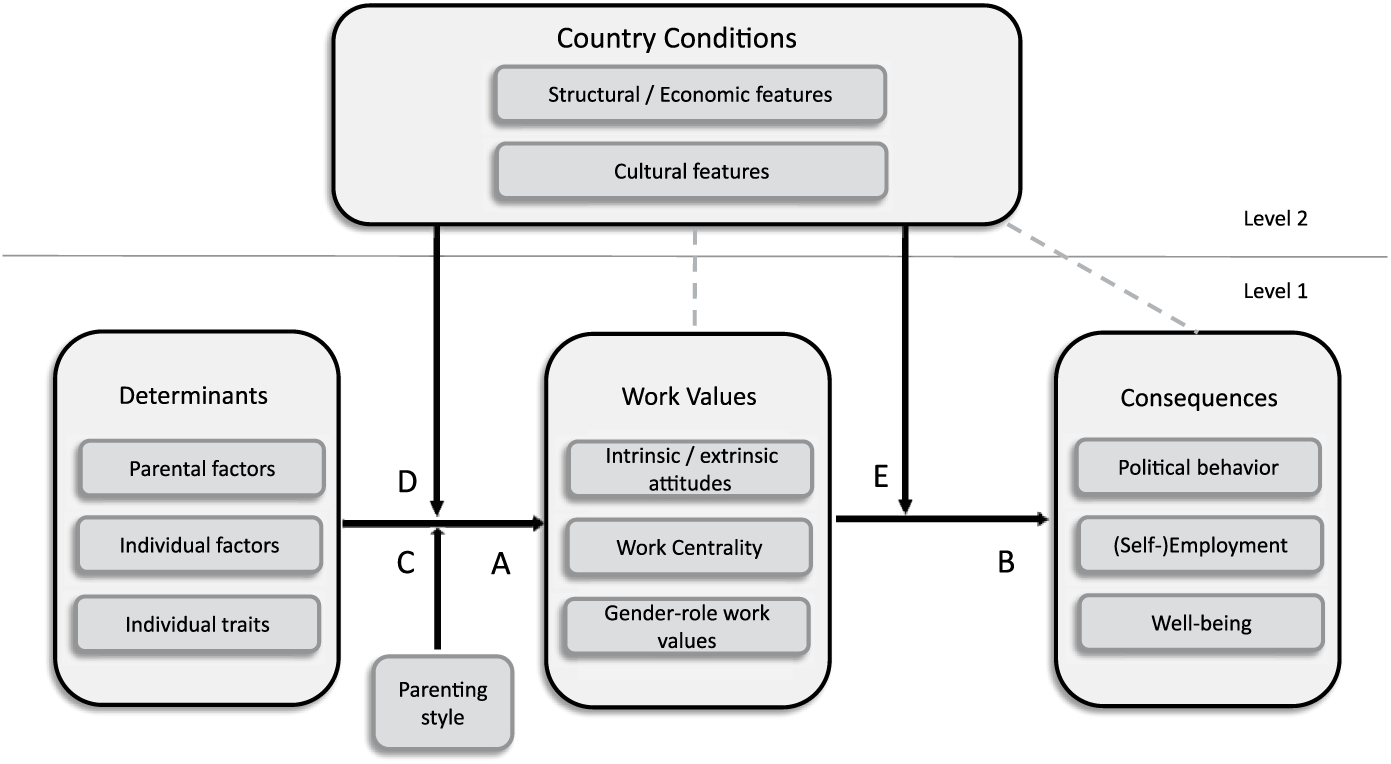
From this, it follows that the topic of work values is of great interest to the social sciences and that social scientific approaches to employment need to address more than the typical questions that preoccupy labor economists (e.g., labor supply, wage growth, skills mismatch, for example). Acknowledging the widespread interest in work values that cuts across disciplinary borders, in this volume we bring together theoretically informed and methodologically rigorous empirical investigations, seeking to further the state of research on the importance of work values and attitudes in the social sciences and the use of this scientific knowledge to improve development of public policy. To deal with this challenge, we aim to answer three main research questions. Figure 1 provides a schematic overview of this volume in terms of questions and relationships.
Conceptual Model
Several contributions deal with the first question, in which we focus on factors that possibly explain individual differences in work values and attitudes. Our main interest lies with studying processes of intergenerational transmission. So how do parents affect the work values of their children? Moreover, individual explanations dealing with personality traits and educational and occupational resources are taken into account (Figure 1, arrow A). The first question reads, To what extent are parental qualities, individual traits, and individual resources relevant for the explanation of a person’s work values?
Work values may also have consequences in other domains of people’s lives. By means of long-lasting socialization processes in a work context, individuals may develop work attitudes that consequentially lead to more motivation to be politically active, to become self-employed and report more well-being (arrow B). The second general question thus is, To what extent do work values have consequences in the political, economic, and well-being domain?
Last, this volume acknowledges that work values may not be similarly constituted and consequential in all contexts. Contexts are expected to affect people in various ways. Our collection of research is unique because we aim to point to the conditional effects of parental socialization in the transmission of values and resources across generations (arrow C). Additionally, we investigate the intergenerational transmission and possible consequences of work values in a number of countries. By doing so, we offer the opportunity to investigate whether transmission processes are differently affected by a country’s economic and cultural constellation (arrow D) and whether having certain work values leads to different consequences in economically and culturally different countries (Figure 1, arrow E). This leads to the third research question: To what extent do economic and cultural qualities of countries condition (1) the impact of determinants of work values and (2) the impact of work values on self-employment, political engagement, and well-being?
To answer these research questions, contributing authors make use of several cross-national data sources with abundant information on both determinants of work values, on intrinsic and extrinsic work values and work ethics, and on several possible consequences of work values. We further combine theoretical insights from different branches of social and behavioral research to arrive at a more complete understanding of the causes and consequences of people’s work values in varying contexts.
Work Values and Attitudes: Clarification of the Concepts
Values may be observed as internalized representations of moral beliefs that function as guiding principles for people’s actions (Cemalcilar, Secinti, and Sumer 2018). A person’s attitudes most often relate to a specific theme or situation and reflect personal opinions (Rokeach 1973). Values and attitudes are closely aligned, and research suggests that they are the products of cultural, institutional, and personal forces acting upon the individual (Brief and Nord 1990). Consequently, values and attitudes regarding work are shaped by interpersonal interactions, by social norms, and by experiences in the domain of work and in personal life. They mostly refer to goals people desire and would like to achieve through working. In this issue, the terms work values and work attitudes are used rather interchangeably. All contributions to this issue conceive extrinsic, and/or intrinsic work values, and/or work centrality as main dependent or independent characteristics of work attitudes (see Figure 1).
First, from Maslow’s (1954) notion of a hierarchy of needs, it follows that some rewards from work are more basic than others (Kalleberg and Marsden, this volume). Basic needs generally refer to income resulting from work and the long-term security that work may offer. Extrinsic work values relate to these basic needs and emphasize the consequences of work in the sense of tangible rewards external to the individual, including status, income, and financial safety (Deci and Ryan 2000). Thus, people who aim to earn a lot of money, or obtain social status, or gain power and prestige in social networks are expected to be driven by extrinsic values (Van den Broek et al., this volume). Inherently, extrinsic values are not related to the work itself, the way one (has to) works, or the content of the work. Halman and Müller (2006) even stress that extrinsic rewards may be seen as a compensation for the general obligatory, unpleasant character of work.
Second, people generally come to value meaningful, self-actualizing work after fundamental needs regarding income and security have been fulfilled (Kalleberg and Marsden, this volume). Hence, these intrinsic work values focus on the process of work, that is, the intangible rewards that reflect the inherent interest in and motivation from work such as the job’s potential to offer learning experience or working creatively (Deci and Ryan 2000). Likewise, others describe intrinsic work values in terms of the desire or strive for personal development, community contribution, and self-fulfillment (Van den Broek et al., this volume). Another aspect of intrinsic work values relates to people’s value of the relative freedom to arrange their own work, decide on working hours, and decide on cooperation with others. It is important to acknowledge that prior research has demonstrated that extrinsic and intrinsic work values are not opposing phenomena but often go together within a worker (Gesthuizen and Verbakel 2011).
Third, we are interested in work centrality, which has its roots in Max Weber’s work on the Protestant work ethic. A strong work ethic would have led to economic prosperity in Protestant countries in the eighteenth century (M. Weber 1905/2013). Work ethics may be described as the degree to which individuals place work at the center of their lives and regard hard work as intrinsically good (Cemalcilar, Secinti, and Sumer 2018). We conceive work centrality to correspond to individuals’ perception of how important work is in their lives (Paullay, Alliger, and Stone-Romero 1994). We expect work ethics to vary across countries, since they are closely related to traditionalism and modernity of societal norms in different societies (Inglehart and Baker 2000).
Transmission of Work Values: Various Mechanisms
As an overarching and comprehensive theoretical guiding line to study transmission of work values, we employ Bronfenbrenner’s (1979) socio-ecological framework. A focal point of this socio-ecological model is the relationship of individuals with their direct environment. Bronfenbrenner assumes that an individual’s behavior and beliefs are affected by the social settings in which a person is situated and is developing (family, neighborhood, country). More specifically, Bronfenbrenner distinguishes micro, meso, exo, and macro systems that all are influential for the (lifelong) socialization and learning of individuals.
According to Bronfenbrenner (1979), these different systems may be observed as overarching layers, which may be described as a series of Russian dolls; the innermost level represents the individual (ego). An individual is accordingly surrounded and affected by different environmental forces. For instance, features of environments and experiences in a person’s youth are directly associated with the family (micro-system), whereas growing up in lower- or higher-status families indirectly relates to the resource position of parents in comparison with their direct social environment (exo-system). Meso-systems refer to the school and work environments in which people are socialized and are affected through social and ideological learning (Grusec and Hastings 2014). Country characteristics affecting a person’s development relate to macro-system features in Bronfenbrenner’s terminology. The socio-ecological model closely aligns with Bourdieu’s (1986) idea of the social space. Bourdieu argues that a person’s lifestyle—attitudes and behaviors—is affected by a person’s position in a so-called social space and by the distribution of scarce resources in that space.
From these theoretical insights, it follows that people may differ in their work values because they reside in different social settings (Kalleberg and Marsden, this volume). Therefore, all contributions emphasize that transmission of work values will be affected and conditioned by characteristics of the social environments in which people are living. This may refer to the families from which individuals originate (e.g., Schönpflug 2008), the schooling they have experienced (e.g., Chapoulie 2017), and the workplaces in which they worked (e.g., B. Weber et al. 2017), but also to the country in which they are living (e.g., Hofstede 1984). Public policy is directed at the modification of these contexts in which people live, identifying specific target groups and designing policy measures to bring about behavioral changes (Tosun and Treib 2018). Growing up in a society, people also acquire cultural norms and values of their close surroundings via enculturation (Inglehart and Baker 2000). Consequently, a unique key feature of this volume is its country-comparative focus. We expect to provide novel insights into and a better understanding of how contexts matter for individuals’ work attitudes and work ethics.
To explain the transmission of work values in this volume, we presume that the development of work-related opinions and values within individuals takes place during interactions with the social environment of people. First, we discuss how work values are nurtured in the process of socialization in families, schools, and work (Figure 1, arrows A and C). Second, we address how work values transfer to other domains and environments (arrow B). Third, we consider the larger country context. We study how causes and consequences of works values are conditioned by the structural and cultural constellation of various countries (arrows D and E).
Determinants of work values: Three socializing environments
A main issue that is addressed in this volume is how work values are formed and shaped within the individual (Gallie, this volume; Kalleberg and Marsden, this volume). In our research, we distinguish three levels of socialization or ideological learning—in the family home, in education at schools, and at the workplace—to explain a person’s work values. We thereby acknowledge that work values are shaped by experiences inside and outside the workforce (Kalleberg and Marsden, this volume). This is relevant because socialization in a family with intrinsic or extrinsic work values probably also predetermines children for certain schooling tracks and levels and also for a career in specific occupations (see, e.g., Chapoulie 2017). Hence, socialization environments are interrelated, and selection may be seen as a serious drawback. Therefore, to gain a complete picture of transmission processes with regard to work values, we account for all three major socialization domains (arrow A).
First, during childhood, the family provides the primary socialization ground, and it is expected to affect a person’s work values (Kohn 1969). Especially in behavioral sciences and sociology, values and attitudes toward work are observed as being the outcome of a long-lasting process of upbringing and socialization in the family home (Schönpflug 2001). Socialization then is seen as “the acceptance of values, standards, and customs of a society as well as the ability to function in an adaptive way in the larger social context” (Grusec and Davidov 2007, 284). Parents convey their values and beliefs to their children directly (e.g., through active education), as well as indirectly through everyday routines (e.g., modeling desired behavior, norm-setting), and through the opportunities they provide to their children (Bryant, Zvonkovic, and Reynolds 2006; Döring et al. 2017). Opinions, activities, and instructions related to work in parental socialization likely result in (adult) attitudes on how to participate in a market economy, on how to value work, and what in work is meaningful and relevant. For instance, parents may exemplify in their upbringing a vast interest in earning money, thereby cultivating their children with more extrinsic work values; whereas other parents may emphasize self-development and independence, socializing their children with intrinsic work values (Wyrwich 2015). Parent-child value similarity as a result of socialization in the family may be observed as important for social adaptation and cultural continuity (Trommsdorff 2008). Yet there is no consensus on the degree of value similarity (Barni et al. 2013).
Second, education affects and nurtures people’s attitudes (Kalmijn and Kraaykamp 2007). Through various experiences and learning processes, especially related to enrollment in higher education, children are expected to develop liberal and modern attitudes (Pascarella and Terenzini 1991). It may be that institutions of higher education transmit these values to students directly (by instruction), but likely having more education advances a person’s breadth of perspective, which for instance leads to support for postmaterialistic (Inglehart and Baker 2000) and intrinsic work values (Gallie, this volume). It may also be that cognitive abilities of the higher educated affect their work attitudes directly, but it seems more likely that people with more cognitive abilities are better able to deal with complex issues and therefore express more balanced normative opinions (Kalmijn and Kraaykamp 2007).
Third, socialization in work-related values likely takes place at the workplace and will be affected by work circumstances and a person’s work history. Kalleberg (1977) has stated that variation in work values are connected to differences in the nature of the jobs people perform and mentions organizational structure, job content, social factors, promotion opportunities, and hours of work as possible relevant factors. In this type of explanation of value differentiation, attitudes of workers are seen as a direct, one-to-one reflection of the structure of their workplace.
In this special issue of The ANNALS, we aim to advance our knowledge by investigating what socialization processes and qualities of parents, schools, and workplaces are important in the development of work attitudes (Figure 1, arrow A) (Aydinli et al. 2015; Jaramillo et al. 2017). Additionally, we study whether the quality of parenting is related to the transmission of work values in the family (arrow C). As a general expectation on the determinants of work values, we assume that parental socialization will nurture values with children that resemble parental values (parent-child similarity). Further, we expect, from the theoretical notions of Maslow (1954) and Inglehart and Baker (2000), that higher-income groups and those with higher education will more often support intrinsic work values and assign less value to the centrality of work in their lives. Finally, uncertain circumstances in a person’s daily work probably lead to support for extrinsic work values more often. In this volume, we seek to identify the magnitude of the various socializing conditions that intervene in these value transmission processes.
Consequences of work values: How do they transfer in other domains?
We presume that the various ways people relate to their work, in terms of extrinsic or intrinsic values, or work commitment, may affect other domains of human life. First, in social psychology, self-determination theory (Deci and Ryan 2000) assumes that the incorporation of specific types of values (intrinsic or extrinsic) matters when looking at individual well-being. From this perspective, extrinsic work values are less satisfying for a person, because they are not associated with self-development and self-worth; there is a major focus on externalities. In contrast, self-actualization lies at the base of developing intrinsic work values. Thus, we expect that extrinsically motivated workers will be less satisfied with their life, experience less positive and more negative emotions, and have a negative self-image (Van den Broek et al., this volume). Indeed, meta-analytic evidence on single countries shows that people pursuing extrinsic rather than intrinsic values suffer from lower psychological and physical health (Dittmar et al. 2014). Based on prior research, we may also expect that intrinsically motivated workers with a high work ethic will more often start their work careers as self-employed than those who are extrinsically motivated (Lukeš et al., this volume).
Second, because work values are developed in various workplaces under various conditions, it is likely that parallel specific knowledge and capabilities will be produced. In the workplace, people also obtain the civic skills, mindset, and social networks they need to politically and socially participate. From this so-called spillover model (Visser et al., this volume), we may assume that work offers opportunities to learn how to participate in politics and how to start as self-employed. Moreover, work values may provide the ideological position and motivation required for political participation (Sobel 1993; Shore and Tosun 2019b).
Third, work values may be expressions of underlying moral and political positions (Visser et al., this volume). Such ideological positions will be (partly) developed at the workplace and may be important when looking at other behaviors and attitudes in the economic, political, and personal well-being domains (Inglehart and Baker 2000). This especially seems relevant because the work domain is important in politics; wage systems, company regulations, and labor market laws are directly affected by political decision-making.
In this volume, we thus aim to investigate what consequences intrinsic and extrinsic work values and work centrality have for individual nonelectoral political participation, for self-employment prospects, and for overall well-being (Figure 1, arrow B). As a general expectation, we assume that intrinsic work values go together with ideological learning and with interest in expanding capabilities. Thus, it is likely that intrinsically motivated workers with a high work ethic are also more politically active, more often self-employed, and score higher on well-being. On the other hand, extrinsically motivated people will be less often self-employed and more often will suffer from lower levels of well-being (see Lukeš et al., this volume).
Country comparisons: Are causes and consequences of work values affected differently by contexts?
One of the major contributions of this volume is that we consider work values in a cross-national comparative perspective. As Bronfenbrenner (1979) and Coleman (1988) presume, people may act and develop differently because of the social settings they are in. With regard to work values and attitudes, we expect that countries differ in the number of people who express support for intrinsic and extrinsic values. Indeed, earlier studies have shown that macroeconomic conditions affect support for extrinsic and intrinsic work values (Gallie 2007; Gesthuizen and Verbakel 2011). Such main effects are displayed in Figure 1 with dotted lines. However, in this volume, we actually are more interested in so-called conditioning factors (arrows D and E). By conditioning factors, we are referring to structural and cultural features of countries that affect the magnitude of the associations of various determinants of work values (arrow D) and of the associations between work values and their consequences (arrow E). Earlier comparative research on conditional effects of work values is generally lacking, and therefore our expectations are to some extent speculative.
First, we expect structural macroeconomic conditions to affect the transmission of work values between parents and children (Kittel et al., this volume). We further assume that the relationship between the individual determinants (education, workplace) and work values may be differently affected by a country’s economic progress and wealth (arrow D). In general, we expect that transmission will be more difficult in times of economic crises and high unemployment, and that parents are more likely to transmit extrinsic work values that exemplify stable income and security. It may also be that macroeconomic circumstances affect the association between work values and becoming self-employed, nonelectoral participation, and personal well-being (arrow E). Perhaps economic adversity leads workers with extrinsic work values to express even lower well-being and to refrain from taking part in nonelectoral political action.
Second, based on the eminent works of Hofstede (1984) and Inglehart et al. (2014), we expect that the transmission of work values is affected by the cultural make-up (i.e., cultural values and norms) of a country (Figure 1, arrow D). Culturally, countries may be distinguished by their level of individualism or by their normative constellation (in family norms or gender norms). The transmission of work values by parents is more likely in collectivistic and family-orientated countries (Cemalcilar et al., this volume; Sümer et al., this volume). People are more bound to collective norms in such countries where there is larger attention to the family and social support. In contrast, individual determinants of educational attainment and workplace characteristics could be more relevant in individualistic countries. It is also likely that cultural features of a country affect the impact of work values for various consequences (arrow E). For instance, the Person-Environment fit perspective (Kristof-Brown, Zimmerman, and Johnson 2005) argues that the potential benefits of having a certain value is dependent on the values that are stressed in a person’s larger environment. Consequently, we expect people with extrinsic values to experience more well-being in countries with an individualistic nature. Likewise, intrinsically motivated people will be more politically active in a collectivistic surrounding (Visser et al., this volume).
Data Sources
The contributions to this volume rely on six datasets, which vary with regard to the number of countries covered and to whether the data are longitudinal or cross-sectional. By using different databases, we seek to offer a rigorous test of our hypotheses that (country) contexts matter for how work values are being formed and what consequences they have. Of the six datasets used for the empirical analyses, five are well established and frequently used in social sciences.
First, the Cultural Pathways to Economic Self-Sufficiency (CUPESSE) data explicitly explore the role of the family setting for shaping the attitudes of the millennial generation in eleven countries: Austria, Czech Republic, Denmark, Germany, Greece, Hungary, Italy, Spain, Switzerland, Turkey, and the United Kingdom (for details, see Tosun et al. 2018). The CUPESSE dataset is novel and unique in its cross-national two-generation design. The sample was restricted to young adults between the ages of 18 and 35. Next to primary respondents, fathers and mothers were questioned, which underscores CUPESSE’s unique qualities and makes it complementary to the other data sources. The CUPESSE dataset consists of 20,008 observations (with 5,945 observations with information on at least one parent).
Second, Kalleberg and Marsden as well as Gesthuizen et al. draw on data produced by the International Social Survey Programme (ISSP), which was established in 1984 and conducts annual surveys on diverse topics relevant to social sciences (see Scholz et al. 2017). What makes the ISSP data unique is that they cover a vast number of countries around the globe at different levels of socioeconomic development. Together with its design as a repeated survey, the ISSP data allow for comparisons across countries and over time.
Third, Van den Broeck et al. utilize data from the World Values Survey (WVS), which is also a repeated survey that is administered every five years (see Inglehart et al. 2014). The survey started in 1981 and consists of nationally representative surveys conducted in almost one hundred countries, which makes the WVS comparable to the ISSP. The current seventh wave of the WVS started in January 2017 and is expected to be completed in December 2019 with about seventy to eighty countries joining the program.
Fourth, Gesthuizen et al. employ the European Values Study (EVS) in their equivalence study. The EVS is a large-scale, cross-national, and longitudinal survey research program on basic human values, with the last wave taking place in 2017 in forty-seven European countries (see Bréchon and Gonthier 2017). Topics addressed in the EVS are values related to life, family, work, religion, politics, and society. The 2017 wave of the EVS places great emphasis on the Euro crisis and processes of disintegration in the European Union and how these developments have affected the identity of “Europeans.” The current wave of the EVS is also interesting since it is based on a collaboration with the WVS.
Fifth, the European Social Survey (ESS) data are used by Lukeš et al. and Visser et al. in their contributions. ESS was established in 2001 and has been fielded biennially since 2002. The latest wave for which data are already available is the eighth wave (see, e.g., Breen 2017). The ninth wave is currently being fielded in twenty-five European countries. There is an overlap between the ESS and the EVS with their measurement of human values, which makes these two datasets complementary.
Last, Kalleberg and Marsden use single-country data originating from the General Social Survey (GSS), which is a continuing survey of adults in the United States stressing over-time replication of social indicators (see Smith et al. 2017). The GSS was first launched in 1972. While this database contains data for U.S. respondents only, its main strength lies in its longitudinal data that allow for rigorous testing of hypotheses.
Overview of the Contributions
This issue consists of eleven substantive empirical-analytical contributions that concentrate on the causes and consequences of work values and two reflection pieces that aim to distill the broader practical and scientific implications of the cumulative body of research.
To start, Duncan Gallie gives a comprehensive overview of how research on work values has developed over time. In his review, he identifies four phases in the pertinent literature on work values, with the first one starting in the late 1960s and early 1970s. This phase focused on the impact of economic development on work values. The second phase identified by Gallie corresponds to research in the early 1980s, which was concerned with the role of work values in accounting for unemployment. In the late 1980s, the third phase of research started and extended the focus to the implications of changing work values for women’s increasing participation in the labor market. Since the 1990s, there has been increased interest in the intensity of role attachment to one’s job and organization, which constitutes the fourth and final phase.
The contribution by Arne Kalleberg and Peter Marsden poses the following question: Are the work values of the millennial generation distinctive from those of other generations? In the past, scholars have raised similar questions about the distinctiveness of generations, but finding any compelling explanations for differences between generations has been complicated by aging effects, cohort or generational differences, and period effects. Using GSS and ISSP data, the authors assess the importance of life course differences and conclude that there are few differences in work values among members of different generations. They also find that people from less advantaged social origins are more likely to value extrinsic work values than those from more advantaged backgrounds.
Maurice Gesthuizen, Daniel Kovarek, and Carolin Rapp are interested in learning whether individuals in different cultural contexts place different emphasis on the items constructing either the extrinsic or the intrinsic work values scale. The authors show that there is a difference in the comparability of the data that tap into extrinsic and intrinsic work values: the latter are comparable in much fewer countries (namely, eight) than the first. Yet even with extrinsic work values, the data are comparable only for twenty-two of the forty-seven countries examined. The findings suggest that there is a trade-off between the number of items on the scale and the number of countries to include in an analysis. The findings presented add to the general methodological discussion of how many items are needed to measure a construct when aiming to produce data suitable for cross-national comparisons. While extrinsic and intrinsic work values are multidimensional concepts and require multiple items to capture different aspects of the individual dimensions, a greater number of items results in data that are less comparable across countries. In other words, the authors provide a methodological justification for scaling down the number of items used in cross-national survey studies.
Nebi Sümer, Daniela Pauknerová, Mihaela Vancea, and Elif Manuoğlu examine in detail the intergenerational transmission of work values in the Czech Republic, Spain, and Turkey. Relying on data produced in the CUPESSE project, the authors concentrate on parent-child similarities and the moderating role of parenting behaviors on work values. Of all contributions to this volume, this research perspective most directly captures processes of socialization in families and the mechanisms of the intergenerational transmission of work values in different cultural contexts. While there are differences in the parent-child similarity in work values (with respondents in Turkey having the highest and in the Czech Republic the lowest scores), the mechanisms of how work values are transmitted are remarkably similar across the countries examined. Parents that grant autonomy to their children, exert low levels of psychological control, and give their children emotional warmth increase the chances that their children have stronger moral and redistributive work values and weaker gender role–based work values.
Zeynep Cemalcilar, Carsten Jensen, and Jale Tosun examine both the extent to which work values of young people are determined by the work values of their parents and the extent to which the transmission of work values is conditioned by gender. Drawing from CUPESSE data for Denmark, Germany, Turkey, and the United Kingdom, they show that there is an unconditional and robust effect of socialization within families on work values. In other words, neither gender nor country idiosyncrasies, such as welfare regimes, condition the effect of the intergenerational transmission of work values.
The analyses of Bernhard Kittel, Panos Tsakloglou, and Fabian Kalleitner show that the transmission of work values within the family is a more fundamental determinant of work centrality in adolescents than individual and contextual factors. However, variation across regions does independently affect work values as well. The authors find that parental influence is the most robust determinant of adolescent work centrality, but individual-level variation is also affected by regional-level factors such as the female labor force participation rate.
Similarly drawing on the CUPESSE data and making use of the two-generational structure of the data, Bettina Schuck and Jennifer Shore investigate whether the social mobility that young people have experienced (see Torche 2015) and the future mobility that they expect have an impact on their attitudes toward work and welfare. Results of logistic regression analyses suggest that the relationship between upward/downward mobility and an individual’s views on work and welfare varies depending on the dimension of mobility, with expected future mobility exerting a stronger effect on attitudes toward work and welfare than past mobility experiences.
Martin Lukeš, Federico Vegetti, and Manuel Feldmann examine how work values impact different forms of labor market participation of young adults across Europe. The authors use both CUPESSE and ESS data to address their research question. The findings confirm the importance of intrinsic work values for self-employment and show that extrinsic values are more important to employees than to self-employed young people. The authors also find that work centrality does not differ between the employed and self-employed, which is a rather surprising finding considering the additional workload for self-employed people.
Emily Rainsford, William Maloney, and Sebastian Popa ask whether experiences of unemployment and low-quality work conditions have an impact on young adult’s work values. Using CUPESSE data for young people in eleven European countries, the authors observe a positive effect on extrinsic work values for overqualification. In addition, their empirical investigation shows that unemployment and low-quality work conditions have a larger impact on the “younger” workers in their sample than their “older” counterparts. The latter finding underlines the importance of treating young people not as one coherent group and the need to look into how exactly age and work values are causally linked. In other words, among the young people, the “youngest” ones are the most vulnerable ones in terms of the “scarring effects” (Brandt and Hank 2014) of unemployment and underemployment. Consequently, policies aiming to promote the employment of young people should give this group priority and attempt to prevent them from experiencing unemployment or having to work in low-quality jobs (Tosun et al., this volume).
Mark Visser, Maurice Gesthuizen, and Gerbert Kraaykamp examine to what extent extrinsic and intrinsic work values are associated with nonelectoral political participation. The authors apply multilevel analysis to data from two rounds of the ESS covering thirty-one countries. The results show that people who are extrinsically motivated are less politically active while people who are intrinsically motivated are more politically active. Findings also show that people who highly value extrinsic job rewards are even less politically active in individualist countries, whereas people who highly value intrinsic job aspects are even more engaged politically in those countries. Lower levels of wealth, higher unemployment rates, and greater income inequality all weaken the relationship between work values and political action.
Anja Van den Broeck, Arne Vanderstukken, Karin Proost, and Bert Schreurs assess the health-enhancing effects of work values, which offers valuable insights into the effects of work values and how these depend on or are affected by contexts. Using data originating from the WVS, this contribution contrasts both perspectives in predicting life satisfaction, happiness, and health of young adults (N = 10,430) across the world. Results of multilevel analyses generally suggest that the type of values held by young adults and the type of values prevailing in one’s environment matter more than their fit in the prediction of their life satisfaction, happiness, and health, as predicted by self-determination theory.
A final group of contributions offers a practical and academic reflection on the findings of the individual contributions to this volume. With a background in Greek and European Union politics, Anna Diamantopoulou and Kyriakos Pierrakakis show that work values were at the center of both the political and public debate on the causes of the so-called Eurozone debt crisis, which unfolded in 2009 (see also Tosun, Wetzel, and Zapryanova 2014). Most importantly, the Greek population—which was particularly heavily affected by the crisis—was perceived to be responsible for its economic hardship due to its low work values. Such claims were expressed by mass media as well as politicians of the other EU member states and became internalized by the general public in these countries as indicated by public opinion data.
In the last article, Jale Tosun, Gerbert Kraaykamp, and Zeynep Cemalcilar summarize the main findings of the volume. Furthermore, the editors reflect on the findings by adopting interdisciplinary perspectives from psychology, public policy, and sociology. Most importantly, this piece highlights the main takeaway for the general public, social scientific scholars, and policy-makers.
Footnotes
NOTE:
This issue benefited from financial support by the project Cultural Pathways to Economic Self-Sufficiency and Entrepreneurship (CUPESSE; Seventh Framework Programme; Grant Agreement No. 61325), the Field of Focus 3 “Cultural Dynamics in Globalised Worlds,” and the Field of Focus 4 “Self-Regulation and Regulation: Individuals and Organisations” at Heidelberg University. We further acknowledge helpful comments on this article by Julia Weiss. Dominic Afscharian, Marcel Katzlinger, Lucas Leopold, Julian Rossello, and Paul Thalmann provided valuable research assistance to the entire volume.
Gerbert Kraaykamp is a professor of empirical sociology in the Department of Sociology at Radboud University, in the Netherlands. His major research interests include educational inequality, intergenerational transmission, and health inequality. He has published widely on these subjects in international scientific journals.
Zeynep Cemalcılar is an associate professor of social psychology at Koc University, Istanbul, Turkey. Her most recent research focuses on youth autonomy and self-sufficiency, subjective socioeconomic status, brief social psychological interventions, and technology in the social life.
Jale Tosun is professor at the Institute of Political Science at Heidelberg University, Germany. Her research focuses on comparative public policy, international political economy, and public administration.