




Abstract
Academic literature emphasizes the importance of work values to job satisfaction and commitment. There is agreement that work values are multidimensional—most often identified as having extrinsic and intrinsic elements. However, little work has gone into assessing the measurement invariance of work values in different contexts. In this contribution, we ask, Do we find similar patterns of extrinsic and intrinsic work values across different cultural contexts? As such, we investigate the validity of work values when they are applied in cross-national analyses by identifying sets of items that can be translated into scales of extrinsic and intrinsic work values that carry a similar meaning in those cultural contexts. We thus want to know which items that make up work values are best understood in diverse contexts and are most suitable for cross-cultural analysis. We tackle this issue by relying on the European Values Study 2008, as well as the CUPESSE data from 2016. The results reveal that there is a trade-off between the number of items researchers use to study work values and the number of countries analyzed if we aim for a more equivalent analysis of work values across Europe.
The contributions of this volume of The ANNALS underscore the general importance of analyzing work values in broad context. Work values define the general importance of work in one’s life as well as one’s adherence to existing norms. Further, they are guidelines for employers in selecting adequate employees. Throughout the literature, as well as in this volume, work values have been analyzed from different angles, in particular their multiple causes—at the individual or contextual level—as well as their potential consequences for one’s life satisfaction, economic self-sufficiency, or nonelectoral political participation (Cemalcilar, Secinti, and Sumer 2018; Elizur 1984; Gesthuizen and Verbakel 2011; Lechner et al. 2018; Visser, Gesthuizen, and Kraaykamp 2019; Yankelovich 1985). Another large part of the literature engages with the question of how work values change between generations and over decades (Jin and Rounds 2012; Krahn and Galambos 2013; Lechner et al. 2017; Meriac, Woehr, and Banister 2010; Twenge et al. 2010).
Yet there is little previous academic work on the basic question of what we understand work values to be (Elizur et al. 1991; Halman and Müller 2006; Kaasa 2011; Leuty and Hansen 2011; Vecerník 2003) and whether the measurement of work values is accurate and comparable across cultural contexts. Equivalence is an important issue in cross-cultural research. If we, for example, analyze the most important determinants of work values, we assume that these concepts—or better, the scales we use—are understood the same way in different contexts: each measured item has the same meaning across countries. The meaning of certain concepts may differ as they depend on the cultural, economic, and political setting within a country (Gesthuizen and Verbakel 2014). Does the importance of a secure job have the same emphasis in a country with a strong welfare state compared to a country with very low social security? Do inhabitants of those countries interpret security in a similar fashion and think of the same features related to this concept? Likewise, preferring a secure job over not experiencing too much pressure may, for instance, decisively differ among countries: in one nation, the bulk of the population might prefer security; whereas in the other nation, work pressure occupies the minds of most.
Accordingly, it is the aim of this contribution to empirically test the comparability of measurements of dimensions of work values, as well as to assess the extent to which there is conceptual invariance among a wide-range of countries. We base our analysis on two datasets, the European Values Study and the Cultural Pathways to Economic Self-Sufficiency and Entrepreneurship (CUPESSE) 2016 survey. By means of scalogram analysis, 1 we test whether there are similar patterns for selected items of intrinsic and extrinsic work values across countries.
Dimensions of Work Values
Schwartz (1992, 1994, 20) posits that values encompass five dimensions: “a value is a (1) belief (2) pertaining to desirable end states or modes of conduct, that (3) transcends specific situations, (4) guides selection or evaluation of behavior, people, and events, and (5) is ordered by importance relative to other values to form a system of value priorities.” Work values define the general motivation to work and what kind of work we are looking for. The research on work values is thereby spread over multiple disciplines such as sociology, psychology, economics, and political science (Cemalcilar, Secinti, and Sumer 2018), which leads to a large variety of understandings and variances in the analysis of work values. The literature largely agrees that work values contain different dimensions and subconcepts. The most common distinction thereby is between intrinsic and extrinsic work values (Gesthuizen and Verbakel 2014; Kaasa 2011; Kalleberg 1977; Ros, Schwartz, and Surkiss 1999).
Preferences for work may differ between individuals: some may prefer a job that offers economic benefits, whereas others may look for self-fulfillment in a job. The first refers to extrinsic work values, which cover tangible things such as income, working hours, pension schemes, or insurances. In that sense, these values are external to the individual as they are not connected to the way one works or to the content of one’s work (Kaasa 2011). Hallman and Müller (2006, 119) even go as far as saying that the main purpose of extrinsic values is to reduce the general unpleasant character of work by providing favorable circumstances. In other words, even if someone does not like the content of her work, she might still appreciate it if it provides a decent pay or other amenities. However, following Ester, Braun, and Vinken (2006, 90), extrinsic work values “are no longer sufficient to do the job” of fostering economic development in Europe, as they are outdated. To be compatible with the changes on the European labor market, workers have to augment or even change their traditional mindset and enhance intrinsic work values.
Intrinsic work values are the mirror image of extrinsic values: they describe the desired content of one’s work and not the general circumstances of it. According to Arendt (2013, 140), intrinsic values evolve around personal development and self-fulfillment in work. They stress the importance that an individual places on the “opportunities for further development of personal skills and an interest in the work promoted by the activity” (Tarnai et al. 1995, 140). Someone high on these values may, for example, prefer a job where he has the freedom to decide what he does, even though it means having less security (an extrinsic value). Thus, the focus lies more on the personally defined goals of work, instead of individual wealth or security (Yankelovich 1985). Intrinsic work values apply to the accelerated European labor market. Individuals are supposed to take responsibility in their jobs, be creative, and strive for self-fulfillment instead of working in a typical nine-to-five manner (Ester, Braun, and Vinken 2006). In that sense, the increased importance of intrinsic work values is in line with the pronounced individualization in European societies (Halman, Sieben, and van Zundert 2011).
Even though the literature agrees on these two dimensions of work values, we cannot be certain if these two are present or, better said, understood in the same way in every country. The institutional structure in a country, the religious background, or the current labor market may have a great impact on how the items that are supposed to measure a certain dimension of work values are interpreted (Gesthuizen and Verbakel 2014). Moreover, in surveys and studies, a large number of items measuring both extrinsic and intrinsic work values are usually used (e.g., at least five items per dimension), which raises the question of what pattern these items show in different cultural contexts. Can we be sure that the structure of these items and how they are understood are equivalent across countries? Or that they sum up to the same scale? Our aim is to assess the general patterns of work values’ measures, that is, their cross-national comparability and scalability. More precisely, what would be the best way to assess extrinsic and intrinsic work values in cross-cultural research? Do we need a huge battery of items, or may some specific items suffice? These are our guiding questions in this contribution. In what follows, we test for measurement equivalence of extrinsic and intrinsic work values in different European countries, based on scalogram analysis.
Data and Methods
To test for measurement equivalence of the scales resulting from the most commonly used extrinsic and intrinsic work values items, we rely on European Value Study (EVS) data from 2008 (EVS 2011). The dataset comprises nineteen items on work values. Yet we focus in our analysis on the ten most often used, relating to the extrinsic-intrinsic distinction (see e.g., Ester, Braun, and Vinken 2006; Gesthuizen and Verbakel 2014; Halman and Müller 2006). The EVS 2008/2010 question is, “Here are some aspects of a job that people say are important. Please look at them and tell me which ones you personally think are important in a job: (1) good pay, (2) not too much pressure, (3) good job security, (4) good hours, (5) generous holidays, (6) opportunity to use initiative, (7) a job in which you feel you can achieve something, (8) a responsible job, (9) a job that is interesting, (10) a job that meets one’s abilities.” The first five items refer to extrinsic work values, whereas the latter five signify intrinsic work values. The potential answers then are whether a respondent mentioned the respective item (=1) or not (=0). The EVS asked for these items in forty-seven countries, which we take into account in our analyses. Our sample comprises 67,214 respondents. A list of these countries is included in Figures A3 through A12 in the online appendix.
As the EVS data already are 10 years old, we rely on the CUPESSE data (Tosun et al. 2018) to test the robustness of our findings. This dataset comprises ten items asking about work values and was conducted in eleven European countries in 2016; findings obtained from this additional dataset are listed in the online appendix (Tables A1–A4). 2 The aim of the CUPESSE project was to capture the intergenerational transmission of work values, among other values. The focus was thereby on young adults between 18 and 35. There are 19,996 respondents in the dataset.
Figure 1 summarizes the mean values for each of the ten EVS items, grouped by work value dimension. Starting with the extrinsic dimension, it is clear that the importance that individuals attach to the specific extrinsic work values differs: a well-paying job is on average mentioned by 84 percent of all respondents, followed respectively by “job security” (70 percent), “good hours” (57 percent), “not too much pressure” (47 percent), and “generous holidays” (37 percent). There is a clear rank order in item difficulties, “having a well-paid job” being the least difficult item (i.e., most popular: highest average) and “generous holidays” the most difficult (i.e., least popular: lowest average). In the CUPESSE data, we also find such a rank order in item difficulties (see online appendix Figure A1).
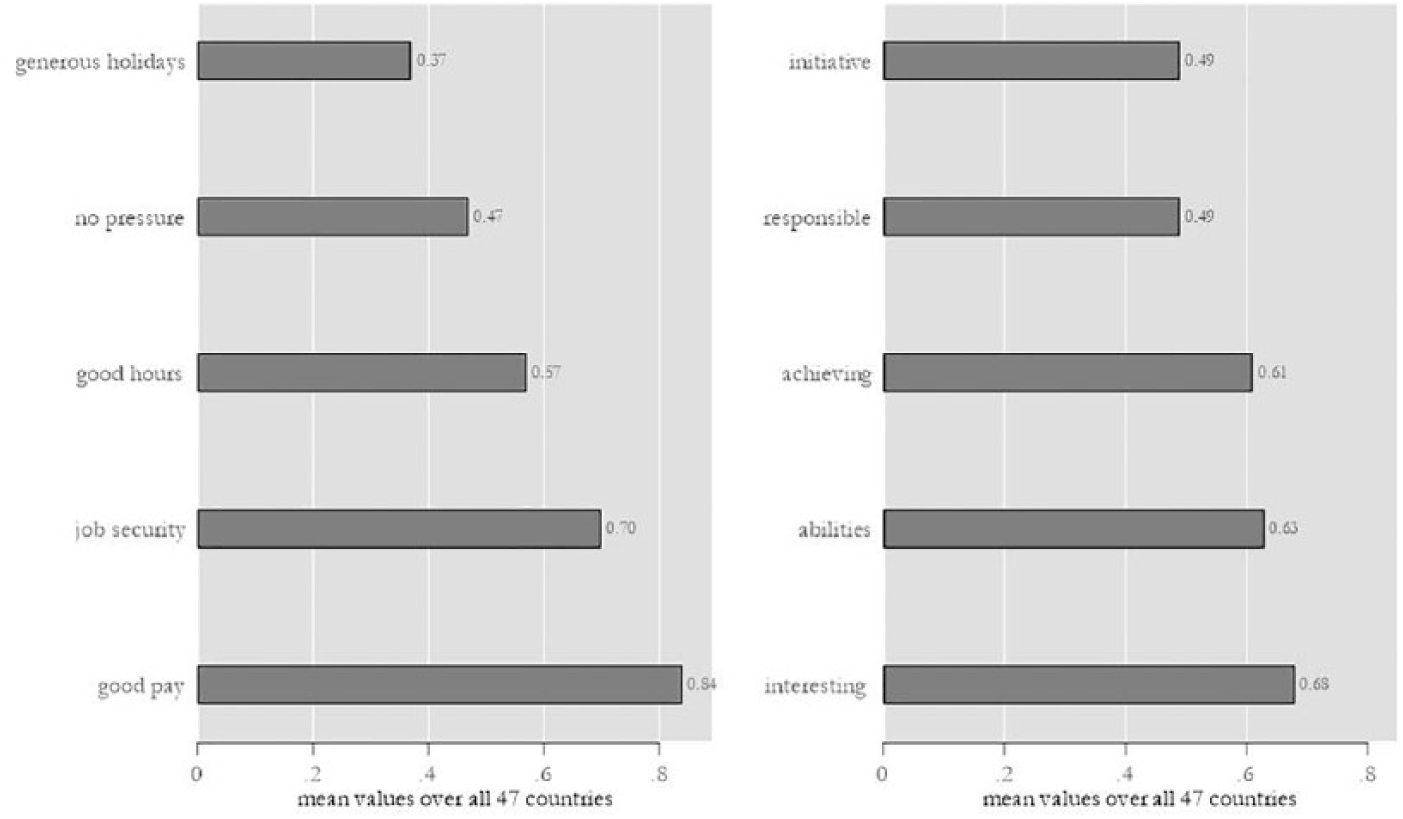
Item Difficulties of Extrinsic and Intrinsic Work Values, EVS
Within the intrinsic dimension, a rank order of item difficulties also appears: 68 percent find “having an interesting job” important, followed by “a job that meets one’s abilities,” “a job in which you feel you can achieve something,” “a responsible job,” and “a job that offers the opportunity to use initiative” (respectively, 63, 61, 49, and 49 percent). On average, the same applies for the CUPESSE data.
Method
We use scalogram (Mokken) analysis (Mokken 1971; Sijtsma and Meijer 2016; Sijtsma and Molenaar 2002) to test whether and to what extent the items underlying each work value dimension have a similar structure/pattern, as well as sufficient scalability, if we compare the countries in our datasets. Scalogram analysis is based on item-response theory. It assumes that the answer that a respondent gives to an item (important vs. not important)—which is part of a certain latent construct, here extrinsic and intrinsic work values—not only depends on his true (unmeasured) attitude regarding this construct, but also on the difficulty of this particular item that is developed to measure it. For instance, an individual can, in reality, attach an above-average importance to extrinsic work values; but given that “generous holidays” is a difficult item, not many respondents consider this item as particularly important for extrinsic work values (see, e.g., Figure 1), so this individual will most likely score “generous holidays” as not important (0). Thus, the more difficult the item, the stronger, in theory, it expresses the latent construct to be measured. Given a respondent’s true position on the latent continuum of “finding extrinsic work values important” (continuum ranging from left = less difficult items to right = more difficult items), she finds the manifest items of extrinsic work values important (observed score 1) that are positioned at her left of the continuum, whereas the items positioned at the right are evaluated as not important (observed score 0). In scalogram analysis, the score a respondent gets on the scale of, in this example, extrinsic work values then simply is a summation of the scores “important” (1). The higher this scale score, the more someone values extrinsic work characteristics. 3
The H-parameters (Loevinger’s parameters of homogeneity) indicate the strength of the scale as a whole and the deviation from the assumed pattern if all combinations of items are included in one formula. H-parameters >.30 and <.40 indicate a weak scale, H-parameters >.40 and <.50 indicate moderate scales, whereas H-parameters >.50 indicate strong scales. Moreover, scalogram analysis provides additional tests—the first and second criterion of monotonicity, also called monotone homogeneity and double monotonicity—which are important, if not crucial, for assessments of cross-national equivalence, and are based on so called rest score methods (see van der Ark 2012). A test of the first criterion of monotonicity implies that, in our example, those who in reality value extrinsic job characteristics more than intrinsic also have a higher probability of answering “important” to “having a secure job” or, for that matter, whatever item measuring extrinsic work values. The second criterion of monotonicity implies that the item response functions of two or more items do not intersect. If they do not intersect, for every respondent on every position on the latent continuum (thus varying in how they value extrinsic job characteristics), the rank order of item difficulties is uniform: everyone rank orders the items in the same way. This uniformity, both across countries (similar rank orders in item difficulties) and within countries across respondents, is vital for our assessment of equivalence and invariance. If we find similar patterns across and within nations, the underlying structure of the scales is similar, and we can safely assume that the items are understood similarly and the scale scores can be compared across groups.
If we find, for a combination of items, similar rank orders of item difficulties for a set of countries, sufficiently high H-parameters, and no violations of the first and second criteria of monotonicity, we conclude that for this set of countries, the measurement of the dimension of work values is equivalent. Excluding items could result in fewer deviations and thus a larger pool of countries that can be compared on the construct, yet at the cost of substantial aspects of the meaning of the concept. For instance, if “having a secure job” needs to be excluded to achieve comparability of extrinsic work values across nations, the concept of extrinsic work values does not contain this aspect anymore. Because “job security” is part of the theoretical concept, excluding “job security” diminishes the internal validity of the theoretical concept, and it becomes more “narrow.”
Results
We present our results in several steps. First, we present for both dimensions of work values the rank order of item difficulties for each country separately and compare them to the rank order that is found when calculated for all countries at the same time (the overall pattern). Deleting items from the set means that we achieve a larger pool of countries for which the dimension of work values is comparable. We therefore also determine the order of deleting items from the set so that with each single deletion, we retain as many countries as possible that match with the overall pattern (Table 1). Second, detailed analyses show the scalability (H-parameters) and violations of the first and second criteria of monotonicity for each item in each county, in every step of deleting an item from the analysis (Tables 2–3). Finally, for the combination of items within a work value dimension that generates the highest number of nations with equivalent scales, we present for each country average scores on the scales of extrinsic and intrinsic work values. These scales are standardized z-scores, so that the overall average is zero, and the average country scores depict whether and to what extent they are above or below average (Figure 2). These findings show the rank order among countries in valuing extrinsic and intrinsic work characteristics, based on measures that can be compared cross-nationally.
Item Difficulties of Extrinsic and Intrinsic Work Values, EVS
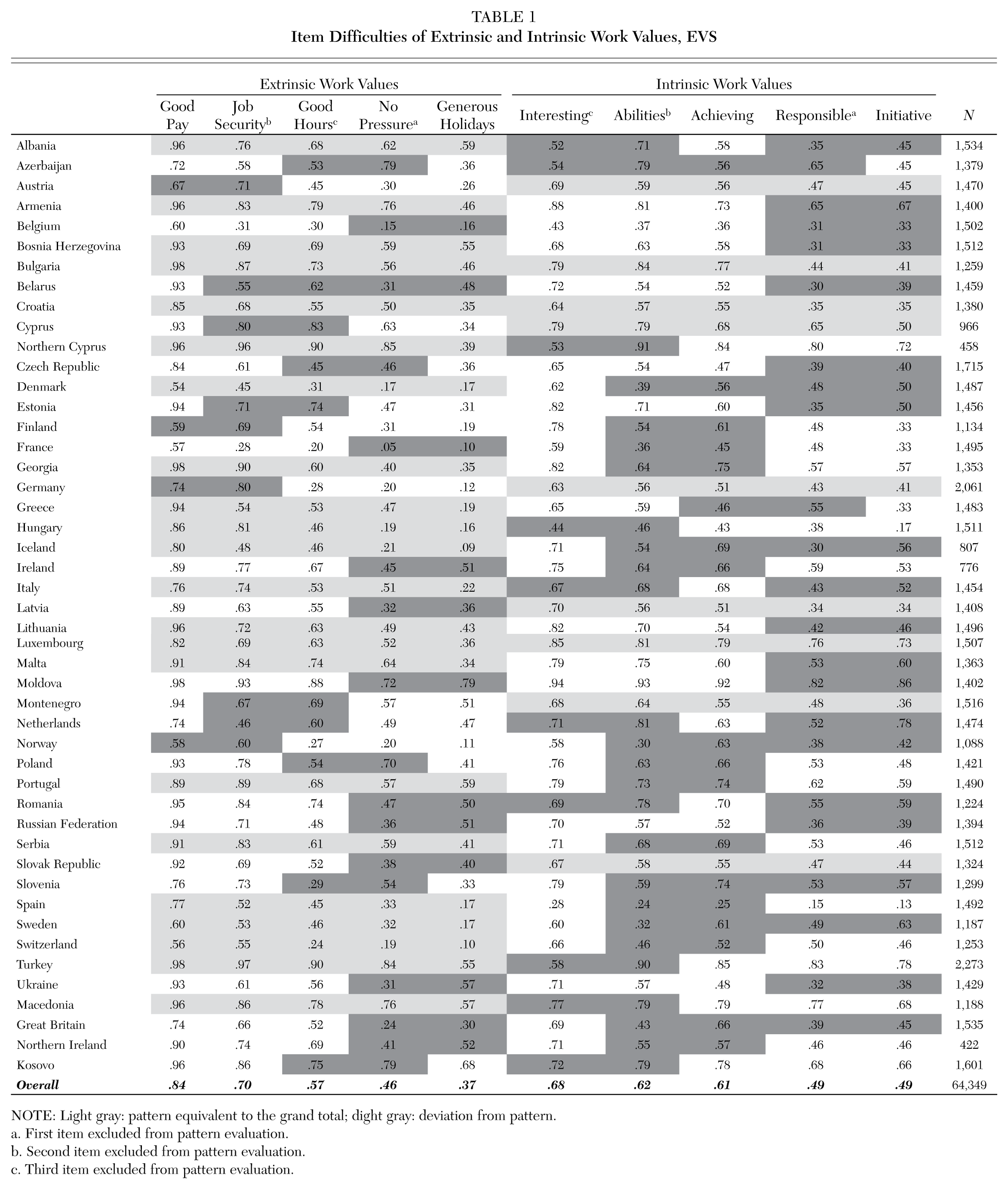
NOTE: Light gray: pattern equivalent to the grand total; dight gray: deviation from pattern.
First item excluded from pattern evaluation.
Second item excluded from pattern evaluation.
Third item excluded from pattern evaluation.
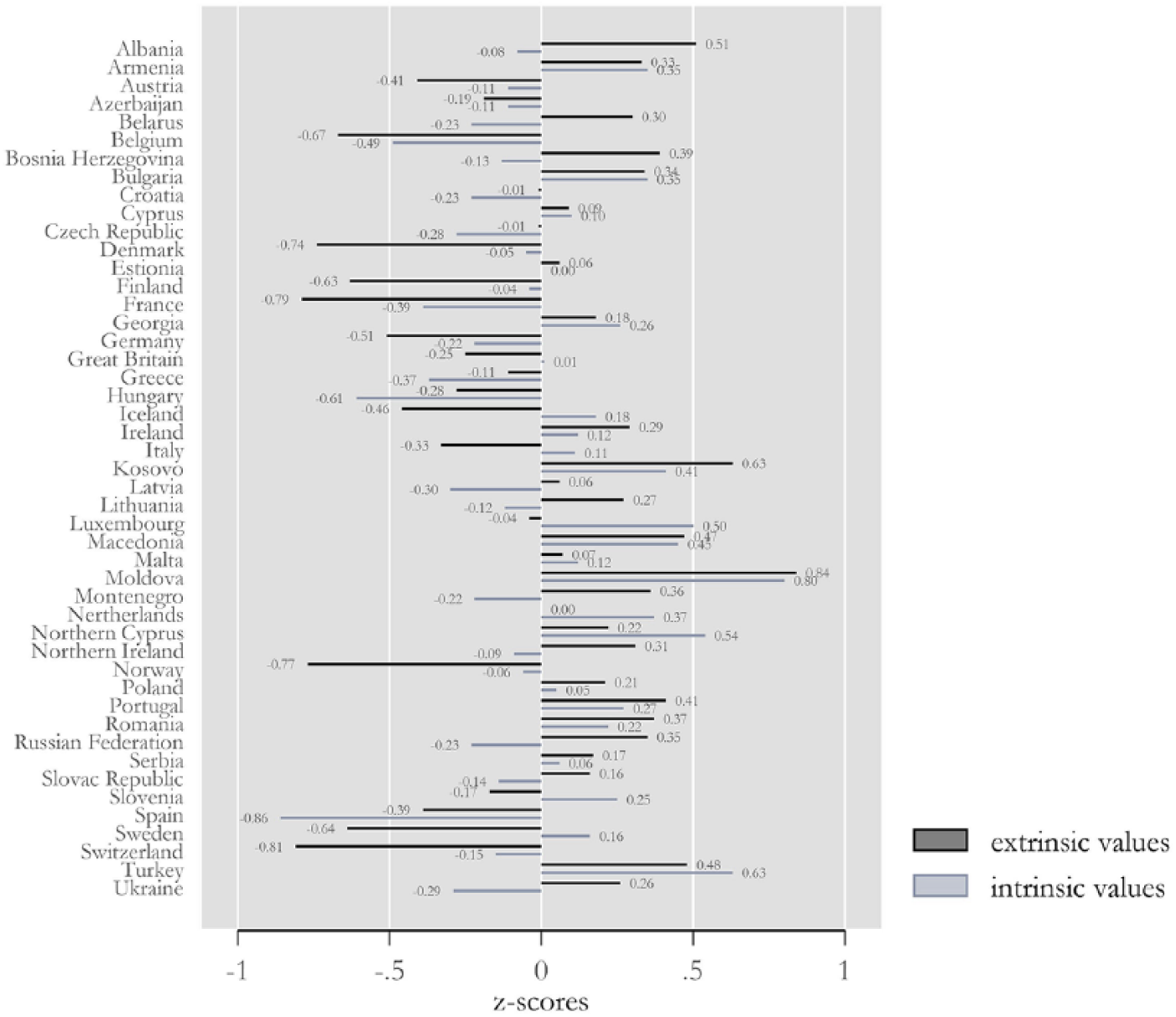
Differences in Extrinsic and Intrinsic Work Values across Countries (EVS), Based on Most Equivalent Scales
Starting with the extrinsic dimension of work values, the light gray areas in Table 1 show that out of the forty-seven countries, twenty-two have a pattern of rank order in item difficulties that matches the overall pattern: good pay showing the highest rate of agreement, after which the order of importance, respectively, is job security, good hours, no pressure, and generous holiday (see also Figure 1). The dark gray areas depict the deviations from the general pattern, meaning a different rank order in item difficulties. For Azerbaijan, for instance, we see that “experiencing not too much pressure” causes a large deviation from the overall pattern: in this country it is the least difficult, most important work value, instead of the second most difficult according to the general pattern. The column for no pressure also shows that this item causes deviations in many nations. Deleting this item would make most countries switch from deviating to not deviating from the overall pattern (thirteen to be precise; see Tables 2–3). After “no pressure” is deleted, eliminating “job security” from the analyses would result in the highest gain in terms of countries following the overall pattern (nine in total). Deleting “good hours,” in a final step, would add the last three countries to the pool of countries having a similar rank order in item difficulty.
Cross-National Equivalence of Extrinsic Work Values, Scalogram Analysis, EVS
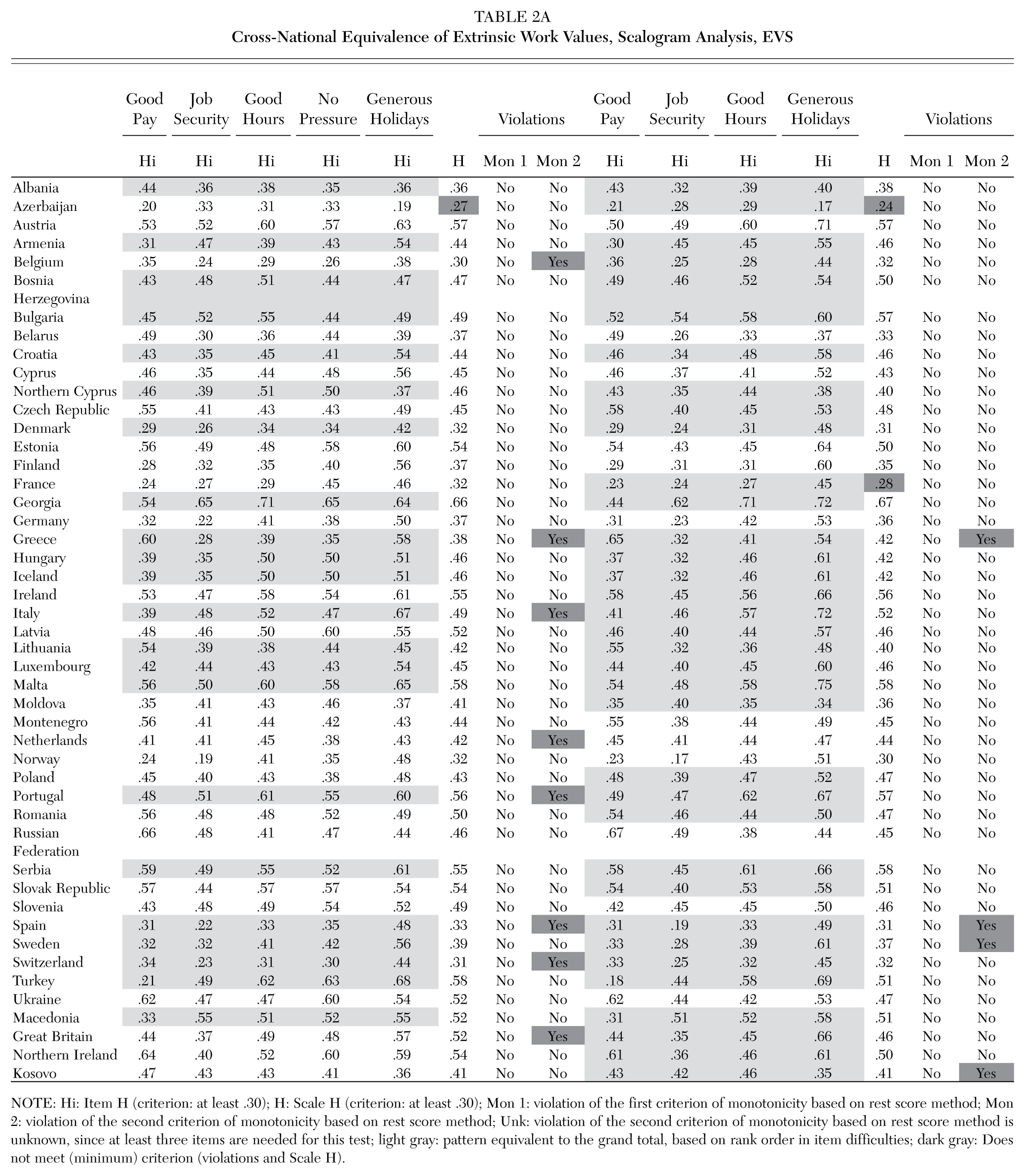
NOTE: Hi: Item H (criterion: at least .30); H: Scale H (criterion: at least .30); Mon 1: violation of the first criterion of monotonicity based on rest score method; Mon 2: violation of the second criterion of monotonicity based on rest score method; Unk: violation of the second criterion of monotonicity based on rest score method is unknown, since at least three items are needed for this test; light gray: pattern equivalent to the grand total, based on rank order in item difficulties; dark gray: Does not meet (minimum) criterion (violations and Scale H).
Cross-National Equivalence of Extrinsic Work Values, Scalogram Analysis, EVS
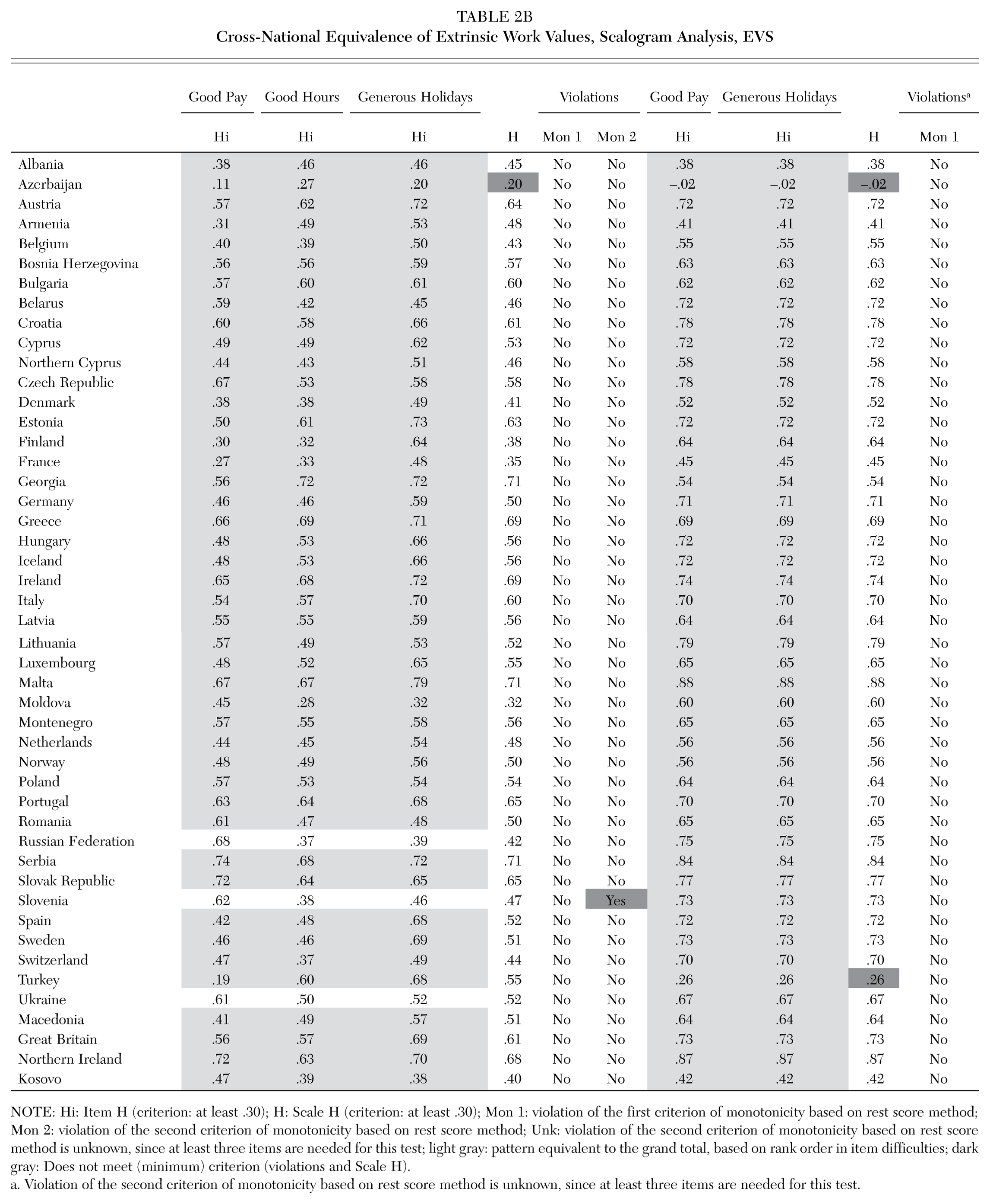
NOTE: Hi: Item H (criterion: at least .30); H: Scale H (criterion: at least .30); Mon 1: violation of the first criterion of monotonicity based on rest score method; Mon 2: violation of the second criterion of monotonicity based on rest score method; Unk: violation of the second criterion of monotonicity based on rest score method is unknown, since at least three items are needed for this test; light gray: pattern equivalent to the grand total, based on rank order in item difficulties; dark gray: Does not meet (minimum) criterion (violations and Scale H).
Violation of the second criterion of monotonicity based on rest score method is unknown, since at least three items are needed for this test.
Cross-National Equivalence of Intrinsic Work Values, Scalogram Analysis, EVS
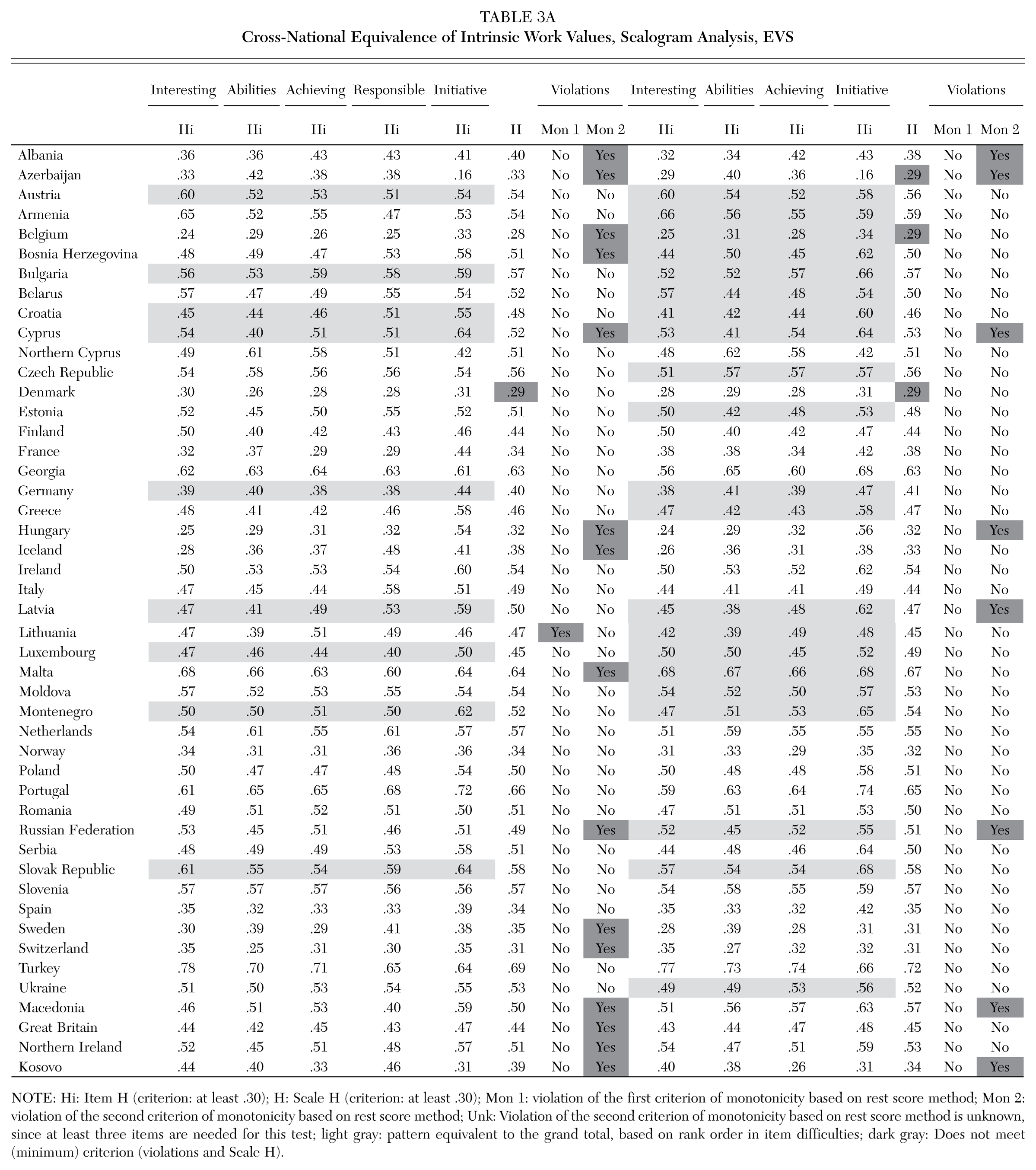
NOTE: Hi: Item H (criterion: at least .30); H: Scale H (criterion: at least .30); Mon 1: violation of the first criterion of monotonicity based on rest score method; Mon 2: violation of the second criterion of monotonicity based on rest score method; Unk: Violation of the second criterion of monotonicity based on rest score method is unknown, since at least three items are needed for this test; light gray: pattern equivalent to the grand total, based on rank order in item difficulties; dark gray: Does not meet (minimum) criterion (violations and Scale H).
Cross-National Equivalence of Intrinsic Work Values, Scalogram Analysis, EVS
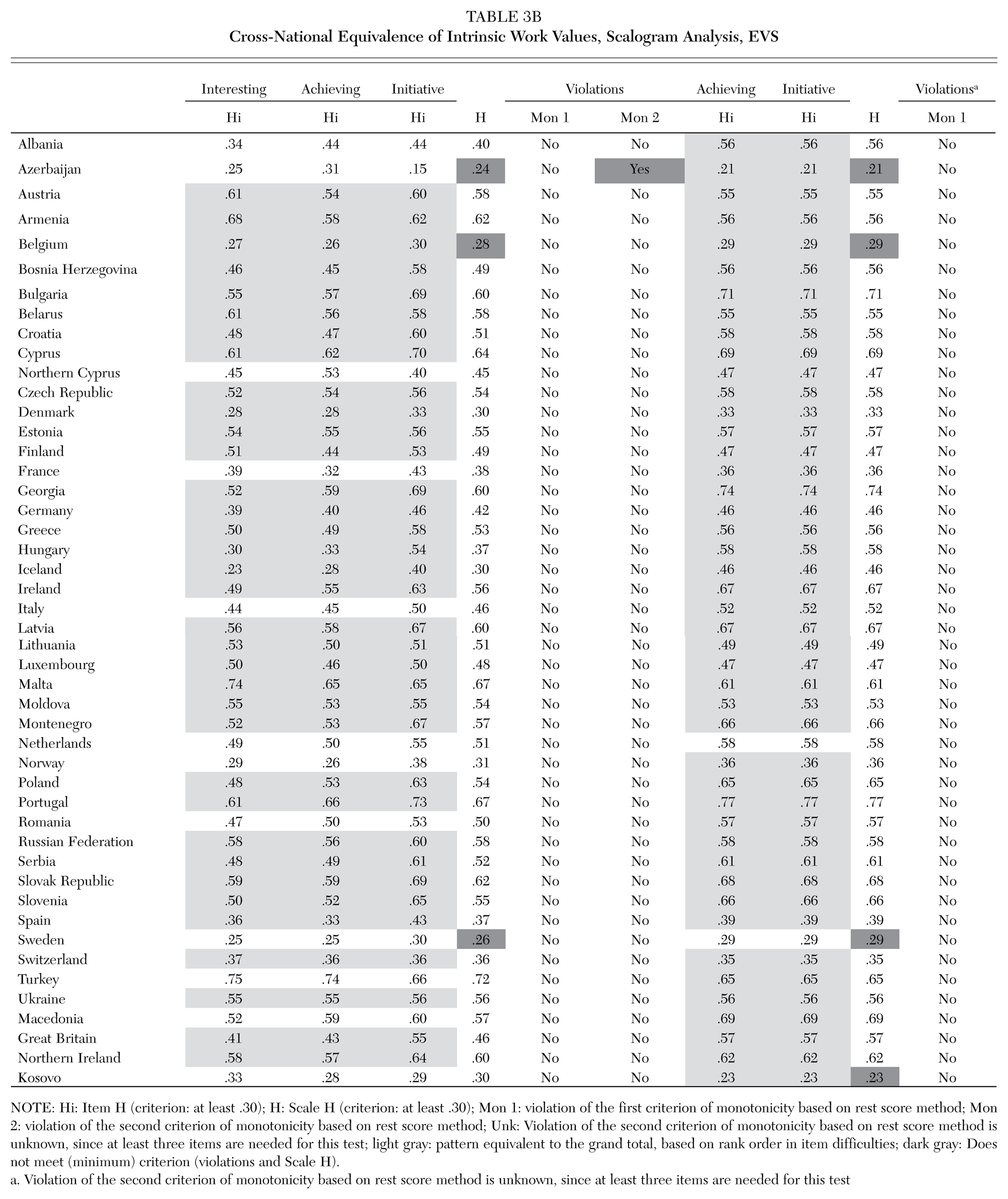
NOTE: Hi: Item H (criterion: at least .30); H: Scale H (criterion: at least .30); Mon 1: violation of the first criterion of monotonicity based on rest score method; Mon 2: violation of the second criterion of monotonicity based on rest score method; Unk: Violation of the second criterion of monotonicity based on rest score method is unknown, since at least three items are needed for this test; light gray: pattern equivalent to the grand total, based on rank order in item difficulties; dark gray: Does not meet (minimum) criterion (violations and Scale H).
Violation of the second criterion of monotonicity based on rest score method is unknown, since at least three items are needed for this test
For the intrinsic dimension of work values, we see straightaway that fewer countries, nine in total, have a pattern equivalent to the overall rank order of item difficulties. We also see more dark gray areas compared to the extrinsic dimension, depicting numerous deviations from the general pattern. Removing “a responsible job” first from the analyses adds the most countries to the pool of “nondeviators.” A job that meets one’s abilities is the second item generating the highest wins, and finally having an interesting job. For the intrinsic dimension of work values, the Netherlands and Sweden can never achieve a rank order in item difficulties similar to the overall pattern, as in these countries “using initiative” is held to be more important (less difficult) than “the ability to achieve something,” which in the overall pattern initiative is the most difficult intrinsic work value.
Tables 2 and 3 show the scalability parameters (Hi and H) and violations of the first and second criterion of monotonicity (Mon1 and Mon2) for each step in the process of deleting items from the scale. Again, light gray areas in Tables 2 and 3 depict the countries that have a rank order in item difficulties similar to the overall pattern. Dark gray cells show where violations are; that is, Hi- or H-parameters below .30 and significant violations of the first or second criterion of monotonicity. The results reveal that if a researcher wishes to study the construct of extrinsic work values with as many items as possible in a cross-national comparison, it would be premature to state that he or she could do so for twenty-two countries. Tables 2 and 3 show that for five (Greece, Italy, Portugal, Spain, and Switzerland) out of the twenty-two countries with a rank order similar to the overall pattern, the second criterion of monotonicity is violated, meaning that respondents within those countries differ in their rank order of item difficulties. Consequently, we may state that the fewer items we use, the more countries are similar to the overall pattern and the fewer violations regarding scalability and monotonicity.
Detecting the countries similar to the overall pattern and without any violation, seventeen countries can be safely compared when using all extrinsic work value items (see Table 2A); twenty-nine if the scale is based on “good pay,” “job security,” “good hours,” and “generous holidays” (see Table 2A); forty-three if “good pay,” “good hours,” and “generous holidays” are used to calculated summated cumulative scales (see Table 2B); and forty-five if “good pay” and “generous holidays” are used to calculate scale scores (see Table 2B). Azerbaijan and Turkey remain incomparable due to insufficient scalability; that is, for those nations, the two remaining items cannot be used for cumulative scaling, even though the rank order of item difficulties is similar to the overall pattern (see Table 2B).
For the dimension of intrinsic work values, eight countries can be safely compared if all five items are to be used (see Table 3A). Cross-national comparisons are possible for seventeen countries if “a responsible job” is not included in the scale (see Table 3A), for thirty-four nation if “a job that meet one’s abilities” is excluded subsequently (see Table 3B), and for forty-two nations if the scale is solely based on “the possibility to achieve something” and “the possibility to use initiative” (see Table 3B). For the dimension of intrinsic work values, problems remain for Azerbaijan, Belgium, the Netherlands, Sweden, and Kosovo, due to insufficient scalability, deviating rank orders, or both.
In the end, equivalence analyses are used to find answers to comparative research questions on differences among countries and to explain them. Even though we did not formulate such theoretically guided research questions, we end this result section by presenting average scores of countries on the extrinsic and intrinsic dimension of work values. Figure 2 summarizes these averages. Both scales are based on two items, so they achieve as high a level of comparability as possible. Furthermore, the scale scores have been calculated for all forty-seven countries together and standardized using z-scores, meaning that the average across all countries is zero, and each score depicts to what extent its rate of valuing extrinsic and intrinsic work characteristics is below or above average. Note that even though they are in Figure 2, for Azerbaijan, Belgium, the Netherlands, Sweden, and Kosovo, the scale is not equivalent for the intrinsic dimension; while for the extrinsic dimension, strictly speaking, Azerbaijan and Turkey cannot be included in the comparison.
On average, the importance attached to extrinsic work characteristics is highest in Eastern European countries such as Albania, Bosnia Herzegovina, Bulgaria, and Moldova; and lowest in Scandinavian countries such as Norway and Sweden, but also in Switzerland. Intrinsic work values are on average rated highest in Moldova, Luxembourg, and Northern Cyprus; while inhabitants of Belgium, Hungary, and Spain appreciate intrinsic work characteristics well below the European average. Figure 2 also shows that both dimensions of work values are positively correlated: on average, higher averages of extrinsic work values go hand-in-hand with higher averages of intrinsic work values, implying that the importance of work, irrespective of which characteristic it is about, varies between countries. Yet the correlations are most often weak to moderate (see Table A5 in the online appendix), underscoring that even though related, both dimensions of work values can be distinguished empirically.
We conduct the same tests of scale equivalence for the CUPESSE data, and those results are displayed in the online appendix. The results support our findings from the EVS: the more countries we want to compare, the fewer items we should use, at the cost of the “richness” of the theoretical construct. Here also, internal validity is traded for external validity.
Discussion and Conclusion
The leading question of this contribution was whether people in different cultural contexts (i.e., different countries) have similar or different things in mind when they think about extrinsic or intrinsic work values. Prior research has underscored cohort differences, showing that different age groups emphasize different values (Lechner et al. 2017; Meriac, Woehr, and Banister 2010; Twenge et al. 2010), and previous work has also tried to assess the measurement equivalence of these values across countries (Leuty and Hansen 2011; Vecerník 2003).
In contrast to these prior studies, though, our work assesses the general scalability of the most commonly used work value measures. Testing the scalability of items is important because it allows the researcher to take empirical realities into account when comparing respondents across cultures with respect to the same concept. Trade-offs between internal validity (if a measurement of values is valid for a given country) and external validity (if a measurement that is valid for one country can be applied in another country) are unavoidable, but a transparent process of narrowing the list of items used for measurement (or countries to which those items are applied) contributes to a well-justified case selection in cross-national comparative studies, as long as one can argue that the most important items are included.
Our findings add to the general discussion of how many items are needed to accurately measure a given construct and how much added value comes from including a battery of items for a given measurement. Some argue that single-item measures offer more advantages than multi-item measures (Gardner et al. 2016). Single-item measures circumvent the issue of measurement invariance across cultural contexts. However, they might not suffice to capture the many dimensions of certain constructs. For this particular research on work values, we have seen that the extrinsic and intrinsic dimensions consist of multiple items that capture the different aspects of each dimension. Each dimension is indeed made up of multiple facets, but using more and more items to measure a particular aspect of work values can result in less comparability across countries. Researchers are thus faced with the trade-off between the “richness” of the scale and the number of countries to which that scale can be justifiably applied in comparative analyses. The more countries we want to compare, the fewer items we should use.
Another takeaway of our analysis is the apparent difference of the cross-national comparability of work values on the two dimensions: the number of items that one is able to safely compare (in the European context, at least) differs substantially. Whereas for extrinsic values, twenty-two countries are comparable if all items are used based on the results of our scalogram analysis, the corresponding number of countries drops to only eight when we look at intrinsic values. In a similar fashion, the analysis on the intrinsic dimension also yielded a higher number of incomparable countries.
These findings resonate with prior research that points out the challenges of capturing intrinsic work values. Some of the literature emphasizes the varied and possibly overlapping measures of intrinsic work values, the context- and interaction-dependent dynamic of intrinsic orientations, as well as the growing prevalence of “intrinsic life satisfaction” outside the workplace, embedded into an emerging hedonistic value pattern in postindustrial and modern countries (Sortheix, Chow, and Salmela–Aro 2015). These make cross-cultural comparisons of intrinsic motivations more difficult and also more costly (in terms of the trade off of particular subdimensions [items] to gain more comparability).
Our finding that both dimensions of work values are positively correlated (Table A5 in the online appendix) tallies with results of previous research (Gesthuizen and Verbakel 2011) that emphasizes that these dimensions are not inversely related (as was argued earlier in Ester, Braun, and Vinken 2006; Yankelovich 1985). Following the logic of Hauff and Kirchner (2015), extrinsic values cannot be substituted for intrinsic ones (or vice versa): people formulate additional work-life demands and attach higher importance to work value sets without neglecting previously dominant dimensions. Hence, this contribution reiterates the message that work values are not only systematically interrelated, but have distinguishable dimensions, one of which can be enhanced without compromising the other. As generations or times change, people might attach higher importance to novel work-related expectations while leaving more traditional, income- or security-related dimensions intact as well.
Our results also illustrate how Eastern European respondents value the extrinsic dimension more than individuals from other EVS countries. In this sense, our analyses support previous studies (Ester, Braun, and Vinken 2006; Hauff and Kirchner 2015; Kaasa 2011; Parboteeah, Cullen and Paik 2013) that argued for extrinsic values being more important in less-developed countries. In general, the predominance of income and security-related work values concerns the significantly lower share of “postmodern demanders” among employees in postcommunist Eastern European countries, as well as the overall positive relationship between modernization or individualization and the importance attached to intrinsic work values. Similarly, the negative relationship between postindustrialization and extrinsic work values is perceived as a manifestation of shifting from materialist to postmaterialist values. Apart from cross-cultural comparisons, future research should focus on cases clearly violating the second criterion of monotonicity, identifying and explaining within-nation variability, that is, specific value patterns among respondent subgroups of a given country.
In sum, this article emphasizes the trade-off that researchers need to make between (1) covering the most possible subdimensions of a latent construct and (2) equivalencies that are desirable in cross-cultural research. Future research on work values could concentrate on the comparable cases, where all aspects of a given dimension (extrinsic or intrinsic) can be included in the analyses, preserving the wealth of the construct. Or, depending on the research question, one with a multilevel design could seek the inclusion of the most possible (i.e., comparable) countries and opt for getting rid of a particular number of items, sacrificing the full meaning of the concept measured and risking the omission of substantial aspects of the meaning. We recommend that other researchers compare the results they get by employing scales consisting of a varying number of items (if not using the full one), as well as with a complete pool of countries, with the set of safely comparable ones, as ways of performing robustness checks. Nonetheless, the question remains: How many items are enough to measure the complex nature of extrinsic and intrinsic work values, to rightfully reject or confirm hypotheses, as well as to come to valid overall conclusions within cross-national studies? Our findings suggest that researchers should focus on the most important items for each scale to truly capture work values in cross-cultural research.
Supplemental Material
Gethuizen_Appendix_682 – Supplemental material for Extrinsic and Intrinsic Work Values: Findings on Equivalence in Different Cultural Contexts
Supplemental material, Gethuizen_Appendix_682 for Extrinsic and Intrinsic Work Values: Findings on Equivalence in Different Cultural Contexts by Gerbert Kraaykamp, Zeynep Cemalcilar, Jale Tosun, Maurice Gesthuizen, Daniel Kovarek and Carolin Rapp in The ANNALS of the American Academy of Political and Social Science
Footnotes
NOTE:
The research leading to these results received funding from the European Union Seventh Framework Programme under grant agreement no. 613257 – CUPESSE (Cultural Pathways to Economic Self-Sufficiency and Entrepreneurship).
Notes
Maurice Gesthuizen is an assistant professor in the Department of Sociology at Radboud University (Nijmegen, the Netherlands). His major research interests include educational inequality, economic vulnerability, social capital, and their interrelations. He has published widely on these subjects in international scientific journals.
Daniel Kovarek is a PhD candidate in the Department of Political Science at Central European University. His research interests include voting behavior, public opinion, and party politics.
Carolin Rapp is an assistant professor in the Department of Political Science at the University of Copenhagen. Her research lies in the intersection among political sociology, political psychology, and social policy research. Her research has appeared in, for example, the Journal of Politics, Journal of Ethnic and Migration Studies, and Social Science Research.
References
Supplementary Material
Please find the following supplemental material available below.
For Open Access articles published under a Creative Commons License, all supplemental material carries the same license as the article it is associated with.
For non-Open Access articles published, all supplemental material carries a non-exclusive license, and permission requests for re-use of supplemental material or any part of supplemental material shall be sent directly to the copyright owner as specified in the copyright notice associated with the article.
