



Abstract
Young adults’ work values evolve as they are socialized into education and work. We study a core concept of work values, work centrality, and distinguish between an extrinsic dimension, that is, the relative importance of work; and an intrinsic dimension, that is, nonfinancial employment commitment. Using data collected by the CUPESSE project on two generations of families in nine European countries, we explore the congruence of work values between parents and adolescents and the effect of the regional-level social and economic context on young adults’ work values. We find, first, that parental influence is the most robust determinant of extrinsic and intrinsic work centrality in adolescents. Second, the relative importance of work to young women varies across regions, but the variation is explained in part by female labor force participation rates in those regions. Third, differing patterns of extrinsic and intrinsic work centrality across European regions are explained, in part, by gender, education, and subjective financial satisfaction.
Keywords
Work values are important to labor market participation. They are concrete conceptions of the multidimensional concept of the meaning of work (Nord et al. 1988; Dekas and Baker 2014; Ros, Schwartz, and Surkiss 1999). We focus on one core work value, work centrality, defined as the subjective belief that work is important in one’s life (Walsh and Gordon 2008; Rosso, Dekas, and Wrzesniewski 2010; Ros, Schwartz, and Surkiss 1999) and further differentiate this concept into two components according to the important distinction between extrinsic and intrinsic motivations (Harpaz and Fu 1997).
We aim to shed light on three related questions: First, how important is the transmission of work centrality within the family? Second, in what way does work centrality vary across Europe? Third, which contextual factors influence work centrality? Following established measures (Rosso, Dekas, and Wrzesniewski 2010), we operationalize the extrinsic component as the relative importance of work compared to leisure (Relative Importance of Work or RIW) and the intrinsic component as the intention to work in the absence of financial necessity (Nonfinancial Employment Commitment or NEC). While both dimensions measure the general importance of work, they highlight different aspects of the meaning of work in the life of an individual. RIW emphasizes the social role of work, including the need to work to make a living, while NEC focuses on the subjective value of work, and we expect these dimensions of work centrality to be affected by sociodemographic and contextual factors in different ways.
We study three sets of determinants of work centrality: individual factors such as the characteristics of the present job and the family situation, socialization effects due to transmission within the family, and the social role of respondents in the wider society (Gallie, Felstead, and Green 2012; Kalleberg 1977; Kalleberg and Marsden 2013). Although there is much evidence suggesting the relevance of socialization effects (Roberts and Bengtson 1999; Johnson 2002), the relationship is far from perfect. We address this gap by studying the factors affecting the deviation of youth work values from their parents’ values after taking transmission effects into account for both aspects of work centrality.
We combine the three levels in a single model and argue that while individual work values are rooted in familial socialization, the socioeconomic and cultural contexts play an important role as well. In contrast to previous studies (Turunen and Nätti 2017; Esser 2009; Parboteeah and Cullen 2003), we conceptualize the context not at the level of countries but at the regional level, which is arguably more immediately relevant in socioeconomic and cultural terms. Whereas country-level averages constitute a baseline, within-country variations in economic prosperity, labor market conditions, and cultural values are large in European countries, most notably along the center-periphery and the urban-rural cleavages (Lipset and Rokkan 1967; Hooghe and Marks 2018). Living conditions in urban metropoles and rural peripheries are more similar across countries than within countries. Furthermore, social institutions such as the family culture follow different political cleavages than current national borders (Alesina et al. 2015; Duranton, Rodríguez-Pose, and Sandall 2009). Also, a welfare or employment regime perspective has been shown to be only of limited use in a work value context (Steiber 2013). Thus, a focus on country-level comparisons may conceal more than illuminate. As a second research question, then, we ask what socioeconomic and cultural factors in the region condition individual deviations in the transmission of work values within the family in addition to individual factors.
We study these questions with data from the Cultural Pathways to Economic Self-Sufficiency and Entrepreneurship (CUPESSE) project, which is unique in providing data that systematically trace the transmission of work values from parents to their children across different European countries (Tosun et al. 2018). We analyze these questions for NEC and RIW separately. By merging the CUPESSE data with regional (NUTS-2) social and economic indicators from EUROSTAT and controlling for country effects, we integrate contextual variation into the analysis. 1
Dimensions of Work Centrality
Research on work values has a long tradition in sociology (Weber 1904/2005; Durkheim 1893/2014). Most researchers define work values in terms of outcomes people desire and seek through work (Brief 1998; Cherrington 1980; Nord et al. 1988). Despite several critiques and extensions (Gallie 2007; Halaby 2003) and the introduction of newer classifications (Wrzesniewski et al. 1997), the two-factor model of intrinsic and extrinsic values has remained dominant in research classifications (Kalleberg and Marsden 2013; Mortimer et al. 1996; Johnson, Sage, and Mortimer 2012).
Work centrality is often supposed to transcend the distinction between intrinsic and extrinsic work values (Rosso, Dekas, and Wrzesniewski 2010; Ros, Schwartz, and Surkiss 1999). As stated above, a high level of work centrality means that one sees work as an important aspect of life itself. Work centrality influences decisions about work, especially during economic hardship, when greater efforts are necessary (Johnson, Sage, and Mortimer 2012). It also enhances job search efforts, vocational aspirations, the school-to-work transition, job search intensity, job selection, and job satisfaction (Kanfer, Wanberg, and Kantrowitz 2001; Hitlin 2006; Jin and Rounds 2012; Bal and Kooij 2011; Kalleberg 1977).
Although RIW and NEC have both been used in combined scales of work centrality (England and Harpaz 1983; Harpaz and Fu 1997), we argue that these two indicators measure conceptually distinct dimensions of the value assigned to work. First, we conceptualize the RIW as the subjective relevance of work in life by contrasting feelings about work to feelings about leisure from a utilitarian perspective. Our measure of RIW is based on parts of Furnham’s (1990) operationalization of Weber’s (1904/2005) concept of work ethic. He interpreted work centrality as “leisure avoidance.” This approach results in the item, “Work should always come first even if it means less spare time,” which is then rated on a 4-point Likert scale ranging from strongly disagree to strongly agree. 2 We dichotomize this scale by categorizing the first two answers as “low work centrality” (53 percent of respondents) and the second two as “high work centrality” (47 percent of respondents).
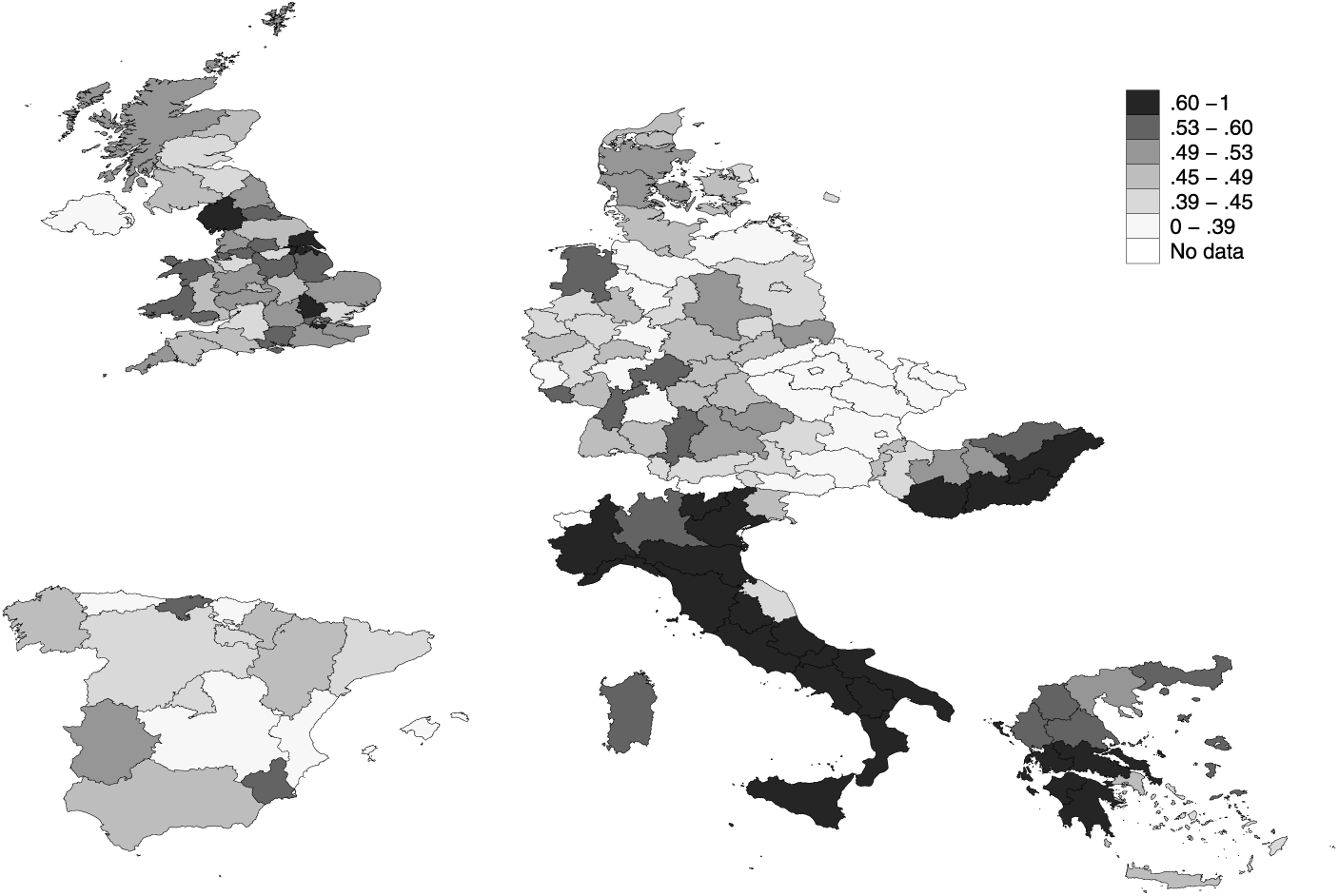
Figure 1 depicts the distribution of RIW aggregated at the NUTS-2 level in the countries studied. We observe very high levels of RIW in Italy, in particular the southern part; Hungary; and the southeastern part of England. High levels are found in the British Midlands, in the southern part of Germany as well as Lower Saxony, and in large parts of Greece. On the other side of the scale are Spain, Austria, the Czech Republic, the eastern and northern parts of Germany, and parts of the United Kingdom. Denmark, parts of Hungary, and some areas in the United Kingdom and Germany are in the middle range of the scale.
Relative Importance of Work (RIW)
Second, we focus on the value of work beyond the need for income. Morse and Weiss (1955) told participants to imagine that they inherited enough money to live comfortably for the rest of their lives and asked whether they intended to continue working. An astonishing 80 percent of the respondents answered yes. This idea of NEC is closely related to Weber’s concept of a religious belief in work as a way toward salvation (Rosso, Dekas, and Wrzesniewski 2010). Hence, the item on employment commitment in the case of unexpected wealth refers to the importance of work as an end in itself, thereby highlighting the intrinsic value of work (Steiber 2013). Our question wording focuses on the general orientation toward work and not on the current job situation: “If you were to get enough money to live as comfortably as you would like for the rest of your life, would you continue to work or would you stop working?” Respondents could answer “Continue work” or “Stop working.” More than measuring a single aspect of the work ethos, NEC should be interpreted as a way to operationalize individual work ethos in a single question. Although multi-item indicators are more frequently used in international comparisons, the measure has remained popular (Gallie, this volume; Steiber 2013; Turunen and Nätti 2017; van der Wel and Halvorsen 2015).
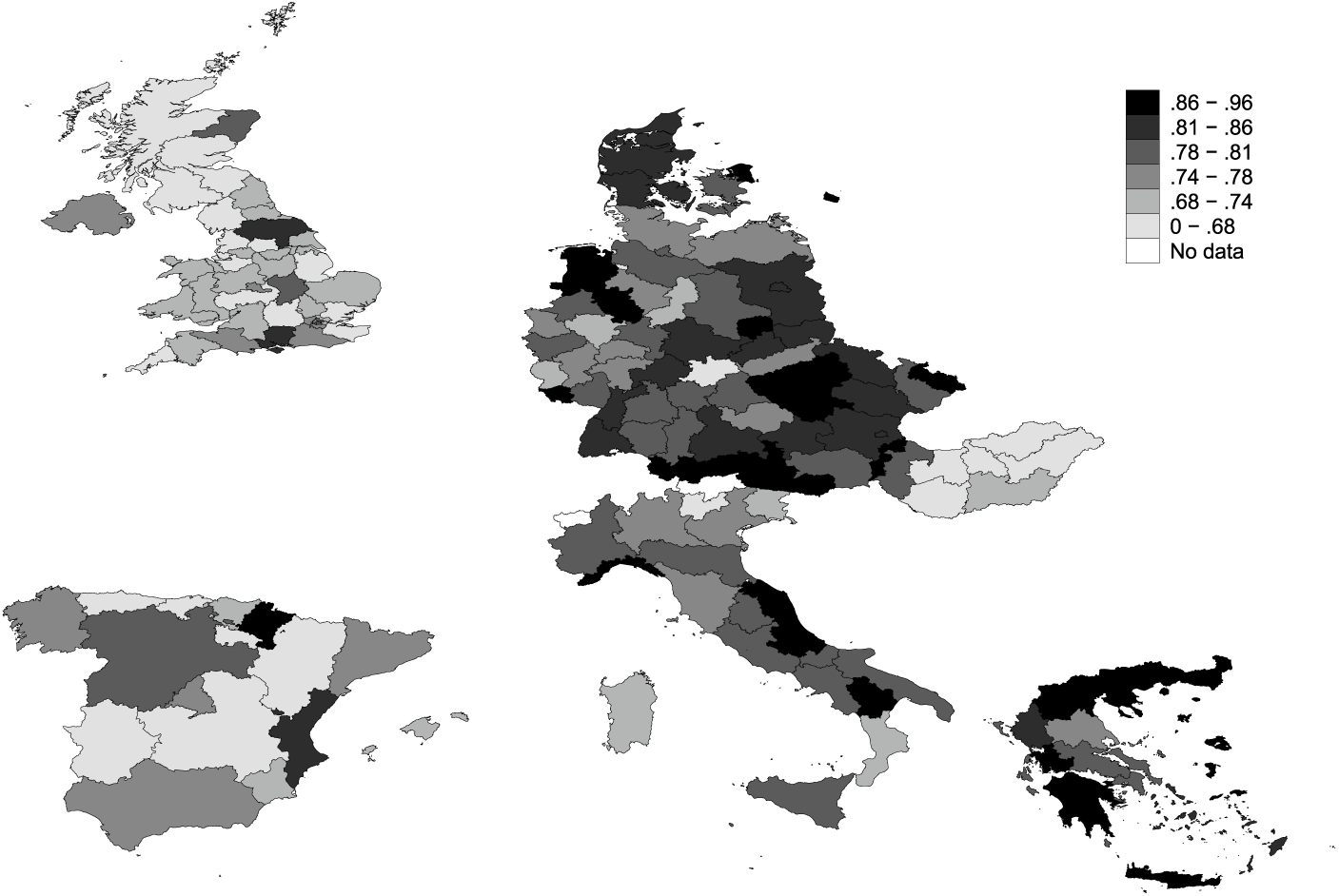
Figure 2 shows the share of respondents in a NUTS-2 region who believe that they would continue work even if they would not need the income from work. Most notably, Austria, Germany, and Greece score highest and Hungary scores lowest on the NEC measure. Thus, respondents in the first set of countries give work a low status in comparison to leisure but cannot imagine ceasing work even if they would not need to work. Quite the reverse order is observed in Hungary, parts of the United Kingdom, and the northeastern part of Italy: respondents tend to rate work very highly in comparison to spare time, but the share of those who would stop working if they had the opportunity is very high. In the other countries, the scores of the two variables are more aligned.
Nonfinancial Employment Commitment (NEC)
As the covariation of RIW and NEC is small (Gamma = 0.2; see Table A2 in the online appendix), our argument that the two dimensions of work centrality actually capture very different aspects of the concept is empirically supported. A principal component analysis of work centrality measures (regardless of using a one- or a three-item operationalization) and NEC results in a two-factor model (online appendix Table A3), which further supports our decision to investigate the multidimensionality of work centrality and analyze RIW and NEC separately.
We thus observe substantial variation not only in the average scores on RIW and NEC across European regions but also in the relative scores of the two variables, yielding different regional profiles of congruent and incongruent work centrality measures.
Determinants of Work Centrality
The main idea of our argument is that individual work values are embedded in a social context. We distinguish two levels of context, that is, the family as a proximate and direct source of work values and the broader socioeconomic and cultural conditions as a distant framework of opportunities and limitations motivating or restraining the development of individual work values. We first discuss the two levels of contextual conditions and then present the individual-level factors constituting the model to which the contextual conditions are added and compared.
Transmission of work centrality within the family
The family context has often been highlighted as a prime influence in shaping the value structures of children, especially work values (Kalleberg and Marsden 2013; Roberts and Bengtson 1999). Both socialization theory (Bush and Simmons 1981; Long and Hadden 1985) and social attainment theory (Blau and Duncan 1967; Mortimer 1974) suggest that work orientations are socially transmitted from parents to children through social interactions and observation. Socialization is the prime mechanism of the initial development of values and patterns of behavior (Grusec and Kuczynski 1997). Additionally, the social psychology of work stresses the connection between social origins and adult job values (Johnson 2002; Kohn and Schooler 1969). Parents are the prime agents of socialization and value development in early childhood and adolescence (Whiston and Keller 2004). We measure the intergenerational transmission of work values using value congruency between parents and children. In line with the strong empirical evidence and expectations of socialization and social attainment theory, we anticipate (H1) strong value congruency between parents and their children in both measures of work centrality.
The regional socioeconomic and cultural context
Workers may seek jobs that conform to their values, although such jobs may not be available given job market conditions (Kalleberg 1977). First, according to need-based theories (Kalleberg and Marsden 2013; Maslow 1954), RIW should be higher when jobs are scarce in a labor market. Second, consistent with a reinforcement and accentuation model, workers should emphasize the values they can obtain in their actual job (Johnson, Sage, and Mortimer 2012; Rosenberg 1979). In this case, the level of unemployment in the relevant labor market should have a positive impact on RIW but a negative one on NEC, because having a job becomes more important but the probability of having an adequate job decreases. Furthermore, people who are out of work for long periods might grow accustomed to their situation. At the regional level, this is argued to weaken the social norm of working hard (Clark 2003). Additionally, high levels of unemployment may boost the fear of losing one’s job, which has also been shown to affect NEC negatively (Steiber 2013). Consequently, we expect (H2) that higher unemployment rates (operationalized by the unemployment rate of 18- to 24-year-olds at the NUTS-2 level) will lower the chances of getting a job that people are willing to work for without the extrinsic need to do so. We also include the general level of long-term unemployment in the region, which should be better suited to capturing the social norm of being unemployed.
At the individual level, high levels of subjective job insecurity have a negative effect on the employment commitment of employees (Turunen and Nätti 2017; Steiber 2013). Hence, perceived job expectations may contribute to explaining work centrality. According to status attainment theory, the primary effect of the parents’ social status is enhanced by secondary effects stemming from education and employment prospects (Sewell, Haller, and Ohlendorf 1970). To capture the social status environment and assess the effect of the socioeconomic context on work centrality, we add the percentage of employees in sectors with a low human capital intensity in the NUTS-2 region. A high share of employees in these sectors should hinder the development of strong intrinsic work centrality (NEC) as chances of reaching a human capital intense job are lower (H3) (Tabellini 2010). The lower the overall skill level in the region, the higher will be the need to work for survival (RIW) and the lower the willingness to work beyond financial necessity (NEC).
Furthermore, besides these economic factors, cultural variation should also affect work values, as Weber (1904/2005) has argued in his seminal study on the protestant ethic and capitalism. Several studies have shown that work centrality is shaped by the cultural background and by social institutions (Warr 2008; Parboteeah and Cullen 2003). However, in a comparative study, England and Whitely (1990) found more similarities than differences in work centrality across countries. This result has been replicated in other studies (Snir and Harpaz 2006), which suggests that the national level may be too broad a unit of analysis to assess the effect of culture. 3
Roughly speaking, more peripheral and more rural areas typically score higher in maintaining traditional cultural values, which affects economic development (Tabellini 2010). Traditional values such as security, conformity, and tradition have also been associated with stronger extrinsic work values (Ros, Schwartz, and Surkiss 1999). One important marker of cultural norms with respect to the organization of the family and the society is the definition of gender-specific social roles. Recent studies have attributed variation in gender roles to historically grown cultural differences at the regional level (Alesina et al. 2015; Duranton, Rodríguez-Pose, and Sandall 2009). Through a variety of channels, ranging from individual identity to the existence of childcare institutions, shared convictions about social roles are captured in the aggregated participation of women in the labor market (operationalized as the female labor force participation rate in the age group 25–34 at the NUTS-2 level). We expect that (H4) regions with higher female labor force participation exhibit lower RIW and higher NEC.
Measuring these factors at the regional level (NUTS-2 level), while including country effects, is a pragmatic solution that avoids excessive averaging while maintaining a reasonable number of observations per unit of analysis. Thus, we eliminate variation that is due to cultural and institutional differences between countries that could overlap with socioeconomic variation and instead focus on variation across regions. 4
Individual factors
Given that an extensive literature has explored the individual determinants of work values, we include a set of variables that captures these factors as a baseline model to which we compare the extensions at the family and regional levels. 5 In other words, we focus on specific sociodemographic core variables that may help to explain different patterns of RIW and NEC.
Although age seems to be an important factor for work values (Hanlon 1986; Bal and Kooij 2011), age variation in our sample of young adults is too small to capture maturing effects or closeness to retirement (Highhouse, Zickar, and Yankelevich 2010). Instead, we account for different stages in the respondent’s life course and the specific roles that are attached to them (Sagie, Elizur, and Koslowsky 1996) by including several sociodemographic and socioeconomic variables.
First, given the different social roles attributed to men and women and the gender-segregated occupation structures and work roles of men and women still prevalent in European societies (Mannheim 1993), we include gender as a predictor. To the extent that traditional gender roles are relevant, we should observe higher RIW among men. If the gender segregation argument holds, NEC should be higher for women than for men, because women should only work if they are intrinsically motivated.
Second, parenthood raises the importance of extrinsic work rewards, which, in turn, could influence work values. This may also be the result of self selection, as people with strong extrinsic values are more likely to marry and have children early (Johnson 2001, 2005; Mortimer, Lorence, and Kumka 1986). Therefore, the presence of children should be associated with higher RIW and lower NEC.
Third, education is a way to obtain high-quality jobs that, despite some dispute about details, can better satisfy extrinsic and intrinsic work motivations (Warr 2008; Harpaz and Fu 1997; Harpaz 2002). Thus, both RIW and NEC should be positively related to education.
Fourth, apart from a small group of highly qualified professionals, migrants tend to find jobs at the lower end of the occupational status hierarchy (Hudson 2007; Wrench, Rea, and Ouali 1999). As a consequence, they hold less rewarding jobs, and we should expect higher values on RIW but lower values on NEC.
Fifth, from a need perspective, low-income earners should focus on work due to the dominance of extrinsic benefits, resulting in higher values of RIW (Kalleberg and Marsden 2013). In turn, financial need is expected to reduce intrinsic work values, leading to a diminished interest in working beyond necessity. Need-based theories thus suggest that financial stability is negatively related to RIW and positively related to NEC.
Gallie, Felstead, and Green (2012) showed, in line with earlier results (Mortimer et al. 1996; Mortimer and Lorence 1979), that low-skill occupations decrease intrinsic job preferences. In addition, jobs demanding higher skills should be positively related to both extrinsic and intrinsic job preferences, which in turn should foster the relative importance of work in life in general. Hence, the occupational skill level, measured by the grouped ISCO-1 level (Gallie 2007), should be positively related to NEC and RIW.
Data
The empirical analysis is based on data from the CUPESSE project, an interdisciplinary project on intergenerational work value transmission funded by the European Commission under the FP7 framework (Tosun et al. 2018). In this article, we use data from nine member countries of the European Union that participated in the survey (Austria, the Czech Republic, Denmark, Germany, Great Britain, Greece, Hungary, Italy, and Spain). Data were collected in two stages. First, a probability sample of at least 1,000 young adults aged 18 to 35 was drawn from each country. Then parents were surveyed, if the young adult participants provided the means of contact. Since this approach may generate a response bias toward close parent-youth relationships that may, in turn, translate into higher similarity in values favoring a positive empirical relationship, we conducted chi-squared tests of independence comparing the share of youth respondents who provided parent data with those who did not. The tests resulted in significant differences in Denmark, Italy, and Spain for RIW and in Austria and Germany for NEC. Although significant, the small values of Cramér’s V indicate very weak associations (see online appendix Tables A4 and A5). Thus, although we do not know whether parents’ values differ, we know that young adults who provided parent data hold roughly the same values on work centrality as those who did not. The CUPESSE data are cross-sectional, which limits our ability to draw inferences on casual relations. But because the goal of this article is to highlight parent-child similarities in RIW and NEC and the importance of the regional context, cross-sectional data should be sufficient. We merge the data with NUTS-2 Eurostat indicators of low human capital intensive jobs defined as not being employed in technology- and knowledge-intensive sectors, the youth unemployment rate of people aged 15 to 24, and the female labor force participation rate of people aged 25 to 35 in 2015 (see online appendix Table A1 for a description of variables).
Results
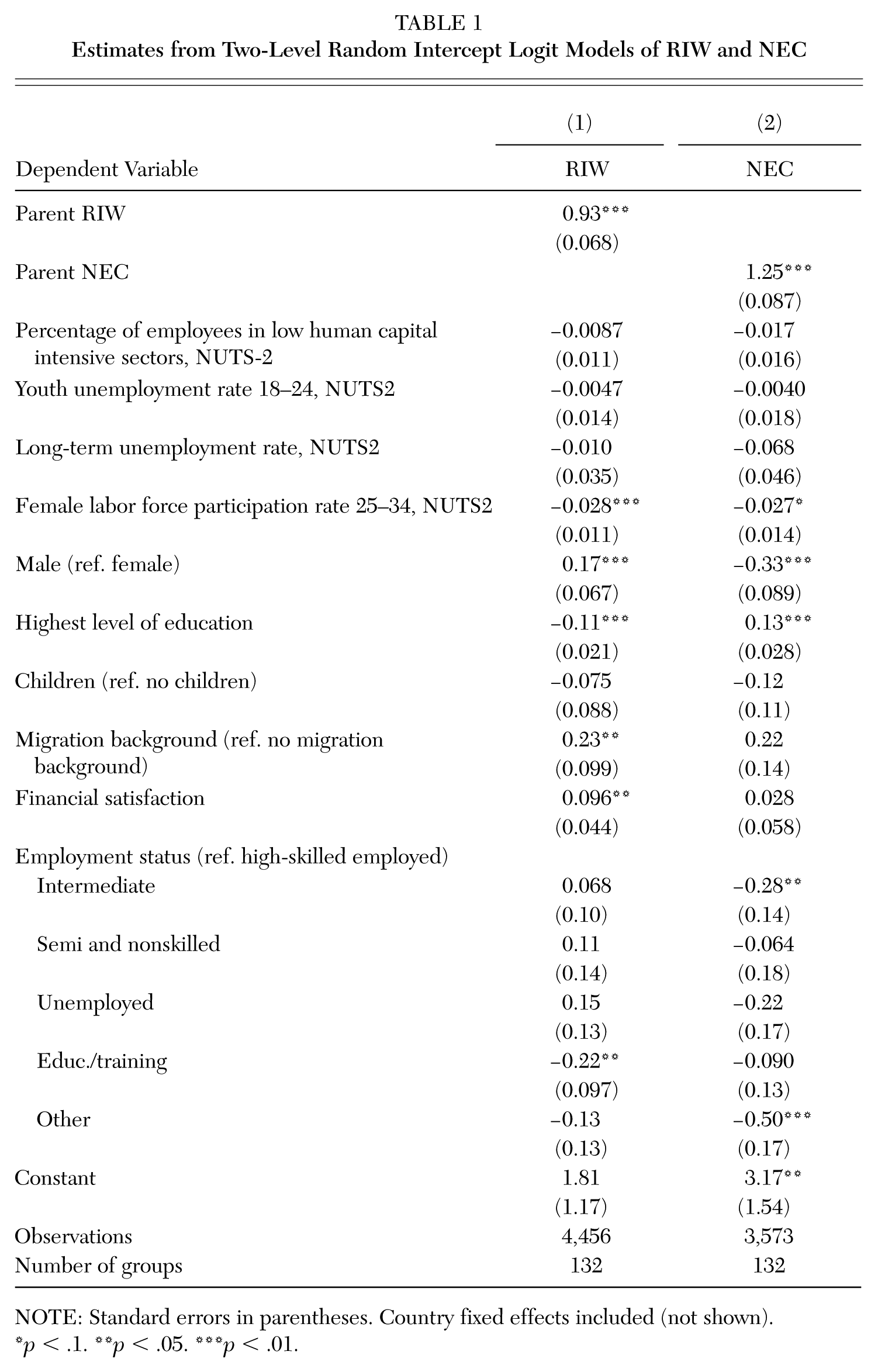
We estimated two-level random-intercept models where individuals (level 1) are nested in regions (level 2). The intraclass correlation coefficient (ICC) of the null model is .106 for RIW and .078 for NEC. Hence roughly 10 percent of the variation in the data is explained by regional variation if we do not account for country variation. Similar magnitudes have also been reported in multilevel regressions of work centrality with country data at level 2 (Turunen and Nätti 2017; Stam, Verbakel, and de Graaf 2013). We included country fixed effects to account for the nested structure of the regions in national cultures, welfare regimes, and legal systems. The corresponding ICCs are .021 for RIW and .025 for NEC. The null hypothesis that the between-region variance is zero is rejected (likelihood-ratio test, p < .01) for both dependent variables. Thus, we can assume that regional effects have a small but significant influence and that by controlling for country-level effects we have a conservative measure for regional effects on work values. Table 1 presents the results of the random-intercept models. Column 1 refers to RIW and column 2 to NEC.
Estimates from Two-Level Random Intercept Logit Models of RIW and NEC
NOTE: Standard errors in parentheses. Country fixed effects included (not shown).
p < .1. **p < .05. ***p < .01.
Family effects
Model 1 (RIW), on the relative importance of work compared to leisure, shows a strong congruence between youth and parent work centrality even though we control for various covariates. Hypothesis 1 (H1), that parents’ work values are a strong predictor of their children’s work values, is thus supported. This is also the case in model 2 (NEC), where the parent effects are even larger and, once more, the single strongest of all the predictors in our analysis. The strength of the effect is even more impressive as previous studies have suggested that, more than the parents’ actual work values, the children’s perception of their parents’ work values influences the child’s work values (Whitbeck and Gecas 1988).
Regional context effects
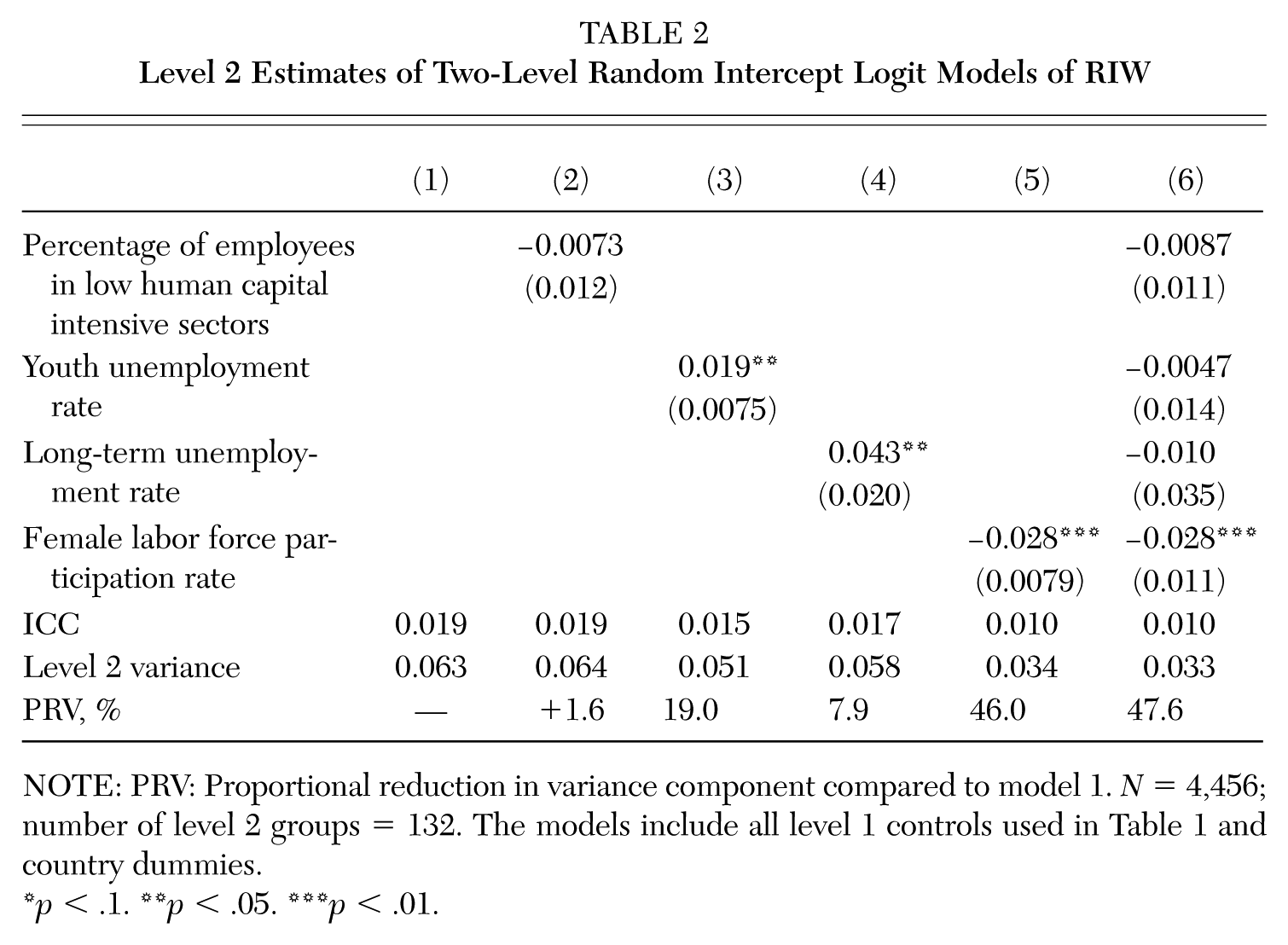
We expected that higher unemployment rates will lower the chances of getting jobs that people are willing to work for without the extrinsic need to do so (H2). The analysis indicates that the coefficient fails to reach statistical significance in the full model. However, stepwise inclusion of the regional-level indicators shows that regions with higher unemployment rates and especially with higher long-term unemployment rates have higher levels of RIW (see Table 2). Hence, we cannot find a detrimental effect of unemployment on the social norm of work. In contrast, the results suggest that in regions with high unemployment RIW becomes more salient, which could be interpreted as an effect of the higher salience of the need for extrinsic job rewards. 6
Level 2 Estimates of Two-Level Random Intercept Logit Models of RIW
NOTE: PRV: Proportional reduction in variance component compared to model 1. N = 4,456; number of level 2 groups = 132. The models include all level 1 controls used in Table 1 and country dummies.
p < .1. **p < .05. ***p < .01.
Contrary to our expectations, we find no statistically significant negative influence of the percentage of employment in sectors with low human capital intensity in the region on RIW or NEC (H3). While these results render the importance of occupational macro effects on work centrality unimportant, we emphasize that this result must be interpreted with caution. The cross-sectional character of our data might be insufficient to reveal the discouraging effects of low occupational opportunities over time. Furthermore, lower expectations stemming from parent-child congruency might mediate the effects of the actual occupational structure. In sum, model effects (Tables 2 and 3) indicate that regional socioeconomic variables are more relevant for RIW than for NEC, as the full model reduces residual level 2 variance for the latter only to a limited extent (13.3 percent), while it cuts the residual variance level 2 for RIW nearly in half (47.6 percent).
Level 2 Estimates of Two-Level Random Intercept Logit Models of NEC
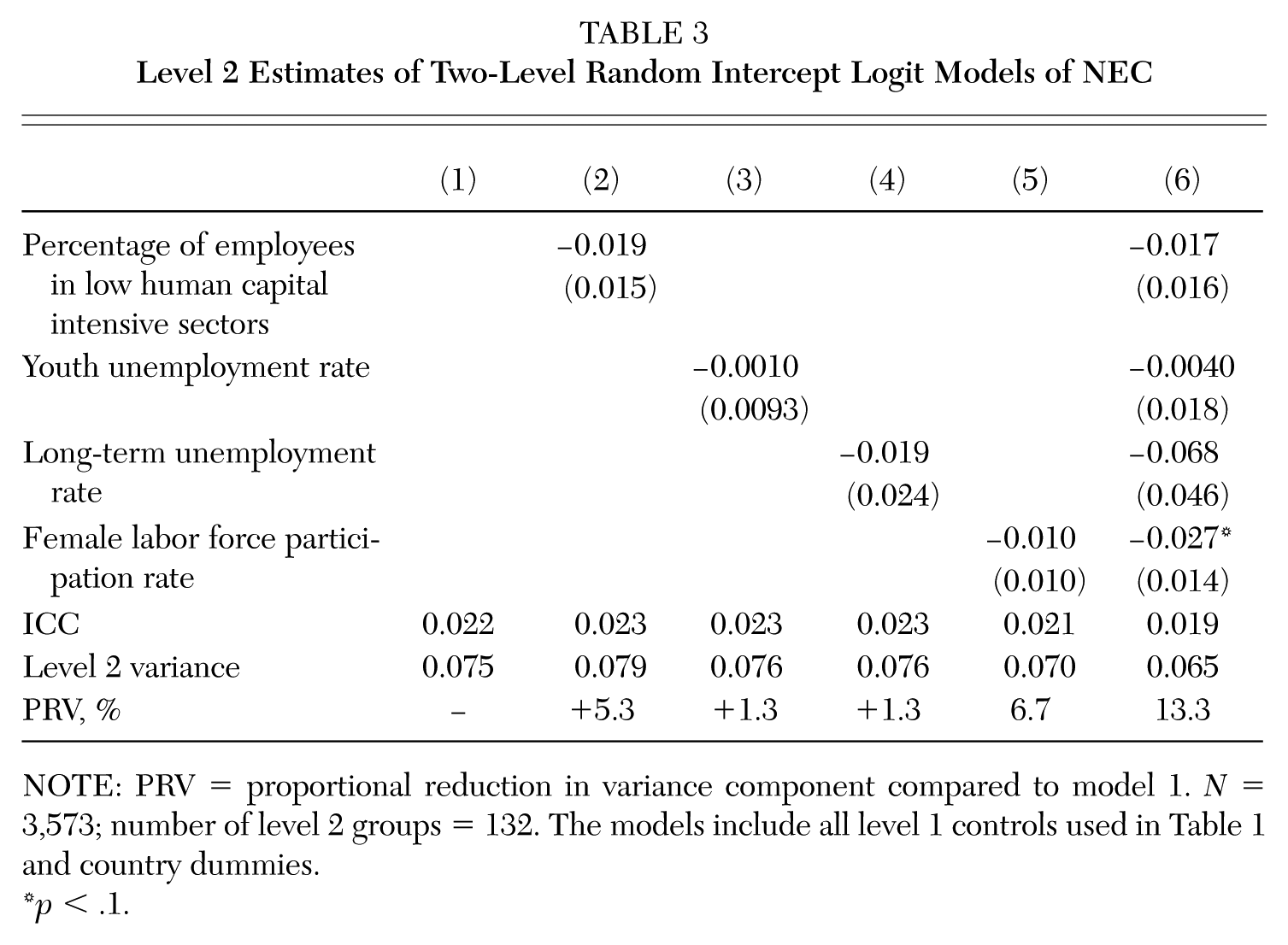
NOTE: PRV = proportional reduction in variance component compared to model 1. N = 3,573; number of level 2 groups = 132. The models include all level 1 controls used in Table 1 and country dummies.
p < .1.
In regions with higher female labor force participation rates, respondents reported lower rates of RIW. This supports our hypothesis that cultural norms about the familial distribution of labor might discourage women to work. We calculated separate models by gender, which suggested that the estimated coefficient indeed results from a negative effect for women only for both RIW and NEC (online appendix Table A7). Thus, in regions with low rates of female labor force participation, which arguably reflect strong traditional values, the importance of work relative to leisure is more salient for women. Contrary to our expectations, this regional effect is also negative for NEC. Studying the results more closely, we find that the regional rate of female labor force participation becomes significant only when controlling for the unemployment rate in the region as well, indicating that women living in regions with a high rate of unemployment and a high female labor force participation rate respond that they are less willing to continue their job if they have no financial necessity to do so. This shows the relevance of high-quality occupations for women, as women who face the risk of unemployment may be more likely to discontinue their job careers in favor of their families, resulting in cumulating disadvantages for their career and earning possibilities.
Individual effects
Male respondents consider work more important than leisure when compared to women but are less inclined to answer that they will continue work without financial necessity to do so. Although we anticipated that people in different stages of their life course would be affected by the specific work roles attached to them, the presence of a child in the family has no effect on work values in our main model (Table 1). 7 The current employment status indicates that for individuals in education, work is less important. The employment category “other” mostly contains individuals who are working at home or on parental leave. Since this category is predominantly populated by women, the result that individuals in this category have lower rates of NEC emphasizes the importance of gender roles for work centrality.
Education decreases RIW but is positively related to NEC. There are two possible explanations for this discrepancy: On one hand, people with higher education may self-select into positions providing rewards that motivate them to continue working even if it is not financially necessary to do so. On the other hand, the higher intrinsic work values of more educated people lead them to favor work beyond its extrinsic necessity. The data do not allow for a clear interpretation.
Migration background had the expected positive effect on RIW. However, contrary to expectations, a migration background has no significant negative influence on the NEC. This observation would require further analysis with more specific data.
Financial satisfaction positively affects RIW, while we find no significant influence on NEC. This seems to contradict need theories, which emphasize a hierarchy of rewards perspectives. However, this result would be in line with an instrumental perspective that stresses the comparative utility of work to leisure. 8 Moreover, needs may not be sufficiently pressing to raise the relative importance of work. A third potential explanation may be that for some occupational groups, work is not viewed as a way of reducing financial instability. Occupational classes fail to explain shifting patterns in the full model. However, this is mainly due to a correlation between education and occupational quality because dropping the education indicator renders the effect of occupational class significantly negative for RIW and positive for NEC. Thus, work in higher positions, which in other studies has shown to better satisfy intrinsic job motivations, influences the ability of people to enjoy work beyond extrinsic necessity, but its relative effect in addition to education is difficult to measure in a cross-sectional study. Panel studies might help to better distinguish the effect of educational attainment and occupational quality.
Discussion and Conclusion
Work centrality is a core measure of the overall importance of work in life. In this article, we have considered it as multidimensional in operation: we explore an extrinsic aspect (the relative importance of work to individuals or RIW) and an intrinsic aspect (the extent to which individuals are motivated to work even if work is not a financial necessity; what we call nonfinancial employment commitment or NEC). As expected, the extrinsic and intrinsic aspects of work centrality differ substantially across European regions.
We differentiate three levels of influence on individual work values: the family as a proximate and direct source of work values; the broader regional socioeconomic context as a more distant framework of opportunities and limitations motivating or restraining the development of individual work values; and individual core characteristics such as gender, education, and current employment status and occupation skill level. We study the importance of the transmission of work centrality within the family and the contextual and individual factors that help to explain the level of individual work centrality, in addition to transmission within the family.
We find, first, that the transmission of work values from parents to their children contributes most to the explanation of young adults’ work values. Both RIW and NEC exhibit strong persistence over generations. Second, the regional female labor force participation rate reduces RIW and NEC for young women. Third, we identify three individual-level factors that help to explain variation in RIW and NEC. Women reported significantly lower levels for RIW and higher levels of NEC. Education enables individuals to obtain jobs in which rewards from work are also nonmonetary, but higher education also reduces the overall importance of work compared to leisure. The opposite seems to be the case for financial satisfaction, which favors interpretations that focus on value congruency theories rather than a need perspective.
Future research might focus on the variation in the meaning of work to individuals at different stages in their life course and the relevance of gender roles. In particular, panel studies could help to further our knowledge on the correspondence between gender roles and work values in different societal contexts. Our results indicate that socioeconomic context may play a role in determining an individual’s work values. Future studies could also investigate the immediate context at the level of neighborhoods, which would yield an even better measure of the relevant socioeconomic context for individuals than the NUTS-2 regions used here. A panel perspective could also help to disentangle the effects of context and the family during the important stage of entry into the labor market. Our results may underestimate the relevance of context because the economic situation should also influence parents’ work values.
Individual work centrality is shaped by the transmission of values within the family in a specific socioeconomic context and is further influenced by the individual situation. Our results indicate that for most young adults in Europe, work is a central aspect of their life, although they differ in the emphasis on its expected rewards. While nonfinancial employment commitment dominates among highly educated people and in regions with low unemployment, people in the opposite condition will be much more willing to put leisure behind work. Thus, our study indicates that the social conditions into which people are socialized as well as contextual and situational factors affect their work values, leaving only limited space for discussions about wrong “work cultures” to foster work centrality.
Supplemental Material
Kittel_online_appendix_682 – Supplemental material for The Transmission of Work Centrality within the Family in a Cross-Regional Perspective
Supplemental material, Kittel_online_appendix_682 for The Transmission of Work Centrality within the Family in a Cross-Regional Perspective by Gerbert Kraaykamp, Zeynep Cemalcilar, Jale Tosun, Bernhard Kittel, Fabian Kalleitner and Panos Tsakloglou in The ANNALS of the American Academy of Political and Social Science
Footnotes
NOTE:
This research was funded under the EU Seventh Framework Programme collaborative research project CUPESSE (Cultural Pathways to Economic Self-Sufficiency and Entrepreneurship; grant agreement number 613257). We are grateful for very helpful comments from anonymous reviewers. We also want to thank the participants of the workshop “Work Attitudes and Values in Post-Crisis Europe” in Heidelberg 2018, especially Anne-Marie Parth, for their comments and suggestions.
Notes
Bernhard Kittel is a professor of economic sociology at the University of Vienna. His main research interests are justice attitudes and group decision-making and youth labor markets. Recent publications have appeared in the Journal of Public Economics, Political Research Quarterly, the Journal of Youth Studies, and Sociological Inquiry.
Fabian Kalleitner is a PhD candidate in the Department of Economic Sociology at the University of Vienna. His current research focuses on fiscal sociology and biased perceptions, status attainment processes, and web survey methodology.
Panos Tsakloglou is a professor at the Athens University of Economics and Business. His research focuses on inequality, poverty, social exclusion, and the redistributive role of public policies and has been published in the Quarterly Journal of Economics, the Economic Journal, the Journal of Development Economics, and the Journal of European Social Policy.
References
Supplementary Material
Please find the following supplemental material available below.
For Open Access articles published under a Creative Commons License, all supplemental material carries the same license as the article it is associated with.
For non-Open Access articles published, all supplemental material carries a non-exclusive license, and permission requests for re-use of supplemental material or any part of supplemental material shall be sent directly to the copyright owner as specified in the copyright notice associated with the article.
