



Abstract
Promoting gender equality, adapting to climate change, and ensuring food security are pressing global challenges. This study highlights the interlinkages among these issues, arguing that women's empowerment through joint land ownership enhances households’ food security amid increasing climate vulnerability. Specifically, we claim that joint land ownership strengthens women's bargaining power within households, leading to the adoption of climate-sensitive agricultural practices and improved households’ spending and saving behaviour. This, in turn, fosters the food and nutritional security of households facing extreme weather events. To test our hypothesis, we combine temperature and rainfall data with information on land ownership and food consumption from the Living Standards Measurement Study for Tanzanian households. Based on coarsened exact matching, propensity score matching, and a differences-in-differences approach, our findings demonstrate that joint land ownership reduces food rationing and improves diet diversity in regions affected by extreme weather events.
Introduction
Eliminating hunger and malnutrition is a key policy objective in the United Nations’ 2030 Agenda for Sustainable Development. Reaching the Sustainable Development Goal target of Zero Hunger by 2030 presents a significant challenge. Recent estimates by the United Nations Food and Agriculture Organization (FAO, 2023a) suggest that approximately 10 per cent of the world's population was hungry in 2022, and that nearly 600 million people will face hunger by 2030. Tanzania, although experiencing improvements in recent years, is one of those countries struggling with adequate food provision. An estimated 14.3 million Tanzanians experienced food insecurity in 2020, and 35 per cent of children are stunted (Burrone and Giannelli, 2023; FAO, 2020).
Climate change and its related weather variability are important drivers of this food insecurity in Tanzania and other countries. Persistent shifts in temperature, humidity, rainfall patterns, and the occurrence of extreme weather events will adversely impact agricultural production systems, leading to reduced food production, availability, and intake (European Food and Safety Authority (EFSA), 2022; FAO, 2015). For example, in Tanzania, weather variability is projected to considerably reduce the yields of major crops, including maize, sorghum, and rice (Rowhani et al., 2011).
To tackle the major challenge of preventing climate-related hunger, implementing development policies that enhance the resilience of agricultural sectors is imperative. One such policy is arguably promoting gender equality by increasing women's land rights. Gender inequality is increasingly recognised as a structural factor that exacerbates climate vulnerability, particularly by limiting women's access to productive resources, decision-making, and adaptive capacity (e.g. IPCC, 2022). Yet, many women across Africa own considerably less land than men and are also disadvantaged regarding other land rights (Doss et al., 2015; Gaddis et al., 2022; Slavchevska et al., 2021).
In this study, we argue that joint land certification (i.e. issuing land certificates in the names of both wives and husbands) is a simple yet highly effective way of mitigating food insecurity in the context of climate change and its related weather variability. Providing women with a land title is not only a policy goal in itself but may also enhance women's bargaining position within the household (Goli et al., 2025; Meinzen-Dick et al., 2019; Wiig, 2013). These changes may, in turn, positively impact a household's level of food production, availability, and consumption.
Empirically, we investigate the impact of joint land certification on the food security of smallholder farmers facing extreme weather events in Tanzania. In doing so, we evaluate data from approximately 4,000 Tanzanian households recorded by the Living Standards Measurement Study-Integrated Surveys on Agriculture (LSMS-ISA) (National Bureau of Statistics (NBS) [Tanzania] 2011, 2014). We analyse this data by combining a differences-in-differences (DiD) approach with two different matching techniques (Coarsened Exact Matching [CEM] and Propensity Score Matching [PSM]). This identification strategy allows us to assess the relationship between women's reported land ownership and food security. We show that the food intake and dietary diversity of households holding joint land ownership are less influenced by extreme weather events compared to households where the man is the sole owner of the land.
Our study contributes to two main strands of research. First, a growing body of research points to gendered climate adaptation and coping strategies. Scholars have demonstrated that men's and women's responses to the impacts of weather variability and climate change may differ, particularly in terms of safeguarding their food security and livelihoods (e.g. Connors et al., 2023; Mensah et al., 2021; Teklewold, 2023). This literature, however, has paid scant attention to how particular policies and institutional factors may mediate the nexus between gender and adaptive strategies. Second, scholars have increasingly emphasised how women's land rights may be linked to several socio-economic and environmental outcomes, including poverty, human capital investment, natural resource management, and food security (e.g. Meinzen-Dick et al., 2019). However, to the best of our knowledge, no research has examined the extent to which women's land titling may mitigate the detrimental effects of climate shocks on food security. By combining the two strands of literature and employing a quasi-experimental research design, we aim to deepen our understanding of the interplay between land titling, gender, and climate-related food insecurity.
Our study proceeds as follows: the next section briefly discusses the potential channels linking joint land titling to improved food access and consumption. The following section outlines our case selection, data, and methodology, followed by an analysis and discussion of the results. We conclude by emphasising potential policy implications and offering recommendations for future research.
Land Titling, Climate Change Adaptation, and Food Security
In many rural areas of Africa, land tenure systems are primarily based on customary law, where land is allocated according to local traditional practices and rules without formal registration procedures (e.g. Alden Wily 2018). However, amid population pressure, environmental degradation, low investment levels, and slow economic development, land tenure policies – once considered a low priority on a continent perceived as having abundant land – became increasingly urgent (Behr et al., 2018). This urgency led to a wave of land reforms across Africa in the 1990s and 2000s, including the introduction of land titling or certification programs aimed at strengthening the legal recognition and security of land rights.
Particularly in sub-Saharan Africa, promoting land titling to secure land tenure and property rights is seen as a means to enhance households’ resilience in the face of climate change (e.g. Bhattarai et al., 2015; Chaudhury et al., 2012). Strengthening women's land claims is a crucial component of many land titling programs. According to the FAO (2023b), women own agricultural land at significantly lower rates than men, with men holding ownership at least twice as often as women in nearly half of African countries. A meta-analysis by Twyman et al. (2020) confirms this pattern, highlighting that women have less access to and less control over land. For example, in Tanzania, the National Bureau of Statistics estimates that only 33 per cent of women own agricultural land, compared to 47 per cent of men (UN Women, 2023).
A growing number of scholars have emphasised the importance of advancing women's land rights for various development outcomes, which can positively impact a household's level of food security (e.g. Meinzen-Dick et al., 2019). Improving women's land rights has been linked to women's equality and empowerment (Agarwal, 1997; Lawry et al., 2017). Women who jointly hold land titles with their husbands are seen as making more significant contributions to the household, strengthening their influence and voice (Allendorf, 2007; Goli et al., 2025; Wiig, 2013). Increased female bargaining power often translates into enhanced household food security, as a systematic literature review by Aziz et al. (2022) emphasised.
Besides encouraging gender equality, granting more land rights to women is also seen as a lever to improve household welfare (e.g. Meinzen-Dick et al., 2019; Melesse et al., 2018; Schling and Pazos, 2024). Although the nexus between women's land rights and food security remains underexplored (c.f. Meinzen-Dick et al., 2019), different plausible channels link women's land titling to better nutritional outcomes. 1 The conceptual framework developed by Meinzen-Dick et al. (2019) outlines several mechanisms through which secure land rights and tenure for women can reduce poverty (and enhance food security).
First, land often serves as a means of securing credit in many less developed countries. Specifically, land titles can be used as collateral for loans (e.g. Sheldon and Kaminaga, 2023). Evidence supporting this mechanism is primarily found in qualitative studies, although some quantitative evidence also exists, as demonstrated by Lawry et al. (2017). For instance, the study by Nguyen and Le (2023) in Vietnam illustrates that land ownership was often used to secure credit from formal institutions, such as banks. This increases the household's overall welfare, as informal credit institutions often impose tremendous financial and non-financial costs. More importantly, access to credit can provide greater income-generating opportunities. In turn, access to (more) credit and potentially more income can help to increase resilience to shocks (e.g. Sheldon and Kaminaga, 2023). For example, if yields are down due to extreme weather events, access to credit might serve as a buffer to maintain a household's level of food security.
Second, women's land ownership can also influence the household's decision-making regarding spending and saving behaviour. This idea draws on gender bargaining models (e.g. Agarwal, 1997), which emphasise that household members negotiate over resources and outcomes based on their relative bargaining power. Secure land tenure might strengthen women's fallback position and economic autonomy, thereby enhancing their influence over key household decisions, especially under stress conditions such as droughts, floods, or crop failures. In such contexts, women with greater bargaining power are more likely to prioritise expenditures that bolster household food security and adaptive capacity. Empirical evidence supports this link: improved access to resources through stronger land rights for women leads to greater investment in education, health, and nutrition (e.g. Melesse et al., 2017; Sraboni et al., 2014). Menon et al. (2014), for example, find that Vietnamese households with female-only land certificates significantly shift their spending patterns, allocating more to food while reducing spending on alcohol and tobacco. Similar results can be found for other countries. For instance, Allendorf (2007) demonstrates for Nepal that women's land ownership improves child nutrition outcomes – a finding directly relevant to the claim that empowering women through land ownership can enhance food security. Hoddinott and Haddad (1995) show that women's empowerment leads to a greater proportion of the household budget being allocated to food in Côte d’Ivoire. Focusing on Ghana, Doss (2006) demonstrates that women's share of assets, mainly farmland, significantly increases household food expenditure. Joint land titling may then strengthen household adaptive capabilities to extreme weather by shifting spending priorities toward food security and long-term well-being.
Third and perhaps most importantly, women's land ownership enhances their agency in agricultural decision-making – a key pathway to reduce households’ vulnerability to climate shocks. Typically, men make the majority of farm management decisions (Twyman et al., 2020). However, drawing on climate resilience theory, one can assume that women's involvement in agricultural decisions strengthens a household's ability to cope with, adapt to, and transform in response to climate-related shocks. Several empirical studies support this mechanism. For example, an investigation conducted by Wiig (2013) in Peru finds that joint property rights strengthen women's agency in decision-making regarding agricultural production and land investment. Similarly, Doss et al. (2014) conclude that women with individual and joint land ownership had more voice over farming decisions than women without land ownership.
Women's control over agricultural resources contributes to local food security, particularly under conditions of climate stress. Research consistently shows that women are more likely than men to adopt climate-resilient and sustainable agricultural practices (e.g. Bryan et al., 2021). For example, Teklewold (2023), using panel data from Ethiopia, Malawi, Tanzania, and Nigeria, finds that women with land rights are more likely to implement a portfolio of climate-smart practices, such as intercropping and crop diversification. Similar conclusions are drawn from studies by Mengesha et al. (2021) and Holland et al. (2017), which link women's land rights to the adoption of agroecological strategies. Experimental evidence from Mensah et al. (2021) further suggests that female-headed households are more likely to prioritise long-term environmental sustainability over short-term financial gain, reflecting a deeper form of adaptive capacity.
Beyond practice adoption, women's land ownership has been shown to directly improve agricultural outcomes. A recent analysis by Doss (2025) reveals that women's empowerment and their increased roles in decision-making significantly enhance household-level agricultural productivity. In a similar vein, Connors et al. (2023) demonstrate that in Burkina Faso, India, Malawi, and Tanzania, households where women participate more in agricultural decision-making produce not only greater quantities of food crops but also a more diverse set of nutrient-dense crops. Classic studies by Hoddinott and Haddad (1995) and Duflo and Udry (2004) further underscore that women are more likely than men to prioritise the cultivation of food crops over cash crops – an essential focus for household food security, especially during periods of climatic disruption.
It is important to note that while strengthened land rights can enhance women's bargaining power and expand their role in climate-resilient agricultural decision-making, empowerment is a multidimensional process that extends beyond formal ownership. Women may hold land titles without meaningful control over land use or without the social support needed to translate ownership into influence (e.g. Doss et al., 2015; Peterman, 2011). Although most empirical studies report positive associations between improved land rights and women's empowerment, a smaller body of work highlights more limited or context-specific effects (Djurfeldt 2020).
These studies suggest that the impact of titling reforms may be constrained by persistent patriarchal norms, discriminatory inheritance laws, legal illiteracy, weak enforcement of statutory rights, gender-biased customary institutions, or women's limited access to complementary resources such as credit, labour, and market opportunities (Doss and Meinzen-Dick 2020). Joint land titling is most effective when accompanied by shifts in informal gender relations and improvements in women's access to traditional institutions, courts, as well as productive inputs, such as credit, which are essential for realising both empowerment gains and broader household food security.
To the best of our knowledge, no study has examined whether joint land ownership can mitigate the negative effect of weather variability on food security. That is, whether women's empowerment through more equal land rights can increase households’ resilience to extreme weather events. A few important recent empirical studies come close to what we envision. First, Solomon and Kijima (2022) examine the effects of droughts, floods, and landslides on, among others, food consumption in Ethiopia. Specifically, they examined whether land registration and certification programs mitigate the adverse income effects of these weather shocks. Using a DiD approach, Solomon and Kijima (2022) conclude that land certification enables households to access credit, thereby mitigating the detrimental impact of extreme weather events on food consumption. A study by Ajefu and Abiona (2020) on Malawi essentially confirms these results. The authors examine the effect of land tenure security status on household food security and conclude that tenure security may cushion the adverse effects of climate shocks on food security. Both studies, however, do not account for gender differences in land tenure. We extend these analyses by examining the specific role of women's land titling in explaining the food security of households facing extreme weather events. In doing so, we take up Teklewold et al. (2022) call for a more gender-sensitive approach to land rights and climate adaptation strategies.
Besides these two studies, an important Tanzanian-specific study was conducted by Burrone and Giannelli (2023). They examine the relationship between women's land ownership (sole or joint ownership) and household food security in Tanzania. Using panel data and fixed-effect linear models, Burrone and Giannelli (2023) show that women's land ownership significantly contributes to household dietary uptake. Specifically, women's sole ownership of food crop plots and joint ownership of cash crop plots show the greatest and most consistent effects on household food security. We expand on their analysis by testing whether women's land rights can also protect households’ food security in the face of extreme weather events. As such, we test the extent to which women's land rights might offer adaptive capacity.
Methodology
Study Area: Tanzania
We examine the effect of joint land titling on the relationship between extreme weather events and food security in Tanzania from 2010 to 2012. Despite some improvements in recent years, food security remains a significant issue in this country (Burrone and Giannelli, 2023). The malnourishment rate among children under five is above the African average, with 31.8 per cent suffering from chronic malnutrition (Mmbando et al., 2022). It is therefore no surprise that Tanzania is considered one of the most vulnerable countries worldwide to climate-induced malnutrition (USAID, 2018). Climate projections foresee a marked escalation in rainfall, floods, temperatures, and droughts across various areas of Tanzania over the next few decades (CIMA and UNDDR, 2019).
Land rights given to Tanzanian women might mitigate this potentially detrimental effect. Tenure security and women's land rights are central issues in Tanzania (Genicot and Hernandez-de-Benito, 2022; Tsikata, 2003). Under customary law, women's access to land has traditionally depended on their relationship with a male partner or relative. This changed in 1999 with the adoption of the Land Act and the Village Land Act, which, while preserving customary land rules, mandate that customary land law needs to align with the constitution's non-discrimination clause. As a result, these two acts established a legal framework enabling both men and women to obtain formal tenure rights (Ali et al., 2016).
Data and Operationalisation
We rely on panel data from the LSMS-ISA surveys conducted in 2010 and 2012 by the World Bank in Tanzania to investigate our research question (National Bureau of Statistics (NBS) [Tanzania] 2011, 2014). These two survey rounds sampled the same individuals and provided a consistent and representative data source. Crucial is the fact that the two surveys capture key details on plot characteristics (such as size and ownership status), non-farm income activities, household consumption, and other socioeconomic indicators. Our analysis focuses on households as the unit of analysis.
We concentrated on the 2010 and 2012 survey waves for two key reasons. First, a severe drought affected East Africa in 2011, impacting nearly half a million people in Tanzania (e.g. NASA, 2011). The crisis was exacerbated by an unusually dry short rainy season in late 2010 and the near-complete failure of the long rainy season in 2011 (Oestigaard, 2016). This extreme weather event occurred between the two survey waves, allowing us to examine how land ownership structures can influence households’ resilience to extreme weather shocks. Second, the close temporal proximity of the two survey waves – spanning just two years – offers a crucial methodological advantage: it minimises risks from confounding variables and unobserved heterogeneity, bolstering the robustness of our findings.
Food Security
Measuring food insecurity presents several challenges (Barrett, 2010). Beyond availability and access, scholars have emphasised additional key dimensions such as utilisation, stability, and subjective experiences (Wheeler and Von Braun, 2013). Given the information available in the LSMS surveys, we draw on two complementary and widely used indicators that capture distinct aspects of food security. The first focuses on households’ subjective perception of food access. Specifically, we use the survey question: “In the past 7 days, did you worry that your household would not have enough food?” We construct a binary variable that equals 1 if a household responded “Yes” in 2012 but “No” in 2010, and 0 otherwise. This coding, Food Worry, captures a perceived deterioration in food security over time.
Second, in response to recurrent critiques that previous research has relied too narrowly on dietary energy availability as a proxy for food security (e.g. Barrett, 2010), we also incorporate a measure of dietary diversity. This metric, widely employed by international agencies and the academic community, reflects the variety of foods consumed and provides a broader perspective on nutritional adequacy. Numerous studies regard dietary diversity as a proxy for the nutrient adequacy of individual diets (e.g. Mahmudiono et al., 2020). Generally, dietary diversity indices capture the number of food groups consumed over the past seven days. However, no standardised consensus exists on how many food groups should be included (Deléglise et al., 2022).
In this study, we constructed an additive dietary diversity index based on household consumption of the following food groups during the past seven days: (1) nuts and pulses, (2) vegetables, (3) meat, fish, and animal products, (4) fruits, and (5) milk and dairy products. Cereals and roots were deliberately excluded because, in our dataset, these categories were predominantly represented by white flour products with relatively low nutritional value. We use these categories to calculate the so-called Dietary Diversity Score (DDS). 2 This score was calculated by summing the number of days a household consumed each of the five food groups, yielding a range of 0–35. Lower DDS values indicate greater food insecurity, while higher scores reflect more diverse and nutritionally adequate diets. On this basis, we assess whether household dietary diversity declined after the 2011 drought.
Joint Land Ownership
The LSMS-ISA also records ownership information for each individual plot cultivated by a household. Specifically, we base our measure on the question “Who in the household owns this plot?” and classify a household as having joint land ownership when at least half of the plots it cultivates are jointly owned by two individuals, at least one of whom is female. Based on this question, we construct a binary treatment variable that takes the value 1 if more than 50 per cent of a household's plots are jointly owned and at least one of the co-owners is female (treatment group), and 0 if 50 per cent or more of the household's plots are owned exclusively by one or multiple males (control group).
Notably, the LSMS-ISA does not contain information on which household members are listed on formal land titles. The survey only asks whether anyone in the household holds a land title, without specifying the individuals named on the certificate. This limitation necessitates the use of the ownership question described above. While ideally, we would have liked to rely on the gender of the formal titleholder, we are confident that the ownership information captures intra-household bargaining dynamics to a meaningful extent. Figure 1 shows the distribution of the number of households across both groups in the entire sample.
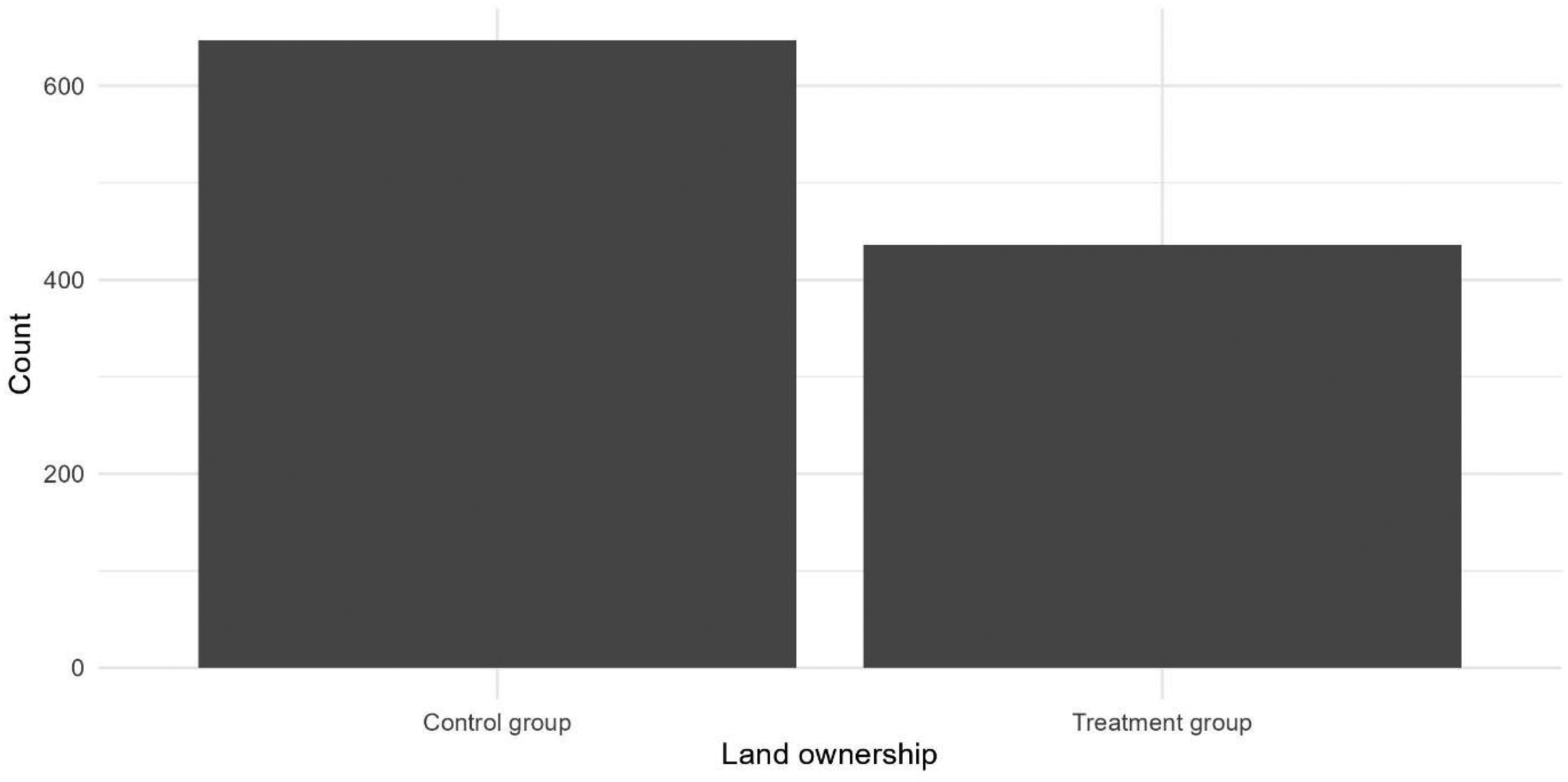
Distribution of Land Ownership.
Extreme Weather Events
We utilised the Standardized Precipitation Evapotranspiration Index (SPEI) (Beguería et al., 2023), a widely recognised index developed by Vicente-Serrano et al. (2010) to measure extreme weather events. The SPEI quantifies local deviations from the average water balance, calculated as precipitation minus potential evapotranspiration, at a spatial resolution of 0.5° × 0.5°. As such, the SPEI incorporates both temperature and precipitation anomalies. Because the SPEI is location-standardised, meaning it only accounts for abnormal deviations for that particular location, we argue that these extreme weather events may be treated as randomly assigned (Vestby, 2019).
We determined whether a Tanzanian household was in an area that experienced extreme dryness or wetness during the 2011 growing season (January to June). Extreme conditions were defined as SPEI values below −2 (severe dryness) or above +2 (severe wetness) occurring at least once during this period. We focus on the growing season because previous research (e.g. Ahmed et al., 2011) highlights that weather shocks are particularly impactful during this period. The year 2011 was characterised by insufficient rainfall during the farming “masika” season across various Tanzanian regions. Our data indicate that roughly 9 per cent of the Tanzanian households in our sample were exposed to extreme weather during this growing season.
Figure 2 illustrates the geographical distribution of Tanzanian households and the occurrences of severe dryness and wetness during the 2011 growing season, along with the treatment status (joint land ownership or not). As the figure shows, a significant number of the included households are located in the North-Western regions, Dar es Salaam, or in the Southeast of the country, mirroring Tanzania's population density. The figure also shows that households with and without joint land ownership are evenly distributed across Tanzania. This minimises the risk of our results being strongly driven by regional effects.
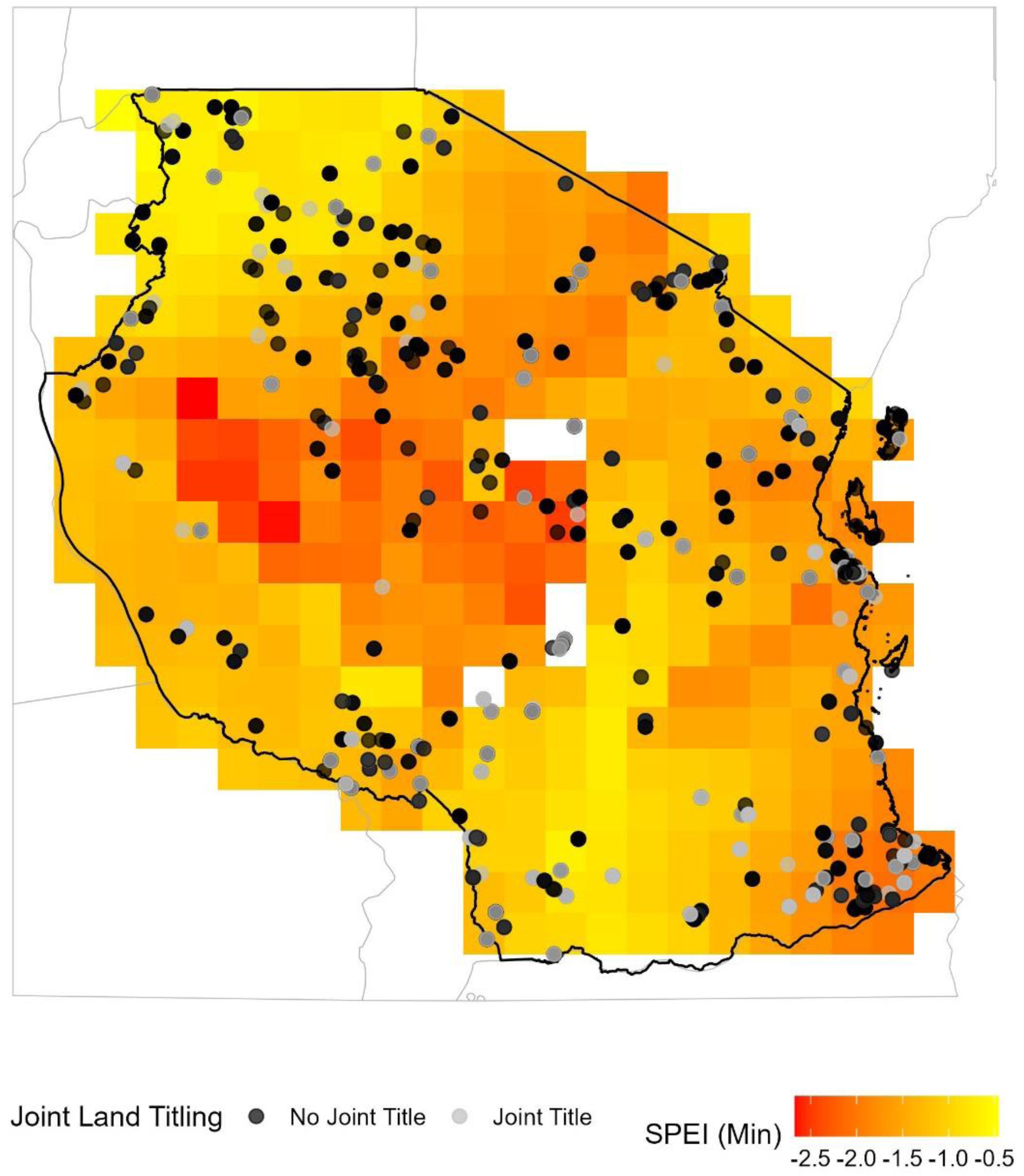
Drought Conditions and Land Ownership in Tanzania.
Control Variables
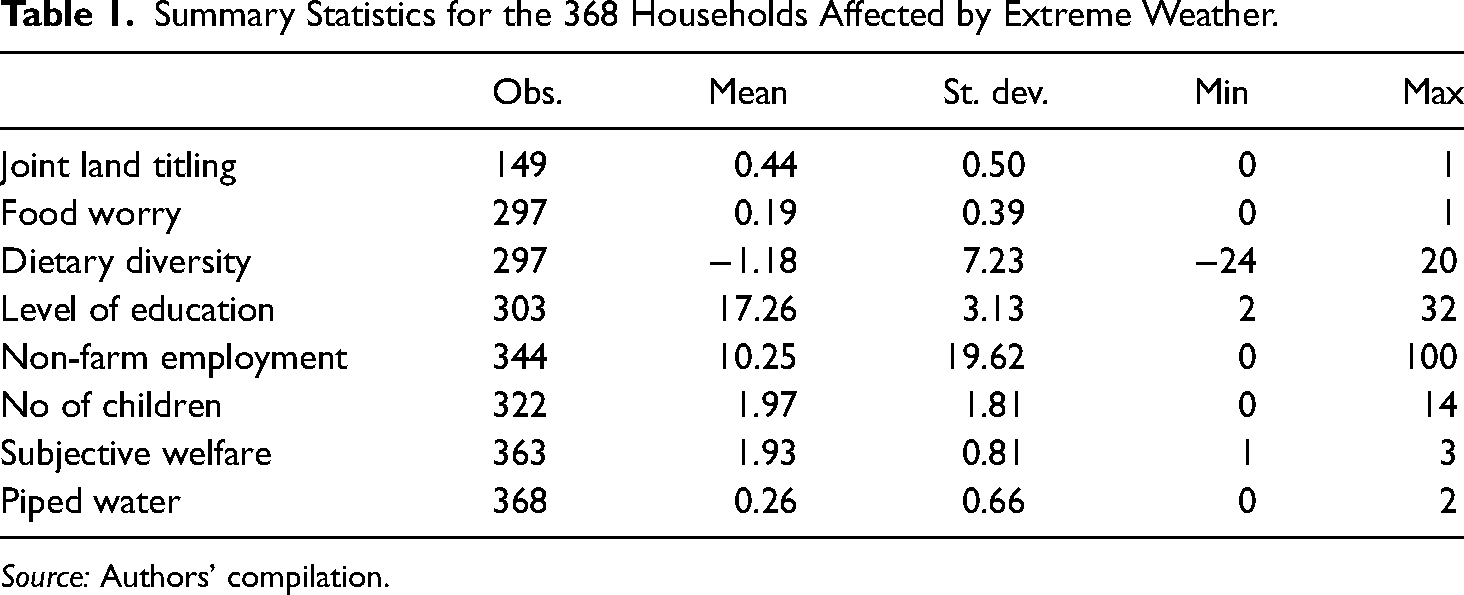
We control for various important factors that might influence food insecurity and are also correlated with joint land ownership. Our selection of confounding factors is guided by key findings from the literature and data availability (e.g. Bashir and Schilizzi, 2013). Specifically, we include the level of education (based on the maximum education within a household), non-farm employment (the percentage of household members engaged in wage work outside agriculture or self-employment in non-agricultural businesses during the 12 months preceding the interview), the number of household members under 11 years old, the household's subjective well-being as an indicator for wealth, and a variable indicating access to piped water (either inside or outside the dwelling) to capture differences in regional state capacity. As emphasised by Bashir and Schilizzi (2013), these variables can be considered key determinants of rural household food security in Africa. At the same time, they may also influence the likelihood of joint land titling within the household. While we do believe these control variables capture the most important confounding variables, it is worth keeping in mind that it is impossible to rule out all alternative explanations with the observational data available to us. Table 1 shows the descriptive statistics for all variables.
Summary Statistics for the 368 Households Affected by Extreme Weather.
Source: Authors’ compilation.
Empirical Strategy
Whether a household exhibits joint land ownership is non-random. It depends on many other factors that may also impact food insecurity. That is, the probability of households having joint land titles is likely influenced by other household characteristics or institutional determinants that correlate with food insecurity. To address this issue, we rely on matching techniques to mitigate selection bias and leverage the longitudinal survey design of the two rounds of the LSMS-ISA.
Applying a matched DiD estimator (e.g. Bertoni et al., 2020; Chabé-Ferret and Subervie, 2013) enables us to compare changes in food security between treated households (those with joint land ownership) and selected control households (those without shared land ownership) across a pre-drought (2010) and post-drought (2012) period. This procedure introduces a time dimension through which we can better control for unobserved time-invariant factors that are constant within households. This strategy also allows us to isolate the effect of joint land ownership on households’ resilience against weather shocks.
Figure 3 depicts our empirical strategy. We begin our empirical strategy by utilising the 3,924 households surveyed by the LSMS-ISA in both 2010 and 2012. Unfortunately, our effective sample is smaller due to missing information for many households on several variables. For example, information on the land ownership structure is only available for 1,399 households. Moreover, we further restrict our sample to households that experienced extreme weather conditions during the 2011 growing season (January–June), reducing our sample from 1,399 to 368 households. These households are then classified into treatment (66 households) and control (83 households) groups based on whether their plots were jointly owned in 2010. 3
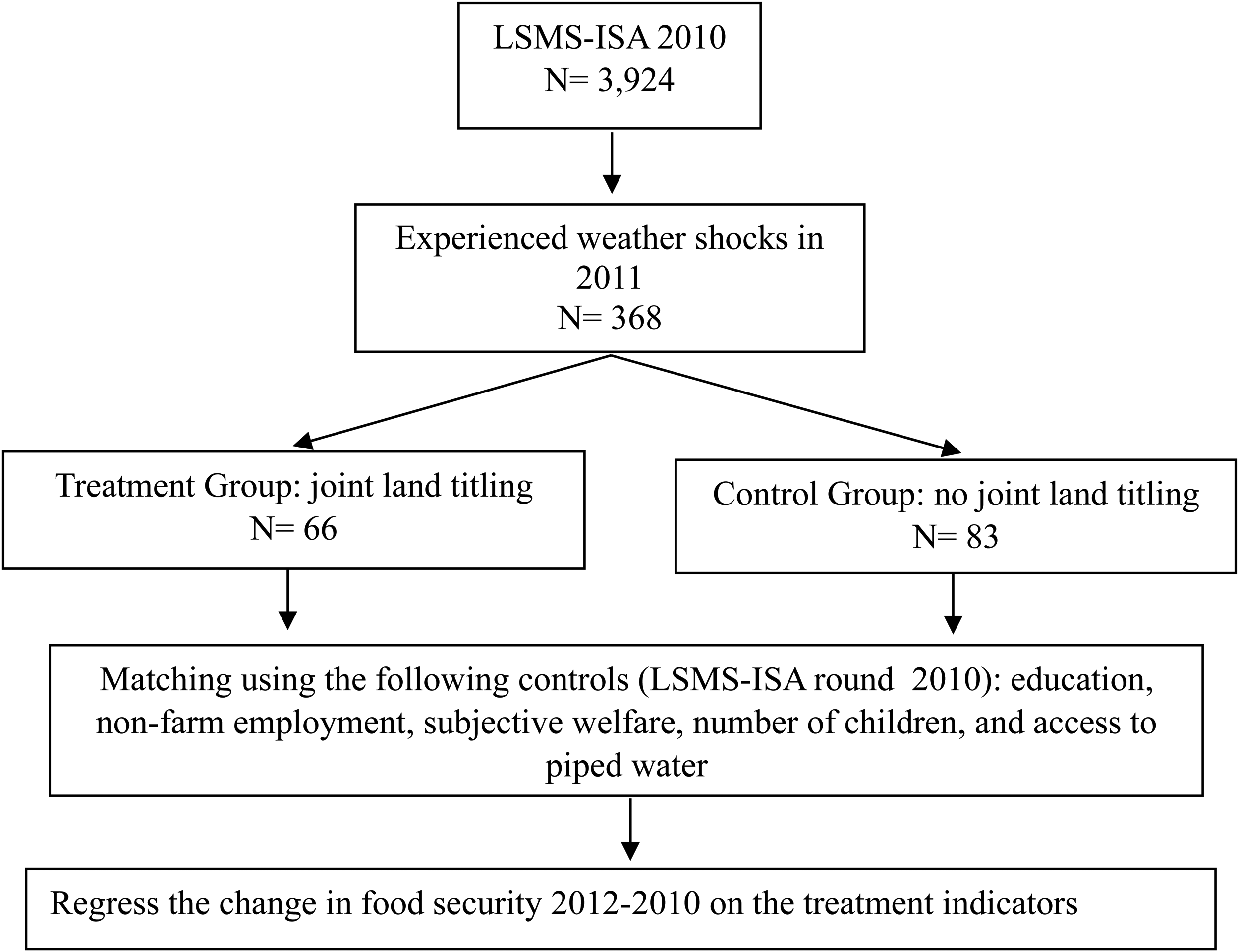
Empirical Approach.
Using our chosen control variables, we then apply two matching algorithms: CEM and PSM. The CEM often achieves a more substantial reduction in covariate imbalance than other matching methods by allowing researchers to define the balance between the treated and control groups ex ante rather than adjusting for it ex post (see Bertoni et al., 2020; Iacus et al., 2019). Additionally, CEM tends to yield superior results, particularly when the number of confounders is relatively low (fewer than 10), and most confounders are continuous variables (Ripollone et al., 2020). However, CEM might be sensitive to the choice of coarsened strata. Consequently, we also rely on the more commonly used PSM.
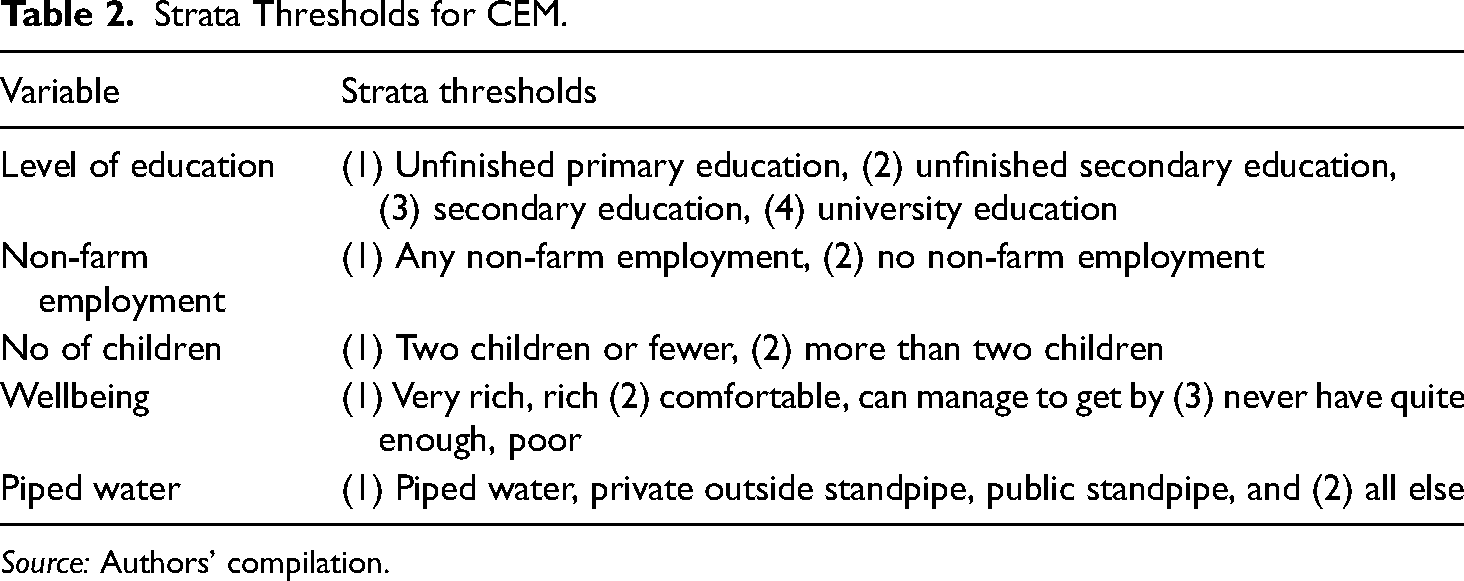
Coarsened Exact Matching relies on defined strata to coarsen the covariates and achieve balance in the covariate space. In essence, this step allows the researcher to be explicit about which households are comparable and which are too dissimilar. We achieved an acceptable balance between these two objectives with the strata described in Figure 3.
We categorised the level of education into four strata: unfinished primary education, primary but unfinished secondary education, secondary but no university education, and university education. Regarding non-farm employment, approximately 75 per cent of the included Tanzanian households have no household member engaged in non-farm employment. Therefore, we grouped this variable into two strata: households without non-farm employment and households with at least one member working in a non-farm job. Household composition was grouped into two categories based on the number of children: households with two or fewer children and those with more than two. For subjective well-being, we defined three strata: (1) “very rich” and “rich” combined, (2) “comfortable” and “can manage to get by,” and (3) “never have quite enough” and “poor,” forming the final category. Access to piped water was classified using a binary approach: one stratum included households with access to any private or public standpipe, while the other comprised all remaining households. Table 2 depicts the strata thresholds.
Strata Thresholds for CEM.
Source: Authors’ compilation.
For PSM, we relied on simple one-to-one nearest-neighbour matching. That is, we calculated propensity scores using logistic regression and then assigned the most similar control unit to each treated unit. We assessed the resulting balance statistics in graphical and numerical form using differences in means and variance ratios (Stuart, 2010). Figure A1 and Table A1 in the Supplementary Materials demonstrate that PSM substantially reduced the imbalance in covariates. Almost all standardised differences in mean are below 0.1, and the variance ratios are between 0.5 and 2. According to Rubin (2001), our resulting balance is, therefore, adequate.
Drawing on these matched samples, we assessed the average treatment effect of joint land titling on our measures of food insecurity. For this purpose, we follow Bertoni et al. (2020) and run weighted linear regressions on the difference between the 2010 and 2012 food rationing and food diversity measures. Intuitively, we subtract the difference in food insecurity for the period 2012–2010 for the control group from the difference in food insecurity for the period 2012–2010 for the treatment group. This allows us to control for the household's food security at baseline, absent weather shocks. The weighted regression models account for any remaining imbalances between the treatment and control groups. Under the assumption that both groups would have followed parallel trends in the absence of treatment, this approach estimates the Sample Average Treatment Effect on the Treated. 4
We rely on ordinary least-squares estimation for our dietary diversity measure and, given its binary nature, logistic regression for our measure of food availability. We include the matching covariates in our regression specifications, as this yields “doubly robust” inference. Our findings are consistent if either the parametric model or the matching is correct (Ho et al., 2007). We cluster the standard errors on the level of the matches (Abadie and Spiess, 2021).
Results
Table 3 displays the results of our matched DiD analyses using the difference of the “worry about food” question between 2012 and 2010 as the dependent variable. For brevity, we report only the coefficients for our main treatment variable. The complete regression output is presented in Supplementary Materials, Table A2. Both Model 1 (using PSM) and Model 2 (using CEM) show that joint land ownership is negatively and statistically significantly associated with households’ worry about food availability. That is, Tanzanian households with joint land ownership are less likely to report a worsened food situation following the 2011 East African drought than households without joint land ownership. Both matching procedures yield very similar results, bolstering our confidence that the findings are not artefacts of the chosen strata neither of the CEM algorithm nor due to the reliance on the propensity score.
Effect of Joint Land Titling on Food Worry.
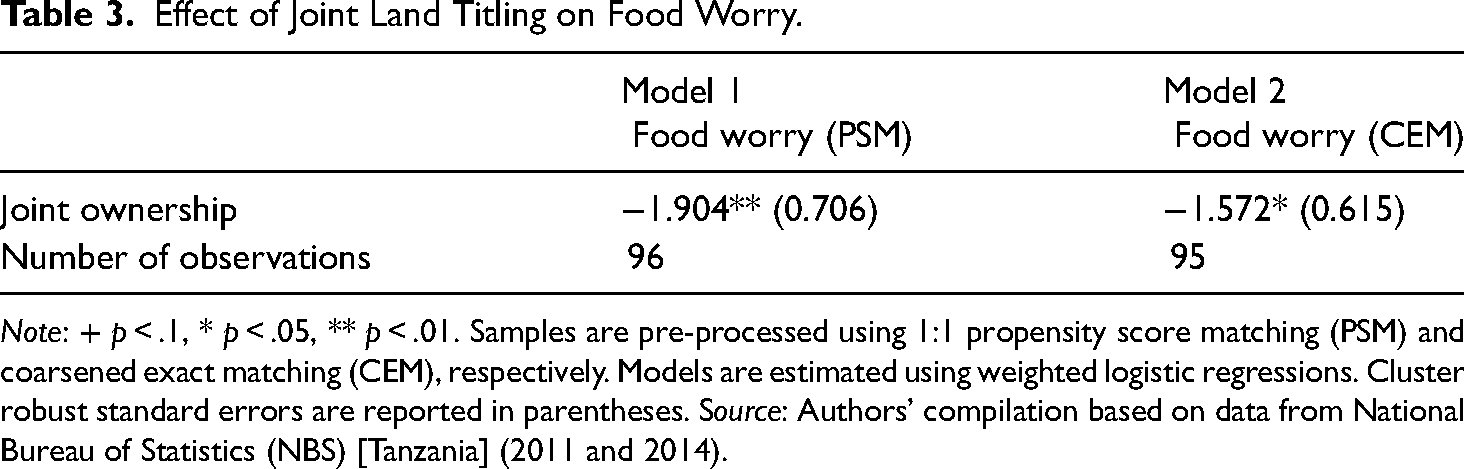
Note: + p < .1, * p < .05, ** p < .01. Samples are pre-processed using 1:1 propensity score matching (PSM) and coarsened exact matching (CEM), respectively. Models are estimated using weighted logistic regressions. Cluster robust standard errors are reported in parentheses. Source: Authors’ compilation based on data from National Bureau of Statistics (NBS) [Tanzania] (2011 and 2014).
To illustrate the effect size, we use our fitted regression models to predict the average outcomes for the treatment and control groups. In Model 1, the average predicted likelihood of reporting food-related worry is 0.32 in the control group and only 0.08 in the treatment group. Similarly, Model 2 predicts 0.30 for the control group and 0.09 for the treatment group. With an overall average of 0.21, these differences represent a significant effect, as shown in Figure 4: Tanzanian households without joint land ownership are three to four times more likely to report worsened food availability following the 2011 drought than those with joint land ownership. Importantly, our analysis accounts solely for whether women are considered plot owners. We lack information on the perceived security of land tenure and on women's awareness of land rights. We expect that the effect of joint land titling would be even stronger if the analysis were restricted to households with high tenure security and women who are well-informed about their land rights.
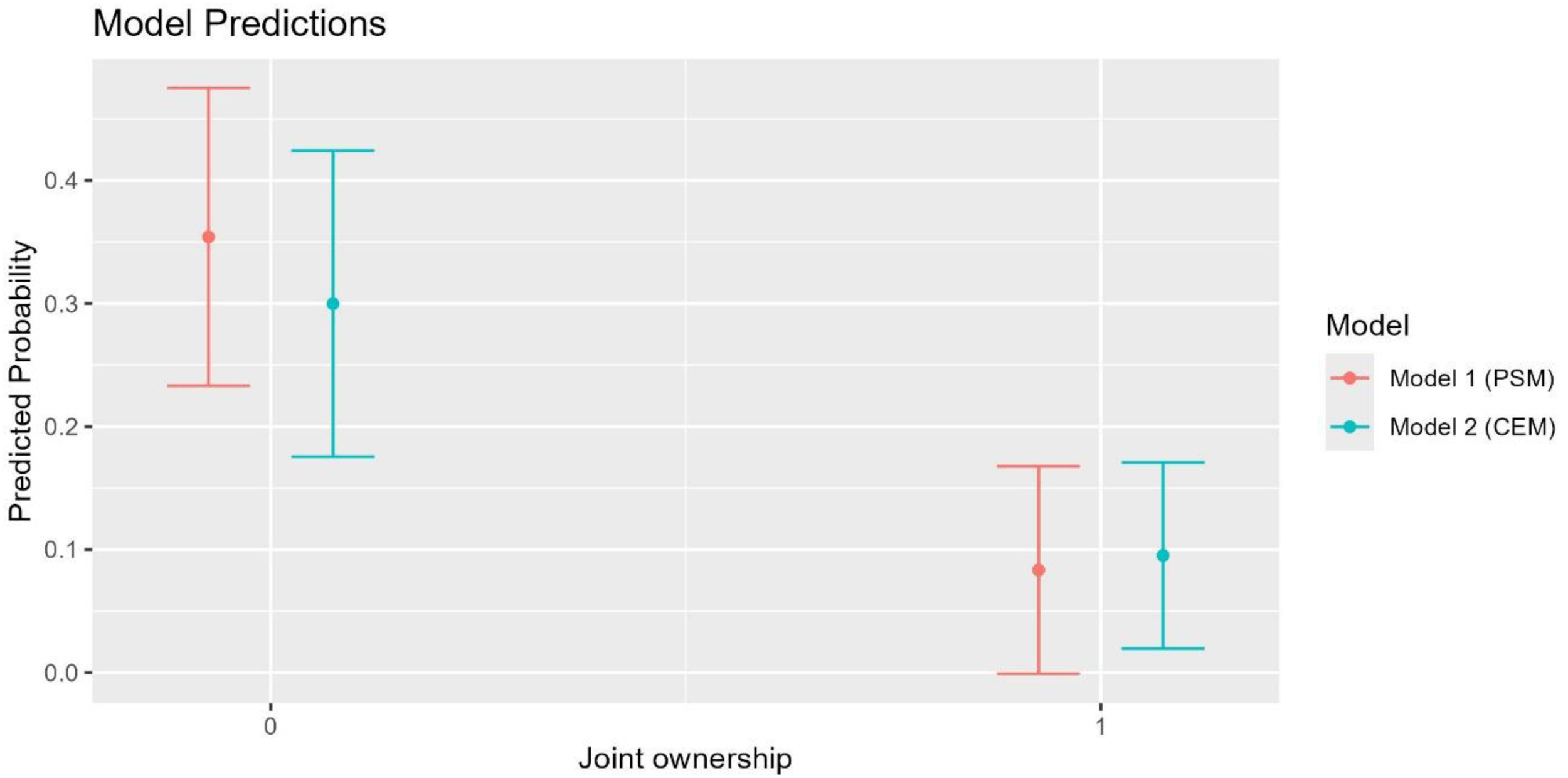
Predicted Probability of Reporting Worry about Food.
We now turn to the effect of joint land ownership on dietary diversity. Table 4 reports our PSM (Model 3) and CEM (Model 4) regression results. The full regression output can be found in Supplementary Materials in Table A3. Recall that the dependent variable in these models is an additive dietary diversity index of the different food groups consumed by a household. The positive coefficients of joint ownership in Models 3 and 4 indicate that households with joint land ownership consumed a more diverse range of food groups and had a more varied diet. The effect is statistically significant at the 5 per cent level for both Model 3 and Model 4. The coefficients are very similar across the CEM and the PSM models, again strengthening our confidence in the robustness of these results.
Effect of Joint Land Titling on Dietary Diversity.
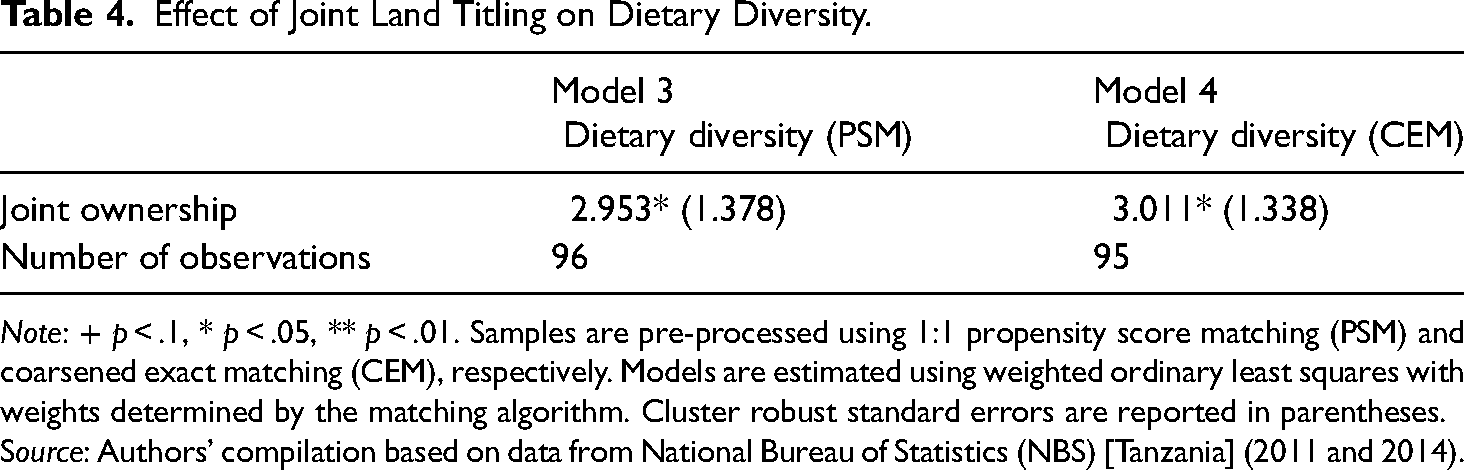
Note: + p < .1, * p < .05, ** p < .01. Samples are pre-processed using 1:1 propensity score matching (PSM) and coarsened exact matching (CEM), respectively. Models are estimated using weighted ordinary least squares with weights determined by the matching algorithm. Cluster robust standard errors are reported in parentheses.
Source: Authors’ compilation based on data from National Bureau of Statistics (NBS) [Tanzania] (2011 and 2014).
To illustrate the substantive effect sizes, we again consider the average prediction of our fitted regression models. Because the dependent variable is constructed as the difference between 2012 and 2010 of the dietary diversity indices, it can take on values between −35 and +35. On this scale, Model 3 predicts an average value of −3.45 for the control group and −0.5 for the treatment group. These findings are very similar to the results of Model 4, which predicts an average of −3.6 for the control group and −0.55 for the treatment group. As seen in Figure 5, predicted values below zero indicate that dietary diversity worsened after the 2011 drought for both the treatment and control groups. However, this deterioration was more pronounced for households without joint land ownership.
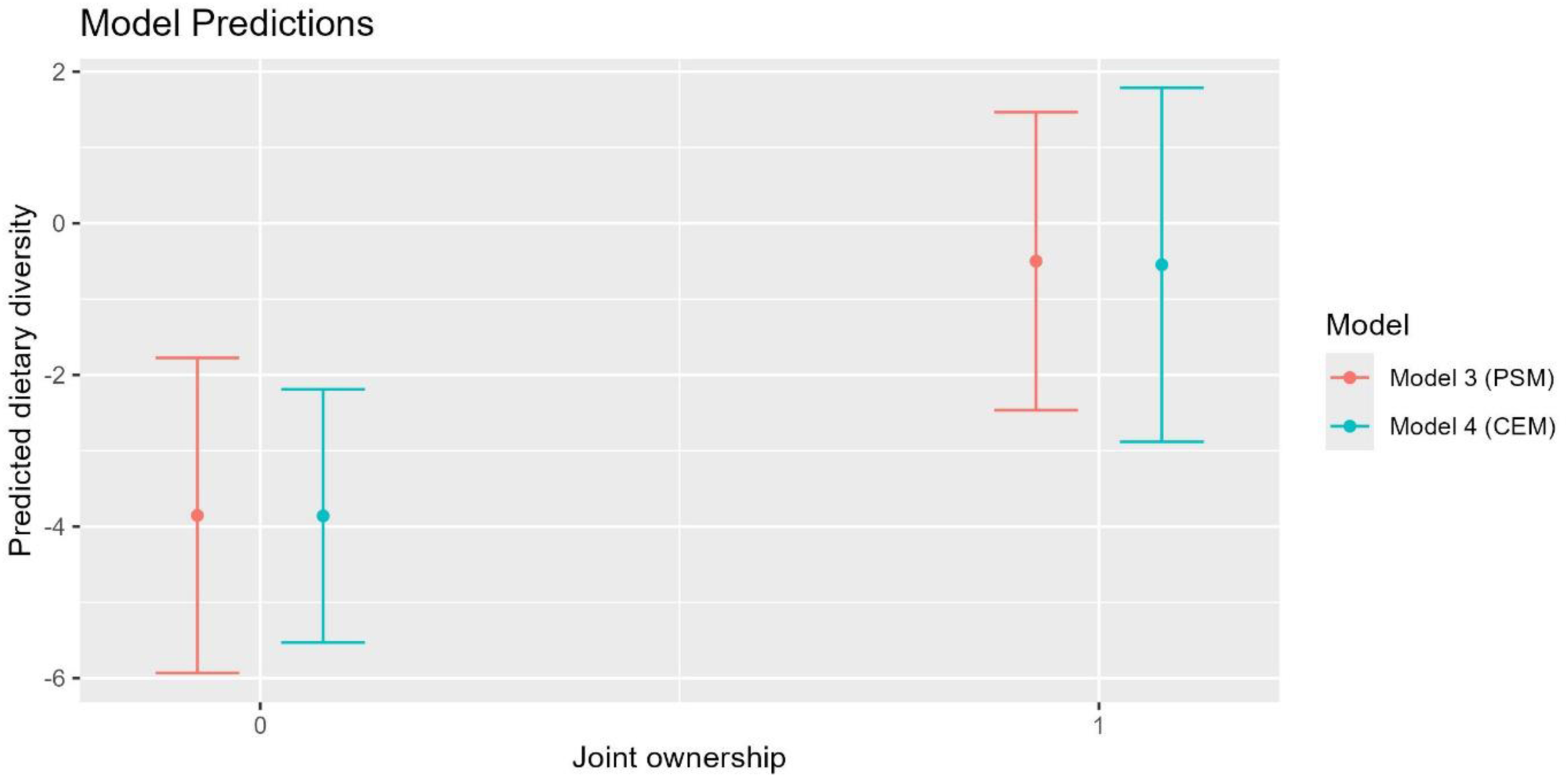
Predicted Dietary Diversity.
Robustness
We also take further steps to probe the robustness of the presented findings. First, there might be concerns that our matching approach discards a substantial number of observations from the sample. While we do this to improve covariate balance, we also present results using the entire (e.g. unmatched) sample to regress our measures of food security on a binary indicator of extreme weather as defined above, our joint ownership variable, an interaction term between these two, as well as our full battery of control variables. We estimate two versions of the model. In the first, the dependent variable is the change in food security between 2010 and 2012. In the second model, we use food security in 2012 as the dependent variable and include food security in 2010 as a control variable. Tables A4 and A5 in the Supplementary Materials present these results. The findings confirm our matching analyses: the interaction term between joint land ownership and extreme weather exhibits the expected sign and reaches statistical significance.
Another concern involves unobserved regional confounders. Joint land ownership may be more prevalent in specific areas of Tanzania, raising concerns about whether these regional patterns correlate with drought or food security outcomes. One way to address this concern is by restricting the analysis to within-region comparisons. We implement this by including region fixed effects (i.e. first-order administrative divisions) in the regression models based on the unmatched sample. Results are reported in Tables A6 and A7 in the Supplementary Materials. Reassuringly, the main findings remain largely unchanged; if anything, the interaction effect between joint land ownership and extreme weather becomes even more pronounced. 5
Next, we also vary the definition of extreme weather, that is, we verify whether our results remain valid when using a less extreme definition of an SPEI, specifically one below −1.5 or above 1.5. The results can be found in Tables A8 and A9 in the Supplementary Materials. 6 Interestingly, our results hold only for models using worry about food as the dependent variable, not for those using the dietary diversity index. Joint land ownership may be more effective at securing food availability than food diversity.
To check whether our results might be driven by unobserved confounders, we conduct a placebo test: we shift one component of our treatment – the SPEI during the 2011 growing season – two years into the future, replacing it with the SPEI during the 2013 growing season. If future weather conditions were to explain past survey responses, this would suggest that hidden factors, rather than the treatment, drive our results. In contrast, finding no such effect would strengthen confidence in our identification. Reassuringly, we find that extreme weather in 2013 has no effect on food security outcomes measured in 2012 (see Tables A11 and A12 in the Supplementary Materials).
We also test whether our results are influenced by the presence of formal land titles. While only 302 of the 3,924 households in our sample report holding a formal title to at least one plot, titled households could bias our findings if they systematically differ in ownership structures or in their vulnerability to climate shocks. To account for this, we rerun our analysis including a binary indicator for formal land title ownership (Tables A13 and A14 in the Supplementary Materials). The results remain robust: joint ownership continues to show the same relationship as in our main analysis.
Conclusion
Our study has examined the extent to which joint land titling attenuates the detrimental effects of extreme weather events on households’ food security. In doing so, we contribute to two major strands of literature. First, our study adds to previous work on gendered adaptation strategies that enhance households’ adaptive capacity to weather variability (e.g. Bhattarai et al., 2015; Chaudhury et al., 2012; Mensah et al., 2021). Second, it builds on the literature exploring how promoting women's land rights may improve socio-economic outcomes, particularly food security (e.g. Meinzen-Dick et al., 2019).
Drawing on existing research, we argued that granting land titles to women enhances access to credit, influences household spending and saving behaviours, and, most importantly, empowers women in agricultural decision-making. This empowerment, in turn, fosters adaptive and coping strategies, including greater food purchases and the adoption of climate-sensitive farming practices. Ultimately, these mechanisms enhance household resilience to the adverse effects of climate change, thereby improving food security.
Our empirical analysis supports this claim: households in which women co-own land experience lower levels of food insecurity during periods of extreme drought or excessive rainfall. These households tend to have greater food availability and more diverse dietary intake. Our study represents an important first step in assessing the role of women's land ownership for households’ climate resilience and food security. At the same time, several caveats should be noted. First, we cannot fully rule out the possibility that our estimates are affected by omitted variable bias. Certain pre-treatment factors are not covered by our LSMS data, and we cannot include them in our models. Similarly, we note that there may be sources of treatment heterogeneity within the group of joint-ownership households, such as income levels or regional variation in the importance of customary rules. Our results thus reflect average effects across households and regions and may mask heterogeneity in impacts across income levels or settings with differing strengths of customary land tenure systems.
Second, our estimates capture the average association between joint land ownership and household food security but do not isolate the specific mechanisms – such as bargaining power, credit access, or decision-making authority – through which these effects may operate. Future research should explore these potential causal links in more depth.
Third, future studies should also examine whether the reported relationship extends beyond the Tanzanian context. From the introduction of the Land Act of 1999, the Tanzanian government has been actively involved in formally acknowledging women's rights to own, inherit, and transfer land. Critics have noted that, while progressive on paper, several key inheritance laws that continue to entrench gender discrimination remain absent from the list of statutes earmarked for amendment (Dancer, 2017; Landesa, 2025). As a result, married women in Tanzania continue to face restricted rights over jointly owned land (Genicot and Hernandez-de-Benito, 2022). This shows that the effectiveness of joint titling programs hinges on addressing the tension between customary and statutory land governance, reforming discriminatory inheritance laws, and raising women's awareness of their rights.
Despite the highlighted potential limitations, our study offers valuable insights for designing gender-sensitive interventions that support joint land titling as a strategy for climate adaptation and improved food security. More broadly, it underscores the crucial role of women in climate change adaptation in low-income, rural settings. Our findings emphasise that women are pivotal actors in driving change. Gender-informed climate initiatives can build on past policy successes to further empower women and dismantle barriers to their full participation in agriculture. Ultimately, empowering women and promoting food security in the face of increasing climate risks will require a coordinated and integrated policy approach. Well-designed rural strategies must recognise women as key agents of change, driving climate resilience and sustainable development across vulnerable rural communities.
Supplemental Material
sj-docx-1-afr-10.1177_00020397261450226 - Supplemental material for Women's Empowerment and Climate Adaptation: Does Joint Land Ownership Promote Food Security of Households Facing Extreme Weather Events in Tanzania?
Supplemental material, sj-docx-1-afr-10.1177_00020397261450226 for Women's Empowerment and Climate Adaptation: Does Joint Land Ownership Promote Food Security of Households Facing Extreme Weather Events in Tanzania? by Tim Wegenast, Niklas Hänze and Roos Haer in Africa Spectrum
Footnotes
Acknowledgements
The authors thank the participants of the International Conference on Land Governance and Future Challenges (Landau, June 2024) and the In_equality Conference (Konstanz, April 2024) for their very helpful comments.
Ethical Considerations
Ethical approval was not required for this study, and informed consent was not applicable.
Funding
The authors disclosed receipt of the following financial support for the research, authorship, and/or publication of this article: Niklas Hänze acknowledges funding by the Deutsche Forschungsgemeinschaft (DFG – German Research Foundation) under Germany's Excellence Strategy EXC-2035/1–390681379.
Declaration of Conflicting Interests
The authors declared no potential conflicts of interest with respect to the research, authorship, and/or publication of this article.
Data Availability Statement
The scripts required to replicate the analysis are available upon request. The full dataset used is based on data from the Living Standards Measurement Study (LSMS) Program, which cannot be shared directly because access requires registration and approval through the LSMS Program. Researchers may request access at  . The scripts demonstrate how the models are estimated once the LSMS data have been downloaded.
Supplemental Material
Supplemental material for this article is available online.
Notes
Author Biographies
References
Supplementary Material
Please find the following supplemental material available below.
For Open Access articles published under a Creative Commons License, all supplemental material carries the same license as the article it is associated with.
For non-Open Access articles published, all supplemental material carries a non-exclusive license, and permission requests for re-use of supplemental material or any part of supplemental material shall be sent directly to the copyright owner as specified in the copyright notice associated with the article.
