



Abstract
The Amiche are Eritreans who were born or brought up in Ethiopia before Eritrean independence. This article focuses on the Amiche group's political and social situation. It explores the way its members perceive themselves and are perceived by others over recent years. From a social anthropological perspective, the article examines the extent to which a stable social identity has developed out of fluid and continuous inclusion and exclusion by, and within, neighbouring groups. We argue that the Amiche represent a distinct case of stable liminality – a permanent in-between status that has evolved into a social identity that is unique in its own right, rather than a temporary transitional state. Unlike classical liminality theories that emphasise transition, we demonstrate how protracted displacement and exclusion have produced a relatively stable social group characterised by their very in-betweenness.
Introduction
Mehari was born in Addis Ababa to parents who fled Eritrea in the early 1970s during the war of independence. In 1998, he was deported to Eritrea with his parents, following the outbreak of the Ethiopia–Eritrea border war. 1 Regardless of their Ethiopian citizenship documents, the family was labelled as Eritrean. On his arrival in Eritrea, like many others, Mehari was forced to join the war following brief training. After eight years in the Eritrean army, he managed to escape to Sudan, where he spent over one year and migrated back to Ethiopia, this time as an Eritrean refugee. He was assigned to the Adi Harush camp, where he spent around ten years. In 2020, the refugee camp became a battlefield in the Tigray war, forcing Mehari, his wife and two children to leave in disarray with many other Eritrean refugees. They migrated southward, looking for safety. After they travelled on foot through a conflict zone, they ended up in Dabat, a small town near the new refugee camp, Alemwach, established for Eritrean refugees fleeing the war.
We met Mehari in the Adi Harush refugee camp in 2019. His biography encapsulated the complex displacement patterns of the so-called Amiche (Interview with Mehari, 2019, 2020, and 2024). The Amiche are Eritreans born or raised in Ethiopia before Eritrean independence who have experienced multiple deportations and displacements across the Ethiopia–Eritrea border. These Amiche are nicknamed after an old Italian company that used to assemble vehicles in Addis Ababa. Their families have been displaced or migrated from Eritrea before and during the thirty years of the Eritrean war of independence (1960 to 1991). 2 In analogy to these cars, they are said to be made out of parts coming from outside – Eritrea – and assembled inside Ethiopia (Riggan, 2019, 2023; Massa, 2017).
During the Ethiopia–Eritrean border war (1998–2000), around seventy-five thousand individuals of Eritrean descent, including many Amiche, were deported from Ethiopia. Jennifer Riggan, an anthropologist doing fieldwork in Assab, Eritrea, at the climax of the deportation, documented the “uneasy relationship between official processes that produced [national] boundaries around identities” (Riggan, 2011: 133), leading to their deportation from Ethiopia and reception in Eritrea, and the socio-political context on the ground. Some of these deportees emigrated despite Eritrea's closed borders, some ended up as stateless and many of them in refugee camps in Ethiopia (Campbell, 2013; Hepner, 2009; Kibreab, 2003; Tronvoll, 2009).
During the war between Tigray and the Ethiopian federal state (2020–2022), the Amiche along with other Eritreans living in Ethiopia, once again found themselves caught in the middle of several warring groups: Tigray fighters, Eritrean soldiers, Amhara militia, and the Ethiopian national army. Caught between multiple warring factions, the Amiche faced suspicion from all sides: Eritrean soldiers treated them as traitors, Amhara militias conflated them with Tigrayans due to linguistic similarities, and Tigrayan forces suspected them of espionage. Our analysis focuses on the Amiche who have fled Eritrea, the country of their ascribed nationality, to go back to Ethiopia, the country of their birth or former residence, epitomising not only multiple and vicious cycles of displacement but their belonging, layers and categories of inclusion and exclusion and citizenship.
The case of Amiche, in sum, raises fundamental questions about citizenship, belonging, and identity in contexts of protracted displacement. We argue that the Amiche have developed a stable social identity from fluid and continuous inclusion and exclusion across national boundaries and examine the following questions: (a) How has protracted displacement created not merely a transitional liminal space, but a distinct, relatively stable social identity? (b) What does this reveal about the relationship between displacement, citizenship, and belonging?
Historical and Political Background
Eritrea and Ethiopia have a deeply intertwined, yet also bitterly polarised, history. The history of the relationship between the Christian kingdom of Ethiopia in the highlands and the territory across the Mereb River (which later became Eritrea) before the Italian occupation of 1890 is complex and contested. It has been subject to multiple interpretations, which are beyond the scope of this article (see Reid, 2005; Zewde, 1991). Nevertheless, it is uncontested that these events produced long-standing vicious cycles of displacement, deportation, liminal citizenship, and living in limbo on both sides of the border. 3 The Amiche found themselves caught in the middle of this turmoil.
In 1975, the Tigrayan elite established the Tigray People's Liberation Front (TPLF) and started a war against the Ethiopian central government with the support of the Eritrean People Liberation Front (EPLF) that was fighting on the Eritrean side of the border, by then the domestic border. In the 1980s, when the war in Eritrea and Tigray intensified, it was common for the Tigrinya speakers to be harassed by the Ethiopian military government and labelled as “wayane and sha’abiya,” which stood for TPLF and EPLF, respectively. However, the terms were vaguely used to criminalise all Tigrinya speakers, most of whom lived in the urban centres of Ethiopia. Many of the Tigrinya speakers were forced to flee Ethiopia to avoid detentions and killings due to suspicion that they aimed to disintegrate the Ethiopian state (Tadesse, 1999).
Victories in 1991 brought EPLF and TPLF to power in Eritrea and Ethiopia, respectively. The boundary between Eritrean and Ethiopian Tigrinya speakers was blurred while both sides enjoyed their victories. Some Ethiopians complained that while the new Eritrean government deported many Ethiopians who used to live there until independence, the TPLF-dominated new government in Ethiopia did not reciprocate or defend the Ethiopians. Against this background, Eritreans in Ethiopia – including Amiche – enjoyed a comfortable position: some of them went to Eritrea to their newly independent country while others continued to live in Ethiopia, where their close relationship with Tigrayans created a favourable business environment. Some of them took part in the Eritrean referendum that officially confirmed Eritrean independence. Their citizenship was not put into question on either side. Most of them continued to use their Ethiopian documents.
The situation of Eritreans in Ethiopia suddenly changed in 1998 when disputes started between the two states over contested territories around the border town of Badme in May 1998 (Negash and Tronvoll, 2000). After that, violent discourses dominated the Ethiopian media landscape. In an unexpected turn, individuals in Ethiopia who were traced back to Eritrea experienced a state of liminal citizenship once again (Krasniqi, 2019). Many thousands of individuals of Eritrean origin – many of them belonging to the Amiche – were deported, detained, and laid off from jobs (Riggan, 2011, 2023). In Ethiopia, history was rewritten to emphasise not only the differences between the two former allies but also stress how much the EPLF and Eritreans used to dominate and despise the Tigrayans (Tadesse, 1999). In other words, the ethno-cultural commonality and discourses of shared political oppression and victimhood between the two groups were suddenly overshadowed by the animosity and suspicion created due to the conflict.
Living in Limbo and Belonging
Eritrean refugees are often situated on the fringes of society, as are many other refugees worldwide. They find themselves in a state of legal, political, and economic limbo – in other words, a state of liminality. Liminality has become a concept widely used in various disciplines (Finn, 2021). Van Gennep talked about the liminal phase, studying rites of passage, describing how individuals passed from one social identity to another, while Victor Turner used the term in relation to his theory on communitas, focusing on the transition process through an inter-human experience such as a ritual (Van Gennep, 2011; Turner 1995: 95ff.). Appadurai (2006) stressed the quality of liminality to draw a line between those who belong and those who do not, arguing that nation-states are constituted by purification efforts that render those considered impure liminal. Bringing in yet another focus, Elwert (1989), following Turner (1994), characterised geographically moving actors (migrants, settlers) as a “tidal movement.” He argued that zones of inclusion and exclusion establish a band in between subsystems.
Unfortunately, none of these concepts enables us to adequately frame our observations. While drawing from existing theories that focus on transition and boundary making certainly helps – they remain insufficient for our observations. Former theories demonstrated that liminality can serve to push the boundaries of a system, that a core quality of a system is its function to separate two entities, and that this line in between is not only separating but also connecting. The case of the Amiche illuminates certain deficiencies: If we conceptualise stable liminality not only as an extension, a band or a boundary, we get to understand that it is also a social phenomenon in its own right. Just as the Wadden Sea may be perceived as either land or sea when viewed at a single moment in the tidal cycle, it may also be understood and analysed as an ecosystem in its own right. 4
Looking at the deficiencies exposed by the Amiche case, we extend liminality theory in three ways. First, while Turner and Van Gennep conceptualised liminality as transitional, the Amiche demonstrate how in-betweenness can stabilise into a permanent social identity. Second, whereas Elwert's conception presumes eventual integration, we show how stable liminality creates distinct social formations that persist across generations. Third, the Amiche illustrate how exclusion from multiple systems can generate not statelessness or anomie, but resourceful adaptation and distinctive social networks that transcend national boundaries.
Conceptualising liminality as stable rather than transitional yields further insights: Elwert's (1989) liminality concept draws from Turner's frontier concept. According to Turner, the frontier is a zone of contact between different social structures, where people have to adjust flexibly to a situation that is characterised by continuous insecurity and lawlessness (Turner, 1994). Elwert combined the idea of a contact zone with a system perspective (Luhmann, 1984). 5 Luhmann's system theory highlights the self-referential autonomy of each system separated from another entity by a common boundary. The so-called autopoietic quality of systems is, in other words, the observation that each system functions according to its own rules and is, at the same time, framing neighbouring systems. The resulting liminality concept focuses on the stabilisation of subsystems through the institutionalisation of isolated zones for “testing” and “introducing adaptation” (Elwert, 1989: 455). This enables analyses to look at the extraction and retraction of systems, overlapping areas, or friction in between systems and subsystems, and observes systems-internal and intersystem changes – but it does not explicitly look at the possibility of subsystems to stabilise or to emerge.
Donahoe et al. established that individuals shift alliances and ultimately often realign social identities 6 within a range of options confined by different markers (Adugna, 2011; Donahoe et al., 2009). The Amiche likewise are not only liminal to one system or the other, but they are also able to transcend the boundaries. As we will show below, this category sui generis shapes social realities, social structures, patterns of behaviour, and models of action. Riggan (2011: 133) argued that “state practices of classification and cleansing” change the ways in which in-between groups “blend and blur categories of national belonging” but do not destroy them. We hold that the war between Ethiopia and Eritrea, and the subsequent deportation of Eritreans, have amalgamated a space and an identity for the Amiche and their state of in-betweenness. We argue that the boundary between the Tigrinya speakers across the border in Ethiopia and Eritrea, according to our observations, has shown the very same process of blurred, contested, blended boundaries as described for Eritreans. Yet, in moments of crisis, these boundaries became more solidified and rigid.
Methodology
The Amiche represent a paradigmatic case for understanding displacement, identity, and citizenship in three respects. First, their experiences of multiple displacements – repeatedly crossing the Ethiopia–Eritrea border under different legal statuses – reveal the complex dynamics of inclusion and exclusion that characterise protracted displacement in the Horn of Africa. Second, their trajectory from fluid to stable liminality offers theoretical insights into how in-betweenness can crystallise into a distinct social identity, advancing scholarly debates on the relationship between forced migration, citizenship, and belonging. Third, comparative analysis with other Eritrean refugees in Ethiopia and with non-deported people of Eritrean descent illuminates the constitutive role of legal status, displacement history, and transnational networks in shaping group identity.
The primary data informing this article were gathered in Ethiopia between October 2019 and September 2020 as part of a joint team research project entitled “Transnational Figurations of Displacement” (TRAFIG). The project used mixed-method research combining in-depth biographical interviews, observations, and surveys. 7 In total, the wider research this article draws on included over 700 persons: 90 per cent of our respondents were Eritrean refugees; 60 per cent were male; and the share of respondents living in and outside of camps was roughly 50:50. The respondents in the specific locations were selected according to sex, age, family status, educational background (as an indicator of socio-economic status/class), nationality, ethnicity (where appropriate), legal status at current place of residence, religion, access to support by governments, humanitarian organisations, and finally translocal and/or transnational connections.
In addition, over thirty additional expert interviews with key government officials, INGOs, local NGOs, and UN organisations working with refugees were selected purposively based on their engagement in refugee governance as identified through the snowball method. Interviews were conducted in English, Amharic, Afar, and Tigrinya by the authors and respective local research teams. Beyond individual narratives, the study incorporated perspectives from host community members, international NGO staff, government officials, and decision-makers at national and international levels. Respondent selection employed purposive sampling combined with systematic serendipity – a methodological approach that deliberately incorporates chance encounters and unexpected opportunities for data collection (cf. disclaimer below).
Information about the Amiche was a byproduct of TRAFIG rather than an a priori interest. TRAFIG focused on refugees’ connectivity and mobility as a solution for protracted displacement (Tufa et al., 2021). As themes such as multiple displacement, deportations, belonging, exclusion, and life in limbo emerged repeatedly during fieldwork, we began giving more emphasis to the Amiche, as different from other Eritrean refugees. After we contextually and thematically categorised, interpreted, and analysed our data, we found the themes academically promising, interesting, and thus conducted additional interviews in 2022 and 2024, the later one specifically with the Amiches. In the follow-up, we used a diachronic perspective, analysing past and present, personal and indirect relations, including connections with members of the community of origin, host communities and relations formed with other persons in transit.
The study adhered to the principles of approaching the field in the most ethical, unbiased, and reflective manner possible. It adhered to participatory, dialogical research principles, generating representative ideal-typical cases without claiming statistical representativeness. Research locations were strategically selected following consultation with regional experts and local research teams. We paid attention to differences in ethnicity, gender, age, and diversity. All respondents (locals, officials, and experts) have been granted anonymity, though their names are known to the authors. In addition to using pseudonyms throughout the paper to protect all respondents, as little information about time, place, and characteristics as possible is mentioned to protect the persons concerned. All respondents were informed orally or on paper about the study's content, objectives, conditions of confidentiality, and opportunity to withdraw their consent at any time.
Four analytical themes emerge from the primary data: ambiguous citizenship, liminal belonging, legal categories, and intersecting identities. These form the organisational structure for the ensuing analytical sections of this article.
Homecoming and Ambiguous Citizenship
According to Tesfay, who was a young Amiche and grew up in Hawassa, a city in southern Ethiopia, many Eritreans considered independence and “home going” would be the end of the longing for the nation and their suffering in the hands of Ethiopian security forces. They never expected to see a change from friendship to animosity, let alone to come that fast. In an interview with Tesfay in Addis Ababa in April 2024, he stated, …. My father was imprisoned several times by the Derg [military junta that ruled Ethiopia between 1974 and 1991]. There were hundreds of Eritreans and Tigrayans in Hawassa detention centres during the Derg. When the EPLF occupied Eritrea and the TPLF occupied Ethiopia, my father was still in prison. He was released only after the victory. He took us: three sons and two daughters to Eritrea within the first two months of independence and his release from prison (Interview with Tesfay, 2024).
The story of another informant, himself a deported Amiche, illustrates how subjection to forces beyond individual control gradually created solidarity among those who underwent the same experience. He recounted how the emotional reception for them created expectations of a better future in their newly independent homeland (Interview with Yohannes, 2024). The following cases also underline that expectations and emotions have been just as important as formal and legal recognition for the state of liminality in regard to citizenship for the Amiche. Soon after their homecoming, many of the young Amiche deportees were forced to join the Eritrean military and, subsequently, the war. Some of them did not only lack the experience of involvement in the military, but also did not speak any of the Eritrean languages – they spoke Amharic and perhaps other Ethiopian languages. That made it difficult for the Amiche to communicate with their Eritrean comrades and also caused suspicion. According to Riggan, though Amharic was frequently spoken in Assab, particularly by the Amiche and Ethiopians, “… after 1998, it was no longer appropriate to speak it in schools or government offices” (2023: 10). This illustrates the changing political situation and attitudes experienced by the Amiche in Eritrea on an everyday level.
Kiros was one of those deportees drafted into the army upon return to his then-unknown motherland. Kiros, his sister, and his mother (who was originally from Eritrea) used to live in a public rental house in Megenagna in downtown Addis Ababa. His father, who was a strong supporter of Eritrean independence, was imprisoned several times by the Ethiopian military regime. He passed away when Kiros and his sister were seven and nine years old, respectively. His mother had to struggle hard to support the family. In 1993, his mother took them to vote for Eritrean independence, which was just a public performance of showing sympathy to a country that was liberated through a war of independence two years back. However, they never got Eritrean citizenship and documents (Interview with Kiros, 2024).
The fact that Kiros participated in the referendum did not please his Ethiopian friends in his neighbourhood, who harboured a grudge. Five years later, they informed the police, which led to the family's deportation in 1998. Ethiopians were critically divided over Eritrean independence. The referendum was facilitated by TPLF, the ruling party, and there was strong resistance, mainly from non-Tigrayan centrist urban dwellers. Now, the quarrel between the governments in Eritrea and Ethiopia run by EPLF and TPLF meant that “Eritreans in Ethiopia,” such as people like Kiros, faced hostility from both the government and the already critical opposition groups. The neighbours who had denounced Kiros belonged to either of the two.
Kiros was forced to go to Sawa, the infamous Eritrean military training centre, fifteen days after arriving in Keren town. Kiros’ mother had lived in Keren town before she was displaced due to conflict in the 1960s. They returned to Keren town since some of her relatives remained there. Kiros did not gain the sympathy of his Eritrean military commanders. He spent close to a decade and a half waiting for the day he would be freed from the forced and indefinite military service. He was accused of lacking military discipline, being untrustworthy, and not respecting the Eritrean cultural codes – especially speaking Amharic and listening to Amharic music. Finally, Kiros was imprisoned for nine months before managing to escape to Sudan – another case exemplifying the Amiche's multiple and protracted displacements, suffering, and experience of graduated citizenship.
Legal Framework and Everyday Impact
After the war, people of Eritrean descent, who were not expelled, continued to confront a situation of ambiguous citizenship. The Ethiopian public, including their neighbours, discursively considered them Eritreans – a nationality that they had never acquired. This had direct consequences on their access to services, jobs, and political participation (Campbell, 2013). Many Ethiopians revised, in retrospect, the act of voting for Eritrean independence as a sign of renouncing “Ethiopian-ness” and accepting Eritrean citizenship. As discussed above, based on this accusation, many “Eritreans” were dismissed from their job, some were detained, and many were deported. However, at the time of the vote, there was no formal control of citizenship. The Eritrean provisional government – awaiting de jure international recognition – was not in a position to issue passports. Rather, the participation of Eritreans in the voting for Eritrean independence was based on the amicable relationship between the two governments.
In 2003, three years after the end of the war, the Ethiopian government came up with directives issued to determine the status of “Eritreans” residing in Ethiopia. Article 4.2 of the directives reads: “A person of Eritrean origin who has not opted for Eritrean nationality shall be deemed as having decided to maintain his or her Ethiopian nationality and his or her Ethiopian nationality shall be guaranteed” (Refworld, 2004). In other words, they were allowed to reactivate their Ethiopian citizenship. As a result, the Amiche who were not expelled are legally Ethiopian citizens, yet they live in a situation of political ambiguity as they are simultaneously included and excluded: legally, having Ethiopian identity documents means they are entitled to full citizenship, including all privileges and obligations. On a political level, however, they are reminded of their “Eritrean-ness” in their everyday lives, which leaves them in ambiguous citizenship and in a liminal status. Being aware of their position, many “Eritreans with Ethiopian citizenship said they still feel compelled to conceal their background, even among close friends. They rarely congregate as a community, nor are they politically engaged… They get work permits but must not bring attention to themselves” (Reliefweb, 2008). Even after over a decade, many individuals still conceal their Eritrean background for fear of discrimination and harassment (Southwick, 2009).
According to those who dealt with the legal dimensions of these issues, many Amiche had to manage not only the question of deportations or ID cards, but also statelessness. Campbell (2013: 94ff.) identifies processes of exclusion, whereby the autocratic state reified its power by bestowing citizenship upon some while withholding it from others. Applying Campbell's approach to the case of the Amiche reveals two things. Firstly, due to the ambiguity of liminal stability, individuals experience different forms of inclusion and exclusion. Secondly, the single most important feature distinguishing the above cases is probably their ability to navigate the pathways to citizenship. In a region where identity politics usually come into full swing in situations of crisis, this ability is not just abstract (Abbay, 1998; Smith, 2013; Tronvoll, 2009). Our research took place during a time in which the tensions between the Tigray region, Eritrea, and the central Ethiopian government escalated into the Tigray war in 2020. We witnessed uncomfortable reactions when the issue of citizenship was mentioned. In other words, the described dynamics have remained an issue throughout time, only varying in intensity.
Following the 1998–2000 war, the Eritrean government has increasingly become one of the most repressive regimes on the continent. The suppression of freedom of speech and religion, forced and indefinite national service, and arrests and torture of opposition have been widely cited as reasons for Eritrean youth fleeing their country (Belloni, 2018; Hirt and Mohammad, 2013; Kibreab, 2014; Treiber, 2017). The border between the two countries is highly militarised. Nonetheless, it could not stop hundreds of thousands of Eritrean youths from crossing into Ethiopia. On their return as Eritrean refugees, the Amiche's peculiar in-betweenness added an additional layer on the already problematic issue of displacement and indefinite waiting, which is common to many refugees. On top of a long-standing and vicious cycle of deportation, displacement, and problems of (re)integration, the returning Amiche faced typical kinds of inclusion and exclusion that made them different from other Eritrean refugees. With their local language proficiency and social interaction capacity, they were socio-culturally included, though they were politically and legally excluded. There were also in-group differences among the Amiche in Ethiopia. The refugee Amiche are legally excluded and classified as foreigners, as opposed to the Amiche who were not deported and continued using their Ethiopian documents; thus, they are legally considered Ethiopian citizens (cf. Figure 1).
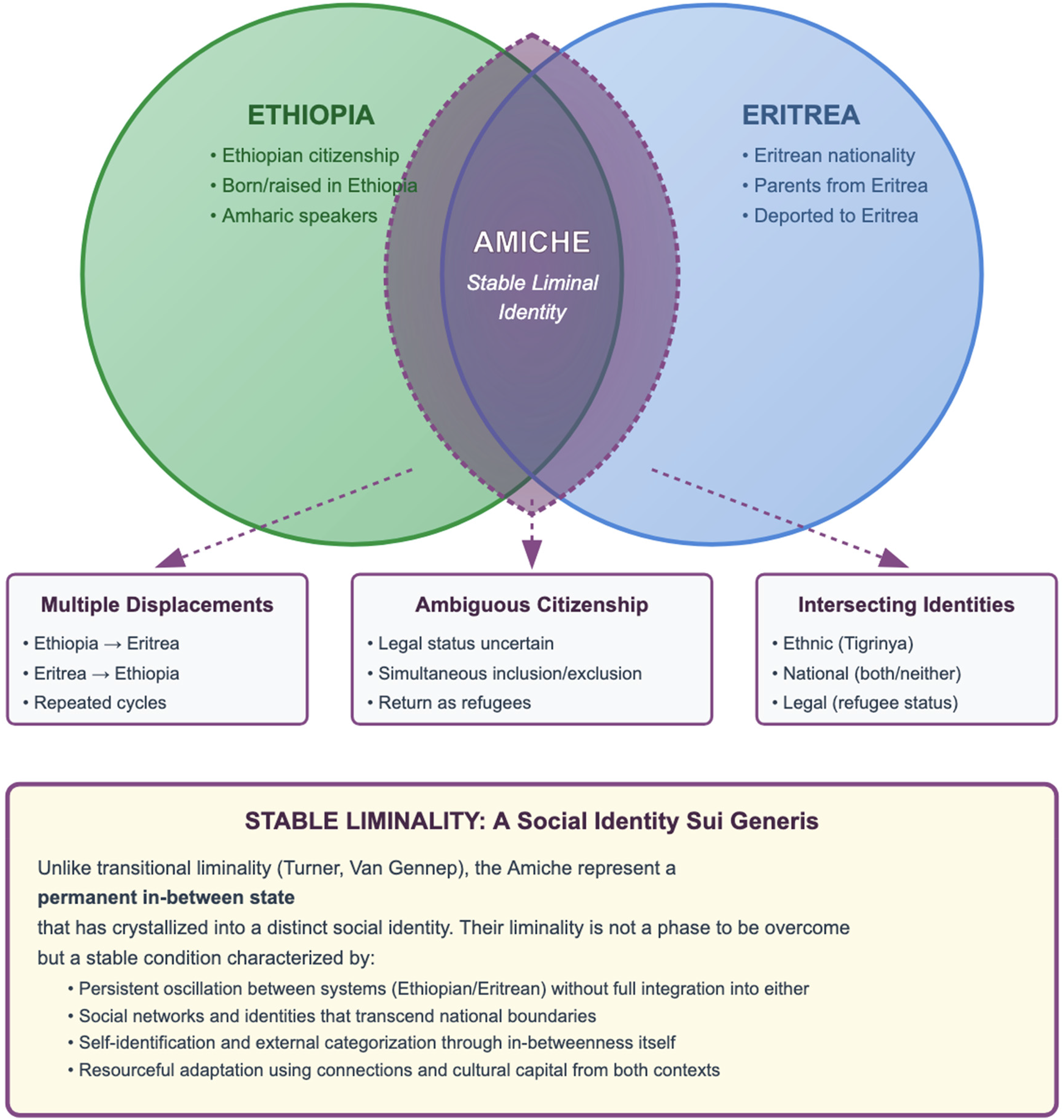
Stable liminality model.
During our research that was conducted in refugee camps before the Tigray war in 2019 and early 2020, we found that the Amiche were considered as a special category of Eritrean refugees by the camp authorities, camp residents, and the host communities. The Amiche usually speak very good Amharic as opposed to other Eritrean refugees. Most of them had urban backgrounds, were better educated, and, therefore, better socially integrated. Partly because of these factors, they usually served as a bridge between the refugees and the various agencies working in and around the camps – governmental and non-governmental organisations, the UN Refugee Agency, and other international organisations. This is illustrated by various cases where they were selected to serve on refugee committees. In and around the camps, it was common for the camp officials and the local host community to characterise Eritrean refugees – most of them young with a military background – as arrogant and rude in their human interactions. 9 However, they considered the Amiche to be an exceptional category that usually mediates between the refugees and the local officials and host community.
The camp officials usually introduce visitors, such as researchers, to the Amiche, not only because of their language capacity but also due to their capacity to connect with other refugees (Interview with Kassa, 2019; Interview with Mehereteab, 2019). The external view towards the Amiche contributes to making their group salient and the boundaries between them and the other Eritrean refugees strong. The deportation, displacement, and their status made the Amiche who have returned as refugees different from other people of Eritrean origin living in Ethiopia. The latter live in political uncertainty, but at least they are legally Ethiopian citizens with documents. The Amiche who once enjoyed Ethiopian citizenship now live as refugees with deportation trauma and without Ethiopian citizenship. Some of them, like Tesfay, live with their family members who were not expelled, but they are refugees constrained by the country's refugee laws.
Regardless of their socio-cultural inclusion, we also observed during our research that camp administrators viewed the Amiche with the same amount of suspicion as against other Eritreans. Amiche respondents reported that their deportation history, military service, and social connections led camp authorities to view them as a security concern and suspect them of working for the Eritrean government.
Intersecting Identities
In 2015, refugees in Adi Harush camp held a demonstration complaining about their treatment by the Ethiopian government, leading to the arrest of several refugees accused of organising the demonstration. Among them was a man who, although he was released after four months in detention, had his resettlement to the United States cancelled due to accusations of involvement in violence (Interview with Joseph, 2019). People like him, including Kiros, recounted that they had repeatedly been exposed to additional layers of abjection that had triggered different episodes of protracted displacement limbo. These episodes alternate with periods when they can lead a stable life. The status as in-betweens simultaneously opens and closes doors. This experience is traversing various social spaces. It renders the Amiche both members and outsiders within the group of Eritrean refugees – another example of their continuous state of simultaneous inclusion and exclusion (cf. Figure 1).
Refugee camps, on the one hand, are the prototypes of spaces of limbo and institutionalised exclusion (Brankamp, 2022). They are, on the other hand, transit points, characterised by continuous comings and goings, and thus, ongoing everyday integration (Rudolf et al., 2025). During our field work, we found that Eritreans move from refugee camps to nearby towns and cities within Ethiopia as soon as they can afford to do so (cf. Tufa et al., 2021). Amiche are in a better position in this regard than the other refugees. They are the major beneficiaries of the OCP due to two reasons: (1) their connections to Ethiopia make finding a guarantor relatively easy for them, and (2) the Amiche enjoy their language advantage (as speakers of Amharic) in urban spaces such as Addis Ababa (cf. Figure 1). They have better networks that help them find jobs informally. The latter is necessary since refugees do not receive official work permits. Getting a guarantor and access to livelihood, relinquishing humanitarian support, are the two conditions to get out of the camp policy status.
A good example of this dynamic is illustrated by Yonas, who is an Amiche refugee that we interviewed in Addis Ababa in April 2024. Yonas stated: I arrived in Adi Harush camp in 2015. My wife and my daughter joined me in the camp after six months. I was very lucky that I did spend less than one year in the camp. I remembered a landline telephone number of a friend of mine from the time before I was deported in 1998. I called him, and asked him to be my guarantor so that I could benefit from OCP. He accepted my request without any hesitation. Then, shortly, I moved with my family to Addis Ababa (Interview with Yonas, 2024).
Individuals may be included in or excluded from different social groups at home, in transit, and at their destinations, depending on their migration trajectories, the places they reach, and the timing of their arrival. Among Eritrean refugees, social positioning can be structured along multiple axes, including lineage, locality, ethnicity, nationality, and legal status. These layers of belonging and exclusion unfold across overlapping spatial and temporal registers. On the one hand, experiences are not confined to physical locations: simultaneous or diachronic events can transcend space, as demonstrated both in the cases discussed and in studies on the role of information and communication technologies (Bruijn and Dijk, 2012; Ponzanesi, 2019). On the other hand, the diversity of individual trajectories becomes particularly visible in the shifting statuses that people on the move inhabit across different spaces.
Our analyses cannot fully do justice to the complexity of the experiences Amiche are subjected to at different times and spaces. Yet it is evident that recurring patterns of exclusion and inclusion produce a relatively stable liminal status and, subsequently, particular forms of belonging. Comparing the diachronic descriptions of the turmoil experienced by Amiche in Ethiopia with research on their liminality in other regions (Riggan, 2011, 2019, 2024) reveals the constantly shifting processes of nation-building and national narration in the Horn of Africa. In Ethiopia, the accounts presented here confirm arguments that liminality generates broader societal “anxieties.” In Assab, their liminality similarly posed a challenge to narratives of Eritrean national purity and homogeneity. This underscores the fluidity not only of minority positions but also of the markers and boundaries of majority identities.
In Ethiopia, the construction of Amiche as a subgroup within Eritrean refugees – and their resulting intermediary roles in camps – points to attempts to extend or strategically recalibrate the symbolic boundaries of the majority. At the same time, the anxieties expressed in denunciations and deportations reveal cracks and divisions within national narratives of homogeneity. These fractures highlight the instability inherent in projects of nation-making and make it possible to anticipate developments such as more recent and ongoing ethnic-based conflicts in Ethiopia.
Stable Liminality
We have described Eritreans who lived and worked in Ethiopia before independence: Amiche were born and raised there by parents or relatives of different ethnic backgrounds (Afar, Tigrigna or Kunama). Some left immediately after independence, some were deported during the Eritrean-Ethiopian war, and some others stayed. However, according to various studies and our observations, many Amiche did not integrate either in Eritrea or in Ethiopia. The examples above suggest that everyday categorisation remains dynamic. It is a social fact that boundaries are relative to circumstances and that identity markers are to some extent fluid. Fluidity here means that options can be opened as well as closed by an Amiche identification: this was dramatically illustrated during the war in Tigray in 2020–2022. Amiche could get by as people from Addis Ababa or be attacked as Eritreans. In other words, the ability to identify and be identified along ethnic, linguistic, and national lines is often a matter of life and death. Despite the evidence we have presented on the fluidity and relative arbitrariness of the underlying markers, our findings also demonstrate that these socially constructed identifications can be inescapably rigid.
Like any other, a liminal system is defined by its environment and is subject to shifting boundaries. In the case of the Amiche, this environment is the legal framework for Ethiopian or Eritrean citizenship, the ever-changing political situation, and the conflicts surrounding it. According to the imperatives of the Ethiopian and Eritrean political systems, manifested in legal and administrative rules, their respective national identities became incompatible. However, as we will show below, the Amiche are characterised by outsiders and identify themselves through a stable “in-between” state that transcends this incompatibility. In other words, Amiche became a distinct community in its own right – oscillating in terms of legal, political, economic, and social integration or exclusion (cf. Figure 1). This is an example of what has been described as an everyday practice of transnational lived citizenship that, regardless of legal status or official rights, “… potentially disrupts social-historical patterns of exclusion, …[reaching] beyond the rights-based status conferred by the nation-state” (Müller and Belloni 2021: 5).
While many migration studies describe liminality as a permanent condition (Marotta, 2025), our research showed that the Amiche can be seen as a social group sui generis, that is, of its own kind. As a social group, the Amiche exhibit characteristics that distinguish them sufficiently from the wider groups of which they form part to constitute a distinct social identity. Although they have overlapping identities, they are often characterised as outsiders and identify themselves through a stable “in-between” state. This is more than the merging space of two other entities. Our observations illustrate that the dynamic but also permanent status of Amiche has become a social identity constituted by the very liminality that distinguishes it from others.
Conclusion
The cases described reveal general details of how distinguishing markers function at political, social, and economic levels. We argued that a stable liminality approach to Amiche positionality and belonging is conducive to highlighting dynamics that would otherwise be difficult to isolate. The accounts presented here show that the Amiche, like most other displaced people, were stereotyped as foreigners, intruders, and a threat to the social cohesion of their communities. The experiences of our research participants from the Amiche, on the other hand, illustrate two characteristics that set them apart from other displaced communities. First, the Amiche were legally integrated into both the Ethiopian and Eritrean communities. Second, they were at times socially integrated and emotionally welcomed in both countries. The stories presented show how the Amiche became a group with their own identity and increasing social cohesion, benefiting from their networks like other identity-based networks among displaced populations in Ethiopia. The experience of liminality brings individuals together, and the reflection of impurity marks the constituents that unite them (Tufa et al., 2022).
Recent studies on forced displacement emphasise the “unending nature” of “belonging elsewhere” (Brun et al., 2017: 15) – a condition we have described above as living in limbo. This unendingness, they argue, gives rise to new “social identities that foster belonging forged from experiences of exclusion” (ibid.). In this respect, we concur with the literature in three ways: first, that the Amiche identity encompasses multiple belongings; second, that it is simultaneously symbiotic and transcendent; and third, that it remains contested and internally contradictory (Campbell, 2013: 94ff.; Riggan, 2011: 140; Riggan, 2023: 8ff.; Tronvoll, 2009). However, the mainstream literature on forced migration focuses predominantly on those deprived of civil rights, for example, in refugee camps. Consequently, much of this scholarship has overlooked the counterpart to this unending condition – that liminality can generate unity and relative stability.
Beyond what existing literature demonstrates about the role of such processes in delineating the boundaries of the “pure” citizen within the nation-state, the case of the Amiche reveals an additional dimension: marginalisation here is neither unidirectional nor predictable in its outcomes. The Amiche occupy shifting positions – alternately marginalised and integrated, situated both at the periphery and, at times, at the centre of social and political configurations. They experience inclusion and exclusion across two identity formations that, depending on historical and political conjunctures, are cast as either mutually exclusive or inextricably intertwined.
Furthermore, our analysis shows that liminality can operate as a productive resource. The Amiche identity not only entails exclusion but simultaneously enables access to multiple and overlapping support networks. This highlights the temporal and spatial persistence of liminality, underscoring that it constitutes more than the aggregate of the marginalising mechanisms from which it emerges. It is, in itself, a structuring condition that generates continuity, coherence, and resilience amid displacement.
Footnotes
Acknowledgements
The authors are grateful to the reviewers, whose suggestions were instrumental in improving the paper. This article drew on data collected during the TRAFIG project, which received funding from the European Union's Horizon 2020 research and innovation programme under grant No. 822453. The content reflects only the authors’ views, and the European Commission is not responsible for any use that may be made of the information it contains. The project applied a rigorous ethical screening and an approach guaranteeing the highest scientific standards laid down in (a) the European ALLEA Code of Conduct from 2023, extended by (b) the German rules on GWP (cf. DFG 2019) and local rules. Thanks go out to all participants, colleagues, and the reviewers whose help was crucial in improving the paper.
Data Availability
The authors welcome any inquiries – please reach out directly.
Declaration of Conflicting Interests
The authors declared no potential conflicts of interest with respect to the research, authorship, and/or publication of this article.
Ethical Approval and Informed Consent
In addition to Trafig's ethical clearance procedures, the project applied a rigorous ethical screening and an approach guaranteeing the highest scientific standards laid down in (a) the European ALLEA Code of Conduct from 2023, extended by (b) the German rules on GWP (cf. DFG 2019) and local rules.
Funding
The authors disclosed receipt of the following financial support for the research, authorship, and/or publication of this article: The TRAFIG project has received funding from the European Union's Horizon 2020 research and innovation programme under grant No 822453. The content reflects only the authors' views, and the European Commission is not responsible for any use that may be made of the information it contains.

Notes
Author Biographies
Appendix: List of Interviews
To guarantee the anonymity of the interviewees, all the names we mentioned here are pseudonyms.