




Abstract
This article is based on a series of observations made in the offices of the Dakar Labour Inspectorate between 2020 and 2023 and describes how labour is regulated by the inspection agents. The recent developments in the Labour Code deprived the department of virtually all its sanction powers, and the authority of labour inspectors depends on their ability to maintain people's belief in their power rather on than their actual powers of punishment. The work of inspection agents is a function of the law, of course, but it is also the product of the dynamics of the interactions among these agents, workers and employers. This is the only way the state can hope to impose its authority on the heart of labour relations.
The advent of structural adjustment on the African continent led to a conceptual crisis that has affected the ways people think about labour. This symbolic revolution is common to other socio-historical contexts (Willemez, 2020), but it has been of unequalled intensity in Africa, where it has called into question the representations of labour and modernity inherited from colonisation in radical ways (Ferguson, 1999). Alternative concepts of labour to wage-earning have therefore been of growing interest to researchers. In concentrating on the study of the “informal” (Charmes and Adair, 2014), some work has contributed to the virtual disappearance of labour as a subject, which rendered invisible such topics as entrepreneurship, as Jean Copans and Matteo Rizzo have recently reported (2014, 2017). Other scholars have taken an interest in popular representations of “fair” or “good” labour (Ferguson and Li, 2018; Monteith and Giesbert, 2017), seeking emancipation from views of labour that are now deemed too ethnocentric, in favour of more comprehensive approaches. During this same period, the scientific agenda developed alongside that of international lenders, who also endorsed the “informal” category (Benanav, 2019; Lautier, 2004), making self-employment and entrepreneurship the new hegemonic model in the place of wage-earning (Chapus et al., 2021).
However, this watershed moment did not, in one stroke, erase the traces left by an earlier time when the single unique figure of the wage-earning worker embodied modernity (Cooper, 2004), and wage-earning is still the ambition of many workers (Bourdarias, 2014). Some formal labour institutions have survived, and in countries like Senegal, the labour inspectorate is a vestige of this earlier period (Guèye, 2011; Renucci, 2021). This segment of the administration faces a major challenge, however. According to the Senegalese Agence Nationale de la Statistique et de la Démographie, more than 97 per cent of enterprises are moving away from a formal legal framework, and virtually all newly incorporated companies are now informal. 2 Structural adjustment measures have severely weakened the protective aspect of labour law since the 1990s (Ndiaye, 2017; Ndiaye and Samb, 1997), while employment policies as a whole now tend to value entrepreneurship (Baumann, 2016). These days, priority is given above all to “improving the business climate” to encourage investment. It is as if public policies and everyday practices in the economic world are denying any authority to the labour inspectorate and the ideal working environment it is supposed to defend.
This article describes the labour inspectors' regulatory activities in what is a hostile environment. In so doing, it seeks to tackle the structural contrast between formal and informal economic activities in a new way. Existing work offers three important means of envisaging informal labour. First, one can adopt a nominalist approach, where the challenge is to group together, and then name, a collection of economic activities that have a “family resemblance.” Here, it is necessary either to define the contours of what is informal (Charmes, 1990; Portes et al., 1989): whether we are referring to a sector or an economy, or to suggest alternative categories that are supposedly better adapted to the real situation, such as unstructured sectors (Nihan, 1980) or popular economy (Hillenkamp, 2009). More rarely, some works have chosen to adopt a constructivist approach to the informal, focusing on how the category was invented, how it spread and the influence it has had on reality (Benanav, 2019; Lautier, 2004). There is a third option, however: we can look at how the contours of the contrast between formal and informal are seen in practical terms in negotiations between state agents and the people they are faced with (Rubbers, 2007). 3
This article pursues this last avenue. To do this, it investigates the everyday activities of the inspection agents who are responsible for classifying business activities and disciplining actors in the economic world. How does the administration regulate the world of labour in Senegal? This article argues that because the recent developments in the Labour Code have deprived the inspectorate of practically all its sanctioning powers, the everyday practice of labour inspectors depends on their ability to maintain people's belief in their power rather than their actual powers of punishment. Inspection agents’ work is a function of the law, of course, but it is also the product of the dynamics of interaction among these agents, workers, and employers within the claustrophobic confines of their offices or when they are out visiting a company. This situation makes the regulatory work of this government department eminently idiosyncratic. The constant adaptation is the only way the state can hope to impose its authority on the heart of labour relations through its representatives. Before examining this topic, the article looks at the recent history of the department to provide context for the study.
A New Professional Culture
At the end of the 1990s, there was consistent evidence that the labour inspectorate had no resources. The inspectors had no cars – and sometimes even no chairs or offices – and the buildings were in pitiful condition. In the capital, Dakar, there were barely a dozen inspectors, and in some regions, inspections were being carried out by mere secretaries. When they took up their positions in the inspectorate, graduates of the École Nationale d’Administration (ENA) were struck by the lack of resources. The number of people leaving the labour inspectorate grew as a result of the structural adjustment policies and the “trimming” of the government administration (Ndiaye, 2017). Among the inspectors who remained, the back-and-forth between the inspectorate and the human resources departments of private companies increased.
In the Dakar inspectorate, a group of inspectors who had recently graduated from the ENA tried to take a stand against this state of affairs at the end of the 2000s. In particular, this handful of young inspectors, who had been recruited one or two years apart, decided to use their checks on companies to protest against the inspectorate's inertia. At the time, most inspection-related activities consisted of advising workers and employers or mediating in the case of a conflict. Actual checks were unusual and were only carried out if the hierarchy asked for them. This small group of inspectors set out on foot for companies located close to the inspection site to carry out unannounced checks. Their initiative was quickly brought to a stop by their superiors, but their protests continued with the creation of the Syndicat des Inspecteurs et Contrôleurs du Travail et de la Sécurité Sociale a few years later. 4 The trade union replaced the Amicale, which had been established by the previous generation of inspectors in the 1970s. This change in the type of professional association was linked to a change in the institutional culture. In the 2000s, newly-recruited inspectors did not have the same relationship with their superiors and their profession. While the Amicale's activities focused on the spread of know-how relating to labour law, the union concentrated primarily on mobilisation and advocacy. Its work led to a coordinated strike by all the regional inspectorates in 2009 over the course of three days.
Some older inspectors explained this transgression of the longstanding tradition of negotiation between labour inspection agents and the government as a result of the supposed socialisation of individuals involved in student movements. 5 The primary people involved, however, explained their state of mind at the time in comparison with the areas of government where their fellow graduates had been sent, which had many more resources. Not only did they feel unappreciated by the government, but they were also frustrated by perceived excesses among both employers and the trade unionists who accompanied the workers during the inspectorate proceedings. One might also venture to suggest another explanation. The inspectorate went through mass departures during the 1990s, weakening existing socialisation and the transmission of institution's values and know-how, which in turn allowed these values to be called into question. In effect, the inspectors who took up their posts at the beginning of the 2000s learned among their peers, which led to a break from the previous generation and made transgressions of agency norms possible.
The government promised agents that their salaries would be reviewed and their working conditions would improve. In fact, some inspectorates in the region were renovated. The inspectors’ bonuses were also gradually aligned with those of diplomats, who worked in one of the most prestigious government sectors. In addition, as agents advanced in their careers, with some being sent to work in other ministry offices while formally remaining part of the labour inspectorate, the strike mutated into effective lobbying that would advance the collective claims of the labour inspectorate. Some of the leaders of the 2009 movement came to head at regional inspectorates in the major towns. Some work directly in the Ministry of Labour, while others have been promoted to the General Inspectorate, the highest organ of the labour inspectorate. Because the structures and norms of the Senegalese administration allow for personnel decisions to be based on clientelist ties (Blundo, 2014), leaders of the union movement who advanced were able to control lower-level personnel decisions and make membership of the trade union one of the ways of rising through the inspectorates’ ranks. This practice contributed to the consolidation of a new professional culture particular to this generation of inspectors and produced a break from the culture of their elders.
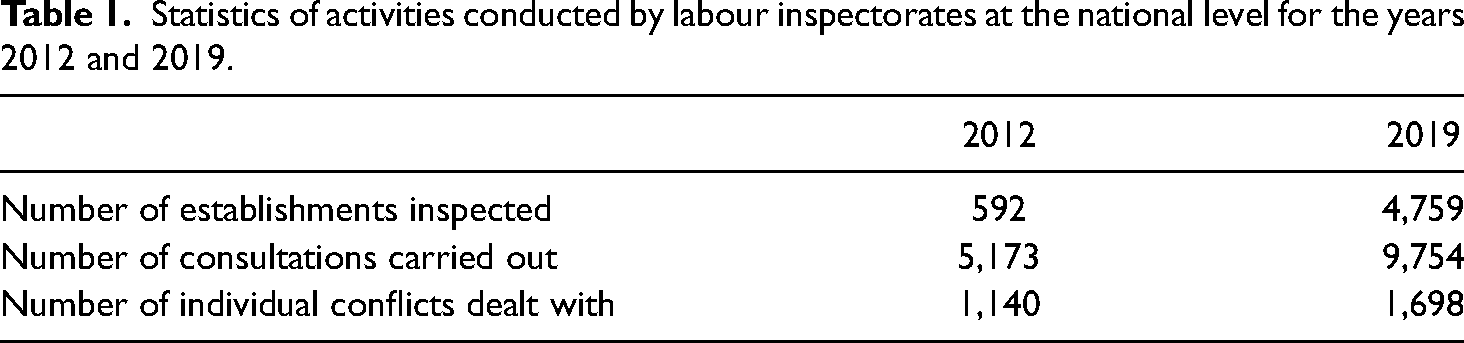
Since 2013, the government has regularly allowed the inspectorate to hire more inspectors and controllers, which has made it partially possible to offset the still large numbers of people leaving for other areas of the government or the private sector. No fewer than 75 agents (inspectors and controllers combined) have been hired. In 2020, the total number of inspection agents in Senegal was 90. 6 Counting all the regions, there are slightly more controllers (47) than inspectors (43). The hierarchical distinction between inspectors and controllers, with the former higher than the latter, can be important for career progress or when it comes to signing certain documents. However, it does not reflect any noteworthy difference in the agents’ daily work. Although the Dakar inspectorate alone has over one-third of the total staff, hiring also occurred in the regions of Saint-Louis and Thiès, where there are about a dozen agents, compared with only three or four at the beginning of the 2000s. This expansion has an impact on inspection activities. The number of checks has increased spectacularly, as has the number of conflicts dealt with (see Table 1). However, increased activity has not looked the same across the country. Some inspectorates focus almost exclusively on advice and mediation, while others seem to emphasise inspections. Once again, the Dakar inspectorate differs from the rest, carrying out almost 25 per cent of all inspection activities.
Statistics of activities conducted by labour inspectorates at the national level for the years 2012 and 2019.
This article is based on my ethnographic work in the Dakar inspectorate a decade after the generational shift, expanded hiring, and increased inspection described in this short history. Initially, I followed trade unionists, and often the workers advising them, in their day-to-day activities in the corridors of the inspectorate, but my observations always ended at the threshold of the offices of the inspectors (Cissokho, 2022). To expand my research, during an interview with the Deputy Director of the General Labour Inspectorate, I asked if I could be granted an “internship” at the Dakar inspectorate. The official put me in touch with the Regional Director in Dakar, who in turn put me in contact with two of his deputies. Some weeks later, I spent a week with a team of future inspectors from the ENA who were doing an internship at the end of their studies. I went with them from office to office and from business to business, largely attending mediation meetings between workers and employers. This initial internship experience was supplemented by a second in 2021 that lasted for two weeks, during which I was the only intern. The second internship was largely devoted to company inspections. I also continued to visit the inspectorate regularly during my stays in Senegal in 2021, 2022, and 2023. My internships enabled me to collect observations on the inspection agents’ daily work, which is often referred to within the inspectorate as the “Three Cs”: “conciliation” or meditiation between employees and employers, “contrôles” (i.e. inspections) in companies, and “counsel,” that is, advice offered most commonly to workers who come to the inspectorate's offices.
My immersion in the Dakar labour inspectorate was made possible by the existence of “internships” reserved for student inspectors – a programme that predated my arrival. Acceptance of my presence was also facilitated by the kinship I developed with the inspection agents, who were close to me in terms of age and education. Most were men, and some had done a part of their studies in France. These shared characteristics, when taken together with my family name and my phenotypical features, eased – but did not actually cause to disappear – the assignations to which researchers from France are customarily subject when they carry out studies in Senegal or elsewhere (Quashie, 2020). In the first place, however, my presence and the acceptance of my investigation were the result of the change in professional culture that took place in this administration during the 2000s. My study was undoubtedly viewed as one way of making these changes visible, a goal the inspectorate was also pursuing by organising open days, relaunching a professional journal, making frequent appearances on television broadcasts, and instituting a “working days” project that brought together all actors with professional relationships with the inspectorate.
Power without Sanctions
At the time of my investigation, the labour inspectorate was in an ambivalent situation. It had undoubtedly benefited from the wave of recruitment in the 2000s, which gave rise to a collective desire to strengthen the roles of inspectors and controllers. However, the movement ran up against the changed reality of the Labour Code and the inherited features of the administration. Although the inspectorate had more material and human resources in 2020 than it had at the end of the 1990s, the legal powers available to its agents were almost non-existent. In 1994, the inspectorate's previous agreement on redundancies, which had required that disputes between an employer and an employee pass through the inspectorate before going to court, was done away with. In 1997, the Labour Code was modified, and disputes could be handled directly before the courts without going through the inspectorate first. Beyond these changes to the Labour Code, the inspectorate faced other structural constraints. Although the inspectorate was theoretically able to issue fines, it did not have an account at the Treasury into which they could be paid. Agents therefore made it a habit not to impose them. In addition, the letters to inform employers that they had been called to appear before the inspectorate were sent by workers themselves, which hampered any legal recourse against an employer who did not appear when they were summoned. Moreover, although the Labour Code gives inspectors the right to keep records and commence legal proceedings, these proceedings were never taken up by the Prosecutor's office, which was preoccupied with other matters deemed to be more serious.
These constraints transformed the administration of the inspectorate into a perpetual negotiation. It made governance by the inspectorate's agents an eminently personalised activity, in which moral judgements and the law were intertwined based on the nature of the users, the inspector and the situation. This operating method is not unique to the Dakar labour inspectorate; it is the very foundation of the law (Bourdieu, 1986) and the routine work of government counter staff in the United States (Lipsky, 1980), France (Dubois, 2008; Spire, 2008), and other parts of Africa (Bierschenk and Olivier de Sardan, 2014). In the case of the inspectorate, placing our emphasis on this general feature of government workings makes it possible to reveal the way that state authorities in the world of labour impose their authority in a context that is unfavourable towards any intervention.
Retaining a Mandate
Imposing the authority of the inspectorate in labour relations means, first, ensuring that its inspectors’ authority is not displaced in favour of another regulatory body. The appointment of an inspector and their right to act can be called into question by the parties at any moment during the proceedings. The employer or workers can decide to go before the courts or can challenge some decisions taken by the inspectorate before other administrative authorities, which is common in the case of the dismissal of staff representatives. Not only do inspectorate's agents have to worry about cases being removed from the jurisdiction of the labour inspectorate, but they must also worry about losing their individual authority because of interventions of their superiors, who may try to sway proceedings thanks to personal or political connections or pressures.
In the end, this labour inspectorate derives the greater part of its right to intervene from the position of arbitrator that each of the protagonists in a dispute grants it. In this context, taking sides too clearly in favour of one party or the other risks calling into question the inspectors’ legitimacy. Inspectors tenuous and dependent authority is one of the fundamental ambiguities of the inspectorate's activities; it very often limits the inspectorate's agents to listening, recording, and mediating without ever being able to impose anything, on pain of seeing their right to act taken away for the benefit of some other jurisdiction. This position of neutrality alone enables them to offset what they lack under the law: an exclusive mandate.
Asserting their neutrality first means systematically establishing the “facts” at the beginning of the mediation, listening, ensuring that the representative has transcribed the workers’ demands correctly, and giving the floor to the worker. As an example, here is an extract of my notes, taken as I was in the office of an inspector following a morning of mediation. The inspector reads the letter he received from the worker a few days earlier. It is written perfectly, but the man does not speak French. It was written by his representative, a trade unionist who is sitting slightly behind him. The man worked in a workshop from 9 a.m. to 5 p.m. He believes he has been dismissed without a valid reason. The inspector reads the letter again and translates it into Wolof. He asks the worker if it corresponds to what he wanted to say. The inspector explains some of the legal terms used in the letter. He reviews what is meant by “damages”, what IPRES (Institution de Prévoyance Retraite du Sénégal [the Senegalese Retirement Planning Institute] is and what “severance pay” means. The trade unionist who is representing the worker presses on clumsily, calling the inspector “Maître”, as if he were in court. The worker responds that aside from what the letter says, he is only asking for his salary, and is not worried about the rest of his rights.
In addition to using expertise to establish perceived neutrality, inspectors seeking to retain their mandate also need to keep trade unionists and employees who are keen to show their actual or supposed closeness to the inspectors at a distance. During conciliation proceedings, the inspectorate's agents take care to adopt the most neutral attitude possible – from the way they have the parties come into their offices and seat them to how they greet them. At the beginning of my study, what the inspectors said about their mission followed the same logic. From my point of view, the labour law – and by extension the activities of the inspectorate's agents – were inherently partial because the aim was, above all, to offset the fundamentally unequal position between an employer and an employee. In my interviews, however, my interlocutors at the inspectorate proclaimed themselves to be always equidistant between workers and employers, or even sometimes at the service of the economy rather than employees or employers.
The display of impartiality on the part of the inspectorate's agents continued as far as their written documents. They systematically refused to take a position in the reports that they drafted when conciliation proceedings came to an end for fear that the courts or one of the parties might reproach them for being partial. Sensitive decisions are drafted with the greatest care, discussed in a team, reviewed by deputies of the regional director, and sometimes revised several times before being made public.
Inspections are also typical of this general attitude of neutrality and careful to avoid perceived bias. Inspection activities saw a considerable increase in the 2010s along with the change in the institutional culture brought about by the generational renewal within the inspectorate. Whereas the generation of inspectors of the 1980s did not prioritise inspections, the generation that arrived in the 2000s prioritised the “standing inspection,” that is, their ability to move walk through the city and conduct inspections. The Dakar inspectorate was the leader of this movement, followed by inspectorate in the city of Thiès. Although the vast majority of enterprises operate in a state of relative illegality, suggesting sanctions could be common, these inspections almost never conclude with any kind of sanction. Of the 4759 inspections carried out by the labour inspectorate across the country in 2019, only five ended with an infraction report. The great majority simply resulted in a summons to appear before the inspectorate or in verbal or written observations. 7
Doing Without Sanctions
The inspectorate's authority therefore relies on a kind of bluff. Because the inspectorate does not have any real powers of punishment, how the inspectors’ power is staged is key. This staging of their power first plays out while they wait to see the inspector, as the anthropologist Javier Auyero noted in the case of the everyday workings of the administration in Argentina (2012). In the morning, the corridors of the inspectorate are full of people waiting at the doors of the inspectors’ offices. Access to these offices is controlled by local assistant security officers, who have supplemented the police in all administration offices since their force was created in 2013. While waiting, the worker and the employer feel that they are at the mercy of the inspector, who can call on them at any moment. The discretionary power of the department is illustrated by the comings and goings of the people who are authorised by the security officer, who sometimes remains in his chair for several hours, to move in the name of a mysterious arbitrariness that nothing can be done about. When access is given to the office, the sensations gained in the corridor during the wait continue. The inspector's massive office lends the conciliation proceedings a solemn character, even more so with legal tomes placed carelessly next to a laptop computer, a printer, and a coffee machine – all of which are symbols of modernity. Accessories also play an important role during inspections. The arrival by car, the forms to be filled out by the human resources manager and the employees, the agents’ business card, and simply the agents’ appearance and the way that they present themselves lend weight to their visit, giving it all the appearance of a government visit.
Aside from the décor and the various accessories, the inspectorate's authority often resides in the way agents undermine the credibility of their main competitor, the trade union representatives who accompany the workers, when the interests of workers in conciliation proceedings are defined. These representatives often compete with the inspectors on purely legal points of interpretation, and more fundamentally on the lawful definition of workers’ interests during the mediation proceedings. Discrediting the union representative increases the inspector's chances of making the worker accept his or her decision if the representative opposes it. In most cases, these rivalries manifest themselves in the little barbs the trade unionist and the inspector exchange during the proceedings, or in exceptional cases more overt verbal fights. Notes from another encounter I observed help illustrate this dynamic: The 10 o'clock group enters the inspector's office. It is made up of a worker and his trade union representative and a woman on her own. The woman is the employer. She asks for a delay to wait for the person who has to be with her before the conciliation proceedings commence. The inspector agrees. However, he takes advantage of the situation to ask the representative who is accompanying the worker for his trade union card. The representative's outfit is worn and dirty. His clothes contrast with those are the inspector, who is wearing a very well-cut traditional garment. The union representative takes out a decrepit card. The young inspector points this [the sorry state of the card] out to him. The union representative responds that he is not accustomed to coming to the labour inspectorate, and that he is more often in court.
The scene described here is representative of the systematic references to the errors committed by trade unionists in the area of the law and more generally, an attitude of disdain on the part of the inspectorate's agents. However, the authority game between inspectors and union representatives is likely to change dramatically during certain interactions, as the agents may rely on the representatives to convince workers to accept their solution. To do so, they play on the trade unionists’ financial interest in resolving the matter. Although there is no text that embodies this practice, the representatives receive a commission for each matter that they present before the inspectorate or the labour tribunal. This is often the only income they have. For a union representative who accompanies a worker, a matter for which a solution is found in the course of the day guarantees that he will return home with enough income to cover his daily expenses.
To encourage the cooperation of union representatives, workers, and employers, the inspectors can threaten to dispose of a file and leave it to the courts. For employers, going before the courts potentially means running the risk of being ordered to pay. The fragile nature of inspectors’ authority can therefore become a threat. In addition, employers risk having their dispute mentioned in the weekly bulletin drawn up by the inspectorate for the President of the Republic if they are not receptive to the inspectorate's suggestions.
Inspectors can also threaten to transfer the case to other, less accommodating regulatory bodies, as the example below illustrates: It's Friday morning, and we're in the inspectorates’ meeting room. A group of agents is facing the human resources manager of one of the capital's most important banks, the local managers of the same bank, and the manager of a temporary employment agency. The entire week has been dedicated to checking branches of this bank. These inspections are part of a broader campaign targeting the banking sector adopted by the authorities in the face of a surge in disputes in the sector regarding the significant use of temporary employees. This morning's meeting is in some way the climax of the week. The checks have been complicated. It's the beginning of the month, which is a critical time for these branches because they are invaded by large numbers of employees who want to take out all or part of their salaries. The bank managers have often shown a reluctance to host the inspectorate's teams, which has manifested itself in long waiting periods before being received, sometimes hostile conduct on the part of branch managers and sometimes even a refusal to receive the agents. The issue for this morning's meeting is to provide an update on the resistance the agents faced at the time of their visits and to instil fear into the bank's management by reminding them that the inspections are mandatory. The inspector who has been given the task of chairing the meeting lists the infringements that have been noted, including health-related failings and, above all, a failure to make the branches’ employee contracts available to the inspectorate's agents. The human resources manager apologises profusely. She will make the contract available to the agents. The inspector adds a new layer: if they come across this type of problem again, they may file a complaint with the Directorate-General of the Financial Sector, which will undoubtedly be less accommodating.
During conciliation proceedings, listening always plays an important role in securing an acknowledgement of the inspectorate's authority. This is not so much a bluff as a kind of skill in the way conciliation meetings are conducted. For many inspectors, it is a prelude to the smooth running of every meeting. Conciliation is reputed to have a cathartic function. It enables workers to speak, and sometimes the feeling that they are being listened to is enough to reduce the tension and obtain an agreement. The agents adapt their language and the way they speak to the interlocutors they have before them. They blend a more personal register with legalese. Some inspectors have no hesitation in playing on joking relationships based on kinships, regional or ethnic belonging, or the closeness engendered by mastery of a particular language other than French or Wolof. Others sometimes invoke prior relationships between the two parties or good morals.
Despite this, in the vast majority of the cases I had the opportunity to observe, the versions of the facts given by the employers and the workers remain irreconcilably opposed: The young woman takes the floor when her time comes. She introduces herself as an entrepreneur. She took over her mother's fashion company last November, but with COVID, her situation deteriorated very quickly, so she asked someone to help with the workshop. When the worker arrived, she clearly saw that he wouldn't do. He was too old. Also, she very quickly discovered that he had problems with his eyesight. When she gave him things to sew or cut, he messed everything up. She never told him he had been hired. She just gave him money to cover his transportion, which she gave him every Saturday in the amount of 10,000 FCFA. The man then asked for this to be given to him in a single payment, every month. She very quickly told him that he wouldn't make it, but he begged her. This is why she kept him on for such a long time. While the young woman is recounting her version of the story, the worker fiddles with his prayer beads nervously. He moves around in his chair. The inspector lets him answer. He tells the woman off for insulting him. He wasn't hired to sew but to manage the workshop! She gave him travel money, but not a salary. He wants the difference between what she gave him for travel and what he should have earned as the manager of the workshop. The representative has done his calculations. He's missing 25,000 FCFA a month if he's to have salary corresponding to a workshop manager. The young woman replies that she never talked about a salary. The man who is accompanying the young woman complains. He's the one who presented the worker to her, and he doesn't understand how they got to this point.
“It Depends Who's Wrong and Who's Right”
One of the main primary forces that makes it possible to impose the inspector's authority lies is the performative use of the law. Here, the agents’ practice is in line with well-known administrative practices in general, and inspections in particular (Dodier, 1988). Given the insecurity of the inspectorate's agents, they engage in a perpetual negotiation of the rules of law throughout the conciliation proceedings. They call upon legal standards to strengthen their position as mediators, as well as to discredit a worker's claims or to threaten an employer with more serious sanctions if they do not cooperate. In many of the cases that I had the opportunity to observe, however, the final agreement lies outside the provisions of the law and is made in the name of moral, rather than legal, values. Paradoxically, the law is used as a lever to find an acceptable agreement outside the provisions of the Labour Code. Imposing the authority of the state in labour relations, therefore, requires an expert determination of when the law must be applied and to what extent. At the end of the day, preparation of the conciliation report gives the agreement an appearance of legality, but the inspectors are the only judges of what is or is not acceptable, whatever one thinks of their expertise and power. The willingness to go beyond the law is not without consequences, as it makes it possible for an agreement to be reached in 57 per cent of cases, 9 which is a relatively significant number given that inspectors do not have any real sanctioning power. However, this flexibility with the law makes the work of the inspectors unpopular with a good number of their magistrate colleagues, who believe that agreements made in this way are illegal, and sometimes begrudge ratifying them when they later become the subject of a challenge on the part of one or other of the parties.
Awareness of the subjective nature of the interpretation of legal rules sometimes leads to a feeling of vertigo among the younger agents. In the face of this, the inspectors take refuge in the collective. Their offices become spaces for a collective deliberation on what should be done or not done with regard to the law and moral considerations. Some agents also conveniently seek refuge behind the complexity of labour law and the existence of a significant amount of case law or a number of different laws, as well as the reality of the way the Senegalese business world functions. As other works have underlined (Bonanno, 2022), governance of the inspectorate's agents relies to a large extent on the rules of evidence. Where they are complicated by the nature of the infraction or, as is often the case in Senegal, by the absence of a written document attesting to the employment relationship, the work of the agents becomes equally complicated.
Some inspectors establish moral boundaries beyond which they refuse to approve an agreement. Of course, a worker can “waive his rights,” but he cannot “waive indisputable rights.” The problem therefore moves from a definition of workers’ rights to a definition of what is “indisputable.” Some inspectors make severance pay the symbol of these rights in the face of other potential forms of compensation such as travel expenses. Others situate them halfway to what the worker can legally claim. This kind of arbitration reveals one of the subtleties of the agents’ practices. As Marième N’Diaye and Sophie Andreetta have recently noted, the rule of law cannot be ignored even in contexts in which formal rules are deemed not to apply (Andreetta and N'Diaye, 2021). In the precise case of inspections, this observation aligns with other recent comments on the sociology of labour (Chappe and Tonneau, 2022). The personal arbitration of inspectors depends the limits of what is negotiable. While conciliation reports often approve agreements made outside what is provided by the law, they always do so with reference to legal rules. Compensation is therefore always the subject of a “calculation” that is sometimes made rapidly directly on a calculator during the course of the conciliation proceedings and makes the allocation of one amount or the other the result of a quasi-scientific process.
Benjamin Rubbers has described a similar process in the task of classifying situations applied by customs officers in Congo (2007). However, unlike this example, the work of classifying inspection agents as I have seen it is not systematically anchored in the “paradigm of corruption.” Rather, the definition of what is acceptable rests on complex arbitrations based, of course, on the rule of law and, among other things, an estimate of the level of distress of the worker who comes before the inspectorate, the presumed resources of the company, the attitude of the parties or the initial claims of each party. A high level of financial distress on the part of a worker may, for example, push an agent to lower the rights the user can claim in such a way as to find a quick end to the dispute. Conversely, when a given worker is only claiming a small amount of money, this logic can also push the agent to approve an agreement that gives the worker an amount to which he would not normally be entitled. This blend creates the practical rules that frame how the inspectorate's agents act (Olivier de Sardan, 2014). The settlement proposed by the inspector in the matter between the young woman entrepreneur and workshop manager described above is a good illustration of this: The inspector is now alone in the meeting room with the worker and his representative. The man he now refers to familiarly as “the old man” is more than 60 years of age, which means he can no longer be legally considered a salaried worker. He might be able to claim a services agreement, but if this is the case, the dispute does not fall within the purview of the labour inspectorate. The inspector suggests that the young women should pay the 20,000 FCFA of salary he is missing to settle the matter. The worker doesn't understand. He's the head of a household, and he began working when he was 18. How can it be said that he's no longer a worker? The inspector repeats that he is no longer a worker in the eyes of the law. He therefore risks losing if he goes to court. The inspector smiles in the face of the “old man's” obstinacy and his difficulty with acknowledging the legal arbitrariness. After a few minutes of discussion, he ends up by asking him: “How much do you want?”. The man asks for the one and a half months of salary he's missing: 50,000 FCFA.
This proposal, which was made by the inspector behind the closed doors of his office in front of the worker ends up being finalised. The suggested compensation may seem fair to the inspector from a moral standpoint, but it is technically outside the law. The “old man” cannot be treated as an employee because of his age. The relatively small amount and the failure to acknowledge the law no doubt contributed towards making this solution acceptable to the employer.
This work of categorising situations and adapting the law also takes place during inspections, which have considerably increased since the 2010s and the change in the institutional culture caused by the generational renewal at the inspectorate. Inspections can be carried out randomly. They can also be targeted on the orders of the Inspectorate-General or the Ministry as a result of current events, complaints made to the Ministry directly, or more political factors. In every case, however, inspections are reserved to so-called “formal” activities. The agents start out from the principle that their regulatory activities are restricted to formal actions. In a somewhat arbitrary fashion, this classification automatically excludes the vast majority the world of work that is within the inspectorate's jurisdiction. It operates on the basis of the exterior appearance of commercial buildings or the type of business. The arbitrary nature of this classification was revealed to me one day when, paradoxically, the purpose of my mission was preventative information sharing and gathering in the informal trade, as my notes on one experience illustrate: The International Labour Organisation has put pressure on the Ministry of Labour to organise an awareness-raising session on COVID in the workplace. The inspectorate has transformed it into an opportunity to go out and meet informal workers and hand out questionnaires to them. The inspectors therefore have materials to distribute: plastic posters with prevention measures and masks. I'm in a team made up of two inspectors and two interns. We're responsible for the port area, which tis close to the inspectorate. However, we don't go to the large companies located not far away, but to the market near these large enterprises. One of them tells me he would very much have liked to check one of the large companies at the port, but today it's informal businesses that are the target. When we leave the market, we stop off at a bookshop. It's definitely informal, the inspector tells me. The business seems to me to be far more official compared with the stalls we had stopped at earlier. I ask what makes him think the business is informal. He explains that bookshops have to file a document with the inspectorate, but he doesn't see many of them. This bookshop must therefore undoubtedly be informal.
When inspections are carried out as a team, these assessments about formality are often made jointly. They are made by the group in charge of inspecting a precise geographical sector or by the regional director and his deputies in charge of planning. In the case of conciliation proceedings, these assessments are more individual, even though in some cases they can be discussed jointly during breaks. These assessments about the formality of work affect the law and the times and situations when it must be applied.
In counselling activities as well, inspectors must decide whether to apply the law. Workers frequently arrive at the office of an inspector for a simple piece of advice on a situation they believe to be unfair, and this visit offers the opportunity for an initial sorting out of their potential claims. In the process, cases judged to be too eccentric or impossible to prove are eliminated.
How inspectors go about pursuing the “Three Cs” (“conciliation,” “contrôles,” and “counsel”) varies. Each inspector develops their own style based on their personality, training, more or less recent arrival in the department, career trajectories prior to joining the inspectorate, and office placements. They, in turn, develop reputations that shape the tasks assigned to them. Particular inspectors become known for being especially skilled in labour law while others become known for being more skilled as a psychologist because they are sensitive to the “sociological dimension of the law.” These styles are acknowledged by the hierarchy. The regional director and his deputies allocate the various requests that arrive on a daily basis based on these specific elements, paying particular attention to matters they decide are sensitive because they might be politicised or mediatised.
Conclusion
When young inspectors leave the ENA, they have been impregnated with a certain view of the state. They imagine that it is omnipotent and that by extension the people who represent it are too. However, when they actually take up their posts, they are disappointed. In their interactions with users and colleagues who have been sent to other parts of the administration, everything reminds them that they do not have the powers they naturally believed that they would inherit as state agents. Of course, the agents of the inspectorate have a title and a function; however, two decades of mobilisation have not been able to successfully erase the changes made at the end of the 1990s on the occasion of the structural adjustments. The law gives them no means of imposing their decisions. Their mandate can be called into question at any time. This situation has an impact on the agents’ regulatory activities. It makes the inspectorate's work a perpetual negotiation, in which the rule of law naturally occupies an important position, but where the heart of the agents’ authority lies in their ability to stage their power, to impose their expertise in the face of the skill of trade unionists, to apply psychology by listening to the complainant, to use cunning by changing the course of a conciliation meeting, or to adapt their interpretation of the law to the situation. However, this work is not simply reduced to a bluff intended to confirm the authority of the inspectorate's agents. It is underpinned by values, by a certain professional ethic held by this generation of inspectors who emerged from the mass recruitment of the 2000s. The everyday work of the agents I was able to follow consists less in setting themselves up as defenders of the ideal of modernity associated with wage-earning work, but more modestly in attempting to influence the ordinary practices of economic actors. Imposing the authority of the state on labour relations therefore involves making employers and workers adhere to judicial rules by causing them to think about their relationship with reference to the law, but without necessarily applying it.
Footnotes
Declaration of Conflicting Interests
The author declared no potential conflicts of interest with respect to the research, authorship, and/or publication of this article.
Funding
The author disclosed receipt of the following financial support for the research, authorship, and/or publication of this article: This work was supported by the Agence Nationale de la Recherche.