




Abstract
This article draws insights from access, claim-making and critical environmental justice scholarships to reveal how community-based conservation (CBC) may provide strategic openings for marginalised individuals to claim recognition. Empirically, we ground it in the context of a Sustainable Charcoal Project in rural Kilosa, Tanzania. In our study villages, Ihombwe and Ulaya Mbuyuni, the project provided an opening for the marginalised to claim recognition based on contested migration-and-settlement histories. These histories produced intra-community differentiation as firstcomers (mis)used the project for political domination, cultural status and material benefits. When the project opened governance spaces, latecomers embraced CBC institutions and processes as strategic openings to contest their marginalisation and claim for recognition. We suggest that CBC may produce political benefits where (mal)recognition of rights to resource access occurs as some people hold a sense of belonging more to the land than others.
Introduction
Community-based conservation (CBC) interventions are often linked with unintended negative social consequences. Shivji (2002) finds, for example, that CBC interventions produce conditions under which resource dispossession can occur and customary rights become restricted. Others indicate that CBC weakens some groups’ socio-political belonging and reproduce differences in resource access, further oppressing the marginalised (Hall et al., 2011; Howson, 2017; Lau and Scales, 2016; Turner and Moumouni, 2019). Increasingly, the literature shows, however, that CBC can open up deliberative spaces that promote a culture of villagers questioning their local institutions’ performance (see Brockington, 2007; Mwamfupe et al., 2022). This work illustrates how relatively powerless individuals and groups use CBC as a space to contest and claim belonging and inclusion. Scholars point to examples of this pattern with CBC interventions in Indonesia (Astuti and McGregor, 2017), Burkina Faso (Karambiri and Brockhaus, 2019), Nepal (Nightingale et al., 2019), India (Fanari, 2022), China (He et al., 2021), and Mexico (Gutierrez-Zamora et al., 2022). According to these analysts, CBC provides “strategic opening” (Lund, 2013) by creating structures of opportunity to advance the marginalised people's claims over recognition. Yet, we have little understanding on how such strategic openings for recognition justice unfold in countries implementing CBC while forbidding ethnic-based resource access, such as in Tanzania (e.g., Mamdani, 2012; Shivji, 2012).
To fill this research gap, our case study of the implementation of a CBC intervention called the “Sustainable Charcoal Project” (SCP) in Kilosa, east-central Tanzania asks: (i) how does a sense of belonging to a village and specific ethnic lineage mediate resource access and (ii) in what ways do CBC interventions reinforce marginalised people's claim-making for recognition and inclusion? We argue that CBC interventions that bring economic benefits to the historically marginalised can also bring them political benefits, as new deliberative and governance spaces give them openings to claim recognition. Although Tanzania was somewhat unique in post-colonial Africa in the emphasis its first president placed on limiting the political salience of identity and creating a sense of shared nationalism (Shivji, 2012), we find that the onset of SCP in Kilosa evoked perceptions of “firstcomers” and “latecomers” that were rooted in claims about belonging to the territory through the notion of “we got here first.” As such, this case study provides a useful opportunity for examining a broader challenge in Africa, where discourses of belonging and resource access based on ethnic identities and settlement histories are on the rise (Côte, 2020; Karambiri and Brockhaus, 2019; Lacan, 2023).
Although existing literature rarely discusses the political benefits associated with CBC interventions, scholars such as Brockington (2007) and Mwamfupe et al. (2022) point to their existence. For instance, in Tanzania, CBC interventions usually start with community sensitisation and education with regard to resource governance and various aspects that facilitate communication between different actors (Mwamfupe et al., 2022). These early steps cultivate a culture of questioning the performance of local institutions and village governance malpractices (Brockington, 2007). The culture is particularly important in Kilosa, where a traditional clan- and ethnic-based socio-political institution called undewa shapes everyday affairs in the villages (Beidelman, 1966, 1978, 2012). Undewa entails a territorial belonging and land entitlement grounded on claims of being the first to settle in a territory. As a notion of belonging, undewa is linked to claims of some ethnic groups being the first to settle in our study villages, Ulaya Mbuyuni and Ihombwe. Undewa works by excluding ethnic groups that came later, preventing them from accessing certain environmental resources and power over village affairs. The SCP brought deliberative governance to a sub-village level and formalised charcoal production. The latecomers engaged more in producing charcoal while the firstcomers held entitlement to authority. Therefore, our study shows that the SCP challenged undewa, illustrating CBC's potential to counterbalance politics of belonging in rural conservation spaces.
Our case study borrows insights from “access,” “claim-making,” and “critical environmental justice” scholarships. Following Ribot and Peluso (2003), we define access as the ability to use or benefit from productive resources. We are interested in exploring claims about belonging as a mechanism that mediates access through specific social relations and cultural frames. Claims about belonging may shape how individuals or groups control, gain or maintain access and how the excluded parties may seek contestation, cooperation, or negotiation over resources (Peluso and Ribot, 2020). To understand how these processes and the resulting consequences unfold, we use Garcia and Van Dijk's (2019) “claim-making” theory, which sets out analytic tools to understand how people make claims to natural resources. The theory has “talking claims” as one of the analytic tools where speech is strategically used to make, justify and contest claims to resources. In contesting and negotiating for recognition and access to resources, claim-making is thus crucial. Recognition as a justice dimension was pivotal in the emergence of critical environmental justice (hereafter CEJ). CEJ goes beyond economic dimensions by focusing on diverse ways in which justice can be recognised or denied, at different levels and in different ways for different people (Álvarez and Coolsaet, 2020). CEJ directed our attention to and recognition of differences in people's identities and histories in the study villages.
Our data came from a range of ethnographic methods carried out by Mathew during seven months of fieldwork from April to September 2016 and in January 2017. The data advances CBC as an approach with potential to even out negative consequences of belonging, as the marginalised embrace the approach and use deliberative spaces created by CBC to claim recognition and inclusion in access and authority. By connecting the concepts of access and claim-making to the politics of belonging and recognition, we contribute to the emerging literature on the importance of recognition justice in conservation interventions (e.g., Bétrisey et al., 2018; Fanari, 2022; Gutierrez-Zamora et al., 2022; He et al., 2021; Martin et al., 2016; Massarella et al., 2020). However, we do not intend to brush aside significant social harms that CBC projects have brought into many rural communities in the Global South. Yet, we argue that while we are still pondering alternative just conservation approaches (e.g., the convivial conservation proposal – see Büscher and Fletcher, 2020), place-based lessons for recognition and inclusion are important for the discussion going forward.
We proceed as follows. We first discuss theoretical perspectives on recognition justice in conservation interventions. Methodology follows, describing the study site and context and the methods used for data generation. We then historicise the intra-community differentiations, demonstrating how they emerged out of the sense of belonging and entitlements to environmental resources and authority in Kilosa. After presenting our findings, we interpret the findings in light of the previously described theoretical insights regarding recognition justice. Finally, we reflect on what our analysis means for scholarly discussion and practical design of CBC approaches in Tanzania and beyond.
Claiming Recognition in Environmental Conservation Interventions
Recognition is the least understood and studied aspect of justice in environmental conservation interventions. Many conservation practices have been characterised by disrespect for differences and inattention to the presence of cultural domination (Dawson et al., 2021). However, as Massarella et al. (2020) note, emergent CEJ scholarship offers a new focus on recognition, that prioritises attention to respect for differences and avoidance of domination (Martin et al., 2016). The CEJ scholarship furthers work on recognition by highlighting “the conditions that are the basis of injustices suffered by minority groups” (Álvarez and Coolsaet, 2020: 59). Special attention is given to historic and systemic drivers of injustices based on contextually grounded empirics of how justice logics are conceived and applied in practice in Africa, Asia and South America. The CEJ scholarship helps identify how CBC interventions reinforce claims for recognition among those who are marginalised based on practices of belonging founded in migration-and-settlement histories. We contribute to this scholarship by connecting the concepts of access and claim-making to the politics of belonging and recognition in conservation. This connection enables us to illustrate CBC's potential to produce political benefits in areas where exclusion, rooted in practices of belonging to the land, produce (mal)recognition of rights to resource access.
Martin et al. (2016) provide four components that help to operationalise recognition in conservation. First, moral subjects: these are subjects of justice, stakeholders or users deserving recognition. Second, harms: these are kinds of injustices (material harm, constrained capabilities or socio-political exclusion) that moral subjects suffer out of conservation interventions. Third, mechanisms: they are the roots of marginalisation. Fourth, responses: these are solution frameworks for the harms and mechanisms. We use these components as analytical tools to understand the harms experienced by the marginalised as a result of the practices of belonging and kinds of opportunities that the SCP provided them to claim recognition. Building on Lacan (2023), we use these components to highlight the role of conservation interventions and local people's attachment to them in political processes of claim-making for recognition.
Claim-making is key to the political processes for recognition and access to resources. As García and van Dijk (2019) state, access involves claim-making practices that are done individually or collectively. Our interest is on the practice of “talking claims,” a discursive strategy based on stories told or speeches read in the struggle over resources access in agrarian societies (Fortmann, 1995). Talking claims can also involve counterclaiming practices that aim to thwart claims and to stop or reverse processes of accessing natural resources. The strength of a “talking claim” depends on the speaker's social and oral when performing in the arena of a dispute meeting (García and van Dijk, 2019). Like Turner and Moumouni (2019), we use the theory of claim-making to understand how claims of belonging based on the migration-and-settlement histories are contested and to identify spaces that the SCP opened up for the marginalised to reinforce their recognition. Other authors have looked at such opened-up spaces in the context of claiming territorial resources from state and private interests (Astuti and McGregor, 2017), local citizenship in a forest conservation project in Burkina Faso (Karambiri and Brockhaus, 2019), and rights to justly govern everyday resource affairs in Nepal (Nightingale et al., 2019). Our analysis adds to this scholarship by looking at a country where the national emphasis is on reducing ethnicity's salience and prioritising non-ethnic unity. Unlike in neighbouring countries such as Kenya where ethnicity is an accepted mechanism in determining access to land resources and authority (see Achiba and Lengoiboni, 2020), post-independent Tanzania has followed a “nation-building” ideology that prioritises non-ethnic relations in resource governance. Nonetheless, recognition and access to resources and authority had largely been determined by ethnic-based mechanisms. We examine how, in this context, SCP opened new spaces for claims to recognition as residents and access to resources and authority. As the practices of belonging often play around ties of ethnic citizenship (Koot et al., 2019), our analysis thus adds insightful empirics from a country where ethnic-based relations are rarely discussed as access mechanisms in resource governance.
The CEJ scholarship frames spaces like those identified in this study as “strategic openings,” conditions that allow for the marginalised to counterclaim recognition injustices. Although CBC interventions can produce a variety of harms, under certain conditions, they can provide opportunities for their alleviation (Martin et al., 2016). Such opportunities can include the creation of engagement and deliberation spaces that enable villagers to question the performance of local institutions and village governance malpractices (Brockington, 2007). Mwamfupe et al. (2022) note that local people perceive these created spaces as among the community- and household-level benefits of CBC interventions in southeastern Tanzania. We similarly investigate the opportunities that CBC provides to address (mal)recognition that reinforces disrespects for differences, cultural domination and resource exclusion.
Methodology
Study Area and Context
Under the Tanzania Forest Conservation Group's (TFCG) technical facilitation, the SCP started in 2012 with financial support from the Swiss Agency for Development and Cooperation. Initially, TFCG implemented the SCP in ten villages in Kilosa District of Morogoro region (Figure 1). The SCP formalised charcoal production through commercially viable value chains for legal, sustainably sourced charcoal. It was developed within the Community-Based Forest Management (CBFM) scheme to institutionalise charcoal production. CBFM is a form of participatory forestry that takes place in forests owned by the village council on behalf of the village assembly, leading to the creation of a village land forest reserve. CBFM has three policy objectives: improving forest conditions, improving local livelihoods, and improving governance.
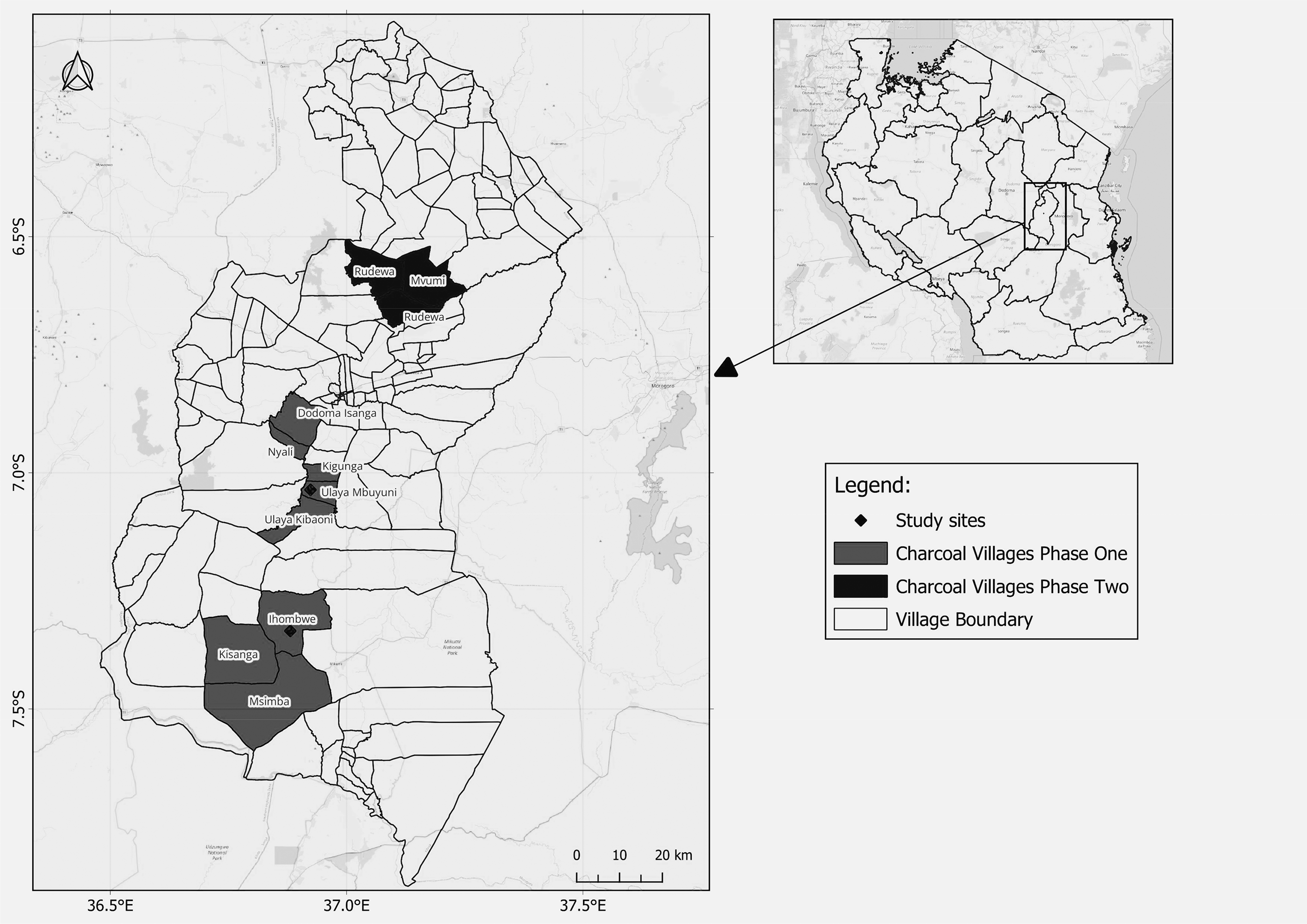
Map Showing the SCP Project Villages.
In our study villages, Ihombwe and Ulaya Mbuyuni (Table 1), CBFM and the village land forest reserve were preceded by TFCG-facilitated village land use planning. The TFCG supported the creation of two locally elected resource committees: the village natural resource committee (VNRC) and village land use management committee (hereafter land committee). These were responsible for managing forest management units (FMUs), where specific uses such as charcoal making, firewood collection, and timber harvesting take place. Four legislative acts and one set of guidelines established this governance framework: the 1975 Villages and Ujamaa Villages Act, the 1982 Local Government (District Authorities) Act, the 1999 Village Land Act, the 2002 Forest Act, and the 2007 national CBFM guidelines (MNRT, 2007; URT, 1975, 1982, 1999 and 2002).
Village Characteristics.
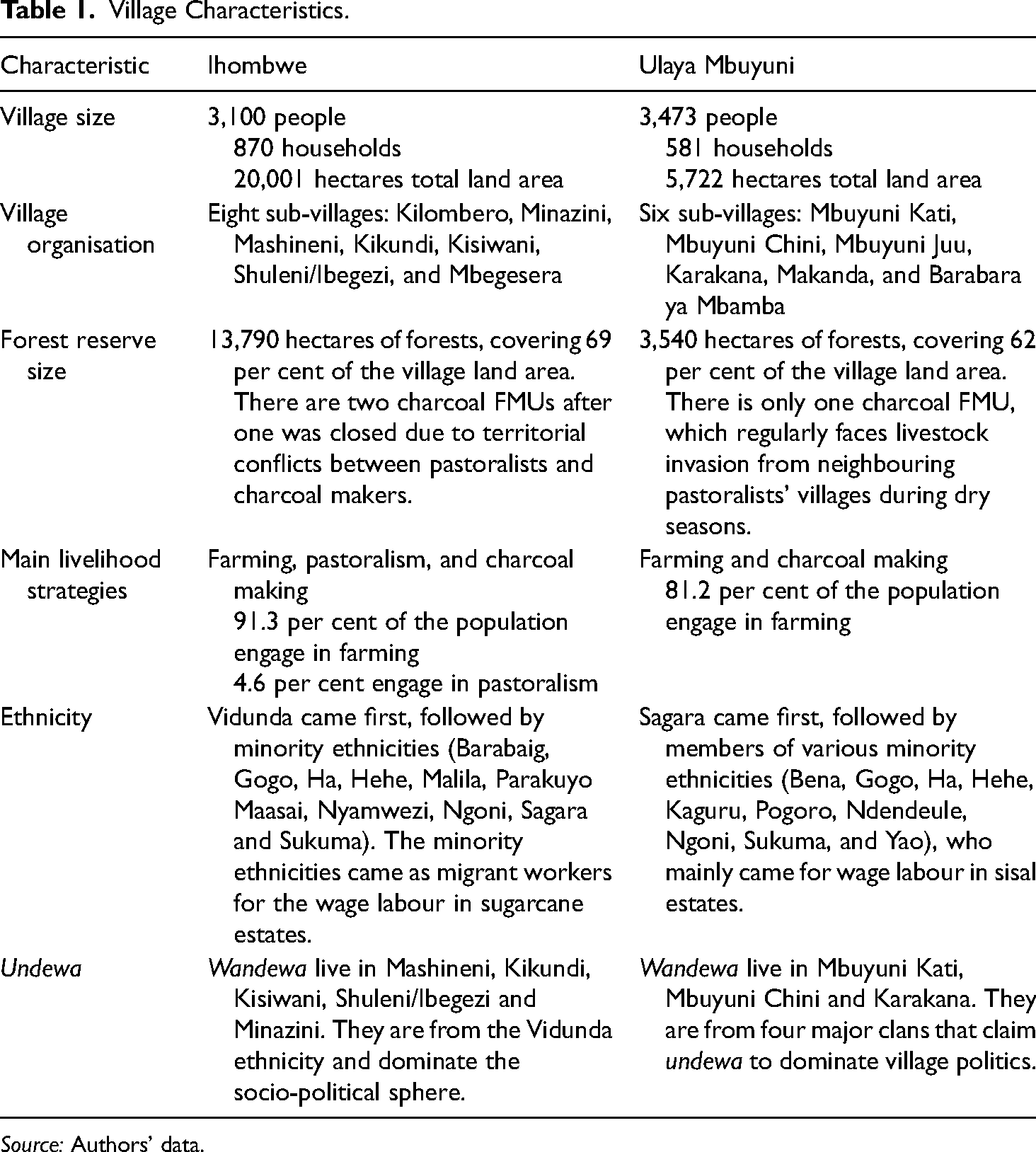
Source: Authors’ data.
The 1975 Act introduced a nation-wide village governance framework based on a village assembly, where adult village residents (at least eighteen years old) perform direct democracy (Greco, 2016). The assembly gathers once a quarter to provide “a public space to discuss the conduct and the decisions of the village leadership” (Greco, 2016: 24). Once every five years, villagers elect the village leadership: a village council (a board of a maximum twenty-five representatives); a village chairman; and hamlet chairmen (Greco, 2016). The state posts a paid and trained village administrator, the Village Executive Officer. The CBFM guidelines grant the council authority to own and govern forest resources on village land; the council acts on the assembly's recommendations (Ministry of Natural Resources and Tourism [MNRT], 2007). The 1982 Act treats both the council and the assembly as key village government's organs, describing the assembly as the villages’ supreme authority (United Republic of Tanzania [URT], 1982). The assembly is an arena for promoting collective action and reinforcing popular democracy, as its members have voting and vetoing powers (Greco, 2016). Both CBFM and SCP were implemented within this village governance framework. This statutory framework complexified resource access, which in rural societies is traditionally based on ancestral entitlements (Lund and Boone, 2013). However, it made our study villages interesting as intra-community differentiations were still embedded in migration-and-settlement histories that entitled firstcomers to privileged access to resources and governance. This commonly occurs in CBC interventions, as statutory frameworks assume communities to be groups of homogenous individuals, possessing common characteristics (Agrawal and Gibson, 1999).
Methods
Information for this analysis comes from a range of ethnographic methods carried out during seven months of fieldwork from April to September 2016 and in January 2017. Mathew started fieldwork by conducting a focus group discussion with village council members. This discussion guided purposive selection of initial respondents, as discussants suggested people with information to answer the research questions. Through snowball sampling, he later selected more respondents. In total, he conducted sixty-nine in-depth interviews. He paid attention to respondents’ heterogeneity based on settlement history and location of residence. He then had fourteen additional focus groups with charcoal producers, farmers, pastoralists, elderly people, youth groups, and members of the village resource and land committees. He also attended ten VNRC's closed meetings as an observer, and he shadowed four events. He shadowed the village chairperson, VNRC members, and a CBFM official in a land boundary dispute in Ihombwe (see McDonald, 2005). He shadowed one VNRC's forest patrol when it investigated an invasion into a charcoal FMU, in which Ihombwe's village and VNRC chairpersons had allegedly allocated over 40 hectares of land to a non-resident. He followed Ulaya Mbuyuni's VNRC during its allocation of charcoal plots to registered producers. And he shadowed Ulaya Mbuyuni's village executive officer, sub-village chairpersons, and resource and land committees’ members when they summoned farmers from minority ethnicities to explain their cultivation inside the village forest reserve. He further conducted four expert interviews: one with SCP officials, one with the Tanzania Forest Service's district manager in Kilosa, and one each with SCP's technical adviser and the Swiss Agency's programme officer in Dar es Salaam. We ensured participants’ anonymity and confidentiality by removing their real names, while accepting that at the individual level this may not be enough to protect them from harm 1 (St. John et al., 2016).
Historical Origins of Intra-Community Differentiations in Kilosa
Pre-independent Tanzania was organised around ethnic-based institutions (Beidelman, 2012; Brennan, 2017). In rural Kilosa, one institution, the undewa, predominated. Undewa is a socio-political institution and social identity mechanism founded on the claim of “we got here first,” with the goal of controlling village affairs. Property, leadership, and authority have always been passed on along clan and ethnic lineages, and the history of settlement formation shaped the property institutions (Beidelman, 1966, 2012). As Brennan (2017: 2) notes, “indigenous insiders or first-comers” claimed “political authority over a given territory and people.” This is what the Vidunda, the first settlers in Ihombwe village, did in the early 1950s, as they organised and regulated their everyday lives and practices under one mndewa (leader of the firstcomers) (Beidelman, 1966). In Ulaya Mbuyuni village, the first settlers, the Sagara, also did the same (Beidelman, 1978). This “meant that the latecomers had to recognize the former's ownership and ritual authority over the land, as well as their mythical accounts of original settlement” (Brennan, 2017: 3). For easier governance of people's everyday affairs, the British colonial government encouraged ethnic identity and accepted the customary institutions (Beidelman, 2012).
However, after obtaining independence in 1961, the Tanzanian government abolished chieftainship and its customary institutions (Beidelman, 2012; Boone and Nyeme, 2015; Greco, 2016). Through President Julius Nyerere, the government built a centralised state structure (Mamdani, 2012), promoting one generalised “African culture” to displace tribal identity with a national one (Beidelman, 2012). Nyerere's nation-building project aimed to remove “the colonial legacy of a division between customary and civil law on the one hand and civil and native authorities on the other” (Mamdani, 2012: 109). He admired the idea of non-ethnic culture (Lofchie, 2014), showing zero tolerance for ethnic favouritism of any form at any level (Brennan, 2017; Mamdani, 2012; Shivji, 2012). Some scholars argue that this nation-building policy resulted in a lower salience of ethnicity in Tanzania than in neighbouring nations such as Kenya (e.g., Achiba and Lengoiboni, 2020; Lacan, 2023). By extension, some argue that resource institutions and access are not shaped by concerns over who really belongs to the land in rural Tanzania (Boone and Nyeme, 2015; Lofchie, 2014).
Claims to the contrary, notwithstanding, Nyerere's nation-building project did not entirely eliminate the ethnic-based distinctions that before influenced socio-political organisations and everyday lives of rural societies, such as those of Kilosa (Beidelman, 2012). Intra-community struggles that have historically been at the centre of agrarian economies in Tanzania (cf. Shivji, 1978) were ignored. In Kilosa, strong opposition arose to the displacement of an ethnic identity with a national one, as this was at odds with how traditional societies functioned (Beidelman, 2012). For instance, the clan- and ethnic-based socio-political institution, undewa, was maintained, as wandewa (firstcomers and their descendants) retained their customary control of land resources and entitlement to govern and control village affairs (Beidelman, 1978, 2012). This sense of entitlement reigned among wandewa despite changes in Kilosa's socio-political organisations in the 1960s and 1970s.
The formal abolition of customary authorities and the development of a wage-labour economy based on sisal and sugarcane estates in and around Kilosa changed local society but earlier exclusionary patterns remained (Benjaminsen et al., 2009; Hirst, 1972). According to Hirst (1972: 231), the labour economy attracted a large number of migrant workers from other parts of Tanzania, bringing “a degree of contact between all tribes within a country which far surpassed that of the past.” This changed spatial organisation of rural Kilosa. After the sisal economy collapsed in the 1980s, the workers remained as peasants in many villages in and around the former estates. Today, these former wage labourers and their descendants constitute a substantial proportion of the inhabitants of these villages (Benjaminsen et al., 2009). Traditionally, wandewa leaders had authority to accept or reject latecomers (Beidelman, 1971, 1978). The latecomers, who were mainly wage labourers in the estates, thus remained excluded from the socio-political institutions and occupied a considerably inferior position (Beidelman, 2012). It is in this context of exclusion, that we investigate the CBC intervention and their impact on how social differentiations based on identity and migration-and-settlement histories mediate access to land resource and change claims for recognition.
Findings
After several days of ethnographic fieldwork, it became obvious that some villagers emphasised their belonging to the villages based on “migration-and-settlement” history, using the claim of being the first to settle in the villages to marginalise those who came later. The prominence of this discourse pointed us to the need for a nuanced investigation of divisive migration-and-settlement claims in everyday resource governance. The following findings thus address mechanism of access for exclusion by retelling incidents that happened in the villages and talking claims used to maintain or gain recognition. The findings operationalise Martin et al.'s (2016) recognition components by illustrating: (i) mechanisms for exclusion and recognition injustices, (ii) harms of the exclusion and injustices, and (iii) the CBC approach as a solution framework for the (mal)recognition.
Mechanisms for Exclusion and Recognition Injustices
Spatial Organisation of the Village
Ihombwe and Ulaya Mbuyuni were formally established during Tanzania's 1970s villagisation programme, which was part of Nyerere's nation-building project. Ihombwe was founded in 1973/74. Before its formation, there were two residential areas: Luhembe in the northern part and Mfilisi in the southern part. One Vidunda elder noted about Luhembe: It is in Luhembe where the Vidunda people first settled in the early 1950s. But, Luhembe was not easily accessible as was Mfilisi, which had a better road thanks to the Tanzania-Zambia Oil Pipeline Limited's construction of the road to its pumping stations in Mbegesera and Kikongi, a neighbouring village. Thick and dense forest vegetation covered and surrounded Luhembe, which had wild animals like leopards, lions, and elephants, making it closed for the outsiders. This made it dangerous for our children to attend classes in the primary school, which was located in Mfilisi (Interview, Ihombwe elder, 22 June 2016).
In 2012, contestation over the spatial organisation recurred when TFCG offered to build a new village office as part of the SCP's operations. Mfilisi residents demanded the location to be alongside Mikumi-Kilosa highway that connects the village, citing poor accessibility to Luhembe during rain seasons as the reason. But, wandewa wanted the office to remain in Luhembe. They were even more hostile and overtly offensive towards the latecomers during discussion meetings. One informant said, “During the meetings, several wandewa openly said ‘[We] cannot accept any propositions these wachoma mkaa [charcoal producers] and wakuja [passersby]’ make about our village.” 6 Wandewa used the terms wachoma mkaa and wakuja to connote the latecomers as dirty forest destroyers and careless people with no permanent rights of residence. One informant added, “their higher social status leads them [wandewa] to believe that they have legitimacy to make uncontested propositions on village affairs.” 7
Village Leadership Positions
The village assembly has statutory powers to elect the village council, village chairperson and village committees. Wandewa have held village chairpersonship positions since 1974 even though, as of January 2017, they constituted slightly less than half of the households and population in both villages. 8 For instance, Ihombwe has had five village chairpersons, all from wandewa sub-villages (Table 1). In Ulaya Mbuyuni, four wandewa clans had held leadership positions since 1974. Three people from these clans had held chairpersonships for over twenty-nine years in total. Filling these positions rewarded wandewa with bargaining power over lucrative positions and memberships in village committees. Informants noted that the VNRC is the most desired. Election of its members occurs every three years, with each sub-village getting two positions. In Ihombwe, wandewa had ten out of the sixteen positions. Besides, two wandewa siblings acted as chairperson and treasurer of the VNRC. The treasurer's wife was a sub-village chairperson and council member. And the treasurer's son kept the village's GPS device, used for geo-referencing charcoal production plots. He was also the land committee's secretary.
Irrigated Farmlands
As firstcomers, wandewa occupied land where there are streams that do not dry up entirely even during the worst of the dry season (Beidelman, 1971). One informant said, “These people [wandewa] have larger tracts of agricultural land and possess all irrigated farmlands and valleys.”
9
The valleys are relatively fertile due to alluvial deposits that the rainy season floods bring. These conditions enable wandewa to farm throughout the year: maize, beans, and cowpeas in migunda fields (permanently cultivated farmlands), and African eggplant, tomato, amaranth, pumpkin, and green pepper in malolo (valley gardens). Malolo are the most important, as they are well watered, the most fertile and the freest from rocky soils. The ethnic-based access to migunda and malolo allow wandewa to earn more than the latecomers. One young mndewa narrated the following: Mostly, it is the young people [from wandewa] who farm in the malolo. They are used to such a farming practice. In the malolo, there are two farming seasons: from June to July, and September to October. On average, the land occupancy is around 1ha per person. In a good season, one can get forty viroba [a local measurement for a 50 kg sack] of African eggplant, where each kiroba [singular term for viroba] is sold at Tanzanian shillings [TZS] 45,000 [approx. US$19]. That means one person can get TZS 1.8 million [approx. US$781] in a good season. That is why we [wandewa] are not interested in making charcoal (Interview, Ihombwe resident, 11 July 2016).
On the other hand, the latecomers occupied miteme farmlands on the villages’ margins. Miteme are bush fields that are not fertile and are good for no more than one or two years of farming. They are also poorly watered, very rocky, and covered with trees and scrub, requiring arduous labour to clear (Beidelman, 1971). Farming in the miteme is completely rainfed. As maize cultivation is mostly rainfed, half of the latecomers who cultivated maize, thus farmed in the miteme (IVC, 2013; Ulaya Mbuyuni Village Council, 2012). Declining mean annual rainfall has decreased maize yields in the Morogoro region (Paavola, 2008). With the dual function of maize as a food and a cash crop, the decreased yields adversely affected the latecomers. For wandewa, miteme held no economic significance and only those with land insufficiency would trouble themselves to cultivate there. But, for the latecomers, miteme occupancy and low productivity forced them to be charcoal producers as a critical livelihood diversification strategy. For example, Ulaya Mbuyuni had eighty registered producers, with 40–45 being active. Ihombwe had sixty producers, all latecomers. A producer received a 50 × 50 m2 plot from the VNRC. On average, the plot generated fifty sacks (50 kg each) of charcoal. 12 One sack was sold between TZS 10,000 and 14,000 [approx. US$4 and 6]. 13 Hence, at an average price of TZS 12,000 [approx. US$5] per sack, from one plot a produce earned around TZS 600,000 [approx. US$260] – one-third of mndewa's earnings from a malolo at the same time of year. Next, we present the consequences of these forms of marginalisation.
Harms of the Exclusion and (Mal)Recognition
Spatial Organisation and Bargaining Powers
Living near the village office gave wandewa leverage over decision making for everyday village affairs. As per the earlier mentioned village governance legislations, the village council's supreme authority is legitimised by the village assembly. The assembly's venue is usually where the village office is located. Being at the margins of Ihombwe, many residents in Mbegesera sub-village regularly missed village meetings, as they resided eighteen kilometres from the office. Conversely, as wandewa lived close to the village office, they often attended the meetings. The latecomers’ absence meant that they missed opportunities to hear, discuss and (dis)approve of village affairs, such as the selection of the VNRC leadership, village revenues, and expenditures.
For example, in July 2016, the Kilosa District Council's Committee on Finance, Environment, and Construction visited Ihombwe to learn about the SCP. The visit started with a meeting at the village office. There was a plan to visit Mbegesera before the afternoon. But, the committee arrived in Mbegesera at around 6 p.m., when most of the residents had already left the meeting point. 14 The residents became frustrated as they intended to let the committee know about their lack of charcoal FMU, marginalisation from village affairs, and unfair distribution of charcoal revenues. 15
Besides, both wandewa and the village government perceived the latecomers to be wajuaji (hypercritics). One informant explained: People and leaders at kijijini [wandewa territory where “rightful owners” of the village reside] prefer when we [latecomers] cannot attend village meetings, because they know we are going to ask them difficult questions regarding charcoal revenues and expenditures. That is why it is common for visitors who come to Ihombwe to learn about “successes” of sustainable charcoal [the SCP] to either arrive late in the evening or not arrive at all in Mbegesera. The village government does this purposely, knowing how big Ihombwe is, they should plan time wisely, so even people in Mbegesera can have time to interact with the visitors (Interview, Ihombwe resident, 9 July 2016).
Status Domination and Inequitable Income
Scott (1990: 28) notes that “to have higher status is to have a stronger claim to rewards. It is also to have greater access to the means of enforcing the claims.” Wandewa used several strategies to claim and enforce rewards through their supposedly higher status. We present two strategies of interest to this analysis: village leadership domination and customary access to irrigated farmlands (presented earlier).
The leadership domination mentioned earlier enabled wandewa to (mis)use the statutory institutional setup for their financial benefits. Leadership came with cash allowances. Accessible through participation in the SCP, the allowances driven some wandewa to hold on to VNRC leaderships. Wandewa had no interest in charcoal making. They associated it with tuberculosis and perceived it as a cumbersome activity that involves high energy inputs with low returns. 16 The allowances made participation in the SCP activities lucrative. Each VNRC member received TZS 5,000 (approx. US$2) for doing forest patrols twice per month, meeting once per month, and allocating charcoal production plots. For the member, the allowances applied even for ad hoc forest-related activities. 17 In Ihombwe, both the secretary and treasurer received monthly allowances of TZS 100,000 (approx. US$43). In Ulaya Mbuyuni, they each got TZS 70,000 (approx. US$30). Moreover, in any activity that the TFCG organised, participants usually received an allowance of TZS 5,000.
There were also travel-related allowances. Occasionally, the TFCG sponsored VNRC members to attend workshops, exhibitions, and study tours outside the villages. The members received travel and subsistence allowances. One informant noted, “[O]n one occasion, knowing about allowances, Ulaya Mbuyuni village chairperson [mndewa] chose his nephew to attend a workshop in Kilosa, even though the nephew was not a VNRC member or engaged in forest conservation.” 18 In Ihombwe, the wandewa-dominated VNRC selected wandewa to attend charcoal training workshops even though none of them engaged in charcoal making. One respondent said, “[T]hey basically attend for allowances, taking spaces from those in need of training to acquire official recognition as charcoal producers.” 19 Moreover, VNRC leaders received allowances when travelling to Mikumi and Kilosa towns to withdraw money generated from charcoal sales. Ihombwe purchased a motorcycle to reduce travelling costs. But, sometimes the leaders used it and still took allowances. 20
Despite their lack of involvement in actual charcoal production, wandewa got involved more in governance activities to benefit from SCP-related allowances.
Next, we present how the latecomers used the SCP as a framework (response to the harms) to redress the exclusion and (mal)recognition.
Community-Based Conservation as Strategic Opening
The governance spaces that the SCP brought opened up the latecomers’ options for negotiation and enforcement of their recognition as residents. Analysts of CBC interventions argue that initiatives such as the participatory forest management promote a culture of villagers questioning the performance of their local institutions (e.g., Brockington, 2007; Mwamfupe et al., 2022). This was true with our case, as one informant narrated: One beneficial thing that sustainable charcoal [the SCP] has brought into our village is giving villagers courage to question and be critical of the village government and its leaders’ conduct. In this village, it had never happened that villagers were against the village council's decisions. But, during the VNRC election, villagers were against the council's proposed election procedure of screening candidates before villagers’ voting at the sub-village assemblies (Interview, Ihombwe resident, 7 July 2016).
First, the latecomers did not want the village council to have leverage in selecting people into the VNRC. The national CBFM guidelines state that “The VNRC must be elected by the Village Assembly and not appointed by the Village Council” (MNRT, 2007: 5). However, the council proposed to receive membership applications, screen and pre-select them, and submit the screened applications at each sub-village assembly for election. The latecomers wanted to have actual choices between applicants. They strategically sought to elect people from their group (wajuaji) who are known for raising critical issues such as village's financial transparency. 22 When the council did not submit names of their favourite applicants, they boycotted the elections and demanded a resubmission of all applicants’ names. 23 On 2 June 2016, a re-election was held in Bomba with all applicants.
Second, the latecomers desired to have a new VNRC without any residual members. 24 They did not trust the wandewa-controlled council. But, their desire conflicted with the CBFM guidelines. The guidelines state that for continuity, only one-third of VNRC members should be removed and replaced by new ones (MNRT, 2007). The council capitalised on this instruction to justify its screening procedure. One council member explained, “[T]he procedure was necessary for retaining some members. This would avoid costs of training new members, as TFCG clearly said that there was no longer a budget for that.” 25 Owing to the wandewa's domination and the mistrust of governance system, the latecomers rejected the cost-saving logic and insisted on ousting all members, especially those with undewa identity.
Third, the latecomers wanted to elect VNRC leaders by voting at general assemblies. They reacted against the village chairperson's claim that VNRC members should elect their own leaders. On the reaction, one informant explained, “[V]illagers want to elect VNRC leaders at the assemblies, so that they could hold them accountable through the same assemblies.”
26
The national CBFM guidelines are silent on this. The reaction led to a strategic formation of an alliance of young villagers from both groups (firstcomers and latecomers). The alliance wanted to set a precedent for their control over the VNRC and its leadership. The young wandewa wanted to end their subordination to a dominant wandewa clan, which had four family members holding powerful positions in the council, resources, and land committees.
27
The young latecomers wanted to stop wandewa's leadership domination. This reaction forced the council to ask for TFCG's intervention. On 13 June 2016, a SCP field officer met the council. The council's chairperson and the officer opposed the villagers’ demand to elect VNRC leadership. The officer said: Too much democracy brings chaos and tension. If you allow villagers to elect VNRC leaders, a lot of time would be used; and revenues from sustainable charcoal would decrease, as you would spend time resolving tensions over the election. You have lost resources and revenues due to the absence of a functioning new VNRC. The democracy achieved so far is enough. The villagers’ demand is genuine, but its implementation will be difficult and will take so much time (Participant observation, Ihombwe village office, 13 June 2016).
Discussion
How does a sense of belonging to a village and specific ethnic lineage mediate resource access where nation-building and the displacement of tribal and ethnic identities have been on the political agenda since independence? Our findings reveal that claims about who really belong to the land based on “we got here first” claims played a role in resource access and governance. The claims produced distinct types of intra-community differentiations and patterns of resource use and governance. They represent structural mechanisms that facilitate exclusion and injustices (cf. Martin et al., 2016). The spatial organisation of the villages gave the firstcomers a capability to participate in decision-making processes, as they lived nearby the village offices, commonly used as meeting venues. Undewa gave the firstcomers privileged access to leadership positions and productive farmlands, imposing their status domination. These claims, and ensuing injustices as a result of migration-and-settlement histories, are becoming increasingly common in Africa (Côte, 2020; Koot et al., 2019; Lacan, 2023). Our findings thus support the understanding of these “we got here first” claims as both economic and socio-political strategies of resource inclusion for the firstcomers and exclusion for the latecomers (Karambiri and Brockhaus, 2019; Koot et al., 2019; Lau and Scales, 2016). Our findings contrast with the claim that, when compared to nearby countries, ethnic-based differentiations are less prevalent in Tanzania's resource governance (Boone and Nyeme, 2015). As a socio-political and ethnic institution, undewa clashes with the idea of non-ethnic society, which is a core element of the Tanzanian “nation-building” project, as it contradicts the country's ideals on citizenry.
The claims to have settled in the villages first produced what Martin et al. (2016) call “harms”: the injustices that the latecomers suffered. Being called wachoma mkaa [charcoal producers] and wakuja [passersby] represented cultural subordination of the latecomers and (mal)recognition. Being located far away from the village meetings’ location undermined the latecomers’ participation in village governance. Bluwstein et al. (2016) report a similar observation from a CBC scheme in northern Tanzania, as a village office location gave villagers living closer to it more lobbying power over access negotiations. Moreover, our focus on recognition justice enabled us to better understand roots of injustices and their resulting injustices (cf. Massarella et al., 2020). For instance, as a result of resource and income inequalities rooted in the firstcomers’ perceived privileged access to leadership positions and irrigated farmlands, latecomers were forced to be charcoal producers. They thus produced charcoal as a strategic response to the marginalisation and unequal farmlands access. These harms represent recognition injustices, which occurred through unequal encounters as the relatively powerful wandewa failed to recognise the value of the latecomers as residents. Martin et al. (2016) note that the recognition injustices tend to produce status differences that limit opportunities of the marginalised actors, resulting to both political and economic inequalities. Consequently, these harms and injustices drove the latecomers to react by claiming recognition and inclusion as residents as part of the CBC intervention.
In what ways did the CBC intervention reinforce marginalised people's claim-making for recognition and inclusion? Our findings reveal that the onset of the SCP opened-up governance spaces for rebellion against undewa, giving the latecomers opportunities to alter the existing unequal power dynamics. The intervention created more equitable spaces for engagement and deliberation in questioning local institutions and village governance malpractices (Brockington, 2007; Mwamfupe et al., 2022). The opportunity to elect VNRC representatives from each sub-village was one of such spaces. For the latecomers, as a CBC intervention, the SCP thus presented “strategic opening” (Lund, 2013) to advance their recognition claims. The latecomers used “talking claims” both individually and collectively at different village meetings. In laying their counterclaims, they chose individuals with skills of “knowing how to talk” as a strategy to direct meetings and decisions to their own advantage (cf. García and van Dijk, 2019). Their rejection of the village council's election procedures for VNRC memberships was a strategic move aimed at placing skilled latecomers in the VNRC. They were successful. However, their unsuccessful attempt to control the VNRC's leadership election proved that claim-making strategies to establish access are often contested and far from guaranteed (García and van Dijk, 2019). Failure to control the VNRC's leadership's election is a trend in CBC interventions in Tanzanian forestry sector, where villagers are not fully engaged in or indeed aware of the election (Magessa et al., 2020). Claim-making has then to be maintained through constant negotiations. For instance, constant negotiations were evidenced with the strategic alliance of the young firstcomers and latecomers, which was an attempt to renegotiate access to governance spaces to stop their subordination. The constant negotiations are part and parcel of the need for adequate and effective recognition (He et al., 2021).
Our insights assert the primacy of recognition in the politics of belonging and resource access in environmental conservation. The primacy of recognition justice is becoming apparent in the CEJ literature (Dawson et al., 2021; Martin et al., 2016; Massarella et al., 2020). In addition, the CEJ scholarship elucidates that injustices are often based on claims for recognition. For instance, how the VNRC was populated in the two villages was rooted in the recognition of wandewa as the entitled ones and (mal)recognition of the latecomers as the undeserving ones. Likewise, access to maloloiis determined and maintained by the undewa identity. Such recognitional issues became the foundation for procedural and distributive outcomes which excluded the latecomers. (Mal)recognition practices can thus reinforce inequities in the other justice dimensions as they create unequal playing fields in influencing decision making (procedural) and in distributing responsibilities and benefits (distributive) (McDermott et al., 2013).
These insights expand our understanding of environmental struggles as a complex socio-ecological arena. The arena is both a space for wandewa to claim and maintain control over access and governance and for the latecomers to counterclaim and negotiate their ways for recognition and inclusive governance. Similar to how ethnically marginalised people used opportunities created by a mapping initiative under a forest conservation project to claim territory and resources from state and private interests in Indonesia (Astuti and McGregor, 2017), our case indicates how exclusionary land access and resource governance drove the latecomers to embrace the SCP as a solution framework for the harms and socio-cultural structures that supported their exclusion and (mal)recognition. Their attempt to use the SCP in challenging undewa illustrates CBC's potential to counterbalance the politics and practices of belonging in rural conservation spaces. Despite not always being successful, their attempts reveal a counter-exclusion strategy (Hall et al., 2011), underlining the importance of intra-social stratifications in showing how different individuals experience conservation governance. This understanding is essential for thinking about socially just conservation, as recognition justice is integral to effective and successful CBC (Bétrisey et al., 2018; He et al., 2021). By looking at the strategic openings in the context of claiming recognition as residents and inclusion in resource access and authority, our analysis thus adds insightful empirical dimensions to the CEJ scholarship.
Conclusion
Our findings bear theoretical and conceptual implications for how we analyse governance in CBC interventions. Insights from literatures on access and claim-making help us to expose environmental struggles as an arena of constant contestations and negotiations over recognition and inclusive governance. The constant contestations and negotiations over recognition epitomise an understanding that ongoing environmental struggles in agrarian communities are not only about environmental resources per se (Côte, 2020; Karambiri and Brockhaus, 2019; Lund and Boone, 2013). Apart from constituting what some conservation governance analysts characterise as responses from below (e.g., Asiyanbi et al., 2019; Nepomuceno et al., 2019), the struggles also reveal that there is more than just resistance to CBC interventions. The interventions and governance spaces they bring are also embraced to break intra-community differentiations embedded in exclusionary socio-historical structures. By embracing CBC interventions, the marginalised groups and individuals contest inequitable governance structures and gain recognition. The embracement of CBC structures represents a condition that provides capabilities for the marginalised to counterclaim (mal)recognition tendencies. Uncovering these dynamics and divisive social processes advances our understanding of how resource access and governance are undermined, denied, and maintained in agrarian contexts. It also advances CBC as an approach with potential to counterbalance negative consequences of belonging, as the marginalised use the created deliberative spaces to claim recognition as resident and inclusion in access and authority.
We have used a CBC intervention in east-central Tanzania to elucidate how “we got here first” claims mediate resource governance and how the intervention provides spaces for the marginalised to claim recognition. Ethnicity may not be a salient feature of Tanzania's national political processes as Mugizi and Pastory (2022) indicate, but processes of ethnic-based social differentiation within rural communities such as in Ihombwe and Ulaya Mbuyuni shape resource struggles and responses to resulting recognition injustices. Ethnic-based social identity is rarely discussed as an access mechanism in the context of Tanzanian conservation governance. But, it is a lived reality as Lusasi et al. (2020) also reveal in the governance of forest plantations in southern highlands. Thus, our case provides an illustration of intra-community social differentiations at a grassroots level, in a country where concerns for ethnic-based identities are taboo. This is particularly important to understand, as post-independent African leaders who adhered to nation-building ideologies are long gone. If these intra-community differences are not well recognised in the designing phases, CBC implementation may reinforce pre-existing inequalities. As actionable advices, we first call for CBC project designers’ deliberate efforts to strengthen community sensitisation on resource governance and performance of local institutions. Secondly, the national CBFM guidelines should explicitly recognise the village assembly as the arena for electing both the VNRC membership and leadership.
This case thus expands and pluralises our understanding of the CBC approach. We add new layers of complexity as we demonstrate how the marginalised embrace the approach and the created strategic spaces to claim recognition. We underline the importance of recognition justice in conservation. We argue that CBC interventions should not only be analysed as spaces of dispossession, but also as arenas that present strategic openings for the marginalised to gain political benefits as they contest (mal)recognition practices and negotiate for more inclusive governance. We suggest that CBC should be analysed as an approach with potential to produce political benefits where exclusionary tendencies rooted in the practices of belonging more to the land produce recognition injustices. The described configurations are specific to Kilosa, and they may combine in different ways elsewhere. They thus require continuous investigation elsewhere to inform discussions about just conservation. But, it is worth noting that our argument does not imply brushing aside major social harms that CBC have caused in rural communities in Africa, Asia, and South America. Yet, we argue that while the discussions on alternative just conservation approaches are ongoing (e.g., the convivial conservation proposal – see Büscher and Fletcher, 2020), these place-based insights for recognition and inclusive governance are key going forward. Ignoring these might cause alternative conservation to fail working constructively with local communities by undermining the agency to strengthen their rights and promote their recognition.
Footnotes
Acknowledgements
We would like to thank Ihombwe and Ulaya Mbuyuni villagers for participating in this research study. To carry out this research, MBM received financial support from the Swiss Government Excellence PhD Scholarship, the Human Geography Unit at the Department of Geography, University of Zurich, the ESRC-funded project (grant number ES/I021620/1), and the Research Council of Norway funded project (grant number 250975). MBM also acknowledges the Isaac Newton Trust visiting fellowship at the Centre of African Studies, University of Cambridge. Jennifer Bartmess is thanked for language help and proofreading as are Martina Locher and Stasja Koot for constructive comments that improved earlier versions of this work. We also thank Kasongi Ng’winamila for producing the map in  .
.
Declaration of Conflicting Interests
The authors declared no potential conflicts of interest with respect to the research, authorship, and/or publication of this article.
Funding
The authors disclosed receipt of the following financial support for the research, authorship, and/or publication of this article: This work was supported by the Norges Forskningsråd, Swiss Government Excellence PhD Scholarship, Economic and Social Research Council (grant number 250975, ES/I021620/1).