




Abstract
With most existing research on party switching concentrating on the drivers of defection and the electoral performance of defectors, this research sheds light on the events that occurred after MPs switched parties but before voters sanctioned them in the next election. Using Nigeria as a case study, I discover that instead of establishing their own parties and banking on their personal popularity for electoral victory as some have speculated in new democracies, switchers strive to stay within the dominant parties, thereby challenging generalised narratives of weak parties in Africa. Through the utilisation of qualitative and quantitative data from elite interviews and an original dataset, I equally discover that name recognition and fiercely contested primaries make dominant parties in Nigeria simultaneously the net gainers and losers of party defectors. Additionally, evidence shows that while switchers are more likely to get ballot access than non-switchers, they similarly become targets of party retaliation.
Introduction
With several scholars asserting reelection bid as the major driver of party switching both in developed and developing democracies (Aldrich and Bianco, 1992; Desposato, 2006; Fashagba, 2014; Mann, 2000), I venture further by unpacking the patterns of movement in the “electoral black market” as Arriola et al. (2021) termed it, by questioning which political parties defectors preferred to switch to, why they chose those parties, and the implications of these for our understanding of Nigerian party politics and African politics more broadly. Existing literature have revealed that MPs switch parties when their reelection prospect is threatened by either a dip in their party popularity (Zielinski et al., 2005), the emergence of a popular candidate gunning for their seat at the party primaries (Aldrich and Bianco, 1992), or intraparty squabbles (Nielsen et al., 2019). I focus on the events between when MPs (members of parliament, known as senators and members of the House of Representatives in Nigeria) switched parties and the next election, as these events help to further clarify their motives for switching, whether the tendency to switch differ among groups of MPs (by gender, experience, region, etc.), and the barriers of entry, if any, to switching into another party.
I analyse these important events and movements that occurred after MPs switched parties but before voters sanctioned (approved or penalised) them in the next election in Nigeria, Africa's biggest democracy, with numerous cases of party hopping in the last decade. By examining the patterns of switching in Nigeria's seventh and eighth federal assemblies (2011–2019) (the house of representatives and senate), I discover that instead of establishing their own parties and banking on their personal networks and popularity for electoral victory as some have speculated in new democracies (Klein, 2019; Tavits, 2009), switchers strive to stay within the dominant parties – the People's Democratic Party (PDP) or the All Progressive Congress (APC), and tend to only move to smaller parties when their bid to secure nomination from the dominant parties fails. The scope of this research from 2011 to 2019 coincides with the emergence of a strong opposition party in Nigeria (APC) through the merger of about five opposition parties in 2013 which eventually ousted the ruling party in 2015. The presence of a strong alternative indeed influenced the movement in the electoral black market and the destination of switchers as will be demonstrated in this paper. As of the time this paper was written, the dust was yet to settle not only on the electoral outcomes of MPs in the Nigerian 2023 election but also unresolved controversies on candidate selection processes of various parties. Consequently, switching and ballot access in the ninth assembly (2019–2023) were omitted in this research. I argue that switchers need (big) parties not as just mere vehicles to gain political power in settings where independent candidature is disallowed but because of the strengths, visibility, electoral viability, widespread support, and structures of these parties.
Contrary to narratives that the ruling party often benefits more from party switching (Arriola et al., 2021; Fashagba, 2014; Thames, 2007; Young, 2012), I discover more complicated scenarios in Nigeria where the main opposition party netted the highest number of in-switchers both in the seventh and eighth assemblies, thereby questioning the ruling party advantage. Rather, I argue that most switchers, in the seventh assembly particularly, moved into the party they believed was most likely to win the next election to align themselves with the speculated majority party after the elections and the benefits that would come with it. With widespread dissatisfaction with the ruling PDP in its handling of the Boko Haram insurgency and growing corruption, coupled with internal party squabbles on candidate selection, many PDP MPs would have sensed the dim electoral prospects ahead leading to the defection of seventy-seven of them. APC, on the contrary, presented a candidate who was a former military head of state and advertised him as the solution to Nigeria's major problems – insecurity and corruption. However, the table turned in the eighth assembly when clashes with party leaders and accusations of insubordination led APC to suffer the same fate, losing 70 MPs, with most of them (re)turning to PDP. The intense intraparty competition within the ruling party also produced some sore losers as witnessed both in the seventh and eighth assemblies. So, while Nigerian switchers strive to stay within the bigger parties, they often prefer the opposition to the ruling party to shield themselves from the underperformance of the latter and/or eschew tougher intraparty competition.
I proceed to examine the barriers of accessing party nomination after switching in Nigeria and discover that like in Zambia, candidates’ wealth and popularity often make it easier for them to switch and get party ticket for the next election (Arriola et al., 2021). Party leaders from both the PDP and APC admitted as much in the interviews conducted for this research. I equally discover through a binary logistic regression that switchers are twice more likely to get ballot access than their loyal counterparts after analysing quantitative data comparing party nominations of switchers to non-switchers. A different but related logistic model also confirmed that switchers preferred to defect to the opposition than the ruling party both in the seventh and eighth assemblies, and it signalled more competitive primaries in party strongholds.
Furthermore, evidence suggests that former parties can be revengeful and often take actions against switchers. Existing literature on party switching surprisingly has been quiet about this. Apart from threatening to sue them (which they rarely end up doing), parties (APC and PDP particularly) engage in negative campaigns against switchers, using the fact that they switched parties as an extra ammunition against them. This was glaring in the cases of the senate president and senate minority leader. The former APC chairman also admitted that the party spent lots of resources to ensure that the senate president lost the 2019 election to send a strong message to him and other members contemplating defection.
In sum, I find a symbiotic relationship between switchers and political parties in Nigeria. While switchers try to stay within either the PDP or APC to improve their electability, these parties also encourage wealthy and popular politicians to switch into them to maintain their strength and dominance. Those unable to withstand the intraparty competition within the PDP or APC but who still wish to compete in the coming election join smaller parties and bank on their personal popularity and network to see them through. Generally, I find that switchers get more ballot access than non-switchers but could face negative campaigns from their previous party, thereby raising fears for their reelection chances.
Theory and Method
The camp is divided on the nature of party institutionalisation in Africa. Whilst some argue that African parties suffer from a dearth of ideological and institutional grounding (Manning, 2005; van de Walle, 2003), others find variations within and among African states and refute this generalised narrative of weak African parties (Elischer, 2013; Lebas, 2011; Riedl, 2014, 2018). Similarly, it has been argued that the prevalence of party defection in many new democracies (including those in Africa) is engendered by this weak institutionalisation (Desposato, 2006; Fashagba, 2014). However, ideological convergence as opposed to lack of ideology appears to facilitate this cross-carpeting as Bleck and van de Walle (2013) disclose in their work on the valance appeal of African parties. Riedl (2014) revealingly argues that there are several indicators in measuring party institutionalisation, and different African parties show varied levels of strength and weakness depending on the indicator. The lack of ideological demarcations among many African parties does not exhaust the concept of party institutionalisation since there are other indicators apart from different ideological leanings. Lebas (2011), Riedl (2014), and Angerbrandt (2020) demonstrate that many African parties have connection to society and (regional) public support, key indicators of institutionalised parties.
It is therefore expected that African politicians will consider the networks and popularity of parties while contemplating where to switch to. Consequently, I expect bigger parties with more visibility and name recognition to be the net gainers of defectors, with the latter switching into already established parties as opposed to establishing new ones from scratch contrary to what some scholars have argued (Klein, 2019; Tavits, 2009), to leverage existing party strength and networks. Nonetheless, dominant parties often attract several competing elites (Arriola et al., 2021; Smyth, 2006), thereby tightening their candidate selection process. Since the limited party ticket cannot go round, disgruntled elites and sore losers are expected to find other avenues to gain power, thereby switching out of dominant parties in their hunt for party tickets. Accordingly, dominant parties become simultaneously the net gainers and losers of party switchers. This expectation will be tested through both qualitative and quantitative analyses in this paper.
I collected qualitative data from ten anonymised interviews involving three MPs who switched, one senior legislative aide, three party executives from both the APC and PDP, one gubernatorial candidate who switched parties, one journalist who covered party switching in the Nigerian National Assembly, and one Nigerian sociologist and public analyst and utilised thematic analysis to align the data with relevant themes of this research. In addition, I compiled and analysed an original dataset on party switching in Nigeria and gathered data on variables such as MPs’ history of party defection, gender, ballot access, party affiliation, years in office, chairing of committees, and party strongholds. I conducted two logistic regression models using switching and ballot access as the dependent variables to ascertain which variables correlate with party switching and compare the ballot access of switchers to non-switchers. I equally utilised secondary media sources and press statements released by MPs themselves and political parties on issues surrounding party defections.
Where Do Party Switchers Go and Why?
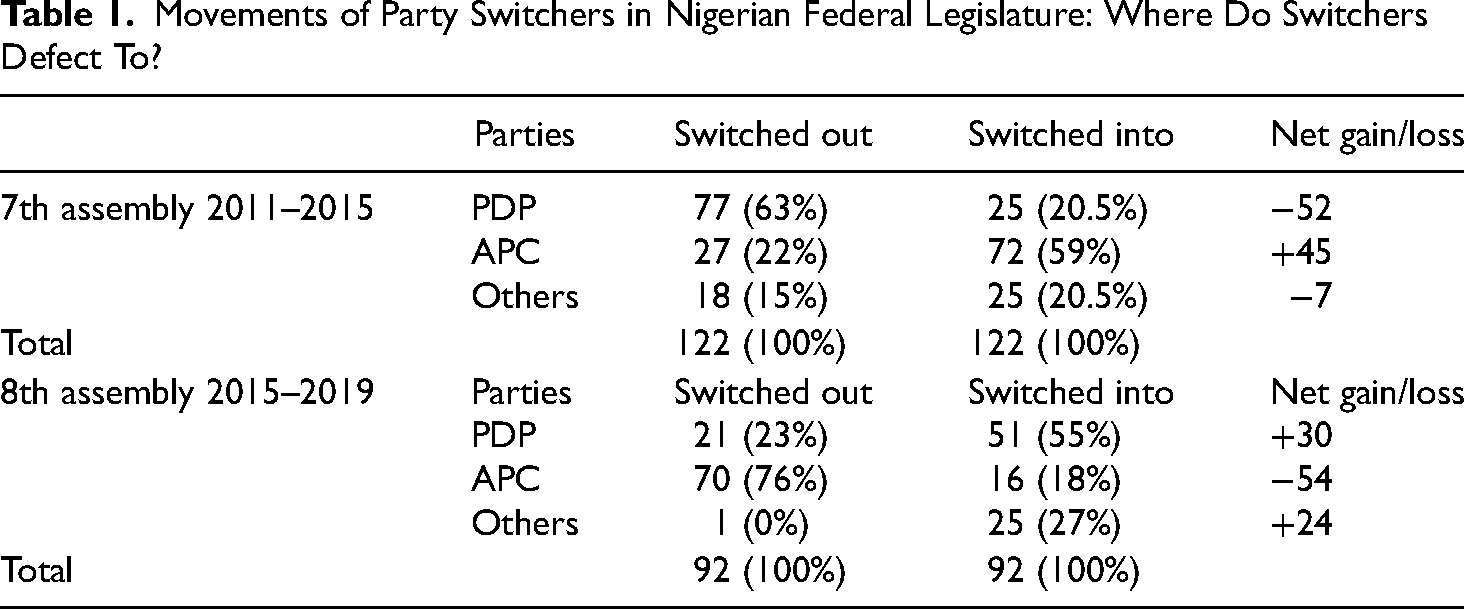
To buttress the point that switching is often a calculated move to improve electoral victory and the gains that come with it, I observe that Nigerian switchers endeavour to remain within the two big parties – PDP and APC. Even though these parties appear to be each other's closest rival, most switchers from one end up in the other. This fluidity between these rival parties can be explained by their ideological convergence or their appeal to the same valence issues as described by Bleck and van de Walle (2013). In fact, parties in Nigeria lack clear ideological demarcations (Fashagba, 2014) but appeal to the same issues such as security, employment, and education in their campaigns. So those who switched from one party to another would not find their new party ideologically incompatible since such delineation did not exist in the first place. However, switchers in Nigeria are selective about the parties they defect into and largely prefer the APC and PDP, even though both parties simultaneously account for the highest numbers of out-switching. As seen in Table 1, whilst the APC and PDP accounted for the highest percentage of all defections (85 per cent in the seventh assembly and 99 per cent in the eighth), 79.5 per cent and 73 per cent of switchers remained within the two parties in the seventh and eighth assemblies, respectively.
Movements of Party Switchers in Nigerian Federal Legislature: Where Do Switchers Defect To?
Their size and structure make them appealing platforms for those vying for office, even those who have cultivated a large personal network. Contrary to the argument that party affiliation becomes less important for politicians with large following because they can drag their supporters to wherever they decide (Klein, 2016; Tavits, 2009), I observe in my interviews that Nigerian MPs in spite of their personal networks also leverage the visibility of PDP and APC to improve their electoral chances (ITA, 15 March 2022; SWI, 12 April 2022).
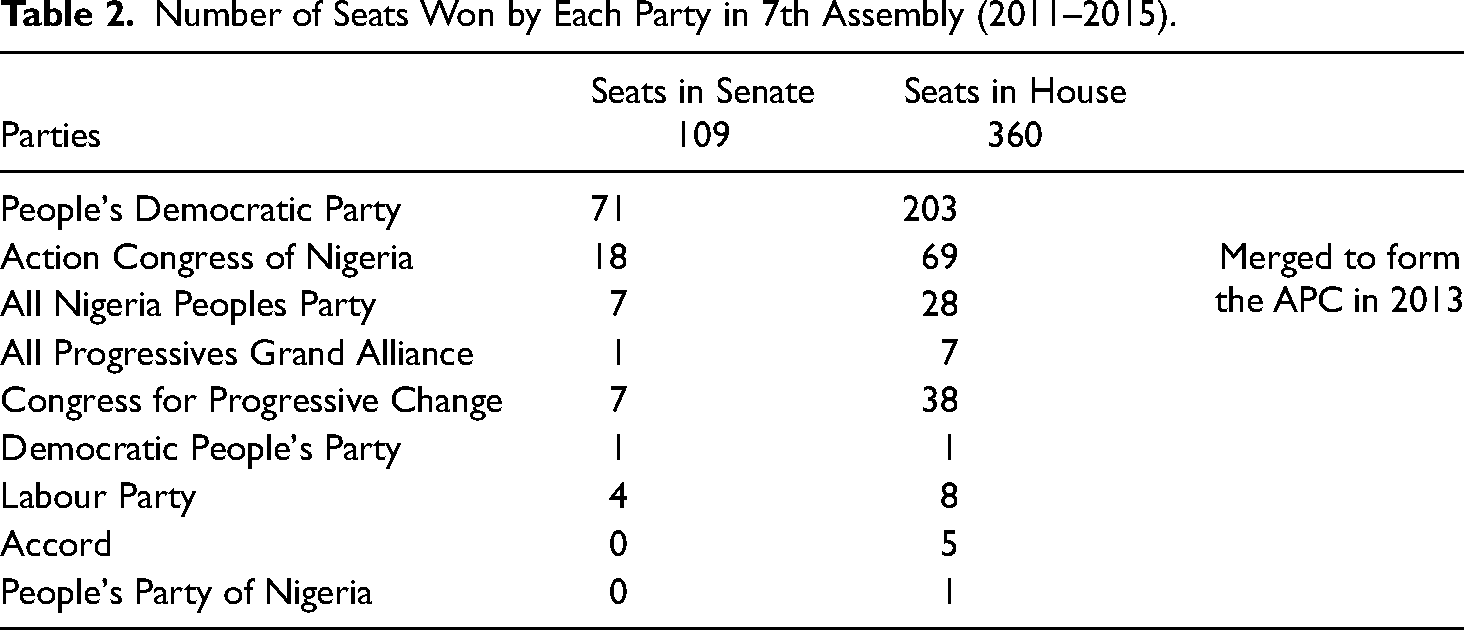
In Nigeria, switchers do not simply join any party but endeavour to remain within the APC or PDP, therefore signalling the strengths of these parties and their link to society. One MP interviewed for this research who argued he defected for policy reasons admitted that he chose to move from the APC to the PDP instead of any other party because of reelection calculations (SWI, 12 April 2022). Both parties have enjoyed majority control in the National Assembly between 2011 and 2019, the timeframe of this research, and equally controlled 98 per cent of the governors’ seats around the country within the same period. PDP was the ruling party from 1999 when democracy was restored to 2015 when it lost its majority to the APC. The latter which was constituted by a merger of about five opposition parties (Action Congress of Nigeria, All Nigeria Peoples Party, Congress for Progressive Change, Democratic People's Party, and some members of All Progressives Grand Alliance [APGA]) in 2013 succeeded in winning power after the 2015 general election. Tables 2 and 3 demonstrate the composition of the National Assembly after the 2011 and 2015 elections.
Number of Seats Won by Each Party in 7th Assembly (2011–2015).
Number of Seats Won by Each Party in 8th Assembly (2015–2019).
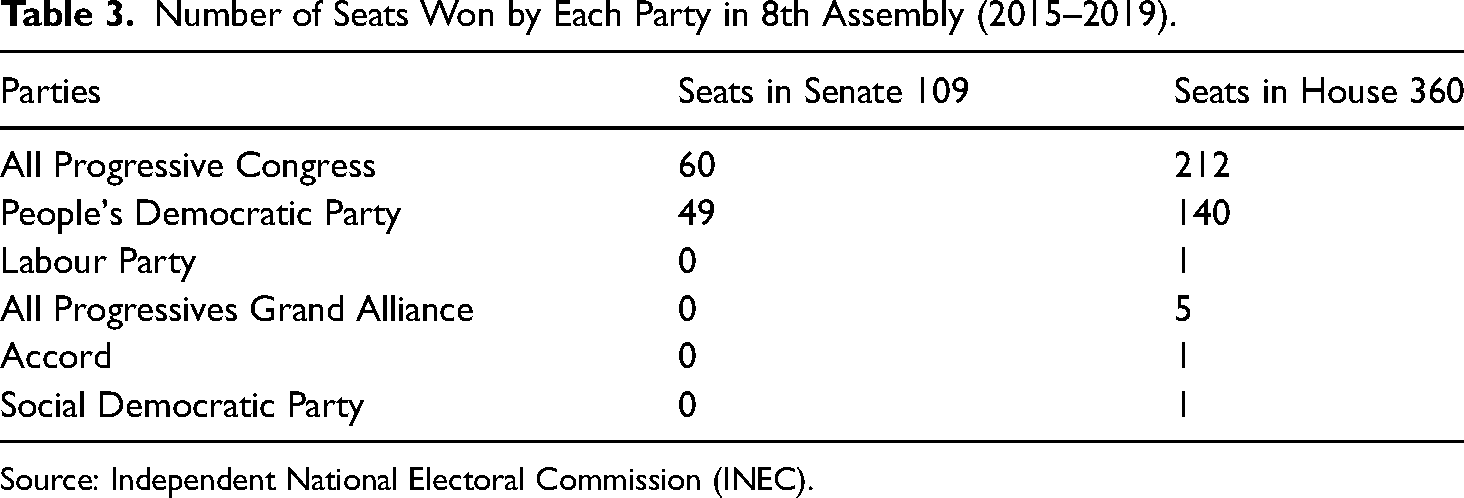
Source: Independent National Electoral Commission (INEC).
With these, APC and PDP cannot be waved off as weakly institutionalised parties even with the absence of clear ideological demarcation between them. We could be witnessing the emergence of a competitive two-party system as found in neighbouring Ghana (Obe, 2019). Although we witnessed the rise of an arguable third force in the 2023 election in the form of the Labour Party (and the New Nigerian People's Party), the election results still suggest APC/PDP dominance. And similar to the observation of Arriola et al. (2021), switching into or remaining in big parties could help defray campaign costs since politicians would utilise existing party structures and networks for their campaign as opposed to building a new party from scratch or struggling to get visibility for a lesser-known party. Since most politicians in Nigeria and Africa more broadly fund their campaigns largely from their own pockets, as opposed to donations from voters and from the private sector (Arriola, 2013), joining a bigger party with existing and widespread structures is more cost effective than building a party from scratch. Relatedly, MPs leverage grassroot support and networks of these big parties to reach voters with the APC and PDP also dominating in the local government level. Since Nigerian state governors have immense control on local government administration (the third tier of government in Nigeria which lacks independence) and the APC and PDP controlling the majority of the governors’ mansions, the parties have a foothold of local governance. Indeed, the visibility of the APC and PDP to everyday Nigerians which has translated to their electoral viability makes them more attractive than other parties that often rear their heads only during the election season. In other words, these big parties dominate the news cycles both during and outside the election season, thereby gaining name recognition among everyday voters. This has undoubtedly improved their electoral viability, making them the preferred option for both switchers and non-switchers alike.
However, I also observe that switchers were more likely to join the opposition rather than the ruling party contrary to intuitive speculations on ruling party advantage (Arriola et al., 2021; Fashagba, 2014; Thames, 2007; Young, 2012). In the seventh assembly, PDP, the then ruling party, incurred a net loss of fifty-two switchers, while APC, the then major opposition party, made a net gain of forty-five switchers (as earlier shown in Table 1), which eventually led to the defeat of the ruling party. This trend reversed in the eighth assembly while still maintaining preference for the major opposition party. Before the 2019 election, APC, after wrestling power from PDP to emerge the ruling party, suffered a net loss of fifty-four switchers, while PDP now in opposition netted thirty in-switchers. This trend raises questions on why switchers prefer the opposition to the ruling party in Nigeria. But unlike in 2015, the APC managed to retain its majority in the house and senate. I argue that particularly in the seventh assembly, switchers wanted to distance themselves from the ruling party which failed to stem the tide of the Boko Haram insurgency and the growing corruption in the country (Owen and Usman, 2015). Zielinski et al. (2005) found a similar trend in Eastern Europe where some MPs abandoned a badly performing ruling party few months to elections to exonerate themselves from blame.
In addition, infighting within the PDP on their presidential candidate for the 2015 election contributed to the ruling party losing seventy-seven MPs. The competitive nature of primaries in these big parties causes intraparty turbulence, more likely in the ruling party than in the opposition where the government resource can be summoned to facilitate electoral victory in the former. Before the 2019 election, many MPs in the ruling APC accused the party leadership of highhandedness, while the latter accused the MPs of insubordination (Ripples Nigeria, 3 June 2019). The then APC chairman claimed MPs wanted preferential treatment and automatic tickets during party primaries, while the latter denounced the chairman as dictatorial and corrupt (Premium Times, 26 July 2018). At the end of the dispute, no less than seventy MPs walked out of the APC.
Furthermore, these internal disputes resulting from the stiff competition within the PDP and APC create opportunities for small parties to lure disgruntled politicians. I observe that parties such as the Social Democratic Party (SDP), All Progressives Grand Alliance, and Accord conduct their primaries/nominations weeks after those of the PDP and APC to lure disgruntled members from the latter. For instance, Senator Gemade from Benue initially switched to PDP few months to the 2019 election but subsequently switched to the lesser-known SDP after he failed to get the PDP nomination, losing the ticket to a former governor (Daily Post, 18 September 2018). The same applied to Honourable Udende also from Benue State, who first switched to PDP and then to APGA where he eventually got ballot access. Fallouts from the APC primaries equally led to the switching of Honourable Stephen Olemija who joined the lesser-known Action Alliance (Pulse News, 22 November 2018) and Honourable Abiodun Dada Awoleye from Oyo State, who dumped the APC for Accord, and many others who moved to smaller parties after losing primaries in the bigger ones. The PDP and APC are similar to the strong parties analysed by Smyth (2006) in Russia, with visibility and organisational capacity, which can afford to reject many candidates including incumbents, some of whom would defect to “parties that have neither reputation nor capacity but can still offer a spot on the ballot” (Arriola et al., 2021: 4).
However, the new electoral act ahead of the 2023 elections has complicated the game for switchers. Unlike previous elections where primaries were conducted latest three months to elections, the Independent National Electoral Commission (INEC) compelled parties to conduct their primaries eight months before the election and within an arguably short window – between April 2022 and June 2022, catching many parties unaware (INEC, 2022). With most of them, including the dominant parties, organising their primaries towards the end of the window when it became clear INEC was bent on the new schedule, MPs had little space to defect after losing their party primaries because even the smaller parties were already fielding candidates by then. So, those who partook in APC or PDP primaries and lost had little space to get nominations in smaller parties because of the tight schedule. I therefore expect a significantly lower number of switchers ahead of the 2023 elections. Unlike the months leading up to the 2015 and 2019 elections where MPs defected in droves, we are unlikely to witness such large movements ahead of the 2023 elections because of the disruptive change in electoral regulations. Preliminary reports show 47 cases of switching in the ninth assembly, compared to 92 in the eighth and 122 in the ninth.
Party Switching and Barriers to Accessing Party Nomination
The fluidity of the movements among parties in Nigeria hints at low barriers of entry further facilitated by ideological convergence among the parties. “You cannot stop sinners from trooping into a church or mosque,” former Lagos state governor Fashola once said about switchers, “what you don’t do is hand over the pulpit to them” (APC United Kingdom Twitter, 2018), implying that while switchers were welcomed into the party, they should be on some kind of probation and not given party privileges immediately. But apart from simply switching from one party to another, many switchers in Nigeria get to compete in primaries or even get outright nomination for the next election within weeks or even days in their new party contrary to Fashola's position. During the mass switching in 2018 which once witnessed no less than thirty-seven MPs walking out of the ruling party on the same day (Premium Times, 24 July 2018), within weeks, most of them participated in primaries in their new party or got outright nomination. So, what then are the barriers, if any, to getting party tickets as a switcher with presumably questionable party loyalty? Demarest (2021a) discovers the strong gatekeeping powers of party leaders in Nigeria, particularly in the APC and PDP, how they set the criteria for who gets what in the party. Fortunately, I was able to interview some regional and national party leaders from both parties on their criteria for accepting switchers and allowing them to compete in primaries. Electability was a key factor mentioned by the party leaders I spoke to, measured by the popularity of the candidates, often with linkages to mobilising structures such as traditional rulers, youth groups, market women organisations, and farmers associations (EPL, 14 March 2022; ITA, 15 March 2022; MDS, 2 March 2022; PAE, 25 January 2022; REO, 11 February 2022; RTE, 2 November 2022; TYE, 12 April 2022). Since electoral victory is the major goal, party leaders often ignore the questionable loyalty of switchers and are more interested in their electability.
Relatedly, wealth is a major consideration and can equally affect the popularity of a candidate. Party executives admitted that the nomination process is expensive, and wealthier candidates, whether switchers or non-switchers, are often the ones who make it through (EPL, 14 March 2022; PAE, 25 January 2022). Indeed, Arriola et al. (2021) found similar scenarios in Zambia where wealthier candidates including those who switched were more likely to get the attention of party executives and eventually win party nomination. Electoral campaigns are expensive, so choosing someone who can afford the bills in the first place is crucial for a good electoral performance. In their words, “party leaders understand that, if their parties are to remain electorally competitive, they must recruit candidates who have the financial wherewithal to meet the costs of clientelistic campaigns” (Arriola et al., 2021: 4). In Nigeria, parties are heavily reliant on financial support from candidates and consequently treat wealthier politicians preferentially. The price of nomination forms is deliberately hiked as a form of fundraising for the party, to screen out those with lesser resources to finance a robust campaign (Ayeni, 2019; Punch News, 30 March 2022). Party delegates who vote in internal elections in either direct or indirect primaries (both are permitted in Nigeria) equally expect and receive financial enticements from candidates (PAE, 25 January 2022). So, money politics is quite prevalent in Nigeria and would bring down any supposed barriers against wealthy switchers.
In some cases, while switchers are allowed to compete in primaries by virtue of their popularity and wealth, they might have to wrestle with another popular and wealthy candidate in their new party. This was the case for Senator Gemade of Benue State who had to compete with a former governor for the PDP ticket in 2019. But in many cases, switchers win party nominations since they would hardly leave their previous party if not confident in getting ballot access in their new one. One MP admitted negotiating with party leaders of the rival party months before officially announcing his defection (SWI, 12 April 2022); another said it would be a political miscalculation to switch into a party where the possibility of getting the ballot access is slimmer than in the previous party (SIO, 2 March 2022). They might have to try multiple parties as witnessed in the cases of Senator Gemade and Honourable Udende who switched twice before the 2019 election, in search of party nomination. This hypothesis that switchers “hunt” for ballot access, thereby improving their chances of party nomination compared to non-switchers, will be subsequently tested in a section of this paper.
Furthermore, lower requirements are expected from smaller parties where the intraparty competition is less intense because of their dimmer electoral prospects, and many switchers can get automatic tickets, banking on their personal networks to help them with reelection. In sum, as indicated by the preferences of party leaders, switchers with popularity and wealth are more likely to get party nomination or at least compete in primaries shortly after they defected into the party. Since electoral victory is the ultimate goal, party leaders consider the electability and wealth of candidates (switchers or non-switchers) to run a successful campaign, while history of political unfaithfulness carries little weight when switchers have fame and fortune.
Ballot Access of Switchers Compared to Non-Switchers
Securing party nomination has been shown to be a major driver of cross-carpeting. Even though switchers prefer to remain within the bigger parties, many of them resort to the smaller ones to get party ticket after their failed bid in either the PDP or APC. In relation to this, Kerevel (2017) discovered that switchers have one major advantage over non-switchers – they are more likely to get ballot access. While Kerevel only tested this in Mexico, the same seems to apply in Nigeria where some switchers even jump ship multiple times to secure ballot access. So, I hypothesise that switchers are more likely to get ballot access than non-switchers based on their ticket-hustling tendencies.
By utilising a binary logistic regression, I hold constant other factors such as gender, party affiliation (ruling party coded as 1 and opposition as 0), party stronghold, house (senate [2] or house of reps [1]), years in office (experience), history of prior switching (those who switched in the seventh assembly and got into eighth assembly), committee leadership, and party merger. The dependent variable (ballot access) is coded 1 for MPs who got ballot access to the next election and 0 for those who did not. I also deploy coarsened exact matching (CEM) to create a control and treatment group which would compare individual MPs from both groups (switchers and non-switchers) with similar attributes. For instance, a male MP in a party stronghold who did not switch is matched with another male MP in a party stronghold who switched. CEM which helps in “reducing bias due to the covariates” is often utilised in fields such as epidemiology, economics, and quantitative political science (Stuart, 2010: 1). Using CEM in logistic regression can help reduce the potential bias that may arise when comparing treated and control groups in observational studies, in this case, switchers and non-switchers. It ensures that the groups are as similar as possible in terms of relevant covariates, making the results of the regression analysis more reliable and interpretable. This approach is particularly valuable when conducting causal inference or assessing the impact of interventions or treatments in situations where randomisation is not feasible (Greene, 2014). Kerevel (2017: 38) equally used CEM within his logistic regression in studying party switching in Mexico – using this matching technique to improve the reliability of his regression results which addresses “the unbalanced nature of the comparison between party switchers and party loyalists.”
However, some observations (MPs) might be left unmatched for lack of similar covariates and are dropped from the analysis (Greene, 2014). By implication, the removal of unmatched MPs will reduce the sample size from the original 469 MPs in each assembly (the eventual number of matched observations will be contained in the regression table in the result section). But before comparing the chances of ballot access between switchers and non-switchers, I check if the aforementioned variables have a significant relationship with switching. I will utilise this to primarily substantiate my argument that switchers in Nigeria prefer the opposition to the ruling party by checking for a significant relationship between switching and party affiliation while holding other variables constant. Statistically significant results of other secondary variables will also be discussed. For instance, are male MPs more likely to switch than female MPs? Or are MPs with more experience less likely to switch than their colleagues with fewer years in the house?
Results from Quantitative Analysis
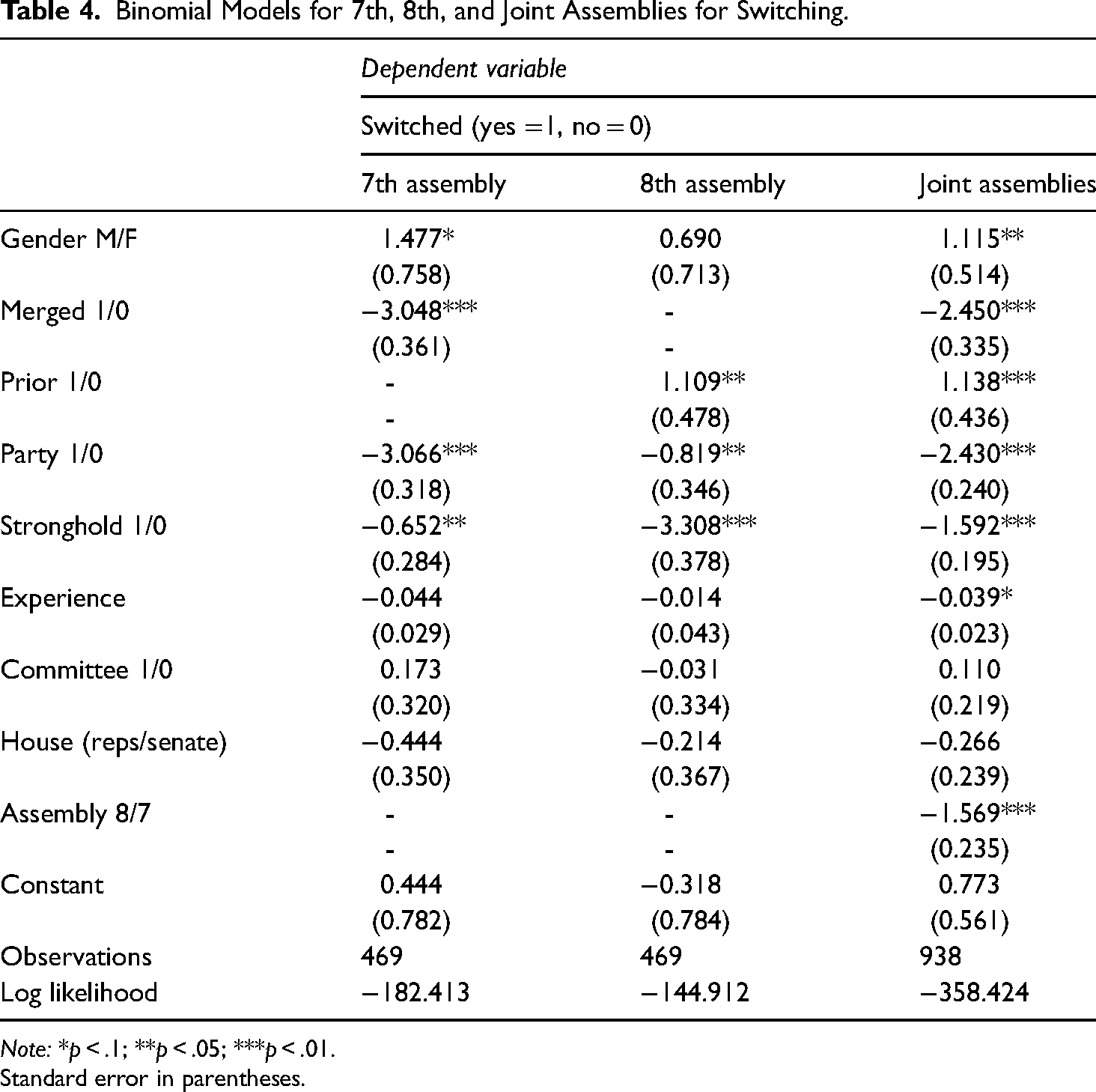
Results from the binary logistic regression shown in Table 4 confirmed that switchers prefer to cross-carpet into the opposition than the ruling party both in the seventh and eighth assemblies, as well as the combination of both. I found a negative and statistically significant relationship between affiliation to the ruling party and switching. In fact, the odds ratio from the joint assemblies showed that switchers were 11.4 times more likely to defect to the opposition than into the ruling party. Interestingly, I also discovered a negative relationship between party stronghold and switching, which is statistically significant across the board. Switchers were five times more likely to defect into parties that are less popular regionally, hinting at more competition for party tickets in strongholds (which compelled some MPs to switch). I equally found other interesting relationships worth discussing. The joint model similarly showed that male MPs were three times more likely to switch than their female counterparts, showing that the tendency to switch is also gendered. But this should be interpreted with caution as there are far fewer women than men in the Nigerian legislature, 1:14 in the seventh assembly and 1:16 in the eighth assembly. While it was difficult to interview the few Nigerian female MPs to probe this further, existing literature on women in African parliaments suggests that those who eventually get into office in a male-dominated environment are usually very committed party members and beholden to party leaders, hence less likely to switch (Clayton and Zetterberg, 2021; Hassim, 2010). Clayton and Zetterberg (2021: 869) further observe “that gendered expectations about proper behaviour limit women legislators’ ability to act independently from their parties,” which can negatively affect their likelihood of switching. Formal or informal party gender quotas can also restrict female MPs from switching since they are not sure the same quotas would exist in the new party.
Binomial Models for 7th, 8th, and Joint Assemblies for Switching.
Note: *p < .1; **p < .05; ***p < .01.
Standard error in parentheses.
Understandably, there was a negative and significant relationship between merged and switching, since MPs involved in the merger in 2013 to form the APC had little reasons to switch out of the APC. In other words, those who merged to form the APC in 2013 already had the 2015 election calculations in mind and saw little need to switch parties, especially since public opinion seemed to favour the APC. The regression results likewise showed that those who switched in the seventh assembly were three times more likely to switch again, than other MPs, as shown in the statistically significant positive relationship between switching and prior (those who switched before). In fact, the collected data showed that 47 MPs out of 122 who switched in the seventh assembly switched yet again in the eighth assembly.
For the model on ballot access/party nomination shown in Table 5, I found a positive and statistically significant relationship between ballot access and switching, implying that switching does improve access to party nomination. In terms of odds/probability, switchers were twice more likely to get ballot access compared to non-switchers in the joint model. There was a negative relationship between party stronghold and ballot access, yet again hinting at more competitive primaries in regions where parties are popular. The results showed that those in party strongholds are about two times less likely to get ballot access. Variables such as experience and party affiliation varied in statistical significance and relationship to ballot access between the seventh and eighth assemblies but were not significant in the joint model.
Binomial Models for 7th, 8th, and Joint Assemblies for Ballot Access.
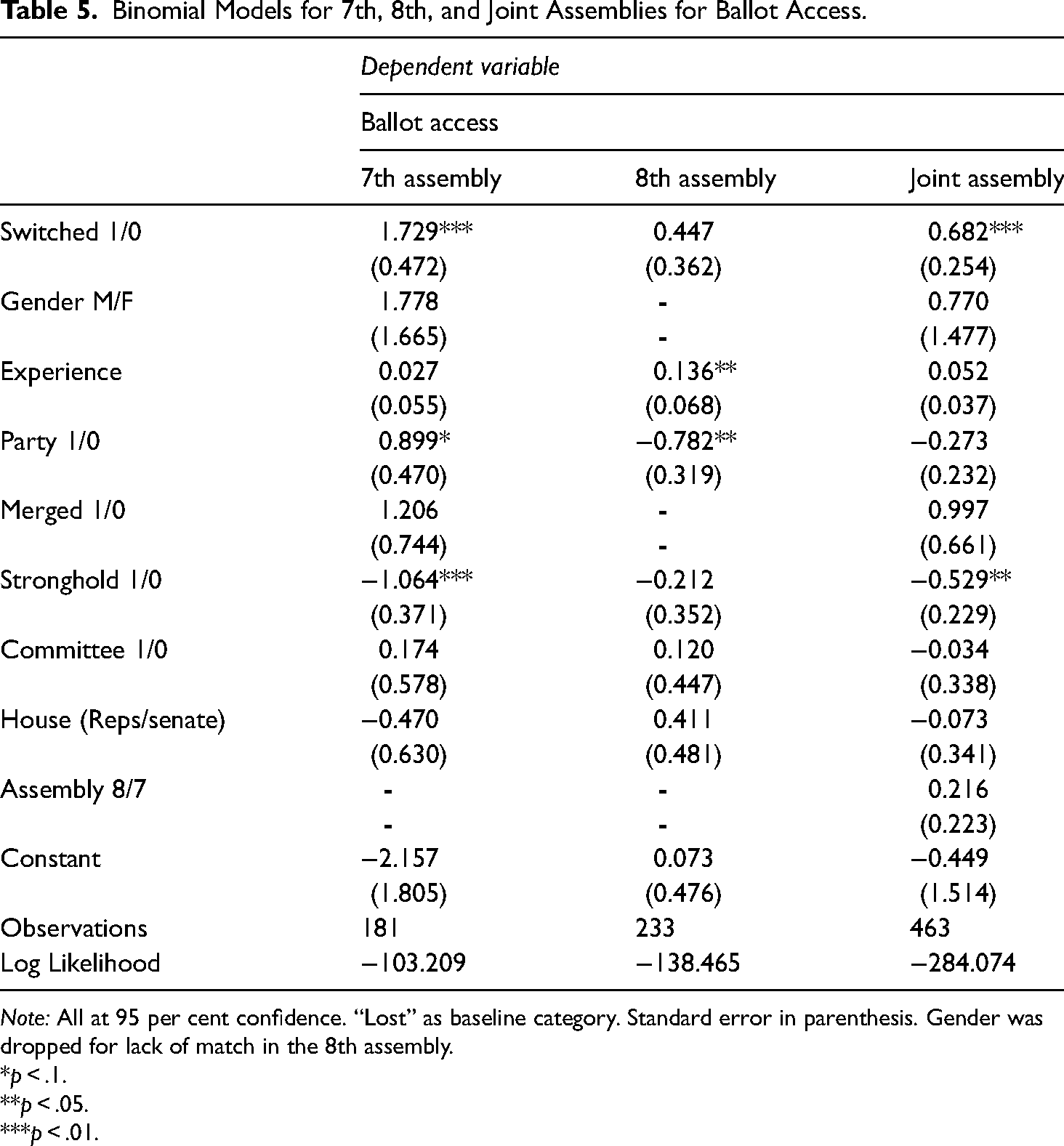
Note: All at 95 per cent confidence. “Lost” as baseline category. Standard error in parenthesis. Gender was dropped for lack of match in the 8th assembly.
*p < .1.
**p < .05.
***p < .01.
Any Penalty for Switching?
While subsequent research can examine whether voters punished Nigerian MPs for switching or not, here, I am concerned with blowbacks from switchers’ previous parties. Existing literature has addressed the curvilinear relationship between party discipline and party switching (Heller and Mershon, 2008; Nielsen et al., 2019) but has been silent on whether parties fight back after losing members. In Nigeria, since both the APC and PDP are the key beneficiaries of switching, threats to sue switchers have often fallen flat. And since most switching occurs few months to elections, the matter is left to voters to litigate at the polls. Nonetheless, I see evidence of negative campaign against switchers, where they are branded as political desperados who want to remain in power by all means necessary. In the seventh assembly, President Goodluck Jonathan lambasted those who left the PDP for APC as troublesome elements whose exit was good for the party. At a public event, he said: If some people have been with the PDP for 14 years and now they said they are leaving for progressive, the question is where are they progressing to? It means in past 14 years, they have been involved in retrogressive activities in the PDP and were problems to us and you will agree with me that now that these retrogressive elements have left, PDP will progress more. (Vanguard News, 9 March 2014)
But I observed more decisive action was taken against switchers in the eighth assembly where the APC spent resources in de-campaigning against the likes of the former senate president and other MPs who switched with him, using that fact that they switched as political ammunition against them and painting them as political desperados. In one of my interviews, a former aide of the senate president recounted the persecutions their boss faced after switching such as fierce media backlashes from the ruling party and blackmail attempts (CEN, 26 January 2022). The then APC chairman, Adams Oshiomhole, admitted how the party orchestrated grassroot support against the former senate president and his colleagues who switched and ensured they lost their reelection bid. Oshiomhole admitted thus: Remember I was saying that Saraki must be removed, people would say how would you do it? I said if he resists removal, then we would uproot. We went to Kwara, we did “otoge” (Enough is Enough). We uprooted Saraki and you cannot commend me for this? Do you know who Saraki is? If you are talking of the smartest political player, seasoned smart guy, he is. But for every smartness he has, I have a superior smartness. At the end of the day who won? As a senate president, we uprooted him as a senator, we uprooted his nominee for governor and senators, we put our own. Today, he doesn’t have one senator in Kwara, he doesn’t have one House of Representatives member in Kwara. (Sahara Reporters, 30 July 2019)
PDP equally retaliated against the former senate minority leader, Godswill Akpabio, who left the party for the APC. PDP reminded the public in a press statement that Akpabio who was declared a corruption suspect by the antigraft agency after allegedly embezzling state funds when he was governor was embraced “shamelessly” by the APC with his alleged crimes expunged. The statement read: The PDP describes the move as a failed antic of an apprehended and deflated felon (Akpabio) who, in his immoral proclivity, attempts futilely to pull off one last survival stunt before facing the gallows, or more so, a mortally wounded snake furtively seeking for one last bite before its inevitable painful death… Nigerians can now see the shameless hypocrisy of the APC, which is now going about, cap in hand, to beg the same persons it haunted as corrupt and evil, seeing that it has been overrun by the tides. (The Herald, 5 August, 2018)
Additionally, for popular MPs who switched, such as the former senate president and senate minority leader, I observe that their old party replaced them with another prominent politician to give these popular switchers a run for their money. APC nominated Ibrahim Yahaya Oloriegbe, a former member of the Kwara State Assembly, who chaired top committees in the house. This ranking member of the party was poised to compete with the former senate president for the Kwara Central senatorial seat. In Akwa Ibom, PDP nominated a former deputy governor of the state and a ranking member of the party to challenge Senator Akpabio who defected. I believe influential defectors are particularly targeted because they often lead the way during mass defection and control the intra-elite network within the house revealed by Demarest (2021b). Defeating these heads of legislative cliques would send a strong message down the ranks of MPs in their network, serving as a deterrent to others. One former MP also disclosed in my interview with him that his previous party withdrew contracts awarded to him, fired his relatives from their jobs, and prevented his “boys” from collecting market tolls (MDS, 2 March 2022). However, he said his new party was offering more perks and opportunities, including easier ballot access.
Understandably, smaller parties are less likely to take punitive actions against switchers. In fact, a politician who was the major financer of a small party recounted to me in an interview how he was beseeched several times to return to the party after he moved to a bigger one (ITA, 15 March 2022). But he faced the difficult choice of remaining in a big party where his influence was diminished by tight competition or staying with the smaller party with virtually no competition but limited electoral prospects. So, stronger parties are more likely to take punitive measures against switchers because they possess the resources and structure for retaliation.
Conclusion
While existing literature on party switching has focused on the motivations of switching and its effects on representation, fewer literature has examined where switchers defect to and its implications. I argued that analysing the destination of switchers can expose the nature of party politics in Nigeria, the appeals of Nigerian parties, and their barriers to entry, if any. As demonstrated in the Nigerian case, party hoppers often jump to parties that improve their electoral chances, especially to avoid the stiff competition in their old party that can prevent them from getting the party ticket. MPs also switched to exonerate themselves of blame after an abysmal performance by their party, as witnessed in the seventh assembly where the then Nigerian ruling party, PDP, could not stem the tide of the Boko Haram insurgency and rising corruption.
But Nigerian MPs do not defect into any party but prefer to remain within the APC or PDP, the two biggest parties in the country, to improve their electoral chances, and only move to smaller parties after failing to clinch a ticket in the PDP or APC. Despite accounting for the highest number of out-switching, both parties were ironically the favourite destinations of switchers because of their visibility, structure, and electoral viability. Regardless of their popularity and personal networks, switchers hope to leverage the popularity of these parties to help their reelection. I argued that the APC and PDP cannot be simply waved off as weakly institutionalised parties because they lack clear ideological demarcation. Their structure, strengths, and popularity which make them the favourite destination of switchers should count as well. In fact, the intense intraparty competition within these parties, leaving a trail of several sore losers, accounts for why defection within them is high. I also observed more cases of defection out of the ruling party contrary to speculations on incumbency advantage. The abysmal performance of the ruling party (whether the APC or PDP) and more intense intraparty competition make the ruling party less attractive to switchers.
In addition, I found that electability and wealth are key criteria considered by party leaders before admitting switchers to contest for tickets in the new party. Since electoral campaigns are expensive, those who eventually got the party tickets in either the PDP or APC were those who could bare the expense of a robust campaign. Furthermore, I found interesting relationships between switching and variables such as gender, party stronghold, and party affiliation. Results from the logistic regression revealed that male MPs were more likely to switch than their female counterpart; switchers were more likely to move into parties outside their regional stronghold where getting nominations might be easier; and switchers were more likely to join the opposition than the ruling party as discussed earlier. I equally discovered in a second logistic regression model that switchers were more likely to get ballot access than non-switchers, signalling their ticket-hunting motivation.
Finally, evidence suggests that parties, particularly the PDP and APC, retaliate against MPs who switched out of them, an issue existing literature have inadequately addressed. Popular MPs who lead the caucus to cross-carpet become the target of negative campaigns by their previous party. The parties also replace popular switchers with another prominent party member, to tighten the battle for the legislative seat. This was the case in the battle for reelection of the former senate president and senate minority leader, where their previous parties orchestrated plans to frustrate their reelection bid. Subsequent research can proceed to examine how switchers eventually performed during the election compared to non-switchers. This paper contributes to our understanding of party strength and appeals in Nigeria against the backdrop of party switching. It has demonstrated that party switching and the destination of switchers, contrary to speculations, signal the strength as opposed to the weakness of Nigerian parties.
Supplemental Material
sj-csv-1-afr-10.1177_00020397231211930 - Supplemental material for Nigerian Electoral Black Market: Where Do Party Switchers Go and Why Does It Matter?
Supplemental material, sj-csv-1-afr-10.1177_00020397231211930 for Nigerian Electoral Black Market: Where Do Party Switchers Go and Why Does It Matter? by Victor Agboga in Africa Spectrum
Supplemental Material
sj-csv-2-afr-10.1177_00020397231211930 - Supplemental material for Nigerian Electoral Black Market: Where Do Party Switchers Go and Why Does It Matter?
Supplemental material, sj-csv-2-afr-10.1177_00020397231211930 for Nigerian Electoral Black Market: Where Do Party Switchers Go and Why Does It Matter? by Victor Agboga in Africa Spectrum
Supplemental Material
sj-csv-3-afr-10.1177_00020397231211930 - Supplemental material for Nigerian Electoral Black Market: Where Do Party Switchers Go and Why Does It Matter?
Supplemental material, sj-csv-3-afr-10.1177_00020397231211930 for Nigerian Electoral Black Market: Where Do Party Switchers Go and Why Does It Matter? by Victor Agboga in Africa Spectrum
Supplemental Material
sj-r-4-afr-10.1177_00020397231211930 - Supplemental material for Nigerian Electoral Black Market: Where Do Party Switchers Go and Why Does It Matter?
Supplemental material, sj-r-4-afr-10.1177_00020397231211930 for Nigerian Electoral Black Market: Where Do Party Switchers Go and Why Does It Matter? by Victor Agboga in Africa Spectrum
Footnotes
Acknowledgements
I appreciate all the constructive feedback received from my supervisors, Gabrielle Lynch, and Andreas Murr.
Declaration of Conflicting Interests
The author declared no potential conflicts of interest with respect to the research, authorship, and/or publication of this article.
Funding
The author disclosed the receipt of the following financial support for the research, authorship, and/or publication of this article: This research was funded through the Working Group in African Political Economy (WGAPE) small grant, and the British Institute in Eastern Africa (BIEA) thematic grant.

Supplemental Material
Supplemental material for this article is available online.
Notes
Interviews for this research were anonymised to give participants the ability to speak freely and to prevent any political victimisation or scapegoating for their participation in this research. Three random letters were assigned to the interviewees and a brief and general descriptor of their position.
Anonymised Interviews
CEN (26 January 2022) interview with a former Senior Legislative Aide.
EPL (14 March 2022) interview with an APC Chieftain.
ITA (15 March 2022) interview with a former Gubernatorial Candidate.
MDS (2 March 2022) interview with a former MP who switched parties.
PAE (25 January 2022) interview with a PDP Benue and National Executive.
REO (11 February 2022) interview with a Nigerian Sociologist and Public Analyst.
RTE (2 November 2022) interview with a Nigerian Journalist and Political Commentator.
SIO (2 March 2022) interview with a former MP who switched parties.
SWI (12 April 2022) interview with a Benue MP who switched parties.
TYE (12 April 2022) interview with an APC Constituency Chair in Benue.
Author Biography
References
Supplementary Material
Please find the following supplemental material available below.
For Open Access articles published under a Creative Commons License, all supplemental material carries the same license as the article it is associated with.
For non-Open Access articles published, all supplemental material carries a non-exclusive license, and permission requests for re-use of supplemental material or any part of supplemental material shall be sent directly to the copyright owner as specified in the copyright notice associated with the article.
