




Abstract
Between the 1850s and 1950s, when abolitionism masked neoslavery and engendered displacement and forced labour migration in West Africa, Africans used forgery as a survival mechanism. They forged legal documents, claimed multiple forms of citizenship and belonging as Afropolitans, and manipulated kinship and imperial bureaucracy in the quest for freedom. One arena of forgery examined in this article entailed the invention of “husband” as “wife-owner,” within a context of gendered aspirations for social reproduction in the age of abolition. Southeastern Nigerian male migrants mobilised freedom papers, labour contracts, marriage certificates, and the medium of petition-writing to fashion themselves into Afropolitan wife-owners in a bid to survive transimperial displacement, marginalisation, and subordination that arose from abolition forgery. Afropolitan masculinity illuminates how abolition forgery generated enduring structures of hierarchical gender relations in West Africa.
Introduction
Robert Boyle walked into a room where his fugitive wife, Hannah Boyle, was sleeping on a mat on the floor. Hannah looked peaceful. Her head was raised on a folded shawl, her hair wrapped in thick folds of a cotton cloth, her neck and breasts exposed, and her arms crossed on her chest. After watching and pondering over Hannah for two hours, Robert pointed a musket at Hannah's left eye and shot her dead. It was 12 a.m. on 24 November 1856. The gunshot awoke their host, John Omoe, who ran outside, looked around, and seeing nothing, went back to sleep. Fellow house guests, William Freeman and George Anthony who slept in the room adjoining Hannah's claimed not to have heard the gunshot. Four hours after he had “wilfully murdered” his wife, Robert walked into the “open air,” laid down on his back, pointed the musket towards his head, and with his right foot, pulled the trigger, such that “the whole of the face and forehead was entirely blown away.” Robert's suicide awoke his friend and fellow house guest, Paul Thomas Boyd, who found the dead bodies of Hannah and Robert and awakened fellow members of the Liberated African Black community in Clarence, capital of the Spanish colony of Fernando Po. 1
Robert and Hannah were Igbo Liberated Africans, ensnared in successive traumas of slavery captivity and abolition recaptivity, forced resettlement, imperial bondage, and fugitive diaspora. Their archive of murder/suicide is unique for nineteenth-century African history. It is a rare documentation of intimate partner violence among Africans, who in pursuit of the freedom promises of abolition, including emancipation, free trade, and free (wage) labour, became displaced/marginalised/subordinated (DMS) across imperial borders and saw their hopes of the liberatory potential of transborder mobility dashed by imperial capitalism. To understand the double tragedy, which was not just a result of the character flaw of an individual African man, we must see the larger picture of abolition forgery in West Africa, by which I mean, how ostensibly noble projects to end the Atlantic slave trade and slavery enabled European states and capitalists seeking colonies and profits, as well as African slaves and subjects seeking freedom, autonomous mobility, and social recovery to exploit abolition laws and “free labour” policies and discourses to reinvent and mask the violence of slavery's gendered socio-political unfreedoms.
To show how such violence emerged as a pattern of the gendered impact of abolition forgery, I theorise Afropolitan masculinity as an asymmetric gendered social identity forged by DMS Africans, who survived abolition forgery by moving beyond state control, exploiting the precarities of imperial abolition policies, and operating in the interstices of African traditions and European imperialism in pursuit of homeland norms of “adult masculinity” (Miescher, 2005). Using archives of the transimperial itinerancies and desires of DMS southeastern Nigerian men in Old Calabar, Fernando Po, and Gabon between the 1850s and 1950s, I argue that abolition forgery imbued Afropolitanism with contradictory marginality such that African male migrants embodied as well as exploited the precarities of displacement to achieve adult masculinity. I situate the abuses experienced by women like Hannah in the Afropolitan survivalism of abolition forgery, because for many DMS Africans, survival entailed relative subjugation and asserting control over means of social reproduction, especially women's labour, property, and bodies.
I characterise DMS Africans’ forgery of alternative pathways to adult masculinity as Afropolitan. As Mbembe coined it, Afropolitanism describes the “paradigm of itinerancy, mobility, and displacement” that has shaped African and African diaspora identities (Mbembe, 2007: 27). Afropolitanism focuses our attention on the stories of mobile Africans, who used homeland norms to forge new social identities beyond state borders in diaspora, and generated gendered identities out of displacement, fugitivity, alienation, and precarity by reconciling “European and African identity logics” (Marcos, 2022; Carcelén-Estrada, 2022; Mbah, 2022). Afropolitanism emphasises that “disembedding” Africans from their natal communities often catalysed new modes of African identity formation (Sidbury and Cañizares-Esguerra, 2011).
To speak of Afropolitan masculinity, therefore, is to describe gendered migrant pathways to adult masculinity, the subaltern forgeries required to create them, and the embodiment of the resulting identities. I demonstrate that Afropolitanism – “the capacity to move and to move constantly,” traverse boundaries, use mobility to survive displacement, and repurpose imperial ideology to define freedom and belonging (Mbembe and Balakrishnan, 2016) – was gendered. This was especially true between the 1850s and 1950s, because European imperial surveillance of African mobility ensured that African men more than women travelled across imperial borders and leveraged imperial documents to traffic and subjugate other bodies to advance self-freedom.
Patriarchies Have Diverse Histories: Argument, Narrative, and Theory
I argue that abolition forgery fostered imperial capitalism and the displacement and subordination of Africans across imperial borders and that DMS African male recovery took the form of Afropolitan masculinity – exploiting abolition policies and abolition-imperial precarities of displacement to subjugate others, especially women, to achieve adult patriarchal masculinity.
Between the 1850s and 1950s, imperial capitalism, characterised by colonisation, land alienation, taxation, plantation monoculture, and monopolies, undermined communal land tenure systems of autonomous peasant agriculture and commodity exchange, as well as slave trading, which hitherto sustained structures of virilocal residence, patrimonial landholding, male breadwinner status, and marriage, the traditional pathways to adult masculinity. Imperial capitalism succeeded to the extent that states, planters, and merchants used abolition to disguise it. Imperial states used promises of liberation to achieve subjectification, planters used free labour to mask forced labour, and merchants used free trade to create monopolies. Imperial capitalism trapped Africans in the “afterlife of slavery” (Hartman, 2007), as liberated but bonded servants, ostensibly free but subjugated to the state, African but European subjects, resettled but displaced.
I discuss three episodes of Afropolitan masculinity in contexts of how Africans survived abolition forgery, which bred transborder displacement, precarity, and subordination.
First, Igbo, Efik, and Ibibio men of southeastern Nigeria emancipated from slavery by the British imperial government before 1848 and resettled in Freetown, Sierra Leone, sought to overcome alienation and imperial infantilisation and gained patriarchal dividend, by using freedom papers to forge themselves into “Black Englishmen,” cross colonial borders to “homelands,” and assert ownership of women as wives, sometimes violently, between 1850 and 1885.
Second, in the first three decades of British colonial rule (1900–1930), southeastern Nigerian men escaped taxation and forced labour by using forged passports to create underground economies of transimperial mobility in the hope of finding “free labour” that might enable them to meet their desires for land, wives, and adult masculinity, only to encounter inter-imperial bondage and neoslavery as forced labourers on cacao plantations in Spanish Equatorial Guinea. They evince futile attempts to forge Afropolitan masculinity and achieve adult masculinity.
Third, between 1942 and 1958, Anglo-Spanish and Anglo-French inter-imperial treaties legalised transimperial forced labour, defined southeastern Nigerian men as potential diasporic breadwinners, and required all Nigerian migrant women to be married to Nigerian migrant indentured men, who in turn used marriage certificates and written petitions to forge themselves into wife-owning husbands in both Spanish Equatorial Guinea and French Gabon. For DMS Igbo, Efik, and Ibibio men to achieve Afropolitan masculinity in diaspora, European imperial agents mediated a transimperial traffic in southeastern Nigerian women as “wives” of migrant men. In so doing, European states in West Africa sought to fulfil elusive promises of abolition to African male imperial subjects, at the dire cost of African women's freedom.
As Liberated African returnees from Sierra Leone to Old Calabar in the second half of the nineteenth century, and as migrant forced labourers from Nigeria to Spanish Guinea cacao plantations and French Gabon forestry concessions in the first half of the twentieth century, Igbo, Efik, and Ibibio men experienced abolition forgery as displacement and coerced “boyhood” (Morrell, 1998; Gardini, 2016; Brown, 2003; Shear, 2003). Held in the neoslavery of imperial bondage (Sundiata,1996; Martino, 2016) when the Atlantic slave trade, but not slavery, was illegal (1850–1916) and later subjugated to debt slavery by colonial taxation and forced indenture through abolition-imperial definitions of wage labour after slavery was abolished (1916–1950), southeastern Nigerian men, some already fathers and husbands, experienced imperial emancipation as derogatory boyhood, and became “plantation boys,” “servant boys,” “farm boys,” and “houseboys” (Vizcaya, 2022) abroad to fulfil natal expectations of adult masculinity.
Attracted by the promises of abolition, southeastern Nigerian men left familiar homes and embraced the precarity of transimperial mobility as an alternative pathway to adult masculinity, to becoming free men, breadwinners, and husbands. They envisioned freedom as mobility beyond the control of imperial states and local elites and as the capacity to overcome the “waithood” of youth (Ocobock, 2017) by marrying wives and supporting families, as well as owning women's bio-social reproductive capacities. However, the freedom promises of abolition were illusions of capitalism. DMS Africans, like Robert, expressed their frustration through petitions, acts of relative subjugation, and physical violence that evinced unfulfiled desires for freedom as well as expressions of the “internalised violence” of abolition forgery (Campbell, 1992; Morrell, 2001; Delius and Glaser, 2002; McCullers, 2011). But they also fabricated a range of imperial documents including freedom papers, passports, and marriage certificates, which enabled them to define freedom as autonomy to move across imperial borders, as well as to subjugate others, especially as “wives,” whose “subsidiary subsistence” (Meillassoux, 1972), including their labour, property, bodies, and social reproductive capacities, sustained migrant men.
Migrant men's forgeries of freedom papers, passports, and marriage certificates reflected how African subalterns mobilised the imperial “bureaucracy of paper” (Bernault, 2019: 54) to survive abolition forgery and exploit its displacement economy. European states and capitalists may have originated abolition forgery, but African subjects enacted forgeries from below to leverage abolition-imperial bureaucracy. Subaltern forgeries ensured that patriarchal kinship underpinned imperial capitalism. Excavating Afropolitan masculinity is a method to recover African agency and illuminate how the conjuncture of abolitionism – the global movement and discourse of free labour and free market, with imperial capitalism – the use of abolitionism to disguise forced labour and monopolies, relied on imperial subjects reinventing heteropatriarchy.
Through the lens of Afropolitan masculinity, we see that abolition forgery entailed the creation of wife-owning husbands, as such patriarchy advanced imperial capitalism, which anchored the exploitation of unfree and low-waged African male labour upon women's “primitive (non-waged) accumulation,” “domestic subsistence,” and bio-social reproduction of labour (Meillassoux, 1981). The intersectional violence or dual burden borne by women like Hannah underpinned the interdependency of imperial capitalism and African patriarchies (Amadiume, 1989; Greene, 1996; Oyěwùmí, 1997; Lindsay, 2003; Osborn, 2011; Achebe, 2011).
DMS African male freedom aspirations, pursuit of “key markers of African manhood” 2 (Barker and Ricardo, 2005), and creative strategies of social recovery/rebirth (Musariri, 2021), entailed constructing a “patchwork of patriarchies”, adapted from imperial ideologies, and locally derived (Lindsay and Miescher, 2003). DMS African male quest for freedom was often also a quest for patriarchal dividend, as migrant men sought to leverage the European imperial idea that the “autonomous, self-owning individual” deserving of a freedom paper and wage contract was male (Dru Stanley, 1998: 27). Such European abolition ideology deemed the freedom and subjecthood of African women and children as predicated upon their belonging to husbands and fathers, enabling DMS males to wield violence and subjugate women (Getz and Clarke, 2016).
Afropolitan masculinity entailed masking female subjugation as male freedom. It began as an Afrofuturist (Dery, 1994) vision of freedom from slavery and imperial bondage, as well as a dream to move freely and establish a family. But as abolition forgery ensured that African subjects escaped one form of bondage only to end up in another, male migrants used claims of being imperial subjects and exploited freedom papers, petition-writing, and marriage documentation to forge themselves into wife-owners. To overcome diasporic subordination, migrant men sought the legible artefacts of abolition-imperial promises of patriarchal dividend, including freedom papers, labour contracts, and marriage certificates, to realise homeland norms of adult masculinity, as breadwinners, household heads, and wife-owners (OECD, 2021; Belucci and Eckert, 2019). They embraced the mask of abolition, by using the rhetoric of freedom and fiction of kinship to conceal relative subjugation. Such were their Afropolitanism, their means of achieving waged “breadwinner masculinity” and homeland “adult masculinity” (Mbah, 2019).
Afropolitan masculinity entailed DMS African men's desire to recover a fictive lost privilege of wife-owning. The notion that wives belong to husbands was a contested ideology of the political economy of the Atlantic slave trade in southeastern Nigeria in the eighteenth and early nineteenth centuries, and only materialised through imperialism in the late nineteenth and twentieth centuries (Mbah, 2019). When DMS Igbo, Efik, and Ibibio men desired wife-owning, they necessarily reinvented ideas of “husband” using colonial documents like freedom papers, labour contracts, and marriage certificates. To survive abolition forgery, which undermined traditional pathways to adult masculinity (Mfecane, 2018), DMS African men embraced “norms of restrictive masculinities,” acting as if they were entitled to women's productive and reproductive capacities. Some responded to women's economic and sexual autonomy with accusations of witchcraft, as well as physical violence, signifying an aspirational outlook geared towards the achievement of a persona (Van Wolputte, 2020). DMS African male acts of relative subjugation were social dramas eliciting diverse commentaries, illuminating how other DMS Africans, African coastal elites, and European men idealised Afropolitan masculinity (Figure 1).
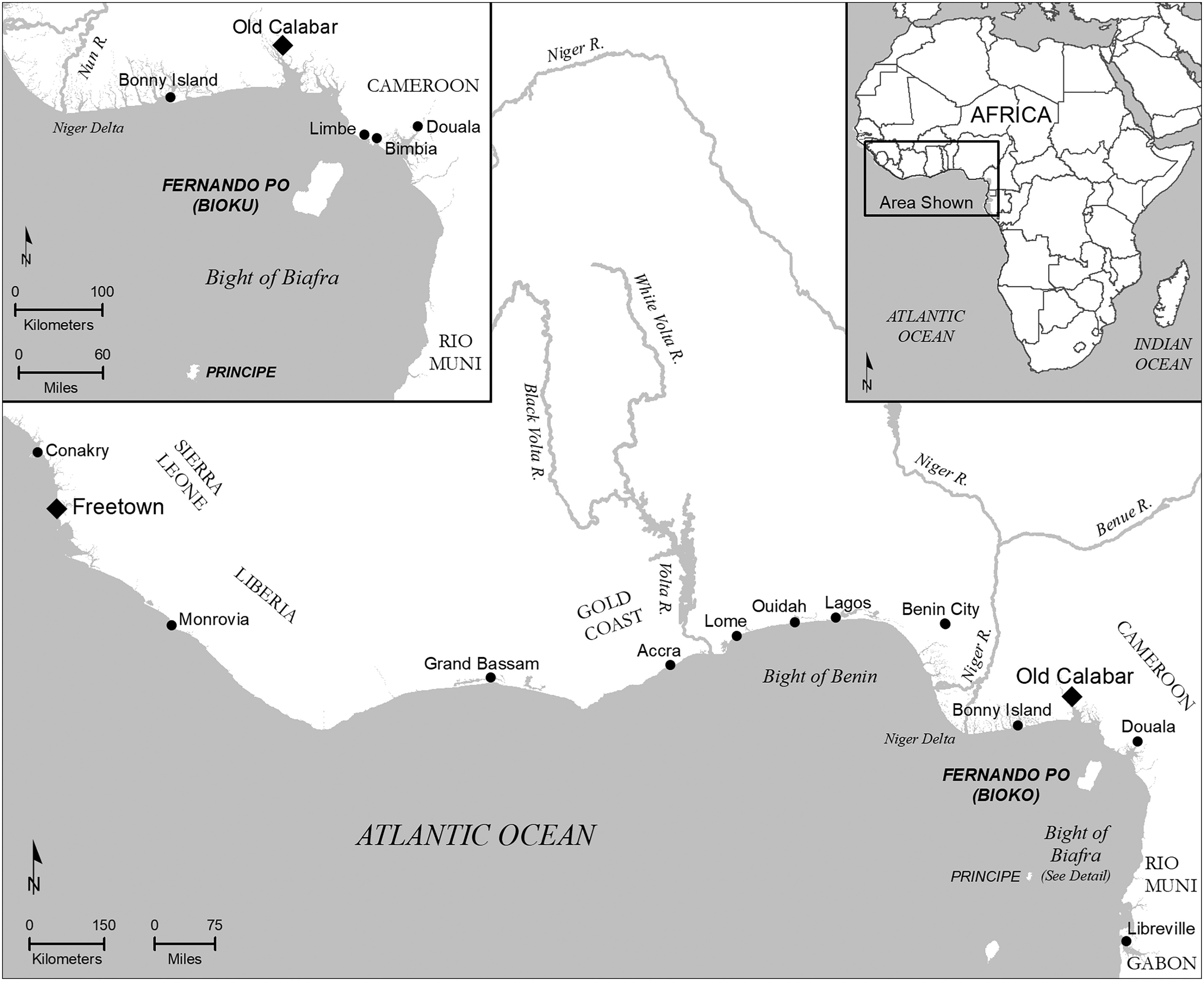
Late nineteenth-century map of West Africa showing Atlantic coastal Old Calabar (Nigeria), Freetown (Sierra Leone), and Fernando Po (now known as Bioko, Equatorial Guinea). Map developed for the Author by Brian Edward Balsley, Certified Geographic Information Systems Professional (GISP).
Liberated African Refugees’ Uses of Freedom Papers to Assert Wife-Owning
Robert and Hannah Boyle had long struggled to define the meanings of “husband” and “wife” as deracinated Liberated Africans, negotiating cycles of displacement, colonial bondage, and gendered unfreedom that characterised imperial abolitionism. The Boyles had relocated to Fernando Po from Old Calabar in 1856, being a part of several families of Efik and Igbo Liberated Africans that left Freetown, Sierra Leone, to reclaim Old Calabar as their homeland in 1854. In the first year of the Boyles’ relocation to Old Calabar, Scottish missionary William Anderson required the British consul of the Bight of Biafra to injunct Robert and another returnee, Paul Thomas Boyd, “to keep the peace towards their wives.” 3 Both men beat their wives to assert control over domestic resources. The following year, the consul injuncted another Liberated African Edward John Mackintosh “to keep the peace towards his wife, her child, and their servants, all of whom he has been brutally ill-using” and reminded Robert Boyle and Paul Boyd of their responsibility to desist from violence against their wives. 4 Four months later, Anderson reported that Robert “has again been beating his wife.” To save Hannah and her children, the missionary shipped them to Fernando Po as refugees under British protection and asked the consul to restrain Robert. He sought to reclaim Hannah and her children by asserting his status as an emancipated “British subject” in possession of a freedom paper, which gave him “perfect right to flog his wife whenever she becomes obstinate and will not do what he says.” 5 Because Robert claimed British subject status, the consul could not restrain him. 6 However, when Hannah resisted Robert's efforts to repossess her and her children, Robert traumatised by slavery and the unfreedom of imperial liberation resolved in frustration to end both their lives. 7
As two out of 99,752 African captives rescued from Atlantic slave ships, emancipated in Freetown by the British vice admiralty court and courts of mixed commission and styled as “Liberated Africans,” Robert and Hannah were people in search of freedom. As beneficiaries of British antislavery and liberation, they became “freedom's debtors,” bound to meet the labour needs of British colonisation in West Africa in exchange for becoming British subjects (Scanlan, 2017: 3–4). They existed as objects of European civilising mission and proof of British humanitarianism (Anderson and Lovejoy, 2020). And like most Liberated Africans, they sought freedom from forced labour, re-enslavement, and economic marginalisation in Freetown, where British settlers required Liberated African men to perform menial and domestic labour, denied their capacity for mental tasks, and emasculated them as “boys” (Anderson, 2013; Fyfe, 1961; Schwartz, 2012, 2020; Ryan, 2016; Misevich, 2009). To escape alienation, forced labour, and infantilisation, many Liberated Africans sought a return to their homelands. Those like Robert originally embarked as captives at the Old Calabar port returned with the hope of kinship and participation in the coast's lucrative transatlantic palm oil trade (Anderson, 2020; Lovejoy, 2017).
Returning was a journey of hope and recovery from the social death of slavery. Legally recognised as British subjects only in British colonies, Liberated Africans lost their rights as British subjects upon relocating to free territories like Old Calabar. They had to generate a new logic of British subjecthood using freedom papers and petitions. Old Calabar proved to be a hostile homeland for returnees, because of local elites’ protection of domestic slavery and British monopoly of the transatlantic palm oil export trade. To survive, returnees embraced Presbyterian missionaries as hosts, protectors, and advocates. They became “boys” and “wards” of missionaries, subjected to their patrons’ discipline. 8 Calabar people referred to the returnees as “slaves of the mission house.” Under missionary protection, returnees wrote petitions to British authorities demanding rights to free trade as British subjects. Through such free trade, some male returnees achieved Afropolitan masculinity: they crossed European imperial borders on their own terms, extended their rights as British subjects beyond British colonies, and fashioned themselves into “Black Englishmen” through the appropriation of imperial language, dressing, and comportment and by claiming multiple forms of belonging. Through petition-writing and presenting their certificates of emancipation and attestation letters from missionaries affirming their “good” or “excellent Christian character,” they evinced what one British consul described as “the health and vigour of manhood.” 9 Their forgery of Afropolitan masculinity as freed, civilised, literate, and rights-bearing British subjects distinguished them from “natives” as “white people” governed by British as opposed to customary law (Marwick, 1897: 326). By performing “whiteness” as well as using abolition's freedom rhetoric to protect their free trading, they achieved patriarchal dividend in Old Calabar without becoming slave-owning elites.
But such use of abolition's freedom promises (Buxton, 1840: 159–74) to achieve Afropolitan masculinity was rare. Most returnees struggled with poverty and subjugated others to survive. Returnees like Robert, Paul, and Edward, for example, depended upon their wives for survival. Because British administrators in Sierra Leone issued “freedom papers” primarily to male Liberated Africans, female Liberated Africans like Hannah depended upon being wards of male fathers and husbands to validate their status as emancipated persons. This enabled husbands to claim rights to women's bodies and labour. Wives farmed and traded in local markets and provisioned families with food. Husbands gambled their money on the palm oil Black Market, but Liverpool supercargoes often seized their palm oil barrels as illicit goods. Because they gave out trade goods on trust to local elites, Liverpool supercargoes claimed every palm oil on the Old Calabar coast as their property and saw returnees’ mercantilism as property theft. Many returnees thus became impoverished. Although male returnees deluged the British foreign office with petitions to uphold their free trade rights as British subjects, the imperial government intervened in only a few cases. British consuls prioritised protecting British merchants’ capital. Moreover, although Afropolitan masculinity entailed the subjugation of women as wives who depended upon their husbands’ freedom papers to validate their status as emancipated persons, Afropolitan masculinity was itself subordinated to coastal elite African hegemonic masculinity, which was reproduced through coastal elites’ capacity to wield ritual violence (Mbah, 2022). Using customary law, Old Calabar elites refused to recognise Liberated Africans as “freemen” or autonomous patriarchs because “they know that formerly they were slaves.” 10 Returnees’ Afropolitan masculinity in Old Calabar, therefore, also meant overcoming the stigma of slavery.
Returnee women who sought economic autonomy had to contend with the fact that disillusioned husbands like Robert, Paul, and Edward depended on them for subsistence and laid claim to their labour, bodies, and sexuality. Amelia Mackintosh wrote the singular petition by a female returnee to Old Calabar in 1857, complaining, My husband, John Mackintosh, has long treated me in a very shameful manner. He has repeatedly beaten me…He has been unwell for some time, and he proclaims that I am the cause of his illness – that I have bewitched him. Sometime ago, he stole some of my property from my house – in particular, a sofa…I presume that you are aware that we do not now live together. He lives among the natives in the town.
11
Amelia detailed the various ways that John failed to achieve Afropolitan masculinity. She emphasised her own economic autonomy and respectability in Old Calabar. Amelia possessed a house. She secured the services of Macaulay, a well-documented Liberated African returnee who traded on Amelia's credit, supplying palm oil to London merchants through the West African mail steamboat. Amelia used her credit-worthiness to secure for John Mackintosh, a loan of trade goods on “trust” from Morgan, a leading Liverpool supercargo at Old Calabar. When John failed to pay Morgan, Amelia paid the debt. It was nearly impossible for Liberated Africans to trade on trust with European supercargoes, and even the most enterprising Liberated African men had to trade through native elites using “ready-money” (instead of trust credit) to circumvent Liverpool palm oil monopoly. Amelia's petition also reveals how men like John and Robert blamed wives for their failures to achieve Afropolitan masculinity. In Amelia's case, John alleged witchcraft. In the tragic case of Hannah, Robert alleged infidelity and saw Hannah's flight from Old Calabar to Fernando Po as treachery. Moreover, Amelia shows that Afropolitan masculinity was an ideal that DMS Africans aspired towards, but many failed to achieve. Its elusive nature led men like Robert and John to behave as if wife-owning was a lost privilege to be regained at all costs.
Returnee men like Robert and John saw themselves as “redeemers” of their wives because they possessed freedom papers, declaring them and their wives to be free. They reflect a broader system of abolition forgery, whereby “redemption” from slavery facilitated new systems of unfreedom and slave trafficking. As resettled Liberated Africans in Freetown used slave trafficking to survive, secure their own precarious freedom, and mitigate imperial subjugation before the 1850s (Misevich, 2009), 12 those that returned to Old Calabar after 1850 similarly used duplicates of their “freedom papers” to “steal away” domestic slaves from local elites in the guise of “redeeming” the slaves from slavery. They exploited the “redeemed” as bonded servants or trafficked them to Freetown and Fernando Po as indentured labourers. 13 Old Calabar elites opposed the “distribution of freedom papers” because it positioned returnees as emancipators, who removed slaves from elite control (Latham, 1973: 109). The elites condemned redemption as a mask of lawlessness. 14 By claiming to be “English man and British subjects,” one argued, returnees placed themselves above customary law. 15 Elite criticism was also a tacit response to British consuls’ defence of redemption, including traffic in women, and “boys and girls from seven to ten years of age” to Fernando Po, as acts of emancipation that led to slaves becoming “perfectly free” and living in conditions superior to the “state of slavery in Old Calabar.” 16 Returnees embraced redemption, the subjugation of others, including wives, in the guise of emancipation, as a prevalent mode of Afropolitan masculinity. And freedom papers enabled them to do so.
When in 1885, a new British consul criminalised redemption as “a most profitable trade amongst the natives of Sierra Leone settled in Old Calabar” tantamount to “legalising slavery … under cover of the British flag.” 17 Liberated Africans turned to purchasing female slaves and recording them as “emancipated wives” on their freedom papers. The consular limitation on DMS African male uses of freedom papers to traffic in and use slaves did not seem to have obstructed their uses of freedom papers to achieve wife-owning. As an idiom of kinship, marriage legitimised and masked slaving and dependency. Egbo Bassey is a case in point. In 1849, he received a freedom paper as a slave refugee under missionary patronage at Old Calabar. In 1858, he “redeemed” eleven slaves and married a formerly enslaved woman named Fanny, all of whom he recorded on his freedom paper (Marwick, 1897: 336–7; Latham, 1973: 104; Nair, 1972: 165). 18 Unlike the eleven slaves, Fanny was a Liberated African who possessed a freedom paper. She was “a slave girl purchased and [gifted]” to British consul Hutchinson by Egbo Tom, “a Duke Town native trader.” Hutchinson renamed her “Fanny Hutchinson” and “left her under the care of the Presbyterian missionaries at Old Kalabar till I have an opportunity of sending her to the Church Missionary Society care at Sierra Leone.” 19 The consul gave Fanny a “form of manumission paper” which became a model freedom paper. 20 So, why did Bassey add Fanny's name to his own freedom paper? It implied that he “redeemed” and owned Fanny. Subordinating slaves and women, as dependents, was a mechanism to expand control over means of social reproduction and survive the precarity of emancipation in the era of abolition forgery.
Coerced Boyhood: How African Men Experienced Transimperial Forced Labour
If capitalism depended on the structure of a “free” labour market, in which the free proprietor of his own labour “sell[s] himself of his own free will” to the owner of capital, means of subsistence, and other means of production, “for a limited time only” (Marx, 1976: 271, 932), abolition forgery collapsed the gulf that separated slavery from Marx's idealised capitalism, by proliferating unfree labour markets: surplus labour ensnared in contract-forced labour regardless of free will, through deceptive recruitment, coercive physical torture, and fictive promises of access to the means of social reproduction, ranging from wage money to subjugated women.
Between the 1850s and 1950s, about 300,000 southeastern Nigerian men were trafficked as forced labourers and quasi-slaves to Spanish Equatorial Guinea and French Gabon (Martino, 2022: 49). The traffic began with Liberated Africans selling “redeemed” slaves to Fernandino cacao planters in the second half of the nineteenth century. With redemption criminalised, the traffic went underground between 1890 and 1942, during which hundreds of Nigerian recruiters, employed by Spanish planters, scoured southeastern Nigeria to inveigle and traffic male labourers. In the 1940s, the British government of Nigeria used treaties with Spain and France to legalise this traffic and extend it to Gabon. Southeastern Nigerian men experienced the successive labour trafficking systems as fictive emancipation, from slavery in the second half of the nineteenth century and from colonial taxation, debt slavery, and landlessness in the first half of the twentieth century. Transimperial unfree labour markets reduced them to the status of racialised minors, boys, or junior men. The desire to escape slavery and imperial violence at home reproduced their vulnerabilities to unfreedom in foreign colonies (Clarence-Smith, 1986, 1994; Ejituwu, 1995; Sundiata, 1996: 23, 130; Martino, 2016: 43–5, 87–96).
Abolition forgery succeeded because migrant labour promised Afropolitan masculinity: it promised “a refuge from slavery” and “tributary labour” (Ofonagoro, 1982: 219–44; Ojo, 2012). 21 It promised an escape from taxation and debt slavery or “voluntary servitude by debtors,” which was “often a prelude to actual slavery.” 22 Many trafficked men had exhausted alternatives, including pawning girls to “potential husbands” to meet “the need for cash.” 23 Lastly, it promised wages and breadwinner masculinity and increased the chances of exploiting the precarities of displacement to subjugate others as a means of social reproduction. Even where relative subjugation proved unsuccessful, enduring the subordination of coerced boyhood in foreign plantations became a new rite of passage to abolition-imperial patriarchal dividend. Transimperial subordination promised wages, wives, and patriarchal households. It touted desire. Recruiters, acting as mediators and “financial and mercantile agents of colonisation who forged autonomous markets” (Martino, 2022: 7), could thus, exploit men's aspirations for freedom, autonomous mobility, and ownership of the means of social reproduction, including land, trading capital, wives, and children – to entrap migrant men in forced labour contracts (Figure 2).
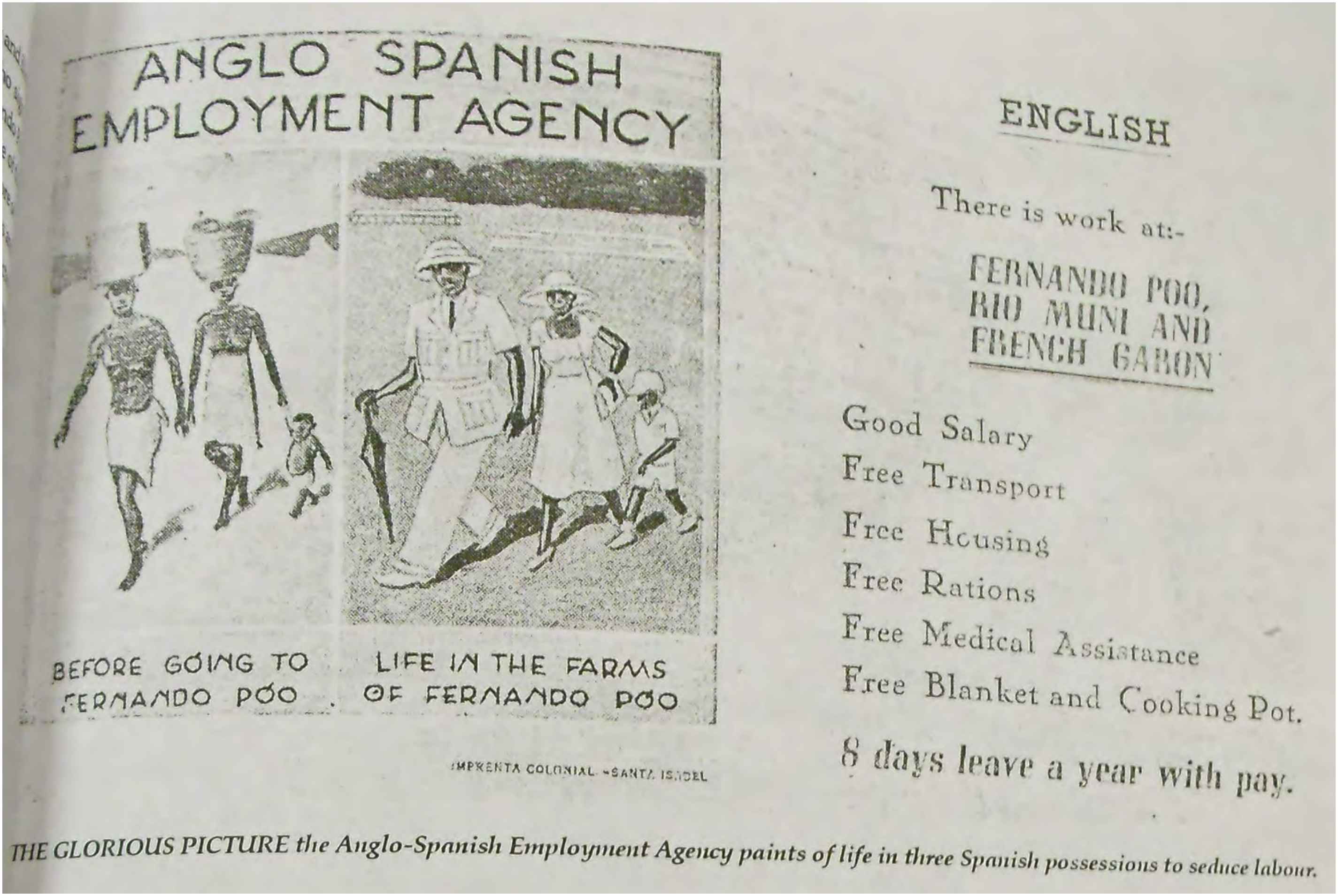
“The glorious picture…to seduce labourers.”
Desire for Afropolitan masculinity drove southeastern Nigerian men to forge passports to cross imperial borders. Between 1900 and 1932, British officials issued “passports” or “passes” to “boys from Calabar” and other districts of southeastern Nigeria to proceed to Fernando Po as indentured labourers. Later, to circumvent the 1929 Labour Ordinance, imperial officials called the passports “trader's permits” (Martino, 2022: 129). But officials were aware of a regular traffic in passports. Recruiters used the same passport to traffic multiple labourers in exchange for labourers’ wage advance, which indebted labourers to planters and forced them into second contracts. British officials were less interested in stopping the traffic and more interested in taxing it. Regulation as opposed to prohibition expanded the bureaucracy of imperial surveillance, while fostering a Black market in “forged permit forms” and police-stamped forged passports. 24 So long as officials received payments for passports, they were not opposed to transimperial forced labour traffic. Thus, a British vice consul at Fernando Po, Mr. Chew, responded to migrants’ passport forgeries by refusing to grant visas to Nigerians with fake passports. Instead, he sold “Emergency Certificates” (with photographs, signatures, and/or thumb-prints) to the Nigerians. 25
Vice consul Chew's Ibibio houseboy and steward “T.B. Idiang of Uyo District” secretly sold copies of the vice consul's “Emergency Certificates” at a lower cost to Nigerian migrants. Idiang was one of seven notorious traffickers “bringing boys to Fernando Po” in the 1920s and 1930s. 26 Idiang's accomplices included George Ndiong of Eket District, James Umo Essien of Uyo District, Itchi of Ikot Itchi Calabar, B.O. Bassey of New Port Harcourt, E.A. Yamva of Calabar, and Benjamin Emereke Edenji of Awka. 27 George Ndiong notoriously trafficked 200 “Ibibio Boys” and sold each of them for “fivety dollars.” 28 Anxious to turn over labourers “quickly and return for another lot,” traffickers like Idiang and Ndiong did not allow migrant “boys” the opportunity to negotiate their contracts but instead forced them into unfavourable contracts. 29 They concluded “private arrangements” and “deceived” labourers into accepting two-year contracts of cocoa plantation labour, during which labourers received “bad treatment and insufficient food,” having been sold for 300 Pesetas (about £10) each. Traffickers justified their “trade” arguing that they had paid substantial amounts in cash and goods to imperial officials to obtain passports and covered the cost of migrants’ transportation to Fernando Po. 30
In 1933, a Nigerian man, Edoho, received a letter from his son, Dan, who lamented that he had been inveigled into forced labour in Fernando Po. A Nigerian recruiter employed by Spanish planters and licenced by British officials promised Dan a high-paying job as a “shop boy” in a British store on Fernando Po. Dan paid the recruiter twelve shillings in exchange for a forged passport, purchased from a British official. The passport bore the name, “Samuel Egbe.” Assuming this identity, Dan boarded a German ship, Wahehe, from Calabar to Fernando Po in October 1932. Once Dan boarded the Wahehe, he became a “boy” cargo, to be subordinated to a plantation master. Upon arrival in Fernando Po, the recruiter locked up Dan and “other boys” from southeastern Nigeria in a warehouse for two days before taking them to the Compañia Colonial de Africa (CCA), which used threat of imprisonment and Spanish police beatings to force Dan and the “other boys” to sign a two-year indenture contract. The boys refused. The recruiter took them to a British consul and labour officer, who explained their options: sign a contract for a meagre wage or go to prison. In this way, Dan and the other forty-seven boys became contracted. Owing to “constant beatings,” some of the boys died. Dan also wrote, “labourers were given pay too small to cover the cost of soap and clothing”; they purchased necessities on credit from planters, who thereby, obliged them to sign another two-year contract to pay their debts. In this sense, the second contract was a form of debt slavery. 31 Desire for Afropolitan masculinity led male imperial subjects to become trapped in a cycle of subservient boyhood.
Despite the violence of coerced boyhood that characterised transimperial forced labour, an imperial official observed, there was no “reluctance on the part of the Ibibio or Calabar boys to go [to Fernando Po].” 32 Afrofuturist visions of male freedom sustained transimperial mobility. In the 1940s, the Labour Department of British Nigeria conducted a survey of 400 recruits, including fifty-six men who already completed first indenture in Fernando Po, to ascertain their motives for going to Fernando Po. 36 per cent desired to engage in trade, 23 per cent wanted to earn money to pay dowry for a wife, 10 per cent wanted to earn money to purchase a bicycle (for taxi business), 9 per cent wanted to assist parents or other relatives, and the remaining 22 per cent identified their motivations as need to buy farmland, build a house, pay school fees, improve knowledge through adventure, and gain experience of travel. No matter their motives, they were fated to become forced labouring boys. The fifty-six labourers returning to Fernando Po on second contracts stated that they used previously earned wages for “bride purchase,” buy farmland, and support their families. 33 The survey shows that men risked transimperial “boyhood,” some of them twice, by venturing into an unknown land in pursuit of Afropolitan masculinity, as a pathway to adult masculinity.
Afropolitan Petitions to Become Transimperial Wife-Owning Husbands
Whereas imperial capitalists extorted the desire for Afropolitan masculinity to entrench forced labour, southeastern Nigerian men subordinated as “boys” in foreign plantation colonies leveraged a masculinist imperial bureaucracy framework, as well as masculinist conceptions of imperial subjecthood in Afropolitan fashion to seize adult masculinity. As they “naturally miss[ed] their freedom,” they used petition-writing as a conspicuous Afropolitan performance of recovery. 34 Petitions enabled men derogated as “boys” to condemn imperial forced labour as slavery, despite the denialism of European officials. In their petitions to British officials, transimperial indentured labourers argued they were enslaved. They represented their experiences of recruitment, contract, and labour to fit the 1925 Anti-Slavery and Aborigines Protection Society's definition of “modern slavery,” as “any system in which force or fraud are exercised to secure control over the labourer for private ends.” 35 They understood the recruiters’ high commission as the price of their sale, because once on the island of Fernando Po, they had no choice but to sign obligatory contracts (Martino, 2016: 152; Martino, 2022: 174). As imperialism was justified not only “to suppress the slave trade” but also “to prevent its revival under the guise of contract labour” (Smith, 1974: 415), transimperial bondage was aberrant. Critiquing it and demanding remedy from it, was one way that DMS “boys” sought to realise their desires for land, cash, and wives. They combined complaints against forced labour with demands for wives to alleviate burdens. 36 Their petitions anchored male freedom upon the transimperial traffic and subordination of women. They evince how African survival of abolition forgery propagated asymmetrical gender relations.
His petition to the British district officer at Calabar, Edet Usuah, entrapped in a four-year forced labour contract in Fernando Po, identified himself as “a John Holt boy at Fernando Poo” because he had been recruited by the British John Holt Company for a Spanish plantation. He stated that he was in the first year of his contract and begged the British official to “help” and try all you can to send me my wife very urgently. I am tired of cooking alone, while I have got a wife & children at home. My wife & children have no one to care for them, as I do care for them when they are with me.
He reiterated, I have full courage that being a John Holt my wife can be sent to me at my demand at any time. When I [say] Govt. or John Holt, it is you that I mean…I need my wife and children because I have no well trusted person that can care for them until I shall finish the [remainder] 3½ years
of forced labour. 37 The British official at Calabar encouraged Usuah to “apply to the vice consul and labour officer at Fernando Poo in the usual way.” 38 Usuah and the official shared a mutually cognizant ideology of imperial paternalism: that wives must “join their husbands” abroad as subsidiary labourers. This ideology began as an informality of transimperial forced labour and only became official policy in 1942.
The informality is evident in how DMS men who wrote before 1942 tried to use petitions to possess wives. In April 1932, Samuel W. Johnson wrote to a British district officer at Calabar, complaining about “the character and prostitute living” of his wife, Lucy Ekanem Edet (alias Ekanem Ndiyo), a “British subject native of Calabar,” who had been “permitted” to travel to Fernando Po “under my responsibility” and “under my name” but turned out not to be “bona-fide” as “she is carrying on [a] slave trade.”
39
Johnson concluded, The attached permit declares “Traveling to Fernando Poo for purpose of joining husband;” as the husband, I am soliciting your aid that the above lady having no lawful contract of marriage…[should not be] permitted any more to travel in my name and be prevented to travel over with children.
40
A police investigation found that Sam Johnson and Lucy Edet were once living together as husband and wife for a period of about three years, after which a quarrel broke off their relationship. It is now alleged by the woman that the quarrel was the cause of the report, and this has been confirmed by a Mr. Oliver. Apparently, the woman has been carrying on this illegal practice [of child trafficking] for a long time to the knowledge of Sam Johnson who was an accessory after the fact.
41
It was not “responsibility” that motivated Johnson's petition, but rather loss of claim to Edet's sexual economy: Edet's body, domestic service, and child trafficking partnership.
Johnson alluded to an informal practice whereby British officials conditioned the capacity of African female British subjects to travel to other European colonies upon their being “wives” of forced-indentured African men. Johnson mobilised Edet's marriage declaration in the colonial court, as well as Edet's “travel permit” as proof that Edet belonged to him as a ward. He was not unlike returnees such as Robert, Paul, and Edward, who used freedom papers to own women. There are similar cases like Johnson's, showing that it was a common and enduring practice for southeastern Nigerian male migrants to Spanish Fernando Po as well as French Gabon to use petitions to male British officials with whom they shared a notion of colonial paternalism and masculinist conception of African transimperial mobility to forge patriarchal rights over women and mask economic dependence on female labour. 42 In some cases, British officials used threat of repatriation to compel wives into a “modus vivendi” with husbands. 43
It was the potency of transimperial forced labour to facilitate Afropolitan masculinity that propelled thousands of southeastern Nigerian men to continue travelling to Fernando Po despite slavery conditions and eventually expand migration to French Gabon in the late 1940s. British, Spanish, and French imperial administrators exploited this potency. In 1942, Britain signed a treaty with Spain to “legalise” the recruitment of indentured labourers from Nigeria for “the Spanish Territories of the Gulf of Guinea.” 44 The treaty defined the waged labourer as axiomatically male and stipulated that each male labourer could bring “wives not to exceed two” and “children under the age of 16 years” as dependents (Article 6). The treaty enabled the British John Holt Company and later an Anglo-Spanish Employment Agency (ASEA) to traffic 103,881 “treaty labourers” from southeastern Nigeria to Fernando Po, while several thousand other migrants continued to be brought in through illegal trafficking (Ejituwu, 1995: 55). By 1949, a “Franco-Nigerian Agreement” also funnelled several thousand southeastern Nigerians to Gabon. Most southeastern Nigerian men worked in cacao and coffee plantations on Fernando Po and in timber forests in Rio Muni and Gabon. Fewer worked as household servants, chauffeurs, carpenters, and stewards. Although “wives” and “children” were not contracted as labourers, they laboured as farmers, nurses, cooks, household servants, seasonal plantation labourers, traders, money-bankers, and sex workers, enabling contracted men to survive.
The Anglo-Spanish treaty of 1942 and the Franco-Nigerian treaty of 1949 capitalised on southeastern Nigerian migrant men's desires for wives and enshrined promises to afford southeastern Nigerian men access to two wives, despite that polygamy was a practice limited to economic and political elites. The treaties gambled on the notion that marriage and aspirations of waged patriarchal households drove men's labour migration. As subsequent events show, where the treaties fell short in delivering on the promise of furnishing male migrants with wives, European officials took on the task of mediating migrant men's acquisition of wives. The treaties required women to register in colonial courts as wives belonging to contracted husbands. For southeastern Nigerian women, transimperial legal marriage declarations functioned as travel permits, without which they could not proceed to Fernando Po or Gabon. For southeastern migrant men, colonial marriage declarations became an avenue to assert ownership over women's bodies and enlist European imperial states’ bureaucracies in acquiring wives whose domesticity enabled male participation in colonial contract-based and forced plantation labour.
British, Spanish, and French officials embarked upon a form of abolition forgery that envisioned a gendered capitalist economy of care, whereby migrant women's subsidiary labour furnished male labourers with food, healthcare, and the comforts of home, sustaining male coerced labour exploitation within transimperial economies and materialising the desires for Afropolitan masculinity. 45 In the 1930s and 1940s, Nigerian newspapers reported that hundreds of women were “holding on to men,” forming lines akin to a “human tug of war” to obtain a marriage declaration. 46 But there are also extensive archival records showing that southeastern Nigerian women refused to join husbands in Fernando Po and Gabon, thus requiring European imperial agents to induce and compel wives to join husbands. Imperial officials fantasised southeastern Nigerian wives as people who were supposed to provide food and make homes for labouring men, soothe labouring men's wounds, and serve as incentives for labouring men to not only consent to a first contract but also re-contract and “settle” in Fernando Po and Gabon in impoverishing and physically disabling forced labour conditions. British, French, and Spanish senior imperial officials deemed southeastern Nigerian wives as “essential” to fostering a sense of community and belonging: getting male labourers “accustomed to their employers, work, and conditions of life.” 47 European officials saw wives as “propaganda” to recruit and retain labourers. They celebrated the fecund wombs of southeastern Nigerian wives in colonial newspapers and used photo-media to propagate migrant labour as a means to achieve Afropolitan masculinity. 48
Such propaganda encouraged DMS men to compete for access to women and their children, as resources, leading one Nigerian reporter to lament, Nigerian women were “shanghaied and kept in Fernando Po against their will.” 49 British officials extensively documented how wives used marriage declarations to claim captive children, disguise child slavery, and traffic children to Fernando Po and Gabon. Officials knew that trafficked children became servants, who alleviated the care labour that wives were to provide to husbands. They knew that transimperial child forced labour, facilitated by marriage declarations, afforded wives the opportunity for independent economic pursuits. 50 Poor labour conditions had led husbands into abusive reliance on women's bodies (Chapdelaine, 2020). Male labourers “hired out” wives “in their desire to make money.” 51 Labouring wives earned “£6 to £7 a month above the man's wage” in 1950s Rio Muni. 52 Labourers sent wives into prostitution because they did not have access to adequate wages (Oham, 2006: 48–51). Because many of the “wives” that male migrants took with them took to sex work as “free women,” “separated from their supposed ‘husbands,’ and established their independent existence,” intimate partner violence became rife (Ejituwu, 1995: 52). In 1950s, Gabon, for example, with a ratio of fifteen southeastern Nigerian men to one wife, 25 per cent of criminal convictions against southeastern Nigerian men were for assault against wives. 53
Because Nigerian wives embodied the fantasy of Afropolitan masculinity, colonial archives are filled with southeastern Nigerian migrant men's petitions for wives. The post-1942 petitions still contained rationalisations but were much more assertive. Thus, Sampson Udoka, employee of the “Luterma Francaise-ABINE” in Libreville, Gabon, petitioned the district officer of Calabar province to send his wife, “Miss Akon James,” because “I see no reason why she should stay up to till now, while others’ women are coming to Gabon.” 54 “There is no reasonable excuse why she should not join me here in Gabon, except she wants to increase the number of harlots in Calabar and Nigeria.” 55 Accompanying Udoka's letter was a formulaic letter from the British vice consul at Libreville, instructing the British labour officer at Calabar to “arrange with the Recruiting Agency” in order to transport Miss Akon to Gabon. 56 ASEA sent an agent to search Calabar towns and retrieve Udoka's wife. 57 Later, Miss Akon appeared at the Calabar ASEA office to avow, “she would be unable to travel owing to a recent death in the family.” 58
Migrant husbands pledged marriage to women, encouraged women to swear marriage affidavits in colonial courts to obtain “travel permits,” and without paying bride price, wrote petitions to British officials to traffic the women as their wives. A British vice consul in Libreville, Gabon, was so overwhelmed with these petitions for wives that he wrote an extensive response in the fourth volume of the Venture: A Newssheet for Nigerians in Gabon, in 1952: Quite a number of men have sent in application forms asking that their wives who are in Nigeria should join them here in the Gabon…Yet we cannot say that we have had any great success with the scheme…It is quite clear that many of the wives are not wives in the true sense of the word…it has been found that they refer to women on whom dowry is incomplete or has not been paid at all…the family of the so-called ‘wife’ has been unwilling to let her leave Nigeria…While I am willing to help you as much as I can, I am powerless in this, and it is up to you to write to the family and pay the outstanding dowry…Write to your wife and tell her to report to the District Officer or the Recruiting Agent…for the Recruiting Agency is not able to go to every village in the Eastern Provinces looking for your wife. Read again what I wrote in the last Venture on this subject, and save yourself disappointment, and save my office work.
59
Conclusion
Southeastern Nigerian male Liberated Africans and transimperial forced labourers embodied Afropolitan masculinity as an externalisation of the violence of abolition forgery in West Africa. The gendered violence that characterised Afropolitan masculinity reflected men's desires for adult masculinity when abolition forgery limited alternative avenues. Male freedom increasingly became dependent upon men's capacity to subjugate others, because the promises of abolition, including free trade and free labour, were illusions of capitalism. European imperial abolitionism entailed replacing a gendered transatlantic slavery system with a gendered forced labour system. In redefining the geographies of African labour exploitation, from export to the New World to retention within imperial peripheries, imperial abolitionism made heteropatriarchal kinship a basis of capitalism. The conjuncture of abolitionism with imperial capitalism relied upon inventing heteropatriarchy. For DMS Africans navigating a transition from slavery to imperial subjecthood between the 1850s and 1950s, abolitionism meant freedom from slavery and empire, accomplished through the relative subjugation of others, variously disguised as emancipation/redemption, Afropolitanism, and marriage. Thus, I have not analysed Afropolitan masculinity as an individual character trait of specific men, but rather, as a robust cultural production of abolition forgery, which shaped African men's aspirations for freedom. Afropolitan masculinity reflects how men's freedom required women's unfreedom. It shows that Africans embodied abolition forgery by using freedom papers, forged passports, and marriage certificates to cushion the precarity of displacement and become wife-owning husbands.
Transimperial mobility was a gendered landscape of opportunities and vulnerabilities. The push and pull factors and legal and illegal infrastructures and ideologies of mobility relied on masculinist frameworks of mobilisation (Palillo, 2022). Attention to the vulnerability that migrant males experienced as a target group of transimperial forced labour within imperial projects of abolitionism illuminates the social forgery of gender violence within African societies, as opposed to essentialising African men as inherently violent and patriarchal. It was Afropolitan for migrant southeastern Nigerian males to represent themselves to British officials as “boys” who believed in abolition's potential to transform them into modern men, in order to elicit imperial coercion of their wives to join them in Fernando Po and Gabon as marginal domesticated labourers whose subjugation enabled men's forced-waged-labour. European imperial officials could then represent migrant men's wage labour as abolition's promise realised, thereby masking cumulative processes of deceitful recruitment, forced contracting, forced labour under threat of prison and use of physical violence, and the traffic in women which reproduced patriarchal dividends. It was vulnerable for DMS African men to don masks as potential wife-owning husbands, even when transimperial capitalism voided any real chance of their becoming wife-owners. Vulnerability is a useful retrospection on survivalism, because in many ways, modern African masculinities have been forged in the crucible of a psychosocial desire to attain “ruling masculinity” (power of choice over transition from boyhood to manhood) and meet the “pressure” to overcome unemployment (Ratele, 2008). The desire to escape slavery, poverty, and tax burdens, earn wages, acquire wives, and create households drove southeastern Nigerian male migrant forced labour, revealing that domesticity and sexuality were not exclusively women's issues in Africa and that gendered concerns, interacting with broader issues of political economy, defined African men's private and public lives (Miescher and Lindsay, 2003: 4).
Footnotes
Declaration of Conflicting Interests
The author declared no potential conflicts of interest with respect to the research, authorship, and/or publication of this article.
Funding
The author disclosed receipt of the following financial support for the research, authorship, and/or publication of this article: This work was supported by the American Council of Learned Societies, Wenner-Gren Foundation.
