



Abstract
What can music used by politicians during campaigns tell us about their behaviour, character and their rule? The article responds to this question by analysing political songs used by Patriotic Front (PF) in Zambia, before winning the 2011 elections and the subsequent elections. This article argues that music can be an important unacknowledged tool for understanding the behaviour of political leaders, and in this case, their gatekeeping behaviour that aims at sustaining the ruling party in power by undermining the opposition.
Introduction
The relationship between music, musicians and political processes is well established in Africa and continues to gain momentum (Allen, 2004; Langlois, 2016; Martin, 2013). The popularity of music in politics derives mainly from its ability to enable the expression of alternative or divergent political or social views often denied time and space in other public forms of communication (Allen, 2004; Ogola et al., 2009); people's culture, everyday life and challenges and help to create collective identities (Turino, 2008); “through its creation, performance, or consumption, music enables people to ‘articulate their ideas, beliefs, and feelings’” (Allen, 2004: 2) and lastly; music also enables politicians to reach out to hard-to-reach constituents such as youth and ethnic minorities who may not have time to attend rallies or listen to politicians directly (Cross, 2012). Attention is thus paid by scholars to understanding the types of songs that are effective for political communication (Fadipe, 2016), the relationship between politicians and musicians (Nyamnjoh and Fokwang, 2005) and the role of music in promoting social stability (Ibekwe, 2013). In short, music helps to motivate community action, and the expression of views, calls attention to oppression and bridges the divide between people of different cultures.
Studies in Zambia often concentrate on: the influence of language on music (Nchindila, 2008); how campaign messages can be framed and made to reach would-be voters through songs and music (Mambwe, 2019); the role and influence of music in the electoral process (Namuyamba et al., 2018); and on understanding the themes and meanings used in the political songs (Lumbwe, 2020). However, these studies rarely explore how music can be used to explain the behaviour of political players. This is the gap of research that this article seeks to fill by exploring the link between music, power and political behaviour through the following key questions: What can music used for political campaigns tell us about the behaviour of politicians as they encounter political power? How does music influence voters’ choices? What lessons can be drawn from the use of music for political campaigns?
This is an ethnographic study that analyses the Patriotic Front (PF) Party's key campaign songs since the party's formation in 2001. It then extends the analysis to 2011 when the party won in the elections and 2021 when it lost to the opposition United Party for National Development (UPND). I selected the songs based on their popular usage during the campaigns and played them repeatedly to get a full understanding of the meanings they carried. I then played the songs during interviews with my informants to sharpen their memory, and to draw their attention to their meanings. In addition, I conducted a total of fifty formal interviews lasting not less than 2 hours and countless informal interviews and conversations. The aim of this research was to understand the contextual meaning of music, what the producers and audiences thought of the lyrics, and why they felt the way they did about it. Therefore, I deployed discourse analysis which involved listening to music and studying the relationships between the information and its context. The PF campaign songs are useful for understanding the paradox of the PF's use of music during electoral campaigns. While the music played a significant part in winning the 2011 election with minimal sponsorship of artists, in 2021 despite a “huge” investment in music, they lost the elections. In this research, while understood as a researcher, I am also an insider. I was born and bred on the Copperbelt, a voter since 1996 and witnessed the three subsequent alterations of power since Zambia's return to multiparty democracy in 1991. My participant observation draws upon this local knowledge of politics and elections in Zambia.
Theoretically, this article draws upon the concept of the gatekeeper to explain political behaviour. “Gatekeeper” states are defined by their dependence on a single resource, which is externally oriented, and the need by the ruling elite to maintain a hold on power through resource distribution, patronage and force (Bayart and Ellis, 2000; De Oliveira, 2015). I use the concept to understand how the PF used music to highlight their debt-financed infrastructure, patrimonial and clientelist distribution to mobilise political support, especially since 2015.
The article begins with an introduction, methodology, theoretical framework and literature review. The article then examines the PF's use of music before their electoral victory in 2011 and between 2015 and 2021 highlighting how the use of music by the PF as gatekeeper, while also bringing the voices of the voters and musicians.
Literature Review
Historically, music has played a significant role in communicating messages of mobilisation and resistance against colonisation in several African countries (le Roux-Kemp, 2014; Nyoni, 2007; Pfukwa, 2015; Pongweni, 1997; Tsoubaloko, 2016; Vershbow, 2010). In the Belgian Congo, for instance, write Jewsiewicki and Pype (2020) music served as an important tool through which natives undermined the strict colonial controls. They cite the Bills movement, a type of masculinity developed in colonial Kinshasa, and inspired by American western films, as an example of a popular culture which happened in local languages and led to hybrid music and dance forms. These locally produced musical styles, the authors note, gradually became important vectors in the search for political independence. The use of music (mainly produced in Lingala) and mass media continued to occupy a central place in the Postcolonial colonial Congo when it was used to glorify Mobutu and cement national sentiment.
Similarly, the authors identify the centrality of folkloric dance in Kagame's post-genocide Rwanda as an essential technology to solidify national cohesion. The deregulation of the media since the mid-1990s, the authors observe, gave way to the proliferation of new radio and television entrepreneurs that nourished local popular culture with new styles and genres. In Nigeria, the emergence of Nollywood films, the rise of Pentecostal-Charismatic Christianity and the dominant use of social media platforms such as WhatsApp and Facebook in recent years transformed how people retrieve and share information and engage with their leaders. According to these authors, the digitalisation of society provides important alternative avenues for expressing and mediating citizenship and kinship (Jewsiewicki and Pype, 2020; see also Agyekum et al., 2019 and Ayettey, 2016 for Ghana).
Similarly, in Zambia, the use of music in politics has a long history dating back to the colonial period. As early as the late 1940s, Kenneth Kaunda, the leader of the United National Independence Party (UNIP) used his guitar to engage local people with songs of freedom (Mambwe, 2019). In the 1950s, music became one of the important mobilising tools used by Africans during the struggle for independence. When Zambia finally got Independence in 1964, first president Kaunda and the ruling UNIP continued to use music to communicate political messages as well as messages of unity in the country. For example, Kaunda used his popular song, Tiyende Pamodzi to galvanise a united Zambia. In the 1970s, the government deliberately engaged musicians to compose songs to communicate Kaunda's philosophy of Humanism and its economic, social and cultural implications (Mambwe, 2019; Nchindila, 2008). In the mid-1970s Zambia became a one-party state with and UNIP the only party and Kaunda the sole candidate in the elections held until Zambia's return to multiparty democracy in 1991. But still, Kaunda continued to use music to convince Zambians to vote yes (see, e.g., Frank Kalipinde's Tivote Yes Let's vote Yes, in Mambwe, 2019).
As economic and living conditions deteriorated throughout the 1980s and 1990s, Zambians used music to articulate their hardships. Mambwe (2019) notes that music was central to the protests that led to constitutional changes that culminated in the country's return to multiparty democracy. During the campaigns prior to the 1991 multiparty elections, both UNIP and the MMD and its leader Frederick Chiluba used music to communicate their political messages – UNIP to restore its dented public image and; the MMD to communicate new hope for Zambia. The MMD specifically, used music to popularise their party symbol, the clock which indicated that it was time for Kaunda to go and give Zambians a fresh start under new leadership. Chiluba won the elections with a resounding victory and ushered in multiparty democracy and economic liberalisation away from Kaunda's state-led economic model (Akwetey and Kraus, 2007; Larmer, 2006, 2007).
After the first ten years, Chiluba sought to go for a third term after exhausting his constitutional two-term limits. Key to these campaigns was Michael Sata, minister without portfolio, and MMD secretary general. When public pressure forced Chiluba to back down on his third term bid, Sata thought he would be next in the line to take the MMD to the 2001 elections. However, Chiluba sidestepped him for Levy Mwanawasa. In frustration, Sata resigned from the MMD and formed the PF, and the same year contested the 2001 general elections which he lost to Mwanawasa. Sata lost the next elections in 2006, and the 2008 presidential by-elections following Mwanawasa's death before winning eventually in 2011 beating Rupiah Banda, the victor of the 2008 elections. These elections, coupled with the liberalisation of the media gave the use of music in politics a new impetus. Mambwe (2019) highlights three important uses of music for political messaging namely as a tool for mass mobilisation and advertising; as a musical product like any other; and as a means to socially reacquaint candidates with would-be voters. Mambwe argues that “music does have power, and part of that power lies in its ability to be used for communication. Through carefully penned and contextually relevant lyrics and arrangements, a song becomes an interaction” (2019: 180–181). Hamusokwe and Mambwe (2021) argue that the political success of the PF in the 2011 and 2016 elections largely rested on the party's ability to utilise and harness the potential of alternative media with and without their populist founder Michael Sata. Rather than taking the author’s findings as given, the rest of the sections analyse the different songs used by the PF since 2001. This is done by paying particular attention to their key messages and how they evolved over time, especially after the PF's victory in 2011, and Sata's death in 2014.
Music and Politics: 2001–2008: PF in Opposition
Larmer and Fraser argue that although Sata lost the 2006 elections, Sata's emergence and articulation of populist politics was more notable than the outcome of the MMD victory (Larmer and Fraser, 2007). Sata's ascendancy cannot however be divorced from the PF's campaign songs. One of the songs used by the PF in 2008 is Inkoloko (a clock) by Felix Phiri or Feligo which metaphorically used the MMD's own symbol to criticise the party and its failures. After fifteen years in power, the MMD had lost its reputation and its popularity was declining (see, e.g., Akwetey and Kraus, 2007; Larmer, 2006). Feligo's song pointed out that the “clock” and its associated slogan “the hour has come” (symbolised by the rise of a thumb and forefinger to represent the clock's hands) was increasingly losing its salt. Inkoloko shed light on the inability of the MMD's clock to read the times, and questioned its relevance as a party symbol when things were going down in the country. The song indicated that if it is not the MMD's failure to read the clock, the clock was broken beyond repair and the time had come to discard it. The only person who would repair the clock, the song argued, was Sata. The song further argued that the country was deep underwater and only Sata's boat, the PF symbol, would stir the country ashore (Nchindila, 2008; Mambwe, 2019).
The other song was Mwe Makufi, directly translated as “(my) knees,” produced by Nathan Nyirenda. This was not a PF song but was appropriated, without permission from the writer by the PF. The PF used the song to communicate the messages of suffering that people endured during the period, and how endurance was the sustaining principle (Nchindila, 2008). Because of the popularity the song gained and how it was seen to propel Sata, the Zambian Government banned it from public broadcasting stations (Mambwe, 2019).
In the 2008 presidential by-elections, Sata received 38.64 per cent of the vote, against the MMD's Rupiah Banda's 40.63 per cent (ECZ, 2008). The PF's song in this election was Icintu Cintu Tumwene “things are things that we have seen” by Hamoba Chimuka and emphasised Sata's experience having served as governor in UNIP and serving in several ministerial positions under the MMD. The song argued that the MMD under Rupiah Banda, who replaced Mwanawasa following his death in 2008, was incapable of running the country as Sata would. But still, Banda won the elections.
The majority of my informants said that the three songs reflected the realities of the time. Justin, a retrenched miner said, “inkoloko and mwe makufi exposed the MMD and reflected what was obtaining on the ground.” Mwemba, a civil servant said, “as a teacher, I could not openly campaign for fear of being dismissed, but I always played the song in the car.” Abigail, a nurse said, “Those songs really made sense and made it easy for people to reflect on their suffering and the need for change.” Mulenga a PF politician said, “Those songs made our campaigns easier. You did not need to say anything, but to sing along and later on emphasise the message in the song.” Simutanyi sees narrow ethno-regional mobilisation, disunity within the opposition and low voter turnout as the reason why the opposition lost the 2008 elections (Simutanyi, 2010). However, most of my informants believed as did Sata, that the PF did not lose the elections in 2008 but that the MMD rigged the elections. However, rather than resorting to violence, Sata encouraged his supporters to mobilise themselves ahead of the 2011 elections and to be vigilant to prevent the MMD from stealing their votes.
2011: Donchi-Kubeba
The use of clientelist approaches, i.e., the distributions of gifts, cash, and other materials to influence voters’ choices is well documented in African studies (Kramon, 2018). However, nowhere this was more apparent, and its limits revealed than in the 2011 elections in Zambia by the ruling MMD. The PF responded by declaring the gifts distributed by the MMD as plundered resources from the public and encouraged its supporters to attend MMD rallies, collect these goods, “but don't tell them” Donchi-Kubeba that on election day they would vote for the PF (Bwalya and Maharaj, 2018; Fraser, 2017). Donchi-Kubeba was then popularised countrywide through a song composed by Dandy Krazy under the title Donchi-Kubeba.
Existing scholarship understands Donchi-Kubeba as: simply a catchphrase whose impact on election results is unclear (Bwalya and Maharaj, 2018); a “primarily theatrical” performance (Fraser, 2017); with the “watermelon” formula coined by the UPND, as a defensive practice against the violent PF supporters (Beardsworth, 2020; Goldring and Wahman, 2016; see also Resnick, 2022; Siachiwena, 2021) or; merely the “icing of the cake” that gave life to PFs campaign promises (Sakala, 2013). However, the current understanding underestimates both the political significance and the various meanings it carries (Musonda forthcoming a).
Donchi-Kubeba instructs voters to “accept the gifts but don't tell them your real intentions.” Yet it is also a plea for calm and restraint, “don't cry please calm down” wilalila ash. “Instead of crying,” the singer reminds listeners of problems they were facing. These include growing unemployment, low wages and deteriorating infrastructure, environmental degradation in the Copperbelt, and the lack of medical staff and medicines in hospitals. The song also talked about the lack of teachers in schools and corruption of government leaders. Further, song talks about clientelism and its associated inequalities. The author suggests that chiefs were given worthwhile assets such as vehicles on top of cash, while poor women only receive a Chitenge (a wrapper). He also talks about the government's failure to provide fertiliser to farmers and how that exaggerated poverty countrywide. He lamented the status of urban roads describing them as swimming pools, graveyards, or gardens. He added that “we no longer talk but just watch,” but encouraged Zambians not to forget about their suffering on voting day.
In October 2011, an online newspaper cited a Zambian who said “when Zambia's history is written … Donchi-Kubeba should be the ink with which that history … would have to be written.” The article argued that the song's impact on society was unprecedented and that “many years down the line, observers will look back at Dandy Krazy's Donchi-Kubeba and see the power of music” (Tumfweko, 2011). This view of Donchi-Kubeba is consistent with the views of most of my informants. Lackson, a retrenched miner, said, “Donchi-Kubeba is a liberation song. It speaks to the challenges Zambians face today as it did in 2011.” Kapembwa, an underground miner, said “Donchi-Kubeba is unmatched. There is no song that can compare.” Sejani, a medical doctor said: “Donchi-Kubeba is like a good doctor who makes the right diagnosis. It highlighted exactly the problems people faced.” Joseph, a trade unionist, added that “Donchi-Kubeba reflected people's problems in ways that made negotiations much easier.” “Each time we went to bargain we would say, look everyone is talking about the low wages that you are giving us including musicians can you give us a better salary and they did.” This popular purchase of Donchi-Kubeba can be said to have contributed to Sata's victory in 2011 and undermined the clientelist approaches of the MMD.
The PF as Gatekeepers
The death, in 2014, of Sata, severely weakened the PF. After Sata, Fraser notes, the PF was left without a charismatic figurehead (Fraser, 2017). Resnick argues that Sata's replacement, “Lungu lacked Sata's charisma, theatrics, and witticisms, which had bolstered his popularity.” Lungu assumed the party leadership with a damaged reputation as a drunkard and one who stole a client's widow's money when he served as her lawyer (Resnick, 2022: 74). Also, many PF heavyweights such as Geoffrey Bwalya Mwamba (GBM), Sata's wife, son and nephew who controversially lost to Lungu for the party presidency resigned together with former vice president Guy Scott and his wife to join the UPND. Winter Kabimba, the secretary general, also resigned and formed his own party.
“Gatekeeper” states are defined by their dependence on a single resource, which is externally oriented, and the need by the ruling elite to maintain a hold on power through resource distribution, patronage and force (Bayart and Ellis, 2000; De Oliveira, 2015). Zambia under Lungu is a typical gatekeeper state. However, the state had no money for the PF to distribute. The privatised mines contributed just about 11.3 per cent between 2015 and 2019 in terms of tax (Oxfam, 2021). Therefore, the PF relied on external borrowing to raise funds. Within ten years, Zambia's debt rose from US$ 1.9 billion in 2011 to US$ 14 billion in 2021 which was invested in the built infrastructure and plundered (GRZ, 2021b; Ofstad and Tjønneland, 2019). By 2021, the PF boasted of enhancing the minimum wage, the tax-free threshold and doubling the salaries of civil servants; increasing power generation capacity from 1600 MW to 2800 MW; building 4,527 housing units for the Defence and Security Wings; 45 district hospitals, four general hospitals, 650 Health Posts and 24 mini hospitals; 14,235 primary and 4,690 secondary schools, 14 trades schools, and 7 universities; 8000-km road network linking different towns and provinces, 4,300 km of feeder roads, and three mega bridges, 4,151 boreholes equipped with hand pumps (PF, 2021: 24–65).
Using the slogan Sonta-Epowabomba the PF pointed at the built infrastructure as evidence of their hard work and why Zambians should vote for them (Beardsworth, 2020; Fraser, 2017; Goldring and Wahman, 2016; Resnick, 2022; Siachiwena, 2021). Also, the PF behaved in power in a way consciously aimed at protecting workers. For example, in 2018, the PF liquidated Konkola Copper Mines and in the process accumulated over US$2.5 billion of its debt. In 2021, they purchased Mopani from Glencore and accrued US$1.5 billion plus interest (GRZ, 2021a). In 2021, the two companies recorded net losses in excess of US$400,000. Although the companies needed over US$800 million in recapitalisation, Lungu prioritised the payment of retirement packages to workers who were not retrenched. Immediately prior to the elections, the PF introduced a debt swap for civil servants, which meant repaying the loans on behalf of civil servants to banks (Lusaka Times, 2021).
Moreover, as some scholars rightly observe, Lungu's presidency was one of “democratic backsliding” during which Zambia's democratic ratings dropped to a “highly defective democracy” (Resnick, 2022: 71). For example, during the 2016 elections the PF adopted various strategies to create unfair advantage. These included the liberal use of government resources for electioneering purposes; muzzling the media; bribing cadres to intimidate voters and use violence against the opposition; preventing the opposition from campaigning freely, and interfering with voter registers ballot papers and election results’ (O’Callaghan, 2020: 88). Between 2016 and 2021, all key political figures had been arrested or faced prosecutions before the courts. In addition, the PF closed several media houses. Lungu also repeatedly undermined the constitution by allowing ministers to continue in office after the dissolution of parliament. This was to enable PF MPs to use government resources during campaigns. He also refused to hand over power to the speaker of parliament when the UPND challenged his election. Further, he pressured the courts to throw out the UPND's petition against his victory in 2016 without hearing their case. Lastly, he pressured the courts to allow him to go for a third term bid in 2021 contrary to the constitution (Beardsworth, 2020; Goldring and Wahman, 2016; O’Callaghan, 2020). These tendencies intensified prior to the 2021 elections when the PF used restrictive laws including COVID-19 to stop the opposition campaigns (Resnick, 2022; Siachiwena, 2021). The next section shows how these gatekeeping tendencies reflected in the PF campaign songs since 2015.
Dununa Reverse
The most popular song in 2015 was Dununa Reverse produced by Jordan Katembula, Wilson Lungu, Felix Phiri, Kayombo Machai and Martin Kapesha According to Lumbwe, “Dununa Reverse was a very striking and entertaining piece of artwork” (Lumbwe, 2020: 13). But the song lacked any real political message besides hailing Lungu and mocking Hichilema as a failure, kalusa (loser) (Mambwe, 2019). Translated loosely, “Dununa Reverse” means “kicking in reverse” (Mambwe, 2019). In the real sense, Mabwe argues, the song lacks “any overtly social and economic themes but is merely a cheer song that borrows from several cheer songs, locally called ‘boostele’ songs, common in sporting events to boost a team” (Mambwe, 2019: 175). The song says Aba bambi balimuchibe, [These others are sweating]; Aba bambi bola naikosa, [For these others, the (football) game is hard] Aba bambi balimuchibe, [These others are sweating]. By saying “bola naikosa,” the song sought to undermine and intimidate Hichilema by portraying him as having difficulties understanding the political game and Lungu as master. The song says “Hichilema is lost in the political field and had no idea about what was going on.” Mambwe explains that by saying “the (football) game is hard or difficult” the song “intended to taunt Hichilema and the UPND … that the game of politics is not for the ‘fainthearted’” and will make those that are not strong feel the heat and sweat. The song specifically called Hichilema, an “under-five” in politics, the term popularly used by Sata to describe Hichilema (Kalobwe, 2021).
If music is used to effectively communicate political messages Dununa Reverse failed to meet that standard. While Mambwe understands Dununa Reverse as “kicking the ball backwards.” Lumbwe (2020) understands it as “kicking the ball forward.” She locates her interpretation in the country's colonial past when mineworkers used “music and entertainment to express social and political issues in ways that the colonists would not understand” (cited in Kalobwe, 2021: 7). The majority of my informants used the song to explain their suffering rather than a positive reflection of the PF. Mwaba, a welder, for example, said that “dancing Dununa Reverse is a typical example of what it means to be a blind follower when politicians tell you they are taking you backwards and you are dancing.” Kambushi, a bus driver said, “Dununa Reverse was an insult to Zambians that we did not realise. We cannot send our children to school and buy food. Balitudununa zoona (we have really been reversed for real).” Chirwa, a retrenched miner said “when I received the retrenchment letter, that's when Dununa Reverse made sense to me.” Kumwenda, also a retrenched miner, said, “I don't want to hear that song. It is like rubbing salt on the wound.” Banda, a subsistence farmer said “if you consider the problems farmers were facing with the drought at the time this song was composed and played, then you realise how that the song says we are stupid.”
Sonta epo Wabomba
Chester (Moses Ngandwe) and Mampi (Mukape), Rich Bizzy (Richard Sigwidi)'s Sonta epo Wabomba, nga wafilwa sela tubombeko (show us your achievements or give us a chance to do our job) was the other song used by the PF. Like Dununa Reverse Sonta epo Wabomba signalled a boastful turn in the PF's use of campaign songs from the Donchi-Kubeba which highlighted people's struggles. Sonta epo Wabomba boasted about Lungus's achievements in his one year as president (after the 2015 by-elections) and claimed, that “Lungu and the PF have ‘spoilt’ (pampered) the people with their good deeds, and how no vote should be made for another candidate” (Kalobwe, 2021: 6; Mambwe, 2019).
Yet, on the Copperbelt, in 2015 over 10,000 miners lost their jobs due to retrenchments in the mines in the wake of the global economic crisis. Of these, about 85 per cent lost their retrenchment packages due to loan recoveries by banks for their outstanding loans and went into unemployment with nothing to live on. The wages for miners continued to lag behind increases in wages for most workers. Working conditions in the mines deteriorated due to the withdrawal of social benefits such as housing, water and electricity. Due to a prolonged drought, many Zambians went for days without electricity throughout the country (Kesselring, 2017). Worse still, millions of informal workers found themselves in precarious informal jobs and the majority remained unemployed despite the PF's promise of more jobs and money in people's pockets. Although Lungu met the 50 per cent + 1 legal requirement to claim the presidency, Hichilema's ascendancy was unavoidable. Whereas in 2011, Hichilema lagged behind Sata and Banda with a paltry 18 per cent of the votes cast, in 2015, his votes increased to 47.63 per cent against Lungu's 50.35 per cent, (just about 3% shy). In the 2016 elections, the PF used the same songs and won, but with a very slim margin.
However, Sonta epowabomba still received largely negative comments. For example, Mwamba, a UPND supporter said “that song talks about what the PF did but it doesn't talk about the stealing. For everything the PF have built, they stole over half of the money. A building that would cost ZMK 100,000 costs ZMK 200,000 and the rest goes into the pockets of the PF. Is that development?” Chibamba, a teacher, argued that “the song talks about infrastructure but when you look at the quality of the same infrastructure, you feel like crying. They build a road so that after two years, they will still work on it. They don't care about the quality because to them what matters is what they get as kickbacks (corruption).” Max, a bus driver said, “the song is a disappointment.” Nonetheless, like in 2016, the PF went into 2021 bubbling with confidence about winning the elections and using music more extensively than before.
The 2021 Elections: Alebwelelapo pamupando (he is Retaining the Seat)
In 2021, the PF produced several songs with one theme Alebwelelapo. Rich Bizzy, Dandy Krazy, Chester, Shenky and Kadafi's song says “Lungu's performance is self-evident and because of that he is retaining the seat.” The song highlights Lungu's achievements: Look at the many hospitals, universities … Well done Lungu. [The song then mocks the opposition] naba opposition baletasha Even the opposition appreciate your works … They [opposition] always ride on a slippery road and like a catfish they find the road difficult to grasp. So, they just fall over like walking on okra … Five times [in an apparent reference to Hichilema] they have failed to fall on this slippery journey … Lungu is simple looking but tough in action … everybody has to follow behind Lungu, nifolo-folo … Even this time it is Lungu we want. Let him finish what he started.
[The song then quickly addresses Lungu] You have built bridges for us, and fly over bridges [roads in the air]. Zambia was not like this before you became president, tefyo yali ifi, you have delivered development everywhere, in Luapula, Southern, Muchinga, and Lusaka and on the Copperbelt, where have you not delivered? [The song then turns to the voters] Sonta apashele tubombelepo [show us any outstanding projects so that Lungu can work on them].
The song further said Lungu's performance guarantees his victory and reminded the voters about the houses that Lungu has built for the police officers whose houses are now clean and they no longer use the local polish mwandaba on their floors. The song also boasts about the ending of load shedding in reference to the investment made by the PF in the electricity infrastructure.
The second song by Yo Maps, Macky 2 and Mampi's song was titled “Soli” literally, “sorry.” Not for the wrongs of the PF. But for those failing to see that Lungu was going to win the elections. Uyo, uyo, alebwelelapo sorry tapali ifyo tungachita there is nothing we can do about the fact that Lungu is winning ... so far, we have worked [and the video clip shows Lungu officially commissioning projects such as roads, bridges, hospitals and universities]. [It then turns to the opposition] sometimes it is good to make your own assessment of the development that has been delivered, instead of always complaining. Although it is bad to praise oneself, we have delivered and very soon the country will be even much better for all. [The song challenges the critics] are you saying you don't see all the development around us? You are just waiting for the day when we will fail. All you do is to condemn us unless it is you ... but uyu wena nilesa wasala but this one [Lungu] he was chosen by God. If it is them [opposition] we would be living in poverty. [Here Lungu is presented as a saviour and messiah and the opposition as heartless and incompetent]. [The song wondered] why some people [opposition] find it so hard to appreciate the works that are self-evident. Lungu has already done the job sorry. [Yo Maps added] let Lungu continue because he cares for the sick. Let him continue moving the ball.
The PF choir song directly spoke to Lungu rather than voters and wondered why Zambians would want another person when they already chose Lungu. It challenges Zambians to stop talking umulomo (gossiping). The song says “plot one, state house is for Lungu and he is going back there.” Look at the bridges, roads and flyover bridges: Thank you Mr President for your good work … We are now travelling on good flat roads. We thank you, father. It is only you who can do this. Father, you are the one who cares for your children. You have a heart like a cucumber [good-hearted]. Our father, we are down on your feet. We ask you to ignore all those who are criticising you. Let them say whatever they want. Your job is a big one. Just continue doing your job. You carry a big name as president. Note how voters are again ignored in this song.
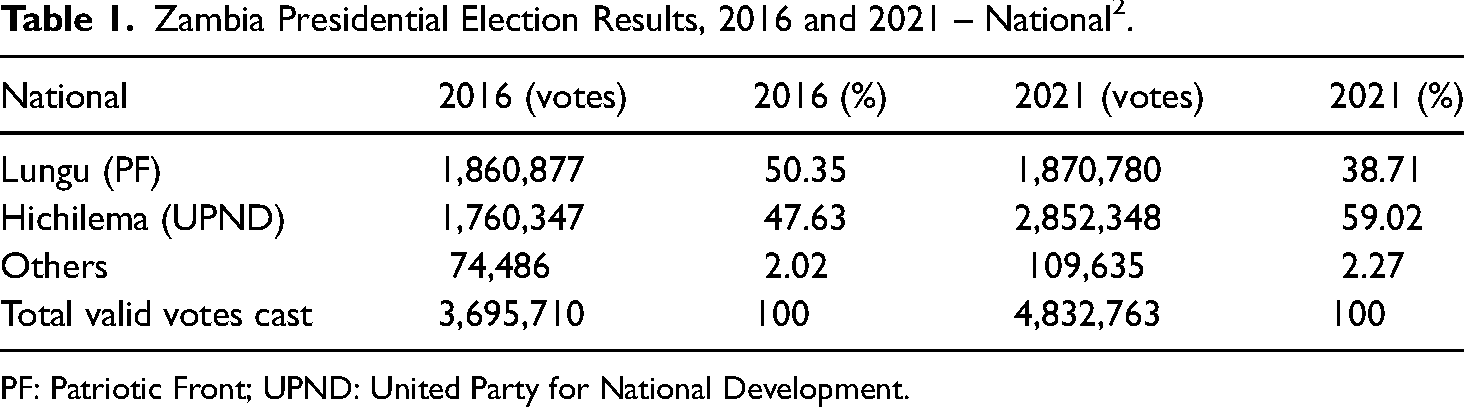
Zambia Presidential Election Results, 2016 and 2021 – National 2 .
PF: Patriotic Front; UPND: United Party for National Development.
The table shows a substantial and decisive swing in the share of votes cast from PF candidate Lungu from 50.35 per cent to 38.71 per cent to Hichilema whose votes increased from 47.63 per cent to 59.02 per cent. These results show that the PF took voters for granted without understanding their real intentions.
These results align with people's responses to the PF songs. On August 2, 2021, Mwansa, forty, and father of four furiously stopped a barman at a local bar in the Nkana constituency in Kitwe from playing one of the alebwelelapo songs: Chifumyepo icho icilwimbo iwe tawishibe ati chiletukalifya imitima. Ulemona kwati twalisekelamo ifyo tuleikala muli Aba bakabolala ba PF? Stop playing that song, it is annoying us. Do you think we are happy with the life we are living under these thieves, the PF? [His friends supported Ezra in making sure that the song was not played] cififumyepofye pantu twalaya kumbi Ku bar just stop the song otherwise we are leaving the bar and go elsewhere. Even though they look innocent [in an apparent reference to the PF], their bad habits cannot be concealed. When they see material things, they change their behaviour. They pretend to be humble. They look loyal. But when they get the money they even start English “who are you? Do you know me? Do you know who I am?” [Ezra said mwankole was the most appropriate song for the moment and “not that nonsense” in reference to alebwelelapo songs].
Although all the musicians chose to be anonymous during the interviews I had with them, they expressed their feelings about the songs in more direct ways. One musician who composed the songs before 2011, said “I composed the song primarily to express my dissatisfaction with the MMD. I did not ask for money.” The second musician said, “when the PF started using the song, I was satisfied with the fact I was contributing to change.” These responses show that the PF merely took advantage of popular music in their campaigns. In contrast, one of the musicians who composed PF songs since 2016 said “it is very difficult to make money through music in Zambia because of piracy. When a politician comes, that is the time to make money.” Another musician said, “This is just business. Even if I sang for the PF, I voted for the opposition.” Such responses explain why some prominent musicians who composed songs for the PF apologised to their fans when the PF lost the elections 1 . These responses shows that the use of music did not help the PF in 2021 as it did in 2011. As Ayettey (2016) argues for Ghana a party that uses music and dance can still lose an election if they fail to deliver to the expectations of voters e.g., in terms of improving their living conditions. As recent studies show (Musonda forthcoming a, b; Resnick, 2022; Siachiwena, 2021) the PF had many failings, which could explain, in this case, why music failed to replicate the 2011 results.
Conclusion
This article analyses the campaign songs of the PF which ruled Zambia between 2011 and 2021, first under the populist leader Michael Sata who died in 2014, and then under Edgar Lungu who eventually lost to Hakainde Hichilema in 2021. It examines the key messages that the PF songs have contained in the four elections in 2011, 2015, 2016 and 2021. It shows that while in opposition the PF song represented what can be described as “struggle songs” that highlighted the difficulties that Zambians faced under the MMD and helped to create a certain morality that was crucial for the PF’s victory. However, since 2015, the PF's songs took a boastful turn as they aimed at hyping a relatively weak, and generally perceived corrupt Lungu as a presidential candidate while disrespecting and undermining the main opposition candidate Hichilema. This tendency was taken to an exaggerated extent to the point that it annoyed many Zambians and fermented what Siachiwena (2021) described as “a silent revolution” which was evidenced by the large turnup and the election of Hichilema as president. This article argues that music can be a useless tool if: it does not reflect popular sentiment; used to undermine, intimidate and disrespect other political players and; used as a tool for boasting, by a party with many failings-mismanaging the economy, and violence and amidst rising poverty. This article argues that music can be an important lens for understanding power relations and political behaviour of politicians than is presently acknowledged.
Footnotes
Declaration of Conflicting Interests
The author declared no potential conflicts of interest with respect to the research, authorship, and/or publication of this article.
Funding
The author received no financial support for the research, authorship, and/or publication of this article.