




Abstract
On 11 August 2016, Zambia held elections for the presidency, National Assembly, local councillors, and mayors. Concurrently, a referendum was held on whether to enhance the Bill of Rights in the Constitution of Zambia. The elections were significant for several reasons: It was the first contest under a newly amended Constitution, which introduced important changes to the electoral framework. It also marked a break with Zambia's positive historical record of arranging generally peaceful elections. Moreover, the election featured an electoral playing field that was notably tilted in favour of the incumbent party. Ultimately, the incumbent president, Edgar Lungu of the Patriotic Front, edged out opposition challenger Hakainde Hichilema of the United Party for National Development. The election was controversial and the opposition mounted an unsuccessful legal challenge to the final results. The 2016 elections represent a reversal in the quality of Zambian democracy and raise questions about the country's prospects for democratic consolidation.
Zambia's electoral history has been peaceful compared to many other sub-Saharan African countries. However, the recent presidential elections in 2015 and 2016 have marked a shift in this trend, with violence increasing. The former president, Michael Sata, had a short tenure as he died in office in October 2014. In accordance with the Constitution of Zambia, Sata's death triggered the need for a by-election. The vacancy in the presidential office led to serious infighting in the ruling Patriotic Front (PF) as prospective candidates wrangled to become Sata's successor. The party constitution states that a presidential candidate is to be elected at a national convention. However, due to the short timeframe in which a candidate must be selected, some senior party members argued that the nomination should automatically be awarded to Minister of Defense Edgar Lungu, who had been appointed acting president when Sata had left the country to receive medical treatment before he eventually died. In the succession struggles, two factions emerged within the PF, each of which went on to arrange its own convention. In the first convention, Lungu stood as the unopposed candidate for president. In the second convention, led by Acting President Guy Scott, several PF heavyweights, including Michael Sata's son Mulenga Sata, Deputy Commerce Minister Miles Sampa, Kasama Central Member of Parliament (MP) Geoffrey Bwalya Mwamba, and Commerce Minister Robert Sichinga, fought it out to become the party nominee. The second convention resulted in a victory for Miles Sampa. Struggles over whether Lungu or Sampa should be regarded the legitimate nominee escalated into violence in Lusaka. The matter was eventually resolved in court, where Lungu was declared duly elected as the PF nominee for president.
The 2015 by-election turned out to be a very close two-horse race, with Lungu defeating Hakainde Hichilema of the United Party for National Development (UPND) by a narrow margin of 27,757 votes, or 1.66 per cent (elections.org.zm 2015). The 2016 election was widely seen as a rerun of the 2015 contest, with Lungu and Hichilema remaining the only two viable candidates. However, a number of factors created uncertainty in the election. Turnout in 2015 had been low, as elections were held in the rainy season. Also, the 2015 election had been arranged using the 2011 voters' roll. The number of registered voters increased from 5.17 million in 2015 to 6.70 million in 2016. Moreover, factionalisation in the PF caused by the earlier succession struggles had resulted in important party defections. Over the course of 2015 and 2016, Sampa, Mulenga Sata, Sichinga, Scott, and others had defected to join the UPND. Most importantly, Hichilema had picked Geoffrey Bwalya Mwamba as his running mate. The Bemba-speaking Bwalya Mwamba was seen as a politician that could help the UPND make inroads into traditional PF strongholds in Copperbelt and Northern provinces.
The 2016 election was held against the backdrop of important institutional changes. The Constitution of Zambia was amended in January 2016, just a few months before the election, and further changes to the Electoral Process Act were enacted in June 2016. The amended Constitution has come under serious criticism from leading Zambian legal scholars both for its content and for the executive-driven process that created it (Ndulo 2016). The constitutional amendments did not address problems related to executive concentration of power. For instance, the new Constitution did not do away with the controversial provision that enables the executive to appoint electoral commissioners. In fact, the amended Constitution enhanced the already great power vested in the presidency. A new and particularly controversial provision of the Constitution, Article 81(4), allows the president to dissolve parliament if it fails to “objectively and reasonably carry out its legislative functions.” In terms of the electoral framework, several new provisions were included in the new Constitution. For instance, the amended Constitution introduced the possibility of a second presidential runoff if no candidate amassed more than 50 per cent of the votes in the first round of voting.
For nominations to the National Assembly, both the PF and the UPND relied on a complex interview process. Candidates who sought the nomination had to go through committee-based interviews at the constituency, district, and provincial level. These committees made their recommendations to the National Executive Committee of each party, who made the final decision. 1 These processes were a major hurdle for female representation. The Zambia Elections Information Centre (ZEIC) observed that only 87 women were adopted as MP candidates across the political parties – a decrease of 36 per cent from 2011 to 2016. 2 Many women who were approved at ward, constituency, and district levels were not adopted when the decisions were made at the provincial level. The lack of transparency around nomination procedures likely had a negative effect on female representation and reflects a failing of intraparty democracy.
Author interview with UPND and PF party officials in Lusaka, July 2016.
Information from a pamphlet obtained at the ZEIC event in Lusaka on polling day.
Candidates, Parties, and Campaigns
The 2016 presidential election was contested by nine candidates, with 13 parties as well as independent candidates participating in the parliamentary elections. Given that Lungu and Hichilema collectively received 95 per cent of the vote in January 2015, unsurprisingly they were widely perceived as the only viable candidates.
Generally, the Zambian election was not contested on a level electoral playing field (Levitsky and Way 2010). The ruling PF enjoyed significant advantages in the campaign period. The Zambian Police Service frequently applied the controversial Public Order Act to deny the opposition the right to hold rallies. Moreover, the PF systematically used state resources, like state events and Air Force helicopters, for campaigning purposes. The government attracted criticism from the international community for its restriction of press freedom. In particular, concerns were raised about the closure of the opposition newspaper, The Post, by the Zambia Revenue Authority (ZRA) less than two months before election day (zambiareports.com 2016a). State media continued to be heavily biased in favour of the ruling party. A report issued by the Media Institute of Southern Africa (MISA) found that the PF received approximately 45 per cent of the media coverage in the Zambian National Broadcasting Corporation's (ZNBC) TV and radio broadcasting, compared to only about 15 per cent for the UPND (MISA Zambia 2016).
Zambia has in the past been known for peaceful elections (Strauss and Taylor 2012), but in 2016 the PF campaigns – and to a lesser extent, the UPND campaigns – were strongly linked to incidences of violence. To protect its supporters from violence, the UPND launched a strategy called the “watermelon” tactic. The strategy urged UPND supporters to be green on the outside (wear the PF's green campaign regalia) and red on the inside (still vote for the red party, the UPND). Ironically, the watermelon strategy is similar to the donchi kubeba (Bemba: “don't tell”) strategy employed by the PF in the 2011 election. Donchi kubeba referred to PF supporters taking the gifts handed out by the then-incumbent Movement for Multi-Party Democracy (MMD) party, without disclosing that they intended to vote for the PF. Some notable examples of violence in 2016 included an event where a former UPND MP and her supporters assaulted a Forum for Democracy and Development (FDD) MP candidate in Namwala (lusakatimes.com 2016f), and an event in Lusaka where police shot and killed a UPND supporter (lusakatimes.com 2016d). Amid unprecedented levels of violence, the Electoral Commission of Zambia (ECZ) took the drastic decision to suspend campaigning for 10 days in Lusaka and Namwala districts, two districts especially affected by violence. Although the decision to suspend the campaign was welcomed by parts of civil society, some smaller parties questioned the fairness of the decision as it deprived them of the right to campaign even though they had not been guilty of perpetrating violence (muvitv.com 2016).
In terms of policy, infrastructure and economic issues dominated the campaigns. After many years of impressive economic growth, Zambia's serious economic decline in recent years, a devalued Zambian kwacha, increased costs of living, unemployment, and closures of copper mines have negatively affected Zambians. These economic problems may have affected the ruling party's popularity, especially in urban areas. The PF's electoral strategy was to emphasise the need for continuity and to highlight the massive investments in infrastructure in the five years preceding the election, especially investment in the Zambian road network. The incumbent party went to the elections under the slogan “Sontapo” (Bemba: “point”), challenging the opposition to demonstrate their achievements. The PF was banking on the new roads increasing their support in rural areas that had previously suffered from poor infrastructure. However, the opposition maintained that the road projects had been expensive and poorly built and had added to a serious national debt problem. The UPND, on the other hand, used “Zambia, forward” as their slogan, crafting a campaign around a message of change and in opposition to what they described as the PF's policy failures. Hichilema, an economist by training, portrayed himself as a more fiscally competent leader than Lungu, stating,
If your car is broken you go to a mechanic, if your child is sick you go to a doctor, and if your economy is broken you go to an economist. (UPND 2016)
Zambia also held a referendum in August 2016, concurrent to the legislative and presidential elections, on enhancing the Bill of Rights in the Constitution. The Constitution had been amended in January 2016 with the necessary two-thirds parliamentary majority. However, the Bill of Rights was not altered in January, as Article 79 of the Constitution dictates that the Bill of Rights cannot be changed without a referendum. As well as proposing a new Bill of Rights, the referendum proposed repealing Article 79, which would have enabled future parliaments to make changes to Zambia's Bill of Rights without a referendum. Although the question may seem uncontroversial, the opposition took this opportunity to campaign against the amended Constitution in its entirety. Just over a month before the election, the ZEIC suggested that many people did not understand the rationale, potential consequences, and mechanics of the referendum (lusakatimes.com 2016c). Despite an education campaign by the ECZ, the population's confusion was perhaps unsurprising given the wording of the question, the inclusion of two issues to resolve under one question (elections.org.zm 2016), and “noise” from the presidential and National Assembly elections obscuring almost everything else. The broad consensus among academic and independent media observers was that this lack of understanding would likely lead to the referendum failing to garner the more than 50 per cent support from eligible voters – rather than simply registered voters – that was required for it to pass.
Results and Voting
Voting day 2016 passed with only a small number of incidents. Logistical problems affected voting in some locations. However, where polling stations did open late it was generally by no more than a few hours, and the ECZ made it clear that anyone still waiting to vote at the time the polling station closed would still be able to cast their ballot. A more serious problem was excessive queuing at many polling stations. Early monitor statements interpreted the long queues as a sign of high turnout. However, final election results showed that turnout had increased only marginally. Stakeholders breathed a sigh of relief in observing that voting was generally peaceful.
The relative tranquillity of election day quickly turned tense, as the ECZ started the process of tabulating and announcing results. Before the election, the ECZ had made public its ambitious goal of declaring the winners within 48 hours of the close of the last polling station. The timeframe seemed overconfident, as the election involved five separate ballots. The ECZ's failure to meet the self-imposed target created further tension around the results and increased the scope for parties, particularly the UPND, to allege that manipulation was occurring.
As the presidential results were announced, the lead swung back and forth between Lungu and Hichilema. The initial results revealed that Hichilema had gained some ground in the areas he needed to improve upon from his 2015 showing – Lusaka and Copperbelt – but it was unclear if, coupled to his large victories in Southern and Western provinces, this would be sufficient.
The disclosure of the presidential results was rather drawn out, with the tallies from every single constituency being individually announced at the ECZ, followed by questions from representatives of the political parties. One notable incident at these sessions was UPND legal counsel Martha Mushipe effectively taking over one session by shouting at the ECZ officials and calling for the director, Pricila Issacs, to resign. Mushipe accused the ECZ of working with the PF to rig the elections. Her fears were mainly fuelled by reports that a man linked to the PF had entered a restricted ECZ area, where he had been able to access the computer system (lusakatimes.com 2016a).
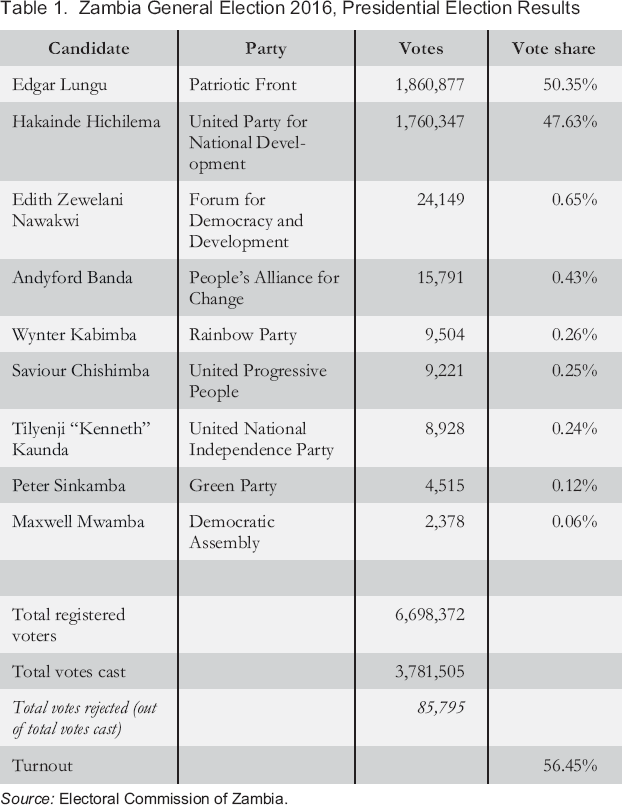
Zambia General Election 2016, Presidential Election Results
Source: Electoral Commission of Zambia.
The final presidential results were announced on 15 August 2016, showing that Lungu had defeated Hichilema by a margin of 100,530 votes. This was an increase from the 27,757 votes that had separated them in 2015. However, Lungu was only 13,022 votes above the more than 50 per cent threshold required to be declared the outright winner in the first round. Following the controversial events, particularly in the pre-electoral period, the results were inevitably contested. For Hichilema, a loss in 2016 also meant that he had failed to win four consecutive elections as leader of the UPND. The results also showed strong regional clustering of support (see Figure 1 below). The 2016 election map basically shows Zambia split in two, with the UPND carrying Southern, Western, and North-Western provinces and the PF winning Northern, Luapula, Eastern, Copperbelt, and Lusaka provinces. Central Province was split. Although the UPND made some inroads into the urban areas, the PF was able to maintain its urban base – quite a rare achievement among incumbent parties in sub-Saharan Africa (Boone and Wahman 2015).
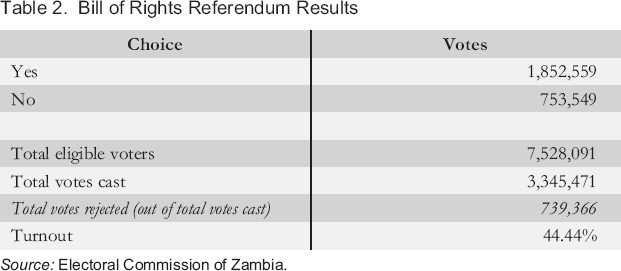
The next significant result announced was the referendum. As expected, the threshold of 50 per cent turnout was not met, meaning that despite the Bill of Rights being supported by 71 per cent of the total valid votes, it failed to pass. A notable feature of the referendum was the high number of rejected ballots. The UPND did not call for voters to reject the Bill of Rights but instead urged them to ignore it, arguing that the amended Constitution introduced at the start of the year was not a “people-driven constitution” and that endorsing the referendum was tantamount to supporting the PF (zambiareports.com 2016b).
Bill of Rights Referendum Results
Source: Electoral Commission of Zambia.
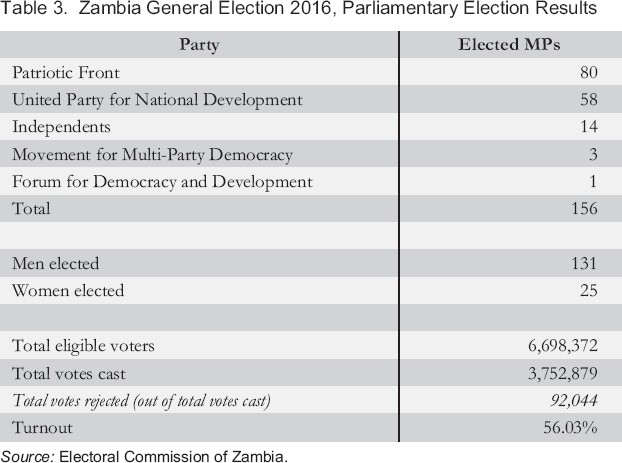
The PF gained a clearer majority in the parliamentary elections. They secured 80 out of 156 seats, with the UPND capturing 58 seats. Geographical voting patterns largely mirrored the presidential election, with the UPND performing strongly in North-Western, Southern, and Western provinces; in these provinces they secured 45 out of 48 seats. Notably, despite 13 parties contesting the parliamentary elections, only four parties in addition to independents actually gained any seats. Nine of the 14 independents that were successful had originally sought to be adopted by the PF or the UPND in the constituencies in which they ran. At the time of writing, there have been some post-election defections of party officials and candidates, but it remains to be seen how many of these independents will align themselves, either officially or unofficially, with the PF or the UPND. In any case, the fact of the PF's majority diminishes the significance of the issue.
Zambia General Election 2016, Parliamentary Election Results
Source: Electoral Commission of Zambia.
In addition to the regionalised voting patterns described above, another notable yet disappointing aspect of the parliamentary elections was the low number of women elected. Only 25 female candidates won their constituencies. This was despite the PF pledging that over 40 per cent of their adopted candidates would be women (lusakatimes.com 2016k). The ZEIC found there were fewer female candidates in 2016 – 94 – compared to the 138 that stood in 2011. The UPND had the most female candidates, with 29, while the PF, despite the aforementioned pledge, fielded only 24 female candidates. The ZEIC suggested that complex nomination procedures, where intraparty democracy was lacking, were a key factor in the lack of female candidates. The ZEIC found numerous cases where women were registered to stand but were replaced at the last minute by men. The frequent violence in the 2016 elections also negatively impacted women, with the ZEIC finding instances of women being “stripped naked” when wearing their preferred political party clothing (osisa.org 2016).
Aftermath
The results alone provide an incomplete picture of the Zambian elections. Election day was the calm both after and before the storm. Immediately following the announcement of the presidential results on August 15, anti-Lungu riots broke out in Southern Province, which overwhelmingly backed Hichilema. Riots broke out in Namwala, Mazabuka, Monze, and Choma. Almost 300 people were arrested across those four areas (lusakatimes.com 2016g). Burning tyres were placed on roads, PF market stalls were burnt down, and UPND cadres clashed with the police (lusakatimes.com 2016h). There were also allegations that UPND cadres had set fire to government offices in Lukulu in Western Province. Despite reports that this was due to an electrical fault (wn.com 2016), and despite violence being rare in rural areas such as Lukulu, this added to the consensus amongst the sympathetic PF media such as Daily Nation and certain radio shows that the UPND were to blame for any tension and violence.
Furthermore, following the crackdown on The Post before the election, there were further infringements on private media post-election. Muvi TV, Komboni Radio, and Itezhi Tezhi Radio – all independent broadcasters – had their licences revoked by the Independent Broadcasting Authority for acting in a manner that “posed a risk to national peace and security” (lusakatimes.com 2016i). While the results themselves tell only a partial story, the geographical spread of the presidential results, illustrated in Figure 1, reveals the divide of the country and the clearly regionalised voting patterns. There were only three competitive provinces: Lusaka, Copperbelt, and Central – all urban or semi-urban provinces.
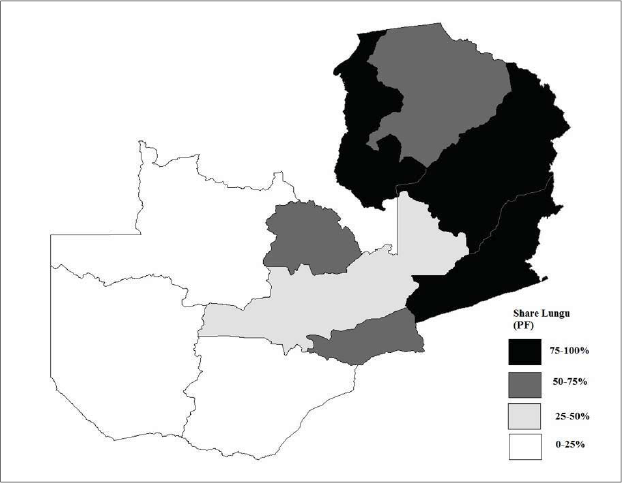
Zambia General Election 2016, Presidential Election Results
The UPND filed a legal challenge with the Supreme Court on 19 August 2016. The petition claimed that President Lungu was fraudulently elected, that his presidency should be nullified, and that a recount was required due to the various irregularities before the election, on election day, and after the election (lusakatimes.com 2016j). There were rumours that, in order to counter potential PF supporters blocking roads to the court, hundreds of UPND cadres would be present when the petition was handed in. Ultimately, though, the petition was submitted with little difficulty, and it turned out to be sufficient to postpone the inauguration until the outcome was clear.
However, in the end the petition was unsuccessful. The Constitutional Court ruled on 5 September 2016 that its jurisdiction to hear the petition had expired. This was based on wording in the Constitution that stipulated that the Court must hear the election petition within 14 days of it being filed. The Court was divided 3 to 2 on whether the petition should be heard, reflecting the contentious nature of the ruling. On 2 September 2016, UPND lawyers had staged a walkout in the Court claiming that they were given only two hours to present their case (lusakatimes.com 2016l). The UPND subsequently filed an application to delay the inauguration of Lungu, on the basis that the Court did not declare him the winner of the elections when they dismissed the petition (lusakatimes.com 2016b). However, Lungu was inaugurated as president on 13 September 2016.
Conclusion
Overall, the 2016 elections did not contribute to democratic consolidation. On the contrary, it is hard not to interpret the election as a step backwards for the state of democracy. Before the election, there was a prevalence of election violence, intimidation, closure of independent media, and significant media bias. While polling day itself appeared largely successful, the post-election period was characterised by additional violence, particularly in Southern Province and Lusaka, and further infringement of independent media. Key institutions failed Zambian democracy. Parties were guilty of the various manipulation tactics described above; state media failed to engage in balanced coverage, while independent media were frequently shut down; the Electoral Commission ran disorganised and slow counting and verification processes; and the judiciary oversaw opaque legal proceedings. In the end, key stakeholders questioned the very legitimacy of the election and there was no general acceptance of the results.
More generally, Zambian democracy appears to be at a crossroads. The 2016 election exhibited many of the democratic deficiencies normally associated with competitive authoritarian regimes (Levitsky and Way 2010). There is an apparent risk that the increased levels of violence may now be locked into the electoral process, especially given that voters did not ultimately reject the main perpetrators of the violence. The high level of violence in urban areas was likely used to prevent increased opposition in the cities. Moreover, and maybe most importantly, the amended Constitution further strengthens the executive grip on power and reduces the checks and balances in the political system. Scholars, civil society, and international actors are likely to keep a close eye on future political developments and possible signs of further democratic erosion in Zambia.