



Abstract
Education policy can embed ethnic inequalities in a country. Education in Burundi, with its historically exclusive political institutions and education, represents an important case for understanding these interactions. In this article, I interview twelve Burundians about how they experienced and perceived ethnicity and politics in their schooling from 1966 to 1993. I argue that education contributed to tangible and perceived social hierarchies based on ethnic inequalities. I show that this exclusion reflected both overt and covert policy goals, through proxies used to identify ethnicity in schools and through the exclusive nature of national exams at the time, which promoted members of the Tutsi minority at the expense of the majority Hutus. This study has implications for understanding how perceptions of inequality in education manifest as grievances against the state. It sheds light on the importance of understanding covert education policy as a potential mechanism for generating exclusion and contributing to conflict.
Introduction
After all, our schooling has not been so much the great redeemer of prejudices as the tireless chronicler of what divides us. (Willinsky, 1998: 1)
When Cadeau finished primary school in 1978, his next step was the concours national, a notoriously difficult exam required for secondary school entry in Burundi. He failed. The next year, he failed again. He finally passed on his fourth attempt and eventually studied law at the University of Burundi in the late 1980s and early 1990s. Almost forty years after he first took the exam, he described his experience:
[the concours national is] a nightmare [that] no Burundian should have had to live through… but I am Tutsi, so I eventually got through. I didn’t realise what was going on, why they were so hard, until I was in the University [of Burundi], and there were no Hutus in my class. The exams were hard to keep them out.
The interethnic dynamic between Hutus (85 per cent) and Tutsis (14 per cent) (CIA WorldFactbook, 2020) shapes Burundi’s history. After independence in 1962, Tutsis maintained political power and systematically excluded Hutus from politics. This exclusion culminated in a civil war from 1993–2005, leading to over 300,000 deaths (Call, 2012). Scholarship on Burundi focuses on the relationships between ethnicity, politics, and conflict – for example, the interplay between the political system and ethnic exclusion in the build-up to the war (Call, 2012; Lemarchand, 1995) or how political institutions changed because of the Arusha Peace and Reconciliation Agreement (2000), which mandated ethnic power-sharing (King and Samii, 2020; Reyntjens, 2015; Uvin, 1999, Uvin, 2009; Vandeginste, 2014). Related to the first area, some studies point to the important role unequally distributed education played in contributing to the violence (Jackson, 2000; Nkurunziza, 2012). Yet, while studies point to unequal education as a cause of the war, they neglect the experiences of individuals in education and how those experiences interacted with politics and contributed to the violence. Indeed, education is a fundamental way that state-based policies interact with individual and group experiences, and decades of scholarship on education and violent conflict illustrate that education is not always a “benevolent actor” and can contribute to conflict (Bellino and Williams, 2018: 3; Burde, 2014; Bush and Saltarelli, 2000; King, 2014; Paulson, 2008). In a context such as Burundi, where intergroup grievances lie at the heart of decades of violence and war, understanding how education both overtly and covertly reinforces political goals and how these objectives shape intergroup grievances has important implications for understanding the causes of violence.
In this article, I analyse the interplay between experiences, education, and politics in Burundi before the civil war (1966–1993). I focus on two key aspects: the government’s silencing of ethnic identity on the one hand, and the exclusive aspects of the Burundian state, which promoted Tutsis and marginalised Hutus, on the other. I show how these shaped experiences of education – first in how participants talked about ethnicity and unity, and second in how the concours national promoted Tutsis at the expense of Hutus. I argue that the disconnect between overt and covert policy goals, and how students perceived them, contributed to tangible and perceived social hierarchies and grievances against the state. These, in turn, contributed to the violence.
This article unfolds in five parts. I first explore the literature on the relationships between politics, education, and conflict. Second, I detail how Burundi’s education system reflected its political institutions during the Tutsi-dominated governments from 1966 to 1993. Third, I describe my interview sample and analysis. Fourth, I show how participants understood ethnicity and exclusion in education during this time and what these understandings meant as the country marched towards war. I conclude with implications for scholarship and policy, and as well as future research agendas.
Relationships between Politics, Unequal Education, and Conflict: The Case of Burundi
In countries where political, social, and economic inequalities overlap with ethnicity, grievances against the state develop and increase the likelihood of civil war (Cederman et al., 2013; Stewart, 2002). Scholarship in this field often analyses the consequence political exclusion of ethnic groups for violence (Call, 2012; Ross, 2007; Vogt, 2019) or strategies governments use to recognise ethnic groups (or not) and address these inequalities after violence (Cederman et al., forthcoming; King and Samii, 2020), and the consequences of this recognition for peace. The important role education plays in shaping these political grievances, though not ignored, is minimised or depoliticised and considered an aspect of social inequalities rather than political inequalities (Østby, 2008). However, education is inherently political (King, 2014), and indeed inequalities in education contribute to political, social, and economic inequalities (Brown, 2011; Langer and Kuppens, 2019).
Moreover, education is one of the principal ways average citizens interact with the state (Burde, 2014), even in places that are far from capital cities and centres of power. Further, the provision of education can promote government legitimacy (Burde et al., 2016; Gellner, 1983; Weiler, 1983), in addition to its role as a source of credentialing and social status (Bourdieu, 1986). Access to higher education is an “influential determinant of social mobility” (Lange, 2012: 20). The presence of education inequalities along ethnic lines is thus a place where inequalities are tangible; whereas power-sharing in political institutions or judicial branch is for the elites, education is, in theory, for everybody (Burde et al., 2017; Novelli et al., 2015). Perhaps because of the tangible nature of these inequalities, both qualitative single-country case studies (Burde, 2014; King, 2014) and quantitative studies (Alcorta et al., 2018; Omoeva et al., 2015; Østby, 2008) emphasise that ethnic inequalities in education directly contribute to conflict.
Unequal education access aggregates upwards and filters into political and economic institutions (Brown, 2011; King, 2014). Yet, overt policy goals – for example, policies that promote education for all or national unity – can mask the covert objectives of a government seeking to marginalise groups from power, such as unequal school distribution or programmes to promote hate (Burde, 2014; King, 2014). Moreover, the perceptions of inequalities can be very different from tangible, or observable, inequalities (Langer and Mikami, 2013), and the differences between observations and perceptions can mask covert policy approaches to discrimination. The disconnect between overt and covert policy goals, and how related perceived inequalities play out in the minds of the youth who experience them, are often overlooked in studies on the relationship between education and conflict. Understanding how youth experienced educational policies can shed light on how the presence of inequalities translates into grievances against the state, which has implications for post-conflict education policy development.
Context: Ethnic Politics in Burundi from 1966 to 1993
After independence in 1962, Tutsis (14 per cent) in Burundi maintained control of political and economic institutions and excluded Hutu (85 per cent) (Call, 2012). A 1966 coup by Michel Micombero brought about the first of three regimes dominated by the Tutsi minority. The repressive Micombero regime initiated a genocide against educated Hutus in 1972, killing almost 100,000 Burundians (Lemarchand, 1995). Afterwards, the government developed an outward-facing political agenda that strove for national unity and mandated ethnic silence (MIN, 1974). Simultaneously, his government embarked on a plan to promote Tutsis at the expense of Hutus with similar policies continued under his successors (Lemarchand, 1995; Uvin, 1999). By the start of Tutsi President Pierre Buyoya’s (1987–1993) term, Tutsis controlled thirteen of fifteen governorships, three-quarters of the legislature and cabinet, and 90 per cent of all army officer positions (Call, 2012).
Violence and war in 1988 created an impetus for Burundian politics to open space for Hutus. In 1991, the government adopted the Charter on National Unity, and the new constitution in 1992 further opened space for Hutus in politics, through mandates for ethnic parity in political parties. In the elections in 1993, Burundians elected a Hutu president, Melchior Ndadaye. His assassination by Tutsi armed forces that October sparked a civil war. The war was fought largely along ethnic lines and resulted in approximately 300,000 deaths (Call, 2012). The Arusha Peace and Reconciliation Agreement (2000) and the post-war Constitution (2005) mandated ethnic-power sharing. After national elections in 2005, the legislature selected a Hutu, Pierre Nkurunziza, who held power through his death in 2020. Table 1 shows a list of the heads of state of Burundi and their ethnicity.
Heads of State in Burundi, Post-Independence.
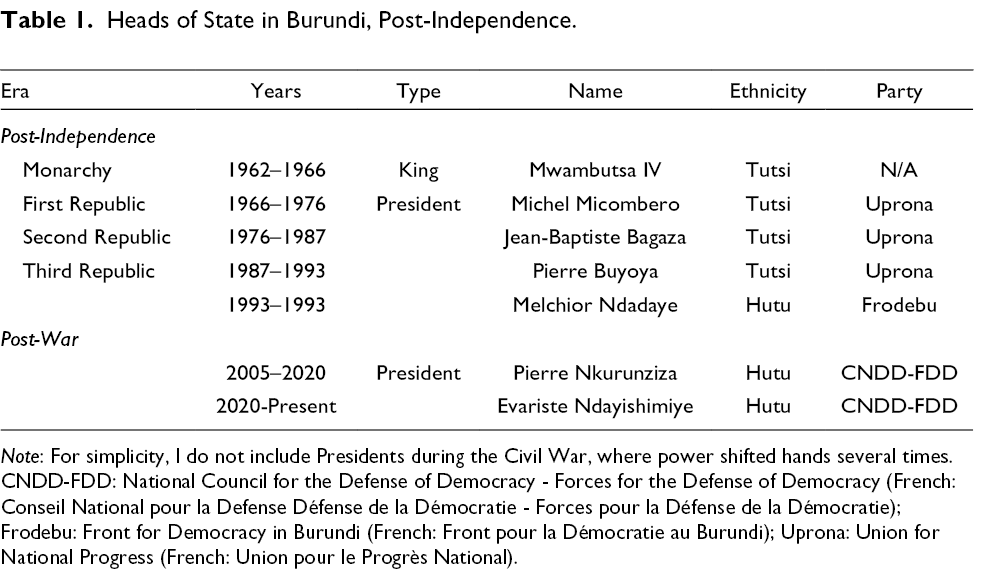
Note: For simplicity, I do not include Presidents during the Civil War, where power shifted hands several times.
CNDD-FDD: National Council for the Defense of Democracy - Forces for the Defense of Democracy (French: Conseil National pour la Defense Défense de la Démocratie - Forces pour la Défense de la Démocratie); Frodebu: Front for Democracy in Burundi (French: Front pour la Démocratie au Burundi); Uprona: Union for National Progress (French: Union pour le Progrès National).
Education from 1966 to 1993
During this time, Burundi’s education system reflected the political system: it promoted national unity while excluding Hutus, particularly in secondary schools and universities. For instance, in 1978, the government developed a plan for universal literacy by 1990 (UNESCO, 1978), which helped increase primary school enrolment from 26 per cent to 52 per cent in 1992 (Obura, 2008). Yet, covert policies subverted these goals and increased inequalities in schooling. For example, there were significant inequalities in education distribution: the south of the country, where all three Presidents were from, saw greater educational investment (Jackson, 2000; Nkurunziza, 2012; Obura, 2008). Figure 1 illustrates the provincial education divide from 1966 to 1993. By 1993, secondary-level enrolment in these provinces topped 50 per cent, though they represented just one-third of the overall population; these provinces accounted for an even greater share of university students (Jackson, 2000).
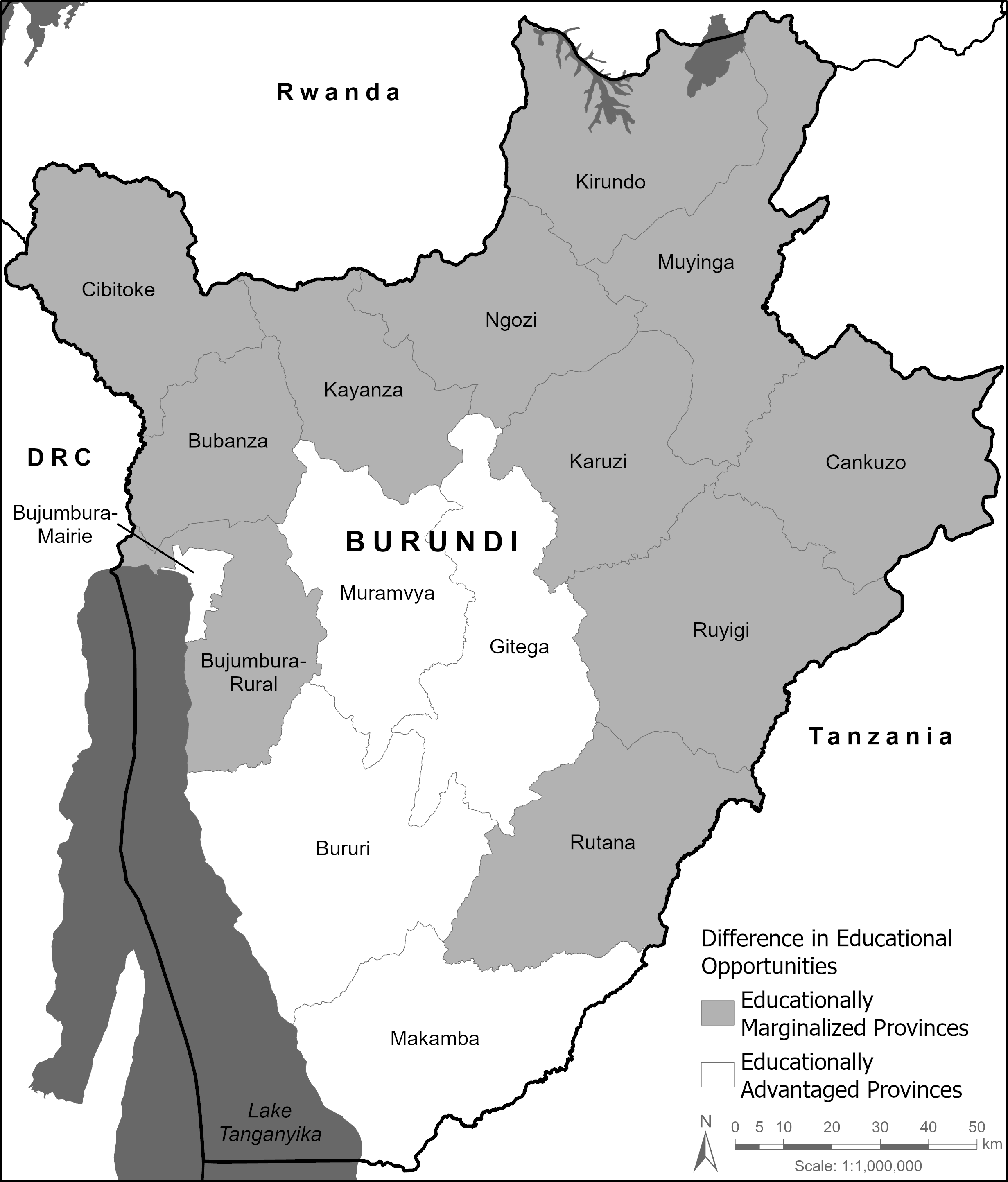
The provincial education divide from 1966 to 1993.
Simultaneous ethno-regional favouritism promoted Tutsi education at the expense of Hutus within these provinces (Nkurunziza, 2012; Verwimp, 2019). An ethnic survey taken in 1988 in a northern province showed that Tutsis represented 102 of the 239 students across five primary schools (43 per cent), 76 per cent of the teachers, and 36 per cent of school directors (Panabel, 1988). According to one scholar, these data highlight that Hutu scholarship was less important than that of Tutsis, and there was an “intervening bias allowing for greater Tutsi representation, particularly in later years [of schooling]” (Panabel, 1988: 112). Inequalities only got worse at higher levels – Tutsi enrolment topped 93.5 per cent in 1989/1990 for programmes such as law and economics (Baraka and Hakizimana, 1992). 1
The concours national, the primary school exit exam, was one of the main reasons for limited Hutu enrolment in higher education. The exam was in French, the language of government, though students only started French in Year 5, the year before the exam (Cohet, 2002; Eisemon et al., 1989; Ndayipfukamiye, 1996). This put Tutsis at a structural advantage: Tutsis controlled access to the government and the civil service (Call, 2012), so more Tutsis were able to speak French compared to Hutus. More explicitly, the government marked student ethnicity on the exam – writing “I” for Tutsi and “U” for Hutu – not only in the concours national but also in the state exam taken at the end of secondary school, which was required for university entrance, to the benefit of Tutsis (Hakizimana, 1992; Ndikumana, 1998: 38–39; Nindorera, 2018; Ntibazonkiza, 1993: 204–210; Timpson et al., 2015). The Minister of Education from the time, Isodore Havyarimana (1982–1987), admitted to its existence in a 2013 interview (Iwacu, 2013), though he denied it contributed to ethnic inequalities in schooling or any malicious intent.
These policies reduced Hutu opportunities to advance in schooling and eliminated opportunities to continue onwards with high-paying careers or government jobs. Scholarship argues that these inequalities in education contributed to the civil war (Jackson, 2000; Nkurunziza, 2012; Sommers and Uvin, 2011), and they are recognised in the Arusha Peace and Reconciliation Agreement as a cause of the violence (Arusha Peace and Reconciliation Agreement, 2000: Chapter I, Article 2.2; see also Dunlop and King, 2021). Yet little is known about how individuals perceived and understood the interplay between overt policy statements of national unity and covert policies of ethnic discrimination in education, and how these perceptions could translate into grievances against the state and contribute to violence.
Methods
I interviewed twelve Burundians about their time in school from 1966 to 1993. 2 I identified participants for this study using a snowball sampling method, after advertising the study in Burundian Facebook groups and listservs. Given the political conditions at the time of these interviews, before the 2015 election, I was unable to go to Burundi to conduct these interviews; thus, ten of twelve participants were based in Canada, with two remote interviews with Burundians in Burundi. I conducted interviews in person, by phone, or on Skype, in English or French, depending on participant preference. Because I could not go to Burundi at the time, I was unable to have a Kirundi translator, which limited my ability to recruit and interview Burundians who did not speak French or English. Internet access was also required for conducting the interviews for Burundians in country. Interviews ranged from one hour to three and a half hours.
To supplement this analysis and account for some of the sample bias, I include excerpts of interviews from two Burundian experts on education in the country. I conducted these interviews after the primary data collection. These experts are both Hutus who were in school during the time in question, though I interviewed them as experts on the subject rather than on their experiences in school. These interviews provide context for the policies and experiences that participants had in schooling.
I analysed the interviews for themes relating to ethnicity and exclusion in school and politics. I looked at how participants framed ethnicity within schools, for both explicit discussions as well as subtle cues regarding its omission from schooling and experiences with ethnic identification policies. In discussions relating to exams, I looked at how both Hutu and Tutsi participants framed their responses concerning their experiences in school and their perceptions of both overt and covert policies relating to ethnic identity and violence. I also identified places where participants spoke to the tensions and dissonance between the overt and covert policies relating to ethnicity in their educational experiences.
There are a few limitations to this study. First, the sample skews towards both Tutsis and men, and though most Burundians live in rural settings, most participants were from the capital city. The second limitation is the use of a snowball sampling method to identify participants. A snowball sample helps in finding typically hard-to-reach populations; however, it also decreases the representativity of the sample and can lead to selection bias (Cohen and Arieli, 2011). While skewed, the participants here are representative of those enrolled in the Burundian education system at the time – predominantly Tutsi men, with very few schools existing in rural Burundi during the period under study. Third, the ability to emigrate away from violence is also generally linked with higher socioeconomic status and educational attainment (Dryden-Peterson, 2016), which was closely linked (though not exclusively) to Tutsi ethnicity. Indeed, the Hutu participants I interviewed were from slightly higher socioeconomic status families than average Burundians. I account for the sample bias throughout the analysis.
Of course, this means that in this study, I spoke primarily with Burundians who benefitted from the educational policies from the time. While the majority of the participants in this study acknowledged they were within the system, and indeed acknowledge (with the benefit of hindsight) the likely consequences of the systemic inequalities that they benefitted from, it would, of course, have been beneficial to interview more Hutus. Indeed, further research is required to fully grasp the consequences of exclusion for those marginalised in education. Rather, this study points to a necessary, if imperfect, first step to discussing the implications of overt and covert education policy on grievances and interethnic conflict.
Findings
Overt National Unity and Ethnic Silence, Covert Ethnic Identification
Schooling in First and Second Republics (1966–1976; 1976–1987)
Participants who were in school during the First and Second Republic stated that while they went to primary school with both Hutus and Tutsis there was a code of silence permeating their school experiences. According to Eraste (Male, Tutsi, 1st Republic), students would be punished for mentioning ethnicity “so we never did, not really.” Michel (Male, Hutu, 2nd Republic) furthered: “We didn’t really talk about ethnicity, that was – we called it ‘taboo’ – you couldn’t talk about it, but everyone knew.” Six participants (of ten) in primary school during the First and Second Republics said it was ‘taboo’ to discuss ethnicity in schooling. However, they described knowing the ethnicities of their peers, despite outward-facing national unity programme. Fabrice, a male Tutsi who started primary school towards the end of the First Republic described the proxies as follows:
… if you spoke French, or if your father survived the 1972 killings, [then] you were a Tutsi, but if you were a refugee who spent time in Tanzania or Zaire, spoke only Kirundi or your father had been killed, then in all likelihood you were a Hutu.
That is, students identified the ethnicity of their peers in two ways: whether a person had a living father, and whether a person spoke French. Ethnicity persisted as a factor in schooling, regardless of it being a ‘taboo’ subject.
Having a living father was a particularly important ethnicity proxy for those in school during the First Republic. All four participants from the First Republic started primary school immediately after the 1972 genocide. Bonheur, whose father died in 1972 said the following:
My dad [Hutu] was killed – I was one of the few in my school with no dad [his school was mostly Tutsi] so it made it more difficult for me. But my mother was Tutsi, so there was some… solidarity, I guess, in that – and my dad, before he died was pretty powerful, so we still had money and all of my friends were Tutsis.
The two Hutu participants, who started school five or six years after the genocide, concurred, as Michel (Male, Hutu, 2nd) described:
there was no problem figuring out if people were Hutu or Tutsi: did you have a dad? Was he killed in ’71, ’72, or ’73? Once we knew [that], we knew the answer. Everyone knew that I didn’t have a father, I was one of the only ones.
The genocide targeted educated male Hutus (Lemarchand, 1995), and this is a likely consequence of this targeting.
As Burundians gained temporal distance from the genocide, language overtook having a father as an important identity proxy. Four of six participants from the Second Republic identified knowing someone’s ethnicity based on whether someone spoke French, more so than those in school in the First Republic (two of four). Those with educated parents and/or parents working for the government who could speak French were likely Tutsis; Hutus, in contrast, were less likely to have parents who spoke French. For example, Julien (Male, Tutsi, 1st Republic), described schooling as such:
my mom didn’t want [me to learn Kirundi], and she decided when they changed the structure to Kirundi [in 1978], she changed me from that [public] school to another school where they spoke French all the time. It was important for the future.
Here, we can see the primacy Tutsi parents placed on learning French – both signalling the “Tutsi” identity and serving a fundamental aspect for future job prospects.
Emma (Female, Tutsi, 2nd) provided a different perspective on ethnic identity in her schooling, given that she is from a rural province. She described,
In high school, though, I knew. We all knew because there were [more] Hutus than Tutsis in my school – something like 60% were Hutus, maybe more like 80%… we were in the countryside and there are more Hutus in the countryside, that’s just the reality. I was never really worried about it, we still got along, we all slept in the same dorms and ate the same food… When I was in the 10th grade… that was the only time I was worried about being with mostly Hutus and was scared to sleep.
Emma is referring to the war in 1988 as a reason she was scared to sleep. She also points to the fact that there was a significant number of Hutus in rural schools during the late 1980s; in her school, between 60 per cent and 80 per cent of students were Hutus. Again, this inclusion reflects some of the policies that broadened education for Hutus in small amounts towards the end of the Second and early Third Republic. That is, even in the context of covert discriminatory policies, there were some areas where it was impossible to remove Hutus from schooling altogether – in rural areas with high Hutu populations.
Schooling in the Third Republic (1987–1993)
As the genocide moved further from the lived experiences of Burundians, and as the country began to open up political space to Hutus in light of the violence in 1988, ethnic identification became more open in schooling. The three participants I spoke with who had started school the latest – Redempta in 1984 (Female, Tutsi, 2nd), Thierry in 1987 (Male, Tutsi, 3rd), and Amani in 1988 (Female, Tutsi, 3rd) – did not recall identifying schoolmates based on whether someone’s father was still alive or not, nor did they talk about language as a proxy for ethnicity. Thierry denied any subtle identification occurring in school: “No, we didn’t really have this system – everyone existed in primary schools regardless of ethnicity. We didn’t talk about it, I guess, but we also didn’t really ask. We all played together and were friends.” Redempta likewise recalled a sense of unity and playing together:
No during school we did not hate Hutu, we played with them and things like that in school. There was a National Unity programme, too, right? So, everyone… I guess most people knew each other’s ethnicity, but no one really cared, we didn’t ask.
For Amani, this covert identification did not occur at all. There were Hutus and Tutsis in her school, and everyone knew everyone’s ethnicity, but this also was not a problem. When I asked her specifically if ethnicity was ‘taboo’ during her time in school, she responded “Oh no, we could talk about it – I guess it wasn’t brought up every day or anything, but it wasn’t forbidden.” Amani started primary school at the start of the violence in 1988, and she completed primary school during the civil war, yet, given the National Unity programme, ethnicity was not, to her recollection, a big deal in her schooling. Of course, it may be that participants here are referencing official narratives rather than their own lived experiences. Given that I did not talk with Hutus in school during this time, there is no comparison between how participants identified in school and the experience of the marginalised group in schooling during this time.
However, this opening occurred even as students progressed through secondary and university. Cadeau (Male, Tutsi, 1st) stated that as he continued in schooling, he developed what he called an “ethnic consciousness”:
In high school though, we developed a[n]… ‘ethnic consciousness’ I want to say… so we would start to identify with an ethnicity. I started high school in 1982 and finish[ed] in 1989. So, during that time it was different. Tutsi were still in power, Hutu were still barred from it, so Hutu felt injustice about that, and they would work in groups instead of with Tutsi.
This mirrors the covert policies from the time: Tutsi representation increased in secondary schools and universities despite programmes that officially denied ethnicity as a key identifying feature for Burundians. As the prevalence of Hutus decreased in school, the facade that Burundians were a unified group faded from Cadeau’s school experience. Again, having greater Hutu representation in the sample from this time would have highlighted the experiences those who were discriminated against in education during this time
These shifts also reflect Burundi’s education policies and politics, starting with broad non-identification and ethnic silence in schools after 1972. With distance from the genocide, ethnicity became more salient in schools as the country opened to ethnic identification. Moreover, as with many of the participants, by the time Cadeau was in university towards the end of the Third Republic (1987–1993), the National Unity doctrine was in place, allowing for ethnicity to become an open topic of discussion again, including in schools.
Contentious Policies: The Concours National
The concours national was an important topic across all of the interviews, participants pointed to this exam as one of the most salient aspects of their schooling. Julien (Male, Tutsi, 1st), for example, described “… then there were the nightmares of the national examinations. These determined the future of all the Burundians, and they were horrible.” Others described them as challenging, but necessary. Secondary schools had fewer spaces than primary schools, therefore high-stakes national testing was “necessary” to ensure that only “the best students” (Thierry, Male, Tutsi, 3rd) would continue to secondary school. Redempta described it as a “brutal” system that “everyone hated, but we all had to take them.” The only exception was Amani (Female, Tutsi, 3rd), the youngest participant. When I asked, she said:
[Laughter] I failed those so bad. I guess most people thought they were hard in the history [of Burundi]. I know my [older] brothers would try to scare me all the time in the days leading up to them… I mean, I failed the first time. But then my dad just paid later, and I went to a private school. 3 I knew that would be the case. I never even really wanted to go to the public schools.
To her, the deciding factor for success hedged on parental finances. Cadeau, the oldest participant, said: “I failed three times, but my father could afford to pay for me to pass anyways and go on to higher education after. So, there was corruption there, I guess.” Of course, high-stakes testing of this nature features prominently around the world, and indeed many students taking such tests would identify them in similar terms. Moreover, around the world, students of higher socioeconomic status are more likely to succeed than those from lower socioeconomic backgrounds. Burundi is no different.
Both Tutsi and Hutu participants talked about the exam being discriminatory, though for different reasons. Tutsis talked about the implicit marginalisation of Hutus as a direct effect of these exams. For example, in the opening quote, Cadeau (Male, Tutsi, 1st) reflected that he had passed the exam because he is a Tutsi, his father could pay. Similarly, Julien (Male, Tutsi, 1st) acknowledged that the unwritten purpose of the exams was to remove Hutus from schooling:
the key with [the exams] is that they were not a system of assessing the level of understanding or knowledge. But they were about selecting the best of the ‘best’… the Tutsis whose parents went to school or worked in the government.
Only one Tutsi interviewee, Fabrice (Male, Tutsi, 2nd), minimised the direct role of the state in promoting one ethnicity over the other, countering: “There [was] no ethnic discrimination… but [Hutus] were carrying some weight that we weren’t and that made a difference in school – it made it easier to pass exams and to do well in school for us.” When I prompted him to explain, he remarked that because Hutus often did not have fathers, they lacked helpful resources to learn or get help. That is, it was not necessarily the state perpetuating the inequalities in schooling, rather, the indirect disadvantages of Hutus caused them to fail.
In contrast, Davy and Michel, the two Hutu participants, perceived deep structural problems and the exams were directly responsible for eliminating Hutus from schools. According to Davy (Male, Hutu, 1st):
And they made it difficult because they wanted that process of elimination. That’s what it was… I knew some people [Hutus] and students who were very intelligent. You know those students that are even smarter than the teacher? I’ve seen them end up going to the lower [quality] school and that didn’t make sense. There’s no way – this guy is 10 points worse than me, how come I got to go to the worse school, and he [goes] there [to a better school]. It didn’t make any sense.
Hutus and Tutsis disagreed about the I/U system used for identifying Tutsis and Hutus on exams. Tutsis, by and large, did not believe the practice was a real policy. Five of the eight Tutsis across each of the Three Republics emphatically denied it. For example, Cadeau (Male, Tutsi, 1st) said:
No, that did not happen, there was no identification written on exams, that was a conspiracy theory. But under Bagaza… some schools did really well, especially in Bururi, and most people think that was because those schools were given exams ahead of time… You see, you cannot tell Hutu and Tutsi by [the] last name in Burundi – unlike some other places.
Emma (Female, Tutsi, 2nd) likewise emphasised:
Oh, no, no, no… Burundi is a country made of a lot of rumours … looking back if you were from Bururi and had an uncle who is a minister or general. That really helped. When I went to [school in] Bururi, the competition was much higher, they had examples [role models]. But Hutus didn’t have [role models], people to look up to, so they didn’t study, maybe, and maybe it was easier for Tutsis. Once you get into the nitty-gritty of it, it is a rumour.
Amani (Female, Tutsi, 3rd) was adamant: “Oh no, that is a rumour. The government was bad, yes, but they would never be that obvious.” That Tutsis denied the existence of the policy is no surprise: while well-meaning, they are also the ones who benefitted from the programme itself.
The two Hutus (Davy and Michel) emphasised this policy as a key barrier to success, without prompting. Michel for example, said, “the I/U system. You know it? That was also important. We would never get very far. It was by design. They would write the ‘I’ or the ‘U’ and if you were a ‘U’, you didn’t have a chance.” Even Bonheur, whose mother was Tutsi and father was Hutu, couched his assertions: “Yes, I think that maybe… it is not a rumour, that there was a system in place to eliminate, for lack of a better word, to eliminate the Hutus from schools.” Thus, Hutu and Tutsi participants had different understandings of the I/U system – Tutsis called it a “rumour” or “conspiracy theory,” and Hutus identified it as a barrier to their success. These disparities in responses point to the different experiences the marginalised group, the Hutus, had in their education compared to the dominant Tutsis.
It is perhaps not surprising that Hutus and Tutsis disagreed on the existence of this policy. Though widely cited as a practice (Nindorera, 2018; Timpson et al., 2015), primary evidence of this policy is sparse. Indeed, the Minister of Education from 1982 to 1987 only acknowledged its existence in 2013 (Iwacu, 2013), though as I mentioned above, he denied that the intent was malicious and that the result was an inequitable system that benefited Tutsis. In contrast, both of the experts I spoke with (who were both Hutus and went through the education system in Burundi in the 1970s and 1980s) said that this policy did exist, and they were quite adamant in its impact, as one expert put it:
… well in Burundi rumors are always truth – or there is always some truth to rumors… Why would a government write this kind of thing down? There are so few Tutsis, he [the President] knew what would happen. Governments don’t write these things down, but you look at the numbers and you will see… It’s the same with the genocide in 1972, Burundians know where all the bodies are buried, and we have these reconciliation commissions and no one believes them and then they start digging at the exact spot where people say their family is buried and they find the bodies. The murderers didn’t write down where they killed people, but the people who were victims know. (Expert Interview, 24 November 2020)
That this expert, who chose to remain anonymous, likened this policy to finding bodies from the 1972 genocide was shocking, although points to similarities in how Burundian Hutus perceive the overt violence they experienced at the hands of the Tutsi-dominated army, and the structural violence they experienced at the hands of the Tutsi-dominated government. The other expert also described a similar process, noting that:
in Burundi, nothing is written down. Why would a government write this policy down? They don’t write down discrimination. Writing an I or a U on a paper, and then adding points or changing the papers to benefit the Tutsis in power – of course, it happened. This is Burundi! There is always complicity of officials in their discrimination. (Expert Interview, 7 February 2020)
In this case, he points to broad corruption, including in education.
Some Tutsi participants acknowledged, unprompted, that these differences in experiences in education likely contributed not only to Hutu grievances but also to sentiments of superiority for Tutsis. For example, some Tutsi interviewees admitted they did not believe that Hutus even had the desire to succeed. Fabrice extensively discussed his and peers’ like-minded perceptions of Hutus’ educational inclinations and aptitude after the exams and in secondary school.
Everyone in my area went to school, but there was a perception that Hutu weren’t intellectual… we thought that Hutu did not want to go to [school], that it was their choice. I guess there was some form of discrimination or bias… We didn’t realize the barriers [Hutus] had at the time in order to get to secondary school or to learn important things that would get them far in life, like math or science or economics. We thought they were choosing this [poverty, rural farm life], when it was just a lot harder for them [to move on in school].
Fabrice further acknowledged that fewer Hutus went to secondary school, though he previously believed Hutus purposefully chose not to. However, he realises now that they did not have as many opportunities – the discrimination Hutus faced within the context of exams and beyond made progressing to higher education more arduous. Likewise, Thierry (Male, Tutsi, 3rd) stated the following:
In some ways, I guess, there was a feeling that we were better than them [Hutus] because we knew they all took the test but failed. We thought it was because we were smarter. But maybe that’s not really the case. I guess you can see the end for that, in ’93… when the country got really bad in the crisis.
Noel (Male, Tutsi, 2nd) pointed to a tangible example of these policies’ consequences in Burundian conflict:
I wonder about Hussein Radjabu. 4 He was trained in agriculture… Even though he didn’t want that. But I wonder, because he could not become president since he did not have enough education and was unable to pass that exam since he was Hutu. He organized the rebellion in 1993… did his problems in education, in passing the exams, fuel his problems with politics and hate for Tutsi leaders? I wonder this a lot if our problems could have been avoided by letting us all have education… How many people, Hutu, didn’t get into high school because of it and then went into the militia. I passed, no problem. But I’m Tutsi.
Here, he acknowledges that some of the Hutu rebel leaders were denied an education because of their ethnicity, and the results of these policies became significant as the country later went to war. It is worth noting that neither of the Hutus in this sample talked about Hutu grievances against the state directly, though I also did not directly ask any participant about this topic. As such, while this contention by Noel is intuitive, that the denial of higher levels of education contributed directly to participation in the war, the interviews here do not provide sufficient data to qualitatively show this to be the case.
As early as 1974, scholars argued that such marginalisation in education would be “used by a repressive minority regime to maintain its own stranglehold on the country” (Greenland, 1974: 62).
The participants in this study thus pointed to ways in which their educational experiences reflected government policies. Moreover, participants described how they internalised both the overt policy goals of national unity and covert policies of exclusion and differentiation between Tutsis and Hutus. Tutsis and Hutus in school during the First and Second Republics divulged that they were not allowed to identify each other as Hutus or Tutsis directly – that it was “taboo” to do so – though they did so implicitly, indicating how students found ways around explicit non-discrimination mandates. Indeed, as with other aspects of Burundian politics, participants recognised each other’s ethnic identity through proxies, including French language proficiency and whether a person had living parents. However, Hutu and Tutsi participants disagree on the mechanisms and the extent to which this exclusion was direct (Hutus would argue through the I/U system) or indirect as a result of poorer educational aptitudes, lack of role models, or fewer opportunities (Tutsis). These interviews show some of the contentious ways covert policies of discrimination manifested in Burundian education from the time, and point to some of the likely consequences.
Conclusion
In this study, I spoke with twelve Burundians who attended school between 1966 and 1993. I show how government policies – both overt and covert – manifested in the schooling experiences of Burundians from the time. I contend that these manifestations of government policy are particularly acute when present in education systems and have significant consequences for generating grievances and creating the underlying conditions for violence. This study has implications for both theory and practice. It builds much of the recent scholarship on education’s vital role in contributing to violent conflict. Moreover, by showing how students from the time internalised government policies – both directly and indirectly – we can see how individual-level experiences in schooling, such as subtly being excluded through the manipulation of exam results, could contribute to identity groups’ grievances against the state. Indeed, education is one of the most prominent ways that non-elites – average, everyday citizens – engage with the state and its formal institutions. Participants in this study, from both the marginalised and dominant ethnic groups, underscored the importance of education in shaping their understandings of ethnicity and difference, including their understanding of how Tutsis were promoted – through exams in particular – at the expense of Hutus.
From a policy perspective, this study acts as a warning for pre-conflict and post-conflict education policy development. Policymakers and practitioners must consider how political institutions are reflected in education systems. Education does not happen in a vacuum, devoid of the political context. This study points to the fact that the provision of primary education, often a key initiative of international development organisations and governments post-conflict, may not be the panacea for building peace as it is often touted to be. Primary education without commensurate policies to equitably increase access to higher education, or providing universal primary education without higher education opportunities, means that increased education opportunities are not felt equally – and indeed may serve to reinforce and strengthen grievances. Of course, further research is required to understand the implications of exclusion from higher levels of education on such grievances.
This study thus serves as a starting point for understanding how students and youth understand education policies and the complex interpretations of these policies. Yet, a few questions remain. For example, this sample is primarily Tutsis and elite Hutus who had access to schooling: how did youth who did not get access to education internalise such policies? Understanding the perspectives of Hutus, females, and rural community residents may further our understanding of how educational inequalities can turn into grievances against the state. This, in turn, could shed light on how inequalities in access to education and covert policy goals of exclusion fomented grievances and contributed more explicitly to the violence in the country. Interviews with ex-combatants about their education experiences – and if and to what extent these experiences shaped their decision to join rebel groups – would likewise further our understanding of these processes in education.
Finally, recent scholarship suggests that post-armed-conflict education reform can yield large dividends for peace, affecting the wider population rather than just the elites and that changes to education systems may help to embed and legitimise nascent power-sharing institutions (Fontana, 2016). This study points to some of the reasons why education contributes to violence and points to barriers that such policies face after violence. More research on perceptions of changing ethnic inequalities in education post-conflict could highlight education’s role as a link between political institutions and peace, or indeed highlight the complexities and challenges faced as countries transition from violence.
Supplemental Material
Online supplementary file 1 - Supplemental material for Ethnicity, Exclusion, and Exams: Education Policy and Politics in Burundi from the Independent Republics to the Civil War (1966–1993)
Supplemental material, Online supplementary file 1, for Ethnicity, Exclusion, and Exams: Education Policy and Politics in Burundi from the Independent Republics to the Civil War (1966–1993) by and Emily Dunlop in Africa Spectrum
Footnotes
Acknowledgements
I am grateful to all who helped in the drafting of this paper. Thank you to Kathy Bickmore for her guidance and detailed feedback throughout this project, starting back in 2012. Elisabeth King provided useful feedback on several versions of this article - and advice throughtout the publishing process. Many others have offered insights and thoughts on aspects of this article throughout the drafting, and encouraged me along the way: Amanda Blewitt, Izat El Amoor, Jo Kelcey, Deanna Pittman, and Rena Deitz. Thank you to the Education, Conflict, and Emergencies SIG (CIES) student paper award reviewers for their comments on a draft of this paper. In addition, I would like to thank the editors and the anonymous reviewers who provided excellent feedback throughout this process, which strengthened the article.
Declaration of Conflicting Interests
The author(s) declared no potential conflicts of interest with respect to the research, authorship, and/or publication of this article.
Funding
The author(s) received no financial support for the research, authorship, and/or publication of this article.

Supplemental Material
Supplemental material for this article is available online.
Notes
Author Biography
Email:
References
Supplementary Material
Please find the following supplemental material available below.
For Open Access articles published under a Creative Commons License, all supplemental material carries the same license as the article it is associated with.
For non-Open Access articles published, all supplemental material carries a non-exclusive license, and permission requests for re-use of supplemental material or any part of supplemental material shall be sent directly to the copyright owner as specified in the copyright notice associated with the article.
