




Abstract
Political space in Burundi underwent a remarkable opening during the Burundian peace process and its immediate aftermath, which led to a rise in social science scholarship in Burundi. This space has increasingly narrowed, particularly since the crisis in 2015, presenting important challenges for social science scholars of Burundi. This changing political environment has consequences for the production of knowledge on Burundi. It is therefore timely to ask what purposes does research on Burundi serve. This article reflects upon different motivations and goals for social science research in Burundi and how these affect the types of research questions that are asked and the formats for knowledge dissemination. It argues that both the opening and closing of the Burundian political landscape bring into sharp relief the need for greater scholarly reflexivity. The article argues that in contexts of structural inequality and increased political control such as Burundi, we need to be particularly attentive to the need for scholarly responsibility and humility, as well as an awareness of the dynamics that have led to calls for the decolonisation of knowledge within the social sciences.
Introduction
Most scholars and observers were cautiously optimistic about the Burundian peace process, from 1998 until elections in 2005. 1 Politics in a country that had experienced repression and cycles of devastating violence since Independence in 1962 seemed to have reached a decisive turning point. This is not to say that there were no concerns. Several scholars pointed to the enormous economic, political, and social challenges that remained in the country after 2005. There were concerns about continued low-intensity violence and insecurity, corruption, and the increasing dominance of hard-line factions within the ruling CNDD-FDD party especially since the 2010 elections. Yet scholars also noted the significant compromises that had been reached during the Arusha peace process and subsequent peace negotiations, and the political changes that had ensued, including lively debates in the media and civil society.
By 2015 however, the enthusiasm that had accompanied the peace process largely turned to disquiet about Burundi’s prospects. The ruling party governed in an increasingly authoritarian manner and the political crisis surrounding President Nkurunziza’s controversial decision to run for a third term in office led to severe economic difficulties, social tensions, refugee flows, and increased violence and repression. 2
The opening of political space in Burundi during the peace process and its immediate aftermath led to the proliferation of social scientists conducting research in Burundi. 3 However, as political space becomes more constrained and controlled in Burundi, it is a good time to reflect upon the purpose(s) of academic knowledge on Burundi, and to offer some suggestions about the future directions of such social science research.
This article first briefly surveys recent research trends in the social science scholarship on Burundi, and discusses some reasons that social scientists pursue research in Burundi: for knowledge’s own sake, to help inform more general social scientific theories, for individual benefit and reward, and for normative goals. These are not necessarily mutually exclusive, but the article shows that motivations matter because they lead to different kinds of research questions, different methodologies, and different forms of research dissemination for different audiences. The article concludes that it is essential to be self-reflective about why we conduct our research, all the more so in contexts of high structural inequality and political control. Humility and responsibility should be central, and the article suggests some ways that scholars can work towards this. This is especially important at a time when scholars face the twin pressures of a narrower, more circumscribed research environment in Burundi on the one hand, and important calls for the decolonisation of knowledge and the privileging of voices and perspectives that have been previously marginalised on the other. While the particular context of Burundi brings its own specific challenges, similar dynamics can be seen in other highly politicised contexts as well.
A Growing Field?
Much of the scholarship on Burundi published in the 1970s–1990s concerned aspects of the history of Burundi (Chrétien, 1993, 2000; Lemarchand, 1970), and includes prominent works by Burundian scholars (Gahama, 1983; Mwohora, 1977, 1987; Nsanze, 2001) and political actors (Manirakiza, 1988, 1990). There are also large numbers of interesting dissertations published by Burundian students at the University of Burundi during this period. By the late 1990s and 2000s, there was an increasing amount of scholarship on Burundi written by political scientists and anthropologists. This work tended to focus on ethnicity and democracy, violence and conflict, and regional political and security dynamics (Daley, 2006; Deslaurier, 1999; Guichaoua, 1995; Khadiagala, 2006; Lemarchand, 2007; Malkki, 1995; Ndikumana, 1998; Ngaruko and Nkurunziza, 2000; Reyntjens, 1994; Sommers, 2001; Uvin, 1999). Whereas earlier work was written mainly in French, the literature on Burundi in the late 1990s and 2000s was in both English and French. Throughout this period, a number of Burundian and foreign political actors also published their accounts and their reflections on political events in Burundi (Buyoya, 1998; Ntibantunganya, 1999; Ould-Abdallah, 2000).
This literature reflected political events in Burundi, so it is not surprising that much of the focus was on violent conflict and its implications. Social science research on Burundi, however, was dwarfed by literature on neighbouring Rwanda following the Rwandan 1994 genocide. Between 1995 and 2018, the International Bibliography of the Social Sciences (IBSS) indexed 675 English or French language peer-reviewed scholarly articles with Rwanda in the title, compared with 136 with Burundi in the title. 4 This can be compared with 1,689 articles in the same IBSS database with Uganda in the title in the same period. While these figures leave out articles published in other languages and in different disciplines, as well as books, dissertations, and non-academic articles, they roughly show levels of interest in the social sciences towards different countries.
Since the signing of the peace agreement between the government and the largest rebel movement, the CNDD-FDD, in Burundi in 2003 and the subsequent election of the CNDD-FDD as ruling party in 2005, scholarly interest in Burundi in the social sciences is rising (see Figure 1). In part, this growing interest in Burundi may reflect opportunities presented by the end of violent conflict in Burundi. It was easier (and safer) for foreign researchers to access the country, there was a dynamism and openness that made Burundi an exciting place to conduct research, and the political transition opened up new topics and questions for researchers.
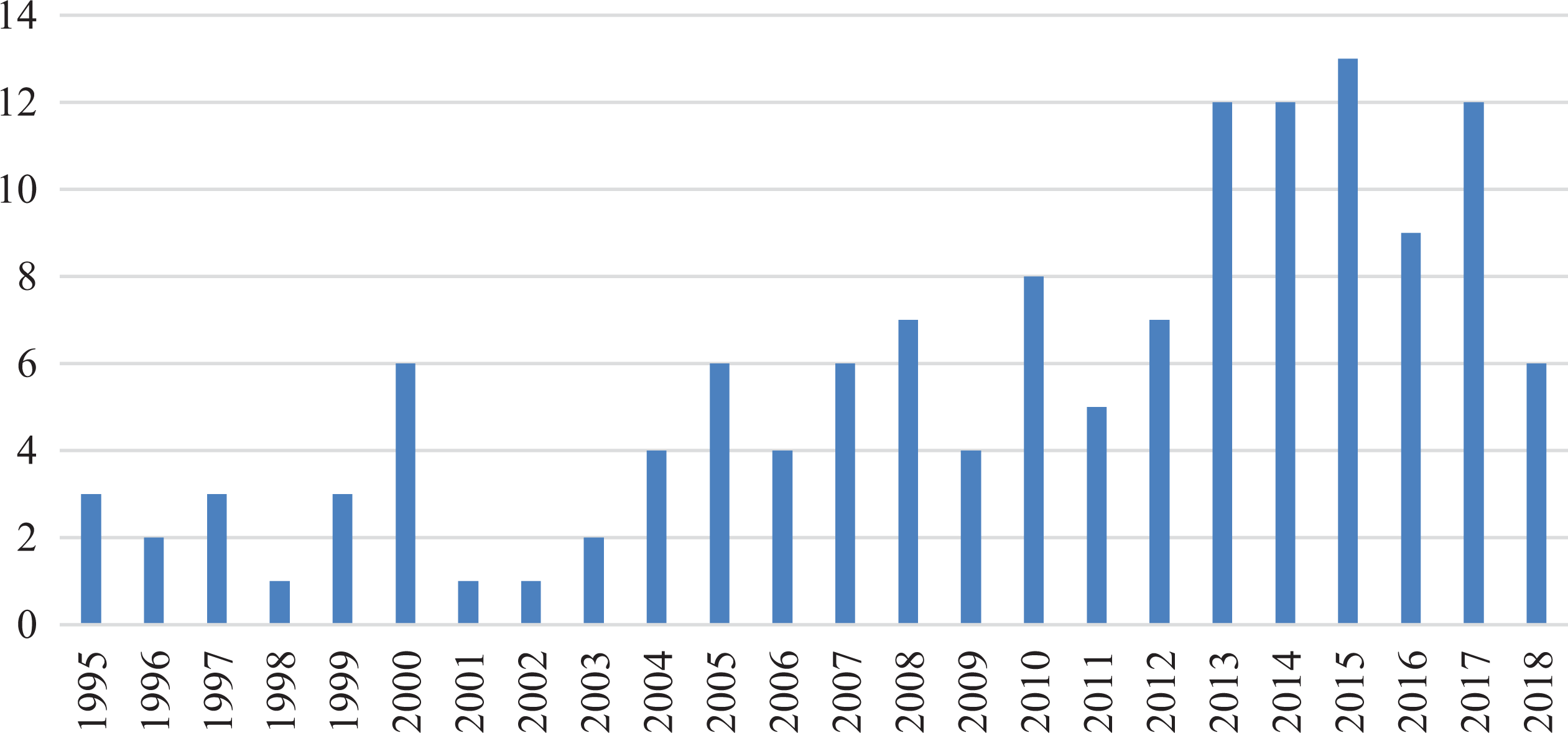
Number of Peer-Reviewed Journal Articles (in IBSS) with Burundi in Title. IBSS: International Bibliography of the Social Sciences.
The post-war Burundi scholarship often mirrored political events from that period. The peace process itself was a popular topic, including constitutional provisions and power-sharing and controversies (Vandeginste, 2009, 2011), transitional justice (Ingelaere and Kohlhagen, 2012; Samii, 2013; Vandeginste, 2012), the role of outside actors (Campbell, 2018; Curtis, 2013; Wilén and Williams, 2018; Wodrig and Grauvogel, 2016), and popular perceptions (Uvin, 2009). A number of authors have researched questions of governance, land and rural issues (Berckmoes and White, 2014; Gaynor, 2014; Nyenyezi and Ansoms, 2014; Purdeková, 2017), gender (Daley, 2007; Martin de Almagro, 2016; Saiget, 2016), the security sector (Biaumet, 2017; Nindorera, 2011; Wilén, 2016), and former armed groups including the CNDD-FDD ruling party (Alfieri, 2016; Burihabwa, 2017; Burihabwa and Curtis, 2019; Rufyikiri, 2017; Van Acker, 2016; Wittig, 2016). The experiences of Burundi were also often analysed as part of larger comparative studies, particularly on topics such as consociational power-sharing and institutional conflict management (Cheeseman, 2011; Mehler, 2013) and mediation (Khadiagala, 2007; Sisk, 2008).
In addition, there were a large number of research consultancies carried out on similar themes during this period. In the 1990s, many Burundian civil society organisations focusing on governance, human rights, and development received funding from donors. These organisations needed baseline analyses of their sectors, and Burundian independent consultants tended to be hired for this. By the 2000s, donors insisted upon certain methodological requirements for these studies, and Burundian university academics were often hired to conduct this research. Research results were used by donors, by the civil society organisations to help plan their activities, and by other researchers. This research therefore had an impact on ideas about intervention in political, economic, and social sectors in Burundi and influenced the work of organisations such as Ligue Iteka, Observatoire de l’action gouvernementale (OAG), Forum pour le renforcement de la société civile (FORSC), Coalition de la société civile pour le monitoring electoral (COSOME), Observatoire de la lutte contre la corruption et les malversations économiques (OLUCOME), and Parole et action pour le réveil des consciences et l’évolution des mentalités (PARCEM). 5
The expansion of the research community led to the recent establishment of an annual conference of social science researchers writing about Burundi (Grauvogel, 2016). All researchers interested in Burundi, however, need to confront a changing political situation in Burundi. Compared to the time of the Arusha peace process and its immediate aftermath, political space is closing and repression is increasing in Burundi. This is already having implications on scholarship in terms of access. Today’s Burundian research community does not suffer from the same stark divisions as the research community in Rwanda does, where academic debates are often highly personalised and polarised (Fisher, 2015; Hintjens, 2015), nor have pre-1990s divisions among historians of Burundi been reproduced (see Chrétien, 1991; Lemarchand, 1991). However, in many countries a polarised research community often accompanies political repression and control, and there may already be some signs of this within the Burundian academic community. 6 As the Burundian government itself becomes more involved in producing and supporting certain narratives, and as the political situation becomes increasingly charged, scholars of Burundi should reflect upon where their research fits into the overall landscape, and what motivates their work.
The Purpose of Research
What is the purpose of research is a core question in the philosophy of the social sciences. We can ask this question about research in any country and on any topic but it is a particularly important question when conducting research in highly politicised contentious contexts, such as contemporary Burundi.
Some people claim that academic knowledge about Burundi (or elsewhere) is pursued for its own sake. The quest for knowledge is a timeless human endeavour. Under this view, we study Burundi’s history, politics, economy, geography, society, law, arts, and culture not due to some preconceived end and not because we have a technical or political project in mind, but because knowledge about Burundi is an end to itself. Indeed, the discovery and transmission of knowledge is the fundamental purpose of academic life. If a scholar is studying the history of the bashingatahe in Burundi, or the social and political practices of a community living in Ruyigi, it may simply be because they find these topics interesting. Perhaps the topic has not been studied in the same way before, or perhaps new information has emerged that may shed new light on a question that has been studied previously.
There is a debate between scholars who believe it is possible to be objective, and those who do not. Those who believe in objectivity think that researchers are somewhat removed from what they are studying. Under this view, researchers observe society and politics and generate robust conclusions by using scientific methods, including the triangulation of different forms of data (George and Bennett, 2004). Scholars should therefore uncover “objective” facts about Burundi, and policymakers, activists, development practitioners, and community members can use the knowledge that scholars have generated.
Other scholars, however, say that it is not possible for researchers to separate themselves from the objects of their inquiries, and that ideas, values, and knowledge are ultimately a reflection of particular sets of social relations (Cox, 1981). These scholars question objectivity, and say that whether we are outsiders or insiders to any situation we interpret events through our own categories of understanding and our own frameworks. This will inevitably influence our observations. Researchers should therefore be aware of their positionality and reflect upon how their background and experiences including nationality, region, gender, ethnicity, social class, and family affect the way they see the world, and how these affect their research. These attributes will also have an influence on the ways in which interviewees or other interlocutors view the researcher, which may again have an impact on interview data and scholarly findings. Among those who believe that positionality affects research, there is disagreement between those who believe it is possible to “correct” for our biases in the search for objectivity, and those who believe that this is not possible. Researchers do not agree on whether there are clear foundations for making knowledge claims. Foundationalists believe that all truth claims about some aspect of Burundian society and politics can be judged as true or false, whereas anti-foundationalists believe that there are never neutral grounds for doing so (see Hansen, 2006). These broader debates about knowledge claims are important because they have a bearing on the types of research questions that are asked and the methods that are used. For instance, a foundationalist research question might ask: what explains the variation in levels of poverty in different Burundian provinces? An anti-foundationalist research question might ask: which intervention practices in Burundi are justified when poverty is defined in a particular way?
Another reason for conducting research in Burundi is to contribute to theories about the world. We learn about Burundi, not only for the sake of knowledge about Burundi, but also because of what we can learn about the world through Burundi. Understanding politics and society in Burundi can contribute to critical insights about dominant concepts in international relations and comparative politics, including sovereignty, the state, the market, political institutions, and the distinction between international and domestic. In other words, scholarship about Burundi can disrupt or reinforce existing ways of reading and thinking about politics and international relations. For instance, Sidney Leclercq calls into question global models of transitional justice, through his analysis of subversion strategies in Burundi (2017), Andrea Purdeková’s research on peace villages in Burundi challenges theories of socio-spatial integration in divided societies (2017), and Burihabwa (2017) and Wittig (2016) use the case of Burundi to contribute to the theorisation of rebel-to-party transitions.
Using insights from Burundi to question or refine global theories is particularly important at a time when there are urgent calls to decolonise knowledge. Instead of taking the global North and theories developed in the North as starting points, a decolonising view advocates using Burundi as a starting point for developing insights about the world (Chakrabarty, 2000). It challenges representations of European states as “normal” states and the Burundian state as being on a path to becoming a “normal” state through the peace process, or as a “deviant” state where that path to normalcy was blocked. 7 Instead, studying the trajectories of Burundian state and society can help scholars refine theories of state and society elsewhere.
There are, however, several questions for researchers wishing to contribute to global theories. One challenge is to differentiate the specificities of Burundi, from what might be generalisable to other contexts. It is not always straightforward to separate the particular from the general. For instance, Louis-Marie Nindorera argues that “avenants secrets” (secret codes and understandings) and “non-dits” (unspoken messages) are particularly important in understanding the political history of Burundi (see also Hakizimana, 1991). 8 The extent to which this is unique to Burundi, or could be generalised to other settings, is an interesting further question. Comparative research and collaborations are ways that some scholars address this. Another source of scholarly disagreement is whether it is even possible to develop global theories, or whether knowledge about Burundi serves to question the universalism underlying many theories in the social sciences, such as theories of the state, civil society, and democracy.
There are also important individual career incentives that may influence the kind of knowledge we seek in Burundi. As researchers with a focus on politics and society in Burundi, we collect insights, opinions, and behaviours of those we study, and we package it for scholarly publication and for teaching outputs. For those of us based in institutions in Europe and North America, too often our targeted audiences are scholars and students in universities in Europe and North America, rather than in Burundian institutions or in the communities that we study. Institutional expectations, at least to some extent, influence some of our research decisions. Researchers are not immune from making research calculations based upon what is likely to help them attain a permanent job, a promotion, a publication in a “high-impact” journal, or some other career goal. Many scholars also sometimes act as consultants for international organisations, non-governmental organisations (NGOs), or governments.
Career considerations are not surprising, and consultancies may provide researchers with valuable financial resources, networks, and security, and can deepen a researcher’s knowledge about a topic. There are, however, implications on how our interlocutors view us (and our motivations) when we assume dual roles as researchers and consultants. Also, these considerations may close off certain avenues of research and emphasise other ones, which have more to do with the needs and expectations of funders (usually Northern-based universities, NGOs, think tanks, and donor governments) rather than the needs, requirements, and preferences of Burundian communities. Institutional expectations may also steer researchers towards certain methods. For instance, in several universities, particularly in the United States, research designs featuring “field experiments” are becoming increasingly common and valued and we are beginning to see this research conducted in Burundi (Voors et al., 2012). The World Bank has also commissioned research that uses these methods. Likewise, institutional or disciplinary pressures to produce comparative research may lead scholars from one context to study another country. Some of the comparative research on Rwanda and Burundi may reflect that tendency. Sometimes this may be based on research concerns in the two countries, but sometimes this may be driven by the professional rewards of conducting comparative research. 9
Furthermore, there are other ethical questions to consider. There is a long history of engaging in research practices and techniques in Africa that would not be permitted in the global North. Social science research is subject to specific ethical standards usually set by professional organisations, universities, funding bodies, and governments, which includes avoiding harm to research populations (Dionne et al., 2016). However, environments such as Burundi permit questionable research behaviour and there are ethical dilemmas involving research subjects, partners, and assistants that are not present in other environments (Cronin-Furman and Lake, 2018; Sriram et al., 2009). Also, the ethical practices required by Northern-based institutions may not be suitable in all contexts, for instance, asking for written consent from interviewees.
More generally, many institutions value original field research. I have been on several PhD committees or tenure reviews where researchers are congratulated on their bravery and perseverance in navigating “difficult” environments. It is indeed the case that scholarship on Burundi has greatly benefitted from the trend towards on-the-ground research, including the move out of the capital city and into less well-known research locales. Nonetheless, as researchers we must be cognisant of the power relations that mean that we can be praised for our willingness to “go to the field” whereas many Burundians in the communities that we study face a host of constraints, including restrictions on their speech, mobility, and safety.
In addition, when foreign researchers 10 operate in countries that are heavily dependent on donor assistance such as Burundi, those they meet may assume that they have much more influence than they do with donor governments. This can improve a researcher’s access, and also the type of materials given to them. Also, donor and diplomatic representatives in the country may feel an immediate “rapport” with foreign researchers (see Autesserre, 2014), which again may have an impact on sources and materials, and even transportation and other logistical assistance. When interviewing non-elites, including vulnerable populations such as internally displaced people and refugees, researchers who are “white women carrying notebooks” may be mistaken for aid workers, even if they say that they are not (Cronin-Furman and Lake, 2018: 609). This may confer some advantages to the researcher, for instance it may increase the willingness of research subjects to spend time with them. These advantages have ethical consequences, including reinforcing structural inequalities. The question of what researchers “give back” to the communities that they study is one that should be at the forefront of any discussion of ethics. How do the participants in our research benefit? Is it enough, for people to “tell their story”? Is it enough to say that people may not individually benefit directly from our research, but that our research may benefit the country as a whole? How do we ensure that research is not another example of unequal extraction out of an African context? Do research collaborations fully acknowledge the intellectual property and input of non-Western scholars (Bouka, 2018)? These are urgent questions.
Finally, many social science researchers have normative agendas, which help guide the questions they choose for their research. In the 1960s and 1970s, a large body of social science work in Africa was considered to be “scholarship for development,” with the goal of “development.” Research in support of development continues today, and there are many other normative projects that may guide our work, for instance, to help improve the situation of the Batwa or other disadvantaged groups, to encourage reconciliation, to encourage democracy, to encourage particular views of justice and rights, to help bring about peace. Researchers may seek to understand the barriers to peace, justice, or development, with a view to overcoming them. Researchers may also have political ends, for instance, the desire to put forward a particular view of history that emphasises certain narratives over others, to delegitimise a particular government or regime, or to bring publicity to human rights abuses, authoritarianism, or militarism.
These normative commitments may be explicit in our work, or they may be implicitly structuring our thoughts. Some scholars have reflected upon what it means to have explicit normative commitments and engagement in Burundi and how this has affected their research (Reyntjens, 2009). It is important for researchers with normative projects to think carefully about methodological design, to be upfront about how our normative goals may add blinkers to the project, and to be clear about whether there is a difference between our research and our activist engagement, and if so, what that difference entails.
Normative commitments tend to be thought of as “positive,” but this is not always the case. In the field of international relations or development studies for instance, researchers may seek to “improve” intervention practices, or make development assistance more effective. The role of scholars in supporting powerful global actors and reinforcing global hierarchies has been extensively debated. Perhaps this was most notable in the debate about anthropologists working for the US military in “human terrain teams” in Iraq and Afghanistan to assist in counter-insurgency operations (Zehfuss, 2012), but the role of scholars in upholding dominant representations and global power structures can be seen in many other examples as well (Rutazibwa, 2014). What, if any, should be the limits to scholars’ assistance to powerful diplomatic and donor communities, and perhaps unwittingly, to the unequal world in which they play a part?
The Burundian government’s increased repression is likely to have an impact on intellectual spaces, including on the types of normative commitments openly articulated by scholars. The Rwandan government actively promotes its own political narratives and seeks to obstruct or delegitimise those with alternative views (Fisher, 2015; Pottier, 2002). In other authoritarian contexts such as Turkey (Baser et al., 2017) and China (Reny, 2016), scholars have to navigate a range of constraints. Given recent political events in Burundi, there is the possibility that the Burundian government may also increasingly seek to control discursive space, including scholarly agendas. This is of concern to researchers who must comply with government requirements in order to get permission to conduct research in the country, but it also poses new risks for interlocutors and interviewees, who may lack the protection that some foreign researchers have (Fujii, 2012; see also Koch, 2013).
Why it Matters
When political and intellectual spaces are tightly constrained, it becomes even more important to reflect upon our research goals and motivations. Choices about research topics, questions, and formats for dissemination follow from the underlying purpose of our research. Research questions are therefore, in part, the products of conceptual categories we already have in our minds, the influences from our institutions and scholarly communities, and our prior beliefs, networks, and normative commitments. The formats through which we transmit our knowledge are also important. Too often, the Burundian communities through which we extract and generate knowledge are not the recipients of this knowledge. And too often, when Burundian students and scholars read about “Burundi” in texts and journals produced in the North, they do not recognise themselves. 11
Two further issues are important for researchers to consider. First, there is often some degree of continuity or even path dependency in an individual’s research. For foreign researchers, our first encounter with Burundi, our contacts, as well as the political situation at the time of that first encounter, help shape our views and our frames of understanding, and therefore our research. For instance, many of the researchers who first studied Burundi in the 1990s and early 2000s had scholarly and social contacts with Burundians who were members or supporters of the political parties FRODEBU and UPRONA. Even though our research focus may change over the years, our contacts and friends from earlier encounters continue to shape our reading and our impressions of the country’s political and social situation. Researchers who first arrived in Burundi during the CNDD-FDD regime are likely to have different contacts and networks. Timing also affects the ways in which researchers may approach a particular topic. In the 1990s and early 2000s for instance, many of us conducting research on the Burundian peace process were influenced by geopolitical events and optimism about the possibilities of international involvement, democracy, and “liberal peacebuilding.” The peace process was often analysed as a moment of opportunity and of global and regional solidarity. Subsequently researchers became more critical about the international interests and ideas underpinning the peacebuilding project in Burundi and elsewhere. In retrospect, perhaps viewing the Arusha peace process as an example of liberal peacebuilding and then discussing the merits or the problems with this type of peacebuilding may have closed off other ways of thinking about Arusha (Grauvogel, 2016). Thus, timing matters, both in terms of who we talk to, who we have access to, which networks we establish, and which topics and approaches we choose.
Second, calls to decolonise knowledge production pose an important challenge to social science researchers working in Burundi. What it means to decolonise knowledge production is itself open to contestation (Branch, 2018) and will depend on particular geographies and histories, as well as intellectual and theoretical trajectories (see, for instance, Mbembe, 2016; Quijano, 2007). At a minimum however, as the conference in Antwerp has shown, it involves the affirmation of Burundian intellectual production, and the questioning of authoritative voice. There is a need for the diversification of authors and experiences, an expansion in the rationales for knowledge production, and a commitment to the accessibility of our research findings. By acknowledging how some ideas and voices are constructed as “authoritative,” we can begin to open up space for alternative possibilities (Sabaratnam, 2011). 12 A decolonised research strategy also requires understanding the colonial legacies on systems of knowledge, the continued structural constraints, and the economic and discursive inequalities faced by researchers (Branch, 2018). This includes an understanding of the origins and constraints of Burundian universities (Bugwabari et al., 2012), the organisation of the Burundian national archives (Nyandwi et al., 1997) and its challenges, but also the origins and persistence of the categories often used to understand Burundi, including ethnicity, development, neopatrimonialism, and the distinction between war and peace.
Where Now? Towards Humility and Responsibility
This article has shown why it is important to reflect upon the purpose(s) behind our research in Burundi. It has highlighted that research on Burundi has gone through different cycles depending on political conditions. It is encouraging that the field of Burundian studies is growing, but this may be part of a cycle that culminated with the peace process, and thus the future is very uncertain. There are, therefore, essential questions about how to encourage a diversity of views and continued academic production based on empirical field work in a context of shrinking political and intellectual space within Burundi and heightened structural inequality.
Where do we go from here? I suggest that social science researchers working in and on Burundi need to be guided by greater humility and responsibility. Of course, humility and responsibility are important for social science researchers in every country and every research site. Yet we need to be particularly attentive to this in an environment of multiple inequalities and power imbalances, heavy aid dependence, violence, fear, and repression.
Greater humility requires us to acknowledge the blinders that may influence our research. What are the unspoken or unacknowledged blinkers that help guide our approaches? As discussed above, these may be conceptual and analytical categories that guide us towards particular interpretations of events, blinders that privilege the knowledge and experiences of men over women, or blinders based on our networks, friendships, and intermediaries. Greater humility is also necessary when thinking about the nature of expertise. Certain people are designated as “experts” and certain methodologies as “rigorous,” but this may have as much to do with global power, colonial histories, and associated inequalities than with individual brilliance, knowledge, or hard work. With greater humility, researchers are more likely to value different forms of knowledge and expertise, and different ways that this knowledge may be articulated. This does not mean that researchers should gather and extract “local knowledge” and render it intelligible to those in power such as development agencies and donor governments. Rather, it leads us towards a decolonised approach that questions existing methods and seeks to reverse knowledge hierarchies.
Furthermore, humility means being aware of our limitations. There is sometimes the temptation, especially among some foreign researchers, to portray themselves as academic “saviours,” calling truth to power and lifting populations out of insecurity and towards development. Yet any saviour complex among researchers is just as dangerous, insulting, and inaccurate as a saviour mentality among humanitarian workers and “peacebuilders” (see Mamdani, 2009), and does a disservice to Burundians who are fighting for justice and greater equality. Seemingly altruistic impulses on the part of researchers may still have negative ethical consequences. This is not to say that foreign researchers should abandon their normative commitments or avoid denouncing injustices, but we should recognise that at best foreigners should play a supportive role in Burundi, and that Burundian agency is far more important both in defining a vision of the future, and working towards it. The Burundian political and economic landscape today does not look like what many researchers had imagined or hoped for fifteen or twenty years ago. For those of us with a normative commitment to peace and social justice, what is striking is that after so many years of research and action, we are still a long way off from those goals.
If humility helps us acknowledge our limitations and remain open to other perspectives, experiences, and forms of knowledge, then responsibility requires concrete steps to help address imbalances and silences. A first step is understanding how authority and expertise have been constructed historically and how they are maintained today. The next step is taking some responsibility for redressing these imbalances. While this can happen in a number of different ways, several ideas are worth noting. First, research that has been conducted and deposited in Burundian institutions, including Masters dissertations at the University of Burundi, should be more visible. This may involve cross-citations, and helping this work become more widely disseminated internationally. It would also be helpful to publish a field work methods guide geared to Burundian researchers, or other black researchers, which would include discussions of specific opportunities and challenges faced by these groups. Second, we can encourage and participate in equitable collaborative research and co-publishing ventures (Bouka, 2018). One good example is the Revue Burundaise de Droit et Société, co-published by the Faculté de droit de l’Université du Burundi and the Institute of Development Policy (IOB) at the University of Antwerp. 13 Third, we can ensure that research is accessible by publishing in open source journals or arranging feedback and discussion events in Burundi, where possible. Fourth, we should prioritise reciprocity with Burundian researchers and interlocutors. For instance, those of us based outside of Burundi can push for scholarships and research opportunities for Burundians who wish to study US nationalism, or Brexit, or Chinese development, or South African foreign policy. We can encourage media outlets, development organisations, and policy think tanks to broaden their outlooks by suggesting that they listen to perspectives and analyses beyond their usual “experts.” These measures will not end structural and historical imbalances, but if all researchers reflect upon their own personal responsibility and complicity in perpetuating unequal structures, and take some action to address these inequalities, it would help ensure a greater range of views and perspectives and therefore a richer research landscape.
Responsibility is also critical for all researchers given the current political context in Burundi. Compared to the openness during the peace process, Burundian politics is increasingly divided, polarised, and controlled. How will it be possible to retain an academic space that is inclusive and civil, where disagreements can be aired without the same kind of personal attacks that have sometimes affected research communities in other divided countries? What happens when it becomes dangerous to articulate certain views and research findings inside Burundi? How can researchers respond responsibly? Reflexivity, epistemic diversity, and ethics are crucial, but this does not mean that all views are equally valid. At a minimum, researchers need to accept responsibility for the practices that we engage in, the representations that we sustain, and the ideas that we promote. Yet in a context of fear, repression, and inequality, responsibility may also involve solidarity, not as academic saviours, but as individuals with a shared interest in a more equitable global future.
Footnotes
Acknowledgement
The author would like to thank the organisers and participants at the July 2018 University of Antwerp Conference on Governance, Peace and Development in Burundi for the discussions that inspired this article. The author is also enormously grateful for the constructive feedback and suggestions from the anonymous reviewers and the editor Julia Grauvogel, as well as Ntagahoraho Z. Burihabwa, Andrea Filipi, Maria Martin de Almagro, Aymar Bisoka Nyenyezi, and Katrin Wittig. Their immensely helpful comments and suggestions greatly strengthened the article, but also showed how much more there is to discuss.
Declaration of conflicting interests
The author(s) declared no potential conflicts of interest with respect to the research, authorship, and/or publication of this article.
Funding
The author(s) received no financial support for the research, authorship, and/or publication of this article.