



Abstract
Communities that were once the target of postcolonial development schemes still contend with the legacies of these interventions, long after such projects have been abandoned. This article looks at the afterlife of Israeli-led agricultural cooperatives that were initiated in the Zambian Copperbelt during the 1960s. Although these schemes collapsed in the decade following their establishment, local communities are still coping with the history of their rise and fall. In the Kafubu Block and Kafulafuta, the physical, social, and economic landscapes resonate with the successes and failures of this modernist planning. The schemes continue to provide a fundamental and contentious point of reference in both individual and community lives. A long-term perspective on the communities’ continued engagement with the legacies of the abandoned schemes deepens our understanding of development's complex “afterlife,” and demonstrates how the past retains its relevance by taking on different meanings over time.
Introduction
In 1966, two years after achieving independence from British colonialism, President Kenneth Kaunda of Zambia invited Israeli planners to establish a series of cooperative settlements in the Copperbelt region. The Israeli-led schemes were to play a key role in an ambitious programme for promoting rural development, based on Kaunda's vision for democratic socialism known as “humanism.” The Israelis were given control over two settlements, the Kafubu Block and Kafulafuta, which they reorganised into a type of cooperative called a moshav, based on a model that had already been applied successfully in Israel itself.
After overcoming certain initial challenges in the first few years, the schemes gradually began to generate surpluses. From 1970 until 1973, agricultural yield and poultry as well as dairy production bore impressive results, and the Zambian moshav farmers’ gross income grew to five times the national average. Kaunda lavishly praised the work of the Israeli experts, and made plans to expand the schemes to other regions of the country. However, these initiatives were never realised because in 1973, in the aftermath of the October War between Israel and its neighbours, Kaunda broke off relations with Israel and ordered the expulsion of its experts within weeks. The planners and advisors left the Kafubu Block and Kafulafuta with their financial resources and know-how, creating a vacuum of expertise. The local farmers failed to run the cooperatives without Israeli technical assistance, and the projects fell into ruin as debts mounted, funds disappeared, and banks repossessed equipment. By the end of 1976, both the Kafubu Block and Kafulafuta cooperatives had collapsed – and the settlers who remained on-site were left to reassemble their lives in the shadow of the projects’ unfulfilled promises.
The moshavim (plural of moshav) schemes in Zambia reflected the strategies and techniques that gave birth to large-scale, state-initiated modernisation initiatives across the continent in the early years of independence (Bloom, Miescher, and Manuh 2014: 2). According to Hintzen, the “quest for development” led modernising political elites to implement projects that were aimed at both improving material circumstances and at controlling, regulating, and directing the evolution of “underdeveloped” populations towards “progress” (Hintzen 2014: 27–28). These authoritarian initiatives sought – but largely failed – to cast local environments in the image of modernist ideologies, often with catastrophic consequences for local populations. This top-down developmentalist approach has since fallen out of favour; as Bonneuil wrote:
Planned-development schemes of the golden age of the develop-mentalist era are now seen as monsters, as mammoth projects that resulted in economic, environmental, and social failures. (Bonneuil 2000: 280)
While recent years have seen patterns of a shift away from top-down development, the legacy of modernist era planning is still present in the communities that once served as its laboratories. Postcolonial development schemes still resonate for individuals and communities who remained on-site long after the projects themselves ceased to operate, and the legacies of these continue to find expression in local initiatives and aspirations.
This article 1 looks at the ways in which the shadow of past devel-opmentalist promises still looms over the former moshav settlements in the Zambian Copperbelt. As we will show, despite the 45 years that have elapsed, the rise and fall of the moshavim in the Kafubu Block and Kafula-futa continues to preoccupy the communities that inhabit the former schemes – and to resonate in their physical, social, and economic landscapes too. The schemes provide a fundamental and contentious point of reference in both individual and community lives, thus drawing our attention to the long-term consequences of development initiatives. We seek to make the case for widening the scholarly vision to those communities and individuals who continue to occupy the spaces of former projects. The continual efforts of these communities to reclaim the legacies of the abandoned schemes contributes to our understanding of development's complex “afterlife,” and demonstrates that the successes and the mishaps of the past take on different meanings over time. Our aim is to show that a failed development scheme can have a resilient afterlife, one that is shaped both by the project's specific history and also through an ongoing dialogue with political, economic, and social circumstances as they have continued to evolve long after the schemes themselves have been dismantled.
Funding for this research was provided by the Israel Science Foundation, Individual Research Grant #540/14. The authors would like to thank Louise Bethlehem for helpful critiques of an earlier version of this article. We also thank the anonymous reviewers and editors of Africa Spectrum for their useful feedback.
Conceptualising the Afterlife of Development Projects
Within the field of international development and aid, recent years have seen a “trend of ‘admitting failure’” (Jones et al. 2013: 8). This long-overdue movement reflects mounting evidence of botched efforts, as well as a painful reality on the ground (1996). A 2011 McKinsey-Devex survey discovered that 64 per cent of donor-funded development projects fail to produce the intended impact for their beneficiaries, while the World Bank admitted that, up until 2000, over 50 per cent of its projects in Africa had failed (Hekala 2012; Lovegrove, Gebre, and Kumar 2011; Ika, Diallo, and Thuillier 2012: 105). In light of this, Ferguson and Lohmann go so far as to suggest that rather than asking how development has helped the poor, we should ask: “What do aid programmes do besides fail to help poor people?” (Ferguson and Lohmann 1994: 180).
This “implicit acknowledgment that development has failed to fulfill its self-proclaimed mission” (Shrestha 2008: 467) has been a key trigger for a critical process of overhauling development thought and practice, including shifts from top-down decision-making to more participatory approaches. Attempts to fundamentally rethink development are vital when we consider the millions of lives that have been affected by failed schemes, and the enormous resources that have been wasted as practitioners try to “get development right” (Krueger 2009: 238). But the quest to understand what has gone wrong with international development has unearthed immense complexity and subsequent confusion with regard to the definitions of failure and success, a binary vision that obscures as much as it clarifies (Obeng-Odoom 2013). Indeed, we are reminded that development projects are multidimensional endeavours and that “[m]ost interventions, at any level, will involve some elements of both success and failure rather than being one or the other outright” (Jones et al. 2013: 1).
Moreover, while development discourse is often cast in teleological terms as an inevitable, unidirectional, and triumphalist progress towards some abstract modernity, in reality the process of socio-economic transformation may oscillate in all directions – and, indeed, is fragile and reversible (Ferguson 1999; Shrestha 2008). Yet a further complication emerges when we consider the common gaps between perspectives held among policymakers, development workers, and beneficiaries, all along what Thomas Bierschenk (2014) has called the “policy chain” of each scheme. Jones et al. (2013) – evoking Robert Chambers's (1997) question “whose reality counts?” – remind us that a project may be perceived as a success by donors and implementers but recognised as a failure by its intended beneficiaries, or vice versa. Lastly, we must be aware that social, economic, and political landscapes are forever shifting, and carry with them changes that affect the very conceptions of success and failure (Kumar and Corbridge 2002).
Instead of dwelling on clear-cut categories of success and failure, a subtler approach would be to take a broad view of project outcomes so as to include short- and long-term impacts – intended and unintended – as well as their desirability among individual and collective beneficiaries (Munns and Bjeirmi 1996; Ika 2015; Dvir et al. 1998). Such a perspective would also seek to understand how even though development projects – “interventions” in the full sense of the term – seek to ignite transformative processes within their host communities, in actuality they may produce secondary consequences that turn out to be no less far-reaching than the project's objectives (Schuller 2007). Such unforeseeable potential project outcomes are not limited to failed ones, and even “when the project does succeed in improving the context, it changes it in ways that could not have been expected” (Ika and Donnelly 2017: 45). Indeed, some projects that were deemed successful have had unintended negative effects, for example on tropical forests (Hayter 2013) or on the legacy of nomadic ways of life (Gronemeyer 1988). Moreover, what may seem like the failure or impotence of schemes in the short term may result in unintentional outcomes in the long run – and, “even a ‘failed’ development project can bring about powerful structural changes” (Ferguson 1990: 275). Thus, much can be gleaned from how local communities experience, respond to, and repurpose the remains of development initiatives long after the project's assessment team has handed in its final report.
A longue durée perspective can help to improve development practice, as one of the roots of failure has been the disregard for history among planners and practitioners (Hodge 2016). Historians have indeed provided vital perspectives on the reasons for failure among colonial and post-colonial development schemes (Cooper and Packard 1997). Recent contributions draw our attention to the central role of local actors, who influence actual outcomes by exercising agency and organise around their interests while resisting unwanted interventions (Van Beusekom and Hodgson 2000). As Cooper (1997) argues, across Africa, historically, political leadership, trade unionists, communities, and individuals alike engaged actively with the concept of development and seized upon the vision of reform in order to impose their own agendas. Hunter's (2014) work, meanwhile, has shown how public discourse around the concept of development in colonial Tanganyika constantly evolved, revealing an ongoing engagement and questioning of norms and policies associated with it within local society. Histories of development have emphasised complex and contradictory roles therein for local communities who, as Isaacman and Isaacman (2013) argue, can be both victims and agents of it.
But while development is now increasingly drawing the attention of historians, current historiography still does not reveal sufficient engagement as yet with what we call the “afterlife” of development projects. More research is needed to understand how local imaginaries, initiatives, and criticisms play a role in shaping and employing the legacy of schemes long after they have completed their formal lifespan. Such reflections bear particular consequences for those communities that still occupy the physical and mental spaces of abandoned initiatives, and fall under their long shadow. In what follows, we will see how local residents continue to dialogue with the history of the Zambian moshav schemes – reconciling and repurposing its potent legacies 45 years and more after these projects have been dismantled.
Prelude to Collapse: The Israeli Moshavim in the Zambian Copperbelt
Kenneth Kaunda developed a philosophy and a vision for postcolonial Zambia that, as noted, he called “humanism.” Declared the Zambian national philosophy in 1967, humanism was to form the foundation of Zambia's national identity and the blueprint for the country's economic development (Stevinson 1985). The ideology reflected a blending of socialist, Christian, and traditional values, and while Kaunda insisted that it was a home-grown philosophy based on traditional modes of thought it in fact shared many similarities to the African socialism that found expression elsewhere on the continent in the postcolonial years. As an integral part of his humanist vision for development, Kaunda promoted the establishment of cooperatives – claiming that this signified a return to a way of life in which “the people are used to doing things communally” (quoted in Bowman 2011: 208).
In 1965, under Kaunda's leadership, the Zambian government launched a programme for establishing state-sponsored cooperatives (Albinson 2002: 23). Through an initiative known as the “Chifubu Appeal,” the Department of Mines and Cooperatives offered cash incentives to those who cleared land and formed agricultural cooperatives. Thousands seized the opportunity, and by 1968 there were 609 registered farming cooperatives – with a total membership of 11,500 farmers. Several scholars have critiqued the hasty rolling out of this programme and the massive waste that it engendered (Scott 1978; Bowman 2011; Macola 2010; Siddle 1970). Most of those who established cooperatives were drawn to the government subsidies and loans being offered, and very few had an actual commitment to socialism or knowledge of running a cooperative (Lombard 1971: 18; Quick 1978: 50–51). The government, on its part, funnelled immense funds into cooperatives without providing the necessary oversight or supervision (Quick 1978: 4). French agronomist René Dumont, who conducted a review of Zambian cooperatives in 1967, found that peasants were unprepared to maintain the initiatives – concluding that,
it would be rash to say that the African peasants want to move towards socialism, because first they have to have a clearer idea of what it is. (Dumont and Mazoyer 1973: 135)
The failure of Kaunda's cooperative appeal had far-reaching political implications, ones that resonated beyond the failed schemes themselves (Gordon 2012). As Larmer and Macola (2007) have argued, the failure fomented discontent among the local population – who blamed the government for not delivering on its post-independence promises. For Kaunda and his United National Independence Party (UNIP), meanwhile, the high stakes of developmentalism undoubtedly influenced the decision to accept Israel's offer of assistance.
The Israeli government had made overtures to Zambia on the eve of its independence, sending a delegation to Lusaka to lay the groundwork for establishing diplomatic relations in early 1964 (Israel National Archives (hereafter INA) Zambia General 1926/4). This was part of a broader history of Israeli state-led involvement in Africa during the 1960s. Through its national aid agency, MASHAV, Israel hoped to strengthen ties with newly independent states and offset the diplomatic isolation resulting from the Arab–Israeli conflict (Oded 2013). MASHAV offered a wide array of technical assistance and training programmes to African nations, including schemes in agriculture, irrigation, regional planning, community development, healthcare, and organised youth movements. Between 1958–1971, tens of thousands of Africans were trained in MASHAV courses both in Africa and Israel, and over 2,700 Israeli technical experts were sent to provide assistance in local projects (Peters 1992).
Within the framework of this broader outreach, Israel offered assistance to Kaunda's cooperative initiative. Facing the pending failure of the Chifubu Appeal, Kaunda was eager to benefit from Israel's proven record of success in cooperative development (Schler 2018). Zambian officials claimed that Israel had earned “a world wide reputation in the field” (Zambia National Archive (hereafter ZNA) NCDP 2/3/2 Aid Israel memorandum of vice president n.d.). and accepted that country's offer to send technical advisors to support Zambian cooperatives. The first group of experts arrived in Lusaka in 1966, and were immediately given control over several struggling settlements situated both outside Lusaka and in the Copperbelt region (see Yadin 1969). The experts proposed transforming these settlements according to the moshav model, which would require a shift from communal farming to cooperatives based on smallholders. Farmers and their families would be given individual plots, but the entire settlement would operate as a cooperative union that oversaw equipment, investments, and marketing. This shift, the Israeli advisors argued, would encourage personal initiative among the farmers, who lacked such motivation under the communal system (Yadin 1969: 29).
These changes eventually led to improved outputs in all the settlements, but the projects in the Copperbelt in particular became the centrepiece of Israeli technical expertise. The Department of Mines and Cooperatives entrusted the Israelis with the task of planning and implementing Kafulafuta, a large-scale settlement block south of the town of Luanshya, and also requested that the Israelis take control over the Ka-fubu Block, an existing settlement scheme that was hastily established by the government in 1966 and which suffered from inadequate planning and insufficient investment. The Kafubu Block's early settlers were drawn from among the unemployed in the nearby mining cities, and came to Kafubu following government promises of resources and training that were ultimately never actually provided (Yadin 1969: 35). Settlers faced many hardships and struggles as they lacked experience in cooperative farming, and had to contend with poor soil and an inadequate water supply (Yadin 1969: 4). The Department of Mines and Cooperatives offered little assistance, and by the time the Israelis arrived many of the first settlers had already abandoned the area and the project was near collapse (Schwartz and Hare 2000).
The Israelis immediately restructured the Kafubu Block and took control over marketing and financing, and also began planning Kafulafu-ta. Both settlements – including the arrangement of villages, homesteads, houses, roads, fields, infrastructure, and communal institutions – were designed using ready-made blueprints from the Lachish regional model, which Israel had implemented at home in the 1950s (Schwartz 2002: 51). The settlers – peaking in number at about 200 in each scheme – were given individual plots to farm with their families instead of the communal fields. Poultry and dairy sectors were established, new crop varieties were introduced, and cultivation was expanded. These changes began to bear fruits in the second year, as the individual holders started to generate surpluses. The poultry sector was particularly successful, expanding rapidly to become the showcase project of the entire Kafubu Block (Yadin 1969: 40–41).
Production was so great that in 1971, the Israelis made an urgent appeal to find consumers for the surplus of six million eggs; this allowed Kaunda to boast that he had fulfilled his post-independence promise to provide each citizen with one egg a day (Schwartz 2002: 94). The Kafula-futa settlement block experienced similar success and, despite some difficulties with stumping, by 1968 thousands of acres were cleared for vegetable cultivation – while pig and poultry farming were also introduced (Schwartz 2002: 89). From 1970 to 1973 production gradually increased within both Copperbelt settlements while farmers’ gross per capita income reached ZMK 130 per annum, as compared to the national rural average income of ZMK 26 per annum (Schwartz 2002: 91). Israeli advisors closely supervised the agricultural production at each settlement, controlled the marketing of surpluses, and oversaw the entire financial management of the cooperative unions.
It is clear that massive Israeli investment and oversight contributed to the success of these moshav projects, but this did not prevent the Zambian government from drawing up plans to extend their implementation to other regions (ZNA NCDP/213/11 External Aid Policy, Israel, minutes of a meeting 29 July 1969). Following a 1968 national review of productivity, the government announced plans to reorganise all agricultural cooperatives according to the principles of the smallholder moshav model (Quick 1978: 112). Kaunda praised the work of the Israeli experts in no uncertain terms both publicly and privately, telling the Israeli ambassador in 1968 that “only the cooperatives in which the Israelis are involved are worthy of their name” (INA 4191/36). In a 1971 Observer article entitled “African Kibbutz,” Kaunda proclaimed that:
These settlements are the pride of our nation. If we can duplicate these experiments in all the other districts of Zambia, we will be on our way to establishing a self-sustaining economy. (The Observer 1971)
In another interview that year, Kaunda described the Israeli-led initiatives as
an achievement which deserves the admiration of the country as a whole […] here we maybe be pretty close to the answer to grassroots development for which we have been searching since independence. (Quoted in Amir 1974: 32)
The Israeli-led projects became the showcase for Kaunda's cooperative initiative, and the Foreign Ministry regularly brought visiting statesmen and dignitaries to see the projects first-hand.
However, these plans never actually came to fruition. Following the October War of 1973, Kaunda fell in line with an OAU directive mandating member states to sever ties with Israel (Schwartz and Hare 2000: 97; for an in-depth examination of why Kaunda abandoned these successful schemes, see Schler 2018). Kaunda's decision took the Israelis by complete surprise, and advisors and planners working in the moshav schemes were directed to leave within weeks. Without Israeli assistance, the moshav farmers were no longer able to secure loans at local banks and also lacked the necessary resources to maintain the expensive equipment required in the poultry and dairy sectors. Soon after the Israelis left, infighting erupted between cooperative members in the scramble for resources. Within a few months equipment was repossessed by the banks, and farmers in both schemes found themselves faced with growing debts and no possibilities for securing investment. By the end of 1976, both the Kafubu Block and Kafulafuta cooperatives had completely collapsed. Member of Parliament Valentine Cafoya bemoaned the downfall of one of the government's proudest initiatives:
Flourishing farms and gardens have been reduced to arid wilderness, and proud villagers, formerly self-sufficient, are now cutting down timber and destroying valuable natural resources in order to eke out a livelihood. (Times of Zambia 1976)
Revisiting the Afterlife of the Zambian
Moshavim
Thousands of communities in Africa have been the target of development schemes that ultimately failed to meet stated objectives; yet, the long-term significance of project collapse has hitherto not received enough scholarly attention. The Israel-run moshav schemes in the Cop-perbelt were facilitated as top-down initiatives that succeeded in the short term due largely to Israeli investment and oversight. The quick collapse of the programmes following the dismissal of these experts confirms that after seven years of Israeli assistance the schemes still had not achieved sustainability. While top-down interventions such as these have been largely dismissed by practitioners and planners, the local communities that remained on-site in the moshavim in the Copperbelt currently articulate a more complex and sympathetic set of narratives around these initiatives. In what follows, we draw on a visit to the Ka-fubu Block and Kafulafuta in September 2015; we conducted interviews with residents and community leaders, surveyed the physical remains of the former schemes, and participated in community meetings and events. Our findings reveal that while the moshav schemes collapsed some four decades earlier, their presence lingers on in the physical space, collective memory, and in current economic and social initiatives too. We will examine the various ways in which the legacy of the moshavim still finds expression, and suggest the reasons why the short-lived, unsustained initiatives still resonate among the communities of the Kafubu Block and Kafulafuta.
The Physical Legacy
According to the original planning of both Kafulafuta and Kafubu Block, settlers were grouped into three villages consisting of homesteads arranged into equal-sized plots upon which uniform housing was built. Houses were set slightly off from the road, and fruit trees were planted around them. Each homestead consisted of two acres that were to be used for vegetable farming, and on the outskirts of the village each family was allocated a second, larger plot for additional agricultural production. Villages were grouped as satellites around a regional service centre that was comprised of cooperative offices, supply and other stores, maintenance and equipment sheds, health centres, educational institutions, a community centre, sports facilities, and a bus stop. Plans mandated that no house should be more than 0.3 miles from the regional centre, so as to allow villagers easy daily access to the services that they needed (The Kafulafuta and Kafubu Cooperative Settlement Projects 1970).
Today, despite the passage of time, the spatial layout and built environment of both the Kafubu Block and Kafulafuta are still replete with evidence of Israeli planning. Houses built according to specifications mandated by the original plan are still in use, although extensions have been added on to some. The mango trees planted next to each house have grown tall in the 50 years since they were planted, providing shade and fruit to residents both old and new. While the regional centre – particularly within the Kafubu Block – has grown and expanded beyond the original site, the satellite villages still largely consist of the homesteads built in the Israeli era, with few additions.
The lasting signs and remnants of Israeli planning in these settlements serve as poignant testimony to the broader context of Zambian history since the 1970s – the sharp economic downturn that Zambia experienced soon after the Israeli-led schemes were abandoned, and the decades of stagnation that then followed. Zambia entered independence with great economic promise, being classified as a middle-income country with one of the highest gross domestic products in Africa (Fraser 2010: 6). However this strong standing disguised substantial economic vulnerability, as Zambia was almost exclusively dependent on the export of copper – resulting in the country's acute susceptibility to fluctuations in the global market.
Kaunda and the UNIP's first decade of rule was characterised by confident spending in many areas of social welfare, and investment in ambitious schemes such as the Israeli moshavim. The weaknesses of Zambia's economy were eventually exposed by the global oil crises of 1973 and 1979, which led to sharp declines in the price of copper – dragging Zambia into an economic slump that would last for some 30 years (Fraser 2010: 9). The collapse of the country's terms of trade led to a severe debt crisis, and Zambia was finally pushed by the World Bank and the International Monetary Fund into implementing economic liberalisation in the form of structural adjustment programmes. This led to more cuts in state wages and jobs, and Zambians suffered from widespread deprivation (Fraser 2010: 9–10). Ferguson's book, Expectations of Modernity, offers an “ethnography of decline” (1999: 1) that describes the multiple strategies that Zambians employed throughout this prolonged downturn to cope both with the stagnation and with their own disillusionment. Ferguson argues that the deep despair that overtook Zambia during the years of decline was directly linked to the expectations that modernist imaginaries of the first decade of independence had nourished. Ambitious schemes such as the Israeli moshav settlements had captured local imaginations, and their collapse hit Zambians with an irrecoverable sense of loss (Ferguson 1999: 4–12).
A visit to what remains today of the Israeli moshav schemes in the Kafubu Block and Kafulafuta brings this painful history into sharp focus. The lack of broad-scale changes to the original scheme is a window through which to peer into the stagnation that has plagued Zambia for decades now. In the eyes of the former moshav settlers, the remnants of the Israeli-led projects are a constant reminder of a bygone era of productivity and visionary optimism that is still remembered by many amid the prevailing absence of new opportunities that has since taken hold. While modernist planning of the postcolonial era was to be largely rejected in later years, current residents of the physical remains of this top-down planning scheme lament, in the words of Piot, “their point of entry into the modern and the global” (2010: 162). The end of modernist development meant the loss of foreign investment, the disappearance of technical advisors, and the absence of a bold vision that would drive change. During our visit, former settlers from the moshavim era insisted on showing us the decayed remains of the modernist planning – rusted and broken pipes that once brought running water into each home, the corroded equipment that lays to waste in the dilapidated storage sheds, bare foundations where buildings once stood, and malfunctioning water pumps that have since never been repaired (Figures 1–3).
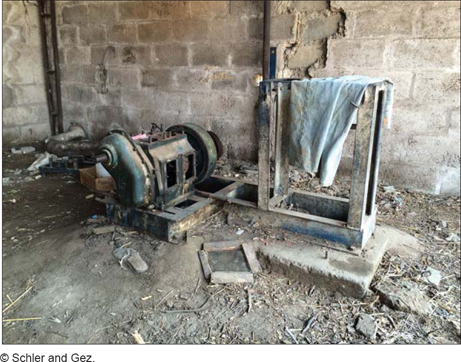
Broken Down Equipment
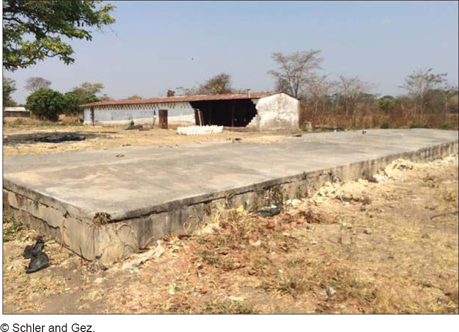
Former Storage Hanger
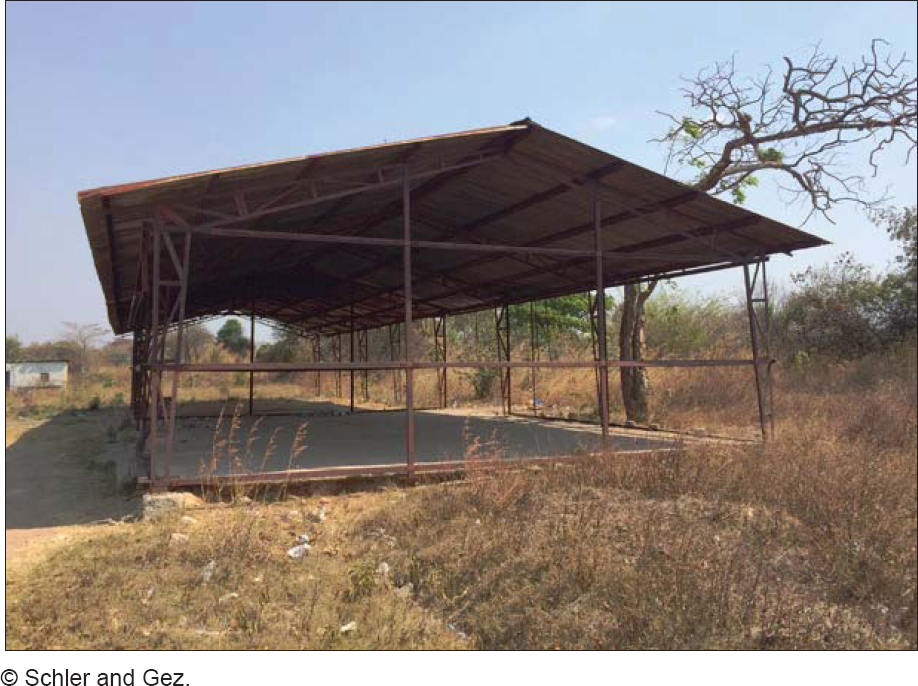
Building Remains
Perhaps nowhere was the sense of stagnation more apparent than in the area that began as the regional centre for the Kafubu Block. Structures built around the old village square are still standing, and community meetings still conducted in the former administrative buildings. Small shops still operate, although they now sell mobile airtime and palm wine rather than farm equipment (Figure 4). Former settlers took us around the remains of the structures built by the Israelis, bemoaning the disrepair. Some of this former project infrastructure has been repurposed; this was the case, for example, with the bus stop originally built at the Kafubu Block village centre. It still stands in the centre of the village square, although there is no road running through the Kafubu Block – and certainly no buses do either. But the structure is still in use, serving as a central point of reference, a meeting point, and also just a shaded spot to sit in (Figure 4). This combination of material durability alongside renovation and reinvention echoes Straube's work (2018) examining similar processes of “reimagining” with regard to communal structures throughout the Copperbelt following the onset of economic decline.
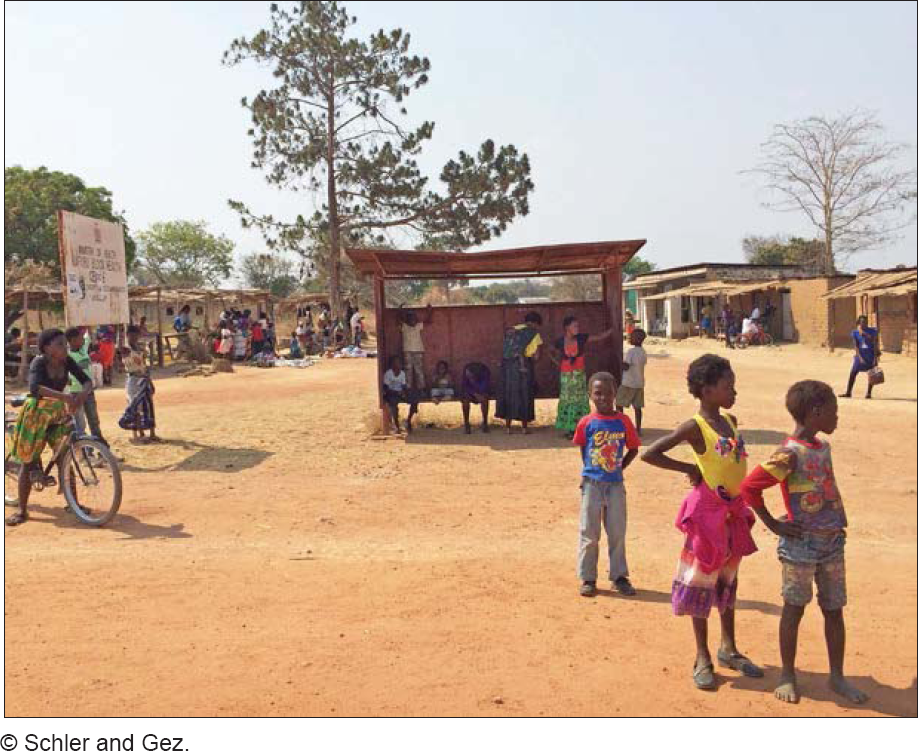
Former Bus Stop in the Kafubu Block
Memory and the Moshavim Legacy
Similarly to physical space, the imprint of the former moshav schemes lives on in both the individual and collective memory – evolving and taking on new meaning with every change that occurs in the surrounding economic, political, and social circumstances. Interviews with former moshav settlers reveal a deep well of detailed recollections related to the projects, their demise, and the aftermath. Equally noteworthy was the inculcation of these memories into those too young to have partaken themselves in the schemes, or who moved to the area only after 1973. For practically everyone we spoke to at both the Kafubu Block and Ka-fulafuta, the moshavim era was a founding moment, a reminder of what should have been, and a key navigation tool for charting the way forward too. These romanticised memories of the schemes belied their history of collapse and unfulfilled promise, and they must be understood within the broader context of the Copperbelt's history.
At the same time, the afterlife of the moshav schemes also reflected aspirations for the future. As will be seen, the arrival of two Israeli researchers inquiring about the former schemes created an opportunity for community members to both reckon with the past and to mobilise that reckoning for the future. Community members in Kafubu Block and Kafulafuta seized upon our meetings to offer their respective interpretations of the collapsed initiatives, and these reflections wove together memories of their engagement with projects and the decades of decline that followed. It was clear that community members also hoped our interest in the former moshavim would ultimately lead to new Israeli schemes. The longing for a return to an era of investment and planning was present in the question posed to us again and again in meetings with local residents: “Are you coming back?” In these conversations, the critique of top-down development was barely present and instead we were told that the return of the Israelis would be greeted by residents by “dancing in the streets.” 2 The warm embrace we received and the romanticised recollections of the collapsed schemes we recorded were thus poignant testimony to the complexities of project afterlife. The legacy of the former schemes that emerged during our visit to the former moshavim was grounded in both the history of demise, downturn, and stagnation on the one hand and aspirations for new opportunities on the other.
Interview, Mela Muyeke, Luanshya, 12 September 2015.
From our very first interactions with current residents, it was clear that there is a widespread collective memory of the schemes. Upon arrival at the Kafubu Block, we approached the first house that we saw and asked the young woman who was hanging her laundry outside if she knew someone in the village who might be able to provide us with information about the history of the place (without specifying what information exactly we were looking for). The woman immediately called out to another member of the household, explaining that “they are looking for information about the Israelite period.” Indeed, at both sites we were repeatedly struck by the prominence of what came to be known by the community as “the time of the Israelites.” It seemed that everyone we spoke to knew about the “Israelite” origins of the settlements, and the presence of the Israelis had taken on almost mythological proportions.
Former settlers with whom we spoke did not question the idea of implanting an Israeli development model in the Zambian countryside, and instead claimed that the schemes failed because the Israelis were given insufficient time to make them sustainable. As one former resident explained:
The people were very disturbed and upset to hear that the Israelites were leaving, because they had only stayed with them only for a short period of time. The Israelites arrived there in 1968, meaning to organise and set a firm foundation for their projects, [but it] took time, so when everyone was trying to grasp the concept, it was announced that the Israelites were supposed to leave. This to the people was a setback. 3
Interview, Albert Chabala, Kafubu, 13 September 2015.
Among former moshav settlers, recollections of the projects themselves were almost universally positive. Descriptions of the schemes revealed a sense that they had brought good fortune, as well as order, justice, equality, and modernity to the area. The projects, we were told, had an excellent reputation and those who participated in them felt chosen:
We were different, we who came into the project area were very happy because we had money coming in and good standards of living. Some people wanted to come but the project area was small to accommodate everyone, otherwise all people wanted to come here. 4
Interview, Albert Chabala, Kafubu, 13 September 2015.
Another former participant praised the orderly manner in which the community was organised, hinting that the schemes emanated a kind of social and economic justice: “These people had a very good plan. These houses were built in the same manner and in lines.” 5 Among some, the romanticisation of the period became associated with Christian convictions and evolved into a sense of divine intervention. As one man described the feeling in his village at the start of the project:
Interview, John Bupe, Kafubu, 13 September 2015.
When they heard the Israelis were coming, they were very happy because they believed that they were coming from heaven. So the people wanted to see what the children of God would do for them, and they were so happy to have them. 6
Interview, Paterson Chikwanda, Kafulafuta, 14 September 2015.
Many interviewees described the equality that was introduced via the schemes, noting that the Israelis brought with them a just division of resources: “It was a nice thing because we received equal treatment, equal plots, and equal houses.” 7 One former participant recalled the even-handedness that guided the allocation of land: “The Israelites argued that it would be unfair for others to get more as they would produce more than others.” Continuing, he added that such an egalitarian approach was considered innovative as:
Interview, Paterson Chikwanda, Kafulafuta, 14 September 2015.
Here each person got the same share, as opposed to a traditional village in which people acquired land according to strength or customary land tenure system. 8
Interview, Moses Mwale, Kafubu, 16 September 2015.
The moshav model, we were told, created a new social reality in which all were made equal. The role of ethnicity was marginalised, meanwhile, in the face of a common new national mission:
From the time Zambia got independence, the concept was to have one country not to be divided by ethnic groups but just have one country, one people. So, the people who came here [were] mostly composed of ex-miners, ex-civic servants, people who didn't even work but wanted to settle on their own. They came here, they did not mind which tribe they belonged to. 9
Interview, John Bupe, Kafubu, 13 September 2015.
The overall sentiment among the former moshav settlers was that modernity had been introduced to the region, and had it remained among them, life would have been far better today. Again and again, our interviewees echoed the language of development and modernisation, emphasising progress and growth – and, according to several former settlers, a much-desired shift from the status of “village” to that of “town”:
Everything was good, piggery, eggs, poultry, layers, et cetera. We were living as though we were in town, we were living a good life, not as we are now. And if the Israelis hadn't left, this place would be a town by now. There was nothing bad; everything was good. 10
Interview, Paterson Chikwanda, Kafulafuta, 14 September 2015.
Another interviewee echoed this belief that the schemes would have brought “progress,” when she described how she believed things could have turned out:
By now we would have already gained middle-class earning capacity, […] yes, we would be exporting organic vegetables to Israel and other places by now! 11
Interview, Mela Muyeke, Luanshya, 12 September 2015.
Conversely, the ending of the idealised, hopeful “present future” (Luhmann 1982; Hänsch, Kroeker, and Oldenburg 2017) was presented by our interviewees as the undoing of progress and a backward turn:
The standard of living went down, there were no more loans, no incentives for our farming. We went back again to the way we were doing it before the cooperatives started. I went to the village and started tilling land using a hoe, our traditional farming. […] Water was pumped from boreholes when the Israelis were here, but when they left, water was not being pumped from the river and people had to go back to where there was water. 12
Interview, Paterson Chikwanda, Kafulafuta, 14 September 2015.
Someone else gave voice to the sense of stagnation that afflicted the community, and indeed the country more broadly:
What these people [the Israelis] did, what they would have done for this nation if they had lived, because many people would not have been dying in poverty. This country would have been properly done with food. […] All the years they spent as they were away was a graveyard for us, we were dead, and their absence killed the communities where they started the projects. 13
Interview, Mela Muyeke, Luanshya, 12 September 2015.
This bleak description captures the moshav settlers’ frustration with the dismantling of the project, as a tremendous setback for the community. Interviewees told us how the project's demise was followed by social breakdown and despair. One former scheme participant described the corruption of those leaders who exploited the Israelis’ departure to take control over resources:
To tell you the truth, the Israelis are too good. What happened was, they left a lot of money, the Israelis. They invested in, you know where we are getting feed for our pigs, feed for chicken. […] Now when these people left, some of the people were happy, the leaders, they knew that they would get a lot of these things including money. […] When the Israelites had left, it was just each one for himself and God for us all. 14
Interview, Best Nsama Yombwe, Kafubu, 13 September 2015.
This last phrase was used again and again to describe the collapse of collective solidarity and the moral decay that followed the Israelis’ departure. Selfishness and greed, we were told, took over the community, and the self-serving vandalism of public property became rife. Some stole pipes and scraps of metal to eke out new sources of income, while others were blamed for having annexed large swaths of land from those who left in despair:
You see, what had happened was, when the Israelites left, the so-called communal land was disbanded. […] Each one for himself and God for us all, and those who were in the leadership had more land than others who were just ordinary people. That is how you find that there were some disparities, some people had six hectares, and others ten hectares, and some people were given more than 20 hectares, and so on. 15
Interview, Best Nsama Yombwe, Kafubu, 13 September 2015.
A symbol of this turn to self-reliance and self-provision was the case of water sources. As we were told, “now everyone has to dig their own well.” 16 The same interviewee went on to bemoan the sharp turn to individualism and self-interest in the period following the disbandment of the projects, and the erosion of interpersonal trust:
Interview, Best Nsama Yombwe, Kafubu, 13 September 2015.
Now, [after the project ended] if individuals, because of selfishness, because of this animal in man, greedy, if individuals now were left to say go and sell, he could even say I carried 15 chickens, five of them died on the road, while the story was different. So all that brought loss as it were. The tempo was lost, the spirit of [being] hardworking, it was lost. Because people were not honest to themselves. 17
Interview, Best Nsama Yombwe, Kafubu, 13 September 2015.
For some, the end of the Israeli schemes was emblematic of what went wrong in Zambia as a whole following the national downturn; the nostalgia for the Israeli era was linked to the lack of opportunities that has plagued these communities ever since the economic decline of the 1970s.
Moving Forward and the Moshavim Legacy
Patience Mususa's work on the coping strategies of Copperbelt residents in the decades following the economic decline cautions us against seeing only disempowered victims. She argues that the economic crises have also given birth to creative energies and new kinds of strategy for devising a better future (Mususa 2010: 391). Similarly, we found that while the legacy of the moshav schemes offers a sombre reminder of personal, communal, and national disappointments, it has also served as a source of inspiration for new social and economic initiatives. Our interviewees evoked the schemes’ former success as evidence that prosperity, justice, and equality are indeed attainable in the Kafubu Block and Kafulafuta. Thus the collective memory around the moshav schemes was not only a vehicle for critiquing the past and the present, but also a means of preserving and remarshalling ambitious visions of the future. Particularly with regard to cooperatives, the past has been mobilised by some members of the community to advance forward-looking aspirations.
This notion that the successes of the past could be revived once more was apparent in the way in which the local community welcomed our arrival. Although we had not prearranged our visit, the sudden appearance of two Israelis quickly became a source of speculation regarding the possible renewal of the Israeli-led schemes. This was evident in individual and group excitement, enthusiastic exchanges of greetings and handshakes, invitations to people's homes, and – as mentioned earlier – the recurring question: “Are you coming back?” Interviewees all attempted to glean more information about “our” “actual” work plan. It did not matter how profusely we insisted that we are academics who in no way represent Israel's aid agency, MASHAV; for our interviewees, our visit rekindled hopes for a return to a time of massive investment and visionary planning.
In meetings with community leaders, cooperative organisations, and private individuals, we were presented with detailed requests for renewed assistance. These entreaties were evidence that the community still draws inspiration from the memory of the moshav schemes, and quickly mobilised around the possibility of their revival. Moreover the content of the wish lists presented to us in these meetings revealed that the moshav schemes’ success continues to provide a vision of prosperity and a roadmap for moving forward, albeit adapted to current circumstances. One interviewee thus gave an itemised list of requests, revealing a clear assessment of what was most needed in the community to achieve long-term prosperity:
If they [the Israelis] can help us with soya beans, which are in high demand, and sorghum, maize, millet, cassava, then it would even help the locals to eat the food which is more healthy – and there would be no talking of drought. […] The government can't help us because they have no money. So if they [the Israelis] came it would be a blessing that they consider crops first. Chickens have also become expensive, but we are more interested in the crops now. We want them [the Israelis] back, they can bring the crops and they can help us to increase the food capacity in [our] homes because those crops last long as for food in the family. 18
Interview, Paterson Chikwanda, Kafulafuta, 14 September 2015.
In a series of meetings, we met with members of the Twashuka Women's Cooperative. The group was founded in 1995 by women in the Kafubu Block who arranged to pool their resources and create a network of support to overcome poverty. They began with chicken farming, but eventually moved into dairy with the help of Heifer International. From its modest origins, the Twashuka Cooperative eventually grew to own 325 cows shared by 35 women. While the group was enjoying relative success, they were still facing many challenges – and our visit was immediately leveraged by the group. The cooperative leadership organised a members’ meeting in the abandoned hangar built by the Israelis in the former regional centre (Figure 2 above). After introductions that included songs, prayers, and speeches, the group's chairwoman rose to present us with a list of projects that could be undertaken by the Israelis should they return. The proposals ranged from small-scale initiatives such as proving bicycles to families in the community to more ambitious demands such as building a paved road to the settlement. The cooperative leader drew a direct link between the history of the Israeli moshav in helping Kaunda deliver on his promise of “one egg a day” and claimed, “we would like for this system to come back or be resumed.” That with one small modification, however:
We are milking, and we have a lot of milk at the moment. When your people were here at first, we heard that there were eggs here, but now we have milk and as such it is milk every day; a glass of milk every day. 19
Chairwoman of the Twashuka's women's cooperative, speech to the whole cooperative in honor of our visit, Kafubu, 15 September 2015.
The chairwoman's most ambitious proposal was for the Israelis to come back and build a system of canals around the Kafubu Block and Kafula-futa, helping bring water closer to the area's farmland and provide another mode of transportation too. Realising that this was a grandiose vision, she added – echoing both biblical and modern times – that:
It is only the Israelites that have done wonders in the desert as such; it is only them that can help to end the perpetual suffering of the women in the area. 20
Chairwoman of the Twashuka's women's cooperative, speech to the whole cooperative in honor of our visit, Kafubu, 15 September 2015.
The women's detailed solicitation for renewed Israeli assistance was an illustration of agency inspired by the memory of the past, but it also indicated that the local community believed it has a role to play in designing the future. Far from the top-down modernisation strategy of the 1960s, our interlocutors signalled to us that an eventual return for the purpose of project renewal would have to be based on local participation, and incorporate the perspectives, aspirations, and needs of the community from the very start.
Conclusion
Forty-five years after the demise of the two Israeli-led moshav schemes in the Zambian Copperbelt, the communities who continue to inhabit the project sites are well aware of the past – and they leverage it both to make sense of the present and to dream of the future. To them, the projects and their promises remain an ontological reality, present both physically and mentally in ways that the original planners could not have foreseen. Long after the schemes were dismantled, their legacy endures for the former project participants still living on-site. Though an ongoing reminder of economic decline, shattered dreams, and stagnation, the project's short-lived success remains a source of pride and possibility for the community. The local population continues to draw upon memories of the projects at significant junctures, and demonstrates that despite their collapse – or, more precisely, because of it – the multifaceted impact on the society is still ongoing.
Thus, this case study demonstrates how – when seen from the vantage point of the longue durée – development is replete with unintended consequences and evolving impacts. As we expand our gaze to capture the unexpected uses and reuses of the material of development in ways that far outlive their original intention and time frame, we gain a whole new perspective on success, failure, and sustainability. While the moshav schemes emerged as a temporary success after their founding in 1967, and then experienced a swift reversal and abandonment by 1973, the projects’ afterlife over the long term blurs the distinction between success and failure. Instead, the examination of development's afterlife encourage us to see how legacies are time-bound and continually open to new layers and interpretations. We are reminded whose reality counts when the Twashuka Women's Cooperative extends an invitation to the Israelis to come back. Their appeal is part of an ongoing effort within the community to remake and reclaim the projects’ remains in ways that are useful to them.
As research within the field of development studies tends towards short-term research and assumptions about organisational survival and continuity (Schuller 2007), we believe scholars should adopt historical and long-term perspectives on the unfolding of development projects – and thus follow the traces of development's (unintended) consequences far beyond formal project trajectories and time frames. Such a perspective can help us to better understand the impact of project planning and outcomes, and further sensitise us to the ways in which communities continue to debate the strategies and practices of development long after planners have exited the stage. The view of the longue durée in the study of development can thus provide important perspectives on questions of impact and sustainability. Just as importantly, such work can draw attention to the actual agency of project recipients as they engage in a brico-lage-like recomposition – using the remains of former projects to form new and relevant solutions in response to changing circumstances and needs. The story of the “creative effervescence [that] sprouted from development's ‘failures’” (Goldman 2008: 37) should consider all categories of stakeholders – and not least, the people most affected by such interventions.