



Abstract
In this article, we analyse the political and social process through which Niger has emerged as a new oil state since 2008. Instead of viewing the situation as a clear-cut resource-curse scenario, we see oil as an important, but by no means determining factor in the country's current political workings. Analysing the main features and narratives of the Nigerien political game in this time of incipient oil production, we first of all observe how various political actors, including the government, political parties, civil society, and wealthy businesspeople, transform oil into a political resource by developing particular notions, images, and meanings of it, including scenarios of a resource curse or resource blessing. We thus argue that in the formative moment of Niger becoming a new oil state, oil appears as an idiom within which Niger's current political and social processes are framed.
Introduction
Over the past two decades, Africa has increasingly been drawn into a new scramble for untapped oil reserves. 1 In this process, a number of African countries have become new oil-producing states. One of these countries is Niger, whose government signed a production-sharing agreement with the China National Petroleum Corporation (CNPC) in 2008. Three years later, the country's first oil refinery, in the southeastern city of Zinder, started production.
The dramatic drop in oil prices in 2015 is a new situation generating a series of interesting research questions. These questions are beyond the scope of this article.
Looking closely at the new African oil states raises the question of how oil becomes a source of social, political, and cultural transformation. Since the early 1990s, after the counter-intuitive empirical findings that many (but not all) states were worse off after years of oil production, the dominant narrative in economics and political science, as well as in media accounts, has been based on the concept of the “resource curse” (Auty 1993). Initially, the resource-curse thesis was used to explain why resource wealth may lead to economic decline. Later, it was taken up and extended as causal relations could be established between resource-rich but otherwise poor countries' tendencies towards political centralisation (Ross 2001), corruption (Leite 1999), and increased incidents of war (Humphreys 2005). Taken together, the resource-curse thesis considers oil – or better, oil money – as the origin of structural changes within African societies and as a fundamental game changer of their politics.
In questioning the dominant focus of resource-curse studies on money flows, some anthropologists have pointed to the importance of the production of meanings of oil, arguing that these significations are essential in constructing a new oil reality and therefore in understanding the social transformations triggered by oil. Behrends and Schareika (2010) have therefore suggested that “signification” as a concept marks a distinctively anthropological approach to the study of oil production. Starting from the tradition of symbolic interactionalism and pragmatism, we conceptualise significations as produced in, through, and for processes of political negotiation between actors with opposing economic interests and varying and potentially conflicting positions of power and degrees of socio-political knowledge. We therefore view significations of oil as a means of creating social and political order as well as influence. Finally, studying signification as practice, and hence a process, not only entails examining temporal aspects of resource making and resource claiming (Ferry and Limbert 2008); rather, significatory practices are also always coupled with tangible political manoeuvres that also need to be taken into account, such as mobilisation, co-optation, repression, and corruption.
Moreover, influential economists and political scientists have started to argue that the resource curse can be overcome by mechanisms of good governance, particularly transparency and institution building (Humphreys, Sachs, and Stiglitz 2007). In this sense, a new paradigm has been emerging in political science and economics over the past decade in which “governance” has become the most important factor in explaining the occurrence of the resource curse, with “good governance” becoming the solution to turn the “curse” into a “blessing” (for a review, see Heinrich and Pleines [2012], who speak of “resource challenges”). As a result, the resource-curse thesis has been articulated all over the globe in policy measures such as the Extractive Industries Transparency Initiative (EITI) and Publish What You Pay (PWYP) (Weszkalnys 2011); as we will show, it has even trickled down into political rhetoric.
Thus, whether and how oil-induced transformations take place depends on the context of its production (Basedau 2005). In this sense, the distribution of oil revenues and the production of meanings of oil must be placed into pre-existing patterns of domination to understand both oil's peculiarity and its particular transformative potential (Behrends, Reyna, and Schlee 2011). In this anthropological study, we focus on both how oil becomes embedded into an already established political arena and the significations it assumes within this arena. To do so, we adopt a political-anthropological approach primarily inspired by the Manchester School's extended-case method (Evens and Handelman 2006). We conducted an ethnography of events that followed the signing of the oil contract in 2008 and the inauguration of Niger's first oil refinery in 2011 and situated these events into a larger political and historical context.
Using the concepts of signification and temporality as analytical lenses allows us to see the specificity of oil in the emerging oil state of Niger primarily as a new idiom for doing politics. By appropriating the symbolic field of oil for their agendas, political players link and express pre-existing political conflicts in the language of oil. Moreover, we use the formative moment of Niger entering oil production as a particularly rewarding occasion to study the political dynamics within a West African state.
We start our analysis 2 by sketching the pre-oil situation in Niger. We then look at the coming of oil and its relation to political conflict, before focusing on the main features and discourses of the Nigerien political game as oil exploitation begins and grows.
We are grateful to Andrea Behrends, Annika Witte, and the anonymous reviewers for their comments on earlier drafts of this paper. The research was funded by the German Research Foundation (Deutsche Forschungsgemeinschaft, DFG) as a subproject entitled “Significations of Oil and Social Change in Niger and Chad” within Priority Program 1448, “Adaptation and Creativity in Africa: Technologies and Significations in the Production of Order and Disorder.” We wish to thank the DFG for its support.
Pre-Oil Niger
Due to its harsh environment and landlocked position, Niger has seen little oil-exploration activity (Augé 2011). The first oil explorations in Niger started as early as 1958 – while it was still a French colony – following the discovery of oil in neighbouring Algeria in 1956. Oil was first found in Niger by Texaco and Esso in 1975 in the Agadem oil block, located in the far east of the country. With the oil explorations and the first positive discoveries becoming known in political circles and at least amongst parts of the Nigerien population in the eastern region of Diffa, oil production was anticipated to start for over three decades before it actually did; it was in fact uranium, and not oil, that first took centre stage in postcolonial Niger.
Niger's political configuration is profoundly shaped by uranium production (Grégoire 2011). The presence of uranium had already been confirmed by 1956. The French considered Niger's uranium of geostrategic importance, both for securing France's energy supply and for its potential use in nuclear weapons. The French state forcefully intervened in Niger's postcolonial transition (van Walraven 2013) and thereby favoured western Nigerien belonging and Zarma people, who in turn constituted the political elite of the country until the National Conference and the transition to democracy in 1991 (Ibrahim 1994).
The introduction of a multiparty system gave rise to a decade of experimentation and repeated breakdowns in the institutional order (Villalón and Idrissa 2005). It also changed the rules of the game in terms of political competition, civil society activism, and media pluralism. A number of new political parties emerged. Over the coming years, the most important would be the newly founded ruling party Mouvement National pour une Société de Développement (National Movement for the Development of Society, MNSD-Nassara), led by Mamadou Tandja; Mahamadou Issoufou's Parti Nigerien pour la Démocratie et le Socialisme (Nigerien Party for Democracy and Socialism, PNDS-Tarayya); and Mahamane Ousmane's Convention Démocratique et Sociale (Democratic and Social Convention, CDS-Rahama). Moreover, since becoming legal and legitimate as counter-balances to state power at the National Conference, and driven largely by economic rather than political goals, civil society associations and labour unions have played an ambiguous role in regime change, contributing to both “autocratic” and “democratic” breakdowns (Elischer 2013). It was in this social and political constellation that the oil project began in 2008. Indeed, long before the first barrel had been produced, oil was being put to use in political disputes.
Crude Awakening: The Coming of Oil in Niger
In June 2008, after 50 years of exploration, Niger signed a contract with CNPC to produce oil from the Agadem block and build a refinery near Zinder, to be connected by a 462.5 km pipeline (see Figure 1). 3
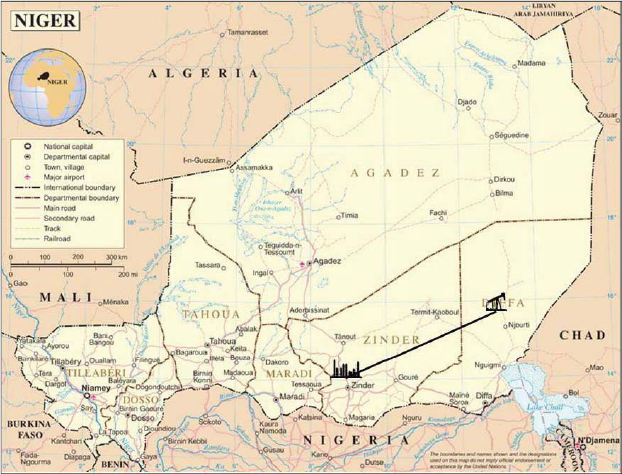
Oil Production in Niger
The agreement involved oilfield exploration and development, a 20,000 bpd joint-venture refinery in Zinder, and the construction and operation of a 462.5 km pipeline connecting the oilfields to the refinery. Since 2012, government revenues from the integrated oil project have been slightly more than USD 100 million annually (approximately 5% of Niger's GDP). Although Niger does not yet export crude oil (export of crude is not expected to start before 2019), annual revenue from Nigerien oil production is already slightly higher than from uranium extraction by AREVA/France, which has made Niger the world's fourth-largest uranium producer.
On signing the contract with CNPC, the Nigerien government received a USD 300 million bonus payment. A few weeks later, on 27 October 2008, the cornerstone ceremony for the oil refinery in Zinder was held. The same day marked the launch of a political campaign known as “Tazartché” or “Continuation!” 4 Tazartché aimed to change the Constitution to allow President Mamadou Tandja a transition phase of three years prior to the new elections, to seek an unlimited number of terms as president, and to switch Niger from a semi-presidential to a presidential system. 5 Upon his arrival in Zinder, thousands of supporters welcomed Tandja with the slogan “Tazartché.” The political mobilisation built on the justification that Tandja had opted for Zinder as the site of the oil refinery, a region that had always felt marginalised by and dissatisfied with national politics in the capital, Niamey. Here we should remember that it was in Zinder that the CDS-Rahama, the coalition partner of Tandja's MNSD at the time, emerged as an eastern Nigerien response to western Nigerien and Zarma dominance (Lund 2001), retaining its electoral stronghold here even today.
The term “tazarce” comes from Hausa and is mostly written “Tazartché” in French. It roughly translates as “continuation.”
Tandja's presidency was set to end in 2009 after the maximum two mandates, as specified in the Nigerien Constitution of the Fifth Republic.
In his speech at the refinery's foundation-stone ceremony, Zinder governor Yahaya Yandaka asked the president, in the name of the Nigerien population, to complete the great construction sites that he had initiated, and especially those that had made Niger an oil producer. After its launch, supporters of the president organised pro-Tazartché demonstrations, and Tandja's political entourage used state television and radio stations across the country to propagate the need for a constitutional change. Three messages seem to have been strategically placed in the political campaign for constitutional change: first, that the Nigerien people wanted Tandja to remain in office, and the Constitution to therefore be changed accordingly; second, that Tandja himself was ultimately responsible for and intimately connected with the development of Nigerien oil (and uranium); and third, that a move to a presidential system would better fit Nigerien culture (Baudais and Chauzal 2011: 298). Throughout the campaign, Tandja was presented as “the father of oil production”; it was his “pragmatism” and “nationalism” that had facilitated Niger becoming an oil-producing country, and changing the president at this decisive moment in history would bring national instability and threaten the country's oil (and uranium) projects. 6
By entering into the oil contract with CNPC, Tandja's “nationalism” refers to his anti-imperial and anti-neocolonial image of a strong leader able to resist Western interference that wanted to keep Niger's oil as a future reserve.
In making use of the resource-curse scenario, long-time political observers of Niger have come to the conclusion that Tazartché was triggered by oil (and uranium). After all, Tazartché was designed to alter the Constitution and get Tandja re-elected as president, thereby placing him in the best position to capture future oil (and uranium) rents (Grégoire 2010, 2011: 222–223; Gazibo 2011: 342–343). But does this assumption withstand empirical scrutiny? A closer look at the emergence of oil and its relationship to political conflict in Niger undermines such analyses built on clear-cut causal links predicted by the resource-curse thesis.
On 7 July 2005, the private Nigerien newspaper Le Temoin published the headline “Guerre souterraine entre Hama et Tandja,” 7 reporting rumours that Tandja would opt for a third mandate. 8 Conflicts had already arisen in 2004 between President Tandja and Prime Minister Hama Amadou, when the former announced his candidacy for a second mandate. At the time, the Nigerien public perceived Amadou as the country's real strongman, pulling the strings while Tandja, “the old man,” was executing only the office of the symbolic president. However, in announcing his second candidacy, Tandja showed his willingness to continue in office, and ultimately won the struggle for power against Amadou within the MNSD-Nassara party. At the time of its conception, Tazartché predated the mining of oil in Niger. Although CNPC had been conducting oil-exploration activities in the Teneré and Bilma oil blocks since 2003, and Esso and PETRONAS in the Agadem oil block since 2002, the latter companies qualified Niger's oil reserves as economically unprofitable (with estimations of reserves of only approximately 350 million barrels at a time when the oil price was still around USD 30/barrel).
“Underground war between Hama and Tandja.”
In a 2005 article, Keenan (2005: 406) also mentioned Tandja's project to change the Constitution to extend his presidency beyond the maximum two terms.
Nevertheless, Amadou remained prime minister after 2004 and looked set to stand for the presidency in 2009, when Tandja's reign would end. However, rumours that Tandja would change the Constitution so he could stand for a third mandate fuelled conflict between the political camps. In December 2005 – shortly after the first rumours of Tazartché had spread – Amadou announced his candidacy for the 2009 presidential elections. In doing so, he sought to show Tandja his determination to fight any attempt at constitutional change. When the embezzlement of international donor funds became public in 2006 in the so-called “affaire MEBA” 9 and the international donor community demanded an explanation, Tandja used the opportunity to launch the anti-corruption campaign “opération mains propres,” in which he mainly targeted members of Amadou's political camp. That same year, Esso and PETRONAS abandoned the Agadem oil block, refusing to build an oil refinery that the Tandja government had made a condition for signing an oil contract designed to diversify Niger's resource sector.
MEBA stands for the Ministère de L'Έducation de Base et de l'Alphabétisation (Ministry of Basic Education and Literacy).
Amadou himself was finally removed from office in a no-confidence vote in 2007 and was imprisoned along with some of his followers in June 2008. 10 The same month, the Nigerien government finally concluded the oil contract with CNPC, who had agreed on the terms set by the Tandja government (raising reserve estimations up to 744 million barrels of oil at a time when the oil price was around USD 147/barrel). 11 After his release, Amadou founded the Mouvement Démocratique Nigérien pour une Fédération Africaine (Nigerien Democratic Movement for an African Federation, MODEN-FA Lumana) party in 2009.
We do not claim that Hama Amadou was innocent. Rather, we argue that he was a political victim, as corruption and embezzlement of public funds are part of the everyday political game (Olivier de Sardan 1999).
At the time of writing in 2018, reserves were already estimated to be close to 4 billion barrels of oil.
By eliminating his strongest political opponent within the party, Tandja regained wide-ranging power and was left virtually unopposed. To turn the strategically fabricated “will of the people” for him to continue as president into a public fact, Tandja bought off popular civil society associations and labour unions to participate in and lobby for Tazartché (Abdoul Azizou 2010). To secure their support, Tandja offered seats in governmental bodies to some civil society activists who had supported Tazartché. To demonstrate the people's will, the Tandja government organised a referendum on constitutional change for 4 August 2009. While Tazartché won at the ballot box, members of the political opposition and the international community claimed the ballot was rigged.
In short, the Tazartché campaign was neither a spontaneous social movement, nor was it triggered by the oil contract with China. While Tazartché started well before the signing of the oil contract, the contract was nevertheless ideologically exploited for Tazartché's realisation. Niger's oil endeavour served to legitimise Tazartché, although Tazartché itself has to be seen as a political conflict. Whereas the USD 300 million bonus payment to the Nigerien state may have been important in funding and organising the campaign, Tazartché was more about securing political power than anticipating the future oil revenues as spoils. Arguably, Tazartché can be taken as a key to understanding the current political processes in Niger and the role oil plays in those processes. Let us therefore look at the political events following Tazartché to see how significations of oil were produced in and for political conflict in Niger.
Crude Alliances: Reactions against Tazartché
As it had done throughout the previous two decades of institutional breakdowns and regime transitions following the introduction of the multiparty system (Villalón and Idrissa 2005), the political elite firmly united against the attempt to centralise power. On 16 July 2009, CDS-Rahama leader Mahamane Ousmane withdrew his party from the ruling coalition and joined with the political opposition as well as several labour unions and civil society associations who had formed the Coordination des Forces pour la Démocratie et la République (Coordination of Forces for Democracy and the Republic, CFDR), a “democracy movement.” The political opposition's strategy was not so much to question Tandja's image of pragmatism and nationalism, but to play the “democracy card” by calling Tazartché a “coup d'état constitutionnel” (CFDR 2009). They accused “Tandja and his clan” of violating constitutional democracy, favouring clientelism and corruption, and being involved in mafia-like practices and drug trafficking in the Sahara.
The opposition organised pro-democracy demonstrations to address the international community and to call for sanctions against the Nigerien state. The call for democracy seems to have evoked the idea of the “resource curse” to shape public sentiment: As Niger now had oil, the country was on the road to dictatorship! National political observers in Nigerien newspapers quickly established a relationship between Niger developing oil production and Tazartché, as did some academic observers (Gazibo 2011; Grégoire 2011, 2010). The opposition forces succeeded with their call, with international sanctions against the Tandja government enacted after the 2009 constitutional referendum.
Tazartché was backed by then Libyan president Mu'ammar al-Qaddafi, who declared it time to ban restrictions on presidential terms from all African constitutions and to let the will of the people decide how long the president could remain in office. Indeed, it is important to note that leaders in a number of both resource-rich and resource-poor African countries including Senegal (2012), Burkina Faso (2014), Congo-Brazzaville (2015), and Burundi (2015) have attempted to push through such constitutional changes in recent years. Given that, drawing hasty conclusions from the resource-curse thesis should be avoided.
Indicating that he was determined to stay in power with the help of China, Tandja reacted to the sanctions with a nationalist discourse, stating that he had “two strings to his bow, if one should break, there is always the other” (Grégoire 2010). In a speech in Diffa, Tandja attacked the political opposition for committing “treason” against their “own brothers” (his government) and collaborating with “the enemy” (the West). We argue, therefore, that while Tandja's primary goal was to secure political power, the USD 300 million bonus payment and the new partnership with China may have provided invaluable financial and ideological resources for the production of meanings and for the acquisition of supporters that were essential for the success of Tazartché, especially in light of international sanctions and powerful internal opposition.
On 18 February 2010 Tandja was overthrown in a military coup led by Commander Salou Djibo. This was nearly two years before the first barrel of oil had been produced. Djibo's stated aim was to turn Niger into an example of democracy and good governance. Leading civil society activists who had supported the opposition in their fight against constitutional change were appointed to prominent positions in the National Consultative Council by the transitional government (Maccatory, Oumarou, and Poncelet 2010: 355). Less than one year after seizing power, Djibo organised new elections, which saw the former opposition party PNDS-Tarayya come to power, with party leader Mahamadou Issoufou becoming president in 2011. Issoufou built a coalition with MODEN-FA Lumana, the party of former prime minister Hama Amadou, who was appointed president of Parliament. The former government majority under Tandja, the CDS and MNSD, found itself forming the new political opposition. With the coming of the new government, the civil society associations within the governmental bodies that had supported Tazartché were removed and replaced by civil society associations that had been members of the CFDR.
One of the first aims of the Issoufou government was to re-establish the old economic partnerships with Western donors (such as with the European Union, International Monetary Fund, and the World Bank) that had been suspended under Tandja, in addition to creating new ones. Oil played a prominent role in this task. In his inaugural speech, Issoufou addressed the international community, declaring his commitment to overcoming the “resource curse” with mechanisms of good governance and promising to use the oil revenues to improve state services such as the provision of schools, health centres, and water supply. To illustrate his commitment to transparency and good governance, Issoufou soon created anti-corruption institutions such as the anti-corruption hotline ligne verte; the Bureau Informations-Réclamations, Lutte contre la Corruption et le Trafic d'Influence (Information and Reclamation Office, Fight against Corruption and Influence Peddling), responsible for fighting corruption in the legal system; and the Haute Autorité de Lutte Contre la Corruption et les Infractions Assimilées (High Authority for the Fight Against Corruption and Related Offences, HALCIA), whose mandate was to fight corruption in the public sector. And, indeed, shortly after Issoufou came to power, many Western donors resumed their suspended economic partnerships with Niger, or created new ones.
Moreover, the hope to overcome the resource curse and to turn it into a blessing with good governance was taken up by civil society associations engaging in the public debate of the extractive industries in Niger. Having been harsh critics of Tazartché and the Tandja government before, the Réseau des Organisations pour la Transparence et l'Analyse Budgétaire (Network of Organisations for Transparency and Budget Analysis, ROTAB), a member of the international transparency networks PWYP and EITI, and the Groupe de Réflexion et d'action sur les industries Extractives du Niger (Group for Reflection and Action on the Extractive Industries of Niger, GREN), also a member of EITI, explicitly drew on the resource-curse scenario in press conferences, publications, and interviews, arguing that the task of civil society should be to prime the population to see oil production as a blessing. In May 2011 one of the authors was walking alongside Salissou Oubandoma – former national coordinator of GREN who was appointed vice president of HALCIA under the new government of Issoufou – through the sandy streets of cité fayçal in Niamey, when we passed a group of elderly politicians from the Tandja regime who were enjoying shade and tea in front of a house. They first greeted Oubandoma, but then immediately stressed with a mixture of amazement and complaint that he had become mute in public after having previously been a harsh critic. The same was said of Ali Idrissa, national coordinator of ROTAB, who is publicly known to have close ties with the Lumana party of Hama Amadou, which was part of the Issoufou government from 2011 to 2013. 12
After Hama Amadou dropped out of the Issoufou government in 2013 and thereafter became Issoufou's main rival, Ali Idrissa turned into one of the most prominent public critics of the Issoufou regime. As a result, he was arrested several times in 2014, 2017, and 2018.
Taken together, tracing the development of the political conflict around Tazartché highlights the inextricable mixture of ideological and material exploitation in politics. First, it becomes apparent that the opposition forces – as in previous institutional breakdowns after the emergence of multiparty politics in Niger – formed a united “democracy movement” against the government when their political positions and shares of state revenues were in danger. Second, the tangible aspects of politics are coupled with the strategic manoeuvres of signification. In this case, oil was signified either as the achievement and future task of a glorious Nigerien statesman, or as the curse that transforms a democratic president into a dictator. Thus, signifying oil as curse or blessing became one of the very political acts through which the struggle for state power and legitimacy was waged.
The following case study of the oil refinery's inauguration demonstrates the successive phases of a “political drama”: from the mobilisation of political capital, to a showdown, to a crisis, to mechanisms of redress, and then to the restoration of peace (Swartz, Turner, and Tuden 1966). The phases of development will help us identify the mechanisms and logics of Nigerien politics in times of oil, and show how significations of resource wealth and development, including the resource-curse scenario itself, became part of the everyday micropolitical game.
Crude Mobilisation: The Oil Refinery's Inauguration Ceremony
While the oil refinery's 2008 foundation-stone ceremony in Zinder was used as the starting signal for Tazartché, the refinery's inauguration ceremony on 28 November 2011, celebrating the first day of production, became the theatre in which political conflicts between the new government (PNDS-Tarayya and MODEN-FA Lumana) and the new opposition (CDS-Rahama and MNSD-Nassara) played out. Whereas Tandja was celebrated as the “father of oil production” in Niger at the foundation-stone ceremony and was especially lauded for his choice of Zinder as the site of the refinery, Issoufou's arrival three years later was accompanied by violent youth protests.
Several weeks before the opening ceremony, political opponents began stirring up public opposition to Issoufou's new government. First, regional and municipal councillors (most of them from the opposition CDS-Rahama or MNSD-Nassara parties) 13 released a press statement about the risk of a social explosion at the oil refinery's imminent inauguration. According to the councillors, public anger about the refinery was high, especially among male-dominated youth gangs called palais, which had sprung up in the context of growing unemployment and had a notorious criminal reputation in Zinder. Anger had increased with the nomination of the nine directors of the Societé de la Raffinerie à Zinder (Society of the Zinder Refinery, SORAZ), none of whom was from the Zinder region. Moreover, with the future creation of over 300 jobs at SORAZ, the regional and municipal councillors feared that local people would be locked out of opportunities at the refinery with the jobs going to western Nigeriens and Zarma people, and thus that the social equilibrium of Zinder was in danger. Subsequently, the councillors publicly installed a committee to ostensibly monitor the recruitment process.
The town council of Zinder was installed in June 2011 by universal suffrage and is composed of 23 councillors. Five political parties are represented on the council: CDS (14 seats); MNSD (4); PNDS (2); ARD (2); and Lumana (1). The regional council was also installed in June 2011 by universal suffrage and is made up of 41 elected councillors, 8 administrative chiefs (“traditional authorities”), and 20 deputies. Seven political parties are represented on the council: CDS (12); PNDS (9); MNSD (8); ARD (5); Lumana (3); RPD (2); and RSD (2). The results show the dominance of CDS (and MNSD) in Zinder.
In the ensuing days, the civil society association Mouvement Populaire pour la Pérennisation des Actions du Développement (MPPAD) released a statement celebrating Tandja as the “father of oil production in Niger” and accusing the newly elected government authorities of bad governance and marginalising the region of Zinder in respect to possible oil benefits. According to the MPPAD, Issoufou and the PNDS were so disconnected from reality and lacking in pragmatism that they had once commented on Tandja's oil project with the words “everything is false, there is no drop of oil, there is only water.” Moreover, the statement harshly rejected the recruitment process in filling leading positions at SORAZ, which it judged “sectarian,” “ethnic,” and “politically motivated,” and demanded the oil minister recall the appointees. The statement ended with the MPPAD calling on the population to mobilise against the new government. The president of the MPPAD was Dan Dubai, 14 a wealthy businessman and a main initiator and supporter of Tazartché. In supporting Tazartché, Dan Dubai hoped to secure a foothold in the government of Tandja and/or in the oil-transport business to come. He organised urban youth into so-called comités de defense in every quarter of Zinder. The leader of each group was given direct orders by the MPPAD, which he was to pass down to his subordinates.
Dan Dubai is Hausa and means “Son of Dubai.”
When the oil and energy minister Foumokoye Gado announced the future official Nigerien fuel price would be XOF 579 per litre (USD 1.19) 15 in a press conference two weeks before the oil refinery's inauguration ceremony, a new wave of texting spread rapidly among the youth of Zinder. Short messages in Hausa and French calling on the population to resist and fight the government were initially sent from unregistered SIM cards. Several days before the inauguration, messages called on the population to boycott President Issoufou's arrival in Zinder. Although the police failed to track the source of these chain messages, it was obvious that some messages were strategically placed by political opponents – especially as the messages' contents were nearly identical to those opponents' declarations.
Although this was a reduction from the former fuel price, which was about XOF 670/liter (USD 1.23), it was well above the XOF 250/liter (USD 0.51) maximum that Zinder's political and social actors were demanding.
One week prior to the inauguration, one of several similar debates was organised by a local radio station about the future prospects of the Zinder oil refinery. The debate featured a government representative, an opposition representative, and Dan Dubai. Dan Dubai listed the negative effects (pollution, poor working conditions) of oil production in Zinder and repeated accusations against the government of poor governance and marginalising the region of Zinder. The opposition representative spoke of the potential role of oil-led development in reducing youth unemployment, expressing equal concern about regional marginalisation in the distribution of jobs at the refinery. The government representative in turn argued that skills, knowledge, and competency and not the candidates' origin were the criteria used to fill positions at SORAZ, accusing the political opposition itself of ethnocentrism and regionalism. Explicitly using the French term “malediction” (curse), he demanded the population calm down and give oil production a chance to turn into a blessing. In doing so, he implicitly accused the political opposition and civil society of being responsible should the “curse” actually become reality.
Just days before the inauguration ceremony, several labour unions and associations – most of which had supported Tazartché – confederated as the Comité Régional des Associations et Syndicats de la Région de Zinder (CRAS). However, CRAS did not include all of the important civil society associations in Zinder, with several others working closely with the government, such as ROTAB, or trying to stay neutral, such as GREN. While members of ROTAB and GREN from Zinder had stressed the good relationship between civil society and government authorities in interviews and informal conversations, CRAS as a body instead heavily criticised the government for failing to deliver oil-induced development: infrastructure projects, a low fuel price, a regional quota for oil workers, health services, and better access to water and education. CRAS accused the government of being corrupt and incompetent, denouncing politics in Niger as based on ethnic and political loyalty. Moreover, in a radio debate broadcast by Zinder radio station Alternative on 15 November 2011, they accused the government of working with civil society organisations who would “eat, drink, applaud, and disperse afterwards” and thus give their blessing to everything the government proposed. Finally, the committee claimed the government must not only deal with these grievances, but also accept CRAS as a member of regional government committees created to supervise the recruitment process, organise the inauguration ceremony, and determine the fuel price.
Here, it is important to note that members of a regional government committee receive food, drinks, and daily allowances, making such positions highly sought-after by members of low- and middle-income groups facing pressing demands for financial redistribution within their social networks. Indeed, by voicing popular grievances, the opposition civil society associations in CRAS saw an opportunity to reclaim the political posts they had lost in the regime change. In order to deliver their list of concerns and demands, CRAS also lobbied for an audience with President Issoufou when he arrived for the inauguration. Here again, it is important to note that audiences with important government officials are widely believed to be occasions where envelopes of money are handed over. The refinery's inauguration thus presented a perfect stage for CRAS to re-enter the public political sphere after regime change had excluded them from the political game and its financial flows.
In the formative moment of Niger becoming a new oil producer, it has become evident that the first step in the mobilisation of political capital and support was the appropriation of the current and sensitive subject of oil by all political players. Each player signified oil in particular ways to make claims to political power and legitimacy. However, although the conflict played out around the inauguration ceremony, the political constellation had historical roots. The people of Zinder had always felt marginalised by Niamey politics; with the regime change from Tandja to Issoufou, Zinder had become the electoral stronghold of the opposition, which, in turn, tried to exploit the event of Niger becoming an oil producer for its political projects. We therefore argue that oil did not completely restructure political constellations in oil-age Niger, but fuelled pre-existing political conflicts. The refinery's inaugural ceremony, in fact, became the stage upon which these conflicts played out.
Crude Action: The Production of Disorder in Zinder
Three days prior to the refinery's inauguration, Dan Dubai was arrested and accused of defaming the president in the aforementioned radio debate. Following his arrest, he was increasingly portrayed by civil society activists and in text messages as a folk hero who dared to speak the truth in the name of the poor.
On 28 November 2011, the President Issoufou arrived at Zinder International Airport for the refinery's inauguration. In his speech at the opening ceremony, Nigerien oil and energy minister Gado stressed that Niger's entrance into the circle of oil producers was a historic moment, and praised the Chinese for their determination to complete the oil project. He then turned to oil revenues, their paradoxical effects, and the threats that they may pose – intensifying inequality, engendering frustration, and even stoking civil war. He argued that these threats had already started to develop – a reference to Tandja's Tazartché campaign for constitutional change. He highlighted the importance of good governance and transparency in the resource sector in order to avoid these pitfalls and for the whole population to profit from the oil, and pointed to the fact that his government had complied with EITI criteria.
However, while Issoufou's arrival had been planned as a huge celebration to usher in a new era of oil, it soon turned into a highly contested event. Supporters of the political opposition tried to disturb Issoufou's official arrival by shouting, insulting him, and throwing stones. Near the bus station in the city centre, youths burnt tyres and fought with security forces. In chain text messages, the disturbance to Issoufou's arrival was portrayed as a major success for the resistance.
In the days following Dan Dubai's arrest, public debate was dominated by his imprisonment. In press statements and radio debates, civil society associations demanded his release, while text messages called on the public to attend the court case, which was set for 6 December at the Zinder Tribunal. That day, several hundred mostly male youths gathered in front of the court. When the security forces started to drive the crowd into the streets, the ensuing clashes resulted in the death of a young student. The death caused public uproar. Over the following two days, youths attacked police stations, built and set alight street barricades of tyres, looted a bank, and burned down a police station. The unrest, which resulted in another death, was finally calmed when the military was deployed to regain control over the city.
Taken together, significations of oil including the notion of a resource curse or blessing have become striking elements of rhetoric in the “crude moves” of Nigerien multiparty politics. While opponents accuse the government of making the “curse” a reality, government supporters use the beginning of oil production to accuse opponents of producing the “curse.” The formative moment of the oil project in Niger thus offered political players new resources and opportunities to voice grievances, build alliances, gain negotiating power, find recognition as an interest group, compete for position and a share of state revenues, and formulate visions of the future and thereby (re)claim political power and legitimacy. These strategic manoeuvres of signification were coupled with tangible manoeuvres of manipulating youth violence or trying to seek a profitable cohabitation with the government. Here, what may have initially appeared to be “politics from below” were, in fact, also “politics from above,” with at least some of the text messages designed by influential political players to mobilise the population against the government.
Crude Order(ing): Redressive Politics and the Restoration of Peace
After the riots, the government responded with the temporary shutdown of the entire SMS network in Zinder. It also used state radio and television, the Office de Radiodiffusion et Télévision du Niger, to announce initial measures, including the dismissal of executive police officers and the convening of a commission to uncover the masterminds of the riots. On 8 December 2011, the prime minister was sent to Zinder to meet with the sultan, the governor, and religious authorities, as well as teacher, parent, and student representatives. After the meeting at the sultanate, a joint statement appealing for calm was released. Following the appeal, the situation in Zinder remained calm but tense. While it became public that the prime minister had distributed money at the meeting, there was no public criticism of the fact that the government had bought off the different representatives to subdue the tensions. 16
The distribution money became public due to an internal conflict within the student union (USN) about how to distribute it amongst themselves. USN members reported that the religious authorities and the parent–teacher association each received XOF 1 million (USD 2,056) while the USN received XOF 300,000 (USD 617).
However, several actors were not included in the meeting. First, CRAS was disappointed they had not been invited. CRAS members had neither been granted an audience with the president at the refinery's inauguration, nor been appointed to regional government committees. Thus, in the following months CRAS continued to sharply criticise the government, culminating in planning a mass demonstration set for March 2012. Shortly before the demonstration was to take place, two of the committee's most influential members said they had received information that opposition politicians planned to hijack the demonstration by distributing tyres and fuel to encourage youth gangs. When CRAS indeed decided to cancel the demonstration, another CRAS member claimed to have proof that those who had pushed for the cancellation of the demonstration had been paid off by a wealthy businessman on behalf of the governor. Debate among CRAS members following the accusations did not focus on “the fact” their comrades had accepted bribes from state officials, but rather that the accused did not share the money with the other members. One committee member, for example, expressed his disappointment that the accused lacked solidarity and referred to their former support for Tazartché. The committee member said he had always shared contributions from the Tandja government equally among the other group members. Indeed, CRAS stopped functioning after the accusations.
Second, having been at the forefront of the December 2011 riots, disaffected male youth of Zinder gained political leverage and became addressees of government policies. The Mouvement des Fadas et Palais pour la Promotion de la Jeunesse (Movement of Fadas and Palais for the Promotion of Youth, MFPPJ) was established between May and June 2012 on the initiative of local political authorities from the government and the sultan. Shortly afterwards, the MFPPJ declared its support for the government and President Issoufou. In a public letter addressed to Dan Dubai and distributed to Niger's presidency and Zinder's various political authorities, they dissociated themselves from the MPPAD and blamed Dan Dubai for organising “anarchist, unilateral, and politically connotated demonstrations.” When President Issoufou came to Zinder a second time for the foundation-stone ceremony of the Zinder–Guidimouni road on 15 May 2012, a huge audience joyously received him. Indeed, the crowd was said to have been even larger than that for Tandja's 2008 foundation-stone/Tazartché-launch ceremony. Following Issoufou's visit, a conflict within the MFPPJ erupted over the contributions it had received from the government (which, aside from monetary contributions, also apparently included an Opel car and free fuel), resulting in a leadership split that left the MFPPJ inoperative.
The cases of the MFPPJ, CRAS, and the prime minister's visit show that there seems to be a socially embedded “moral economy of corruption” (Olivier de Sardan 1999) in Niger, with the logic of the political game inextricably entangled with social logics to redistribute spoils of the game within social networks. Moreover, the course of events illustrates how civil society associations were able to establish themselves as political players in a multiparty system through their ability to act as counter-powers to the government. The ruling party coalition must appease or repress opposition groups by employing political manoeuvres such as bribery, co-option, intimidation, or political arrest. As the course of events furthermore shows, with over 75 per cent of the Nigerien population under 25 years of age and given the potential for violence among youth gangs (in Zinder in particular), disaffected male youths have become targets of both government and opposition mobilisation politics. In this instance, in order to avoid riots and other uprisings, the government addressed the youth by creating formal, structured groups that it could negotiate with and govern more easily.
As in the case of “big” politics and power struggles at the national level, this case study demonstrates that the coming of oil does not automatically determine the constellations of power and the outcomes of political confrontations on a local political arena. Rather, oil flows into an already well-established political arena in which a mixture of significatory and tangible manoeuvres gives the existing political games a new, discernible stimulus.
Conclusion
Using Niger's entrance into the oil age as a lens through which to analyse political dynamics, our case study provides insights into both the inner workings of Nigerien politics and the discursive relevance of oil in the formative moment of the country becoming a new oil producer.
First, we illustrated how oil entered an already well-structured political arena in which pre-existing political conflicts were expressed in oil language. With political liberalisation and the emergence of a multiparty system in Niger in the early 1990s, the rules of the game were transformed from authoritarian silence to a formally defined system to allow for political competition, free press, and civil society activism. It is within this political context that oil production in Niger began. Long before the first barrel could be extracted, different strategic groups politically exploited oil. Tandja's attempt to change the Constitution was legitimised with the oil project, but its origins were related to a political conflict dating back to at least 2004, when he and Prime Minister Hama Amadou began fighting for control within the MNSD-Nassara party. Instead of simply following the logic of the resource-curse thesis and assuming, as long-time political observers of Niger have done, that oil was the root cause of the authoritarian project Tazartché, it seems more appropriate to understand the events as part of a broader complex of ongoing power struggles. In these power struggles, the resource-curse scenario has itself become a piece of political rhetoric for various players in Niger.
Second, oil was not the root cause for the disorder during the oil refinery's 2011 inauguration. Rather, the ceremony became the stage upon which pre-existing conflicts related to Zinder's historical marginalisation and the politics of Tazartché played out. Next to the fact that the regime change from Tandja to Issoufou turned Zinder into the stronghold of the political opposition, the location of Zinder as the site of the oil refinery played an important role in the production of disorder around the opening ceremony. When oil came to Zinder, it was quickly appropriated by various strategic groups who put it to use in the political games they had already been playing. We saw, for example, how Dan Dubai and the civil society associations that had supported Tazartché were left empty-handed after the regime change. These actors tried to use the inauguration as a public stage to build new alliances, gain negotiating power, find recognition as an interest group, and thus re-engage with the political game. Moreover, urban youth gained public and political presence through violent performances and were consequently co-opted into the political projects of more powerful players.
In this sense, the formative moment of Niger entering the oil age opened a window onto the inner workings of Nigerien politics. Our case study revealed the importance of a combination of factors in explaining contemporary Nigerien political dynamics. It is the system of multiparty politics, private media, and civil society activism in combination with a moral economy of corruption that favours spoils of the political game over political ideology. In this game, increasing male youth unemployment and violence can be mobilised and manipulated by various political players to pursue their political projects. However, these dynamics predated oil production in Niger and should, therefore, not be confused with oil-induced transformations.
Comparing the case of Niger with oil politics in neighbouring countries, we see how the significations of oil differ in their temporal dimensions, dependent on the “phases of oil development” (Heilbrunn 2014: 110–144). We view five broad phases of oil production as being of particular importance. First, there is the “state of not-yet-ness” (Witte 2017), when the government and at least parts of the population are aware that oil exploration has begun, but production has not yet started. Weszkalnys (2014) in São Tomé and Príncipe, Witte (2017) in Uganda, and Behrends (2008) in Chad have analysed how the absence or not-yet-ness of oil production spurred all kinds of anticipatory practices and economies of expectation, and thus materialised and affected the country although the oil was still in the ground. The second phase is that of a country as an emergent oil producer, where oil production is just about to commence, or has just commenced. We showed that Niger in 2011/2012 was characterised by oil's immediate presence, with oil acting as an idiom that framed political conflicts in its language. However, with recurrent protests around various events in Niger, after several months or years of production, oil's discursive presence has diminished over time, and political debates have increasingly turned towards other issues (Schritt 2015). The third phase is that of a mature oil producer such as Nigeria, where production started decades ago and patterns to manage and absorb oil revenues have become well established. In this advanced stage of production, oil seems to lose its early significance in public discourse, nevertheless continuing to profoundly shape political configurations; this has been demonstrated in Nigeria (Watts 2004), where it has trickled down into everyday life, becoming expressed in all kinds of illicit behaviour (Apter 2005). Fourth, there is the phase of declining production, as in Gabon or Oman, where hydrocarbons decrease and oil revenues start to fall. In this late stage of production, oil appears to again become discursively pertinent, with a (perceived) end to production looming. In Oman, for example, this has spurred new discussions about a future without oil (Limbert 2010); in Gabon, the continuous depletion of oil has produced new uncertainties among the population (Fricke 2017). Fifth, we can imagine a post-oil phase, in which production has ceased and oil might be (actively) remembered or forgotten. However, we should not conceptualise these phases too neatly, or view them as being self-contained. Oil production can periodically become an issue that sparks public politics, especially in relation to broader international events, such as a price boom or crash.