



Abstract
Using the case of groundwater pollution in Nigeria's Niger Delta, this paper examines the shifting contours of primitive accumulation in the region. Based on two years of ethnographic research, the paper unravels the losses experienced by individuals and their dependents whose privately owned sources of water were polluted. It argues that the groundwater pollution is a deadly but less discussed form of primitive accumulation that has strong implications for peace and development in the affected communities. The paper concludes that accumulation by dispossession driven by oil exploration in the Niger Delta operates in complex ways and generates multifaceted crises; as such, the prospects for resolving the conflicts lie in addressing various strands of the dispossession, including groundwater pollution in the region.
Introduction
Day after day, day after day
We stuck, nor breath nor motion;
As idle as a painted ship
Upon a painted ocean.
Water, water, every where,
And all the boards did shrink;
Water, water, every where,
Nor any drop to drink.
(Samuel Taylor Coleridge 1798)
The above poem by Coleridge, a renowned romantic poet of the eighteenth century, captures the paradoxical existence of water and simultaneous inability for humanity to access it. It should be remembered that the romantic writers were concerned and destabilised by the asphyxiating condition of the environment and decided to take a flight of fancy to the ideal world of nature. This poem pertinently paints the ironic emergent water situation in Rivers State of Nigeria, particularly in Ogale Community and its environs. Ogale, the headquarters of Eleme local government area (LGA), is about 25 kilometres from Port Harcourt, the capital of Rivers State. There is a public secondary school, a dysfunctional general hospital, and a post office, as well as a public primary school in the community. Less than ten metres away from the primary school's gate is a route of pipelines jointly owned by the Nigerian National Petroleum Company and Shell Petroleum Development Company.
These pipes convey refined and unrefined hydrocarbons to various oil terminals in Rivers State. Although buried deep beneath the soil, some of the pipes had ruptured due to poor maintenance, subsequently emptying substantial volumes of premium motor spirit and other hydrocarbon substances into the community's groundwater (UNEP 2011). Pipeline ruptures are some of the many events contributing to the systemic pollution of the Niger Delta. Although there are several reports detailing the unprecedented degree of environmental pollution in the Delta region, Ogale inclusive (Adeaga et al. 2017; Kakulu and Oladele 1992; Peluso and Watts 2001; Watts 2005, 2004; Okonta and Oronto 2003; Osha 2006; Obi 1999, 2010), the report of a two-year study conducted by a multidisciplinary research team at the instance of the United Nations Environment Programme (UNEP) really brought the deplorable environmental condition, especially that of Ogale, to the fore. According to the UNEP report,
the most serious case of groundwater contamination is at Nisisioken Ogale, in Eleme LGA, close to Nigerian National Petroleum Company's product pipeline where an 8 cm layer of refined oil was observed floating on the groundwater which serves the community wells. Of most immediate concern, community members at Nisisioken Ogale are drinking water from wells that are contaminated with benzene, a known carcinogen, at levels over 900 times above the World Health Organization (WHO) guideline. Hydrocarbon contamination was found in water taken from 28 wells at 10 communities adjacent to contaminated sites. At seven wells the samples are at least 1,000 times higher than the Nigerian drinking water standard of 3 μg/l. Benzene was detected in all air samples at concentrations ranging from 0.155 to 48.2 μg/m3. Approximately 10 per cent of detected benzene concentrations in Ogoniland were higher than the concentrations WHO and the United States Environmental Protection Agency (USEPA) reported as corresponding to a 1 in 10,000 cancer risk. (UNEP 2011: 3)
Based on this report's recommendations, the Rivers State government and its collaborative partners declared a water emergency in the affected communities in 2012. The government began to supply approximately five litres of water per capita to residents of the affected communities. The emergency water supply continued until 2013, when Ogale was eventually connected to a source of water from Alode Community. The newly established source supplied water infrequently, and individuals whose privately owned sources were polluted were not given any compensation. The infrequency of the government water supply often created a long queue, thereby throwing the affected communities into the throes of water scarcity. It inadvertently made members of these communities dependents and customers of an emergent water market in the region. Thus the status of residents of these areas has changed from water-sufficient to water-insufficient.
Crises arising from this changed status as well as other consequences of the pollution and their implications for peace and development are conspicuously absent in various narratives of resource control in the Niger Delta of Nigeria (Watts 2010, 2004). This paper 1 , therefore, seeks to contribute to filling this gap. The paper examines the effects of the groundwater pollution through the lived and narrated experiences of individuals who lost their privately owned sources of water. It offers a Marxist interpretation of the pollution and policies that exacerbate the situation. The paper also examines multiple meanings associated with the pollution and draws out their implications for peace in the Niger Delta region.
This article is an output of my fieldwork, which was funded by the African Peacebuilding Network (APN) within the framework of the Social Science Research Council, New York, United States. I am grateful to the APN and to the editors of Africa Spectrum for various critical comments that have improved the quality of this paper.
The Origin of the Groundwater Pollution
Groundwater pollution and the consequent water commoditisation in Ogale as well as the Nigerian government's Water Resources Decree 101 (1993), which transferred rights of ownership of water from community to government, which the government has in turn transferred to corporations, are collectively considered in this article as transparent examples of Karl Marx's (1867: 150) “primitive accumulation” and David Harvey's (2003: 1) “accumulation by dispossession.”
Presently, accumulation by dispossession has been applied to the broader extension of global capital into new social and socio-environmental spaces and relations. Common threads that run through these studies are their focus on how capitalist classes seize collective goods for private benefit as well as their suggestion that the process is ongoing (Collins 2012). While analysing empirical evidence in support of his argument, David Harvey focuses on privatisation policies. This paper, nonetheless, elects to analyse how policies and pollution converged, at the instance of a rentier state and predatory capitalists’ activities, not only to dispossess the masses and enrich the capitalists but also to convert owners of water into consumers (buyers) of water in Ogale. This conversion through Water Resources Decree 101 of 1993 and the pollution activities of Shell Petroleum Company certainly bear many similarities with the pattern of the General Enclosure Acts passed from 1836 onwards in England, which changed the status of many landowners to that of wage labourers. The acts
involve the removal of communal rights, controls or ownership over a piece of land and its conversion into “severalty,” that is a state where the owner had sole control over its use, and of access to it. (Thompson 1963: 14)
Just as the General Enclosure Acts separated some owners from their means of production and converted them into consumers and labourers whose consumption habits and labour power were infinitely malleable and available for capitalists’ projects, Water Resources Decree 101 has subtly ceased citizens’ access to the means of producing potable water. It consequently turned all the affected citizens into consumers of, and some into labourers for, a newly emergent water market in Ogale and its environs. Both the labour power of these pollution-produced labourers and the unavoidable consumption of the new consumers collectively fuel capital accumulation in the affected communities.
The enactment of the Enclosure Acts is widely seen by pundits as a deliberate effort to change the social structure of rural England, a view forcefully expressed by Thompson (1963) in his famous condemnation of the acts as “a plain enough case of class robbery.” This paper therefore borrows from Thompson's dismissal of the acts to argue that Water Resources Decree 101 and the Nigerian government's lax environmental regulations collectively constitute an act of robbery in Ogale's waterscape, which is “the culturally meaningful, sensorially active places in which humans interact with water and with each other” (Orlove and Caton 2010: 403).
Ogale's waterscape comprises resources from surface water, rainwater, and groundwater, among others. Before the promulgation of Water Resources Decree 101, these resources were owned and managed by local communities. Decree 101, promulgated by the Nigerian government in 1993, however, changed these forms of ownership and management of water resources. With the abolishment of communal ownership and management of water resources, the decree transferred the rights of ownership of both groundwater and surface water to the government. The government, through its lax environmental regime, however, surrendered the rights to corporations, thereby making them lords over Nigeria's waterscape.
Decree 101, reminiscent of England's Enclosure Acts of the 1700s, thus reconfigured the Nigerian waterscape and paved the way for the emergence of a new water regime with varying implications nationwide. First, it marks the transformation of water from “commons to commodity”: water is freely sold and bought while local communities no longer have the right to sue corporations in Nigeria's courts for polluting groundwater and stream water, nor do these communities have the right to limit the quantity of water that anyone, either corporation or individual, can use. Such rights now reside with the state.
Second, rainwater is the only source of water not covered by Decree 101. But then, rainwater in Nigeria is much like air, sunlight, and birdsong, which are relatively difficult to be counted as communal resources. As a result, no citizen or community can challenge any corporation in Nigeria's courts for polluting the air or rainwater or disrupting birdsong. Consequently, rainwater has become perversely polluted and thus unfit for human consumption in Ogale and some other parts of the Niger Delta. Worse still, the portion of the Constitution of the Federal Republic of Nigeria that provides that “the State shall protect and improve the environment and safeguard the water, air, and land, forest and wildlife of Nigeria” (Federal Republic of Nigeria 1999) is under the sections 2 that cannot be the subject of direct litigation in a court of law (Oluduro 2012: 165).
The portion that provides for the protection of environment, air, land, and water is in chapter two of the Constitution under the fundamental objectives and directive principles of state policy and is thus non-justiciable against the state by virtue of Section 6 (6) (c), which provides that “the judicial powers vested in accordance with the foregoing provisions of this section shall not except as otherwise provided by this Constitution, extend to any issue or question as to whether any act or omission by any authority or person or as to whether any law or any judicial decision is in conformity with the Fundamental Objectives and Directive Principles of State Policy set out in Chapter II of this Constitution” (Federal Republic of Nigeria 1999).
In a nutshell, Water Resources Decree 101 has dispossessed local communities of their groundwater and surface water, while the Constitution has failed to protect the communities, especially those in areas where petroleum activities are carried out, from water pollution and competitive and commercial interests of multinational corporations. By provision of the decree, anyone interested in sinking a borehole or a hand pump is expected to obtain clearance from the government. The emergent water regime has therefore robbed the citizens of their access to water and denied the people the right to seek justice in Nigeria's courts in the case of water pollution. I use the term “access” in line with Ribot and Peluso's notion (2003: 153), which depicts access as “the ability to derive benefits from things,” rather than the right to things or property.
Events that unfolded in the wake of the groundwater pollution forcibly illustrate the emergence of a market-driven waterscape and the consequent expansion of capitalism into new social and socio-environmental spaces and relations hitherto organised under a form of social relation other than capitalism (Rowell, Marriott, and Stockman 2005; Spronk and Webber 2007; Bakker 2007, 2018; Böhm, Misoczky, and Moog 2012): After the pollution was reported by the United Nations Environment Protection Agency (2011), the government declared a water emergency and began to supply approximately five litres of water per capita per day to the affected communities’ populations from early 2012. By June of that year, the government had connected the affected communities to a new source of water. However, quantities of water supplied both during the water emergency and post–water emergency have been insufficient to prevent water scarcity. As a result, residents of the affected communities, including owners of the polluted wells, who were once water-sufficient, became water-insufficient and have been integrated as customers into the burgeoning water market in the region.
Weak environmental regulation is a strong driver of capital shift across geographies (Andersson 2018). It catalyses capitalists’ project of profit accumulation that simultaneously dispossesses the masses of their means of survival (Beer 2017; Emodi et al. 2017). Weak environmental regulations provide the nomadic pirate class of financial capital an ambient environment to transfer the cost of externalities inherent in its production and consumption systems to the masses. While the transferred externalities continually aid wealth accumulation for the owners of means of production, they consistently erode survival strategies of the hapless masses and ultimately unleash ecological haemorrhages on the populace as well as integrate the people into capitalists’ orbit for profit maximisation. This perspective is explicitly illustrated in the case of Ogale's groundwater pollution problems.
With the Nigerian government's inability to compel Shell Petroleum Development Company, which polluted Ogale's groundwater, to bear the cost of the cleaning and/or to provide adequate alternate potable water for the affected communities, the masses now bear the cost of this externality in the form of paying more for access to water. In the capitalists’ economic calculus, the cost of cleaning the polluted water or providing adequate alternative potable water for the affected communities has the potential to increase the corporation's cost of production. Shell Petroleum Development Company, aided by the government's lax environmental regulations, however, evades that cost, thus accumulating more profit at the expense of the masses. Moreover, chronic water scarcity emanating from the groundwater pollution has made water commoditisation fabulously profitable; thus, besides expanded reproduction, capitalist accumulation in Ogale also expands by incorporating resources and people that were hitherto organised and managed under social relations other than capitalism. Such expanded reproduction and incorporation, I argue in the next section, are experienced by the victims as a loss at multiple scales.
The Nature of Losses and Dispossession of the Groundwater
The lived and narrated experiences of individuals who lost their wells and water pumps in Ogale eloquently embody the loss not just as an economic one but also in other forms, which include the “loss of possession and of belonging” (Kirsch 2006). A true portrait of the economic and other forms of loss is discernible in the shifting waterscapes of Eleme LGA and its environs. A periodisation of Eleme's waterscape suggests three main shifts: The first is the preindustrial waterscape, which began with the earliest human existence in the region and continued all the way up to the early 1960s. It is defined by people's total dependence on rainwater, groundwater, and surface water. During this regime, although some sources of groundwater were owned by individuals, water in everyday social life was described as koro muu, or “common water.” This description in the folk's cultural schemas suggests that water is an overabundant commons that everyone has easy access to. It explicitly indicates that water is next to air in both importance and abundance and that a sentiment of collectiveness dominated its ownership. Little or no distinction was made between who was allowed to use private and public sources of water. Proximity was the major determinant of sources from which people got their water.
The establishment of the Nigerian National Petroleum Corporation and National Fertilizer Company of Nigeria from the 1960s to the 1980s brought in the second waterscape, marked by the influx of industrial waste into surface water, rainwater, and groundwater. It marked a gradual but steady shifting not only in the places where humans had hitherto interacted with water and each other but also in terms of the cultural and sensorial meanings these interactions evoked. With time, rainwater became too acidic and thus unfit for domestic, industrial, and agricultural uses. Moreover, the concomitant effect of petroleum production and other industrial activities such as dredging, rigging, and emptying of effulgent into surface water, along with the acidic rain, is the collective pollution of surface water.
Worse still, by the 1990s, the level of pollution in both rainwater and surface water had approached a lethal level, which partly triggered the resistance led by Kenule Saro-Wiwa, the late environmental activist. Saro-Wiwa's activities compelled the government to begin the rehabilitation of Alesa Water Booster Station, which had been moribund. But the level of achievement was limited due to bureaucracy, an increase in population, and a lack of political will. Individuals nonetheless augmented the infrequent water supply from the government with water from private and public hand pumps and open wells. With the passage of time, the government's commitment to water provisioning ceased, prompting the entire Eleme to become dependent mainly on groundwater.
Owning wells and/or water pumps became a symbol of great status, and giving neighbours access to these sources or constructing and donating a well and/or a hand pump to the public became a marker of even higher status. Promising communities a donation of motorised wells and hand water pumps became a magic bullet for political gladiators in the region, and in Nigeria at large. In cases where the gladiators or even oil companies fulfilled their promises, the names of such donors, either individuals or institutions, were inscribed on donated wells. Inaugurating completed water projects commands a lot of political attention. And sometimes turncoat politicians and even institutions would inaugurate poorly executed water projects with pomp and ceremony just to score a political point or gain a competitive advantage. Donations and launches of water projects became a memorial and a legacy in the popular imagination. They also became a platform for articulating and forging new political alliances.
The donation of motorised wells and hand pumps helped to keep water as koro muu, despite the government failings and the industrial pollution of rainwater and surface water that characterised the aforementioned second waterscape. Many owners of private wells and hand pumps granted uninhibited access to their neighbours. Only individuals who could not gain access to either private or public sources, because of proximity and/or other engagements, purchased water hawked around in 20-litre petroleum-jelly cans. Those who engaged in hawking often fetched the water from public sources. Thus, the money charged was less than USD 0.03 per 20 litres of water.
So water existed mainly as part of the commons until the unacceptably high level of groundwater pollution was made known by UNEP in 2012. The announcement ushered in the current waterscape as well as the new regime, characterised by the pollution and sealing off of the groundwater sources as well as an increased dependence on the burgeoning water market in the region. The emergent waterscape is also defined by a simmering violence. To calm the simmering spectre of violence associated with the new water regime, the government began to supply approximately five litres of water per capita each day during the disaster emergency period. The state also facilitated the rehabilitation of the moribund Alesa Water Booster Station and constructed new water-supply points in Ogale and its environs. The water-rehabilitation project was then linked to the newly constructed water-supply points in affected communities. This link increased the quantity supplied by the government from five to seven litres per capita per day and marked the beginning of the post–water emergency phase.
The rehabilitation of Alesa Water Booster Station and the construction of new water-supply points in Ogale are quite strategic. They undoubtedly reflect capitalist logic that drives corporate social responsibility or development intervention in natural-resource enclaves. The logic is predicated on four prongs:
managing perceptions and making people inside and outside the company feel good about themselves; enabling multinational corporations to obtain competitive advantage; maintaining a stable working environment; and keeping employees happy. (Zalik 2004: 410)
These aims were duly satisfied in the rehabilitated water projects and events that preceded the projects: The awareness campaign in the wake of the pollution was choreographed to mask the social origin of the groundwater disaster. Neither broadcast nor print media outlets operating during the emergency and post-emergency awareness phases related the groundwater pollution to activities of multinational oil corporations. Instead, the pollution was framed almost as a natural phenomenon (Okorie 2013), but the water project was presented as an intervention by the Ministry of Niger Delta Development Affairs, an organisation funded by a joint account belonging to oil companies and the Nigerian government. The overt positioning of the water project and the simultaneous concealment of the social origin of the pollution eloquently articulates the rationality of capitalists’ social benevolence. First, it masks the failings of non-managerial and managerial workers, whose respective duties it was to carry out and monitor routine maintenance practices of ruptured pipelines that polluted the groundwater and, in doing so, it makes the workers feel good about themselves. Second, the emphasis given to the source of the intervention aims to reframe the collective memory of Ogale Community, thereby improving the masses’ perception about Shell Petroleum Development Company.
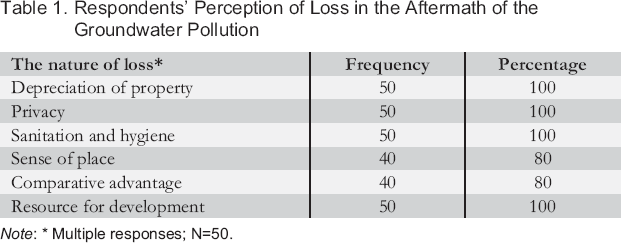
However, for the owners of the polluted wells and water pumps, the artificiality of the choreographed water project and the brutal violence of losses experienced in the wake of the groundwater pollution were, respectively, too obtrusive and too deadly to be hidden under the veil of capitalists’ social benevolence. As a result, the owners who participated in my research project repeatedly pointed to the footprints of falsehood in the water project, while simultaneously reflecting on the multidimensional nature of loss arising from the groundwater pollution. The loss of the groundwater was increasingly seen by the owners as the loss of everything. A summary of various meanings the affected individuals gave to the loss of groundwater is presented in Table 1 and Box 1.
Respondents’ Perception of Loss in the Aftermath of the Groundwater Pollution
Note:
Multiple responses; N=50.
Some Excerpts from FGD
“Cancer lives in our water. Can you take an accommodation in my hotel if you know that using our water can cause cancer?” – A hotelier
“The sense and notion of being at home in my house are gone […]. You cannot do anything with water without announcing it. When shall we have our home back?” – A landlord
“Personal hygiene and sanitation has declined sharply. What do you expect when a toilet facility used by over 20 people is left unwashed? It is too dirty, so people prefer open defecation to using dirty toilet facility. […] Foul odour wouldn't even allow you to stay in the compound let alone use the toilet.” – A landlord
“You know the cost of owning a functional property is gone up. For you to have property, you need more money to get water from another community to this place. The cost of doing business has increased. Only war-chest financial elites can own and maintain five-star hotels here […]. The era for small investors like us has gone with the groundwater.” – A hotelier
Data in Box 1 and Table 1 collectively confirm multiple meanings, including economic, cultural, social, and psychosocial narratives that my research participants associated with the groundwater pollution. There is clear evidence that the transformation of Ogale waterscapes has produced what Albrecht (2005: 45) calls “solastalgia” and what Jackson (2011: 613) calls “dysplacement.” The former is “a form of homesickness” even when one is still at home, as a result of the destruction of landscape – that is, the sense of distress people experience when valued natural environments are negatively transformed. Albrecht uses the term “solastalgia” to describe the losses experienced by indigenous people of the open-pit coal-mining areas of the Upper Hunter River Valley in Australia, one of the world's largest coal-exporting ports. The latter term, “dysplacement,” refers to the “feeling of alienation from ancestral land because of foul odors” (Jackson 2011: 613), experienced by the Aamjiwnaang who dwell in Chemical Valley, one of the most polluted spots in Canada.
People in Ogale Community experience both “solastalgia” and “dysplacement,” as suggested by comments such as this one:
The sense and notion of being at home in my house is gone […]. You cannot do anything with water without announcing it. When shall we have our home back? […] Foul odour wouldn't even allow you to stay in the compound, let alone use the toilet.
There is also a strong yearning for a return to pre-pollution normal among my research participants, as indicated by the comment, “When shall we have our home back?” However, many of the informants know that a full return to pre-disaster normal is impossible: even if original forms are built, the physical and emotional rupture of the tragic pollution has transformed everything and everybody (Sather-Wagstaff 2011). As a result, the informants are experiencing what Terdiman (1993: 6) calls a “memory crisis” – that is, the “disjuncture between the contemporary life and the remembered past.” While Richard Terdiman locates the origins of the crisis in Europe's nineteenth-century upheavals, which involved the loss of innocence and tradition and prompted a sense of emotional detachment (Terdiman 1993), my informants’ memory crisis is rooted in the groundwater pollution supported by the Nigerian government's Water Resources Decree 101.
Conclusion
This paper demonstrates, through the lens of primitive accumulation, ways in which actors of the Nigerian state and multinational corporations dispossess the masses of their water resources in Ogale Community and its environs through policies and pollution associated with oil exploration. Losses experienced by ordinary people in this community – as the neoliberal oil exploration polluted potable water while the brutal violence of market logic filtered through social relationships embedded in water networks – cannot be captured solely by the new monetary cost of water. What is lost is also a set of communal practices around water that brought people together; what has eroded as the local wells turn black has been a set of social relations that were enabled by the fact that water was part of the commons and had more than monetary value. Ensuring the well-being of the residents of the affected areas and stemming the rising youth restiveness in the region will require interventions that significantly address both economic and non-economic consequences of the primitive accumulation.