



Abstract
This paper investigates how the legacy of the South Korean developmental state influences the way the country conducts its development cooperation (DC) policies. We argue that institutions of the developmental state remain instrumental in structuring South Korea's cooperation with the developing world. Two country case studies of South Korean DC and investment projects in Mozambique and Rwanda show that state initiative and a strong state–business partnership are defining elements of South Korean DC. At the same time, both cases show substantial differences when it comes to type of project, type of state–business partnership in the South Korean approach, degree of project ownership by the recipient country, and quality of governance in the recipient countries.
South Korea's path from a poor agricultural country in the 1960s to an industrial powerhouse and Organisation for Economic Co-operation and Development (OECD) member in 1996 was largely shaped by a strong developmental state. We argue that while central elements of the South Korean developmental state – which was criticised for being one of the main reasons the 1997 Asian financial crisis hit South Korea so severely – have lost relevance in domestic policies, they continue to play an important role in shaping South Korean development cooperation (DC). 1
Thomas Kalinowski would like to thank Aurel Croissant and the University of Heidelberg for hosting him as a visiting professor in 2015 and 2016, which allowed him to complete the research and writing of this article. An earlier version of this paper was presented at the conference “Capitalism and Capitalisms in Asia: Origin, Commonality, and Diversity” organised by the Asia Center of Seoul National University, 22–23 October 2015.
We have coined the term “institutional retreat” to refer to this process in which institutions that are considered anachronistic and dysfunctional in their established areas retreat to other policy fields. Institutional retreat is similar to what Thelen called “institutional conversion,” wherein “institutions are not so much amended or allowed to decay as they are redirected to new goals, functions, or purposes” (Streeck and Thelen 2005: 26, italics in original). In the case of institutional retreat, however, institutional goals, functions, and purposes remain largely the same, and merely the policy field has changed. The developmental-state elements we found in the field of DC still have the same goals of expanding industries and facilitating investment; though these goals are now pursued internationally rather than domestically. In some sense DC can be described as an “international extension of the national industrial and mercantilist policies that were the essence of Korea's development strategy in the past” (Kalinowski and Cho 2012: 243). At the same time, institutional retreat can also be distinguished from “institutional spillover,” in which successful institutions are extended from one policy field to another. On the contrary, institutional retreat implies failure or decline in the original policy fields. Most importantly, actors, interests, and ideologies connected to institutions that are pushed out of their traditional fields are now finding new niches in which their specifically structured relationships can survive. We want to uncover how South Korean DC is influenced by the legacy of the South Korean developmental state. With the term “DC,” we mean not only official development assistance (ODA) but also, more broadly, foreign investment that contributes or claims to contribute to a developing country – for example, as part of a public–private partnership (PPP) between the South Korean government and a South Korean company.
The South Korean developmental state relates primarily to two aspects: Chalmers Johnson's (1982, 1995) classic dictum about state autonomy and nationalist, state-led development and Peter Evans' (1995) concept of “embedded autonomy,” which focuses on the strong partnership and collusion between authoritarian states and large business conglomerates (Kim 1997). Within South Korea both elements of the developmental state have come under serious pressure since the beginning of democratisation in the late 1980s and economic globalisation, particularly since the 1997/98 Asian financial crisis. South Korean chaebol (global business conglomerates) have emancipated themselves from government leadership and guidance. Under the old developmental state chaebol implemented government-led investment and employment plans and, in turn, received support and protection from the state. Today, South Korea's chaebol are globally operating businesses with massive assets, their own research facilities, and far less need for government support and protection than in the past. Consequently, chaebol are reluctant to support the South Korean government's plans for national investment and job creation. At the same time, the democratisation process has created a democratic civil society that is critical of authoritarian politics and exposes collusion between the state and businesses. Fundamentally, it is this “double emancipation” (Kalinowski 2008: 449) of corporate globalisation and domestic democratisation (as well as occasional setbacks within these broad trends) that has been shaping South Korea's recent development.
In contrast, government leadership and state–business collusion play an important role in South Korean DC. South Korea's economic relationship with the Global South is largely state led. The government actively uses DC to secure access to resources and open markets for South Korean businesses. Simply put, while market competition, civil society activism, and parliamentary oversight have weakened the traditional developmental state at the domestic level, it has found a new playground in the field of DC. 2 Of course, South Korea is not unique in that it uses DC to advance national economic and political goals; all countries do that in one way or another. It differs, however, in terms of the kind of national interests it promotes and how. In South Korea the national interest in DC is structured along the lines of the old state–business development alliance established during the times of the developmental state. Unlike established players, South Korean companies need active government support to invest in unfamiliar and high-risk environments. In some sense, Gerschenkron's (1962) contention that the later a country develops, the more state involvement is necessary also holds for the global expansion of economies: the later a country globalises economically the more state involvement is necessary to facilitate this globalisation.
There are other policy fields or occasions in South Korea where we can observe a revival of industrial policies and the developmental state, such as in the field of “green growth” (Kim and Thurbon 2015) or in the way fiscal stimulus packages have been implemented since the 2008 global Financial Crisis (Kalinowski 2015).
Two cases of DC serve to illustrate the legacy of the developmental state in South Korea's relationship with the developing world: Mozambique and Rwanda. In both countries DC consisted of a joint effort to increase ODA and expand foreign direct investment and trade. In both cases the initiative for increased cooperation came from the South Korean government and not from private businesses. In the case of Mozambique, development aid opened the door for the state-owned Korea Gas Corporation (KOGAS) to invest in a large gas field as well as a gas liquefaction project. In Rwanda development aid helped to pave the way for a major government contract for a privatised business conglomerate, Korea Telecom (KT), to improve the country's IT infrastructure. Both projects were state-led and characterised by the close cooperation between government agencies and businesses. Based on our case studies, it seems that – despite the similarities – the benefits and problems of South Korean DC depend primarily on the type of project and how it is conducted.
State-Led Development Cooperation and “Resource Diplomacy” in Mozambique
Mozambique is an excellent example of how South Korean DC and economic relations with the developing world are shaped by the legacy of the South Korean developmental state. During the times of the old developmental state in South Korea, government planning and industrial policies “governed the market” (Wade 2004) and facilitated large business conglomerates' growth first in the domestic market and then in the export of final goods. Although current DC policies still have domestic-market goals, they have shifted the focus to facilitating foreign investment and the global expansion of domestic businesses. The government leads and facilitates the expansion of national businesses into new and difficult markets and helps them quickly expand their market shares by socialising investment risks. Because Africa is still regarded as a high-risk market to South Korean business, the state acts as a risk manager, using ODA and especially concessional loans. Thus, the government has taken on a different kind of role in the field of DC, which sets it apart from traditional donors. The case of DC with Mozambique reveals the state's leadership and direct involvement in facilitating foreign direct investment.
Mozambique became a target country of South Korea's “resource diplomacy” efforts to secure access to natural resources for the South Korean economy. The country's relations with Mozambique are a good example of a state-led strategy that employs DC, in general, to incite and – in this case – even initiate South Korean overseas investment. In 2010 the country was named a strategic partner in DC and since then has been receiving steadily increasing aid (see Figure 1). Until 2010 South Korea's ODA to Mozambique was only composed of grants and amounted to less than USD 1 million per year. Since the country was selected as a strategic partner, its ODA volume has been scaled up dramatically, particularly through concessional loans. In 2013 South Korea provided Mozambique with USD 57.08 million in bilateral aid – of which only USD 3.58 million was a grant and USD 53.5 million consisted of concessional loans through the Export–Import Bank of Korea (hereafter, Korea Eximbank) to build infrastructure. In 2014 Mozambique became Africa's largest recipient of the Korean Economic Development Cooperation Fund (EDCF) and eighth largest overall (Korea Eximbank 2015b).
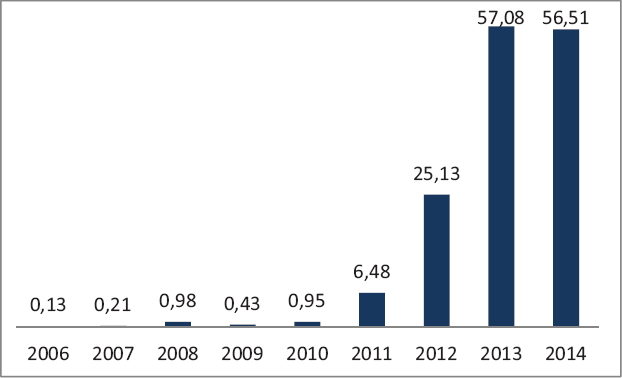
South Korea's Bilateral Aid to Mozambique (2006–2014, USD Millions)
South Korea's naming of Mozambique as a strategic partner and the massive increase of development aid it was providing facilitated further DC between the two countries in the area of gas exploration. Since 2011 KOGAS has invested in major gas liquefaction projects in Mozambique, confirming gas reserves of 1.8 billion tons off the country's eastern coast. KOGAS's 10 per cent stake in gas exploration in Mozambique is equivalent to South Korea's nationwide demand for more than five years. Given that South Korea's resource diplomacy projects have largely failed to meet expectations, this then represents a rare success story (Shin 2012). Mozambique plans to build four liquefied natural gas units with a total annual capacity of 20 million tons by 2018, making it the largest liquefied natural gas export site after Ras Laffan, Qatar. The Korea Eximbank confirmed that the discovery of a natural gas field had given an added boost to bilateral talks on economic cooperation and to the local presence of South Korean companies (Korea Eximbank 2015a). Based on the gas exploration in Area 4, KOGAS plans to build a floating liquefied natural gas plant off the coast of Mozambique in cooperation with South Korea's three biggest shipbuilding companies – Hyundai, Samsung, and Daewoo. The intensified economic exchange resulted in a fivefold increase in bilateral trade from USD 25 million in 2007 to USD 110 million in 2012 (ibid.).
KOGAS's economic engagement was a high political priority, which can be seen by Prime Minister Kim Hwang-sik's official visit to Mozambique in 2012. In 2013 the newly elected president, Park Geun-hye, held talks with the visiting President Armando Guebuza on expanding the countries' resource-focused DC and offered South Korea's economic development expertise. The case of Mozambique is prototypical of the “package deals” offered by the South Korean state, which include intensified political and economic relations facilitated by DC projects. The involvement of the South Korean state in such arrangements is an important reassuring factor for state-owned and private firms, which would otherwise never be willing to risk entering volatile markets in the developing world.
It is still too early to assess the impact of South Korean DC on Mozambique's development particularly because the volume amounted to only 0.3 per cent of Mozambique's total ODA inflow in 2013. South Korea's DC did improve infrastructure, though, and KOGAS investment will lead to an increase in gas exports. However, because South Korea's bilateral ODA approach to Mozambique is overwhelmingly based on investing in raw materials exploration, there is a concern that this strategy could be detrimental to Mozambique's long-term economic development. As we know from the literature on the “resource curse” (Sachs and Warner 2001), dependency on mega-projects in the extractive industries and the energy sectors can lead to a misallocation of resources in the economy and facilitate corruption. Mega-projects in the field of gas extraction also create relatively few jobs, and it is likely that most profits will be divided among foreign investors and a small local elite. Environmental NGOs argue that Mozambique's rich ecology may be negatively affected by gas production, resulting in a loss of income for local artisanal fishermen due to diminishing fish stocks and migration (Folley 2011).
Extending into New Markets in Rwanda through Public Private Partnership
In Mozambique the South Korean government not only took the lead through diplomatic activities and DC, it also indirectly carried out foreign investment through a state-owned company. The case of Rwanda, however, is different. Although the state also initiated an intensified relationship between the two countries, the privatised business conglomerate Korea Telecom (KT) invested financially. This partnership illustrates the close cooperation between state and private business in South Korean DC.
The expansion of South Korea's engagement in Rwanda was more gradual than in Mozambique but saw two major surges in 2010 and 2013 (see Figure 2) that were the consequence of the engagements of Korean businesses in the Rwandan information and communications technology (ICT) sector. Until 2013 South Korea's ODA to Rwanda consisted primarily of grants – the total volume of which amounted to USD 38.06 million (Korea Eximbank 2015b). The majority of grant aid was allocated to technical cooperation, especially in the field of ICT. The Korea International Cooperation Agency (KOICA) has implemented a number of grant projects aimed at improving the growth and development of the ICT industry in Rwanda, which has included dispatching ICT technicians to the country.
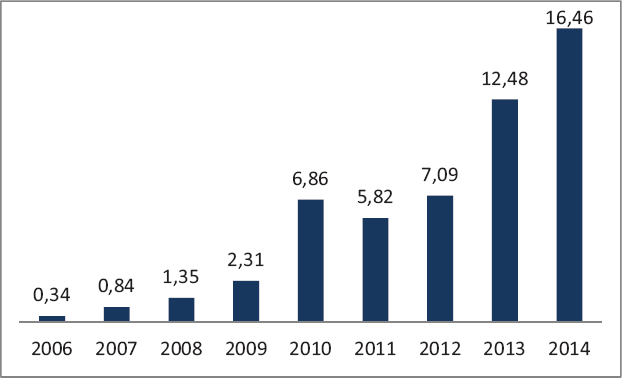
South Korea's Bilateral Aid to Rwanda (2006–2014, USD Millions)
The ICT sector is a strong component of the South Korean economy overall and of South Korean exports specifically. A quarter of South Korea's total goods exports are ICT goods exports, amounting to approximately USD 170 billion in 2013 (Kim et al. 2014). Hence, ICT forms one of the seven strategic components of South Korean ODA. From 1990 to 2010, South Korea spent 15 per cent of total ODA on the ICT sector compared to the OECD Development Assistance Committee's (DAC) average of less than 1 per cent. This focus on ICT reflects both South Korea's own comparative advantage and the significant need for ICT investments in the developing world. South Korean assistance in the field of ICT has led to a diffusion of ICT in recipient countries and provided them with ICT-related benefits. At the same time, most ICT-related ODA has been provided as loans, and most of those have gone to middle- or upper middle–income countries (ibid.) where markets for ICT products, and thus export markets, are much larger than in the least developed countries.
In the case of Rwanda, South Korea's support for ICT aid has been closely linked to KT's involvement in the Rwandan ICT industry. KT was privatised in 2002 and is currently the largest telecommunications business and ninth-largest business conglomerate in South Korea. It is active in many areas, including line repairs, mobile telephony, Internet services, digital television, financial services, entertainment, education, real estate, infrastructure, sports, and software development.
In 2007 KT agreed a deal with the Rwandan government to provide wireless high-speed Internet. The following year KT signed a contract worth USD 38 million to build a national backbone network to connect the Rwandan capital of Kigali with 30 other major cities. This turnkey project involved the construction of a nationwide fibre optic cable network, transmission network, and Internet network as well as equipment supply, construction engineering, and operator training (Darracq and Neville 2014). During this period, Rwanda registered one of the highest growth rates of Internet users in Africa: 8,900 per cent compared with the continent's growth rate of 2,450 per cent and the world's growth rate of 444 per cent (Nirit 2014). According to the Rwanda Development Board, almost a quarter of public sector entities (ministries, agencies, provinces, and districts) and about a third of private sector entities had a web presence (Republic of Rwanda 2013). Based on the positive experiences with previous projects, the Rwandan government and KT agreed to form a joint venture company, Olleh Rwanda Networks, in June 2013 to deploy a high-speed broadband network that would cover 95 per cent of the population within three years (Darracq and Neville 2014). In November 2014 Olleh Rwanda Networks launched a high-speed 4G LTE Internet service, which can support up to 100 Mbps – more than five times the data capacity of the previous service (Mugisha and Mwai 2014). In September 2014 the second joint venture company between the Rwandan government and KT, Africa Olleh Services Ltd, was established to accelerate the deployment of the IT infrastructure and to develop and operate online services. Africa Olleh Services Ltd is responsible for the country's cloud services capability, a system integrator, and a provider of IT solutions to the broader regional market. Currently, 2,500 km of fibre optic cable have been laid throughout the country with nine regional links to neighbouring countries (three links to Uganda, one link to Tanzania, three links to Burundi, and two links to the Democratic Republic of Congo) that facilitate cross-border data traffic and trade (ibid.). With the launch of 4G LTE, the Rwanda government aimed to increase the ICT sector's contribution to GDP to 4 per cent in 2014, up from 3 per cent 2013 (AfDB/OECD/UNDP 2014).
Unlike in the case of Mozambique – where the South Korean government acted as initiator, facilitator, and investor – the South Korean government largely served as facilitator and broker between the Rwandan government and KT. For instance, President Paul Kagame was invited to South Korea three times during a six-year period (2008, 2011, and 2014) and discussed ICT investment with his South Korean counterpart during his latter visit, the Korea–Rwanda Summit. In 2009 Rwanda opened its embassy in Seoul, and the KOICA sent a large number of volunteers to Africa. Moreover, despite being under investigation by the Prosecutor's Office for professional negligence and being subject to a search-and-seizure warrant, KT chairman Lee Suk-Chae was allowed to attend the 2013 Transform Africa Summit – an event jointly sponsored by KT and the Rwandan government where attendees discussed ways to develop African economies through the active use of ICT tools. Lee only received permission to travel to the summit, which was attended by the heads of 12 African nations as well as high-ranking officials from the International Telecommunication Union (ITU) and the World Bank (Jun 2013), after the minister of foreign affairs made a special request to the Prosecution Service.
In terms of mutual benefit, there is no doubt that the Rwandan model is much more promising for South Korea's engagement with the developing world. An important positive aspect, which was missing in the case of Mozambique, was the large degree of ownership by the Rwandan government. The cooperation with South Korean donors and the contract with KT was part of a Rwandan national development strategy that had been implemented since 2000. The Rwandan government planned to improve the country's ICT infrastructure in order to create jobs, support social progress, and propel economic growth. KT's partnership with the Rwandan government in the area of ICT development supports Rwanda's long-term developmental goals. These goals, which are set out in its Vision 2020 programme, consist of transforming Rwanda from a low-income agriculture-based economy to a knowledge-based and service-oriented economy. Thanks to PPP projects with KT, Rwanda became the first African country to launch a wireless broadband facility (MOFAT 2011). As the leader in ICT infrastructure on the African continent, Rwanda launched a grand scheme to become an IT hub in Central and East Africa. The PPP model of the Rwandan government and KT, which is based on establishing joint venture companies, is expected to become a role model for building broadband in developing countries and thus represents the hope that such countries will be able to leapfrog into the digital age.
From KT's perspective, the engagement can generally be considered a success story. Although initial profitability was low, the close cooperation with the government facilitated access to the African IT market and helped KT to beat established Western rivals such as British Telecom (BT). However, South Korean ICT projects have been criticised for focusing on ICT consumption and not ICT production. According to Heeks (2006), the former refers to the use of technology in applications like e-commerce and e-government; the latter, to the creation of hardware, software, and other components of the ICT infrastructure. More importantly, most of South Korea's ICT ODA involves tied aid, which is aid that is tied to certain conditions, such as the requirement to use South Korean products or subcontract to South Korean companies. This ensures that South Korean firms are contracted to build the telecentres, the e-government systems, and so forth, meaning that recipient national firms are excluded from participating. Therefore, in reality, South Korea's ICT development projects contribute far less to economic development than they could. Against this background, some contend that firms, communities, and individuals in developing countries are seen as nothing more than consumers of South Korean goods and services – a mere extension of the commercial focus of South Korean exporters. Some argue that far from representing a “new wave” of donor activity, South Korea's ICT projects instead resemble the activities of Western donors in the 1970s and 1980s (Lee et al. 2008).
Conclusion
South Korean economic relations with the developing world are primarily state-led and dominated by close cooperation between the state and businesses. In this sense the two central elements of the South Korean developmental state have survived by retreating into the field of DC. Strong state involvement can be largely explained by the underdeveloped ability of South Korean businesses to invest in new and risky environments abroad without such support. We called this kind of transformation “institutional relocation” or “institutional retreat” to reflect the fact that the specifically structured relationship between the state and businesses has retreated to a new and much more limited policy niche.
Another aspect that has enabled this institutional retreat is the relative lack of democratic scrutiny and criticism by civil society in the fields of DC compared to other areas characterised by state–business relationships. Foreign policy is generally biased towards the executive, and development aid is seen as an obligation tied to South Korea being part of the global community. These positive goals have partly shielded the policy area of DC from criticism. At the same time, the expansion of South Korean businesses to the developing world is seen as beneficial for South Korea. Thus, government–business collusion remains much less scrutinised in the field of DC compared to the domestic level, where it is primarily seen as a problem. There might even be feedback loops in that businesses criticise domestic activities that fight corruption because they hurt the business of South Korean companies abroad (Hwang 2014). Civil society's scrutiny of DC will likely increase as South Korea's global role grows and more South Koreans become interested in issues of the Global South.
Another finding is that the two case studies differ substantially in the closeness of the cooperation between the state and business and the expected outcome. In Mozambique the project is being conducted by a state-owned company. The Mozambican government, the South Korean government, a South Korean state-owned company, and other foreign investors agreed a classic closed-door deal that was certain to enrich investors and a few Mozambican government officials but would have little or even a negative effect on development in Mozambique due to the resource-curse effect. There was no civil society involvement in the contract negotiations or any democratic oversight in Mozambique, whereas the South Korean public concentrated on the benefits in this rare case of successful resource diplomacy (from a South Korean perspective).
In Rwanda, on the other hand, the state cooperated with a privately owned business conglomerate to secure contracts for IT infrastructure projects. Development aid was used to incite South Korean foreign investment and advance opportunities for a private South Korean company. Using aid in this manner to advance economic interest might not be fully compatible with OECD-DAC rules. At the same time, South Korean investments in Rwanda will most likely have benefits for Rwanda, demonstrating that state–business collusion can have a positive effect if it is embedded in a clear development plan and national ownership of the recipient country.
Our hunch is that the outcome of South Korea's DC will be very mixed but not necessarily inferior to that of established donors. Based on our case studies, it seems that the purpose for developing and investing (resource extraction versus ICT infrastructure) and the existence of sound national development plans in the recipient country are more important than detailed rules of aid effectiveness or untying aid from economic foreign policies. Nevertheless, South Korea's strategy of employing strong state–business cooperation in its interactions with the developing world clashes with global standards and DC “best practices” formulated by the OECD-DAC. These standards and practices highlight the need to untie ODA from commercial interests and industrial policies as well as a preference for grants as opposed to concessional loans.
Finally, it is difficult for new donors like South Korea, as well as bigger players such as China and Japan, to follow the global rules set by established Western donors. This is not only because they have to decide whether or not to follow their respective “national interests” but also because they have to reconcile their donor activities with their domestic institutional path dependencies and the legacies of the East Asian state-led development model. All countries follow what they perceive to be their national interests. The difference is that the national interests of new donors such as South Korea and China are not compatible with the global standards set by traditional Western players. This incompatibility is no excuse for not following global rules, particularly if countries have subscribed to them as members of the OECD-DAC (such as Japan and South Korea). However, it appears that the issues of grants versus loans and untied aid versus tied aid might be less relevant than the goals behind development projects and a recipient country's governance capacity and degree of project ownership. When it comes to the role of PPP in DC, it also seems that it is neither a panacea nor a blunder; rather, success or failure depend more on the type of project and the context within the recipient country. Therefore, it might be necessary to revisit at least some of the global rules and take into account some of the experiences of new donors.