




Abstract
The nomination of incumbent Pierre Nkurunziza to stand again for president in the 2015 national elections triggered a political and security crisis in Burundi. A crucial element in the controversy around his third term was the legality of his candidacy. This paper analyses how domestic and international actors responded to the legal loopholes that characterised Burundi's term-limit legislation. Three responses are distinguished. First, quite paradoxically, an argument was put forward by third-term supporters that stressed constitutional legality, a value usually invoked by third-term opponents. Second, a peace agreement was referred to as a source of legitimacy and as a legal norm. Third, a Constitutional Court ruling was invoked to address the legal loophole. Despite the apparent irrelevance of legal norms in an increasingly authoritarian environment, law significantly shaped the dynamics of the third-term debate and of the wider crisis. The Burundi case also illustrates the limitations of constitutional engineering of democratic governance.
In 2015, Burundi experienced its worst political, security, and humanitarian crisis since its successful negotiated transition to peace after over a decade of civil war that started in the aftermath of the assassination of the country's first democratically elected president on 21 October 1993 (Bouka and Wolters 2016). Post-conflict elections were held in 2005 and 2010. The 2015 crisis was sparked by President Pierre Nkurunziza's announcement of his intention to run for a third term in office on behalf of his party, the National Council for the Defence of Democracy – Forces for the Defence of Democracy (CNDD-FDD). While the crisis was not solely due to the president's potential third term, this issue had a major impact on the political situation both before and after the 2015 elections (Vandeginste 2015a). It gave rise to a split within the CNDD-FDD, resulting in the destabilisation of Burundi's state institutions. Furthermore, it led to unprecedented street protests in the capital city Bujumbura that culminated in a failed coup d'état on 13 May 2015. In the violence that followed the coup attempt, independent media outlets were closed down and many civil society activists were forced into exile (Frère 2016). Hundreds of civilians were tortured and/or killed, while more than 200,000 people fled to neighbouring countries. Rebel movements announced they would undertake an armed struggle to topple the Nkurunziza government.
Objectives and Approach
This case study is both inductive and hypothesis-generating (Levy 2008: 4–5). First, zooming in on the law and politics of the third-term crisis, it seeks to enrich our understanding of both the breakdown of Burundi's internationally applauded transition from conflict to peace and the international involvement with the crisis (Bouka 2016; Wilen 2016). The crisis around the presidential term limit occurred in a context of sustained militarism (Daley and Popplewell 2016). It dramatically accelerated a worrying governance trend, particularly notable since the contested 2010 elections, that paved the way for a return to increasingly authoritarian, de facto one-party rule (Vandeginste 2011; International Crisis Group 2012; Curtis 2013). The paper describes and explains how legal loopholes – the unique combination of constitutional ambiguity and legal enforcement gaps – impacted the positions and strategies adopted by domestic and international actors. Without such loopholes, the crisis would surely have unfolded differently. Second, the paper contributes to the process of theory building on the legal engineering of democratic governance and on executive term limits. Most of the literature looks at the rationale, the types and effects of term limits in general, some scholars focusing more particularly on their link with democracy (Maltz 2007; Reyntjens 2016), constitutionalism (Fombad and Inegbedion 2010), and institutionalisation of political power (Posner and Young 2007). This paper adds to the more recent literature on the evasion and manipulation of term limits (Ginsburg et al. 2011; Corrales and Penfold 2014) and on the role of international actors (Carter 2016). However, unlike other papers that mostly adopt a thematic, comparative, or continent-wide approach, this paper zooms in on one case study, paying special attention to the political use of term-limit legislation by domestic and external actors and the mutual influence between the domestic and international levels. In so doing, some much needed light is also shed on the “black box” of the bargaining dynamics between aid-dependent governments and their international partners in political crisis situations (Molenaers et al. 2015).
The paper is based on continuous monitoring of political developments in Burundi, unstructured interviews and conversations with key domestic and international informants – all of whom requested confidentiality and therefore remain undisclosed, and document analysis of both public and confidential written sources, including diplomatic cables and internal policy notes. It does not analyse the position of all domestic political and civil society actors or of all of Burundi's international partners. A selection has been made from among those international actors who, for political and/or financial reasons, have been most active and influential in this particular case of an aid-dependent post-conflict country (primarily the African Union, East African Community, European Union, United Nations, Belgium, South Africa, Tanzania, and the United States). The paper presents the overall picture, using examples to illustrate the different types of responses to the term-limit loopholes.
Important attention is paid to the temporal dimension of the object of study. In at least two respects, time is an important variable. First, a chronological research perspective reveals a remarkable evolution in the international actors' use of Burundi's legal third-term framework, probably signalling an evolution in their political position and strategy vis-à-vis not only Pierre Nkurunziza's third term but also Burundi's wider political and security crisis. Second, electoral legal deadlines and procedural sequences created or limited opportunities for both domestic and international actors.
Outline
The paper starts with a timeline of the main episodes in Burundi's third-term tale. As will be developed in more detail, some of them coincide with crucial turning points in the political use of Burundi's third-term legislation by domestic and international actors. Next, the legal loopholes are introduced. The paper then turns to the core analysis, distinguishing three types of responses vis-à-vis the legal loopholes: (i) the Constitution-based response, (ii) the Arusha Agreement–based response, and (iii) the judicial response. In all three sections, particular attention is paid to the mutual influence between domestic and international actors in regard to the positions they adopted.
Timeline
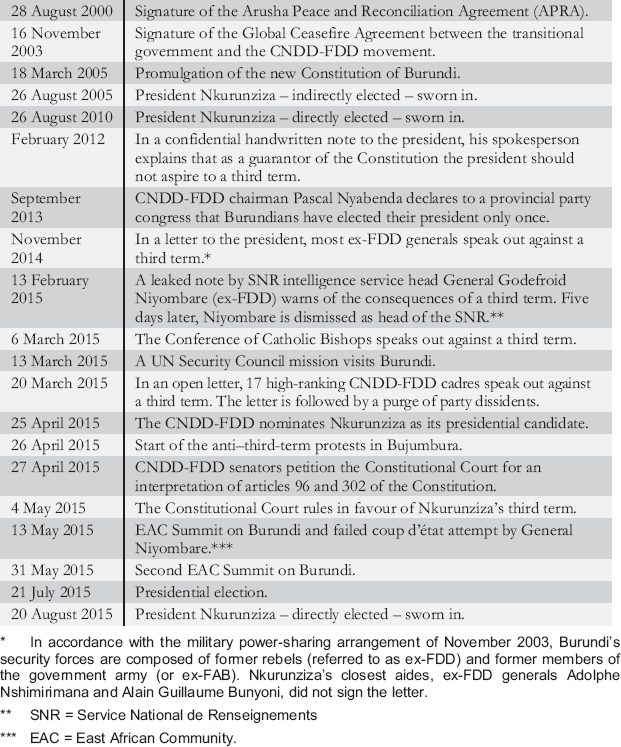
In accordance with the military power-sharing arrangement of November 2003, Burundi's security forces are composed of former rebels (referred to as ex-FDD) and former members of the government army (or ex-FAB). Nkurunziza's closest aides, ex-FDD generals Adolphe Nshimirimana and Alain Guillaume Bunyoni, did not sign the letter.
SNR = Service National de Renseignements
EAC = East African Community.
Legal Loopholes
Unlike in most other cases of executive term-limit evasion, Burundi's Constitution was not amended, replaced, or ignored (Ginsburg et al. 2011: 1831). While there were unsuccessful attempts to replace and, alternatively, amend the Constitution in March 2014, 1 the Burundi case is notably different from the constitutional amendment processes that removed or softened term limits in Uganda (2005), Congo-Brazzaville (2015), and Rwanda (2015) so as to allow the incumbent to renew his term without violating their respective constitutions. 2 Rather, Burundi's third-term legal framework was characterised by a two-pronged loophole, consisting of an unintended ambiguity of the legal norm and an omission in the enforcement scheme. This enabled the executive to maintain an appearance of legality and – to the extent that it is derived from rule adherence (Beetham 2013) – legitimacy.
The proposal did not seek to amend article 96 (which lays down the two-term limit). However, the draft amendment – logically – proposed removing the Constitution's transitional chapter XV, which includes article 302 (see below). According to many local observers, this was an attempt to delay the application of the term limit until 2020. The proposed constitutional amendment fell one vote short of the required four-fifths majority in the National Assembly. For the fascinating eyewitness account of the failed constitutional amendment by the chairman of the National Assembly at the time, see www.africania-news.com/partie-2-nkurunziza-tente-de-modifier-la-constitution-et-echoue-de-justesse (accessed 23 August 2016).
During the hearings organised by the National Commission for Inter-Burundian Dialogue (CNDI) in early 2016, proposals to amend the Constitution, including term limits, have repeatedly been put forward. This may suggest a forthcoming, renewed attempt to amend the Constitution.
First, the ambiguity was caused by the combination of two articles of the Constitution of 18 March 2005. Article 96 states that the president of the republic is elected by direct universal suffrage for a mandate of five years, renewable once. Article 302, which is included in a transitional chapter, states,
As an exception, the first President of the Republic in the post-transition period shall be elected by the National Assembly and the Senate […], with a two-thirds majority of the members. […] The President elected in the first post-transition period cannot dissolve Parliament. 3
Author's translation.
The most reasonable interpretation appears to be that article 302 provides an exception only regarding the modality of the presidential election (indirect instead of direct). However, a strictly literal reading opens the door to a potential alternative interpretation – namely, that the Constitution created a special first post-transition presidency which does not “count” as a first term under article 96. Given this ambiguity in the letter, the intention of Burundi's Constitution drafters is an appropriate source to guide the interpretation of the Constitution. The explanatory memorandum of the Draft Constitution of 18 March 2005 refers to the Arusha Peace and Reconciliation Agreement (APRA) of 28 August 2000, widely recognised as Burundi's foundational roadmap to peace and stability, as its main source of inspiration. The APRA, a peace accord that was signed after two years of international mediation led by former Tanzanian president Julius Nyerere and former South African president Nelson Mandela, contained a constitutional blueprint for post-conflict Burundi. On presidential term limits, it unambiguously stated that the president “shall be elected for a term of five years, renewable only once. No one may serve more than two presidential terms.” 4 As shown below, drawing normative guidance from the APRA was an important strategy of third-term opponents.
The Arusha Peace and Reconciliation Agreement (English and French versions) and the Constitution (in French only) can be consulted online at www.uantwerpen.be/burundi (accessed 23 August 2016).
Second, an enforcement gap reinforced the ambiguity and its political instrumentalisation. The two bodies in charge of applying Burundi's electoral legislation are the electoral commission and the Constitutional Court. As documented in more detail elsewhere (Vandeginste 2014), in addition to a widespread perception that the two bodies cannot function independently – particularly regarding politically sensitive matters, legal constraints on their powers and procedures also reduced their ability to enforce the term limit. Burundi's electoral commission, the Commission Electorale Nationale Indépendante (CENI), is in charge of receiving and validating the nomination of electoral candidates. It is standard practice of CENI to give a purely administrative meaning to this function. Applied to the presidential elections, this means that the commission merely verifies whether the file holding the nomination of a particular candidate contains the 12 elements requested under article 101 of the electoral code (birth certificate, attestation of residence, etc.) (CENI 2015). These elements correspond to the conditions of eligibility laid down in article 94 of the code (nationality, residence, age, etc.). However, articles 94 and 101 of the electoral code do not refer to the presidential term limit laid down in the Constitution. Therefore, when administratively validating the nomination of Nkurunziza (and other presidential candidates), CENI did not verify whether the candidate had served the maximum number of terms in office permitted under the Constitution. A rejection of a candidacy can be challenged before the Constitutional Court. However, once the CENI has validated a nomination, its decision cannot be challenged. Several foreign diplomats wrongly argued that opposition parties would be able to challenge CENI's acceptance of Nkurunziza's candidacy. Was this mere ignorance? Or did they comfortably hide behind the legal framework whose enforcement they knew to be deficient? The Constitutional Court ruled on 4 May 2015 in response to a request for interpretation of the Constitution. We will return to the actors' positioning vis-à-vis the ruling below.
The Constitution-based Response
Domestic Actors
Constitutionalism is fundamentally preoccupied with limiting governmental power in order to counter arbitrariness, and it has been argued that respecting executive term limits is a core element of modern constitutionalism (Fombad and Inegbedion 2010). Advocates of executive term limits usually invoke the value of constitutionalism. An incumbent's disrespect for a constitution normally is a forceful argument in the hands of opponents. In the case of Burundi, however, the value of constitutionalism was strategically invoked by third-term supporters. This was the direct consequence of the ambiguous wording of the constitutional term limit. Because the Constitution of Burundi could be read as permitting an additional term, Nkurunziza supporters framed the issue as a legal matter and put forward rule-of-law arguments, suggesting that only those legally in charge of interpreting the Constitution had the legitimacy to do so (see below). In most cases, incumbents put forward political arguments that allegedly trump the constitutional term limit. They may argue that term limits are not a good idea after all, that they are not fit for a post-conflict state that requires stability, that the people want their leader to stay in office, and so on. In the case of Burundi, however, the incumbent at no point opposed the principle of term limits, nor did he feel the need to use or counter political arguments, comfortably playing the legality card. For instance, when Afrobarometer (2015) published its Burundi report, showing increased popular support for term limits, the government comfortably agreed and merely noted that the term limit simply did not apply yet. In summary, some important advantages of having legality on one's side are demonstrated here. First, acting in accordance with constitutional law is a powerful argument because of its association with the prevention of anarchy and arbitrariness. Second, the incumbent moves the debate away from political arguments, which is quite convenient given the anti–third-term street protests in Bujumbura. A third important strategic advantage links the domestic use of the constitutionality argument with external legitimation of a presidential third term. Indeed, for the pro-Nkurunziza camp, it was quite convenient that Burundi's international partners initially adopted the same Constitution-based position.
International Actors
In response to questions in Parliament, the Belgian minister of foreign affairs stated in May and in October 2014 that Belgium was against third presidential terms if they were not permitted by the relevant constitution. Although Belgium was well aware, as were other international actors, of the ambiguity in Burundi's Constitution, it merely referred to the general principle of constitutionality. This was inspired, first, by the desire to adopt the same, principled position on all countries in the Central African region and not to interfere with country-specific aspects. Adopting a consistent position, however, had a very different meaning in Burundi than in the Democratic Republic of the Congo, Congo-Brazzaville, and Rwanda, in all of which term limits were imposed without constitutional ambiguity. Second, this position allowed international partners not to choose sides. Until February 2015 – while they knew there was internal dissidence but did not expect the anti–third-term movement outside and within the dominant party to be as strong as later turned out to be the case – it was convenient for international actors to respond to the legal loophole in a way that allowed them not to indicate a political preference for or against a third term of Nkurunziza. It was only later, from late February 2015 onwards, that some of them invoked the Arusha Agreement (see below). This shift suggests that their position on the legal loopholes – and on the third-term issue in general – was in reality driven by what those international actors considered to be a politically desirable outcome of the crisis (such as stability, which at the time might have been safeguarded through a political compromise around Nkurunziza's – constitutional or unconstitutional – candidacy), although they initially rhetorically packaged their position as adherence to constitutionalism.
Observations
Senior diplomatic informants confirmed that leaving the legal ambiguity unaddressed – while being aware of its existence – and responding to the term-limit issue on the basis of purely political considerations was a deliberate choice on the part of Burundi's international development partners. Interviews with national political and civil society actors showed that this had very important implications at the domestic level. First, the vacillation between the principled rhetoric that term limits are a matter of democracy and constitutionalism and the pragmatic position based on political considerations resulted in incoherent signals being sent by Burundi's international partners. This was not at all reassuring for potential (but hesitant) dissidents within the CNDD-FDD and, at the same time, it was a wonderful present to the Burundian government, which has longstanding expertise in playing external actors against one another. Second, this position enabled international partners to try to use the third-term issue as leverage to obtain concessions on the quality of the electoral process in general. France, in particular, promoted the idea of a bargain between acceptance of a third presidential term and guarantees of inclusive, free, and fair local and legislative elections. The government was well aware of this strategy and, realising that the passage of time disadvantaged the opposition, embraced it without making any meaningful concessions. Third, the failure to solve the legal ambiguity in tempore non suspecto (say, in 2011) made it much more difficult for the opposition (within and outside the CNDD-FDD) and civil society to use the argument of constitutionalism and legality. To the contrary, legality became an argument in the hands of the third-term advocates. The government consistently used the argument of constitutionality also regarding other aspects of the electoral crisis – for instance, when it refused to delay the elections, which had been requested by most international partners. Fourth, domestic third-term opponents gradually came to realise that the legal ambiguity enabled international partners, in case of an eventual intra-regime consensus around Nkurunziza's nomination, to condone the third term and to defend it as a combination of constitutional legality and political stability. Third-term opponents therefore felt that the international community was an unreliable partner.
The Arusha Agreement–based Response
On 24 February 2015 – one week after the head of the powerful intelligence service SNR was dismissed for opposing Nkurunziza's third term – US Special Envoy Russ Feingold stated,
Unlike the DRC and other countries on the continent, the Burundian Constitution could be read to allow President Nkurunziza to hold a third term. The United States does not refute that there is a legal argument for a third term. Instead […] the United States is urging the Burundian government to ensure that the upcoming elections are consistent with the Arusha Accords, which state unambiguously that no president shall serve more than two terms.
He added, “So, we are not making a legal argument here,” and referred to the merits and the legitimacy of the APRA as a successful roadmap to peace in Burundi (USIP 2015: 10). This was the first explicit reference made by an international partner to the APRA as an authoritative, unambiguous source by which to settle the third-term issue. Three days later, during a debate at the Wilson Centre, US Deputy Assistant Secretary of State David Gilmour reiterated the argument. In his reply, Burundi's ambassador in Washington, however, stated that the presidential elections should be held according to Burundi's Constitution. This illustrates the next stage in the positioning of domestic and international actors vis-à-vis the term-limit loopholes.
Domestic Actors
By early 2012, opposition politicians had begun to refer to the APRA as the norm prohibiting President Nkurunziza's third term. This was also the argument of civil society organisations opposing a third term. In an open letter from 8 October 2013, thirteen advocacy groups requested that the president not violate the APRA or the Constitution, which was (accurately) presented as an emanation of the APRA. This position was also adopted throughout the NGO campaign “Stop the Third Term” launched in January 2015, which put forward the APRA primarily on grounds of legitimacy but also of legality by presenting the APRA either as a supra-constitutional text or as the Constitution's main travaux préparatoires and therefore the most authoritative source of interpretation in case of ambiguity. It should be noted that, at that time, the legal status of the APRA was most unclear. The civil society lobbying campaign successfully reframed the third-term issue as a matter of respect for the APRA (and the peace and stability that resulted from it), rather than as a “technical” constitutional issue. The SNR memo of 13 February 2015 also repeatedly referred to the APRA as the appropriate framework in which to handle the third-term issue. To underscore its importance, the memo systematically referred to the esteem for the APRA held by Burundi's international partners (the United States, France, Tanzania, South Africa, Belgium, the European Union, and Uganda). On the legal value of the APRA, the SNR suggested that in the hierarchy of norms it was superior to the Constitution (SNR 2015: 13). In March 2015, the Catholic bishops also argued that the APRA term limit must be respected and that the Constitution must be interpreted on that basis (CECAB 2015: 2). This forced the government and the international partners to clarify their view on the APRA's status in the debate over the third term.
Without denying the historical importance of the APRA in Burundi's conflict-to-peace transition, the government in several ways downplayed the APRA's relevance for addressing the third-term issue. First, it noted that the APRA was a political agreement, signed with several reservations by a number of parties, which could by no means be superior to the Constitution in Burundi's hierarchy of norms. Second, as stressed by President Nkurunziza in his meeting with the UN Security Council mission on 13 March 2015, the government time and again noted that the APRA was not the only peace agreement that brought an end to the armed conflict in Burundi (UN Security Council 2015a: 18). At least as important was the Global Ceasefire Agreement of 16 November 2003 – signed between the transitional government established on the basis of the APRA and the CNDD-FDD rebel movement – to which no one ever attributed any constitutional status. Why then should, a contrario, the APRA be considered superior to the Constitution? In his address of 18 March 2015 to the meeting of the Burundi configuration of the UN Peacebuilding Commission, Burundi's permanent representative summarised the position of the government that the Constitution adopted by referendum “must take precedence over any other legal or political agreement” and noted that all regional actors also insisted on the supremacy of Burundi's Constitution (Government of Burundi 2015: 2).
International Actors
As noted above, it was not until late February 2015 – when “dissident” General Niyombare had already been dismissed and other ex-FDD generals had closed ranks around Nkurunziza's candidacy – that Burundi's international partners started referring to the APRA. Although some ambiguity in their positions remained (see below), a reference to Arusha in connection with the third-term issue gradually became diplomatic shorthand for a rejection of Nkurunziza's third term. The United States was the most outspoken actor voicing that position. During an improvised press conference at Bujumbura Airport at the end of the UNSC mission to Burundi on 13 March 2015, Ambassador Samantha Power of the United States stated that “the words in the Arusha Accords are very clear that a president can only stand for two terms. That is the position of the [United States].” After Nkurunziza's nomination on 25 April, the United States “deeply regretted” the decision by the CNDD-FDD to “disregard the term-limit provisions of the Arusha Agreement” (US Department of State 2015).
Other international partners strategically maintained rather ambiguous stances when referring to the Arusha Agreement. When I confronted one senior Belgian diplomat with the ambiguous nature of the Arusha-based response adopted by some international actors, he said, “Cela fait partie du plaisir” (“That's part of the fun”), which seemed to evince the deliberate quality of the ambiguity. Those actors were leaving room for different interpretations of their position. On 16 March 2015, the EU Council noted,
There are currently calls in Burundi for the Arusha Agreement to be honoured, particularly as regards the possibility of a third presidential term. These calls cannot be disregarded. (European Council 2015)
This statement did not indicate the European Union's own position. The European Union merely called upon the authorities not to disregard the voices calling for an Arusha-based response to the legal loophole. Within the European Union, certain member states were of the view that this position continued to allow for a consensus in favour of a third term for the incumbent president. Similarly, in a phone call to President Nkurunziza on 27 March 2015, UN Secretary-General Ban Ki-moon urged him to carefully consider the potential consequences of his decisions in the run-up to the presidential election, pointing to “the many voices in Burundi and the international community calling for strict adherence to the letter and spirit of the Arusha Accord, which is the basis for the country's Constitution” (UN Secretary-General 2015). Other actors, such as the UNSC in its press statement of 17 April 2015, vaguely referred to the potential risk that the elections “undermine the peace sustained for almost a decade in Burundi, in the spirit of the Arusha Agreement,” without explicitly linking the APRA to the third-term issue (UN Security Council 2015b).
The position of Tanzania – politically crucial as EAC chair since February 2015 and as a longstanding ally of the CNDD-FDD (Nindorera 2012: 19) – was highly sophisticated vis-à-vis the legal loophole. Speaking at a meeting of the East African Legislative Assembly (EALA) in Bujumbura on 19 March 2015, Tanzanian president Jakaya Kikwete made four suggestions to Burundi's leaders. First, he urged them to respect the Constitution and the APRA to the letter and the spirit. Applied to the third-term debate, this could logically be read (and was indeed read) as an opposition to the third term. Second and third, he urged them not to resort to violence but to opt for dialogue. Fourth, he called upon Burundians to “involve the laws of Burundi when you feel the Constitution or the electoral laws have been violated” (EALA 2015: 15). This last suggestion was warmly welcomed by the government for two reasons: it framed the third-term debate as a legal dispute, and it referred to national judicial mechanisms as the appropriate forums in which to settle the issue (see also below).
Observations
The APRA-based response can be subdivided into two types, defined by their reliance on arguments based on “Arusha legitimacy” versus “Arusha legality.” Actors generally combined yet attributed different weight to these two arguments. The “Arusha legitimacy”–based response referred to the achievements of the APRA in bringing peace, reconciliation, and institutional stability to Burundi and to the spirit of dialogue, consensus, and compromise that would ideally characterise the various dimensions of the elections. Emphasising this legitimacy argument also meant keeping the third term in the political sphere and outside the legal realm. However, particularly the domestic actors involved in the anti–third-term protest campaign also used the “Arusha legality” argument. Seen as a legal source, the APRA allowed for only one possible valid interpretation of the Constitution.
Faced with the APRA-based response, the government was forced to incorporate the APRA into its own narrative, which it had been reluctant to do, for a variety of reasons (including a longstanding aversion of part of the CNDD-FDD towards the APRA, which it had not negotiated itself but joined three years after its initial signature). The government cleverly jumped on the “Arusha legality” subtype. In essence, it saw the APRA as one of several legal standards applicable to the electoral process. It insisted that, like in all other countries, the Constitution was the supreme legal text. In so doing, and finding support in Tanzania's ambiguous position, the government also prepared the groundwork for using the third response, based on an argument of judicial enforcement. This brought to the fore the other aspect of the legal loophole: the enforcement gap.
The APRA-based response leads to another, more general insight about legal loopholes and peace agreements. At first sight, using the APRA to settle the term-limit issue resolved the ambiguity. Its wording is indeed unambiguous when it comes to the two-term maximum. However, rather than closing the legal loophole, the APRA displaced it. The APRA-based approach did not encounter any difficulty in regard to the wording of the norm, but was weakened by the uncertainty of the legal status of the peace agreement in general, and of its constitutional corpus specifically. Is the APRA a source of constitutional law? (And, if so, what chapters?) And where should it be situated in the hierarchy of norms (Vandeginste 2016)? These questions had not in tempore non suspecto been addressed since the signing of the APRA. This omission significantly weakened the position of advocates of an “Arusha legality”–based approach to oppose the third term.
The Judicial Response
As the crisis heightened with demonstrations immediately following President Nkurunziza's nomination, third-term supporters played the ultimate rule-of-law card. A legally competent body, through a legally pre-established procedure, should settle what the government had continuously framed as a primarily legal issue. The enforcement gap – the difficulty in implementing the legal term-limit norm presented above – comes into play here. On 27 April 2015, 14 CNDD-FDD senators (all of them close to Nkurunziza) asked the Constitutional Court for an interpretation of articles 96 and 302 of the Constitution. On 4 May 2015, the Court ruled that the APRA did not permit a third presidential term but that the Constitution drafters in 2005 wrongly 5 interpreted the APRA. According to the Court, under the transitional article 302, an exceptional presidential mandate was created that had nothing to do with article 96. On that basis, the Court concluded that one final renewal of the (then) current presidential term was not contrary to the Constitution. 6 The ruling was the most controversial decision ever handed down by Burundi's Constitutional Court. The Court's vice president, intimidated because of his position during the Court's deliberations, fled the country (Nimpagaritse and Parmentier 2015). Without going into the substance of the Court's argument (see, however, Kabumba 2015 and Vandeginste 2015b), what interests us here is the position adopted by domestic and international actors vis-à-vis the procedure and the ruling, both before and after the judgement.
Kavakure (2016: 30), former minister of foreign affairs, argues – without providing convincing evidence – that this was not a mistake but a deliberate act to enable the winner of the 2005 indirect elections to renew his term two times.
Court ruling RCCB 303 (with an unofficial translation in English) can be consulted online at www.uantwerpen.be/burundi, section “Constitution,” chapter “Cour constitutionnelle.” Strictly speaking, this was not a case of judicial enforcement of the norm. The Court interpreted two articles of the Constitution, it did not render a final judgement on Nkurunziza's candidacy. Nkurunziza had not even introduced his candidacy when the Court handed down its judgement. A counterfactual analysis further clarifies this point. If the Court had decided that the Constitution must be read as imposing a strict maximum of two terms, Nkurunziza's first post-transition term would also fall under the term limit. However, legally speaking, this would not have prevented Nkurunziza from introducing his candidacy or prevented CENI from validating it, given the latter's restrictive, administrative interpretation of its own role (see above).
Domestic Actors
As early as April 2013, in an interview with Jeune Afrique magazine, President Nkurunziza referred to the Constitutional Court and CENI as the only two bodies in charge of validating the nomination of presidential candidates. In his address to the meeting of the Burundi configuration of the UN Peacebuilding Commission on 18 March 2015, Burundi's permanent representative noted that Burundi was faced with the question of interpretation – rather than review – of the Constitution and that this is the exclusive jurisdiction of the Constitutional Court, not of political parties, the media, civil society, or religious or other partners (Government of Burundi 2015: 2). This position was reiterated time and again by the government, in particular in its contacts with international partners, where it stressed that it acted in conformity with standard practice in other states abiding by the rule of law.
When the CNDD-FDD senators petitioned the Court, they asked the judges to interpret the Constitution but argued, at the same time, that the Court had no jurisdiction to take into account the relevant APRA provisions. Given the unambiguous wording of the APRA on the executive term limit, this indicated a pro–third-term motivation of the petitioners. Somewhat paradoxically, third-term opponents from civil society also argued that the Court could not interpret the APRA; however, they did so for another reason: in their view, because the third-term issue needed to be addressed on the basis of the APRA and because the Court did not have jurisdiction to interpret that text, the Court could not deal with the case. Above all, this indicated their lack of confidence in the independence of the Court (see, e.g., OAG 2015). The appointment by presidential decree of the Constitutional Court's president, Charles Ndagijimana, to the board of directors of the national brewery company Brarudi on 8 April 2015 was perceived as an additional attempt to secure the sympathy of Constitutional Court judges.
In his address to the nation two days after the judgement, President Nkurunziza promised to respect the ruling and announced that, if elected, his third term would be his last as requested by the Constitutional Court. The ruling enabled the government to reinforce its legal framing of the third-term question. Blocking Nkurunziza's candidacy would prevent him from exercising his constitutional rights. This rights-based argument was occasionally also linked with two political arguments. First, reference was made to the politically dangerous consequences of denying the president's constitutional right to be re-elected. In some meetings with international diplomats, as if to warn them, government officials noted that preventing the president from exercising his constitutional rights might lead to violence on behalf of his supporters. Second, in particular in exchanges with African colleagues, respect for the court ruling was framed as defending national sovereignty against neocolonial interventionism.
International Actors
Although many had doubts about the independence of the court, Burundi's international partners obviously could not, as a matter of principle, publicly discredit the judicial response to the loophole. Nonetheless, as illustrated below, the procedure divided the international response even further. Also, the judgement gave ammunition to international supporters of the third term.
Prior to the ruling, some actors – among others, the AU Peace and Security Council and the chair of the Burundi configuration of the UN Peacebuilding Commission – urged all stakeholders to respect the verdict. Other international actors – for instance, Belgium – remained silent on the procedure and on the ruling, both before and after. The United States did not comment on the judgement but noted the troubling pressure the Burundian government put on the court and, after the ruling, maintained its position that Nkurunziza should respect the two-term limit unambiguously laid down in the APRA.
AU Commission chairperson Nkosazana Dlamini-Zuma, suspected by some pro-government press of defending a donor-driven agenda rather than representing the view of AU member states, adopted a remarkable position. In a television interview three days after the court ruling, Dlamini-Zuma noted that the judgement went against most other interpretations commonly made of the Constitution and the APRA. 7 Asked whether she urged all Burundians to respect the court ruling, she tellingly answered that sometimes legality is not the only aspect to take into consideration, in particularly when peace is at stake. At the second Emergency Summit of the EAC Heads of State on 31 May 2015, the AU Commission chair spoke out against a third term for President Nkurunziza. With the benefit of hindsight, this meeting was crucial in the international decision making on Nkurunziza's third term. Of particular importance here is the role the Constitutional Court ruling played at the emergency summit and at two other EAC meetings held prior to it, on 15 and 30 May.
See www.youtube.com/watch?v=4-ZXn7MMSyE (accessed 23 August 2016).
On 15 May 2015, the EAC attorney generals met following the directive issued by the heads of state at the first (interrupted) summit of 13 May. Only two attorney generals (of Uganda and Rwanda) attended the meeting, as did a representative of the Kenyan attorney general's office. Tanzania did not take part. The attorney generals advised that in terms of the Constitution and the APRA, President Nkurunziza was not eligible to seek re-election. They de facto overruled the court's judgement. However, given the ad hoc nature of the meeting and the absence of the Tanzanian attorney general, the status and the weight of the attorney generals' opinion remained unclear. On 30 May 2015, the EAC convened at the ministerial level. This meeting proposed two options to the EAC Summit for consideration (EAC 2015: 4–7). The first, preferred option was for the EAC Summit to convince President Nkurunziza to withdraw his candidature. It was argued that this would resolve the controversy on the interpretation of the Constitution and the APRA. However, the main weakness of this scenario was said to be the inability of the incumbent to exercise his right to run based on the court ruling. The second option was for the EAC Summit to suggest that elections take place with President Nkurunziza participating as a candidate. According to the EAC ministerial meeting, a major strength of this option was its conformity with the court ruling (EAC 2015: 6). Certain conditions were attached to this scenario, including a commitment by the president and his party not to amend the Constitution with respect to term limits, if re-elected. At the summit itself on 31 May – which was held in the absence of President Paul Kagame of Rwanda – President Kikwete of Tanzania and President Yoweri Museveni of Uganda declared that what mattered most was the Constitutional Court ruling, not the advice of the EAC attorney generals. The court ruling thus was the formal legal argument in support of what the two presidents considered to be the politically most convenient decision. In the end, the summit merely took note of the legal ambiguity and suggested that a negotiated political solution had been found by the Burundians themselves (EAC 2015: 9). The communiqué of the summit did not adopt a position on the third term. This was welcomed by the Burundian government as a major diplomatic victory. 8
Although at the summit, South African president Jacob Zuma had joined the AU Commission chairperson in her opposition to the third term, he immediately afterwards expressed his support for the position adopted by the summit. In a television interview on 3 June 2016, he said, “Once there is a court decision, that means we've got to look at it from that point of view” (www.youtube.com/watch?v=46YAuBg36p4, accessed 23 August 2016).
Observations
The Constitutional Court ruling intensified the political polarisation (UN Security Council 2015c: 16). Despite a widespread feeling that the Constitutional Court judges could not rule independently and despite suggestions that the verdict may even have been drafted “elsewhere” (Nimpagaritse and Parmentier 2015: 6), the ruling played a critical role in the political responses to the third-term issue. It enabled Nkurunziza supporters to frame the issue as a matter of enjoyment of constitutional rights rather than as a question of political desirability. It also enabled President Nkurunziza to make a concession (namely, the promise that his third term would be his last, as requested by the court), which domestic opponents did not take seriously but which, at the international level, reinforced the bargaining position of those external actors who were willing to accept an additional term under certain conditions. Furthermore, openly discrediting the court ruling would amount to a violation of both national sovereignty and fundamental rule-of-law principles, a perception Western partners wanted to avoid transmitting and, at the same time, a compelling argument also made by other African heads of state. Finally, the ruling enabled some EAC heads of state to present their – politically speaking – preferred scenario as the legally most sound option. This, paradoxically, enabled President Museveni, one of the cosignatories and guarantors of the APRA, to support President Nkurunziza's candidacy. Seen from that perspective, Museveni's appointment as EAC mediator for the Burundi crisis at the third Emergency Summit on 6 July 2015 constituted an announcement of the EAC acceptance of the fait accompli that President Nkurunziza would remain in office.
The Constitutional Court ruling was challenged on legal grounds at the international level. This initiative, however, backfired to the diplomatic advantage of the government. On 6 July 2015, two civil society organisations filed an application at the EAC Court of Justice, arguing that the ruling of the Constitutional Court violated the APRA and the Constitution, as well as the democratic principles enshrined in the EAC treaty. As a remedy, the claimants requested that the Court of Justice order the quashing of the decisions of the Constitutional Court and of CENI, which had allowed Pierre Nkurunziza to run for a third term. The applicants also requested interim orders directing the government to postpone the presidential elections. On 20 July 2015, the EAC Court of Justice decided that it was neither judicious nor necessary or desirable to issue the interim orders. This decision – not on the merits but on interim orders – was politically instrumentalised by the government. While, in reality, the case was still pending before the EAC Court of Justice, the government repeatedly presented the refusal of interim orders as if it were a decision on the merits. In his inaugural address on 20 August 2015, President Nkurunziza noted that the Constitutional Court ruling had been validated by the EAC Court of Justice. The same argument was put forward by Burundian representatives at the UN General Assembly in October 2015 and at the ACP–EU 9 Joint Parliamentary Assembly in December 2015. The government thus repeatedly claimed international legitimacy on the basis of a deliberately erroneous interpretation of the EAC Court of Justice ruling.
After the Elections
President Nkurunziza was re-elected on 21 July and sworn in on 20 August 2015. Despite calls by domestic third-term opponents not to recognise the institutions put in place after the elections, none of the international partners – including those, such as Belgium, who did not recognise the result of the elections – took that step. The opposition movement CNARED (Conseil National pour le respect de l'Accord d'Arusha pour la Paix et la Réconciliation au Burundi et de l'Etat de Droit, National Council for the Restoration of the Arusha Peace and Reconciliation Agreement and the Rule of Law) systematically referred to the Nkurunziza government as the “de facto authorities,” which is the qualification used by the AU in case of an unconstitutional change of government. The AU itself, however, never referred to the Burundi crisis as an unconstitutional change of government as defined, in a non-limitative manner, by the 2007 AU Charter on Democracy, Elections and Governance. Also, various international actors requested that a political dialogue take place to solve the crisis. These requests generally included rather vague – not specifically related to the third-term issue – calls to respect the APRA. Sanctions were imposed and/or announced at various levels (in particular by the European Union and United States) – none of them, however, was directly linked to the third-term issue.
ACP = African, Caribbean and Pacific Group of States.
Conclusion
An in-depth analysis of the particularities of the Burundi case offers new insights into the impact of particular legal settings on the dynamics of a political crisis driven by a contested third term. It reveals the important implications of the legal contours of an initially unintended term-limit evasion scheme. These implications play out at the domestic level (within and outside the dominant party of the incumbent) and in the interaction between domestic and influential international actors.
At first sight, a general conclusion one may be tempted to draw from Burundi's term-limits saga is that, despite a decade of investment in post-conflict state building, legal norms have failed to impose any meaningful constraints on the ambition and vested interests of a powerful “big man” and his networks. Executive term-limit law does not seem to make any difference when the incumbent seeks to remain in power at all costs. Indeed, keeping in mind more recent developments in Rwanda and Congo-Brazzaville, Burundi may well have set a precedent for the wider region's continued struggle with the “president-for-life” syndrome (Prempeh 2008: 120), and symbolised the inability or unwillingness of international actors to do something about it, even in an aid-dependent country where few geopolitical interests are at stake.
At the same time, a more nuanced conclusion is that law does play a role, though in another manner than may have been expected by constitutional democratic governance engineers. Even in an increasingly authoritarian setting with important rule-of-law deficits, law – and its presumed legitimising effect – had an important impact on the dynamics of the third-term crisis. Although it is impossible to analyse the counterfactual, our analysis strongly suggests that, without the loopholes, term-limit legislation would still have led to debate over a third term. This is not to suggest that, without the loopholes, there would not have been a third-term crisis, but it would most probably have been a different crisis, with other local dynamics, with a different balance of power between third-term supporters and opponents, and with fewer opportunities for international partners to hide behind the loopholes. Because of the loopholes, Burundi's case was unique and counterintuitive, with third-term opponents forced to use political arguments and third-term supporters playing the card of legality, constitutionalism, and rule of law. This was an enormous cost of the legal loophole and of the well-informed decision of international actors not to insist on settling it before the third-term crisis erupted.
The Burundi case indeed shows that legal loopholes offer opportunities to international partners to hide their political preferences (for or against an alternation of power) behind a rhetorical smokescreen of adherence to the paradigm of constitutionalism. This may well have motivated them not to insist that the legal ambiguity be solved in tempore non suspecto. Maintaining the ambiguity created room for using the law as a political lever (or for pretending to do so), without taking sides too early on in the race – without siding with the political actor who in the end wins or loses the electoral crisis. Another “cost” (seen from a pro–term-limit perspective) therefore inevitably was that the loophole gave rise to less coherence and to major coordination challenges among international actors.
The analysis of the instrumentalisation of the legal loopholes invites additional research into the political positions, strategies, and motivations of Burundi's international partners. The timing and evolution of their position vis-à-vis the legal framework suggests that, throughout the crisis, their political preferences shifted importantly. A hypothesis seems to be that, above all, their position may well have been driven by negative consequentialism: the desire to avoid consequences that were perceived as being worse than a term-limit evasion. Such outcomes to be avoided may have included: instability (which means tolerating the status quo as long as this is likely to be the most stable outcome), a succession struggle (as long as there is no credible alternative), difficult diplomatic relations with the eventual winner of the crisis (“We were on your side!”), and increasingly bad governance after the elections (in particular after the internal agents of change had left the CNDD-FDD, leaving room for the more radical incumbent camp). Negative consequentialism may lead to accepting or rejecting the third term, depending on the circumstances and the evolution in time. Further research is needed to test this hypothesis.